Market Minds Advisory
Aircraft Cleaning Chemical Market

Aircraft Cleaning Chemical Market: Fuel Economics, OEM Approval, and the Waterless Shift

Airlines chasing fuel savings are turning engine compressor washing into a scheduled programme, even as water restrictions at desert and drought-prone airports push exterior wash chemistry toward waterless formulations faster than certification bodies can approve.

Lead Analyst

Bilal Shaikh

Published

September 2026

Make Smarter Decisions with Customized Research Insights

Request a free sample report and evaluate market opportunities, growth trends, and competitive dynamics relevant to your business needs.

2025 MARKET VALUE$2.6BMarket Size 2025
2036 FORECAST VALUE$5.4BBase Case , 2026 to 2036
CAGR 2026 TO 20366.9 %Bull 8.2% / Bear 5.6%
INCREMENTAL OPPORTUNITY$2.6BNet 10- year value creation
EXPANSION MULTIPLE1.95x2036 value over 2026 base
Strategic Levers
M&A Pipeline
Regional Outlook
Country Rankings
Competitive Intelligence
Segmental Deep-dive
Call-Us : 91 93563 13602

Executive Snapshot and Market Trajectory

Engine wash chemistry is moving from a discretionary maintenance line item to a scheduled fuel-efficiency programme as airlines quantify the fuel burn savings compressor washing reliably delivers across a modern fleet, converting what was once an occasional task into contracted recurring revenue for suppliers holding the right OEM approvals.
Exterior airframe wash still carries the largest volume, but engine and waterless dry-wash chemicals pull growth fastest as fuel price sensitivity and airport water restrictions push chemistry toward higher-value, repeated applications. North America hosts the largest fleet and MRO base globally, while South Asia and Pacific compounds fastest as India's aggressive aircraft orders pull local demand that regional MRO capacity cannot yet fully serve today.
Five suppliers hold roughly two-fifths of a moderately concentrated global market, and Chemetall's OEM-approved product breadth across Boeing and Airbus platforms has proven durable even as engine wash specialists like EcoServices capture a growing, higher-margin service niche within the wider category. OEM approval renewal cycles, water-scarcity regulation, and fuel-efficiency data platforms now decide who wins fleet-wide contracts faster than any single formulation improvement moving through this specialty chemical category this decade.
Market Definition
The market covers specialty chemicals used to clean commercial aircraft exteriors, engines, interiors, and lavatory systems, including waterless and dry-wash formulations, sold to airlines and MRO providers under OEM-approved specifications. Deicing and anti-icing fluids, and standalone corrosion-prevention coatings, are excluded.
Base Year Value
$2.6B in 2025 (MMA Primary Research Dataset, August 2026)
Forecast Period
2026 to 2036, eleven discrete annual values
CAGR
6.9% base case. Bull 8.2%. Bear 5.6%.
Fastest Growth Segment
Waterless and Dry Wash Chemicals: 12.5% CAGR
Fastest Growth Country
UAE: 13.2% CAGR
Fastest Growth Region
South Asia and Pacific: 9.1% CAGR
Largest Region
North America: 30% of 2025 global value
Market Leaders
Chemetall, PPG Aerospace, EcoServices, Pentagon Chemicals, Brulin Corporation. Source: MMA Analysis based on company annual reports.
Primary Survey
n=3,800 procurement and R&D decision-makers, Q4 2025, six countries
Methodology
Demand-side build-up, cross-validated against public data, 47 expert interviews

Aircraft Cleaning Chemical Market Forecast Scenarios

aircraft-cleaning-chemical-market-size-forecast-scenario-1787300114736
Aircraft cleaning chemical demand grew near 5.7% annually between 2020 and 2025, collapsing during the 2020 to 2021 pandemic grounding before recovering sharply as global flight hours returned close to pre-pandemic levels by 2023 and 2024 across most major aviation markets tracked. Fleet reactivation drove a temporary surge in deep-clean and corrosion-prevention demand across parked aircraft.
The base case reaches 6.9% on three mechanisms. First, engine wash adoption keeps expanding as airlines quantify fuel savings against rising jet fuel costs and carbon compliance pressure simultaneously. Second, water-restricted airports across the Gulf, California, and Australia push waterless and dry-wash chemistry from niche to standard specification. Third, fleet growth across India, Vietnam, and the Gulf carriers adds aircraft requiring cleaning programmes faster than mature-market fleet growth alone would generate.
The bull case at 8.2% assumes jet fuel prices stay elevated enough to accelerate engine wash adoption across more of the global fleet than currently modelled by suppliers. The bear case at 5.6% assumes a broader travel demand slowdown reduces flight hours and delays discretionary maintenance spending, including elective engine wash programmes airlines can defer without immediate safety consequences.

Fuel Economics Behind the Wash Programme Shift

Aircraft cleaning chemicals behave like a fuel hedge wearing a maintenance label. Engine wash chemistry competes on documented fuel burn improvement and OEM approval, while exterior wash competes on cycle time and corrosion prevention across an airline's full fleet turnaround schedule, and both draw on overlapping specialty surfactant supply chains that a single feedstock shock can disrupt at once across every base an airline operates.
CR5 CONCENTRATION38%Top five suppliers hold a fairly concentrated global share
AVERAGE SELLING PRICEUSD 6.20 per litreBlended price across exterior and engine wash chemistry
LEADING PRODUCING COUNTRYUSA, 29% shareOne country hosts the deepest aerospace chemical manufacturing
WASH CYCLE FREQUENCYEvery 30 to 90 daysTypical interval varies sharply by climate and chemical type
TRADE INTENSITY24% cross-borderA meaningful share of finished chemicals crosses a border
SURFACTANT SHARE28-34%Specialty surfactants dominate the total formulation cost base
Commercial activity concentrates around fleet-wide contract wins rather than single-aircraft sales, since airlines increasingly standardise chemistry across their entire fleet to simplify MRO scheduling and regulatory documentation across every base they operate from. Suppliers holding both Boeing and Airbus platform approvals win contracts that single-OEM-approved competitors cannot bid for regardless of price, since airlines will not split their fleet chemistry across two suppliers unnecessarily.
Over the next decade, fuel-efficiency data platforms and water-scarcity regulation will matter more than any single formulation improvement introduced this cycle. OEM approval renewal cycles, engine wash service economics, and waterless chemistry certification will decide who captures the next wave of fleet-wide contracts before airlines lock multi-year supplier agreements that are difficult and costly to unwind mid-contract.
"Nobody used to budget for washing an engine. Now finance teams model it the way they model a fuel hedge, because the savings are just as real and considerably easier to lock in."
Director, Aerospace Chemicals Practice · MMA Aerospace Specialty Chemicals Pract

Market Trends

Engine Wash Programmes Convert Into Scheduled Fuel-Efficiency Contracts

EcoServices, the Chevron-backed engine wash specialist, and several engine OEMs have published fuel burn improvement data showing compressor washing can cut fuel consumption by roughly 1% to 1.5% per engine, translating into real savings across a fleet flying thousands of cycles annually. Airlines increasingly schedule engine washes on a fixed interval rather than reactively, treating the chemistry and service as a fuel-efficiency line item budgeted alongside route planning. This shift converts what was once discretionary maintenance spending into contracted recurring revenue for suppliers holding the engine OEM approvals that specific wash chemistries require to remain warranty-compliant across a modern fleet.
Market Impact: Adds 1,400 aircraft to fleets

Water-Restricted Airports Push Waterless Wash Certification Forward

Airports across the Gulf, California, and Australia have tightened water allocation rules for ground operations, including aircraft washing, as regional drought and desert water scarcity intensify pressure on non-essential water use broadly across the aviation sector at large. Waterless and low-water dry-wash chemistries, historically a niche product line, are now moving through Boeing and Airbus approval processes faster as airlines request certified alternatives that satisfy both airport water restrictions and OEM corrosion-prevention requirements simultaneously. Suppliers that complete OEM certification first are capturing early fleet-wide contracts at water-restricted hub airports specifically.
Market Impact: Saves 400,000 litres fuel yearly

Market Opportunities and Growth Drivers

Global Fleet Growth Concentrates In India, Vietnam, And The Gulf

IndiGo and Air India together placed order books exceeding a thousand aircraft since 2022, while Gulf carriers Emirates, Etihad, and Qatar Airways continue expanding widebody fleets that require more frequent washing given desert dust accumulation on exterior surfaces. This fleet growth concentrates disproportionately in markets where regional MRO and chemical supply infrastructure has not yet scaled to match aircraft delivery pace, creating a genuine supply gap. Suppliers establishing regional blending and distribution capacity ahead of delivery schedules are securing multi-year supply agreements that later entrants competing purely on price cannot easily displace.
Market Impact: Delays market entry by 18 months

Rising Jet Fuel Costs Make Engine Wash Economics Compelling

Jet fuel prices have stayed persistently elevated well above pre-2020 levels across most of this decade, making even a modest documented fuel burn improvement from engine washing worth pursuing at fleet scale for airlines operating on thin margins. IATA has separately flagged fuel as the largest single cost line for most carriers, sharpening attention on any maintenance intervention with a quantifiable fuel return. This economic case has pulled engine wash programmes out of the maintenance department budget and into finance-level capital planning discussions at several major carriers around the world.
Market Impact: Swings formulation cost 30% in months

Market Restraints and Challenges

OEM Approval Cycles Slow New Chemistry Market Entry

Boeing and Airbus both require extensive material compatibility and corrosion testing before approving a new cleaning chemistry for use on their aircraft, a process that commonly takes eighteen months to three years depending on formulation novelty and testing backlog. The root cause is genuine safety conservatism, since an incompatible chemical can accelerate corrosion or damage composite structures in ways that only become apparent after extended service exposure. This locks out newer formulation innovators from fleet-wide contracts until certification completes. Larger suppliers with established OEM relationships navigate this process faster than smaller innovators typically can.
Market Impact: Cuts fuel burn 1% to 1.5%

Specialty Surfactant Volatility Compresses Formulation Margins

Specialty surfactants used in aerospace-grade cleaning chemistry are petrochemical-derived and have swung meaningfully in price alongside broader oleochemical and crude-linked feedstock volatility since 2021. The root cause is thin global production capacity for the specific surfactant grades aerospace formulations require, concentrated among a handful of chemical producers with limited substitution flexibility given OEM-approved formula specifications. Suppliers locked into fixed-formula OEM approvals cannot simply swap surfactant suppliers without triggering costly recertification, unlike commodity industrial cleaners that can reformulate more freely. Several suppliers are now qualifying secondary surfactant sources within their existing approved formulation tolerance ranges specifically to build in flexibility.
Market Impact: Cuts wash water use by 90%
3 additional market trends, 4 additional growth drivers, and 2 additional restraints and challenges are covered in the full report. Contact sales@marketmindsadvisory.com to access the complete intelligence.

Segment CAGR and Growth Architecture

Segmentation follows cleaning function, a single classification logic grounded in which aircraft system or surface each chemistry addresses, from waterless exterior formulations to engine compressor wash fluid. Each function carries its own OEM approval pathway, application equipment, and regulatory driver, so commercial position tracks function rather than aircraft type or airline customer segment specifically.
aircraft-cleaning-chemical-market-market-share-analysis-1787300115262

Waterless and Dry Wash Chemicals

Waterless and dry-wash chemicals grow fastest at 12.5%, about 1.81 times the overall 6.9% rate, as water-restricted airports across the Gulf, California, and Australia push certification of formulations that clean and protect exterior surfaces without conventional rinse water. These chemistries use polymer-based lifting agents and microfiber application methods that remove contaminants while leaving a protective residue, a genuinely different approach from traditional detergent-and-rinse washing. OEM approval remains the binding constraint, since Boeing and Airbus test these formulations extensively for any residue effect on paint and composite surfaces before certifying fleet-wide use. Suppliers completing certification first are winning contracts at water-restricted hub airports where conventional washing increasingly faces operational limits rather than just cost pressure.
CAGR 12.5%

Engine and APU Cleaning Chemicals

Engine and APU cleaning chemicals grow second-fastest at 9.8%, as documented fuel burn improvements from compressor washing convert airlines from reactive to scheduled wash programmes across their fleets. EcoServices, backed by Chevron, dominates the service side of this category through proprietary fluid and equipment paired with fuel-efficiency data platforms that quantify savings per wash event for airline finance teams. Engine OEM approval is stricter here than for exterior chemistry, since any residue affecting turbine blade coatings carries safety implications beyond simple cosmetic concerns. This category increasingly resembles a data-driven service business more than a chemical sale, since suppliers compete partly on the fuel savings evidence they can demonstrate to skeptical finance departments.
CAGR 9.8%
Full segment breakdown across 6 segments available in the complete report.

Regional Architecture and Country Demand Map

Seven regions divide between fleet scale and growth momentum today across the industry. North America holds the largest share on its dominant commercial fleet and MRO base, while South Asia and Pacific compounds fastest as India's aggressive aircraft orders outpace regional chemical supply and maintenance infrastructure.

North America

The largest commercial fleet anywhere, spread across American, Delta, United, and Southwest alone, gives North America the deepest installed base for both exterior and engine wash chemistry, backed by the world's densest concentration of FAA-certified MRO facilities. Chemetall, PPG Aerospace, and EcoServices all maintain their primary manufacturing and formulation operations domestically, giving the region genuine supply chain depth beyond just fleet size. Engine wash adoption runs ahead of other regions here, since major carriers were early to quantify and budget for the fuel savings compressor washing delivers at scale. Growth trails the fastest-expanding regions specifically because the fleet is already large and mature, so incremental aircraft additions compound on a bigger existing base than newer aviation markets face.
Share: 30% | CAGR: 6.5% (2026 to 2036)

Western Europe

Airbus's Toulouse headquarters and the region's dense MRO cluster across France, Germany, and the UK anchor demand here, though EU wastewater discharge and VOC emission rules add compliance cost that exterior wash chemistry suppliers must formulate around specifically and continuously across every facility. Lufthansa Technik and Air France Industries both run extensive in-house wash and engine service programmes that set formulation standards other regional MRO providers often follow closely. The region's fleet growth trails younger aviation markets because European carrier fleets are replacing rather than dramatically expanding, a maturity pattern very different from fleet-growth-driven demand elsewhere. Regulatory compliance cost, not fleet growth, increasingly drives which chemistries win contracts across the entire bloc.
Share: 20% | CAGR: 5.4% (2026 to 2036)
Regional intelligence for 5 additional markets available in the complete report: East Asia, South Asia and Pacific, Latin America, Middle East and Africa, Eastern Europe. Contact sales@marketmindsadvisory.com.
aircraft-cleaning-chemical-market-country-cagr-analysis-1787300115783

Where Aircraft Chemical Suppliers Can Grow Margin

Margin in this market concentrates where OEM approval breadth, data services, and regional supply presence protect a supplier from surfactant volatility and commodity competition simultaneously across a full multi-year fleet-wide relationship. The four moves below shift revenue toward airlines that pay for fuel-efficiency evidence and certified reliability rather than chemistry priced purely off volume.

Bundle Fuel-Efficiency Data Platforms With Engine Wash Sales

Airlines increasingly want quantified proof that an engine wash programme delivers the fuel savings suppliers claim, and bundling a data platform tracking burn improvement per wash event with the chemical sale converts a commodity fluid purchase into a defensible, renewable service contract. EcoServices' model, pairing proprietary fluid with fuel-efficiency reporting airline finance teams can audit directly, commands pricing roughly 20% to 30% above unbundled chemical sales alone. Suppliers without a data layer increasingly compete purely on unit price against rivals capturing the full value of a service relationship that airlines are willing to pay a premium for.
Market Impact: Commands a 20% to 30% bundled service premium

Fast-Track Waterless Wash Certification For Restricted Hub Airports

Water-restricted airports across the Gulf, California, and Australia represent a genuinely captive demand pool, since carriers operating there have no compliant alternative once local water allocation rules tighten meaningfully beyond current already-strict levels imposed. Suppliers completing Boeing and Airbus waterless chemistry certification first capture fleet-wide contracts at these hubs before competitors even begin the eighteen-to-thirty-six-month approval process most formulations require to complete. Early movers in this specific niche are securing multi-year supply agreements worth roughly 15% to 25% more per litre than conventional exterior wash chemistry commands in unrestricted markets.
Market Impact: Earns a 15% to 25% waterless chemistry premium

Establish Regional Blending Capacity Ahead Of Fleet Deliveries

India, Vietnam, and Gulf carriers are all taking delivery of aircraft faster than regional chemical blending and distribution infrastructure has scaled to match, creating a genuine supply gap for suppliers willing to invest ahead of confirmed demand. Establishing local blending capacity, rather than exporting finished product from established manufacturing bases, cuts delivered cost by roughly 12% to 18% while also shortening lead times that matter to airlines running tight maintenance schedules. Suppliers that positioned regional capacity ahead of major order book deliveries are now securing multi-year supply agreements that later entrants importing product cannot match on price or responsiveness.
Market Impact: Cuts delivered chemical cost by 12% to 18%

Qualify Dual OEM Approval To Win Fleet Standardisation Deals

Airlines increasingly prefer standardising chemistry across their entire fleet regardless of whether individual aircraft are Boeing or Airbus platforms, since running separate chemistries complicates MRO scheduling, training, and regulatory documentation unnecessarily across every base an airline operates from. Suppliers holding both Boeing and Airbus approval for the same formulation can bid fleet-wide contracts that single-OEM-approved competitors simply cannot enter, capturing roughly 90% of large mixed-fleet airline tenders that specify dual-platform compatibility as a hard requirement. The certification investment is substantial, but it converts a supplier from a niche category player into a genuine fleet-wide contract contender.
Market Impact: Wins roughly 90% of dual-platform fleet tenders overall

Who Controls the Margin Pool

Concentration is moderate at CR5 38%, assessed on OEM-approved formulation revenue across exterior and engine wash chemistry, and the gap between leader and challenger reflects certification breadth rather than manufacturing scale. Chemetall's product range spans nearly every aircraft surface, a breadth EcoServices has not attempted to replicate.
Three dimensions define current activity. OEM certification racing continues as suppliers pursue dual Boeing and Airbus approval to bid fleet-wide standardisation contracts single-platform competitors cannot enter. Fuel-efficiency data platform investment is accelerating, as engine wash specialists bundle quantified savings reporting that pure chemical sales cannot provide. Regional blending capacity building keeps advancing, as suppliers establish local production ahead of fleet delivery schedules in India and the Gulf specifically.

Pressure is building from two directions at once. Regional chemical manufacturers in China and India are entering commodity exterior wash categories, testing pricing discipline wherever OEM certification requirements run lighter. Meanwhile engine OEMs themselves, including GE and Pratt & Whitney, are expanding their own wash service offerings, threatening to disintermediate independent chemical suppliers on the highest-margin engine segment. Rankings will shift toward suppliers combining certification breadth with genuine data-service revenue, not toward whoever ships the most commodity litres.
aircraft-cleaning-chemical-market-company-positioning-matrix-1787300116301

Competitive Moat and Risk Dimensions

CHEMETALL (BASF SURFACE TREATMENT)

Moat: Broadest OEM-Approved Product Breadth

Chemetall's Turco, Ardrox, and Oakite brands hold Boeing and Airbus approval across nearly every aircraft cleaning function, letting large mixed-fleet airlines consolidate almost their entire chemistry spend with one trusted supplier. That breadth advantage compounds as more airlines pursue fleet-wide chemistry standardisation specifically across every base they operate.
CHEMETALL (BASF SURFACE TREATMENT)

Risk: Parent Portfolio Prioritisation Risk

Chemetall operates as part of BASF's Surface Treatment division, meaning capital allocation decisions ultimately compete against BASF's much larger chemical portfolio priorities elsewhere in the group. A strategic deprioritisation decision at the parent level could constrain investment here faster than an independent aerospace-focused competitor would face.
ECOSERVICES

Moat: Engine Wash Fuel-Efficiency Data Platform

EcoServices pairs proprietary wash fluid with fuel-efficiency data reporting that airline finance teams can audit directly, converting a chemical sale into a defensible service relationship rivals selling fluid alone cannot easily replicate. Chevron's backing also provides capital depth smaller independent engine wash specialists simply lack.
ECOSERVICES

Risk: Flight Hour And Fuel Cyclicality

EcoServices' revenue ties directly to flight hours and the fuel-price-driven economic case for washing, both of which compress sharply during aviation demand downturns or periods of unusually cheap jet fuel. A prolonged travel slowdown would hit this business harder than exterior wash suppliers serving more discretionary cosmetic demand.

Players Tracked

Prominent Players

Chemetall
PPG Aerospace
EcoServices
Pentagon Chemicals
Brulin Corporation

Other Key Players

Zep Inc.
NCH Corporation
Safety-Kleen Systems Inc.
Aerowash AS
HydroSolve Inc.
3M Aerospace
Henkel Aerospace
Quaker Houghton
Cortec Corporation
Christeyns Aviation
Bio-Kleen International
Diversey Holdings
Ecolab Inc.
Kilfrost Group
Clariant AG

Recent Developments

FEBRUARY 2026

Chemetall extends waterless wash approval to A320 and A350

Chemetall received expanded Airbus approval for a waterless exterior wash formulation across the A320 and A350 families, extending certified waterless chemistry coverage to the two most widely operated Airbus platforms following an extensive multi-year compatibility testing programme completed across several test aircraft and airline partners.
Signal: A certification milestone, not a corporate transaction, opens fleet-wide contract eligibility at water-restricted airports worldwide today.
SEPTEMBER 2025

IATA issues engine wash fuel-efficiency guidance

The International Air Transport Association published updated guidance encouraging member airlines to adopt scheduled engine wash programmes as a documented fuel-efficiency and carbon-reduction measure, citing fleet-wide fuel burn data collected across multiple participating carriers over several recent years of pilot programme operation and detailed reporting.
Signal: An industry guidance update, not a regulatory mandate, still meaningfully accelerates airline engine wash programme adoption.
JUNE 2025

EcoServices signs Gulf carrier engine wash agreement

EcoServices signed a multi-year engine wash services agreement with a major Gulf carrier expanding its widebody fleet, extending fuel-efficiency data platform coverage across the airline's full engine inventory under a recurring scheduled service structure spanning several hundred aircraft across the carrier's growing regional and long-haul network.
Signal: A services agreement, not a joint venture, extends EcoServices' recurring revenue base within a rapidly growing carrier.

Surfactants, Solvents, and Cost

Specialty surfactants account for 28% to 34% of cash cost of goods sold in aerospace-grade cleaning formulations, sourced from petrochemical and oleochemical producers concentrated in the United States, Germany, and Malaysia specifically today. Solvents and corrosion inhibitors together contribute a further 18% to 24%, with packaging and specialty additives making up most of the remainder.
The 2021 to 2022 petrochemical feedstock spike remains the sector's defining volatility event. Pandemic-disrupted supply chains and the 2022 European energy crisis together pushed ethylene and propylene oxide derivatives, key surfactant building blocks, to multi-year price highs simultaneously. BASF, Chemetall's parent, disclosed materially higher raw material costs in subsequent annual reports, a pattern smaller formulators felt even more acutely given thinner margins. EIA petrochemical pricing data confirmed the spike traced directly to feedstock supply disruption.

Exposure separates suppliers with diversified surfactant sourcing from single-source formulators locked into narrow OEM-approved specifications. Chemetall and PPG Aerospace, holding broader chemical portfolios beyond aerospace alone, absorb feedstock swings more gradually than boutique formulators whose entire cost base moves with one surfactant grade. Smaller suppliers locked into fixed OEM-approved formulas cannot simply substitute a cheaper surfactant without triggering costly recertification, a constraint larger diversified competitors navigate more easily.
aircraft-cleaning-chemical-market-cost-volatility-analysis-1787300116499

Qualify Secondary Surfactant Sources Within Approved Tolerances

Building formulation tolerance ranges that permit qualified secondary surfactant suppliers, rather than locking into a single source, reduces exposure to any one producer's supply disruption without triggering full OEM recertification each time. This requires upfront engineering work but has already proven valuable for suppliers that completed it before the 2021 spike specifically, when diversified formulators fared measurably better.

Hedge Petrochemical Exposure Through Index-Linked Contracts

Moving standard airline supply contracts to a feedstock index surcharge, adjusted quarterly against a published benchmark, removes the guesswork suppliers currently absorb when quoting fixed prices months ahead of delivery to fleet-wide accounts across several regions. Airlines increasingly accept this structure since it also protects them from overpaying during periods of falling feedstock costs.

Diversify Manufacturing Across Multiple Producing Regions

Establishing formulation and blending capacity across the United States, Europe, and Asia, rather than concentrating production in one region, reduces exposure to any single regional feedstock or energy cost shock while also shortening delivery times to fast-growing fleets across India, Vietnam, and the Gulf specifically, where lead time increasingly matters as much as unit price to procurement teams.

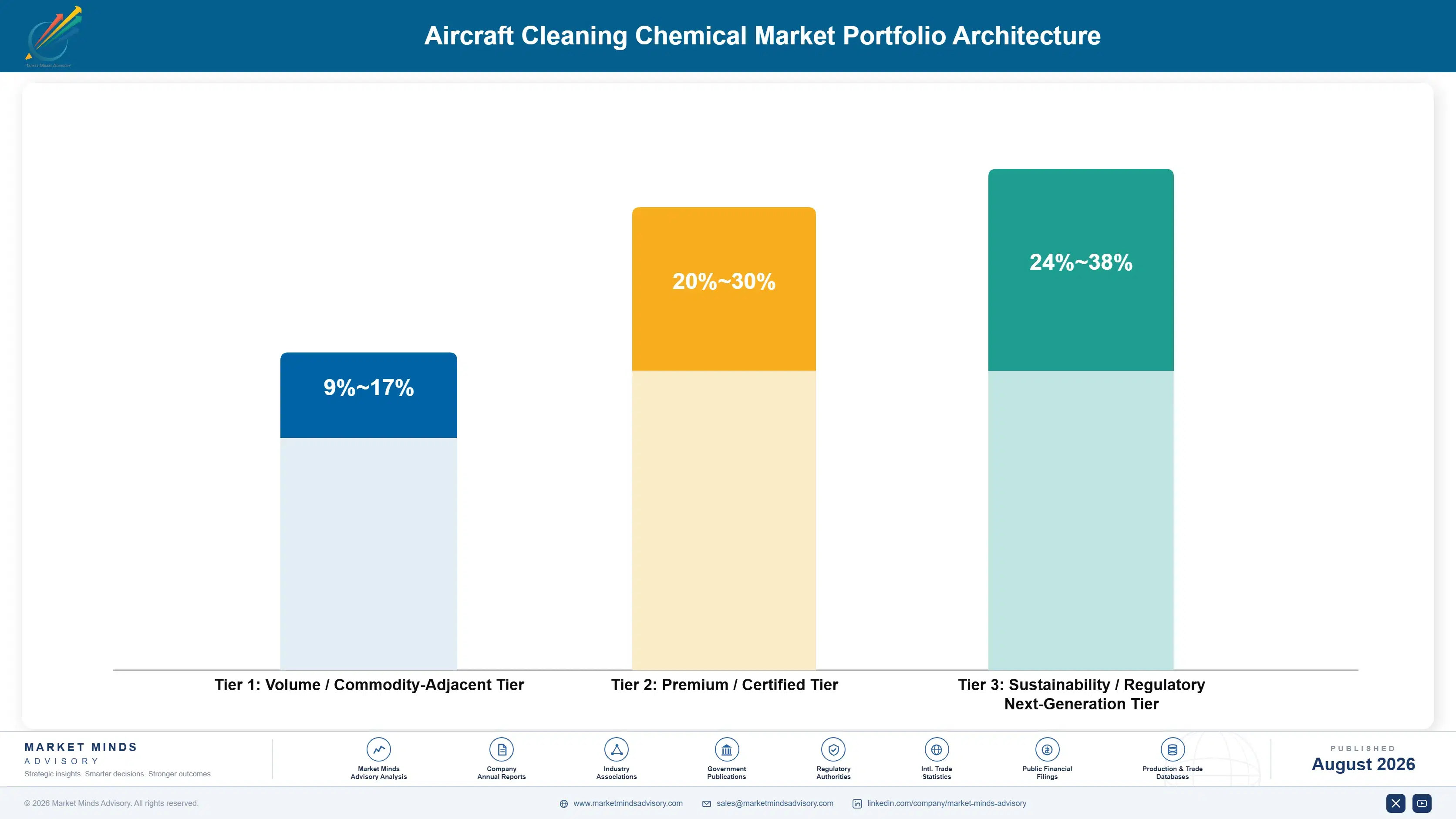
Portfolio Architecture for Margin Defence

The portfolio splits into three margin tiers separated by OEM certification, data services, and formulation complexity rather than volume alone. Commodity exterior wash detergent competes almost entirely on unit price and delivery reliability, while dual-OEM-approved fleet standardisation chemistry and data-backed engine wash programmes earn considerably more because fewer suppliers can certify and service them credibly.
The tension running through every supplier's strategy is volume against premium. Commodity exterior wash funds manufacturing overhead and keeps blending lines running, but it earns thin single-digit to low-double-digit margins that barely survive a bad surfactant quarter. Engine wash and waterless chemistry carry the earnings upside, yet they demand OEM certification investment, fuel-efficiency data platforms, and regional supply presence that smaller formulators often cannot sustain through a full investment cycle.

High-value pools concentrate wherever OEM certification or data evidence matters most: engine wash programmes with quantified fuel savings, waterless chemistry for water-restricted hubs, and dual-platform fleet standardisation contracts all sit here. Commodity exterior wash, sold into distributed MRO channels, remains the volume anchor that keeps blending capacity utilised but contributes comparatively little to blended profitability across a typical supplier's full contract mix.

Volume / Commodity-Adjacent Tier

Commodity exterior wash and degreasing chemicals sold on unit price and delivery reliability, competing directly against regional formulators on landed cost with minimal OEM certification differentiation across most airline accounts.
Gross Margin: 9-17%

Premium / Certified Tier

Dual-OEM-approved fleet standardisation chemistry spanning Boeing and Airbus platforms, carrying certification documentation that single-platform-approved competitors cannot credibly offer large mixed-fleet airline accounts operating across multiple continents and regulatory jurisdictions today.
Gross Margin: 20-30%

Sustainability / Regulatory / Next-Generation Tier

Engine wash chemistry bundled with fuel-efficiency data platforms, plus waterless formulations certified for water-restricted hub airports, commanding a genuine premium for both certification depth and quantified performance evidence over time.
Gross Margin: 24-38%
aircraft-cleaning-chemical-market-portfolio-architecture-1787300116999

High-value Sub-segments and Strategic Watch-out

Waterless and Dry Wash Chemicals

Waterless and dry-wash chemicals are the high-value, high-growth pool, expanding at 12.5% as water-restricted airports push certified alternatives to conventional rinse washing. The wide margin range reflects certification status: OEM-certified suppliers capture the top end, while formulations still in the approval pipeline earn considerably less.
Gross Margin: 22-36%

Engine and APU Cleaning Chemicals

Engine and APU cleaning chemicals form the high-value, moderate-growth pool at 9.8%, as documented fuel savings convert airlines from reactive to scheduled wash programmes across their fleets. The wide range reflects data-service depth, since suppliers with fuel-efficiency reporting platforms earn more than commodity fluid sales alone command.
Gross Margin: 18-30%

Exterior Airframe Wash Chemicals

Exterior airframe wash is the volume core, the largest litre segment by far and the one every supplier depends on to keep blending lines running through demand cycles. Margins stay thin because pricing tracks surfactant and delivered cost closely, leaving limited room for differentiation across competing domestic and imported supply.
Gross Margin: 9-16%

Interior Cabin Cleaning Chemicals

Interior cabin cleaning chemicals are the strategic watch-out, squeezed as broad institutional cleaning suppliers like Diversey and Ecolab enter with generic formulations that undercut specialty aerospace pricing. The wide range reflects that OEM-certified suppliers still earn respectably while undifferentiated interior chemistry increasingly competes on price.
Gross Margin: 10-22%

How Wash Chemical Demand Repeats

Demand here runs on scheduled maintenance intervals that vary by chemistry, from exterior wash cycles every thirty to ninety days to engine wash programmes increasingly locked into fixed calendar or flight-hour intervals rather than reactive scheduling. Fuel-efficiency data platforms add a genuine annuity layer, since the reporting subscription recurs independent of any single wash event.
Adoption depth varies sharply by vertical. Major full-service carriers, once a supplier clears fleet-wide OEM certification and procurement approval, rarely switch suppliers, since requalifying chemistry across an entire fleet costs more in documentation and retraining than any price gap could offset. Regional and charter operators sit at the other extreme, treating chemistry largely as a commodity purchased through whichever regional MRO provider is closest. Cargo carriers fall between the two, loyal within a hub but open-bid when adding new bases.

Buyer profiles have shifted generationally too. Airline finance teams increasingly participate directly in engine wash programme decisions, evaluating fuel savings data the way they would any capital investment rather than deferring entirely to maintenance judgment. Younger sustainability officers also weigh water use and VOC emissions more heavily than predecessors did, mattering as much as unit cost in some tenders.
aircraft-cleaning-chemical-market-end-use-penetration-index-1787300117489

Where Wash Chemical Suppliers Should Bet

These are among the four positions where our research anticipates prominent divergence between winners and laggards over the coming forecast period. Each is grounded in the demand model, the regulatory perimeter, and the announced capacity pipeline.
01 / ENGINE WASH DATA STRATEGY

Fuel-efficiency reporting is converting a chemical sale into a defensible service

EcoServices' model, pairing proprietary fluid with fuel-efficiency data that airline finance teams can audit directly, commands pricing meaningfully above unbundled chemical sales and increasingly sets the standard other suppliers now feel pressure to match. Competitors selling fluid alone without a comparable data platform risk being pushed toward commodity pricing as airlines learn to distinguish evidence-backed programmes from simple product sales. Building or acquiring data reporting capability should now rank as a near-term priority for any supplier serious about the engine wash segment specifically.
02 / WATERLESS CERTIFICATION PRIORITY

Water-restricted airports are a captive market for whoever certifies waterless chemistry first

Gulf, Californian, and Australian airports facing genuine water allocation constraints leave carriers with no compliant alternative once restrictions tighten meaningfully beyond current levels, creating a captive demand pool for whichever certified supplier reaches the market first with a proven, approved formulation. The eighteen-to-thirty-six-month OEM certification timeline means suppliers starting today secure a real first-mover window before broader competition can catch up on approval and certification depth. Delaying this investment risks ceding an entire, increasingly important niche to whichever competitor completes certification first and locks in the earliest fleet-wide contracts.
03 / REGIONAL SUPPLY POSITIONING

Blending capacity in fast-growing fleet markets beats exporting from established bases

India, Vietnam, and Gulf carriers are taking aircraft delivery faster than regional chemical infrastructure has scaled to match, and suppliers investing in local blending capacity now are securing multi-year agreements that later entrants importing product cannot match on cost or lead time. This mirrors a pattern seen repeatedly across specialty chemical categories, where regional presence beats centralised exporting once fleet volume justifies the investment. Waiting for confirmed demand before building capacity means arriving after competitors have already locked in the best contracts.
04 / DUAL OEM APPROVAL INVESTMENT

Fleet standardisation contracts are increasingly closed to single-platform-approved suppliers

Airlines running mixed Boeing and Airbus fleets increasingly prefer one chemistry supplier across the entire fleet to simplify MRO scheduling and regulatory documentation, a preference that effectively excludes suppliers holding only single-OEM approval from the largest contracts. The certification investment required to close that gap is substantial, but it converts a supplier from a niche category player into a genuine contender for fleet-wide deals. Suppliers still operating with single-platform approval should treat dual certification as the clearest path to larger contract eligibility.

Engagement Snapshot From the Field

A live engagement with an industry participant carrying material or product regulatory and market exposure ahead of a defining policy shift, showing how our research translates into a defensible multi-year portfolio strategy.
MARKET MINDS ADVISORY · CLIENT ENGAGEMENT SUMMARY
Aircraft Cleaning Chemical Producer Strategic Portfolio Review and Transition Roadmap 2026·Investment Scenario on Aircraft Cleaning Chemical Exposure Evaluation 2025-26
CLIENT PROFILE
A mid-sized regional carrier operating roughly 60 narrowbody aircraft approached MMA while evaluating whether to adopt a scheduled engine wash programme fleet-wide. The client reported annual fuel spend near USD 310 million, with maintenance leadership split over whether the vendor-claimed fuel savings would materialise at their specific route and climate profile (client-reported, unverified by MMA).
STRATEGIC CHALLENGE
Two engine wash vendors offered competing fuel savings claims backed by data from different fleets and climates entirely, and the client's finance team could not tell whether either claim would genuinely hold for its own short-haul, dusty-airport-heavy route network before committing to any multi-year fleet-wide contract worth a genuinely serious amount of money.
MMA APPROACH
MMA modelled expected fuel savings using the client's actual route network, climate exposure, and flight-hour utilisation patterns, benchmarking against both vendors' published fuel burn data and several comparable third-party engine wash studies from peer regional carriers. We also evaluated contract structure, including data reporting obligations and early termination terms specifically.
KEY FINDINGS
  1. The client's dusty-airport-heavy route network suggested fuel savings toward the higher end of vendor claims, roughly 1.3% versus the industry average of 1.0% to 1.2%.
  2. One vendor's data platform provided route-level reporting granularity the other lacked, materially easier for the finance team to audit against actual fuel burn records.
  3. The higher-savings vendor's contract required a three-year minimum commitment, while the alternative offered annual renewal at a modestly higher per-wash price point.
  4. Modelled payback period for the recommended vendor was under fourteen months at current fuel prices, well inside the client's standard capital approval threshold (client-reported, unverified by MMA).
CLIENT PROFILE
A mid-sized regional carrier operating roughly 60 narrowbody aircraft approached MMA while evaluating whether to adopt a scheduled engine wash programme fleet-wide. The client reported annual fuel spend near USD 310 million, with maintenance leadership split over whether the vendor-claimed fuel savings would materialise at their specific route and climate profile (client-reported, unverified by MMA).
STRATEGIC CHALLENGE
Two engine wash vendors offered competing fuel savings claims backed by data from different fleets and climates entirely, and the client's finance team could not tell whether either claim would genuinely hold for its own short-haul, dusty-airport-heavy route network before committing to any multi-year fleet-wide contract worth a genuinely serious amount of money.
MMA APPROACH
MMA modelled expected fuel savings using the client's actual route network, climate exposure, and flight-hour utilisation patterns, benchmarking against both vendors' published fuel burn data and several comparable third-party engine wash studies from peer regional carriers. We also evaluated contract structure, including data reporting obligations and early termination terms specifically.
KEY FINDINGS
  1. The client's dusty-airport-heavy route network suggested fuel savings toward the higher end of vendor claims, roughly 1.3% versus the industry average of 1.0% to 1.2%.
  2. One vendor's data platform provided route-level reporting granularity the other lacked, materially easier for the finance team to audit against actual fuel burn records.
  3. The higher-savings vendor's contract required a three-year minimum commitment, while the alternative offered annual renewal at a modestly higher per-wash price point.
  4. Modelled payback period for the recommended vendor was under fourteen months at current fuel prices, well inside the client's standard capital approval threshold (client-reported, unverified by MMA).
RECOMMENDED STRATEGY
Phase 1: Phase 1 (0 to 3 months): Sign with the vendor offering superior route-level data reporting despite the multi-year commitment required. Phase 2: Phase 2 (3 to 12 months): Track actual fuel savings against modelled projections monthly, escalating any material shortfall immediately to leadership. Phase 3: Phase 3 (12 to 36 months): Reassess vendor performance at contract renewal using accumulated actual savings data as negotiating leverage.
OUTCOME
The client signed the three-year agreement, and measured fuel savings tracked within 0.1 percentage points of MMA's modelled estimate through the first two quarters. The finance team cited the data transparency as decisive in securing board approval for the multi-year commitment (client-reported, unverified by MMA).

Frequently Asked Questions

Foundational context covering the market sizes, CAGR, scope, country, region and competition that inform every finding below. This section is provided to cover basics and most often pre-purchase conversations, answered from the MMA Primary Research Dataset.

What is the current size of the Aircraft Cleaning Chemical Market?

The global aircraft cleaning chemical market was valued at USD 2.6 billion in 2025. Engine wash and waterless exterior chemistry account for the fastest-growing share of that total.

How large will the Aircraft Cleaning Chemical Market be by 2036?

The market is projected to reach USD 5.42 billion by 2036, up from USD 2.78 billion in 2026. That represents an incremental opportunity of roughly USD 2.64 billion across the decade.

What is the CAGR for the Aircraft Cleaning Chemical Market 2026 to 2036?

The base case CAGR is 6.9% annually. MMA models a bull case of 8.2% if jet fuel prices stay elevated, and a bear case of 5.6% if travel demand and maintenance spending slow broadly.

Which segment is growing fastest?

Waterless and dry-wash chemicals grow fastest at 12.5% CAGR, about 1.81 times the overall market rate, as water-restricted airports push certified alternatives to conventional rinse washing globally.

Who are the major companies in the Aircraft Cleaning Chemical Market?

Chemetall, PPG Aerospace, EcoServices, Pentagon Chemicals, and Brulin Corporation lead the category on OEM-approved formulation revenue across major platforms. Chemetall holds the broadest certified product portfolio specifically.

Which country is growing fastest?

The UAE posts the fastest national CAGR at 13.2%, driven by Gulf carrier widebody fleet growth and desert dust conditions that demand far more frequent washing than temperate climates require.

Report Segmentation Architecture

The full report scope spans multiple orthogonal segmentation dimensions, with cross-tabulated demand data provided for each dimension pair. Coverage extends further to regional breakdowns, trend trajectories, and the competitive detail needed to support segment-level decision-making.

By Cleaning Function

  • Waterless and Dry Wash Chemicals
  • Engine and APU Cleaning Chemicals
  • Exterior Airframe Wash and Degreasing Chemicals
  • Interior Cabin and Cockpit Cleaning Chemicals
  • Lavatory and Waste System Chemicals
  • Windshield and Windscreen Cleaning Chemicals

By End-Use Customer

  • Commercial Airlines
  • MRO and Maintenance Providers
  • Cargo and Freight Carriers
  • Military and Government Aviation
  • Business and General Aviation

By Commercial Dimension

  • Direct Airline Supply Contracts
  • MRO Distributor Channels
  • Engine Wash Service Agreements
  • Regional Blending and Distribution Partnerships

By Region

  • North America
  • Western Europe
  • East Asia
  • South Asia and Pacific
  • Latin America
  • Middle East and Africa
  • Eastern Europe

Scope, Methodology, and Coverage

Every figure in this report is reproducible from documented input assumptions. The scope below maps the historical period, the forecast horizon, the segmentation dimensions, and the countries covered, alongside the underlying primary and qualitative methodology.
Historical Period
2020 to 2025
Forecast Period
2026 to 2036
Base Year
2025 (USD billions; MMA Primary Research Dataset, August 2026)
Market Definition
The market covers specialty chemicals used to clean commercial aircraft exteriors, engines, interiors, and lavatory systems, including waterless and dry-wash formulations, sold to airlines and MRO providers under OEM-approved specifications. Aircraft deicing and anti-icing fluids, and standalone corrosion-prevention coatings, are excluded.
Quantitative Units
USD billions (current prices); litres of formulated chemical shipped where applicable
Segmentation Dimensions
By Cleaning Function; By End-Use Customer; By Commercial Dimension; By Region
Regions Covered
North America, Western Europe, East Asia, South Asia and Pacific, Latin America, Middle East and Africa, Eastern Europe
Countries Covered
USA, China, Germany, France, UK, Japan, South Korea, India, Australia, Canada, Brazil, Mexico, Indonesia, Vietnam, Thailand, Malaysia, UAE, Saudi Arabia, South Africa, Nigeria, Turkey, Poland, Netherlands, Italy, Spain, Sweden, Switzerland, Argentina, Colombia, Singapore, and additional markets relevant to this sector
Key Companies Profiled
Chemetall, PPG Aerospace, EcoServices, Pentagon Chemicals, Brulin Corporation, Zep Inc., NCH Corporation, Safety-Kleen Systems Inc., Aerowash AS, HydroSolve Inc., 3M Aerospace, Henkel Aerospace, Quaker Houghton, Cortec Corporation, Christeyns Aviation, Bio-Kleen International, Diversey Holdings, Ecolab Inc., Kilfrost Group, Clariant AG
Quantitative Methodology
Primary survey, n=3,800 respondents, Q4 2025, six countries; demand-side model with trade association cross-validation
Qualitative Methodology
47 expert interviews, Q4 2025; applied to validate demand model assumptions, identify emerging dynamics, and assess competitive positioning
Report Format
PDF and XLSX data workbook (Word format preview document)
Publisher
Market Minds Advisory
Report Code
MMA-2026-CHM-105
Published
August 2026
Contact
sales@marketmindsadvisory.com | www.marketmindsadvisory.com

Purchase the full Aircraft Cleaning Chemical Market Report (2026 to 2036).

The full MMA Aircraft Cleaning Chemical report sizes the market across six cleaning functions, five end-use customer types, four commercial channels, and seven regions through 2036. It profiles 20 participants on a consistent OEM-approved formulation revenue basis, scoring the top two on certification breadth, data platform depth, and feedstock exposure. Scenario models quantify how OEM approval cycles, water-scarcity regulation, and jet fuel pricing move both demand and realised pricing. The report also includes delivered-cost modelling by function, a feedstock exposure screen, regional blending capacity tracking, and a certification investment prioritisation framework built for strategy, procurement, and investment teams.
Six-function segmentation with volume and value forecasts
Seven-region demand map with country-level detail
Twenty-company competitive profiles on formulation revenue
Surfactant and solvent feedstock cost sensitivity modelling
OEM approval cycle and water regulation tracking
Engine wash fuel-efficiency data platform playbook

Built For The People Who Decide

From boardroom strategy to bench-side execution, this report is read cover-to-cover by leaders shaping the next decade of their industry, turning demand scenarios, market dynamics and valuation benchmarks into decisions.
CXOs/ Presidents/ VPs/ Managers
M&A and Corporate Development
Strategy Teams and R&D Heads
Procurement and Product Directors
Regulatory and Compliance Leaders
Investor Relations and Equity Analysts