Market Minds Advisory
Aircraft Carrier Ship Market

Aircraft Carrier Ship Market: Aircraft Carriers: Redefined Downward, Gated by Reactors and Paid For by Air Wings

A forty thousand tonne ship now flies fixed-wing aircraft that once needed a hundred thousand tonnes and catapults, which changes both who can own a carrier and who can build one.

Lead Analyst

Published

September 2026

Make Smarter Decisions with Customized Research Insights

Request a free sample report and evaluate market opportunities, growth trends, and competitive dynamics relevant to your business needs.

2025 MARKET VALUE$18.5BMarket Size 2025
2036 FORECAST VALUE$34.4BBase Case , 2026 to 2036
CAGR 2026 TO 20365.8 %Bull 7.0% / Bear 4.6%
INCREMENTAL OPPORTUNITY$14.8BNet 10- year value creation
EXPANSION MULTIPLE1.76x2036 value over 2026 base
Strategic Levers
M&A Pipeline
Regional Outlook
Country Rankings
Competitive Intelligence
Segmental Deep-dive
Call-Us : 91 93563 13602

Executive Snapshot and Market Trajectory.

The aircraft carrier is being redefined downward, and that matters more commercially than any new hull. A 40,000 tonne amphibious-derived ship now operates fixed-wing aircraft that once required a hundred thousand tonnes and catapults, which changes who can own one and, just as importantly, who can build one.
Two forces set the commercial pace. Vertical landing aircraft have opened carrier aviation to navies that could never fund a catapult ship, which widens the buyer base considerably. Meanwhile catapult carriers are growing fastest among the large classes as electromagnetic launch replaces steam. Conventional catapult carriers grow fastest at 8.7%, half again the market rate of 5.8%, from a very narrow base indeed.
Five organisations hold 86%, and nuclear propulsion is the line that decides who competes at all. Only two countries build nuclear carriers, and reactor supply rather than yard capacity is the constraint. Below that line the field is wider, because a large flat deck amphibious ship is within reach of far more yards. Navies keep discovering that the hull is the cheap part: the air wing and its support cost more across a service life.
Market Definition
This report covers aviation-capable warships built to operate fixed-wing or rotary aircraft from a full-length flight deck, together with the aviation and propulsion content delivered into them. Scope includes nuclear catapult carriers, conventional catapult carriers, ski-jump conventional carriers, short take-off vertical landing carriers, amphibious assault aviation ships, and helicopter or drone carrier vessels, covering new construction and major aviation conversions. Excluded are the embarked air wings and their weapons, carrier sustainment and refuelling overhauls, escort vessels, amphibious ships without a full flight deck, and shore aviation infrastructure.
Base Year Value
$18.5B in 2025 (MMA Primary Research Dataset, September 2026)
Forecast Period
2026 to 2036, eleven discrete annual values
CAGR
5.8% base case. Bull 7.0%. Bear 4.6%.
Fastest Growth Segment
Conventional Catapult Carriers: 8.7% CAGR
Fastest Growth Country
China: 10.6% CAGR
Fastest Growth Region
South Asia and Pacific: 7.9% CAGR
Largest Region
East Asia: 33% of 2025 global value
Market Leaders
Huntington Ingalls Industries, China State Shipbuilding Corporation, BAE Systems, Fincantieri, Naval Group. Source: MMA Analysis based on contracted programme value and delivered vessel content, July 2026.
Primary Survey
n=3,800 procurement and R&D decision-makers, Q4 2025, six countries
Methodology
Demand-side build-up, cross-validated against public data, 47 expert interviews

Aircraft Carrier Ship Market Forecast Scenarios

aircraft-carrier-ship-market-size-forecast-scenario-1790026296039
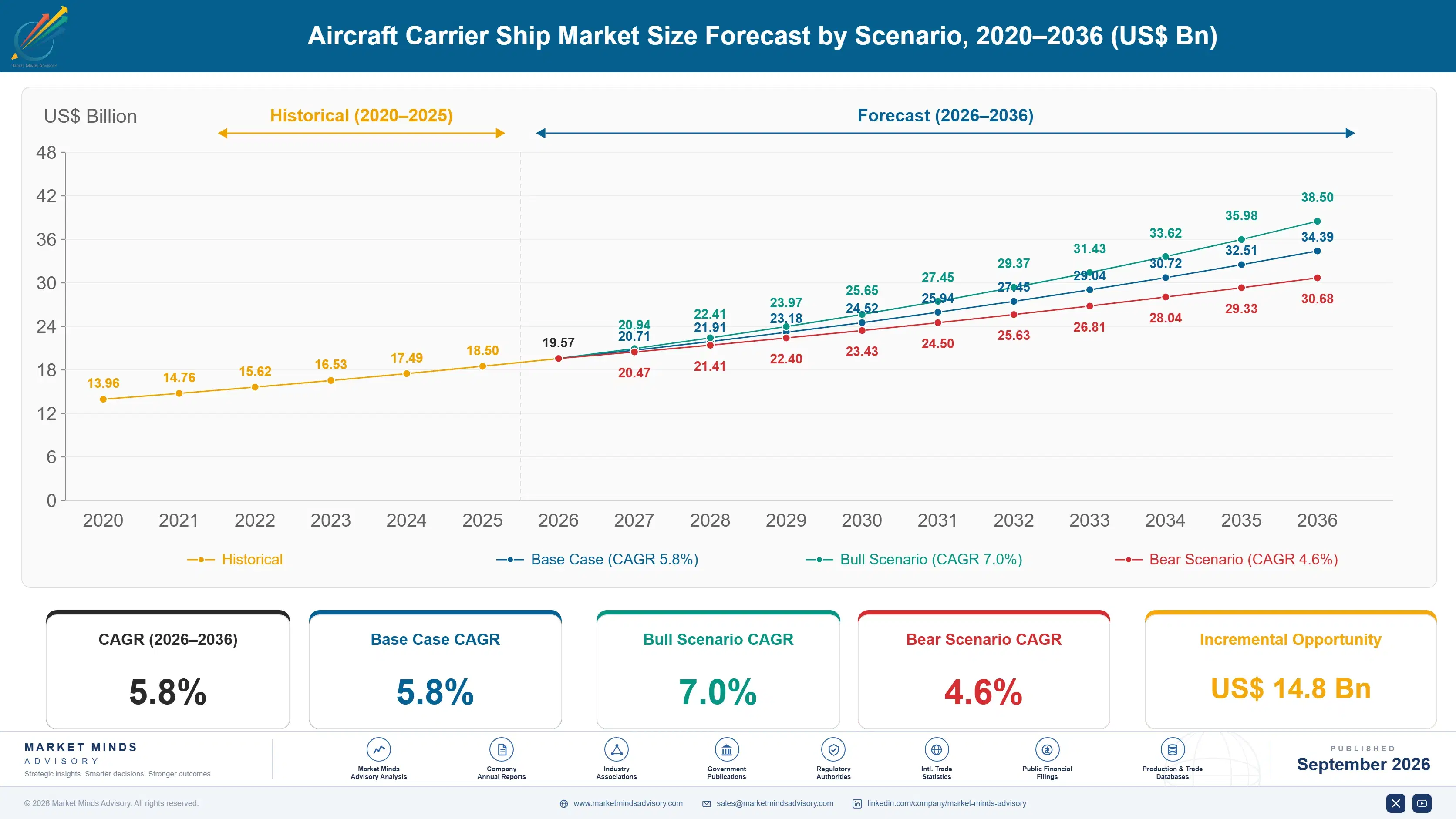
Growth averaged 4.9% across 2020 to 2025 and it was driven by two programmes nobody would have predicted a decade earlier. Chinese construction moved from converted hulls to a domestically designed catapult ship within that window, and several mid-sized navies converted amphibious vessels to operate vertical landing aircraft at a cost that carrier ownership had never previously allowed. Western supercarrier construction continued at its established and unhurried pace.
Base case growth of 5.8% rests on three mechanisms. Chinese carrier construction continues on a cadence no other navy approaches, with each successive hull larger and more capable than the last. Vertical landing aircraft deliveries enable further amphibious conversions across Asia and Southern Europe at a fraction of new construction cost. And European next-generation carrier programmes move from study into detailed design and long-lead procurement during the early forecast period.
The bull case at 7.0% assumes European next-generation programmes commit to construction on announced timelines and that at least one additional navy orders a purpose-built aviation ship. The bear case at 4.6% follows from the alternative: European programmes slip into studies again, conversions substitute for new construction more broadly than expected, and the market grows on refit value rather than on hulls.

The Hull, the Reactor and the Air Wing

What counts as a carrier has changed, and the commercial consequences are larger than the naval architecture ones. Vertical landing aircraft let a 40,000 tonne amphibious hull generate fixed-wing sorties, which brings carrier aviation within reach of navies that could never fund a catapult ship and within build reach of yards that could never lay down a supercarrier. Several navies have taken exactly that route.
FIVE-FIRM CONCENTRATION86%Nuclear qualification and dock scale limit the credible field
AVERAGE LARGE CARRIER COSTUSD 9.8BDelivered hull cost excluding any embarked aviation content
AIR WING COST RATIO1.6 timesAviation and support cost relative to the ship itself
CONSTRUCTION PROGRAMME DURATION9.4 yearsTypical span from keel laying through to operational delivery
CONVERSION COST ADVANTAGE82%Saving from amphibious conversion against comparable new construction
AVIATION SYSTEMS COST SHARE17%Launch, recovery and deck systems within delivered hull cost
Nuclear propulsion remains the line that separates two entirely different industrial problems. Two countries build nuclear carriers, and the constraint there is reactor supply, nuclear qualification and a workforce that took generations to assemble rather than dock capacity. Below that line, a large flat deck is a demanding but conventional shipbuilding exercise, and the field of yards able to attempt one is considerably wider than headline concentration figures suggest.
The ship is the cheaper half of the decision and navies keep learning this late. Air wing acquisition, aircrew training, maintenance infrastructure and support across a service life typically cost around 1.6 times the hull itself. Navies that budget the ship without the wing end up operating expensive helicopter carriers, which is a visible and recurring pattern rather than a theoretical risk.
"Buying the ship is the easy decision and the cheap one. The navies that regret it are the ones that never costed thirty years of flying from it before the keel was laid."
Director, Naval Systems and Shipbuilding Practice · MMA Defence / Naval Aviation Platforms Practice · September 2026

Market Trends

Amphibious Conversion Substitutes For Purpose-Built Carrier Construction

Navies operating amphibious assault ships have modified decks, coatings and aviation facilities to operate vertical landing fighters, obtaining fixed-wing capability at roughly 82% below comparable new construction. Japan, Italy and Turkey have all taken versions of this route, and others are examining it. The commercial effect cuts both ways for industry: conversion work is far smaller than a new hull, but it reaches navies that would otherwise have bought nothing at all and it creates follow-on support relationships lasting decades. Programme values are small but the win rates are unusually high.
Market Impact: Adds 4 aviation hulls per decade
Electromagnetic Launch Replaces Steam On New Catapult Ships

Electromagnetic launch and advanced arresting gear are displacing steam catapults on every new catapult carrier design, because steam plant is maintenance-intensive and constrains aircraft weight ranges at both extremes. Both the newest American and Chinese carriers use electromagnetic systems, which is a rare instance of parallel development arriving at the same answer. Aviation systems already represent around 17% of delivered hull cost, and that share rises with electromagnetic fit alongside the power generation capacity it demands. Parallel arrival at the same answer by two independent programmes is rare in naval engineering.
Market Impact: Commits USD 3.4 billion early

Market Opportunities and Growth Drivers

Chinese Construction Cadence Exceeds Every Other Naval Programme

China has moved from a converted hull to domestically designed ships including a catapult carrier within roughly a decade, at a build cadence no other navy approaches, and successive hulls have grown in size and capability each time. Construction is domestic throughout and closed to external suppliers, which shapes how the addressable figure should be read for anyone outside the country. Amphibious aviation ships are being built alongside the carriers on the same industrial base, compounding the effect on regional totals considerably. External suppliers cannot participate in any part of it.
Market Impact: Air wing costs 1.6 times hull

European Next-Generation Carrier Programmes Enter Design Commitment

European next-generation carrier work has moved from concept study into design and long-lead procurement, with nuclear propulsion decisions taken and industrial arrangements being settled. These programmes carry very long timelines and enormous content value, and they sustain the specialised nuclear naval supply base between construction periods when nothing else would. Design and long-lead spending arrives well before steel is cut, which brings revenue forward for systems suppliers. Roughly USD 3.4 billion in design and long-lead value falls within the forecast period. Nothing else sustains the nuclear naval supply base between hulls.
Market Impact: Restricts nuclear build to 2 countries

Market Restraints and Challenges

Air Wing Cost Deters Navies After The Ship Is Ordered

Air wing acquisition, aircrew training, maintenance infrastructure and support across a service life run around 1.6 times the hull cost, and that figure typically surfaces after the ship decision is taken rather than before it. The root cause is that ship procurement and aviation procurement sit in separate budget lines with separate approval processes in most navies. Commercially this produces ships that operate below capability for years. Mitigation has come through integrated capability contracting, phased air wing build-up, and shipbuilders offering aviation support as part of the original package. Ships operate below capability for years afterwards.
Market Impact: Saves 82% against new construction

Nuclear Qualification Limits Construction To Two Countries

Nuclear carrier construction requires reactor supply, nuclear-qualified welders and inspection regimes that only two national industrial bases hold, and none of it can be established within a relevant timeframe. The root cause is that nuclear naval capability depends on continuous programme flow to sustain qualification, and countries without it cannot start. The commercial effect is that the highest-value segment is closed to everyone else permanently. Participants outside those bases compete instead on conventional propulsion carriers, amphibious aviation ships and the systems content fitted to nuclear hulls. Continuous programme flow is the only way to hold it.
Market Impact: Aviation systems reach 17% of cost
3 additional market trends, 4 additional growth drivers, and 2 additional restraints and challenges are covered in the full report. Contact sales@marketmindsadvisory.com to access the complete intelligence.

Segment CAGR and Growth Architecture

Carriers are segmented here by flight deck configuration, because configuration determines the aircraft the ship can operate, the yard that can build it and the cost of owning it. Mixing configuration with displacement or propulsion creates categories no navy would recognise. Six configurations cover the field from helicopter carriers through to nuclear catapult ships, and the economics differ enormously.
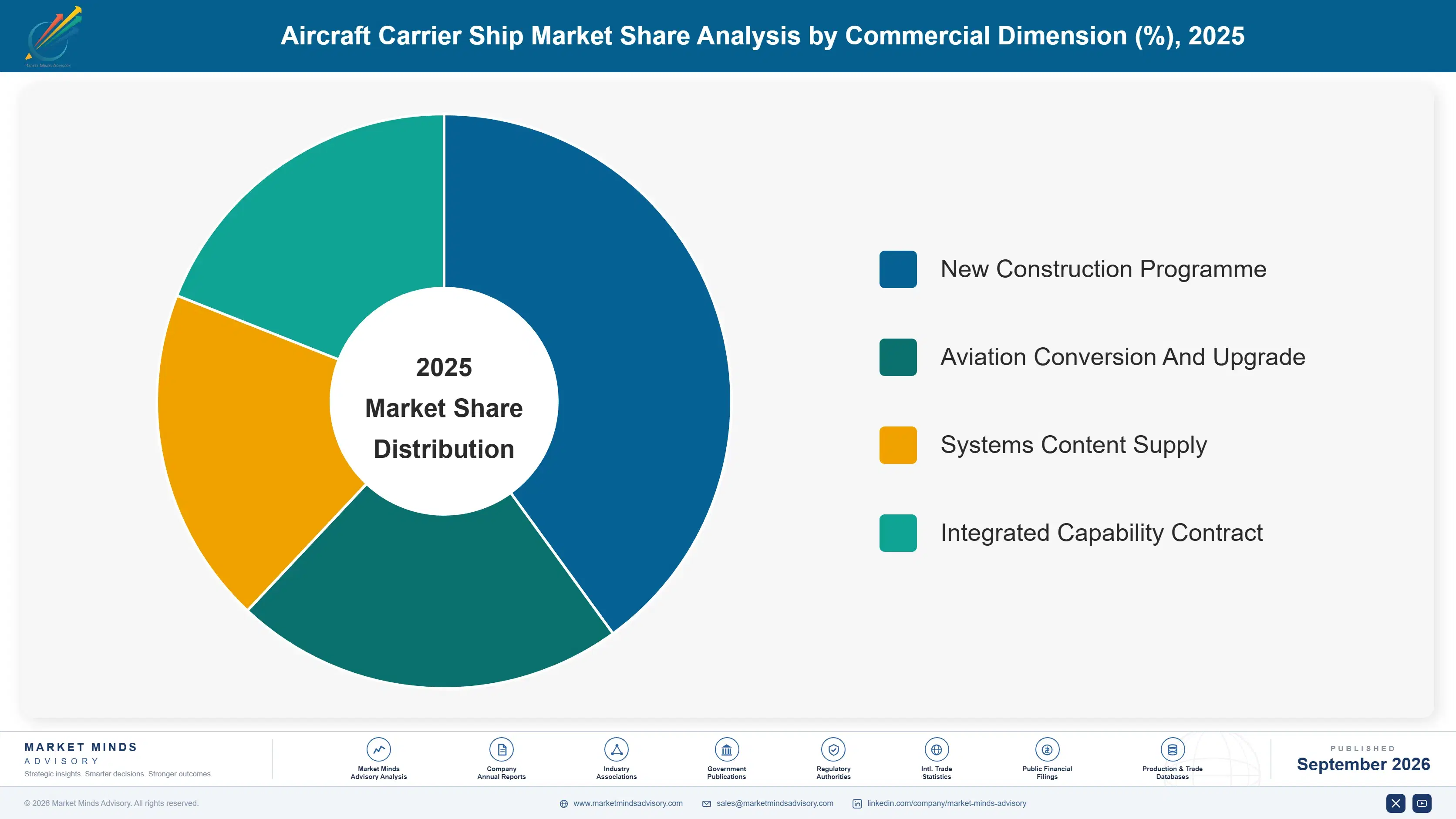
aircraft-carrier-ship-market-market-share-analysis-1790026296651

Conventional Catapult Carriers

Growing at 8.7%, half again the market rate of 5.8%, this class combines full catapult aviation capability with conventional propulsion, which removes the nuclear qualification barrier while keeping the aircraft flexibility that vertical landing ships cannot match. Electromagnetic launch has made the configuration considerably more attractive, since steam plant was the principal reason conventional catapult ships were awkward to operate. Growth comes overwhelmingly from a single national programme, which makes the figure genuinely lumpy rather than broad-based. Any additional navy adopting the configuration would move the class substantially, and at least two are understood to be studying it seriously. Electromagnetic launch has changed the whole calculation for this configuration entirely in a decade.
CAGR 8.7%

Short Take-Off Vertical Landing Carriers

This configuration grows at 7.6% and has done more to widen carrier ownership than anything else in naval aviation. A ship of 25,000 to 45,000 tonnes can operate fixed-wing fighters without catapults, arresting gear or the power generation both demand, which brings the capability within reach of navies whose entire fleet costs less than one supercarrier. Conversions of existing amphibious hulls have been the common route, at roughly 82% below new construction cost. The commercial pattern for industry is many small programmes rather than few large ones, which suits yards that could never compete for a catapult ship. Yards that could never compete for a catapult ship compete credibly here instead.
CAGR 7.6%
Full segment breakdown across 6 segments available in the complete report.

Regional Architecture and Country Demand Map

Construction concentrates where navies both want carriers and can build them, which is a narrower overlap than naval ambition alone suggests. East Asia now leads on programme value through sustained construction cadence, while North America holds the highest individual programme values and Western Europe the deepest design capability.

East Asia

At 33%, above the 22 to 30% band applied elsewhere in this report, East Asia leads on construction cadence rather than on individual programme size. Chinese yards have moved from a converted hull to a domestically designed catapult carrier within roughly a decade while building amphibious aviation ships alongside them, and none of that work is open to external suppliers. Japanese amphibious conversions for vertical landing aircraft add a second and much cheaper stream, while South Korean carrier ambitions have advanced and paused repeatedly. Growth of 7.0% sits above the market rate, driven by a build cadence that no other region attempts to match. No other region attempts a build cadence resembling this one.
Share: 33% | CAGR: 7.0% (2026 to 2036)

North America

Individual programme value is the highest anywhere, even as construction cadence remains deliberately slow. Nuclear supercarrier construction proceeds one hull at a time over roughly a decade each, at delivered costs that dwarf every other carrier programme in the world, and amphibious aviation ships add a steady second line from a separate yard. Nuclear qualification, reactor supply and a workforce assembled across generations make this capability effectively impossible to replicate. Growth of 5.2% sits below the market rate because the programme runs to a settled cadence that neither budget growth nor political attention accelerates meaningfully. Neither budget growth nor political attention accelerates a cadence set by dock capacity and refuelling schedules.
Share: 30% | CAGR: 5.2% (2026 to 2036)
Regional intelligence for 5 additional markets available in the complete report: Western Europe, South Asia and Pacific, Middle East and Africa, Eastern Europe, Latin America. Contact sales@marketmindsadvisory.com.
aircraft-carrier-ship-market-country-cagr-analysis-1790026297171

Where Carrier Programmes Actually Earn Returns

Hull construction is the visible revenue in carrier programmes and rarely the profitable part. Aviation systems content, capability contracting and conversion work decide delivered economics instead. The four levers below reflect positions participants have used to improve returns measurably rather than to win construction awards. Very little of it involves welding steel. Steel is the least of it.

Own Launch And Recovery Systems Content

Aviation systems including launch, recovery, deck handling and arresting equipment represent around 17% of delivered hull cost and carry margins well above steelwork, because very few suppliers can qualify them and navies will not compromise on the system that stops an aircraft. Electromagnetic launch raises that share further, along with the power generation it requires. Suppliers holding this content report gross margin roughly 19 points above hull construction on the same programmes, without carrying the labour exposure that governs yard economics. Qualification scarcity rather than competitive positioning sets the price.
Market Impact: Systems content margin runs roughly 19 points higher

Sell Conversion Work Into Existing Amphibious Fleets

Converting an amphibious hull for vertical landing operation costs roughly 82% below comparable new construction, which reaches navies that would otherwise have bought nothing at all. Programme values are modest but win rates are high, engineering content is proportionally larger than in new build, and each conversion creates a support relationship lasting decades. Participants active in conversion work report roughly 2.8 times the programme count of those pursuing new construction alone. It requires accepting smaller contracts than a shipbuilding organisation is structured to chase. Shipbuilding organisations are not structured to chase them.
Market Impact: Programme count rises roughly 2.8 times higher overall

Contract Capability Rather Than Hull Delivery

Air wing and support costs run around 1.6 times the ship across a service life, and they surface after the hull decision in most navies because the budget lines sit apart. Suppliers offering integrated capability contracts covering ship, aviation facilities and support from the outset capture revenue that otherwise flows elsewhere entirely. Programmes contracted this way have delivered supplier revenue roughly 34% above hull-only scope. The obstacle is governmental rather than commercial, since it requires a customer able to approve across separate budget authorities. Separate budget authorities are the real obstacle here.
Market Impact: Supplier revenue rises roughly 34% higher on capability contracts

Sustain Nuclear Qualification Between Construction Gaps

Nuclear naval capability requires continuous programme flow, because qualification, welder certification and supplier accreditation lapse without work and cannot be restarted quickly. Suppliers who secured design and long-lead funding between construction periods preserved capability that competitors lost permanently. Long-lead and design spending worth roughly USD 3.4 billion falls within this forecast period for exactly that purpose. The commercial discipline is accepting low-margin sustainment work during gaps rather than redeploying the workforce to more profitable commercial contracts. Finance functions reliably resist exactly this decision, and the capability lost is never recovered.
Market Impact: Preserves qualification across USD 3.4 billion of work

Who Controls the Margin Pool

Concentration is 86% for the top five, measured on contracted programme value and delivered vessel content, the basis used throughout this section. Two separate barriers produce it. Nuclear qualification closes the highest-value segment to two national industrial bases, and dock scale closes large conventional construction to a handful of yards. Neither barrier can be crossed by a competitor within any commercially relevant period.
Competition operates almost entirely below the nuclear line. Conventional catapult and vertical landing carriers are contested by several capable yards, and amphibious conversion work is contested more widely still. Aviation systems content is a separate contest again, fought between a small number of qualified suppliers whose products appear on hulls built by competing yards. Price rarely decides any of these, since capability and schedule confidence dominate evaluation.

Positions will shift through conversion and through mid-sized construction rather than at the top. Turkish and Asian yards have demonstrated that a mid-sized industrial base can deliver an aviation-capable ship, which widens the field for navies choosing the vertical landing route. Established builders face a choice between competing for smaller programmes with unfamiliar economics or conceding a growing share of carrier ownership to yards they have never regarded as rivals.
aircraft-carrier-ship-market-company-positioning-matrix-1790026297700

Competitive Moat and Risk Dimensions

HUNTINGTON INGALLS INDUSTRIES

Moat: Sole Nuclear Carrier Builder

The company is the only builder of nuclear aircraft carriers in its national industrial base and one of a very small number worldwide, holding dry dock scale, nuclear qualification and a workforce assembled across generations. No competitor can establish equivalent capability within any relevant timeframe, which makes the position permanent rather than merely defensible against challenge.
HUNTINGTON INGALLS INDUSTRIES

Risk: Single Programme Cadence Dependence

Revenue depends on a carrier programme running to a settled cadence that neither budget growth nor political attention accelerates, which caps growth regardless of demand. Any schedule disruption affects the whole carrier business rather than one product line, and the workforce required cannot be released and reassembled between hulls without losing the qualification the position depends on.
FINCANTIERI

Moat: Mid-Sized Aviation Ship Capability

Fincantieri builds aviation-capable amphibious ships at a size and cost point that suits the navies now entering carrier aviation through vertical landing aircraft, and it holds design and construction experience across several such vessels. That position sits precisely where the market is widening rather than where it is most concentrated, which is an unusually comfortable place to be.
FINCANTIERI

Risk: Excluded From Nuclear Segment

The highest value carrier programmes require nuclear propulsion and national industrial bases the company cannot access, which permanently excludes it from roughly the most valuable segment of this market. Growth therefore depends on how many mid-sized navies commit to aviation ships, a demand pool that is genuinely widening but remains small relative to nuclear carrier programme value.

Players Tracked

Prominent Players

Huntington Ingalls Industries
China State Shipbuilding Corporation
BAE Systems
Fincantieri
Naval Group

Other Key Players

Cochin Shipyard
Babcock International
Navantia
Thales
Mazagon Dock Shipbuilders
Mitsubishi Heavy Industries
Japan Marine United
Hyundai Heavy Industries
Hanwha Ocean
Sedef Shipyard
General Dynamics
Leonardo
Rolls-Royce
BWX Technologies
L3Harris Technologies

Recent Developments

NOVEMBER 2025

Chinese electromagnetic catapult carrier enters operational service

China commissioned its first domestically designed catapult aircraft carrier using electromagnetic launch, following an extended sea trials programme. This was a naval commissioning rather than any corporate transaction, and it places a second country in operation of electromagnetic launch technology within a very few years.
Signal: Parallel arrival at electromagnetic launch confirms it as the settled configuration for all future catapult ships
JUNE 2025

European navy commits next-generation carrier to design and long-lead procurement

A European navy moved its next-generation carrier programme from concept study into detailed design with long-lead item procurement, confirming nuclear propulsion. This was a programme decision rather than a corporate event, and it sustains a specialised supply base that would otherwise lapse between construction periods.
Signal: Long-lead commitment preserves nuclear naval qualification that cannot be restarted once it has been allowed to lapse
FEBRUARY 2025

Mid-sized navy completes amphibious conversion for vertical landing operations

A mid-sized navy completed deck, coating and facility modifications allowing its amphibious assault ship to operate vertical landing fighters. This was an upgrade programme rather than any corporate transaction, and it delivered fixed-wing capability at a small fraction of new purpose-built carrier construction cost anywhere.
Signal: Conversion reaches navies that would never have ordered a purpose-built carrier at any realistic price at all

What Sets Delivered Carrier Cost

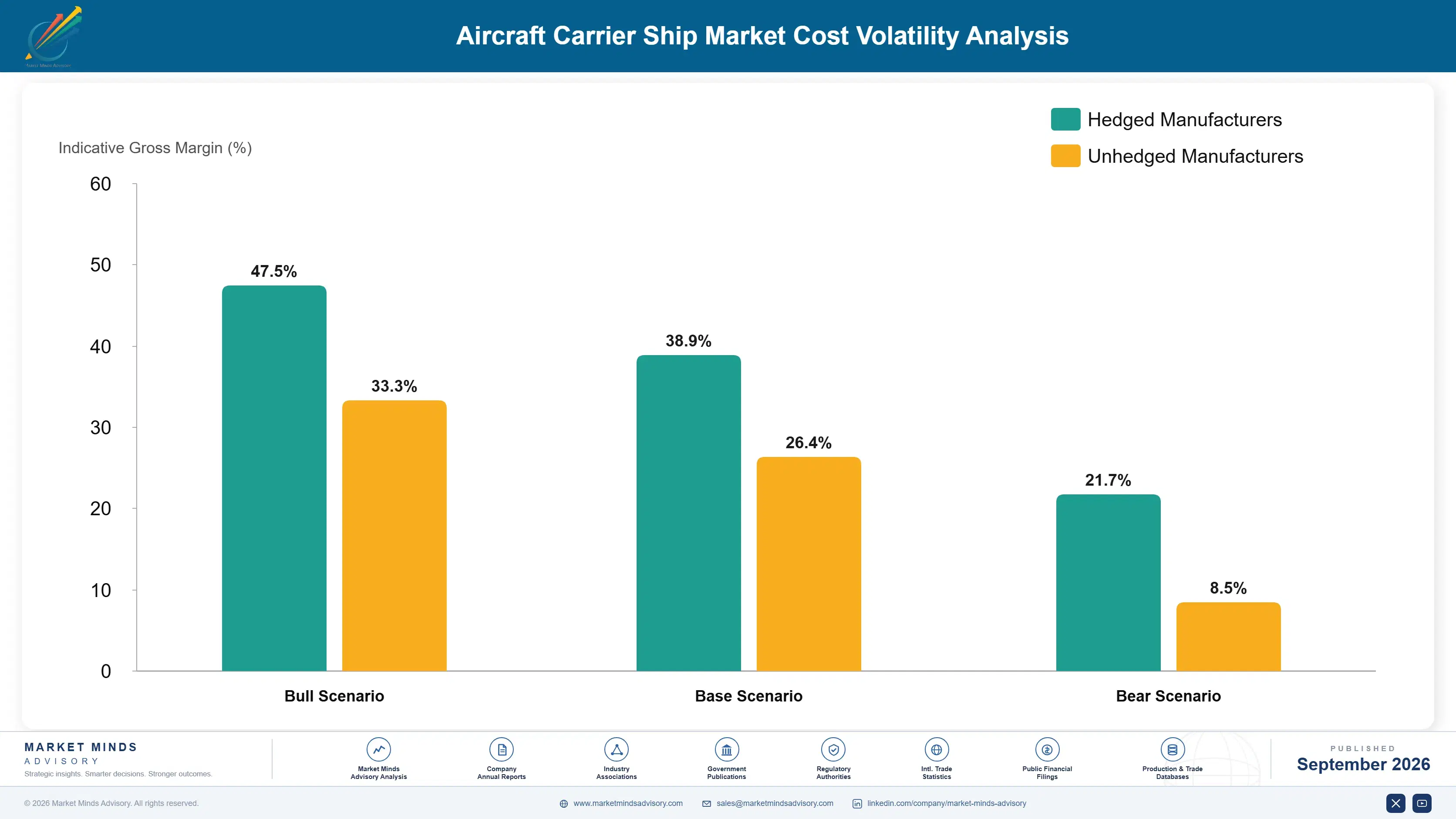
Four inputs dominate. Skilled shipyard labour runs roughly 39% of delivered hull cost, propulsion plant about 22%, aviation launch and recovery systems close to 17%, and steel plate with specialty alloys the remaining 22%. Labour sits in a handful of yard towns, propulsion plant with very few qualified suppliers, and specialist steels from a narrow set of mills in each producing country.
Labour escalation was the principal cost event and it is permanent. Shipyard wages rose sharply from 2022 as yards competed with construction and energy employers for the same trades, and national labour statistics show shipbuilding wage movement well above general manufacturing. Huntington Ingalls and Fincantieri both addressed labour cost and productivity in annual reporting. Nickel and specialty alloy pricing added a smaller second layer through the same period.

Exposure separates by where a participant sits in the programme. Yards carry labour, steel and schedule risk directly under construction contracts, with limited escalation recovery on older fixed-price work. Aviation systems and propulsion suppliers carry component cost but price on qualification scarcity, which passes through far more readily. That asymmetry means identical conditions produce very different outcomes for a builder and a systems supplier on the same ship.
aircraft-carrier-ship-market-cost-volatility-analysis-1790026297897

Index construction contracts to shipbuilding labour indices

General inflation measures understate shipyard wage movement in the specific towns that matter, and contracts priced against them erode steadily across a decade-long build. Yards presenting local labour evidence have secured escalation terms above published indices. The difficulty is assembling wage data yards have not traditionally collected and persuading a customer that the general index is the wrong measure entirely.

Shift revenue mix toward aviation and propulsion systems content

Systems content prices on qualification scarcity rather than on hours, carries roughly 19 points better margin than hull construction, and avoids the labour exposure that governs yard economics across a decade of building. The constraint is that qualifying into launch, recovery or propulsion systems takes years and a customer willing to accept a new supplier on equipment that stops aircraft.

Qualify specialist plate supply across more than one mill

Flight deck and hull plate comes from a narrow set of qualified mills in each producing country, and a single interruption moves a construction schedule measured in years. Qualifying a second mill costs testing time and produces nothing until a disruption occurs. Yards that did it before recent supply tightness held schedules while competitors renegotiated milestone dates with their customers.

Portfolio Architecture for Margin Defence

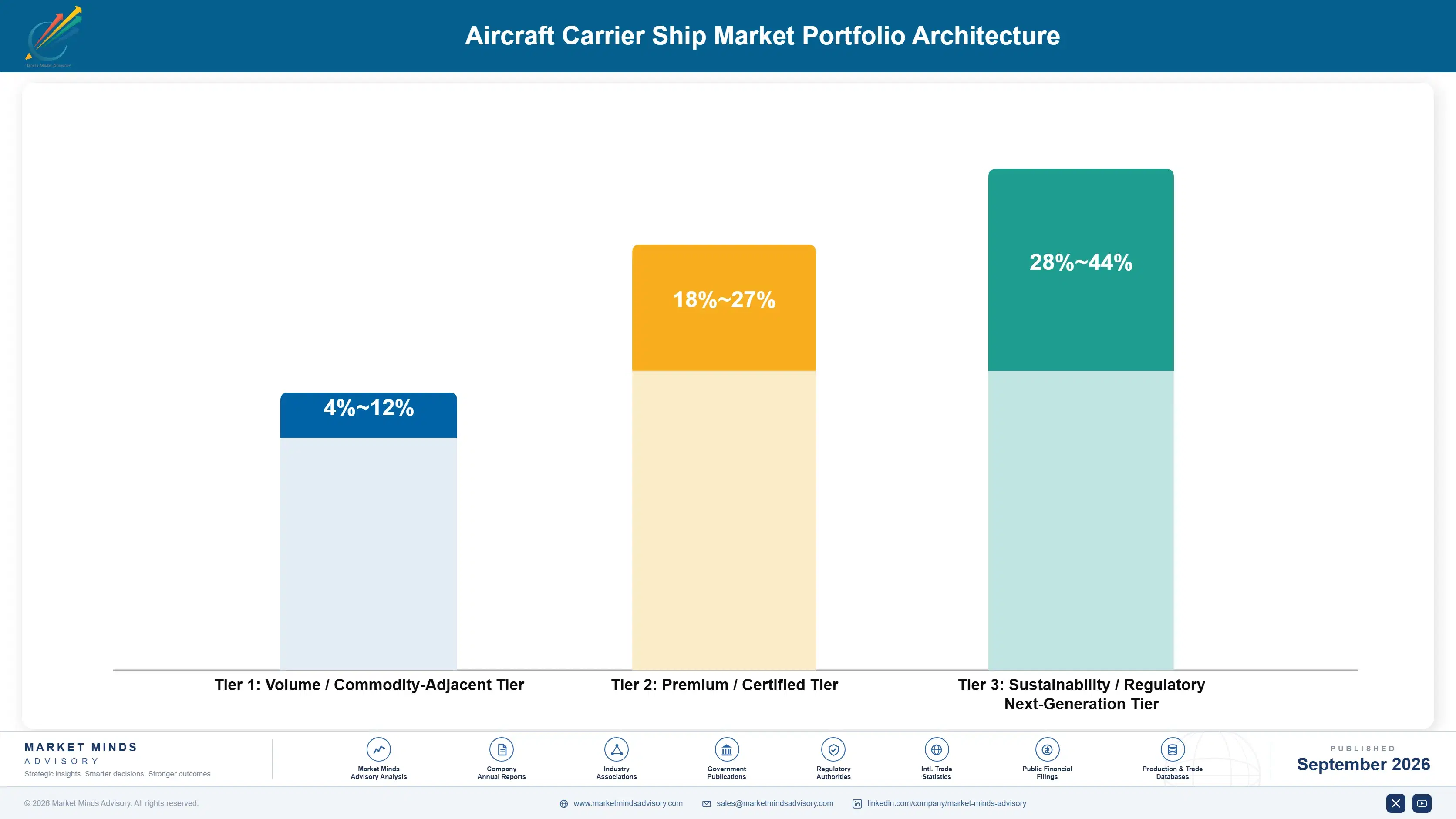
Margin architecture in carrier programmes runs opposite to contract value. Hull construction carries the largest numbers and the thinnest returns, exposed to a decade of labour escalation on contracts priced at the start. Aviation systems and propulsion content sit in the middle at considerably better economics, protected by qualification scarcity. Conversion engineering and integrated capability contracting sit at the top, earning without carrying construction risk at all.
The volume-versus-premium tension here is about which risk a participant wants. Volume means hull construction: enormous contract values, decade-long schedules and full exposure to labour markets nobody controls. Premium means systems content and engineering services, where contracts are smaller, qualification is the barrier and margins hold. A yard cannot easily move between them, which is why the same programme produces very different returns for different participants.

High-value pools concentrate in three places: launch and recovery systems where qualification scarcity gives suppliers real pricing power, conversion engineering that reaches navies new construction never will, and integrated capability contracting that captures air wing support revenue otherwise flowing to entirely separate suppliers. None of the three requires a yard, which is exactly why the margins survive.

Volume / Commodity-Adjacent Tier

Hull construction on long-duration contracts with full labour and steel exposure and limited escalation recovery. The eight point range reflects contract vintage and escalation terms, with older fixed-price work sitting at the bottom of it and occasionally below.
Gross Margin: 4-12%

Premium / Certified Tier

Aviation launch and recovery systems, propulsion plant and combat systems content delivered into carrier programmes. Qualification scarcity defends pricing rather than competitive positioning. The nine point range tracks how many qualified alternatives exist for a given system.
Gross Margin: 18-27%

Sustainability / Regulatory / Next-Generation Tier

Conversion engineering, integrated capability contracting and nuclear qualification sustainment work. Earned without construction risk and priced against the customer's alternative. The sixteen point range spans an engineering services business and a capability contracting business with different economics.
Gross Margin: 28-44%
aircraft-carrier-ship-market-portfolio-architecture-1790026298406

High-value Sub-segments and Strategic Watch-out

Launch And Recovery Systems

Best margins in carrier programmes because qualification scarcity is genuine and navies will not compromise on the equipment that stops aircraft. Electromagnetic fit raises that content share above 17%. The twelve point range reflects how differently electromagnetic and conventional systems are priced across different national programmes.
Gross Margin: 22-34%

Amphibious Conversion Engineering

High margin engineering reaching navies that would never order new construction, at roughly 82% below comparable new build cost. Programme values are small but win rates and follow-on support are both high. The twelve point range reflects how much facility and coating work each conversion actually requires.
Gross Margin: 26-38%

Conventional Carrier Construction

The contested construction segment, growing at 8.7% and open to yards excluded from nuclear work entirely. Growth is lumpy because one single national programme dominates it. The seven point range reflects escalation terms and how much systems content a builder integrates itself rather than subcontracts out.
Gross Margin: 8-15%

Nuclear Carrier Hull Construction

Largest contract values and thinnest margins in the market, exposed to a decade of labour escalation on pricing set at contract signature. Cadence is settled and does not respond to budget growth. The eight point range reflects contract vintage rather than any difference in yard execution quality.
Gross Margin: 4-12%

What Sustains Carrier Spending

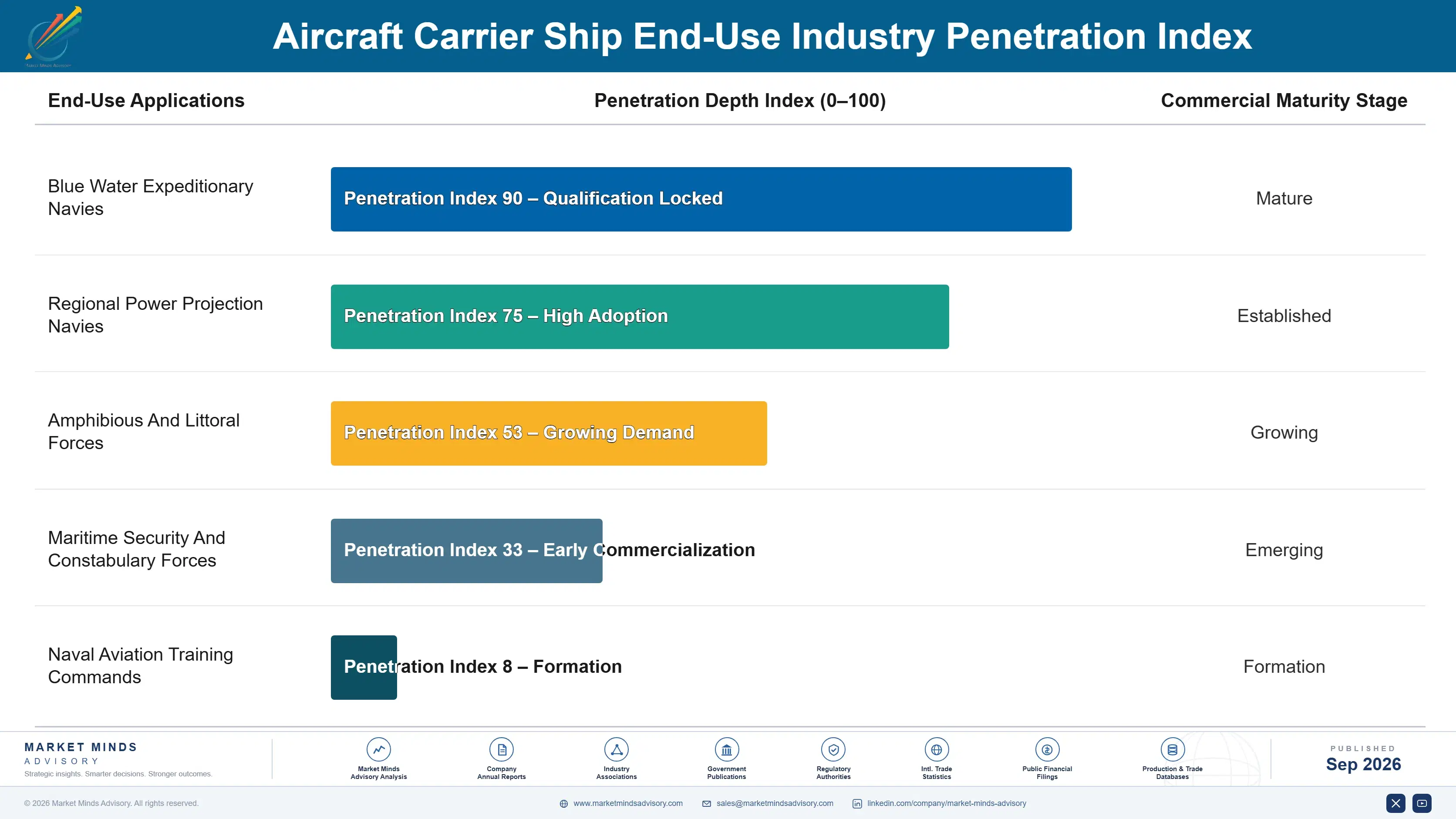
The annuity in carrier programmes is the air wing and its support, and it belongs mostly to suppliers other than the shipbuilder. Aviation acquisition, aircrew training, maintenance infrastructure and support across a service life run around 1.6 times the hull cost, and that spending recurs annually for forty years or more. Shipbuilders capture almost none of it unless they contract for capability rather than for delivery, which few have organised themselves to do.
Adoption depth varies enormously by navy. The largest carrier operators fund the complete capability continuously, including air wing modernisation, escort integration and infrastructure, because carrier aviation is central to how they operate. Mid-sized navies adopting vertical landing carriers typically fund the ship and a partial air wing, then build capability gradually as budgets allow. Navies operating helicopter carriers sit furthest out, buying the platform and treating aviation as a secondary consideration throughout.

The decision has moved up. Carrier acquisition was once argued by naval staffs on capability grounds and approved as a shipbuilding line. It is increasingly decided at head of government level as a statement of national capability, which changes the argument, the timescale and the tolerance for cost growth considerably.
aircraft-carrier-ship-market-end-use-penetration-index-1790026298900

Where Participants Should Position

These are among the four positions where our research anticipates prominent divergence between winners and laggards over the coming forecast period. Each is grounded in the demand model, the regulatory perimeter, and the announced capacity pipeline.
01 / SYSTEMS CONTENT OWNERSHIP

Hold launch and recovery content, not just the steel

Aviation launch, recovery and deck handling systems represent around 17% of delivered hull cost and carry gross margin roughly 19 points above hull construction on the same programme, because qualification scarcity is genuine and no navy compromises on equipment that stops an aircraft. Electromagnetic launch raises that content share further along with the power generation it demands. Systems suppliers also avoid the decade of labour escalation exposure that governs yard economics, which matters more than the margin difference does on its own.
02 / CONVERSION MARKET ENTRY

Chase conversions even though the contracts look small

Converting an amphibious hull for vertical landing operation costs roughly 82% below comparable new construction, which reaches navies that would otherwise buy nothing at all and creates support relationships lasting decades. Participants active in this work report roughly 2.8 times the programme count of those pursuing new construction alone, with engineering content proportionally larger throughout. The obstacle is organisational: a shipbuilding business built to chase decade-long programmes struggles to pursue contracts that are an order of magnitude smaller than that.
03 / INTEGRATED CAPABILITY CONTRACTING

Contract the whole capability, not the hull alone

Air wing acquisition and support run around 1.6 times the hull across a service life, and in most navies that cost surfaces after the ship decision because the budget lines sit apart from each other entirely. Suppliers offering integrated contracts covering ship, aviation facilities and support have delivered revenue roughly 34% above hull-only scope. The barrier is governmental rather than commercial, requiring a customer able to approve across separate budget authorities, which is why so few programmes are structured this way.
04 / NUCLEAR QUALIFICATION CONTINUITY

Take the low-margin gap work to keep nuclear qualification alive

Nuclear naval capability depends on continuous programme flow, because welder certification, supplier accreditation and inspection qualification all lapse during gaps and cannot be rebuilt quickly afterwards. Design and long-lead spending worth roughly USD 3.4 billion falls within this forecast period specifically to bridge exactly such a gap. The commercial discipline is accepting sustainment work at poor margin rather than redeploying a qualified workforce to more profitable commercial contracts, which is precisely the decision that finance functions reliably resist every time.

Engagement Snapshot From the Field

A live engagement with an industry participant carrying material or product regulatory and market exposure ahead of a defining policy shift, showing how our research translates into a defensible multi-year portfolio strategy.
MARKET MINDS ADVISORY · CLIENT ENGAGEMENT SUMMARY
Aircraft Carrier Ship Producer Strategic Portfolio Review and Transition Roadmap 2026·Investment Scenario on Aircraft Carrier Ship Exposure Evaluation 2025-26
CLIENT PROFILE
A European naval systems supplier with roughly USD 1.4 billion in annual revenue (client-reported, unverified by MMA), holding propulsion and deck systems positions on several aviation-capable vessels. The company had structured its business around bidding large new construction programmes and had won nothing in four years, while watching conversion and mid-sized aviation ship work go to competitors it regarded as considerably smaller.
STRATEGIC CHALLENGE
Management viewed conversion work as beneath the company's programme scale and had declined to bid several opportunities. The market data contradicted that judgement: conversion and mid-sized programmes accounted for most of the addressable opportunity count, carried better engineering margin than new construction, and produced support relationships the company was missing entirely. The board needed to decide whether to restructure around them.
MMA APPROACH
MMA sized conversion and mid-sized aviation ship opportunities by navy across a ten-year horizon, modelled margin and win probability against the client's large-programme pipeline, and assessed what organisational changes pursuing smaller contracts would require. Expert interviews with naval programme staff established how supplier selection worked on conversion programmes specifically, as against new construction.
KEY FINDINGS
  1. Conversion and mid-sized aviation ship programmes represented roughly 4.1 times the opportunity count of large new construction across the horizon examined, at better engineering margin throughout.
  2. The client's bid process required approval thresholds that automatically excluded contracts below a value covering most conversion work, which no one had revisited in over a decade.
  3. Support and sustainment revenue following conversions exceeded the original contract value within about seven years on every comparable programme the analysis could identify.
  4. Competitors winning this work were not cheaper, but they responded within timescales the client's approval process could not physically meet at all.
CLIENT PROFILE
A European naval systems supplier with roughly USD 1.4 billion in annual revenue (client-reported, unverified by MMA), holding propulsion and deck systems positions on several aviation-capable vessels. The company had structured its business around bidding large new construction programmes and had won nothing in four years, while watching conversion and mid-sized aviation ship work go to competitors it regarded as considerably smaller.
STRATEGIC CHALLENGE
Management viewed conversion work as beneath the company's programme scale and had declined to bid several opportunities. The market data contradicted that judgement: conversion and mid-sized programmes accounted for most of the addressable opportunity count, carried better engineering margin than new construction, and produced support relationships the company was missing entirely. The board needed to decide whether to restructure around them.
MMA APPROACH
MMA sized conversion and mid-sized aviation ship opportunities by navy across a ten-year horizon, modelled margin and win probability against the client's large-programme pipeline, and assessed what organisational changes pursuing smaller contracts would require. Expert interviews with naval programme staff established how supplier selection worked on conversion programmes specifically, as against new construction.
KEY FINDINGS
  1. Conversion and mid-sized aviation ship programmes represented roughly 4.1 times the opportunity count of large new construction across the horizon examined, at better engineering margin throughout.
  2. The client's bid process required approval thresholds that automatically excluded contracts below a value covering most conversion work, which no one had revisited in over a decade.
  3. Support and sustainment revenue following conversions exceeded the original contract value within about seven years on every comparable programme the analysis could identify.
  4. Competitors winning this work were not cheaper, but they responded within timescales the client's approval process could not physically meet at all.
RECOMMENDED STRATEGY
Phase 1: Phase 1 (four months): Lower bid approval thresholds and create a dedicated team for conversion and mid-sized programmes with its own authority. Phase 2: Phase 2 (12 months): Bid the three nearest conversion opportunities and price deliberately for the support relationship rather than the contract. Phase 3: Phase 3 (22 months): Rebuild the pipeline model around opportunity count and support annuity rather than around individual contract value.
OUTCOME
The client won two conversion programmes within fifteen months, having bid none in the preceding four years (client-reported, unverified by MMA). Engineering margin on both exceeded the company's new construction average, and the support agreements attached to them now represent a recurring revenue line that did not previously exist.

Frequently Asked Questions

Foundational context covering the market sizes, CAGR, scope, country, region and competition that inform every finding below. This section is provided to cover basics and most often pre-purchase conversations, answered from the MMA Primary Research Dataset.

What is the current size of the Aircraft Carrier Ship Market?

The market was worth USD 18.5 billion in 2025 and reaches USD 19.6 billion in 2026. That covers new carrier construction, major aviation conversions and the propulsion and aviation systems delivered into them.

How large will the Aircraft Carrier Ship Market be by 2036?

MMA forecasts USD 34.4 billion by 2036, an increase of USD 14.8 billion over the 2026 base. That represents an expansion multiple of 1.76 times across the forecast period.

What is the CAGR for the Aircraft Carrier Ship Market 2026 to 2036?

The base case CAGR is 5.8%, with a bull case of 7.0% if European next-generation programmes commit to construction on announced timelines. The bear case of 4.6% assumes those programmes slip into further study.

Which segment is growing fastest?

Conventional catapult carriers grow at 8.7%, half again the market rate of 5.8%. Electromagnetic launch removed the steam plant that made the configuration awkward, though growth rests on a single national programme.

Who are the major companies in the Aircraft Carrier Ship Market?

Huntington Ingalls Industries, China State Shipbuilding Corporation, BAE Systems, Fincantieri and Naval Group lead on contracted programme value and delivered vessel content. Cochin Shipyard, Navantia and Babcock follow.

Which country is growing fastest?

China leads at 10.6%, having moved from a converted hull to a domestically designed catapult carrier within roughly a decade while building amphibious aviation ships alongside. Construction is domestic and closed to external suppliers.

Report Segmentation Architecture

The full report scope spans multiple orthogonal segmentation dimensions, with cross-tabulated demand data provided for each dimension pair. Coverage extends further to regional breakdowns, trend trajectories, and the competitive detail needed to support segment-level decision-making.

By Flight Deck Configuration

  • Nuclear Catapult Carriers
  • Conventional Catapult Carriers
  • Ski-Jump Conventional Carriers
  • Short Take-Off Vertical Landing Carriers
  • Amphibious Assault Aviation Ships
  • Helicopter And Drone Carrier Vessels

By End-Use Industry

  • Blue Water Expeditionary Navies
  • Regional Power Projection Navies
  • Amphibious And Littoral Forces
  • Maritime Security And Constabulary Forces
  • Naval Aviation Training Commands

By Commercial Dimension

  • New Construction Programme
  • Aviation Conversion And Upgrade
  • Systems Content Supply
  • Integrated Capability Contract

By Region

  • East Asia
  • North America
  • Western Europe
  • South Asia and Pacific
  • Middle East and Africa
  • Eastern Europe
  • Latin America

Scope, Methodology, and Coverage

Every figure in this report is reproducible from documented input assumptions. The scope below maps the historical period, the forecast horizon, the segmentation dimensions, and the countries covered, alongside the underlying primary and qualitative methodology.
Historical Period
2020 to 2025
Forecast Period
2026 to 2036
Base Year
2025 (USD billions; MMA Primary Research Dataset, September 2026)
Market Definition
This report covers aviation-capable warships built to operate fixed-wing or rotary aircraft from a full-length flight deck, together with the aviation and propulsion content delivered into them. Scope includes nuclear catapult carriers, conventional catapult carriers, ski-jump conventional carriers, short take-off vertical landing carriers, amphibious assault aviation ships, and helicopter or drone carrier vessels, across new construction and major aviation conversion. Excluded are embarked air wings and their weapons, carrier sustainment and refuelling overhauls, escort vessels, amphibious ships without a full flight deck, and shore aviation infrastructure.
Quantitative Units
USD billions (current prices); vessel programme counts; delivered hull cost; aviation systems content value
Segmentation Dimensions
By Flight Deck Configuration; By End-Use Industry; By Commercial Dimension; By Region
Regions Covered
East Asia, North America, Western Europe, South Asia and Pacific, Middle East and Africa, Eastern Europe, Latin America
Countries Covered
USA, China, UK, France, India, Italy, Spain, Japan, South Korea, Turkey, Russia, Brazil, Australia, Egypt, Thailand, Germany, Netherlands, Poland, Croatia, Canada, and additional markets relevant to this sector
Key Companies Profiled
Huntington Ingalls Industries, China State Shipbuilding Corporation, BAE Systems, Fincantieri, Naval Group, Cochin Shipyard, Babcock International, Navantia, Thales, Mazagon Dock Shipbuilders, Mitsubishi Heavy Industries, Japan Marine United, Hyundai Heavy Industries, Hanwha Ocean, Sedef Shipyard, General Dynamics, Leonardo, Rolls-Royce, BWX Technologies, L3Harris Technologies
Quantitative Methodology
Primary survey, n=3,800 respondents, Q4 2025, six countries; demand-side model with trade association cross-validation
Qualitative Methodology
47 expert interviews, Q4 2025; applied to validate demand model assumptions, identify emerging dynamics, and assess competitive positioning
Report Format
PDF and XLSX data workbook (Word format preview document)
Publisher
Market Minds Advisory
Report Code
MMA-2026-CON-917
Published
September 2026
Contact
sales@marketmindsadvisory.com | www.marketmindsadvisory.com

Purchase the full Aircraft Carrier Ship Market Report (2026 to 2036).

The full report sizes the aircraft carrier market across six flight deck configurations and all seven regions, with programme counts and delivered hull costs behind every figure. It separates nuclear from conventional construction throughout, because the two are different industrial problems with entirely different competitive fields. Competitive analysis covers 20 participants on contracted programme value and delivered vessel content, including aviation systems qualification by supplier. Air wing and support cost is modelled against hull cost across a service life, since that ratio determines whether a navy operates its ship at capability. Conversion economics are assessed separately from new construction throughout.
Six-configuration sizing with programme counts and costs
Nuclear and conventional construction separated throughout
Aviation systems qualification mapped by supplier
Air wing life cost modelled against hull cost
Conversion economics assessed against new construction
Twenty-participant assessment on programme value and content

Built For The People Who Decide

From boardroom strategy to bench-side execution, this report is read cover-to-cover by leaders shaping the next decade of their industry, turning demand scenarios, market dynamics and valuation benchmarks into decisions.
CXOs/ Presidents/ VPs/ Managers
M&A and Corporate Development
Strategy Teams and R&D Heads
Procurement and Product Directors
Regulatory and Compliance Leaders
Investor Relations and Equity Analysts