Market Minds Advisory
Aircraft Antenna Market

Aircraft Antenna Market: Aircraft Antennas: Aperture Physics, Flat Panel Displacement And The Certification That Follows Every Installation

The one component that cannot be miniaturised past physics, needing area on an airframe with none spare, now facing the first genuine displacement event this market has seen in decades.

Lead Analyst

Published

September 2026

Make Smarter Decisions with Customized Research Insights

Request a free sample report and evaluate market opportunities, growth trends, and competitive dynamics relevant to your business needs.

2025 MARKET VALUE$0.8BMarket Size 2025
2036 FORECAST VALUE$2.2BBase Case , 2026 to 2036
CAGR 2026 TO 20369.4 %Bull 10.6% / Bear 8.2%
INCREMENTAL OPPORTUNITY$1.3BNet 10- year value creation
EXPANSION MULTIPLE2.45x2036 value over 2026 base
Strategic Levers
M&A Pipeline
Regional Outlook
Country Rankings
Competitive Intelligence
Segmental Deep-dive
Call-Us : 91 93563 13602

Executive Snapshot and Market Trajectory.

An antenna cannot be shrunk past physics. Gain requires aperture, aperture requires area, and an airframe has no spare area, which is why this component has been governed by the same constraint for fifty years while everything around it miniaturised steadily. Physics does not negotiate.
Low orbit constellations broke that constraint from an unexpected direction. A geostationary antenna points at a fixed spot in the sky, while a low orbit one must track satellites crossing overhead within minutes and hand over between them continuously, which mechanically steered designs do poorly and electronically steered flat panels do naturally. Satellite communications antennas now represent 46% of revenue and grow at 14.1% every year. That entire transition happened remarkably quickly indeed here.
Certification remains the gate regardless of technology. Each installation needs its own supplemental type certificate taking around 17 months, and 68% of antennas are fitted to aircraft already flying rather than to new deliveries. Incumbent advantage rests on certification history for parabolic and mechanically steered designs, and it transfers to flat panel arrays considerably less well than the incumbents expected. Paperwork of that kind protects one particular shape only.
Market Definition
Revenue from antennas certified for external or internal fitment to aircraft, spanning communications, navigation, surveillance, weather sensing, satellite connectivity and military datalink and electronic warfare functions, including radomes, mounts and associated installation hardware. Excludes ground station antennas, satellite payload antennas, in-cabin wireless access points, and the modems, transceivers and network equipment sitting behind the antenna.
Base Year Value
$0.8B in 2025 (MMA Primary Research Dataset, August 2026)
Forecast Period
2026 to 2036, eleven discrete annual values
CAGR
9.4% base case. Bull 10.6%. Bear 8.2%.
Fastest Growth Segment
Satellite Communications Antennas: 14.1% CAGR
Fastest Growth Country
India: 11.4% CAGR
Fastest Growth Region
South Asia and Pacific: 11.4% CAGR
Largest Region
North America: 32% of 2025 global value
Market Leaders
Collins Aerospace, Honeywell Aerospace, Thales, Astronics and Cobham Aerospace Communications lead on certified antenna revenue. Source: company annual reports and MMA Primary Research Dataset, July 2026.
Primary Survey
n=3,800 procurement and R&D decision-makers, Q4 2025, six countries
Methodology
Demand-side build-up, cross-validated against public data, 47 expert interviews

Aircraft Antenna Market Forecast Scenarios

aircraft-antenna-market-size-forecast-scenario-1787997712804
The 2020 to 2025 period was reshaped by two unrelated forces. Cabin connectivity adoption accelerated far beyond forecasts once airlines saw passengers comparing carriers on it, while radio altimeter interference from adjacent spectrum forced an unplanned retrofit programme across large parts of the global fleet. Revenue compounded near 8.0% across the period, with connectivity supplying most of it and regulation supplying an unexpected remainder.
Three mechanisms carry the base case forward. Low orbit constellation adoption continues across commercial and business aviation, and each installation requires an antenna capable of tracking satellites rather than pointing at one. Military datalink and electronic warfare demand rises with defence spending across allied nations. And navigation interference in contested airspace is pushing controlled reception pattern antennas onto civil aircraft that have never previously carried anything of the kind at all.
The bull catalyst is airframer line fit selection of flat panel arrays on a high volume type, which would settle the technology question for a generation and hand enormous value to whoever wins it. The bear risk is constellation consolidation: if the number of viable providers narrows, antenna specifications converge, and a market that currently rewards several competing designs would reward considerably fewer of them.

Aperture Is The Only Constraint That Never Moved

Everything else in avionics got smaller and antennas did not, because gain follows aperture area and no processing substitutes for it. A modern narrowbody carries around 34 discrete external antennas competing for skin area that also carries doors, windows, structure and access panels. That constraint has shaped this market for fifty years, and every argument in it reduces to how much area a function is worth.
MARKET CONCENTRATION CR554%Share of certified antenna revenue held by leaders
INSTALLATION CERTIFICATION TIME17 monthsElapsed period from design freeze to supplemental type certificate
CONNECTIVITY ANTENNA SHARE46%Revenue derived from satellite communications rather than other functions
SHIPSET ANTENNA COUNT34Discrete external antennas fitted to a modern narrowbody
RADOME DRAG PENALTY0.4%Additional fuel burn attributable to a fitted external radome
RETROFIT INSTALLATION SHARE68%Antennas fitted to aircraft already in service today
Low orbit constellations changed what the antenna has to do. A geostationary terminal points at one fixed position and stays there; a low orbit terminal tracks satellites crossing overhead within minutes and hands over continuously between them. Mechanically steered designs manage that awkwardly, while electronically steered flat panels do it naturally and sit far lower in the airstream, which matters because a radome costs roughly 0.4% in fuel that airlines measure.
Certification governs everything regardless. An installation requires a supplemental type certificate for each aircraft type, taking around 17 months, and 68% of antennas go onto aircraft already flying. That gives incumbents an advantage built on certification rather than performance. The uncomfortable discovery is that history built on mechanically steered installations transfers to flat panel arrays far less well than assumed.
"Half this industry believed its moat was fifty years of certification paperwork. It turns out the paperwork was specific to a shape of antenna that nobody is buying any more."
Director, Aerospace Communications and Sensing Practice · MMA Aerospace and Defence Components Practice · August 2026

Market Trends

Flat Panel Arrays Displace Mechanically Steered Terminals

Tracking satellites that cross overhead in minutes requires beam steering faster than a motorised dish comfortably provides, and electronically steered flat panels handle it without moving parts while sitting far lower in the airstream. Airlines value the reduced drag independently, since a radome costs measurable fuel across a fleet flying daily. The displacement is genuine rather than incremental, and incumbents holding certification history on mechanically steered installations are finding that experience transfers to the new form factor considerably less usefully than expected. Fifty years of paperwork protected one particular geometry.
Market Impact: Replaces terminals across 68% retrofit

Navigation Interference Brings Military Antennas Onto Airliners

Satellite navigation jamming and spoofing across contested airspace has become frequent enough that commercial operators are fitting controlled reception pattern antennas, a technology previously confined to military aircraft. These antennas null interference arriving from ground directions while preserving satellite reception overhead, and they cost considerably more than the simple patch antennas they replace. Regulators have not mandated anything, and operators flying affected routes are fitting them anyway because the alternative is degraded navigation on regular scheduled services. Operators here are acting well ahead of any regulator on this particular question.
Market Impact: Grows military antennas 11.0% annually

Market Opportunities and Growth Drivers

Constellation Adoption Drives Antenna Replacement Fleet Wide

Airlines adopting low orbit connectivity replace existing terminals rather than adding to them, because the antenna that served a geostationary service cannot track a constellation properly. That converts connectivity upgrades into antenna replacement programmes across entire fleets, with 68% of installations going onto aircraft already flying. Several carriers have committed to fleet-wide rollouts covering hundreds of aircraft each. This is the largest single demand mechanism this market has ever seen and it arrived within roughly three years. Nothing else in this whole market has ever moved at that speed before.
Market Impact: Takes 17 months per aircraft type

Defence Spending Raises Datalink And Electronic Warfare Demand

Allied defence budgets rising across a sustained trajectory pull antenna demand upward across tactical datalinks, electronic warfare, signals intelligence and secure communications, all of which need apertures fitted to airframes with no more spare area than commercial aircraft have. Conformal and shared aperture approaches address that constraint by embedding antennas into structure rather than mounting them on it. The engineering is genuinely difficult and the demand is entirely funded, which is an unusually favourable combination for anybody holding the capability. Funded demand meeting genuine engineering difficulty is a rare pairing.
Market Impact: Competes for 34 antenna positions

Market Restraints and Challenges

Every Installation Requires Its Own Type Certificate

A supplemental type certificate covers one antenna installation on one aircraft type, so a supplier serving a mixed fleet operator carries approval cost repeatedly across airframes sharing most of the engineering. The root cause is an airworthiness regime approving installations rather than products, which is correct since installation is where lightning, structure and drag risk actually sit. Suppliers mitigate through certification families covering related variants, partnering with maintenance organisations holding broad approvals, and prioritising types by installed fleet size. Installation rather than the product is where the actual risk sits.
Market Impact: Displaces 46% of connectivity revenue

Airframe Skin Area Is Genuinely Finite Everywhere

A modern narrowbody already carries around 34 external antennas competing with doors, windows, structure and access panels for skin area that cannot be increased. The root cause is that gain requires aperture and aperture requires area, which no processing improvement changes. Commercially it means every new function must displace an existing one or share an aperture. Suppliers mitigate through multi-function antennas serving several bands from one aperture, conformal designs embedded into structure, and lower profile arrays that reduce drag rather than area. No processing improvement has ever created skin area.
Market Impact: Fits 2,400 civil aircraft annually
3 additional market trends, 4 additional growth drivers, and 2 additional restraints and challenges are covered in the full report. Contact sales@marketmindsadvisory.com to access the complete intelligence.

Segment CAGR and Growth Architecture

Segmentation follows antenna function, since that determines the frequency, the aperture required, the certification path and the customer funding the installation. Six functions describe the market completely, from satellite communications now taking nearly half of revenue through to the high frequency communications antennas that fleets are quietly removing rather than ever replacing at all.
aircraft-antenna-market-market-share-analysis-1787997713334

Satellite Communications Antennas

The fastest function grows at 14.1%, half again the market rate of 9.4%, and it grows because low orbit constellations require an antenna to do something geostationary services never asked of it. Tracking satellites that cross overhead within minutes and handing over continuously between them suits electronically steered flat panels far better than motorised dishes, and the flat form factor also cuts the drag penalty that airlines measure across every flight. Airlines replacing connectivity therefore replace the antenna rather than adding to it, converting upgrades into fleet-wide programmes. The incumbent advantage built on mechanically steered certification history transfers to this form factor considerably less well than anybody in the industry expected it would.
CAGR 14.1%

Military Datalink and Electronic Warfare Antennas

Military antennas grow at 11.0% on defence budgets rising across a sustained multi-year trajectory rather than on any single programme. Tactical datalinks, electronic warfare, signals intelligence and secure communications each demand apertures, and military airframes have no more spare skin area than commercial ones do. That pushes the engineering toward conformal designs embedded into structure and shared apertures serving several functions at once, both of which are genuinely difficult and both of which are fully funded. Export control complicates supply considerably, since an antenna capable of electronic warfare functions carries transfer restrictions that a communications antenna of similar construction simply does not. That distinction shapes who can supply what, entirely independently of capability.
CAGR 11.0%
Full segment breakdown across 6 segments available in the complete report.

Regional Architecture and Country Demand Map

Antenna demand follows aircraft fleets and defence programmes, so it distributes across every operating region. North America leads on the largest fleet, the deepest defence procurement and most of the manufacturing base, with Western Europe and East Asia each holding substantial positions of their own.

North America

The largest share sits here at 32%, carried by the world's biggest commercial fleet, the deepest military antenna procurement anywhere and most of the manufacturing base supplying both. Low orbit constellation adoption began with American carriers committing to fleet-wide rollouts, and the flat panel suppliers that displaced incumbents are largely headquartered here. Radio altimeter interference from adjacent spectrum also forced an unplanned retrofit programme across this fleet, which pulled forward demand nobody had planned for or budgeted. A region that holds the largest fleet, the deepest defence procurement and most of the manufacturing base decides this market's direction more completely than any share figure suggests, and the flat panel displacement began here before anywhere else.
Share: 32% | CAGR: 9.0% (2026 to 2036)

Western Europe

A dense fleet and a genuinely capable manufacturing base anchor this region, with French and British suppliers holding certified positions across commercial and military applications. European regulators approached the radio altimeter interference question differently from American ones, which produced a different retrofit pattern and timetable. Defence rearmament is lifting datalink and electronic warfare antenna demand faster than commercial recovery alone would, and export control across the region shapes which military antenna work can be placed where. Two regulators approaching the same interference problem differently produced two different retrofit programmes on two different timetables, which is an ordinary consequence of divided airworthiness authority and an expensive one for anybody supplying both markets at once.
Share: 23% | CAGR: 8.0% (2026 to 2036)
Regional intelligence for 5 additional markets available in the complete report: East Asia, South Asia and Pacific, Latin America, Middle East and Africa, Eastern Europe. Contact sales@marketmindsadvisory.com.
aircraft-antenna-market-country-cagr-analysis-1787997713852

Where Aircraft Antenna Margin Sits

Four levers work on certification coverage, aperture efficiency and technology positioning rather than on antenna performance, which airlines evaluate far less carefully than most suppliers assume. Certificate families, multi-function apertures, flat panel commitment and interference protection each address something a supplier controls before any fleet decision is taken at all. Performance is rarely decisive.

Certify Families Rather Than Individual Installations

A supplemental type certificate covers one antenna on one aircraft type and takes around 17 months, so a supplier approaching each installation independently carries that cost repeatedly across airframes sharing most of the engineering. Certifying a family across related variants, then approving derivatives against that base, cuts per-type approval time by 40% to 55% where authorities accept the reuse. Fleet operators consolidate toward whoever covers all their types. Suppliers certifying one type at a time keep losing campaigns to competitors who covered the whole fleet first. Coverage decides these campaigns, not capability.
Market Impact: Cuts the approval time by around 48% typically

Serve Several Functions From One Aperture

A narrowbody carries around 34 external antennas competing for skin area that cannot be increased, so every new function must displace an existing one or share an aperture with it. Multi-function designs serving several bands from a single aperture free position and reduce the drag penalty that costs roughly 0.4% in fuel per radome fitted. Airlines value both effects independently and measure the second precisely. The engineering is genuinely difficult, which is exactly why suppliers holding it face far less competition than the antenna count suggests. Competition thins sharply at that engineering level.
Market Impact: Frees antenna positions worth around 0.4% fuel burn

Commit To Flat Panel Before The Line Fit Decision

Airframer line fit selection of flat panel arrays on a high volume type would settle the technology question for a generation, and positions on those decisions are won during architecture definition rather than through any later tender. Suppliers engaged with airframer systems teams two years ahead win selection at roughly 2.7 times the rate of those responding to a released specification. Certification history on mechanically steered installations counts for considerably less here than incumbents assumed, which makes the window genuinely open for the first time in decades. Nobody expected that window to open.
Market Impact: Wins selection at around 2.7 times the rate

Supply Interference Protection Before Anybody Mandates It

Satellite navigation jamming across contested airspace has become frequent enough that operators are fitting controlled reception pattern antennas without any regulatory requirement to do so, purely because degraded navigation on scheduled services is unacceptable. Those antennas carry prices several times the simple patch designs they replace. Around 2,400 civil aircraft are being fitted annually and the number rises with each affected route. Suppliers waiting for a mandate before developing civil variants will arrive after operators have already chosen somebody else entirely. Nobody is going to mandate this before the operators act.
Market Impact: Fits around 2,400 civil aircraft every single year

Who Controls the Margin Pool

Concentration is moderate at around 54% across the five largest suppliers, and the composition of that group is changing faster than in any comparable component market. Collins, Honeywell and Thales hold long-established certified positions across communications, navigation and surveillance functions. Below them sit flat panel specialists, satellite operators supplying their own terminals, and military antenna houses protected by export control. That composition would have looked very different five years ago.
Competition runs on three dimensions. Certificate coverage is the first, since a fleet operator consolidates toward whoever holds approvals across every type it flies. Aperture efficiency is second, since skin area is finite and a design serving several functions is worth more than its performance suggests. Technology fit is third and newly decisive, since constellation tracking favours designs incumbent certification does not cover.

Pressure is arriving from outside the traditional supplier base. Flat panel specialists and satellite operators supplying their own terminals have taken connectivity positions that incumbents assumed certification history protected. Meanwhile military antenna demand rises for suppliers holding export-controlled capability. Rankings shift against suppliers holding neither flat panel capability nor multi-function aperture engineering, since both address where the value actually moved.
aircraft-antenna-market-company-positioning-matrix-1787997714371

Competitive Moat and Risk Dimensions

COLLINS AEROSPACE

Moat: Certificate coverage across aircraft types

Collins holds certified antenna installations across a wider range of aircraft types than any competitor, which is precisely what a mixed fleet operator consolidates around when retrofitting. Each additional approved type raises switching cost further. Building comparable coverage requires certification programmes across many types at 17 months each, which no competitor has undertaken at that scale in any reasonable timeframe.
COLLINS AEROSPACE

Risk: Certification history on displaced designs

Much of that coverage rests on mechanically steered and parabolic installations that constellation tracking requirements are now displacing, and the approval history transfers to flat panel arrays considerably less usefully than assumed. Scale in a displaced form factor is a diminishing asset. Rebuilding coverage on new designs means repeating certification programmes competitors are already running.
THINKOM SOLUTIONS

Moat: Low profile tracking antenna design

ThinKom built low profile tracking antenna technology addressing exactly the constellation requirement that displaced conventional terminals, and it did so before the requirement became urgent for anybody else. The low airstream profile also reduces the drag penalty that airlines measure precisely across a fleet. Competing designs require development and certification measured in years that established suppliers are only now beginning.
THINKOM SOLUTIONS

Risk: Narrow product and customer base

A business concentrated on connectivity antennas depends on constellation adoption continuing at its present pace and on a small number of airline and integrator customers making favourable decisions. It holds no navigation, surveillance or military positions to offset a connectivity slowdown. Larger competitors can absorb a poor year in one function in a way a specialist genuinely cannot.

Players Tracked

Prominent Players

Collins Aerospace
Honeywell Aerospace
Thales
Astronics
Cobham Aerospace Communications

Other Key Players

Safran
L3Harris Technologies
Gilat Satellite Networks
Get SAT
Hughes Network Systems
BAE Systems Space and Mission Systems
Comant Industries
Sensor Systems
ThinKom Solutions
Viasat
Kymeta
Starlink Aviation
Panasonic Avionics
Amphenol Antenna Solutions
Leonardo

Recent Developments

FEBRUARY 2024

Radio altimeter retrofit deadline reached across the fleet

Aviation authorities required operators to complete radio altimeter tolerance upgrades addressing interference from adjacent spectrum allocations, forcing an unplanned equipment and antenna retrofit programme across large parts of the fleet. This was regulatory action by aviation authorities rather than any commercial arrangement between equipment suppliers.
Signal: Spectrum allocated somewhere else entirely generated antenna retrofit demand that nobody in this industry forecast at all.
AUGUST 2024

Satellite operator acquired an aviation terminal developer

A satellite communications operator completed the acquisition of an electronically steered aviation antenna developer, adding terminal capability alongside its network services rather than relying on independent antenna suppliers. This was an acquisition rather than a merger or joint venture, and it moved antenna capability inside a service provider.
Signal: Service providers buying up antenna capability changes exactly who the independent suppliers are now competing against.
JUNE 2025

Carriers extended low orbit connectivity across whole fleets

Several major carriers continued fleet-wide rollouts of low orbit satellite connectivity, replacing existing geostationary terminals with electronically steered antennas across hundreds of aircraft each. These were independent fleet investment decisions by separate airlines rather than any coordinated commercial arrangement between any of the carriers involved.
Signal: Connectivity upgrades quietly became fleet-wide antenna replacement programmes rather than simple additions to existing installations anywhere.

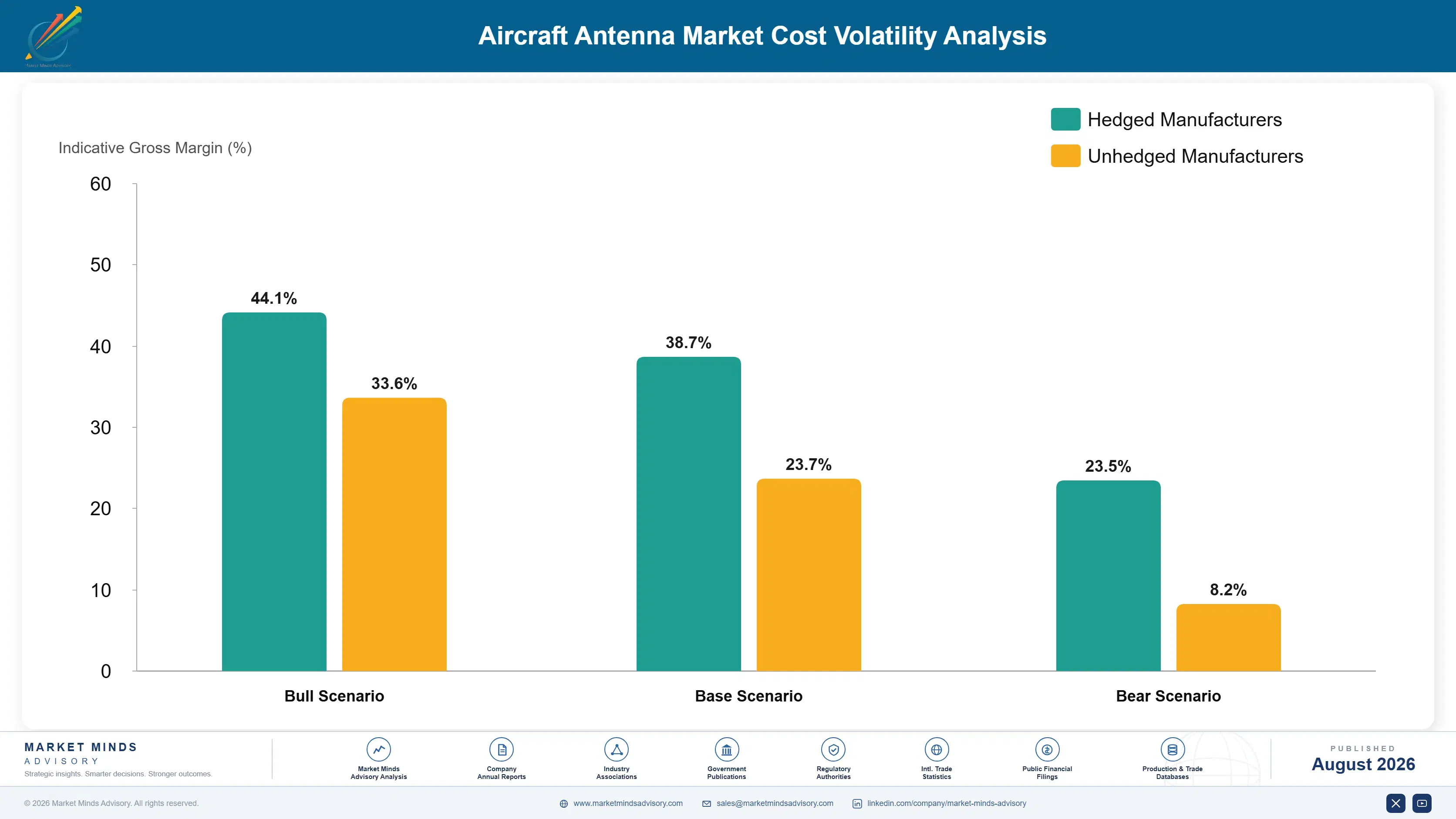
What A Certified Antenna Costs

Unit cost divides into four components on a typical certified antenna. Radiating elements, feed structure and beam forming electronics absorb roughly 41% of build cost on an electronically steered design and considerably less on a passive one. Radome and mechanical hardware run near 19%, assembly and environmental test near 17%, and certification amortisation with installation engineering accounts for the remaining 23% across a programme.
The 2021 to 2023 semiconductor shortage bore unusually hard on electronically steered designs. A phased array uses hundreds of radio frequency components per aperture, none substitutable without requalification, and suppliers waited rather than redesigning a certified product. RTX and Honeywell both discussed component availability and supply chain pressure across that period in their annual reporting. Passive antennas carried on largely unaffected, which briefly reversed the technology advantage the market had been moving toward.

Exposure varies by design type and by certification strategy. Electronically steered antennas carry heavy component content and benefit least from volume until production scales properly. Passive designs carry almost none. Suppliers certifying families across related aircraft variants spread the 23% component widely, while those approving each installation separately carry it fully every time and price accordingly against competitors who did not.
aircraft-antenna-market-cost-volatility-analysis-1787997714565

Certification families covering related aircraft variants

Approving a family across related variants rather than certifying each installation independently spreads the largest non-hardware cost component across many programmes and shortens approval considerably where authorities accept the reuse. The installation delta must be documented rigorously to obtain that acceptance. Suppliers structuring certification this way widen fleet coverage far faster than competitors approaching each type separately.

Multi-function apertures reducing installation count

Serving several bands from one aperture reduces the number of installations an aircraft requires, which cuts certification cost, frees skin area and removes drag that airlines measure across every flight. The design work is genuinely difficult and the certification is no harder than a single function equivalent. Suppliers holding it face considerably less competition than the antenna count suggests.

Component qualification breadth on steered array designs

A phased array uses hundreds of radio frequency components per aperture, and qualifying alternates for the highest risk items before a shortage arrives converts a production stoppage into a cost problem instead. Requalification during a shortage is far too slow to help anybody. Suppliers who qualified alternates before 2021 continued shipping while competitors simply waited for allocation.

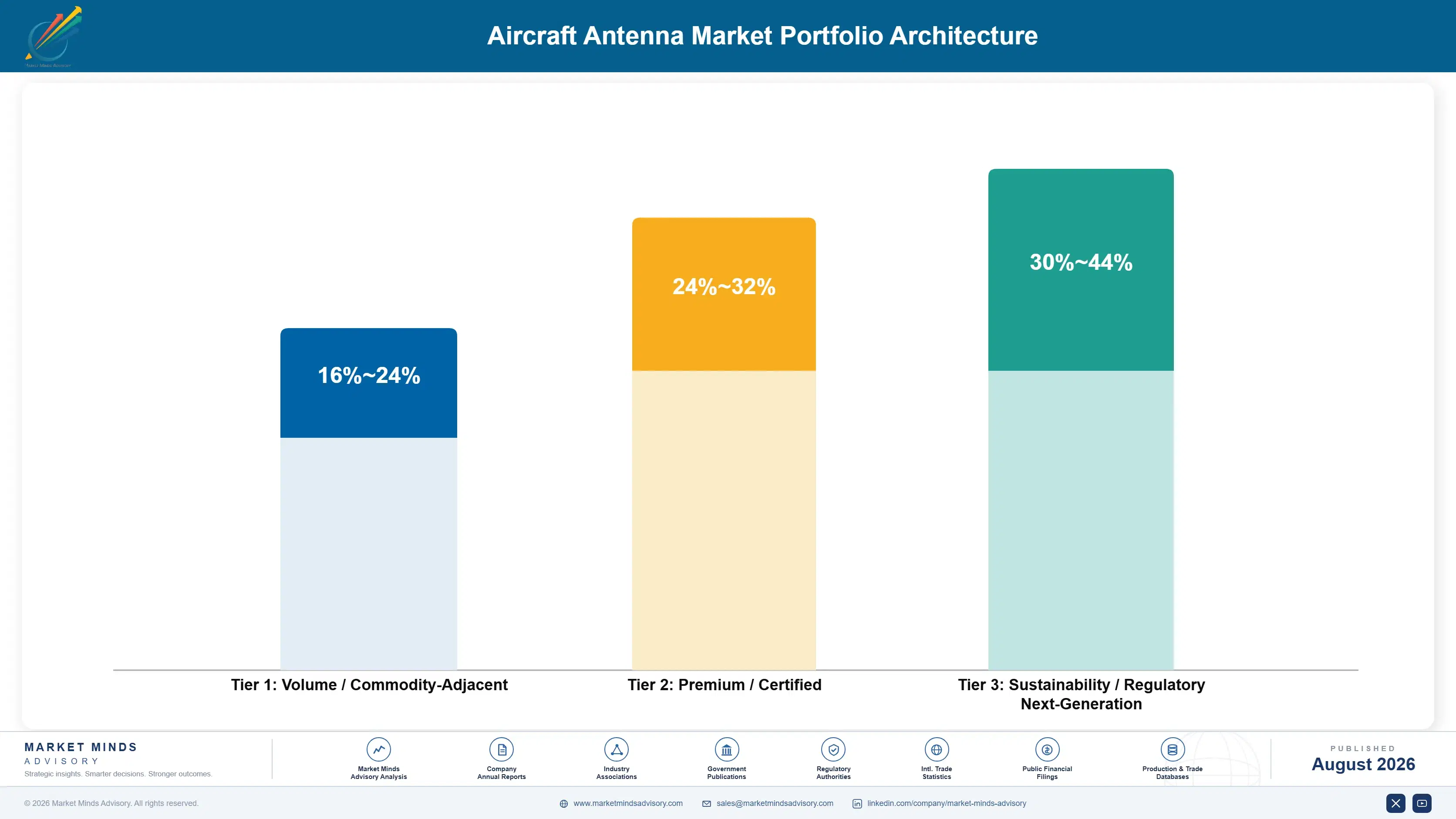
Portfolio Architecture for Margin Defence

The portfolio separates by whether the function is settled or moving. Navigation, surveillance and voice communications antennas form the volume core: passive designs, well understood certification, positions held for decades and pricing compressed accordingly. Suppliers hold them because they carry shipset volume across 34 positions on a narrowbody and because the aftermarket that follows a certified installation runs for the airframe's entire operating life. Nobody replaces them.
Margin concentrates where aperture engineering is genuinely hard. Multi-function designs, weather and sensing arrays and conformal military antennas all require capability a passive antenna maker does not hold, and they price on scarcity rather than on comparison. The tension is that these positions require sustained engineering investment against a market whose total unit volume is small, which several suppliers have found difficult to justify internally at all.

The value has moved decisively toward satellite communications, and it moved faster than incumbents adjusted. Connectivity now takes 46% of revenue, the technology requirement changed with low orbit constellations, and the certification history that protected incumbents was specific to a form factor that fleets are now replacing rather than renewing anywhere. That was a genuine surprise.

Volume / Commodity-Adjacent

Passive communications, navigation, landing and transponder antennas across large shipset counts. Range spans eight points because aftermarket capture differs enormously between suppliers holding certified positions and those selling through open distribution.
Gross Margin: 16-24%

Premium / Certified

Weather, sensing and surveillance arrays requiring genuine aperture engineering. Range spans eight points because multi-function designs serving several bands from one position command pricing that single function equivalents never approach.
Gross Margin: 24-32%

Sustainability / Regulatory / Next-Generation

Electronically steered connectivity antennas, military datalink and electronic warfare apertures, and interference protection designs. Range spans fourteen points because export control and technology scarcity both price independently of any manufacturing cost.
Gross Margin: 30-44%
aircraft-antenna-market-portfolio-architecture-1787997715066

High-value Sub-segments and Strategic Watch-out

Satellite Communications Antennas

High value and high growth at 14.1%, taking 46% of market revenue as low orbit constellations replace geostationary terminals. The twelve point range separates flat panel specialists from incumbents still selling mechanically steered designs into a shrinking requirement. The requirement itself simply changed underneath everybody.
Gross Margin: 32-44%

Military Datalink and EW Antennas

High value with moderate growth at 11.0%, funded by sustained defence budgets across allied nations. The ten point range reflects export control exposure, which prices independently of manufacturing cost and excludes competitors entirely from some programmes. Export control decides access here rather than any capability.
Gross Margin: 28-38%

Navigation and Landing Antennas

The volume core across 34 shipset positions and the source of aftermarket revenue lasting an airframe's entire life. Passive designs, settled certification, positions held for decades, and pricing compressed by exactly that stability. Nothing about that particular requirement is ever likely to change at all.
Gross Margin: 16-24%

VHF and HF Communications

The strategic watch-out rather than a growth pool. High frequency installations are being removed rather than replaced as satellite communications cover the routes that once required them, freeing skin area that other functions immediately claim. Freed skin area never stays free for very long anywhere.
Gross Margin: Variable

Why Antennas Stay Where Installed

A certified antenna installation produces annuity economics across the airframe's whole life. Once approved it ships with every aircraft built to that configuration and generates replacement demand for decades, and substituting it means a new supplemental type certificate taking around 17 months that no operator will fund without a technical reason. That permanence explains why suppliers compete so hard on certificate coverage and so little on antenna performance.
Stickiness varies sharply by function. Navigation, landing and surveillance antennas are effectively permanent, since nothing about their requirement changes and recertification serves no purpose. Satellite communications antennas are the least sticky in the entire market, because the technology requirement changed underneath them and fleets are replacing rather than renewing. Military antennas sit between, moving at platform upgrade points and protected by export control in the interim.

The buying decision has moved up the organisation. An antenna was once a component specification chosen by an avionics engineer, and connectivity antennas are now selected as part of a passenger experience programme approved at board level with fleet-wide commitments attached. Suppliers organised to sell components into engineering departments are meeting a buyer who evaluates entirely different things and signs for considerably larger numbers.
aircraft-antenna-market-end-use-penetration-index-1787997715558

Where Antenna Makers Should Commit

These are among the four positions where our research anticipates prominent divergence between winners and laggards over the coming forecast period. Each is grounded in the demand model, the regulatory perimeter, and the announced capacity pipeline.
01 / CERTIFICATE FAMILY STRUCTURE

Fleet operators consolidate toward whoever covers everything

A supplemental type certificate covers one antenna on one aircraft type and takes around 17 months, so a supplier approaching each installation independently carries that cost repeatedly across airframes sharing most of their engineering. Certifying a family across related variants and approving derivatives against that base cuts per-type approval time by 40% to 55% wherever authorities accept the evidence reuse. Fleet operators consolidate toward whoever covers all their types, and suppliers certifying individually keep losing campaigns entirely on coverage alone.
02 / MULTI-FUNCTION APERTURE ENGINEERING

Skin area is the scarce resource, not antenna performance

A narrowbody already carries around 34 external antennas competing for skin area that cannot be increased by anybody, so every new function must displace an existing one or else share an aperture with it. Multi-function designs serving several bands from a single position free area and cut the drag penalty costing roughly 0.4% in fuel for each radome fitted. Airlines value both effects independently and measure the second one precisely, and the engineering difficulty is exactly what limits competition here.
03 / FLAT PANEL COMMITMENT TIMING

The line fit decision settles this for a generation

Airframer line fit selection of flat panel arrays on any high volume type would settle the technology question for a generation, and those positions are won during architecture definition rather than through any tender issued later on. Suppliers engaged with airframer systems teams two years ahead win selection at roughly 2.7 times the rate of those responding to a released specification instead. Certification history on mechanically steered installations counts for far less here than the incumbents had assumed it would.
04 / INTERFERENCE PROTECTION SUPPLY

Operators are buying this without any mandate at all

Satellite navigation jamming across contested airspace has now become frequent enough that commercial operators are fitting controlled reception pattern antennas with no regulatory requirement whatsoever, simply because degraded navigation on scheduled services is simply unacceptable to them. Those antennas carry prices several times those of the simple patch designs they replace on the same aircraft. Around 2,400 civil aircraft are now being fitted annually, and suppliers waiting for a mandate will arrive after operators have already chosen somebody else entirely.

Engagement Snapshot From the Field

A live engagement with an industry participant carrying material or product regulatory and market exposure ahead of a defining policy shift, showing how our research translates into a defensible multi-year portfolio strategy.
MARKET MINDS ADVISORY · CLIENT ENGAGEMENT SUMMARY
Aircraft Antenna Producer Strategic Portfolio Review and Transition Roadmap 2026·Investment Scenario on Aircraft Antenna Exposure Evaluation 2025-26
CLIENT PROFILE
A certified antenna manufacturer holding installations across communications, navigation and surveillance functions on a broad range of commercial aircraft types, with a mechanically steered satellite communications product and no flat panel capability. Revenue had grown modestly while its connectivity share fell each year, and management attributed the decline to aggressive pricing by new entrants rather than to any change in what airlines were actually specifying.
STRATEGIC CHALLENGE
The board needed to understand whether its connectivity position could be defended with existing technology, and whether certification history genuinely protected it as the sales organisation continued to argue. It also faced operators on two campaigns asking for controlled reception pattern antennas for navigation interference protection, a military technology the company had never offered in any civil variant.
MMA APPROACH
MMA analysed four years of connectivity campaign outcomes, separating losses on price from losses on technology fit, and assessed the client's certification portfolio against the installations that constellation adoption actually requires. Expert interviews with airlines, integrators, constellation operators and certification authorities established what fleets were specifying and how much certification history genuinely transferred.
KEY FINDINGS
  1. None of the seventeen lost connectivity campaigns had been decided on price, and every one had specified electronically steered tracking capability the client could not supply at all.
  2. Certification history transferred poorly, with authorities treating flat panel installation as a new approval rather than a derivative, removing the advantage the sales organisation had relied upon.
  3. The client held certified positions on 23 aircraft types certified individually, where family grouping would have covered the same fleet through six approvals instead.
  4. Controlled reception pattern demand had reached two campaigns in a year with no regulatory driver behind it, and no competitor yet offered a civil variant either.
CLIENT PROFILE
A certified antenna manufacturer holding installations across communications, navigation and surveillance functions on a broad range of commercial aircraft types, with a mechanically steered satellite communications product and no flat panel capability. Revenue had grown modestly while its connectivity share fell each year, and management attributed the decline to aggressive pricing by new entrants rather than to any change in what airlines were actually specifying.
STRATEGIC CHALLENGE
The board needed to understand whether its connectivity position could be defended with existing technology, and whether certification history genuinely protected it as the sales organisation continued to argue. It also faced operators on two campaigns asking for controlled reception pattern antennas for navigation interference protection, a military technology the company had never offered in any civil variant.
MMA APPROACH
MMA analysed four years of connectivity campaign outcomes, separating losses on price from losses on technology fit, and assessed the client's certification portfolio against the installations that constellation adoption actually requires. Expert interviews with airlines, integrators, constellation operators and certification authorities established what fleets were specifying and how much certification history genuinely transferred.
KEY FINDINGS
  1. None of the seventeen lost connectivity campaigns had been decided on price, and every one had specified electronically steered tracking capability the client could not supply at all.
  2. Certification history transferred poorly, with authorities treating flat panel installation as a new approval rather than a derivative, removing the advantage the sales organisation had relied upon.
  3. The client held certified positions on 23 aircraft types certified individually, where family grouping would have covered the same fleet through six approvals instead.
  4. Controlled reception pattern demand had reached two campaigns in a year with no regulatory driver behind it, and no competitor yet offered a civil variant either.
RECOMMENDED STRATEGY
Phase 1: Phase one: begin flat panel development or partnership immediately, accepting that certification will run its full course regardless of existing approval history. Phase 2: Phase two: restructure the 23 individual certifications into family groupings, negotiating evidence reuse with each of the certifying authorities directly. Phase 3: Phase three: develop a civil controlled reception pattern variant from existing military capability, entering a segment nobody currently serves commercially.
OUTCOME
The client reported winning its first flat panel campaign within six quarters of committing to a partnership (client-reported, unverified by MMA), having lost seventeen consecutively beforehand. Family certification cut approval time on two new types by 46%. The civil interference protection variant entered certification during the review period with no competitor announced.

Frequently Asked Questions

Foundational context covering the market sizes, CAGR, scope, country, region and competition that inform every finding below. This section is provided to cover basics and most often pre-purchase conversations, answered from the MMA Primary Research Dataset.

What is the current size of the Aircraft Antenna Market?

The market is valued at USD 0.8 billion in 2025, measured as revenue from antennas certified for fitment to aircraft across communications, navigation, surveillance, sensing and military functions.

How large will the Aircraft Antenna Market be by 2036?

MMA forecasts USD 2.16 billion by 2036, up from USD 0.88 billion in 2026. That represents incremental revenue of USD 1.28 billion and an expansion multiple of 2.45 times.

What is the CAGR for the Aircraft Antenna Market 2026 to 2036?

The base case CAGR is 9.4%, with a bull case of 10.6% and a bear case of 8.2%. Low orbit constellation adoption supplies most of that growth across commercial fleets.

Which segment is growing fastest?

Satellite communications antennas grow at 14.1%, half again the market rate of 9.4%. Low orbit constellations require tracking that mechanically steered designs handle rather poorly.

Who are the major companies in the Aircraft Antenna Market?

Collins Aerospace, Honeywell Aerospace, Thales, Astronics and Cobham Aerospace Communications lead on certified antenna revenue, holding around 54% between them right across the whole market.

Which country is growing fastest?

India grows fastest at 11.4%, driven by fleet expansion at a pace no other market matches and by defence modernisation directing requirements toward domestic manufacture.

Report Segmentation Architecture

The full report scope spans multiple orthogonal segmentation dimensions, with cross-tabulated demand data provided for each dimension pair. Coverage extends further to regional breakdowns, trend trajectories, and the competitive detail needed to support segment-level decision-making.

By Antenna Function

  • Satellite Communications Antennas
  • VHF and HF Communications Antennas
  • Navigation and Landing Antennas
  • Surveillance and Transponder Antennas
  • Weather and Sensing Antennas
  • Military Datalink and Electronic Warfare Antennas

By End-Use Industry

  • Commercial Airliners
  • Business Aviation
  • Regional and Turboprop
  • Military Fixed Wing
  • Rotorcraft
  • Unmanned Aircraft Systems

By Commercial Dimension

  • Line Fit Airframer Supply
  • Retrofit Supplemental Type Certificate
  • Connectivity Provider Bundling
  • Aftermarket Replacement Supply
  • Military Programme Integration
  • Licensed Manufacture

By Region

  • North America
  • Western Europe
  • East Asia
  • South Asia and Pacific
  • Latin America
  • Middle East and Africa
  • Eastern Europe

Scope, Methodology, and Coverage

Every figure in this report is reproducible from documented input assumptions. The scope below maps the historical period, the forecast horizon, the segmentation dimensions, and the countries covered, alongside the underlying primary and qualitative methodology.
Historical Period
2020 to 2025
Forecast Period
2026 to 2036
Base Year
2025 (USD billions; MMA Primary Research Dataset, August 2026)
Market Definition
Revenue from antennas certified for external or internal fitment to aircraft, spanning satellite communications, voice communications, navigation and landing, surveillance and transponder, weather and sensing, and military datalink and electronic warfare functions, including radomes, mounts and associated installation hardware. Line fit supply, retrofit installation under supplemental type certificate, connectivity bundling, aftermarket replacement and military programme integration are included. Ground station antennas, satellite payload antennas, in-cabin wireless access points, and the modems and network equipment behind the antenna are excluded.
Quantitative Units
USD billions, certified antenna revenue
Segmentation Dimensions
Antenna function, end-use aircraft category, commercial supply dimension, region
Regions Covered
North America, Western Europe, East Asia, South Asia and Pacific, Latin America, Middle East and Africa, Eastern Europe
Countries Covered
United States, United Kingdom, France, Germany, Israel, China, Japan, South Korea, India, Australia, Brazil, United Arab Emirates, Poland
Key Companies Profiled
Collins Aerospace, Honeywell Aerospace, Thales, Astronics, Cobham Aerospace Communications, Safran, L3Harris Technologies, ThinKom Solutions, Gilat Satellite Networks, Viasat
Quantitative Methodology
Primary survey, n=3,800 respondents, Q4 2025, six countries; demand-side model with trade association cross-validation
Qualitative Methodology
47 expert interviews, Q4 2025; applied to validate demand model assumptions, identify emerging dynamics, and assess competitive positioning
Report Format
PDF and XLSX data workbook (Word format preview document)
Publisher
Market Minds Advisory
Report Code
MMA-2026-CON-321
Published
August 2026
Contact
sales@marketmindsadvisory.com | www.marketmindsadvisory.com

Purchase the full Aircraft Antenna Market Report (2026 to 2036).

The full report treats aircraft antennas as an aperture allocation problem meeting its first genuine technology displacement in decades. It quantifies how much certification history actually transfers between mechanically steered and flat panel installations, models skin area competition across the 34 positions a narrowbody carries, and assesses the drag penalty airlines measure on every radome fitted. Segment analysis covers all six antenna functions, with particular attention to satellite communications now taking nearly half of revenue on technology incumbents did not build. Competitive assessment ranks twenty suppliers on certified antenna revenue across every operating region worldwide.
Six antenna function segmentation with growth rates
Certification transfer between steered and flat designs
Twenty supplier assessment on certified antenna revenue
Skin area competition across shipset antenna positions
Radome drag penalty quantified against fleet fuel burn
Interference protection adoption ahead of any mandate

Built For The People Who Decide

From boardroom strategy to bench-side execution, this report is read cover-to-cover by leaders shaping the next decade of their industry, turning demand scenarios, market dynamics and valuation benchmarks into decisions.
CXOs/ Presidents/ VPs/ Managers
M&A and Corporate Development
Strategy Teams and R&D Heads
Procurement and Product Directors
Regulatory and Compliance Leaders
Investor Relations and Equity Analysts