Market Minds Advisory
Air Pollution Control Systems Market

Air Pollution Control Systems Market: Retrofit Demand Now Outruns New-Build Capacity

A commercial reading of industrial emissions control equipment, where tightening particulate and NOx standards across Asian heavy industry are forcing retrofit spending that outpaces new-plant construction, and digital compliance reporting is reshaping procurement.

Lead Analyst

David Horsley

Published

September 2026

Make Smarter Decisions with Customized Research Insights

Request a free sample report and evaluate market opportunities, growth trends, and competitive dynamics relevant to your business needs.

2025 MARKET VALUE$28.4BMarket Size 2025
2036 FORECAST VALUE$55.0BBase Case , 2026 to 2036
CAGR 2026 TO 20366.2 %Bull 7.4% / Bear 4.9%
INCREMENTAL OPPORTUNITY$24.9BNet 10- year value creation
EXPANSION MULTIPLE1.82x2036 value over 2026 base
Strategic Levers
M&A Pipeline
Regional Outlook
Country Rankings
Competitive Intelligence
Segmental Deep-dive
Call-Us : 91 93563 13602

Executive Snapshot and Market Trajectory

A coal plant that passed inspection five years ago often cannot pass it today, and retrofitting the existing fleet has become a bigger revenue pool than equipping new plants. Regulators moved the compliance bar, and equipment suppliers who can retrofit fast are the ones capturing that shift.
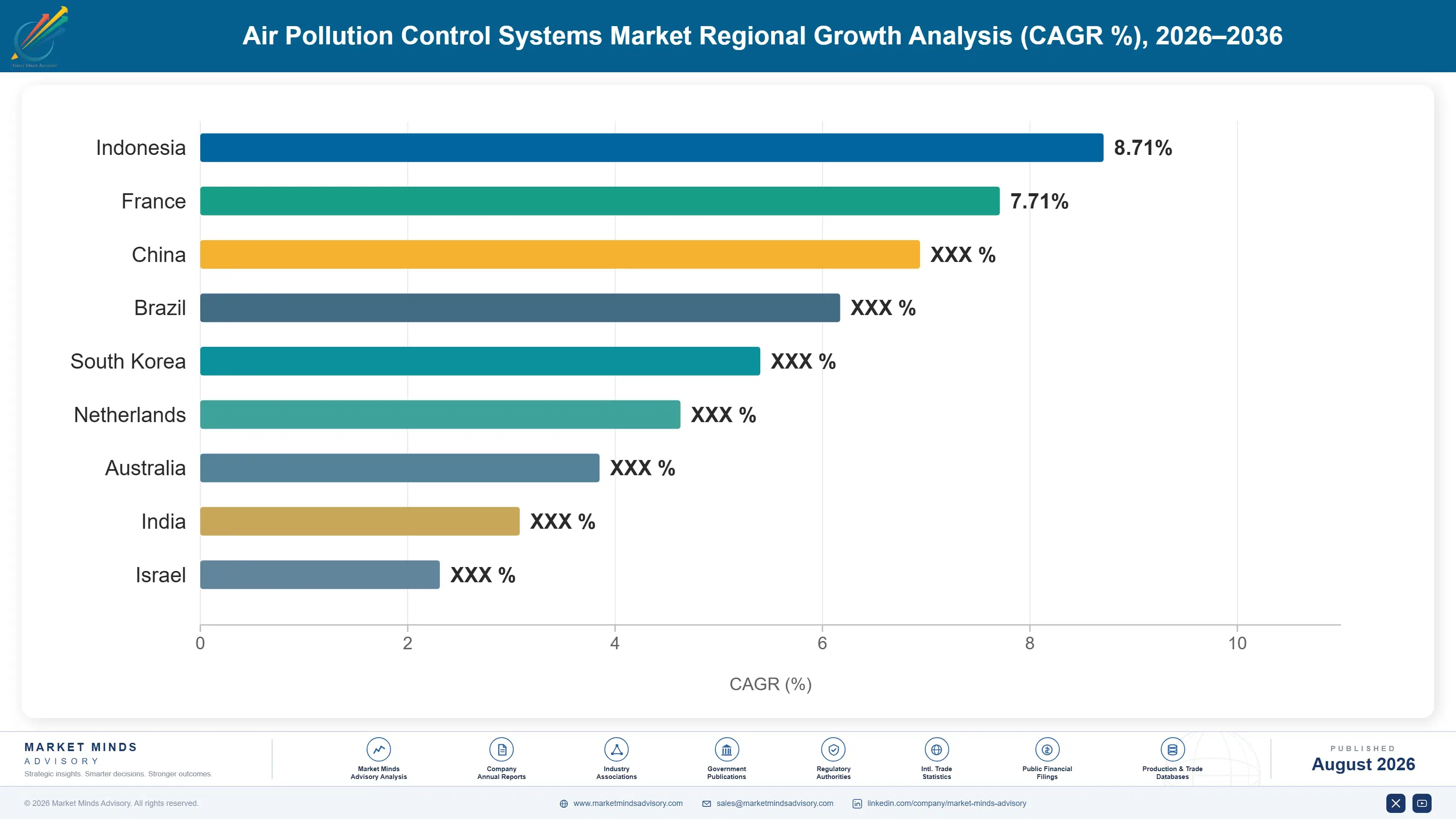
The market stands at USD 28.4 billion in 2025 and reaches USD 55.02 billion by 2036 at a 6.2% CAGR. Selective catalytic reduction and NOx control systems grow fastest at 9.5%, about 1.53 times the overall rate, as marine, power, and heavy industry all face tightening nitrogen oxide limits simultaneously. India posts the quickest national growth at 10.8% as the National Clean Air Programme forces retrofit spending across thousands of previously unregulated facilities.
Concentration is moderate at 38% for the top five, reflecting a field of diversified environmental equipment majors competing against regional specialists with strong local retrofit relationships and regulatory familiarity built over many years. Two forces are reshaping the industry now. Retrofit demand has permanently overtaken new-build equipment spending in most developed markets, and continuous digital emissions monitoring is becoming a mandatory compliance layer rather than an optional add-on.
Market Definition
The air pollution control systems market covers equipment that removes particulate matter, nitrogen oxides, sulfur oxides, volatile organic compounds, and other regulated pollutants from industrial and power generation exhaust streams, including associated continuous emissions monitoring systems. General HVAC filtration, indoor air quality products, and mobile source emissions control sold with vehicles are excluded.
Base Year Value
$28.4B in 2025 (MMA Primary Research Dataset, August 2026)
Forecast Period
2026 to 2036, eleven discrete annual values
CAGR
6.2% base case. Bull 7.4%. Bear 4.9%.
Fastest Growth Segment
Selective Catalytic Reduction and NOx Control Systems: 9.5% CAGR
Fastest Growth Country
India: 10.8% CAGR
Fastest Growth Region
South Asia and Pacific: 8.3% CAGR
Largest Region
East Asia: 29% of 2025 global value
Market Leaders
CECO Environmental, Babcock and Wilcox, Thermo Fisher Scientific, Donaldson Company, Nederman Group. Source: MMA Analysis based on company disclosures.
Primary Survey
n=3,800 procurement and R&D decision-makers, Q4 2025, six countries
Methodology
Demand-side build-up, cross-validated against public data, 47 expert interviews

Air Pollution Control Systems Market Forecast Scenarios

air-pollution-control-systems-market-size-forecast-scenario-1787332636523
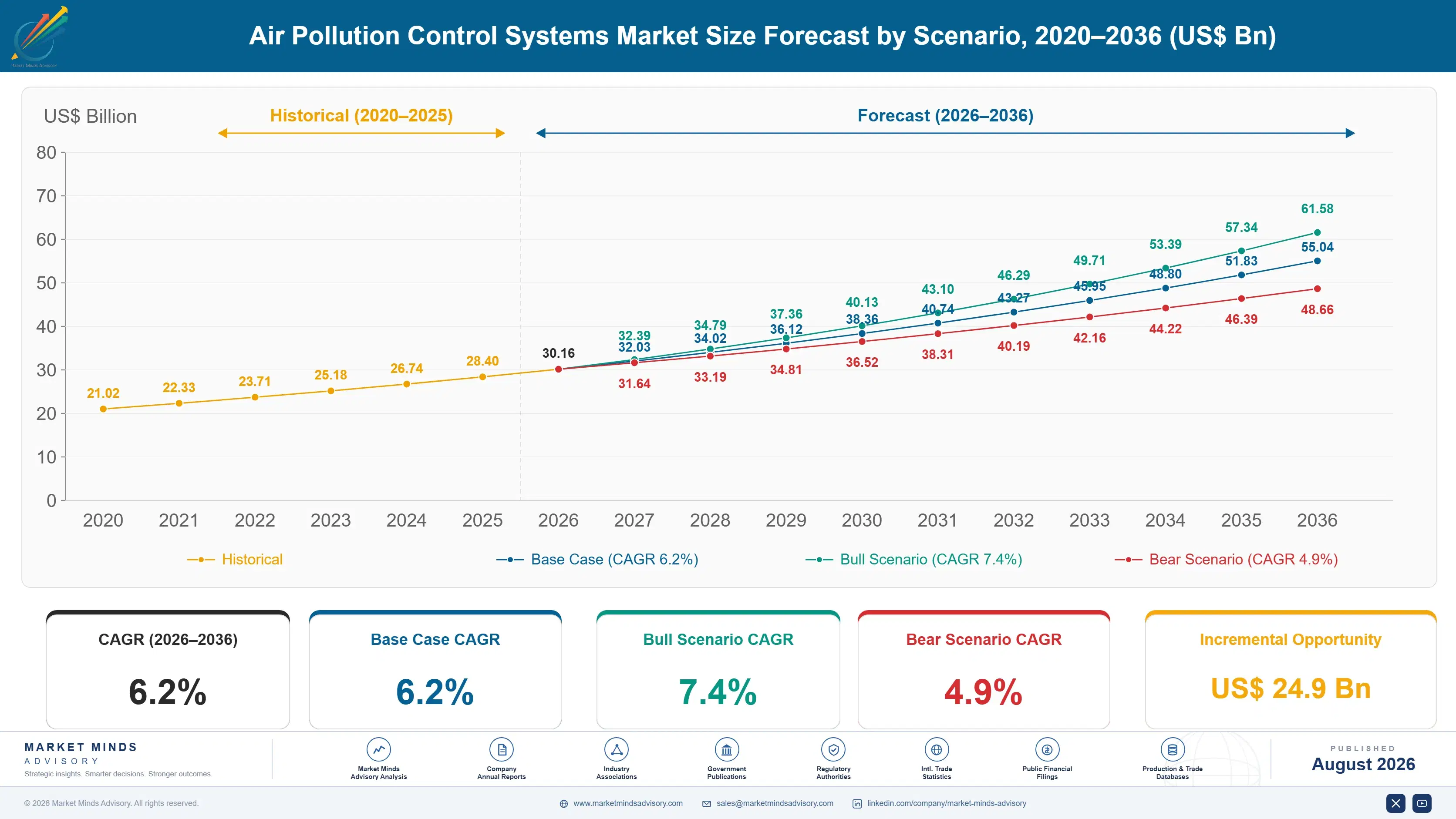
Growth from 2020 to 2025 compounded near 5.3%, held back early by pandemic-era construction delays that pushed several planned retrofit projects past their original schedules across major industrial regions, then accelerated as deferred spending resumed alongside genuinely new regulatory deadlines that had continued advancing regardless of the broader disruption underway, leaving a backlog suppliers spent years working through afterward.
Three mechanisms carry the base case to 6.2%. First, retrofit mandates, as regulators in China, India, and the European Union tighten particulate and NOx limits on facilities already in operation rather than only new construction. Second, marine sector compliance, as International Maritime Organization sulfur and nitrogen limits force fleet-wide scrubber and SCR retrofits across shipping operators. Third, digital monitoring adoption, as continuous emissions monitoring becomes a standing compliance requirement rather than a periodic testing exercise.
The bull case at 7.4% assumes regulatory tightening accelerates further across emerging Asian markets and marine retrofit mandates expand beyond their current scope faster than currently projected. The bear case at 4.9% assumes industrial capital spending slows during a broader manufacturing downturn and regulators delay enforcement deadlines under pressure from affected heavy industry lobbying groups.

Why Retrofit Spending Now Outweighs New Construction

Three forces set demand. Retrofit mandates provide the volume base, as regulators increasingly apply tightened particulate and NOx limits to facilities already operating rather than only new construction, converting existing plants into forced buyers. Marine sector compliance provides a second, genuinely global stream, as International Maritime Organization rules force scrubber and SCR retrofits across shipping fleets regardless of vessel age. And digital monitoring adoption adds a third, steadi
MARKET CONCENTRATIONCR5: 38%Moderately concentrated among diversified environmental equipment majors globally
AVERAGE SELLING PRICEUSD 0.4 to 45 million per systemInstalled system cost spread across facility scale and technology
TOP PRODUCING COUNTRY SHAREChina: about 23%Share of global emissions control equipment manufacturing output
RETROFIT SHARE OF REVENUEAbout 58%Portion of category revenue from existing-facility retrofit projects
STEEL AND CATALYST COSTAbout 34% of COGSPortion of production cost from structural steel and catalyst materials
SYSTEM OPERATING LIFE15 to 25 yearsTypical service life before a control system needs full replacement
The commercial character is set by steel and catalyst cost more than by control technology sophistication. Structural steel and catalyst materials together account for roughly 34% of cost of goods sold, and that share is exactly why suppliers with scaled steel fabrication and catalyst manufacturing capability hold pricing power that smaller regional integrators relying on subcontracted fabrication cannot match on large retrofit contracts.
The next decade turns on two things. Whether Asian regulatory tightening keeps expanding at its current pace, since China and India together represent the largest untapped retrofit population remaining globally. And whether continuous emissions monitoring becomes a universal compliance requirement rather than remaining concentrated in the most heavily regulated jurisdictions, since that expansion would convert a niche monitoring segment into a genuinely mandatory equipment category.
"Nobody budgets for a retrofit until the regulator forces the question, and then it becomes the most urgent capital project in the plant. That's why this industry runs on regulatory calendars more than on any demand forecast we could build from industrial output alone."
Director, Industrial Equipment and Environmental Systems Practice · MMA Industri

Market Trends

Retrofit Spending Has Permanently Overtaken New-Build Demand

Roughly 58% of category revenue now comes from retrofitting existing facilities rather than equipping new construction, a reversal from a decade ago when new-build projects dominated supplier order books across most major markets. Regulators applying tightened particulate and NOx limits to operating facilities, rather than grandfathering them under older standards, are the direct cause of that shift. CECO Environmental and Babcock and Wilcox have both restructured sales teams specifically around retrofit project pipelines through 2024 and 2025. Suppliers without genuine retrofit engineering capability increasingly lose bids to competitors who can work around a live, operating facility.
Market Impact: India tightened standards across 20
Continuous Emissions Monitoring Is Becoming A Standing Requirement

Regulators across major jurisdictions increasingly require continuous emissions monitoring rather than periodic stack testing, converting monitoring equipment from an occasional compliance purchase into standing infrastructure every regulated facility must maintain and calibrate continuously for as long as the plant keeps operating at all. Thermo Fisher Scientific has expanded monitoring system production capacity specifically to meet this shift toward mandatory continuous reporting. That requirement also generates recurring calibration and data reporting service revenue that periodic testing never produced. Digital compliance infrastructure is becoming as commercially important as the pollution control equipment itself.
Market Impact: IMO rules cover 2 pollutant classes

Market Opportunities and Growth Drivers

Asian Regulatory Tightening Is Creating The Largest Retrofit Pool

China and India together operate the largest population of industrial facilities still running on older emissions control technology or none at all, and both countries have tightened particulate and NOx standards considerably over the past several years under domestic clean air programmes. That regulatory tightening is converting an enormous installed base of unregulated or under-regulated facilities into a forced retrofit market larger than any single Western economy could generate independently. Andritz and Hamon have both expanded regional manufacturing and engineering capacity specifically to serve this demand directly rather than exporting from Western facilities.
Market Impact: Steel and catalyst reach 34% share

Marine Sulfur And Nitrogen Rules Force Fleet-Wide Retrofits

International Maritime Organization sulfur cap rules and expanding nitrogen oxide emission control areas are forcing shipping operators to install scrubbers or switch fuel across entire fleets, and scrubber retrofit remains the more capital-efficient choice for operators running vessels with significant remaining service life. That regulatory driver is genuinely global rather than regional, since a vessel trading internationally must comply regardless of which country's waters it currently operates within on any given voyage. Fuel Tech and several marine-focused suppliers have built dedicated shipping retrofit divisions specifically to serve this demand at scale across multiple fleet operators.
Market Impact: Shutdowns can delay projects 6+ mon

Market Restraints and Challenges

Steel And Catalyst Cost Volatility Squeezes Fixed-Price Contracts

Structural steel and catalyst materials together account for roughly 34% of cost of goods sold, and that concentration is the root cause of margin compression when input costs spike while large retrofit contracts typically lock in fixed pricing at the bidding stage months before construction actually begins. Commercially this hits smaller regional integrators hardest, since they lack the purchasing scale or hedging sophistication larger suppliers use to smooth input cost swings across a broader project portfolio. Operators respond with escalation clauses in longer project contracts and pre-purchasing steel ahead of confirmed contract award wherever cash flow allows.
Market Impact: Retrofit work is 58% of revenue

Retrofit Projects Face Unpredictable Facility Shutdown Windows

Retrofitting a live industrial facility requires coordinating installation around planned maintenance shutdown windows that operators guard carefully, and that scheduling constraint is the root cause of project delays that regularly push installation into a facility's next available outage rather than the originally planned timeline. Commercially this creates revenue recognition unpredictability that new-build projects, built on a construction schedule the supplier largely controls, do not share to the same degree at all. Suppliers respond by pre-fabricating major components off-site to compress the on-site installation window as tightly as possible given the constraint.
Market Impact: Mandates expanded across 2024-2025
3 additional market trends, 4 additional growth drivers, and 2 additional restraints and challenges are covered in the full report. Contact sales@marketmindsadvisory.com to access the complete intelligence.

Segment CAGR and Growth Architecture

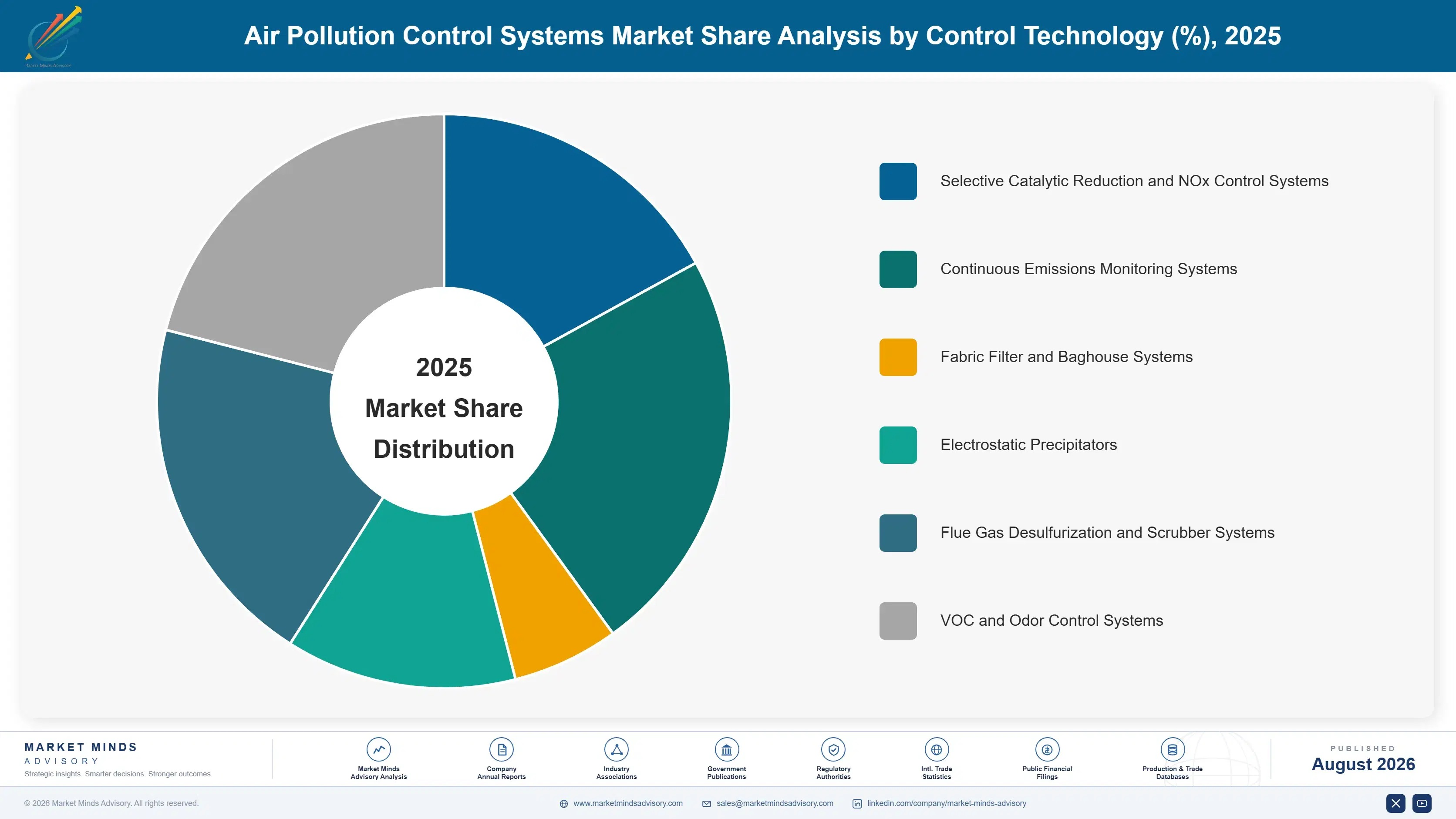
Segmentation follows control technology type, a single engineering logic describing which pollutant class the equipment removes and how rather than which industry buys it. Each technology carries its own capital cost, catalyst or media replacement cycle, and retrofit complexity, so commercial position tracks the underlying control mechanism rather than end-use industry alone across every category.
air-pollution-control-systems-market-market-share-analysis-1787332637088

Selective Catalytic Reduction and NOx Control Systems

Selective catalytic reduction and NOx control systems grow fastest at 9.5%, about 1.53 times the overall 6.2% rate, covering catalyst-based and non-catalytic nitrogen oxide reduction technology for power plants, industrial boilers, and marine vessels facing tightening nitrogen oxide limits simultaneously across multiple regulatory regimes. Marine retrofit demand under expanding emission control areas is genuinely new volume this segment did not previously capture at meaningful scale. Fuel Tech and Babcock and Wilcox both compete strongly here alongside catalyst specialists supplying the replacement media this technology requires periodically. Recurring catalyst replacement revenue makes this segment attractive beyond the initial installation sale, since a working system generates consumable demand for its entire operating life.
CAGR 9.5%

Fabric Filter and Baghouse Systems

Fabric filter and baghouse systems grow at 6.4%, the largest segment by installed base though no longer the fastest, covering particulate removal technology that has progressively displaced older electrostatic precipitator installations across cement, steel, and power generation facilities. Growth remains steady as fabric filtration delivers more consistent particulate capture efficiency than ageing electrostatic technology, particularly for fine particulate matter that regulators increasingly target specifically. Donaldson Company and CECO Environmental both hold strong positions here across industrial and power generation customer bases worldwide. This segment remains the volume foundation underneath the category even as growth concentrates in NOx control and monitoring elsewhere in the portfolio, which is where most incremental margin now sits.
CAGR 6.4%
Full segment breakdown across 6 segments available in the complete report.

Regional Architecture and Country Demand Map

Heavy industry concentration and regulatory stringency together set this distribution more than raw manufacturing output does across most markets globally. East Asia leads on both installed industrial base and tightening domestic standards, while share elsewhere tracks how aggressively each jurisdiction has moved against existing-facility emissions.

North America

Retrofit demand anchors North America's 24% share, as American power plants and industrial facilities continue upgrading equipment installed decades ago to meet tightened particulate and NOx standards phased in under existing federal air quality rules. CECO Environmental and Donaldson Company both maintain extensive domestic manufacturing and engineering capacity serving this retrofit-driven demand directly. Canadian demand follows a comparable trajectory, concentrated in oil sands processing and power generation facilities specifically. Marine retrofit demand along both coasts adds a meaningful secondary revenue stream tied to international shipping compliance requirements that continue tightening steadily. Growth of 6.0% reflects steady retrofit spending against a mature, already well-regulated industrial base nationally, with most large facilities already carrying at least baseline control equipment installed.
Share: 24% | CAGR: 6.0% (2026 to 2036)

Western Europe

Regulatory maturity shapes demand across Western Europe's 20% share more than new industrial growth does, with European Union industrial emissions directives already among the strictest globally and largely implemented across existing facilities years ago. German and French industrial operators maintain advanced emissions control standards reflecting both regulatory pressure and domestic environmental expectation. British demand follows a comparable trajectory independently of European Union regulation post-Brexit, maintaining similar standards across its own industrial base and supply chain. Growth of 4.6%, the slowest of the seven, reflects a mature market where most major retrofit projects already occurred during the previous regulatory tightening cycle across the region, leaving a smaller remaining addressable base for suppliers to pursue.
Share: 20% | CAGR: 4.6% (2026 to 2036)
Regional intelligence for 5 additional markets available in the complete report: East Asia, South Asia and Pacific, Latin America, Middle East and Africa, Eastern Europe. Contact sales@marketmindsadvisory.com.
air-pollution-control-systems-market-country-cagr-analysis-1787332637606

Where Emissions Control Suppliers Actually Win Retrofits

Competing on new-build equipment price alone means missing the larger and steadier retrofit revenue pool that now defines this category. The four moves below shift revenue toward positions a cheaper competitor cannot easily match: retrofit engineering depth, catalyst and consumable service revenue, steel cost discipline, and digital monitoring integration built directly into new contracts.

Build Retrofit Engineering Capability For Live Facilities

Retrofitting a live industrial facility, where 58% of category revenue now originates, requires engineering expertise new-build construction does not, since installation must work around planned maintenance shutdown windows the operator controls tightly and cannot easily extend without significant lost production cost. Suppliers who invest in pre-fabrication and rapid installation methods compress that shutdown window considerably, winning contracts competitors without comparable retrofit depth simply cannot bid competitively against on cost or schedule. CECO Environmental has structured recent capability investment around this retrofit specialisation across multiple industrial sectors and geographies, treating it as a core priority rather than an afterthought.
Market Impact: Retrofit work is 58% of all categor

Capture Recurring Catalyst And Consumable Replacement Revenue

Selective catalytic reduction systems require periodic catalyst replacement across their entire 15 to 25 year operating life, and suppliers who maintain the original customer relationship into consumable replacement capture recurring revenue considerably more predictable than one-time installation sales alone ever provide. That relationship also generates genuine competitive intelligence about a customer's future retrofit and expansion plans before competitors even learn a project exists. Fuel Tech has built meaningful commercial strategy specifically around this consumable and service revenue relationship across its installed base, treating catalyst service as a genuine profit centre rather than an incidental add-on to the original sale.
Market Impact: Systems need catalyst service for 1

Pre-Purchase Steel Ahead Of Confirmed Contract Award

Structural steel and catalyst materials together account for roughly 34% of cost of goods sold, and suppliers securing steel supply ahead of price spikes protect margin considerably better than competitors buying reactively once a fixed-price retrofit contract has already been signed and cannot be renegotiated. That discipline also lets a supplier bid more competitively on large retrofit tenders, since input cost uncertainty no longer forces as wide a contingency margin into the quoted price. Steel cost discipline is becoming a genuine differentiator in competitive tender evaluations, particularly on the largest retrofit programmes where pricing scrutiny runs deepest.
Market Impact: Steel and catalyst reach 34% of tot

Bundle Continuous Monitoring Into New Retrofit Contracts

Regulators increasingly require continuous emissions monitoring alongside the control equipment itself, and suppliers who bundle monitoring system installation directly into retrofit contracts capture that adjacent revenue rather than ceding it to a separate monitoring specialist bidding independently on the same facility. Thermo Fisher Scientific has built partnership relationships with control equipment suppliers specifically to capture this bundled opportunity, which can add 10% or more to total deal value across major retrofit programmes. That bundling also simplifies procurement for the customer, who increasingly prefers a single accountable vendor over coordinating separate contracts and warranty relationships across multiple suppliers on one project.
Market Impact: Bundled contracts can add 10%+ to d

Who Controls the Margin Pool

Concentration is moderate: the top five hold roughly 38% of revenue, reflecting a field of diversified environmental equipment majors competing against regional specialists with strong local retrofit relationships and regulatory familiarity. The gap between leaders and challengers is retrofit engineering depth and catalyst service relationships rather than raw manufacturing scale alone. All participants here are assessed on one basis, annual manufacturing and installation revenue from air pollut
Competition runs along three lines. First, retrofit engineering capability, since suppliers who compress shutdown installation windows win contracts price-focused competitors cannot match. Second, catalyst and consumable service revenue, as recurring replacement relationships prove considerably more valuable than one-time installation sales alone. Third, digital monitoring integration, particularly for suppliers bundling compliance reporting directly into retrofit contracts.

Pressure is building from two directions. Chinese and Indian manufacturers are expanding capacity rapidly to serve fast-growing domestic retrofit demand that established Western suppliers serve less efficiently given logistics and local engineering relationships. Meanwhile monitoring specialists including Thermo Fisher Scientific are partnering directly with control equipment suppliers to bundle compliance offerings together. Rankings should favour suppliers combining retrofit depth with genuine monitoring integration.
air-pollution-control-systems-market-company-positioning-matrix-1787332638128

Competitive Moat and Risk Dimensions

CECO ENVIRONMENTAL

Moat: Retrofit engineering specialisation

CECO Environmental has built its commercial strategy specifically around retrofit engineering for live industrial facilities, giving it installation speed advantages competitors focused on new-build construction cannot easily replicate. Its diversified technology portfolio spanning particulate and NOx control lets it serve a single customer across multiple pollutant compliance needs simultaneously. Deep relationships across industrial sectors provide referral-driven growth few competitors match.
CECO ENVIRONMENTAL

Risk: Exposure to industrial capital cycles

CECO Environmental's retrofit-heavy revenue base is sensitive to industrial capital spending cycles, since customers can delay discretionary retrofit timing when facing margin pressure regardless of regulatory deadlines approaching. Regional specialists in China and India can undercut on price for standard retrofit work where engineering complexity is lower. Steel and catalyst cost exposure across its portfolio is considerable given contract scale.
THERMO FISHER SCIENTIFIC

Moat: Monitoring technology and data platform

Thermo Fisher Scientific holds leading continuous emissions monitoring technology and an established data reporting platform that regulators and customers already trust, giving it credibility new monitoring entrants must build from nothing. Its broader scientific instrumentation business provides cross-selling opportunities pure-play monitoring specialists lack entirely. Partnership relationships with control equipment suppliers extend its reach into bundled retrofit contracts directly.
THERMO FISHER SCIENTIFIC

Risk: Narrow exposure beyond monitoring niche

Thermo Fisher Scientific's environmental monitoring position remains a small part of a much larger diversified scientific instrumentation business, limiting the focused investment this specific category might otherwise receive from a pure-play competitor. Control equipment suppliers building in-house monitoring capability could bypass its partnership model over time. Regulatory scope changes affecting monitoring requirements directly shape this narrower revenue stream considerably.

Players Tracked

Prominent Players

CECO Environmental
Babcock and Wilcox
Thermo Fisher Scientific
Donaldson Company
Nederman Group

Other Key Players

Fuel Tech
Andritz
Hamon
GE Vernova
Mitsubishi Power
Envea
Durr
Camfil
Wood plc
Beltran Technologies
Tri-Mer Corporation
Air Clean LLC
Pollution Systems
KCH Services
Clean Air Engineering

Recent Developments

APRIL 2025

CECO Environmental expands retrofit engineering capacity in Asia

CECO Environmental announced retrofit engineering and fabrication capacity expansion across two Asian facilities to serve tightening regional NOx and particulate standards. This was an organic capacity expansion rather than an acquisition, extending capability the company had piloted at a single site the previous year specifically.
Signal: Capacity investment ahead of confirmed reg
OCTOBER 2024

Thermo Fisher Scientific partners with major SCR equipment supplier

Thermo Fisher Scientific announced a partnership agreement with a major selective catalytic reduction equipment supplier to bundle continuous emissions monitoring directly into retrofit contracts. This was a partnership agreement rather than an acquisition or joint venture, extending its monitoring reach into bundled retrofit sales specifically.
Signal: Monitoring specialists are increasingly pa
FEBRUARY 2025

Babcock and Wilcox wins major marine scrubber retrofit contract

Babcock and Wilcox announced a major contract to retrofit scrubber systems across a shipping operator's international fleet ahead of tightening International Maritime Organization sulfur requirements taking effect soon. This was a confirmed supply and installation contract rather than an acquisition, extending its marine retrofit position considerably.
Signal: Marine retrofit contracts are increasingly

Structural Steel, Catalyst Materials, Fabrication Labour

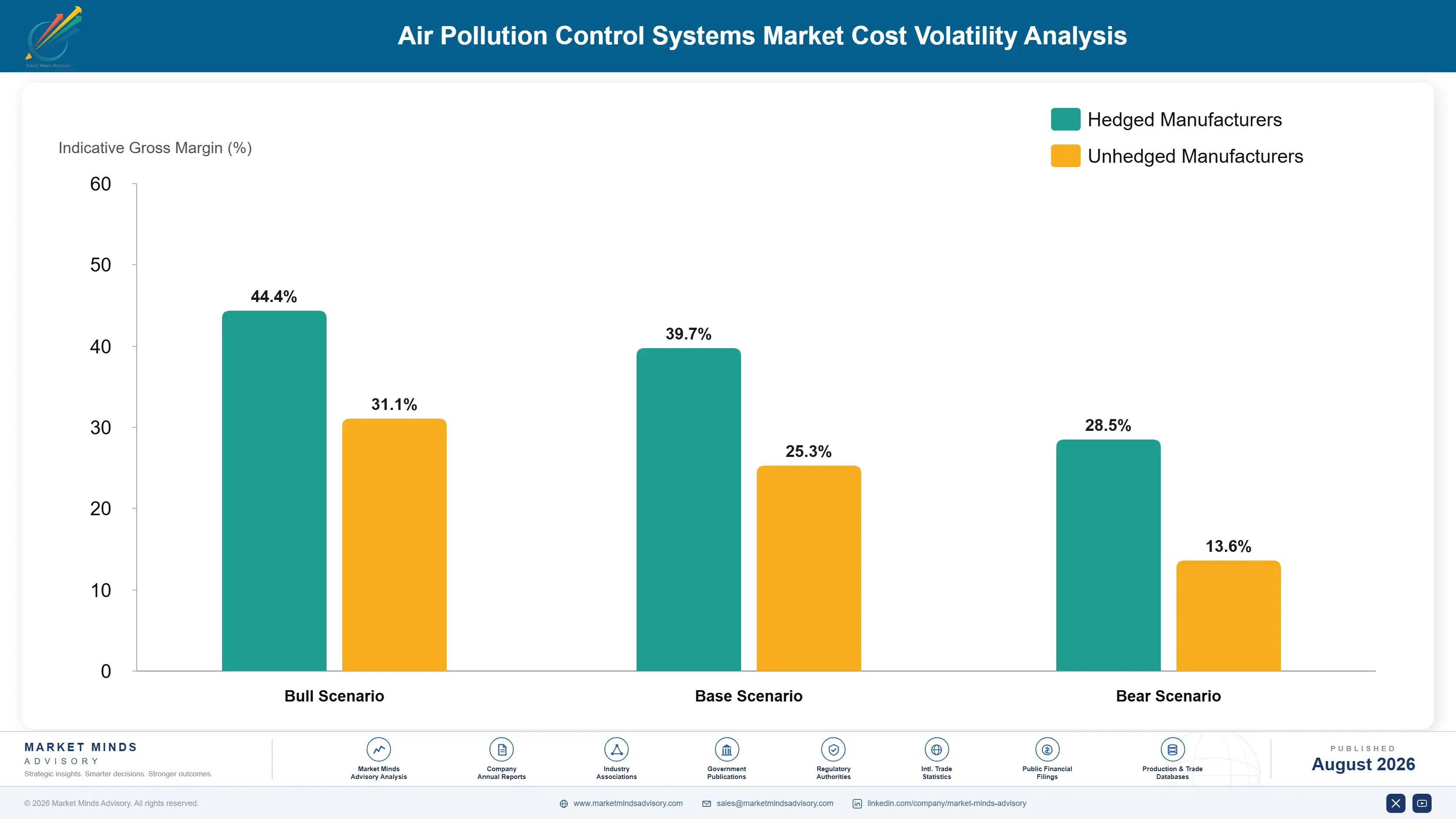
Structural steel and catalyst materials together account for roughly 34% of cost of goods sold, sourced from steel mills and specialty catalyst manufacturers whose pricing varies with industrial commodity and precious metal conditions depending on catalyst chemistry chosen. Fabrication and installation labour contribute a further 26% to 32%. Engineering and design take 10% to 14%, with the remainder covering freight and overhead.
Global steel prices spiked considerably through 2021 and 2022 amid broader supply chain disruption and demand recovery following pandemic-era production cuts across major steel-producing regions worldwide. CECO Environmental's annual report disclosed material input cost pressure across that period, and several suppliers renegotiated fixed-price contracts or absorbed margin compression rather than walking away from already-committed retrofit projects underway at the time this pressure hit hardest across the industry.

Exposure varies by contract structure and catalyst chemistry. Suppliers with escalation clauses in longer project contracts pass volatility through directly, while those on fixed-price agreements signed before a price spike absorb it until project completion arrives. Catalyst formulations using precious metals carry additional exposure to metal price volatility that correlates less predictably with broader steel markets generally.
air-pollution-control-systems-market-cost-volatility-analysis-1787332638323

Negotiate escalation clauses into longer retrofit contracts

Suppliers building steel and catalyst price escalation clauses directly into multi-year retrofit agreements pass volatility through to customers rather than absorbing it against thin fixed-price margin, a structure that protects profitability during spikes though it requires negotiating leverage smaller integrators sometimes struggle to secure with larger, better-resourced industrial buyers holding more purchasing power of their own to negotiate with.

Pre-purchase steel ahead of confirmed contract award

Suppliers with sufficient balance sheet capacity are pre-purchasing structural steel ahead of finalising contract terms, locking in cost before a fixed-price bid is submitted rather than exposing the quoted price to volatility between bid submission and eventual contract award months later in the procurement cycle that follows initial tender submission to the client and its advisors.

Diversify catalyst chemistry to reduce precious metal exposure

Catalyst manufacturers developing formulations using less precious metal content, or blending multiple catalyst chemistries across a product line, reduce concentrated exposure to any single metal's price volatility, a diversification strategy that protected several manufacturers during recent precious metal price spikes more effectively than single-chemistry competitors managed at the time this hit hardest across the sector.

Portfolio Architecture for Margin Defence

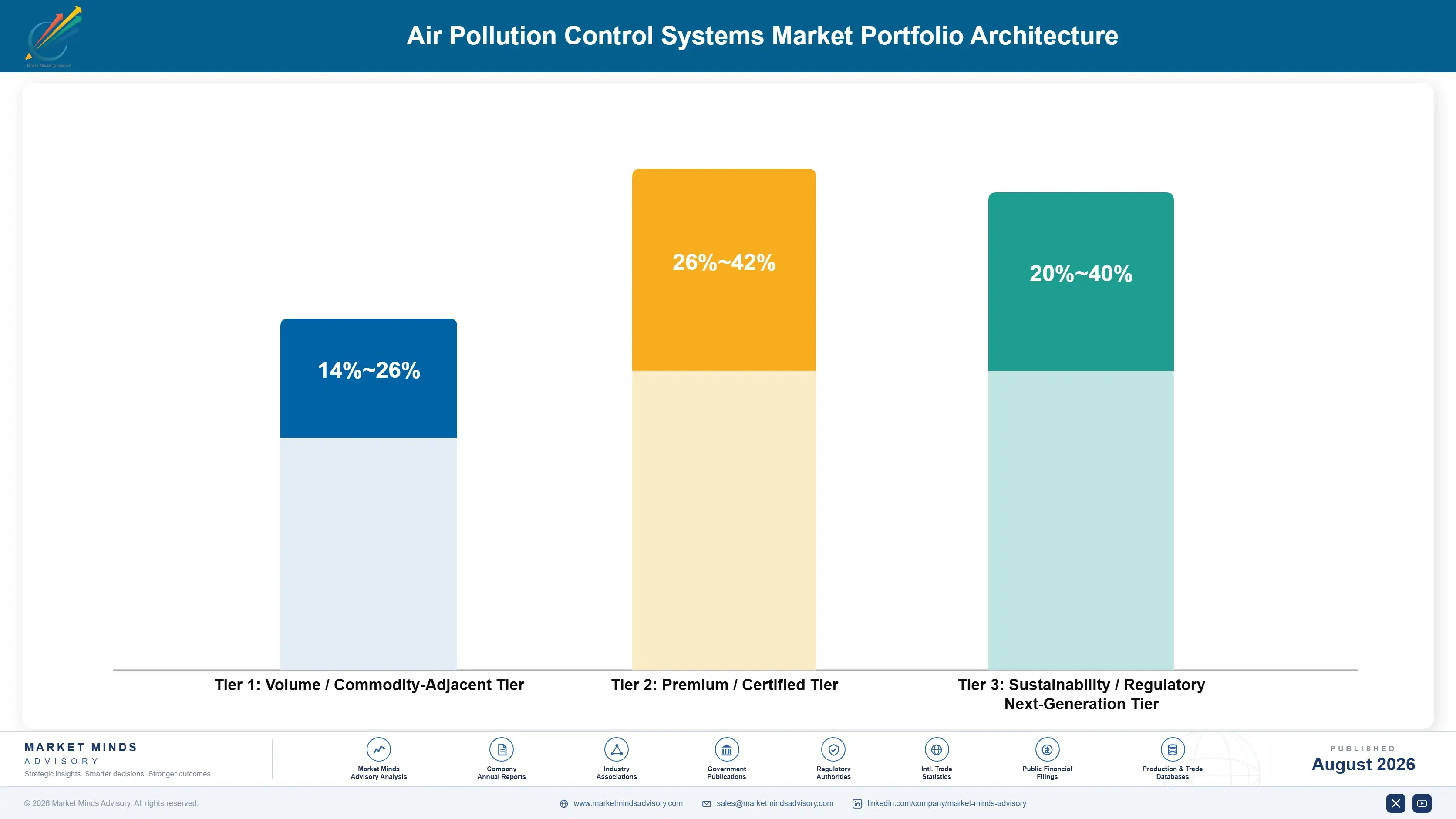
The portfolio splits into three tiers with sharply different economics. Standard particulate control equipment forms the volume tier, competing largely on price with margin set by steel cost and fabrication scale. NOx control and monitoring systems earn considerably more because catalyst service relationships and regulatory complexity both resist commoditisation pressure hitting standard particulate formats. Bundled retrofit-plus-monitoring programmes sit differently, priced against contract swi
The tension runs between winning standard particulate control volume on price and building catalyst service and monitoring capability that protects margin over the long run. A supplier chasing every standard retrofit bid available eventually gets squeezed as regional competitors undercut on price, yet building NOx and monitoring capability requires investment thin-margin particulate work rarely funds adequately. Suppliers handling this well treat particulate control as the volume base and NOx plus monitoring as the margin engine.

High-value pools concentrate where catalyst service, monitoring integration, or retrofit depth limit competition: SCR systems generating recurring catalyst revenue, bundled monitoring contracts capturing adjacent spending, and complex retrofit programmes requiring genuine live-facility engineering. Standard particulate control sits at the other end, competing almost entirely on price against every regional fabricator with comparable equipment.

Volume / Commodity-Adjacent Tier

Standard fabric filter and particulate control equipment for mainstream industrial facilities competing largely on price and delivery speed. Margin is thin and set almost entirely by steel cost and fabrication scale.
Gross Margin: 14-26%

Premium / Certified Tier

SCR and NOx control systems with recurring catalyst service relationships serving power generation, marine, and heavy industry clients across most regions. Margin reflects catalyst service revenue and genuine engineering complexity involved.
Gross Margin: 26-42%

Sustainability / Regulatory / Next-Generation Tier

Bundled retrofit-plus-monitoring programmes and next-generation low-emission control technology addressing both compliance and digital reporting requirements together for regulated facilities everywhere. The wide range reflects early-stage bundled pricing still settling industry-wide.
Gross Margin: 20-40%
air-pollution-control-systems-market-portfolio-architecture-1787332638817

High-value Sub-segments and Strategic Watch-out

Selective Catalytic Reduction and NOx Control Systems

High value and high growth at 9.5%, the fastest technology, as power, marine, and heavy industry all face tightening nitrogen oxide limits simultaneously across nearly every major regulatory regime worldwide today and increasingly across export-facing fleets and facilities too, suppliers now consistently and reliably report seeing.
Gross Margin: 26-42%

Continuous Emissions Monitoring Systems

High value with strong growth at 8.6%, driven by regulators converting periodic stack testing into standing continuous monitoring requirements that generate recurring calibration and compliance reporting service revenue for suppliers across nearly every regulated facility type and jurisdiction worldwide today and increasingly well into tomorrow too.
Gross Margin: 28-46%

Fabric Filter and Baghouse Systems

The volume core by installed base, growing at 6.4% as particulate control remains the largest category even as growth concentrates in NOx control and monitoring elsewhere in the portfolio entirely. Bundled equipment platforms compete here mainly on scale and price alone today across every region.
Gross Margin: 14-26%

Electrostatic Precipitators

The strategic watch-out, growing at just 3.2% and steadily displaced by fabric filtration offering more consistent fine particulate capture across most industrial applications worldwide today. Survival increasingly depends entirely on legacy installed base maintenance rather than genuine new installation demand emerging anywhere at all today.
Gross Margin: 12-22%

How Emissions Control Revenue Actually Persists

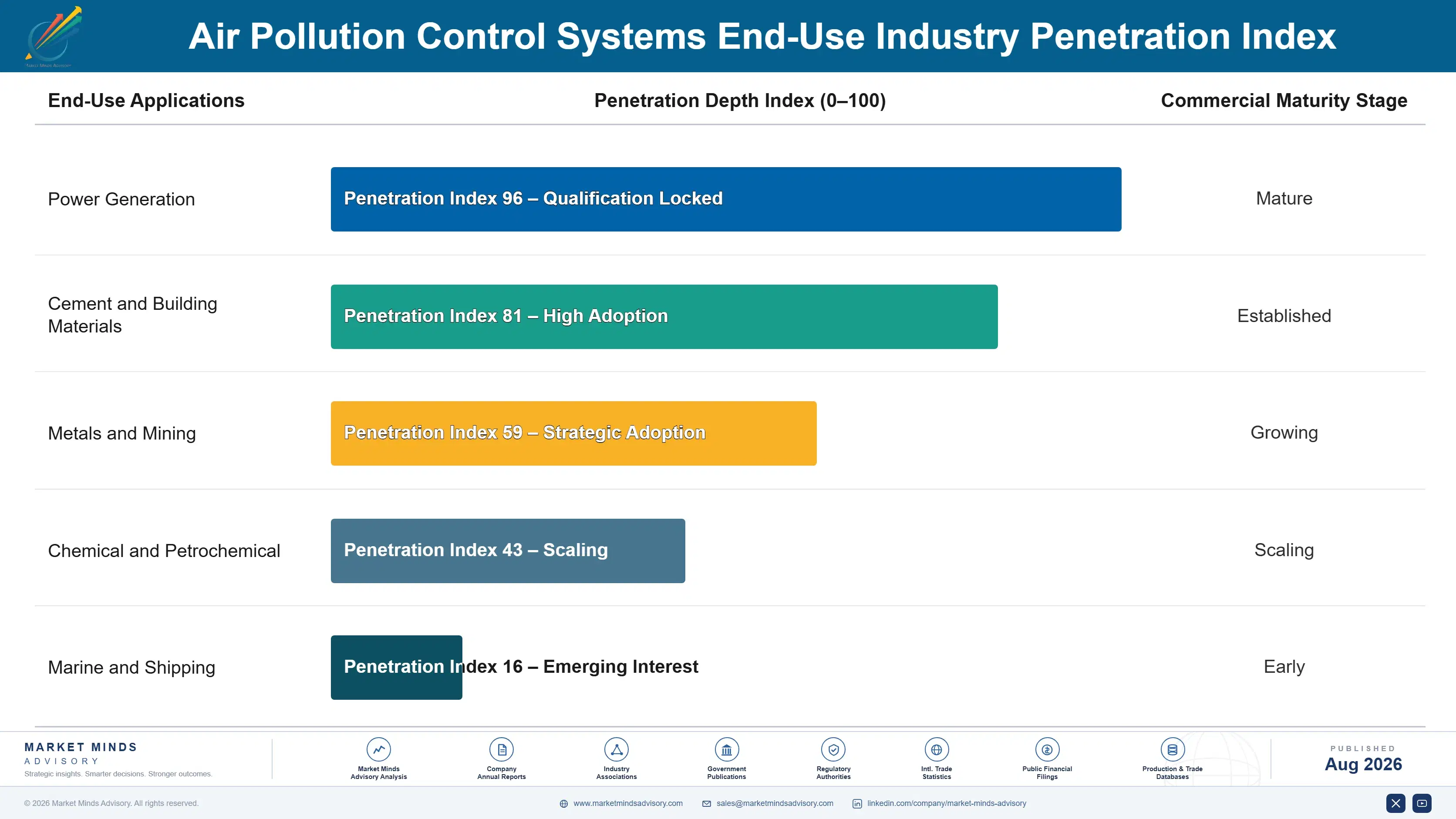
Revenue depends on a system's entire operating relationship, not on winning a single installation contract. An SCR system generates catalyst replacement revenue across its full 15 to 25 year operating life, so annuity value sits in that ongoing service relationship rather than in the original installation sale alone. Standard particulate control programmes behave differently, generating a single installation payment with comparatively limited recurring revenue once the system is delivering compl
Stickiness varies sharply by technology and service depth. SCR and monitoring systems stick hardest, since switching a catalyst or monitoring supplier mid-relationship risks compliance continuity that operations teams avoid disrupting unless genuinely forced to. Standard particulate programmes stick moderately, protected mainly by installation familiarity and spare parts compatibility rather than genuine differentiation. Price-driven standard retrofit contracts switch most readily, since any qualified fabricator meeting specification satisfies the requirement.

Buyer profiles have shifted generationally. Plant engineering teams that once selected suppliers primarily on installed cost increasingly weigh retrofit engineering speed and long-term service relationship depth, given how disruptive an extended shutdown window actually costs a facility. Environmental compliance and sustainability leadership increasingly sit alongside engineering in supplier selection, a shift regulatory complexity has made necessary rather than optional.
air-pollution-control-systems-market-end-use-penetration-index-1787332639309

Our Call On Emissions Control

These are among the four positions where our research anticipates prominent divergence between winners and laggards over the coming forecast period. Each is grounded in the demand model, the regulatory perimeter, and the announced capacity pipeline.
01 / RETROFIT DEPTH WINS

Shutdown-window engineering decides contract awards

Retrofitting a live industrial facility requires engineering expertise that new-build construction does not, since installation must work around planned maintenance shutdown windows the operator controls tightly and cannot easily extend without significant lost production cost. Suppliers who invest in pre-fabrication and rapid installation methods compress that window considerably, winning contracts competitors without comparable retrofit depth cannot bid against on cost or schedule. Suppliers should treat retrofit engineering as the primary growth investment rather than a secondary capability handled reactively when a bid demands it.
02 / CATALYST SERVICE COMPOUNDS

Recurring replacement revenue beats one-time sales

Selective catalytic reduction systems require periodic catalyst replacement across their entire 15 to 25 year operating life, and suppliers who maintain the original customer relationship into consumable replacement capture recurring revenue considerably more predictable than one-time installation sales alone ever provide. That relationship also generates competitive intelligence about a customer's future plans before competitors even learn a project exists. Building this service relationship should rank above chasing every new installation bid available, since the recurring revenue proves far more durable over the system's operating life.
03 / STEEL DISCIPLINE PROTECTS BIDS

Locking input cost early wins competitive tenders

Structural steel and catalyst materials together account for roughly 34% of cost of goods sold, and suppliers securing steel supply ahead of price spikes protect margin considerably better than competitors buying reactively once a fixed-price contract has already been signed and cannot be renegotiated later. That discipline also lets a supplier bid more competitively on large retrofit tenders, since input cost uncertainty no longer forces as wide a margin into the quoted price. Suppliers still pricing reactively should build this into standard practice, not treat it as an occasional hedge.
04 / MONITORING BUNDLING ADDS VALUE

Single-vendor compliance packages beat split contracts

Regulators increasingly require continuous emissions monitoring alongside control equipment itself, and suppliers who bundle monitoring installation directly into retrofit contracts capture that adjacent revenue rather than ceding it to a separate specialist bidding independently on the same facility. That bundling also simplifies procurement for the customer, who increasingly prefers a single accountable vendor over coordinating separate contracts and warranty relationships across multiple suppliers on one project. Suppliers without a monitoring partnership already in place should build one before the next major tender arrives.

Engagement Snapshot From the Field

A live engagement with an industry participant carrying material or product regulatory and market exposure ahead of a defining policy shift, showing how our research translates into a defensible multi-year portfolio strategy.
MARKET MINDS ADVISORY · CLIENT ENGAGEMENT SUMMARY
Air Pollution Control Systems Producer Strategic Portfolio Review and Transition Roadmap 2026·Investment Scenario on Air Pollution Control Systems Exposure Evaluation 2025-26
CLIENT PROFILE
A regional power generation operator running four coal-fired facilities engaged MMA after state regulators announced tightened particulate and NOx limits with a thirty-month compliance deadline across the entire fleet. The client reported an estimated retrofit budget near USD 240 million, with no prior large-scale emissions retrofit experience across its engineering team (client-reported, unverified by MMA).
STRATEGIC CHALLENGE
Leadership needed to sequence retrofits across four facilities without taking more than one plant offline for extended maintenance at a time, since simultaneous shutdowns would have created a regional power supply shortfall the client's regulatory and commercial obligations could not reasonably absorb during peak demand periods across the service territory it covered.
MMA APPROACH
MMA benchmarked five qualified retrofit suppliers on engineering capacity, pre-fabrication capability, and demonstrated shutdown window compression across comparable prior projects. We modelled a sequencing plan balancing regulatory deadline risk against grid reliability requirements across the fleet. We then assessed catalyst and monitoring bundling options to simplify the client's ongoing vendor relationships.
KEY FINDINGS
  1. Two of five suppliers could not demonstrate shutdown windows short enough to meet the client's grid reliability constraints across all four facilities simultaneously.
  2. A staggered sequencing plan completing one facility every seven months met the regulatory deadline with a four-month buffer still remaining comfortably afterward.
  3. Bundling monitoring installation into the retrofit contract reduced projected total cost by roughly 9% versus running fully separate procurement processes throughout the project.
  4. The selected supplier's catalyst service agreement locked pricing for eight years, protecting the client against modelled precious metal cost volatility going forward.
CLIENT PROFILE
A regional power generation operator running four coal-fired facilities engaged MMA after state regulators announced tightened particulate and NOx limits with a thirty-month compliance deadline across the entire fleet. The client reported an estimated retrofit budget near USD 240 million, with no prior large-scale emissions retrofit experience across its engineering team (client-reported, unverified by MMA).
STRATEGIC CHALLENGE
Leadership needed to sequence retrofits across four facilities without taking more than one plant offline for extended maintenance at a time, since simultaneous shutdowns would have created a regional power supply shortfall the client's regulatory and commercial obligations could not reasonably absorb during peak demand periods across the service territory it covered.
MMA APPROACH
MMA benchmarked five qualified retrofit suppliers on engineering capacity, pre-fabrication capability, and demonstrated shutdown window compression across comparable prior projects. We modelled a sequencing plan balancing regulatory deadline risk against grid reliability requirements across the fleet. We then assessed catalyst and monitoring bundling options to simplify the client's ongoing vendor relationships.
KEY FINDINGS
  1. Two of five suppliers could not demonstrate shutdown windows short enough to meet the client's grid reliability constraints across all four facilities simultaneously.
  2. A staggered sequencing plan completing one facility every seven months met the regulatory deadline with a four-month buffer still remaining comfortably afterward.
  3. Bundling monitoring installation into the retrofit contract reduced projected total cost by roughly 9% versus running fully separate procurement processes throughout the project.
  4. The selected supplier's catalyst service agreement locked pricing for eight years, protecting the client against modelled precious metal cost volatility going forward.
RECOMMENDED STRATEGY
Phase 1: Phase 1 (0 to 7 months): Retrofit the first facility while completing detailed engineering for the remaining three plants in parallel. Phase 2: Phase 2 (7 to 21 months): Complete the second and third facility retrofits sequentially, maintaining grid reliability throughout the programme. Phase 3: Phase 3 (21 to 30 months): Complete the fourth facility retrofit with buffer time remaining ahead of the regulatory compliance deadline.
OUTCOME
The client completed all four retrofits within the sequencing plan and met the regulatory deadline with buffer time remaining, avoiding any grid reliability incident throughout the entire programme and across every facility involved. Bundled monitoring procurement delivered savings close to the modelled estimate (client-reported, unverified by MMA).

Frequently Asked Questions

Foundational context covering the market sizes, CAGR, scope, country, region and competition that inform every finding below. This section is provided to cover basics and most often pre-purchase conversations, answered from the MMA Primary Research Dataset.

What is the current size of the Air Pollution Control Systems Market?

The global air pollution control systems market is valued at USD 28.4 billion in 2025, covering particulate, NOx, SOx, and VOC control equipment plus continuous emissions monitoring. Mobile source and HVAC filtration are excluded.

How large will the Air Pollution Control Systems Market be by 2036?

The market is forecast to reach USD 55.02 billion by 2036 in the base case, about 1.83 times the 2026 level. That represents incremental value of roughly USD 24.86 billion across the decade.

What is the CAGR for the Air Pollution Control Systems Market 2026 to 2036?

The market grows at a 6.2% CAGR in the base case, with bull and bear scenarios at 7.4% and 4.9%. The spread turns mainly on Asian regulatory tightening pace and industrial capital spending strength.

Which segment is growing fastest?

Selective catalytic reduction and NOx control systems grow fastest at 9.5%, about 1.53 times the overall rate, as power, marine, and heavy industry face tightening nitrogen limits. Monitoring systems follow at 8.6%.

Who are the major companies in the Air Pollution Control Systems Market?

Leading companies include CECO Environmental, Babcock and Wilcox, Thermo Fisher Scientific, Donaldson Company, and Nederman Group. Concentration is moderate, with the top five holding roughly 38% of revenue.

Which country is growing fastest?

India grows fastest at a 10.8% CAGR, as the National Clean Air Programme forces retrofit spending across thousands of previously unregulated facilities. China follows on manufacturing scale and domestic tightening.

Report Segmentation Architecture

The full report scope spans multiple orthogonal segmentation dimensions, with cross-tabulated demand data provided for each dimension pair. Coverage extends further to regional breakdowns, trend trajectories, and the competitive detail needed to support segment-level decision-making.

By Control Technology

  • Selective Catalytic Reduction and NOx Control Systems
  • Continuous Emissions Monitoring Systems
  • Fabric Filter and Baghouse Systems
  • Electrostatic Precipitators
  • Flue Gas Desulfurization and Scrubber Systems
  • VOC and Odor Control Systems

By End-Use Industry

  • Power Generation
  • Cement and Building Materials
  • Metals and Mining
  • Chemical and Petrochemical
  • Marine and Shipping

By Commercial Dimension

  • New-Build Equipment Contracts
  • Retrofit and Upgrade Projects
  • Catalyst and Consumable Service Agreements
  • Monitoring and Compliance Reporting Services

By Region

  • North America
  • Western Europe
  • East Asia
  • South Asia and Pacific
  • Latin America
  • Middle East and Africa
  • Eastern Europe

Scope, Methodology, and Coverage

Every figure in this report is reproducible from documented input assumptions. The scope below maps the historical period, the forecast horizon, the segmentation dimensions, and the countries covered, alongside the underlying primary and qualitative methodology.
Historical Period
2020 to 2025
Forecast Period
2026 to 2036
Base Year
2025 (USD billions; MMA Primary Research Dataset, August 2026)
Market Definition
The air pollution control systems market comprises equipment that removes particulate matter, nitrogen oxides, sulfur oxides, volatile organic compounds, and other regulated pollutants from industrial and power generation exhaust streams, valued at manufacturer and installer revenue from equipment and associated services. It spans selective catalytic reduction and NOx control systems, continuous emissions monitoring systems, fabric filter and baghouse systems, electrostatic precipitators, flue gas desulfurization and scrubber systems, and VOC and odor control systems across power, industrial, and marine end uses. General HVAC filtration, indoor air quality products, and mobile source emissions control sold with vehicles are excluded.
Quantitative Units
USD billions (current prices); installed system counts where applicable
Segmentation Dimensions
By Control Technology; By End-Use Industry; By Commercial Dimension; By Region
Regions Covered
North America, Western Europe, East Asia, South Asia and Pacific, Latin America, Middle East and Africa, Eastern Europe
Countries Covered
USA, China, Germany, India, Japan, South Korea, UK, France, Canada, Australia, Brazil, Mexico, Chile, Peru, UAE, Saudi Arabia, South Africa, Poland, Czech Republic, Hungary, Romania, Indonesia, Vietnam, Italy, and additional markets relevant to this sector
Key Companies Profiled
CECO Environmental, Babcock and Wilcox, Thermo Fisher Scientific, Donaldson Company, Nederman Group, Fuel Tech, Andritz, Hamon, GE Vernova, Mitsubishi Power, Envea, Durr, Camfil, Wood plc, Beltran Technologies, Tri-Mer Corporation, Air Clean LLC, Pollution Systems, KCH Services, Clean Air Engineering
Quantitative Methodology
Primary survey, n=3,800 respondents, Q4 2025, six countries; demand-side model with trade association cross-validation
Qualitative Methodology
47 expert interviews, Q4 2025; applied to validate demand model assumptions, identify emerging dynamics, and assess competitive positioning
Report Format
PDF and XLSX data workbook (Word format preview document)
Publisher
Market Minds Advisory
Report Code
MMA-2026-CON-118
Published
August 2026
Contact
sales@marketmindsadvisory.com | www.marketmindsadvisory.com

Purchase the full Air Pollution Control Systems Market Report (2026 to 2036).

The full MMA Air Pollution Control Systems report sizes the market across six control technologies, five end-use industries, four commercial dimensions, and seven regions through 2036. It profiles 20 companies on a consistent manufacturing and installation revenue basis, scoring each on retrofit engineering depth, catalyst service relationships, and monitoring integration. Scenario models quantify how retrofit mandates, marine sector compliance, and steel cost volatility move both revenue and margin by technology. The report also includes retrofit versus new-build spending tracking, catalyst service revenue benchmarking, and regulatory calendar mapping for commercial and engineering leadership teams.
Six-technology and four-dimension market sizing to 2036
Twenty-company benchmark on manufacturing and installation revenue
Retrofit versus new-build spending tracking by region
Catalyst and consumable service revenue benchmarking
Regulatory calendar mapping across major jurisdictions
Marine sector scrubber and SCR retrofit demand modelling

Built For The People Who Decide

From boardroom strategy to bench-side execution, this report is read cover-to-cover by leaders shaping the next decade of their industry, turning demand scenarios, market dynamics and valuation benchmarks into decisions.
CXOs/ Presidents/ VPs/ Managers
M&A and Corporate Development
Strategy Teams and R&D Heads
Procurement and Product Directors
Regulatory and Compliance Leaders
Investor Relations and Equity Analysts