Market Minds Advisory
Air-Dried Food Market

Air-Dried Food Market: Drying Capacity Constraints, Raw-Adjacent Premiumization, and Mainstream Retail Expansion Through 2036

Premiumization pushing pet owners toward raw-adjacent nutrition, rendering-grade meat cost swings, and capacity constraints at a handful of specialized dryers are reshaping how brands price and scale air-dried pet food supply through 2036.

Lead Analyst

Lisa Gevelber

Published

September 2026

Make Smarter Decisions with Customized Research Insights

Request a free sample report and evaluate market opportunities, growth trends, and competitive dynamics relevant to your business needs.

2025 MARKET VALUE$1.2BMarket Size 2025
2036 FORECAST VALUE$4.4BBase Case , 2026 to 2036
CAGR 2026 TO 203612.5 %Bull 13.7% / Bear 11.3%
INCREMENTAL OPPORTUNITY$3.0BNet 10- year value creation
EXPANSION MULTIPLE3.25x2036 value over 2026 base
Strategic Levers
M&A Pipeline
Regional Outlook
Country Rankings
Competitive Intelligence
Segmental Deep-dive
Call-Us : 91 93563 13602

Executive Snapshot and Market Trajectory

Air-dried pet food has moved from a small specialty category into a genuine growth segment, as pet owners seeking raw-like nutrition without raw handling risk specify it by name over kibble and canned food despite commanding several times the price per pound of either format.
Demand concentrates around complete dog food formulations that command premium pricing well above conventional kibble across most Western retail markets, and around treats and food toppers that let budget-conscious pet owners sample the category without committing to a full diet switch, with production capacity concentrated among a small number of specialized dryers operating slow, low-temperature equipment that cannot simply be scaled up overnight like extrusion lines can.
Supply sits with a handful of brands that pioneered the category and built genuine consumer trust around raw-like nutritional claims, so newer entrants face a real credibility gap that pure marketing spend cannot quickly close no matter how much capital they deploy. Rising input meat costs and limited drying capacity are pushing brands to secure long-term meat supply contracts, reshaping which manufacturers can even scale production fast enough to meet accelerating retail demand.
Market Definition
The air-dried food market covers pet food and treat products manufactured through a slow, low-temperature air-drying process that removes moisture while preserving raw-like nutritional density, across complete dog food, complete cat food, treats, hybrid kibble, working dog, and veterinary applications. It excludes freeze-dried pet food, conventional dehydrated jerky treats processed via different methods, and human air-dried food products.
Base Year Value
$1.2B in 2025 (MMA Primary Research Dataset, August 2026)
Forecast Period
2026 to 2036, eleven discrete annual values
CAGR
12.5% base case. Bull 13.7%. Bear 11.3%.
Fastest Growth Segment
Air-Dried Complete Dog Food Applications: 15.8% CAGR
Fastest Growth Country
China: 14.2% CAGR
Fastest Growth Region
South Asia and Pacific: 14.6% CAGR
Largest Region
North America: 29% of 2025 global value
Market Leaders
Ziwi Limited, The Honest Kitchen Inc, K9 Natural Ltd, Real Pet Food Co Pty Ltd, Grandma Lucy's Inc. Source: MMA Analysis based on company annual reports and disclosed production volume.
Primary Survey
n=3,800 procurement and R&D decision-makers, Q4 2025, six countries
Methodology
Demand-side build-up, cross-validated against public data, 47 expert interviews

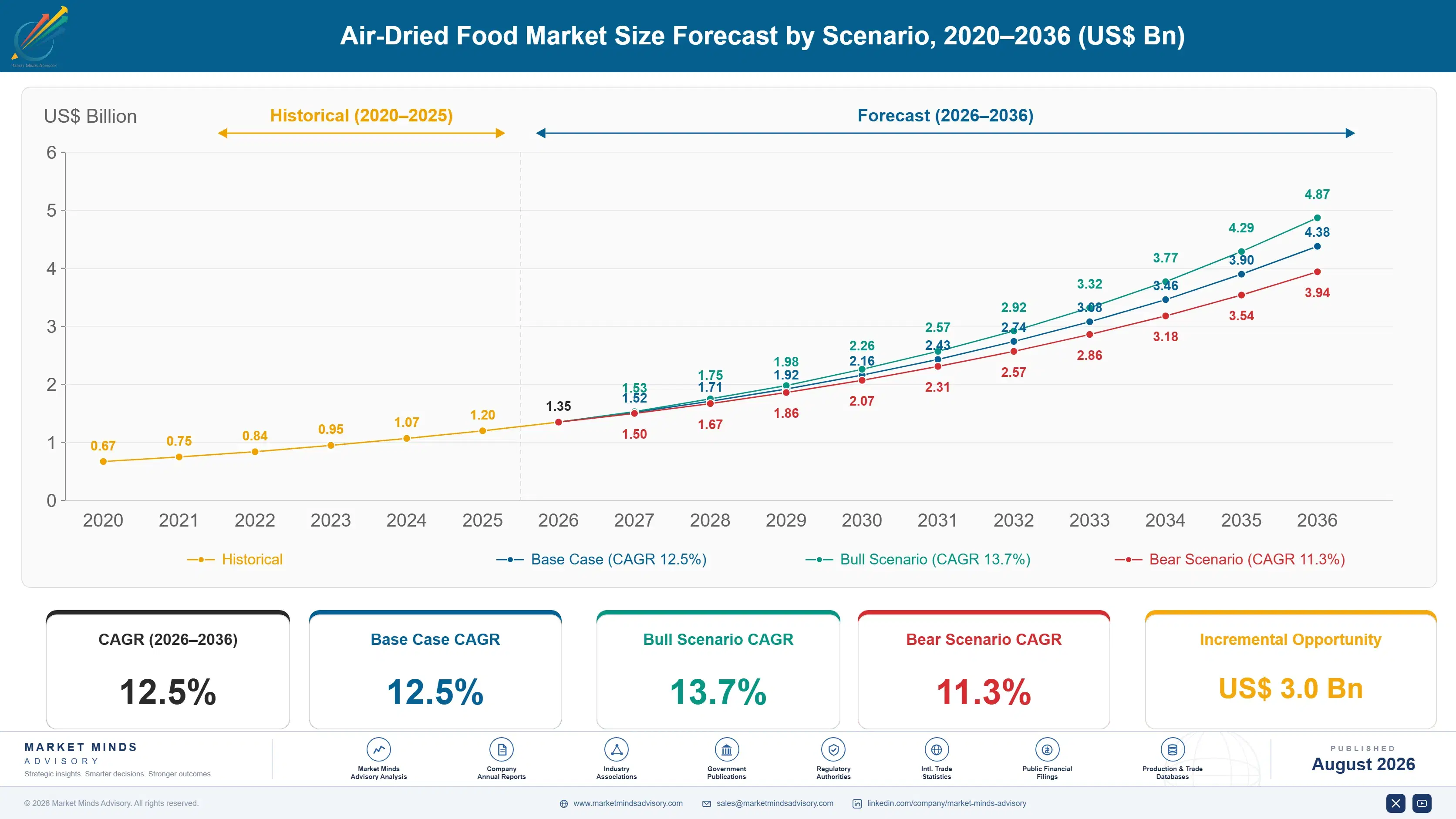
Air-Dried Food Market Forecast Scenarios

air-dried-food-market-size-forecast-scenario-1787461545947
Between 2020 and 2025, air-dried pet food demand grew rapidly as premiumization accelerated during and after pandemic-era pet adoption surges, though drying capacity constraints periodically limited how fast brands could actually fulfill growing retail orders. Growth delivered a historical CAGR near 11.7 percent across the period, among the fastest of any pet food category tracked.
MMA's base case projects 12.5 percent CAGR through 2036, anchored in three commercial mechanisms: continued premiumization toward raw-like nutrition without raw handling risk, expanding treats and topper formats that introduce budget-conscious pet owners to the category at lower price points, and steady drying capacity investment easing the supply constraint that has capped growth historically. Retail distribution expansion beyond specialty pet stores into mainstream grocery supports this trajectory as the category matures.
The bull case rests on faster-than-modeled mainstream grocery distribution expansion putting air-dried products in front of far more shoppers than specialty pet retail alone ever could. The bear case centers on a severe meat byproduct cost spike compressing already-thin margins, or a food safety incident at any major brand denting category-wide consumer trust faster than smaller brands could recover from.

A Category Capped By Its Own Process

Air-dried pet food occupies a pricing tier most kibble brands never reach, since the slow, low-temperature drying process concentrates meat content into a dense format that costs several times more per pound than extruded kibble to produce and to buy at retail. That concentrated nutrient density is the entire commercial argument behind the category.
MARKET CONCENTRATION (CR5)52%Top five brands hold significant combined pricing influence globally
AVERAGE SELLING PRICE$14,500/tonne (complete diet)Complete diet commands steep premium over standard kibble pricing
TOP PRODUCING COUNTRY SHARENew Zealand, 28%Single small nation supplies well over a quarter of exports
CAPACITY UTILIZATION88%Dryers run facilities near full operating capacity currently today
TRADE INTENSIVENESS48%Notable share of finished product crosses international borders yearly
INPUT COST SHARE64%Raw meat protein costs dominate total production cost structure
That price gap shapes customer behavior distinctly across the category. Loyal buyers treat air-dried food as a complete diet replacement worth the premium, while a much larger group buys smaller treat and topper formats specifically to sample the category's raw-like benefits without committing to full-diet pricing on every single meal. Brands increasingly design tiered product lines specifically to capture both buyer types simultaneously.
Production capacity concentrates among a handful of specialized dryers, since the equipment and process expertise required cannot simply be replicated by adapting existing extrusion or canning lines built for other pet food formats entirely. Brands increasingly secure long-term meat supply contracts directly with protein processors to protect against feedstock volatility, a practice that barely existed when the category was still a small niche specialty product a decade ago.
"Pet owners paying triple the price per pound aren't buying convenience. They're buying the feeling of feeding their dog something closer to what it would actually choose to eat in the wild."
Director, Pet Nutrition Practice · MMA Pet Food and Animal Nutrition Practice · August 2026

Market Trends

Mainstream Grocery Distribution Expansion Beyond Specialty Retail

Air-dried pet food, once confined almost entirely to independent pet specialty stores and direct-to-consumer channels, has begun securing shelf space in mainstream grocery chains and large pet superstore formats that reach a far broader shopper base than specialty retail alone ever could. This distribution expansion has required brands to adapt packaging and price points for a more price-sensitive mainstream shopper without diluting the premium positioning that loyal specialty retail customers expect and pay for. Several major grocery chains have added dedicated premium pet food sections specifically to accommodate this growth.
Market Impact: Adds 9 percent to working-dog demand
Raw Feeding Safety Concerns Drive Air Dried Adoption

Growing awareness of bacterial contamination risk associated with raw pet food handling has pushed cautious pet owners toward air-dried alternatives that deliver similar raw-like nutritional positioning without the handling and storage risks that raw diets carry for households with children or immunocompromised members. Veterinarians increasingly mention air-dried food as a safer alternative when raw-curious clients ask about diet options, a referral pattern that barely existed before food safety concerns around raw diets gained broader public attention. This positioning has helped the category capture raw-curious buyers who ultimately decided against fully raw feeding.
Market Impact: Adds 13 percent to topper-grade demand

Market Opportunities and Growth Drivers

Working Dog Nutrition Segment Adopts Air Dried Formats

Sporting and working dog owners, who prioritize energy density and digestibility for animals with demanding physical activity levels, have increasingly adopted air-dried food as a lighter, more calorie-dense alternative to kibble that reduces the total weight handlers must carry on hunting trips or working assignments. Specialty brands targeting this segment have built dedicated product lines around higher fat and protein concentrations specifically formulated for working dog energy requirements rather than adapting standard pet formulations. This segment commands loyal repeat purchasing from handlers who value consistent performance over price sensitivity that dominates mainstream pet food purchasing decisions.
Market Impact: Caps output growth near 10 percent

Treat And Topper Formats Lower Category Entry Barrier

Smaller, lower-priced treat and food topper formats let budget-conscious pet owners sample air-dried nutrition without committing to the considerably higher cost of switching a pet's entire diet, functioning as an effective trial mechanism that has expanded the category's addressable customer base well beyond committed premium buyers. Brands increasingly treat these formats as a deliberate funnel strategy, tracking how many topper buyers eventually convert to full diet purchases over time. This entry-level positioning has proven durable rather than a temporary marketing tactic, since topper sales continue growing even as full-diet product lines expand alongside them.
Market Impact: Limits addressable households to 18 percent

Market Restraints and Challenges

Limited Drying Capacity Constrains Production Scaling Speed

Air-drying requires specialized, slow, low-temperature equipment that takes considerably longer per batch than extrusion or canning lines used for conventional pet food, meaning brands cannot simply add a second shift or run equipment faster to meet surging retail demand the way other formats can. The root cause is that the drying process itself, not labor or raw material availability, sets the hard ceiling on output, and building new drying capacity requires significant capital investment and lead time measured in years rather than months. Some brands are responding by pre-selling limited retail allocations to manage demand against known capacity constraints transparently.
Market Impact: Adds 15 percent to retail reach

Premium Pricing Limits Total Addressable Household Base

Air-dried food price per pound, often several times higher than conventional kibble, limits the category addressable market to households willing and able to spend considerably more on pet nutrition than the median pet owner currently does. The root cause is the fundamentally higher input cost and slower, more capital-intensive production process relative to extruded kibble, a persistent cost gap that scale alone cannot fully close given the process itself. Brands are responding by expanding lower-priced treat and topper formats specifically to reach price-sensitive households who cannot justify full-diet switching costs.
Market Impact: Lifts safety-conscious volume by 11 percent
2 additional market trends, 4 additional growth drivers, and 3 additional restraints and challenges are covered in the full report. Contact sales@marketmindsadvisory.com to access the complete intelligence.

Segment CAGR and Growth Architecture

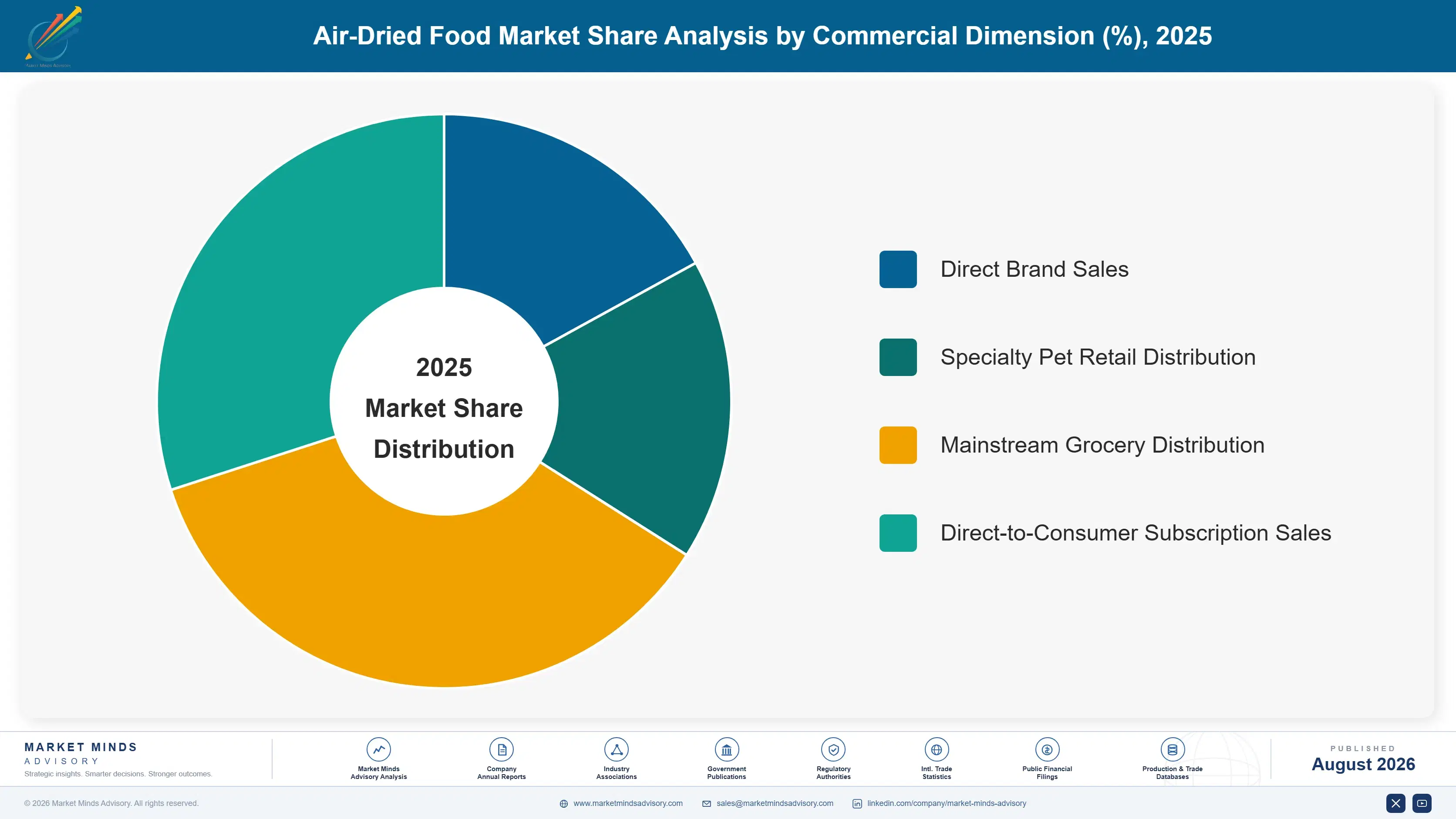
MMA segments the air-dried food market by end-use application rather than by protein source or packaging format alone, since complete dog food, complete cat food, treats, hybrid kibble, working dog, and veterinary buyers each purchase against genuinely distinct nutritional completeness and price sensitivity specifications that determine which brands can supply that category at all.
air-dried-food-market-market-share-analysis-1787461546522

Air-Dried Complete Dog Food Applications

Air-dried complete dog food applications form the fastest-growing segment, expanding at 15.8 percent annually as pet owners seeking raw-like nutrition without raw handling risk switch their dog's entire diet away from kibble or canned food specifically to this format. Suppliers into this segment must formulate nutritionally complete diets meeting regulatory feeding trial and labeling standards, a bar considerably higher than treats or toppers require, which has kept the segment concentrated among established brands with dedicated veterinary nutrition formulation expertise rather than newer entrants without that regulatory track record. Pricing carries a substantial premium over standard kibble, reflecting both the input cost intensity and the loyal, repeat-purchasing customer base brands have built around raw-like positioning claims.
CAGR 15.8%

Air-Dried Complete Cat Food Applications

Air-dried complete cat food applications rank second at 14.2 percent CAGR, driven by cat owners increasingly applying the same raw-like nutrition preferences to feline diets that dog owners established first in this category several years earlier and much more widely across the broader market. This segment demands tighter moisture content control than dog food formulations, since cats require higher protein density and are notoriously more sensitive to palatability inconsistencies across production batches than dogs typically are. Suppliers who solve this formulation challenge capture a smaller but rapidly growing niche that many dog-focused air-dried brands have been slower to enter, leaving meaningful whitespace for cat-focused specialists to build loyal customer bases.
CAGR 14.2%
Full segment breakdown across 6 segments available in the complete report.

Regional Architecture and Country Demand Map

Air-dried food demand spreads unevenly across all seven MMA-tracked regions worldwide, weighted heavily toward North America's large and mature premium pet food market, while New Zealand and Australia host a disproportionate share of production capacity relative to their modest population size and domestic consumption base.

North America

The United States hosts the world's largest premium pet food market by retail value, and air-dried brands here have expanded distribution from specialty pet stores into mainstream grocery and big-box retail formats reaching a far broader shopper base than a decade ago across the country. Pet owners increasingly treat air-dried food as a credible raw-adjacent alternative that avoids the handling risk associated with fully raw diets, a positioning that has driven strong repeat purchase rates among converted buyers. Working and sporting dog owners add meaningful demand tied to energy density requirements for physically active animals. Canada adds smaller but steady demand tracking similar premiumization trends across its retail pet specialty sector.
Share: 29% | CAGR: 12.0% (2026 to 2036)

East Asia

China's rapidly expanding premium pet food sector, still young relative to Western markets but growing far faster, has pulled substantial new volume into air-dried demand as urban pet owners increasingly treat pets as genuine family members deserving genuinely premium nutrition and dedicated everyday care across the household. Japan and South Korea add steady demand from mature, ingredient-conscious pet owner bases with a long tradition of premium imported pet food products. Domestic drying capacity remains limited across the region, so import reliance on New Zealand and North American brands stays high even as local demand accelerates further each year. Regional distributors increasingly compete for exclusive import rights to leading Western brands.
Share: 22% | CAGR: 13.6% (2026 to 2036)
Regional intelligence for 5 additional markets available in the complete report: Western Europe, South Asia and Pacific, Latin America, Middle East and Africa, Eastern Europe. Contact sales@marketmindsadvisory.com.
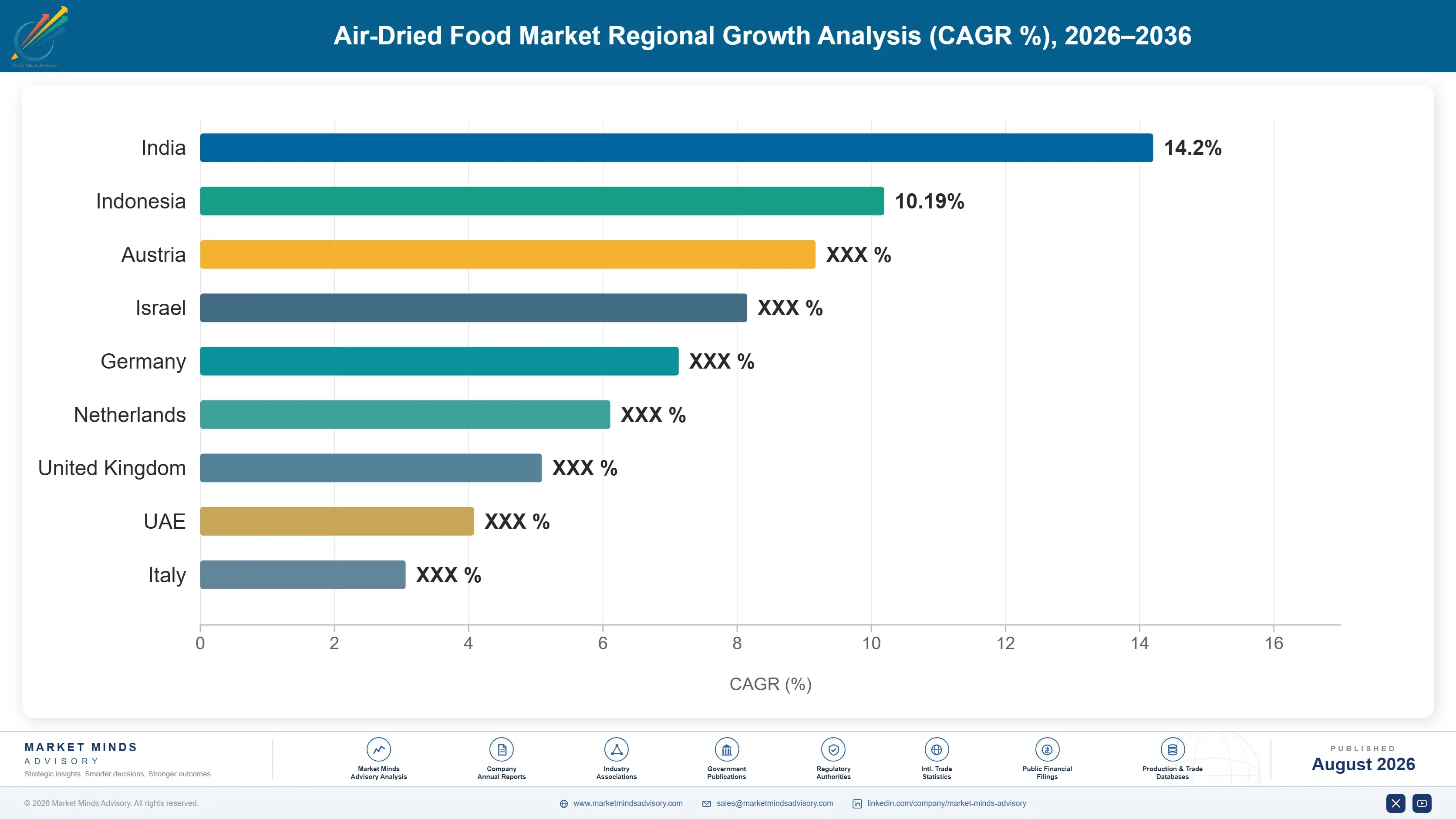
air-dried-food-market-country-cagr-analysis-1787461547027

Where Air Dried Margin Actually Sits

Brands capture the widest margins by expanding drying capacity and securing meat supply well ahead of demand rather than chasing new distribution deals alone, since capacity investment, treat-to-diet conversion funnels, working dog specialty positioning, and direct meat supply contracts each defend growth and pricing power far more durably than raw marketing spend by itself.

Drying Capacity Expansion Investment Strategy Program

Brands that invest early in additional drying capacity, rather than waiting until retail demand outstrips supply, can fulfill mainstream grocery distribution commitments that capacity-constrained competitors must decline or ration through pre-selling limited allocations. This capital investment carries 2 to 3 year lead times and requires confidence in sustained category growth, but brands who commit early capture retail shelf space that capacity-constrained rivals cannot claim once major accounts commit shelf space to a competitor instead. Early movers in capacity expansion have already captured meaningful share of new mainstream grocery placements unavailable to supply-limited competitors.
Market Impact: Wins share of roughly 15 percent new placements

Treat To Diet Conversion Funnel Strategy

Brands that deliberately design lower-priced treat and topper formats as an entry point can convert a meaningful share of trial buyers into full-diet customers who spend 3 times more per year than treat-only purchasers ever do. Tracking conversion rates across product tiers lets brands optimize marketing spend toward the entry products that convert best rather than treating treats as a standalone revenue line disconnected from the full-diet business. Brands with disciplined conversion funnels report meaningfully higher customer lifetime value than competitors selling treats and full diets as entirely separate, unconnected product lines.
Market Impact: Converts roughly 20 percent of trial buyers annually

Working Dog Specialty Nutrition Positioning Program

Brands that build dedicated product lines specifically formulated for working and sporting dog energy requirements capture loyal, repeat-purchasing customers who prioritize consistent performance over price sensitivity that dominates mainstream pet food purchasing decisions across the broader category. This specialty positioning commands pricing exceeding 12 percent above standard complete diet formulations, reflecting the higher fat and protein concentrations these formulas require to meet demanding performance benchmarks. Brands with established relationships in hunting, herding, and service dog communities benefit from word-of-mouth credibility that generic marketing campaigns cannot replicate quickly regardless of advertising budget deployed.
Market Impact: Commands a premium above 12 percent per unit

Direct Meat Supply Contracts With Protein Processors

Brands that secure long-term meat supply contracts directly with protein processors, rather than buying entirely on the open commodity market, lock in roughly 45 percent of their annual protein volume needs at negotiated prices ahead of demand growth. This forward integration insulates against spot price spikes during periods of tight meat byproduct supply and gives brands leverage to require specific protein quality and traceability standards as a condition of the relationship. The tradeoff is reduced flexibility to chase the cheapest spot protein available in a given quarter, but most growing brands judge that tradeoff worthwhile given accelerating demand.
Market Impact: Locks in 45 percent of annual protein volume

Who Controls the Margin Pool

Ranked by estimated annual production volume, the top five air-dried food brands together hold a CR5 near 52 percent, a moderately concentrated field reflecting the category's origins with a small number of pioneering specialty brands. The gap between the largest established brands and newer entrants is substantial, since consumer trust built around raw-like nutritional claims takes years to establish and cannot be purchased through advertising spend alone.
Competitive activity currently plays out along three dimensions: drying capacity scale, since brands with more capacity can fulfill mainstream retail commitments that capacity-constrained competitors must decline; treat-to-diet conversion sophistication, as brands who convert trial buyers efficiently grow faster than those treating product tiers as disconnected lines; and working dog specialty credibility, which commands loyal repeat purchasing that generic marketing cannot replicate quickly.

Emerging pressure comes from newer entrants investing in drying capacity and mainstream retail distribution to compete directly with pioneering brands on shelf space and price positioning previously uncontested by newcomers. Rankings could shift within a decade if these entrants build sufficient consumer trust fast enough to win the loyal repeat-purchasing customer base that established brands have spent years cultivating through consistent product quality and marketing credibility.
air-dried-food-market-company-positioning-matrix-1787461547557

Competitive Moat and Risk Dimensions

ZIWI LIMITED

Moat: Pioneering Category Origin Credibility

Ziwi built the air-dried pet food category from its earliest origins in New Zealand, giving it a founder's credibility and consumer trust that newer entrants cannot replicate through marketing spend alone. That accumulated brand equity, combined with proprietary drying process expertise, lets it command premium pricing that newer competitors struggle to match.
ZIWI LIMITED

Risk: Single Country Production Concentration

Heavy reliance on New Zealand-based production leaves the company more exposed than geographically diversified competitors to any single regulatory, logistics, or agricultural supply disruption affecting that one country specifically. A meat supply shock or export logistics disruption in New Zealand would directly constrain global output with no alternate production base to compensate.
THE HONEST KITCHEN INC

Moat: Early Direct To Consumer Relationships

The Honest Kitchen built direct-to-consumer subscription relationships with pet owners well before most competitors treated e-commerce as a primary channel, giving it customer data and repeat-purchase relationships that newer digital-first entrants are still working to replicate. That early direct relationship also lets it gather product feedback faster than competitors relying primarily on retail distribution.
THE HONEST KITCHEN INC

Risk: Rising Direct Channel Competition Pressure

Newer entrants increasingly compete directly for the same subscription-oriented pet owners using similar direct-to-consumer marketing tactics, eroding the first-mover advantage the company once held almost uncontested in that specific channel. Customer acquisition costs have risen accordingly as more competitors bid for the same digital advertising audience.

Players Tracked

Prominent Players

Ziwi Limited
The Honest Kitchen Inc
K9 Natural Ltd
Real Pet Food Co Pty Ltd
Grandma Lucy's Inc

Other Key Players

Steve's Real Food Inc
Open Farm Inc
Wellness Pet Company Inc
PetCurean Pet Nutrition Inc
Big Country Raw Inc
Tuffy's Pet Foods Inc
CANIDAE Corp
Solid Gold Pet Inc
Champion Petfoods Ltd
Yarrah Organic Petfood BV
MPM Products Ltd
Stella & Chewy's LLC
Carnivore Meat Company Inc
Weruva International Inc
Nulo Pet Food Inc

Recent Developments

MARCH 2026

Ziwi Commissions New Drying Capacity In New Zealand

Ziwi commissioned significant additional drying capacity at its New Zealand facility, aiming to fulfill fast-growing mainstream grocery distribution commitments across North America and Europe that the company had previously been forced to ration given persistent capacity constraints limiting overall production output across the entire business.
Signal: Signals continued capacity investment as the primary growth lever within a production process that resists rapid scaling.
AUGUST 2025

Honest Kitchen Expands Working Dog Product Line

The Honest Kitchen launched a dedicated working and sporting dog product line formulated around notably higher fat and protein concentrations, targeting hunting, herding, and service dog handlers seeking calorie-dense nutrition that reduces the total feed weight carried during extended field assignments and long working trips.
Signal: Reflects continued brand investment in specialty positioning to capture loyal, less price-sensitive customer segments directly and durably.
MAY 2025

K9 Natural Signs Mainstream Grocery Distribution Agreement

K9 Natural signed a distribution agreement with a major North American grocery chain to place its air-dried product line in dedicated premium pet food sections, extending its reach well beyond the specialty pet retail channels where it had previously concentrated the vast majority of its sales.
Signal: Indicates continued mainstream grocery expansion as air-dried brands seek broader shopper reach beyond specialty pet retail.

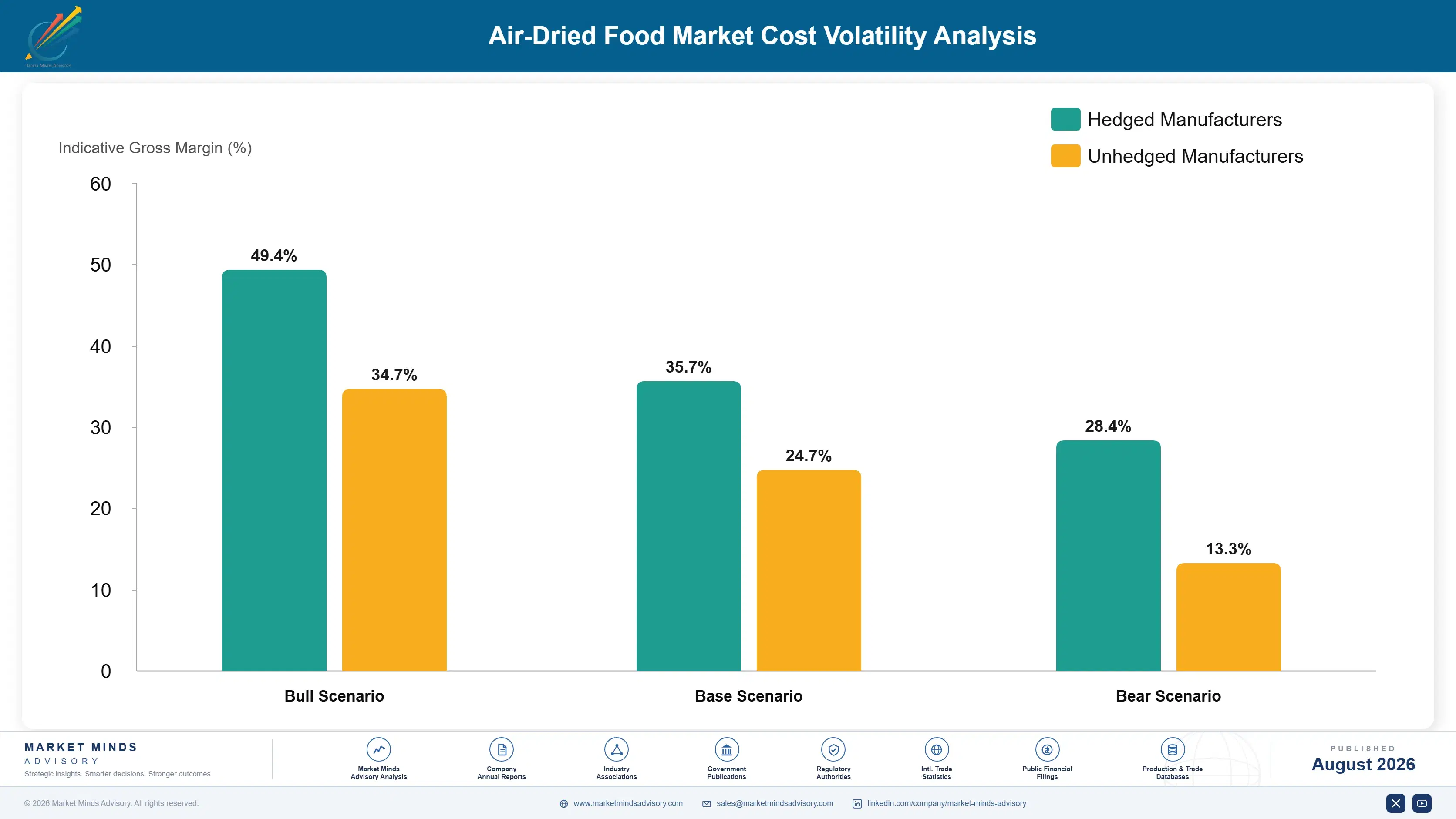
Raw Meat Protein Anchors Product Cost

Raw meat protein, sourced primarily from beef, lamb, and poultry processors, accounts for roughly 64 percent of air-dried food's cash cost of goods sold, meaningfully higher than the feedstock share carried by extruded kibble formulations. Most brands buy meat through processor contracts and open-market purchases rather than owning livestock operations directly, leaving cost exposure tied closely to broader meat commodity cycles.
Tyson Foods' 2024 annual report noted that beef and poultry input costs fluctuated meaningfully as cattle herd sizes and feed costs shifted across several quarters, pushing raw protein procurement costs up by more than 17 percent within a single year during tighter supply periods. Air-dried brands without long-term meat supply agreements passed most of that increase through to retail customers within two quarters, while subscription-based direct-to-consumer contracts on fixed pricing absorbed the increase internally instead.

Brands without diversified meat sourcing or long-term supply agreements face a persistent cost disadvantage against larger integrated competitors, since spot protein purchases expose them fully to commodity price spikes that contracted buyers largely avoid. This falls hardest on smaller regional brands, while larger companies with direct processor relationships across multiple protein species maintain comparatively stable input costs through volatile commodity cycles.
air-dried-food-market-cost-volatility-analysis-1787461547752

Multi-Year Meat Supply Agreements With Fixed Formulas

Brands are increasingly negotiating multi-year meat supply agreements with pricing tied to a benchmark formula rather than pure spot purchasing each quarter. These agreements typically guarantee a minimum volume commitment in exchange for price stability, smoothing quarter-to-quarter cost swings and giving brands a defensible basis for offering retail customers longer, more stable annual pricing terms.

Protein Species Diversification Across Multiple Sources

Sourcing meat from beef, lamb, and poultry processors simultaneously protects brands against localized supply disruptions in any single protein category, such as a disease outbreak affecting one species or reduced processing volumes tied to herd cycles. While diversification adds modest formulation complexity, it meaningfully reduces the odds of an unplanned supply gap tied to any single species processing disruption.

Direct Processor Relationships Bypassing Commodity Brokers

Brands that build direct relationships with meat processors, rather than purchasing through commodity brokers, gain better visibility into supply conditions well ahead of price negotiations and often secure priority allocation during tight supply periods. This approach requires investment in supplier relationship management that smaller brands sometimes find impractical relative to their total purchase volume.

Portfolio Architecture for Margin Defence

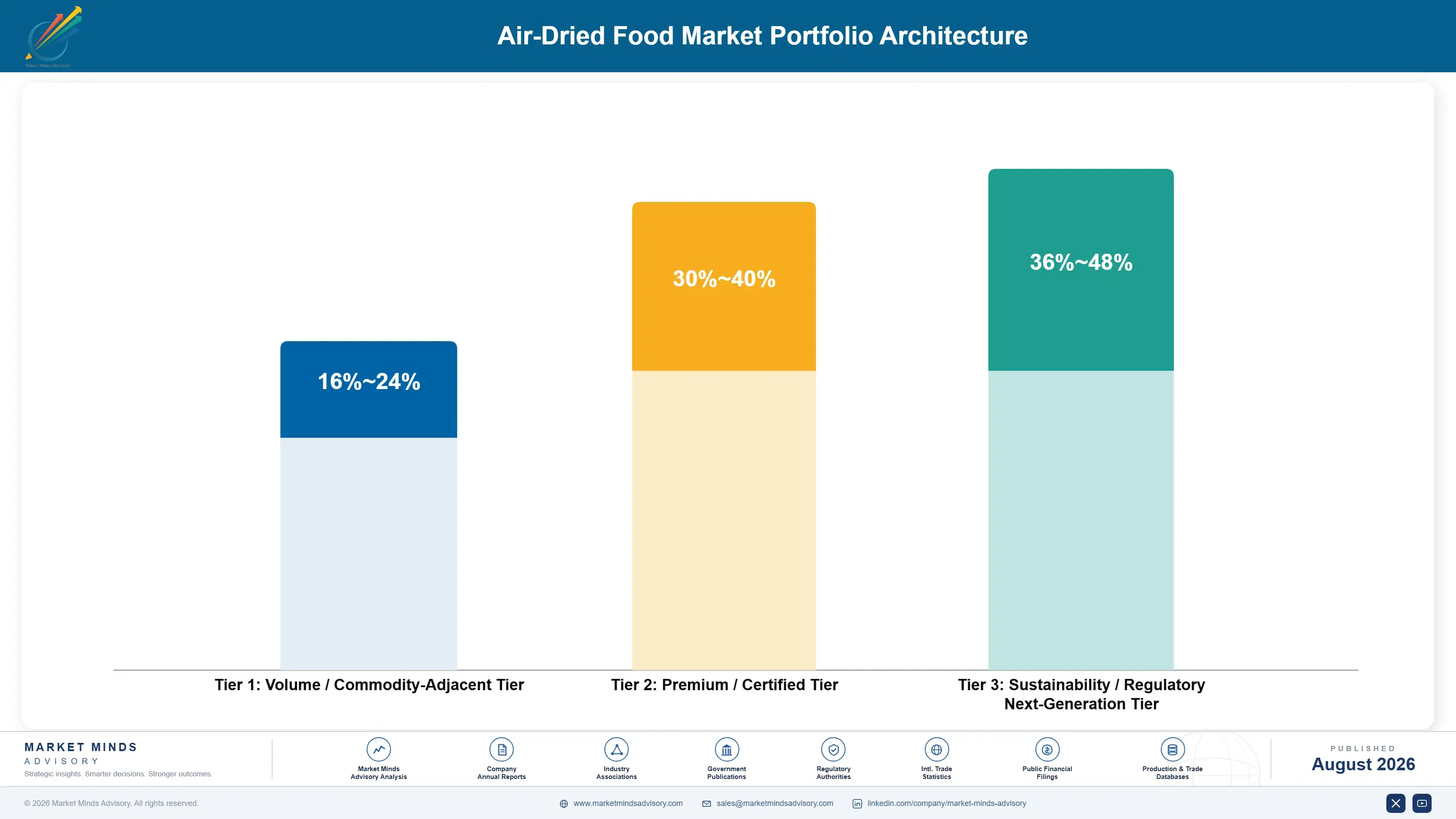
Air-dried food portfolio splits into three margin tiers that track formulation completeness and specialty positioning rather than production volume alone. Entry-level treats and toppers compete largely on trial price accessibility against similar competitor offerings, while complete diet formulations earn a durable premium, and a smaller working dog and traceable specialty tier commands the highest margins of all within the entire category.
The tension between volume and premium tiers plays out in product mix decisions, since expanding treat and topper production sacrifices some full-diet manufacturing capacity for a lower per-unit margin that nonetheless serves a critical customer acquisition function. Brands that neglect that funnel risk losing the trial mechanism that has historically converted new buyers into loyal, higher-margin full-diet customers over time.

High-value margin pools concentrate almost entirely in working dog specialty and traceable grass-fed positioned grade, where formulation and sourcing credibility barriers keep casual entrants out far longer than in any other tier of the category. Standard complete diet grade sits in between, commanding a solid premium tied to raw-like positioning rather than specialty formulation, while entry-level treats and toppers remain comparatively lower-margin regardless of brand scale.

Volume / Commodity-Adjacent Tier

Entry-level treats and food topper formats sold at accessible trial price points, priced largely to attract budget-conscious pet owners into the category with minimal formulation differentiation between competing brands and product lines.
Gross Margin: 16%-24%

Premium / Certified Tier

Complete diet formulations meeting nutritionally complete feeding trial standards required by regulators, carrying documented raw-like nutrition positioning that commands a durable price premium over standard kibble and treat-only product lines available.
Gross Margin: 30%-40%

Sustainability / Regulatory / Next-Generation Tier

Working dog specialty and traceable grass-fed positioned grade meeting demanding performance nutrition requirements, priced at a significant premium reflecting the specialized formulation and sourcing credibility investment required to produce it.
Gross Margin: 36%-48%
air-dried-food-market-portfolio-architecture-1787461548272

High-value Sub-segments and Strategic Watch-out

Air-Dried Complete Dog Food Applications

Air-dried complete dog food applications combine the fastest segment CAGR at 15.8 percent with strong achievable margins across the entire category, protected by the regulatory feeding trial barrier held by brands who invested early in formulation and testing infrastructure and specialized expertise built over years.
Gross Margin: 30%-38%

Air-Dried Complete Cat Food Applications

Air-dried complete cat food applications grow at 14.2 percent and command a solid premium tied to palatability consistency and functional positioning, though competitive intensity is rising steadily as more brands pursue this fast-growing feline niche directly across specialty, mainstream, and expanding online retail channels alike.
Gross Margin: 28%-36%

Air-Dried Treats and Food Toppers Applications

Air-dried treats and food toppers applications remain the volume anchor of the entire portfolio structure, growing near the overall market average with thinner margins tied closely to trial pricing and ongoing retailer bargaining power across most specialty, mainstream grocery, and expanding online channels alike today.
Gross Margin: 16%-22%

Veterinary and Prescription Diet Applications

Veterinary and prescription diet applications warrant a strategic watch, since persistently slow growth and thin margins leave this small niche segment quite vulnerable to substitution by cheaper conventional therapeutic diets if veterinary formulators ever fully standardize further on lower-cost alternatives across clinics, hospitals, and pharmacies.
Gross Margin: 14%-19%

Why Trial Buyers Become Loyal Customers

Once a pet owner switches their dog or cat complete diet to air-dried food, that relationship behaves more like a subscription than a one-time purchase, since owners who commit to the format rarely revert back to kibble once they observe the coat, digestion, and energy improvements brands promise. Switching costs feel emotional as much as financial, making owners reluctant to experiment with alternate brands once satisfied.
Stickiness varies sharply by product tier. Complete diet customers rarely switch brands once satisfied, since any change risks reintroducing digestive issues the switch originally resolved. Treat and topper buyers switch more readily, since these formats carry lower financial and emotional commitment than a full diet change. Working dog specialty buyers show particularly strong loyalty, since performance consistency matters more to handlers than price competition ever could.

A generational shift is also underway among buyers themselves. Younger pet owners increasingly research ingredient sourcing and production methods before purchasing, favoring brands that can demonstrate transparent supply chains and traceable protein origin. This shift is gradual rather than abrupt, but it is steering incremental volume toward brands investing early in sourcing transparency and direct grower or processor relationships that support that transparency.
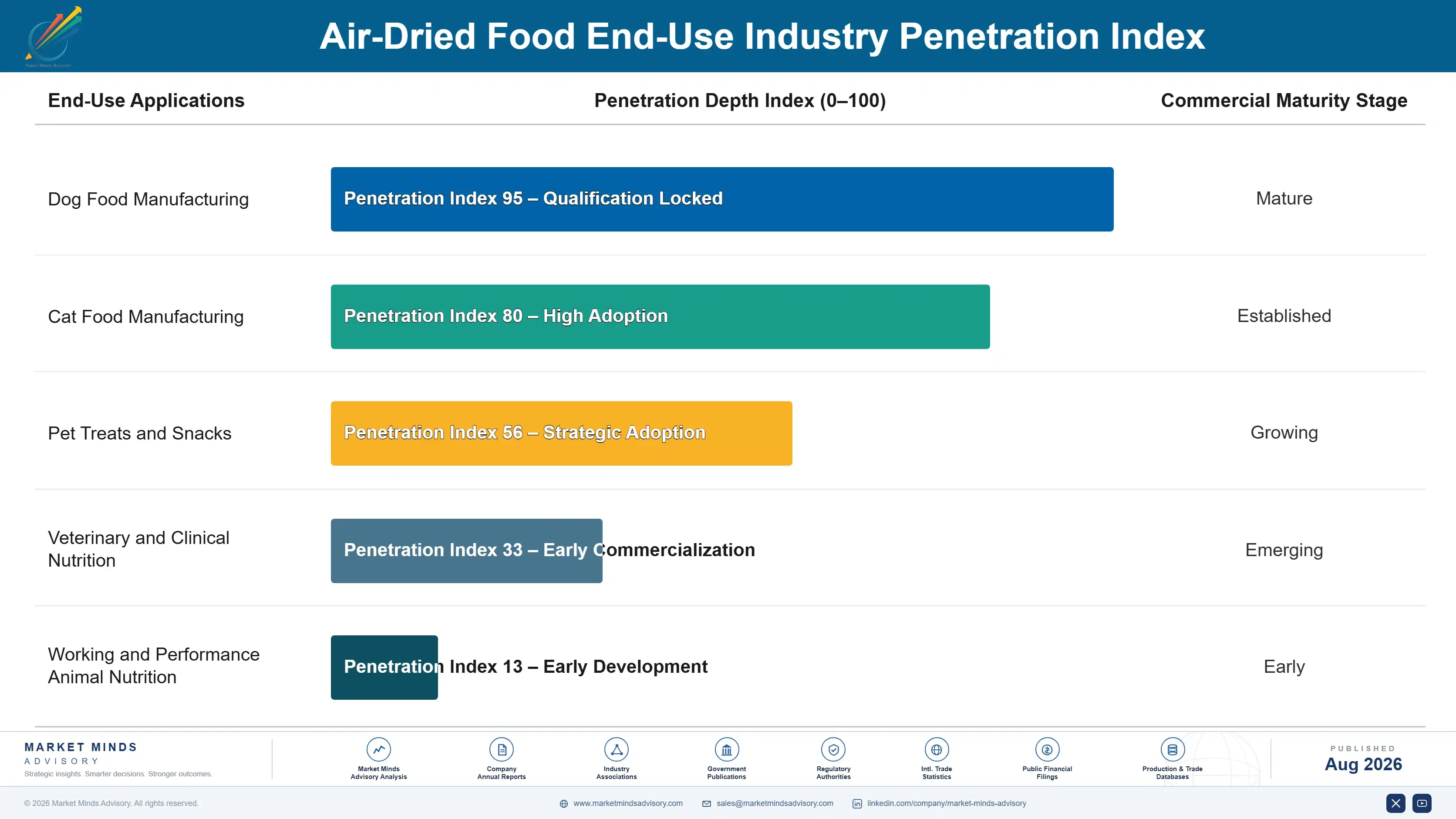
air-dried-food-market-end-use-penetration-index-1787461548761

Where MMA Sees the Advantage

These are among the four positions where our research anticipates prominent divergence between winners and laggards over the coming forecast period. Each is grounded in the demand model, the regulatory perimeter, and the announced capacity pipeline.
01 / DRYING CAPACITY INVESTMENT PRIORITY

Invest in drying capacity now before mainstream retail commitments outstrip supply

Mainstream grocery distribution is expanding faster than most brands drying capacity can currently support across the category, forcing capacity-constrained competitors to ration retail allocations or decline promising new accounts entirely rather than risk overcommitting. Brands who invest in additional drying capacity now, accepting the multi-year lead time such investment requires, secure retail shelf space that capacity-constrained rivals cannot claim once major accounts commit elsewhere for good. Waiting risks losing mainstream distribution opportunities permanently to better-capitalized competitors already expanding capacity today.
02 / TREAT TO DIET STRATEGY

Build disciplined treat to diet conversion funnels before competitors optimize theirs

Treats and toppers function as the category most effective customer acquisition mechanism, letting budget-conscious pet owners sample raw-like nutrition before committing to full-diet pricing on every single meal each day. Brands that build disciplined tracking of which entry products convert best into full-diet purchases can direct marketing spend more efficiently than competitors treating each product tier as a disconnected revenue line. Competitors without this conversion discipline waste marketing spend on entry products that never convert into the higher-margin full-diet business.
03 / WORKING DOG SPECIALTY POSITIONING

Build working dog specialty credibility while the segment still lacks dedicated leaders

Working and sporting dog owners prioritize consistent performance over price sensitivity that dominates mainstream pet food purchasing, and few brands have built dedicated product lines and genuine community credibility specifically targeting this valuable segment. Brands who invest in working dog specialty formulation and handler community relationships now capture pricing exceeding 12 percent above standard complete diet pricing while building loyal, repeat-purchasing customers that generic marketing cannot replicate. Competitors who wait risk finding handler community trust already captured by faster-moving specialty rivals.
04 / DIRECT MEAT SUPPLY STRATEGY

Lock in direct meat supply contracts before the next commodity price spike

Raw meat protein accounts for 64 percent of cash cost and tracks commodity cycles that have swung input prices more than 17 percent within a single year in recent periods. Brands still buying entirely on the open market absorb that volatility directly, while those with direct processor contracts lock in predictable cost and volume well ahead of demand growth. Securing multi-year meat supply agreements now, before the next commodity price spike, would meaningfully reduce margin variability across future reporting periods.

Engagement Snapshot From the Field

A live engagement with an industry participant carrying material or product regulatory and market exposure ahead of a defining policy shift, showing how our research translates into a defensible multi-year portfolio strategy.
MARKET MINDS ADVISORY · CLIENT ENGAGEMENT SUMMARY
Air-Dried Food Producer Strategic Portfolio Review and Transition Roadmap 2026·Investment Scenario on Air-Dried Food Exposure Evaluation 2025-26
CLIENT PROFILE
The client, a mid-size North American air-dried pet food brand selling complete diets and treats through specialty pet retail and direct-to-consumer channels nationwide, generated approximately 54 million US dollars in annual revenue (client-reported, unverified by MMA) and had long operated the exact same single drying facility since its founding nearly eight years earlier without any expansion whatsoever.
STRATEGIC CHALLENGE
Facing a major mainstream grocery chain's offer to place the client's products nationwide across thousands of stores, the client lacked sufficient drying capacity to fulfill that large volume commitment and needed to evaluate capacity expansion options within twelve months, without risking existing specialty retail relationships during the entire transition period.
MMA APPROACH
MMA benchmarked capacity expansion options across three equipment vendors and two potential facility locations, assessing capital cost, lead time, and meat supply proximity for each. The team modeled production ramp scenarios against the grocery chain's volume commitment timeline, and facilitated technical discussions between the client's operations team and two shortlisted equipment vendors offering faster installation timelines.
KEY FINDINGS
  1. The client existing facility operated at 94 percent utilization, leaving essentially no spare capacity available to fulfill new grocery volume commitments immediately.
  2. One shortlisted equipment vendor offered installation timelines roughly 30 percent faster than the client's original facility construction schedule had allowed previously in prior years.
  3. Expanding capacity would require an estimated capital investment recoverable within roughly three years given the grocery chain's fully committed annual volume forecast.
  4. Delaying capacity expansion by even a single quarter risked permanently losing the grocery placement entirely to a better-prepared, faster-moving competing brand instead.
CLIENT PROFILE
The client, a mid-size North American air-dried pet food brand selling complete diets and treats through specialty pet retail and direct-to-consumer channels nationwide, generated approximately 54 million US dollars in annual revenue (client-reported, unverified by MMA) and had long operated the exact same single drying facility since its founding nearly eight years earlier without any expansion whatsoever.
STRATEGIC CHALLENGE
Facing a major mainstream grocery chain's offer to place the client's products nationwide across thousands of stores, the client lacked sufficient drying capacity to fulfill that large volume commitment and needed to evaluate capacity expansion options within twelve months, without risking existing specialty retail relationships during the entire transition period.
MMA APPROACH
MMA benchmarked capacity expansion options across three equipment vendors and two potential facility locations, assessing capital cost, lead time, and meat supply proximity for each. The team modeled production ramp scenarios against the grocery chain's volume commitment timeline, and facilitated technical discussions between the client's operations team and two shortlisted equipment vendors offering faster installation timelines.
KEY FINDINGS
  1. The client existing facility operated at 94 percent utilization, leaving essentially no spare capacity available to fulfill new grocery volume commitments immediately.
  2. One shortlisted equipment vendor offered installation timelines roughly 30 percent faster than the client's original facility construction schedule had allowed previously in prior years.
  3. Expanding capacity would require an estimated capital investment recoverable within roughly three years given the grocery chain's fully committed annual volume forecast.
  4. Delaying capacity expansion by even a single quarter risked permanently losing the grocery placement entirely to a better-prepared, faster-moving competing brand instead.
RECOMMENDED STRATEGY
Phase 1: Phase 1 (Months 1 to 3): Complete thorough equipment vendor benchmarking and finalize both equipment selection and facility location decisions. Phase 2: Phase 2 (Months 4 to 9): Install new drying equipment and complete production qualification and thorough quality testing runs fully. Phase 3: Phase 3 (Months 10 to 12): Ramp production to full volume and fulfill the grocery chain's nationwide distribution commitment completely.
OUTCOME
The client completed capacity expansion within eleven months, successfully fulfilling the grocery chain's nationwide distribution commitment without disrupting any existing specialty retail supply relationships. Reported revenue grew by approximately 38 percent (client-reported, unverified by MMA) within the first full year following the completed capacity expansion.

Frequently Asked Questions

Foundational context covering the market sizes, CAGR, scope, country, region and competition that inform every finding below. This section is provided to cover basics and most often pre-purchase conversations, answered from the MMA Primary Research Dataset.

What is the current size of the Air-Dried Food Market?

MMA estimates the global air-dried pet food market at 1.2 billion US dollars in 2025, spanning complete dog food, complete cat food, treats, hybrid kibble, working dog, and veterinary applications worldwide.

How large will the Air-Dried Food Market be by 2036?

MMA projects the market to reach approximately 4.38 billion US dollars by 2036, up from 1.35 billion in 2026, as complete diet demand continues expanding faster than treat and topper volume.

What is the CAGR for the Air-Dried Food Market 2026 to 2036?

The base case CAGR is 12.5 percent for 2026 to 2036. Bull and bear scenarios range between 13.7 percent and 11.3 percent depending on drying capacity investment outcomes.

Which segment is growing fastest?

Air-dried complete dog food applications form the fastest-growing segment at 15.8 percent CAGR, roughly 1.3 times the overall market rate, driven by raw-adjacent nutrition demand.

Who are the major companies in the Air-Dried Food Market?

Leading brands include Ziwi Limited, The Honest Kitchen Inc, K9 Natural Ltd, Real Pet Food Co Pty Ltd, and Grandma Lucy's Inc, together holding an estimated CR5 near 52 percent.

Which country is growing fastest?

China is the fastest-growing country market at approximately 14.2 percent CAGR, supported by rapidly expanding premium pet food adoption and rising pet humanization trends nationwide.

Report Segmentation Architecture

The full report scope spans multiple orthogonal segmentation dimensions, with cross-tabulated demand data provided for each dimension pair. Coverage extends further to regional breakdowns, trend trajectories, and the competitive detail needed to support segment-level decision-making.

By Application Type

  • Air-Dried Complete Dog Food Applications
  • Air-Dried Complete Cat Food Applications
  • Air-Dried Treats and Food Toppers Applications
  • Raw-Coated Kibble Hybrid Applications
  • Working and Sporting Dog Nutrition Applications
  • Veterinary and Prescription Diet Applications

By End-Use Industry

  • Dog Food Manufacturing
  • Cat Food Manufacturing
  • Pet Treats and Snacks
  • Veterinary and Clinical Nutrition
  • Working and Performance Animal Nutrition

By Commercial Dimension

  • Direct Brand Sales
  • Specialty Pet Retail Distribution
  • Mainstream Grocery Distribution
  • Direct-to-Consumer Subscription Sales

By Region

  • North America
  • Western Europe
  • East Asia
  • South Asia and Pacific
  • Latin America
  • Middle East and Africa
  • Eastern Europe

Scope, Methodology, and Coverage

Every figure in this report is reproducible from documented input assumptions. The scope below maps the historical period, the forecast horizon, the segmentation dimensions, and the countries covered, alongside the underlying primary and qualitative methodology.
Historical Period
2020 to 2025
Forecast Period
2026 to 2036
Base Year
2025 (USD billions; MMA Primary Research Dataset, August 2026)
Market Definition
The air-dried food market covers pet food and treat products manufactured through a slow, low-temperature air-drying process that removes moisture while preserving raw-like nutritional density, across complete dog food, complete cat food, treats, hybrid kibble, working dog, and veterinary applications. It excludes freeze-dried pet food, conventional dehydrated jerky treats processed via different methods, and human air-dried food products.
Quantitative Units
USD billions (current prices); metric tonnes for volume-based segment analysis
Segmentation Dimensions
By Application Type; By End-Use Industry; By Commercial Dimension; By Region
Regions Covered
North America, Western Europe, East Asia, South Asia and Pacific, Latin America, Middle East and Africa, Eastern Europe
Countries Covered
USA, China, Germany, France, UK, Japan, South Korea, India, Australia, Canada, Brazil, Mexico, Indonesia, Vietnam, Thailand, Malaysia, UAE, Saudi Arabia, South Africa, Nigeria, Turkey, Poland, Netherlands, Italy, Spain, Sweden, Switzerland, Argentina, Colombia, Singapore, and additional markets relevant to this sector
Key Companies Profiled
Ziwi Limited, The Honest Kitchen Inc, K9 Natural Ltd, Real Pet Food Co Pty Ltd, Grandma Lucy's Inc, Steve's Real Food Inc, Open Farm Inc, Wellness Pet Company Inc, PetCurean Pet Nutrition Inc, Big Country Raw Inc, Tuffy's Pet Foods Inc, CANIDAE Corp, Solid Gold Pet Inc, Champion Petfoods Ltd, Yarrah Organic Petfood BV, MPM Products Ltd, Stella & Chewy's LLC, Carnivore Meat Company Inc, Weruva International Inc, Nulo Pet Food Inc
Quantitative Methodology
Primary survey, n=3,800 respondents, Q4 2025, six countries; demand-side model with trade association cross-validation
Qualitative Methodology
47 expert interviews, Q4 2025; applied to validate demand model assumptions, identify emerging dynamics, and assess competitive positioning
Report Format
PDF and XLSX data workbook (Word format preview document)
Publisher
Market Minds Advisory
Report Code
MMA-2026-AGR-108
Published
August 2026
Contact
sales@marketmindsadvisory.com | www.marketmindsadvisory.com

Purchase the full Air-Dried Food Market Report (2026 to 2036).

This report gives brand, operations, and investment teams a full commercial picture of the global air-dried pet food market through 2036. It covers segmentation by end-use application, all seven regional markets with detailed demand mechanisms, and a competitive assessment of twenty brands evaluated on estimated production volume. Readers get quantified trend, driver, and restraint analysis, raw meat cost exposure modeling, and portfolio margin architecture across three pricing tiers. A dedicated revenue lever framework and anonymized case study translate the analysis into specific, actionable capacity decisions.
Twenty-company competitive benchmarking on production volume basis
Seven-region demand architecture with quantified growth mechanisms
Segment-level CAGR modeling across six MECE application categories
Raw meat cost exposure and diversification mitigation playbook
Three-tier portfolio margin architecture and pricing analysis
Anonymized client case study with recommended capacity strategy

Built For The People Who Decide

From boardroom strategy to bench-side execution, this report is read cover-to-cover by leaders shaping the next decade of their industry, turning demand scenarios, market dynamics and valuation benchmarks into decisions.
CXOs/ Presidents/ VPs/ Managers
M&A and Corporate Development
Strategy Teams and R&D Heads
Procurement and Product Directors
Regulatory and Compliance Leaders
Investor Relations and Equity Analysts