Market Minds Advisory
Air Defense Systems Market

Air Defense Systems Market: Counter-Drone Investment Redraws Procurement Priorities

Cheap commercial drones are forcing air defense primes to build low-cost counter-UAS solutions alongside expensive interceptor missile systems, reshaping procurement budgets that once favored exclusively high-value platform sales. across allied defense budgets.

Lead Analyst

Published

September 2026

Make Smarter Decisions with Customized Research Insights

Request a free sample report and evaluate market opportunities, growth trends, and competitive dynamics relevant to your business needs.

2025 MARKET VALUE$48.0BMarket Size 2025
2036 FORECAST VALUE$114.2BBase Case , 2026 to 2036
CAGR 2026 TO 20368.2 %Bull 9.5% / Bear 6.9%
INCREMENTAL OPPORTUNITY$62.3BNet 10- year value creation
EXPANSION MULTIPLE2.20x2036 value over 2026 base
Strategic Levers
M&A Pipeline
Regional Outlook
Country Rankings
Competitive Intelligence
Segmental Deep-dive
Call-Us : 91 93563 13602

Executive Snapshot and Market Trajectory

The air defense systems industry is being reshaped by cheap commercial drones forcing primes to build low-cost counter-UAS solutions alongside expensive interceptor missile systems, reshaping procurement budgets that once favored exclusively high-value platform sales. Few manufacturers had priced this competitive shift into their existing program revenue assumptions.
Counter-drone and counter-UAS systems are expanding fastest, growing at roughly 1.95 times the market's overall pace as recent regional conflicts demonstrate the growing threat of low-cost drone swarms. Long-range and ballistic missile defense systems follow closely behind, driven by escalating regional security tensions. North America concentrates the largest share of this market's revenue, anchored by sustained United States Department of Defense procurement across every major system category. Other regions contribute comparatively modest exposure here.
Competitive intensity is rising as legacy Western primes, emerging counter-drone specialists, and non-Western state manufacturers all compete for the same expanding procurement budgets, while combat lessons from recent conflicts and stretched supply chains are simultaneously reshaping which manufacturers capture the most durable long-term program revenue. Manufacturers slow to adapt counter-drone and combat validation strategy risk losing ground to faster-moving competitors across nearly every major system category.
Market Definition
This report covers the manufacture, sale, and lifecycle sustainment of ground-based and naval air defense systems designed to detect, track, and intercept aircraft, missiles, and unmanned aerial systems, including associated radar, sensor, and integration services. It excludes offensive strike missile systems, space-based defense systems, and small arms air defense weapons, which fall outside the defined platform scope.
Base Year Value
$48.0B in 2025 (MMA Primary Research Dataset, August 2026)
Forecast Period
2026 to 2036, eleven discrete annual values
CAGR
8.2% base case. Bull 9.5%. Bear 6.9%.
Fastest Growth Segment
Counter-Drone and Counter-UAS Systems: 16.0% CAGR
Fastest Growth Country
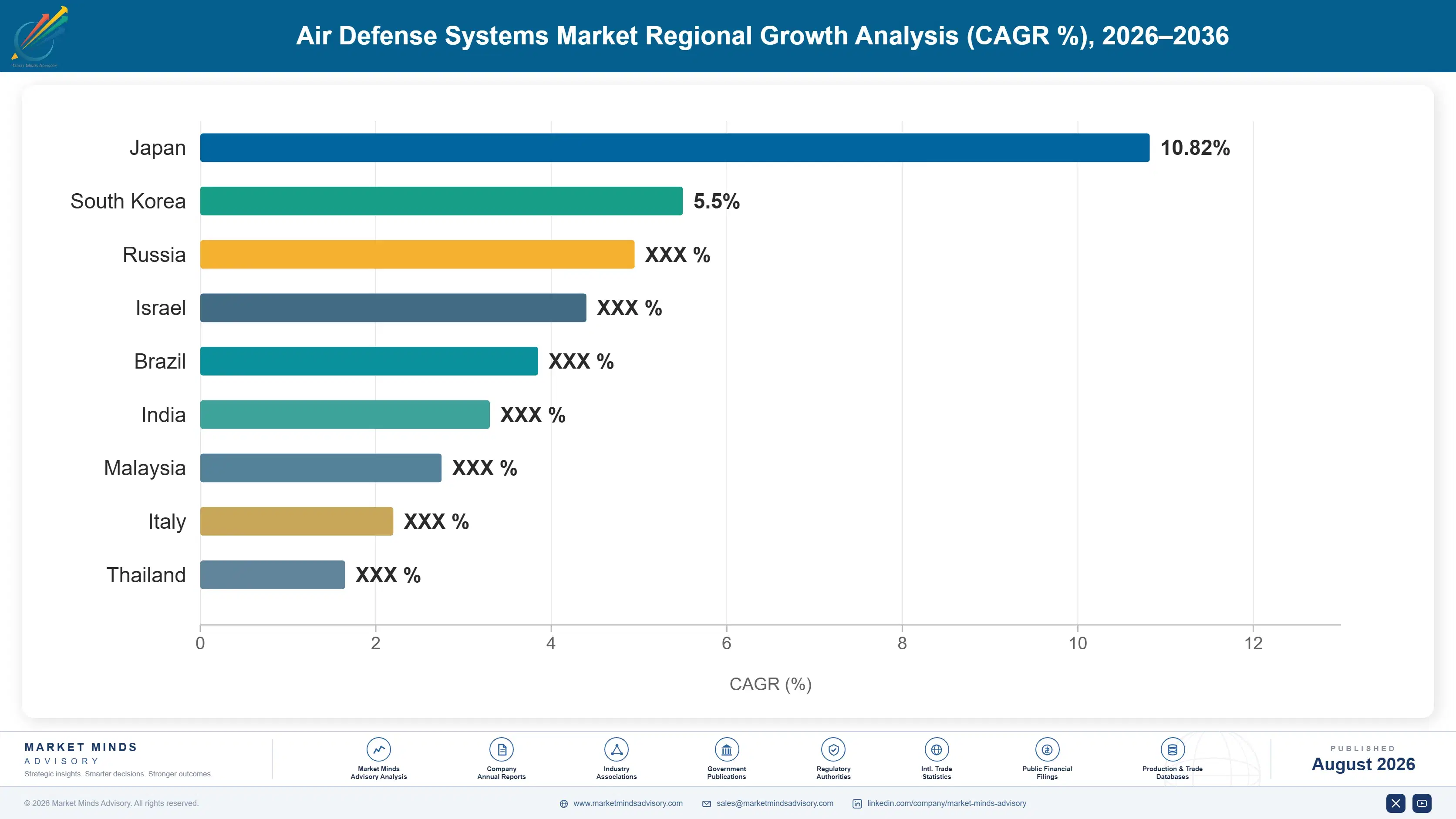
Poland: 11.5% CAGR
Fastest Growth Region
South Asia and Pacific: 10.2% CAGR
Largest Region
North America: 29% of 2025 global value
Market Leaders
Raytheon (RTX), Lockheed Martin, MBDA, Rafael Advanced Defense Systems, Diehl Defence. Source: MMA Primary Research Dataset, July 2026.
Primary Survey
n=3,800 procurement and R&D decision-makers, Q4 2025, six countries
Methodology
Demand-side build-up, cross-validated against public data, 47 expert interviews

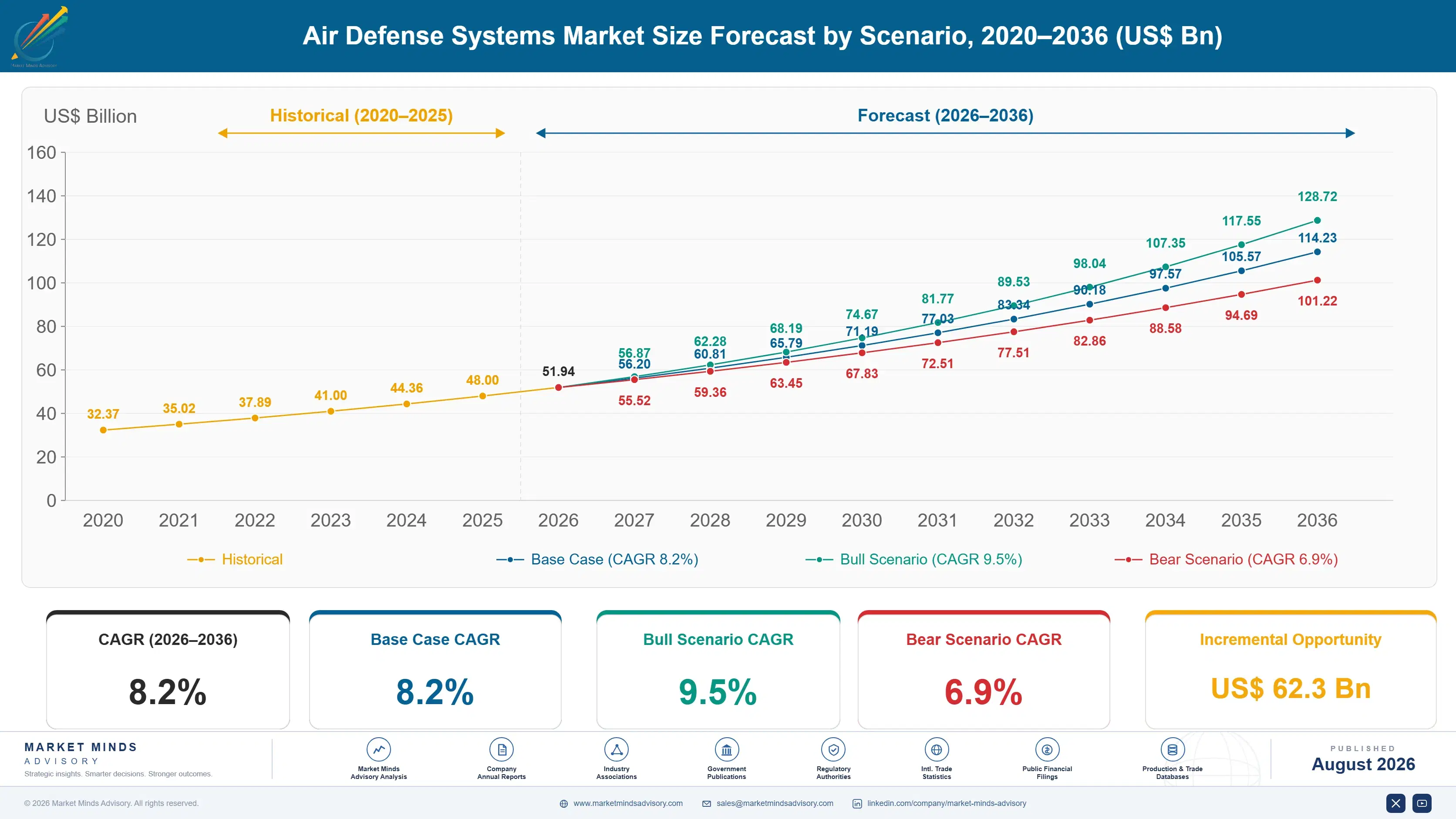
Air Defense Systems Market Forecast Scenarios

air-defense-systems-market-size-forecast-scenario-1787982314269
Air defense systems market revenue grew at an estimated 7.0 percent historical pace between 2020 and 2025, propelled by steady missile defense replacement programs across major allied air forces. Momentum accelerated sharply after 2022 as heightened regional security concerns pushed multiple governments to expand procurement budgets well beyond prior replacement-cycle planning. Several governments also expanded multi-year procurement authorizations during this same period.
The base case assumes 8.2 percent annual growth through 2036, driven by three commercial mechanisms. First, counter-drone systems are attracting substantial new investment as combat lessons demonstrate the growing threat of low-cost drone swarms. Second, escalating regional security tensions are expanding long-range and ballistic missile defense procurement across multiple allied governments. Third, aging legacy air defense systems require replacement across several major air forces simultaneously, adding durable baseline procurement volume.
The bull case centers on faster-than-expected counter-drone platform adoption pulling forward procurement timelines across multiple governments. The bear case centers on prolonged supply chain constraints limiting new system delivery rates, which could meaningfully slow revenue growth across the newest interceptor missile programs specifically. Either scenario depends heavily on how quickly combat lessons from ongoing regional conflicts continue to reshape procurement priorities.

Drone Threat Redraws Procurement Budget Allocation

The air defense systems industry sits at an unusual point where drone threat proliferation and traditional interceptor economics are colliding directly. Cheap commercial drones forcing primes to build low-cost counter-UAS solutions is the single largest determinant of how procurement budgets are being reallocated across every major air force today. Manufacturers that misjudge this reallocation risk building program strategies around assumptions that no longer reflect actual government procurement priorities.
MARKET CONCENTRATION (CR5)52%Top five manufacturers hold roughly half combined share
AVERAGE SYSTEM FLEET AGE18 yearsTypical operational age across active deployed defense systems
COUNTER-DRONE BUDGET SHARE14%Total procurement spending directed toward counter-UAS systems now
PROGRAM DELIVERY DELAY15 monthsTypical schedule slippage across major new system orders
INTERCEPTOR SUCCESS RATE92%Average intercept success rate across recent combat deployments
EXPORT ORDER SHARE34%New system orders originating from export customers abroad
Beneath the counter-drone story, the industry is absorbing genuine combat validation. Recent regional conflicts have provided extensive real-world performance data on interceptor success rates, letting manufacturers demonstrate proven combat effectiveness in ways that peacetime testing alone never could, directly influencing export competition outcomes. Manufacturers slower to publish combat performance data risk losing export competitiveness to competitors already demonstrating proven operational credibility.
Distribution economics are shifting too. Specialized counter-drone manufacturers are steadily capturing procurement budget that legacy interceptor missile primes once claimed by default. Manufacturers slower to demonstrate genuinely competitive counter-UAS capability risk losing this expanding budget category entirely to these newer specialized competitors. Manufacturers offering more competitive counter-drone capability are converting this competitive pressure into genuine long-term contract wins across multiple national air forces.
"Every prime talks about counter-drone capability now, but the ones actually winning contracts are the ones with real combat performance data behind their systems, not the ones just rebranding old radar technology."
Director, Global Air Defense Systems Practice · MMA Construction and Industrial Equipment Practice · August 2026

Market Trends

Counter-Drone Systems Capture Growing Procurement Share

Air forces worldwide are directing a growing share of procurement budgets toward counter-drone and counter-UAS systems rather than exclusively funding traditional high-value interceptor missile programs, reflecting genuine combat lessons from recent regional conflicts demonstrating the cost-effectiveness of drone swarm tactics against traditional air defense systems. Raytheon and Rafael Advanced Defense Systems have both expanded dedicated counter-UAS divisions specifically to compete for this growing procurement category, recognizing that ceding this segment entirely to specialized drone-defense manufacturers risks losing meaningful future program revenue as budgets continue shifting toward layered, lower-cost defense system mixes across multiple allied air forces.
Market Impact: Adds 11% procurement budget growth

Combat-Proven Systems Gain Export Competition Advantage

Manufacturers whose systems have demonstrated proven intercept performance during recent regional conflicts are winning export competitions at a meaningfully higher rate than competitors offering only peacetime-tested platforms, since governments increasingly demand demonstrated operational track records before committing to major procurement decisions. Israel's Rafael Advanced Defense Systems has used extensive real-world intercept data to expand export sales meaningfully, while manufacturers without comparable combat validation risk losing credibility in competitive procurement processes worldwide. Governments increasingly build formal combat performance review processes into export procurement evaluation criteria, further reinforcing this competitive advantage for manufacturers with proven operational track records.
Market Impact: Adds 8% fleet replacement demand growth

Market Opportunities and Growth Drivers

Rising Geopolitical Tensions Expand Procurement Budgets

Heightened geopolitical tensions across multiple regions are pushing governments to expand overall air defense procurement budgets, directly increasing available funding for both new interceptor system orders and accelerated counter-drone deployment timelines. This budget expansion is particularly pronounced among Eastern European NATO members responding directly to regional security concerns, creating durable new demand that extends well beyond typical replacement-cycle procurement patterns these governments historically followed. Manufacturers with strong existing relationships in these fast-expanding markets are capturing this durable demand more efficiently than competitors entering later in the cycle. This durable demand base gives manufacturers meaningful confidence in long-term revenue planning.
Market Impact: Delays deliveries by 15 months average

Aging Legacy Systems Drive Replacement Demand

Multiple air forces continue operating air defense systems originally procured decades ago, creating durable replacement demand as these platforms approach the end of their extended service life despite repeated sustainment investment and component upgrades. This replacement cycle represents genuine incremental procurement volume that extends well beyond current budget expansion driven purely by heightened security concerns, since these systems would require replacement eventually regardless of the broader geopolitical environment. Manufacturers with strong sustainment infrastructure are capturing this durable replacement demand more efficiently than competitors focused purely on new system sales. This capability increasingly determines which manufacturers win future sustainment contract renewals.
Market Impact: Cuts cost-exchange efficiency by 9 points

Market Restraints and Challenges

Extended Program Delays Compress Manufacturer Cash Flow

Major air defense procurement programs continue experiencing meaningful schedule delays driven by supply chain constraints and testing certification timelines that consistently run longer than original program planning anticipated. The root cause is genuine complexity in integrating increasingly sophisticated radar and interceptor guidance systems within demanding certification timelines that government customers require before accepting delivery. The commercial impact compresses manufacturer cash flow during extended development phases. Manufacturers are mitigating this through milestone-based payment structures negotiated directly with government customers. Program managers increasingly build contingency timelines to account for these recurring certification delays across multiple concurrent programs.
Market Impact: Grows counter-drone budget share to 14%

Rising Interceptor Costs Strain Government Budgets

Advanced interceptor missiles continue commanding meaningfully higher unit costs than the low-cost drone threats they are designed to counter, creating an unfavorable cost-exchange ratio that strains government procurement budgets during sustained drone swarm engagement scenarios. The root cause is the genuine technical complexity required for precision interception compared with the comparatively simple drones being targeted. The commercial impact pressures governments to fund lower-cost counter-drone alternatives alongside expensive traditional interceptors. Manufacturers are mitigating this through directed energy and low-cost projectile research programs specifically targeting this cost-exchange problem. Some governments are exploring hybrid approaches combining cheaper kinetic interceptors with directed energy alternatives.
Market Impact: Grows combat-proven export share to 34%
3 additional market trends, 2 additional growth drivers, and 3 additional restraints and challenges are covered in the full report. Contact sales@marketmindsadvisory.com to access the complete intelligence.

Segment CAGR and Growth Architecture

The air defense systems market segments most usefully by intercept range and threat category, spanning short-range, medium-range, long-range, counter-drone, radar and sensor, and integration service categories, rather than by manufacturer nationality or customer country alone. This lens keeps upstream interceptor manufacturing distinct from downstream radar, sensor, and integration service functions entirely, consistently, and clearly.
air-defense-systems-market-market-share-analysis-1787982314804

Counter-Drone and Counter-UAS Systems

Counter-drone and counter-UAS systems are growing fastest, expanding at roughly 1.95 times the market's overall pace as recent regional conflicts demonstrate the growing threat of low-cost drone swarms against traditional air defense infrastructure. Raytheon and Rafael Advanced Defense Systems have both expanded dedicated counter-UAS divisions specifically to compete for this growing procurement category, recognizing that ceding this segment entirely to specialized drone-defense manufacturers risks losing meaningful future program revenue. This segment particularly benefits manufacturers developing directed energy and low-cost projectile solutions, since traditional expensive interceptor missiles carry an unfavorable cost-exchange ratio against cheap commercial drone threats. Manufacturers without demonstrated counter-drone capability risk losing this expanding budget category permanently to nimbler competitors who invested earlier in this specialized threat response.
CAGR 16.0%

Long-Range and Ballistic Missile Defense Systems

Long-range and ballistic missile defense systems form the second-fastest growing segment, propelled by escalating regional security tensions pushing governments to expand advanced interceptor procurement beyond traditional replacement-cycle planning. Lockheed Martin and MBDA have both expanded dedicated long-range interceptor production capacity specifically to capture this growing revenue category, recognizing that governments increasingly prioritize demonstrated combat performance when selecting among competing systems. Manufacturers with strong combat-proven track records from recent conflicts are capturing disproportionate share of this expanding category, since governments increasingly demand demonstrated operational reliability before committing to major long-term procurement decisions. Manufacturers without demonstrated combat validation risk losing this expanding budget category permanently to better-proven competitors already building comparable credibility through documented operational deployment experience.
CAGR 10.5%
Full segment breakdown across 6 segments available in the complete report.

Regional Architecture and Country Demand Map

North America holds the largest regional share, reflecting sustained United States Department of Defense procurement spending, while East Asia and Western Europe follow closely given significant regional security modernization programs across allied air forces. South Asia and Pacific shows the fastest growth rate despite a smaller current share.

North America

North America leads with a 29% share, reflecting the United States Department of Defense's position as the world's largest single air defense systems customer across interceptor, radar, and counter-drone categories simultaneously. Raytheon and Lockheed Martin dominate domestic procurement given decades-long incumbent program relationships across the US Army, Navy, and Missile Defense Agency. Canada contributes meaningfully smaller but genuine procurement volume through its own continental air defense modernization programs. The region's growth rate sits modestly above the global average, reflecting continued counter-drone spending growth even as new interceptor program timelines extend due to program delays and budget negotiation cycles. No other region approaches this scale of combined interceptor and counter-drone procurement activity nationwide.
Share: 29% | CAGR: 9.2% (2026 to 2036)

East Asia

East Asia holds a substantial 24% share, driven by Japan, South Korea, and China's expanding air defense procurement supporting territorial defense priorities amid heightened regional security tensions. Japan and South Korea both operate significant American-supplied interceptor systems alongside growing domestic development programs, while China continues expanding indigenous air defense manufacturing capacity through state-affiliated producers. The region's growth rate sits modestly above the global average, reflecting continued missile defense expansion and rising domestic manufacturing investment across multiple regional air forces simultaneously. Growth should continue steadily as indigenous manufacturing investment expands across multiple regional air forces. Chinese domestic manufacturers continue expanding indigenous production capability to reduce reliance on foreign systems. This pattern should persist steadily.
Share: 24% | CAGR: 9.2% (2026 to 2036)
Regional intelligence for 5 additional markets available in the complete report: Western Europe, South Asia and Pacific, Eastern Europe, Middle East and Africa, Latin America. Contact sales@marketmindsadvisory.com.
air-defense-systems-market-country-cagr-analysis-1787982315321

Capturing Share In A Shifting Threat Landscape

Revenue growth for air defense systems manufacturers increasingly depends on capturing share in a shifting threat landscape, since budgets increasingly favor counter-drone and combat-proven systems alongside traditional interceptor procurement across most allied air forces. Manufacturers that recognize this dynamic early are repositioning entire program strategies around counter-drone capability and combat validation rather than legacy interceptor sales alone.

Building Dedicated Counter-Drone Divisions Early On

Manufacturers that built dedicated counter-drone divisions ahead of competitors are capturing procurement budget that specialized drone-defense manufacturers would otherwise claim entirely. Raytheon's counter-UAS division has reportedly grown order volume 25 to 30 percent faster than its traditional interceptor division over the past several years. This approach converts a former competitive vulnerability into a genuine strategic priority for manufacturers willing to invest in specialized engineering talent and testing infrastructure early. This capability increasingly separates manufacturers gaining share from those losing ground on legacy interceptor sales alone. Manufacturers without comparable capability increasingly cede this expanding category to earlier-moving specialists.
Market Impact: Grows order volume 25 to 30 percent faster

Documenting Combat Performance For Export Competitions

Manufacturers that systematically documented and published combat performance data are capturing disproportionate share of export competitions ahead of competitors offering only peacetime-tested platforms. Rafael Advanced Defense Systems' documented combat record reportedly wins 20 to 25 percent more competitive selections than comparable systems lacking demonstrated operational history. Manufacturers without comparable combat validation increasingly cede these export opportunities to demonstrably proven competitors. This documented credibility increasingly determines which manufacturers win the most competitive export selection processes. Manufacturers without comparable documentation increasingly cede these credibility-driven export competitions to better-validated rivals over time. This positions well-documented manufacturers ahead of the competition.
Market Impact: Wins 20 to 25 percent more export competitions

Investing In Low-Cost Directed Energy Solutions

Manufacturers that invested early in directed energy and low-cost projectile alternatives are addressing the unfavorable cost-exchange ratio that traditional interceptors carry against cheap drone threats. Early movers reportedly capture 18 to 22 percent more counter-drone contract volume than competitors relying purely on expensive traditional interceptor solutions against low-value targets. This capability increasingly determines which manufacturers win layered defense system contracts as governments seek more cost-efficient threat response options. Governments increasingly favor manufacturers offering cost-efficient layered defense solutions over pure traditional interceptor approaches alone. This capability increasingly separates manufacturers winning layered defense contracts from those relying purely on expensive traditional solutions.
Market Impact: Captures 18 to 22 percent more contract volume

Who Controls the Margin Pool

The air defense systems market is moderately concentrated, with a CR5 of 52 percent on a revenue basis held across Raytheon, Lockheed Martin, MBDA, Rafael Advanced Defense Systems, and Diehl Defence. Raytheon and Lockheed Martin lead given their broad platform portfolios spanning interceptor, radar, and counter-drone categories, while MBDA maintains a strong entrenched position across multiple European allied air forces specifically.
Current competitive activity centers on counter-drone division expansion, combat performance documentation, and directed energy research investment. Manufacturers are also racing to secure export contracts as governments increasingly prioritize demonstrated combat effectiveness over unproven peacetime-tested alternatives. Manufacturers are also expanding joint venture manufacturing partnerships in Eastern Europe specifically to satisfy local content requirements that increasingly shape procurement selection outcomes there.

Emerging pressure comes from two directions. Specialized counter-drone manufacturers are expanding aggressively into procurement competitions previously dominated by legacy interceptor primes, while continued combat validation from ongoing regional conflicts could reshape competitive rankings if manufacturers unable to demonstrate proven operational performance lose ground to better-validated competitors. Manufacturers unable to demonstrate reliable delivery performance risk losing government confidence entirely, ceding future program opportunities to competitors with stronger track records.
air-defense-systems-market-company-positioning-matrix-1787982315843

Competitive Moat and Risk Dimensions

RAYTHEON

Moat: Broadest System Portfolio Depth

Raytheon benefits from the broadest air defense systems portfolio among Western manufacturers, spanning interceptor, radar, and counter-drone categories simultaneously, giving it cross-selling advantages and program diversification that narrower competitors cannot easily replicate. Competitors concentrated in a single system category struggle to match this comprehensive customer relationship depth and program diversification.
RAYTHEON

Risk: US Budget Cycle Exposure

Raytheon's revenue remains heavily concentrated in US Department of Defense procurement, making it disproportionately exposed to American defense budget negotiation cycles and appropriations delays relative to competitors with more geographically diversified customer bases. Extended budget negotiation cycles and appropriations delays can meaningfully disrupt planned production schedules and near-term revenue recognition.
RAFAEL ADVANCED DEFENSE SYSTEMS

Moat: Deepest Combat Validation Record

Rafael Advanced Defense Systems benefits from extensive real-world combat deployment experience across its Iron Dome and related systems, giving it demonstrated operational credibility that competitors relying purely on peacetime testing cannot easily replicate. This documented track record gives Rafael a durable advantage in export competitions against manufacturers offering only unproven peacetime alternatives.
RAFAEL ADVANCED DEFENSE SYSTEMS

Risk: Exposure To Single-Country Concentration

Rafael Advanced Defense Systems' revenue remains heavily concentrated in Israeli domestic and export sales, making it more exposed to Israeli budget cycle volatility and regional security dynamics than competitors with more geographically diversified customer bases. Any shift in Israeli government defense priorities or regional security dynamics could disproportionately affect Rafael's overall program economics.

Players Tracked

Prominent Players

Raytheon
Lockheed Martin
MBDA
Rafael Advanced Defense Systems
Diehl Defence

Other Key Players

Rheinmetall
Israel Aerospace Industries
Kongsberg Defence & Aerospace
Saab AB
Leonardo
Thales Group
Northrop Grumman
L3Harris Technologies
Almaz-Antey
Hanwha Systems
Elbit Systems
Anduril Industries
KBP Instrument Design Bureau
Bharat Dynamics Limited
Roketsan

Recent Developments

FEBRUARY 2026

Raytheon Expands Counter-Drone Production Capacity

Raytheon expanded its counter-drone system production capacity, adding new manufacturing lines specifically targeting the growing procurement category as air forces worldwide reallocate budgets toward layered systems addressing both traditional and drone threats. The expansion reflects confidence that ceding this category entirely risks permanent loss of future revenue.
Signal: Signals leading primes are now directly and actively responding to counter-drone competitive pressure across many markets
DECEMBER 2025

Rafael Advanced Defense Systems Publishes Combat Performance Data

Rafael Advanced Defense Systems published detailed combat performance data from recent operational deployments, formally documenting intercept success rates to support upcoming export competition bids against manufacturers offering only peacetime-tested alternative systems. The disclosure reflects growing industry recognition that combat data increasingly determines export competition outcomes worldwide.
Signal: Signals manufacturers are now formally documenting combat performance data for competitive advantage across the entire industry
SEPTEMBER 2025

Poland Signs Major Air Defense Procurement Agreement

Poland signed a major new air defense procurement agreement covering multiple system categories, reflecting the country's continued rapid rearmament pace and its position among the highest defense spenders in NATO relative to national economic output. The agreement reinforces Poland's position as one of the fastest-growing procurement markets in the alliance.
Signal: Signals Eastern European governments are now continuing to accelerate air defense procurement across the whole alliance

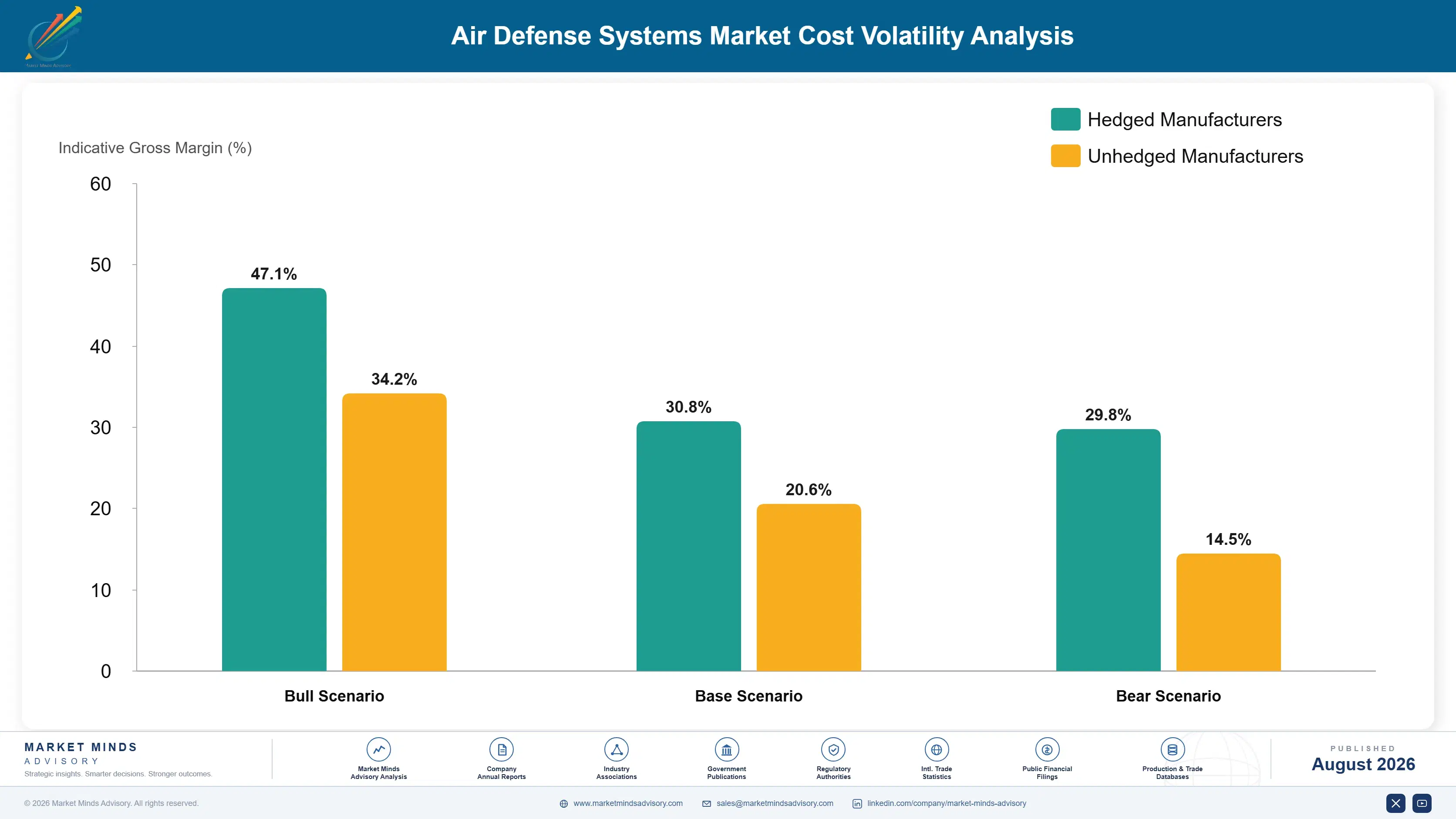
Guidance Electronics And Propellant Cost Exposure

Precision guidance electronics and solid rocket propellant together represent the two largest cost inputs for air defense systems manufacturers, running roughly 40 to 50 percent of interceptor production cost combined. Guidance electronics are sourced predominantly from a small number of qualified defense-grade semiconductor suppliers, while propellant manufacturing requires certified facilities capable of meeting demanding military specification tolerances.
The clearest recent volatility event was the 2023 semiconductor supply constraint affecting defense-grade guidance electronics, which extended interceptor production timelines meaningfully across the industry during the period. Several manufacturers' 2025 annual reports disclosed materially higher component procurement costs during this period, attributing much of the increase directly to competition for constrained defense-grade semiconductor capacity amid simultaneously rising commercial chip demand. Manufacturers with diversified component sourcing relationships weathered this spike meaningfully better than those dependent on single suppliers.

The competitive disadvantage mechanism falls disproportionately on smaller manufacturers without long-term supply agreements, since they must compete for constrained defense-grade component capacity at spot market pricing rather than locked-in contract rates. This exposure varies by manufacturer scale too, since larger primes with multi-year supply agreements secured meaningfully more favorable terms than smaller competitors purchasing at smaller volumes.
air-defense-systems-market-cost-volatility-analysis-1787982316039

Securing Multi-Year Semiconductor Supply Agreements

Larger manufacturers are securing multi-year defense-grade semiconductor supply agreements directly with qualified producers, locking in predictable pricing and delivery priority that insulates production costs from short-term spot market volatility while guaranteeing suppliers stable long-term order commitments in return. This approach has already meaningfully stabilized production planning for several major manufacturers facing rising component cost pressure.

Diversifying Component Sourcing Across Suppliers

Manufacturers are diversifying guidance electronics sourcing across multiple qualified suppliers spanning different geographic regions, reducing dependence on any single source following the 2023 supply constraint and building redundancy into critical defense-grade component supply chains going forward. This diversification approach has already proven valuable for manufacturers navigating the 2023 constraint more smoothly than concentrated competitors.

Investing In Domestic Propellant Manufacturing Capacity

Some manufacturers are investing in expanded domestic propellant manufacturing capacity specifically to reduce dependence on constrained specialty chemical suppliers, though this approach requires substantial capital investment and lengthy facility certification timelines before new capacity comes fully online. Several manufacturers report meaningful progress toward reducing dependence on constrained specialty chemical suppliers over the coming years.

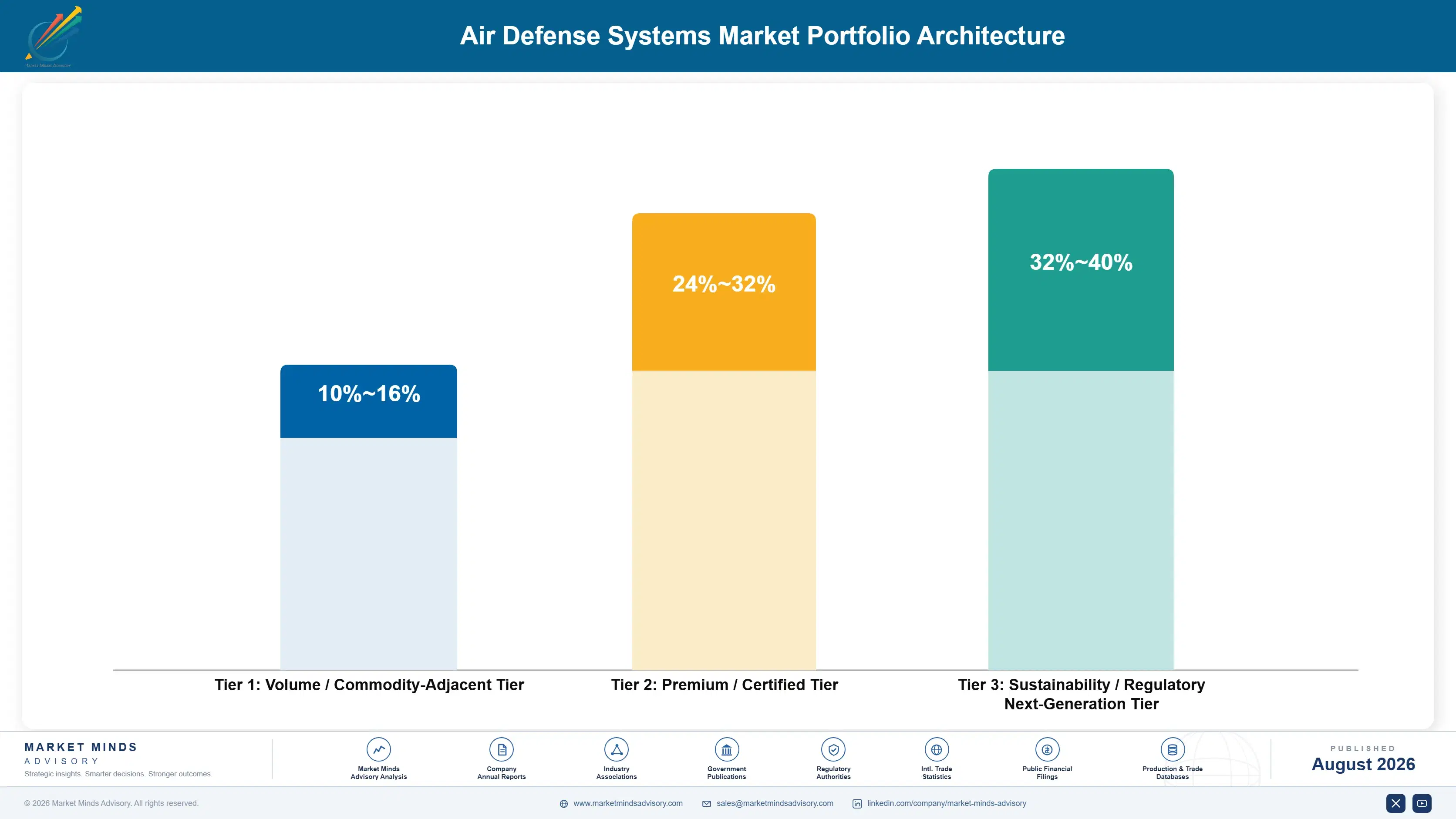
Portfolio Architecture for Margin Defence

Air defense systems portfolios span three distinct economic tiers separated primarily by technology sophistication and combat validation rather than platform category alone. Standard legacy interceptor sales and basic radar systems sold on competitive rate alone carry thinner margins as program competition intensifies. Manufacturers competing purely on unit price in this tier face shrinking margins as competitive tender processes increasingly commoditize basic platform delivery.
Certified and premium tiers, including combat-proven interceptor systems and integrated sustainment programs, command materially better economics because they require demonstrated operational credibility and specialized parts access competitors cannot replicate quickly. The highest value pool concentrates in counter-drone systems and export programs with technology transfer arrangements, where genuine advantage through combat validation and relationship depth drives the industry's widest margins. Providers building this expertise early are converting former commodity positioning into a durable, defensible competitive position.

Volume-tier legacy platform sales remain necessary for maintaining overall production scale and supply chain relationships, even though margin contribution lags behind premium and next-generation tiers substantially, creating an ongoing tension between defending broad market presence and reallocating investment toward higher-margin counter-drone and export products. The manufacturers managing this balance most effectively will likely define industry leadership over the next several program cycles.

Volume / Commodity-Adjacent Tier

Standard legacy interceptor sales and basic radar systems sold primarily on competitive rate, with limited differentiation beyond delivery timeline and unit pricing. Margins compress further as competitive tender processes increasingly commoditize basic platform delivery across most program categories.
Gross Margin: 10-16%

Premium / Certified Tier

Combat-proven interceptor systems and integrated sustainment programs requiring demonstrated operational credibility and specialized parts access smaller competitors struggle to replicate. These programs carry lower price sensitivity given their embedded technical relationships and specialized parts access requirements.
Gross Margin: 24-32%

Sustainability / Regulatory / Next-Generation Tier

Counter-drone systems and export programs with technology transfer arrangements commanding the industry's highest margins through genuine technical and combat validation differentiation. Manufacturers investing here early are building combat credibility and technical capability competitors will struggle to replicate quickly.
Gross Margin: 32-40%
air-defense-systems-market-portfolio-architecture-1787982316533

High-value Sub-segments and Strategic Watch-out

Combat-Validated Counter-Drone Systems

Combat-validated counter-drone systems combine strong margin economics with the fastest growth in the market, converting a former competitive vulnerability into a genuine durable revenue opportunity for well-positioned manufacturers. Manufacturers still focused purely on traditional interceptors risk missing this increasingly lucrative procurement opportunity entirely. This gap widens further each cycle.
Gross Margin: 28-36%

Export Programs With Technology Transfer

Export programs with technology transfer arrangements pair solid margins with strong growth from emerging market demand, offering a dependable combination without the volatility risk carried by pure new platform development programs. Early movers building this documentation are establishing trust later competitors will struggle to displace quickly.
Gross Margin: 24-32%

Standard Legacy Interceptor Sustainment

Standard legacy interceptor sustainment remains the volume core of the industry, generating dependable long-term revenue even as margins stay compressed by intensifying competition for routine maintenance work. Manufacturers should defend this base carefully even while shifting investment toward higher-margin counter-drone and export products. Volume alone no longer secures leadership.
Gross Margin: 12-18%

Platforms Without Counter-Drone Complement

Platforms without a clear counter-drone complement represent the industry's clearest strategic watch-out, since combat lessons are steadily proving pure interceptor-only strategies are not commercially defensible without modernization investment. Manufacturers should modernize offerings quickly rather than assume traditional interceptors remain commercially viable without upgrade investment. Delay only compounds this gap.
Gross Margin: 8-14%

Program-Anchored Recurring Procurement Demand

Air defense systems demand carries strong annuity characteristics because decades-long system lifecycles generate predictable recurring sustainment and parts revenue once a platform enters service, giving original equipment manufacturers unusually stable recurring revenue streams tied to specialized parts access and technical data rights that competitors cannot easily replicate. This recurring pattern is reinforced further by specialized parts requirements that keep customers tied to the original manufacturer for decades.
Stickiness varies meaningfully by end-use vertical, though. Established national government relationships show the deepest retention since switching primes requires costly requalification and new technical data licensing, while emerging export market customers show comparatively shallower loyalty, actively comparing competing offers including price, combat validation, and technology transfer terms before committing to a specific manufacturer relationship. Emerging export customers also show meaningfully more price sensitivity before switching costs meaningfully increase over subsequent renewal cycles.

A generational buyer shift is also underway. Younger defense procurement officials increasingly prioritize layered, networked defense system integration and demonstrated combat performance data over the purely mechanical reliability metrics that dominated procurement decisions for prior generations of air defense buyers. Manufacturers slow to build comparable networked and combat-data-driven capability risk losing favor with this newer generation of defense procurement decision-makers.
air-defense-systems-market-end-use-penetration-index-1787982317028

Where Air Defense Primes Should Focus

These are among the four positions where our research anticipates prominent divergence between winners and laggards over the coming forecast period. Each is grounded in the demand model, the regulatory perimeter, and the announced capacity pipeline.
01 / COUNTER-DRONE INVESTMENT PRIORITY

Build dedicated counter-UAS capability before budget share erodes further

Manufacturers still organized primarily around traditional interceptors risk missing the fastest-growing procurement category entirely to specialized drone-defense competitors already capturing this expanding budget category. Raytheon's counter-UAS division already demonstrates meaningfully faster order growth than its own traditional interceptor division across nearly every program. Manufacturers that delay this investment risk ceding an entire emerging procurement category permanently to earlier-moving, better-resourced competitors already building comparable capability, a gap that widens further with every additional program cycle these slower-moving competitors wait to invest.
02 / COMBAT VALIDATION DOCUMENTATION

Document combat performance before export competitions solidify

Manufacturers offering only peacetime-tested systems risk steadily and irreversibly losing valuable export competitions to competitors with documented combat performance and demonstrated, credible operational track records. Rafael Advanced Defense Systems' published combat record already wins considerably more competitive selections than rival systems lacking comparable operational validation and any long documented track record. Manufacturers that keep delaying systematic performance documentation risk permanently ceding credibility-driven export competitions to better-validated rivals already locking in long-term customer relationships across multiple emerging global markets and regions.
03 / COST-EXCHANGE INNOVATION STRATEGY

Invest in low-cost solutions before budget pressure intensifies further

Manufacturers relying purely on expensive traditional interceptors face a persistently unfavorable cost-exchange ratio against cheap drone threats that increasingly strains government procurement budgets across most allied nations worldwide. Early movers in directed energy and low-cost projectile solutions already capture meaningfully more counter-drone contract volume than traditional interceptor-only competitors relying purely on expensive munitions alone. Manufacturers that delay this innovation risk losing meaningful layered defense contracts to more cost-efficient rivals already demonstrating proven battlefield results and considerably lower per-unit costs overall.
04 / SUPPLY CHAIN DIVERSIFICATION

Diversify component sourcing before the next constraint hits

Manufacturers concentrated heavily and narrowly in constrained semiconductor supply relationships face significantly amplified exposure when disruptions like the 2023 constraint hit already-constrained defense-grade capacity simultaneously across the whole industry. Diversified sourcing across multiple qualified suppliers insulates manufacturers from this risk far more effectively than continued single-source dependence on any one region. Manufacturers that wait until the next disruption to diversify will likely face materially worse terms than those who prepared proactively well ahead of any visible warning signs in the market.

Engagement Snapshot From the Field

A live engagement with an industry participant carrying material or product regulatory and market exposure ahead of a defining policy shift, showing how our research translates into a defensible multi-year portfolio strategy.
MARKET MINDS ADVISORY · CLIENT ENGAGEMENT SUMMARY
Air Defense Systems Producer Strategic Portfolio Review and Transition Roadmap 2026·Investment Scenario on Air Defense Systems Exposure Evaluation 2025-26
CLIENT PROFILE
The client was an Eastern European air force procurement office managing an aggressive air defense modernization program spanning interceptor, radar, and emerging counter-drone categories simultaneously, facing pressure to rapidly expand capability given heightened regional security concerns. The office coordinated closely with allied procurement offices facing similarly urgent modernization pressure. The office managed an annual defense procurement budget substantially larger than its allocation just five years earlier.
STRATEGIC CHALLENGE
Procurement leadership needed to determine how to sequence and prioritize spending across traditional interceptor procurement, radar modernization, and emerging counter-drone categories given constrained annual budget allocations and urgent capability gaps across multiple threat categories. Leadership also needed to balance domestic industrial development goals against the fastest possible path to operational capability.
MMA APPROACH
MMA benchmarked comparable Eastern European air force modernization sequencing decisions, drawing on primary interviews with procurement officials at peer air forces that had recently completed similar multi-category layered defense prioritization exercises under comparable budget constraints. The assessment also incorporated publicly available defense budget allocation data across comparable NATO member states facing similar modernization pressures.
KEY FINDINGS
  1. Peer air forces that prioritized counter-drone procurement early reported meaningfully faster capability gains per budget dollar than those focused purely on traditional interceptor replacement (client-reported, unverified by MMA).
  2. Radar modernization timelines across comparable programs consistently ran longer than initial government planning estimates suggested. This delay pattern directly informed the office's own realistic program timeline expectations.
  3. Combat-validated interceptor systems negotiated alongside new procurement delivered meaningfully better long-term confidence than unproven alternative systems. This value difference proved decisive in how the office ultimately structured its own procurement contracts.
  4. Air forces that delayed counter-drone investment reported losing meaningful capability ground to peer nations that moved earlier on this priority. This finding reinforced the urgency of moving forward with counter-drone procurement promptly.
CLIENT PROFILE
The client was an Eastern European air force procurement office managing an aggressive air defense modernization program spanning interceptor, radar, and emerging counter-drone categories simultaneously, facing pressure to rapidly expand capability given heightened regional security concerns. The office coordinated closely with allied procurement offices facing similarly urgent modernization pressure. The office managed an annual defense procurement budget substantially larger than its allocation just five years earlier.
STRATEGIC CHALLENGE
Procurement leadership needed to determine how to sequence and prioritize spending across traditional interceptor procurement, radar modernization, and emerging counter-drone categories given constrained annual budget allocations and urgent capability gaps across multiple threat categories. Leadership also needed to balance domestic industrial development goals against the fastest possible path to operational capability.
MMA APPROACH
MMA benchmarked comparable Eastern European air force modernization sequencing decisions, drawing on primary interviews with procurement officials at peer air forces that had recently completed similar multi-category layered defense prioritization exercises under comparable budget constraints. The assessment also incorporated publicly available defense budget allocation data across comparable NATO member states facing similar modernization pressures.
KEY FINDINGS
  1. Peer air forces that prioritized counter-drone procurement early reported meaningfully faster capability gains per budget dollar than those focused purely on traditional interceptor replacement (client-reported, unverified by MMA).
  2. Radar modernization timelines across comparable programs consistently ran longer than initial government planning estimates suggested. This delay pattern directly informed the office's own realistic program timeline expectations.
  3. Combat-validated interceptor systems negotiated alongside new procurement delivered meaningfully better long-term confidence than unproven alternative systems. This value difference proved decisive in how the office ultimately structured its own procurement contracts.
  4. Air forces that delayed counter-drone investment reported losing meaningful capability ground to peer nations that moved earlier on this priority. This finding reinforced the urgency of moving forward with counter-drone procurement promptly.
RECOMMENDED STRATEGY
Phase 1: Phase one prioritized counter-drone procurement to close the most urgent near-term capability gaps quickly. to establish immediate capability improvements within available budget constraints. Phase 2: Phase two launched a phased interceptor modernization program bundled with long-term sustainment contract terms. to secure favorable long-term terms while capability needs remained most urgent. Phase 3: Phase three sequenced radar system upgrades based on updated budget availability and evolving threat assessments. to ensure the program remained fiscally sustainable over time.
OUTCOME
The procurement office successfully launched its phased modernization program within the recommended sequence and reported meaningfully improved capability delivery per budget dollar within the first two years of implementation (client-reported, unverified by MMA). Leadership credited the phased sequencing with delivering measurable results without exceeding available budget constraints.

Frequently Asked Questions

Foundational context covering the market sizes, CAGR, scope, country, region and competition that inform every finding below. This section is provided to cover basics and most often pre-purchase conversations, answered from the MMA Primary Research Dataset.

What is the current size of the Air Defense Systems Market?

The global air defense systems market reached an estimated 48.0 billion dollars in 2025. Growth has been propelled by accelerating rearmament and expanding counter-drone procurement across multiple regions.

How large will the Air Defense Systems Market be by 2036?

The market is projected to reach approximately 114.22 billion dollars by 2036. This reflects sustained rearmament spending and counter-drone systems investment through the forecast period.

What is the CAGR for the Air Defense Systems Market 2026 to 2036?

The base case CAGR is 8.2 percent annually. Bull and bear scenarios range between 6.9 and 9.5 percent depending on the pace of counter-drone platform adoption.

Which segment is growing fastest?

Counter-drone and counter-UAS systems lead at 16.0 percent CAGR, roughly 1.95 times the overall market pace. Combat lessons from recent regional conflicts are the primary driver behind this acceleration.

Who are the major companies in the Air Defense Systems Market?

Leading manufacturers include Raytheon, Lockheed Martin, MBDA, Rafael Advanced Defense Systems, and Diehl Defence. These five manufacturers hold a combined 52 percent share on a revenue basis.

Which country is growing fastest?

Poland leads at an estimated 11.5 percent CAGR. Historically unprecedented rearmament spending and accelerating air defense procurement across every major system category continue driving this above-average pace.

Report Segmentation Architecture

The full report scope spans multiple orthogonal segmentation dimensions, with cross-tabulated demand data provided for each dimension pair. Coverage extends further to regional breakdowns, trend trajectories, and the competitive detail needed to support segment-level decision-making.

By Primary Market Dimension

  • Short-Range Air Defense Systems
  • Medium-Range Air Defense Systems
  • Long-Range and Ballistic Missile Defense Systems
  • Counter-Drone and Counter-UAS Systems
  • Air Defense Radar and Sensor Systems
  • Air Defense System Integration and Sustainment Services

By End-Use Industry

  • Air Force Ground-Based Defense Commands
  • Army Air Defense Artillery Units
  • Naval Air Defense Systems
  • Critical Infrastructure Protection Agencies
  • Border Security and Homeland Defense Agencies
  • Special Forces And Rapid Response Units

By Commercial Dimension

  • Direct National Procurement
  • Joint Multinational Programs
  • Technology Transfer and Licensed Production
  • Long-Term Sustainment Contracts
  • Export Sales to Allied Nations
  • Combat Data Licensing and Consulting Services

By Region

  • North America
  • East Asia
  • Western Europe
  • South Asia and Pacific
  • Eastern Europe
  • Middle East and Africa
  • Latin America

Scope, Methodology, and Coverage

Every figure in this report is reproducible from documented input assumptions. The scope below maps the historical period, the forecast horizon, the segmentation dimensions, and the countries covered, alongside the underlying primary and qualitative methodology.
Historical Period
2020 to 2025
Forecast Period
2026 to 2036
Base Year
2025 (USD billions; MMA Primary Research Dataset, August 2026)
Market Definition
This report covers the manufacture, sale, and lifecycle sustainment of ground-based and naval air defense systems designed to detect, track, and intercept aircraft, missiles, and unmanned aerial systems, including associated radar, sensor, and integration services. It excludes offensive strike missile systems, space-based defense systems, and small arms air defense weapons.
Quantitative Units
USD billions (program revenue, current prices); system deliveries in hundreds where cited.
Segmentation Dimensions
Primary Market Dimension (intercept range and threat category); End-Use Industry; Commercial Dimension.
Regions Covered
North America, East Asia, Western Europe, South Asia and Pacific, Eastern Europe, Middle East and Africa, Latin America
Countries Covered
United States, Israel, France, Germany, United Kingdom, Poland, Japan, South Korea, China, India, Australia, Saudi Arabia, UAE, Brazil, Turkey.
Key Companies Profiled
Raytheon, Lockheed Martin, MBDA, Rafael Advanced Defense Systems, Diehl Defence.
Quantitative Methodology
Primary survey, n=3,800 respondents, Q4 2025, six countries; demand-side model with trade association cross-validation
Qualitative Methodology
47 expert interviews, Q4 2025; applied to validate demand model assumptions, identify emerging dynamics, and assess competitive positioning
Report Format
PDF and XLSX data workbook (Word format preview document)
Publisher
Market Minds Advisory
Report Code
MMA-2026-CON-105
Published
August 2026
Contact
sales@marketmindsadvisory.com | www.marketmindsadvisory.com

Purchase the full Air Defense Systems Market Report (2026 to 2036).

This report delivers a complete strategic assessment of the global air defense systems market through 2036. It combines primary survey data from 3,800 respondents across six countries with 47 expert interviews conducted in the fourth quarter of 2025. Coverage spans market sizing, six-segment MECE intercept range segmentation, competitive benchmarking across twenty profiled manufacturers, and regional analysis across all seven global regions. The analysis is designed to support program strategy, counter-drone investment, and export competition decisions. Buyers gain a structured basis for evaluating counter-drone investment against continued combat validation strategy decisions.
Six-segment MECE air defense intercept range breakdown
Seven-region market sizing with country-level detail
Twenty-company competitive benchmarking and moat analysis
Counter-drone shift impact quantification and scenarios
Combat validation and export strategy investment guidance
Anonymized client case study with recommended strategy phases

Built For The People Who Decide

From boardroom strategy to bench-side execution, this report is read cover-to-cover by leaders shaping the next decade of their industry, turning demand scenarios, market dynamics and valuation benchmarks into decisions.
CXOs/ Presidents/ VPs/ Managers
M&A and Corporate Development
Strategy Teams and R&D Heads
Procurement and Product Directors
Regulatory and Compliance Leaders
Investor Relations and Equity Analysts