Market Minds Advisory
Air Combat Maneuvering Instrumentation Market

Air Combat Maneuvering Instrumentation Market: Air Combat Maneuvering Instrumentation: The Pod Disappears and Accreditation Becomes the Moat

Hanging an instrumentation pod on a stealth aircraft ruins the signature the crew came to train with, so the hardware that carried this industry's margin for thirty years is being designed out.

Lead Analyst

Published

September 2026

Make Smarter Decisions with Customized Research Insights

Request a free sample report and evaluate market opportunities, growth trends, and competitive dynamics relevant to your business needs.

2025 MARKET VALUE$1.2BMarket Size 2025
2036 FORECAST VALUE$2.7BBase Case , 2026 to 2036
CAGR 2026 TO 20367.6 %Bull 8.9% / Bear 6.3%
INCREMENTAL OPPORTUNITY$1.4BNet 10- year value creation
EXPANSION MULTIPLE2.08x2036 value over 2026 base
Strategic Levers
M&A Pipeline
Regional Outlook
Country Rankings
Competitive Intelligence
Segmental Deep-dive
Call-Us : 91 93563 13602

Executive Snapshot and Market Trajectory.

The pod is being designed out of this market. Hanging an instrumentation pod on a stealth aircraft degrades the signature the crew is supposed to be training with, so fifth-generation platforms carry the function internally. Thirty years of hardware margin is disappearing with it, and few suppliers have replaced it.
Two forces are setting the pace. Fifth-generation fleet growth across the United States, Japan, South Korea and Western Europe converts pod demand into embedded instrumentation demand, which is a different product sold to a different buyer. Rangeless training then extends the addressable base to air arms without instrumented ranges. Embedded instrumentation grows fastest at 11.4%, half again the market rate of 7.6%.
Concentration is extreme: five suppliers hold 66% of installed instrumentation, and the barrier is accreditation rather than engineering. Training data from a fifth-generation aircraft is classified, so debrief systems must sit inside accredited enclaves, and coalition exercises become a data-release negotiation rather than a technical exercise. That single constraint now decides more competitions than pod performance ever did, and it favours suppliers already cleared inside national programmes rather than those holding better technology on paper.
Market Definition
Air combat maneuvering instrumentation covers the equipment and software that measure, record and replay live air combat training engagements: airborne instrumentation carried externally or embedded internally, datalink and relay infrastructure, ground debrief and display systems, fixed range tracking installations, and weapon simulation with kill removal logic. Scope includes the accreditation and data handling software that makes classified training data usable. Excluded are full flight simulators and virtual training devices, aerial target vehicles, range safety systems, electronic warfare threat emitters, and operational mission data recorders not used for training assessment.
Base Year Value
$1.2B in 2025 (MMA Primary Research Dataset, September 2026)
Forecast Period
2026 to 2036, eleven discrete annual values
CAGR
7.6% base case. Bull 8.9%. Bear 6.3%.
Fastest Growth Segment
Embedded Internal Instrumentation: 11.4% CAGR
Fastest Growth Country
India: 11.0% CAGR
Fastest Growth Region
South Asia and Pacific: 9.9% CAGR
Largest Region
North America: 32% of 2025 global value
Market Leaders
Cubic Corporation, Leonardo DRS, Elbit Systems, Saab, Thales. Source: MMA Analysis based on installed instrumentation base and contracted programme value, July 2026.
Primary Survey
n=3,800 procurement and R&D decision-makers, Q4 2025, six countries
Methodology
Demand-side build-up, cross-validated against public data, 47 expert interviews

Air Combat Maneuvering Instrumentation Market Forecast Scenarios

air-combat-maneuvering-instrumentation-market-size-forecast-scenario-1790025739171
Growth through 2020 to 2025 averaged 6.4% and the composition of it changed completely over those six years. Pod procurement flattened as fifth-generation deliveries accelerated, while ground debrief and datalink spending rose to compensate. Several air arms also discovered during the reduced flying tempo of 2020 and 2021 that their debrief infrastructure was the limiting factor in training value, not their pod count, and funded accordingly afterwards.
Base case growth of 7.6% rests on three mechanisms. Fifth-generation fleet expansion across allied air forces creates embedded instrumentation requirements on aircraft that cannot carry pods without defeating the training objective. Rangeless architectures extend instrumented training to air arms that never built instrumented ranges, widening the customer base rather than raising spend per customer. And coalition exercise growth forces investment in data-release and cross-domain debrief tooling that did not previously exist as a product category.
The bull case at 8.9% depends on multi-national data-release frameworks being agreed, which would let allied air arms debrief fifth-generation engagements together rather than separately. The bear case at 6.3% assumes the opposite: classification friction keeps coalition training shallow, embedded instrumentation stays inside platform programmes, and the addressable market shrinks back toward ground systems on their own.

From Pod Hardware to Accredited Debrief Infrastructure

What this industry sells has changed twice in a decade. It sold pods, then it sold pods plus ground systems, and now the pod is optional while the ground system is not. Buyers with fifth-generation aircraft need instrumentation that does not alter the aircraft's signature, and that requirement moves the function inside the airframe and inside the platform contract.
FIVE-FIRM CONCENTRATION66%Accreditation history rather than engineering defends these positions
AVERAGE POD UNIT PRICEUSD 0.6MExternal airborne instrumentation excluding any ground infrastructure cost
INSTRUMENTED FIGHTER SHARE44%Portion of allied fighter fleets carrying training instrumentation
EMBEDDED ATTACH RATE81%Share of new stealth deliveries using internal instrumentation
SYSTEM REFRESH INTERVAL11 yearsTypical replacement cycle on installed ground debrief systems
SOFTWARE COST SHARE47%Portion of delivered system value from software and accreditation
Classification is the commercial reality nobody advertises. Recorded engagement data from a fifth-generation aircraft reveals performance characteristics that the platform's owner treats as national secrets, which means debrief systems have to run inside accredited enclaves and coalition partners cannot simply share a screen. Suppliers already accredited inside a national programme hold an advantage no amount of product superiority overcomes, and getting accredited from outside takes years rather than months.
Rangeless instrumentation is the offsetting opportunity. Air arms that never built instrumented ranges can now run measured engagements using datalink relay and portable ground equipment, which opens a customer base previously excluded by infrastructure cost. Those customers buy smaller systems and buy them less often, so the revenue per account is lower, but the account count rises substantially and the competitive field there is far less settled.
"Everybody in this market still talks about pod accuracy. The competitions are being decided on whether your debrief system can be accredited inside a national enclave, which is a lawyer's question more than an engineer's."
Director, Defence Test and Training Systems Practice · MMA Defence Systems / Live Training and Instrumentation Practice · September 2026

Market Trends

Instrumentation Moves Inside The Airframe Permanently

Fifth-generation aircraft cannot carry external instrumentation without altering the low-observable characteristics the crew is training to exploit, so the function is being built into the aircraft itself. That shifts procurement authority from the training command to the platform programme office, which is a different buyer with different priorities and a much longer decision cycle. Suppliers who sold pods to training commands for thirty years now have to win a place inside a platform baseline instead. Around 81% of new stealth deliveries already use internal instrumentation rather than pods. Training commands no longer control this decision.
Market Impact: Covers 640 newly delivered aircraft
Rangeless Architectures Open Air Arms Without Ranges

Measured air combat training once required an instrumented range with fixed tracking installations, which put it out of reach for most air forces. Datalink relay between aircraft, portable ground equipment and cloud-hosted debrief now deliver comparable assessment without permanent infrastructure. The commercial consequence is a much wider customer base buying much smaller systems, which suits challengers better than incumbents built around large fixed-range programmes. Roughly 26 air arms have become addressable under this model that were not addressable under the fixed-range one. Revenue per account falls while account count rises sharply.
Market Impact: Affects 19 annual coalition exercises

Market Opportunities and Growth Drivers

Allied Fifth-Generation Fleet Growth Creates Embedded Instrumentation Requirements

Fifth-generation fighter deliveries to the United States, Japan, South Korea, Australia and several European air arms are running at a pace that makes instrumentation a fleet-wide requirement rather than a squadron-level purchase. Each of these customers needs training measurement that survives inside a low-observable airframe, and that requirement is written into platform sustainment rather than training budgets. The demand is non-discretionary because operational readiness certification depends on measured engagement results. Roughly 640 aircraft entering service over the forecast period carry the requirement from delivery. Instrumentation is written into sustainment rather than training budgets.
Market Impact: Delays coalition awards 26 months

Coalition Exercise Growth Forces Cross-Domain Debrief Investment

Large multi-national exercises across Europe, the Pacific and the Gulf have grown in both frequency and participant count since 2022, and each one surfaces the same problem: participating air arms cannot debrief together because their recorded data carries different national classifications. Solving it requires cross-domain guards, release tooling and agreed data standards, none of which existed as products five years ago. That work is now being funded separately from instrumentation itself. Around 19 major coalition exercises annually now specify shared debrief capability. No supplier had a product for this five years ago.
Market Impact: Shifts 62% of decisions upstream

Market Restraints and Challenges

Classification Rules Block Shared Training Data Between Allies

Recorded engagement data reveals platform performance that owning nations treat as protected, so allied air arms flying the same exercise often cannot see each other's results. The root cause is that release authority sits with the platform's originating government rather than with the exercise sponsor, and no supplier can negotiate around it. Commercially this caps the value of coalition debrief products and stretches sales cycles into multi-year government-to-government discussions. Participants are working on cross-domain guards, data abstraction that removes performance detail, and release-by-default frameworks agreed at alliance level. Progress depends on governments, not suppliers.
Market Impact: Internal fit reaches 81% penetration

Platform Programme Offices Control Embedded Instrumentation Access

When instrumentation moves inside the airframe, the decision moves to the platform programme office and the aircraft manufacturer. Independent instrumentation suppliers lose direct access to the training command that used to buy from them. The root cause is integration authority: nothing goes inside a low-observable airframe without the platform authority's agreement. The commercial effect is that suppliers become subcontractors on terms they do not set. Mitigation has taken three forms: early positioning inside platform baselines, retrofit kits for earlier blocks, and concentrating instead on ground and datalink scope the platform office does not control.
Market Impact: Adds 26 newly addressable air arms
4 additional market trends, 3 additional growth drivers, and 2 additional restraints and challenges are covered in the full report. Contact sales@marketmindsadvisory.com to access the complete intelligence.

Segment CAGR and Growth Architecture

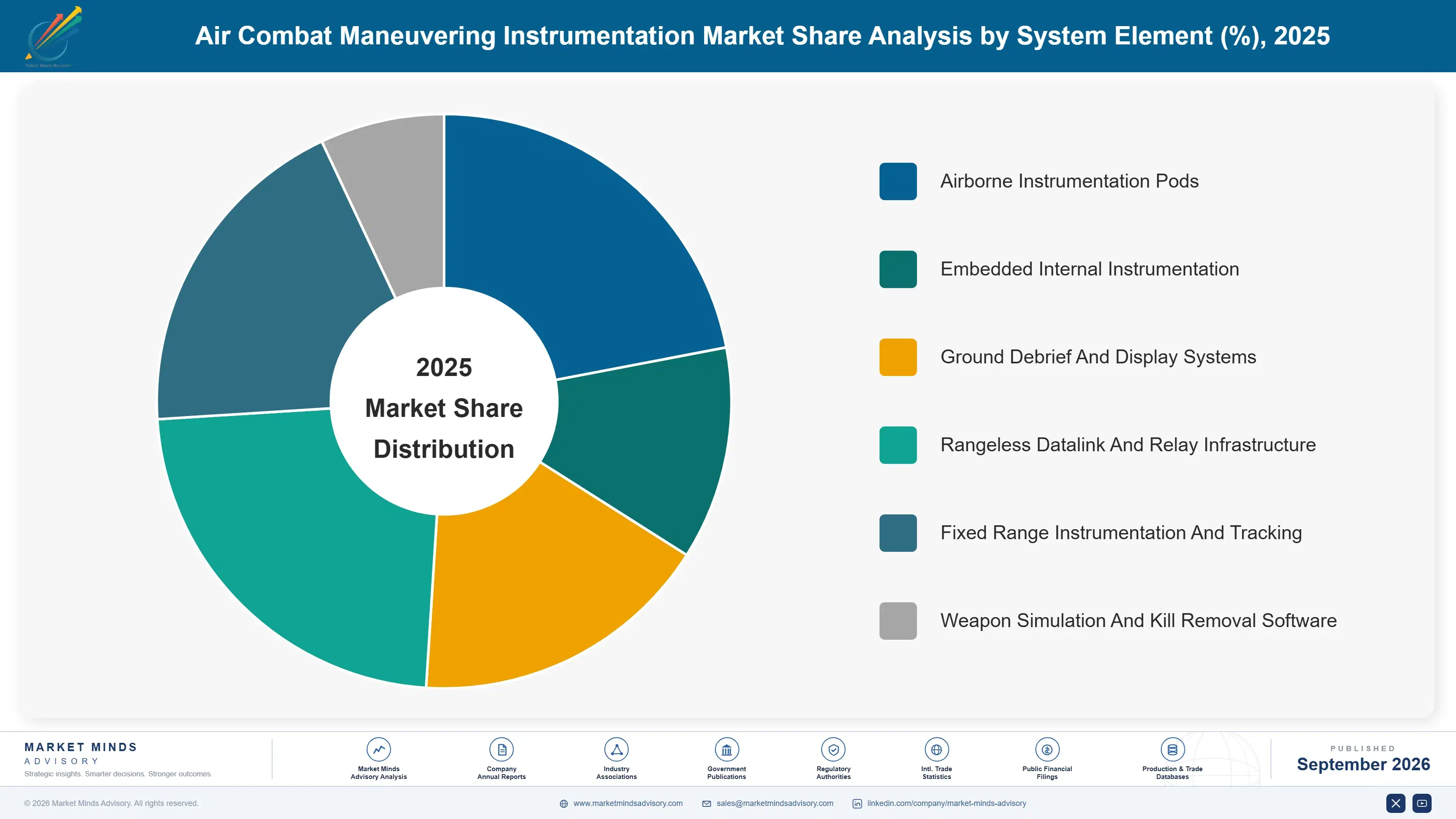
Instrumentation is segmented here by system element, because each element is procured separately, by a different authority, on a different cycle. Mixing system element with exercise type or service branch produces categories that overlap on every real programme. Six elements cover the measurement chain from airborne sensing through to accredited debrief output, and margin spread across them is wide.
air-combat-maneuvering-instrumentation-market-market-share-analysis-1790025739706

Embedded Internal Instrumentation

Growing at 11.4%, half again the market rate of 7.6%, this is where the market is going and where the incumbents are least comfortable. The product sits inside the airframe, which means the platform programme office and airframe manufacturer control access, and the instrumentation supplier negotiates as a subcontractor rather than selling to the training command directly. Unit economics are better than pods because there is no pod structure, environmental qualification is shared with the airframe, and the content is locked in for the aircraft's life. Winning a place inside a platform baseline is close to permanent; losing one is equally difficult to reverse. The buyer is the platform authority, not the training command.
CAGR 11.4%

Rangeless Datalink And Relay Infrastructure

Datalink relay and portable ground equipment let air arms run measured engagements without an instrumented range, which is why this element grows at 9.8% while fixed range instrumentation grows at 4.7%. The customer base is genuinely new: air forces that could never justify permanent range infrastructure now buy a transportable capability instead. Systems are smaller and cheaper, so revenue per account falls while account count rises. Competitive dynamics here are the loosest in the market because accreditation requirements are lighter when the customer flies fourth-generation aircraft, and several challengers have won positions incumbents did not contest seriously. Revenue per account falls while the number of accounts rises, which suits challengers better than incumbents.
CAGR 9.8%
Full segment breakdown across 6 segments available in the complete report.

Regional Architecture and Country Demand Map

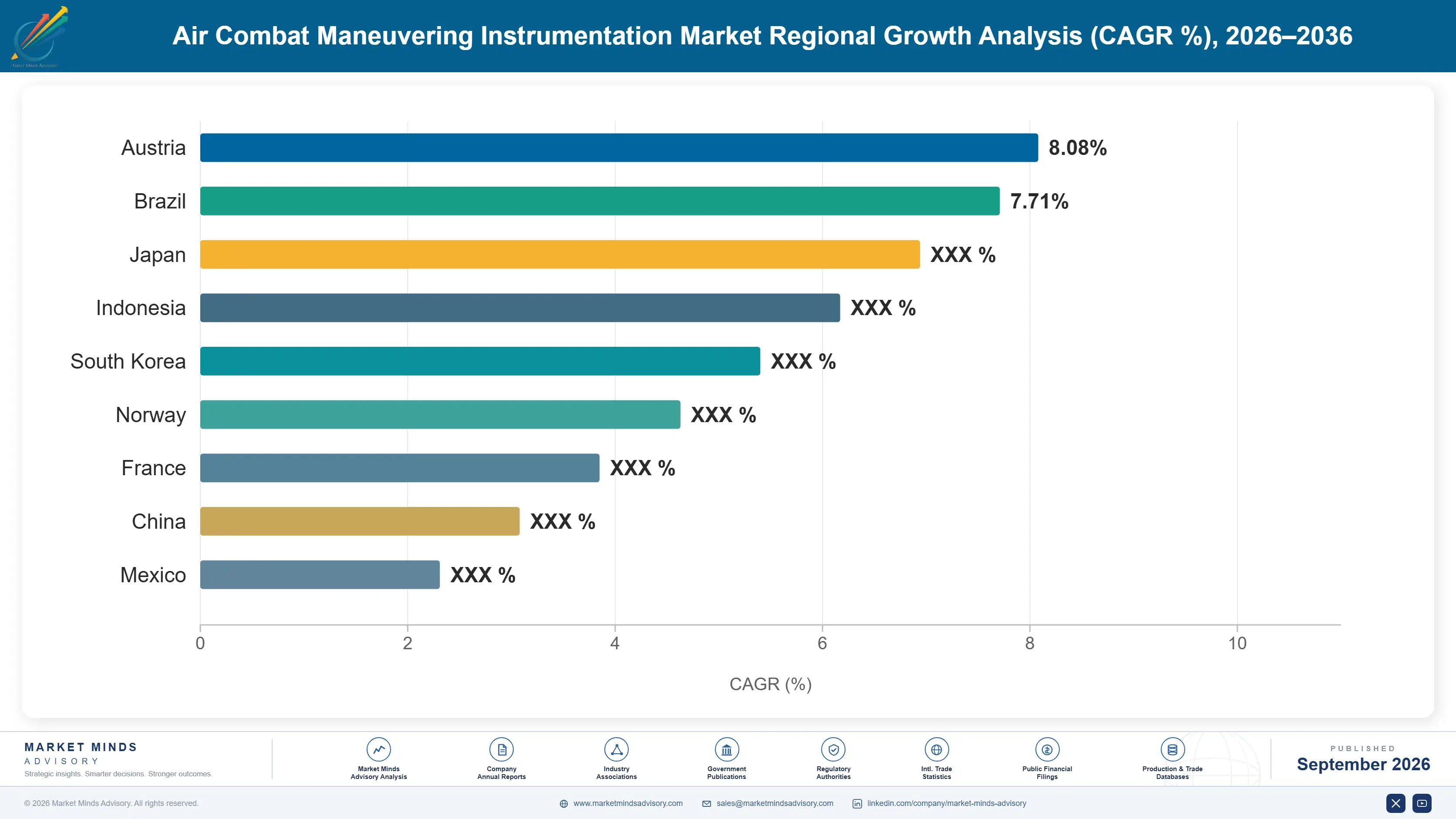
Demand follows fifth-generation fleets and exercise tempo rather than total aircraft numbers. North America leads on installed instrumentation because it operates the largest instrumented ranges and the largest stealth fleet, while East Asian growth reflects new fifth-generation deliveries arriving alongside indigenous training programmes. Exercise tempo matters more than fleet size.

North America

Instrumented range infrastructure is what puts this region first. The United States operates the largest network of instrumented training ranges and the largest fifth-generation fleet, and both drive continuous instrumentation and debrief investment rather than periodic programme purchases. Embedded instrumentation decisions here sit inside platform sustainment rather than training budgets, which changes who suppliers must persuade. Canadian demand is smaller and currently focused on preparing debrief infrastructure ahead of fifth-generation deliveries. Growth of 7.1% is slightly below the market rate, because the installed base is large and mature and much of the spending is replacement rather than expansion. Volume is high; growth is not. Replacement, not expansion, funds most of it.
Share: 32% | CAGR: 7.1% (2026 to 2036)

Western Europe

Coalition training is the distinguishing feature across this region. European air arms fly together constantly, and the classification friction that comes with mixed fourth and fifth-generation fleets surfaces most sharply here. Italy, the Netherlands, Norway, Denmark and the United Kingdom all operate stealth aircraft alongside partners who do not, which creates demand for release tooling and cross-domain debrief that barely existed as a product five years ago. National ranges are small, so rangeless and deployable instrumentation sells well. Growth of 6.1% trails the market rate because pod fleets are already equipped and much of the new requirement sits inside platform programmes counted elsewhere. Deployable equipment sells well where national ranges are small.
Share: 22% | CAGR: 6.1% (2026 to 2036)
Regional intelligence for 5 additional markets available in the complete report: East Asia, South Asia and Pacific, Latin America, Middle East and Africa, Eastern Europe. Contact sales@marketmindsadvisory.com.
air-combat-maneuvering-instrumentation-market-country-cagr-analysis-1790025740233

Where Instrumentation Programmes Generate Real Profit

Pod sales were the visible revenue in this market for thirty years and they are no longer where profit is decided. Accreditation position, platform baseline access and debrief software content determine delivered margin now. The four levers below reflect positions participants have used to improve programme economics measurably. Each has been tested on delivered work.

Secure National Accreditation Before Competing For Programmes

Accreditation to handle classified engagement data inside a national enclave takes two to three years and cannot be bought at tender time. Suppliers holding it enter competitions that others are formally excluded from, which removes price comparison altogether. Win rates on accredited programmes run roughly 2.7 times those on open competitions for the same suppliers. The investment is unglamorous: security infrastructure, cleared personnel and documented processes that generate no revenue directly. It is also the single most defensible position available in this market. Competitors cannot buy this position at tender time.
Market Impact: Accredited programme win rates roughly 2.7 times higher

Buy Into Platform Baselines Early And Cheaply

Embedded instrumentation content is decided during platform development or block upgrade definition, years before any training command sees a requirement. Suppliers positioned inside those decisions capture content locked in for the aircraft's service life, typically 30 years or more. Getting there means funding integration work at low or negative margin during development, which finance functions resist. The return is a revenue stream with no recompetition risk: content value per aircraft averages around USD 340,000 across a fleet that cannot change supplier without reopening the airframe. Recompetition risk on that content is effectively zero.
Market Impact: Locks in content for roughly 30 service years

Sell Debrief Software Onto Competitors' Instrumentation

Ground debrief and analysis software can consume engagement data from instrumentation the supplier did not provide, which reaches customers lost on the airborne competition. Software carries gross margin well above hardware and requires no platform integration authority. Suppliers offering genuinely instrumentation-agnostic debrief report attach rates roughly 41% higher into install bases they did not equip. The barrier is data format access, which incumbents protect, so this lever works best where the customer insists on open interfaces in the original airborne contract. No platform integration authority is required for any of it.
Market Impact: Debrief software attach rate improves roughly 41% higher

Package Rangeless Capability As A Deployable Service

Air arms without instrumented ranges will not buy range infrastructure, but they will buy measured training events. Suppliers offering deployable instrumentation as a service, bringing equipment and analysts to the customer's base for an exercise period, convert a capital decision the customer will not make into an operating decision they will. Contract values are modest at roughly USD 1.4 million per annual programme, but margins run above product sales and the relationships persist. This is how most of the 26 newly addressable air arms are being reached. Capital decisions become operating decisions.
Market Impact: Service programmes average roughly USD 1.4 million annually

Who Controls the Margin Pool

Concentration is among the highest in defence training equipment, with the top five holding 66% of installed instrumentation and contracted programme value, the basis used throughout this section. The gap to the next tier is wider than the figure implies, because accreditation and platform baseline positions are not contestable within a normal procurement cycle. A supplier not already cleared inside a national programme cannot get cleared in time to bid it.
Competitive activity currently turns on three dimensions. Accreditation coverage decides which competitions a supplier may enter at all. Platform baseline position decides who captures embedded content on new aircraft. And interface openness in ground debrief decides who can sell software into install bases they did not equip. Incumbents lead on the first two and have every reason to resist the third, which is where challengers are concentrating.

Rankings will move in the rangeless and deployable segment rather than in the core. Accreditation requirements are lighter where customers fly fourth-generation aircraft, infrastructure demands are minimal, and several challengers have already won positions incumbents did not contest seriously. The risk for established suppliers is that these customers eventually buy fifth-generation aircraft, and the challenger is already inside the relationship.
air-combat-maneuvering-instrumentation-market-company-positioning-matrix-1790025740759

Competitive Moat and Risk Dimensions

CUBIC CORPORATION

Moat: Broadest Accredited Programme Coverage

Cubic holds accredited positions across a wider set of national training programmes than any competitor, which determines which competitions it may enter and which others cannot. The installed base of its combat training system across allied air arms also creates interoperability expectations that new entrants cannot satisfy, because exercise planning assumes the data formats and debrief workflows already in use.
CUBIC CORPORATION

Risk: Heavy External Pod Exposure

A substantial share of the firm's instrumentation revenue still derives from external pod products and their support, exactly the content being designed out as fifth-generation fleets grow. Replacing it requires winning embedded content inside platform baselines, where the platform programme office and airframe manufacturer control access and the commercial terms are considerably less favourable.
LEONARDO DRS

Moat: Platform Programme Integration Access

Leonardo DRS sits inside United States platform and sustainment programmes in ways that give it visibility and access to embedded instrumentation decisions years ahead of any training requirement being published. That position is difficult to attack because integration authority rests with the platform side, and the company's existing qualification work on those airframes lowers its cost to add content.
LEONARDO DRS

Risk: Limited Export Market Position

The company's strength is weighted toward United States programmes, and export instrumentation markets are where growth is fastest. Competing there means accreditation in other national systems and acceptance of local content conditions, both of which take years and neither of which follows automatically from a strong domestic position inside platform programmes.

Players Tracked

Prominent Players

Cubic Corporation
Leonardo DRS
Elbit Systems
Saab
Thales

Other Key Players

CAE
RTX
Northrop Grumman
BAE Systems
Indra Sistemas
HAVELSAN
LIG Nex1
Hanwha Systems
Mitsubishi Electric
NEC Corporation
Bharat Electronics
Israel Aerospace Industries
Rheinmetall
Aviation Industry Corporation of China
Kongsberg Defence and Aerospace

Recent Developments

APRIL 2025

Allied air arms agree shared debrief data standard for coalition exercises

A group of allied air forces agreed a common data standard and release process for debriefing mixed-generation coalition engagements. This was a government-level agreement rather than any corporate transaction, and it creates a defined product requirement for cross-domain release tooling that suppliers can now build against.
Signal: Turns a multi-year classification negotiation into a specified product requirement that suppliers can finally bid against properly
OCTOBER 2024

Asian air force awards national instrumentation programme with local software content

An East Asian air force awarded a national air combat instrumentation and debrief programme requiring domestic accreditation and local software development. The award was a competitive procurement rather than a joint venture, though it obliges the winning supplier to place substantial software engineering work inside the country.
Signal: Local accreditation and in-country engineering are becoming award conditions rather than negotiable supplier preferences in this region
JANUARY 2025

Instrumentation supplier launches deployable rangeless training service offering

An established instrumentation supplier introduced a deployable service where it brings equipment and analysts to a customer base for an exercise period rather than selling range infrastructure. The launch was an organic commercial initiative, not an acquisition, and it targets air arms that will never build instrumented ranges.
Signal: Converts a capital decision customers refuse into an operating decision they will actually approve without difficulty

What Sets Delivered Instrumentation Cost

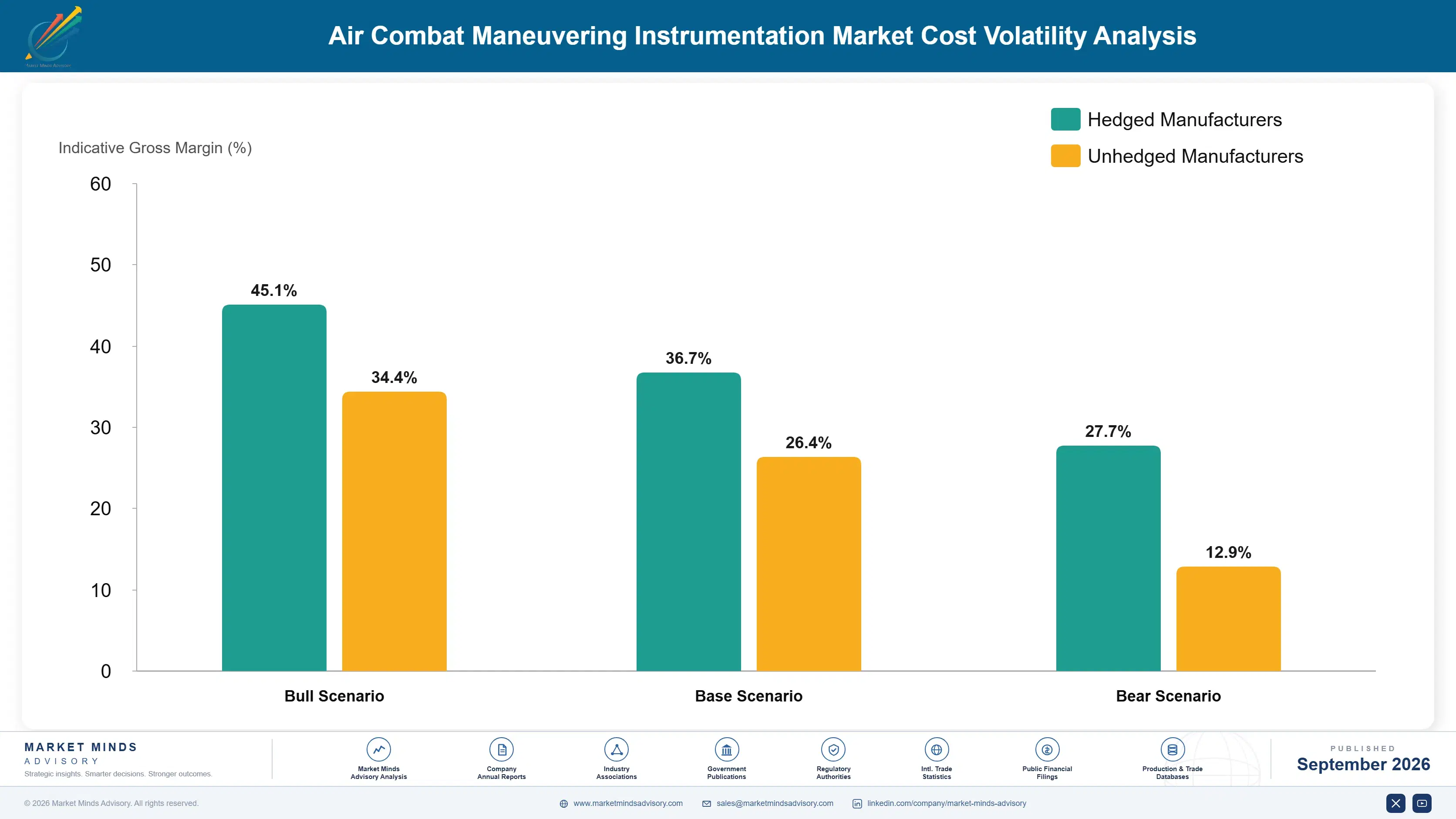
Delivered cost divides four ways. GNSS receivers and inertial measurement units run roughly 21% of cost of goods sold. Radio frequency datalink modules account for about 17%, ruggedised packaging and environmental qualification close to 13%, and software engineering plus security accreditation labour the remaining 49%. Navigation and RF supply sits in the United States, Japan and Europe, with semiconductor inputs from East Asia.
The 2023 export licensing of gallium and germanium by China's Ministry of Commerce hit this market through its radio frequency content, because datalink modules depend on gallium nitride and gallium arsenide devices. Component lead times extended through 2024 and several suppliers disclosed procurement pressure in annual reporting. Fixed-price instrumentation contracts absorbed most of the increase, and the effect showed up as delivery slip rather than visible price movement.

Exposure divides by product mix, which makes it competitive rather than sector-wide. Suppliers weighted toward airborne hardware carry the navigation, RF and qualification cost directly. Those weighted toward debrief and accreditation software barely feel it, since their cost base is cleared engineering labour. Geographically, suppliers holding cleared personnel in multiple national systems face labour cost pressure instead, which is rising faster than component cost.
air-combat-maneuvering-instrumentation-market-cost-volatility-analysis-1790025740954

Shift mix toward accredited software and debrief content

Revenue from debrief software, analysis tooling and accreditation services carries no component exposure and better gross margin than airborne hardware. Moving mix in that direction hedges input cost and improves earnings quality at the same time. The constraint is that software revenue per customer is smaller than a pod programme, so contract value falls as margin improves.

Qualify second-source radio frequency devices during development

Qualifying alternative gallium nitride and gallium arsenide suppliers during development costs test time but removes the single largest component dependency. Suppliers who did this before 2023 maintained delivery schedules while competitors renegotiated dates with customers. Doing it retrospectively requires requalification of a fielded design, which on accredited systems means repeating security assessment work as well as environmental testing.

Grow cleared engineering capacity ahead of programme need

Security-cleared software engineers are the binding cost input in this market, and clearance timelines mean capacity cannot be added when a contract is won. Building cleared capacity ahead of demand carries idle labour cost, but suppliers without it decline work or subcontract at poor margin. Several participants now treat cleared headcount as a strategic asset rather than an overhead line.

Portfolio Architecture for Margin Defence

Margin architecture in this market has inverted over a decade. Pod hardware and range installation sit at the bottom, competitive on specification and increasingly displaced by embedded alternatives. Embedded platform content and accredited ground debrief sit in the middle at considerably better economics. Accreditation services, cross-domain release tooling and analysis software sit at the top, where very few competitors can operate at all.
The volume-versus-premium tension is unusual because the volume tier is shrinking rather than growing. Pod revenue declines as fifth-generation fleets expand, so defending it consumes engineering attention on a product line with a visible end date. Meanwhile the premium tier requires cleared personnel and accreditation infrastructure that take years to build. Suppliers caught between the two, still earning from pods but not yet accredited for what replaces them, face the hardest transition in the sector.

High-value pools concentrate in three places: accreditation services and cross-domain release tooling where almost no competition exists, embedded platform content locked in for an airframe's life, and instrumentation-agnostic debrief software that reaches install bases the supplier never equipped. None of the three depends on winning an airborne hardware competition, which is exactly why the margins hold.

Volume / Commodity-Adjacent Tier

External instrumentation pods, fixed range tracking installations and associated support. Competitive against written specifications with a declining addressable fleet. The eight point range reflects how differently suppliers treat installation and qualification scope within pod programmes.
Gross Margin: 19-27%

Premium / Certified Tier

Embedded platform instrumentation content and accredited ground debrief systems. Platform baseline position and national accreditation defend pricing here. The nine point range tracks whether the supplier holds accreditation directly or works through a cleared partner, which changes economics materially.
Gross Margin: 36-45%

Sustainability / Regulatory / Next-Generation Tier

Accreditation services, cross-domain data release tooling and engagement analysis software. Competition is minimal because cleared capability and security process maturity gate entry. The twelve point range reflects immature pricing across a small number of programmes with no comparable benchmark.
Gross Margin: 50-62%
air-combat-maneuvering-instrumentation-market-portfolio-architecture-1790025741466

High-value Sub-segments and Strategic Watch-out

Cross-Domain Release And Accreditation Tooling

Highest value content in the market with almost no competition at all, driven by coalition exercise growth across 19 major annual events. Demand depends on alliance-level data-release agreements being reached. The twelve point range reflects genuinely immature pricing across the very few programmes delivered anywhere so far.
Gross Margin: 50-62%

Embedded Platform Instrumentation Content

Growing fastest at 11.4% and locked in for an airframe's service life once won, which makes each position close to permanent. The buyer is the platform programme office rather than the training command. The eight point range reflects how differently integration cost is shared with airframe manufacturers.
Gross Margin: 38-46%

Ground Debrief And Display Systems

The volume core of current revenue, growing at 8.1% and refreshed on an eleven-year cycle that makes demand predictable. Accreditation requirements defend pricing wherever classified engagement data is handled. Margin depends heavily on whether the supplier also owns the airborne instrumentation that feeds the system directly.
Gross Margin: 34-42%

External Instrumentation Pod Supply

Slowest growing at 6.2% with a visible end date as fifth-generation fleets displace pod-carrying aircraft. Support revenue persists longer than new unit sales, but engineering investment here earns a steadily shrinking return. Several suppliers are now managing this line for cash rather than for any growth.
Gross Margin: 19-27%

What Customers Fund Year After Year

The annuity here is accreditation and software maintenance rather than hardware support. Once a debrief system is accredited inside a national enclave, changing supplier means repeating the accreditation, which costs time the training command will not spend. That makes the recurring software and security maintenance revenue unusually secure, and it typically exceeds original hardware value across an eleven-year system life by a comfortable margin.
Adoption depth separates sharply by fleet composition. Air arms operating fifth-generation aircraft run the full measurement chain including embedded instrumentation, accredited debrief and release tooling, and they fund upgrades continuously because training assessment feeds readiness certification. Fourth-generation operators typically buy pods and a basic debrief capability, then leave it alone for a decade. Air arms without instrumented ranges buy deployable services episodically, tied to specific exercises rather than to an annual training programme.

The buyer profile has moved. Instrumentation was specified by range engineers who cared about tracking accuracy above everything else. It is increasingly specified by training commanders and security accreditation authorities jointly, and the accreditation authority now holds an effective veto that no engineering argument has ever managed to overcome.
air-combat-maneuvering-instrumentation-market-end-use-penetration-index-1790025741959

Where The Advantage Actually Lies

These are among the four positions where our research anticipates prominent divergence between winners and laggards over the coming forecast period. Each is grounded in the demand model, the regulatory perimeter, and the announced capacity pipeline.
01 / ACCREDITATION POSITION BUILDING

Treat national accreditation as the primary competitive asset

Accreditation to handle classified engagement data inside a national enclave takes two to three years and formally excludes suppliers who lack it from the competitions that matter most. Win rates on accredited programmes run roughly 2.7 times those on open competitions for the same firms, which is a gap no product advantage produces. The investment is security infrastructure, cleared personnel and documented process, none of which generates revenue directly, and that is exactly why most competitors continue to underfund it consistently.
02 / PLATFORM BASELINE ACCESS

Buy into embedded content during platform development, not procurement

Embedded instrumentation grows at 11.4%, half again the market rate of 7.6%, and the content is settled during platform development or block upgrade definition rather than at any training procurement. Winning a position there locks in content for an airframe's service life of 30 years or more, worth around USD 340,000 per aircraft with no recompetition risk. The cost is funding integration work at poor margin years early, which finance functions consistently resist and, on this evidence, should stop resisting.
03 / DEBRIEF INTERFACE OPENNESS

Sell analysis software onto instrumentation you did not supply

Ground debrief software can consume engagement data from any instrumentation source and requires no platform integration authority, which makes it the only route into install bases lost on the airborne competition. Suppliers offering genuinely instrumentation-agnostic debrief report attach rates roughly 41% higher into accounts they never equipped in the first place. The obstacle is data format access that incumbents protect deliberately, so this depends on customers writing interface openness into the original airborne contract, which sophisticated buyers now do routinely.
04 / RANGELESS SERVICE DELIVERY

Reach range-less air arms through deployable service contracts

Roughly 26 air arms have become addressable through rangeless architectures that were excluded when measured training required permanent infrastructure. Not one of them will fund permanent range construction, but they will fund measured exercise events at around USD 1.4 million per annual programme with margins running above product sales elsewhere. The strategic value exceeds the revenue considerably: most of these customers will buy fifth-generation aircraft eventually, and whoever holds the training relationship at that point starts the competition from inside it.

Engagement Snapshot From the Field

A live engagement with an industry participant carrying material or product regulatory and market exposure ahead of a defining policy shift, showing how our research translates into a defensible multi-year portfolio strategy.
MARKET MINDS ADVISORY · CLIENT ENGAGEMENT SUMMARY
Air Combat Maneuvering Instrumentation Producer Strategic Portfolio Review and Transition Roadmap 2026·Investment Scenario on Air Combat Maneuvering Instrumentation Exposure Evaluation 2025-26
CLIENT PROFILE
A European defence electronics firm with roughly USD 480 million in annual revenue (client-reported, unverified by MMA), of which air combat instrumentation contributed about 19% (client-reported, unverified by MMA). The company held a strong pod and ground debrief position with three national air arms but had been excluded from two recent competitions it could not formally bid, having no accreditation in either customer's national security system.
STRATEGIC CHALLENGE
Management read the exclusions as a procurement fairness problem and had escalated them politically. The commercial reality was different: accreditation is a multi-year investment the company had never made, and pod revenue was already declining as customer fleets renewed. The board needed to know whether to fund accreditation, pivot to software, or exit instrumentation altogether within three years.
MMA APPROACH
MMA mapped accreditation requirements across nine target national programmes, costed the security infrastructure and cleared personnel each would need, and modelled revenue under three strategies. Expert interviews with training command and accreditation authority staff established which requirements were genuinely non-negotiable and which were treatable through a cleared local partner instead.
KEY FINDINGS
  1. Accreditation in three of the nine target programmes could be achieved through cleared local partners rather than direct investment, at roughly a quarter of the internal cost the company had assumed.
  2. Pod revenue was forecast to decline 44% over the forecast period as customer fleets renewed, considerably steeper than the company's own planning assumption of a gradual taper.
  3. Instrumentation-agnostic debrief software reached 61% of the addressable European install base, against 23% for the client's current architecture requiring its own airborne feed.
  4. Cleared engineering headcount, not product capability, was the binding constraint on every growth route the analysis examined across all three strategies without exception.
CLIENT PROFILE
A European defence electronics firm with roughly USD 480 million in annual revenue (client-reported, unverified by MMA), of which air combat instrumentation contributed about 19% (client-reported, unverified by MMA). The company held a strong pod and ground debrief position with three national air arms but had been excluded from two recent competitions it could not formally bid, having no accreditation in either customer's national security system.
STRATEGIC CHALLENGE
Management read the exclusions as a procurement fairness problem and had escalated them politically. The commercial reality was different: accreditation is a multi-year investment the company had never made, and pod revenue was already declining as customer fleets renewed. The board needed to know whether to fund accreditation, pivot to software, or exit instrumentation altogether within three years.
MMA APPROACH
MMA mapped accreditation requirements across nine target national programmes, costed the security infrastructure and cleared personnel each would need, and modelled revenue under three strategies. Expert interviews with training command and accreditation authority staff established which requirements were genuinely non-negotiable and which were treatable through a cleared local partner instead.
KEY FINDINGS
  1. Accreditation in three of the nine target programmes could be achieved through cleared local partners rather than direct investment, at roughly a quarter of the internal cost the company had assumed.
  2. Pod revenue was forecast to decline 44% over the forecast period as customer fleets renewed, considerably steeper than the company's own planning assumption of a gradual taper.
  3. Instrumentation-agnostic debrief software reached 61% of the addressable European install base, against 23% for the client's current architecture requiring its own airborne feed.
  4. Cleared engineering headcount, not product capability, was the binding constraint on every growth route the analysis examined across all three strategies without exception.
RECOMMENDED STRATEGY
Phase 1: Phase 1 (nine months): Open the debrief architecture to third-party instrumentation feeds and requalify it against two competitor airborne systems at reference sites. Phase 2: Phase 2 (18 months): Secure accreditation through cleared local partners in three target national programmes rather than building internal capability from scratch. Phase 3: Phase 3 (30 months): Grow cleared engineering headcount ahead of demand and manage the pod line for cash rather than continued development investment.
OUTCOME
The client opened its debrief architecture and won two software placements onto competitor instrumentation within 16 months (client-reported, unverified by MMA). Partner-route accreditation delivered access to two previously closed programmes, and software plus services rose to roughly 44% of instrumentation revenue from 21% (client-reported, unverified by MMA) while pod revenue declined broadly as forecast.

Frequently Asked Questions

Foundational context covering the market sizes, CAGR, scope, country, region and competition that inform every finding below. This section is provided to cover basics and most often pre-purchase conversations, answered from the MMA Primary Research Dataset.

What is the current size of the Air Combat Maneuvering Instrumentation Market?

The market was worth USD 1.2 billion in 2025 and reaches USD 1.3 billion in 2026. That covers airborne instrumentation, datalink infrastructure, ground debrief systems, range tracking and weapon simulation software.

How large will the Air Combat Maneuvering Instrumentation Market be by 2036?

MMA forecasts USD 2.7 billion by 2036, an increase of USD 1.4 billion over the 2026 base. That represents an expansion multiple of 2.08 times across the forecast period.

What is the CAGR for the Air Combat Maneuvering Instrumentation Market 2026 to 2036?

The base case CAGR is 7.6%, with a bull case of 8.9% if multi-national data-release frameworks are agreed. The bear case of 6.3% assumes classification friction keeps coalition training shallow.

Which segment is growing fastest?

Embedded internal instrumentation grows at 11.4%, half again the market rate of 7.6%. Stealth aircraft cannot carry external pods without degrading the signature crews are training to exploit.

Who are the major companies in the Air Combat Maneuvering Instrumentation Market?

Cubic Corporation, Leonardo DRS, Elbit Systems, Saab and Thales lead on installed instrumentation base and contracted programme value. CAE, RTX, Northrop Grumman and BAE Systems follow.

Which country is growing fastest?

India leads at 11.0%, driven by air force modernisation alongside domestic instrumentation and debrief development. Indigenous content rules mean foreign suppliers participate through partnership rather than direct sale.

Report Segmentation Architecture

The full report scope spans multiple orthogonal segmentation dimensions, with cross-tabulated demand data provided for each dimension pair. Coverage extends further to regional breakdowns, trend trajectories, and the competitive detail needed to support segment-level decision-making.

By System Element

  • Airborne Instrumentation Pods
  • Embedded Internal Instrumentation
  • Ground Debrief And Display Systems
  • Rangeless Datalink And Relay Infrastructure
  • Fixed Range Instrumentation And Tracking
  • Weapon Simulation And Kill Removal Software

By End-Use Industry

  • Fighter And Attack Squadrons
  • Advanced Jet Training Units
  • Naval Aviation Forces
  • Aggressor And Adversary Air Units
  • Test And Evaluation Establishments

By Commercial Dimension

  • Direct Equipment Procurement
  • Embedded Platform Content Subcontract
  • Deployable Training Service Contract
  • Software And Accreditation Maintenance Agreement

By Region

  • North America
  • Western Europe
  • East Asia
  • South Asia and Pacific
  • Latin America
  • Middle East and Africa
  • Eastern Europe

Scope, Methodology, and Coverage

Every figure in this report is reproducible from documented input assumptions. The scope below maps the historical period, the forecast horizon, the segmentation dimensions, and the countries covered, alongside the underlying primary and qualitative methodology.
Historical Period
2020 to 2025
Forecast Period
2026 to 2036
Base Year
2025 (USD billions; MMA Primary Research Dataset, September 2026)
Market Definition
This report covers air combat maneuvering instrumentation: the equipment and software that measure, record and replay live air combat training engagements. Scope includes external instrumentation pods, embedded internal instrumentation, datalink and relay infrastructure, ground debrief and display systems, fixed range tracking installations, weapon simulation and kill removal software, and the accreditation and cross-domain release tooling that makes classified training data usable. Excluded are full flight simulators and virtual training devices, aerial target vehicles, range safety systems, electronic warfare threat emitters, and operational mission recorders not used for training assessment.
Quantitative Units
USD billions (current prices); instrumented aircraft counts; pod unit pricing; embedded content value per airframe
Segmentation Dimensions
By System Element; By End-Use Industry; By Commercial Dimension; By Region
Regions Covered
North America, Western Europe, East Asia, South Asia and Pacific, Latin America, Middle East and Africa, Eastern Europe
Countries Covered
USA, China, Germany, France, UK, Japan, South Korea, India, Australia, Canada, Brazil, Mexico, Indonesia, Vietnam, Thailand, Malaysia, UAE, Saudi Arabia, South Africa, Nigeria, Turkey, Poland, Netherlands, Italy, Spain, Sweden, Switzerland, Argentina, Colombia, Singapore, and additional markets relevant to this sector
Key Companies Profiled
Cubic Corporation, Leonardo DRS, Elbit Systems, Saab, Thales, CAE, RTX, Northrop Grumman, BAE Systems, Indra Sistemas, HAVELSAN, LIG Nex1, Hanwha Systems, Mitsubishi Electric, NEC Corporation, Bharat Electronics, Israel Aerospace Industries, Rheinmetall, Aviation Industry Corporation of China, Kongsberg Defence and Aerospace
Quantitative Methodology
Primary survey, n=3,800 respondents, Q4 2025, six countries; demand-side model with trade association cross-validation
Qualitative Methodology
47 expert interviews, Q4 2025; applied to validate demand model assumptions, identify emerging dynamics, and assess competitive positioning
Report Format
PDF and XLSX data workbook (Word format preview document)
Publisher
Market Minds Advisory
Report Code
MMA-2026-CON-903
Published
September 2026
Contact
sales@marketmindsadvisory.com | www.marketmindsadvisory.com

Purchase the full Air Combat Maneuvering Instrumentation Market Report (2026 to 2036).

The full report sizes air combat maneuvering instrumentation across six system elements and all seven regions, with instrumented aircraft counts and content value per airframe behind every figure. It models the transition from external pods to embedded instrumentation explicitly, because the two are sold to different buyers on different cycles and treating them as one market misstates both. Competitive analysis covers 20 participants on installed base and contracted programme value, including accreditation coverage by national programme. Classification and data-release constraints are assessed as commercial barriers rather than technical ones, which is how they behave. Margin architecture is modelled by tier with software and accreditation annuity economics separated from hardware support.
Six-element sizing with instrumented aircraft counts
Pod to embedded transition modelled by fleet
Accreditation coverage mapped by national programme
Twenty-participant competitive assessment on installed base
Rangeless addressable air arm population quantified
Software and accreditation annuity economics by tier

Built For The People Who Decide

From boardroom strategy to bench-side execution, this report is read cover-to-cover by leaders shaping the next decade of their industry, turning demand scenarios, market dynamics and valuation benchmarks into decisions.
CXOs/ Presidents/ VPs/ Managers
M&A and Corporate Development
Strategy Teams and R&D Heads
Procurement and Product Directors
Regulatory and Compliance Leaders
Investor Relations and Equity Analysts