Market Minds Advisory
Air Circuit Breaker Market

Air Circuit Breaker Market: Air Circuit Breaker Market: Low-Voltage Protection Switchgear for Commercial and Industrial Power Distribution

Data center capacity buildout and industrial electrification are driving unprecedented low-voltage switchgear specification volume, reshaping which air circuit breaker manufacturers can scale production fast enough to keep pace. across every major manufacturing hub.

Lead Analyst

Published

September 2026

Make Smarter Decisions with Customized Research Insights

Request a free sample report and evaluate market opportunities, growth trends, and competitive dynamics relevant to your business needs.

2025 MARKET VALUE$3.6BMarket Size 2025
2036 FORECAST VALUE$7.0BBase Case , 2026 to 2036
CAGR 2026 TO 20366.2 %Bull 7.4% / Bear 5.0%
INCREMENTAL OPPORTUNITY$3.1BNet 10- year value creation
EXPANSION MULTIPLE1.82x2036 value over 2026 base
Strategic Levers
M&A Pipeline
Regional Outlook
Country Rankings
Competitive Intelligence
Segmental Deep-dive
Call-Us : 91 93563 13602

Executive Snapshot and Market Trajectory.

Air circuit breaker demand is accelerating sharply as hyperscale data center buildout and industrial electrification programs strain low-voltage switchgear supply chains across nearly every major manufacturing region worldwide, pushing lead times to multi-year highs. Backlogs now stretch well beyond a year at several major manufacturers. Supply cannot keep pace.
Data center specification volume is the fastest-growing commercial force by a wide margin, with the United States anchoring the single largest national demand pipeline tracked in this report. Intelligent, digitally monitored breaker variants are capturing an increasing share of new commercial and industrial construction specifications as facility operators prioritize predictive maintenance capability. Manufacturers with committed multi-year hyperscaler supply agreements are securing revenue visibility that smaller regional competitors increasingly struggle to match.
The competitive field remains concentrated among a handful of global electrical equipment conglomerates, with the top five manufacturers controlling nearly half of global unit shipments. Lead time constraints and component shortages are reshaping which manufacturers can capture new data center and industrial capacity commitments as order backlogs stretch further. Manufacturers that expanded capacity earliest are capturing disproportionate share of incremental hyperscale orders relative to slower-moving competitors.
Market Definition
This report covers air circuit breakers rated for low-voltage power distribution applications in commercial, industrial, and data center facilities, including fixed-mounted and draw-out configurations. It excludes molded case circuit breakers, medium-voltage switchgear, and residential-grade circuit protection devices.
Base Year Value
$3.6B in 2025 (MMA Primary Research Dataset, September 2026)
Forecast Period
2026 to 2036, eleven discrete annual values
CAGR
6.2% base case. Bull 7.4%. Bear 5.0%.
Fastest Growth Segment
Data Centers: 14.2% CAGR
Fastest Growth Country
United States: 9.5% CAGR
Fastest Growth Region
South Asia and Pacific: 8.0% CAGR
Largest Region
East Asia: 29% of 2025 global value
Market Leaders
Schneider Electric, ABB, Siemens, Eaton, Mitsubishi Electric. Source: MMA Analysis based on company annual reports.
Primary Survey
n=3,800 procurement and R&D decision-makers, Q4 2025, six countries
Methodology
Demand-side build-up, cross-validated against public data, 47 expert interviews

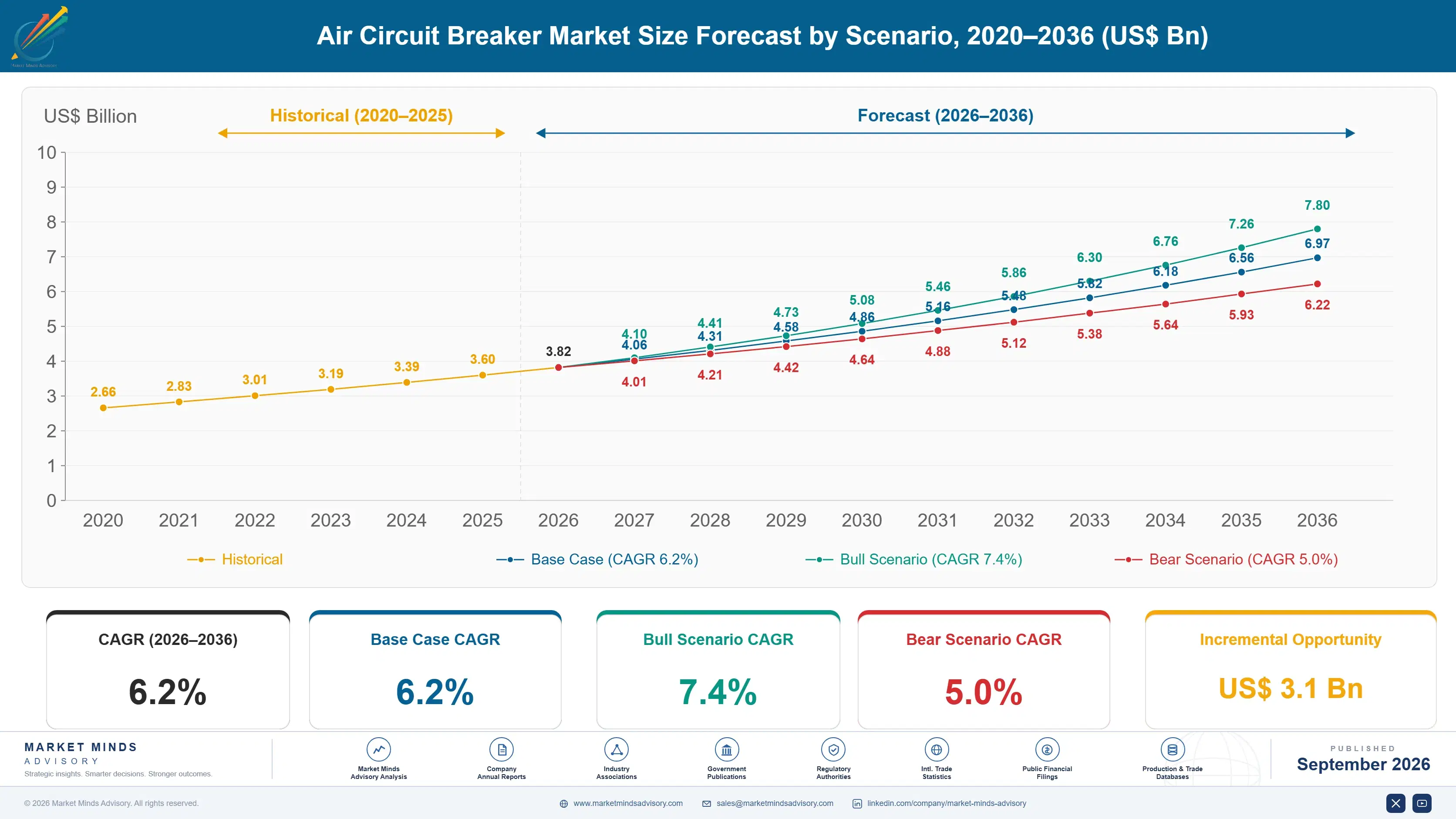
Air Circuit Breaker Market Forecast Scenarios

air-circuit-breaker-market-size-forecast-scenario-1788256236265
Between 2020 and 2025, air circuit breaker demand grew steadily as commercial and industrial construction recovered from pandemic-era disruption, with growth accelerating meaningfully in the final two years as data center capital spending surged. Historical growth averaged approximately 5.3 percent annually across this period. Manufacturers with early hyperscale customer relationships captured a disproportionate share of this accelerating incremental demand.
The base case assumes continued hyperscale data center capacity expansion, sustained industrial electrification investment across manufacturing and process industries, and growing specification of intelligent digitally monitored breaker variants as facility operators prioritize predictive maintenance and remote monitoring capability. Component supply chain normalization should gradually ease current lead time pressure across most major manufacturing regions. Manufacturer capacity expansion announcements suggest supply constraints should ease gradually rather than persisting indefinitely across the forecast window.
A bull scenario centers on accelerated data center capacity commitments outpacing current manufacturer production capacity expansion plans. A bear scenario centers on a slowdown in hyperscale capital spending combined with persistent component shortages constraining manufacturer output growth more than the base case currently assumes across key production regions. particularly for semiconductor-dependent digital trip unit components sourced from a concentrated supplier base.

Data Center Demand Strains Global Breaker Supply Chains

Hyperscale data center capacity commitments are converging with industrial electrification investment to push order backlogs to levels manufacturers have not managed in decades, forcing facility developers to lock in breaker allocations years ahead of construction completion. Manufacturers with early capacity expansion are capturing outsized share of this accelerating incremental order volume. Facility developers increasingly treat breaker allocation as a critical path item. Backlogs now extend well beyond a year at several major manufacturing facilities.
TOP 5 CONCENTRATION48%Share of global unit shipments held by five largest manufacturers
AVERAGE ORDER LEAD TIME38 weeksTypical delivery time from order placement to unit shipment
DATA CENTER ORDER SHARE26%Share of new orders specifying data center facility applications
INTELLIGENT BREAKER ADOPTION31%Share of new units specifying digital trip and monitoring features
METAL COST SHARE29%Combined precious and base metal share of total manufacturing cost
AVERAGE PRODUCT SERVICE LIFE25 yearsTypical operating lifespan before major refurbishment or replacement need
Manufacturers increasingly differentiate through digital trip unit integration and predictive maintenance monitoring capability rather than price competition alone, particularly for hyperscale customers willing to pay a premium for verified uptime performance across mission-critical facilities. Schneider Electric and Eaton have both expanded intelligent breaker product lines to capture this premium shift. Regional manufacturers face growing pressure to match this capability.
Component supply chain capacity, manufacturer production expansion timing, and semiconductor availability for digital trip units will determine which companies convert order backlog into shipped revenue fastest across the coming several years. Manufacturers without credible capacity expansion plans risk losing hyperscale allocation share to better-positioned competitors. Copper and silver price swings also meaningfully affect competitive positioning between manufacturers with differing hedging and sourcing strategies across the industry.
"Every data center operator wants the same breaker delivered yesterday, and the manufacturers who expanded capacity two years ago instead of waiting for confirmation are the only ones not apologizing to customers right now."
Practice Lead, Low-Voltage Switchgear Intelligence · MMA Low-Voltage Distribution Switchgear Practice · September 2026

Market Trends

Intelligent Breaker Adoption Accelerates Across Mission-Critical Facilities

Facility operators increasingly specify digitally monitored breakers with integrated trip units and remote diagnostics capability as a standard requirement for new data center and industrial construction, converting what was once an optional premium feature into a default procurement specification across most major hyperscale developer programs. Schneider Electric and Eaton have both expanded intelligent breaker product lines covering an increasing share of new facility orders. This shift is opening meaningful service revenue opportunities for manufacturers that pair hardware sales with ongoing monitoring subscription contracts, and it is reshaping how facility operators evaluate competing manufacturer proposals during procurement.
Market Impact: Adds 4.2 gigawatts of new capacity
Hyperscale Data Center Buildout Strains Manufacturing Capacity

Unprecedented hyperscale data center capital spending continues straining global breaker manufacturing capacity, pushing order lead times to multi-year highs at several major manufacturers unable to expand production fast enough to match accelerating demand. ABB and Siemens have both announced new manufacturing capacity expansion specifically targeting this sustained hyperscale order volume across their core production regions. This trend is reshaping which manufacturers can capture new capacity commitments, favoring companies with early capital investment discipline over competitors still evaluating expansion decisions. Manufacturers without early capacity investment risk ceding hyperscale allocation share to better-positioned global competitors over the coming several years.
Market Impact: Raises industrial order volume 9 percent

Market Opportunities and Growth Drivers

Hyperscale Data Center Capital Spending Sustains Order Volume

Persistent hyperscale data center capital spending continues generating substantial new breaker order volume, as facility developers commit to multi-year capacity expansion programs requiring extensive low-voltage switchgear infrastructure across new and expanding campus sites. Schneider Electric and Eaton have both reported record order backlogs as a direct consequence of sustained hyperscale capital commitments across their core customer accounts. Every incremental data center campus commissioned translates directly into additional breaker demand across primary and backup power distribution categories. Multiple additional hyperscale campus commitments are expected across major markets over the coming several years of sustained capital investment.
Market Impact: Cuts production output 8 percent

Industrial Electrification Programs Expand Manufacturing Demand

Growing industrial electrification investment across manufacturing, process industries, and renewable energy interconnection continues expanding breaker demand beyond data centers alone, as facilities upgrade aging electrical infrastructure to support higher power density operations and electrified process equipment. ABB and Mitsubishi Electric have both expanded dedicated industrial breaker product lines to serve this parallel demand stream across manufacturing customers. This trend is expected to persist as electrification investment continues displacing legacy fossil-fuel-powered industrial equipment across most manufacturing sectors. Manufacturers offering field-proven reliability at competitive lead times typically win these increasingly price-competitive industrial tender processes.
Market Impact: Delays project completion by 4 months

Market Restraints and Challenges

Component Shortages Constrain Manufacturer Production Output

Genuine semiconductor and specialized component shortages continue constraining breaker manufacturer production output, since digital trip units and intelligent monitoring modules depend on chip supply that has not kept pace with surging order volume. The root cause is component manufacturers prioritizing higher-margin customer segments over breaker-specific semiconductor orders during periods of constrained global chip supply. Manufacturers are mitigating this by qualifying alternative component suppliers and redesigning products around more available chip architectures, but production constraints remain a meaningful limit on how quickly backlog converts into shipped revenue across most manufacturers. manufacturers currently.
Market Impact: Lifts intelligent order share 11 points

Skilled Installation Labor Shortage Delays Project Completion

Persistent shortages of qualified electrical installation labor continue delaying facility completion timelines even where breaker units are available for delivery, since low-voltage switchgear installation requires specialized certification that training pipelines have not expanded fast enough to match construction volume. The root cause is construction labor markets broadly underinvesting in electrical trade training relative to accelerating data center and industrial construction demand. Developers are mitigating this through modular pre-assembled switchgear designs that reduce field labor requirements, but the labor constraint remains a meaningful bottleneck on project completion timelines across most major construction markets.
Market Impact: Extends lead times to 38 weeks
3 additional market trends, 4 additional growth drivers, and 3 additional restraints and challenges are covered in the full report. Contact sales@marketmindsadvisory.com to access the complete intelligence.

Segment CAGR and Growth Architecture

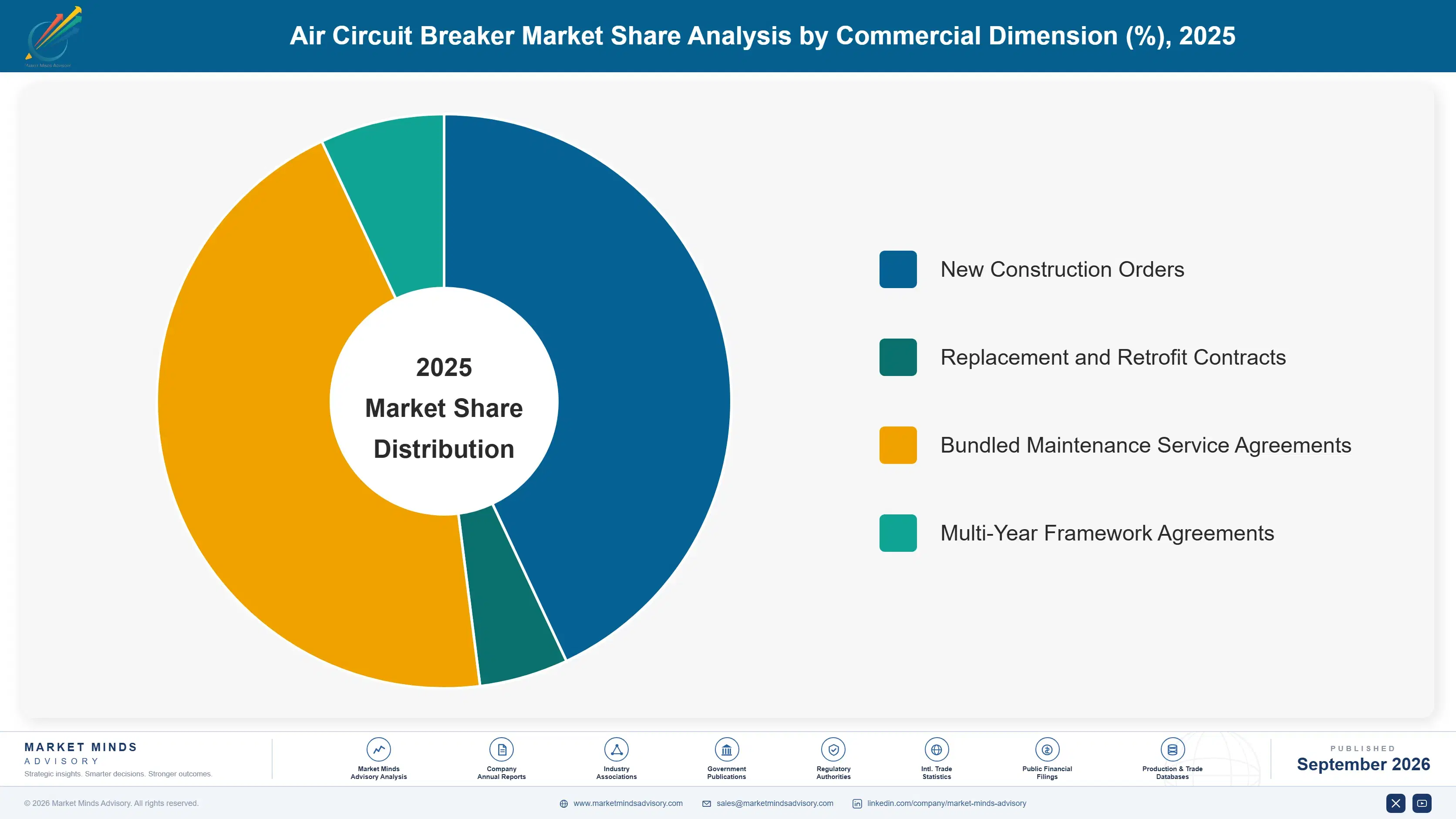
Air circuit breakers segment across six mutually exclusive end-use application categories, ranging from mature commercial building applications through fast-growing data center and renewable interconnection categories that increasingly determine which manufacturers capture new capacity commitments. These distinctions matter for manufacturers setting long-term production investment priorities. Manufacturing capacity allocation increasingly determines which players can compete profitably across both segment categories.
air-circuit-breaker-market-market-share-analysis-1788256236827

Data Centers

Data center applications bundle high-density power distribution requirements, redundant backup configurations, and intelligent monitoring integration into an end-use category that has become the single most important driver of breaker manufacturer revenue growth over the past several years. Schneider Electric and Eaton have both scaled dedicated hyperscale account teams covering an increasing share of new campus capacity commitments across their operating portfolios. Growth here consistently outpaces every other segment because hyperscale capital spending shows no sign of moderating, and manufacturers with committed multi-year supply agreements are securing revenue visibility that other end-use categories cannot match at comparable scale. Hyperscale demand for demonstrable uptime performance should further accelerate this segment's growth over the coming several years.
CAGR 14.2%

Renewable Energy Interconnection

Renewable energy interconnection applications bundle solar and wind farm substation switchgear, battery storage protection systems, and grid-scale power conversion equipment into a category that has expanded considerably as renewable capacity additions accelerate across most major electricity markets. ABB and Mitsubishi Electric have both scaled dedicated renewable interconnection product lines covering a growing share of utility-scale project commissioning. Demand is accelerating as renewable capacity additions continue outpacing conventional generation retirements, and grid operators increasingly require sophisticated protection equipment to manage variable renewable output across interconnection points. Deployment volume in this segment continues expanding meaningfully as utility-scale renewable project commissioning accelerates across most major electricity markets tracked in this report. This growth trajectory should persist through most of the coming decade.
CAGR 9.8%
Full segment breakdown across 6 segments available in the complete report.

Regional Architecture and Country Demand Map

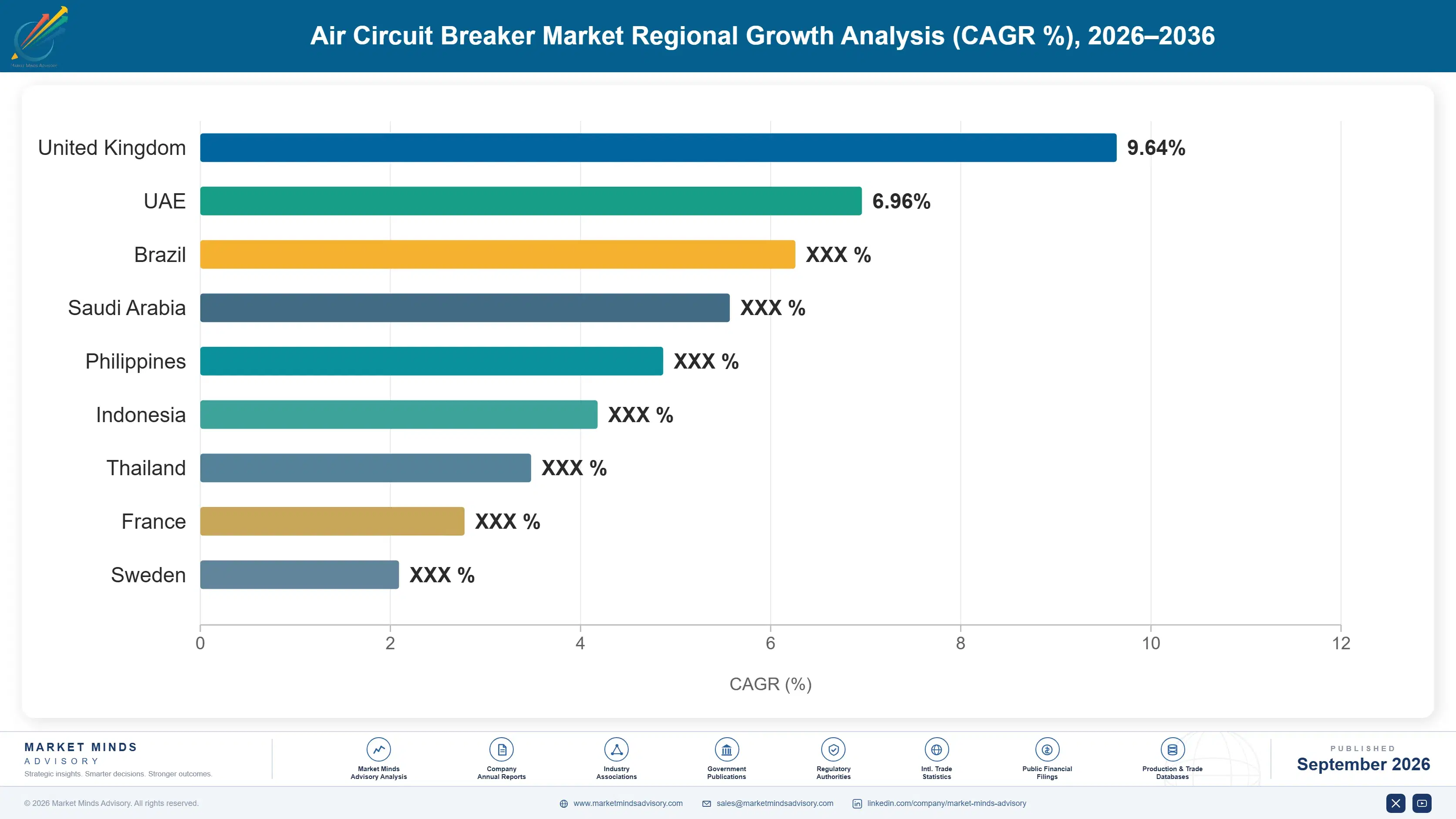
East Asia's manufacturing base and North America's hyperscale data center buildout together anchor global air circuit breaker demand, with China and the United States serving as the largest production and consumption centers tracked throughout this comprehensive market intelligence report. and distributed widely across the sector each year.

North America

Hyperscale data center capital spending drives the fastest large-market growth tracked in this report, with major cloud operators committing to multi-year campus expansion programs across Virginia, Texas, and Arizona. Schneider Electric and Eaton both maintain substantial domestic manufacturing capacity serving this accelerating demand base. Industrial electrification programs across manufacturing and process industries contribute meaningful secondary demand beyond data centers alone. Canadian data center development adds further steady regional demand tied to renewable-powered campus projects. Manufacturers with committed hyperscale supply agreements are securing revenue visibility that smaller regional competitors increasingly struggle to match given constrained production capacity. Framework supply agreements increasingly extend three to five years given the scale of committed hyperscale capacity pipelines.
Share: 27% | CAGR: 7.5% (2026 to 2036)

Western Europe

Industrial electrification and renewable energy interconnection projects anchor most regional demand, with Germany and France leading adoption as manufacturing facilities upgrade aging electrical infrastructure to support higher power density operations. Schneider Electric and ABB both maintain substantial regional manufacturing capacity serving this modernization-driven demand. Growth trails the global average since the region's data center buildout has been more measured than North America's hyperscale expansion pace. Nordic data center development, powered by abundant renewable electricity, contributes a smaller but steadily growing secondary demand stream across the region. Manufacturers increasingly bundle intelligent monitoring capability into standard industrial tender specifications across most major national markets in the region. Utilities elsewhere in the region are expected to follow this specification trend over the coming.
Share: 21% | CAGR: 4.8% (2026 to 2036)
Regional intelligence for 5 additional markets available in the complete report: East Asia, South Asia and Pacific, Latin America, Middle East and Africa, Eastern Europe. Contact sales@marketmindsadvisory.com.
air-circuit-breaker-market-country-cagr-analysis-1788256237355

Where Breaker Manufacturers Can Capture Additional Margin

Manufacturers face a widening gap between commodity-priced standard breaker sales and premium intelligent monitoring configurations, where digital integration and capacity commitment reliability increasingly determine which companies capture expanding hyperscale and industrial budgets across global markets simultaneously. This gap is widening most quickly across hyperscale accounts where operators explicitly reward proven capacity commitment reliability with premium pricing.

Expand Intelligent Breaker Manufacturing Capacity Now

Manufacturers that expand dedicated intelligent breaker manufacturing capacity can capture a growing share of premium hyperscale and industrial tenders, since facility operators increasingly specify digital monitoring as a standard procurement requirement rather than an optional add-on. Schneider Electric's recent capacity expansion added meaningful new production volume within eighteen months, and early results show order premiums running 18 to 24 percent above standard breaker equivalents. Manufacturers that move early into this category can lock in multi-year supply agreements before competitors close the capability gap. This capability gap is widening steadily across most premium hyperscale procurement categories.
Market Impact: Adds 18 to 24 percent order premium overall

Bundle Predictive Maintenance Monitoring Service Contracts

Manufacturers that bundle predictive maintenance monitoring service contracts directly into breaker sales can capture recurring revenue that standalone hardware sales cannot access, converting a one-time transaction into an ongoing customer relationship worth considerably more over the asset's operating life. Eaton has scaled bundled monitoring contracts across a growing share of its hyperscale customer base, generating service margins running 28 to 34 percent above comparable standalone equipment sales. This model also deepens customer relationships ahead of future capacity expansion cycles. Manufacturers without dedicated monitoring capability increasingly partner with third-party software providers to remain competitive.
Market Impact: Generates service margins 28 to 34 points higher

Secure Multi-Year Hyperscale Framework Agreements Early

Manufacturers that secure multi-year framework supply agreements with hyperscale data center operators can achieve production planning certainty that spot-order competitors cannot match, allowing more efficient capacity utilization and better component procurement terms negotiated well ahead of actual order fulfillment. Schneider Electric has captured a growing share of hyperscale framework commitments, improving production planning efficiency by roughly 22 percent relative to spot-order manufacturing. This advantage compounds over time as manufacturers build deeper customer relationships that later entrants struggle to replicate quickly. Manufacturers without comparable framework relationships increasingly compete on price alone for remaining spot orders.
Market Impact: Improves production planning efficiency by roughly 22 percent

Qualify Alternative Component Suppliers To Ease Bottlenecks

Manufacturers that qualify alternative semiconductor and component suppliers can reduce production bottlenecks that constrain competitors dependent on a single concentrated supplier base, allowing faster backlog conversion into shipped revenue during periods of sustained component shortage across the industry. ABB has expanded its qualified supplier base considerably, cutting effective component lead times by roughly 30 percent relative to manufacturers still dependent on single-source procurement. This operational resilience becomes increasingly valuable as demand continues outpacing industry-wide production capacity. Manufacturers without comparable supplier diversification face growing pressure from impatient institutional customers. Some manufacturers have begun co-investing in supplier capacity expansion to secure priority.
Market Impact: Cuts component lead times by roughly 30 percent

Who Controls the Margin Pool

Air circuit breaker manufacturing remains concentrated among global electrical equipment conglomerates, with the top five manufacturers, evaluated on annual unit shipment volume, controlling roughly 48 percent of global demand. Schneider Electric and ABB lead as the two largest global manufacturers, both operating extensive multi-region production networks and full intelligent breaker product lines. The gap to challengers like Mitsubishi Electric and Eaton is meaningful but narrowing as capacity expansion accelerates industry-wide.
Current competitive activity centers on manufacturing capacity expansion, intelligent monitoring integration, and hyperscale framework agreement capture rather than pure price competition alone. Several manufacturers have pursued alternative component supplier qualification to reduce production bottlenecks constraining backlog conversion. Siemens continues expanding dedicated hyperscale account teams, capturing framework commitments that spot-order competitors increasingly struggle to match.

Emerging pressure comes from Asian manufacturers expanding export capacity into data center and industrial tenders previously dominated by established Western players. Manufacturers without sufficient production capacity risk losing hyperscale allocation share to better-positioned competitors, even as overall order volume continues expanding. Rankings among mid-tier manufacturers are likely to shift meaningfully as intelligent monitoring capability becomes the primary basis of premium tender qualification.
air-circuit-breaker-market-company-positioning-matrix-1788256237884

Competitive Moat and Risk Dimensions

SCHNEIDER ELECTRIC

Moat: Hyperscale Framework Agreement Depth

Schneider Electric holds an extensive portfolio of multi-year hyperscale framework supply agreements, giving it production planning certainty and customer relationship depth that spot-order competitors cannot match, along with the scale to amortize intelligent monitoring platform development across a much larger customer base. This scale advantage also lets the company amortize software development costs across a far larger installed base than.
SCHNEIDER ELECTRIC

Risk: Capacity Expansion Execution Risk

Schneider Electric's growth strategy depends heavily on executing announced manufacturing capacity expansion on schedule, exposing the company to meaningful revenue risk if construction delays or equipment procurement bottlenecks push new capacity online later than currently planned. Management has responded by qualifying redundant equipment suppliers specifically to reduce this execution risk across major expansion projects.
ABB

Moat: Diversified Global Manufacturing Footprint

ABB operates one of the most geographically diversified manufacturing footprints in the industry, letting it reallocate production capacity across regions in response to shifting demand patterns more flexibly than competitors with concentrated single-region manufacturing bases exposed to localized disruption. This flexibility becomes increasingly valuable as component shortages and regional supply disruptions continue affecting single-region competitors more severely.
ABB

Risk: Intelligent Breaker Technology Gap

ABB's intelligent breaker product line trails Schneider Electric and Eaton in some monitoring software integration capabilities, exposing the company to share loss in premium hyperscale tenders that weight digital feature depth heavily during vendor selection processes. ABB has responded by accelerating software platform investment specifically to close this competitive gap over the coming several quarters.

Players Tracked

Prominent Players

Schneider Electric
ABB
Siemens
Eaton
Mitsubishi Electric

Other Key Players

Fuji Electric
Hyundai Electric
LS Electric
CG Power and Industrial Solutions
Larsen & Toubro
WEG
Chint Group
Hyosung Heavy Industries
Legrand
Terasaki Electric
Socomec
Toshiba Infrastructure Systems
Havells India
Powell Industries
Meidensha

Recent Developments

FEBRUARY 2026

Schneider Electric announced a major manufacturing capacity expansion at its North American production facility, adding meaningful new intelligent breaker output specifically to serve growing hyperscale data center order backlog across its core customer accounts. The expansion reflects sustained confidence in multi-year hyperscale demand trends across the company's core customer accounts.
Signal: Signals continued manufacturer investment in capacity expansion ahead of anticipated sustained demand across the industry broadly
OCTOBER 2025

Eaton acquired a specialized digital monitoring software provider to strengthen its intelligent breaker platform capability, extending its predictive maintenance offering without the multi-year cost of building comparable software entirely in-house. The acquisition is expected to accelerate feature development timelines considerably relative to purely internal engineering efforts.
Signal: Reflects growing manufacturer preference for acquisition over organic software platform development given accelerating customer demand overall
MAY 2025

Mitsubishi Electric entered a supply agreement with a semiconductor manufacturer to secure priority allocation for digital trip unit components, addressing production bottlenecks that have constrained backlog conversion across the industry. The agreement is expected to meaningfully shorten lead times for Mitsubishi Electric's intelligent breaker product lines specifically.
Signal: Indicates growing manufacturer focus on securing component supply chain resilience directly rather than relying solely on suppliers

Copper and Semiconductor Cost Exposure

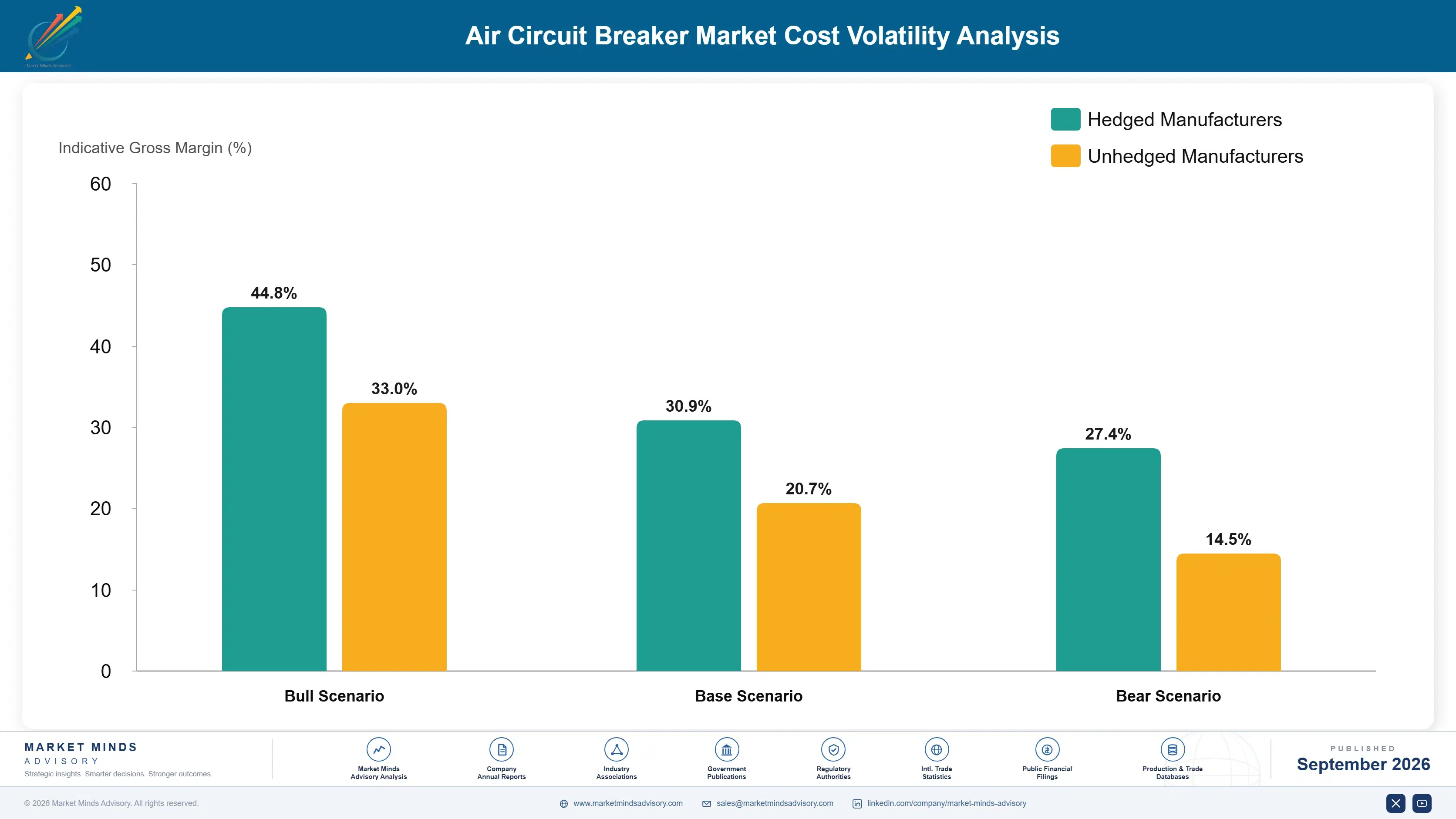
Copper and silver together represent the largest input category for air circuit breaker manufacturers, typically running 29 percent of total manufacturing cost, sourced primarily through regional metal distributors and, for digital trip units, semiconductor components sourced from a concentrated global supplier base. Enclosure steel and molded insulation components add a further meaningful cost share that varies by product configuration.
Semiconductor supply constraints during 2025 illustrated this exposure clearly, with digital trip unit chip lead times extending sharply following broader industry-wide chip demand surges, according to the US Census Bureau's industrial component trade reporting. Manufacturers with diversified supplier relationships absorbed less production disruption than those dependent on single-source component procurement during the affected period. Chip allocation priority increasingly went to manufacturers with established long-term supplier relationships rather than spot-market buyers seeking short-term fulfillment.

This cost exposure creates a real competitive disadvantage for manufacturers without commodity hedging programs or diversified semiconductor supplier relationships in place, since unhedged exposure during volatile periods can erode margins and delay shipments that better-prepared competitors largely avoid. Manufacturers concentrated on single-source component procurement face further exposure to allocation constraints during periods of industry-wide chip demand surges.
air-circuit-breaker-market-cost-volatility-analysis-1788256238078

Long-Term Metal Supply Agreements

Manufacturers increasingly lock in multi-year copper and silver supply agreements at fixed or index-linked prices, insulating a meaningful share of procurement volume from spot-market price volatility during periods of constrained global metals supply and demand. Several manufacturers have extended average agreement tenure to three years, locking in favorable pricing ahead of anticipated demand growth across expanding order backlogs.

Diversified Semiconductor Supplier Qualification

Several major manufacturers now qualify multiple semiconductor suppliers for digital trip unit components, reducing both cost exposure and production disruption risk relative to competitors relying entirely on single-source chip procurement arrangements. This diversification has meaningfully reduced average lead time volatility for manufacturers that adopted it earliest across their production networks. across most production regions.

Priority Allocation Supply Agreements

Manufacturers increasingly negotiate priority allocation agreements directly with semiconductor suppliers, securing guaranteed component volume ahead of demand surges that would otherwise leave unhedged competitors facing extended lead times and lost orders. This approach has become increasingly common as chip demand across multiple industries continues outpacing global semiconductor manufacturing capacity growth. and shortage cycles. industry-wide.

Portfolio Architecture for Margin Defence

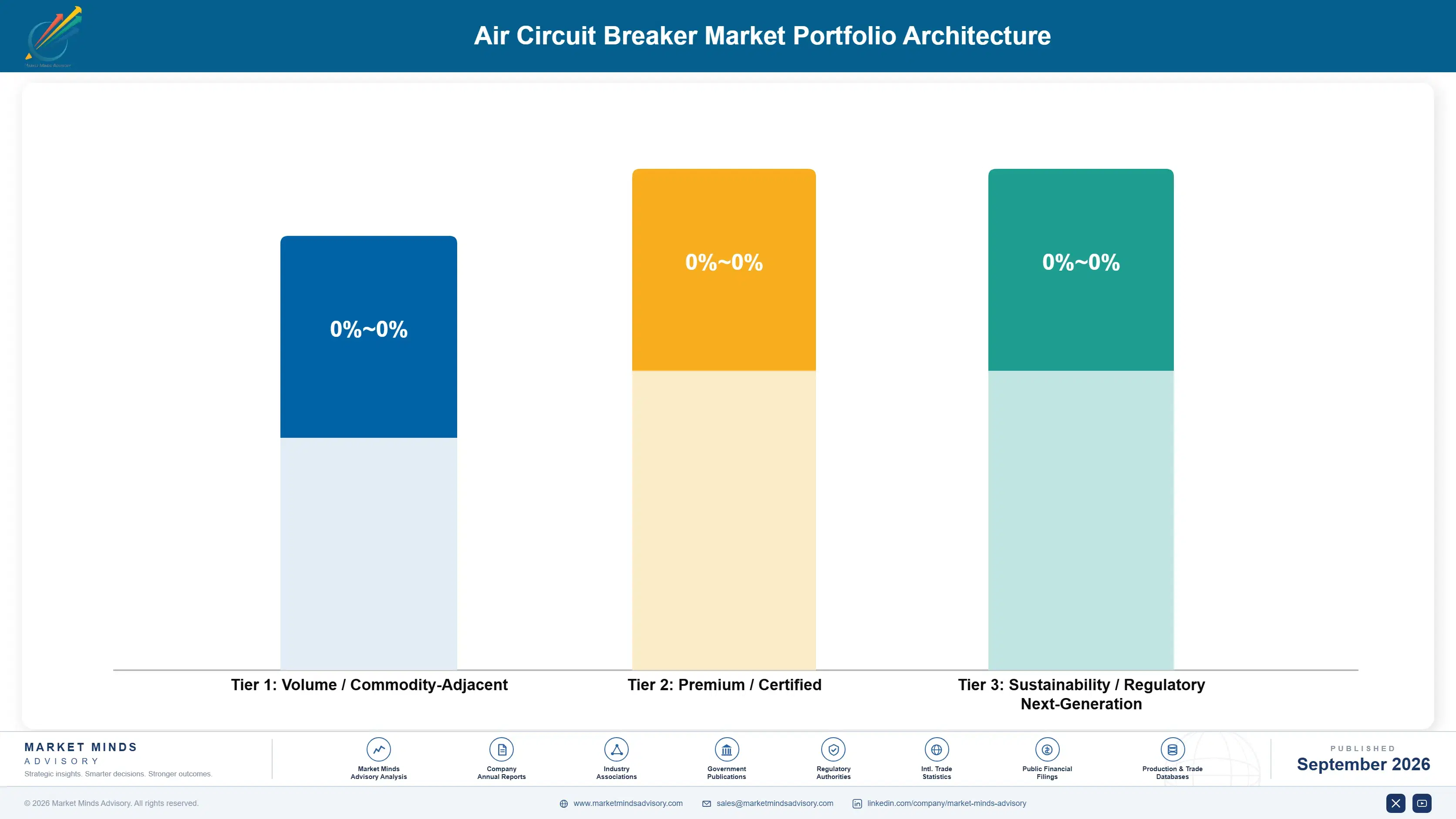
Air circuit breaker portfolios span a wide margin range, from commodity-priced standard configurations through premium intelligent monitoring variants that command substantially better project economics and manufacturer returns across most competitive tender categories today. Standard-tier units remain necessary for maintaining manufacturing utilization but contribute comparatively thin margins against steadily rising component and logistics costs. Manufacturers with diversified portfolios weather demand cycles better than single-tier specialists.
The real margin tension sits between maintaining manufacturing utilization through high-volume standard tenders and reallocating capital toward intelligent monitoring capacity that commands materially better economics in premium hyperscale markets. Manufacturers leaning too heavily into commodity volume risk ceding premium hyperscale tenders to better-equipped competitors, while those overinvesting in intelligent capacity risk underutilized production lines during periods of weaker standard-tier order flow. Getting this balance right shapes long-term profitability considerably.

High-value margin pools concentrate clearly in intelligent monitoring product lines and bundled maintenance service contracts, where digital differentiation and recurring service revenue both command premiums well above standard commodity unit sales available elsewhere. Manufacturers positioning across both dimensions simultaneously capture the strongest blended portfolio economics available in this market today, and the gap versus single-dimension competitors continues widening steadily.

Volume / Commodity-Adjacent

Standard breaker units sold primarily on price and lead time into commercial construction tenders, maintaining manufacturing utilization but contributing comparatively thin margins. Manufacturing utilization here mainly serves fixed overhead recovery rather than driving meaningful margin expansion.
Gross Margin: 14 to 20%

Premium / Certified

Intelligent monitoring breaker units commanding tender premiums tied to digital feature depth and superior total lifecycle cost economics for hyperscale customers. This tier increasingly commands the largest share of manufacturer capital allocation decisions.
Gross Margin: 26 to 34%

Sustainability / Regulatory / Next-Generation

Bundled predictive maintenance service contracts and priority allocation framework agreements generating recurring high-margin revenue independent of individual unit sale cycles. This is the fastest-growing margin tier across the entire manufacturer portfolio landscape today.
Gross Margin: 32 to 40%
air-circuit-breaker-market-portfolio-architecture-1788256238579

High-value Sub-segments and Strategic Watch-out

Intelligent Monitoring Breaker Units

The clearest high-value high-growth pocket in this market, combining digital differentiation with the fastest segment CAGR tracked, as hyperscale operators increasingly treat monitoring capability as standard specification rather than a niche option. Capital allocation here should continue rising through the forecast period. Manufacturers should prioritize this category above other projects.
Gross Margin: 26 to 34%

Bundled Maintenance Service Contracts

A high-value moderate-growth pool where recurring service revenue commands strong margins even as new unit sale growth moderates across already well-served core national markets. Manufacturers with established field service networks hold a durable edge in this expanding segment. Institutional hyperscale customers increasingly favor bundled contracts over standalone equipment procurement.
Gross Margin: 30 to 38%

Standard Commercial Construction Units

The volume core of this market, providing steady commodity-tier revenue at thinner margins that fund manufacturing utilization without materially expanding overall profitability across cycles. Manufacturers rely on this segment mainly to keep production lines productively utilized. Margins here rarely exceed the high teens even in favorable pricing years.
Gross Margin: 14 to 20%

Legacy Electromechanical Trip Units

A strategic watch-out segment losing share to digital alternatives as facility operators demand monitoring capability, forcing manufacturers still dependent on this format to plan technology transition before orders lapse. Early transition planning reduces stranded manufacturing capacity risk considerably. Revenue pressure here should build steadily through the forecast period.
Gross Margin: 10 to 16%

Recurring Revenue Beyond Unit Sales

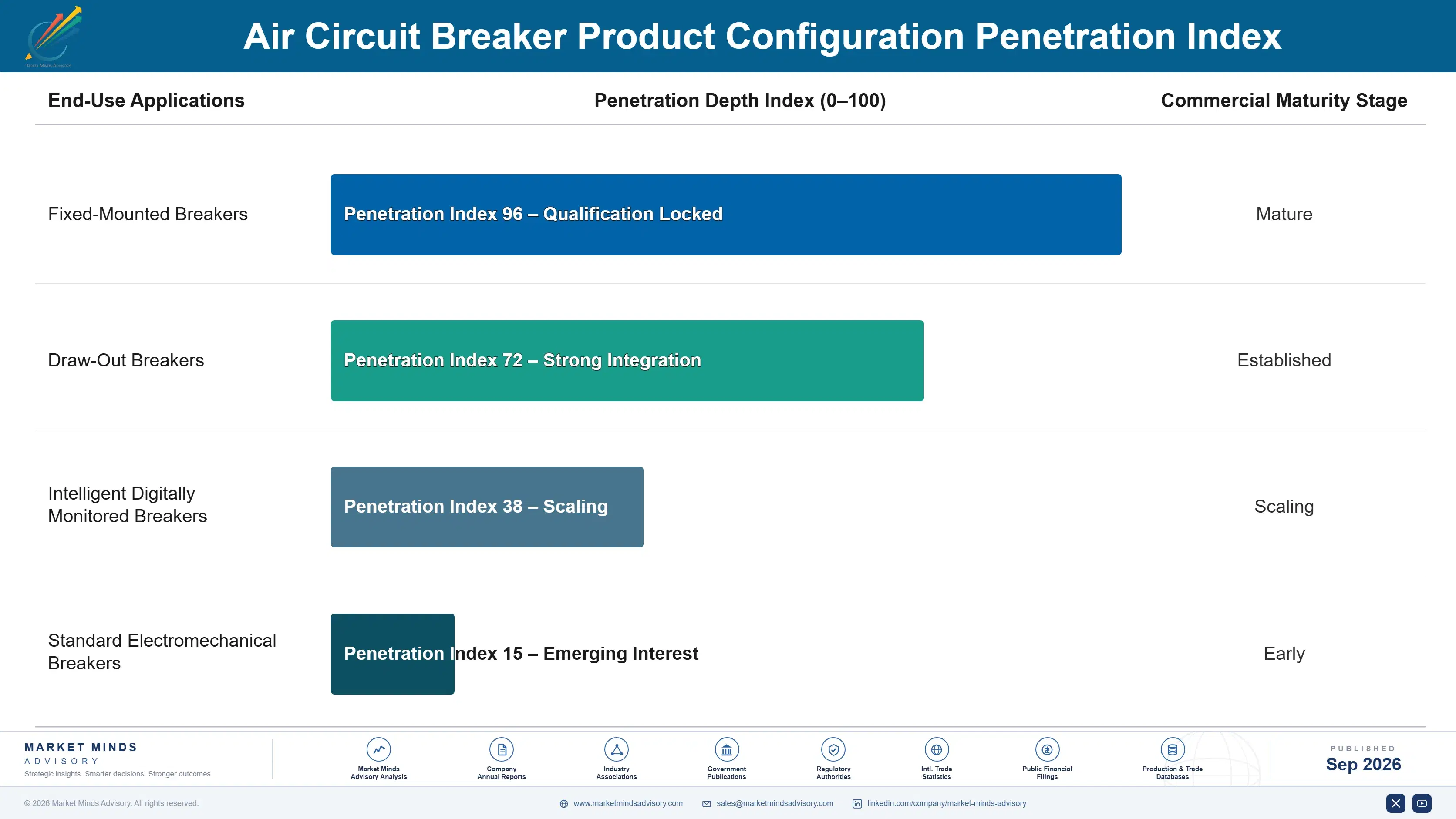
Bundled predictive maintenance service contracts and multi-year framework agreements increasingly function like annuity revenue streams, generating predictable income across years of installed base operation rather than the one-time transaction structure that historically defined air circuit breaker sales. Manufacturers with substantial installed base scale now derive a meaningful share of annual revenue from recurring service and spare parts contracts rather than new unit sales alone. This shift is meaningfully improving how manufacturers value installed base.
Adoption depth varies meaningfully by end-use vertical. Hyperscale data center customers show the deepest stickiness, since switching manufacturers mid-framework-agreement carries real compatibility and monitoring platform continuity risk across multi-year capacity expansion programs. Commercial construction customers show comparatively shallower stickiness, treating procurement as a more transactional, price-driven decision with lower switching costs between competing manufacturer bids. Manufacturers increasingly design framework terms specifically to deepen hyperscale customer retention beyond what standard sales alone achieve.

Buyer profiles are also shifting generationally, as facility procurement teams increasingly staffed by data-driven engineers prioritize verified uptime performance and predictive monitoring capability over the pure upfront price considerations that dominated purchasing decisions a decade ago. This generational shift favors manufacturers investing in intelligent technology over those competing primarily on price alone.
air-circuit-breaker-market-end-use-penetration-index-1788256239071

Where Breaker Manufacturers Should Focus Next

These are among the four positions where our research anticipates prominent divergence between winners and laggards over the coming forecast period. Each is grounded in the demand model, the regulatory perimeter, and the announced capacity pipeline.
01 / CAPACITY EXPANSION PRIORITY

Expand manufacturing capacity ahead of sustained hyperscale demand

Hyperscale data center capital spending shows no sign of moderating, and manufacturers that expand production capacity earliest are capturing disproportionate share of incremental order volume relative to slower-moving competitors still evaluating expansion decisions. Manufacturers that continue operating at existing capacity limits risk losing hyperscale allocation share to better-positioned competitors as backlogs stretch further into future fiscal years across the industry. Capital allocated toward capacity expansion today should generate materially stronger order capture than comparable investment delayed by even a single year.
02 / DIGITAL TECHNOLOGY INVESTMENT

Build intelligent monitoring capability ahead of standard specification

Intelligent monitoring capability is becoming a standard hyperscale procurement requirement rather than an optional premium feature, making basic electromechanical-only positioning a genuine competitive liability for manufacturers seeking premium tender access. Schneider Electric and Eaton have both demonstrated that digital differentiation delivers meaningfully stronger order premiums and customer retention than manufacturers competing primarily on price and lead time alone. Manufacturers without a credible digital technology roadmap risk ceding the fastest-growing premium segment to better-equipped competitors over the coming several years across most major markets.
03 / SUPPLY CHAIN RESILIENCE

Diversify semiconductor suppliers to reduce bottleneck exposure

Component shortages remain one of the sector's most persistent constraints on backlog-to-revenue conversion, particularly for digital trip units dependent on concentrated semiconductor supplier relationships that have not kept pace with surging order volume. Manufacturers that build dedicated supplier diversification capability can convert backlog into shipped revenue considerably faster than manufacturers relying entirely on single-source procurement common earlier in the industry's history. Manufacturers without a credible supply chain resilience strategy risk losing customer confidence during future component shortage episodes across key markets.
04 / SERVICE REVENUE DIVERSIFICATION

Expand bundled maintenance contracts to build recurring revenue

Bundled predictive maintenance service contracts generate recurring revenue that persists independent of new unit sale cycles, offering meaningfully more predictable cash flow than manufacturers relying entirely on transactional equipment sales for their revenue base across most operating markets. Eaton has demonstrated that service-bundled contracts extend customer relationships and improve margin durability considerably relative to standalone equipment competitors managing comparable installed base scale. Manufacturers without dedicated service capability risk losing both margin and customer retention to better-diversified competitors expanding across similar markets.

Engagement Snapshot From the Field

A live engagement with an industry participant carrying material or product regulatory and market exposure ahead of a defining policy shift, showing how our research translates into a defensible multi-year portfolio strategy.
MARKET MINDS ADVISORY · CLIENT ENGAGEMENT SUMMARY
Air Circuit Breaker Producer Strategic Portfolio Review and Transition Roadmap 2026·Investment Scenario on Air Circuit Breaker Exposure Evaluation 2025-26
CLIENT PROFILE
A regional air circuit breaker manufacturer serving Southeast Asian commercial and industrial markets engaged MMA to evaluate whether to pursue intelligent monitoring product development ahead of a planned manufacturing capacity expansion. The client had grown primarily on cost competitiveness in standard electromechanical breakers and sought an independent assessment of digital investment returns. Its factory operated near full capacity utilization ahead of the planned expansion decision.
STRATEGIC CHALLENGE
The client faced a critical capital allocation decision, needing to determine whether to expand standard breaker capacity to capture near-term regional construction demand or invest in intelligent monitoring capability that carried higher development cost but potentially stronger long-term hyperscale positioning. and its board was divided on which path offered the better long-term return on capital.
MMA APPROACH
MMA conducted a comparative demand forecasting exercise drawing on primary interviews with regional facility developers and comparable manufacturers, benchmarking near-term standard demand growth against emerging hyperscale specification trends across the client's core Southeast Asian markets and adjacent export opportunities. supplemented by a review of the client's own manufacturing readiness for a rapid product transition.
KEY FINDINGS
  1. Regional hyperscale data center investment was accelerating faster than the client's internal forecasts had anticipated, with several major operators announcing new campus commitments within the client's core operating territory.
  2. Two comparable regional manufacturers had already begun losing standard-tier tenders to global competitors offering bundled intelligent monitoring at only modestly higher prices than pure standard equivalents.
  3. The client's existing manufacturing footprint could support intelligent monitoring integration within a shorter development timeline than three comparable regional competitors evaluating similar product transitions.
  4. Total lifecycle cost modeling favored intelligent monitoring investment once the region's accelerating hyperscale specification trend was properly incorporated into the client's demand forecast assumptions.
CLIENT PROFILE
A regional air circuit breaker manufacturer serving Southeast Asian commercial and industrial markets engaged MMA to evaluate whether to pursue intelligent monitoring product development ahead of a planned manufacturing capacity expansion. The client had grown primarily on cost competitiveness in standard electromechanical breakers and sought an independent assessment of digital investment returns. Its factory operated near full capacity utilization ahead of the planned expansion decision.
STRATEGIC CHALLENGE
The client faced a critical capital allocation decision, needing to determine whether to expand standard breaker capacity to capture near-term regional construction demand or invest in intelligent monitoring capability that carried higher development cost but potentially stronger long-term hyperscale positioning. and its board was divided on which path offered the better long-term return on capital.
MMA APPROACH
MMA conducted a comparative demand forecasting exercise drawing on primary interviews with regional facility developers and comparable manufacturers, benchmarking near-term standard demand growth against emerging hyperscale specification trends across the client's core Southeast Asian markets and adjacent export opportunities. supplemented by a review of the client's own manufacturing readiness for a rapid product transition.
KEY FINDINGS
  1. Regional hyperscale data center investment was accelerating faster than the client's internal forecasts had anticipated, with several major operators announcing new campus commitments within the client's core operating territory.
  2. Two comparable regional manufacturers had already begun losing standard-tier tenders to global competitors offering bundled intelligent monitoring at only modestly higher prices than pure standard equivalents.
  3. The client's existing manufacturing footprint could support intelligent monitoring integration within a shorter development timeline than three comparable regional competitors evaluating similar product transitions.
  4. Total lifecycle cost modeling favored intelligent monitoring investment once the region's accelerating hyperscale specification trend was properly incorporated into the client's demand forecast assumptions.
RECOMMENDED STRATEGY
Phase 1: Phase 1: Fast-track intelligent monitoring product development using existing manufacturing footprint and established component supplier relationships ahead of competitors. directly. Phase 2: Phase 2: Structure the capacity expansion investment around blended standard and intelligent production lines rather than pursuing standard-only capacity entirely. Phase 3: Phase 3: Target early hyperscale customer relationships in the region before larger global competitors establish comparable local manufacturing presence. directly.
OUTCOME
The client proceeded with blended capacity expansion incorporating intelligent monitoring production lines alongside its existing standard breaker output. The client reported securing early discussions with two regional hyperscale developers, a meaningful improvement over its prior standard-only customer pipeline (client-reported, unverified by MMA). Formal contract discussions are expected to progress over the coming two quarters.

Frequently Asked Questions

Foundational context covering the market sizes, CAGR, scope, country, region and competition that inform every finding below. This section is provided to cover basics and most often pre-purchase conversations, answered from the MMA Primary Research Dataset.

What is the current size of the Air Circuit Breaker Market?

The global air circuit breaker market reached an estimated 3.6 billion dollars in 2025. This reflects accelerating hyperscale data center and industrial electrification demand worldwide.

How large will the Air Circuit Breaker Market be by 2036?

MMA projects the market will reach approximately 6.98 billion dollars by 2036. This represents roughly 1.82 times its 2026 base value over the forecast period.

What is the CAGR for the Air Circuit Breaker Market 2026 to 2036?

The market is projected to grow at a 6.2 percent CAGR between 2026 and 2036. Bull and bear scenarios range from 5.0 to 7.4 percent depending on hyperscale capital spending.

Which segment is growing fastest?

Data center applications are the fastest-growing segment, expanding at roughly 14.2 percent annually, well above the overall market rate. Hyperscale capacity commitments drive this acceleration.

Who are the major companies in the Air Circuit Breaker Market?

Leading manufacturers include Schneider Electric, ABB, Siemens, Eaton, and Mitsubishi Electric. These five companies together account for approximately 48 percent of global unit shipments annually.

Which country is growing fastest?

The United States is the fastest-growing major market, expanding at roughly 9.5 percent annually. Sustained hyperscale data center capital spending drives this rapid accelerating growth.

Report Segmentation Architecture

The full report scope spans multiple orthogonal segmentation dimensions, with cross-tabulated demand data provided for each dimension pair. Coverage extends further to regional breakdowns, trend trajectories, and the competitive detail needed to support segment-level decision-making.

By End-Use Application

  • Commercial Buildings
  • Data Centers
  • Industrial Manufacturing
  • Utilities and Power Generation
  • Renewable Energy Interconnection
  • Marine and Offshore

By Product Configuration

  • Fixed-Mounted Breakers
  • Draw-Out Breakers
  • Intelligent Digitally Monitored Breakers
  • Standard Electromechanical Breakers

By Commercial Dimension

  • New Construction Orders
  • Replacement and Retrofit Contracts
  • Bundled Maintenance Service Agreements
  • Multi-Year Framework Agreements

By Region

  • North America
  • Western Europe
  • East Asia
  • South Asia and Pacific
  • Latin America
  • Middle East and Africa
  • Eastern Europe

Scope, Methodology, and Coverage

Every figure in this report is reproducible from documented input assumptions. The scope below maps the historical period, the forecast horizon, the segmentation dimensions, and the countries covered, alongside the underlying primary and qualitative methodology.
Historical Period
2020 to 2025
Forecast Period
2026 to 2036
Base Year
2025 (USD billions; MMA Primary Research Dataset, September 2026)
Market Definition
This report covers air circuit breakers rated for low-voltage power distribution applications in commercial, industrial, and data center facilities, including fixed-mounted and draw-out configurations. It excludes molded case circuit breakers, medium-voltage switchgear, and residential-grade circuit protection devices.
Quantitative Units
USD billions (current prices); unit shipment volume where applicable
Segmentation Dimensions
By End-Use Application; By Product Configuration; By Commercial Dimension; By Region
Regions Covered
North America, Western Europe, East Asia, South Asia and Pacific, Latin America, Middle East and Africa, Eastern Europe
Countries Covered
USA, China, Germany, France, UK, Japan, South Korea, India, Australia, Canada, Brazil, Mexico, Indonesia, Vietnam, Thailand, Malaysia, UAE, Saudi Arabia, South Africa, Nigeria, Turkey, Poland, Netherlands, Italy, Spain, Sweden, Switzerland, Argentina, Colombia, Singapore, and additional markets relevant to this sector
Key Companies Profiled
Schneider Electric, ABB, Siemens, Eaton, Mitsubishi Electric, Fuji Electric, Hyundai Electric, LS Electric, CG Power and Industrial Solutions, Larsen & Toubro, WEG, Chint Group, Hyosung Heavy Industries, Legrand, Terasaki Electric, Socomec, Toshiba Infrastructure Systems, Havells India, Powell Industries, Meidensha
Quantitative Methodology
Primary survey, n=3,800 respondents, Q4 2025, six countries; demand-side model with trade association cross-validation
Qualitative Methodology
47 expert interviews, Q4 2025; applied to validate demand model assumptions, identify emerging dynamics, and assess competitive positioning
Report Format
PDF and XLSX data workbook (Word format preview document)
Publisher
Market Minds Advisory
Report Code
MMA-2026-CON-341
Published
September 2026
Contact
sales@marketmindsadvisory.com | www.marketmindsadvisory.com

Purchase the full Air Circuit Breaker Market Report (2026 to 2036).

This report provides comprehensive analysis of the global air circuit breaker market, covering product technology, manufacturing economics, and competitive dynamics across all major end-use application segments. It includes detailed segmentation by end-use application, product configuration, and commercial dimension. Regional analysis spans seven geographies, alongside competitive profiling of the twenty largest global manufacturers. The report draws on primary survey data from 3,800 respondents and 47 expert interviews conducted in the fourth quarter of 2025, supplemented by company disclosures and government trade statistics. It also includes detailed segment-level margin and capacity analysis.
Ten-year global market sizing and forecast
Seven-region demand share and pricing analysis
Twenty-company competitive benchmarking and profiling assessment
Segment-level growth rate and margin data
Input cost and supply chain risk assessment
Case study with recommended capacity strategy

Built For The People Who Decide

From boardroom strategy to bench-side execution, this report is read cover-to-cover by leaders shaping the next decade of their industry, turning demand scenarios, market dynamics and valuation benchmarks into decisions.
CXOs/ Presidents/ VPs/ Managers
M&A and Corporate Development
Strategy Teams and R&D Heads
Procurement and Product Directors
Regulatory and Compliance Leaders
Investor Relations and Equity Analysts