Market Minds Advisory
Air Bubble Bags Market

Air Bubble Bags Market: E-Commerce Parcel Volume and the Compostable Protection Shift

E-commerce fulfillment operators are locking in multi-year bubble bag supply contracts as parcel volume climbs, even as retailer plastic-reduction commitments and compostable film formulations push suppliers to defend share against paper-based alternatives.

Lead Analyst

Bilal Shaikh

Published

September 2026

Make Smarter Decisions with Customized Research Insights

Request a free sample report and evaluate market opportunities, growth trends, and competitive dynamics relevant to your business needs.

2025 MARKET VALUE$2.3BMarket Size 2025
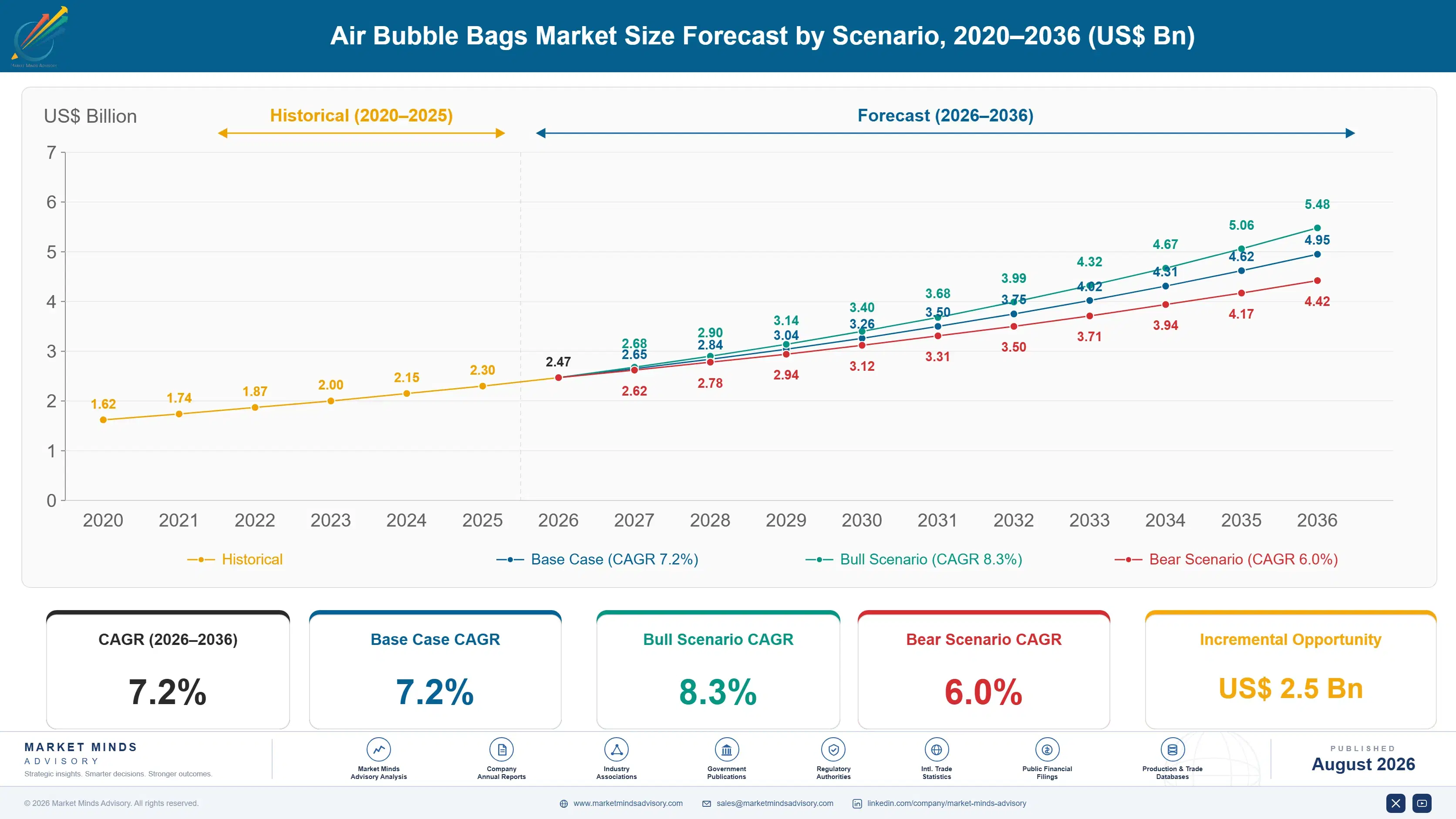
2036 FORECAST VALUE$5.0BBase Case , 2026 to 2036
CAGR 2026 TO 20367.2 %Bull 8.3% / Bear 6.0%
INCREMENTAL OPPORTUNITY$2.5BNet 10- year value creation
EXPANSION MULTIPLE2.00x2036 value over 2026 base
Strategic Levers
M&A Pipeline
Regional Outlook
Country Rankings
Competitive Intelligence
Segmental Deep-dive
Call-Us : 91 93563 13602

Executive Snapshot and Market Trajectory

E-commerce fulfillment operators are converting bubble bag purchasing from a spot-market commodity buy into multi-year supply contracts, treating protective packaging reliability as a fulfillment-center operating requirement rather than a line item to shop around each quarter. That contractual shift is pulling converter capacity investment forward across the category this year.
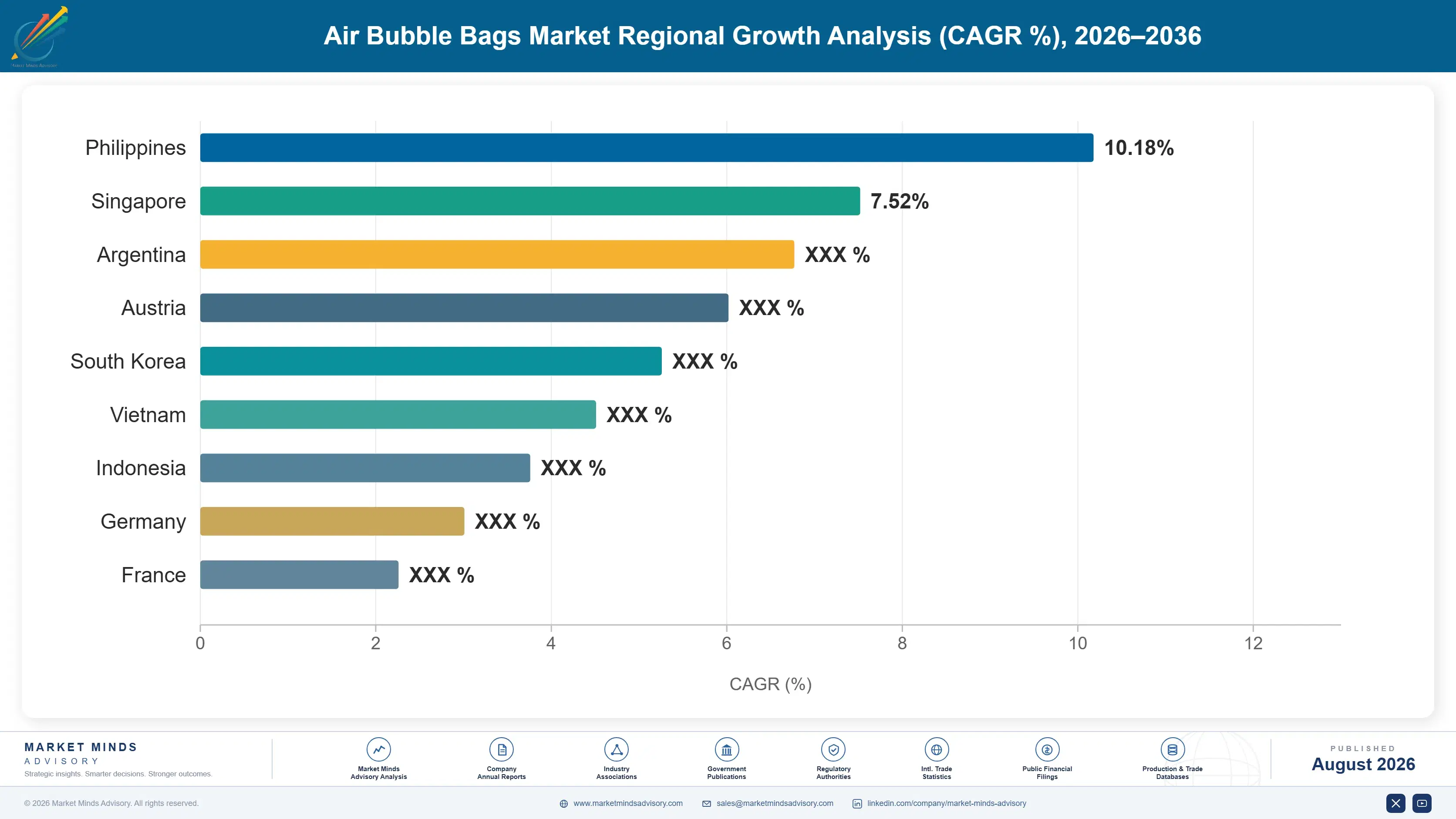
Biodegradable and compostable bubble bags are capturing the fastest growth as large retailers commit publicly to phasing out conventional polyethylene mailers, even though performance and cost gaps keep the segment a small share of total volume today. East Asia holds the deepest single manufacturing base given its film converting scale, while Vietnam's expanding export packaging sector drives the fastest-growing single country market as regional capacity keeps scaling up steadily.
Competitive intensity remains fragmented relative to the addressable market size, since bubble film lamination and bag conversion require only moderate capital investment that has pulled in hundreds of regional converters worldwide over the past decade. Sealed Air and Storopack's brand recognition and fulfillment-center distribution relationships set the pace that challengers chase, while paper mailer substitution keeps pressuring the category's lowest-differentiation, price-only segment hardest of all across nearly every single global market region examined.
Market Definition
The air bubble bags market covers flexible protective mailers and pouches constructed from air-cushioned bubble film, used to protect goods during shipping and handling across e-commerce fulfillment, industrial parts distribution, and retail shipping applications. It excludes rigid protective packaging such as molded foam inserts, non-cushioned flat poly mailers without air-bubble protection, and corrugated shipping boxes sold as a separate packaging category.
Base Year Value
$2.3B in 2025 (MMA Primary Research Dataset, August 2026)
Forecast Period
2026 to 2036, eleven discrete annual values
CAGR
7.2% base case. Bull 8.3%. Bear 6.0%.
Fastest Growth Segment
Biodegradable and Compostable Bubble Bags: 11.8% CAGR
Fastest Growth Country
Vietnam: 11.5% CAGR
Fastest Growth Region
South Asia and Pacific: 9.2% CAGR
Largest Region
East Asia: 28% of 2025 global value
Market Leaders
Sealed Air Corporation, Storopack Hans Reichenecker GmbH, Pregis LLC, Sigma Plastics Group, Novolex. Source: MMA Analysis based on company annual reports and investor filings.
Primary Survey
n=3,800 procurement and R&D decision-makers, Q4 2025, six countries
Methodology
Demand-side build-up, cross-validated against public data, 47 expert interviews

Air Bubble Bags Market Forecast Scenarios

air-bubble-bags-market-size-forecast-scenario-1787300502037
Air bubble bag demand grew steadily between 2020 and 2025, with a pandemic-era e-commerce surge pulling volumes sharply higher before growth normalized to a steadier pace as parcel volume growth itself moderated from its 2021 peak. The category closed 2025 at an estimated 6.7% historical CAGR, tracking closely with broader e-commerce parcel volume growth over the same period.
The base case rests on three reinforcing mechanisms. First, global e-commerce parcel volume keeps climbing as online retail penetration expands across emerging markets that still have substantial room to grow. Second, large retailers are converting voluntary plastic-reduction pledges into supplier scorecards that reward recycled-content and compostable formulations, pulling premium segment growth ahead of the commodity base. Third, industrial parts and electronics distributors continue expanding e-commerce channels that require anti-static and cushioned protective packaging beyond standard consumer mailers.
The bull case turns on major e-commerce platforms accelerating compostable packaging mandates across their fulfillment networks faster than the base forecast assumes, pulling premium segment volumes forward sharply. The bear risk is paper-based mailer substitution accelerating faster than expected as brand sustainability commitments favor recyclability claims over bubble film's cushioning performance advantage, slowing unit volume growth in the category's largest commodity segment.

Parcel Protection Economics and the Compostable Substitution Curve

Air bubble bags sit at the intersection of two converging pressures: e-commerce parcel volume that keeps expanding as online retail penetration deepens, and brand sustainability commitments that increasingly scrutinize single-use plastic packaging regardless of its cushioning performance advantage over paper alternatives. Both forces are reshaping the category, one pushing volume higher and the other pushing material composition toward recycled and compostable formulations across most major mark
MARKET CONCENTRATION29% CR5Fragmented supply base with moderate manufacturing entry barriers
AVERAGE SELLING PRICE$0.08-0.42 per unitPrice varies steeply by size, material, and cushioning specification
TOP PRODUCING COUNTRYChina, 33% shareChinese converters supply the largest single national output share
CAPACITY UTILISATION74%Utilisation tracks e-commerce parcel volume seasonality fairly closely
TRADE INTENSITY46% cross-borderNearly half of units cross a border before fulfillment use
FEEDSTOCK COST SHARE41% of COGSPolyethylene resin costs dominate most input spending lines
Commercially, the market splits between commodity polyethylene bags sold largely on price to high-volume fulfillment operators, and a smaller but growing premium tier of recycled-content and compostable bags sold on documented sustainability credentials. Large e-commerce platforms increasingly specify material composition directly in supplier contracts rather than leaving the choice to individual fulfillment center procurement teams to decide independently.
Over the next decade, material innovation will matter more than converting capacity alone. Compostable film formulations that match conventional polyethylene's cushioning performance without the cost premium that has confined them to niche accounts today would meaningfully reshape category economics, and the suppliers that solve that performance-cost equation first stand to capture outsized share of large retailer contracts industry-wide over the coming decade.
"Everyone wants to talk about compostable bubble bags, but the honest answer is that most large fulfillment operators still buy on cushioning performance and delivered cost first. Sustainability wins the RFP only when the film actually performs."
Director, Protective Packaging Practice · MMA Packaging Practice ·<

Market Trends

Retailers Convert Plastic Pledges Into Supplier Scorecards

Major e-commerce retailers are moving beyond voluntary plastic-reduction pledges to embed specific recycled-content and compostability requirements directly into supplier scorecards and multi-year packaging contracts, converting what was once a marketing aspiration into a binding purchasing criterion. Several large retailers have disclosed recycled-content targets for shipping mailers reaching 40% or more by 2027 in recent sustainability disclosures, and converters report these targets increasingly determine which suppliers make the qualified vendor list. Sealed Air and Pregis have both expanded dedicated recycled-content bubble bag production lines since 2024 specifically to meet this scorecard-driven demand across major retail accounts.
Market Impact: Parcel volume tops 190 billion annually
Compostable Film Formulations Close the Performance Gap

New compostable bubble film formulations using certified compostable base resins are beginning to close the cushioning performance gap with conventional polyethylene that has confined compostable bags to niche premium accounts since their commercial introduction years ago. Several converters have released reformulated compostable films since 2024 that match conventional polyethylene drop-test performance within a narrow margin, a meaningful improvement over earlier compostable formulations that cracked or lost cushioning under cold-weather shipping conditions. Large fulfillment operators piloting these newer formulations report performance now approaching parity in roughly 70% of standard shipping scenarios tested across multiple carriers.
Market Impact: Anti-static orders outpace category growth 2x

Market Opportunities and Growth Drivers

Global E-Commerce Parcel Volume Keeps Climbing

Global e-commerce parcel volume has continued climbing as online retail penetration deepens across both mature and emerging markets, with industry logistics data showing worldwide parcel volume growing past 190 billion shipments annually in 2025. Every incremental parcel shipped in a soft-sided format requires proportional bubble bag or equivalent protective packaging volume, and MMA's primary survey found more than 65% of surveyed fulfillment operators citing parcel volume growth, not unit price changes, as the primary driver behind their most recent capacity planning decisions. That demand base persists regardless of near-term shifts toward recycled or compostable formulations.
Market Impact: Paper gains 3-5 share points yearly

Electronics and Industrial Parts Distribution Expands Online

Electronics and industrial parts distributors continue expanding direct-to-customer e-commerce channels that require anti-static and cushioned protective packaging beyond what standard consumer mailers provide, a higher-value application than basic commodity bubble bags serve. Distributors report anti-static bubble bag orders growing meaningfully faster than the broader category as component-level electronics sales shift from traditional distributor warehouses toward direct online fulfillment models requiring individually packaged protection for sensitive components. This shift is pulling specialized protective packaging demand into channels that previously relied on bulk industrial packaging formats rather than individual parcel-level protection for smaller shipments.
Market Impact: Adds 20-30% cost premium

Market Restraints and Challenges

Paper Mailer Substitution Pressures Commodity Segment

Paper-based padded mailers and honeycomb wrap alternatives are gaining share against conventional polyethylene bubble bags among brands prioritizing recyclability claims over cushioning performance, a substitution pattern rooted in genuine consumer and retailer perception that paper reads as more sustainable regardless of its actual lifecycle impact relative to recycled-content plastic film. That substitution pressure concentrates hardest in the commodity segment, where cushioning performance requirements are modest enough that paper alternatives can substitute without meaningful damage-rate increases. Suppliers are responding by emphasizing recycled-content certification and lifecycle assessment data that challenge the simplistic paper-versus-plastic sustainability narrative driving much of this substitution.
Market Impact: Recycled-content targets reach 40%+ by 2027

Compostable Formulation Costs Still Exceed Conventional Film

Despite recent performance improvements, compostable bubble film formulations still cost meaningfully more than conventional polyethylene film, a premium rooted in smaller production scale and specialty resin costs rather than any single supply bottleneck, and that premium keeps compostable bags confined mostly to premium, brand-committed accounts rather than the broader commodity market. Mid-tier converters without dedicated sustainability-focused retail contracts often cannot justify the cost premium to price-sensitive fulfillment operators, limiting adoption to accounts where the brand has already committed publicly to compostable packaging targets. Suppliers are responding with blended formulations that capture partial sustainability credit at a smaller premium.
Market Impact: Matches performance in 70% of tests
3 additional market trends, 4 additional growth drivers, and 3 additional restraints and challenges are covered in the full report. Contact sales@marketmindsadvisory.com to access the complete intelligence.

Segment CAGR and Growth Architecture

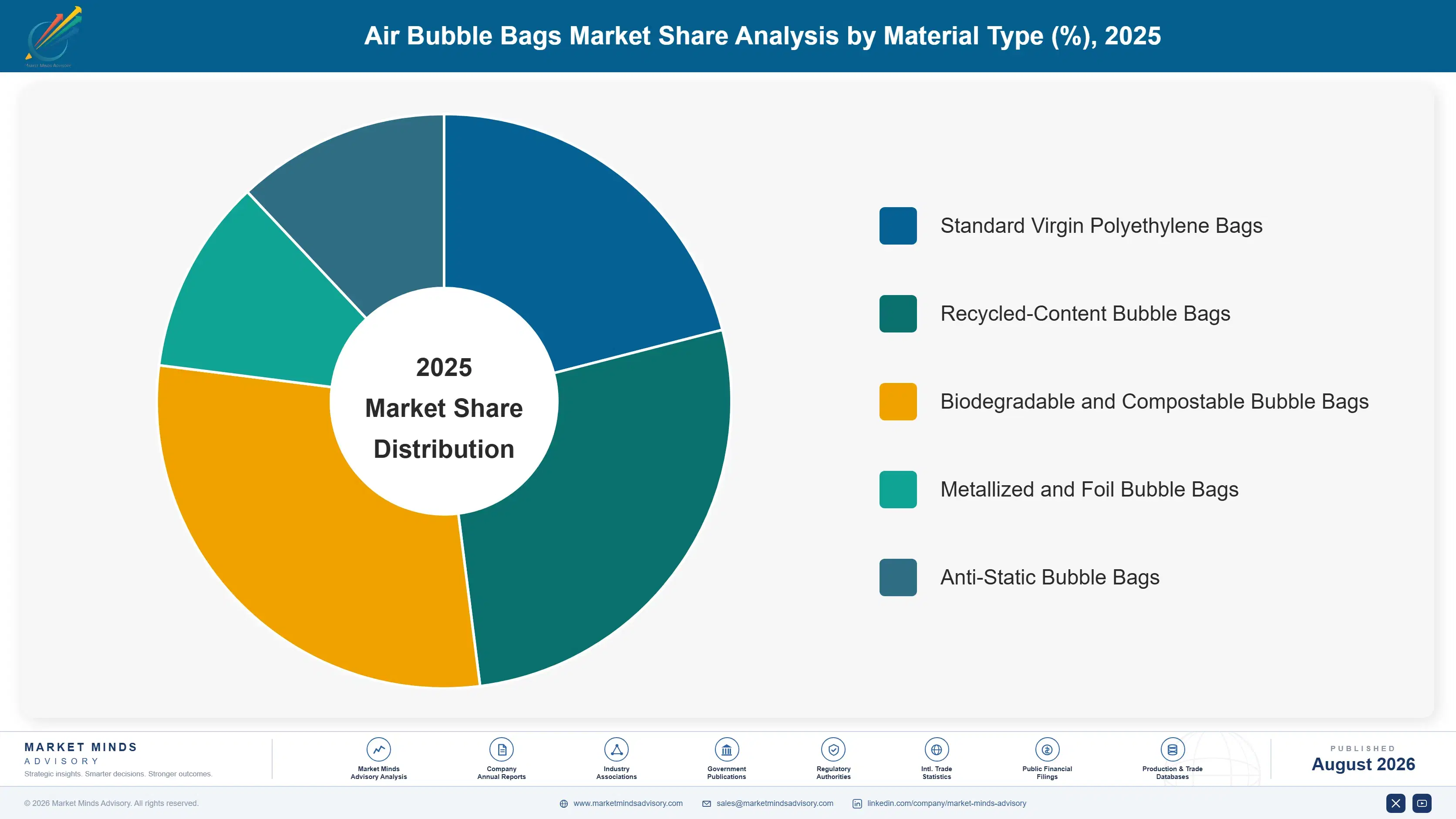
Segmentation follows material composition rather than end-use channel, since the base film chemistry, whether conventional polyethylene, recycled-content, or compostable, determines cost structure and sustainability positioning more than whether a bag ships consumer apparel or industrial components. Standard polyethylene bags remain the volume base, but recycled and compostable formulations now address sustainability requirements conventional film cannot satisfy.
air-bubble-bags-market-market-share-analysis-1787300502569

Biodegradable and Compostable Bubble Bags

Biodegradable and compostable bubble bags are the fastest-growing material segment, expanding at an estimated 11.8% CAGR against a market average of 7.2%, roughly 1.64 times the overall pace. Growth tracks directly with large retailer sustainability commitments and improving compostable film performance that is narrowing the cushioning gap with conventional polyethylene, though the segment still represents a small absolute share of total category volume given persistent cost premiums. Sealed Air and Pregis currently lead on shipped compostable volume, though the segment requires meaningfully more research investment in film formulation than standard polyethylene converting. Continued adoption depends on compostable film costs continuing to fall toward parity with conventional film across the forecast period.
CAGR 11.8%

Recycled-Content Bubble Bags

Recycled-content bubble bags rank second-fastest, growing at an estimated 10.2% CAGR as retailers specify recycled polyethylene content as a lower-cost, more mature sustainability pathway than fully compostable alternatives while broader compostable infrastructure continues developing across major markets. The segment benefits from recycled resin supply chains that are considerably more established than compostable resin supply, letting converters scale recycled-content production faster and at lower incremental cost than compostable alternatives require. Adoption still trails standard polyethylene by a wide margin given ongoing recycled resin quality consistency challenges that affect cushioning performance. Growth is concentrated among suppliers including Novolex and Sigma Plastics Group that have expanded recycled-content film capacity to meet retailer scorecard requirements.
CAGR 10.2%
Full segment breakdown across 5 segments available in the complete report.

Regional Architecture and Country Demand Map

Air bubble bag demand concentrates where film converting scale and e-commerce parcel volume overlap. East Asia leads on both converting capacity and its own massive domestic e-commerce volume, North America follows closely on fulfillment density, and South Asia and Pacific grows fastest as penetration expands rapidly.

North America

E-commerce fulfillment center density anchors North America's bubble bag demand, as major platforms and third-party logistics providers ship a large and growing volume of soft-sided parcels requiring cushioned protection across dense distribution networks. The US accounts for the large majority of regional demand, driven by the world's highest per-capita e-commerce parcel volume and a fulfillment network built around fast, frequent shipment cycles that favor lightweight bubble bags over bulkier corrugated boxes for smaller items. Sustainability-focused retailers headquartered in the region are driving disproportionate recycled-content and compostable segment growth relative to their share of total volume. Canada contributes a smaller, steadier share, while Mexico's contribution grows fastest of the three as nearshoring expands fulfillment capacity closer to US demand.
Share: 25% | CAGR: 8.1% (2026 to 2036)

Western Europe

Regulation and consumer expectations, not e-commerce volume growth alone, increasingly shape Western Europe's bubble bag demand. The EU's packaging waste regulation is pushing converters across Germany, France, and the Netherlands to expand recycled-content and compostable offerings ahead of tightening minimum content requirements taking effect over the coming years across the bloc. Consumer expectations in several markets run ahead of regulatory minimums, particularly in Germany and Scandinavia, where major retailers have voluntarily committed to eliminating conventional plastic mailers on accelerated timelines set internally. Growth here trails the global average, reflecting both a mature e-commerce fulfillment base and continued substitution pressure from paper-based alternatives favored by environmentally conscious European consumers specifically across most demographics.
Share: 19% | CAGR: 5.9% (2026 to 2036)
Regional intelligence for 5 additional markets available in the complete report: East Asia, South Asia and Pacific, Latin America, Middle East and Africa, Eastern Europe. Contact sales@marketmindsadvisory.com.
air-bubble-bags-market-country-cagr-analysis-1787300503082

Where Bubble Bag Margin Concentrates Next

Four commercial moves separate converters capturing outsized margin from those competing purely on delivered unit price. Each depends on shifting revenue toward certification, fulfillment integration, custom sizing, or supply continuity that current shipment volume does not yet fully reflect, particularly as commodity polyethylene pricing keeps compressing hard at the low end of the category.

Certified Recycled and Compostable Content Premium Program

Converters that secure recognized third-party recycled-content and compostability certifications are commanding a durable price premium over uncertified sustainability-claim bags, since large retailers increasingly require documented certification to satisfy their own sustainability disclosure and audit obligations. Certified bags typically command a price premium of 15 to 28% over functionally similar uncertified alternatives, a margin reflecting both certification cost and the reduced compliance risk buyers value highly. Converters without recognized certification increasingly lose large retailer contracts to certified rivals regardless of underlying cushioning performance, making certification a baseline requirement for enterprise fulfillment accounts.
Market Impact: Commands a durable 15 to 28% price premium

Custom Fulfillment Center Sizing and SKU Optimization Program

Converters offering custom bag sizing and SKU rationalization services, analyzing a fulfillment operator's actual shipment dimension data to recommend an optimized bag size range, are capturing service revenue that generic bag sellers cannot offer. A dedicated sizing optimization engagement typically reduces a fulfillment operator's total bag SKU count by 20 to 35% while cutting void-fill material usage, savings the operator shares with the converter through a premium on the resulting optimized order volume. This service model matters most for large fulfillment operators managing thousands of distinct product dimensions across multiple distribution centers.
Market Impact: Cuts customer SKU count by 20 to 35%

Multi-Year Supply Continuity and Capacity Reservation Program

Converters offering contractual supply continuity guarantees, including reserved capacity commitments during peak shipping seasons, are winning large fulfillment center accounts that experienced painful bubble bag shortages during past holiday shipping surges when demand outpaced converting capacity industry-wide. Multi-year continuity contracts typically carry a price premium of 6 to 12% over spot-market purchasing, reflecting the value large operators place on avoiding a stockout during their highest-revenue shipping weeks of the year across the calendar. Suppliers able to demonstrate genuine reserved peak-season capacity increasingly win these contracts over lower-cost competitors without comparable capacity commitments in place.
Market Impact: Commands 6 to 12% premium over spot pricing

Fulfillment Automation Integration and Sizing Data Services

Converters that integrate directly with automated packaging systems used in large fulfillment centers, supplying pre-sized, machine-compatible bag formats matched to specific automated packing equipment, are capturing higher-margin business than commodity converters selling generic bags through distributors. This integration typically requires a dedicated engineering relationship carrying setup fees of $25,000 to $90,000 depending on facility automation complexity, in addition to the recurring per-unit revenue that follows over the contract term. This service model matters most for the largest fulfillment operators running highly automated packing lines that require precisely specified, consistent bag dimensions across every shipment.
Market Impact: Setup fees typically run $25,000 to $90,000 per site

Who Controls the Margin Pool

The top five converters hold an estimated 29% of global bubble bag shipment volume, a fragmented concentration reflecting moderate manufacturing entry barriers that have pulled hundreds of regional converters into the category worldwide. Sealed Air and Storopack lead on brand recognition and fulfillment-center distribution relationships, while a long tail of regional converters competes mainly on price for basic commodity polyethylene bags.
Current competitive activity centers on three fronts. Compostable film launches are redrawing the premium tier, with Sealed Air, Pregis, and Storopack all racing to close the performance gap with conventional polyethylene. Fulfillment automation integration is becoming a genuine differentiator among converters targeting the largest e-commerce accounts. And several regional converters are pursuing recycled-content certification and distributor partnerships to move beyond commodity export pricing into branded competition.

Emerging pressure comes from Southeast Asian and Chinese converters moving up the value chain into certified recycled-content and compostable categories once dominated by Western and Japanese suppliers, aided by domestic resin supply that keeps their input costs consistently lower. If regional converters close the certification and brand-trust gap further, expect share to shift meaningfully, particularly in Latin America and South Asia where price sensitivity runs higher than at flagship accounts.
air-bubble-bags-market-company-positioning-matrix-1787300503600

Competitive Moat and Risk Dimensions

SEALED AIR CORPORATION

Moat: Brand Recognition and Fulfillment Scale

Sealed Air built its brand into the default reference point for protective packaging among North American and European fulfillment operators, a recognition advantage that smaller converters cannot replicate quickly, giving it pricing power in negotiations with large retailers and distributors that trust the name and its documented performance history.
SEALED AIR CORPORATION

Risk: Premium Pricing Under Cost Pressure

Sealed Air's brand-driven premium pricing depends on buyers valuing recognition and documented performance enough to pay more than commodity Asian alternatives, and that willingness to pay could erode if lower-cost converters close the quality and reliability gap faster than Sealed Air can defend its position through continued innovation.
STOROPACK HANS REICHENECKER GMBH

Moat: European Fulfillment Integration Depth

Storopack built deep integration relationships with European fulfillment operators around automated packaging equipment compatibility, a technical and logistical advantage that pure commodity bag sellers cannot match, giving it access to procurement relationships built on equipment-level integration rather than unit price alone across major long-standing accounts.
STOROPACK HANS REICHENECKER GMBH

Risk: Regional Concentration Limits Global Reach

Storopack's strength is heavily concentrated in European fulfillment relationships, leaving it more exposed to regional e-commerce and regulatory shifts than more geographically diversified competitors, and expanding meaningfully into North American or Asian accounts requires rebuilding the integration relationships that took years to establish domestically in Europe.

Key Players

Sealed Air Corporation
Storopack Hans Reichenecker GmbH
Pregis LLC
Sigma Plastics Group
Novolex

Others

Smurfit Kappa Group
International Plastics Inc.
Polyair Inter Pack Inc.
Ranpak Holdings Corp
ProAmpac LLC
Automated Packaging Systems LLC
Sancell Pty Ltd
Cellofoam North America Inc.
Intertape Polymer Group
Signode Industrial Group
Berry Global Group Inc.
Macfarlane Group PLC
RAJA Group
Supreme Industries Ltd
Nefab Group

Recent Developments

FEBRUARY 2025

Sealed Air Launches Reformulated Compostable Bubble Film for Retail Accounts

Sealed Air Corporation released a reformulated compostable bubble film matching conventional polyethylene drop-test performance within a narrow margin, addressing the category's most persistent adoption barrier since compostable formats launched years earlier. The release followed eighteen months of field testing with several large North American retail fulfillment partners.
Signal: Signals compostable film performance becoming the primary competitive battleground among premium-tier suppliers industry-wide this planning cycle.
SEPTEMBER 2024

Pregis Expands Recycled-Content Film Production Capacity

Pregis LLC commissioned additional recycled-content bubble film production capacity at its US facility, roughly doubling dedicated output for retail accounts pursuing sustainability scorecard compliance nationwide across its network. The expansion followed sustained order backlog growth as major retailers finalized recycled-content packaging requirements through 2024 and into 2025.
Signal: Signals recycled-content bubble bag demand outpacing existing certified converting capacity across the industry currently this cycle.
APRIL 2025

Storopack Acquires Regional Fulfillment Automation Integration Specialist

Storopack Hans Reichenecker GmbH acquired a regional automated packaging equipment integration specialist to strengthen its fulfillment center service offering across Europe, targeting large e-commerce operators running highly automated packing lines across multiple facilities. The acquired specialist continues operating under its existing brand within Storopack's broader structure.
Signal: Signals established suppliers formalizing automation integration as a distinct competitive capability beyond commodity film sales alone.

Polyethylene Resin Feedstock Exposure

Polyethylene resin accounts for roughly 41% of cost of goods sold in bubble bag manufacturing, with virgin resin supply concentrated among major petrochemical producers in North America, the Middle East, and China, while recycled and compostable specialty resins remain supplied by a smaller, concentrated producer base. Film lamination adhesives and printing inks add a further meaningful share, sourced predominantly from specialty chemical suppliers regardless of location.
Polyethylene resin prices spiked sharply during 2021 and 2022 as global petrochemical supply chains tightened following pandemic disruptions, with several converters reporting input cost increases exceeding 25% in their 2022 annual reports just as parcel volume was climbing fastest. The EIA's feedstock review has flagged resin pricing as sensitive to crude oil and natural gas cycles and competing demand from other flexible packaging categories nationally.

Smaller regional converters without long-term resin supply contracts absorbed the price spike hardest, losing contract bids to larger suppliers including Sealed Air and Novolex that had negotiated priority pricing with major petrochemical producers. Converters with backward integration into resin production weathered input volatility somewhat better than those dependent on the open market, a durable cost advantage that persists as recycled and compostable resin demand climbs faster than supply.
air-bubble-bags-market-cost-volatility-analysis-1787300503797

Multi-Year Resin Supply Agreements

Larger converters are locking multi-year polyethylene resin supply agreements directly with petrochemical producers, trading some pricing flexibility for guaranteed volume and price stability that protects margin during future resin market volatility, an increasingly standard practice among the top five converters following the 2021 to 2022 price spike experience. Smaller converters increasingly pool orders through distributors to gain similar allocation priority.

Backward Integration Into Recycled Resin Processing

Several larger converters are investing directly in recycled resin processing capacity rather than purchasing entirely on the open market, reducing exposure to specialty resin price swings and improving supply reliability, though this requires meaningfully higher fixed capital investment than pure film converting operations alone require to sustain profitably over multiple years and production cycles across facilities.

Regional Resin Sourcing Diversification Strategy

Converters are qualifying multiple regional resin suppliers across North America, the Middle East, and Asia rather than depending on a single sourcing region, reducing exposure to any single geography's supply disruption or trade policy shift while adding modest logistics complexity to sourcing operations overall across multiple facilities and distribution networks worldwide over several years.

Portfolio Architecture for Margin Defence

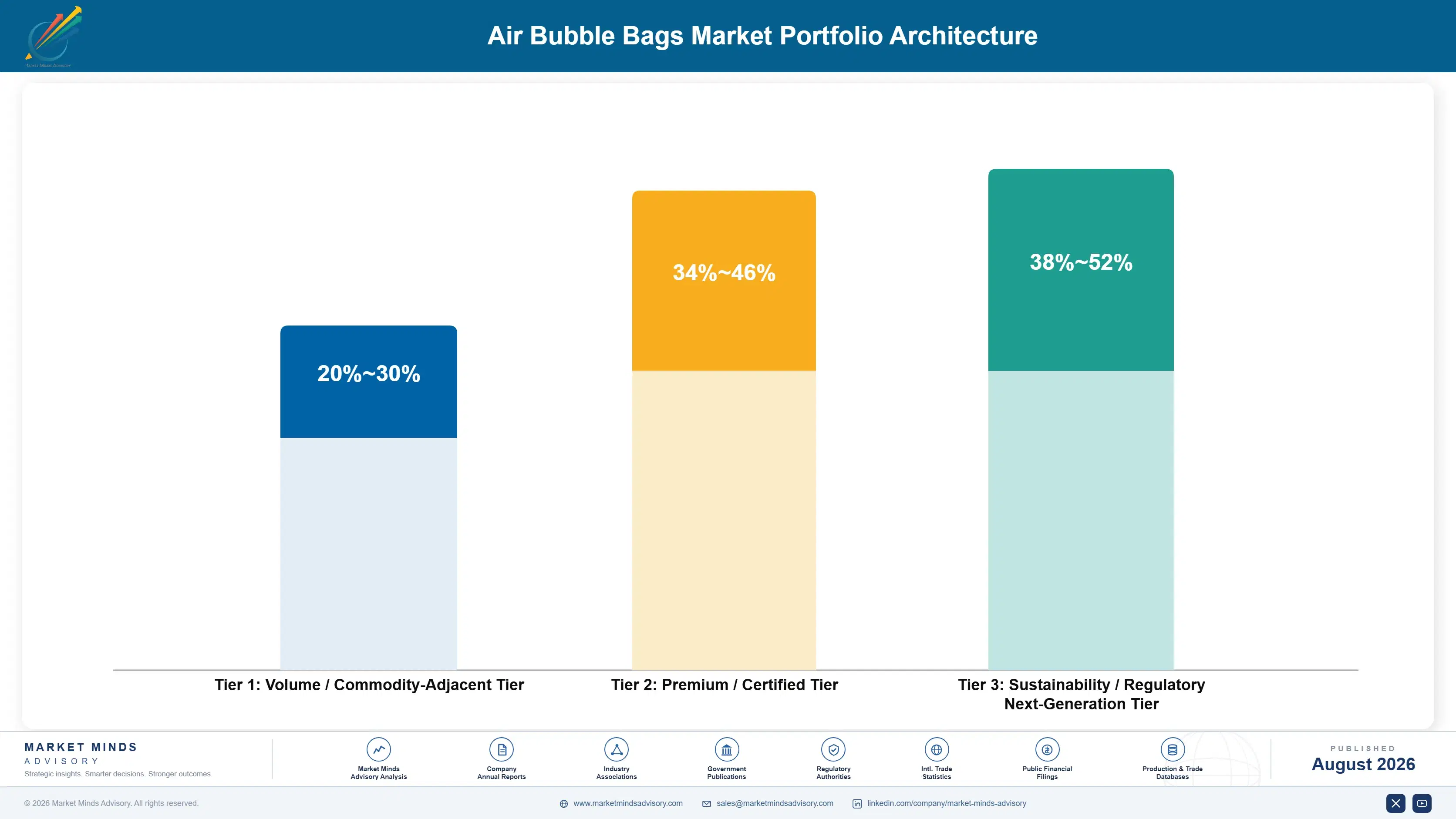
Air bubble bag portfolios split across three tiers with meaningfully different margin economics. The volume tier, standard virgin polyethylene bags sold largely on price, competes hardest against Asian imports and delivers gross margins in the 20 to 30% range. Premium certified recycled-content and compostable bags bundling documented sustainability credentials command materially higher margins, reflecting resin cost and certification investment layered on top of base film chemistry.
The tension between volume and premium tiers shapes capacity allocation decisions across the industry. Volume polyethylene capacity is easiest to scale and fastest to fund, but Asian price competition keeps margin pressure constant in that tier. Premium recycled and compostable capacity requires deeper resin sourcing investment and slower certification cycles, but rewards patient capital with margins that hold up even as volume-tier pricing keeps eroding.

High-value margin pools concentrate in compostable and recycled-content bags, fulfillment automation integration services, and the sizing optimization layer that increasingly separates established converters from commodity bag sellers. These pools remain a modest share of total shipment volume today, but they are growing faster than the standard polyethylene base and are where most converter research and development spending is now directed.

Volume / Commodity-Adjacent Tier

Standard virgin polyethylene bags sold primarily on unit price, facing the heaviest direct competition from Asian imports. These units carry the thinnest margins in the portfolio and depend on manufacturing scale rather than certification to stay profitable.
Gross Margin: 20-30%

Premium / Certified Tier

Recycled-content bags bundling documented certification, fulfillment automation compatibility, and multi-year supply continuity guarantees that large retailers pay a premium to access. This tier generates steady repeat business, since certified accounts rarely switch without cause.
Gross Margin: 34-46%

Sustainability / Regulatory / Next-Generation Tier

Compostable bubble film formulations tied to expanding retailer plastic-reduction commitments and tightening EU packaging waste regulation. This tier draws the heaviest research spending, since formulation and certification both require sustained investment to defend against fast-moving entrants.
Gross Margin: 38-52%
air-bubble-bags-market-portfolio-architecture-1787300504297

High-value Sub-segments and Strategic Watch-out

Biodegradable and Compostable Bubble Bags

The fastest-growing, highest-margin pool in the market, driven by large retailer sustainability commitments that reward suppliers with mature compostable formulation and certification already proven in the field. Suppliers without that capability risk losing the fastest-growing accounts to specialists that moved earlier in the adoption cycle.
Gross Margin: 40-52%

Recycled-Content Bubble Bags

A smaller but rapidly scaling high-value pool as retailers specify recycled content as a mature, lower-cost sustainability pathway, gated by consistent recycled resin quality and supply chain qualification cycles. Suppliers that secure early retailer qualification tend to hold that relationship for years, since switching mid-contract is costly.
Gross Margin: 34-44%

Standard Virgin Polyethylene Bubble Bags

The volume core of the market, serving cost-sensitive fulfillment accounts where Asian price competition keeps margins under the most sustained pressure of any product tier. This segment still generates the largest absolute shipment volume, and defending share funds the research spending premium tiers require to grow.
Gross Margin: 20-28%

Unbranded Low-Cost Imports

A strategic watch-out segment where rapidly expanding low-cost, limited-certification units could pull volume-tier pricing down faster than certification and brand trust can defend established margins. Suppliers without a genuine quality or certification advantage against these imports should expect continued price erosion across the volume tier.
Gross Margin: 12-22%

The Fulfillment Relationship as the Moat

Air bubble bag economics increasingly resemble a fulfillment-service relationship rather than a simple commodity sale. Sizing optimization, automation integration, and multi-year supply continuity contracts generate recurring engagement with large e-commerce operators that persists well beyond the initial supply agreement, and converters that own that relationship can forecast expansion and replacement demand with more confidence than pure commodity competitors ever can.
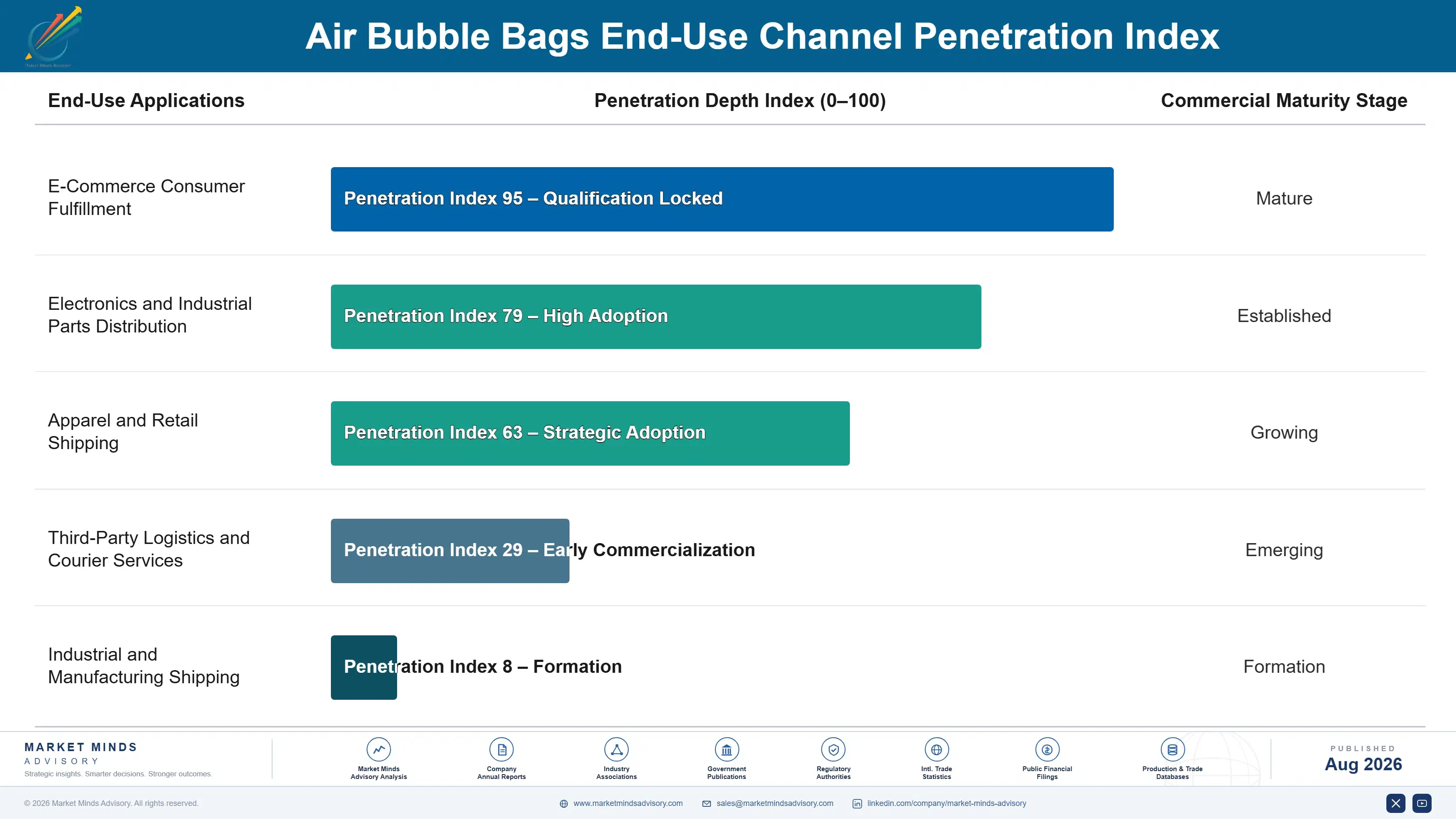
Adoption depth varies by end-use channel. Large e-commerce fulfillment operators, once qualified on a converter's sizing specifications and automation compatibility, rarely switch given the cost and operational risk of requalifying an entire fulfillment line's packaging workflow mid-season. Smaller independent retailers show shallower stickiness so far, since they often buy through packaging distributors rather than direct converter relationships and switch more readily on price alone.

A generational shift in buyer profiles is underway as sustainability and packaging engineering officers, rather than pure procurement, increasingly co-sign bag sourcing decisions given brand reputation exposure tied to plastic packaging claims. These buyers weight certification credibility and fulfillment integration depth alongside unit cost, a shift that favors converters with proven, documented supply chains over those competing purely on price across every region.
air-bubble-bags-market-end-use-penetration-index-1787300504785

Where MMA Sees the Opportunity

These are among the four positions where our research anticipates prominent divergence between winners and laggards over the coming forecast period. Each is grounded in the demand model, the regulatory perimeter, and the announced capacity pipeline.
01 / COMPOSTABLE SEGMENT INVESTMENT

Prioritize compostable formulation research over commodity capacity growth

Biodegradable and compostable bubble bags are growing roughly 1.64 times faster than the overall market, driven by large retailer sustainability commitments that show no sign of slowing as plastic-reduction pledges convert into binding scorecards. Suppliers still weighted toward commodity polyethylene capacity risk ceding the fastest-growing, highest-margin accounts to specialists that built compostable formulation and certification earlier in the adoption cycle. Capital directed toward compostable research now should pay back faster than incremental polyethylene expansion into an increasingly crowded, price-competitive commodity tier.
02 / FULFILLMENT INTEGRATION BUILD-OUT

Treat automation integration as a core competitive moat investment

Suppliers that still compete purely on unit price without automation integration capability are leaving significant value on the table that sizing optimization, equipment compatibility, and supply continuity are already capturing for established brands. These integration relationships carry materially higher switching costs than the underlying commodity sale, locking large fulfillment operators into renewal patterns that price-only competitors struggle to break. Building this capability now, before Asian entrants close the technical integration gap further, is worth more than matching a rival's price cut for cut.
03 / RESIN COST HEDGING

Lock multi-year polyethylene supply agreements ahead of the next cycle

Polyethylene resin costs already run close to 41% of cost of goods sold, and the 2021 to 2022 spike showed producer allocation constraints can push converter costs up more than 25% within a single year. Suppliers without multi-year supply agreements risk losing contract bids to better-hedged rivals during the next volatile cycle, damaging fulfillment operator relationships built over years in a single sharp shortage. Locking supply now, even at a premium to spot pricing, protects margin stability and the credibility needed to win long-duration retail contracts.
04 / REGIONAL CAPACITY POSITIONING

Weigh Asian cost scale against Western certification trust carefully

East Asia now holds the largest manufacturing base for bubble bag production and continues adding capacity faster than most other regions, making cost leadership there increasingly difficult for Western converters to contest directly on unit price. Western suppliers still hold a genuine advantage in certification credibility, fulfillment integration depth, and retailer relationship trust that Asian entrants have not yet fully closed. The sounder strategy is not chasing Asian manufacturing cost scale directly, but doubling down on the certification and integration capability Asian competitors still cannot replicate at comparable trust levels.

Engagement Snapshot From the Field

A live engagement with an industry participant carrying material or product regulatory and market exposure ahead of a defining policy shift, showing how our research translates into a defensible multi-year portfolio strategy.
MARKET MINDS ADVISORY · CLIENT ENGAGEMENT SUMMARY
Air Bubble Bags Producer Strategic Portfolio Review and Transition Roadmap 2026·Investment Scenario on Air Bubble Bags Exposure Evaluation 2025-26
CLIENT PROFILE
The client is a national apparel and accessories retailer operating an e-commerce fulfillment network shipping roughly 8 million parcels annually across three US distribution centers. The retailer had publicly committed to eliminating conventional plastic mailers by 2028 and needed an independent assessment of which alternative materials could meet that commitment without significantly increasing damage rates or shipping costs (client-reported, unverified by MMA).
STRATEGIC CHALLENGE
The retailer needed to decide between transitioning to compostable bubble bags, recycled-content polyethylene bags, or paper-based padded mailers, against uncertainty about how each alternative would affect damage rates, per-unit cost, and the credibility of its public sustainability commitment given varying documentation standards across material types and certification bodies it evaluated.
MMA APPROACH
MMA conducted a vendor-neutral material assessment benchmarking compostable, recycled-content, and paper-based alternatives against damage rate data, per-unit cost, and certification credibility, drawing on the retailer's own historical shipping damage claims and MMA's primary survey data on material performance across comparable e-commerce operators and fulfillment networks operating nationwide across all regions surveyed.
KEY FINDINGS
  1. Damage rates for lightweight apparel items showed no statistically meaningful difference between recycled-content polyethylene and compostable bubble bags in controlled testing across representative shipment types.
  2. Paper-based padded mailers showed damage rates running nearly 40% higher than either plastic alternative for items with any rigid components, making paper unsuitable for a meaningful share of the retailer's product catalog.
  3. Recycled-content bags offered a per-unit cost roughly 22% lower than compostable alternatives while still satisfying the retailer's stated sustainability commitment given current certification standards accepted by its sustainability team.
  4. A hybrid approach using recycled-content bags for most items and compostable bags for the retailer's premium product line balanced cost discipline against the brand differentiation value of the fully compostable claim.
CLIENT PROFILE
The client is a national apparel and accessories retailer operating an e-commerce fulfillment network shipping roughly 8 million parcels annually across three US distribution centers. The retailer had publicly committed to eliminating conventional plastic mailers by 2028 and needed an independent assessment of which alternative materials could meet that commitment without significantly increasing damage rates or shipping costs (client-reported, unverified by MMA).
STRATEGIC CHALLENGE
The retailer needed to decide between transitioning to compostable bubble bags, recycled-content polyethylene bags, or paper-based padded mailers, against uncertainty about how each alternative would affect damage rates, per-unit cost, and the credibility of its public sustainability commitment given varying documentation standards across material types and certification bodies it evaluated.
MMA APPROACH
MMA conducted a vendor-neutral material assessment benchmarking compostable, recycled-content, and paper-based alternatives against damage rate data, per-unit cost, and certification credibility, drawing on the retailer's own historical shipping damage claims and MMA's primary survey data on material performance across comparable e-commerce operators and fulfillment networks operating nationwide across all regions surveyed.
KEY FINDINGS
  1. Damage rates for lightweight apparel items showed no statistically meaningful difference between recycled-content polyethylene and compostable bubble bags in controlled testing across representative shipment types.
  2. Paper-based padded mailers showed damage rates running nearly 40% higher than either plastic alternative for items with any rigid components, making paper unsuitable for a meaningful share of the retailer's product catalog.
  3. Recycled-content bags offered a per-unit cost roughly 22% lower than compostable alternatives while still satisfying the retailer's stated sustainability commitment given current certification standards accepted by its sustainability team.
  4. A hybrid approach using recycled-content bags for most items and compostable bags for the retailer's premium product line balanced cost discipline against the brand differentiation value of the fully compostable claim.
RECOMMENDED STRATEGY
Phase 1: Phase 1 (Months 1 to 4): Transition standard product lines to recycled-content bags across all three US distribution centers immediately. Phase 2: Phase 2 (Months 5 to 10): Introduce compostable bags for the premium product line with dedicated brand marketing support materials. Phase 3: Phase 3 (Months 11 to 16): Evaluate damage rate and cost data system-wide and consider broader compostable segment expansion plans.
OUTCOME
The retailer began the hybrid transition in early 2026, completing recycled-content conversion across all three distribution centers ahead of schedule. Early data through mid-2026 showed damage rates holding steady against the prior conventional baseline, though full progress toward the 2028 target will not be confirmed until the premium-line compostable rollout completes (client-reported, unverified by MMA).

Frequently Asked Questions

Foundational context covering the market sizes, CAGR, scope, country, region and competition that inform every finding below. This section is provided to cover basics and most often pre-purchase conversations, answered from the MMA Primary Research Dataset.

What is the current size of the Air Bubble Bags Market?

The global air bubble bags market reached an estimated $2.3 billion in 2025. Growth concentrates in e-commerce fulfillment channels where parcel volume keeps climbing alongside expanding sustainability requirements.

How large will the Air Bubble Bags Market be by 2036?

MMA forecasts the market reaching approximately $4.95 billion by 2036, roughly double its 2026 value. Biodegradable and compostable bags are expected to drive a disproportionate share of that incremental growth.

What is the CAGR for the Air Bubble Bags Market 2026 to 2036?

The base case CAGR is 7.2% across the forecast period, with a bull case near 8.3% and a bear case near 6.0% depending on e-commerce parcel volume trends and paper mailer substitution pace.

Which segment is growing fastest?

Biodegradable and compostable bubble bags are the fastest-growing segment, expanding at roughly 11.8% CAGR, about 1.64 times the overall market pace, driven by retailer sustainability commitments.

Who are the major companies in the Air Bubble Bags Market?

Leading converters include Sealed Air, Storopack, Pregis, Sigma Plastics Group, and Novolex. The top five hold an estimated 29% of global shipment volume in a fragmented market.

Which country is growing fastest?

China leads growth in absolute manufacturing volume, but Vietnam is expanding fastest in percentage terms, driven by its growing export packaging sector and regional e-commerce expansion.

Report Segmentation Architecture

The full report scope spans multiple orthogonal segmentation dimensions, with cross-tabulated demand data provided for each dimension pair. Coverage extends further to regional breakdowns, trend trajectories, and the competitive detail needed to support segment-level decision-making.

By Material Type

  • Standard Virgin Polyethylene Bags
  • Recycled-Content Bubble Bags
  • Biodegradable and Compostable Bubble Bags
  • Metallized and Foil Bubble Bags
  • Anti-Static Bubble Bags

By End-Use Channel

  • E-Commerce Consumer Fulfillment
  • Electronics and Industrial Parts Distribution
  • Apparel and Retail Shipping
  • Third-Party Logistics and Courier Services
  • Industrial and Manufacturing Shipping

By Commercial Dimension

  • Original Bag Sales
  • Certification and Compliance Documentation Services
  • Fulfillment Automation Integration Services
  • Distributor and Wholesale Channels

By Region

  • North America
  • Western Europe
  • East Asia
  • South Asia and Pacific
  • Latin America
  • Middle East and Africa
  • Eastern Europe

Scope, Methodology, and Coverage

Every figure in this report is reproducible from documented input assumptions. The scope below maps the historical period, the forecast horizon, the segmentation dimensions, and the countries covered, alongside the underlying primary and qualitative methodology.
Historical Period
2020 to 2025
Forecast Period
2026 to 2036
Base Year
2025 (USD billions; MMA Primary Research Dataset, August 2026)
Market Definition
The air bubble bags market covers flexible protective mailers and pouches constructed from air-cushioned bubble film, used to protect goods during shipping and handling across e-commerce fulfillment, industrial parts distribution, and retail shipping applications. It excludes rigid protective packaging such as molded foam inserts, non-cushioned flat poly mailers without air-bubble protection, and corrugated shipping boxes sold as a separate packaging category.
Quantitative Units
USD billions (current prices); unit shipment volume in billions of bags where disclosed
Segmentation Dimensions
By Material Type; By End-Use Channel; By Commercial Dimension; By Region
Regions Covered
North America, Western Europe, East Asia, South Asia and Pacific, Latin America, Middle East and Africa, Eastern Europe
Countries Covered
USA, China, Germany, France, UK, Japan, South Korea, India, Australia, Canada, Brazil, Mexico, Indonesia, Vietnam, Thailand, Malaysia, UAE, Saudi Arabia, South Africa, Nigeria, Turkey, Poland, Netherlands, Italy, Spain, Sweden, Switzerland, Argentina, Colombia, Singapore, and additional markets relevant to this sector
Key Companies Profiled
Sealed Air Corporation, Storopack Hans Reichenecker GmbH, Pregis LLC, Sigma Plastics Group, Novolex, Smurfit Kappa Group, International Plastics Inc., Polyair Inter Pack Inc., Ranpak Holdings Corp, ProAmpac LLC, Automated Packaging Systems LLC, Sancell Pty Ltd, Cellofoam North America Inc., Intertape Polymer Group, Signode Industrial Group, Berry Global Group Inc., Macfarlane Group PLC, RAJA Group, Supreme Industries Ltd, Nefab Group
Quantitative Methodology
Primary survey, n=3,800 respondents, Q4 2025, six countries; demand-side model with trade association cross-validation
Qualitative Methodology
47 expert interviews, Q4 2025; applied to validate demand model assumptions, identify emerging dynamics, and assess competitive positioning
Report Format
PDF and XLSX data workbook (Word format preview document)
Publisher
Market Minds Advisory
Report Code
MMA-2026-PAC-101
Published
August 2026
Contact
sales@marketmindsadvisory.com | www.marketmindsadvisory.com

Purchase the full Air Bubble Bags Market Report (2026 to 2036).

The full Air Bubble Bags Market report delivers a comprehensive assessment of material technology, competitive positioning, and regional demand through 2036. It includes detailed segmentation by material type, end-use channel, and commercial dimension, alongside profiles of all twenty companies covered in this summary. The report quantifies regional market size and growth across all seven world regions, with country-level detail for the thirty-plus markets MMA tracks. Buyers receive access to MMA's underlying primary survey dataset and expert interview transcripts, enabling further custom analysis. A dedicated chapter benchmarks polyethylene resin cost exposure and mitigation strategies across converter types.
Material-level segmentation across five product technology categories
Profiles of twenty leading air bubble bag converters worldwide
Regional sizing and forecasts across all seven world regions
Polyethylene resin cost exposure and mitigation strategy chapter
Primary survey dataset access covering 3,800 respondent interviews
Competitive development tracking with dated corporate event log

Built For The People Who Decide

From boardroom strategy to bench-side execution, this report is read cover-to-cover by leaders shaping the next decade of their industry, turning demand scenarios, market dynamics and valuation benchmarks into decisions.
CXOs/ Presidents/ VPs/ Managers
M&A and Corporate Development
Strategy Teams and R&D Heads
Procurement and Product Directors
Regulatory and Compliance Leaders
Investor Relations and Equity Analysts