Market Minds Advisory
AI Workload Management Market

AI Workload Management Market: AI Workload Management Market. Trends and Forecast 2026 to 2036

GPU scarcity is forcing enterprises to treat compute scheduling as a board-level cost problem, pushing vendors to prove utilization gains that justify subscription spend before hyperscalers bundle equivalent orchestration for free.

Lead Analyst

Published

September 2026

Make Smarter Decisions with Customized Research Insights

Request a free sample report and evaluate market opportunities, growth trends, and competitive dynamics relevant to your business needs.

2025 MARKET VALUE$3.2BMarket Size 2025
2036 FORECAST VALUE$15.6BBase Case , 2026 to 2036
CAGR 2026 TO 203615.5 %Bull 16.8% / Bear 14.2%
INCREMENTAL OPPORTUNITY$11.9BNet 10- year value creation
EXPANSION MULTIPLE4.22x2036 value over 2026 base
Strategic Levers
M&A Pipeline
Regional Outlook
Country Rankings
Competitive Intelligence
Segmental Deep-dive
Call-Us : 91 93563 13602

Executive Snapshot and Market Trajectory.

GPU capacity remains scarce and expensive enough that enterprises now treat workload scheduling and utilization optimization as a board-level cost discipline, pushing vendors to prove measurable efficiency gains before hyperscalers commoditize equivalent orchestration capability into their own cloud platforms, services, and pricing tiers.
Commercial activity concentrates around inference serving optimization, since production generative AI deployment now generates far more compute spend than model training did during the earlier research-heavy phase of enterprise AI adoption and internal experimentation across most industries and company sizes. Inference serving platforms show the fastest growth, with India's cost-sensitive enterprise cloud adoption absorbing a disproportionate share of new workload management deployments as companies scale AI usage while controlling infrastructure spend across most budget cycles.
Competitive intensity sits moderately concentrated among five vendors controlling roughly half of platform revenue, while dozens of specialized challengers compete for narrower GPU scheduling, cost optimization, and multi-cloud orchestration niches across most enterprise buyer categories and geographic markets served worldwide. Rising GPU costs and growing enterprise scrutiny over AI infrastructure spending are reshaping which platforms win enterprise contracts as finance departments demand clearer return on compute investment.
Market Definition
The AI Workload Management Market covers software platforms that schedule, orchestrate, and optimize computing resources for machine learning training and inference workloads across GPU clusters, cloud environments, and hybrid infrastructure. It excludes underlying cloud infrastructure services and hardware sold as separate product categories.
Base Year Value
$3.2B in 2025 (MMA Primary Research Dataset, September 2026)
Forecast Period
2026 to 2036, eleven discrete annual values
CAGR
15.5% base case. Bull 16.8%. Bear 14.2%.
Fastest Growth Segment
Inference Serving and Optimization Platforms: 21.0% CAGR
Fastest Growth Country
India: 19.5% CAGR
Fastest Growth Region
South Asia and Pacific: 17.5% CAGR
Largest Region
North America: 32% of 2025 global value
Market Leaders
Leading participants include Nvidia, Databricks, Anyscale, Weights and Biases, and Run:ai. Source: MMA Analysis based on company annual reports.
Primary Survey
n=3,800 procurement and R&D decision-makers, Q4 2025, six countries
Methodology
Demand-side build-up, cross-validated against public data, 47 expert interviews

AI Workload Management Market Forecast Scenarios

ai-workload-management-market-size-forecast-scenario-1789986604954
Between 2020 and 2025 the market grew at a milder 14.3% historical rate as GPU orchestration remained largely a research and academic concern, with commercial momentum accelerating meaningfully only after generative AI deployment scaled production inference workloads starting around 2023 across most enterprise AI adoption programs, industry categories, company sizes, and geographic markets worldwide today.
The base case assumes 15.5% annual growth through 2036, driven by three mechanisms: accelerating inference serving optimization demand as generative AI production deployment scales across most enterprise applications, business functions, and customer-facing products globally, expanding GPU scheduling investment as compute scarcity forces enterprises to maximize existing infrastructure utilization rates, and rapid Indian enterprise cloud adoption absorbing a disproportionate share of new workload management deployments as companies scale AI usage carefully.
A bull scenario near 16.8% growth would require continued GPU scarcity sustaining enterprise willingness to pay for utilization optimization software across most industry verticals and company sizes. A bear case near 14.2% reflects hyperscalers bundling equivalent orchestration capability directly into cloud platforms at no additional cost, compressing standalone software vendor revenue across smaller and mid-market enterprise accounts facing budget scrutiny.

Where Compute Scarcity Meets Software Margin

AI workload management software emerged directly from the GPU scarcity that followed generative AI's commercial breakout, as enterprises discovered that poorly scheduled training and inference jobs left expensive compute capacity idle for meaningful portions of each billing cycle across most cloud and on-premises deployments. This inefficiency became impossible to ignore once compute costs began consuming a larger share of overall technology budgets than expected during initial AI project planning.
MARKET CONCENTRATIONCR5 45%Share held by five largest global platform vendors combined
AVERAGE CONTRACT VALUE$95,000 annuallyTypical enterprise subscription spend on workload management tools
TOP ADOPTING COUNTRYUnited States, 36% shareShare of global platform revenue generated by enterprises there
GPU UTILIZATION RATE42% averageTypical enterprise GPU cluster utilization before optimization software deployment
INFERENCE SPEND SHARE61% of AI computePortion of total enterprise AI compute now spent on inference
MULTI-CLOUD ADOPTION RATE38% of large enterprisesPortion of large accounts running workloads across multiple cloud providers
Commercial character centers on proving return on compute investment: finance departments now scrutinize AI infrastructure spending with the same rigor previously reserved for cloud computing budgets, demanding utilization dashboards and cost attribution data that justify continued platform subscription renewal across business units. Vendors offering granular per-team and per-project cost visibility are winning enterprise contracts over competitors still providing only aggregate cluster-level reporting.
Over the next decade, hyperscaler bundling strategy will likely determine which standalone vendors survive, as AWS, Microsoft Azure, and Google Cloud increasingly offer native orchestration capability that competes directly with independent workload management software vendors lacking comparable cloud platform integration depth. Vendors that fail to differentiate beyond basic scheduling risk losing renewal business to bundled hyperscaler alternatives offered at effectively no incremental cost.
"Every AI workload management vendor is racing against the day their biggest customer's cloud provider ships the same feature for free, and that day is coming faster than most admit."
Director, AI Infrastructure and Cloud Technology Practice · MMA Technology Practice · September 2026

Market Trends

Inference Serving Optimization Overtakes Training Workloads

Production generative AI deployment now accounts for roughly 61% of total enterprise AI compute spend, surpassing model training as the dominant workload category for the first time as companies move from experimentation to deployed applications serving real customer traffic. Vendors are launching dedicated inference optimization platforms that dynamically batch requests, cache common responses, and route traffic across available GPU capacity to minimize per-query cost, since inference workloads run continuously in production rather than in scheduled training bursts. This shift is forcing vendors to redesign core product architecture around continuous production traffic rather than scheduled batches.
Market Impact: GPU rental costs rose roughly 30%
Hyperscaler Native Tools Pressure Standalone Vendor Margins

AWS, Microsoft Azure, and Google Cloud are all expanding native workload orchestration and cost optimization features directly into their core cloud platforms, offering functionality that increasingly overlaps with standalone workload management software vendors. Enterprise buyers report growing willingness to accept hyperscaler-native tooling given its zero incremental cost, pressuring standalone vendors to demonstrate meaningfully superior multi-cloud portability and optimization depth that justify continued subscription spend beyond what free bundled alternatives provide. Vendors report roughly 25% pricing pressure from this competitive dynamic across most enterprise renewal negotiations conducted recently. Smaller vendors without comparable differentiation face the steepest competitive threat overall.
Market Impact: AI spend reached 18% of budgets

Market Opportunities and Growth Drivers

GPU Cost Inflation Drives Utilization Software Demand

Enterprise GPU rental costs rose an estimated 30% between 2023 and 2025 as demand for AI training and inference capacity outpaced available data center supply, forcing companies to seek software solutions that maximize output from existing expensive compute allocations rather than simply purchasing additional capacity. Companies deploying workload optimization software report utilization improvements from an average baseline of 42% toward 65% or higher, translating directly into meaningful cost avoidance on GPU rental and cloud compute spending that finance departments increasingly scrutinize closely. This measurable return on investment increasingly justifies platform subscription costs during budget approval discussions.
Market Impact: Bundled tools cut standalone pricing 25%

Enterprise AI Budget Scrutiny Demands Cost Attribution

Corporate finance departments increasingly demand granular cost attribution data showing which teams and projects consume AI compute resources, given that AI infrastructure spending grew to represent an estimated 18% of total enterprise technology budgets in 2025 compared with negligible share just three years earlier. This scrutiny pushes enterprises toward workload management platforms offering detailed chargeback and showback reporting capability that finance leaders can present to boards justifying continued AI investment against competing budget priorities across the organization. This reporting need increasingly determines which platforms win renewal negotiations against less transparent alternatives.
Market Impact: Utilization gains cap near 20%

Market Restraints and Challenges

Hyperscaler Bundling Threatens Standalone Vendor Viability

AWS, Microsoft Azure, and Google Cloud are all launching native workload orchestration features that overlap significantly with standalone software vendor capability, offered as part of existing cloud platform subscriptions at effectively zero incremental cost to enterprise customers. The root cause lies in hyperscalers viewing orchestration as strategic platform stickiness rather than standalone revenue, letting them subsidize features that independent vendors must price to cover development costs. Vendors are mitigating this by focusing on multi-cloud portability that single-cloud hyperscaler tools cannot match. Some smaller vendors already report pricing pressure exceeding 25% across affected enterprise renewal accounts.
Market Impact: Inference now represents 61% of spend

GPU Supply Constraints Limit Optimization Software Value

Severe GPU supply shortages limit how much workload management software can actually improve utilization when enterprises simply cannot obtain sufficient compute capacity regardless of scheduling sophistication, capping realistic value proposition gains at roughly 20 to 25% improvement over baseline utilization rates. The root cause traces to constrained global semiconductor fabrication capacity unable to meet explosive AI compute demand growth across multiple competing enterprise and hyperscaler buyers simultaneously. Vendors are mitigating this by expanding into cost optimization and cloud arbitrage capability beyond pure scheduling. This constraint particularly affects smaller enterprises unable to secure guaranteed capacity reservations.
Market Impact: Bundling pressures standalone pricing by 25%
3 additional market trends, 4 additional growth drivers, and 2 additional restraints and challenges are covered in the full report. Contact sales@marketmindsadvisory.com to access the complete intelligence.

Segment CAGR and Growth Architecture

This report segments the AI Workload Management Market by software function, the classification enterprises actually use when selecting tools for GPU scheduling, inference optimization, training pipeline management, or cost control across distinct technical and commercial needs within their broader AI infrastructure environment, capital budget, internal staffing model, and continuously evolving cloud deployment strategy today.
ai-workload-management-market-market-share-analysis-1789986605809

Inference Serving and Optimization Platforms

Inference serving and optimization platforms are the fastest-growing software category, expanding at 21.0% annually as production generative AI deployment generates far more compute spend than model training did during earlier experimentation phases across most enterprise industries and use cases. These platforms dynamically batch requests, cache common responses, and route traffic across available GPU capacity to minimize per-query cost for continuous production workloads running around the clock. Anyscale and Nvidia both lead this category with expanded inference optimization features launched since 2024, while newer entrants capture share among cost-sensitive mid-market enterprise buyers specifically. Their established platform scale increasingly represents a meaningful barrier to entry for newer specialized competitors. Smaller vendors increasingly struggle to match this manufacturing and testing scale independently.
CAGR 21.0%

GPU Orchestration and Scheduling Software

GPU orchestration and scheduling software, the second-fastest-growing category at 18.5% annually, benefits from rising enterprise demand for maximizing utilization of scarce and expensive GPU cluster capacity across training and inference workload categories and business units. Enterprise buyers increasingly require intelligent job scheduling and resource allocation as standard capability before deploying additional GPU capacity purchases and infrastructure investment. Companies specializing in this category, including Run:ai and Weights and Biases, are winning enterprise contracts by demonstrating measurable utilization improvements against documented baseline performance metrics. Financial services buyers in particular report the steepest reliance on this category for regulatory compute reporting purposes. Adoption is accelerating fastest among enterprises facing the heaviest existing GPU capacity constraints and cost pressure.
CAGR 18.5%
Full segment breakdown across 6 segments available in the complete report.

Regional Architecture and Country Demand Map

North America drives most platform revenue given hyperscaler and AI vendor headquarters concentration and enterprise AI budget scale, while East Asia gains ground through domestic AI investment scale, and South Asia and Pacific grows fastest as India's cost-sensitive enterprise cloud adoption accelerates broadly nationwide today.

North America

The United States anchors global demand through concentrated hyperscaler and AI vendor headquarters, including Nvidia, Databricks, and Anyscale, alongside the largest enterprise AI compute budget pool spending on workload optimization across most industry verticals and company sizes nationwide. Enterprise adoption of inference serving and cost attribution tools runs ahead of other regions given earlier generative AI production deployment at scale. Canada contributes modest additional demand through mid-market enterprise AI adoption following similar platform capability trends. Enterprise procurement teams increasingly evaluate vendors specifically on multi-cloud portability and inference optimization depth before signing renewal contracts across most sectors. This scrutiny is reshaping which vendors win the largest enterprise accounts nationwide. Insurance underwriters increasingly favor documented compute governance processes reducing budget overrun exposure.
Share: 32% | CAGR: 16.0% (2026 to 2036)

Western Europe

Germany and the United Kingdom drive regional demand through large enterprise AI budgets across manufacturing, financial services, and retail sectors adopting workload management for cost control and compute governance. France contributes meaningful additional demand through AI research institution and enterprise adoption at a steady pace. Growth trails the global average as stricter data sovereignty regulation compliance requirements weigh more heavily on cloud-based workload management adoption than in less regulated markets. Financial services buyers in particular demand comprehensive audit trails documenting compute allocation and cost attribution before deployment approval. This regulatory environment increasingly shapes product development priorities for vendors serving European enterprise customers. Nordic markets add incremental demand through technology sector AI adoption tied to expanding regional cloud infrastructure investment.
Share: 19% | CAGR: 14.0% (2026 to 2036)
Regional intelligence for 5 additional markets available in the complete report: East Asia, South Asia and Pacific, Latin America, Middle East and Africa, Eastern Europe. Contact sales@marketmindsadvisory.com.
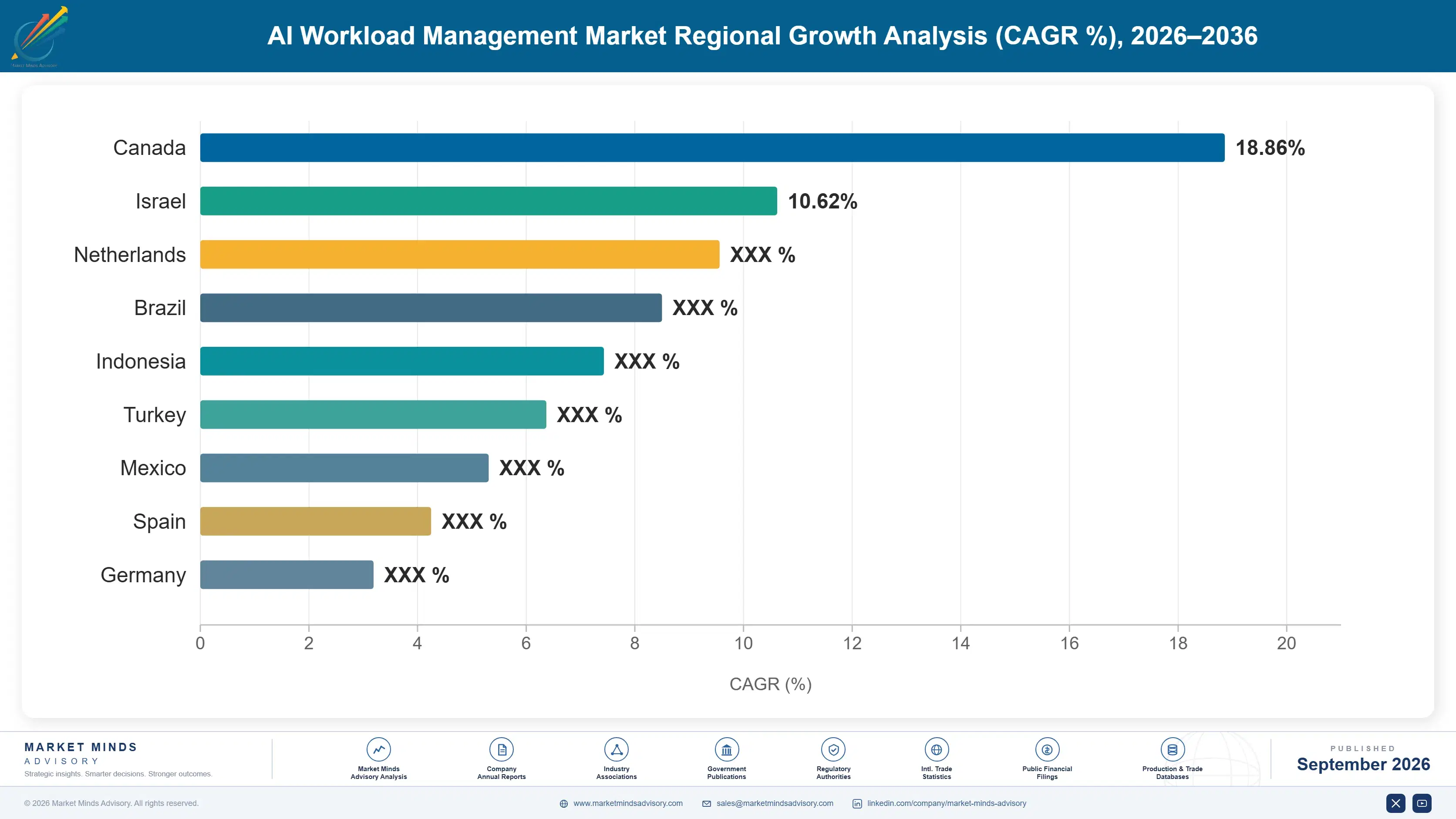
ai-workload-management-market-country-cagr-analysis-1789986606611

Where Vendors Can Outrun Hyperscaler Bundling

As hyperscalers bundle basic orchestration for free, vendors must build value beyond scheduling: multi-cloud portability, granular cost attribution reporting, inference-specific optimization, and global delivery efficiency that native cloud tools cannot easily replicate given their single-provider architecture, standard pricing model, and inherent cost structure limitations across most enterprise segments, industries, and evolving buyer categories today.

Multi-Cloud Portability as Key Differentiation Anchor

Vendors offering genuine multi-cloud workload portability capture enterprise accounts that hyperscaler-native tools cannot serve, since single-provider orchestration inherently locks customers into one cloud vendor's infrastructure and pricing. Enterprises running workloads across multiple cloud providers report choosing standalone platforms specifically for this portability roughly 40% more often than accounts using only one cloud provider. This differentiation increasingly justifies premium pricing against free bundled hyperscaler alternatives lacking comparable cross-platform flexibility. Vendors without comparable portability increasingly struggle to compete for these larger, more sophisticated enterprise accounts. This advantage compounds meaningfully as enterprises expand their multi-cloud infrastructure footprint over time.
Market Impact: Multi-cloud portability drives roughly 40% higher platform adoption

Granular Cost Attribution as Premium Enterprise Feature

Vendors offering detailed per-team and per-project cost attribution capture premium pricing from finance departments requiring chargeback and showback reporting that basic hyperscaler dashboards cannot provide at comparable granularity across most enterprise account tiers and organizational structures. Enterprise accounts requiring this reporting depth pay roughly 30% more than accounts using standard aggregate cluster-level reporting alone across comparable contract terms and renewal cycles. This capability increasingly determines which vendors win renewal negotiations against competitors lacking comparable financial reporting sophistication. Finance leaders increasingly lead vendor selection decisions given this reporting capability's board-level visibility.
Market Impact: Granular cost reporting commands roughly a 30% premium

Inference-Specific Optimization for Production AI Workloads

Vendors building dedicated inference optimization capability, including dynamic batching and response caching, capture the fastest-growing segment of enterprise AI compute spend as production deployment scales beyond training workloads. Platforms specializing in inference optimization report customer growth rates roughly 35% above competitors focused primarily on training pipeline management alone. This specialization increasingly determines competitive positioning as inference spend continues representing a majority share of total enterprise AI compute. Vendors lacking this specialization increasingly lose competitive evaluations to inference-focused challengers gaining enterprise traction. This specialization increasingly shapes vendor product roadmaps and go-to-market investment priorities.
Market Impact: Inference specialists show roughly 35% faster customer growth

India Delivery Center Expansion for Cost Efficiency

Vendors expanding engineering and customer success delivery centers across India's large enterprise cloud talent base are reducing platform development and support costs meaningfully while improving service coverage across time zones for global enterprise customers. Companies with established India delivery operations report cost structures roughly 25% more efficient than competitors relying entirely on higher-cost domestic talent for equivalent engineering and support functions across product lines. Vendors without comparable scale increasingly struggle to match resulting pricing competitiveness. This model increasingly shapes how competitors structure their own global delivery footprints going forward. This model continues expanding steadily across most competing vendor organizations.
Market Impact: India delivery centers cut costs by roughly 25%

Who Controls the Margin Pool

Concentration sits moderate, with a CR5 near 45% on a platform revenue basis and a meaningful gap separating Nvidia and Databricks from mid-tier challengers like Anyscale and Weights and Biases, who compete on inference optimization depth and experiment tracking rather than broad infrastructure platform breadth across most enterprise buyer categories, workload types, and geographic markets served today across most industries.
Current competitive activity centers on three dimensions: inference serving optimization feature launches capturing the fastest-growing compute spend category across most enterprise deployments and cloud environments, multi-cloud portability positioned as a defense against hyperscaler bundling pressure, and granular cost attribution reporting commanding premium pricing from finance-scrutinized enterprise buyers. India delivery center expansion has also become a meaningful cost lever among vendors seeking pricing advantage.

Emerging pressure comes from hyperscalers building native orchestration capability directly into cloud platforms, potentially disintermediating standalone software vendors entirely for smaller and mid-market enterprise accounts facing budget scrutiny across most industry categories. Vendors slow to add inference specialization or cost attribution depth risk losing enterprise renewal contracts to better-prepared competitors, while multi-cloud portability increasingly determines which challengers gain meaningful share against single-provider hyperscaler alternatives.
ai-workload-management-market-company-positioning-matrix-1789986607418

Competitive Moat and Risk Dimensions

NVIDIA

Moat: Hardware and Software Full-Stack Control

Nvidia's control over both GPU hardware and workload orchestration software gives it integration advantages that pure software vendors cannot replicate, since its scheduling tools are optimized specifically for its own chip architecture and performance characteristics across most deployment configurations, cloud environments, and enterprise data center setups.
NVIDIA

Risk: Vendor-Neutral Positioning Credibility Gap

Nvidia's dominant hardware market position makes some enterprise buyers hesitant to adopt its workload management software given concerns about vendor lock-in, risking share loss among customers preferring vendor-neutral orchestration tools compatible across multiple GPU hardware suppliers, cloud providers, and enterprise infrastructure environments over the coming years.
DATABRICKS

Moat: Established Enterprise Data Platform Base

Databricks' existing enterprise data platform customer base gives it natural cross-selling advantages into AI workload management, since customers already running data pipelines on its platform face lower switching costs adopting comparable AI infrastructure tools within the same environment, existing contractual relationship, and established billing arrangement.
DATABRICKS

Risk: Broad Platform Focus Dilution Risk

Databricks' broader data platform positioning sometimes limits dedicated focus on specialized inference optimization compared with purpose-built competitors like Anyscale, risking slower innovation pace in the fastest-growing segment of the AI workload management category specifically across most enterprise deployment scenarios and buyer segments served today worldwide.

Players Tracked

Prominent Players

Nvidia
Databricks
Anyscale
Weights and Biases
Run:ai

Other Key Players

Domino Data Lab
Determined AI
Ray Project Commercial Offerings
SambaNova Systems
CoreWeave
Lambda Labs
MosaicML
Iguazio
ClearML
Grid AI
Baseten
Modal Labs
Together AI
Fireworks AI
Predibase

Recent Developments

FEBRUARY 2025

Anyscale Launches Dedicated Inference Optimization Suite

Anyscale introduced a dedicated inference optimization suite offering dynamic batching and response caching capability targeting enterprises scaling generative AI production deployment beyond initial pilot phases across most industry verticals. The launch directly addresses growing enterprise demand for inference-specific tooling as production compute spend increasingly exceeds training workload costs.
Signal: Signals vendors racing to build inference-specific capability as production AI deployment accelerates across most industries and company sizes.
JUNE 2025

Databricks Acquires Cost Attribution Reporting Startup

Databricks acquired a smaller cost attribution and chargeback reporting software startup, integrating granular financial reporting capability directly into its core AI infrastructure platform offering across all customer account tiers. The acquisition strengthens Databricks' positioning against enterprise finance departments increasingly demanding detailed compute cost visibility and reporting.
Signal: Signals larger platforms increasingly acquiring specialized cost reporting capability rather than building comparable tools internally themselves.
OCTOBER 2025

Run:ai Expands India Engineering Delivery Operations

Run:ai announced a significant expansion of its India-based engineering and customer success delivery operations, aiming to reduce platform development costs while improving support coverage across global time zones and customer segments. The expansion positions Run:ai to compete more aggressively on pricing against larger, higher-cost domestic competitors.
Signal: Signals continued vendor consolidation of engineering operations toward lower-cost global delivery center locations across most regions.

Cloud Compute and GPU Rental Cost Exposure

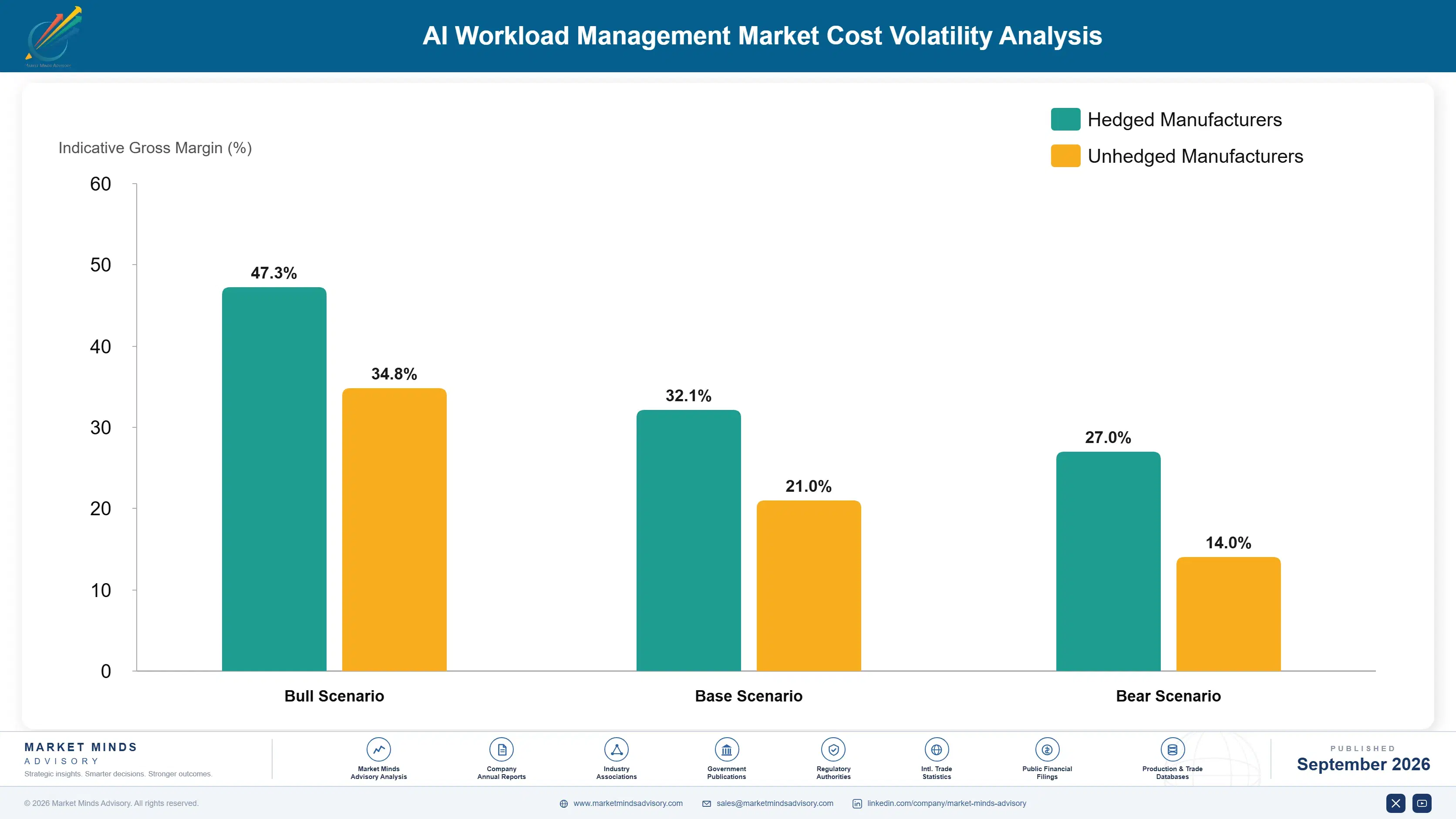
Cloud compute and GPU rental costs represent roughly 25 to 32% of total operating cost of goods sold for AI workload management vendors, given the infrastructure required to host, test, and demonstrate platform capability across large enterprise customer deployments continuously and at meaningful scale each day, with the remainder split across engineering talent, customer support staffing, and sales operations.
GPU rental and cloud compute pricing rose an estimated 30% between 2023 and 2025 as demand for AI training and inference capacity outpaced available data center capacity, according to company annual reports from AWS, Microsoft Azure, and Google Cloud citing sustained enterprise demand growth across most AI infrastructure software categories, as data processing volumes climbed alongside rapidly expanding generative AI production deployment across enterprise accounts globally.

This exposure disadvantages smaller vendors lacking negotiated enterprise compute pricing agreements, forcing them to absorb higher per-customer hosting costs than larger competitors with committed-use discounts across their infrastructure spend and vendor contracts and supplier relationships. Vertically integrated vendors like Nvidia with proprietary hardware access gain a meaningful and durable cost advantage over competitors dependent on third-party cloud infrastructure at standard retail pricing.
ai-workload-management-market-cost-volatility-analysis-1789986607715

Negotiated Multi-Year Cloud Infrastructure Contracts

Larger vendors increasingly negotiate committed-use cloud infrastructure agreements with AWS, Microsoft Azure, and Google Cloud spanning multiple years, locking in discounted per-instance pricing well below standard published pricing tiers offered broadly to smaller customers across the industry. This reduces exposure to compute cost inflation while providing budget predictability across annual planning and procurement cycles.

Efficient Demo Environment Resource Allocation

Some vendors are implementing more efficient demo and testing environment resource allocation, spinning down unused GPU capacity automatically rather than maintaining always-on infrastructure for sales demonstrations and customer proof-of-concept trials across most active sales pipelines and regions nationwide. This reduces per-customer hosting costs meaningfully while maintaining acceptable responsiveness for prospective customer evaluations and technical assessments.

Customer Bring-Your-Own-Cloud Deployment Models

Several vendors are shifting toward deployment models where customers run the software within their own existing cloud infrastructure rather than the vendor hosting compute directly, transferring infrastructure cost exposure to customers already paying for cloud capacity. This reduces vendor infrastructure cost exposure considerably while giving customers more direct control over their own compute spending.

Portfolio Architecture for Margin Defence

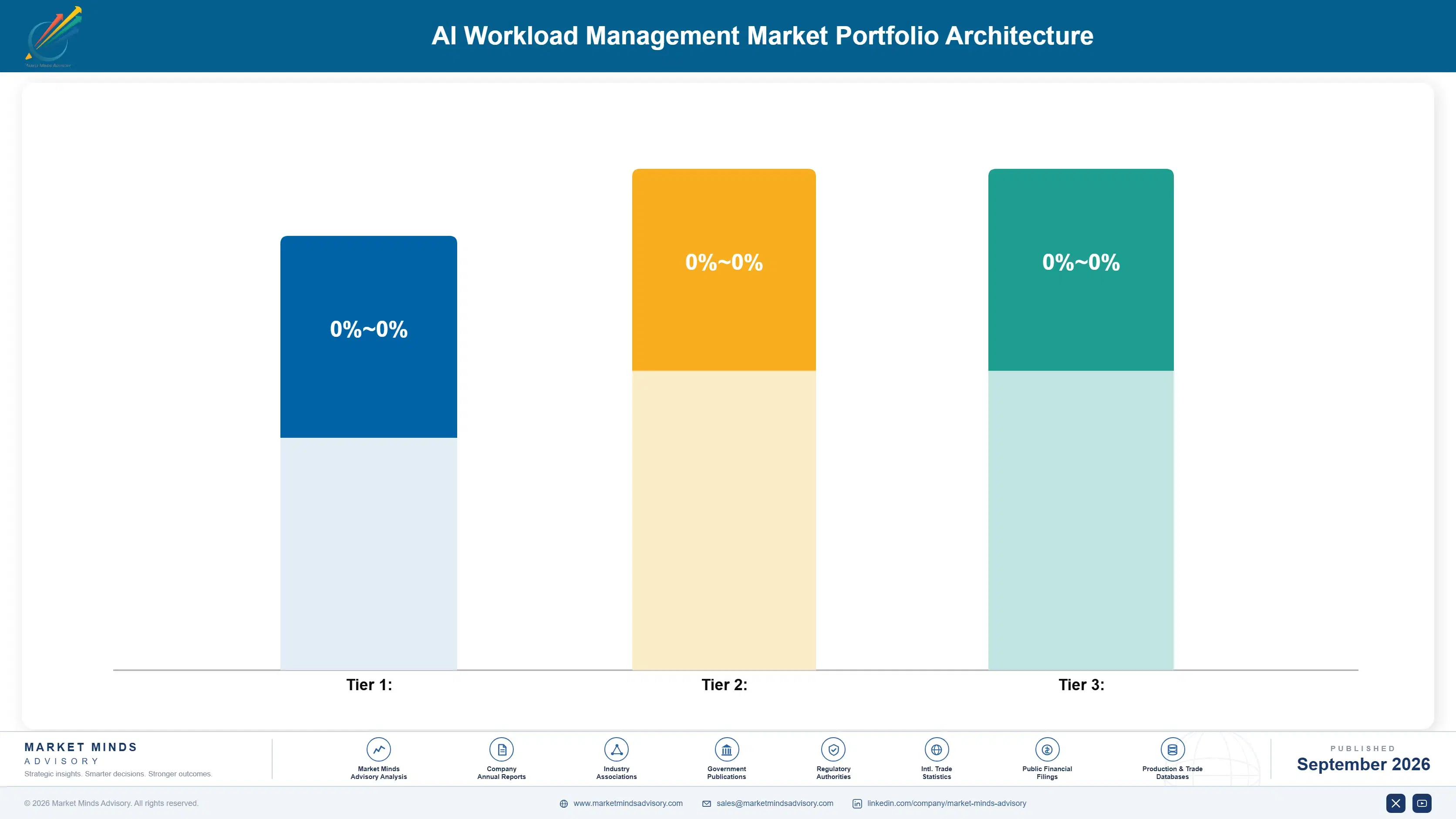
Vendors operate across three margin tiers: entry-level self-service scheduling tools serving small AI teams generate gross margins around 55 to 62%, while enterprise platforms bundling inference optimization and cost attribution command 68 to 76% given technical differentiation competitors cannot quickly replicate without years of investment. The gap has widened considerably as enterprise buyers pay substantially more for compute cost predictability and reliability.
Entry-level self-service scheduling tools still represent the largest share of subscriber count, particularly among small AI teams managing modest GPU clusters directly through simple dashboards, but the highest value creation now concentrates in enterprise contracts bundling inference optimization, multi-cloud portability, and cost attribution capability. Vendors must balance product investment between broad self-service accessibility and premium enterprise feature depth without overextending resources.

High-value margin pools concentrate specifically around inference optimization, multi-cloud portability, and granular cost attribution, all requiring engineering investment that smaller regional competitors struggle to replicate quickly at comparable quality and reliability. Vendors positioned across all three tiers, rather than concentrated purely in self-service subscriptions, are best placed to capture disproportionate profit as the broader market keeps shifting toward production AI deployment and inference scale.

Entry-level self-service GPU scheduling tools sold on price to small AI teams managing basic cluster orchestration, generating gross margins of 55 to 62% amid intense competition among numerous low-cost self-service platform tools.
Gross Margin

Enterprise platforms bundling inference optimization, multi-cloud portability, and cost attribution commanding gross margins of 68 to 76% given technical differentiation and integration depth that meaningfully limit competitive entry from smaller vendors.
Gross Margin

Energy-efficient scheduling tools optimizing for lower data center power consumption responding to growing enterprise sustainability commitments and rising electricity costs, generating gross margins around 60 to 68% as early movers capture premium efficiency-conscious contracts.
Gross Margin
ai-workload-management-market-portfolio-architecture-1789986608480

High-value Sub-segments and Strategic Watch-out

Inference Serving and Optimization Platforms

Fastest-growing and highest-margin segment as production generative AI deployment generates far more compute spend than model training did previously across most enterprise industries today. Vendors with established inference optimization capability are capturing premium positioning ahead of competitors still focused primarily on training pipeline management alone.

GPU Orchestration and Scheduling Software

Second-fastest growing segment tied to rising enterprise demand for maximizing utilization of scarce and expensive GPU cluster capacity across training and inference workloads, teams, and business units. Vendors building deeper scheduling intelligence here can capture disproportionate value as compute scarcity continues constraining enterprise AI budgets.

MLOps and Lifecycle Management Tools

Core revenue segment representing steady subscription renewal demand across most active enterprise and mid-market deployments currently tracked across most industry verticals and company sizes, generating stable margins as competitive pricing pressure persists moderately. This segment remains commercially essential even as growth shifts toward inference-specific alternatives over the coming forecast period.

Model Training Pipeline Management

Strategic watch-out segment facing steady share decline as inference workloads increasingly dominate enterprise AI compute spend relative to training-focused activity across most organizations. Vendors overexposed to this legacy category risk meaningful margin erosion absent diversification into inference or cost optimization product lines over coming years.

Why Compute Governance Contracts Stay Sticky

Revenue durability comes primarily from subscription models tied to GPU cluster size and compute spend under management, since enterprises rarely dismantle workload orchestration infrastructure once integrated into production AI pipelines given the switching cost involved in migrating scheduling logic, historical usage data, and integration configurations across dependent internal systems. Vendors renewing multi-year enterprise contracts capture predictable recurring revenue even as new customer acquisition slows.
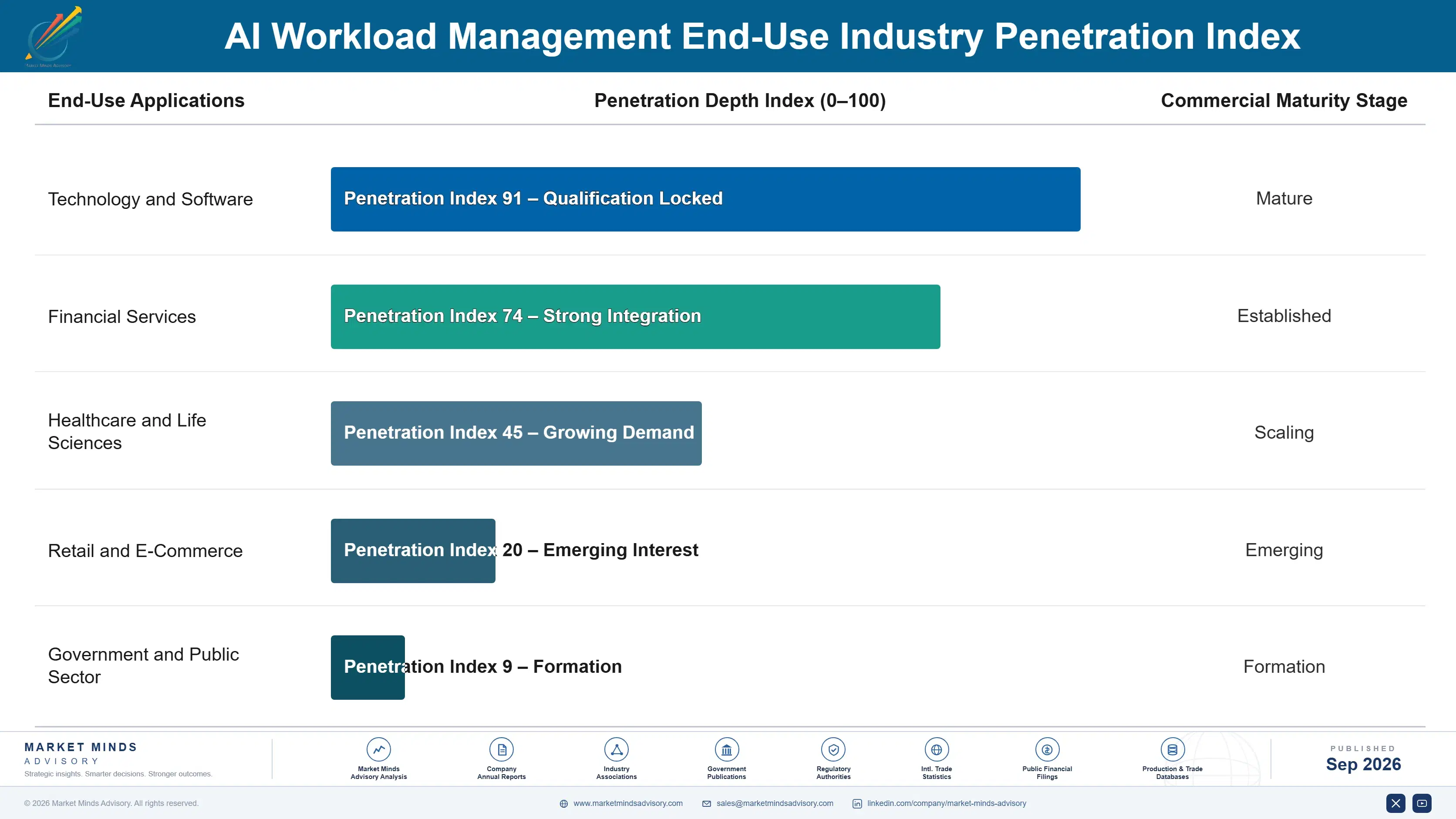
Adoption depth varies meaningfully by vertical: technology and financial services buyers show the deepest engagement, running extensive multi-cluster AI infrastructure programs with dedicated platform engineering teams managing hundreds of active GPU nodes, while smaller companies use workload management far more sparingly, often limited to basic scheduling for a handful of shared GPU instances managed with minimal dedicated staffing and lighter governance requirements overall.

Younger platform engineers entering enterprise infrastructure roles increasingly expect granular cost attribution and multi-cloud portability as standard platform features, rather than accepting the manual capacity planning and single-provider lock-in that defined the category for the prior several years of AI infrastructure practice and early experimentation. This generational shift pressures vendors still selling basic scheduling tools to modernize product architecture quickly or risk losing renewal business.
ai-workload-management-market-end-use-penetration-index-1789986609233

Differentiate Fast Before Hyperscalers Bundle It

These are among the four positions where our research anticipates prominent divergence between winners and laggards over the coming forecast period. Each is grounded in the demand model, the regulatory perimeter, and the announced capacity pipeline.
01 / INFERENCE OPTIMIZATION PRIORITIZATION

Build inference-specific capability ahead of training-focused rivals

Inference now represents roughly 61% of total enterprise AI compute spend, surpassing training for the first time as production generative AI deployment scales beyond initial experimentation phases across most enterprise industries, company sizes, and geographic markets worldwide today. Vendors building dedicated inference optimization capability, including dynamic batching and response caching, capture the fastest-growing segment expanding at 21.0% annually across most deployment types and buyer categories. Competitors still focused primarily on training pipeline management risk missing the largest and fastest-growing compute spend category available today.
02 / MULTI-CLOUD PORTABILITY DEFENSE

Build genuine portability before hyperscaler bundling accelerates further

Hyperscalers are expanding native workload orchestration features that overlap significantly with standalone software vendor capability, offered as part of existing cloud subscriptions at effectively zero incremental cost to enterprise customers across most cloud platforms, pricing tiers, and contract structures. Vendors offering genuine multi-cloud portability capture enterprise accounts that single-provider hyperscaler tools cannot serve, driving roughly 40% higher platform adoption among multi-cloud enterprises across most industry categories. Competitors lacking this differentiation risk losing renewal business to free bundled alternatives lacking comparable flexibility.
03 / COST ATTRIBUTION REPORTING DEPTH

Build granular financial reporting before finance scrutiny intensifies

Enterprise finance departments increasingly demand granular cost attribution data showing which teams and projects consume AI compute resources, given that AI infrastructure spending now represents a meaningful and growing share of total enterprise technology budgets across most industries, company sizes, and organizational structures. Vendors offering detailed chargeback and showback reporting command roughly 30% premium pricing over competitors providing only aggregate cluster-level visibility and reporting depth across comparable enterprise accounts. Waiting until finance scrutiny intensifies further risks losing enterprise contracts to already-differentiated reporting-focused competitors.
04 / GLOBAL DELIVERY COST OPTIMIZATION

Expand India delivery operations to fund competitive pricing

India's enterprise cloud talent base is expanding rapidly, and vendors building substantial engineering and support delivery operations there report cost structures roughly 25% more efficient overall than competitors relying entirely on higher-cost domestic talent for equivalent engineering and support functions across most product lines and service categories. This cost advantage increasingly funds more aggressive product investment and pricing flexibility during competitive procurement negotiations with price-sensitive buyers. Vendors without comparable global delivery scale risk losing price-sensitive mid-market accounts to better-positioned rivals.

Engagement Snapshot From the Field

A live engagement with an industry participant carrying material or product regulatory and market exposure ahead of a defining policy shift, showing how our research translates into a defensible multi-year portfolio strategy.
MARKET MINDS ADVISORY · CLIENT ENGAGEMENT SUMMARY
AI Workload Management Producer Strategic Portfolio Review and Transition Roadmap 2026·Investment Scenario on AI Workload Management Exposure Evaluation 2025-26
CLIENT PROFILE
The client is a mid-market financial technology firm operating fraud detection and credit scoring models across a multi-cloud infrastructure environment spanning several jurisdictions and regions. The company reported (client-reported, unverified by MMA) annual AI infrastructure spend of approximately $18 million and had historically managed GPU cluster scheduling through internally built tools requiring significant engineering maintenance overhead.
STRATEGIC CHALLENGE
The firm faced persistently low GPU utilization rates alongside rising compute costs, while its internally built scheduling tools required disproportionate engineering time to maintain relative to the value delivered. Leadership needed an independent assessment of commercial workload management platforms before committing capital ahead of the next annual infrastructure budget planning cycle.
MMA APPROACH
MMA conducted a comparative assessment of AI workload management vendors' inference optimization and multi-cloud portability capability, benchmarking against primary survey data covering similar financial technology firm deployments across comparable regulatory environments. The engagement combined expert interviews with the client's platform engineering leadership alongside MMA's competitive landscape data to identify the vendor best suited to the firm's specific compliance and performance requirements.
KEY FINDINGS
  1. The client's internally built scheduling tools consumed an estimated 15% of platform engineering team capacity on ongoing maintenance alone (client-reported, unverified by MMA).
  2. GPU cluster utilization averaged just 38%, meaningfully below the industry benchmark typical for organizations using commercial optimization software platforms and tools today.
  3. Comparable financial technology firms had already migrated to commercial workload management platforms roughly eighteen months earlier on average across the broader industry.
  4. Multi-cloud portability was a specific regulatory requirement given the firm's data residency obligations across multiple jurisdictions and various regional financial markets served.
CLIENT PROFILE
The client is a mid-market financial technology firm operating fraud detection and credit scoring models across a multi-cloud infrastructure environment spanning several jurisdictions and regions. The company reported (client-reported, unverified by MMA) annual AI infrastructure spend of approximately $18 million and had historically managed GPU cluster scheduling through internally built tools requiring significant engineering maintenance overhead.
STRATEGIC CHALLENGE
The firm faced persistently low GPU utilization rates alongside rising compute costs, while its internally built scheduling tools required disproportionate engineering time to maintain relative to the value delivered. Leadership needed an independent assessment of commercial workload management platforms before committing capital ahead of the next annual infrastructure budget planning cycle.
MMA APPROACH
MMA conducted a comparative assessment of AI workload management vendors' inference optimization and multi-cloud portability capability, benchmarking against primary survey data covering similar financial technology firm deployments across comparable regulatory environments. The engagement combined expert interviews with the client's platform engineering leadership alongside MMA's competitive landscape data to identify the vendor best suited to the firm's specific compliance and performance requirements.
KEY FINDINGS
  1. The client's internally built scheduling tools consumed an estimated 15% of platform engineering team capacity on ongoing maintenance alone (client-reported, unverified by MMA).
  2. GPU cluster utilization averaged just 38%, meaningfully below the industry benchmark typical for organizations using commercial optimization software platforms and tools today.
  3. Comparable financial technology firms had already migrated to commercial workload management platforms roughly eighteen months earlier on average across the broader industry.
  4. Multi-cloud portability was a specific regulatory requirement given the firm's data residency obligations across multiple jurisdictions and various regional financial markets served.
RECOMMENDED STRATEGY
Phase 1: Phase one: migrate to a commercial workload management platform offering multi-cloud portability within a nine-month transition window overall each quarter. Phase 2: Phase two: redeploy freed platform engineering capacity toward model development work rather than infrastructure maintenance tasks going forward continuously each quarter. Phase 3: Phase three: implement granular cost attribution reporting to support ongoing infrastructure budget justification to finance leadership annually and each quarter.
OUTCOME
Within one year of platform migration, the client reported (client-reported, unverified by MMA) GPU utilization improvement from 38% to roughly 64%, alongside meaningful reduction in platform engineering maintenance burden overall. Freed engineering capacity was redirected toward model development initiatives previously delayed by infrastructure maintenance demands.

Frequently Asked Questions

Foundational context covering the market sizes, CAGR, scope, country, region and competition that inform every finding below. This section is provided to cover basics and most often pre-purchase conversations, answered from the MMA Primary Research Dataset.

What is the current size of the AI Workload Management Market?

The AI Workload Management Market is valued at $3.2 billion in 2025. This reflects global spend on platforms scheduling and optimizing GPU compute for machine learning training and inference.

How large will the AI Workload Management Market be by 2036?

The market is projected to reach $15.63 billion by 2036. Growth is anchored by GPU scarcity and expanding production inference deployment across most enterprise sectors.

What is the CAGR for the AI Workload Management Market 2026 to 2036?

The market is forecast to grow at a 15.5% compound annual growth rate between 2026 and 2036. This reflects accelerating enterprise adoption offsetting hyperscaler bundling pressure.

Which segment is growing fastest?

Inference Serving and Optimization Platforms is the fastest-growing segment at a 21.0% CAGR, roughly 1.35x the overall market rate. Production generative AI deployment is driving this rapid expansion.

Who are the major companies in the AI Workload Management Market?

Leading companies include Nvidia, Databricks, Anyscale, Weights and Biases, and Run:ai. These five firms compete on inference optimization, multi-cloud portability, and cost attribution depth today.

Which country is growing fastest?

India is the fastest-growing country at a 19.5% CAGR. Its cost-sensitive enterprise cloud adoption pattern drives outsized platform deployment demand nationwide across most industries and companies.

Report Segmentation Architecture

The full report scope spans multiple orthogonal segmentation dimensions, with cross-tabulated demand data provided for each dimension pair. Coverage extends further to regional breakdowns, trend trajectories, and the competitive detail needed to support segment-level decision-making.

By Primary Market Dimension

  • Inference Serving and Optimization Platforms
  • GPU Orchestration and Scheduling Software
  • MLOps and Lifecycle Management Tools
  • Cost Optimization and FinOps for AI Tools
  • Multi-Cloud Workload Distribution Software
  • Model Training Pipeline Management

By End-Use Industry

  • Technology and Software
  • Financial Services
  • Healthcare and Life Sciences
  • Retail and E-Commerce
  • Government and Public Sector

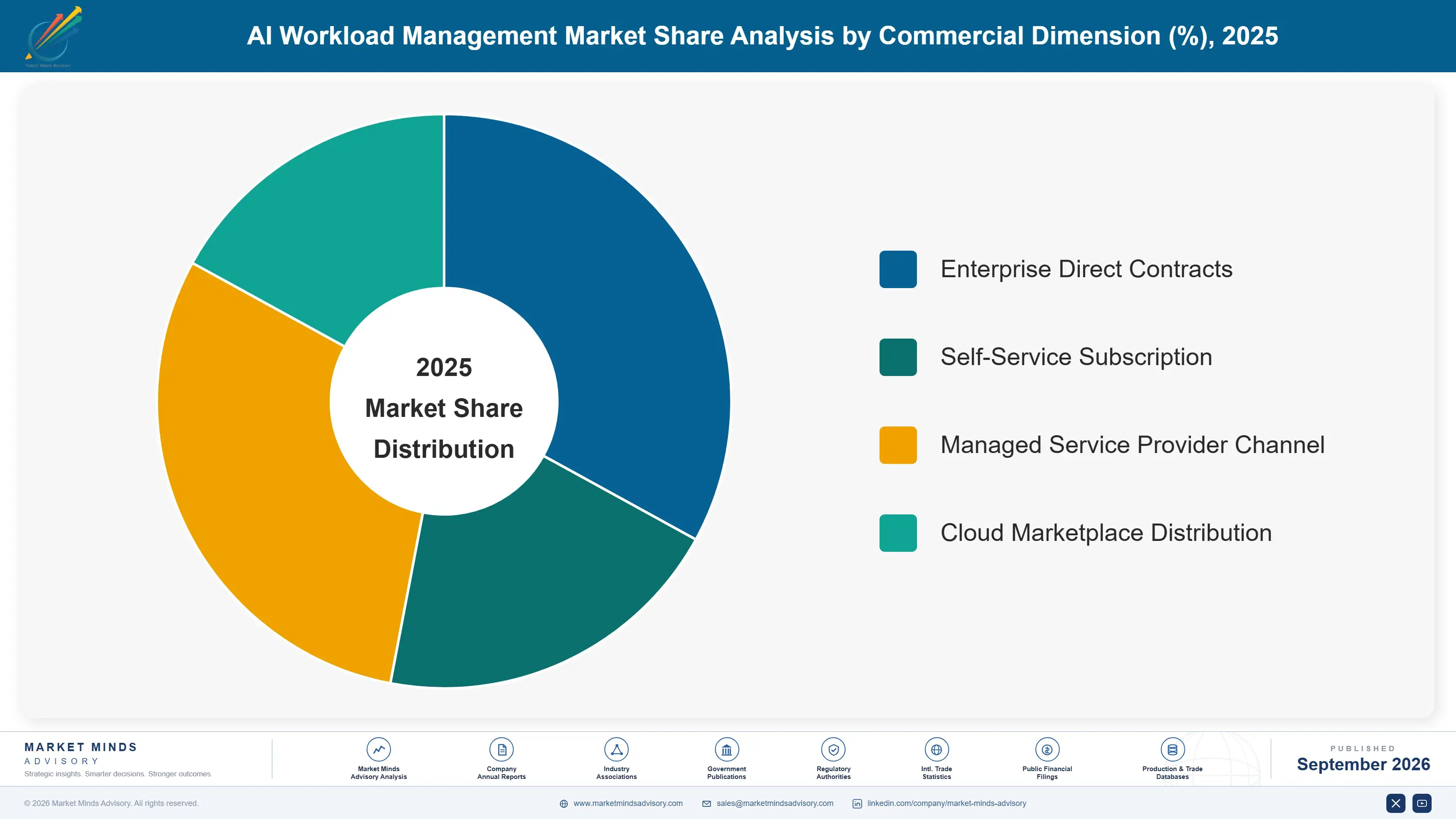
By Commercial Dimension

  • Enterprise Direct Contracts
  • Self-Service Subscription
  • Managed Service Provider Channel
  • Cloud Marketplace Distribution

By Region

  • North America
  • Western Europe
  • East Asia
  • South Asia and Pacific
  • Latin America
  • Middle East and Africa
  • Eastern Europe

Scope, Methodology, and Coverage

Every figure in this report is reproducible from documented input assumptions. The scope below maps the historical period, the forecast horizon, the segmentation dimensions, and the countries covered, alongside the underlying primary and qualitative methodology.
Historical Period
2020 to 2025
Forecast Period
2026 to 2036
Base Year
2025 (USD billions; MMA Primary Research Dataset, September 2026)
Market Definition
The AI Workload Management Market covers software platforms that schedule, orchestrate, and optimize computing resources for machine learning training and inference workloads across GPU clusters, cloud environments, and hybrid infrastructure. It excludes underlying cloud infrastructure services and hardware sold as separate product categories.
Quantitative Units
Value in USD Billion, GPU Cluster Count in Thousand Units Managed
Segmentation Dimensions
By Software Function, By End-Use Industry, By Commercial Dimension, By Region
Regions Covered
North America, Western Europe, East Asia, South Asia and Pacific, Latin America, Middle East and Africa, Eastern Europe
Countries Covered
United States, Canada, United Kingdom, Germany, France, China, Japan, South Korea, India, Indonesia, Australia, Brazil, Mexico, Saudi Arabia, United Arab Emirates, South Africa, Poland
Key Companies Profiled
Nvidia, Databricks, Anyscale, Weights and Biases, Run:ai, Domino Data Lab, Determined AI, Ray Project Commercial Offerings, SambaNova Systems, CoreWeave, Lambda Labs, MosaicML, Iguazio, ClearML, Grid AI, Baseten, Modal Labs, Together AI, Fireworks AI, Predibase
Quantitative Methodology
Primary survey, n=3,800 respondents, Q4 2025, six countries; demand-side model with trade association cross-validation
Qualitative Methodology
47 expert interviews, Q4 2025; applied to validate demand model assumptions, identify emerging dynamics, and assess competitive positioning
Report Format
PDF and XLSX data workbook (Word format preview document)
Publisher
Market Minds Advisory
Report Code
MMA-2026-TEC-926
Published
September 2026
Contact
sales@marketmindsadvisory.com | www.marketmindsadvisory.com

Purchase the full AI Workload Management Market Report (2026 to 2036).

This report provides a comprehensive assessment of the global AI Workload Management Market, covering market sizing, segmentation, and regional dynamics through 2036. It examines competitive positioning among leading platform vendors, the shift toward inference-specific optimization, and revenue opportunities within multi-cloud portability and cost attribution reporting. The analysis draws on primary survey data, expert interviews, and company disclosures to quantify demand shifts across enterprise, self-service, and hyperscaler-adjacent channels. Readers gain a data-grounded view of where platform investment and vendor selection decisions carry the greatest commercial return.
Ten-year market sizing and forecast model
Six-segment software function segmentation with growth rates
Seven-region demand and competitive share breakdown
Twenty-company competitive landscape and moat assessment
Cloud compute cost and volatility risk analysis
Portfolio margin and revenue lever guidance

Built For The People Who Decide

From boardroom strategy to bench-side execution, this report is read cover-to-cover by leaders shaping the next decade of their industry, turning demand scenarios, market dynamics and valuation benchmarks into decisions.
CXOs/ Presidents/ VPs/ Managers
M&A and Corporate Development
Strategy Teams and R&D Heads
Procurement and Product Directors
Regulatory and Compliance Leaders
Investor Relations and Equity Analysts