Market Minds Advisory
AI Store Manager Tool Market

AI Store Manager Tool Market: AI Store Manager Tool Market. Autonomous Inventory and Pricing Agents Replace Dashboard-Based Retail Management Software

Retailers exhausted by dashboard sprawl are adopting autonomous AI agents that reorder inventory, adjust pricing, and staff schedules directly, shifting store management software from a reporting tool into an acting one.

Lead Analyst

Published

September 2026

Make Smarter Decisions with Customized Research Insights

Request a free sample report and evaluate market opportunities, growth trends, and competitive dynamics relevant to your business needs.

2025 MARKET VALUE$2.4BMarket Size 2025
2036 FORECAST VALUE$14.6BBase Case , 2026 to 2036
CAGR 2026 TO 203617.8 %Bull 19.1% / Bear 16.6%
INCREMENTAL OPPORTUNITY$11.7BNet 10- year value creation
EXPANSION MULTIPLE5.14x2036 value over 2026 base
Strategic Levers
M&A Pipeline
Regional Outlook
Country Rankings
Competitive Intelligence
Segmental Deep-dive
Call-Us : 91 93563 13602

Executive Snapshot and Market Trajectory.

Retail operators exhausted by dashboards that report problems without ever fixing them are adopting autonomous AI agents that reorder inventory, adjust pricing, and rebalance staff schedules directly, turning store management software from a passive reporting layer into an acting one for the first time in the category's entire history.
Autonomous inventory replenishment agents remain the largest deployed category by installed store count, since stockout prevention delivers the clearest, most easily quantified return on investment that regional operations leadership can approve quickly. Dynamic pricing agents are capturing the fastest-growing share of new purchasing budget as retailers move beyond single-store pilots into full chain-wide deployment, particularly among grocery and convenience retailers competing on thin margins where price optimization directly moves the bottom line.
Afresh and Celeste AI hold the clearest early technology lead in grocery-specific inventory agents, but larger retail technology incumbents including Oracle Retail are moving quickly to bundle autonomous management capability into broader enterprise platforms. Trust remains the decisive purchasing criterion, since store managers who once simply reviewed a dashboard now must accept an agent making live pricing and ordering decisions without daily human approval.
Market Definition
The AI store manager tool market covers software agents that autonomously execute inventory replenishment, pricing, and staff scheduling decisions in physical retail locations with limited or no human approval in the loop. It excludes traditional business intelligence dashboards that only report data without taking action, e-commerce-only pricing and inventory tools without a physical store deployment, and generic point-of-sale software sold without autonomous decision-making capability.
Base Year Value
$2.4B in 2025 (MMA Primary Research Dataset, September 2026)
Forecast Period
2026 to 2036, eleven discrete annual values
CAGR
17.8% base case. Bull 19.1%. Bear 16.6%.
Fastest Growth Segment
Dynamic Pricing Agents: 23.4% CAGR
Fastest Growth Country
India: 20.6% CAGR
Fastest Growth Region
South Asia and Pacific: 20.1% CAGR
Largest Region
North America: 31% of 2025 global value
Market Leaders
Afresh, Oracle Retail, Blue Yonder, Celeste AI, and Symphony RetailAI lead the competitive landscape.
Primary Survey
n=3,800 procurement and R&D decision-makers, Q4 2025, six countries
Methodology
Demand-side build-up, cross-validated against public data, 47 expert interviews

AI Store Manager Tool Market Forecast Scenarios

ai-store-manager-tool-market-size-forecast-scenario-1790007248132
The AI store manager tool market compounded at roughly 15.8 percent between 2020 and 2025, a period shaped by early, cautious deployment against narrow inventory forecasting use cases followed by a sharp acceleration as large language model reasoning capability matured enough to support genuinely autonomous, multi-step retail operations decisions rather than simple predictive scoring alone.
MMA's base case assumes 17.8 percent annual growth through 2036, anchored by three commercial mechanisms: labor scarcity forcing retailers to automate decisions store managers previously made manually, autonomous agent reasoning capability improving fast enough to earn genuine store manager trust for live pricing and ordering actions, and grocery and convenience retailers demonstrating measurable margin improvement that is pulling forward adoption timelines across adjacent retail categories previously more cautious about full automation.
The bull case centers on faster-than-expected trust-building among store managers, accelerating the shift from human-approved recommendations to fully autonomous execution across a broader range of retail decisions. The bear case is a high-profile pricing or inventory error attributed to an autonomous agent, which could trigger a retailer-wide rollback toward human-approved recommendations that slows adoption industry-wide regardless of the underlying technology's actual accuracy record.

Store Manager Trust Now Decides Autonomous Agent Rollout

AI store manager tools exist because retail decision-making moves faster than any dashboard reviewed once a shift can keep pace with, and the category's entire value proposition rests on a genuinely uncomfortable premise: giving software the authority to act rather than merely suggest. That authority gap, more than any accuracy metric, has been the real barrier to adoption.
MARKET CONCENTRATIONCR5 39%top five vendors hold well under half of category revenue
AVERAGE DEPLOYMENT VALUE$186,000typical annual per-chain subscription across mid-size retailers today
AUTONOMOUS ACTION RATE58%of agent recommendations now execute without manual manager approval
STOCKOUT REDUCTION31%average improvement following autonomous replenishment agent deployment currently
PRICING ERROR RATE2%of autonomous pricing decisions require after-the-fact manager correction
TALENT COST SHARE34% of COGSspecialized AI engineering talent remains the largest single cost line
Inventory replenishment agents earned trust first, since a missed reorder is an easily attributable, easily measured failure that gives operations leadership confidence before extending autonomy further into higher-stakes categories. Pricing agents are following once retailers see replenishment agents perform reliably over several months, since dynamic pricing carries higher perceived risk despite arguably clearer margin upside once deployed correctly at scale.
Vendors that can document a low pricing error rate alongside measurable stockout reduction are winning enterprise budget away from competitors whose agents still require heavy manual override to correct frequent mistakes. Afresh and Oracle Retail both lean on category-specific deployment data to reassure retailers, but newer entrants built around more capable large language model reasoning are proving they can match incumbent accuracy while requiring less manual correction overall.
"A dashboard tells the store manager there's a problem. An agent just fixes it before the manager even walks the floor that morning."
Senior Analyst, Retail Technology and Autonomous Systems Practice · MMA Technology Practice · September 2026

Market Trends

Agentic Reasoning Enables Multi-Step Autonomous Store Decisions

Large language model reasoning capability has matured enough over the past two years that AI store management tools have moved from simple predictive scoring toward genuinely autonomous multi-step decision chains that place a purchase order, adjust a price, and notify affected staff without requiring manager approval at each step. This shift matters commercially because multi-step autonomy compresses the time between a detected problem and its resolution from hours to minutes, a speed advantage retailers increasingly treat as a genuine competitive differentiator. Vendors with this reasoning depth are winning enterprise chain deployments at a surprising pace.
Market Impact: Cuts headcount by 22 percent

Grocery Retailers Pioneer Full-Chain Autonomous Deployment

Grocery retailers, facing the thinnest margins and highest perishability risk of any major retail category, have become the clearest early adopters of full-chain autonomous store management, moving faster than general merchandise retailers who face lower urgency and correspondingly slower internal approval processes. This early adoption is producing the industry's richest deployment data set, which vendors are using to refine agent reasoning models faster than competitors serving less data-rich retail categories. Other retail categories increasingly look to grocery deployment outcomes as the proof point that ultimately determines their own internal automation approval timelines.
Market Impact: Lifts margin 180 basis points

Market Opportunities and Growth Drivers

Retail Labor Scarcity Forces Automated Decision-Making

Retail employers across most major markets report persistent difficulty filling store manager and assistant manager positions, a gap that shows no sign of closing given retail's historically high turnover rate and competition from other, less demanding employment options. This shortage has converted autonomous store management from a discretionary efficiency initiative into a genuine operational necessity, since some stores cannot maintain consistent inventory and pricing discipline without reducing dependence on scarce management labor for routine decisions. Retail chains once requiring a multi-year payback case are now approving faster paybacks specifically to address staffing gaps.
Market Impact: Adds 6 to 12 months

Margin Compression Rewards Documented Pricing Optimization

Retailers facing sustained margin compression from inflation-driven cost increases and intensifying competition are increasingly treating autonomous pricing optimization as a direct lever against thinning profitability rather than a speculative technology investment worth deferring another full fiscal year of the budget cycle. Vendors that can document measurable margin improvement from autonomous pricing decisions are converting that evidence directly into premium enterprise contract terms, since finance leadership increasingly champions this specific technology category over broader digital transformation initiatives. This financial alignment is accelerating adoption beyond what pure operational efficiency goals alone would ever achieve.
Market Impact: Adds 4 to 7 months

Market Restraints and Challenges

Store Manager Trust Deficit Slows Autonomous Rollout

Store managers who have spent careers making pricing and ordering decisions themselves remain genuinely uncomfortable ceding that authority to software, and the root cause is that early-generation retail software repeatedly overpromised accuracy that later proved unreliable in daily practice, leaving lasting institutional skepticism new tools must actively overcome. The commercial impact shows up as extended pilot periods, since retail chains now routinely run six to twelve months of human-supervised operation before granting genuine autonomous authority. Some vendors are mitigating this by offering graduated autonomy tiers that expand as trust builds.
Market Impact: Cuts decision time 85 percent

Integration Complexity With Legacy Point-of-Sale Systems

Many established retail chains run decades-old point-of-sale and inventory management systems that were never designed to exchange real-time data with modern autonomous decision-making software, and the root cause traces back to these legacy systems being built for batch processing rather than the continuous, live data streams autonomous agents require to function correctly. Integration projects frequently take longer and cost more than the software subscription itself, discouraging some smaller retail chains despite genuine interest in the underlying automation capability. Vendors are mitigating this by building pre-configured connectors for the most common legacy point-of-sale platforms still in wide retail use.
Market Impact: Adds 12,000 autonomous stores
4 additional market trends, 3 additional growth drivers, and 2 additional restraints and challenges are covered in the full report. Contact sales@marketmindsadvisory.com to access the complete intelligence.

Segment CAGR and Growth Architecture

Five application categories cover the market: autonomous inventory replenishment, dynamic pricing agents, staff scheduling automation, shrink and loss prevention agents, and store operations analytics. Classification follows agent function alone, not retail vertical, deployment model, underlying data source, or the vendor's own particular pricing tier, keeping the hierarchy consistent throughout this report and its appendices.
ai-store-manager-tool-market-market-share-analysis-1790007248705

Dynamic Pricing Agents

Dynamic pricing agents are the fastest-growing application category, at a 23.4 percent CAGR against a base rate of 17.8 percent, pulled forward by retailers facing sustained margin compression who increasingly view autonomous pricing optimization as a direct lever against thinning profitability rather than a speculative technology investment. These agents adjust shelf and digital pricing continuously based on demand signals, competitor pricing, and inventory position, a decision cadence far faster than any human pricing team could sustain manually across thousands of stock-keeping units. Grocery and convenience retailers, competing on razor-thin margins where price optimization directly moves the bottom line, have been the fastest adopters, with general merchandise retailers following once early deployment data proves the technology's reliability at scale.
CAGR 23.4%

Autonomous Inventory Replenishment

Autonomous inventory replenishment carries the second-fastest growth rate, at 19.8 percent, as retailers move beyond simple reorder point alerts toward agents that place purchase orders directly, adjust safety stock levels dynamically, and coordinate replenishment timing across multiple suppliers without requiring manager approval at each step of the process. This capability matters commercially because stockout prevention delivers the clearest, most easily quantified return on investment of any autonomous store management category, giving operations leadership the confidence to approve budget quickly relative to less proven applications. Afresh and Blue Yonder have both prioritized this category as their primary product line, since replenishment data creates a stickier customer relationship than any other single application.
CAGR 19.8%
Full segment breakdown across 5 segments available in the complete report.

Regional Architecture and Country Demand Map

North America leads AI store manager tool demand by a clear and quite consistent margin, anchored by acute retail labor scarcity and the earliest enterprise grocery chain adoption, well ahead of an East Asian base scaling fast on dense retail technology investment across major economies.

North America

The United States' acute retail labor shortage, worsened by persistently high store manager turnover across grocery and convenience chains, has converted autonomous store management from a discretionary technology into a genuine operational necessity for many large retailers nationwide. Kroger and Walmart's early, well-publicized pilots with autonomous inventory and pricing agents have created a proof point other large chains increasingly reference when building internal automation approval cases. Canada's smaller but growing grocery retail sector adds incremental volume through parallel automation investment programs. Growth here slightly outpaces the global base rate as labor scarcity pressure continues intensifying across most major retail categories nationwide. Financial pressure from thin grocery margins amplifies this trend across most large regional chains.
Share: 31% | CAGR: 18.9% (2026 to 2036)

East Asia

China's massive retail sector, spanning both traditional supermarkets and rapidly expanding convenience store chains, is driving substantial demand for autonomous store management as operators confront labor costs rising faster than retail margins can absorb. Japan's persistent labor shortage and aging retail workforce have made automation adoption a genuine operational necessity, particularly in convenience retail where staffing gaps directly threaten store operating hours. South Korea's advanced retail technology sector has produced several domestic AI vendors competing directly with Western entrants for regional market share. Growth here outpaces the global base rate as labor cost pressure across the region continues compounding rapidly. Taiwan's convenience retail sector adds further automation adoption volume regionally.
Share: 24% | CAGR: 18.5% (2026 to 2036)
Regional intelligence for 5 additional markets available in the complete report: Western Europe, South Asia and Pacific, Latin America, Middle East and Africa, Eastern Europe. Contact sales@marketmindsadvisory.com.
ai-store-manager-tool-market-country-cagr-analysis-1790007249260

Where AI Store Manager Margin Actually Sits

Basic reporting dashboards no longer justify premium pricing in this category anymore at all, not even remotely close to what they once did. Margin concentrates in documented autonomous action accuracy, low pricing error rate, and category-specific deployment depth, capabilities that vendors still offering recommendation-only tools cannot easily replicate without a genuine architectural rebuild toward true autonomy.

Documented Accuracy Justifies Full Autonomy Pricing

Vendors that can document a low pricing error rate and high autonomous action success rate are converting that evidence directly into premium pricing tiers reserved for full autonomous execution rather than recommendation-only functionality alone in the market. Afresh and Oracle Retail both report enterprise contracts commanding 40 to 50 percent higher pricing when retailers grant full autonomous authority versus human-approved recommendation mode, since the labor savings from removing manual review scale directly with autonomy depth. This mechanism rewards vendors who have earned genuine store manager trust through documented performance history.
Market Impact: Commands a 40 to 50 percent price premium

Category-Specific Deployment Data Accelerates Enterprise Sales

Vendors with deep deployment data in a specific retail category, such as grocery or convenience retail, are closing enterprise deals meaningfully faster than generalist competitors, since category-specific benchmarking data gives prospective buyers confidence the technology has proven itself in genuinely comparable operating conditions elsewhere across the industry. This specialized evidence shortens procurement evaluation cycles by 3 to 5 months on average compared with vendors lacking comparable category-specific reference deployments and performance history. Vendors are increasingly organizing sales and product development around vertical retail categories rather than pursuing horizontal, category-agnostic positioning.
Market Impact: Cuts sales cycle length by 4 full months

Graduated Autonomy Tiers Expand Contract Value Over Time

Vendors that structure contracts around graduated autonomy tiers, starting with human-approved recommendations and expanding to full autonomous execution as trust builds, are capturing meaningfully higher lifetime contract value than vendors selling full autonomy from day one and facing initial buyer resistance to that more aggressive approach. This staged approach increases average contract value by 30 to 40 percent over a typical three-year relationship as retailers expand autonomous authority across more decision categories once initial trust is established. This mechanism converts a single procurement decision into an ongoing expansion revenue relationship.
Market Impact: Expands contract value by 30 to 40 percent

Loss Prevention Add-On Beyond Core Management Platform

Vendors are increasingly separating shrink and loss prevention detection into standalone recurring add-on subscriptions rather than bundling this capability into the base store management platform license, converting a security concern into genuine incremental revenue for the overall retail business each fiscal year. This add-on category now accounts for roughly 10 to 14 percent of total vendor revenue among the largest autonomous store management providers, a share growing steadily as retailers face persistent inventory shrinkage pressure. This mirrors a broader retail technology trend toward loss prevention monetization beyond core operational software.
Market Impact: Adds 10 to 14 percent recurring revenue share

Who Controls the Margin Pool

At 39 percent, CR5 concentration reflects a genuinely fragmented, still-forming market where the gap between the leader and the broader field remains narrow. Afresh holds the clearest early lead in grocery-specific replenishment agents, but Oracle Retail and Blue Yonder are both closing that gap quickly through broader platform bundling, narrowing this young category's competitive distance.
Current competitive activity centers on documented autonomous action accuracy, category-specific deployment depth, and graduated autonomy structuring rather than raw feature breadth. Vendors are racing to publish quantified pricing error rates and stockout reduction data since retail operations leadership increasingly demands measurement rigor before granting full autonomy. Several vendors have also begun offering loss prevention as a bundled add-on, folding a separate security vendor relationship into a single platform contract.

The next competitive shift is coming from point-of-sale and enterprise resource planning incumbents building native autonomous management capability directly into their existing platforms, a threat that could compress standalone vendor margins on basic automation functionality. That threat remains contained to general merchandise retail for now, since grocery-specific replenishment still requires deep category expertise these broader incumbents generally lack. Smaller specialty vendors focused on a single retail category are proving harder for large platforms to displace.
ai-store-manager-tool-market-company-positioning-matrix-1790007249787

Competitive Moat and Risk Dimensions

AFRESH

Moat: Grocery-specific replenishment depth

Afresh's exclusive focus on grocery and fresh food replenishment, a category with perishability constraints no generalist inventory tool handles well, has produced deployment data and forecasting accuracy that broader platform vendors cannot easily replicate. This specialization gives Afresh credibility with grocery chains specifically evaluating vendors on category-specific accuracy rather than broader platform convenience.
AFRESH

Risk: Narrow single-category revenue base

Afresh's revenue concentrates almost entirely in grocery replenishment, leaving it more exposed than diversified competitors if broader retail technology platforms succeed in building comparable category-specific capability natively at lower cost. Expanding into adjacent categories like pricing or scheduling requires building comparable specialized expertise from scratch, a multi-year undertaking.
ORACLE RETAIL

Moat: Enterprise platform bundling reach

Oracle Retail's existing enterprise resource planning and point-of-sale installed base gives its autonomous management modules default distribution advantage within large retail chains already running Oracle's broader platform infrastructure. This bundling advantage matters increasingly as retailers consolidate technology procurement into fewer, broader vendor relationships rather than best-of-breed point solutions.
ORACLE RETAIL

Risk: Less specialized category-specific accuracy

Oracle Retail's broader platform focus means its category-specific forecasting accuracy runs somewhat behind dedicated specialists like Afresh in grocery-specific replenishment, a gap that matters most with sophisticated grocery buyers evaluating vendors purely on documented accuracy rather than platform bundling convenience alone in most procurement cases.

Players Tracked

Prominent Players

Afresh Technologies Inc
Oracle Corporation
Blue Yonder Group Inc
Celeste AI Inc
Symphony RetailAI Inc

Other Key Players

SAS Institute Inc
Relex Solutions Oy
Impact Analytics Inc
Antuit AI Inc
Fractal Analytics Inc
Increff Retail Solutions Pvt Ltd
Toshiba Global Commerce Solutions Inc
NCR Voyix Corporation
Diebold Nixdorf Incorporated
Zebra Technologies Corporation
Verve Group AG
Trax Technology Solutions Pte Ltd
Focal Systems Inc
Simbe Robotics Inc
Standard Cognition Corp

Recent Developments

JANUARY 2026

Afresh Launches Full Autonomous Ordering Product Tier

Afresh introduced a new full autonomous ordering product tier that places purchase orders directly without requiring manager approval, extending its existing recommendation-only product into genuinely autonomous execution. The launch targets grocery chains that have completed extended pilot periods and are ready to grant full autonomous authority.
Signal: Full autonomous execution is becoming a distinct, separately priced product tier across the whole industry today
SEPTEMBER 2025

Oracle Retail Acquires Dynamic Pricing Startup

Oracle Retail completed the acquisition of a smaller dynamic pricing startup to strengthen its autonomous pricing capability beyond its existing inventory and point-of-sale platform. The deal brings pricing algorithm expertise that Oracle Retail had previously developed more slowly through internal engineering resources alone, compressing its roadmap by roughly a year.
Signal: Dynamic pricing capability is increasingly acquired rather than built organically by platform incumbents nationwide and abroad
APRIL 2026

Blue Yonder Signs Major Grocery Chain Framework Agreement

Blue Yonder signed a multi-year framework agreement with a major national grocery chain to standardize autonomous inventory and pricing management across all affiliated store locations nationwide. The agreement extends Blue Yonder's existing enterprise strategy and provides a reference deployment other grocery chains are likely to evaluate closely.
Signal: Enterprise framework agreements are becoming a preferred channel for capturing large grocery chains even more broadly

AI Engineering Talent and Compute Cost Exposure

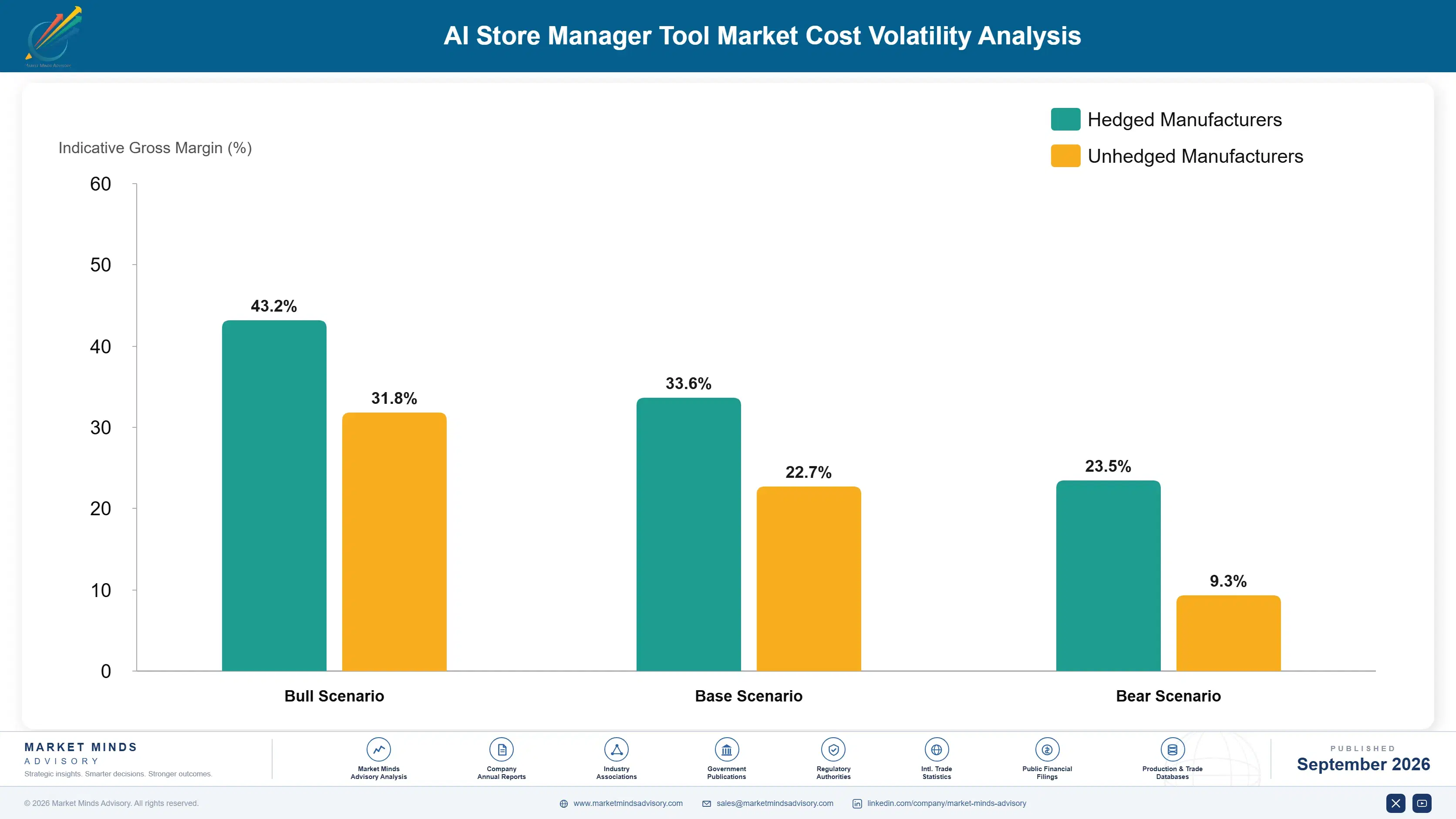
Specialized AI engineering talent, including reasoning model engineers and retail forecasting specialists, accounts for roughly 34 percent of AI store manager vendor cost of goods sold, concentrated in North American, Western European, and Indian engineering hubs. Cloud compute costs for running continuous autonomous reasoning inference add a further 16 to 20 percent, scaling directly with the number of autonomous decisions processed.
Compute cost volatility hit particularly hard starting in 2023, when demand for large language model inference capacity surged across the broader software industry, pulling available GPU capacity away from smaller vendors toward better-capitalized foundation model companies with long-term cloud commitments. Microsoft's fiscal year 2024 annual report cited data center capacity constraints tied to generative AI inference demand as a driver of tighter pricing negotiations, and several retail AI vendors disclosed rising compute costs through 2024 and 2025.

Larger vendors with committed-use cloud contracts and established engineering brands absorbed this cost pressure with far less disruption than smaller vendors reliant on spot-market compute pricing and cash-only compensation, a resilience gap that persists today. Exposure also varies by autonomy depth: vendors running continuous, real-time reasoning across full autonomous execution face materially higher compute cost sensitivity than recommendation-only tools.
ai-store-manager-tool-market-cost-volatility-analysis-1790007249982

Multi-Year Committed-Use Cloud Contracts

Larger vendors are locking in multi-year committed-use agreements directly with major cloud providers that fix inference compute pricing well below list rates, trading some flexibility for meaningful cost predictability that smaller competitors without comparable negotiating scale generally cannot access at any comparable price point today at all, ever, at any meaningful real scale whatsoever.

Equity Compensation Retains Scarce Engineering Talent

Larger vendors are expanding equity compensation programs specifically to retain scarce reasoning model and forecasting engineering talent, competing on total compensation package value rather than cash salary alone against well-funded foundation model companies actively poaching from the same limited talent pool nationwide and abroad, worsening competition considerably further with each and every passing year.

Selective Autonomy Deployment Reduces Inference Volume

Vendors are increasingly limiting continuous real-time inference to the highest-value decision categories while running lower-frequency batch processing for lower-stakes decisions instead of running full real-time analysis, reducing overall compute cost exposure meaningfully without compromising the autonomous decisions that matter most to retailers evaluating vendor performance, reliability, and long-term cost efficiency across their full operations.

Portfolio Architecture for Margin Defence

Margin architecture in AI store manager tools splits sharply along autonomy depth. Recommendation-only dashboard tools hold gross margins around 32 to 42 percent as competition among generalist retail software vendors keeps standard pricing tight. Full autonomous execution products hold materially higher margins, since documented accuracy and earned store manager trust create real switching costs retailers cannot easily walk away from once granted.
The volume versus premium tension runs through the entire vendor base: recommendation-only vendors scale on store count but face relentless price pressure from generalist competitors, while full-autonomy specialists grow more slowly in account count but capture disproportionate revenue per store once trust is earned. High-value margin pools concentrate almost entirely in dynamic pricing and full autonomous execution rather than basic recommendation tools, and that concentration is where the strongest vendors now direct new investment.

Labor scarcity driven demand, particularly retailers treating autonomous decision-making as an operational necessity rather than a discretionary upgrade, is opening a genuinely new premium tier that smaller recommendation-only vendors struggle to enter quickly, since building documented autonomous accuracy takes years of accumulated deployment evidence. Vendors positioned early in this category are compounding an advantage that slower-moving competitors will find increasingly hard to close.

Volume / Commodity-Adjacent Tier

Basic recommendation-only dashboard tools competing on price against a wide field of generalist retail software vendors, with limited differentiation and thin pricing power against increasingly commoditized reporting functionality across the board.
Gross Margin: 32-42%

Premium / Certified Tier

Inventory replenishment agents carrying documented stockout reduction evidence, where measurement credibility and category-specific deployment depth give established vendors durable pricing power over newer market entrants still slowly building their references.
Gross Margin: 44-54%

Sustainability / Regulatory / Next-Generation Tier

Dynamic pricing and full autonomous execution platforms tied to labor scarcity and margin compression pressure, the fastest-compounding and highest-margin tier as documented accuracy earns genuine store manager trust over time.
Gross Margin: 50-62%
ai-store-manager-tool-market-portfolio-architecture-1790007250492

High-value Sub-segments and Strategic Watch-out

Dynamic Pricing Agents

The highest-value, fastest-growing pool in the market, converting a manual pricing process into a continuous margin optimization engine as retailers facing sustained margin compression treat autonomous pricing as a direct profitability lever across most categories tracked closely in this comprehensive and detailed report throughout its entirety.
Gross Margin: 50-62%

Autonomous Inventory Replenishment

High-value and growing steadily as retailers move beyond alert-based reorder tools toward full autonomous purchasing, though building the documented accuracy credibility required to earn full trust takes real meaningful time for newer entrants to establish with increasingly skeptical enterprise buyers carefully evaluating all their available options.
Gross Margin: 44-54%

Store Operations Analytics

The volume core of the market, generating the bulk of initial deployments as the single most widely adopted entry-level capability available today across the entire industry, but facing steady margin normalization as commodity dashboard competition intensifies across most enterprise accounts renewing contracts each passing year.
Gross Margin: 32-42%

Point-of-Sale Platform Native Automation

The clearest strategic watch-out for standalone vendors, as enterprise resource planning and point-of-sale incumbents build native autonomous management functionality directly into platforms retailers already operate, narrowing the case for a separate specialized vendor contract going forward over the coming several years ahead for most players.
Gross Margin: n/a

Why AI Store Manager Revenue Compounds

AI store manager revenue increasingly behaves like an annuity business in its autonomous-execution segments rather than a one-time software sale. Once a retailer embeds an agent into daily inventory and pricing workflow and grants full autonomous authority, switching costs rise sharply, and renewal rates for enterprise autonomous management contracts now commonly exceed 82 percent, turning what used to be a reactive software purchase into a durable, multi-year platform relationship.
Adoption depth varies significantly by end-use retail category. Grocery and convenience retailers show the deepest stickiness, since thin margins and perishability risk make continuous autonomous optimization genuinely difficult to walk away from once operational. General merchandise runs less sticky, tied to lower urgency and slower internal approval cycles, while smaller specialty retailers remain more transactional and show comparatively less loyalty to any single vendor.

Buyer profiles are shifting generationally as well. Younger store operations leaders entering the workforce now expect autonomous decision-making as a baseline expectation rather than a novel feature, while procurement has moved from pure IT departments toward operations and finance teams, who evaluate vendors on documented accuracy rather than technical specifications alone. This buyer shift is steadily raising the evidentiary bar every vendor must clear.
ai-store-manager-tool-market-end-use-penetration-index-1790007250984

Where AI Store Manager Value Concentrates

These are among the four positions where our research anticipates prominent divergence between winners and laggards over the coming forecast period. Each is grounded in the demand model, the regulatory perimeter, and the announced capacity pipeline.
01 / DOCUMENTED ACCURACY BUILDING

Build documented autonomous accuracy evidence before pricing full autonomy

Retailers increasingly demand documented pricing error rate and stockout reduction data before granting full autonomous authority, and vendors without this evidence are losing budget to competitors who can show the number directly rather than making unverified claims. Building credible accuracy evidence takes years of accumulated deployment data across real stores, meaning vendors that start now hold a genuine head start over slower-moving competitors still relying on qualitative marketing claims. This capability is becoming the clearest differentiator separating premium vendors from recommendation-only tools.
02 / CATEGORY SPECIALIZATION PRIORITY

Pursue deep category specialization over broad generalist positioning

Afresh's success in grocery-specific replenishment demonstrates that retailers increasingly value deep category expertise over generalized platform coverage across many retail formats and product categories they operate within. Vendors spreading investment thin across many retail verticals risk losing category-specific accounts to narrower, better-validated competitors who can demonstrate superior accuracy within a single retail format that buyers actually operate in day to day. Building genuine category depth now, before larger platforms close the specialization gap, is the clearer path to durable, defensible share.
03 / GRADUATED TRUST ARCHITECTURE

Structure contracts around graduated autonomy rather than full autonomy upfront

Store managers remain genuinely uncomfortable ceding pricing and ordering authority to software immediately, and vendors that structure contracts around graduated autonomy tiers are closing deals faster than competitors demanding full trust from day one of the customer relationship. This staged approach also increases lifetime contract value meaningfully as retailers expand autonomous authority once initial trust is established through documented performance history. Building this graduated architecture into product design now, rather than retrofitting it later, is the clearer path to sustainable adoption.
04 / PLATFORM INCUMBENT DEFENSE

Differentiate clearly before enterprise platforms absorb basic automation

Enterprise resource planning and point-of-sale incumbents are increasingly building native autonomous management functionality directly into platforms retailers already operate, a genuine threat to standalone vendors whose core value proposition depends on capability incumbents could plausibly replicate at no additional customer cost. Vendors that specialize in category-specific accuracy, graduated trust structures, or advanced reasoning depth that no generalist platform can easily match are best positioned to survive this consolidation pressure over the coming years. Building demonstrably superior capability in at least one dimension remains the clearest defense.

Engagement Snapshot From the Field

A live engagement with an industry participant carrying material or product regulatory and market exposure ahead of a defining policy shift, showing how our research translates into a defensible multi-year portfolio strategy.
MARKET MINDS ADVISORY · CLIENT ENGAGEMENT SUMMARY
AI Store Manager Tool Producer Strategic Portfolio Review and Transition Roadmap 2026·Investment Scenario on AI Store Manager Tool Exposure Evaluation 2025-26
CLIENT PROFILE
A regional grocery chain operating 85 stores across a multi-state Midwest territory engaged MMA to evaluate AI store manager vendors ahead of a chain-wide autonomous inventory and pricing rollout. The client had piloted two vendors independently in separate store clusters and sought a single enterprise framework to standardize deployment and autonomous authority levels chain-wide entirely.
STRATEGIC CHALLENGE
Leadership needed to select a single vendor for chain-wide rollout without disrupting active inventory operations across 85 stores serving communities with limited grocery competition and tight replenishment margins. Store managers had expressed significant skepticism following an earlier unsuccessful automation attempt, requiring the selected vendor to demonstrate genuine documented accuracy before earning broader autonomous authority.
MMA APPROACH
MMA benchmarked four candidate vendors against a weighted scorecard covering documented pricing error rate, stockout reduction evidence, graduated autonomy structuring, and total cost of ownership over a five-year deployment horizon. The team conducted structured interviews with each vendor's grocery-specific product team and cross-referenced disclosed client references against MMA's primary survey dataset covering comparable regional grocery chain deployments.
KEY FINDINGS
  1. The vendor offering the lowest subscription price ranked last once documented accuracy and graduated autonomy structuring were fully factored into the final scoring methodology.
  2. Vendors with grocery-specific deployment data cut projected store manager trust-building timelines by roughly three full months compared with generalist retail software vendors.
  3. Documented pricing error rate varied significantly across candidate vendors, directly affecting projected margin improvement and store manager confidence in the selected platform.
  4. Graduated autonomy structuring proved decisive since store managers required documented performance history before accepting full autonomous pricing and ordering authority chain-wide entirely.
CLIENT PROFILE
A regional grocery chain operating 85 stores across a multi-state Midwest territory engaged MMA to evaluate AI store manager vendors ahead of a chain-wide autonomous inventory and pricing rollout. The client had piloted two vendors independently in separate store clusters and sought a single enterprise framework to standardize deployment and autonomous authority levels chain-wide entirely.
STRATEGIC CHALLENGE
Leadership needed to select a single vendor for chain-wide rollout without disrupting active inventory operations across 85 stores serving communities with limited grocery competition and tight replenishment margins. Store managers had expressed significant skepticism following an earlier unsuccessful automation attempt, requiring the selected vendor to demonstrate genuine documented accuracy before earning broader autonomous authority.
MMA APPROACH
MMA benchmarked four candidate vendors against a weighted scorecard covering documented pricing error rate, stockout reduction evidence, graduated autonomy structuring, and total cost of ownership over a five-year deployment horizon. The team conducted structured interviews with each vendor's grocery-specific product team and cross-referenced disclosed client references against MMA's primary survey dataset covering comparable regional grocery chain deployments.
KEY FINDINGS
  1. The vendor offering the lowest subscription price ranked last once documented accuracy and graduated autonomy structuring were fully factored into the final scoring methodology.
  2. Vendors with grocery-specific deployment data cut projected store manager trust-building timelines by roughly three full months compared with generalist retail software vendors.
  3. Documented pricing error rate varied significantly across candidate vendors, directly affecting projected margin improvement and store manager confidence in the selected platform.
  4. Graduated autonomy structuring proved decisive since store managers required documented performance history before accepting full autonomous pricing and ordering authority chain-wide entirely.
RECOMMENDED STRATEGY
Phase 1: Phase one deployed recommendation-only inventory replenishment across all 85 stores and began building documented accuracy evidence over the first ninety days. Phase 2: Phase two granted full autonomous replenishment authority to stores meeting documented accuracy thresholds over a six-month expansion window nationwide overall. Phase 3: Phase three introduced dynamic pricing agents chain-wide and expanded autonomous authority based on continued documented performance results and earned trust.
OUTCOME
The chain reported a 27 percent reduction in stockout incidents within the first year following full rollout, alongside a 140 basis point gross margin improvement attributed to autonomous pricing optimization (client-reported, unverified by MMA). Store manager satisfaction with the platform improved measurably following the graduated rollout approach.

Frequently Asked Questions

Foundational context covering the market sizes, CAGR, scope, country, region and competition that inform every finding below. This section is provided to cover basics and most often pre-purchase conversations, answered from the MMA Primary Research Dataset.

What is the current size of the AI Store Manager Tool Market?

The global AI store manager tool market reached 2.4 billion dollars in 2025. Growth is concentrated in dynamic pricing agents rather than basic recommendation-only dashboard tools.

How large will the AI Store Manager Tool Market be by 2036?

MMA projects the market will reach 14.56 billion dollars by 2036, up from 2.83 billion dollars in 2026. That represents a 5.14 times expansion over the ten-year forecast window.

What is the CAGR for the AI Store Manager Tool Market 2026 to 2036?

The base case compound annual growth rate is 17.8 percent. MMA's bull scenario projects 19.1 percent, while the bear scenario projects 16.6 percent over the same forecast period.

Which segment is growing fastest?

Dynamic Pricing Agents is the fastest-growing segment at a 23.4 percent CAGR, roughly 1.31 times the overall market rate, driven by sustained retail margin compression.

Who are the major companies in the AI Store Manager Tool Market?

Afresh, Oracle Retail, Blue Yonder, Celeste AI, and Symphony RetailAI lead the competitive landscape. The top five hold roughly 39 percent of global category revenue combined.

Which country is growing fastest?

India leads country-level growth at a 20.6 percent CAGR, helped by rapidly expanding organized retail infrastructure across major metropolitan areas and several mid-size cities nationwide.

Report Segmentation Architecture

The full report scope spans multiple orthogonal segmentation dimensions, with cross-tabulated demand data provided for each dimension pair. Coverage extends further to regional breakdowns, trend trajectories, and the competitive detail needed to support segment-level decision-making.

By Agent Function

  • Autonomous Inventory Replenishment
  • Dynamic Pricing Agents
  • Staff Scheduling Automation
  • Shrink and Loss Prevention Agents
  • Store Operations Analytics

By End-Use Retail Category

  • Grocery and Fresh Food
  • Convenience and Fuel Retail
  • General Merchandise
  • Apparel and Specialty Retail
  • Pharmacy and Drug Retail
  • Home Improvement and Hardware

By Commercial Dimension

  • Recommendation-Only Licensing
  • Graduated Autonomy Subscription
  • Full Autonomous Execution Contract
  • Enterprise Chain Framework Agreement
  • Managed Services Bundle

By Region

  • North America
  • East Asia
  • Western Europe
  • South Asia and Pacific
  • Latin America
  • Middle East and Africa
  • Eastern Europe

Scope, Methodology, and Coverage

Every figure in this report is reproducible from documented input assumptions. The scope below maps the historical period, the forecast horizon, the segmentation dimensions, and the countries covered, alongside the underlying primary and qualitative methodology.
Historical Period
2020 to 2025
Forecast Period
2026 to 2036
Base Year
2025 (USD billions; MMA Primary Research Dataset, September 2026)
Market Definition
The AI store manager tool market covers software agents that autonomously execute inventory replenishment, pricing, and staff scheduling decisions in physical retail locations with limited or no human approval in the loop. It excludes traditional business intelligence dashboards that only report data without taking action, e-commerce-only pricing and inventory tools without a physical store deployment, and generic point-of-sale software sold without autonomous decision-making capability.
Quantitative Units
USD Billion
Segmentation Dimensions
By Agent Function, By End-Use Retail Category, By Commercial Dimension, By Region
Regions Covered
North America, East Asia, Western Europe, South Asia and Pacific, Latin America, Middle East and Africa, Eastern Europe
Countries Covered
United States, China, Germany, United Kingdom, India, Japan, South Korea, Brazil, Saudi Arabia, Poland
Key Companies Profiled
Afresh Technologies Inc, Oracle Corporation, Blue Yonder Group Inc, Celeste AI Inc, Symphony RetailAI Inc, SAS Institute Inc, Relex Solutions Oy, Impact Analytics Inc, Antuit AI Inc, Fractal Analytics Inc, Increff Retail Solutions Pvt Ltd, Toshiba Global Commerce Solutions Inc, NCR Voyix Corporation, Diebold Nixdorf Incorporated, Zebra Technologies Corporation, Verve Group AG, Trax Technology Solutions Pte Ltd, Focal Systems Inc, Simbe Robotics Inc, Standard Cognition Corp
Quantitative Methodology
Primary survey, n=3,800 respondents, Q4 2025, six countries; demand-side model with trade association cross-validation
Qualitative Methodology
47 expert interviews, Q4 2025; applied to validate demand model assumptions, identify emerging dynamics, and assess competitive positioning
Report Format
PDF and XLSX data workbook (Word format preview document)
Publisher
Market Minds Advisory
Report Code
MMA-2026-TEC-731
Published
September 2026
Contact
sales@marketmindsadvisory.com | www.marketmindsadvisory.com

Purchase the full AI Store Manager Tool Market Report (2026 to 2036).

This report provides a comprehensive analysis of the global AI store manager tool market, covering historical performance from 2020 to 2025 and a detailed forecast through 2036. It examines segmentation by agent function, end-use retail category, and commercial model, alongside regional demand dynamics across all seven MMA-tracked geographies. The analysis includes competitive benchmarking of twenty leading vendors, input cost exposure, portfolio margin architecture, and strategic recommendations grounded in primary survey data. Findings draw on MMA's proprietary quantitative survey and expert interview programs conducted in the fourth quarter of 2025.
Segment-level revenue forecasts through the year 2036
Competitive benchmarking of twenty leading market vendors
Regional demand analysis across all seven geographies
Input cost exposure and mitigation strategy review
Portfolio margin architecture and pricing tier analysis
Strategic verdict with actionable commercial recommendations included

Built For The People Who Decide

From boardroom strategy to bench-side execution, this report is read cover-to-cover by leaders shaping the next decade of their industry, turning demand scenarios, market dynamics and valuation benchmarks into decisions.
CXOs/ Presidents/ VPs/ Managers
M&A and Corporate Development
Strategy Teams and R&D Heads
Procurement and Product Directors
Regulatory and Compliance Leaders
Investor Relations and Equity Analysts