Market Minds Advisory
AI Rack Power Budgeting Software Market

AI Rack Power Budgeting Software Market: AI Rack Power Budgeting Software Market. Trends and Forecast 2026 to 2036

Data center operators racing to pack more GPUs per rack are hitting hard power ceilings, pushing software that dynamically budgets and reallocates power across racks from a nice-to-have into mandatory infrastructure for AI deployment.

Lead Analyst

Published

September 2026

Make Smarter Decisions with Customized Research Insights

Request a free sample report and evaluate market opportunities, growth trends, and competitive dynamics relevant to your business needs.

2025 MARKET VALUE$0.4BMarket Size 2025
2036 FORECAST VALUE$2.3BBase Case , 2026 to 2036
CAGR 2026 TO 203616.5 %Bull 17.8% / Bear 15.2%
INCREMENTAL OPPORTUNITY$1.8BNet 10- year value creation
EXPANSION MULTIPLE4.61x2036 value over 2026 base
Strategic Levers
M&A Pipeline
Regional Outlook
Country Rankings
Competitive Intelligence
Segmental Deep-dive
Call-Us : 91 93563 13602

Executive Snapshot and Market Trajectory.

GPU-dense AI racks are hitting hard power ceilings, forcing operators to adopt dedicated budgeting software rather than relying on static provisioning across most new data center deployments built specifically for AI training and inference workloads nationwide and internationally across most major markets today and increasingly.
Workload-aware power scheduling is capturing the fastest adoption as operators seek to squeeze more compute from fixed power envelopes rather than expanding electrical capacity, which often takes years to build, permit, and connect to regional power grids. The United Arab Emirates and other Gulf states investing heavily in sovereign AI infrastructure are adopting this software fastest as new data centers are built with power constraints designed in from day one rather than retrofitted later.
Established data center infrastructure management vendors are racing to add AI-specific power budgeting features as venture-backed startups target the same emerging niche with more specialized, purpose-built tooling designed from scratch for this specific use case, workload type, and hardware generation. Hyperscale operators increasingly build proprietary power management software in-house, leaving vendors focused primarily on colocation and enterprise-owned data centers lacking comparable internal engineering resources and dedicated budgets.
Market Definition
The AI Rack Power Budgeting Software Market covers software platforms that monitor, allocate, cap, and forecast electrical power consumption across individual server racks in AI-optimized data centers. It excludes the physical power distribution hardware itself and general-purpose data center infrastructure management software not specifically addressing rack-level AI workload power constraints.
Base Year Value
$0.4B in 2025 (MMA Primary Research Dataset, September 2026)
Forecast Period
2026 to 2036, eleven discrete annual values
CAGR
16.5% base case. Bull 17.8%. Bear 15.2%.
Fastest Growth Segment
Workload-Aware Power Scheduling Software: 20.5% CAGR
Fastest Growth Country
United Arab Emirates: 26.0% CAGR
Fastest Growth Region
South Asia and Pacific: 18.5% CAGR
Largest Region
North America: 32% of 2025 global value
Market Leaders
Leading participants include Schneider Electric, Vertiv, Nlyte Software, Sunbird Software, and NVIDIA.
Primary Survey
n=3,800 procurement and R&D decision-makers, Q4 2025, six countries
Methodology
Demand-side build-up, cross-validated against public data, 47 expert interviews

AI Rack Power Budgeting Software Market Forecast Scenarios

ai-rack-power-budgeting-software-market-size-forecast-scenario-1788414050715
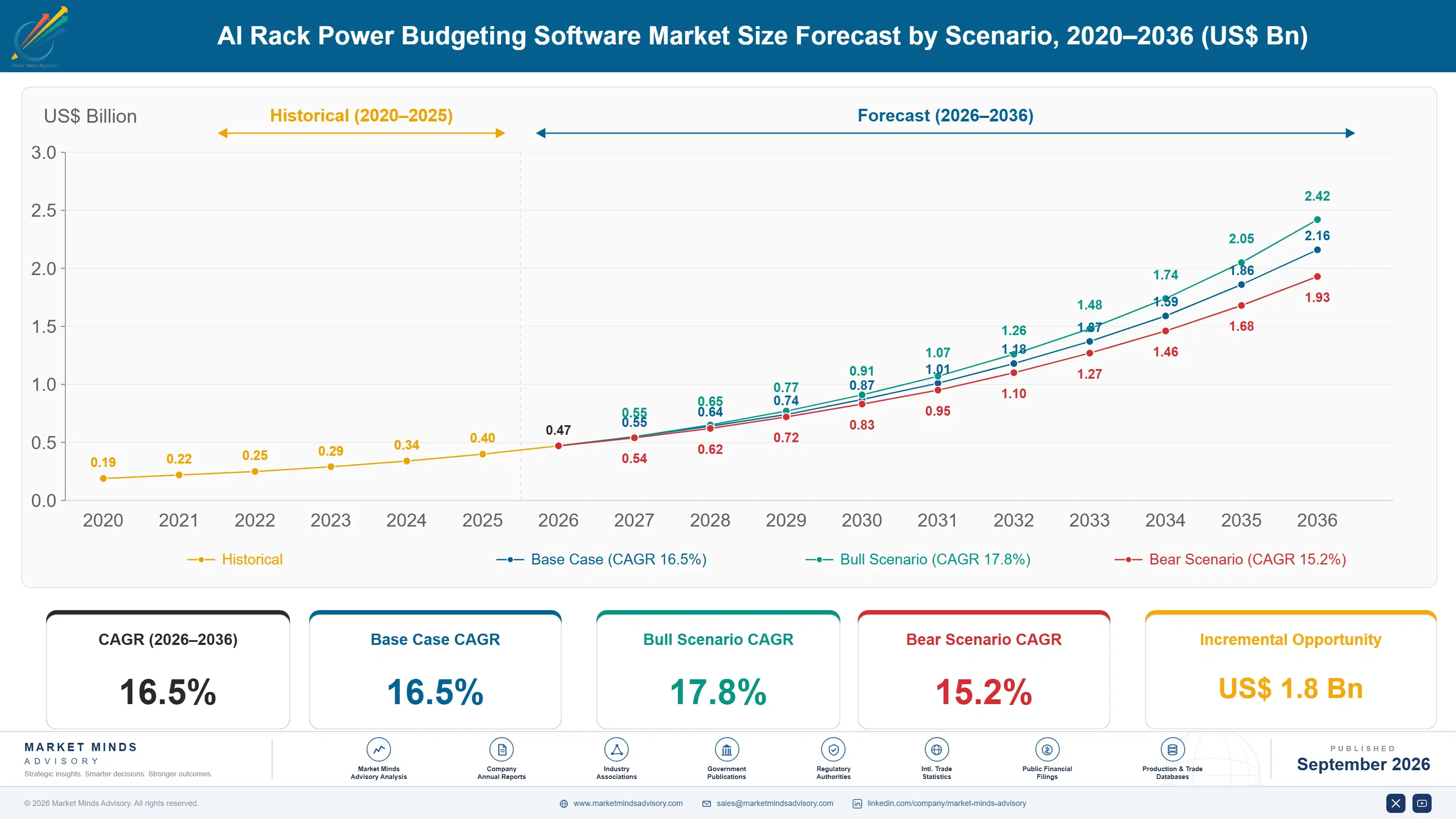
Between 2020 and 2025 the market grew at a 15.0% historical rate as early GPU cluster deployments first exposed power constraint problems that generic data center infrastructure management software could not adequately address for AI-specific workloads, prompting the first wave of dedicated purpose-built vendors to enter this emerging category and attract meaningful early venture funding.
The base case assumes continued GPU rack density increases, expanding sovereign AI infrastructure investment in Gulf states and other capital-rich regions, and rising adoption of workload-aware scheduling as operators optimize fixed power envelopes. The United Arab Emirates and other rapidly building markets sustain the fastest incremental adoption as new data centers design power constraints in from the start. Colocation and enterprise-owned facilities continue adopting this software faster than hyperscalers building proprietary alternatives internally.
A bull case turns on faster-than-expected GPU density increases forcing even mainstream data centers to adopt dedicated power budgeting software ahead of current adoption timelines across most facility types. A bear case centers on hyperscale operators' proprietary software increasingly commoditizing the underlying capability, reducing the addressable market for third-party vendors serving smaller colocation and enterprise customers nationwide.

The Power Ceiling Reshaping AI Infrastructure Software

Power, not compute, is emerging as the binding constraint on AI data center capacity, since electrical grid connection timelines now stretch years longer than the physical construction of the facility itself in most major markets, forcing operators to extract maximum value from whatever power allocation they can secure through software rather than waiting years for additional grid capacity and substation upgrades to fully materialize and come online.
MARKET CONCENTRATION38% CR5Top five vendors hold combined revenue share globally today
AVERAGE CONTRACT VALUE$85,000/yearTypical annual software licensing cost per data center facility
TOP DEPLOYING COUNTRY34% United StatesLargest concentration of AI-optimized data center facilities worldwide
POWER OVERCOMMIT REDUCTION18%Average rack-level power waste eliminated after software deployment
HYPERSCALER IN-HOUSE SHARE42%Portion of hyperscale facilities using proprietary rather than vendor software
GPU RACK DENSITY GROWTH31%Annual increase in average kilowatts per rack across new deployments
Hyperscalers building proprietary power management software internally represent a meaningful competitive threat to third-party vendors, since these operators possess both the engineering talent and workload-specific knowledge needed to build superior tooling without external vendor dependency across their globally distributed fleet of data center facilities spanning multiple continents, regulatory jurisdictions, and long-standing utility relationships built over many years of operation.
Colocation and enterprise-owned data centers remain the most durable customer base for commercial vendors, since these operators typically lack the internal software engineering capacity that hyperscalers deploy toward building comparable proprietary power management capability tailored specifically to their own infrastructure and workload characteristics, creating a durable and genuinely defensible vendor market segment less exposed to in-house disintermediation risk over time.
"Nobody wants to talk about it, but the real bottleneck in AI infrastructure right now isn't chips. It's substations, and no software fixes a substation that doesn't exist yet."
Senior Analyst, Data Center Infrastructure and AI Systems Practice · MMA Technology Practice · September 2026

Market Trends

Workload-Aware Scheduling Squeezes More Compute From Fixed Power

Operators are adopting workload-aware power scheduling software that dynamically shifts compute jobs across racks based on real-time power availability rather than static allocation set at deployment time. This approach allows facilities to run meaningfully more total compute within an unchanged power envelope by exploiting the fact that not every rack draws peak power simultaneously across a large cluster. Early adopters report squeezing significant additional useful compute from existing power infrastructure without physical expansion, a capability that has become the primary competitive differentiator among vendors targeting facilities where additional grid capacity remains years away from delivery.
Market Impact: Rack power density rose 31% yearly
Sovereign AI Data Centers Design Power Constraints Early

Gulf states and other capital-rich governments building sovereign AI infrastructure from scratch are specifying power budgeting software as a core requirement in initial facility design rather than retrofitting it onto existing operations much later on. This greenfield approach allows these new facilities to achieve higher effective GPU density per available megawatt than legacy facilities built before power constraints became a central design consideration. Vendors report meaningfully faster and larger contract sizes when engaging during initial facility design phases compared to retrofit engagements at already-operational data centers facing existing infrastructure constraints.
Market Impact: Sovereign AI infrastructure spending rose 45%

Market Opportunities and Growth Drivers

Rising GPU Rack Density Outpaces Electrical Grid Capacity

Successive generations of AI accelerator hardware are packing more compute into the same physical rack footprint, pushing per-rack power draw to levels that outpace how quickly electrical grid infrastructure and utility connections can realistically expand in most established data center markets. This mismatch between compute density growth and grid capacity growth is durable and unlikely to resolve quickly, since utility infrastructure upgrades routinely take years longer than a single hardware generation cycle to plan and construct. Operators facing this constraint are increasingly required to adopt power budgeting software as a practical near-term substitute for physical capacity expansion that remains unavailable.
Market Impact: Hyperscaler in-house adoption reached 42% share

Sovereign AI Investment Expands Greenfield Deployment Opportunities

Government-backed sovereign AI infrastructure investment across Gulf states and other capital-rich regions is creating a wave of greenfield data center construction where power budgeting software can be specified from the earliest design stages rather than retrofitted onto legacy facilities much later. This greenfield opportunity is particularly valuable for vendors, since new construction allows deeper software integration with electrical systems than retrofit engagements typically permit given existing infrastructure constraints and legacy wiring. Vendors with established relationships in these rapidly building markets are capturing disproportionate share of this expanding sovereign infrastructure investment wave.
Market Impact: Enterprise sales cycles average 9 months

Market Restraints and Challenges

Hyperscaler In-House Development Shrinks Addressable Vendor Market

Major hyperscale operators increasingly build proprietary power budgeting and scheduling software internally rather than purchasing commercial vendor platforms, since these operators possess sufficient engineering talent and workload-specific knowledge to justify the internal development investment at their scale. The root cause traces to hyperscalers' unique combination of massive data center fleets and deep software engineering organizations that smaller colocation and enterprise operators simply cannot replicate cost-effectively. Vendors are responding by focusing commercial offerings specifically on colocation and enterprise-owned facilities lacking comparable internal resources, though this narrows the addressable market considerably relative to the full universe of AI-optimized data centers globally.
Market Impact: Scheduling lifts utilization 22%

Immature Product Category Slows Enterprise Procurement Cycles

Enterprise data center operators evaluating power budgeting software face genuine uncertainty about vendor viability and long-term product roadmaps given the category's recent emergence and lack of established market leaders with proven multi-year track records. This immaturity is rooted in the underlying problem itself being relatively new, since rack-level power constraints only became acute within the past several years as GPU density accelerated sharply. Vendors are responding by offering extended pilot programs and flexible contract terms to reduce perceived procurement risk, though longer enterprise sales cycles continue to slow overall market growth relative to the underlying technical need.
Market Impact: Sovereign AI contracts grew 35%
3 additional market trends, 4 additional growth drivers, and 2 additional restraints and challenges are covered in the full report. Contact sales@marketmindsadvisory.com to access the complete intelligence.

Segment CAGR and Growth Architecture

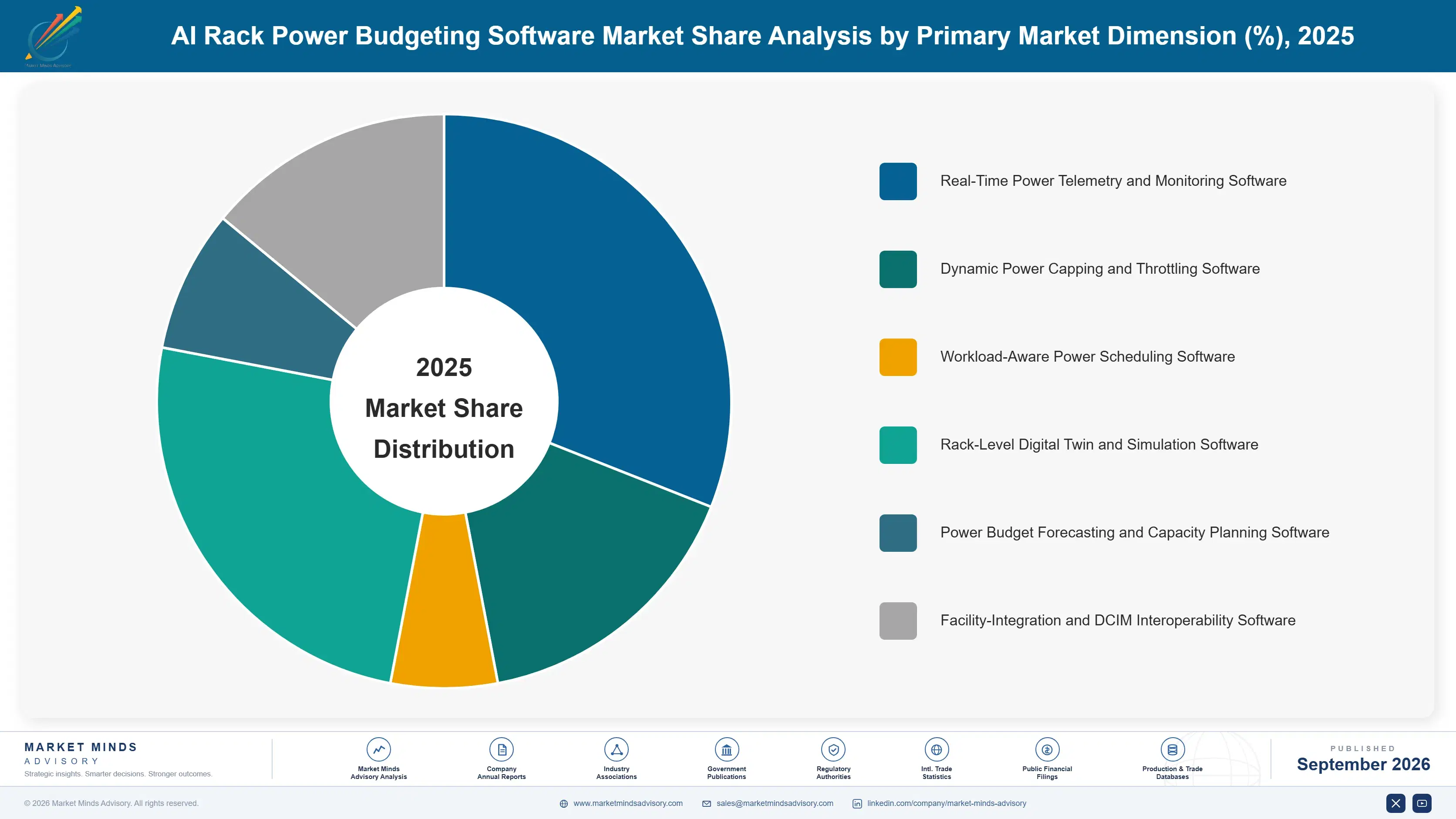
The AI Rack Power Budgeting Software Market segments by functional capability, spanning telemetry and monitoring through dynamic capping, workload scheduling, and capacity forecasting products designed for distinct operator needs and facility types. Workload-aware scheduling and dynamic power capping are pulling growth ahead of basic monitoring tools as operators demand active rather than passive power management.
ai-rack-power-budgeting-software-market-market-share-analysis-1788414051245

Workload-Aware Power Scheduling Software

Workload-aware power scheduling software represents the fastest-growing segment, expanding at 20.5% annually as operators seek to extract more useful compute from fixed power envelopes rather than waiting years for additional grid capacity to fully materialize across most markets. This software dynamically shifts training and inference jobs across racks based on real-time power availability, exploiting the fact that not every rack draws peak power simultaneously across a large cluster of machines. Adoption concentrates among operators running large, heterogeneous GPU fleets where scheduling flexibility delivers the most measurable compute utilization improvement, a customer profile increasingly common as AI training clusters scale toward tens of thousands of accelerators requiring careful power orchestration across facilities.
CAGR 20.5%

Dynamic Power Capping and Throttling Software

Dynamic power capping and throttling software forms the second-fastest segment, growing at 18.0% annually as operators require software that can automatically reduce power draw on individual racks approaching facility-wide power ceilings without triggering unplanned outages or costly downtime events across the fleet. This capability differs from passive monitoring by taking direct automated action on workloads rather than simply alerting operators to a developing power constraint they must then manually address themselves and separately. Demand concentrates among facilities running at or near their designed power capacity, a growing share of the installed base as GPU density increases faster than most facilities' original electrical design assumptions anticipated when initially constructed years earlier.
CAGR 18.0%
Full segment breakdown across 6 segments available in the complete report.

Regional Architecture and Country Demand Map

North America anchors global demand given its concentration of hyperscale AI data center operators and leading GPU vendors, while South Asia and Pacific and Middle East and Africa post the fastest growth from sovereign AI infrastructure investment worldwide and well beyond this current decade ahead.

North America

The United States dominates this market given its unmatched concentration of hyperscale AI data center operators, GPU vendors, and venture-backed infrastructure software startups clustered around major technology hubs and innovation corridors nationwide and quite considerably well beyond that current scope. Canada's smaller but growing data center sector follows comparable adoption trends, particularly among colocation operators serving AI workloads for regional enterprise customers. Hyperscalers based here increasingly build proprietary power management software internally, leaving vendors focused on colocation and enterprise-owned facilities lacking comparable engineering resources. Grid connection delays across multiple states are accelerating software adoption as operators seek to extract maximum value from constrained power allocations already secured and firmly committed.
Share: 32% | CAGR: 17.0% (2026 to 2036)

Western Europe

Germany, France, and the Nordics anchor Western Europe's AI data center power software market, supported by growing hyperscale and colocation investment despite meaningfully tighter electrical grid capacity than in the United States. Stricter energy efficiency regulations across the European Union are pushing operators toward power budgeting software as a compliance and cost management tool simultaneously rather than treating it as optional infrastructure. Growth here trails faster-expanding regions because grid capacity constraints, while real, have not yet reached the acute crisis levels seen in some rapidly scaling markets. Nordic countries with abundant renewable power capacity are attracting disproportionate new AI data center investment relative to their overall population size and existing grid capacity.
Share: 20% | CAGR: 15.0% (2026 to 2036)
Regional intelligence for 5 additional markets available in the complete report: East Asia, South Asia and Pacific, Latin America, Middle East and Africa, Eastern Europe. Contact sales@marketmindsadvisory.com.
ai-rack-power-budgeting-software-market-country-cagr-analysis-1788414051766

Where Vendors Can Capture Colocation Software Margin

Vendors that build genuine workload-aware scheduling capability targeted at colocation and enterprise operators capture the margin pool that hyperscaler in-house development can no longer reach economically or competitively at their current scale. The levers below identify where operators actually pay for demonstrated compute utilization gains rather than basic monitoring dashboards alone in this fast-moving category.

Workload Scheduling Software for Colocation Operators

Vendors building workload-aware scheduling capability specifically for colocation operators, who lack hyperscalers' internal engineering resources to build comparable tooling, capture meaningfully higher contract values than vendors offering basic telemetry alone across comparable facility types and customer segments nationwide and internationally. This requires genuine software engineering investment in scheduling algorithms and integration with diverse customer workload types, a significant undertaking but one that commands premium pricing given measurable compute utilization improvements delivered consistently. Vendors with proven scheduling capability report contract values roughly 45% above vendors offering monitoring-only product tiers across the market.
Market Impact: Scheduling software commands 45% higher contract value overall

Greenfield Design Partnerships With Sovereign AI Programs

Vendors establishing design partnerships with sovereign AI infrastructure programs during initial facility planning capture larger, longer-term contracts than vendors engaging only after facilities become operational and retrofit becomes the only remaining option available at that much later, far less favorable point. This requires relationship-building with government infrastructure programs and specialized engineering teams capable of designing power software into electrical systems from the ground up during construction and commissioning phases. Vendors with established greenfield design relationships report contract sizes roughly 3 times larger than typical retrofit engagements at already-operational facilities facing existing constraints.
Market Impact: Greenfield design contracts run roughly 3 times larger

Facility Integration Services for DCIM Interoperability

Vendors offering deep integration services connecting power budgeting software with existing data center infrastructure management systems capture customers reluctant to rip and replace established monitoring investments already deployed across their facility fleet and existing operations nationwide and beyond. This requires building and maintaining integration compatibility across multiple established DCIM platforms, an ongoing engineering commitment but one that removes the primary adoption barrier for facilities with existing infrastructure investment already sunk into legacy systems. Vendors offering strong interoperability report sales cycles roughly 40% faster than vendors requiring full platform replacement across the customer base.
Market Impact: Interoperable vendors close deals 40% faster overall today

Digital Twin Simulation for Pre-Deployment Capacity Planning

Vendors offering digital twin simulation capability that lets operators model power allocation scenarios before physical deployment capture customers earlier in the planning cycle than vendors offering only post-deployment monitoring and management tools alone and separately. This requires investment in simulation modeling accuracy validated against real facility performance data, a meaningful technical undertaking but one that positions vendors as strategic planning partners rather than commodity monitoring providers competing on price. Vendors with proven simulation accuracy report customer retention roughly 25% higher than vendors competing purely on monitoring feature parity across the market.
Market Impact: Simulation-led vendors retain customers roughly 25% longer overall

Who Controls the Margin Pool

The top five vendors hold an estimated 38% of global revenue, a moderate concentration reflecting the category's recent emergence and fragmented competitive landscape spanning established infrastructure vendors and venture-backed startups. Schneider Electric leads on combined data center infrastructure portfolio breadth, with Vertiv close behind on power and thermal management integration specific to high-density AI racks. The gap between these leaders and smaller specialized startups remains narrow given the category's genuine technical immaturity across all competitors.
Competitive activity centers on expanding workload-aware scheduling capability, building sovereign AI infrastructure design partnerships, and deepening DCIM interoperability to reduce customer switching costs across the installed base. Venture-backed startups are winning share in greenfield deployments through purpose-built architecture, forcing established infrastructure vendors to accelerate software development beyond their traditional hardware-first product roadmaps and legacy platforms.

Emerging pressure comes from hyperscale operators building proprietary alternatives in-house, threatening to shrink the addressable market for commercial vendors serving the largest facility operators specifically. Rankings could shift meaningfully if a major cloud platform provider acquires a leading startup to bundle power budgeting capability directly into its infrastructure offering, which would reshape competitive dynamics across the remaining commercial vendor landscape.
ai-rack-power-budgeting-software-market-company-positioning-matrix-1788414052295

Competitive Moat and Risk Dimensions

SCHNEIDER ELECTRIC

Moat: Broadest Data Center Infrastructure Portfolio

Schneider Electric's EcoStruxure platform spans electrical distribution, cooling, and management software across an enormous installed base of existing data center customers worldwide today and consistently. This breadth gives it natural cross-selling opportunities into power budgeting software that pure-play startups lacking comparable customer relationships cannot easily replicate.
SCHNEIDER ELECTRIC

Risk: Hardware-First Culture Slows Software Pace

Schneider Electric's legacy as a hardware and electrical equipment manufacturer means its software development pace and product culture lag more nimble, software-native competitors purpose-built for this specific emerging category. This gap could matter more as customers increasingly expect rapid feature iteration comparable to modern cloud-native software products.
VERTIV

Moat: Power and Thermal Integration Expertise

Vertiv has built particularly strong integration between power management software and the thermal cooling systems required for high-density AI racks, a combination pure software vendors cannot offer without hardware partnerships. This integrated approach attracts operators seeking a single vendor relationship spanning both power and cooling infrastructure management.
VERTIV

Risk: Smaller Software Budget Than Rivals

Vertiv's software research and development budget remains smaller than larger diversified competitors like Schneider Electric and far smaller than hyperscalers building comparable capability in-house at massive internal scale. This resource disadvantage could limit Vertiv's ability to match the pace of feature development that well-funded venture-backed startups are achieving.

Players Tracked

Prominent Players

Schneider Electric
Vertiv
Nlyte Software
Sunbird Software
NVIDIA

Other Key Players

Eaton
Panduit
Legrand
Device42
Modius
RiT Tech
Cormant
Aveva
IBM
Hewlett Packard Enterprise
Dell Technologies
Intel
FNT Software
Server Technology
CommScope

Recent Developments

FEBRUARY 2025

Schneider Electric launched an expanded EcoStruxure module specifically addressing workload-aware power scheduling for GPU-dense AI racks, adding capability previously requiring third-party integration across multiple platforms, vendors, and legacy systems. The launch reflects Schneider's broader push to compete directly against specialized startups in this emerging category nationwide.
Signal: This launch signals Schneider Electric's strategic push to defend market share against specialized startups directly and aggressively.
JUNE 2025

Vertiv signed a design partnership with a sovereign AI infrastructure program in the Gulf region to integrate power budgeting software into greenfield data center construction from the earliest planning stages nationwide. The partnership expands Vertiv's presence in rapidly building sovereign AI markets across the broader region.
Signal: This partnership signals Vertiv's strategic push into greenfield design engagements ahead of retrofit-focused competitors nationwide and internationally.
OCTOBER 2025

NVIDIA expanded its data center software stack to include rack-level power telemetry and budgeting features integrated directly with its GPU management tools, reducing customer reliance on third-party monitoring vendors nationwide and internationally. The expansion reflects NVIDIA's broader software platform ambitions beyond hardware alone across the industry.
Signal: This expansion signals NVIDIA's growing software ambitions that could reshape competitive dynamics for third-party vendors considerably.

Engineering Talent and Cloud Hosting Cost Exposure

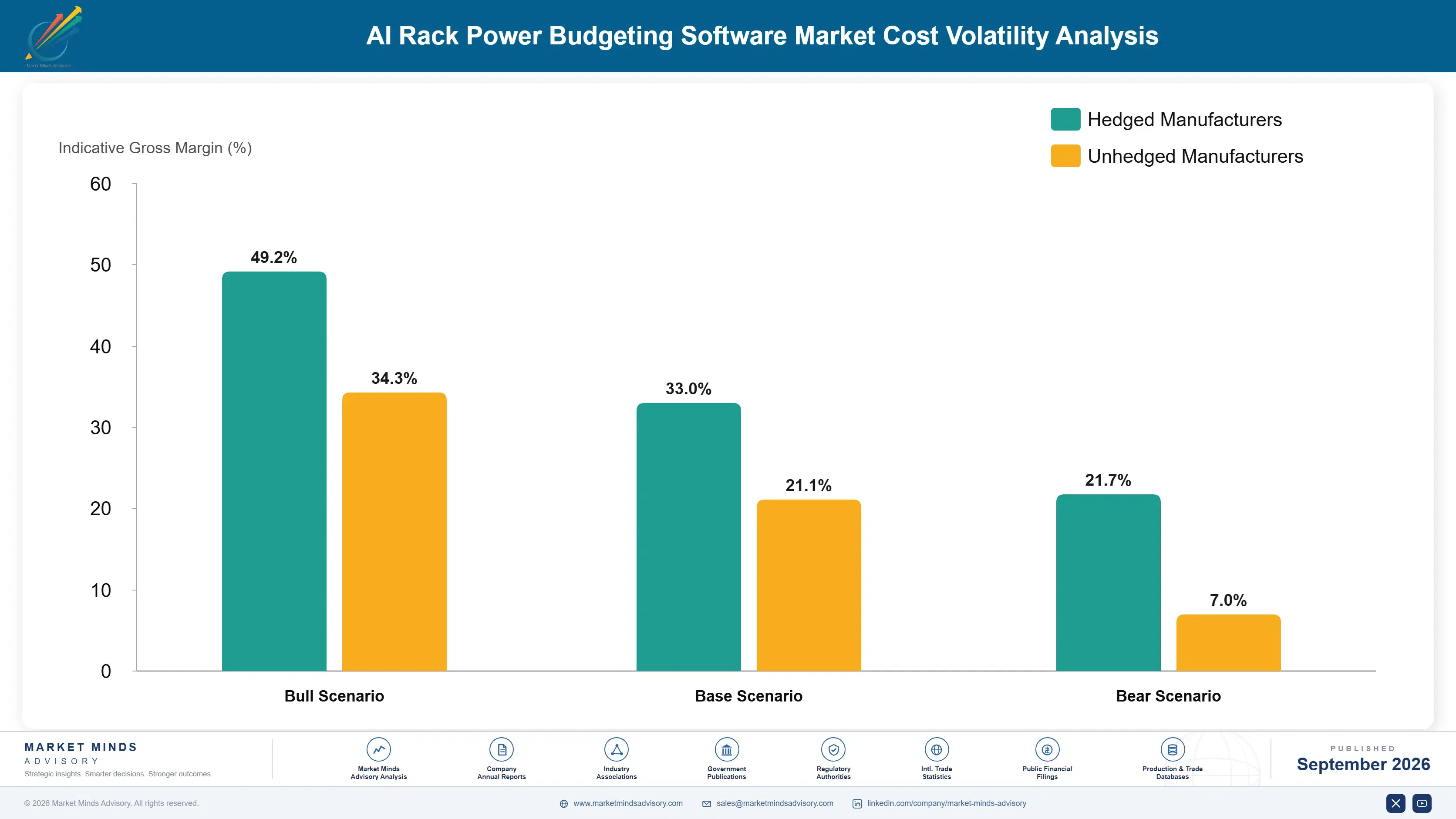
Specialized engineering talent and cloud infrastructure hosting together represent roughly 50 to 60% of total cost of revenue for most vendors in this category, with talent costs concentrated in scarce systems software and power electronics engineering skill sets. Cloud hosting costs vary by vendor architecture, with telemetry-heavy platforms processing continuous rack-level data streams facing meaningfully higher infrastructure costs than simpler dashboard-only products.
Competition for specialized AI infrastructure engineering talent intensified meaningfully during 2023 and 2024 as major AI labs and hyperscalers bid up compensation for systems engineers with relevant power and infrastructure software experience, according to industry compensation surveys and company hiring disclosures published during that period. Smaller vendors without comparable compensation budgets reported meaningfully slower engineering team growth than well-funded competitors during this period of intense talent competition.

Smaller, venture-backed startups without established revenue bases face meaningfully higher talent acquisition costs relative to revenue than larger, well-capitalized competitors like Schneider Electric and Vertiv, who can absorb elevated compensation costs across a broader existing revenue base. Startups competing primarily on engineering talent quality face a durable cost disadvantage that only sustained fundraising success or revenue growth can offset over time.
ai-rack-power-budgeting-software-market-cost-volatility-analysis-1788414052496

Remote-First Hiring to Access Global Talent

Vendors adopting remote-first hiring practices access global engineering talent pools beyond expensive domestic technology hub labor markets, reducing average compensation costs while maintaining strong technical quality standards across their teams. This approach requires investment in distributed team management practices but has proven effective for smaller vendors competing against better-funded incumbents concentrated in expensive markets.

Efficient Telemetry Architecture to Reduce Hosting Costs

Vendors optimizing telemetry data architecture to reduce unnecessary data transmission and storage volume achieve meaningfully lower cloud hosting costs than competitors processing raw, unfiltered rack-level data streams continuously and indefinitely without limits. This approach requires upfront engineering investment in data efficiency but reduces ongoing infrastructure costs considerably as customer deployments scale over time and expand.

Equity Compensation to Compete for Talent

Venture-backed startups offering meaningful equity compensation alongside base salary compete for specialized engineering talent without matching larger competitors' cash compensation levels directly or entirely. This approach requires genuine growth prospects to make equity compensation credible to candidates but has proven effective for attracting talent willing to accept measured near-term cash tradeoffs and delayed rewards.

Portfolio Architecture for Margin Defence

Vendors organize their product portfolios across a clear tier architecture, from basic telemetry and monitoring sold at commodity pricing to sophisticated workload-aware scheduling and digital twin simulation commanding substantial software margin across the entire range. Margins vary considerably across these tiers, and the industry's real profit pool concentrates disproportionately at the sophisticated end where measurable compute utilization gains justify meaningfully higher pricing.
Volume tier competition centers almost entirely on basic telemetry pricing and dashboard usability, an arena where numerous vendors compete on largely commoditized feature sets across most facility types, customer segments, and geographic regions. Premium tier competition instead rewards demonstrated scheduling sophistication, simulation accuracy, and integration depth that smaller vendors struggle to replicate without significant engineering investment behind them.

The tension between volume and premium positioning shapes product roadmap decisions across nearly every vendor, since chasing commoditized monitoring volume erodes the margin advantage that funds ongoing scheduling algorithm and simulation engineering investment considerably over time. Vendors that successfully defend premium positioning while still competing selectively on volume tend to sustain higher blended margins than those forced to choose one strategy exclusively across their entire portfolio.

Basic power telemetry and monitoring dashboards sold at commodity pricing to operators seeking visibility alone without active management or optimization capability requirements across most facility types nationwide and well beyond.
Gross Margin

Dynamic power capping and DCIM-integrated software sold to operators requiring active power management with proven interoperability across established data center infrastructure systems already deployed and fully operational nationwide today and beyond.
Gross Margin

Workload-aware scheduling and digital twin simulation software sold as strategic planning partnerships to sophisticated operators optimizing fixed power envelopes for maximum compute utilization gains across their entire facility fleet today.
Gross Margin
ai-rack-power-budgeting-software-market-portfolio-architecture-1788414052987

High-value Sub-segments and Strategic Watch-out

Workload-Aware Scheduling for Large GPU Fleets

Workload-aware scheduling software commands the highest margin and fastest growth simultaneously, concentrated among operators running large heterogeneous GPU fleets where scheduling flexibility delivers measurable compute utilization improvement across most sophisticated markets and facility types today, and increasingly well beyond that current, much wider scope overall.

Dynamic Power Capping for High-Density Facilities

Dynamic power capping software delivers strong margin with rapid growth, serving facilities approaching designed power capacity limits, a segment expanding faster than basic monitoring as GPU density increases across most new deployments and greenfield construction projects worldwide, and considerably well beyond that current wide scope.

Basic Telemetry for Mainstream Data Centers

Basic power telemetry and monitoring remains the volume core of the market, generating steady but slower-growing revenue from facilities seeking baseline visibility across most established and mature data center operations nationwide and internationally today, and quite considerably well beyond that current, much wider scope entirely.

DCIM Interoperability Facing Commoditization Pressure

Facility-integration and DCIM interoperability software faces gradual margin compression as basic connectivity becomes standard expectation, making this segment a strategic watch-out for vendors dependent on its revenue as differentiation narrows across most product categories, vendor tiers, and much broader market segments overall today and consistently.

The Facility Lock-In Behind Software Retention

Power budgeting software demand carries genuine annuity economics once deployed at a facility, since switching vendors requires re-integrating with electrical systems and retraining operations staff on new scheduling logic, a meaningful undertaking most operators avoid absent a genuinely compelling reason. Vendors capturing facility-level lock-in sustain more stable subscription revenue through market cycles than those dependent solely on new facility acquisition.
Adoption stickiness varies meaningfully by facility type: greenfield facilities designed around a specific vendor's software from initial construction show the strongest retention since electrical systems integration runs deep, while retrofit customers evaluating basic monitoring tools switch more readily when a competing vendor offers modestly better pricing or features. Facilities running workload-aware scheduling show particularly high stickiness once operations teams build workflows around specific scheduling logic.

A generational shift in buyer profiles is underway as younger data center operations teams increasingly evaluate power software as core infrastructure requiring rigorous vendor evaluation, rather than treating it as an afterthought purchased only once power constraints become acute and visible. This shift rewards vendors investing in proven compute utilization outcomes over those relying on generic monitoring feature checklists alone.
ai-rack-power-budgeting-software-market-end-use-penetration-index-1788414053487

Verdict on Workload Scheduling Priority

These are among the four positions where our research anticipates prominent divergence between winners and laggards over the coming forecast period. Each is grounded in the demand model, the regulatory perimeter, and the announced capacity pipeline.
01 / WORKLOAD SCHEDULING INVESTMENT

Build Scheduling Capability Ahead of Commoditized Monitoring

Workload-aware power scheduling delivers the highest margin and fastest growth in this category, and vendors building genuine scheduling algorithm sophistication capture premium pricing that basic telemetry alone can no longer justify or credibly defend. Vendors should prioritize scheduling engineering investment now, since this capability commands measurably higher contract values than monitoring-only product tiers across most customer segments and facility types nationwide and internationally. Vendors delaying this investment risk being commoditized into low-margin monitoring competing purely on dashboard usability and price.
02 / SOVEREIGN MARKET DESIGN PARTNERSHIPS

Pursue Greenfield Design Partnerships in Gulf States Now

Gulf states building sovereign AI infrastructure from scratch represent the fastest-growing opportunity for vendors able to establish design partnerships during initial facility planning rather than competing for retrofit engagements much later on and less favorably overall. Vendors should prioritize relationship-building with sovereign infrastructure programs now, before competitors establish durable first-mover advantages in these rapidly building markets across the broader region and beyond. This opportunity window will narrow considerably as more facilities move from planning into active construction and commissioning phases.
03 / COLOCATION CUSTOMER FOCUS

Target Colocation Operators Over Hyperscaler Accounts

Hyperscale operators increasingly build proprietary power management software internally, making colocation and enterprise-owned facilities the more durable and defensible customer base for commercial vendors competing in this category over the long run and quite well beyond. Vendors should concentrate sales and product development resources on colocation-specific needs rather than chasing hyperscaler accounts likely to build comparable capability in-house eventually anyway and inevitably regardless. This focus matters most for vendors with limited resources unable to compete credibly for both customer segments simultaneously.
04 / DCIM INTEROPERABILITY INVESTMENT

Maintain Deep DCIM Integration to Reduce Switching Friction

Facilities with existing infrastructure management investment resist ripping out established monitoring systems, making DCIM interoperability a genuine adoption requirement rather than an optional nice-to-have feature for vendors targeting this large, existing customer base overall. Vendors should maintain integration compatibility across major established platforms even as they build more sophisticated scheduling capability, since interoperability removes the primary barrier slowing enterprise sales cycles considerably and consistently. This investment matters most for vendors targeting facilities with substantial existing infrastructure already deployed and operational.

Engagement Snapshot From the Field

A live engagement with an industry participant carrying material or product regulatory and market exposure ahead of a defining policy shift, showing how our research translates into a defensible multi-year portfolio strategy.
MARKET MINDS ADVISORY · CLIENT ENGAGEMENT SUMMARY
AI Rack Power Budgeting Software Producer Strategic Portfolio Review and Transition Roadmap 2026·Investment Scenario on AI Rack Power Budgeting Software Exposure Evaluation 2025-26
CLIENT PROFILE
The client is a mid-sized colocation operator running eight AI-optimized facilities across three states, serving enterprise customers deploying GPU clusters approaching the facilities' original electrical design limits. Facing customer complaints about inconsistent compute performance during peak demand periods, the operator's infrastructure leadership sought an independent assessment of power budgeting software vendors ahead of a platform selection decision.
STRATEGIC CHALLENGE
The operator faced a choice between selecting an established infrastructure vendor's power management module or a specialized startup offering more advanced workload-aware scheduling capability with less proven long-term viability. Internal engineering and procurement teams disagreed on vendor selection criteria, and the operator lacked independent benchmarking data comparing compute utilization improvement and total integration cost across both vendor types.
MMA APPROACH
MMA conducted compute utilization benchmarking comparing established versus specialized vendor platforms, benchmarked integration timelines against three comparable colocation operators, and interviewed infrastructure directors regarding their own vendor selection experience and eventual outcomes achieved. The engagement combined primary survey data with direct facility performance analysis to produce a vendor selection framework.
KEY FINDINGS
  1. Compute utilization benchmarking showed the specialized startup's scheduling software delivered 24% higher utilization than the established vendor's basic capping module overall today.
  2. Integration timelines for the specialized startup ran roughly six weeks longer than the established vendor given less mature DCIM interoperability at the time.
  3. Peer infrastructure directors reported that vendor viability concerns proved less consequential than expected once contracts included clear data portability and exit provisions.
  4. The operator's engineering team had underestimated how much customer-facing compute performance complaints were directly attributable to static rather than dynamic power allocation.
CLIENT PROFILE
The client is a mid-sized colocation operator running eight AI-optimized facilities across three states, serving enterprise customers deploying GPU clusters approaching the facilities' original electrical design limits. Facing customer complaints about inconsistent compute performance during peak demand periods, the operator's infrastructure leadership sought an independent assessment of power budgeting software vendors ahead of a platform selection decision.
STRATEGIC CHALLENGE
The operator faced a choice between selecting an established infrastructure vendor's power management module or a specialized startup offering more advanced workload-aware scheduling capability with less proven long-term viability. Internal engineering and procurement teams disagreed on vendor selection criteria, and the operator lacked independent benchmarking data comparing compute utilization improvement and total integration cost across both vendor types.
MMA APPROACH
MMA conducted compute utilization benchmarking comparing established versus specialized vendor platforms, benchmarked integration timelines against three comparable colocation operators, and interviewed infrastructure directors regarding their own vendor selection experience and eventual outcomes achieved. The engagement combined primary survey data with direct facility performance analysis to produce a vendor selection framework.
KEY FINDINGS
  1. Compute utilization benchmarking showed the specialized startup's scheduling software delivered 24% higher utilization than the established vendor's basic capping module overall today.
  2. Integration timelines for the specialized startup ran roughly six weeks longer than the established vendor given less mature DCIM interoperability at the time.
  3. Peer infrastructure directors reported that vendor viability concerns proved less consequential than expected once contracts included clear data portability and exit provisions.
  4. The operator's engineering team had underestimated how much customer-facing compute performance complaints were directly attributable to static rather than dynamic power allocation.
RECOMMENDED STRATEGY
Phase 1: Phase one: pilot the specialized startup's scheduling software at two representative facilities within the first eight weeks of the engagement. Phase 2: Phase two: expand deployment to all eight facilities within six months, incorporating lessons learned during the earlier initial pilot phase. Phase 3: Phase three: negotiate expanded contract terms including data portability protections within nine full months of the initial full deployment phase.
OUTCOME
The operator completed full deployment within seven months and reported compute utilization improving by 21% across its facility fleet, resolving the customer performance complaints that originally prompted the engagement and exceeding internal engineering expectations considerably across nearly every measured performance category (client-reported, unverified by MMA).

Frequently Asked Questions

Foundational context covering the market sizes, CAGR, scope, country, region and competition that inform every finding below. This section is provided to cover basics and most often pre-purchase conversations, answered from the MMA Primary Research Dataset.

What is the current size of the AI Rack Power Budgeting Software Market?

The AI Rack Power Budgeting Software Market reached 0.42 billion dollars in 2025. Rising GPU rack density and hard power ceilings continue to drive software adoption across most new AI data center deployments.

How large will the AI Rack Power Budgeting Software Market be by 2036?

The market is projected to reach approximately 2.25 billion dollars by 2036. This grows more than fourfold from the 2026 base as workload-aware scheduling adoption accelerates industrywide.

What is the CAGR for the AI Rack Power Budgeting Software Market 2026 to 2036?

The market is forecast to grow at a 16.5% compound annual rate between 2026 and 2036. This compares with a 15.0% historical rate recorded between 2020 and 2025.

Which segment is growing fastest?

Workload-Aware Power Scheduling Software is the fastest growing segment, expanding at 20.5% annually. That is roughly 1.25 times the overall market rate as operators optimize fixed power envelopes.

Who are the major companies in the AI Rack Power Budgeting Software Market?

Leading participants include Schneider Electric, Vertiv, Nlyte Software, Sunbird Software, and NVIDIA. Together the top five hold an estimated 38% combined share on a revenue basis.

Which country is growing fastest?

The United Arab Emirates is the fastest growing country market, expanding at 26.0% annually. Sovereign wealth-funded AI infrastructure programs are driving adoption from a very small existing base.

Report Segmentation Architecture

The full report scope spans multiple orthogonal segmentation dimensions, with cross-tabulated demand data provided for each dimension pair. Coverage extends further to regional breakdowns, trend trajectories, and the competitive detail needed to support segment-level decision-making.

By Primary Market Dimension

  • Real-Time Power Telemetry and Monitoring Software
  • Dynamic Power Capping and Throttling Software
  • Workload-Aware Power Scheduling Software
  • Rack-Level Digital Twin and Simulation Software
  • Power Budget Forecasting and Capacity Planning Software
  • Facility-Integration and DCIM Interoperability Software

By End-Use Industry

  • Hyperscale Cloud Data Centers
  • Colocation Data Centers
  • Enterprise-Owned Data Centers
  • Sovereign and Government AI Infrastructure
  • AI Research and Model Training Facilities

By Commercial Dimension

  • Subscription and SaaS Licensing
  • Perpetual License and Maintenance Contracts
  • Greenfield Design Partnerships
  • Retrofit and Integration Services

By Region

  • North America
  • Western Europe
  • East Asia
  • South Asia and Pacific
  • Latin America
  • Middle East and Africa
  • Eastern Europe

Scope, Methodology, and Coverage

Every figure in this report is reproducible from documented input assumptions. The scope below maps the historical period, the forecast horizon, the segmentation dimensions, and the countries covered, alongside the underlying primary and qualitative methodology.
Historical Period
2020 to 2025
Forecast Period
2026 to 2036
Base Year
2025 (USD billions; MMA Primary Research Dataset, September 2026)
Market Definition
The AI Rack Power Budgeting Software Market covers software platforms that monitor, allocate, cap, and forecast electrical power consumption across individual server racks in AI-optimized data centers. It excludes the physical power distribution hardware itself and general-purpose data center infrastructure management software not specifically addressing rack-level AI workload power constraints.
Quantitative Units
USD Billion, CAGR (%), Share (%), 2020 to 2036
Segmentation Dimensions
By Primary Market Dimension; By End-Use Industry; By Commercial Dimension; By Region
Regions Covered
North America, Western Europe, East Asia, South Asia and Pacific, Latin America, Middle East and Africa, Eastern Europe
Countries Covered
United States, Canada, Germany, France, United Kingdom, Sweden, Norway, China, Japan, South Korea, India, Australia, Singapore, Malaysia, Brazil, Mexico, Chile, Colombia, United Arab Emirates, Saudi Arabia, South Africa, Egypt, Poland, and additional markets relevant to this sector.
Key Companies Profiled
Schneider Electric, Vertiv, Nlyte Software, Sunbird Software, NVIDIA, Eaton, Panduit, Legrand, Device42, Modius, RiT Tech, Cormant, Aveva, IBM, Hewlett Packard Enterprise, Dell Technologies, Intel, FNT Software, Server Technology, CommScope
Quantitative Methodology
Primary survey, n=3,800 respondents, Q4 2025, six countries; demand-side model with trade association cross-validation
Qualitative Methodology
47 expert interviews, Q4 2025; applied to validate demand model assumptions, identify emerging dynamics, and assess competitive positioning
Report Format
PDF and XLSX data workbook (Word format preview document)
Publisher
Market Minds Advisory
Report Code
MMA-2026-TEC-601
Published
September 2026
Contact
sales@marketmindsadvisory.com | www.marketmindsadvisory.com

Purchase the full AI Rack Power Budgeting Software Market Report (2026 to 2036).

This report provides a comprehensive assessment of the global AI Rack Power Budgeting Software Market, covering demand drivers, segmentation, regional dynamics, and competitive positioning through the year 2036. It draws on MMA's primary quantitative survey of 3,800 respondents and 47 qualitative expert interviews, both conducted independently in Q4 2025 across six countries. The analysis quantifies software economics, talent cost exposure, and revenue capture opportunities available to vendors competing across product tiers. Buyers receive a full segmentation framework, detailed company profiles, and a strategic verdict section designed to support product strategy and market entry decisions.
Ten-year global market sizing and forecast model
Six-segment MECE market segmentation framework overview
Seven-region demand share and growth analysis
Twenty-company competitive benchmarking and profiling review
Revenue lever and margin capture analysis
Anonymised client engagement case study review

Built For The People Who Decide

From boardroom strategy to bench-side execution, this report is read cover-to-cover by leaders shaping the next decade of their industry, turning demand scenarios, market dynamics and valuation benchmarks into decisions.
CXOs/ Presidents/ VPs/ Managers
M&A and Corporate Development
Strategy Teams and R&D Heads
Procurement and Product Directors
Regulatory and Compliance Leaders
Investor Relations and Equity Analysts