Market Minds Advisory
AI-enabled Biometrics Market

AI-enabled Biometrics Market: AI-enabled Biometrics: Multimodal Verification and the Shift to Continuous Identity Assurance

The shift from single-modality scanners to AI-fused facial, voice, and behavioral verification is redrawing procurement for border control, banking, and enterprise access systems, as liveness detection standards tighten faster than legacy vendors can retrofit hardware.

Lead Analyst

Published

September 2026

Make Smarter Decisions with Customized Research Insights

Request a free sample report and evaluate market opportunities, growth trends, and competitive dynamics relevant to your business needs.

2025 MARKET VALUE$18.6BMarket Size 2025
2036 FORECAST VALUE$84.9BBase Case , 2026 to 2036
CAGR 2026 TO 203614.8 %Bull 16.1% / Bear 13.5%
INCREMENTAL OPPORTUNITY$63.5BNet 10- year value creation
EXPANSION MULTIPLE3.98x2036 value over 2026 base
Strategic Levers
M&A Pipeline
Regional Outlook
Country Rankings
Competitive Intelligence
Segmental Deep-dive
Call-Us : 91 93563 13602

Executive Snapshot and Market Trajectory.

Deepfake-grade spoofing attempts have forced buyers across banking, telecom, and border control to demand liveness-certified, multimodal verification instead of relying on single-sensor fingerprint or face matching, reshaping procurement criteria for identity systems almost overnight this year and pushing several large issuers to rewrite vendor qualification standards mid-contract.
Banks, airports, and telecom carriers are consolidating vendor shortlists around platforms that fuse facial, voice, and behavioral signals into one continuous confidence score rather than a single point-in-time match, and that shift is concentrating spend among vendors that can prove liveness accuracy under independent audit, with North America and East Asia absorbing the largest share of near-term enterprise contract value across financial services and government identity programmes.
Competitive intensity is rising sharply as legacy fingerprint specialists race to acquire liveness-detection startups rather than build the capability internally, while national identity programmes and biometric payment rollouts across South Asia are pushing smaller regional integrators into the very same regulatory qualification tiers that global incumbents have long occupied alone, considerably narrowing the technical gap between challenger firms and established suppliers faster than most analysts had expected only two years earlier.
Market Definition
The AI-enabled biometrics market covers hardware, embedded software, and cloud verification platforms that use machine learning to match or continuously authenticate facial, fingerprint, iris, voice, or behavioral traits. It excludes non-AI legacy scanners sold without adaptive matching algorithms and physical access-control hardware sold without an identity-verification function.
Base Year Value
$18.6B in 2025 (MMA Primary Research Dataset, September 2026)
Forecast Period
2026 to 2036, eleven discrete annual values
CAGR
14.8% base case. Bull 16.1%. Bear 13.5%.
Fastest Growth Segment
Multimodal Biometric Systems: 20.0% CAGR
Fastest Growth Country
India: 17.2% CAGR
Fastest Growth Region
South Asia and Pacific: 16.8% CAGR
Largest Region
East Asia: 29% of 2025 global value
Market Leaders
NEC Corporation, Idemia, Thales, Aware Inc., and Fingerprint Cards AB lead the market. Source: MMA Primary Research Dataset, July 2026.
Primary Survey
n=3,800 procurement and R&D decision-makers, Q4 2025, six countries
Methodology
Demand-side build-up, cross-validated against public data, 47 expert interviews

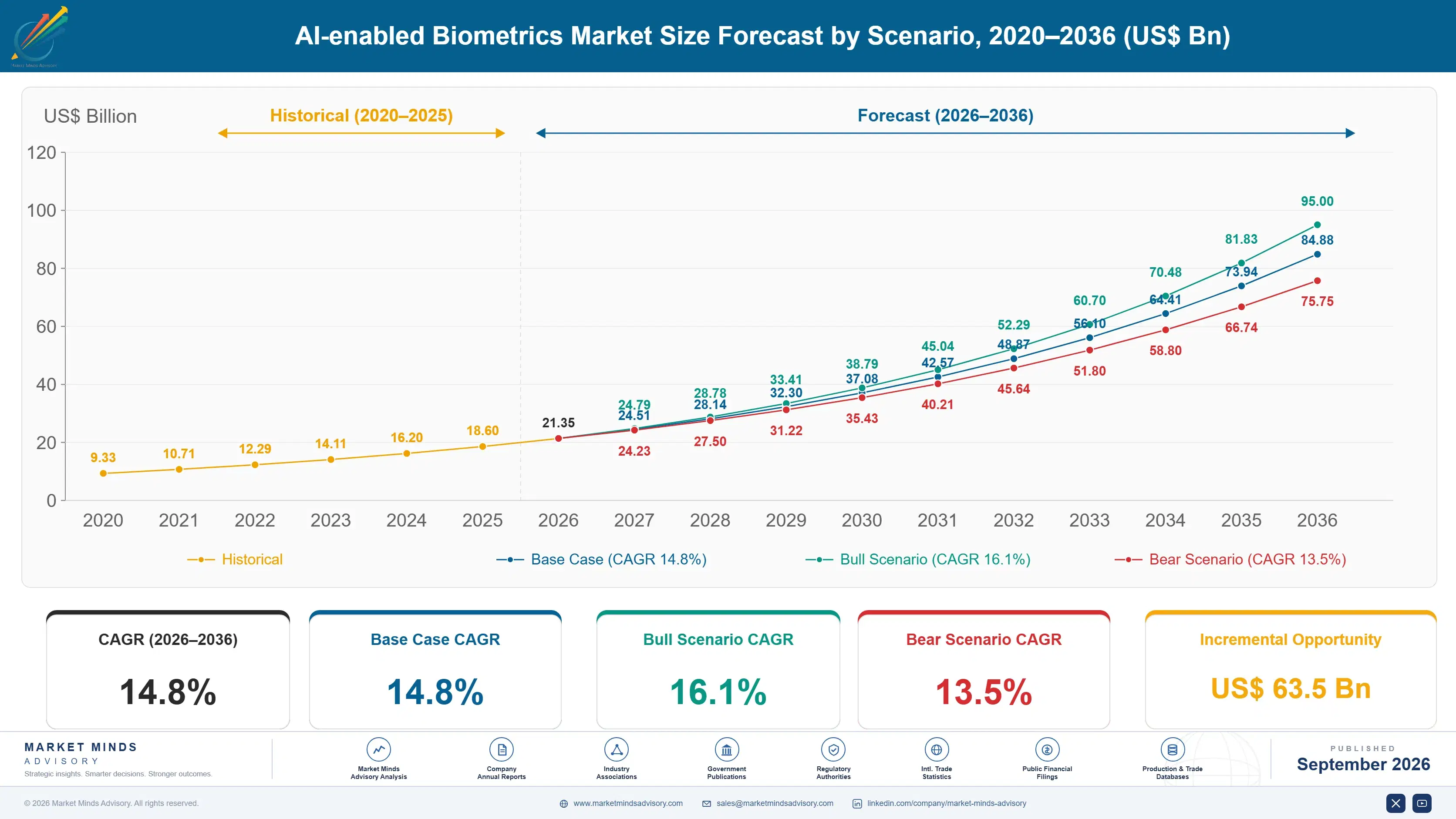
AI-enabled Biometrics Market Forecast Scenarios

ai-enabled-biometrics-market-size-forecast-scenario-1790009952436
Between 2020 and 2025 the market grew at an estimated 13.8 percent annual clip as smartphone facial authentication and national digital identity programmes normalized biometric authentication for hundreds of millions of consumers worldwide, though most deployments still relied on single-modality matching rather than the fused, continuous verification buyers now expect from new enterprise contracts across banking, telecom, and government identity procurement.
The base case assumes 14.8 percent annual growth through 2036, driven by three mechanisms: mandatory liveness-detection standards replacing static face and fingerprint checks across banking and border control, telecom carriers embedding continuous behavioral verification into subscriber onboarding to cut fraud losses, and national identity programmes across South and Southeast Asia moving from pilot to nationwide procurement. Enterprise access-control refresh cycles add a steadier, less headline-grabbing layer of recurring demand underneath.
The bull case turns on regulators mandating deepfake-resistant liveness certification across financial services within three years, pulling forward replacement cycles industry-wide well ahead of current vendor roadmaps. The bear case centers on privacy litigation and biometric data-collection bans spreading beyond the jurisdictions that already restrict facial recognition, which would slow public-sector procurement and dent near-term vendor revenue meaningfully.

Liveness Certification and the New Verification Stack

Buyer expectations across identity verification shifted once generative AI tools made it possible to fabricate a convincing synthetic face or voice in minutes, and vendors that could not certify liveness detection under independent audit began losing shortlisted status inside enterprise procurement cycles almost immediately, particularly across banking and government identity programmes that face the highest fraud exposure and the strictest new compliance mandates.
TOP-FIVE VENDOR CONCENTRATION38%Combined revenue share held by the leading global suppliers
AVERAGE SYSTEM ASP$2,150Blended hardware and software price per deployed verification unit
LEADING MANUFACTURING HUB SHARE34%Share of global sensor production concentrated in one country
AI MATCHING ACCURACY RATE99.7%Independently audited false match rate under standardized liveness testing
ENTERPRISE RENEWAL RATE91%Share of enterprise customers renewing multi-year verification platform contracts
CROSS-BORDER DEPLOYMENT SHARE46%Portion of contracts spanning multiple national jurisdictions and currencies
Commercial activity now clusters around platforms that combine facial, voice, and behavioral signals into a single ongoing confidence score rather than a one-time match at login, and system integrators that can bundle hardware, matching software, and compliance documentation into one contract are winning multi-year deals that pure hardware vendors increasingly cannot compete for alone, especially where procurement teams demand audited accuracy claims backed by third-party testing labs.
Over the next decade, the decisive forces will be regulatory certification regimes that formalize liveness-detection benchmarks, continued price declines in edge-AI matching chips that push biometric verification into lower-cost consumer devices, and growing scrutiny over how biometric templates are stored and shared across borders under increasingly divergent national privacy rules that vendors must now navigate market by market.
"The vendors losing ground here aren't the ones with worse algorithms. They're the ones who can't prove it to an auditor."
Director, Digital Identity and Trust Practice · MMA Technology Practice · September 2026

Market Trends

Deepfake-Resistant Liveness Detection Becomes a Procurement Requirement

Presentation-attack detection standards built around ISO/IEC 30107-3 have moved from optional certification to a hard procurement gate across banking and border control tenders within the past eighteen months. Buyers now require vendors to demonstrate resistance to injected synthetic video and 3D mask attacks under third-party laboratory testing before a contract is signed, not merely at renewal. That shift has forced smaller suppliers to either license certified liveness engines from larger vendors or exit competitive bids entirely, consolidating near-term deal flow toward suppliers that already hold current certification across multiple jurisdictions and device form factors.
Market Impact: Adds 340 million annual biometric enrollments
Multimodal Fusion Replacing Single-Sensor Verification Architectures

NIST Face Recognition Vendor Test benchmarks now routinely favor systems that combine facial, voice, and behavioral signals over single-modality matching, since fused architectures cut false-acceptance rates well below what any one sensor achieves alone. Airport border control and high-value banking transactions are moving first, deploying combined face-plus-voice checks at enrollment and step-up authentication at transaction time. Hardware vendors that historically sold standalone fingerprint or iris scanners are now bundling software fusion layers into every new contract, since buyers increasingly refuse to sign multi-year deals for single-sensor systems given how quickly spoofing techniques against any one modality have advanced.
Market Impact: Reduces account takeover losses 35 percent

Market Opportunities and Growth Drivers

National Digital Identity Programmes Scaling Across South Asia

India's Aadhaar-linked authentication layer and Pakistan's NADRA biometric verification system are moving from enrollment-stage fingerprint capture toward AI-based facial and iris matching for welfare disbursement, telecom SIM registration, and banking know-your-customer checks. Both programmes are procuring matching engines capable of processing enrollment volumes that dwarf typical enterprise deployments, and vendors that clear government accuracy and bias-testing thresholds gain a reference deployment that materially eases procurement in adjacent Southeast Asian and African national identity tenders, since those buyers routinely cite proven at-scale government deployments as a mandatory qualification requirement before shortlisting any new vendor.
Market Impact: Delays public deployments by 14 months

Financial Institutions Mandating Continuous Behavioral Authentication for Fraud Control

Retail banks and card networks are embedding continuous behavioral biometrics, keystroke cadence, device grip, and navigation patterns into mobile banking sessions rather than relying on one-time login checks, following regulatory guidance from banking supervisors that treats static authentication as insufficient against account-takeover fraud. Card issuers report that behavioral layers catch a meaningful share of fraudulent sessions that pass credential and one-time-passcode checks cleanly, which has turned continuous authentication from a fraud-team pilot into a standard line item in core banking platform renewal contracts negotiated across North America and Western Europe this year.
Market Impact: Raises compliance costs 22 percent annually

Market Restraints and Challenges

Biometric Data Privacy Litigation Constraining Public Sector Deployment

Illinois-style biometric information privacy statutes and the EU's treatment of biometric data as a special category under GDPR have produced a wave of class-action litigation and regulatory fines against employers and retailers that captured facial or fingerprint data without explicit consent. The root cause is a patchwork of national and state consent frameworks that vendors must navigate jurisdiction by jurisdiction rather than against one harmonized standard, which slows public-sector procurement cycles considerably. Vendors are mitigating exposure by shifting template storage on-device and adopting decentralized matching architectures that avoid centralizing raw biometric data in vendor-controlled cloud systems.
Market Impact: Adds $4.2 billion certified liveness spend

Presentation Attack Sophistication Outpacing Certification Standard Updates

Generative AI tools now produce synthetic video and voice convincing enough to defeat liveness checks that passed certification only two years earlier, while ISO and national certification bodies typically need eighteen to twenty-four months to revise testing protocols. That lag creates a root-cause gap between certified accuracy claims and real-world attack sophistication, exposing vendors and their enterprise customers to liability if a certified system is later defeated by a novel attack vector. Leading vendors are mitigating the gap through continuous red-team testing consortiums and quarterly model retraining rather than waiting for the next formal certification cycle.
Market Impact: Cuts false acceptance rates 60 percent
3 additional market trends, 2 additional growth drivers, and 4 additional restraints and challenges are covered in the full report. Contact sales@marketmindsadvisory.com to access the complete intelligence.

Segment CAGR and Growth Architecture

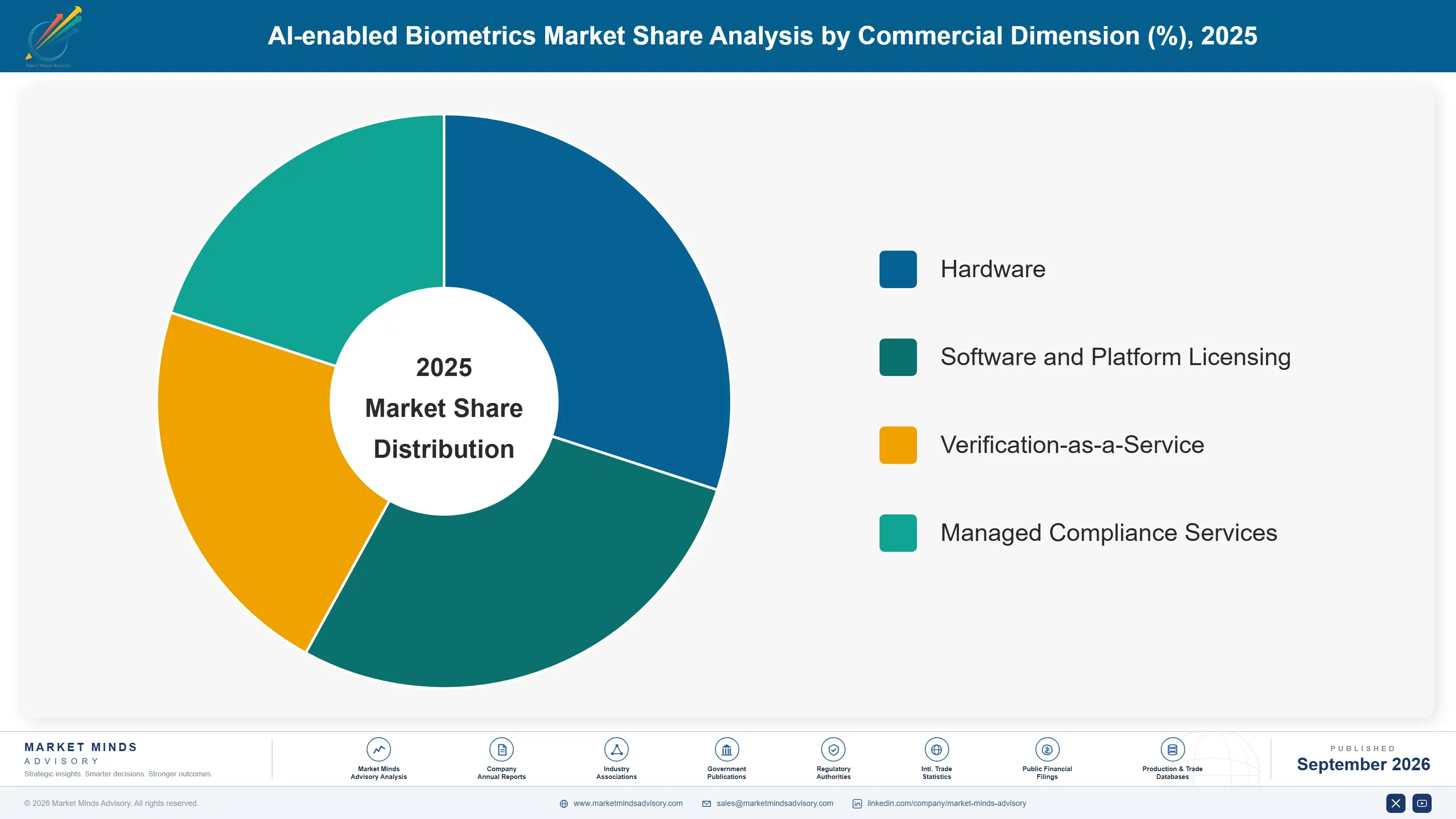
This report segments the market by biometric modality and matching technology rather than by end-use industry, since the same AI matching engine typically serves banking, government, and enterprise access buyers interchangeably across very different deployment contexts. Six modality segments capture how vendors differentiate on technical architecture, sensor design, and certification pathway rather than on the industry they ultimately sell into.
ai-enabled-biometrics-market-market-share-analysis-1790009953004

Multimodal Biometric Systems

Multimodal biometric systems combine facial, voice, fingerprint, or behavioral signals into a single fused confidence score, and they are growing fastest because banking, telecom, and border-control buyers increasingly reject single-sensor architectures as too easy to spoof with generative AI tools. Vendors that already sell standalone facial or fingerprint hardware are racing to add fusion software layers rather than cede these contracts to specialist integrators, since procurement teams now routinely require at least two independent modalities before shortlisting a vendor for any high-value banking or government identity tender. Fusion architectures also allow continuous re-authentication throughout a session rather than a single point-in-time check, which is increasingly a contractual requirement rather than a differentiator.
CAGR 20.0%

Facial Recognition

Facial recognition remains the largest single modality by revenue and is growing nearly as fast as multimodal systems, driven by liveness-detection upgrades that retrofit deepfake resistance into existing camera-based deployments at airports, retail stores, and mobile banking apps across every major market. Vendors are shipping software-only upgrades that add presentation-attack detection to installed camera hardware, extending the replacement cycle for physical scanners while capturing recurring software-license revenue instead of a one-time hardware sale. National identity programmes across multiple continents are also standardizing on facial matching as the primary enrollment modality, reinforcing demand even as certification requirements tighten further with each passing procurement cycle and as camera resolution requirements rise in parallel.
CAGR 18.5%
Full segment breakdown across 6 segments available in the complete report.

Regional Architecture and Country Demand Map

East Asia leads on sensor manufacturing scale and national identity deployment, while North America and Western Europe concentrate the highest-value banking and enterprise software contracts. South Asia and Pacific is expanding fastest as government identity programmes move from pilot phases to nationwide rollout across several large economies.

North America

North America's demand is concentrated in banking fraud prevention and federal border-control modernization, with airport biometric exit programmes and bank-grade continuous authentication driving the largest share of near-term enterprise contract value. Card networks and major retail banks have moved behavioral biometrics from pilot to production across digital banking channels, citing measurable reductions in account-takeover fraud as the primary business case rather than regulatory mandate alone. Federal agencies are separately expanding facial matching at land and air border crossings under modernization programmes that require vendors to hold current liveness certification before bidding. Enterprise access-control refresh cycles inside large technology and financial services employers add a steady secondary layer of demand beneath these headline government and banking deployments.
Share: 26% | CAGR: 15.5% (2026 to 2036)

Western Europe

Western Europe's growth trails other regions because GDPR's treatment of biometric data as a special category slows public-sector procurement relative to jurisdictions with lighter consent requirements, forcing vendors to build region-specific data-handling architectures before bidding on government tenders. Even so, national identity card modernization programmes across several member states and airport biometric boarding at major European hubs are sustaining steady deployment volume. Banks across the region are adopting continuous behavioral authentication somewhat more cautiously than North American peers, citing consumer consent obligations under GDPR that require clearer disclosure before behavioral data collection begins. Vendors that can demonstrate on-device template storage and decentralized matching architectures are winning a disproportionate share of new European public-sector contracts as a direct result.
Share: 20% | CAGR: 13.2% (2026 to 2036)
Regional intelligence for 5 additional markets available in the complete report: East Asia, South Asia and Pacific, Latin America, Middle East and Africa, Eastern Europe. Contact sales@marketmindsadvisory.com.
ai-enabled-biometrics-market-country-cagr-analysis-1790009953535

Monetizing Certification, Fusion, and Continuous Verification

Vendors are finding that the largest incremental margin sits outside the initial hardware or license sale, in recurring certification updates, software-only fusion upgrades, and subscription verification services layered onto an already-installed base of cameras, scanners, and enrollment records that customers across banking, telecom, and government have already paid to deploy over the past several years.

Retrofitting Liveness Detection Into Installed Camera Hardware

Vendors are packaging presentation-attack detection as a software-only upgrade sold to customers who already own compatible camera hardware, avoiding a full hardware refresh cycle entirely. This model converts a one-time equipment sale into a recurring license renewed alongside annual certification updates, and early adopters report the upgrade attach rate reaching roughly 40 percent of the installed base within eighteen months of launch. Margin on these software-only upgrades runs well above hardware margin, since there is no manufacturing or logistics cost attached, and the certification renewal creates a natural annual touchpoint for cross-selling additional modality licenses.
Market Impact: Adds roughly a 40 percent upgrade attach rate

Bundling Continuous Behavioral Authentication as a Subscription Add-On

Banks and telecom carriers that already license facial or fingerprint matching are increasingly offered behavioral biometrics as a metered subscription add-on priced per active monitored account rather than per transaction. This shifts a meaningful share of vendor revenue onto a recurring, usage-linked basis that scales with the customer's own user growth instead of a fixed annual license fee. Vendors report attach rates above 25 percent among existing enterprise customers within the first renewal cycle, since the marginal integration cost is low once the core matching platform is already deployed and the fraud-reduction case largely sells itself internally.
Market Impact: Lifts recurring revenue per account by 25 percent

Packaging Certification and Compliance Documentation as a Service

Rather than leaving customers to assemble their own audit trail for regulatory examinations, vendors are packaging certification maintenance, bias-testing documentation, and jurisdiction-specific compliance reporting into a standing annual service contract. This converts what used to be a one-time sales-support cost into a distinct revenue line, and banks in particular are paying a premium to offload the compliance-documentation burden entirely rather than staff it internally. Early data suggests customers on this service tier renew at a rate roughly 15 percentage points higher than customers who purchase certification support only as needed.
Market Impact: Improves customer renewal rates by 15 percentage points

Cross-Selling Verification Into Adjacent Fraud and KYC Platforms

Vendors that built their reputation on physical access-control hardware are now cross-selling the same underlying matching engine into digital know-your-customer and fraud-prevention platforms sold to the same banking and telecom customers, capturing budget that previously went entirely to specialist fraud-software vendors. Because the core AI model and enrollment data already exist, the incremental cost of extending into a new use case is low relative to the contract value captured, and vendors pursuing this path report average contract value per customer expanding by roughly 30 percent within two years of the initial deployment.
Market Impact: Expands average contract value by roughly 30 percent

Who Controls the Margin Pool

At an estimated 38 percent combined share, the top five vendors hold a moderate lead over a long tail of regional integrators and single-modality specialists, and the gap between the leading two suppliers and the rest of the next tier is widening as liveness certification raises the technical bar for smaller challengers to clear without outside investment.
Current competitive activity centers on three fronts: acquiring liveness-detection and deepfake-resistance startups rather than building the capability in-house, forming certification partnerships with independent testing laboratories to shorten procurement cycles, and bundling multimodal fusion software with legacy single-sensor hardware to defend installed-base renewal contracts against newer multimodal-native entrants that lack an existing customer base to protect.

Emerging pressure is coming from cloud-native verification platforms that sell matching-as-a-service with no proprietary hardware at all, undercutting incumbents on integration speed for digital-first banking and telecom customers. Rankings are most likely to shift wherever a challenger secures a large national identity programme reference deployment before an incumbent does, since those contracts function as credibility signals that shape adjacent government procurement decisions for years afterward and are difficult for slower-moving rivals to dislodge once won.
ai-enabled-biometrics-market-company-positioning-matrix-1790009954062

Competitive Moat and Risk Dimensions

NEC CORPORATION

Moat: Government Reference Deployment Scale

NEC's decades of national identity and law-enforcement facial-matching deployments across Asia and Latin America give it reference sites few competitors can match when bidding for new government contracts. Procurement officials routinely cite prior deployments as a qualification requirement, and NEC's installed base across dozens of national programmes makes it difficult for challengers without comparable references to clear early-stage bid shortlists.
NEC CORPORATION

Risk: Slow Cloud-Native Product Transition

NEC's core platforms were architected around on-premises government deployments, and the company has moved more slowly than cloud-native challengers to offer matching-as-a-service pricing that digital-first banking and telecom customers increasingly prefer. That lag risks ceding faster-growing commercial segments to newer entrants even as NEC retains its government reference advantage.
IDEMIA

Moat: Multimodal Border Control Contracts

Idemia's position in passport issuance and multimodal border-control systems across dozens of countries creates high switching costs, since replacing an embedded national identity or border platform requires years of recertification and political coordination that most governments are reluctant to undertake once a system is operating reliably.
IDEMIA

Risk: Private Equity Ownership Overhang

Idemia's private equity ownership structure creates financing leverage that could constrain research spending relative to publicly listed rivals during a period when continuous investment in liveness-detection algorithms is a decisive competitive requirement, particularly if refinancing conditions tighten materially before the next planned ownership transition takes place.

Players Tracked

Prominent Players

NEC Corporation
Idemia
Thales
Aware Inc.
Fingerprint Cards AB

Other Key Players

Suprema
Innovatrics
Cognitec Systems
BioCatch
Onfido
Daon
Precise Biometrics
Iris ID Systems
Herta Security
FaceFirst
Ayonix
Aratek
Neurotechnology
Mitek Systems
Anviz Global

Recent Developments

JANUARY 2026

NEC Expands AI Facial Matching Deployment Across Airport Border Control

NEC expanded its AI facial-matching deployment across airport border-control checkpoints in six additional countries, adding continuous liveness monitoring to existing enrollment infrastructure rather than replacing installed camera hardware entirely. The rollout extends NEC's reference-deployment base ahead of several pending national identity tenders across adjacent regional markets this year.
Signal: Reinforces NEC's government reference base considerably ahead of several upcoming regional national identity programme tenders next year
AUGUST 2025

Idemia Acquires Biometric Liveness Detection Startup

Idemia acquired a liveness-detection startup specializing in generative-AI spoof resistance, adding presentation-attack detection capability that Idemia had previously licensed from a third party under a costlier arrangement. The acquisition brings the core detection algorithm in-house and shortens certification renewal timelines across Idemia's border-control and banking contracts.
Signal: Brings liveness detection fully in-house at Idemia, reducing its dependence on costlier third-party algorithm licensing arrangements
APRIL 2026

Thales Forms Joint Venture for Multimodal Biometric Payment Systems

Thales formed a joint venture with a regional payments processor to develop multimodal biometric authentication for point-of-sale and mobile payment transactions, combining Thales's matching engine with the processor's existing merchant network. The venture targets commercial launch across several European markets within the next eighteen months.
Signal: Opens a new biometric payments distribution channel for Thales through an established, already-scaled shared merchant network

Compute, Sensor, and Talent Cost Exposure

Cloud GPU compute for training and running matching models accounts for roughly 30 to 38 percent of vendor cost of goods sold, sourced from a handful of hyperscale cloud providers and chip foundries concentrated in Taiwan and South Korea. Image sensor and camera-module components add another meaningful share, most of it imported from East Asian manufacturers regardless of where hardware is assembled.
The 2024 to 2025 spike in AI accelerator prices, driven by demand from large language model training competing directly for the same foundry capacity biometric vendors rely on, pushed inference-hardware costs up sharply according to company investor day disclosures. Smaller vendors without long-term supply agreements absorbed the increase into margin, while larger suppliers with reserved cloud capacity were comparatively insulated from the worst of the volatility smaller rivals faced.

The competitive disadvantage falls hardest on smaller regional integrators that lack purchasing scale to negotiate reserved-capacity cloud contracts or long-term chip supply agreements, forcing them to buy compute and sensor components closer to spot prices than their larger rivals. Vendors with in-house data centers or long-term hyperscaler agreements can price certification-heavy government contracts more aggressively, widening the cost gap between scaled incumbents and smaller challengers over successive renewal cycles.
ai-enabled-biometrics-market-cost-volatility-analysis-1790009954260

Reserved Cloud Capacity and Multi-Year Chip Supply Agreements

Leading vendors are locking in multi-year reserved-capacity agreements with hyperscale cloud providers and direct supply contracts with chip foundries to smooth exposure to spot-price spikes in AI accelerator markets. These agreements typically trade a modest capacity commitment premium for price certainty that lets vendors bid on multi-year government contracts without needing to rebase pricing mid-term.

On-Device Edge Inference to Reduce Cloud Dependence

Vendors are shifting a growing share of matching inference onto edge devices and local servers rather than routing every transaction through cloud infrastructure, cutting recurring compute cost and reducing exposure to hyperscaler pricing changes. This also addresses data-residency requirements in several jurisdictions, giving the approach a compliance benefit alongside the direct cost saving it delivers.

Portfolio Architecture for Margin Defence

Portfolio economics split cleanly along three tiers: commodity single-modality hardware sold mostly on price, certified multimodal software sold on compliance assurance, and next-generation continuous-authentication platforms sold on fraud-reduction outcomes. Gross margin widens sharply moving up this ladder, since certification and continuous-monitoring revenue carries near-zero incremental hardware cost once the underlying platform is built and the initial certification investment has already been made.
The volume tier still generates the largest unit shipment count by far, dominated by fingerprint and single-camera facial scanners sold into price-sensitive access-control and consumer-device markets where buyers treat competing products as largely interchangeable commodity items. Premium tiers instead compete on certified accuracy and liveness resistance, and buyers there pay materially more for documented compliance rather than for any single hardware specification alone.

High-value margin pools concentrate almost entirely in certification-heavy banking and government contracts, where continuous behavioral authentication and multimodal fusion software command premium recurring pricing well above anything the volume tier can support today. Vendors positioning purely on hardware price increasingly find themselves squeezed toward the bottom of the portfolio as buyers pay for assurance rather than for raw matching-accuracy specifications alone.

Standalone fingerprint and single-camera facial scanners sold into access control and consumer devices, priced almost entirely on unit cost with thin differentiation between competing suppliers and limited room for software-driven margin expansion.
Gross Margin

Certified multimodal systems with independently audited liveness detection, sold into banking, telecom, and government tenders that require documented compliance before any contract is awarded and renewed annually thereafter under updated certification standards.
Gross Margin

Continuous behavioral authentication and adaptive fraud-detection platforms priced on subscription and outcome-based fraud-reduction metrics rather than one-time hardware or license cost, with margin scaling alongside monitored account volume over the contract term.
Gross Margin
ai-enabled-biometrics-market-portfolio-architecture-1790009954766

High-value Sub-segments and Strategic Watch-out

Continuous Behavioral Authentication for Digital Banking

Continuous behavioral authentication for digital banking, where fraud-reduction outcomes justify premium subscription pricing and adoption is still accelerating well ahead of most other segments across the entire market this year, as issuers race to cut account-takeover losses that have been rising steadily across nearly every major digital banking channel.

Multimodal Border Control and National Identity Platforms

Multimodal border-control and national identity platforms, where large government contract values and steady multi-year rollout schedules deliver reliable margin even as unit growth moderates somewhat from the sharper pace of earlier peak years across leading markets, leaving vendors with a dependable base of renewal revenue.

Standalone Fingerprint Access Control Hardware

Standalone fingerprint access-control hardware, the largest unit-volume segment overall but one facing continual price compression from commoditized components and a rising number of low-cost regional suppliers entering the market each year with broadly comparable technical specifications, shrinking differentiation, and thinner margin for established incumbent vendors.

Voice-Only Authentication Facing Deepfake Erosion

Voice-only authentication, which faces mounting scrutiny as generative-AI voice cloning tools erode buyer confidence faster than vendors can certify countermeasures, risking a lasting shift in buyer preference toward multimodal alternatives that fuse voice with other independent verification signals rather than relying on a single audio channel alone.

Why Certification Locks In Renewal Revenue

Verification contracts behave like annuities once a vendor clears the initial certification hurdle, since switching a certified liveness engine requires re-running the entire audit and accreditation process rather than simply swapping software packages between vendors. Buyers renew rather than re-bid, and renewal pricing typically holds or rises as certification requirements tighten with each successive multi-year cycle across most jurisdictions.
Stickiness varies sharply by vertical: banking and government identity deployments renew at very high rates because switching risks compliance gaps during the transition window, while consumer-device integrations turn over faster as device refresh cycles introduce new vendors with each hardware generation regardless of prior relationship strength or accumulated trust. Telecom sits between the two, renewing steadily but facing periodic re-tendering driven by regulatory review.

A generational shift in buyer profile is underway as chief fraud officers and compliance leaders, rather than IT procurement teams alone, increasingly own the vendor selection decision, weighting audited liveness performance and regulatory defensibility over raw hardware cost. That shift favors vendors who can document compliance clearly over those competing purely on price, reshaping how renewal negotiations unfold across nearly every major account each year.
ai-enabled-biometrics-market-end-use-penetration-index-1790009955257

Where MMA Sees the Durable Edge

These are among the four positions where our research anticipates prominent divergence between winners and laggards over the coming forecast period. Each is grounded in the demand model, the regulatory perimeter, and the announced capacity pipeline.
01 / CERTIFICATION INVESTMENT DISCIPLINE

Prioritize vendors with current multi-jurisdiction liveness certification

Vendors that hold current liveness certification across multiple jurisdictions are winning shortlisted status well before competitors without it, since procurement teams increasingly treat certification as a gate rather than a differentiator worth debating. Buyers evaluating new suppliers should weight certification currency and renewal cadence at least as heavily as raw matching accuracy, since a lapsed certificate can disqualify an otherwise strong bid instantly and irreversibly. This dynamic will only intensify as generative-AI spoofing sophistication continues rising across every major market.
02 / FUSION ARCHITECTURE TIMING

Move to multimodal fusion ahead of the single-sensor replacement wave

Buyers still running single-modality deployments should plan fusion upgrades now rather than waiting for a full hardware refresh cycle, since vendors are already bundling software-only fusion layers that avoid a costly rip-and-replace across the installed base. Waiting risks being pushed into an unplanned emergency upgrade once a spoofing incident forces the issue, typically on worse commercial terms than a carefully planned migration would secure well in advance. Early movers are also locking in favorable multi-year pricing before broader market demand pushes costs upward considerably.
03 / NATIONAL IDENTITY PROGRAMME TIMING

Track South Asian identity rollouts as an early demand signal

National identity programmes across South Asia are scaling faster than almost any comparable enterprise deployment anywhere, and vendors that win early reference contracts there gain credibility that eases procurement in adjacent African and Southeast Asian government tenders. Investors and buyers tracking vendor momentum should treat these government reference wins as a leading indicator of broader commercial traction rather than a minor regional data point worth setting aside. The pattern has already repeated across at least three separate vendors so far this cycle.
04 / COMPLIANCE DOCUMENTATION INVESTMENT

Fund compliance documentation as a standing capability, not a one-off

Vendors and enterprise buyers alike underestimate how much renewal risk sits in incomplete compliance documentation rather than in matching accuracy itself, since auditors increasingly demand a continuous paper trail rather than a single point-in-time certificate. Building a standing documentation capability, rather than assembling audit evidence reactively before each renewal, measurably shortens sales cycles and reduces the chance a strong technical bid is disqualified on paperwork alone. That capability is fast becoming a genuine, durable differentiator across the entire competitive vendor landscape.

Engagement Snapshot From the Field

A live engagement with an industry participant carrying material or product regulatory and market exposure ahead of a defining policy shift, showing how our research translates into a defensible multi-year portfolio strategy.
MARKET MINDS ADVISORY · CLIENT ENGAGEMENT SUMMARY
AI-enabled Biometrics Producer Strategic Portfolio Review and Transition Roadmap 2026·Investment Scenario on AI-enabled Biometrics Exposure Evaluation 2025-26
CLIENT PROFILE
The client is a top-twenty global retail bank operating digital banking channels across more than fifteen countries, serving tens of millions of active mobile banking users. The bank had relied on static password and one-time-passcode authentication for a decade and was seeing rising account-takeover fraud losses that its existing fraud-detection stack could not adequately contain, prompting an executive-level review of its authentication architecture.
STRATEGIC CHALLENGE
Account-takeover fraud losses had grown to a level the bank's fraud team described internally as unsustainable, and existing one-time-passcode authentication was proving easy to defeat through SIM-swap and phishing attacks. Leadership needed a path to continuous, harder-to-spoof authentication without disrupting the mobile banking experience for tens of millions of existing customers across every serviced market.
MMA APPROACH
MMA assessed six continuous-authentication and biometric fusion vendors against a common evaluation framework covering matching accuracy, liveness certification currency, integration effort, and total cost of ownership. The engagement included a phased pilot design across three priority markets and a vendor negotiation playbook intended to secure favorable multi-year pricing ahead of a planned global rollout.
KEY FINDINGS
  1. Two of six shortlisted vendors lacked current liveness certification in at least one priority market, disqualifying both from the final selection round.
  2. Behavioral biometric layering reduced simulated account-takeover success rates by an estimated 42 percent during structured pilot testing across markets (client-reported, unverified by MMA).
  3. Integration effort varied by a factor of nearly three between the fastest and slowest vendor, driven mainly by API maturity rather than matching accuracy differences.
  4. Customers in two pilot markets reported measurably higher trust in the bank's mobile app following rollout, based on post-deployment survey data (client-reported, unverified by MMA).
CLIENT PROFILE
The client is a top-twenty global retail bank operating digital banking channels across more than fifteen countries, serving tens of millions of active mobile banking users. The bank had relied on static password and one-time-passcode authentication for a decade and was seeing rising account-takeover fraud losses that its existing fraud-detection stack could not adequately contain, prompting an executive-level review of its authentication architecture.
STRATEGIC CHALLENGE
Account-takeover fraud losses had grown to a level the bank's fraud team described internally as unsustainable, and existing one-time-passcode authentication was proving easy to defeat through SIM-swap and phishing attacks. Leadership needed a path to continuous, harder-to-spoof authentication without disrupting the mobile banking experience for tens of millions of existing customers across every serviced market.
MMA APPROACH
MMA assessed six continuous-authentication and biometric fusion vendors against a common evaluation framework covering matching accuracy, liveness certification currency, integration effort, and total cost of ownership. The engagement included a phased pilot design across three priority markets and a vendor negotiation playbook intended to secure favorable multi-year pricing ahead of a planned global rollout.
KEY FINDINGS
  1. Two of six shortlisted vendors lacked current liveness certification in at least one priority market, disqualifying both from the final selection round.
  2. Behavioral biometric layering reduced simulated account-takeover success rates by an estimated 42 percent during structured pilot testing across markets (client-reported, unverified by MMA).
  3. Integration effort varied by a factor of nearly three between the fastest and slowest vendor, driven mainly by API maturity rather than matching accuracy differences.
  4. Customers in two pilot markets reported measurably higher trust in the bank's mobile app following rollout, based on post-deployment survey data (client-reported, unverified by MMA).
RECOMMENDED STRATEGY
Phase 1: Phase 1 (Months 1-3): Run controlled pilots of the two finalist vendors across three priority markets with matched customer cohorts. Phase 2: Phase 2 (Months 4-6): Negotiate multi-year pricing and data-residency terms with the winning vendor ahead of global rollout commitments and contract signing. Phase 3: Phase 3 (Months 7-12): Execute phased global rollout, prioritizing markets with the highest existing account-takeover fraud exposure and regulatory pressure.
OUTCOME
The bank selected a vendor offering fused facial and behavioral authentication and began phased rollout across its three largest markets. Within the first two full quarters of deployment, the bank reported a meaningful reduction in account-takeover losses and improved customer satisfaction scores tied to faster login (client-reported, unverified by MMA), though full multi-country rollout remains in progress.

Frequently Asked Questions

Foundational context covering the market sizes, CAGR, scope, country, region and competition that inform every finding below. This section is provided to cover basics and most often pre-purchase conversations, answered from the MMA Primary Research Dataset.

What is the current size of the AI-enabled Biometrics Market?

The AI-enabled biometrics market is valued at approximately $18.6 billion in 2025. This figure covers hardware, embedded software, and cloud platforms using machine learning for identity verification worldwide.

How large will the AI-enabled Biometrics Market be by 2036?

MMA projects the market will reach approximately $84.9 billion by 2036. That represents nearly a fourfold expansion from the 2026 base value of roughly $21.4 billion.

What is the CAGR for the AI-enabled Biometrics Market 2026 to 2036?

The market is forecast to grow at a 14.8 percent compound annual rate between 2026 and 2036. Bull and bear scenarios range from 13.5 to 16.1 percent.

Which segment is growing fastest?

Multimodal biometric systems are the fastest-growing segment, expanding at an estimated 20.0 percent CAGR through 2036. That is roughly 1.35 times the overall market growth rate.

Who are the major companies in the AI-enabled Biometrics Market?

NEC Corporation, Idemia, Thales, Aware Inc., and Fingerprint Cards AB lead the market. Together they hold an estimated 38 percent combined share on a revenue basis.

Which country is growing fastest?

India is the fastest-growing country, expanding at an estimated 17.2 percent CAGR through 2036. Growth is driven by nationwide biometric identity and welfare-disbursement programme rollouts.

Report Segmentation Architecture

The full report scope spans multiple orthogonal segmentation dimensions, with cross-tabulated demand data provided for each dimension pair. Coverage extends further to regional breakdowns, trend trajectories, and the competitive detail needed to support segment-level decision-making.

By Primary Market Dimension

  • Facial Recognition
  • Fingerprint Recognition
  • Iris and Retina Recognition
  • Voice and Behavioral Biometrics
  • Multimodal Biometric Systems
  • Vein and Palm Recognition

By End-Use Industry

  • Banking and Financial Services
  • Government and Public Sector
  • Telecom
  • Healthcare
  • Retail and E-Commerce

By Commercial Dimension

  • Hardware
  • Software and Platform Licensing
  • Verification-as-a-Service
  • Managed Compliance Services

By Region

  • North America
  • Western Europe
  • East Asia
  • South Asia and Pacific
  • Latin America
  • Middle East and Africa
  • Eastern Europe

Scope, Methodology, and Coverage

Every figure in this report is reproducible from documented input assumptions. The scope below maps the historical period, the forecast horizon, the segmentation dimensions, and the countries covered, alongside the underlying primary and qualitative methodology.
Historical Period
2020 to 2025
Forecast Period
2026 to 2036
Base Year
2025 (USD billions; MMA Primary Research Dataset, September 2026)
Market Definition
The AI-enabled biometrics market covers hardware, embedded software, and cloud verification platforms that use machine learning to match or continuously authenticate facial, fingerprint, iris, voice, or behavioral traits. It excludes non-AI legacy scanners sold without adaptive matching algorithms and physical access-control hardware sold without an identity-verification function.
Quantitative Units
USD billions (current prices); enrollment volumes and unit shipments where applicable
Segmentation Dimensions
Biometric Modality; End-Use Industry; Commercial Dimension; By Region
Regions Covered
North America, Western Europe, East Asia, South Asia and Pacific, Latin America, Middle East and Africa, Eastern Europe
Countries Covered
USA, China, Germany, France, UK, Japan, South Korea, India, Australia, Canada, Brazil, Mexico, Indonesia, Vietnam, Thailand, Malaysia, UAE, Saudi Arabia, South Africa, Nigeria, Turkey, Poland, Netherlands, Italy, Spain, Sweden, Switzerland, Argentina, Colombia, Singapore, and additional markets relevant to this sector
Key Companies Profiled
NEC Corporation, Idemia, Thales, Aware Inc., Fingerprint Cards AB, Suprema, Innovatrics, Cognitec Systems, BioCatch, Onfido, Daon, Precise Biometrics, Iris ID Systems, Herta Security, FaceFirst, Ayonix, Aratek, Neurotechnology, Mitek Systems, Anviz Global
Quantitative Methodology
Primary survey, n=3,800 respondents, Q4 2025, six countries; demand-side model with trade association cross-validation
Qualitative Methodology
47 expert interviews, Q4 2025; applied to validate demand model assumptions, identify emerging dynamics, and assess competitive positioning
Report Format
PDF and XLSX data workbook (Word format preview document)
Publisher
Market Minds Advisory
Report Code
MMA-2026-TEC-589
Published
September 2026
Contact
sales@marketmindsadvisory.com | www.marketmindsadvisory.com

Purchase the full AI-enabled Biometrics Market Report (2026 to 2036).

This report provides a ten-year quantitative sizing and forecast model for the AI-enabled biometrics market, covering hardware, embedded software, and cloud verification platforms across all seven global regions. It includes detailed segmentation by biometric modality, competitive benchmarking of the top twenty vendors, and a proprietary MMA Primary Research dataset drawn from expert interviews and a large-scale quantitative survey. Buyers receive regional deep-dives, vendor moat and risk assessments, and forward-looking scenario modeling calibrated against historical adoption patterns. An anonymized case study and a full revenue-lever breakdown round out the deliverable for teams building vendor strategy or investment theses.
Ten-year quantitative market sizing and forecast model
Segmentation by biometric modality and matching technology
Vendor moat and risk assessment for top players
Regional deep-dives across all seven global regions
Primary survey and expert interview dataset access
Revenue lever and portfolio margin benchmarking analysis

Built For The People Who Decide

From boardroom strategy to bench-side execution, this report is read cover-to-cover by leaders shaping the next decade of their industry, turning demand scenarios, market dynamics and valuation benchmarks into decisions.
CXOs/ Presidents/ VPs/ Managers
M&A and Corporate Development
Strategy Teams and R&D Heads
Procurement and Product Directors
Regulatory and Compliance Leaders
Investor Relations and Equity Analysts