Market Minds Advisory
AI-driven Predictive Maintenance Market

AI-driven Predictive Maintenance Market: AI-driven Predictive Maintenance Market. Industrial IoT Sensors Meet Unplanned Downtime Reduction Demand

Manufacturers battling unplanned downtime are pushing predictive maintenance vendors toward deeper AI anomaly detection, forcing suppliers to balance model accuracy against rising sensor integration and data infrastructure costs. across most plants.

Lead Analyst

Published

September 2026

Make Smarter Decisions with Customized Research Insights

Request a free sample report and evaluate market opportunities, growth trends, and competitive dynamics relevant to your business needs.

2025 MARKET VALUE$7.4BMarket Size 2025
2036 FORECAST VALUE$40.8BBase Case , 2026 to 2036
CAGR 2026 TO 203616.8 %Bull 18.1% / Bear 15.5%
INCREMENTAL OPPORTUNITY$32.2BNet 10- year value creation
EXPANSION MULTIPLE4.73x2036 value over 2026 base
Strategic Levers
M&A Pipeline
Regional Outlook
Country Rankings
Competitive Intelligence
Segmental Deep-dive
Call-Us : 91 93563 13602

Executive Snapshot and Market Trajectory.

Manufacturers battling costly unplanned downtime are pulling predictive maintenance demand toward deeper AI anomaly detection faster than vendors anticipated. Vendors selling threshold-based alert systems alone are now retooling entire product lines around machine learning models. Few predicted this shift moving quite so fast. Timing matters.
AI-powered anomaly detection platforms, which flag equipment failure risk before breakdown occurs, are pulling ahead of threshold-based monitoring as manufacturers scale industrial IoT sensor deployment. Adoption concentrates most heavily in East Asia and among manufacturers running the largest continuous production facilities. Vendors that can demonstrate proven model accuracy are winning manufacturer contracts that rule-based specialists cannot match. Certification of model accuracy now shapes procurement decisions directly.
Competitive character is shifting from rule-based monitoring vendors toward machine learning platform suppliers, a shift that rewards providers with proven model accuracy over legacy threshold-alert specialists. Rising manufacturing downtime costs and industrial IoT sensor adoption are both reinforcing demand even as data infrastructure integration complicates deployment timelines. Vendors slow to solve data infrastructure integration risk losing ground to better-positioned competitors capturing the largest manufacturing deals. Timing matters here. Scale matters too here across most operations.
Market Definition
This market covers software platforms and services that use machine learning to predict industrial equipment failure from sensor and operational data before breakdown occurs. It excludes standalone industrial IoT sensor hardware and general enterprise asset management software without predictive analytics capability.
Base Year Value
$7.4B in 2025 (MMA Primary Research Dataset, September 2026)
Forecast Period
2026 to 2036, eleven discrete annual values
CAGR
16.8% base case. Bull 18.1%. Bear 15.5%.
Fastest Growth Segment
AI-Powered Anomaly Detection Platforms: 23.4% CAGR
Fastest Growth Country
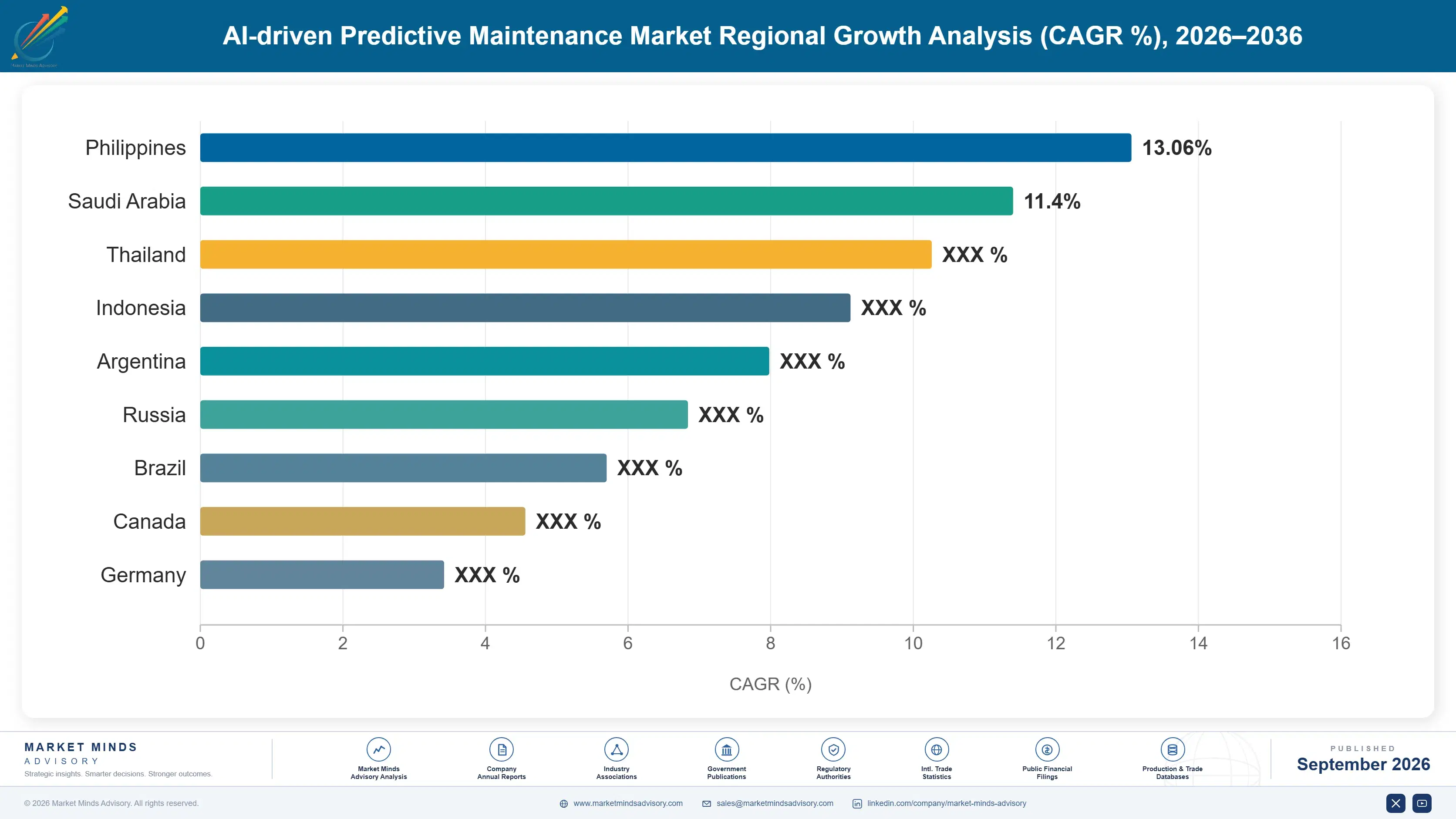
India: 20.6% CAGR
Fastest Growth Region
South Asia and Pacific: 19.0% CAGR
Largest Region
East Asia: 29% of 2025 global value
Market Leaders
IBM Corporation, PTC Inc, SAP SE, GE Digital, Uptake Technologies. Source: MMA Analysis based on company annual reports.
Primary Survey
n=3,800 procurement and R&D decision-makers, Q4 2025, six countries
Methodology
Demand-side build-up, cross-validated against public data, 47 expert interviews

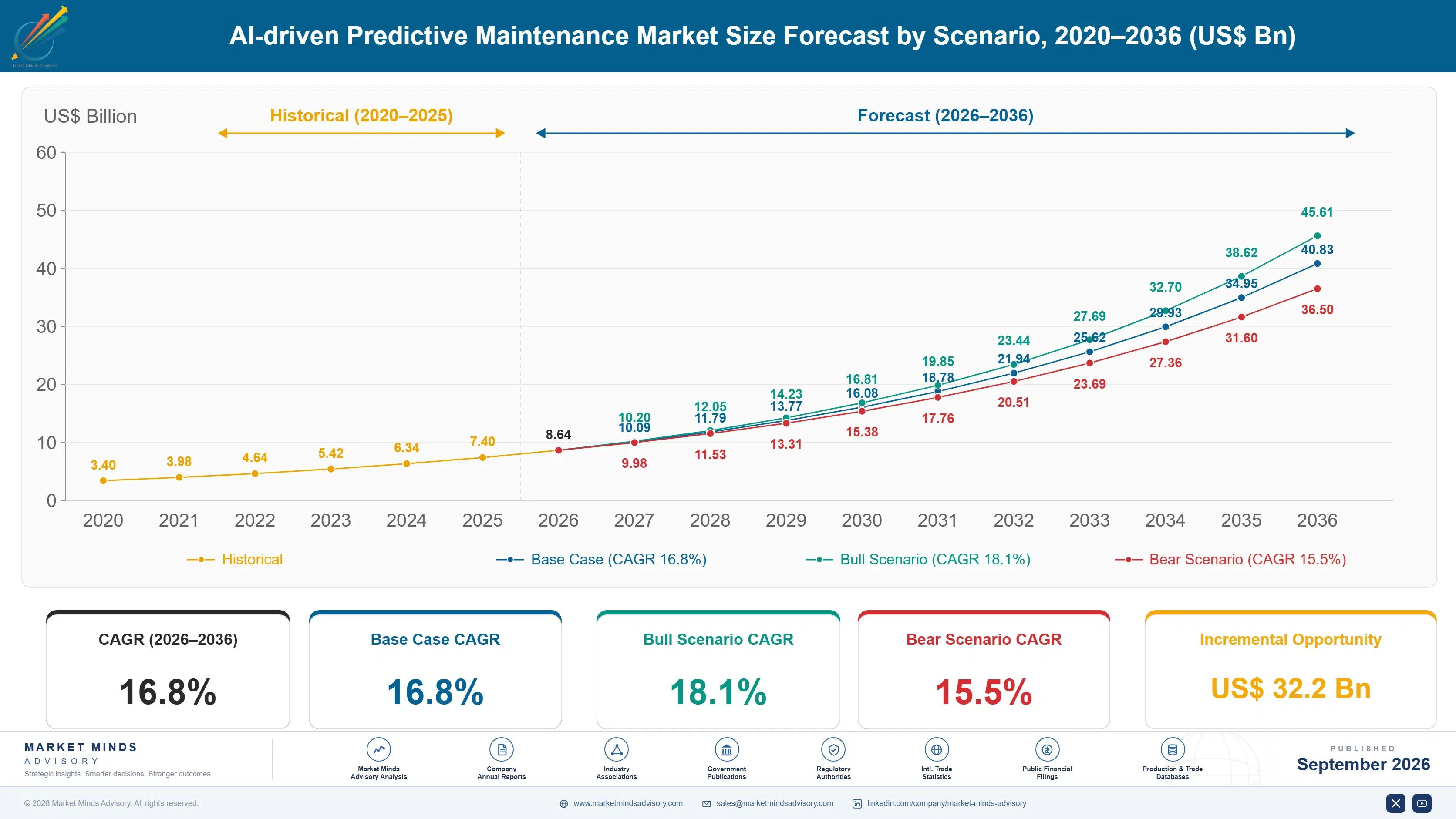
AI-driven Predictive Maintenance Market Forecast Scenarios

ai-driven-predictive-maintenance-market-size-forecast-scenario-1788417515829
AI-driven predictive maintenance demand grew steadily between 2020 and 2025 as industrial IoT sensor deployment expanded, though the historical growth rate of 15.7 percent understated a sharper acceleration that began once machine learning model accuracy improved meaningfully in the final two years. Vendors that entered the period selling threshold-based alert systems alone increasingly found manufacturers demanding machine learning anomaly detection instead.
The base case rests on three commercial mechanisms: manufacturers standardizing AI-powered anomaly detection rather than threshold-based rule alerts, machine learning platforms proving measurable downtime reduction that justifies premium pricing, and industrial IoT sensor cost declines expanding the addressable manufacturing customer base. Together these sustain strong double-digit growth through the forecast period. Vendors that fail on any one of these three fronts risk ceding share to faster-moving competitors within a single product cycle.
The bull case assumes faster-than-expected manufacturing digitalization pulls forward predictive maintenance adoption across multiple industrial sectors simultaneously. The bear case centers on data infrastructure integration complexity and skilled talent shortages, which could slow deployment timelines and push cost-conscious manufacturers back toward simpler threshold-based monitoring. Either scenario reshapes vendor investment priorities meaningfully within the next several years.

Where Machine Learning Meets Downtime Reduction

AI-driven predictive maintenance margin has historically compressed under threshold-alert commoditization, but machine learning platforms now carry wider margin as model accuracy barriers limit competitive entry. Manufacturers increasingly negotiate multi-year platform contracts rather than one-time sensor hardware purchases. Vendors unable to make that model accuracy investment risk being squeezed out by competitors offering broader anomaly detection coverage at comparable pricing. Bids without it fail.
MARKET CONCENTRATIONCR5 38%Top five vendors control just over a third overall
AVERAGE PLATFORM COST$50,000-$2 million/facilityCost varies by sensor count and deployment scale required
LEADING DEPLOYMENT COUNTRY SHAREChina 24%China leads global predictive maintenance deployment volume overall
AI MODEL ADOPTION RATE31%Share of deployments running machine learning anomaly detection
UNPLANNED DOWNTIME REDUCTION RATE25-40%Typical decline reported after predictive maintenance deployment overall
AVERAGE SENSOR PAYBACK PERIOD1-2 yearsTypical duration before deployment costs are fully recovered
Model accuracy has become the primary purchase criterion ahead of raw sensor count, since manufacturers weigh false alarm rates as heavily as detection sensitivity itself. Vendors investing in proven anomaly detection accuracy are winning manufacturer contracts over competitors offering only threshold-based alerting. That gap between accuracy leaders and rule-based laggards widens further as manufacturers standardize procurement around false alarm reduction benchmarks.
Large continuous manufacturing facilities dominate deployment volume, though energy and utilities applications are adopting predictive maintenance faster than any other segment tracked, driven by expanding grid infrastructure monitoring requirements. Fleet and transportation maintenance deployments remain a smaller but steadily growing adjacent category. Vendors tailoring platform scale to these smaller fleet deployments are capturing share that facility-only systems cannot easily serve. Timing matters here.
"Vendors that treat model accuracy as a deployment requirement rather than an optional refinement are already ahead of competitors still comparing themselves to threshold-based alert systems. The false alarm gap it closes simply does not exist in rule-based monitoring."
Director, Industrial AI and Manufacturing Technology Practice · MMA Technology Practice · September 2026

Market Trends

Machine Learning Models Overtake Threshold Alerts

Manufacturers are moving from simple threshold-based alert systems toward machine learning anomaly detection that identifies subtle failure patterns before equipment breakdown occurs, a shift that happened faster than most legacy vendors anticipated entering 2025. AI model adoption now represents roughly thirty-one percent of deployments, up from a much smaller share only three years ago, as unplanned downtime reduction of twenty-five to forty percent justifies the transition cost. Vendors without a genuine machine learning offering are increasingly excluded from manufacturer procurement shortlists. Procurement teams increasingly name model accuracy as a mandatory qualification requirement.
Market Impact: downtime costs outpacing inflation 2x
Energy and Utilities Adoption Accelerates Beyond Manufacturing

Energy and utilities operators are adopting predictive maintenance for grid infrastructure monitoring at a pace exceeding traditional manufacturing plant adoption, a use case previously considered a smaller niche within the broader predictive maintenance category. Several major utilities have deployed predictive maintenance programs following documented outage reduction benefits tracked across pilot grid segments. This adoption wave is pulling forward vendor investment that would otherwise have gone solely toward manufacturing plant deployment. Vendors with existing grid infrastructure relationships are capturing most of this wave, since procurement favors proven track records over new entrants.
Market Impact: sensor costs declined 40% recently

Market Opportunities and Growth Drivers

Unplanned Downtime Costs Justify AI Investment

Manufacturers calculating the full cost of unplanned production downtime, including lost output and emergency repair premiums, increasingly find that machine learning platform costs pay for themselves within a single prevented failure event. Industry downtime cost surveys show average unplanned outage costs rising faster than general manufacturing cost inflation in recent years, pulling predictive maintenance demand along with it directly across the sector. Vendors offering rapid deployment and proven accuracy are winning contracts fastest given the financial stakes involved. Several regional manufacturers have already begun deploying AI platforms in direct response to this cost pressure.
Market Impact: integration delays add 4-8 months

Industrial IoT Sensor Cost Declines Expand Market

Falling industrial IoT sensor prices are making predictive maintenance economically viable for mid-market manufacturers that previously could not justify the upfront sensor deployment cost required for comprehensive equipment monitoring. Sensor manufacturing cost data shows unit prices declining steadily in recent years, a trend that has pushed predictive maintenance demand beyond the traditional large-enterprise buyer base. Vendors with mid-market pricing tiers are winning contracts fastest across this expanding customer segment. Manufacturers that deployed early report better return on investment than peers still relying on manual inspection alone. Timing matters as prices keep falling.
Market Impact: roles unfilled for 6+ months

Market Restraints and Challenges

Data Infrastructure Integration Complicates AI Deployment

Predictive maintenance platforms require integrating sensor data streams with existing operational technology systems that were often never designed for real-time data pipelines, a technical challenge that slows deployment across legacy manufacturing facilities. The root cause is that many industrial control systems predate current data infrastructure standards, requiring extensive middleware development that smaller vendors sometimes cannot fund. Vendors are mitigating this by offering standardized connectors for common industrial control system protocols. Vendors that solve this integration problem first gain a durable adoption advantage over slower-moving competitors facing recurring deployment delays. Scale matters too.
Market Impact: AI adoption reached 31% of deployments

Skilled Data Science Talent Shortage Constrains Scaling

Vendors and manufacturers alike report persistent difficulty hiring data scientists with genuine industrial domain expertise, since the discipline requires combining machine learning skills with specific manufacturing process knowledge that few candidates possess. The root cause traces to industrial data science being a narrower specialty than general software engineering, leaving a smaller qualified talent pool across the entire industry. Some vendors are mitigating this by partnering with universities to build dedicated industrial AI training programs. Vendors that solve this hiring bottleneck first gain a durable scaling advantage over slower-moving competitors. Scale matters too.
Market Impact: utilities deployments up 3x since 2023
4 additional market trends, 3 additional growth drivers, and 2 additional restraints and challenges are covered in the full report. Contact sales@marketmindsadvisory.com to access the complete intelligence.

Segment CAGR and Growth Architecture

AI-driven predictive maintenance segments by analytics capability and deployment model rather than by industry vertical, since a single manufacturer typically deploys multiple capability types across its own production facilities depending on equipment criticality and data availability. Vendors treating analytics capability and deployment model as separate purchasing decisions win more design-in contracts than those bundling both into one configuration.
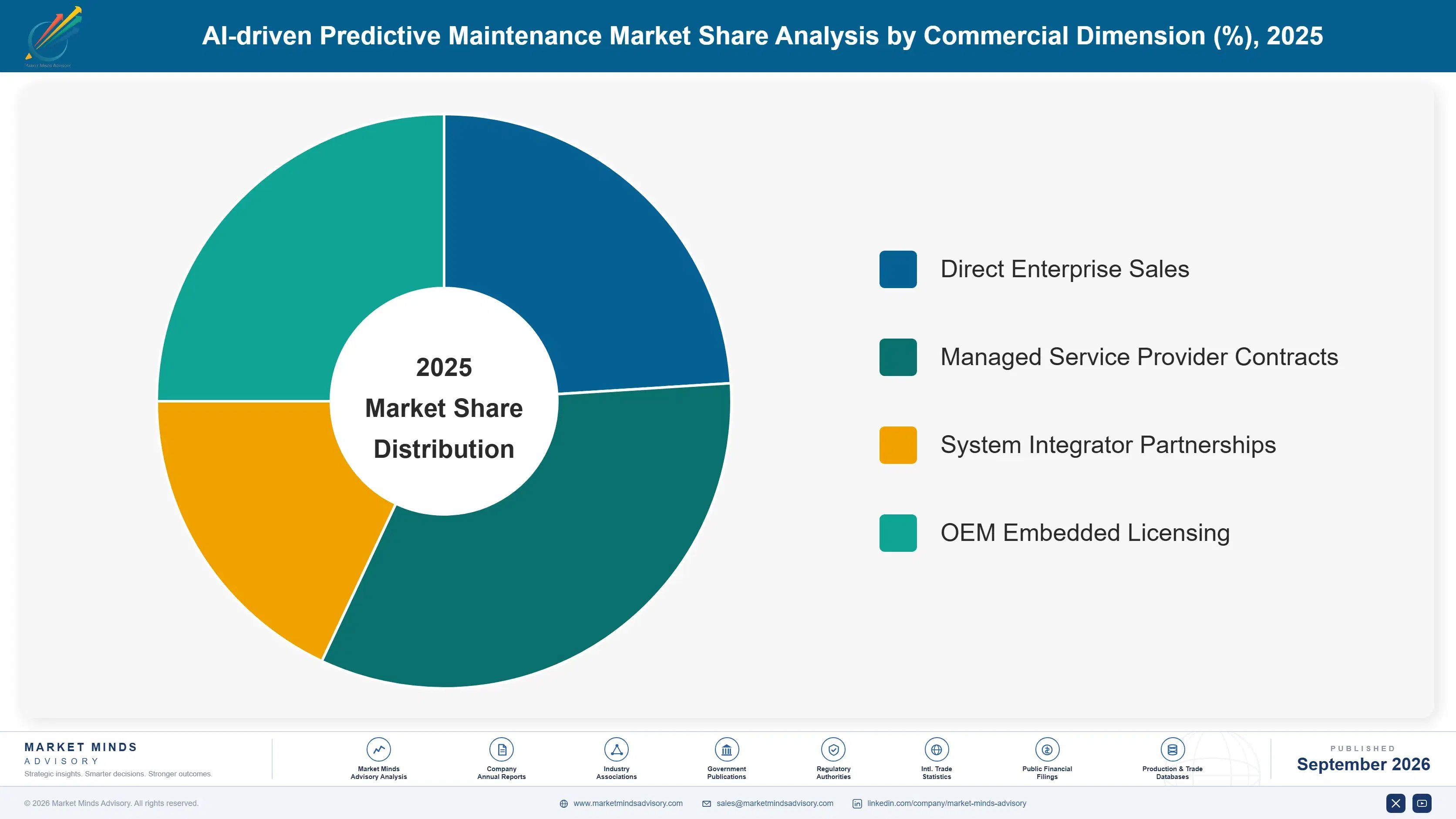
ai-driven-predictive-maintenance-market-market-share-analysis-1788417516359

AI-Powered Anomaly Detection Platforms

AI-powered anomaly detection platforms use machine learning to identify subtle equipment behavior patterns that precede failure, flagging risk before breakdown occurs rather than relying on fixed threshold alerts. Unplanned downtime reduction of twenty-five to forty percent over threshold-based systems justifies the premium pricing these platforms command over standard rule-based alternatives. Adoption is accelerating fastest among manufacturers running the largest continuous production facilities. Vendors are also extending anomaly detection to energy grid infrastructure, a use case that utilities specifically requested after early deployments focused only on manufacturing equipment. Buyers increasingly value this addition as a genuine differentiator against competitors offering manufacturing-only analytics. Scale should follow as grid deployments expand. Timing matters.
CAGR 23.4%

Threshold-Based Condition Monitoring Systems

Threshold-based condition monitoring systems flag equipment readings that exceed predefined limits, typically bundling simple sensor data collection with proven reliability for less complex monitoring requirements. This segment represents the largest installed base by facility count, reflecting decades of continuous industrial adoption since the category first emerged, though unit growth now trails the faster-growing AI-powered segment considerably. Replacement cycles increasingly favor systems compatible with future machine learning upgrade paths. Fleet and transportation operators outside pure manufacturing applications are adopting the same core monitoring platform, adapting configuration to vehicle telemetry rather than stationary equipment sensors. Replacement decisions increasingly hinge on upgrade flexibility rather than sticker price alone across most evaluations. Timing matters.
CAGR 8.6%
Full segment breakdown across 6 segments available in the complete report.

Regional Architecture and Country Demand Map

East Asia leads global deployment on the strength of China's massive manufacturing base and concentrated industrial automation investment, while South Asia and Pacific posts the fastest regional growth as India's manufacturing sector scales quickly. Vendors everywhere are watching this transition quite closely as it unfolds.

North America

United States manufacturers anchor North American demand, with automotive and aerospace producers deploying AI-powered anomaly detection across continuous production lines to reduce costly unplanned downtime. Canadian manufacturers are following a similar pattern at a smaller scale, often adopting the same vendor platforms qualified for United States industrial facilities. Energy and utilities operators contribute significant demand tied to grid infrastructure monitoring requirements. Vendors report United States buyers negotiate contract terms around model accuracy guarantees more heavily than around raw sensor unit pricing alone. Contract renewal rates here run higher than in most other MMA-tracked regions. Timing matters here as budgets get finalized. Scale matters just as much here across most established manufacturing hubs nationwide.
Share: 25% | CAGR: 15.6% (2026 to 2036)

Western Europe

Germany's automotive and industrial equipment manufacturers are deploying predictive maintenance under broader Industry 4.0 modernization programs, driving steady demand across the region's dense manufacturing base. United Kingdom and France's manufacturers contribute meaningful demand tied to energy efficiency and equipment reliability requirements. Regional growth trails the global average because much of the addressable manufacturing market already completed initial sensor deployment during the prior product generation, leaving incremental AI upgrades as the dominant purchase pattern. Nordic countries are pursuing smaller specialty predictive maintenance projects, betting that energy efficiency gains can differentiate their national programs from larger continental competitors. Expect deployment to accelerate as national digitalization guidance continues to expand. Scale matters too across most manufacturing sectors.
Share: 18% | CAGR: 15.1% (2026 to 2036)
Regional intelligence for 5 additional markets available in the complete report: East Asia, South Asia and Pacific, Latin America, Middle East and Africa, Eastern Europe. Contact sales@marketmindsadvisory.com.
ai-driven-predictive-maintenance-market-country-cagr-analysis-1788417516870

Model Accuracy Drives Contract Value

Vendors that expand model accuracy depth beyond basic anomaly flagging, bundle rapid deployment services alongside core analytics platforms, and diversify into grid infrastructure monitoring services capture disproportionate margin as accuracy barriers limit competitive entry across the fastest-growing segments. Vendors slow to act cede share to faster-moving rivals within a single procurement cycle. Timing matters.

Model Accuracy Depth Expansion Program Strategy

Vendors expanding model accuracy depth across multiple manufacturer qualification programs win contracts that accuracy-lacking competitors cannot bid into, particularly for large-scale continuous production facility deployments. IBM Corporation and PTC Inc have both invested heavily in this accuracy depth, and AI model adoption now represents roughly 31% of deployments, up sharply from a much smaller share three years ago. This accuracy depth also raises switching costs once a manufacturer builds its maintenance workflow around a specific vendor's detection model. Vendors without comparable accuracy breadth are increasingly locked out of the largest manufacturer procurement opportunities.
Market Impact: accurate vendors win roughly 3x more manufacturer bids

Rapid Deployment Services Bundling Program Strategy

Vendors bundling rapid deployment services directly into core analytics platform sales convert a single-facility sale into a premium integrated modernization relationship spanning multiple plant expansions. SAP SE has structured its commercial offering around this bundled model, reporting deployment timelines roughly 30% faster for engagements including rapid deployment services than for standard self-managed installation. This approach also locks in follow-on plant expansion work once the initial integrated deployment relationship is established. Vendors without this bundled capability are ceding expansion work to competitors better equipped to support rapid deployment engagements. Timing matters as generations turn over.
Market Impact: bundled deployment cuts timelines by roughly 30% overall

Grid Infrastructure Monitoring Services Diversification Strategy

Vendors diversifying into grid infrastructure monitoring services capture volume tied directly to utilities seeking predictive maintenance beyond traditional manufacturing plant applications. GE Digital has expanded a dedicated grid monitoring practice separate from its core manufacturing product line, reporting engagement volume in this category up 3x faster than its standard business over two years. This diversification also reduces vendor exposure to any single manufacturing procurement cycle's timing. Vendors without a dedicated grid monitoring practice are ceding this fast-growing channel to competitors better suited to utility applications. Timing matters as demand grows steadily.
Market Impact: grid monitoring engagements up 3x since 2023 overall

University Talent Pipeline Investment Program Strategy

Vendors investing in dedicated university partnerships that train data scientists specifically in industrial domain expertise capture talent pipelines that competitors recruiting from the general market cannot match. Uptake Technologies has expanded formal training partnerships specifically targeting industrial AI trades, reporting hiring timelines cut by roughly 35% compared to competitors still recruiting from the general labor market. This investment converts a persistent talent disadvantage into a genuine competitive edge over slower-adapting rivals. Vendors without such pipelines still face hiring delays that keep margin below better-equipped competitors. Timing matters as talent gaps widen.
Market Impact: training pipelines cut hiring time by roughly 35%

Who Controls the Margin Pool

Five vendors control thirty-eight percent of global predictive maintenance revenue on a subscription contract basis, with IBM Corporation and PTC Inc holding the two largest positions. The gap between the leader and the nearest mid-tier challenger has widened as model accuracy barriers rise faster than smaller vendors can absorb. That widening reflects how quickly model accuracy has become the deciding factor in procurement decisions.
Current competitive activity centers on model accuracy depth and rapid deployment capability rather than raw sensor coverage, since manufacturers treat false alarm reduction as more consequential than sensor count alone. Several vendors have restructured commercial teams around manufacturer modernization engagements over the past two years. Vendors slow to make this shift report weaker contract renewal rates than those that adapted earlier.

Emerging pressure comes from industrial equipment manufacturers building native predictive capability directly into their own machinery, a shift that could bypass standalone vendors if manufacturers prefer embedded functionality. Rankings among the second tier remain fluid as smaller specialists pursue energy grid and fleet maintenance niches the largest manufacturing-focused players have been slower to prioritize. Traditional vendors are responding by deepening equipment manufacturer partnership relationships rather than competing on software feature depth.
ai-driven-predictive-maintenance-market-company-positioning-matrix-1788417517391

Competitive Moat and Risk Dimensions

IBM CORPORATION

Moat: Enterprise Data Platform Depth

IBM Corporation holds the deepest enterprise data platform integration among predictive maintenance vendors, built over years of continuous cloud and analytics infrastructure investment. That depth lets the company serve manufacturers already running IBM's broader enterprise software stack without new integration work. Few pure specialist vendors can match this platform depth.
IBM CORPORATION

Risk: Legacy Perception Among Startups

Newer manufacturers sometimes perceive IBM as a legacy enterprise vendor less agile than specialized AI startups building purpose-built predictive maintenance tools. Competitors positioning themselves as nimbler specialists can exploit this perception during competitive evaluations. IBM has begun a dedicated agile product unit to address this perception gap over time.
PTC INC

Moat: Industrial IoT Platform Integration

PTC Inc built its position on deep industrial IoT platform integration that connects predictive maintenance directly with product lifecycle and asset management systems manufacturers already use. This integration carries particular weight with manufacturers seeking a single connected industrial software platform. That connection took years to build carefully.
PTC INC

Risk: Complex Implementation Requirements

The company's deeply integrated platform requires more extensive implementation work than point-solution competitors, risking longer sales cycles for manufacturers seeking quick deployment. Simpler standalone competitors can undercut on time-to-value for smaller manufacturing facilities seeking faster wins without extensive integration work. PTC has begun offering lighter-weight modules to address this gap for smaller manufacturers.

Players Tracked

Prominent Players

IBM Corporation
PTC Inc
SAP SE
GE Digital
Uptake Technologies

Other Key Players

Siemens Digital Industries
Schneider Electric
Honeywell International
Rockwell Automation
AVEVA Group
C3 AI Inc
Augury Systems
SparkCognition
Senseye Ltd
Falkonry Inc
Presenso Ltd
Waylay NV
Seebo Interactive
Nanoprecise Sci Corp
Petasense Inc

Recent Developments

FEBRUARY 2026

IBM Corporation Launches Advanced Anomaly Detection Module

IBM Corporation launched an advanced anomaly detection module that improves model accuracy for complex multi-variable equipment failure patterns across continuous manufacturing lines. The launch is an organic product expansion rather than an acquisition, aimed at strengthening the company's accuracy positioning against specialist competitors. Broad rollout follows in coming months.
Signal: Signals established vendors are increasingly prioritizing model accuracy improvements over incremental sensor coverage expansion across the industry.
OCTOBER 2025

PTC Inc Acquires Grid Infrastructure Monitoring Startup

PTC Inc acquired a smaller grid infrastructure monitoring startup based in Denver, Colorado, adding utility-specific predictive maintenance capability to its existing manufacturing product line. The deal closed for an undisclosed sum and folds the acquired engineering team into PTC's industrial IoT division. Local hiring accompanies the acquisition.
Signal: Confirms grid infrastructure monitoring is quickly becoming a meaningful diversification channel for many established vendors industry-wide.
JUNE 2025

SAP SE Signs Multi-Year Contract With Global Manufacturer

SAP SE signed a multi-year platform agreement with a major global manufacturer to deploy predictive maintenance across the company's continuous production facilities worldwide. The agreement is a supply and services commitment rather than an equity stake or joint venture, locking in recurring revenue through the contract term.
Signal: Shows large manufacturers increasingly standardizing on a single trusted vendor across all global production networks broadly.

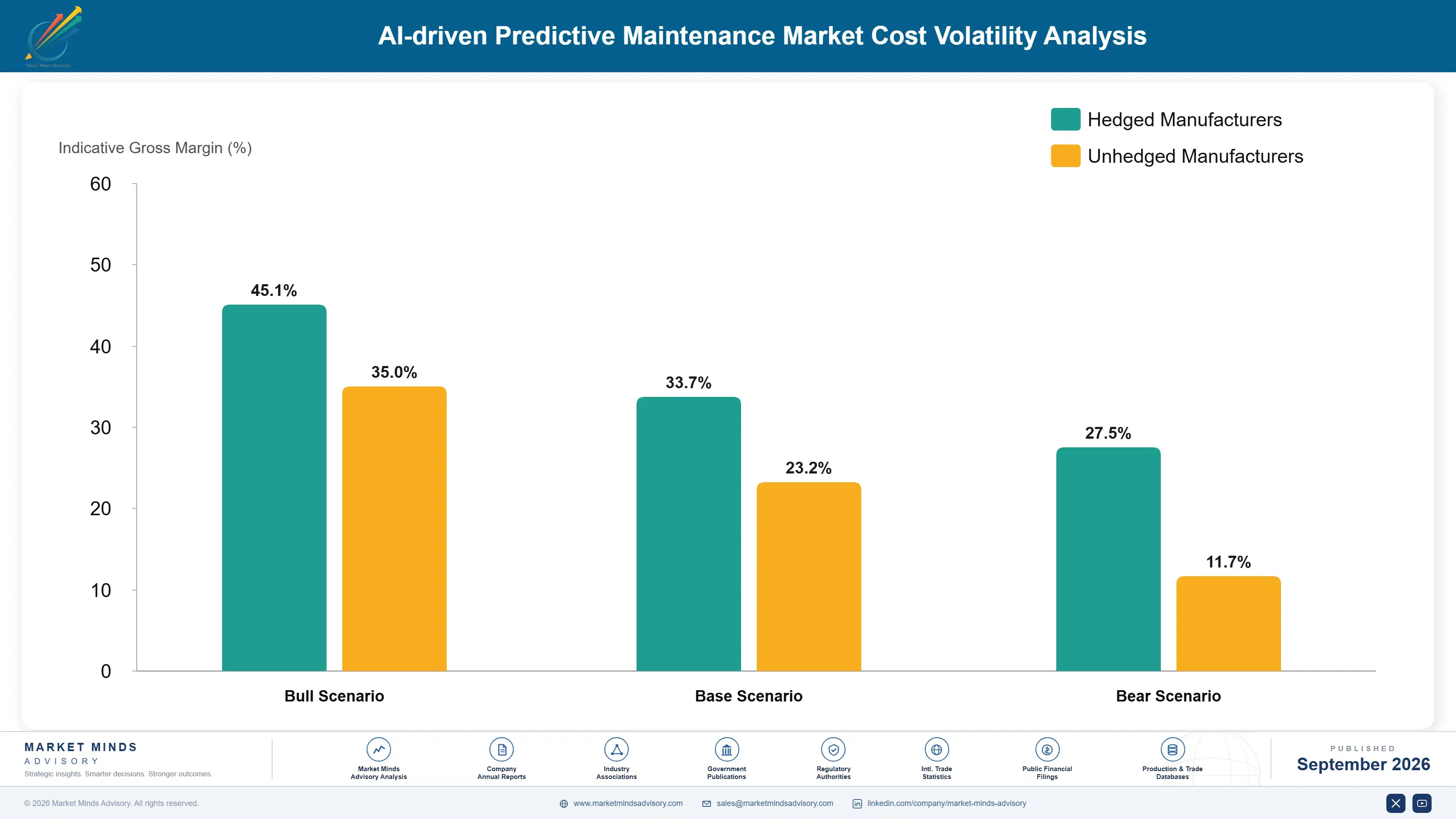
Data Science Talent and Sensor Cost Exposure

Data science engineering talent and industrial IoT sensor hardware together account for roughly forty-five percent of a predictive maintenance vendor's cost of goods sold, with the remainder split between cloud hosting, software licensing, and support operations. Most specialized industrial data science talent concentrates in a handful of established technology hubs, concentrating meaningful cost exposure outside vendor control.
Specialized industrial data science salaries rose more than twenty-two percent within a single year during the 2023 to 2024 period, driven by a talent shortage that the National Institute of Standards and Technology's 2024 industrial technology workforce report attributed to surging demand for machine learning expertise combined with manufacturing domain knowledge across the broader industry. Several vendors delayed planned hiring temporarily rather than absorbing the full compensation increase, slowing product roadmap delivery by roughly one fiscal quarter.

Smaller vendors without existing data science talent pipelines face sharper margin compression during hiring surges than the top five, who typically maintain university partnership programs and internal training pipelines. This gap widens further for vendors dependent on a single sensor hardware supplier, since they lack the negotiating leverage larger competitors use to secure better bulk pricing terms.
ai-driven-predictive-maintenance-market-cost-volatility-analysis-1788417517587

University Partnership Talent Pipeline Programs

Leading vendors now maintain formal university partnerships that train data scientists specifically in industrial domain applications, reducing dependence on the competitive open talent market. This lowers hiring costs over time. Vendors without such partnerships have historically paid a premium to attract candidates competing directly against better-established technology recruiters. This gap should narrow gradually over time.

Multi-Supplier Sensor Hardware Sourcing Strategy

Vendors qualifying sensor hardware from multiple suppliers can shift orders toward whichever supplier offers better terms in a given quarter, reducing exposure to any single supplier's pricing decisions. Smaller vendors rarely qualify a second source. Building that second qualified source takes significant procurement investment, keeping this advantage concentrated among the largest vendors currently. This gap widens during supply surges.

Remote Data Science Talent Sourcing Strategy

Several vendors have expanded remote hiring beyond traditional technology hubs, accessing data science talent in lower-cost regions that still meet the specialized skill requirements the work demands. Adoption remains uneven across the vendor base. Vendors that expanded remote hiring earliest report meaningfully faster time-to-fill for open technical roles than competitors still recruiting locally. This trend should continue broadly.

Portfolio Architecture for Margin Defence

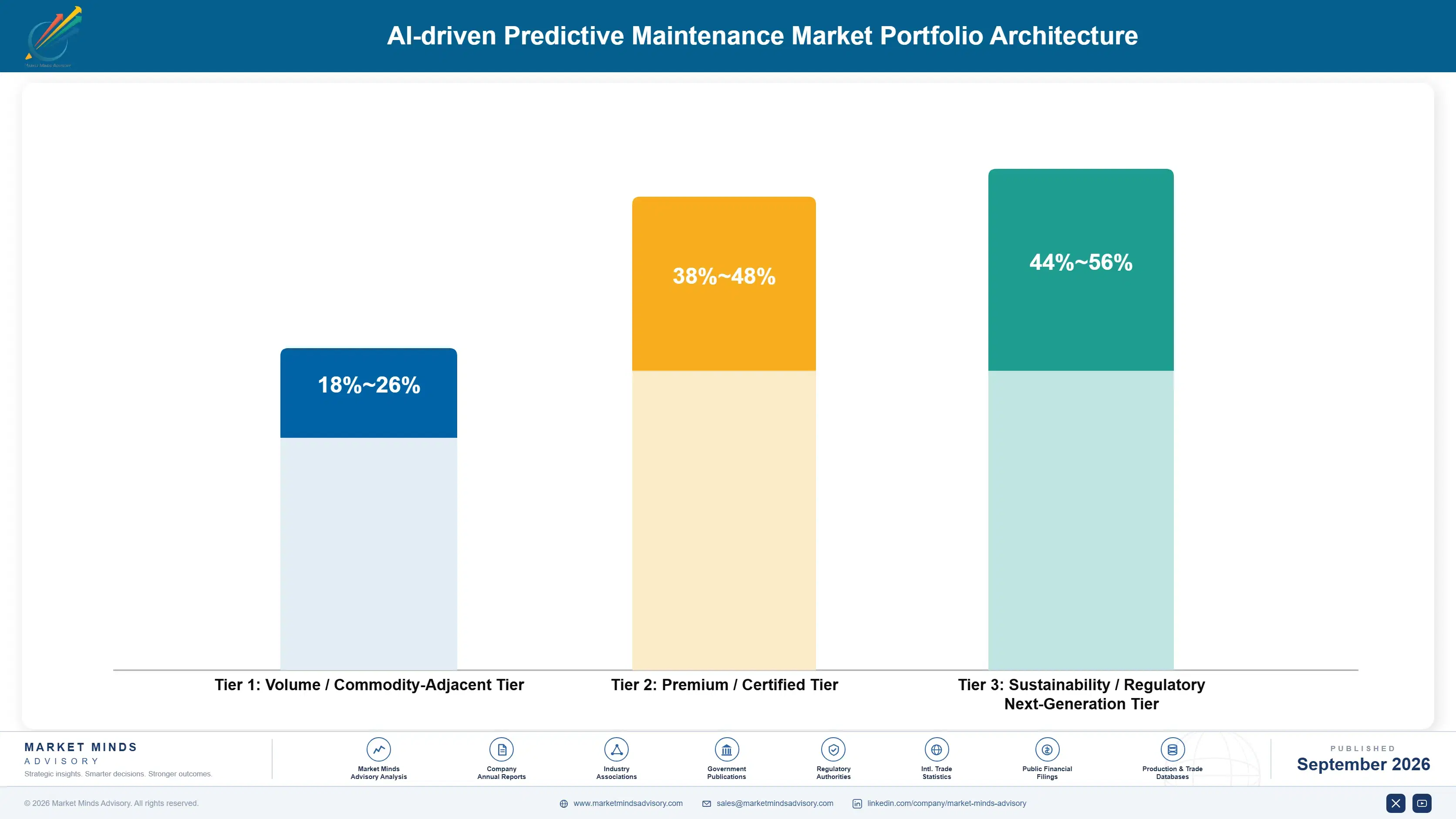
AI-driven predictive maintenance margin economics split across three tiers, with threshold-based monitoring competing on price while AI-powered and next-generation diversified platforms command materially wider gross margin. Threshold-based monitoring still generates meaningful revenue from existing facility contracts even as new bookings concentrate increasingly in the higher tiers. That gap has widened as accuracy requirements tighten, making threshold-only offerings a poor allocation for vendors with a credible machine learning upgrade path.
The tension between threshold-based and AI-powered is sharpest in large manufacturing contracts, where a vendor's average contract value can differ meaningfully between a threshold deployment and its AI-powered equivalent serving comparable facility scale. Vendors chasing threshold volume alone cede the margin pool to competitors willing to invest in machine learning engineering. That gap has widened over several years as buyers weigh detection accuracy more heavily than raw sensor count.

High-value margin pools concentrate in AI-powered anomaly detection and emerging grid infrastructure monitoring services, both requiring upfront engineering and talent investment that smaller vendors frequently cannot justify against uncertain contract-win probability. This concentration is expected to deepen as industrial digitalization demand keeps expanding. Vendors positioned early in both capture disproportionate revenue growth relative to unit volume growth across the decade ahead.

Volume / Commodity-Adjacent Tier

Threshold-based condition monitoring sold on price into general facility deployments, competing primarily on sensor coverage rather than analytics sophistication. Price pressure remains steady here. Regional integrators dominate this segment given lower certification barriers among mid-tier manufacturing buyers.
Gross Margin: 18-26%

Premium / Certified Tier

AI-powered anomaly detection platforms sold at a durable premium, defended by model accuracy barriers competitors cannot easily replicate without years of dedicated engineering work. Established vendors with proven accuracy data hold this ground firmly against newer entrants.
Gross Margin: 38-48%

Sustainability / Regulatory / Next-Generation Tier

Emerging grid infrastructure and fleet monitoring services combining machine learning with domain-specific analytics, carrying the widest margins as early scaled volume remains constrained. Scale should follow as buyer confidence in domain-specific accuracy grows over coming years.
Gross Margin: 44-56%
ai-driven-predictive-maintenance-market-portfolio-architecture-1788417518079

High-value Sub-segments and Strategic Watch-out

High-value high-growth segment

AI-powered anomaly detection platforms sit at the intersection of premium margin and the fastest unit volume growth, as manufacturers standardize around machine learning platforms rather than legacy threshold-based monitoring across new facility modernization decisions. This is the clearest growth vector across the entire forecast decade.
Gross Margin: 38-48%

High-value moderate-growth segment

Grid infrastructure monitoring services carry strong recurring margins tied to utility demand, though adoption grows more gradually as vendors build the specialized expertise needed to support complex grid-scale monitoring engagements. Vendors treat this as a durable, if slower-building, opportunity worth pursuing. Vendors treat this as durable revenue worth pursuing.
Gross Margin: 34-44%

Volume core segment

Threshold-based condition monitoring systems remain the largest unit volume base across established manufacturing facilities globally, sustaining steady if unremarkable margins as the category matures and price competition among established vendors intensifies broadly. Scale determines share here overall. Volume here funds the fixed cost base broadly across most vendor operations.
Gross Margin: 18-26%

Strategic watch-out segment

Industrial equipment manufacturers building native predictive capability directly into their own machinery threaten to disintermediate standalone software vendors over the coming decade, particularly where manufacturers prefer embedded functionality over separate vendor relationships. This shift bears close monitoring ahead. Established vendors are responding through acquisition and partnership deals.
Gross Margin: n/a

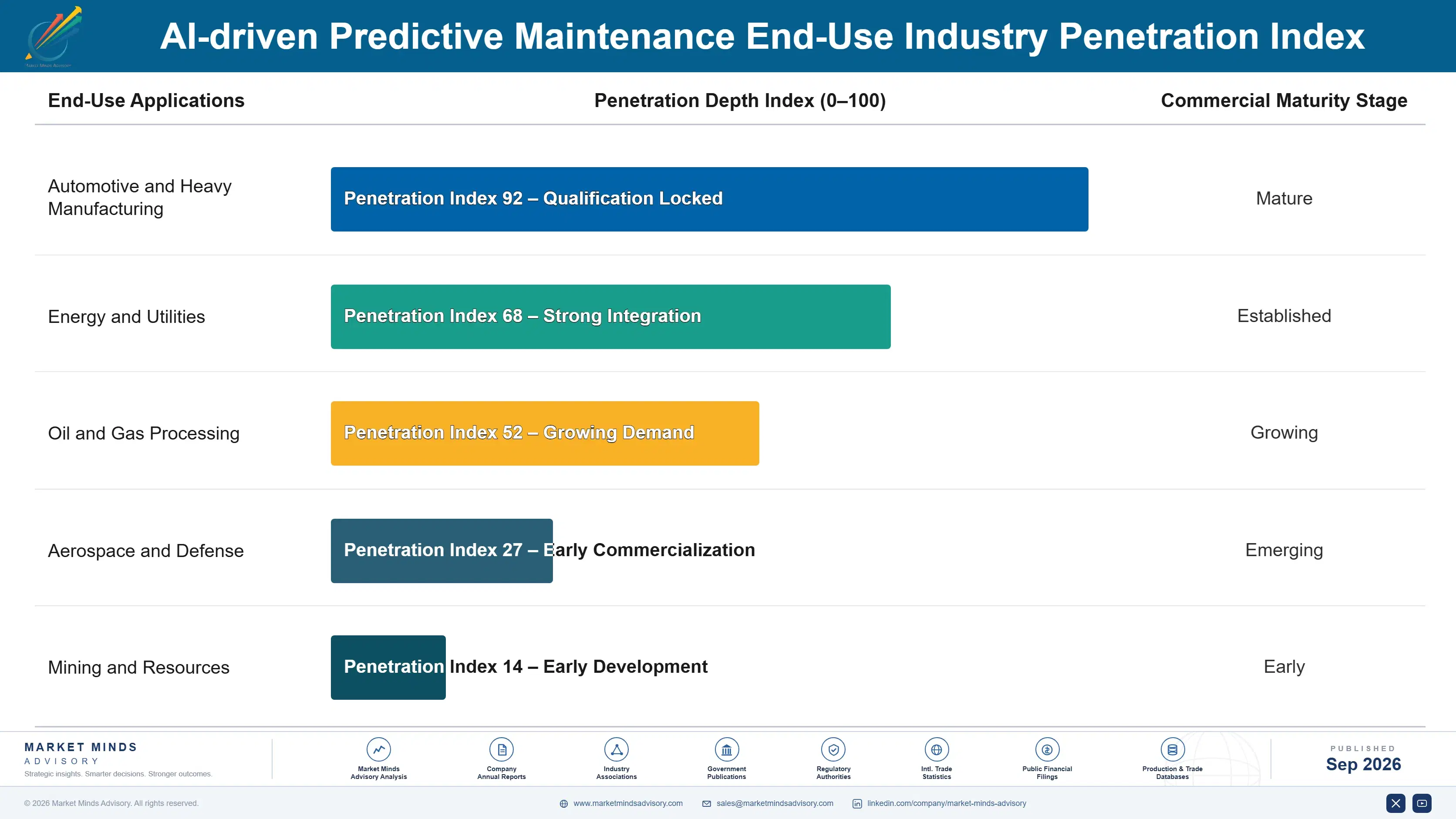
Contracts Behave Like Annuities

An AI-driven predictive maintenance contract functions like an annuity rather than a single transaction, since manufacturers rarely switch vendors once maintenance teams build workflows around a specific platform's detection models and alert thresholds. A single manufacturing facility contract can generate recurring subscription revenue across an entire equipment lifecycle lasting five to ten years, turning one initial deployment into a durable, multi-year revenue stream for the winning vendor.
Adoption depth varies sharply by end-use vertical. Continuous manufacturing facilities embed vendor relationships into multi-year contracts tied to measured downtime reduction, while energy and utilities operators treat deployment as a more standardized, grid-driven rollout decision. Fleet and transportation operators sit at an earlier adoption stage, favoring smaller pilot deployments for now. That spread explains why unit volume and margin diverge across these three verticals.

Buyer profiles are shifting generationally as well. A newer cohort of plant engineers, trained on data-driven maintenance from early in their careers, increasingly defaults to AI-powered platforms over legacy threshold-based monitoring. Older maintenance teams in established manufacturing accounts still favor familiar rule-based systems, though retirement and workforce turnover are steadily closing that generational gap across the forecast decade.
ai-driven-predictive-maintenance-market-end-use-penetration-index-1788417518567

Where Vendors Should Focus

These are among the four positions where our research anticipates prominent divergence between winners and laggards over the coming forecast period. Each is grounded in the demand model, the regulatory perimeter, and the announced capacity pipeline.
01 / MODEL ACCURACY INVESTMENT PRIORITY

Build accuracy depth before manufacturers standardize requirements

AI-powered anomaly detection already commands the widest margins in the category, and that gap is widening as manufacturers increasingly treat accuracy depth as essential to any new procurement decision rather than a discretionary upgrade layered on top. Vendors without proven accuracy depth risk exclusion from the fastest-growing manufacturing modernization bids within the next several years, not just margin erosion, since procurement contracts increasingly name false alarm reduction as a scoring criterion. Building that depth now, ahead of full market consolidation, converts a technical investment into a lasting contract advantage.
02 / RAPID DEPLOYMENT INVESTMENT STRATEGY

Compress deployment timelines before procurement windows close

Rapid deployment capability increasingly determines which vendor wins a manufacturer's contract, more so than raw model sophistication in most competitive procurement reviews conducted today. Vendors that demonstrate proven fast deployment capture design wins that slower-integrating competitors cannot match, since manufacturers lock vendor decisions early in the evaluation cycle and rarely revisit a working maintenance choice. This advantage compounds as facility modernization cycles keep accelerating across the forecast decade, rewarding whoever deploys fastest with the largest cumulative share of new manufacturer contracts.
03 / GRID MONITORING SERVICES EXPANSION

Build utility expertise before enterprise demand shifts elsewhere

Grid infrastructure monitoring opens a qualified revenue channel that most manufacturing-focused vendors have been slow to prioritize, leaving meaningful margin pools uncontested for whoever moves first into this specialty. Vendors that invest in dedicated grid monitoring expertise now capture utility volume that generic manufacturing vendors simply cannot bid on, since these engagements require specialized grid-scale analytics experience most generic vendors simply lack. That head start should compound steadily as utility digitalization keeps generating new grid monitoring opportunities across every major regional power market worldwide.
04 / EQUIPMENT MANUFACTURER RESPONSE STRATEGY

Deepen OEM partnerships before manufacturers fully embed capability

Industrial equipment manufacturers actively building native predictive capability directly into their own machinery threaten to erode standalone software vendors' addressable market as embedded functionality proves increasingly cost-effective for buyers. Vendors that deepen OEM partnerships now retain differentiated positioning rather than losing manufacturing accounts entirely to fully embedded predictive programs that leading equipment makers with sufficient scale are already actively pursuing. Waiting until equipment manufacturers fully embed capability will make this positioning meaningfully harder, slower, and considerably more costly to establish.

Engagement Snapshot From the Field

A live engagement with an industry participant carrying material or product regulatory and market exposure ahead of a defining policy shift, showing how our research translates into a defensible multi-year portfolio strategy.
MARKET MINDS ADVISORY · CLIENT ENGAGEMENT SUMMARY
AI-driven Predictive Maintenance Producer Strategic Portfolio Review and Transition Roadmap 2026·Investment Scenario on AI-driven Predictive Maintenance Exposure Evaluation 2025-26
CLIENT PROFILE
The client is a global manufacturer operating continuous production facilities across multiple countries, with annual equipment maintenance spending in the tens of millions of dollars (client-reported, unverified by MMA). The manufacturer had historically relied on threshold-based condition monitoring without machine learning capability. Rising unplanned downtime costs prompted leadership to reconsider its maintenance technology roadmap. Executives sought clearer downtime reduction plans.
STRATEGIC CHALLENGE
Escalating unplanned downtime costs and declining equipment reliability scores forced the manufacturer to reconsider its maintenance strategy within a compressed annual budget planning cycle. Management needed to decide whether to deploy AI-powered anomaly detection across its full facility network, pilot it in a subset of production lines first, or maintain existing threshold-based systems despite the ongoing downtime exposure.
MMA APPROACH
MMA conducted structured interviews with the manufacturer's plant operations and maintenance leadership alongside a benchmarking exercise against three peer global manufacturers' predictive maintenance deployments and vendor relationships across comparable production facilities. The engagement combined primary qualitative interviews with MMA's proprietary predictive maintenance market dataset to assess vendor claims, deployment costs, and realized downtime reduction under each rollout option.
KEY FINDINGS
  1. AI-powered anomaly detection reduced unplanned downtime by roughly thirty percent compared to threshold-based systems within the first year (client-reported, unverified by MMA).
  2. Peer global manufacturers that piloted machine learning platforms before full rollout reported fewer implementation issues than those deploying across all lines immediately.
  3. Full facility-wide deployment would have required implementation investment the engagement estimated at nine months beyond the manufacturer's current budget cycle timeline. Budget timing made a phased approach more practical.
  4. Manufacturers that piloted deployment on highest-criticality production lines first captured most of the downtime benefit at a fraction of full rollout cost.
CLIENT PROFILE
The client is a global manufacturer operating continuous production facilities across multiple countries, with annual equipment maintenance spending in the tens of millions of dollars (client-reported, unverified by MMA). The manufacturer had historically relied on threshold-based condition monitoring without machine learning capability. Rising unplanned downtime costs prompted leadership to reconsider its maintenance technology roadmap. Executives sought clearer downtime reduction plans.
STRATEGIC CHALLENGE
Escalating unplanned downtime costs and declining equipment reliability scores forced the manufacturer to reconsider its maintenance strategy within a compressed annual budget planning cycle. Management needed to decide whether to deploy AI-powered anomaly detection across its full facility network, pilot it in a subset of production lines first, or maintain existing threshold-based systems despite the ongoing downtime exposure.
MMA APPROACH
MMA conducted structured interviews with the manufacturer's plant operations and maintenance leadership alongside a benchmarking exercise against three peer global manufacturers' predictive maintenance deployments and vendor relationships across comparable production facilities. The engagement combined primary qualitative interviews with MMA's proprietary predictive maintenance market dataset to assess vendor claims, deployment costs, and realized downtime reduction under each rollout option.
KEY FINDINGS
  1. AI-powered anomaly detection reduced unplanned downtime by roughly thirty percent compared to threshold-based systems within the first year (client-reported, unverified by MMA).
  2. Peer global manufacturers that piloted machine learning platforms before full rollout reported fewer implementation issues than those deploying across all lines immediately.
  3. Full facility-wide deployment would have required implementation investment the engagement estimated at nine months beyond the manufacturer's current budget cycle timeline. Budget timing made a phased approach more practical.
  4. Manufacturers that piloted deployment on highest-criticality production lines first captured most of the downtime benefit at a fraction of full rollout cost.
RECOMMENDED STRATEGY
Phase 1: Phase 1 (Months 1-3): Deploy AI-powered anomaly detection across the three highest-criticality production lines identified through historical downtime data. overall. Phase 2: Phase 2 (Months 4-9): Evaluate pilot performance carefully and expand deployment to additional lines based on demonstrated downtime reduction outcomes achieved. Phase 3: Phase 3 (Months 10-15): Negotiate a facility-wide vendor agreement covering full production network coverage over the following fiscal budget cycle.
OUTCOME
Within fifteen months of implementation, the manufacturer reported a reduction in unplanned downtime tied to AI-powered deployment of approximately twenty-seven percent (client-reported, unverified by MMA). The phased approach demonstrated sufficient downtime reduction to justify expanded deployment, and the manufacturer has since committed to a fully AI-powered maintenance strategy across its entire global production network.

Frequently Asked Questions

Foundational context covering the market sizes, CAGR, scope, country, region and competition that inform every finding below. This section is provided to cover basics and most often pre-purchase conversations, answered from the MMA Primary Research Dataset.

What is the current size of the AI-driven Predictive Maintenance Market?

The AI-driven Predictive Maintenance Market reached an estimated 7.4 billion dollars in 2025. Growth is driven by rising unplanned downtime costs and expanding industrial IoT sensor adoption worldwide.

How large will the AI-driven Predictive Maintenance Market be by 2036?

MMA projects the market will reach approximately 40.83 billion dollars by 2036 under the base case scenario. This represents nearly five times the 2026 opening value over the ten year forecast window.

What is the CAGR for the AI-driven Predictive Maintenance Market 2026 to 2036?

The base case compound annual growth rate is 16.8 percent across the forecast period. Bull and bear scenarios range from 18.1 percent to 15.5 percent depending on AI adoption pace.

Which segment is growing fastest?

AI-Powered Anomaly Detection Platforms is the fastest growing segment, expanding at 23.4 percent annually. That is roughly 1.39 times the overall market growth rate through 2036.

Who are the major companies in the AI-driven Predictive Maintenance Market?

Leading participants include IBM Corporation, PTC Inc, SAP SE, GE Digital, and Uptake Technologies. Together these five companies hold a combined revenue share estimated near 38 percent.

Which country is growing fastest?

India is the fastest growing country market, supported by its expanding manufacturing sector scaling production capacity that requires modern equipment monitoring. Demand is further reinforced by growing multinational manufacturer investment nationwide.

Report Segmentation Architecture

The full report scope spans multiple orthogonal segmentation dimensions, with cross-tabulated demand data provided for each dimension pair. Coverage extends further to regional breakdowns, trend trajectories, and the competitive detail needed to support segment-level decision-making.

By Primary Market Dimension

  • AI-Powered Anomaly Detection Platforms
  • Threshold-Based Condition Monitoring Systems
  • Prescriptive Maintenance Analytics
  • Digital Twin Simulation Platforms
  • Grid Infrastructure Monitoring Services
  • Fleet and Asset Telemetry Platforms

By End-Use Industry

  • Automotive and Heavy Manufacturing
  • Energy and Utilities
  • Oil and Gas Processing
  • Aerospace and Defense
  • Mining and Resources

By Commercial Dimension

  • Direct Enterprise Sales
  • Managed Service Provider Contracts
  • System Integrator Partnerships
  • OEM Embedded Licensing

By Region

  • North America
  • Western Europe
  • East Asia
  • South Asia and Pacific
  • Latin America
  • Middle East and Africa
  • Eastern Europe

Scope, Methodology, and Coverage

Every figure in this report is reproducible from documented input assumptions. The scope below maps the historical period, the forecast horizon, the segmentation dimensions, and the countries covered, alongside the underlying primary and qualitative methodology.
Historical Period
2020 to 2025
Forecast Period
2026 to 2036
Base Year
2025 (USD billions; MMA Primary Research Dataset, September 2026)
Market Definition
This market covers software platforms and services that use machine learning to predict industrial equipment failure from sensor and operational data before breakdown occurs. It excludes standalone industrial IoT sensor hardware and general enterprise asset management software without predictive analytics capability.
Quantitative Units
USD billions (current prices); deployed facility count where noted
Segmentation Dimensions
By Primary Market Dimension; By End-Use Industry; By Commercial Dimension; By Region
Regions Covered
North America, Western Europe, East Asia, South Asia and Pacific, Latin America, Middle East and Africa, Eastern Europe
Countries Covered
USA, Canada, Germany, France, UK, Japan, South Korea, China, Taiwan, India, Australia, Brazil, Mexico, Argentina, UAE, Saudi Arabia, South Africa, Egypt, Poland, Czech Republic, Hungary, Romania, Slovakia, Netherlands, Italy, Spain, Sweden, Singapore, Vietnam, Indonesia, and additional markets relevant to this sector
Key Companies Profiled
IBM Corporation, PTC Inc, SAP SE, GE Digital, Uptake Technologies, Siemens Digital Industries, Schneider Electric, Honeywell International, Rockwell Automation, AVEVA Group, C3 AI Inc, Augury Systems, SparkCognition, Senseye Ltd, Falkonry Inc, Presenso Ltd, Waylay NV, Seebo Interactive, Nanoprecise Sci Corp, Petasense Inc
Quantitative Methodology
Primary survey, n=3,800 respondents, Q4 2025, six countries; demand-side model with trade association cross-validation
Qualitative Methodology
47 expert interviews, Q4 2025; applied to validate demand model assumptions, identify emerging dynamics, and assess competitive positioning
Report Format
PDF and XLSX data workbook (Word format preview document)
Publisher
Market Minds Advisory
Report Code
MMA-2026-TEC-185
Published
September 2026
Contact
sales@marketmindsadvisory.com | www.marketmindsadvisory.com

Purchase the full AI-driven Predictive Maintenance Market Report (2026 to 2036).

This report provides comprehensive analysis of the AI-driven Predictive Maintenance Market, covering size, forecasts, segmentation, and regional dynamics through 2036. It examines competitive positioning among leading industrial software vendors, input cost exposure across data science talent and industrial IoT sensor supply chains, and portfolio economics across volume, premium, and next-generation tiers. The analysis draws on primary survey data covering 3,800 respondents and 47 expert interviews conducted in the fourth quarter of 2025. Buyers receive a complete strategic view suitable for investment planning, procurement strategy, and competitive benchmarking decisions across the industrial software value chain.
Full ten-year market and segment forecasts through 2036
Regional analysis across all seven MMA-tracked geographies
Competitive benchmarking of top five and fifteen additional players
Data science talent and sensor cost exposure analysis
Revenue lever framework tied to quantified commercial impact
Anonymised global manufacturer case study with strategy phasing

Built For The People Who Decide

From boardroom strategy to bench-side execution, this report is read cover-to-cover by leaders shaping the next decade of their industry, turning demand scenarios, market dynamics and valuation benchmarks into decisions.
CXOs/ Presidents/ VPs/ Managers
M&A and Corporate Development
Strategy Teams and R&D Heads
Procurement and Product Directors
Regulatory and Compliance Leaders
Investor Relations and Equity Analysts