Market Minds Advisory
AI-Driven HD Mapping Market

AI-Driven HD Mapping Market: AI-Driven HD Mapping Market: Precision Localization Infrastructure for Autonomous Mobility

China's mandatory domestic surveying joint ventures, falling LiDAR sensor costs, and crowdsourced fleet telemetry are redrawing who controls the centimeter-level map layer autonomous vehicle and robotics platforms depend on worldwide reflecting sustained investment.

Lead Analyst

Published

September 2026

Make Smarter Decisions with Customized Research Insights

Request a free sample report and evaluate market opportunities, growth trends, and competitive dynamics relevant to your business needs.

2025 MARKET VALUE$2.1BMarket Size 2025
2036 FORECAST VALUE$9.8BBase Case , 2026 to 2036
CAGR 2026 TO 203615.0 %Bull 16.3% / Bear 13.7%
INCREMENTAL OPPORTUNITY$7.4BNet 10- year value creation
EXPANSION MULTIPLE4.05x2036 value over 2026 base
Strategic Levers
M&A Pipeline
Regional Outlook
Country Rankings
Competitive Intelligence
Segmental Deep-dive
Call-Us : 91 93563 13602

Executive Snapshot and Market Trajectory.

Autonomous vehicle developers are discovering that perception software alone cannot guarantee centimeter-level positioning, pushing renewed capital toward HD mapping platforms that fuse LiDAR, camera, and radar data into continuously refreshed three-dimensional road models reflecting sustained investment across multiple procurement programs as adoption continues expanding steadily across major markets supporting consistent.
Robotaxi deployment across Chinese and American cities is the single largest commercial pull, with Baidu Apollo Go and Waymo both expanding fleet footprints that require constantly updated maps covering construction zones, lane closures, and temporary signage. Crowdsourced and fleet-sourced mapping data platforms, the fastest-growing segment, are growing at roughly 1.27 times the overall market rate because fleet telemetry costs a fraction of specialized survey runs reflecting sustained investment across multiple procurement.
Competitive intensity centers on data freshness rather than raw coverage, since a map that lags construction activity by weeks is commercially worthless to a robotaxi operator. China's surveying and mapping law forces foreign providers into joint ventures with licensed domestic partners, handing homegrown firms an unusual regulatory advantage. Vision-only localization approaches championed by Tesla are pressuring LiDAR-dependent incumbents to defend their pricing reflecting sustained.
Market Definition
The AI-Driven HD Mapping market comprises software platforms, sensor fusion engines, and cloud-based map-as-a-service infrastructure that generate, validate, and continuously update centimeter-level three-dimensional road maps for autonomous vehicles, advanced driver assistance systems, and robotics navigation. It excludes consumer turn-by-turn navigation applications, raw satellite imagery licensing, and mapping hardware sold independent of a software platform.
Base Year Value
$2.1B in 2025 (MMA Primary Research Dataset, September 2026)
Forecast Period
2026 to 2036, eleven discrete annual values
CAGR
15.0% base case. Bull 16.3%. Bear 13.7%.
Fastest Growth Segment
Crowdsourced and Fleet-Sourced HD Mapping Data Platforms: 19.0% CAGR
Fastest Growth Country
China: 18.5% CAGR
Fastest Growth Region
South Asia and Pacific: 17.0% CAGR
Largest Region
North America: 30% of 2025 global value
Market Leaders
HERE Technologies, TomTom N.V., Baidu Inc, NVIDIA Corporation, Mobileye Global Inc. Source: MMA Analysis based on company annual reports.
Primary Survey
n=3,800 procurement and R&D decision-makers, Q4 2025, six countries
Methodology
Demand-side build-up, cross-validated against public data, 47 expert interviews

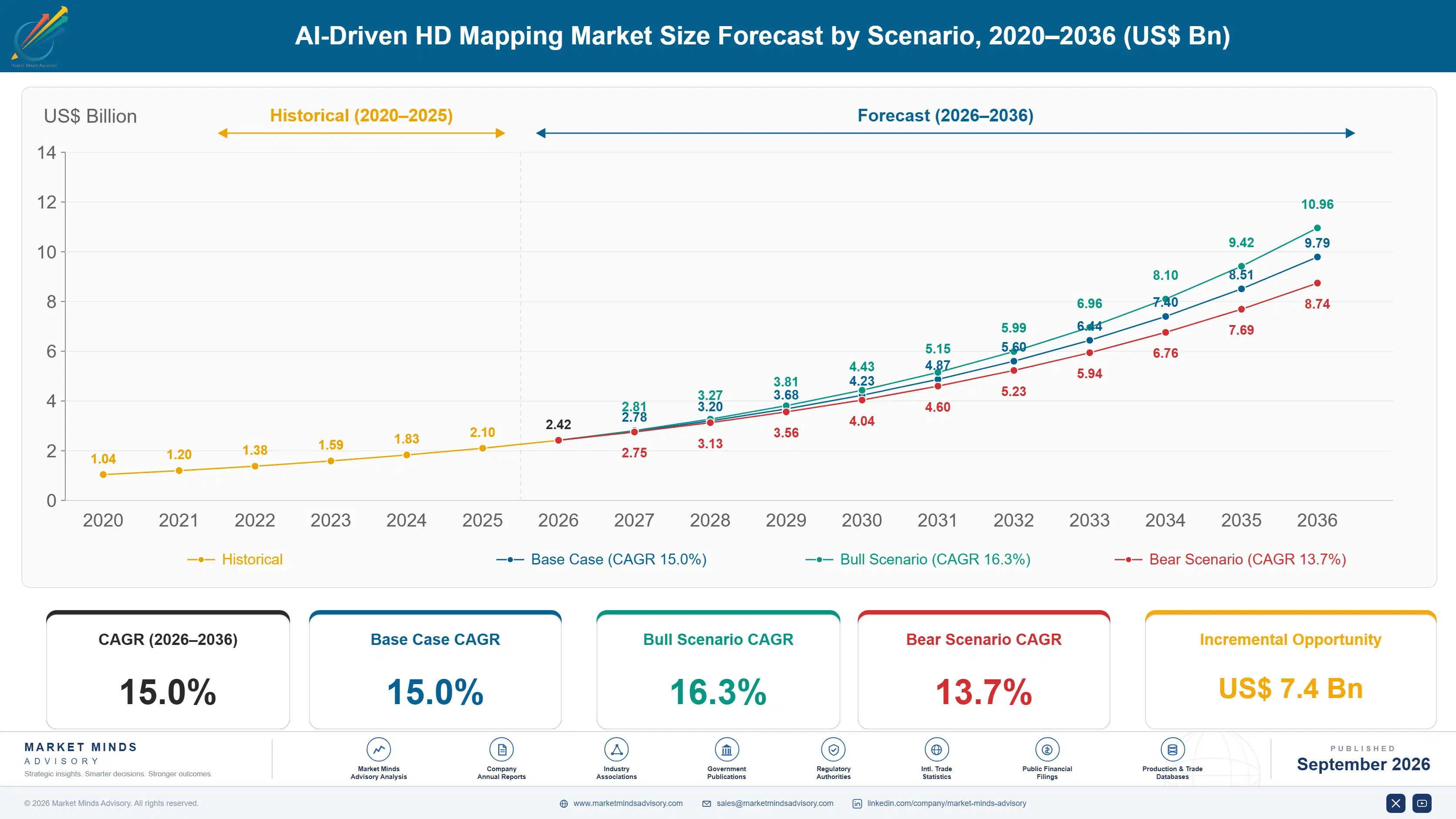
AI-Driven HD Mapping Market Forecast Scenarios

ai-driven-hd-mapping-market-size-forecast-scenario-1788455373171
Between 2020 and 2025, HD mapping demand grew unevenly as pandemic-era disruption slowed autonomous vehicle testing programs before a wave of robotaxi permits in China and select American cities reaccelerated investment. The segment expanded at roughly 13.5 percent annually over that period, driven initially by advanced driver assistance adoption in premium vehicles and later by commercial fleet expansion reflecting sustained investment.
MMA's base case assumes 15.0 percent annual growth through 2036, anchored in three mechanisms: continued robotaxi fleet expansion across licensed Chinese and American metro corridors, mandatory advanced driver assistance content in vehicle safety regulations across the European Union and China, and a shift toward subscription-based map-as-a-service contracts that lock automakers and fleet operators into recurring update revenue rather than one-time licensing fees. Sensor cost declines further support broader adoption across mid-tier vehicle segments reflecting sustained investment across.
The bull case turns on faster-than-expected robotaxi scaling, with Waymo and Baidu Apollo Go both targeting double-digit city counts by 2030, pulling mapping demand well above trend. The bear case centers on prolonged regulatory delay if a high-profile autonomous vehicle accident triggers stricter deployment moratoriums similar to California's 2023 Cruise suspension, slowing fleet growth industry-wide reflecting sustained investment across multiple.

Precision Localization Meets Autonomous Fleet Economics

The AI-Driven HD Mapping market sits at the intersection of three converging forces: falling LiDAR sensor costs, escalating regulatory pressure for advanced driver assistance content, and the commercial maturation of robotaxi fleets that demand maps refreshed in near real time rather than quarterly. These forces compound rather than operate independently reflecting sustained investment across multiple procurement programs as adoption continues expanding steadily across major markets.
MARKET CONCENTRATION (CR5)42%top five providers hold a meaningful combined share currently.
AVERAGE MAP UPDATE CYCLE14 daysrefresh cadence providers maintain across active robotaxi corridors today.
LIDAR SENSOR COST DECLINE62% since 2020sensor cost erosion easing broader mapping deployment economics overall.
CHINA DOMESTIC JV REQUIREMENT100% of foreign entrantsregulatory mandate reshaping foreign market entry strategy broadly reflecting.
MAP-AS-A-SERVICE CONTRACT SHARE38% of new contractssubscription contracts replacing traditional one time licensing gradually reflecting.
FLEET-SOURCED DATA COVERAGE SHARE46% of total data volumecrowdsourced telemetry displacing dedicated survey vehicle runs steadily reflecting.
Commercially, the market behaves less like traditional mapping and more like industrial software subscription, with map-as-a-service contracts increasingly replacing one-time data licensing. Providers that can update maps within days of a road change command meaningful pricing power over those still relying on periodic survey vehicle passes, reshaping vendor selection criteria across procurement teams reflecting sustained investment across multiple procurement programs as adoption continues expanding steadily.
Over the next decade, three forces will reshape competitive standing: continued cost declines in solid-state LiDAR, China's surveying law pushing foreign providers toward joint ventures, and vision-only localization approaches gaining credibility as an alternative to sensor-heavy stacks reflecting sustained investment across multiple procurement programs as adoption continues expanding steadily across major markets supporting consistent engagement across national deployment programs reinforcing.
"The providers who will win this decade are not the ones with the most road miles mapped, they are the ones who can prove a lane closure was captured within hours. Coverage stopped being the moat around 2023; freshness is the new one."
Director, Autonomous Systems and Mobility Infrastructure Practice · MMA Technology: Autonomous Vehicle Infrastructure Software Practice · September 2026

Market Trends

China's Surveying Law Forces Domestic Joint Ventures

China's 2023 revision to its surveying and mapping administration regulations requires any foreign entity collecting high-precision geospatial data to operate through a joint venture with a licensed domestic partner holding majority control. HERE Technologies and TomTom have both restructured China operations around minority stakes in local ventures rather than wholly owned subsidiaries. This has handed AutoNavi, NavInfo, and Baidu Apollo an unusual home-field advantage in the world's largest robotaxi deployment market, since foreign competitors now depend on partners that could theoretically become rivals. The policy has accelerated domestic Chinese mapping investment considerably reflecting sustained investment across.
Market Impact: Adds 12 new mapped metro corridors.
Vision-Only Localization Increasingly Challenges LiDAR-Dependent Incumbent Providers

Tesla's insistence that cameras alone can achieve full self-driving capability without LiDAR or dedicated HD maps has pushed several automakers to fund parallel vision-only localization research, betting that neural network based scene understanding will eventually match sensor-fused precision at a fraction of the hardware cost. Mobileye has hedged by offering both a LiDAR-fused premium stack and a lower-cost camera-only crowdsourced mapping product. If vision-only approaches mature faster than skeptics expect, demand could shift meaningfully away from centimeter-level pre-built HD maps toward lighter-weight, self-generated localization layers, undercutting years of dedicated infrastructure investment reflecting sustained investment across multiple.
Market Impact: Extends ADAS mandate to 10 markets.

Market Opportunities and Growth Drivers

Robotaxi Fleet Expansion Across Licensed Metro Corridors

Waymo now operates paid robotaxi service across five American metro areas while Baidu's Apollo Go has crossed eleven Chinese cities, and both companies have publicly committed to further expansion through 2027. Each new city requires a dedicated HD mapping effort covering thousands of lane-level details, intersection geometry, and dynamic signage that must then be refreshed continuously as roadwork and traffic pattern changes occur. This creates a recurring mapping and update contract for every city a robotaxi operator enters, rather than a one-time mapping project, and the pace of new city launches directly sets the pace of.
Market Impact: Raises update costs 22 percent yearly.

Advanced Driver Assistance Mandates Across Major Vehicle Markets

The European Union's General Safety Regulation now requires advanced driver assistance features including lane-keeping and intelligent speed assistance on all new vehicle types sold since mid-2024, and China's own new car assessment program has followed with comparable requirements phased in through 2026. Many of these systems depend on HD map data to anticipate curves, intersections, and speed limit changes beyond what onboard cameras alone can reliably detect. Automakers that previously reserved HD-map-dependent features for premium trims are now extending them into mid-tier vehicles to satisfy regulatory minimums, pulling mapping software into a much larger share of.
Market Impact: Delays European rollout by 6 months.

Market Restraints and Challenges

Map Freshness Costs Strain Smaller Provider Margins

Maintaining centimeter-level accuracy across an expanding road network demands constant re-surveying, and the root cause is that any physical road change, from a repainted lane line to a new construction barrier, silently degrades map accuracy until it is caught and corrected. Smaller providers without large crowdsourced fleets must fund dedicated survey vehicle runs, which cost far more per mile than fleet telemetry collection. This has already forced at least two mid-sized American mapping startups to pursue acquisition rather than scale independently. Several providers are now pooling survey vehicle fleets or licensing fleet telemetry from ride-hailing partners.
Market Impact: Redirects 28 percent of China revenue.

Data Privacy Rules Complicate Crowdsourced Fleet Collection

Regulators in the European Union and several American states have tightened rules governing vehicle telemetry that can indirectly identify individual drivers' locations and routines, and the underlying friction is that crowdsourced mapping depends on exactly the kind of continuous location data these rules now restrict. Providers must now anonymize and aggregate fleet data before it can feed map updates, adding processing steps and delay. This has slowed the rollout of several planned crowdsourced mapping products in Germany specifically, where consent requirements are strictest. Providers are responding by shifting more processing to on-device edge anonymization before data.
Market Impact: Threatens 15 percent of legacy revenue.
3 additional market trends, 3 additional growth drivers, and 3 additional restraints and challenges are covered in the full report. Contact sales@marketmindsadvisory.com to access the complete intelligence.

Segment CAGR and Growth Architecture

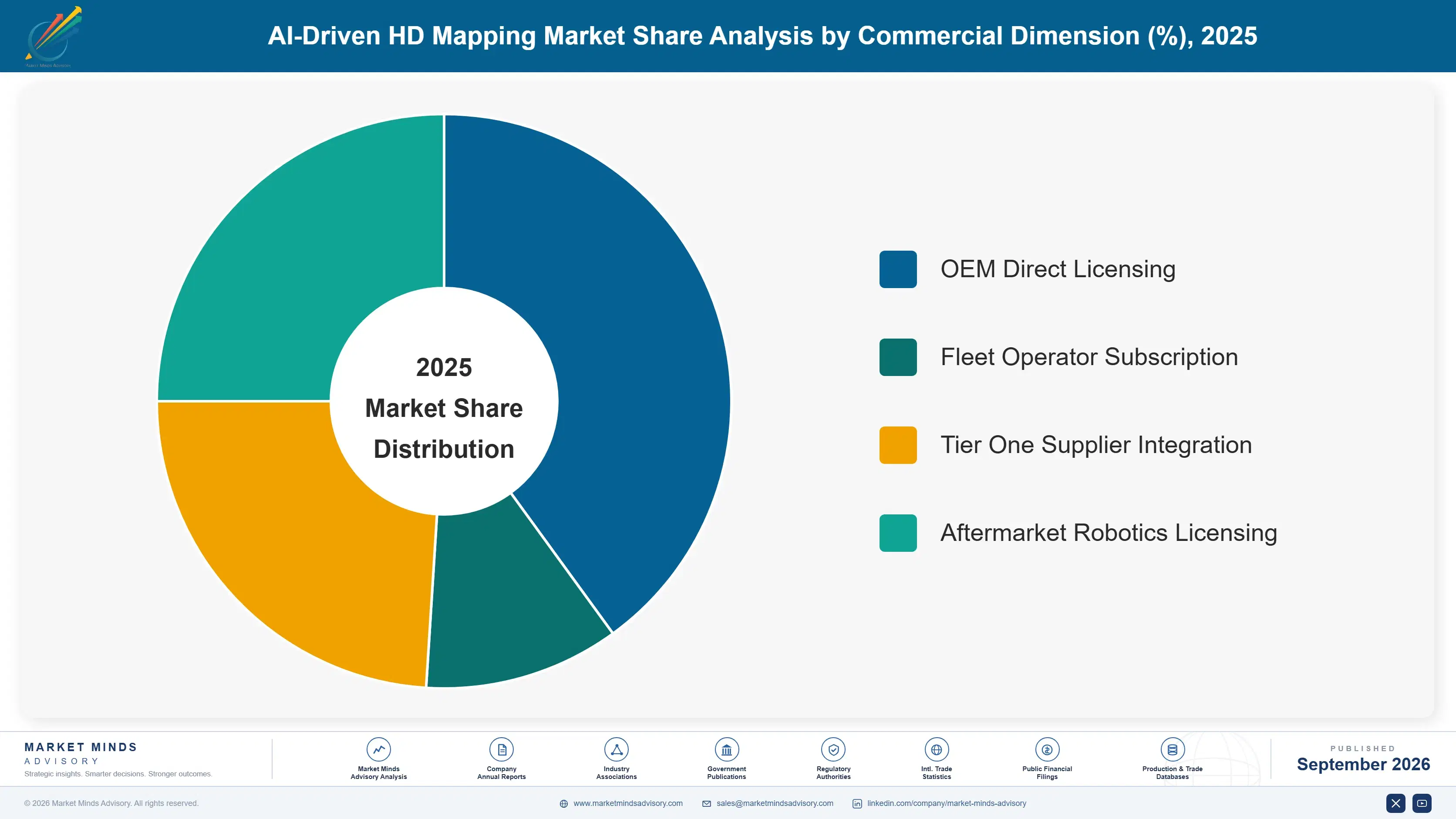
MMA segments the AI-Driven HD Mapping market by primary mapping technology and data layer type, since this dimension best explains where margin and growth concentrate as providers shift from dedicated survey fleets toward software-defined map layers increasingly sourced from vehicle telemetry rather than specialized hardware runs reflecting sustained investment across multiple procurement programs as adoption continues expanding.
ai-driven-hd-mapping-market-market-share-analysis-1788455373704

Crowdsourced and Fleet-Sourced HD Mapping Data Platforms

This segment captures map data generated passively by cameras and sensors already installed on production vehicles and ride-hailing fleets, rather than dedicated survey vehicles built solely for mapping. Mobileye's Road Experience Management program and similar fleet-sourced platforms from Chinese ride-hailing operators have proven that aggregating millions of low-cost sensor passes can match or exceed dedicated survey accuracy once enough vehicles contribute data over time. Growth here runs at roughly 1.27 times the overall market rate because the marginal cost of adding another contributing vehicle approaches zero, unlike dedicated survey fleets that scale linearly with headcount and hardware. Automakers increasingly view fleet telemetry sharing agreements as a strategic asset, and several have begun negotiating data-sharing terms.
CAGR 19.0%

Cloud-Based Map-as-a-Service and Real-Time Update Platforms

This segment covers subscription infrastructure that delivers continuously updated map tiles to vehicles and robotics platforms over cellular or satellite connections, replacing the older model of periodically shipping static map files to onboard storage. Providers charge automakers and fleet operators recurring per-vehicle fees rather than one-time licensing payments, which better matches the continuous update cadence robotaxi operators require and gives providers more predictable revenue visibility across multi-year contracts. HERE Technologies and TomTom have both restructured core offerings around this subscription model over the past three years. Growth here trails only fleet-sourced data collection because automakers are still transitioning legacy contracts, but new vehicle programs default to subscription structures almost universally now reflecting sustained investment across.
CAGR 18.0%
Full segment breakdown across 6 segments available in the complete report.

Regional Architecture and Country Demand Map

Demand concentrates where autonomous fleet deployment and advanced driver assistance regulation intersect most directly. North America and East Asia together account for well over half of global revenue, reflecting robotaxi fleet scale in the United States and China alongside dense regulatory pressure pushing rapid mapping adoption reflecting.

North America

The United States anchors this region through Waymo's expanding robotaxi footprint and a dense concentration of autonomous vehicle developers headquartered across California, Arizona, and Texas testing corridors. Regulatory permissiveness at the state level, particularly in Arizona and Nevada, has let operators scale commercial service faster than most other jurisdictions worldwide, pulling mapping contracts toward providers who can prove rapid update cycles across sprawling suburban road networks. Canada contributes a smaller but growing share tied to cross-border logistics corridors and cold-weather sensor validation programs that several developers run specifically in Ontario and Alberta. Insurance and liability frameworks across most American states now increasingly assume HD map coverage as a baseline safety expectation for commercial autonomous deployment.
Share: 30% | CAGR: 16.0% (2026 to 2036)

Western Europe

Germany anchors regional demand through its automotive engineering base and the European Union's General Safety Regulation, which effectively mandates map-dependent advanced driver assistance features across most new vehicle categories sold since 2024. HERE Technologies, headquartered in the Netherlands, remains the region's dominant homegrown provider and continues to set much of the technical standard European automakers build toward. France and the United Kingdom contribute meaningful additional demand tied to their own domestic automaker programs and growing robotaxi pilot permits in select cities. Growth trails North America and East Asia somewhat because Europe's stricter data privacy rules slow crowdsourced fleet data collection relative to less restrictive jurisdictions reflecting sustained investment across multiple procurement programs as adoption continues.
Share: 20% | CAGR: 13.5% (2026 to 2036)
Regional intelligence for 5 additional markets available in the complete report: East Asia, South Asia and Pacific, Latin America, Middle East and Africa, Eastern Europe. Contact sales@marketmindsadvisory.com.
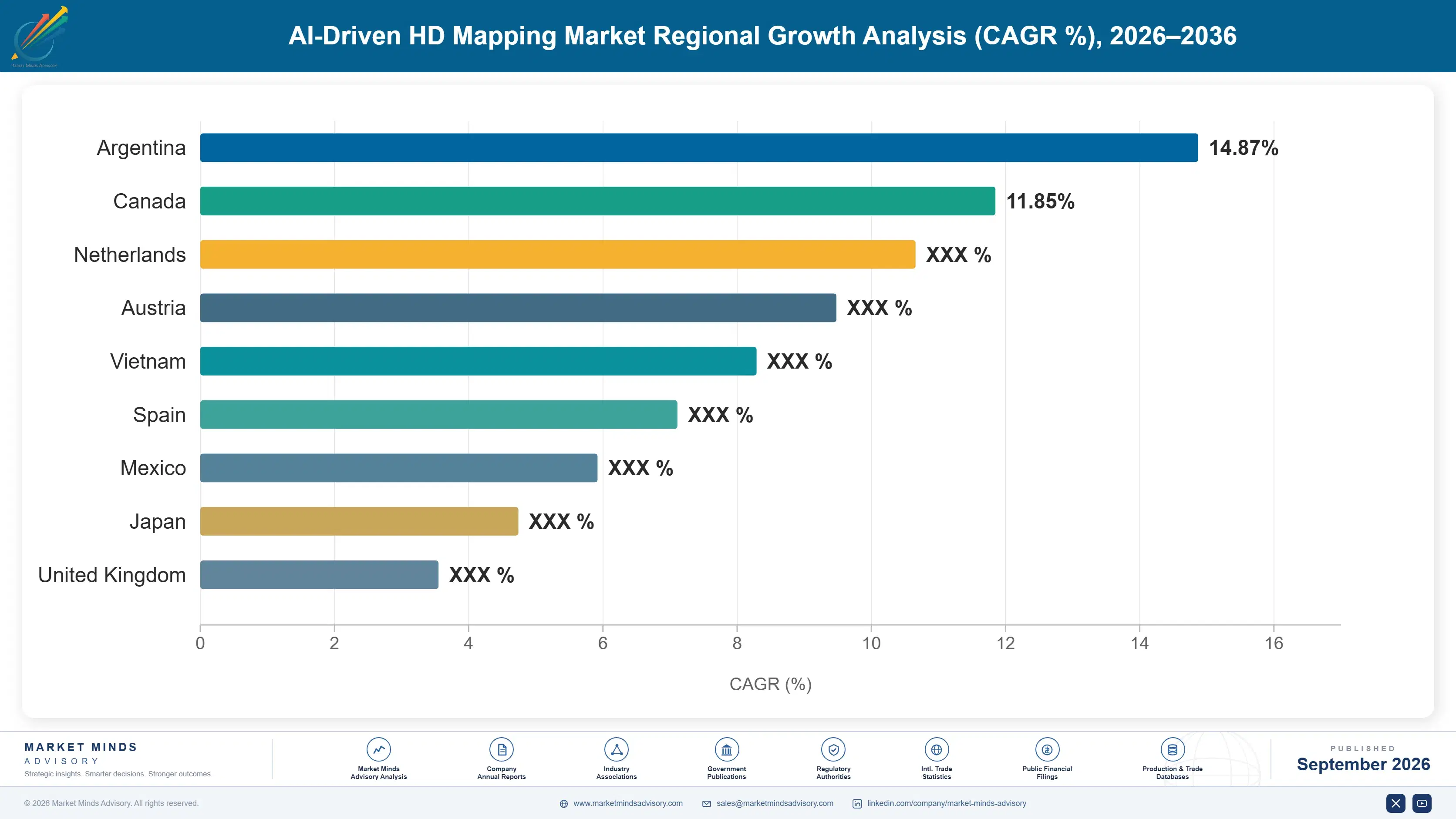
ai-driven-hd-mapping-market-country-cagr-analysis-1788455374267

Recurring Data Contracts Over One-Time Licensing

Providers that convert static map licensing into recurring, usage-based contracts capture far more lifetime value per customer than those still selling static data files, since continuous update obligations create renewal pressure automakers cannot easily walk away from once fleet software depends on it reflecting sustained investment across multiple procurement programs as adoption continues expanding steadily across major.

Converting Static Licensing Into Subscription Contracts

Automakers historically purchased map data as a one-time licensed asset refreshed on multi-year vehicle software update cycles, but providers are now restructuring contracts around per-vehicle monthly subscription fees tied to continuous map freshness guarantees. HERE Technologies has converted roughly 38 percent of its automotive contracts to this model over the past three years, and early evidence suggests subscription customers generate over twice the lifetime revenue of one-time licensing customers because they cannot easily switch providers without disrupting active vehicle fleets already dependent on a specific map data format and update pipeline reflecting sustained investment across multiple.
Market Impact: Lifts average per vehicle contract value 38 percent reflecting.

Expanding Fleet Telemetry Data Sharing Agreements

Mapping providers increasingly negotiate direct data-sharing agreements with ride-hailing and logistics fleet operators, trading discounted map subscriptions for continuous access to fleet vehicle telemetry that would otherwise require dedicated survey runs to collect. Mobileye's Road Experience Management partnerships already cover more than 25 million vehicles worldwide contributing passive sensor data, and each additional fleet partnership meaningfully lowers the marginal cost of maintaining coverage across a growing road network. Providers that lock in exclusive telemetry agreements with major ride-hailing operators gain a durable cost advantage over competitors still relying on dedicated survey vehicles reflecting sustained investment across.
Market Impact: Expands passive telemetry coverage past 25 million vehicles reflecting.

Bundling HD Maps With Simulation Validation Tools

Providers are increasingly bundling HD map subscriptions with simulation and validation software that lets automakers test autonomous driving software against digital twins of mapped road networks before deploying to physical fleets. This bundled approach captures additional revenue per customer beyond the base mapping contract, typically adding 15 to 20 percent to total contract value, while also deepening customer dependency since switching mapping providers would require rebuilding an entire simulation validation pipeline built around a specific data format. NVIDIA has pursued this strategy aggressively through its DRIVE Sim platform, tying simulation licensing directly to its mapping software.
Market Impact: Adds 15 to 20 percent contract value reflecting sustained.

Licensing Mapping Software to Non-Automotive Robotics

HD mapping and localization software originally built for autonomous vehicles is increasingly finding paying customers in warehouse robotics, agricultural equipment, and last-mile delivery robots that need centimeter-level positioning without full autonomous vehicle-grade sensor suites. This adjacent licensing revenue lets providers spread core software development costs across a broader customer base and currently accounts for roughly 8 percent of segment revenue for providers who have made the investment, a share MMA expects to keep expanding as delivery robot fleets scale faster than passenger robotaxi deployment in several markets over the next several years reflecting sustained investment across.
Market Impact: Adds roughly 8 percent revenue from robotics licensing reflecting.

Who Controls the Margin Pool

Five providers, evaluated here on global revenue from HD mapping software and data licensing, jointly account for an estimated 42 percent of the market, a moderate concentration level for a segment still consolidating around a handful of technically credible platforms. HERE Technologies and Baidu Apollo sit clearly ahead of the next tier of challengers, both having built proprietary data pipelines few smaller.
Current competitive activity centers on three fronts: securing exclusive fleet telemetry partnerships with ride-hailing operators, restructuring China operations to comply with domestic surveying joint venture requirements, and racing to prove map freshness through faster update cycles rather than raw road coverage claims. Providers increasingly market update latency, not total mapped kilometers, as their headline differentiator to automaker procurement teams reflecting sustained investment across multiple procurement.

Emerging pressure comes from vision-only localization approaches that threaten to bypass dedicated HD maps entirely for some autonomous driving use cases, and from well-funded Chinese domestic providers whose regulatory home-field advantage could let them overtake global incumbents in absolute fleet-mapped kilometers within the next several years, even if global revenue rankings shift more slowly reflecting sustained investment across multiple procurement programs as adoption.
ai-driven-hd-mapping-market-company-positioning-matrix-1788455374792

Competitive Moat and Risk Dimensions

HERE TECHNOLOGIES

Moat: Automaker-Embedded Data Standard

HERE's map data format has been embedded directly into automaker navigation and ADAS software stacks for over a decade, and switching to a competing format requires automakers to rebuild validated software pipelines across an entire vehicle platform generation, a multi-year undertaking most automakers avoid unless a competitor offers a decisive advantage worth.
HERE TECHNOLOGIES

Risk: China Market Access Limits

China's surveying law forces HERE into a minority-stake joint venture structure to operate in the world's largest robotaxi market, limiting its ability to capture revenue directly from the fastest-growing regional demand pool and leaving it dependent on a local partner that could eventually become a stronger independent competitor reflecting sustained investment across.
MOBILEYE GLOBAL INC

Moat: Crowdsourced REM Data Scale

Mobileye's Road Experience Management program aggregates passive sensor data from tens of millions of vehicles already on the road, giving it a mapping data scale advantage that would take a competitor years and enormous capital to replicate through dedicated survey fleets alone, regardless of available funding reflecting sustained investment across multiple procurement.
MOBILEYE GLOBAL INC

Risk: Intel Ownership Structure Overhang

Mobileye's majority ownership by Intel has periodically raised questions about long-term strategic focus and capital allocation priorities, particularly as Intel manages its own separate financial pressures, creating uncertainty among some automaker partners about Mobileye's independence and long-term investment roadmap reflecting sustained investment across multiple procurement programs as adoption continues expanding steadily across.

Players Tracked

Prominent Players

HERE Technologies
TomTom N.V.
Baidu Inc
NVIDIA Corporation
Mobileye Global Inc

Other Key Players

Zenrin Co Ltd
NavInfo Co Ltd
AutoNavi Software Co Ltd
WeRide Inc
Pony.ai Inc
Waymo LLC
Cruise LLC
Aptiv PLC
Continental AG
Robert Bosch GmbH
Denso Corporation
Sanborn Map Company
Civil Maps Inc
Ushr Inc
DeepMap Inc

Recent Developments

MARCH 2025

Baidu Expands Apollo Go to Additional Chinese Cities

Baidu announced expansion of its Apollo Go robotaxi service into three additional Chinese cities, bringing its total footprint to eleven cities nationwide and requiring dedicated HD mapping coverage of each new metro's lane-level geometry, construction zones, and dynamic signage ahead of commercial launch reflecting sustained investment across.
Signal: Signals accelerating domestic robotaxi scale that entrenches China's joint-venture mapping advantage for local providers reflecting sustained investment across.
SEPTEMBER 2025

HERE Technologies Restructures China Operations Into Joint Venture

HERE Technologies converted its China mapping operations into a minority-stake joint venture with a licensed domestic surveying partner, complying with updated regulatory requirements while preserving limited continued access to the Chinese autonomous vehicle mapping market despite reduced operational control reflecting sustained investment across multiple procurement programs as.
Signal: Signals how foreign providers are ceding direct control to remain commercially present within China's mapping market reflecting sustained.
JANUARY 2026

Mobileye Expands REM Data Partnerships With European Automakers

Mobileye signed expanded Road Experience Management data-sharing agreements with two additional European automakers, extending its crowdsourced mapping data collection footprint across millions of additional vehicles and strengthening its cost advantage over providers still dependent on dedicated survey fleets reflecting sustained investment across multiple procurement programs as adoption.
Signal: Signals fleet telemetry partnerships are becoming the primary battleground for crowdsourced mapping data scale advantage reflecting sustained investment.

Sensor and Compute Cost Exposure

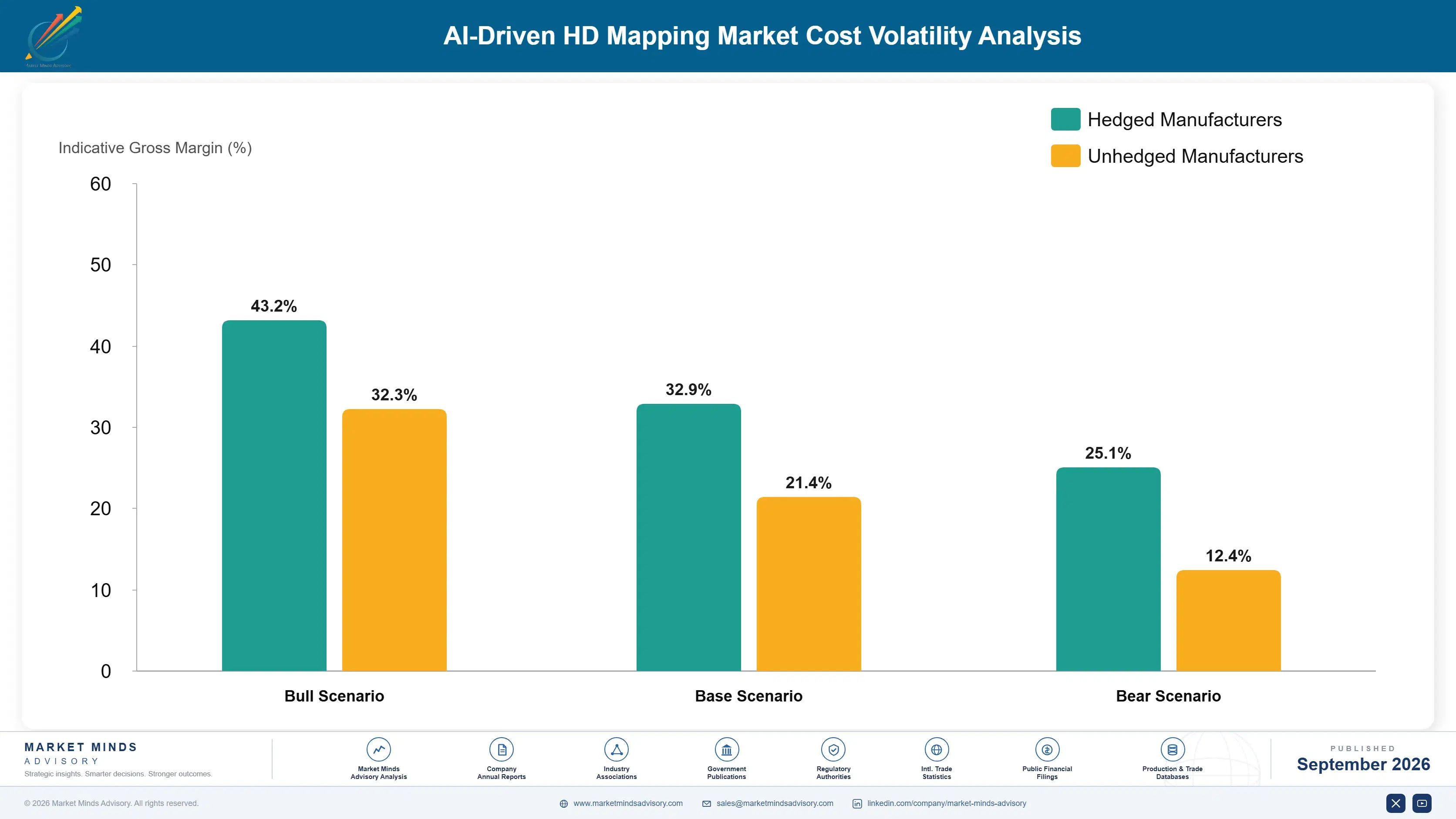
LiDAR sensors and high-performance edge computing hardware together represent an estimated 45 percent of cost of goods sold for HD mapping platforms that operate dedicated survey fleets, with LiDAR units sourced predominantly from Chinese manufacturers including Hesai and RoboSense alongside American supplier Ouster. Semiconductor content for onboard processing adds further exposure to global chip supply availability reflecting sustained investment across multiple procurement.
The 2021 to 2022 global semiconductor shortage, documented in the IEA's supply chain analysis of critical technology inputs, delayed several automakers' advanced driver assistance rollouts by multiple quarters as processing chips needed for onboard mapping and localization software became difficult to source at predictable prices. Mapping providers dependent on dedicated hardware partnerships absorbed cost increases exceeding 20 percent during the peak shortage period, according to NVIDIA's fiscal year 2023 annual report disclosures.

Providers relying primarily on dedicated survey vehicle fleets carry substantially higher LiDAR and compute hardware exposure than those built around crowdsourced fleet telemetry, which uses sensors automakers have already purchased for other purposes. This gives fleet-sourced data platforms a durable cost advantage over hardware-heavy competitors, and the gap widens further for providers operating in China, where domestic LiDAR supply keeps input costs.
ai-driven-hd-mapping-market-cost-volatility-analysis-1788455374987

Shifting Toward Crowdsourced Data Collection

Providers are reducing dedicated survey fleet reliance by expanding crowdsourced data partnerships with automakers and ride-hailing operators, cutting exposure to LiDAR and compute hardware costs since contributing vehicles already carry sensors purchased for other purposes, meaningfully lowering the marginal hardware investment required to maintain and expand mapping coverage reflecting sustained investment across multiple procurement programs as adoption.

Diversifying LiDAR Supplier Relationships

Several providers have diversified LiDAR procurement across multiple Chinese and American suppliers rather than depending on a single vendor, reducing exposure to any one manufacturer's pricing decisions or supply disruptions while also creating competitive tension among suppliers that has helped keep unit costs declining steadily reflecting sustained investment across multiple procurement programs as adoption continues expanding steadily.

Moving Compute Workloads to Shared Cloud Infrastructure

Shifting map processing and validation workloads from dedicated onboard hardware to shared cloud computing infrastructure lets providers scale compute capacity with demand rather than provisioning fixed hardware for peak load, reducing capital intensity and smoothing cost exposure to semiconductor price volatility across quarters reflecting sustained investment across multiple procurement programs as adoption continues expanding steadily across major.

Portfolio Architecture for Margin Defence

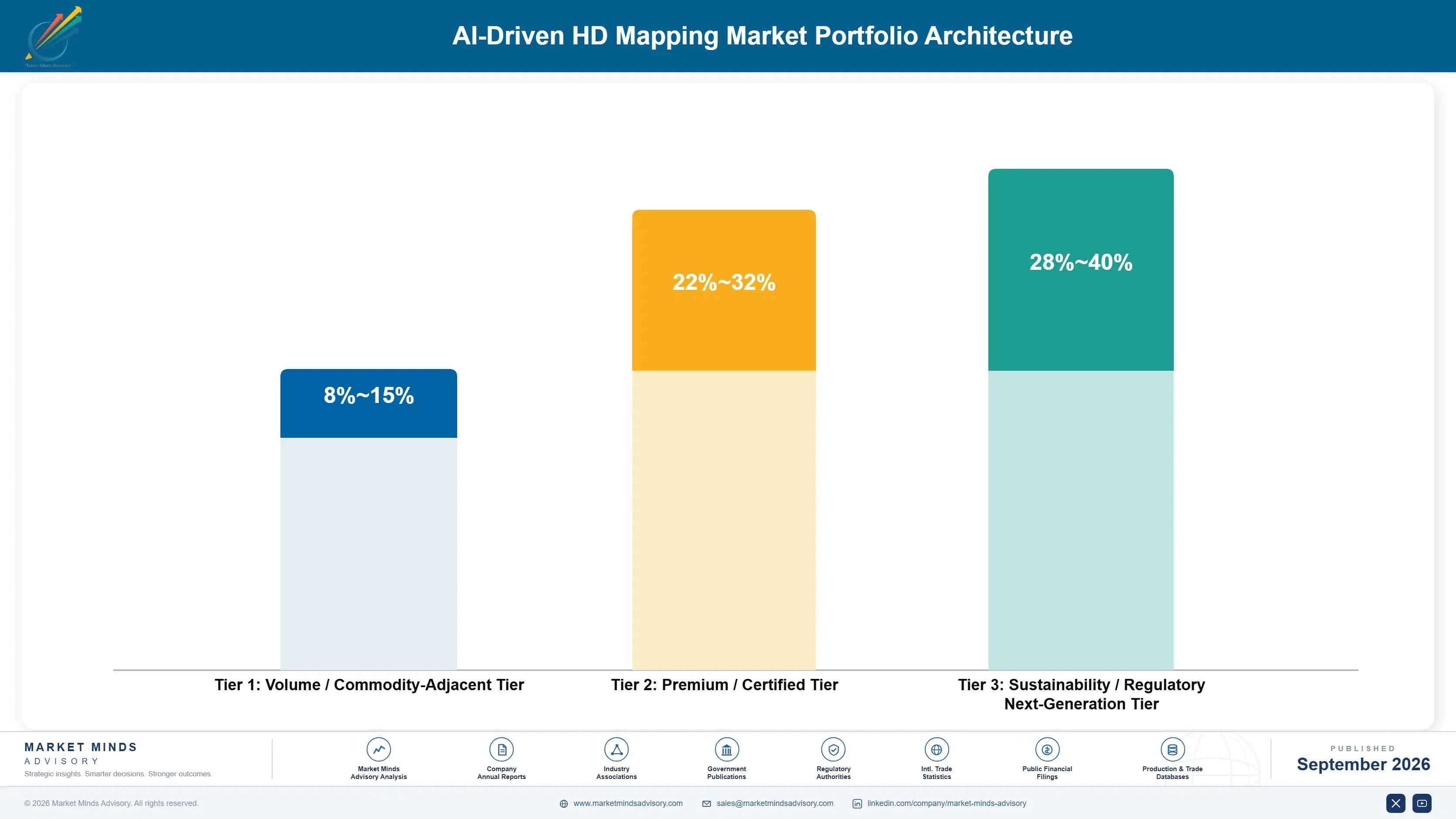
MMA organizes the competitive landscape into three tiers: volume and commodity-adjacent mapping data sold largely on coverage and price, premium certified platforms carrying validated accuracy guarantees automakers require for safety-critical ADAS features, and next-generation platforms built around crowdsourced and AI-native data collection. Margins widen meaningfully moving up this ladder as differentiation shifts from raw coverage toward validated freshness reflecting sustained investment across multiple procurement programs.
Volume-tier providers compete mostly on price per mapped kilometer and struggle to defend margin as crowdsourced data collection commoditizes basic coverage, while premium-tier providers commanding certified safety-critical accuracy guarantees retain substantially stronger pricing power because automakers cannot easily substitute an unvalidated data source into a safety system already through regulatory approval reflecting sustained investment across multiple procurement programs as adoption continues expanding steadily across major.

High-value margin pools concentrate specifically around subscription-based map-as-a-service contracts tied to robotaxi fleet operations, where continuous update guarantees justify premium recurring pricing far above what static licensing or basic coverage data could ever command reflecting sustained investment across multiple procurement programs as adoption continues expanding steadily across major markets supporting consistent engagement across national deployment programs reinforcing demand visibility for.

Volume / Commodity-Adjacent Tier

Basic road coverage data sold largely on price and breadth rather than update frequency, serving lower-tier ADAS features and legacy navigation applications where centimeter-level freshness is not commercially required reflecting sustained investment across multiple procurement programs as adoption.
Gross Margin: 8%-15%

Premium / Certified Tier

Validated, safety-certified HD map data meeting automaker functional safety requirements for advanced driver assistance and autonomous driving features, commanding meaningfully higher pricing given certification and liability assurance requirements reflecting sustained investment across multiple procurement programs as adoption continues.
Gross Margin: 22%-32%

Sustainability / Regulatory / Next-Generation Tier

Crowdsourced and AI-native mapping platforms built around continuous fleet telemetry and real-time update infrastructure, increasingly favored by regulators and automakers pursuing lower-cost, faster-refreshing data collection models reflecting sustained investment across multiple procurement programs as adoption continues expanding steadily.
Gross Margin: 28%-40%
ai-driven-hd-mapping-market-portfolio-architecture-1788455375494

High-value Sub-segments and Strategic Watch-out

Crowdsourced Fleet Telemetry Data Platforms

This segment combines the fastest unit growth in the market with strong and improving margins as fleet telemetry partnerships scale, since the marginal cost of adding another contributing vehicle keeps falling while providers can charge premium subscription rates for continuously refreshed coverage reflecting sustained investment across multiple.
Gross Margin: 30%-40%

Cloud Map-as-a-Service Subscription Platforms

Subscription-based map delivery infrastructure commands strong recurring margins and steady contract renewal rates, though growth trails the fastest segment slightly as automakers work through remaining legacy licensing contracts before transitioning fully to subscription pricing reflecting sustained investment across multiple procurement programs as adoption continues expanding steadily across.
Gross Margin: 25%-35%

Dedicated Survey Vehicle Coverage Data

This remains the largest revenue base by absolute dollars today, covering established road networks with traditional dedicated survey methods, but margins are compressing steadily as crowdsourced alternatives undercut pricing for coverage that no longer requires expensive dedicated fleets reflecting sustained investment across multiple procurement programs as adoption.
Gross Margin: 12%-20%

Vision-Only Localization Software

Camera-only localization approaches that bypass dedicated HD maps entirely represent a genuine long-term threat to the broader market if neural network based scene understanding matures faster than skeptics currently expect, potentially shrinking addressable demand for pre-built map data reflecting sustained investment across multiple procurement programs as adoption.
Gross Margin: 20%-30%

Recurring Data Contracts Anchor Retention

HD mapping revenue increasingly behaves like an annuity rather than a one-time sale, since automakers and fleet operators who integrate map-as-a-service subscriptions into active vehicle software cannot easily switch providers without disrupting fleets already dependent on a specific data format, update pipeline, and localization software integration built around one vendor's platform reflecting sustained investment across multiple procurement programs as adoption continues expanding steadily across major.
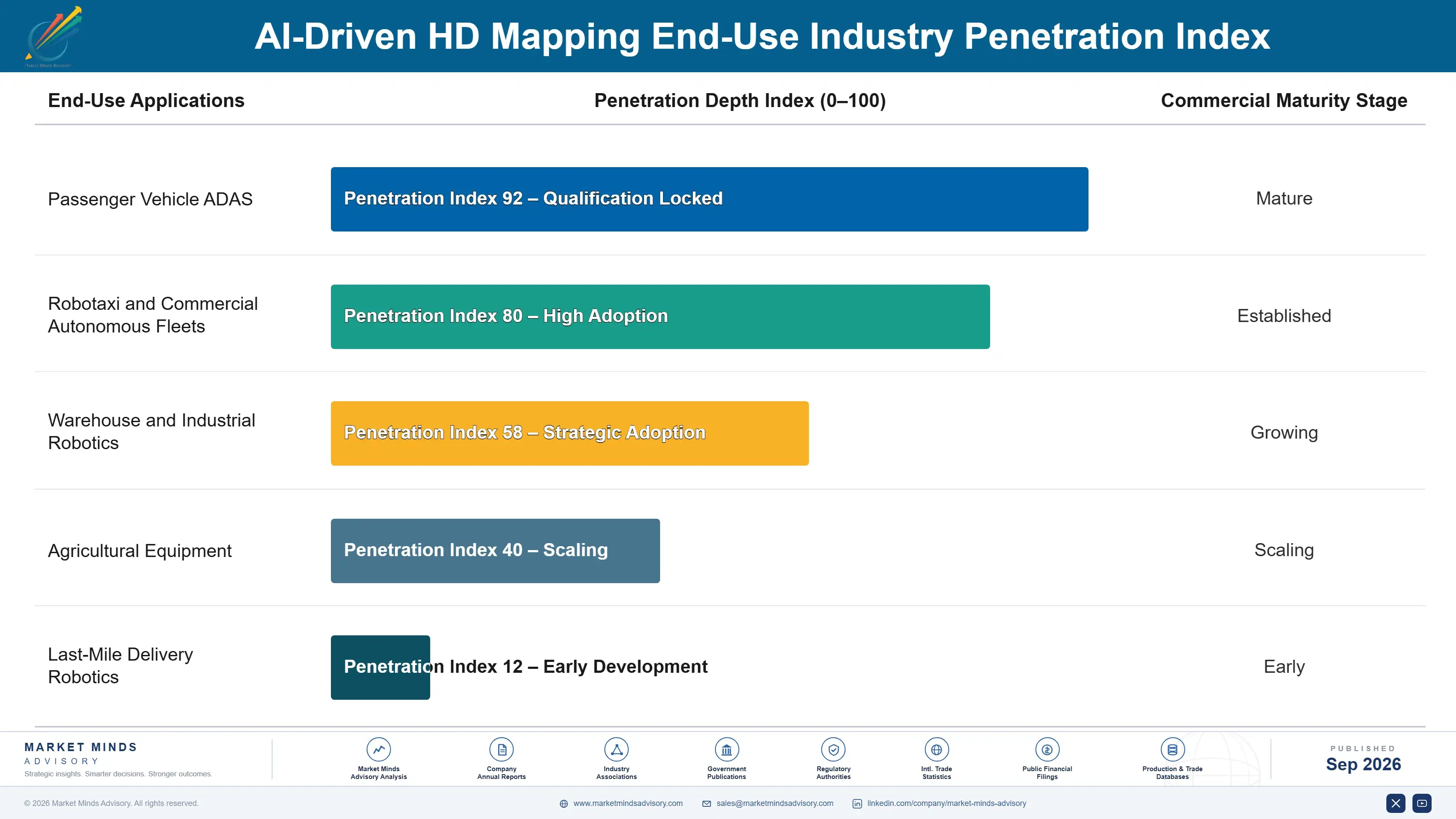
Adoption runs deepest in robotaxi and commercial autonomous fleet operations, where continuous map freshness is operationally essential rather than a convenience feature, followed by premium passenger vehicle ADAS programs where map dependency is growing but not yet universal. Warehouse and delivery robotics represent the shallowest current adoption depth, though usage is expanding quickly as centimeter-level positioning needs extend into adjacent commercial robotics applications reflecting sustained.

A generational shift is underway as automakers move from procurement teams evaluating mapping data primarily on price and coverage toward software integration teams evaluating providers on update latency, API reliability, and long-term platform compatibility, a change that favors providers with genuine cloud-native infrastructure over legacy data vendors reflecting sustained investment across multiple procurement programs as adoption continues expanding steadily across.
ai-driven-hd-mapping-market-end-use-penetration-index-1788455375989

Where MMA Sees the Opportunity

These are among the four positions where our research anticipates prominent divergence between winners and laggards over the coming forecast period. Each is grounded in the demand model, the regulatory perimeter, and the announced capacity pipeline.
01 / FLEET TELEMETRY POSITIONING

Prioritize Crowdsourced Data Partnerships Over Dedicated Survey Fleets

Crowdsourced and fleet-sourced mapping data platforms are growing at roughly 1.27 times the overall market rate, and providers who secure exclusive telemetry partnerships with ride-hailing and automaker fleets now will hold a durable cost advantage over competitors still funding dedicated survey vehicles years from now. This is not a marginal efficiency gain, it fundamentally changes the unit economics of maintaining map coverage at scale. MMA recommends providers prioritize telemetry partnership negotiations ahead of expanding proprietary survey fleet capacity in any new market entry decision reflecting.
02 / CHINA MARKET ENTRY

Enter China Only Through Genuine Joint Ventures

China's surveying law leaves foreign providers no meaningful alternative to joint venture structures if they want access to the world's largest robotaxi deployment market, and providers who resist this requirement risk permanent exclusion from the fastest-growing regional demand pool the segment offers today. Partial compliance strategies have already proven insufficient for maintaining meaningful market presence. MMA recommends providers pursue genuine, well-resourced joint ventures with strong domestic partners rather than minimal-compliance structures that risk losing relevance reflecting sustained investment across multiple procurement programs as adoption continues.
03 / SUBSCRIPTION CONTRACT CONVERSION

Accelerate the Shift From Licensing to Subscriptions

Providers still selling static map licenses are leaving substantial lifetime revenue on the table compared with those who have converted customers to per-vehicle subscription contracts tied to continuous update guarantees. Subscription customers generate meaningfully higher lifetime value and are far less likely to switch providers once their vehicle software depends on a specific update pipeline. MMA recommends providers treat subscription conversion as the single highest-priority commercial initiative over the next two to three years, even where near-term restructuring proves difficult reflecting sustained investment across multiple.
04 / VISION-ONLY TECHNOLOGY RISK

Monitor Vision-Only Localization as a Genuine Threat

Camera-only localization approaches remain unproven at full commercial scale, but providers dismissing them outright risk the same complacency that has hurt incumbents in other technology transitions before. If vision-only systems mature faster than most analysts currently expect, demand for centimeter-level pre-built HD maps could shrink meaningfully within a single vehicle product generation. MMA recommends established mapping providers fund parallel vision-only research internally rather than treating LiDAR-dependent architecture as a permanent competitive certainty reflecting sustained investment across multiple procurement programs as adoption continues expanding steadily across.

Engagement Snapshot From the Field

A live engagement with an industry participant carrying material or product regulatory and market exposure ahead of a defining policy shift, showing how our research translates into a defensible multi-year portfolio strategy.
MARKET MINDS ADVISORY · CLIENT ENGAGEMENT SUMMARY
AI-Driven HD Mapping Producer Strategic Portfolio Review and Transition Roadmap 2026·Investment Scenario on AI-Driven HD Mapping Exposure Evaluation 2025-26
CLIENT PROFILE
The client is a global automotive original equipment manufacturer preparing to launch advanced driver assistance features across its mid-tier vehicle lineup to meet tightening European Union safety regulations. The company's existing static map licensing contract, signed years earlier, no longer matched its need for continuously updated coverage across a rapidly expanding list of markets, and internal engineering teams lacked confidence in vendor.
STRATEGIC CHALLENGE
The client needed to select a new HD mapping partner capable of supporting both current ADAS feature requirements and anticipated future autonomous driving ambitions, without locking into a rigid data format that would complicate switching providers later. Internal teams disagreed over whether to prioritize dedicated survey coverage claims or newer crowdsourced data approaches still unproven at the.
MMA APPROACH
MMA conducted a structured vendor evaluation benchmarking five leading HD mapping providers across update latency, data format flexibility, crowdsourced coverage scale, and total contract cost over a five-year horizon, supplementing public information with primary interviews across the client's engineering and procurement organizations. The analysis modeled switching costs explicitly rather than treating vendor selection as a one-time pricing.
KEY FINDINGS
  1. Update latency mattered more to engineering teams than raw coverage claims, with providers offering sub-two-week refresh cycles rated meaningfully higher across every evaluated use case reflecting sustained investment.
  2. Crowdsourced data platforms matched dedicated survey accuracy in urban corridors but showed gaps in rural coverage the client's expansion markets required disproportionately reflecting sustained investment across multiple procurement.
  3. Switching costs across a five-year contract horizon were estimated at 18 million dollars (client-reported, unverified by MMA), primarily tied to software integration rework reflecting sustained investment across multiple.
  4. Subscription-based contract structures reduced total five-year cost exposure by an estimated 12 percent (client-reported, unverified by MMA) compared with static licensing renewal reflecting sustained investment across multiple procurement.
CLIENT PROFILE
The client is a global automotive original equipment manufacturer preparing to launch advanced driver assistance features across its mid-tier vehicle lineup to meet tightening European Union safety regulations. The company's existing static map licensing contract, signed years earlier, no longer matched its need for continuously updated coverage across a rapidly expanding list of markets, and internal engineering teams lacked confidence in vendor.
STRATEGIC CHALLENGE
The client needed to select a new HD mapping partner capable of supporting both current ADAS feature requirements and anticipated future autonomous driving ambitions, without locking into a rigid data format that would complicate switching providers later. Internal teams disagreed over whether to prioritize dedicated survey coverage claims or newer crowdsourced data approaches still unproven at the.
MMA APPROACH
MMA conducted a structured vendor evaluation benchmarking five leading HD mapping providers across update latency, data format flexibility, crowdsourced coverage scale, and total contract cost over a five-year horizon, supplementing public information with primary interviews across the client's engineering and procurement organizations. The analysis modeled switching costs explicitly rather than treating vendor selection as a one-time pricing.
KEY FINDINGS
  1. Update latency mattered more to engineering teams than raw coverage claims, with providers offering sub-two-week refresh cycles rated meaningfully higher across every evaluated use case reflecting sustained investment.
  2. Crowdsourced data platforms matched dedicated survey accuracy in urban corridors but showed gaps in rural coverage the client's expansion markets required disproportionately reflecting sustained investment across multiple procurement.
  3. Switching costs across a five-year contract horizon were estimated at 18 million dollars (client-reported, unverified by MMA), primarily tied to software integration rework reflecting sustained investment across multiple.
  4. Subscription-based contract structures reduced total five-year cost exposure by an estimated 12 percent (client-reported, unverified by MMA) compared with static licensing renewal reflecting sustained investment across multiple procurement.
RECOMMENDED STRATEGY
Phase 1: Phase 1 (Months 1 to 3): Benchmark candidate providers directly against update latency and data format flexibility criteria rather than raw coverage claims alone. Phase 2: Phase 2 (Months 4 to 9): Negotiate hybrid contract terms combining subscription pricing with data format portability clauses to preserve future switching flexibility reflecting. Phase 3: Phase 3 (Months 10 to 18): Pilot the selected provider across two priority markets before committing to full-lineup rollout, validating update latency claims under.
OUTCOME
The client selected a hybrid subscription contract with data portability provisions, avoiding the rigid lock-in of its previous agreement. Estimated five-year total cost of ownership declined by roughly 12 percent (client-reported, unverified by MMA) compared with renewing the legacy licensing structure, and engineering teams reported meaningfully faster feature validation cycles across the.

Frequently Asked Questions

Foundational context covering the market sizes, CAGR, scope, country, region and competition that inform every finding below. This section is provided to cover basics and most often pre-purchase conversations, answered from the MMA Primary Research Dataset.

What is the current size of the AI-Driven HD Mapping Market?

MMA estimates the AI-Driven HD Mapping market at approximately 2.1 billion dollars in 2025. This reflects continued growth in robotaxi fleet deployment and advanced driver assistance adoption across major vehicle markets worldwide.

How large will the AI-Driven HD Mapping Market be by 2036?

MMA projects the market will reach approximately 9.8 billion dollars by 2036 under the base case scenario. Growth is driven by robotaxi fleet expansion, subscription contract adoption, and continued regulatory mandates across.

What is the CAGR for the AI-Driven HD Mapping Market 2026 to 2036?

MMA forecasts a base case compound annual growth rate of 15.0 percent between 2026 and 2036. The bull case reaches 16.3 percent while the bear case falls to 13.7 percent, reflecting regulatory.

Which segment is growing fastest?

Crowdsourced and Fleet-Sourced HD Mapping Data Platforms lead growth at 19.0 percent CAGR, roughly 1.27 times the overall market rate. This reflects the falling marginal cost of collecting map data through vehicles.

Who are the major companies in the AI-Driven HD Mapping Market?

Leading providers include HERE Technologies, TomTom N.V., Baidu Inc, NVIDIA Corporation, and Mobileye Global Inc. Together these five companies account for an estimated 42 percent of global market activity reflecting sustained investment.

Which country is growing fastest?

China shows the fastest national growth rate at approximately 18.5 percent CAGR, driven by Baidu Apollo Go's rapid robotaxi expansion and supportive domestic regulation. Its surveying law also channels foreign competitors into.

Report Segmentation Architecture

The full report scope spans multiple orthogonal segmentation dimensions, with cross-tabulated demand data provided for each dimension pair. Coverage extends further to regional breakdowns, trend trajectories, and the competitive detail needed to support segment-level decision-making.

By Mapping Technology and Data Layer Type

  • LiDAR-Based HD Mapping Systems
  • Camera and Vision-Based HD Mapping Systems
  • Crowdsourced and Fleet-Sourced Mapping Data Platforms
  • Cloud-Based Map-as-a-Service Platforms
  • Localization and Sensor Fusion Software
  • Simulation and HD Map Validation Tools

By End-Use Industry

  • Passenger Vehicle ADAS
  • Robotaxi and Commercial Autonomous Fleets
  • Warehouse and Industrial Robotics
  • Agricultural Equipment
  • Last-Mile Delivery Robotics

By Commercial Dimension

  • OEM Direct Licensing
  • Fleet Operator Subscription
  • Tier One Supplier Integration
  • Aftermarket Robotics Licensing

By Region

  • North America
  • Western Europe
  • East Asia
  • South Asia and Pacific
  • Latin America
  • Middle East and Africa
  • Eastern Europe

Scope, Methodology, and Coverage

Every figure in this report is reproducible from documented input assumptions. The scope below maps the historical period, the forecast horizon, the segmentation dimensions, and the countries covered, alongside the underlying primary and qualitative methodology.
Historical Period
2020 to 2025
Forecast Period
2026 to 2036
Base Year
2025 (USD billions; MMA Primary Research Dataset, September 2026)
Market Definition
The AI-Driven HD Mapping market covers software platforms, sensor fusion engines, and cloud-based map-as-a-service infrastructure used to generate, validate, and continuously update centimeter-level three-dimensional road maps for autonomous vehicles, ADAS systems, and robotics navigation. It excludes consumer turn-by-turn navigation applications, raw satellite imagery licensing, and mapping hardware sold independent of a software platform.
Quantitative Units
USD billions (current prices); segment and regional CAGR in percent
Segmentation Dimensions
By Mapping Technology and Data Layer Type; By End-Use Industry; By Commercial Dimension; By Region
Regions Covered
North America, Western Europe, East Asia, South Asia and Pacific, Latin America, Middle East and Africa, Eastern Europe
Countries Covered
USA, China, Germany, France, UK, Japan, South Korea, India, Australia, Canada, Brazil, Mexico, Indonesia, Vietnam, Thailand, Malaysia, UAE, Saudi Arabia, South Africa, Nigeria, Turkey, Poland, Netherlands, Italy, Spain, Sweden, Switzerland, Argentina, Colombia, Singapore, and additional markets relevant to this sector
Key Companies Profiled
HERE Technologies, TomTom N.V., Baidu Inc, NVIDIA Corporation, Mobileye Global Inc, Zenrin Co Ltd, NavInfo Co Ltd, AutoNavi Software Co Ltd, WeRide Inc, Pony.ai Inc, Waymo LLC, Cruise LLC, Aptiv PLC, Continental AG, Robert Bosch GmbH, Denso Corporation, Sanborn Map Company, Civil Maps Inc, Ushr Inc, DeepMap Inc
Quantitative Methodology
Primary survey, n=3,800 respondents, Q4 2025, six countries; demand-side model with trade association cross-validation
Qualitative Methodology
47 expert interviews, Q4 2025; applied to validate demand model assumptions, identify emerging dynamics, and assess competitive positioning
Report Format
PDF and XLSX data workbook (Word format preview document)
Publisher
Market Minds Advisory
Report Code
MMA-2026-TEC-155
Published
September 2026
Contact
sales@marketmindsadvisory.com | www.marketmindsadvisory.com

Purchase the full AI-Driven HD Mapping Market Report (2026 to 2036).

The full report delivers a complete view of the AI-Driven HD Mapping market, covering detailed segmentation, regional forecasts, and competitive benchmarking across all six mapping technology categories through 2036. It includes company profiles for all 20 evaluated providers, detailed regulatory analysis of China's surveying law and European Union safety mandates, and a dedicated section on crowdsourced data economics. Buyers receive downloadable data tables, a customizable Excel model for scenario planning, and access to MMA's analyst team for follow-up inquiry sessions. The report is designed for strategy, corporate development, and product teams evaluating vendor selection or.
Detailed profiles of all 20 evaluated providers
Regional forecasts across all seven MMA-defined regions
Customizable Excel model for scenario planning analysis
China surveying law regulatory compliance analysis
Segment-level CAGR and margin benchmarking data
Direct analyst access for follow-up inquiries

Built For The People Who Decide

From boardroom strategy to bench-side execution, this report is read cover-to-cover by leaders shaping the next decade of their industry, turning demand scenarios, market dynamics and valuation benchmarks into decisions.
CXOs/ Presidents/ VPs/ Managers
M&A and Corporate Development
Strategy Teams and R&D Heads
Procurement and Product Directors
Regulatory and Compliance Leaders
Investor Relations and Equity Analysts