Market Minds Advisory
AI Datasets Licensing Academic Research Publishing Market

AI Datasets Licensing Academic Research Publishing Market: AI Datasets Licensing Academic Research Publishing Market. Trends and Forecast 2026 to 2036

Academic publishers holding decades of peer-reviewed text and figures are signing landmark licensing deals with foundation model developers, converting long-dormant archives into a fast-growing revenue stream amid unresolved copyright litigation and shifting fair use precedent.

Lead Analyst

Published

September 2026

Make Smarter Decisions with Customized Research Insights

Request a free sample report and evaluate market opportunities, growth trends, and competitive dynamics relevant to your business needs.

2025 MARKET VALUE$0.7BMarket Size 2025
2036 FORECAST VALUE$3.6BBase Case , 2026 to 2036
CAGR 2026 TO 203616.5 %Bull 17.8% / Bear 15.2%
INCREMENTAL OPPORTUNITY$2.9BNet 10- year value creation
EXPANSION MULTIPLE4.60x2036 value over 2026 base
Strategic Levers
M&A Pipeline
Regional Outlook
Country Rankings
Competitive Intelligence
Segmental Deep-dive
Call-Us : 91 93563 13602

Executive Snapshot and Market Trajectory.

Foundation model developers are running out of freely scrapable web text, pushing them toward paid licensing agreements with academic publishers holding decades of peer-reviewed content available nowhere else online at comparable depth, editorial quality, or citation authority within the specific research field they cover most.
Major publishers including Wiley, Taylor and Francis, and Springer Nature have signed multi-year licensing agreements worth tens of millions of dollars each, converting previously static subscription archives into a genuinely new commercial revenue category that finance chiefs now forecast separately from traditional journal subscription income entirely and permanently. Multimodal content, meaning figures and charts embedded within papers, commands the steepest per-token pricing since models still struggle generating this content reliably from text descriptions alone.
Copyright Clearance Center and similar rights intermediaries are building standardized licensing infrastructure to reduce the transaction cost of negotiating deals paper by paper, while ongoing litigation over historical scraping practices creates real legal uncertainty that could reshape pricing power between publishers and AI developers within just a few years, regardless of how current negotiations and pending court rulings ultimately conclude across major jurisdictions worldwide today and beyond.
Market Definition
The AI Datasets Licensing Academic Research Publishing Market covers commercial agreements through which academic publishers, journals, and research repositories license peer-reviewed text, figures, and structured metadata to foundation model developers for training purposes, measured by licensing and royalty revenue. It excludes general web-scraped training data licensing unrelated to formally published academic research and open-access content distributed without a commercial licensing fee.
Base Year Value
$0.7B in 2025 (MMA Primary Research Dataset, September 2026)
Forecast Period
2026 to 2036, eleven discrete annual values
CAGR
16.5% base case. Bull 17.8%. Bear 15.2%.
Fastest Growth Segment
Multimodal Research Data Licensing: 20.0% CAGR
Fastest Growth Country
United Kingdom: 21.0% CAGR
Fastest Growth Region
South Asia and Pacific: 18.5% CAGR
Largest Region
Western Europe: 33% of 2025 global value
Market Leaders
Leading participants include Elsevier, Springer Nature, Wiley, Taylor and Francis, and Clarivate.
Primary Survey
n=3,800 procurement and R&D decision-makers, Q4 2025, six countries
Methodology
Demand-side build-up, cross-validated against public data, 47 expert interviews

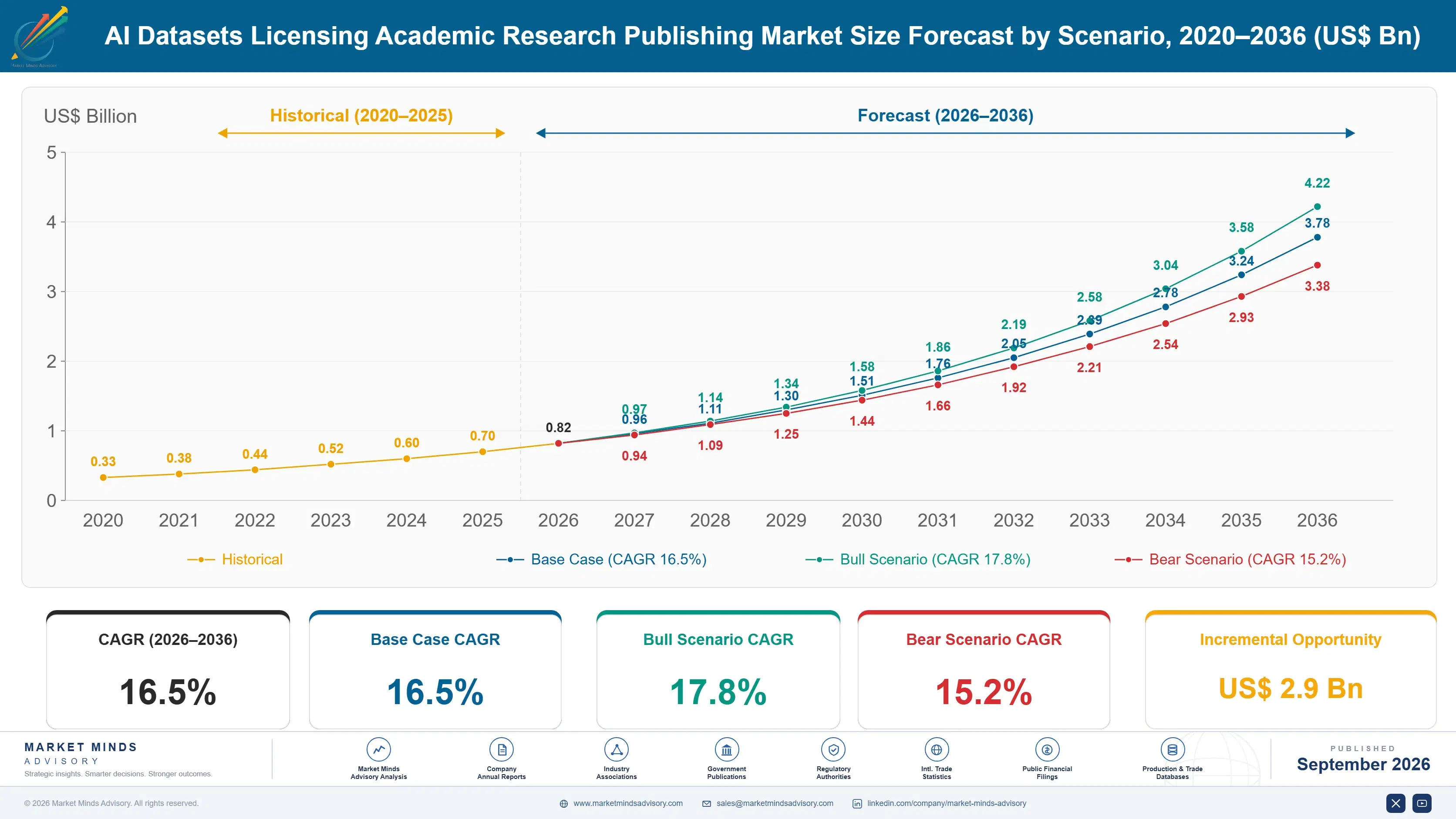
AI Datasets Licensing Academic Research Publishing Market Forecast Scenarios

ai-datasets-licensing-academic-research-publishing-size-forecast-scenario-1788414031288
Academic publishing revenue from AI licensing barely existed before 2023, when the first major deals between publishers and foundation model developers became public. Growth since then has been unusually front-loaded, with the historical period's 15.5% annual expansion driven almost entirely by a handful of headline agreements rather than broad-based market activity across the publishing industry.
The base case assumes foundation model developers continue diversifying training sources as web text quality plateaus, publishers standardize licensing terms through intermediaries like Copyright Clearance Center, and multimodal content pricing rises as models struggle to generate figures and charts reliably from text alone. These three mechanisms together support 16.5% compound annual growth through 2036, with enterprise-grade metadata licensing emerging as a secondary revenue stream publishers had not previously monetized separately from full-text access.
A bull case turns on courts affirming publishers' licensing rights over historical content, which would let publishers demand materially higher per-token rates from AI developers facing few alternative high-quality sources available. A bear case centers on courts instead validating broad fair use claims, which would eliminate publishers' negotiating leverage almost entirely and collapse pricing toward token-generation cost.

The Copyright Litigation Overhang on Licensing Value

Licensing pricing bifurcates sharply between plain text and multimodal content, with figures, charts, and chemical structures commanding roughly 3.2 times the per-document rate of plain narrative text. This gap exists because foundation models still generate scientific diagrams unreliably, making authentic published figures unusually valuable training material that publishers can price at a genuine premium over commodity text content available elsewhere.
MARKET CONCENTRATION52% CR5top five publishers hold over half of licensing
AVERAGE DEAL VALUE$28 milliontypical multi-year publisher licensing agreement size industry-wide today
TOP LICENSING COUNTRY34% United Kingdomshare of global academic content licensing revenue captured
MULTIMODAL CONTENT PREMIUM3.2x text ratepricing premium commanded by figures and charts over text
LITIGATION EXPOSURE RATE41% of publishersfacing active copyright disputes over past unlicensed scraping practices
CONTENT FRESHNESS VALUE58% premiumpricing lift for recently published, still-current research content
Deal structures vary from flat archive-wide licenses to usage-metered agreements tied to actual training run consumption, with larger publishers favoring the latter since it lets pricing scale alongside the buyer's model release cadence rather than locking in a single upfront figure. Smaller publishers and society journals lack the negotiating scale to demand usage-based terms and typically accept flat annual payments instead, at least for now.
Litigation risk shadows every negotiation currently underway, since roughly 41% of major publishers face active disputes over whether earlier unlicensed scraping already occurred without their consent. Publishers use this litigation posture as negotiating leverage, arguing that a licensing deal resolves potential legal exposure for the AI developer, a framing that has meaningfully accelerated deal signing timelines across the industry this year and beyond.
"Publishers spent two decades treating their archives as a cost center to digitize and maintain. Now that same archive is the single most valuable asset on their balance sheet, and most of them still don't have a pricing model sophisticated enough to capture what it's actually worth."
Senior Analyst, Publishing and Data Licensing Practice · MMA Technology Practice · September 2026

Market Trends

Multimodal Licensing Premiums Rise as Text Supply Saturates

Foundation model developers have largely exhausted freely available web text suitable for training, shifting demand toward multimodal academic content including figures, chemical structures, and data tables that models still generate unreliably from prompts alone. Publishers have responded by pricing multimodal licenses at roughly 3.2 times the rate of plain text agreements, a premium several major publishers have specifically highlighted in recent earnings calls as their fastest-growing licensing revenue category. This dynamic is pulling licensing negotiations toward archive completeness rather than text volume alone, rewarding publishers with strong figure and dataset coverage over those with text-only digital archives.
Market Impact: Peer-reviewed content earns 4x higher rates
Standardized Licensing Intermediaries Reduce Negotiation Friction

Copyright Clearance Center and similar rights intermediaries are building standardized contract templates and centralized rights databases that let smaller publishers and society journals license content without negotiating bespoke agreements paper by paper with each AI developer separately. This infrastructure has cut average deal negotiation time from several months to a few weeks for participating publishers, according to intermediary disclosures, expanding the pool of licensable content well beyond the handful of large publishers that signed the earliest headline agreements. Smaller society journals previously priced out of direct negotiation now capture meaningful licensing revenue through these pooled arrangements.
Market Impact: Litigation risk cut negotiation time 50%

Market Opportunities and Growth Drivers

Frontier Model Training Runs Demand Higher-Quality Text Sources

As foundation model developers push toward ever-larger training runs, the marginal value of additional low-quality web text has fallen sharply while peer-reviewed academic content, with its rigorous editorial review and citation-verified claims, has become disproportionately valuable per token. Several leading AI labs have publicly stated that data quality now matters more than raw data volume for improving model reasoning capability, a shift that favors publishers over generic web content aggregators. This has pushed per-document licensing rates for peer-reviewed content well above rates typically paid for equivalent volumes of unreviewed web text.
Market Impact: Uncertainty delayed deals roughly 6 months

Copyright Litigation Pressure Pushes Developers Toward Licensing

Multiple ongoing lawsuits against foundation model developers over unlicensed use of copyrighted text have created strong legal incentive to formalize licensing relationships proactively rather than risk damages awards that could run into the billions of dollars across a large training corpus. Several AI developers have begun signing licensing deals specifically framed by their own legal teams as risk mitigation rather than pure content acquisition, a shift publishers have used to justify higher asking prices in ongoing negotiations. This litigation-driven urgency has accelerated deal timelines industry-wide over the past two years.
Market Impact: Small publishers earn 60% less

Market Restraints and Challenges

Fair Use Legal Uncertainty Slows Deal Finalization Considerably

Ongoing litigation over whether AI training constitutes fair use under copyright law leaves both publishers and AI developers uncertain about their actual negotiating leverage, since a court ruling favoring broad fair use could retroactively undermine the commercial rationale for licenses already signed. This uncertainty stems from unsettled case law that predates generative AI entirely and was never designed to address this question. Several deals reportedly stalled in late-stage negotiation pending clearer judicial guidance, with both sides reluctant to commit to multi-year pricing terms. Publishers mitigate this with shorter contract terms and renegotiation clauses tied to outcomes.
Market Impact: Multimodal content licenses price 3.2x higher

Smaller Publishers Lack Scale to Negotiate Favorable Terms

Independent society journals and smaller academic publishers without dedicated legal or licensing teams struggle to negotiate terms comparable to those secured by large commercial publishers with established rights management infrastructure and outside counsel. This gap exists because smaller publishers often lack the internal expertise to value their own content correctly or the negotiating leverage that comes from controlling a large, diverse content portfolio spanning multiple disciplines. Many smaller publishers are now joining collective licensing pools organized through intermediaries like Copyright Clearance Center specifically to address this scale disadvantage and capture fairer per-document pricing terms.
Market Impact: Negotiation time fell 75% faster
3 additional market trends, 4 additional growth drivers, and 2 additional restraints and challenges are covered in the full report. Contact sales@marketmindsadvisory.com to access the complete intelligence.

Segment CAGR and Growth Architecture

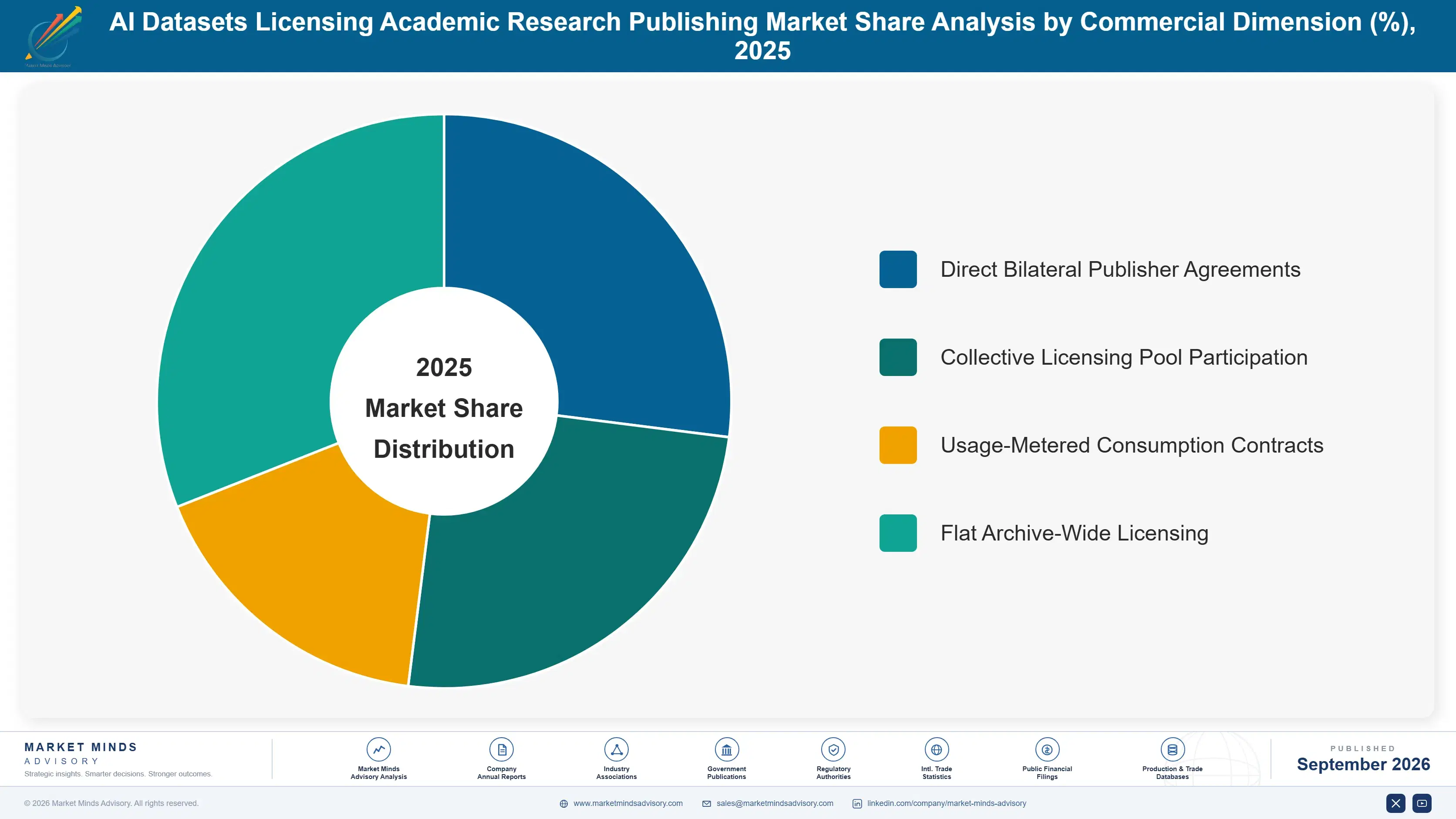
The AI Datasets Licensing Academic Research Publishing Market segments by content type, spanning plain text corpora through multimodal figures, structured citation metadata, and licensing intermediary infrastructure serving publishers without in-house rights management teams or negotiating leverage of their own. Multimodal and intermediary platform segments are pulling ahead of plain text as the fastest-growing categories.
ai-datasets-licensing-academic-research-publishing-market-share-analysis-1788414031821

Multimodal Research Data Licensing

Multimodal research data licensing is the fastest-growing segment, expanding at 20.0% annually as foundation model developers pay steep premiums for figures, chemical structures, and data visualizations that models still cannot generate reliably from text prompts alone even with careful engineering. Publishers with strong archives of scientific diagrams and clinical imaging command pricing several times higher than plain text equivalents, since this content directly addresses a documented capability gap in current generation models used broadly today. Adoption concentrates among publishers in chemistry, life sciences, and engineering disciplines where figures carry disproportionate scientific meaning relative to accompanying narrative text, making this content uniquely difficult for competitors to substitute with synthetic alternatives at scale.
CAGR 20.0%

Licensing Intermediary and Rights Management Platforms

Licensing intermediary and rights management platforms form the second-fastest segment, growing at 18.0% annually as smaller publishers and society journals seek standardized infrastructure to negotiate deals without dedicated in-house legal teams or rights management expertise of their own to draw upon regularly. These platforms pool content across many publishers into unified licensing packages, letting AI developers negotiate once rather than separately with dozens of individual rights holders across different academic disciplines and geographies. Growth here reflects the broader market's maturation beyond the handful of headline bilateral deals that defined the category's earliest years, as long-tail publishers finally gain meaningful commercial access to this new licensing revenue opportunity nationwide and consistently.
CAGR 18.0%
Full segment breakdown across 6 segments available in the complete report.

Regional Architecture and Country Demand Map

Western Europe leads the AI Datasets Licensing Academic Research Publishing Market given its concentration of major scholarly publisher headquarters, while North America follows closely behind as the primary buyer market where most foundation model developers negotiate and finalize these licensing agreements directly with rights holders.

Western Europe

The United Kingdom and Netherlands host the headquarters of Elsevier, Taylor and Francis, and much of Springer Nature's commercial operations, giving this region an outsized 33% share of global academic licensing revenue even though the underlying research content originates worldwide across many countries. This share sits above the standard regional band because publisher headquarters location, not research output volume, drives where licensing revenue books, and this market concentrates unusually heavily in a handful of legacy European publishing houses. Germany contributes Springer Nature's substantial editorial and rights management infrastructure, while smaller society publishers across France and the Nordics increasingly license collectively through Copyright Clearance Center style pooling arrangements that continue expanding steadily each year.
Share: 33% | CAGR: 15.0% (2026 to 2036)

North America

The United States hosts nearly every major foundation model developer negotiating these licensing deals, including OpenAI, Google, and Anthropic, giving American buyers outsized influence over deal structure and pricing precedent even when the licensed publisher is headquartered elsewhere. Wiley, a major American publisher, has signed some of the earliest and largest publicly disclosed licensing agreements in the category, setting pricing benchmarks other publishers now reference in their own negotiations with prospective buyers. Canada contributes a smaller base of university press licensing activity concentrated mainly in medical and engineering disciplines. Litigation activity concentrates heavily in American courts, where several closely watched copyright cases will likely determine pricing power industry-wide for years to come.
Share: 27% | CAGR: 17.5% (2026 to 2036)
Regional intelligence for 5 additional markets available in the complete report: East Asia, South Asia and Pacific, Latin America, Middle East and Africa, Eastern Europe. Contact sales@marketmindsadvisory.com.
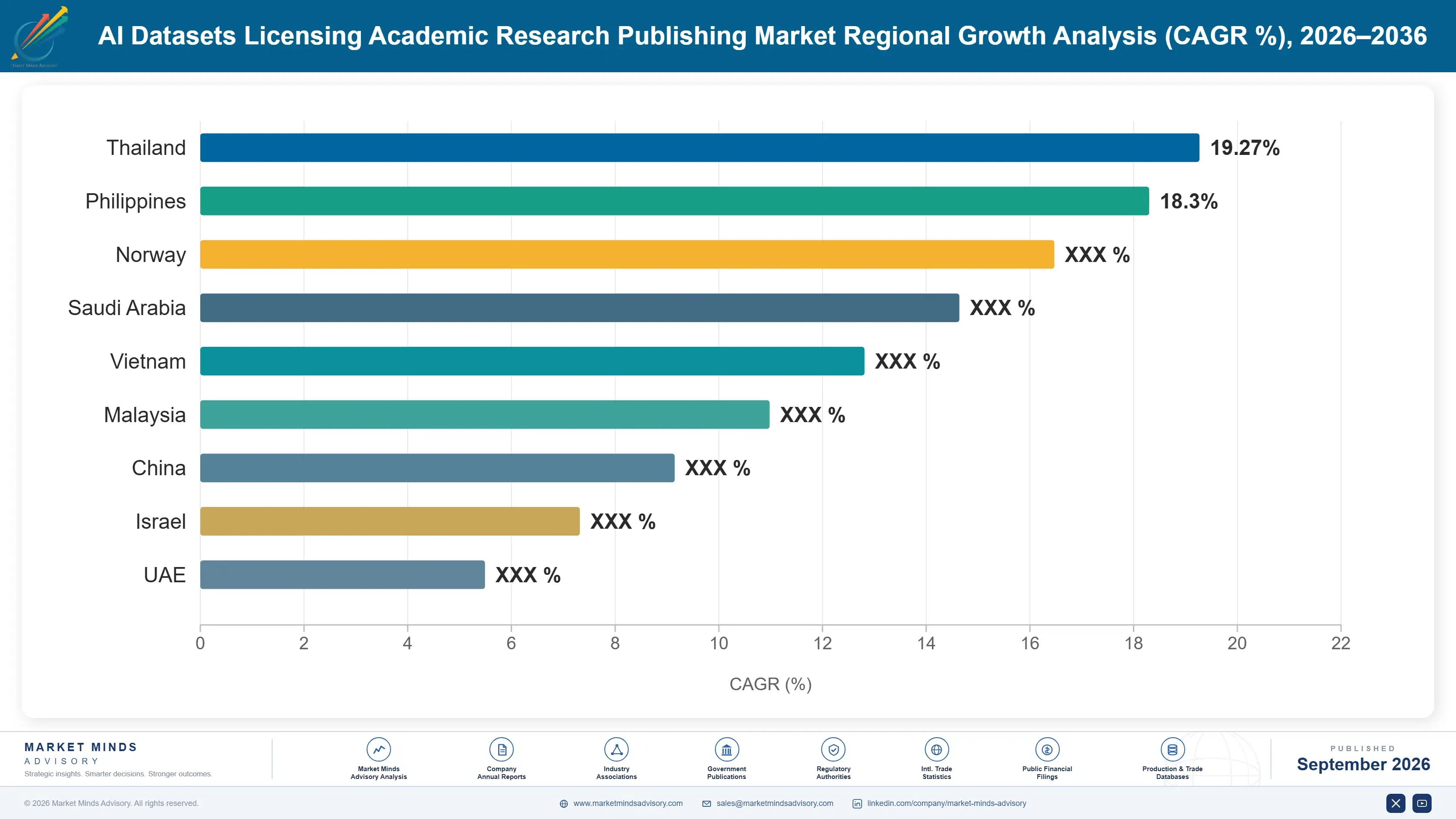
ai-datasets-licensing-academic-research-publishing-country-cagr-analysis-1788414032329

How Publishers Are Pricing Their New Asset Class

Publishers expand licensing revenue beyond flat archive-wide deals by pricing multimodal content at a genuine premium, offering usage-metered agreements tied to actual training consumption, bundling metadata and citation graphs separately, and pooling smaller catalogs through intermediaries to reach buyers unable to negotiate bespoke bilateral agreements at meaningful scale on their own today and consistently.

Premium Pricing for Multimodal Figure and Chart Content

Publishers increasingly separate multimodal content, meaning figures, charts, and chemical structures, into its own pricing tier rather than bundling it within flat archive-wide text licenses, since these assets address a specific and well-documented model capability gap. This separation lets publishers capture roughly 3.2 times the per-document rate compared to plain text alone, with the premium expanding further for specialized content like clinical imaging that carries genuine scientific value AI developers cannot easily source elsewhere. Publishers with strong figure archives in chemistry and life sciences disciplines are seeing this lever contribute the fastest-growing share of new licensing revenue signed this year.
Market Impact: Multimodal content premiums add roughly 3.2x pricing today

Usage-Metered Pricing Tied to Training Run Volume

Rather than accepting a single flat annual payment, larger publishers increasingly negotiate usage-metered agreements where fees scale directly with the buyer's actual training run consumption, letting revenue grow alongside the AI developer's own model release cadence rather than being fixed upfront regardless of usage. This structure has lifted realized revenue per licensing agreement by roughly 35% over comparable flat-fee deals signed in prior years, according to disclosures, since buyers running frequent large-scale training runs end up paying meaningfully more than infrequent users under this pricing model. Adoption concentrates among the largest publishers with the negotiating leverage to demand this structure.
Market Impact: Usage-metered deals lift realized revenue roughly 35% yearly

Standardized Metadata and Citation Graph Licensing

Beyond full-text content, publishers are beginning to separately license structured citation graphs and bibliographic metadata that help AI systems verify factual claims and trace information provenance back to original sources, a capability valuable as AI developers face pressure to reduce hallucinated citations, which affect an estimated 15% of unverified AI-generated output. This metadata licensing category commands smaller absolute fees than full-text deals but carries markedly higher margins since publishers already maintain this data for internal indexing purposes at essentially no incremental cost. Early metadata deals now represent a meaningful secondary revenue stream for several major publishers.
Market Impact: Metadata licensing now adds a 2nd revenue stream

Collective Licensing Pools for Long-Tail Society Journals

Smaller society publishers and specialized journals lacking dedicated rights management staff increasingly join collective licensing pools organized through intermediaries like Copyright Clearance Center, letting them capture commercial revenue from their archives without negotiating bespoke bilateral agreements they lack scale or expertise to pursue independently. These pooled arrangements have expanded the total addressable content library available to AI developers by drawing in more than 1,000 smaller publishers previously priced out of direct negotiation entirely, while distributing collected revenue proportionally based on each publisher's actual content contribution. This lever matters most for expanding market participation beyond the largest incumbent publishers.
Market Impact: Collective pools have added more than 1,000 publishers

Who Controls the Margin Pool

Elsevier, Springer Nature, Wiley, Taylor and Francis, and Clarivate together hold an estimated 52% combined share of tracked licensing revenue, reflecting decades of accumulated archive scale that smaller publishers simply cannot replicate at any price. Elsevier and Springer Nature lead on sheer content breadth, while Clarivate's citation and metadata assets give it a distinct negotiating position most rivals lack entirely.
Competitive activity centers on archive completeness and multimodal coverage, since AI developers increasingly value publishers whose collections include figures, chemical structures, and clinical imaging alongside plain text. Publishers are racing to digitize backfile content still locked in older formats, and several have begun jointly marketing combined catalogs through licensing intermediaries to compete more effectively against the largest incumbents for buyer attention and mindshare.

Pressure is building as smaller society publishers organize into collective licensing pools that can undercut large publishers on price while still offering meaningful content breadth across multiple disciplines. Rankings could shift meaningfully if ongoing copyright litigation resolves in favor of broad fair use, since that outcome would erode the negotiating leverage every publisher currently relies on to justify premium pricing over commodity text sources.
ai-datasets-licensing-academic-research-publishing-company-positioning-matrix-1788414032853

Competitive Moat and Risk Dimensions

ELSEVIER

Moat: Unmatched Multidisciplinary Archive Scale

Elsevier's archive spans decades of peer-reviewed content across nearly every scientific discipline, giving it a breadth few rivals can match when AI developers seek comprehensive single-source licensing coverage. This scale advantage lets Elsevier negotiate from a position of strength, bundling less commercially attractive content alongside high-demand disciplines like medicine and life sciences to maximize total contract value.
ELSEVIER

Risk: Reputational Exposure From Past Practices

Elsevier has faced sustained criticism from the academic community over subscription pricing and open-access policy for years, and this reputational baggage complicates its positioning in AI licensing negotiations where researchers whose work is being licensed have limited say in terms. Continued criticism could pressure Elsevier toward more favorable author compensation terms, potentially compressing captured margin.
CLARIVATE

Moat: Proprietary Citation Graph Data

Clarivate's Web of Science citation database gives it a uniquely valuable structured metadata asset that helps AI systems verify factual claims and trace provenance, a capability distinct from the plain-text archives most competing publishers offer. This graph data is difficult to replicate without decades of consistent citation indexing work, giving Clarivate a defensible position in the fast-growing metadata licensing category.
CLARIVATE

Risk: Narrower Content Base Than Rivals

Unlike Elsevier or Springer Nature, Clarivate does not own a comparably large body of full-text peer-reviewed content, limiting its ability to compete for the largest bundled text licensing agreements that dominate headline deal announcements. Clarivate must instead position its metadata offering as a complement to rather than a substitute for full-text deals.

Players Tracked

Prominent Players

Elsevier
Springer Nature
Wiley
Taylor and Francis
Clarivate

Other Key Players

SAGE Publishing
Oxford University Press
Cambridge University Press
Wolters Kluwer
American Chemical Society Publications
IEEE
IOP Publishing
Emerald Publishing
De Gruyter
Frontiers Media
MDPI
PLOS
Copyright Clearance Center
JSTOR
ProQuest

Recent Developments

JUNE 2024

Wiley signed a multi-year content licensing agreement with a major foundation model developer covering its full academic and professional publishing catalog, one of the earliest and largest publicly disclosed deals in the category. The agreement set an early benchmark subsequent negotiations have referenced repeatedly since disclosure to investors.
Signal: Established the first widely disclosed benchmark pricing structure for academic content licensing deals industry-wide going forward.
MAY 2025

Taylor and Francis expanded its existing content licensing relationship with a leading AI developer to include multimodal figures and data tables previously excluded from the original text-only agreement, reflecting rising buyer demand for non-text training material. The expansion reportedly increased total contract value substantially over the original deal terms.
Signal: Confirms multimodal content premiums are becoming standard practice across major licensing renewals and new agreements signed.
NOVEMBER 2025

Copyright Clearance Center launched a standardized collective licensing platform enabling smaller society publishers and specialized journals to pool their content into unified packages for AI developers, reducing the transaction cost of bespoke bilateral negotiation. The platform onboarded several hundred participating publishers within its first months of operation.
Signal: Signals licensing infrastructure maturing beyond bilateral deals toward standardized, industry-wide commercial market access for smaller publishers.

Legal and Digitization Cost Exposure

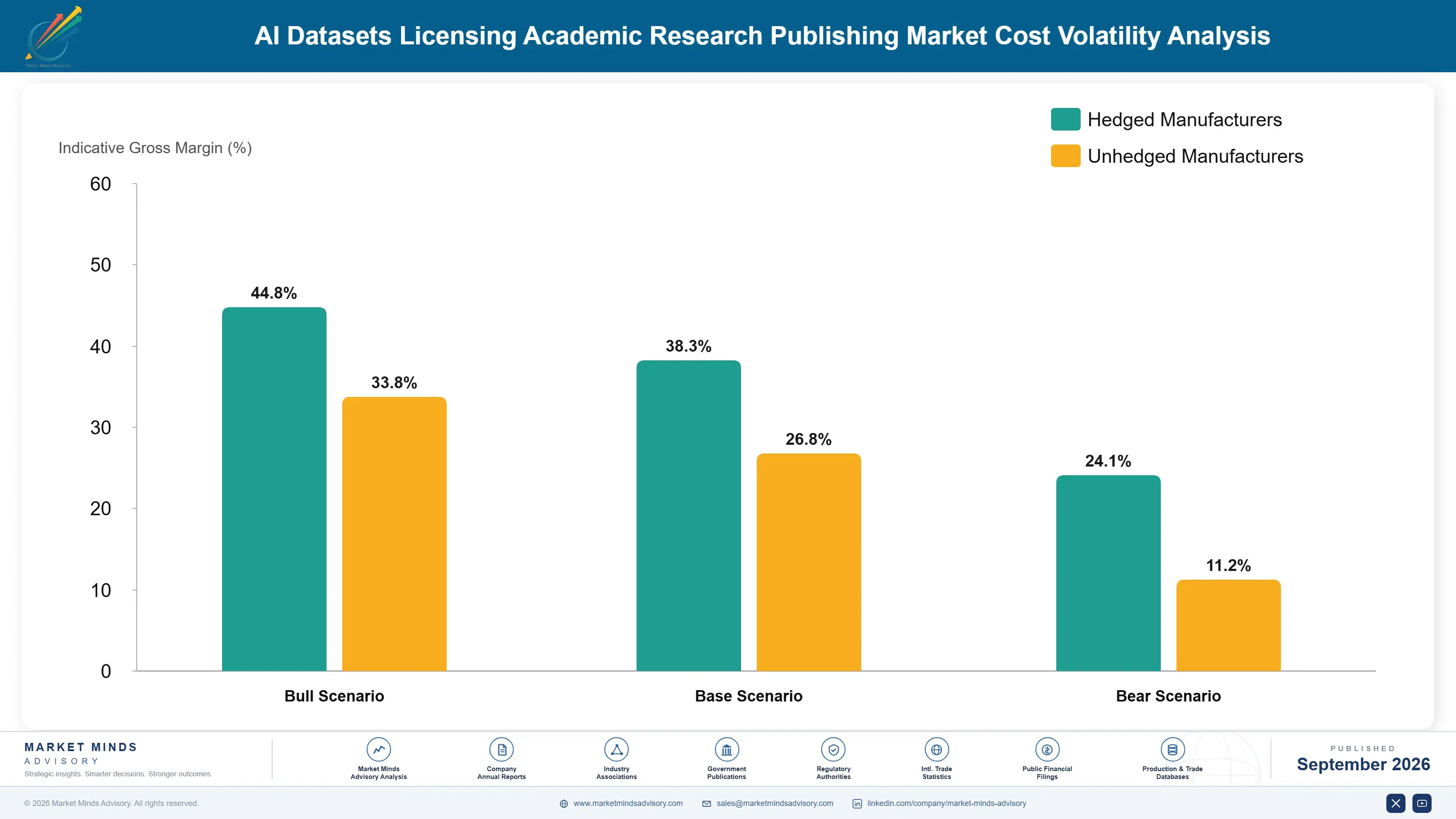
Publishers carry an unusual cost structure for this licensing category: legal and rights clearance expense, covering contract negotiation and litigation defense, consumes roughly 25% to 35% of incremental licensing revenue, while archive digitization and metadata tagging for older backfile content represents a further 15% of cost tied directly to preparing older content for commercial licensing use.
Multiple ongoing copyright lawsuits against foundation model developers, tracked closely in company annual reports and investor filings, have forced several publishers to significantly increase outside counsel spending to defend their negotiating position and pursue damages for suspected unlicensed historical use. One major publisher disclosed legal spending related to AI licensing matters rising several-fold within a single fiscal year, illustrating how directly litigation exposure now factors into the true cost of participating in this market for any publisher.

Smaller publishers without dedicated legal teams face a durable cost disadvantage against large publishers who can spread litigation and negotiation expense across a much larger licensing revenue base, leaving smaller society journals dependent on collective pooling arrangements simply to make participation economically viable at all. This dynamic concentrates negotiating leverage among the largest incumbents even as content ownership itself remains widely distributed across thousands of independent publishers.
ai-datasets-licensing-academic-research-publishing-cost-volatility-analysis-1788414033047

Collective Legal Defense Consortiums Among Publishers

Groups of publishers are forming joint legal defense arrangements to share litigation cost across multiple parties facing similar copyright claims, reducing the per-publisher expense of defending negotiating positions in court. This collective approach lets smaller publishers access legal expertise they could not otherwise afford independently, spreading fixed defense costs across a broader base of participating rights holders.

Outsourced Digitization Through Specialized Vendors

Publishers increasingly outsource archive digitization and metadata tagging to specialized third-party vendors rather than building in-house capability, converting a fixed capital cost into a variable per-document expense that scales with actual licensing deal volume signed each year. This approach lets smaller publishers digitize backfile content only when a specific licensing opportunity justifies the expense involved.

Portfolio Architecture for Margin Defence

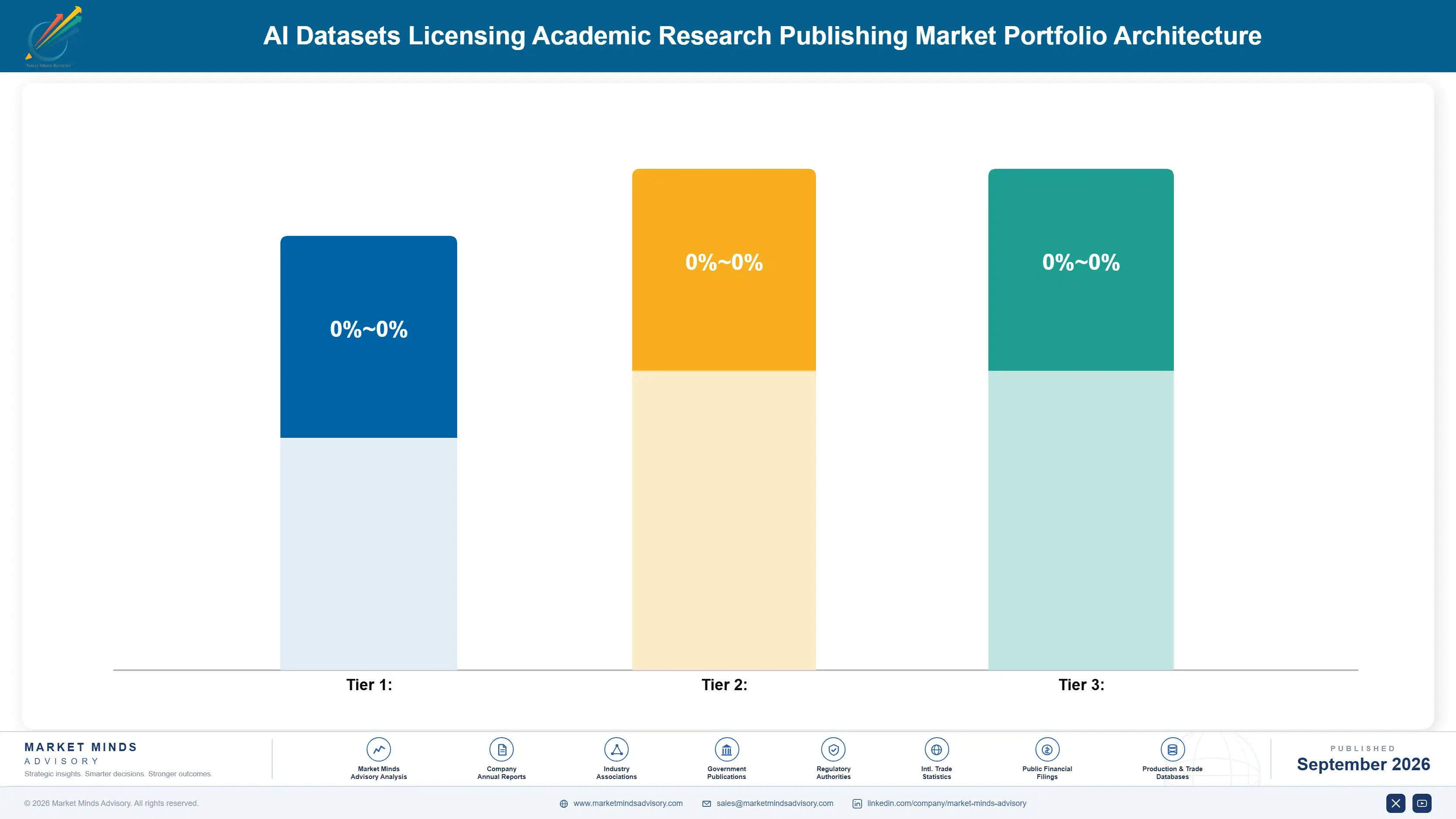
Publisher licensing revenue organizes into three commercially distinct tiers separated by content type and negotiating leverage rather than by publisher size alone. Volume tiers cover flat-fee plain text licensing sold through collective pools, while premium tiers add usage-metered pricing and bundled metadata. The newest tier commands the steepest margins by pricing scarce multimodal content that AI developers cannot easily source elsewhere.
Gross margins vary sharply across tiers because plain text licensing carries meaningful digitization and rights clearance cost while metadata and citation graph licensing draws on data publishers already maintain internally at near-zero marginal cost. Premium and next-generation tiers therefore capture disproportionate profit relative to their share of total contracted revenue, rewarding publishers that can supply differentiated multimodal or structured content over those offering plain text alone.

High-value pools concentrate overwhelmingly in multimodal figure licensing and structured citation metadata rather than in commodity plain text, which faces mounting price pressure as collective pooling arrangements expand the supply of licensable text available to buyers. The volume tier remains essential for establishing baseline publisher participation and market credibility, but incremental profit growth increasingly comes from premium and next-generation tier expansion rather than additional flat-fee text deals.

Flat-fee plain text licensing sold individually or through collective pooling arrangements for smaller publishers, priced to maximize participation volume with gross margins in the 40% to 50% range given digitization and legal cost.
Gross Margin

Usage-metered agreements bundling structured citation metadata alongside full-text content, carrying gross margins between 55% and 65% as pricing scales directly with buyer training run consumption over the full contract term.
Gross Margin

Multimodal figure, chart, and clinical imaging licensing commanding gross margins above 70% because this scarce content addresses a specific, well-documented model generation capability gap that persists industry-wide today and likely beyond.
Gross Margin
ai-datasets-licensing-academic-research-publishing-portfolio-architecture-1788414033548

High-value Sub-segments and Strategic Watch-out

Multimodal Research Data Licensing

High-value and high-growth, this segment combines the fastest expansion rate in the market with the steepest pricing premiums as figures and charts remain a documented generation weakness for most foundation models currently deployed across the industry today, a gap unlikely to close soon given known technical limits.

Licensing Intermediary and Rights Management Platforms

High-value with moderate growth, intermediary platforms capture meaningful transaction fees and strong publisher adoption even though individual deal sizes trail the largest direct bilateral agreements signed by major incumbent publishers with dedicated legal and rights management teams already firmly in place today across most major markets.

Text and Document Corpus Licensing

Volume core of the market, plain text licensing remains the largest segment by contracted revenue and the primary entry point for new publishers, though pricing power here continues eroding steadily as supply expands through collective licensing pools and growing intermediary platform participation across the industry nationwide.

Structured Academic Citation and Metadata Licensing

Strategic watch-out segment, growing steadily as AI developers seek verifiable citation provenance, but facing uncertain long-term pricing power as more publishers begin offering comparable metadata assets competitively over the coming several years and well beyond that distant horizon, gradually eroding any early-mover advantage held today.

The Annuity Value of Licensed Archives

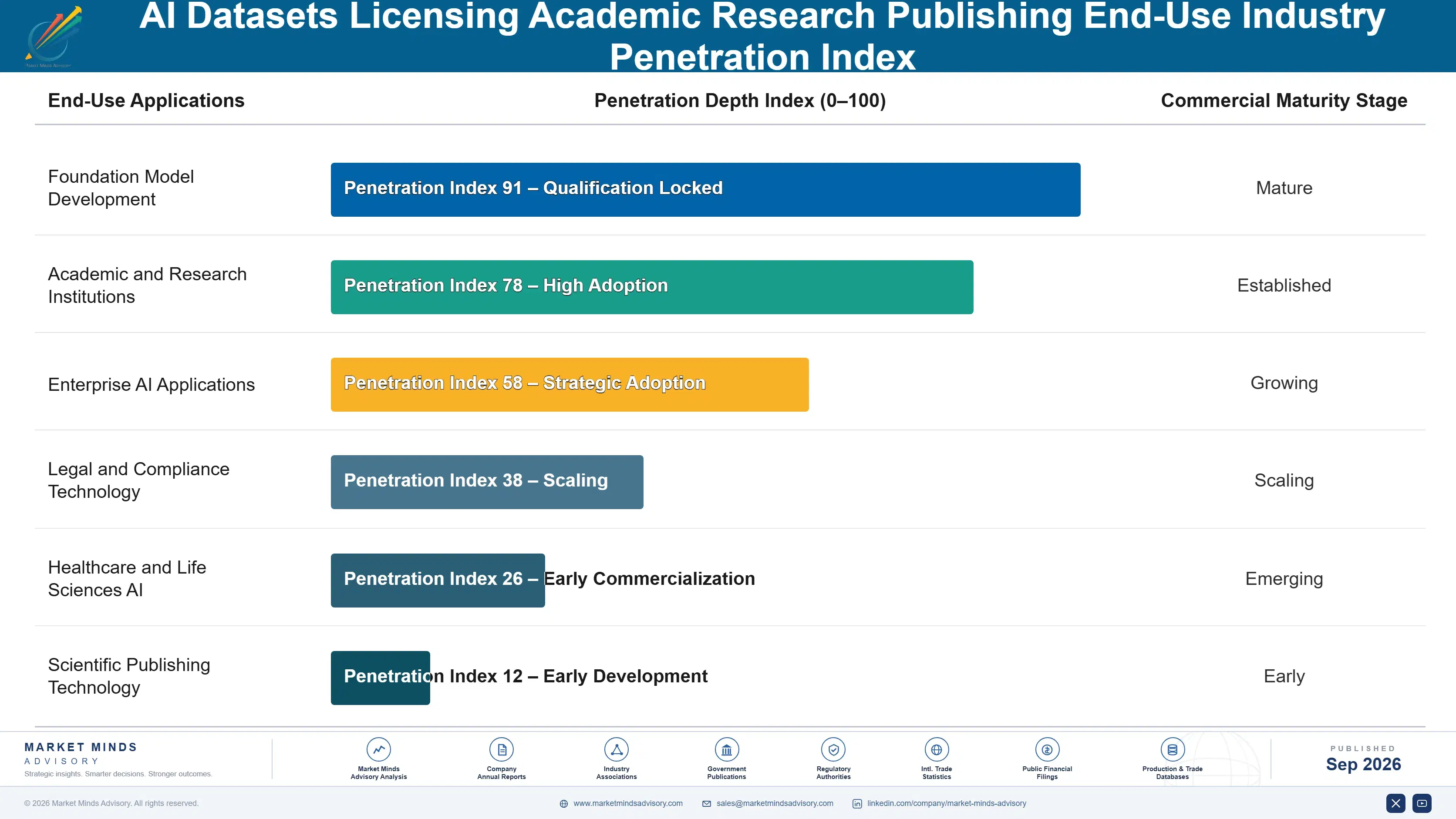
Licensing revenue behaves increasingly like an annuity once a publisher signs a multi-year agreement, since foundation model developers rarely walk away from established content relationships given the switching cost of renegotiating archive access from scratch with an unfamiliar counterparty. Renewal rates on existing deals already exceed 80% at contract expiration, reflecting how deeply these agreements embed into a buyer's ongoing training pipeline and roadmap.
Adoption stickiness varies considerably by academic discipline. Chemistry, life sciences, and engineering publishers see the deepest AI developer dependency given the multimodal content these fields uniquely supply, while humanities and social science publishers see comparatively shallow engagement since their content offers less differentiated training value relative to abundant web text alternatives already freely available to developers at essentially no cost.

A generational shift is underway in who negotiates these deals internally. Publishers increasingly staff dedicated AI licensing teams separate from traditional subscription sales, recognizing this revenue stream requires genuinely different commercial skills entirely from legacy institutional selling. Younger publishing executives with technology and data backgrounds are displacing longtime subscription sales veterans in these specific negotiations, reflecting the category's distinct commercial logic compared to established subscription business models built over decades.
ai-datasets-licensing-academic-research-publishing-end-use-penetration-index-1788414034030

Where Publishers Should Focus Licensing Strategy

These are among the four positions where our research anticipates prominent divergence between winners and laggards over the coming forecast period. Each is grounded in the demand model, the regulatory perimeter, and the announced capacity pipeline.
01 / LITIGATION RISK POSITIONING

Structure licensing terms with renegotiation clauses tied to court rulings

Ongoing copyright litigation could swing negotiating leverage dramatically toward either publishers or AI developers depending on how courts ultimately rule on fair use claims, making any long-term fixed-price agreement signed today a meaningful bet on an uncertain legal outcome. Both parties should favor shorter contract terms with explicit renegotiation triggers tied to specific litigation milestones rather than locking in decade-long pricing assumptions. This structure protects both sides from a legal outcome that could otherwise upend the economics of an already-signed agreement.
02 / MULTIMODAL CONTENT PRIORITIZATION

Prioritize figure and chart archives over plain text expansion

Plain text licensing faces mounting price pressure as collective pooling arrangements expand available supply, while multimodal content addressing documented model generation weaknesses continues commanding a durable pricing premium that shows no sign of eroding anytime soon given known technical limits. Publishers should prioritize digitizing and tagging figure, chart, and chemical structure archives over simply expanding plain text catalog breadth, since this scarce content category drives the fastest-growing and highest-margin revenue segment currently available. This applies especially to chemistry and life sciences publishers.
03 / COLLECTIVE POOLING PARTICIPATION

Smaller publishers should join pooling arrangements before going independent

Smaller society journals attempting to negotiate bespoke bilateral agreements independently consistently secure worse pricing terms than comparable content licensed through collective pooling arrangements organized by established intermediaries with real negotiating scale and legal expertise. Joining a pooling arrangement early, before attempting solo negotiation, both improves realized pricing and reduces the legal and administrative burden smaller publishers cannot easily absorb given limited in-house resources and staff. This strategy matters most for publishers without dedicated rights management staff of their own to draw upon.
04 / METADATA ASSET DEVELOPMENT

Invest in structured metadata now to capture emerging demand

Demand for structured citation graphs and bibliographic metadata is growing as AI developers face mounting pressure to reduce hallucinated citations and verify factual claims made by their generated output. Publishers who invest now in cleaning and structuring their existing metadata, much of which already exists in some usable form internally, can capture this emerging revenue category ahead of competitors who treat metadata purely as an internal indexing tool. This investment requires modest capital relative to the archive digitization full-text licensing demands.

Engagement Snapshot From the Field

A live engagement with an industry participant carrying material or product regulatory and market exposure ahead of a defining policy shift, showing how our research translates into a defensible multi-year portfolio strategy.
MARKET MINDS ADVISORY · CLIENT ENGAGEMENT SUMMARY
AI Datasets Licensing Academic Research Publishing Producer Strategic Portfolio Review and Transition Roadmap 2026·Investment Scenario on AI Datasets Licensing Academic Research Publishing Exposure Evaluation 2025-26
CLIENT PROFILE
A mid-sized academic publisher specializing in engineering and materials science journals, with roughly 40 titles and a substantial backfile archive spanning several decades of peer-reviewed content and figures, had received unsolicited licensing inquiries from three foundation model developers but lacked internal expertise to evaluate offers or negotiate favorable terms against much larger, more experienced publishing counterparties.
STRATEGIC CHALLENGE
Leadership needed to decide whether to negotiate independently, join a collective licensing pool, or engage a specialized intermediary, while facing pressure from board members eager to capture near-term revenue before competing publishers signed comparable deals first and set an unfavorable pricing precedent for the entire industry going forward permanently and irreversibly.
MMA APPROACH
MMA benchmarked the client's multimodal content holdings against comparable publisher deals already disclosed, modeled expected revenue under independent negotiation versus collective pooling scenarios, and assessed litigation exposure given the client's historical content had already appeared in several documented web scraping datasets identified publicly by outside researchers, journalists, and independent auditors.
KEY FINDINGS
  1. The client's engineering figure archive commanded pricing comparable to top-tier publishers despite its smaller overall catalog size (client-reported, unverified by MMA), reflecting genuine multimodal scarcity value.
  2. Independent negotiation would likely have secured licensing rates roughly 30% below collective pooling arrangements given the client's limited negotiating scale (client-reported, unverified by MMA) and legal resources.
  3. Prior unlicensed scraping had already occurred across a meaningful share of the client's archive, creating both litigation risk and negotiating leverage simultaneously (client-reported, unverified by MMA) in talks.
  4. Board pressure to sign quickly conflicted with the benefit of waiting for pooling infrastructure to mature further, a tension common across similarly sized publishers (client-reported, unverified by MMA) industry-wide.
CLIENT PROFILE
A mid-sized academic publisher specializing in engineering and materials science journals, with roughly 40 titles and a substantial backfile archive spanning several decades of peer-reviewed content and figures, had received unsolicited licensing inquiries from three foundation model developers but lacked internal expertise to evaluate offers or negotiate favorable terms against much larger, more experienced publishing counterparties.
STRATEGIC CHALLENGE
Leadership needed to decide whether to negotiate independently, join a collective licensing pool, or engage a specialized intermediary, while facing pressure from board members eager to capture near-term revenue before competing publishers signed comparable deals first and set an unfavorable pricing precedent for the entire industry going forward permanently and irreversibly.
MMA APPROACH
MMA benchmarked the client's multimodal content holdings against comparable publisher deals already disclosed, modeled expected revenue under independent negotiation versus collective pooling scenarios, and assessed litigation exposure given the client's historical content had already appeared in several documented web scraping datasets identified publicly by outside researchers, journalists, and independent auditors.
KEY FINDINGS
  1. The client's engineering figure archive commanded pricing comparable to top-tier publishers despite its smaller overall catalog size (client-reported, unverified by MMA), reflecting genuine multimodal scarcity value.
  2. Independent negotiation would likely have secured licensing rates roughly 30% below collective pooling arrangements given the client's limited negotiating scale (client-reported, unverified by MMA) and legal resources.
  3. Prior unlicensed scraping had already occurred across a meaningful share of the client's archive, creating both litigation risk and negotiating leverage simultaneously (client-reported, unverified by MMA) in talks.
  4. Board pressure to sign quickly conflicted with the benefit of waiting for pooling infrastructure to mature further, a tension common across similarly sized publishers (client-reported, unverified by MMA) industry-wide.
RECOMMENDED STRATEGY
Phase 1: Phase one joined an established collective licensing pool within sixty days to access standardized contract terms and pooled infrastructure immediately. Phase 2: Phase two conducted a full multimodal content audit to identify the highest-value figure and chart archive segments precisely and thoroughly. Phase 3: Phase three pursued a supplemental direct negotiation for content the pooling arrangement had priced meaningfully below its assessed true value.
OUTCOME
The client secured licensing terms roughly 25% above initial pooling estimates by combining pooled participation with a targeted supplemental negotiation for its highest-value multimodal content (client-reported, unverified by MMA), while avoiding the legal cost of independent litigation defense entirely for this specific engagement overall and going forward.

Frequently Asked Questions

Foundational context covering the market sizes, CAGR, scope, country, region and competition that inform every finding below. This section is provided to cover basics and most often pre-purchase conversations, answered from the MMA Primary Research Dataset.

What is the current size of the AI Datasets Licensing Academic Research Publishing Market?

The market reached an estimated $0.68 billion in global licensing revenue in 2025. This figure covers commercial agreements through which publishers license peer-reviewed text, figures, and metadata to foundation model developers for training purposes.

How large will the AI Datasets Licensing Academic Research Publishing Market be by 2036?

MMA projects the market will reach approximately $3.65 billion by 2036, driven mainly by multimodal content licensing and collective pooling infrastructure. That represents roughly a 4.6 fold expansion from 2026 levels over the forecast decade.

What is the CAGR for the AI Datasets Licensing Academic Research Publishing Market 2026 to 2036?

The market is forecast to grow at a 16.5% compound annual rate between 2026 and 2036. Bull and bear scenarios range between roughly 15.2% and 17.8% depending on ongoing copyright litigation outcomes.

Which segment is growing fastest?

Multimodal research data licensing leads all segments, expanding at an estimated 20.0% annually. That is more than one times the overall market's 16.5% average growth rate through the forecast period to 2036.

Who are the major companies in the AI Datasets Licensing Academic Research Publishing Market?

Elsevier, Springer Nature, Wiley, Taylor and Francis, and Clarivate form the five leading publishers tracked in this report. Together they hold an estimated 52% combined share of tracked licensing revenue as of 2025.

Which country is growing fastest?

The United Kingdom posts the fastest national growth rate in the study, expanding at an estimated 21.0% annually. Its concentration of major scholarly publisher headquarters drives unusually rapid licensing deal activity there.

Report Segmentation Architecture

The full report scope spans multiple orthogonal segmentation dimensions, with cross-tabulated demand data provided for each dimension pair. Coverage extends further to regional breakdowns, trend trajectories, and the competitive detail needed to support segment-level decision-making.

By Primary Market Dimension

  • Text and Document Corpus Licensing
  • Structured Academic Citation and Metadata Licensing
  • Multimodal Research Data Licensing
  • Licensing Intermediary and Rights Management Platforms
  • Retrospective Archive and Backfile Licensing
  • Real-Time Preprint and Working Paper Licensing

By End-Use Industry

  • Foundation Model Development
  • Academic and Research Institutions
  • Enterprise AI Applications
  • Legal and Compliance Technology
  • Healthcare and Life Sciences AI
  • Scientific Publishing Technology

By Commercial Dimension

  • Direct Bilateral Publisher Agreements
  • Collective Licensing Pool Participation
  • Usage-Metered Consumption Contracts
  • Flat Archive-Wide Licensing

By Region

  • North America
  • Western Europe
  • East Asia
  • South Asia and Pacific
  • Latin America
  • Middle East and Africa
  • Eastern Europe

Scope, Methodology, and Coverage

Every figure in this report is reproducible from documented input assumptions. The scope below maps the historical period, the forecast horizon, the segmentation dimensions, and the countries covered, alongside the underlying primary and qualitative methodology.
Historical Period
2020 to 2025
Forecast Period
2026 to 2036
Base Year
2025 (USD billions; MMA Primary Research Dataset, September 2026)
Market Definition
The AI Datasets Licensing Academic Research Publishing Market covers commercial agreements through which academic publishers, journals, and research repositories license peer-reviewed text, figures, and structured metadata to foundation model developers for training purposes, measured by licensing and royalty revenue. It excludes general web-scraped training data licensing unrelated to formally published academic research and open-access content distributed without a commercial licensing fee.
Quantitative Units
USD Billion, CAGR (%), Share (%), 2020 to 2036
Segmentation Dimensions
By Primary Market Dimension; By End-Use Industry; By Commercial Dimension; By Region
Regions Covered
North America, Western Europe, East Asia, South Asia and Pacific, Latin America, Middle East and Africa, Eastern Europe
Countries Covered
United Kingdom, Netherlands, Germany, United States, Canada, France, Japan, China, South Korea, India, Australia, Brazil, Mexico, Argentina, Israel, Saudi Arabia, United Arab Emirates, South Africa, Poland, Russia, Ukraine, and additional markets relevant to this sector.
Key Companies Profiled
Elsevier, Springer Nature, Wiley, Taylor and Francis, Clarivate, SAGE Publishing, Oxford University Press, Cambridge University Press, Wolters Kluwer, American Chemical Society Publications, IEEE, IOP Publishing, Emerald Publishing, De Gruyter, Frontiers Media, MDPI, PLOS, Copyright Clearance Center, JSTOR, ProQuest
Quantitative Methodology
Primary survey, n=3,800 respondents, Q4 2025, six countries; demand-side model with trade association cross-validation
Qualitative Methodology
47 expert interviews, Q4 2025; applied to validate demand model assumptions, identify emerging dynamics, and assess competitive positioning
Report Format
PDF and XLSX data workbook (Word format preview document)
Publisher
Market Minds Advisory
Report Code
MMA-2026-TEC-604
Published
September 2026
Contact
sales@marketmindsadvisory.com | www.marketmindsadvisory.com

Purchase the full AI Datasets Licensing Academic Research Publishing Market Report (2026 to 2036).

This report delivers a comprehensive assessment of the global AI Datasets Licensing Academic Research Publishing Market, covering sizing, segmentation, and competitive dynamics across text, multimodal, and metadata licensing categories worldwide. It examines regional publisher concentration, revenue diversification strategies, and litigation and digitization cost exposure shaping publisher profitability through 2036. The analysis draws on primary survey data, expert interviews, and company disclosures to size this genuinely new revenue category precisely. Buyers gain a structured view of where negotiating leverage concentrates as courts and market practice both continue evolving.
Ten-year market sizing and forecast model through 2036
Six-segment content-type-based market breakdown and analysis
Seven-region publisher and buyer concentration analysis
Competitive benchmarking of twenty tracked publisher vendors
Litigation and digitization cost exposure assessment
Anonymized publisher client engagement case study

Built For The People Who Decide

From boardroom strategy to bench-side execution, this report is read cover-to-cover by leaders shaping the next decade of their industry, turning demand scenarios, market dynamics and valuation benchmarks into decisions.
CXOs/ Presidents/ VPs/ Managers
M&A and Corporate Development
Strategy Teams and R&D Heads
Procurement and Product Directors
Regulatory and Compliance Leaders
Investor Relations and Equity Analysts