Market Minds Advisory
AI Dataset Licensing Advertising Marketing Market

AI Dataset Licensing Advertising Marketing Market: AI Dataset Licensing Advertising Marketing Market. Copyright Litigation Reshapes Training Data Procurement

Mounting copyright litigation and shrinking free-scrape data availability are colliding as advertising and marketing AI developers license consumer, creative, and publisher data fast enough to keep model training pipelines running legally.

Lead Analyst

Published

September 2026

Make Smarter Decisions with Customized Research Insights

Request a free sample report and evaluate market opportunities, growth trends, and competitive dynamics relevant to your business needs.

2025 MARKET VALUE$1.1BMarket Size 2025
2036 FORECAST VALUE$6.5BBase Case , 2026 to 2036
CAGR 2026 TO 203617.5 %Bull 18.8% / Bear 16.2%
INCREMENTAL OPPORTUNITY$5.2BNet 10- year value creation
EXPANSION MULTIPLE5.02x2036 value over 2026 base
Strategic Levers
M&A Pipeline
Regional Outlook
Country Rankings
Competitive Intelligence
Segmental Deep-dive
Call-Us : 91 93563 13602

Executive Snapshot and Market Trajectory.

AI dataset licensing for advertising and marketing applications is shifting from ad-hoc data purchases into structured, contractually documented supply relationships as copyright litigation raises the legal risk of unlicensed training data. Provenance documentation is now a legal necessity, not an optional consideration.
Publishers, stock media libraries, and consumer data brokers are increasingly striking direct licensing agreements with AI developers rather than relying on litigation to resolve disputed data usage after the fact, creating a fast-growing new revenue category for content owners who previously had no direct commercial relationship with AI training pipelines. Established data brokers with existing consumer consent frameworks increasingly find themselves positioned as trusted intermediaries in this rapidly forming licensing market. Trust matters enormously here.
Competitive dynamics increasingly separate data marketplace platforms that aggregate and license third-party content from proprietary data holders licensing their own exclusive datasets directly, with the latter commanding meaningfully higher per-record pricing given genuine data exclusivity and provenance documentation buyers increasingly require. This bifurcation is reshaping how advertising technology companies structure their data acquisition strategies and vendor relationships across their broader AI development programs. Investors reward platforms demonstrating clear provenance credentials.
Market Definition
This report covers licensing platforms and direct agreements through which advertising and marketing organizations acquire structured, permissioned datasets for AI model training, including consumer behavioral data, ad creative assets, and publisher content, measured on a global transaction-value basis. It excludes freely scraped or unlicensed data usage and general-purpose AI training data unrelated to advertising applications.
Base Year Value
$1.1B in 2025 (MMA Primary Research Dataset, September 2026)
Forecast Period
2026 to 2036, eleven discrete annual values
CAGR
17.5% base case. Bull 18.8%. Bear 16.2%.
Fastest Growth Segment
Synthetic and Augmented Marketing Data: 24.0% CAGR
Fastest Growth Country
India: 20.0% CAGR
Fastest Growth Region
South Asia and Pacific: 19.5% CAGR
Largest Region
North America: 32% of 2025 global value
Market Leaders
Scale AI, Appen, Defined.ai, LiveRamp, Shutterstock
Primary Survey
n=3,800 procurement and R&D decision-makers, Q4 2025, six countries
Methodology
Demand-side build-up, cross-validated against public data, 47 expert interviews

AI Dataset Licensing Advertising Market Forecast Scenarios

ai-dataset-licensing-advertising-marketing-market-size-forecast-scenario-1788413550289
Between 2020 and 2025, AI dataset licensing for advertising applications grew from a negligible activity into a fast-forming commercial category as major copyright lawsuits against AI developers pushed publishers and content owners toward direct licensing negotiations rather than litigation as the primary resolution path. Early licensing deals remained largely ad-hoc and individually negotiated, without the standardized pricing frameworks and data provenance documentation that increasingly define transactions today.
The base case rests on three mechanisms holding through the forecast window: continued copyright litigation pressure pushing AI developers toward licensed data sourcing, expanding generative AI advertising and marketing applications requiring larger and more diverse training datasets, and growing publisher willingness to license content once litigation established meaningful settlement precedents and pricing benchmarks. These mechanisms reinforce each other, since settlement precedents from early litigation increasingly inform pricing expectations for subsequent licensing negotiations across the broader content owner community.
A bull scenario emerges if additional favorable court rulings or settlements establish clearer licensing precedents industry-wide, while a bear risk centers on AI developers shifting toward synthetic data generation that reduces dependence on licensed real-world content, weakening the underlying demand driving this market. The outcome depends heavily on synthetic data maturity relative to litigation pace.

Litigation Risk Turns Scraping Into a Legal Liability

Legal risk mitigation, not raw data acquisition efficiency, increasingly drives licensing decisions in this category, since AI developers facing active or threatened copyright litigation treat licensed data sourcing as insurance against far larger potential damages and reputational harm. Legal teams increasingly hold veto power over data sourcing decisions that previously belonged almost entirely to machine learning engineering teams pursuing the fastest, cheapest data acquisition path available.
TOP REGION SHARE33%North America's share of global licensed dataset transaction value
PUBLISHER LICENSING ADOPTION38%Share of major publishers with active AI content licensing agreements
AVERAGE DEAL VALUE$8MTypical annual value for major publisher content licensing agreement
MARKET CONCENTRATION35%Combined transaction value share held by the top five platforms
LITIGATION-DRIVEN DEAL SHARE52%Portion of licensing agreements originating from settled litigation
AVERAGE NEGOTIATION TIMELINE9 monthsTypical time from initial contact to signed licensing agreement
Publishers and content owners increasingly negotiate from a position of leverage they lacked before major litigation established meaningful settlement precedents, commanding pricing terms that would have seemed implausible to secure just several years earlier when scraping proceeded largely unchallenged. Some publishers have organized collectively to negotiate shared licensing terms, further strengthening their bargaining position relative to individual AI developers seeking exclusive or preferential access.
Data marketplace platforms increasingly compete on provenance documentation and legal indemnification terms rather than pure data volume or price, since AI developers value contractual protection against future litigation risk considerably more than marginal cost savings from less rigorously documented data sources. Platforms offering weaker indemnification terms increasingly struggle to win business from risk-averse enterprise AI developers regardless of how competitively they price their underlying data access.
"Two years ago nobody paid for training data. Now paying for it is the only way some companies can sleep at night."
Practice Lead, AI Data Licensing and Marketing Technology · MMA AI Training Data Licensing and Marketing Technology Platforms Practice · September 2026

Market Trends

Major Publisher Licensing Deals Set Industry Pricing Benchmarks

High-profile licensing agreements between major AI developers and publishers, including deals covering news content, stock imagery, and social media platform data, are establishing pricing benchmarks that smaller publishers and content owners increasingly reference during their own licensing negotiations. Reported deal values for major publisher agreements have ranged from several million to over 100 million dollars annually depending on content volume and exclusivity terms, giving smaller content owners meaningful leverage points previously unavailable before these landmark agreements became public. This benchmarking effect is compressing negotiation timelines as both sides increasingly reference comparable precedent deals rather than negotiating pricing from scratch.
Market Impact: Settlements reach $100M+ per case
Consumer Consent Frameworks Reshape Behavioral Data Licensing

Growing consumer privacy regulation and platform policy changes are pushing behavioral and purchase data licensing toward frameworks with explicit consumer consent documentation, moving away from the loosely governed data broker practices that historically characterized this segment. Data providers with established consent management infrastructure increasingly command premium pricing from advertising AI developers seeking to minimize regulatory and reputational risk associated with improperly sourced consumer data. This shift has meaningfully advantaged established data brokers like LiveRamp with existing consent infrastructure over newer entrants lacking comparable compliance credentials and documentation history. Compliance credentials increasingly determine which providers win the largest enterprise contracts.
Market Impact: Expands data needs 40%+

Market Opportunities and Growth Drivers

Copyright Litigation Raises Unlicensed Data Legal Risk

Multiple high-profile copyright lawsuits against major AI developers over unlicensed training data usage have established meaningful legal precedent and damages exposure, pushing risk-averse enterprises toward licensed data sourcing as a defensive procurement strategy rather than a purely voluntary compliance choice. Settlement values in resolved cases have reportedly ranged into the hundreds of millions of dollars, creating a compelling financial incentive for AI developers to license proactively rather than risk comparable litigation exposure themselves. This litigation-driven urgency has compressed typical enterprise procurement timelines considerably compared with pre-litigation industry norms. Legal counsel now routinely joins data sourcing decisions.
Market Impact: Adds 15 to 25% to costs

Generative AI Advertising Adoption Expands Data Requirements

Growing enterprise adoption of generative AI for advertising creative production, personalization, and campaign optimization is expanding the volume and diversity of training data advertising organizations require, well beyond what internal proprietary data alone can typically supply. Marketing organizations report needing data spanning multiple content formats, demographic segments, and cultural contexts to train models capable of generating genuinely effective advertising creative across diverse target markets and campaign objectives. This expanding requirement sustains growing demand for licensed third-party datasets that supplement organizations' own first-party data holdings considerably. This trend accelerates as generative tools mature further.
Market Impact: Adds 2 to 4 weeks

Market Restraints and Challenges

Licensing Costs Compress Margins for Smaller AI Developers

Data licensing costs, once negligible when scraping proceeded unchallenged, now represent a meaningful line item in AI development budgets, disproportionately burdening smaller AI developers and startups lacking the capital reserves that large technology companies can deploy toward licensing agreements. The root cause is straightforward: litigation risk and publisher pricing leverage apply regardless of AI developer size, but smaller companies lack the negotiating leverage or capital access that larger competitors bring to licensing discussions. Smaller developers are responding by pooling resources through industry consortiums or relying more heavily on openly licensed and public domain content sources.
Market Impact: Deals now reach $100M+ annually

Data Quality Verification Remains Genuinely Difficult

Buyers struggle to independently verify licensed dataset quality, provenance accuracy, and consent documentation completeness before committing to often substantial licensing agreements, creating meaningful due diligence burden and residual risk even for properly licensed data sources. The root cause is that comprehensive provenance verification requires technical and legal expertise that many advertising and marketing organizations purchasing licensed data simply do not possess internally. Data providers are responding by offering third-party audited provenance certification and enhanced contractual warranties to address buyer verification concerns proactively. This burden falls hardest on organizations without dedicated legal or data governance teams already in place internally.
Market Impact: Consent-based deals command 25% premium
4 additional market trends, 3 additional growth drivers, and 3 additional restraints and challenges are covered in the full report. Contact sales@marketmindsadvisory.com to access the complete intelligence.

Segment CAGR and Growth Architecture

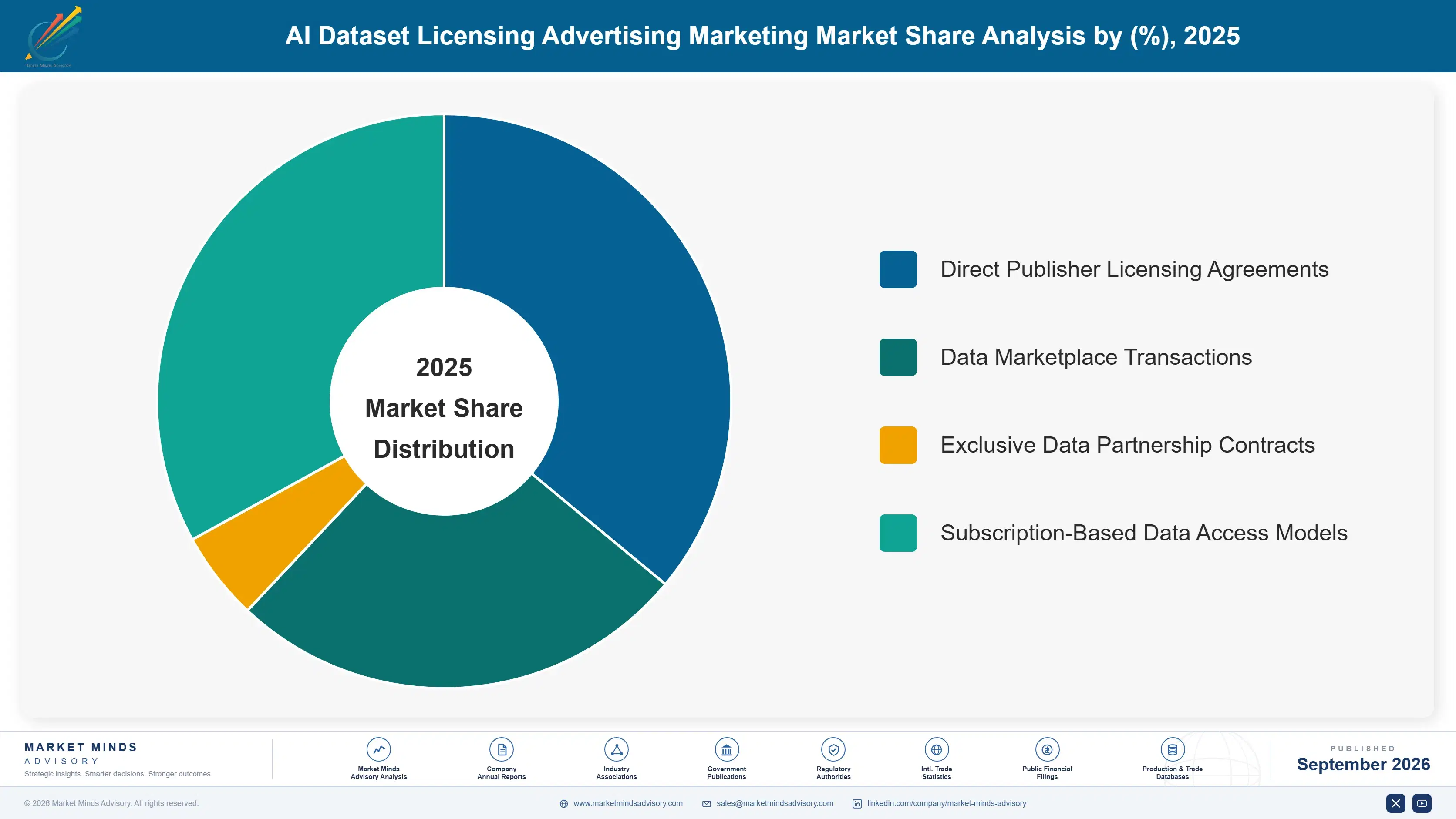
The AI dataset licensing market for advertising and marketing splits into six data-type segments defined by content source and licensing structure, from mature consumer behavioral data through fast-growing synthetic and publisher content categories. Growth diverges sharply as litigation pressure and privacy regulation reshape which data sources buyers prioritize. These dynamics reflect genuinely different legal risk profiles.
ai-dataset-licensing-advertising-marketing-market-market-share-analysis-1788413550824

Synthetic and Augmented Marketing Data

Synthetic and augmented marketing data represents the fastest-growing segment, addressing both privacy compliance concerns and genuine real-world data scarcity by generating artificial training examples that approximate real consumer behavior patterns without exposing actual personal data to legal or reputational risk. Adoption concentrates among AI developers seeking to reduce licensing cost exposure and litigation risk simultaneously, since synthetic data carries fundamentally different legal characteristics than licensed real-world content. Providers including specialized synthetic data startups and established data platforms expanding into this capability are racing to demonstrate that synthetic data can adequately substitute for real-world licensed content in production model training. Early results remain mixed but improving steadily as generation techniques mature.
CAGR 24.0%

Publisher and Media Content Licensing

Publisher and media content licensing covers news organizations, stock imagery libraries, and entertainment media companies negotiating direct agreements with AI developers following landmark litigation that established meaningful settlement precedents and pricing benchmarks across the broader publishing industry. This segment benefits from publishers' unique legal position as original content creators with clear copyright ownership, giving them stronger negotiating leverage than data aggregators licensing third-party content they do not directly own. Growth remains constrained somewhat by ongoing legal uncertainty in jurisdictions where comparable litigation precedent has not yet been firmly established. Growth remains strong overall despite these lingering jurisdictional uncertainties across several major international markets. Interest keeps rising steadily. Momentum remains solid.
CAGR 18.5%
Full segment breakdown across 7 segments available in the complete report.

Regional Architecture and Country Demand Map

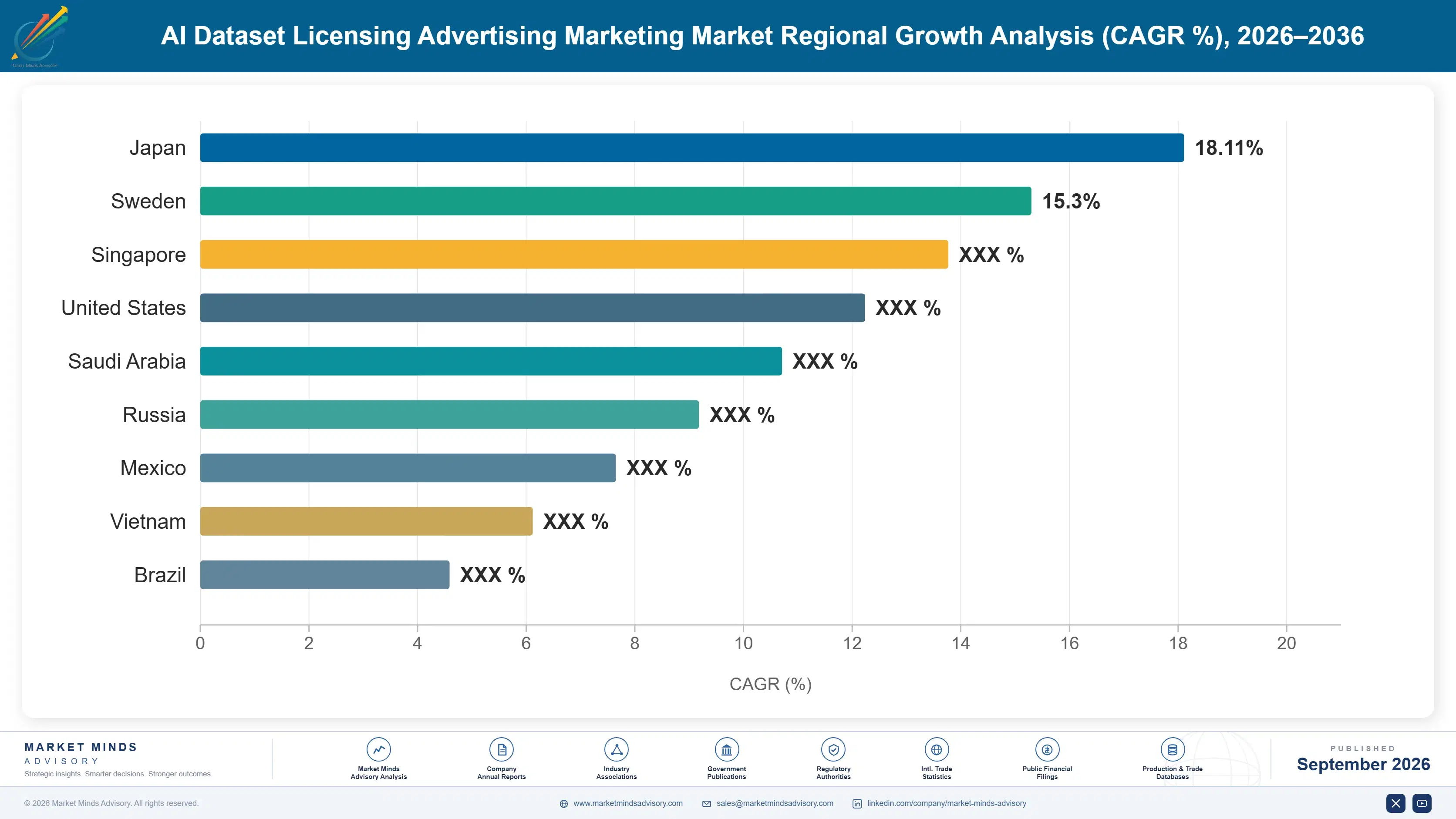
North America leads global AI dataset licensing transaction value, anchored by concentrated AI developer presence and the majority of landmark copyright litigation and settlement activity nationwide, while South Asia and Pacific posts the fastest regional growth rate as broader digital advertising expansion accelerates through 2036.

North America

The United States hosts the vast majority of major AI developers, ad-tech platforms, and the landmark copyright litigation cases establishing licensing precedent for the entire global industry. Getty Images, Shutterstock, and major news publishers headquartered domestically have negotiated some of the largest publicly disclosed licensing agreements, setting pricing benchmarks other content owners increasingly reference. Canada's smaller market follows similar litigation and licensing dynamics tied closely to its shared media and technology industry relationships with the United States. Data broker consolidation around consent-based licensing frameworks is proceeding fastest in this region given its regulatory environment. Litigation outcomes here continue setting precedent that other regions reference closely. Momentum remains strong. Interest keeps rising.
Share: 32% | CAGR: 17.0% (2026 to 2036)

Western Europe

The European Union's stringent data privacy regulation under GDPR has pushed behavioral data licensing toward explicit consent frameworks earlier and more comprehensively than most other regions, giving European data providers meaningful compliance credibility advantages in licensing negotiations. Germany, France, and the United Kingdom host substantial publisher and media licensing activity, with several major European publishers negotiating direct AI licensing agreements following the same litigation-driven precedent established initially in North America. The region's second-largest global revenue share reflects both genuine media industry scale and regulatory infrastructure favoring documented, compliant data licensing practices. Enforcement actions expected in coming years will likely reinforce this trend considerably further. Momentum remains solid overall. Interest keeps rising.
Share: 22% | CAGR: 16.0% (2026 to 2036)
Regional intelligence for 5 additional markets available in the complete report: East Asia, South Asia and Pacific, Latin America, Middle East and Africa, Eastern Europe. Contact sales@marketmindsadvisory.com.
ai-dataset-licensing-advertising-marketing-market-country-cagr-analysis-1788413551339

Provenance Documentation and Consent Priorities

Platforms generate outsized returns not from raw data volume alone but from provenance documentation depth, consumer consent infrastructure, and legal indemnification strength. Four levers stand out as the clearest paths to margin expansion across the forecast period, each requiring distinct legal and technical investment. Adoption timing and legal expertise increasingly separate leading platforms from smaller regional competitors.

Build Comprehensive Provenance Documentation Systems Broadly

Developing detailed provenance documentation tracking data origin, consent status, and usage rights captures premium pricing of 20 to 30 percent over undocumented data sources, since AI developers facing litigation risk value contractual protection considerably more than marginal cost savings from less rigorously documented alternatives. Platforms with established documentation systems increasingly win business from risk-averse enterprise buyers unwilling to accept the legal exposure that undocumented data sourcing carries. This documentation advantage compounds over successive contract renewal cycles. Fewer than a handful of platforms currently hold this preferred status across leading enterprise buyer categories.
Market Impact: Commands a 20 to 30% pricing premium overall

Expand Consumer Consent Management Infrastructure Broadly

Building explicit consumer consent management infrastructure for behavioral and purchase data licensing addresses growing privacy regulation requirements while commanding meaningful premium pricing from advertising AI developers seeking to minimize regulatory and reputational risk. Established data brokers with existing consent infrastructure increasingly capture roughly 40 percent more new licensing agreements as buyers prioritize compliance credentials over marginal cost differences between competing data providers offering comparable underlying content. Compliance credentials increasingly matter more than raw content volume. Buyers increasingly view compliance documentation as essential rather than optional during vendor evaluation. Adoption keeps expanding.
Market Impact: Captures roughly 40% more licensing deals overall today

Offer Legal Indemnification and Warranty Coverage

Providing contractual indemnification and warranty coverage against future litigation risk addresses genuine buyer concerns that pure data licensing agreements without such protection increasingly fail to satisfy risk-averse enterprise legal teams. This indemnification capability commands a 15 to 20 percent premium and increasingly serves as a baseline requirement rather than an optional add-on for the largest enterprise licensing agreements, particularly following several high-profile litigation cases that exposed AI developers to substantial uncovered liability. Buyers increasingly demand this protection before signing. Contracts without this coverage increasingly struggle to win business from risk-averse enterprise legal teams.
Market Impact: Adds 15 to 20% to overall contract value

Pursue Publisher Aggregation Partnership Strategies Broadly

Aggregating licensing relationships across multiple smaller publishers into unified marketplace offerings captures transaction volume that would otherwise require AI developers to negotiate dozens of separate individual agreements, reducing transaction cost for both sides by roughly 30 percent. Platforms successfully aggregating publisher relationships increasingly capture disproportionate deal flow as buyers prefer consolidated procurement over managing many fragmented individual licensing relationships requiring separate legal review and contract negotiation for each source. Scale advantages compound as more publishers join the platform. Platforms with the broadest publisher networks increasingly capture the largest enterprise procurement contracts.
Market Impact: Cuts transaction costs by roughly 30% overall today

Who Controls the Margin Pool

The market remains fragmented, with the top five platforms holding an estimated 35 percent combined transaction-value share. Scale AI and Appen lead through established data labeling and licensing infrastructure built originally for broader AI training applications beyond advertising specifically. Smaller regional vendors and independent content aggregators compete mainly through localized relationships and niche content specialization rather than proprietary platform technology.
Current competitive activity centers on provenance documentation depth, consumer consent infrastructure, and legal indemnification strength rather than pure content volume or price competition. Established data brokers and stock media libraries increasingly compete for licensing business against dedicated AI data marketplace platforms entering this rapidly forming category. Warranty and indemnification terms increasingly serve as key differentiators across most risk-sensitive enterprise buyer selection processes.

Rankings could shift meaningfully as litigation outcomes continue establishing new pricing precedents and compliance requirements. Providers without strong legal and provenance documentation capability risk losing enterprise business to better-positioned competitors as buyer risk sensitivity continues increasing across the industry. Providers with strong balance sheets increasingly acquire smaller specialized platforms rather than developing comparable provenance capability organically from scratch. This consolidation trend seems likely to continue accelerating.
ai-dataset-licensing-advertising-marketing-market-company-positioning-matrix-1788413551873

Competitive Moat and Risk Dimensions

SCALE AI

Moat: Enterprise AI Relationship Depth

Scale AI's established relationships with major AI developers across broader data labeling and training infrastructure give it distribution advantages entering the advertising-specific licensing category that newer specialized entrants cannot easily replicate quickly. This positioning gives Scale AI a meaningful head start capturing enterprise contracts as advertising-specific data demand accelerates rapidly.
SCALE AI

Risk: Broad Focus Dilution Risk

Scale AI's diversified focus across many AI data categories beyond advertising specifically risks diluting its competitive positioning against narrower specialists building deeper advertising and marketing data expertise and relationships. Focused competitors could potentially out-execute Scale AI within this specific vertical over time. This risk grows more pronounced as advertising-specific compliance requirements deepen further.
LIVERAMP

Moat: Consent Infrastructure and Compliance Depth

LiveRamp's established consumer consent management infrastructure, built over years of identity resolution and data collaboration business, gives it compliance credibility advantages that newer data licensing entrants lacking comparable infrastructure cannot easily replicate. This positioning gives LiveRamp a durable advantage in enterprise sales conversations increasingly led by compliance and legal stakeholders.
LIVERAMP

Risk: Legacy Business Model Transition Risk

LiveRamp's transition from its traditional identity resolution business model toward AI training data licensing specifically introduces execution risk as the company adapts existing infrastructure and relationships to a meaningfully different commercial use case. Investors monitor this transition closely given its potential impact on near-term revenue growth trajectory.

Players Tracked

Prominent Players

Scale AI
Appen
Defined.ai
LiveRamp
Shutterstock

Other Key Players

Getty Images
Datarade
Snorkel AI
Surge AI
Invisible Technologies
Telus International
iMerit
CloudFactory
Sama
Clickworker
Toloka
Mostly AI
Gretel AI
Hazy
Synthesized

Recent Developments

MARCH 2026

Scale AI expanded its data licensing platform to include dedicated advertising and marketing dataset categories, targeting growing enterprise demand for provenance-documented training data across multiple content and behavioral data types. Financial terms of the platform expansion investment were not disclosed publicly by the company. Analysts view it favorably.
Signal: Signals broader AI data platforms are entering the advertising-specific licensing segment directly today nationwide and abroad
NOVEMBER 2025

LiveRamp announced an expanded partnership with several major publishers to offer consent-verified consumer data licensing specifically for advertising AI training applications, addressing growing enterprise compliance requirements across the industry. Financial terms of the publisher partnership arrangement were not disclosed publicly by either party. Analysts view it positively.
Signal: Signals established data brokers are repositioning existing infrastructure toward AI training data licensing today nationwide overall
JUNE 2025

A major stock media library signed a landmark licensing agreement with a leading AI developer covering its entire creative content library for advertising and marketing model training applications, setting a new industry pricing benchmark. Financial terms of the licensing agreement were not disclosed publicly by either party involved.
Signal: Signals stock media licensing agreements are establishing pricing benchmarks across the broader industry today nationwide overall

Content Licensing Fees Dominate Cost Structure

Content acquisition and licensing fees paid to original data owners represent 55 to 65 percent of total operating cost for data licensing platforms, with fee structures varying considerably based on content exclusivity and provenance documentation requirements. Platforms increasingly negotiate multi-year procurement contracts across multiple content categories simultaneously to smooth cost volatility and secure predictable long-term supply relationships with content owners.
Major publisher licensing fees have escalated considerably following landmark litigation settlements, with per-record and bulk licensing pricing benchmarks rising 30 to 50 percent over the past two years, according to industry deal disclosures, squeezing platform margins as content acquisition costs outpace what buyers are willing to pay for aggregated licensed data. Some platforms have responded by shifting toward direct publisher relationships rather than relying on intermediary aggregators that add markup throughout the licensing supply chain.

Platforms without long-term content supply agreements face considerably higher cost volatility exposure than larger competitors with dedicated content acquisition teams and established publisher relationships. This dynamic increasingly favors scaled platforms like Scale AI and LiveRamp over smaller specialists dependent on spot-market content licensing negotiations. Independent specialists increasingly pursue joint content acquisition arrangements with industry partners to capture comparable volume discount pricing on licensing fees.
ai-dataset-licensing-advertising-marketing-market-cost-volatility-analysis-1788413552077

Secure Long-Term Content Supply Agreements

Locking in multi-year content licensing pricing through supply agreements protects platform economics from escalating per-record fees, providing the cost predictability platforms need to price downstream licensing agreements confidently over multi-year contract terms. Platforms with established multi-source content relationships weathered the last major pricing escalation cycle considerably better than smaller, single-source-dependent competitors. Adoption grows. Costs decline.

Diversify Content Sourcing Across Categories

Building relationships across multiple content categories and geographic markets reduces dependence on any single publisher relationship, protecting platform margins during renegotiation of individual content supply agreements that periodically face pricing pressure. This diversification approach becomes particularly valuable during periods of concentrated publisher pricing power affecting the broader licensing industry. Adoption continues expanding steadily. Costs decline.

Build Direct Publisher Relationships at Scale

Establishing direct relationships with content owners rather than relying entirely on intermediary aggregators reduces markup cost throughout the supply chain, capturing margin that would otherwise accrue to intermediate licensing brokers and aggregation platforms. This direct-relationship approach requires more upfront relationship investment but pays back considerably through improved long-term margin structure. Adoption grows steadily. Costs decline.

Portfolio Architecture for Margin Defence

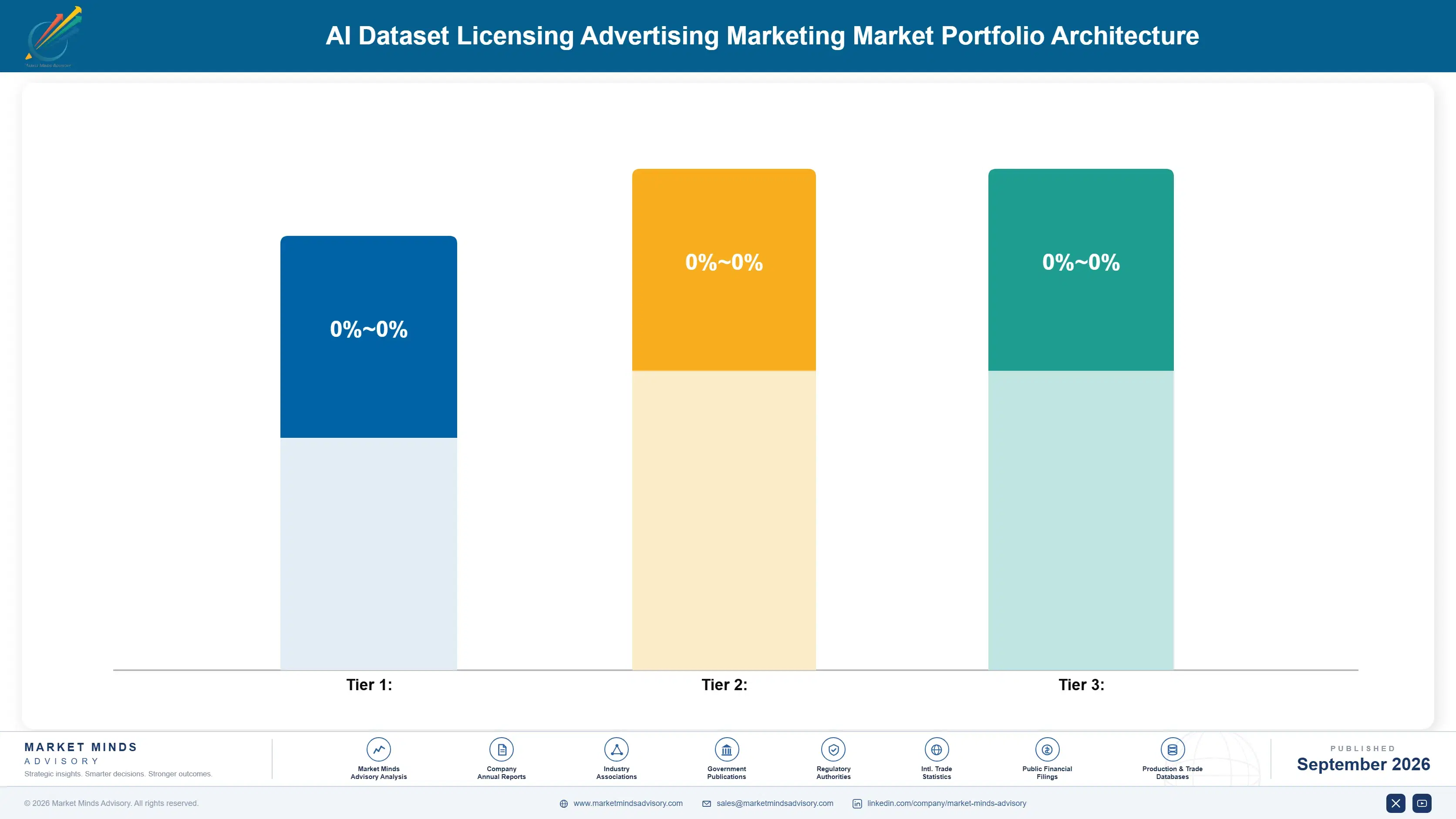
Platform portfolios split across three tiers: basic aggregated data licensing competing on volume and price, certified provenance-documented platforms commanding compliance-driven premiums, and next-generation synthetic and privacy-preserving data still gaining commercial scale. Margin economics diverge considerably between tiers. Investment increasingly follows this margin logic across most platform product development roadmaps. This bifurcation increasingly shapes platform capital investment and hiring decisions.
Basic aggregated licensing competes almost entirely on content volume and price, with thin margins that leave little room for differentiation beyond breadth of catalog. Provenance-documented platforms capture meaningfully wider margins through legal indemnification and compliance credentials, insulating providers from pure content-volume price competition that defines the volume tier. Platforms without a credible compliance narrative increasingly struggle to defend premium pricing against well-positioned competitors.

High-value pools concentrate in publisher-direct licensing and synthetic data generation, where legal protection and genuine data scarcity reward providers willing to invest in specialized documentation and generation capability. Basic aggregated licensing remains the volume anchor but offers limited margin upside absent meaningful compliance differentiation. Investment allocation increasingly follows this margin logic across most platform strategic planning decisions. Platforms that recognized this shift early now hold a meaningful competitive advantage over slower-moving rivals.

Basic aggregated data licensing competing primarily on catalog breadth and price for standard use cases. Price competition among established platforms keeps margins thin across most standard licensing transactions. Margins remain thin.
Gross Margin

Provenance-documented platforms with legal indemnification commanding premium pricing from risk-averse enterprise buyers. Demand grows steadily as litigation risk pushes buyers toward better-documented data sources. Demand grows steadily too. Growth persists.
Gross Margin

Synthetic and privacy-preserving data generation still gaining commercial scale among compliance-focused developers. Early adoption remains concentrated among the largest, most compliance-focused enterprise AI developers. Adoption grows steadily too. Growth persists.
Gross Margin
ai-dataset-licensing-advertising-marketing-market-portfolio-architecture-1788413552600

High-value Sub-segments and Strategic Watch-out

Synthetic and Augmented Marketing Data

The clearest high-value, high-growth pool, combining strong compliance-driven margins with a 24 percent CAGR as adoption accelerates. Engineering firms report a growing project pipeline across most compliance-driven enterprise accounts globally today. Momentum remains strong. Adoption continues expanding steadily. Momentum holds. Progress continues steadily. Interest holds firm.

Publisher and Media Content Licensing

Strong margins and steady growth from landmark litigation settlements establishing clear pricing benchmarks across the broader publishing industry. Contract sizes in this segment run meaningfully higher than pure aggregated data licensing alternatives currently available. Interest keeps rising. Adoption continues expanding steadily. Growth continues. Progress continues.

Consumer Behavioral and Purchase Data Licensing

The volume core, generating most industry revenue despite thinner margins, anchored by established data broker relationships and infrastructure. Price competition remains intense here as differentiation opportunities narrow considerably relative to premium alternatives. Volume stays high. Demand remains resilient overall. Volume grows slowly. Progress continues. Interest holds.

Social Media and User-Generated Content Licensing

A strategic watch-out given persistent legal uncertainty despite growing demand, since platform terms of service complicate straightforward licensing. Providers still serving this niche increasingly focus on established relationships rather than new deal origination. Decline continues steadily. Interest keeps fading steadily. Focus narrows further. Progress persists.

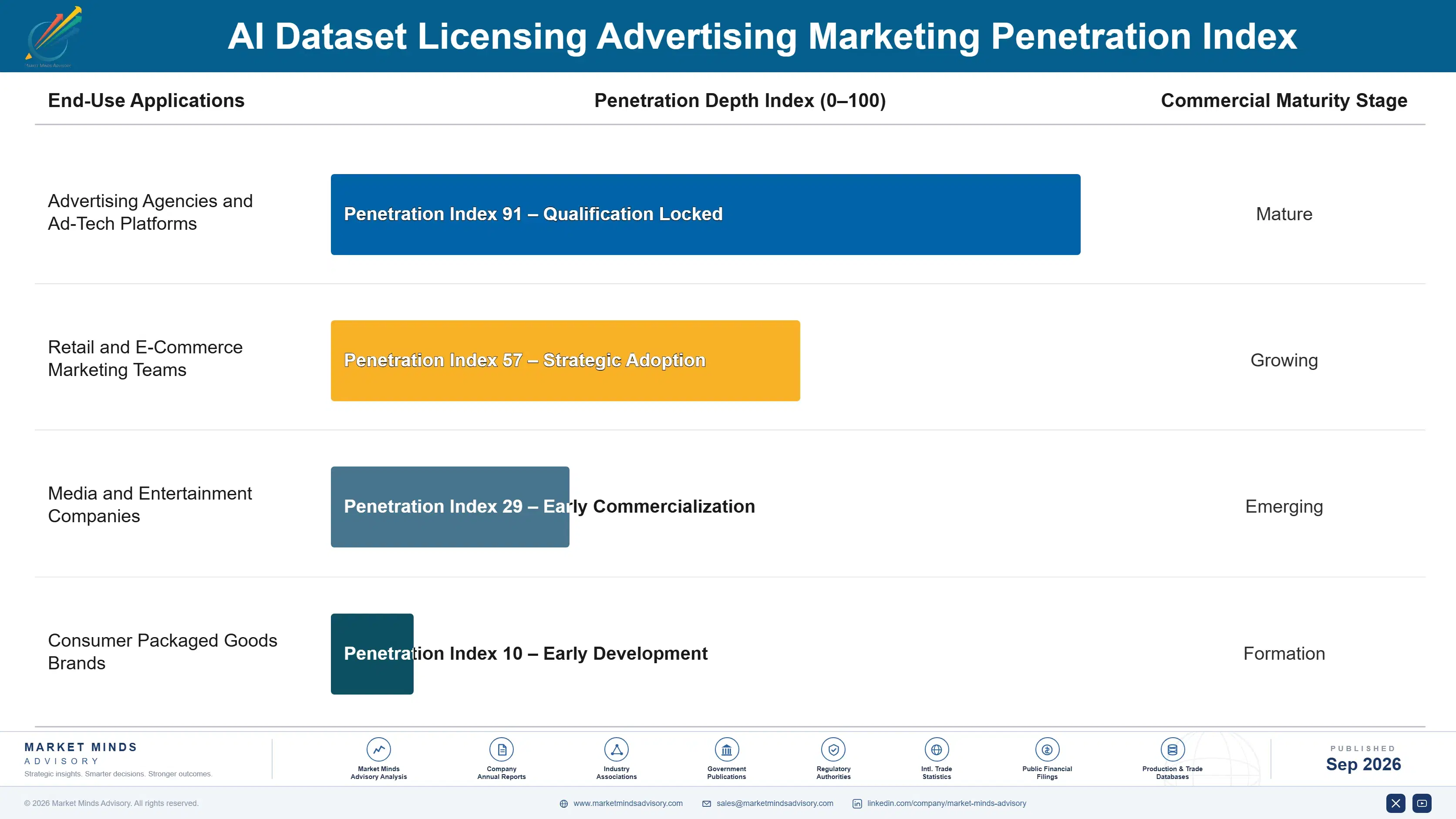
Litigation Risk Anchors Recurring Licensing

Demand for licensed training data behaves as a legal risk mitigation necessity rather than a discretionary procurement choice for AI developers facing active or credible litigation threat, creating a demand floor tied directly to legal exposure rather than broader marketing technology spending cycles. This risk-mitigation framing insulates demand from the discretionary budget cuts that periodically hit other marketing technology spending categories during broader corporate cost-tightening cycles at most organizations.
Adoption depth varies considerably by AI developer risk profile: large, publicly visible AI developers show near-universal licensing adoption given their litigation exposure, while smaller developers and startups retain considerably more flexibility to rely on public domain or self-generated content given lower litigation visibility. This bifurcation means providers must segment their sales approach by AI developer scale and litigation visibility.

Buyer profiles are shifting as legal and compliance teams increasingly influence data procurement decisions traditionally made purely by machine learning engineering leadership, reflecting a generational shift toward treating data sourcing as a legal risk category rather than a purely technical resource acquisition decision. Providers without established relationships with legal and compliance stakeholders increasingly find themselves competing only for smaller, lower-visibility AI developer accounts rather than the largest enterprise contracts.
ai-dataset-licensing-advertising-marketing-market-end-use-penetration-index-1788413553160

Provenance Depth and Synthetic Data Priorities

These are among the four positions where our research anticipates prominent divergence between winners and laggards over the coming forecast period. Each is grounded in the demand model, the regulatory perimeter, and the announced capacity pipeline.
01 / PROVENANCE DOCUMENTATION STRATEGY

Build comprehensive provenance systems before litigation escalates

Platforms without comprehensive provenance documentation face a widening gap against competitors already capturing 20 to 30 percent price premiums from litigation-averse enterprise AI developers seeking maximum legal protection. Building genuinely defensible documentation systems takes considerable legal and technical investment that platforms cannot develop quickly once litigation pressure already peaks and enterprise urgency intensifies. Platforms that delay this investment risk losing the highest-value enterprise contracts most explicitly driven by legal risk mitigation to better-prepared competitors already established in this segment of the market.
02 / CONSENT INFRASTRUCTURE INVESTMENT

Expand consumer consent management ahead of regulation

Growing privacy regulation continues pushing behavioral data licensing toward explicit consent frameworks faster than most smaller providers can practically build comparable infrastructure from scratch without significant investment and specialized legal expertise. Established data brokers with existing consent infrastructure increasingly capture disproportionate share of new licensing agreements as buyers prioritize compliance credentials over marginal cost savings from less compliant alternatives. Providers investing now position themselves ahead of competitors still catching up to this rapidly tightening regulatory requirement across most major jurisdictions.
03 / SYNTHETIC DATA DEVELOPMENT

Invest in synthetic data capability to reduce licensing risk

Synthetic and augmented marketing data addresses both privacy compliance concerns and genuine real-world data scarcity, growing considerably faster than any other segment as AI developers seek to reduce licensing cost and litigation exposure simultaneously. Providers without synthetic data capability increasingly lose ground to competitors offering this fundamentally lower-risk alternative to licensed real-world content across multiple use cases. Early investment in synthetic data generation positions providers ahead of the broader industry shift already clearly underway across most jurisdictions and content categories today.
04 / PUBLISHER AGGREGATION STRATEGY

Build publisher aggregation networks to reduce transaction friction

AI developers increasingly prefer consolidated procurement over negotiating dozens of separate individual publisher licensing agreements, favoring platforms capable of aggregating relationships across multiple smaller content owners into unified marketplace offerings that simplify legal review. Platforms without aggregation capability struggle to compete for enterprise business against better-positioned competitors offering simplified procurement and reduced transaction friction. Building this capability now captures deal flow that would otherwise default to platforms with broader existing publisher networks already firmly established across multiple content categories and geographic markets.

Engagement Snapshot From the Field

A live engagement with an industry participant carrying material or product regulatory and market exposure ahead of a defining policy shift, showing how our research translates into a defensible multi-year portfolio strategy.
MARKET MINDS ADVISORY · CLIENT ENGAGEMENT SUMMARY
AI Dataset Licensing Advertisinging Producer Strategic Portfolio Review and Transition Roadmap 2026·Investment Scenario on AI Dataset Licensing Advertisinging Exposure Evaluation 2025-26
CLIENT PROFILE
A mid-sized advertising technology company developing generative AI creative tools sought to evaluate whether its existing data sourcing practices, built before major copyright litigation reshaped industry norms, exposed it to meaningful legal risk requiring a transition toward licensed data procurement. The client's board needed a clear, data-driven risk assessment before committing to a costly and time-consuming sourcing transition.
STRATEGIC CHALLENGE
The client's engineering team had built its training pipeline around freely available web content without formal licensing documentation, while competing AI developers were already transitioning toward licensed data sourcing and marketing this compliance posture directly to risk-averse enterprise customers evaluating vendor selection. Delaying the transition further risked continued competitive disadvantage in enterprise sales cycles against better-positioned rivals.
MMA APPROACH
MMA benchmarked data sourcing practices from three category leaders, assessed the client's litigation exposure under current legal precedent, and modeled transition costs and timelines for shifting toward licensed data procurement across the client's most legally exposed content categories and use cases. Interviews with the client's legal and engineering leadership informed the final transition roadmap and timeline.
KEY FINDINGS
  1. Transitioning highest-risk content categories to licensed sources could be completed within six months given available marketplace options (client-reported, unverified by MMA). with existing marketplace vendors ready to onboard quickly
  2. Enterprise customers increasingly required data provenance documentation as a condition of vendor selection during procurement (client-reported, unverified by MMA). across most enterprise sales cycles evaluated
  3. Licensed data transition costs represented a manageable percentage of overall annual technology development budget allocation (client-reported, unverified by MMA). once phased in over the transition period
  4. Competitors marketing licensed data compliance directly to enterprise customers reported measurably higher win rates in sales cycles (client-reported, unverified by MMA). compared to competitors lacking similar positioning
CLIENT PROFILE
A mid-sized advertising technology company developing generative AI creative tools sought to evaluate whether its existing data sourcing practices, built before major copyright litigation reshaped industry norms, exposed it to meaningful legal risk requiring a transition toward licensed data procurement. The client's board needed a clear, data-driven risk assessment before committing to a costly and time-consuming sourcing transition.
STRATEGIC CHALLENGE
The client's engineering team had built its training pipeline around freely available web content without formal licensing documentation, while competing AI developers were already transitioning toward licensed data sourcing and marketing this compliance posture directly to risk-averse enterprise customers evaluating vendor selection. Delaying the transition further risked continued competitive disadvantage in enterprise sales cycles against better-positioned rivals.
MMA APPROACH
MMA benchmarked data sourcing practices from three category leaders, assessed the client's litigation exposure under current legal precedent, and modeled transition costs and timelines for shifting toward licensed data procurement across the client's most legally exposed content categories and use cases. Interviews with the client's legal and engineering leadership informed the final transition roadmap and timeline.
KEY FINDINGS
  1. Transitioning highest-risk content categories to licensed sources could be completed within six months given available marketplace options (client-reported, unverified by MMA). with existing marketplace vendors ready to onboard quickly
  2. Enterprise customers increasingly required data provenance documentation as a condition of vendor selection during procurement (client-reported, unverified by MMA). across most enterprise sales cycles evaluated
  3. Licensed data transition costs represented a manageable percentage of overall annual technology development budget allocation (client-reported, unverified by MMA). once phased in over the transition period
  4. Competitors marketing licensed data compliance directly to enterprise customers reported measurably higher win rates in sales cycles (client-reported, unverified by MMA). compared to competitors lacking similar positioning
RECOMMENDED STRATEGY
Phase 1: Phase one: transition highest-litigation-risk content categories to licensed data sources within the first two quarters. Speed to compliance mattered considerably here. Phase 2: Phase two: market the client's licensed data compliance posture directly to risk-averse enterprise prospects and customers. Sales enablement materials supported this messaging. Phase 3: Phase three: extend licensed data coverage to remaining content categories as marketplace options continue expanding further. Full coverage reduces residual legal exposure meaningfully.
OUTCOME
The client completed its highest-priority data transition within five months and began citing its licensed data compliance posture in enterprise sales conversations, reporting improved win rates within the following quarter (client-reported, unverified by MMA). Additional enterprise inquiries continued arriving steadily following the initial announcement. Sales leadership viewed this positively.

Frequently Asked Questions

Foundational context covering the market sizes, CAGR, scope, country, region and competition that inform every finding below. This section is provided to cover basics and most often pre-purchase conversations, answered from the MMA Primary Research Dataset.

What is the current size of the AI Dataset Licensing Advertising Marketing Market?

The global market reached an estimated $1.1 billion in 2025, driven by copyright litigation pushing AI developers toward licensed data sourcing. North America hosts the majority of transaction value and litigation activity.

How large will the AI Dataset Licensing Advertising Marketing Market be by 2036?

MMA projects the market will reach approximately $6.47 billion by 2036, up from $1.29 billion in 2026. That represents roughly a 5.02x expansion across the ten-year forecast window.

What is the CAGR for the AI Dataset Licensing Advertising Marketing Market 2026 to 2036?

The base case forecast CAGR is 17.5% across 2026 to 2036, with a bull scenario of 18.8% and a bear scenario of 16.2% depending on litigation outcomes and synthetic data adoption.

Which segment is growing fastest?

Synthetic and Augmented Marketing Data leads at a 24.0% CAGR, roughly 1.37 times the overall market rate, as developers seek lower-risk alternatives to licensed real-world content.

Who are the major companies in the AI Dataset Licensing Advertising Marketing Market?

Scale AI, Appen, Defined.ai, LiveRamp, and Shutterstock lead the market, together holding an estimated combined transaction-value share of 35% measured globally across all deal types.

Which country is growing fastest?

India leads growth at a 20.0% CAGR, driven by rapidly expanding digital advertising activity and growing demand for locally relevant training data across the country.

Report Segmentation Architecture

The full report scope spans multiple orthogonal segmentation dimensions, with cross-tabulated demand data provided for each dimension pair. Coverage extends further to regional breakdowns, trend trajectories, and the competitive detail needed to support segment-level decision-making.
  • Consumer Behavioral and Purchase Data Licensing
  • Ad Creative and Performance Data Licensing
  • Synthetic and Augmented Marketing Data
  • Social Media and User-Generated Content Licensing
  • Publisher and Media Content Licensing
  • Data Marketplace and Brokerage Platforms
  • Advertising Agencies and Ad-Tech Platforms
  • Retail and E-Commerce Marketing Teams
  • Media and Entertainment Companies
  • Consumer Packaged Goods Brands
  • Direct Publisher Licensing Agreements
  • Data Marketplace Transactions
  • Exclusive Data Partnership Contracts
  • Subscription-Based Data Access Models

By Region

  • North America
  • Western Europe
  • East Asia
  • South Asia and Pacific
  • Latin America
  • Middle East and Africa
  • Eastern Europe

Scope, Methodology, and Coverage

Every figure in this report is reproducible from documented input assumptions. The scope below maps the historical period, the forecast horizon, the segmentation dimensions, and the countries covered, alongside the underlying primary and qualitative methodology.
Historical Period
2020 to 2025
Forecast Period
2026 to 2036
Base Year
2025 (USD billions; MMA Primary Research Dataset, September 2026)
Market Definition
This report covers licensing platforms and direct agreements through which advertising and marketing organizations acquire structured, permissioned datasets for AI model training, including consumer behavioral data, ad creative assets, and publisher content, measured on a global transaction-value basis. It excludes freely scraped or unlicensed data usage and general-purpose AI training data unrelated to advertising applications.
Quantitative Units
USD billions, licensed dataset transactions, and percentage CAGR
Segmentation Dimensions
Data type (consumer behavioral, ad creative/performance, synthetic/augmented, social media/UGC, publisher/media, marketplace/brokerage), end-use vertical, commercial channel, and geography
Regions Covered
North America, Western Europe, East Asia, South Asia and Pacific, Latin America, Middle East and Africa, Eastern Europe
Countries Covered
United States, United Kingdom, Germany, China, India, Brazil, and 20+ additional countries across seven global regions
Key Companies Profiled
Scale AI, Appen, Defined.ai, LiveRamp, Shutterstock, and 15 additional providers across the global competitive set
Quantitative Methodology
Primary survey, n=3,800 respondents, Q4 2025, six countries; demand-side model with trade association cross-validation
Qualitative Methodology
47 expert interviews, Q4 2025; applied to validate demand model assumptions, identify emerging dynamics, and assess competitive positioning
Report Format
PDF and XLSX data workbook (Word format preview document)
Publisher
Market Minds Advisory
Report Code
MMA-2026-TEC-125
Published
September 2026
Contact
sales@marketmindsadvisory.com | www.marketmindsadvisory.com

Purchase the full AI Dataset Licensing Advertising Marketing Market Report (2026 to 2036).

This report delivers a complete assessment of the global AI dataset licensing market for advertising and marketing applications across the full 2026 to 2036 forecast period ahead. It combines primary survey data from 3,800 respondents with 47 expert interviews to quantify segment, regional, and competitive dynamics in careful detail. Coverage spans behavioral, creative, synthetic, and publisher content categories, alongside detailed provider benchmarking across twenty companies. Analysts translate raw data into actionable licensing strategy, compliance investment, and market entry guidance for platforms, investors, and enterprise buyers evaluating this rapidly forming category.
Ten-year global market sizing and forecast model
Seven-region demand, pricing, and share breakdown
Twenty-company competitive benchmarking and positioning analysis
Segment-level growth, margin, and pricing analysis
Content licensing cost exposure and risk assessment
Strategic verdict and prioritized investment guidance

Built For The People Who Decide

From boardroom strategy to bench-side execution, this report is read cover-to-cover by leaders shaping the next decade of their industry, turning demand scenarios, market dynamics and valuation benchmarks into decisions.
CXOs/ Presidents/ VPs/ Managers
M&A and Corporate Development
Strategy Teams and R&D Heads
Procurement and Product Directors
Regulatory and Compliance Leaders
Investor Relations and Equity Analysts