Market Minds Advisory
AI Data Center Localized Hotspot Cooling Systems Market

AI Data Center Localized Hotspot Cooling Systems Market: AI Data Center Localized Hotspot Cooling Systems Market. Chip Power Density Forces a Shift to Targeted Liquid Cooling

Escalating AI accelerator power density and shrinking thermal headroom are colliding as data center operators retrofit targeted liquid cooling around specific high-heat racks rather than replacing whole-facility cooling infrastructure outright.

Lead Analyst

Published

September 2026

Make Smarter Decisions with Customized Research Insights

Request a free sample report and evaluate market opportunities, growth trends, and competitive dynamics relevant to your business needs.

2025 MARKET VALUE$1.4BMarket Size 2025
2036 FORECAST VALUE$6.8BBase Case , 2026 to 2036
CAGR 2026 TO 203615.5 %Bull 16.8% / Bear 14.2%
INCREMENTAL OPPORTUNITY$5.2BNet 10- year value creation
EXPANSION MULTIPLE4.22x2036 value over 2026 base
Strategic Levers
M&A Pipeline
Regional Outlook
Country Rankings
Competitive Intelligence
Segmental Deep-dive
Call-Us : 91 93563 13602

Executive Snapshot and Market Trajectory.

Localized hotspot cooling is shifting from an experimental retrofit to a standard design requirement as the latest AI accelerators push individual rack power density well beyond what air cooling can dissipate reliably across most facilities. Chip vendor design guides now assume liquid cooling as baseline.
Hyperscalers and colocation operators are racing to deploy direct-to-chip liquid cooling and rear-door heat exchangers around specific high-density racks rather than overhaul entire facility cooling systems, preserving existing air-cooled infrastructure for lower-density workloads while concentrating capital on the racks that actually generate extreme heat flux, a targeted approach that shortens deployment timelines considerably compared with full facility retrofits. Deployment timelines matter enormously given the pace of accelerator generation turnover. Deployment speed increasingly determines competitive positioning.
Competitive intensity is rising as established thermal management incumbents face aggressive new entrants specializing purely in two-phase and immersion cooling technology, while chip manufacturers increasingly co-design cooling requirements directly into next-generation accelerator packaging specifications rather than leaving thermal solutions entirely to downstream integrators managing installation independently. This co-design trend is reshaping vendor product roadmaps considerably. Vendors slow to align with chip roadmaps risk losing design-win opportunities to faster-moving specialists.
Market Definition
This report covers targeted liquid and hybrid cooling systems deployed around specific high-density racks or chips within AI data centers, including direct-to-chip cold plates, rear-door heat exchangers, and localized immersion pods, measured on a global installed-capacity basis. It excludes whole-facility HVAC and general-purpose data center air cooling infrastructure.
Base Year Value
$1.4B in 2025 (MMA Primary Research Dataset, September 2026)
Forecast Period
2026 to 2036, eleven discrete annual values
CAGR
15.5% base case. Bull 16.8%. Bear 14.2%.
Fastest Growth Segment
Two-Phase Direct-to-Chip Cooling: 22.0% CAGR
Fastest Growth Country
Malaysia: 19.5% CAGR
Fastest Growth Region
South Asia and Pacific: 17.5% CAGR
Largest Region
North America: 32% of 2025 global value
Market Leaders
Vertiv, CoolIT Systems, Boyd Corporation, LiquidStack, nVent
Primary Survey
n=3,800 procurement and R&D decision-makers, Q4 2025, six countries
Methodology
Demand-side build-up, cross-validated against public data, 47 expert interviews

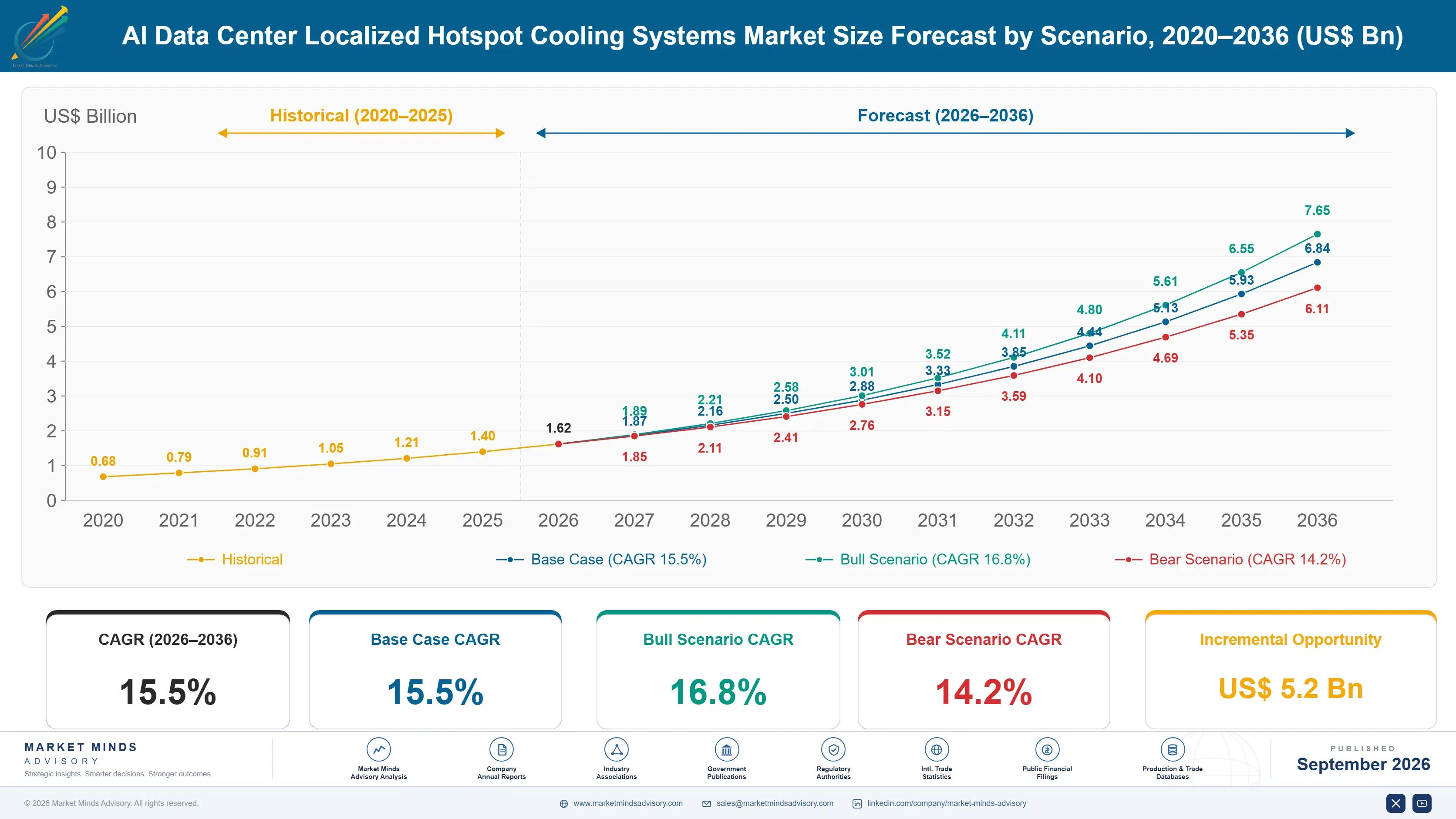
AI Data Center Localized Hotspot Cooling Systems Market Forecast Scenarios

ai-data-center-localized-hotspot-cooling-systems-m-size-forecast-scenario-1788413530646
Between 2020 and 2025, hotspot cooling adoption grew from a niche high-performance computing practice into a mainstream requirement as generative AI training workloads pushed individual accelerator power consumption from roughly 300 watts to over 1,000 watts within a handful of chip generations. This rapid escalation caught many facility operators without adequate liquid cooling infrastructure already in place, forcing hurried retrofit projects.
The base case rests on three mechanisms holding through the forecast window: continued accelerator power density escalation with each new chip generation, hyperscaler capital expenditure sustaining aggressive AI infrastructure buildout, and gradual standardization of direct-to-chip cooling interfaces reducing integration friction for facility operators adopting the technology at scale. These mechanisms reinforce each other, since standardized interfaces reduce integration cost precisely as capital availability and technical necessity align most strongly across the industry.
A bull scenario emerges if accelerator power density growth accelerates faster than expected, pulling forward liquid cooling adoption timelines industry-wide, while a bear risk centers on an AI infrastructure spending slowdown that delays new data center construction and the localized cooling capacity that typically accompanies it. Capital discipline among hyperscalers facing investor scrutiny over AI infrastructure returns will likely determine which scenario prevails across the decade.

Chip Power Density Forces a Cooling Architecture Rethink

Chip power density, not facility square footage, has become the binding design constraint for AI data centers, since a single high-density rack can now generate more heat than an entire row of conventional servers did just a few years earlier. Facility designers now model cooling capacity per rack rather than per square foot, a shift that has upended decades-old data center design conventions and forced rapid retraining of facility engineering teams across the industry.
TOP REGION SHARE32%North America's share of global installed cooling capacity today
LIQUID COOLING ATTACH RATE38%Share of new AI racks deployed with direct-to-chip cooling
AVERAGE RACK POWER DENSITY80 kWTypical power draw per rack in modern AI compute clusters
MARKET CONCENTRATION42%Combined installed-capacity share held by the top five vendors
RETROFIT PROJECT SHARE55%Portion of deployments retrofitting existing facilities rather than new-build
AVERAGE DEPLOYMENT TIMELINE6 monthsTypical time from order to operational cooling system commissioning
Facility operators increasingly favor targeted retrofit deployments over full facility overhauls, concentrating capital on the specific racks running the highest-density AI accelerators while leaving lower-density workloads on existing air-cooled infrastructure to preserve capital efficiency. This targeted approach shortens deployment timelines considerably compared with whole-facility retrofits, letting operators bring new AI capacity online in months rather than the year or more a full overhaul typically requires.
Standardization efforts around cold plate interfaces and quick-disconnect fittings are gradually reducing integration friction, though the market still features meaningful proprietary fragmentation across vendors that complicates multi-vendor deployments within the same facility. Facility operators managing multi-vendor deployments increasingly demand interoperability guarantees before committing to any single vendor's proprietary cooling architecture, pressuring vendors toward more open interface standards.
"Nobody cools an entire data center for one hot rack anymore. You surround the hotspot and leave the rest of the room alone."
Practice Lead, Data Center Infrastructure and Thermal Management · MMA Data Center Thermal Management and Precision Cooling Equipment Practice · September 2026

Market Trends

Two-Phase Cooling Moves From Lab to Commercial Deployment

Two-phase direct-to-chip cooling, which uses a dielectric fluid that boils and condenses to absorb heat far more efficiently than single-phase liquid systems, has moved from laboratory demonstration into commercial deployment at several hyperscale facilities over the past two years. Vendors including LiquidStack and JetCool have shipped commercial two-phase systems capable of dissipating over 1,500 watts per chip, meaningfully exceeding the practical limits of conventional single-phase cold plate designs. Adoption remains concentrated among the highest-density accelerator deployments where single-phase cooling can no longer keep pace with chip thermal design power requirements at current chip generations.
Market Impact: Chips exceed 1,000 watts each
Chip Vendors Co-Design Cooling Into Accelerator Packaging

Major AI accelerator manufacturers are increasingly specifying integrated cooling interfaces directly within chip packaging designs, moving cooling from an afterthought handled by downstream integrators into a co-designed element of the chip itself. This shift has compressed qualification timelines for cooling vendors seeking design-win status from roughly eighteen months to under nine months as chip vendors publish reference cooling specifications earlier in their own development cycles. Cooling vendors with established chip vendor relationships increasingly capture disproportionate share of new accelerator generation design wins ahead of the broader competitive field. Few vendors currently hold this preferred status across leading chip platforms.
Market Impact: Backed by $200B+ in annual capex

Market Opportunities and Growth Drivers

Rising Accelerator Thermal Design Power Exceeds Air Cooling Limits

The latest generation of AI training accelerators now carries thermal design power exceeding 1,000 watts per chip, more than triple the level common just three chip generations earlier, pushing well past the practical dissipation limits of conventional air cooling regardless of airflow volume or heat sink design sophistication. This physical ceiling forces facility operators toward liquid cooling not as a preference but as a hard engineering requirement, since no amount of additional air handling capacity can adequately cool chips generating this much concentrated heat within such a small physical footprint.
Market Impact: Retrofits cost 25 to 40% more

Hyperscaler Capital Expenditure Sustains Aggressive Buildout Pace

Major hyperscalers have committed well over 200 billion dollars in combined annual capital expenditure toward AI infrastructure buildout, a substantial share of which flows directly into data center construction and the specialized cooling systems required to support next-generation accelerator deployments at scale. This sustained capital commitment gives cooling vendors unusually clear multi-year demand visibility compared with most industrial equipment categories, supporting aggressive capacity expansion and manufacturing investment decisions across the thermal management supply chain. Facility operators increasingly negotiate long-term cooling equipment supply agreements alongside their broader construction contracts to secure priority allocation amid tight vendor manufacturing capacity.
Market Impact: Redesign costs run 10 to 20%

Market Restraints and Challenges

Retrofit Complexity Raises Installation Cost and Risk

Retrofitting liquid cooling into existing air-cooled facilities requires substantial modification to power distribution, floor loading, and leak detection infrastructure, often costing 25 to 40 percent more than equivalent capacity in purpose-built new facilities designed for liquid cooling from the outset. The root cause is that most existing data centers were architected decades ago around air cooling assumptions that fundamentally conflict with liquid cooling infrastructure requirements like floor-level plumbing and coolant distribution units. Operators are responding by prioritizing retrofit investment at their highest-value facilities while directing genuinely new AI capacity toward purpose-built liquid-cooled construction wherever feasible.
Market Impact: Dissipates 1,500+ watts per chip commercially

Proprietary Interfaces Limit Vendor Interoperability Broadly

Competing cooling vendors continue offering proprietary cold plate and quick-disconnect interface designs rather than converging on shared industry standards, complicating facility operators' ability to mix components from multiple vendors within the same deployment or switch suppliers without significant redesign cost. The root cause is that vendors view proprietary interfaces as a competitive moat protecting recurring component and service revenue rather than a customer convenience worth sacrificing for interoperability. Industry consortiums are responding with emerging standardization efforts, though meaningful convergence likely remains several years away given competing vendor incentives. Large customers increasingly push vendors toward openness.
Market Impact: Cuts qualification to under 9mo
4 additional market trends, 3 additional growth drivers, and 3 additional restraints and challenges are covered in the full report. Contact sales@marketmindsadvisory.com to access the complete intelligence.

Segment CAGR and Growth Architecture

The AI data center localized hotspot cooling market splits into six technology segments defined by heat transfer mechanism and deployment scope, from mature rear-door heat exchangers through fast-growing two-phase direct-to-chip systems. Growth diverges sharply as accelerator power density outpaces single-phase cooling limits, reflecting genuinely diverging vendor technology bets across the entire industry landscape today.
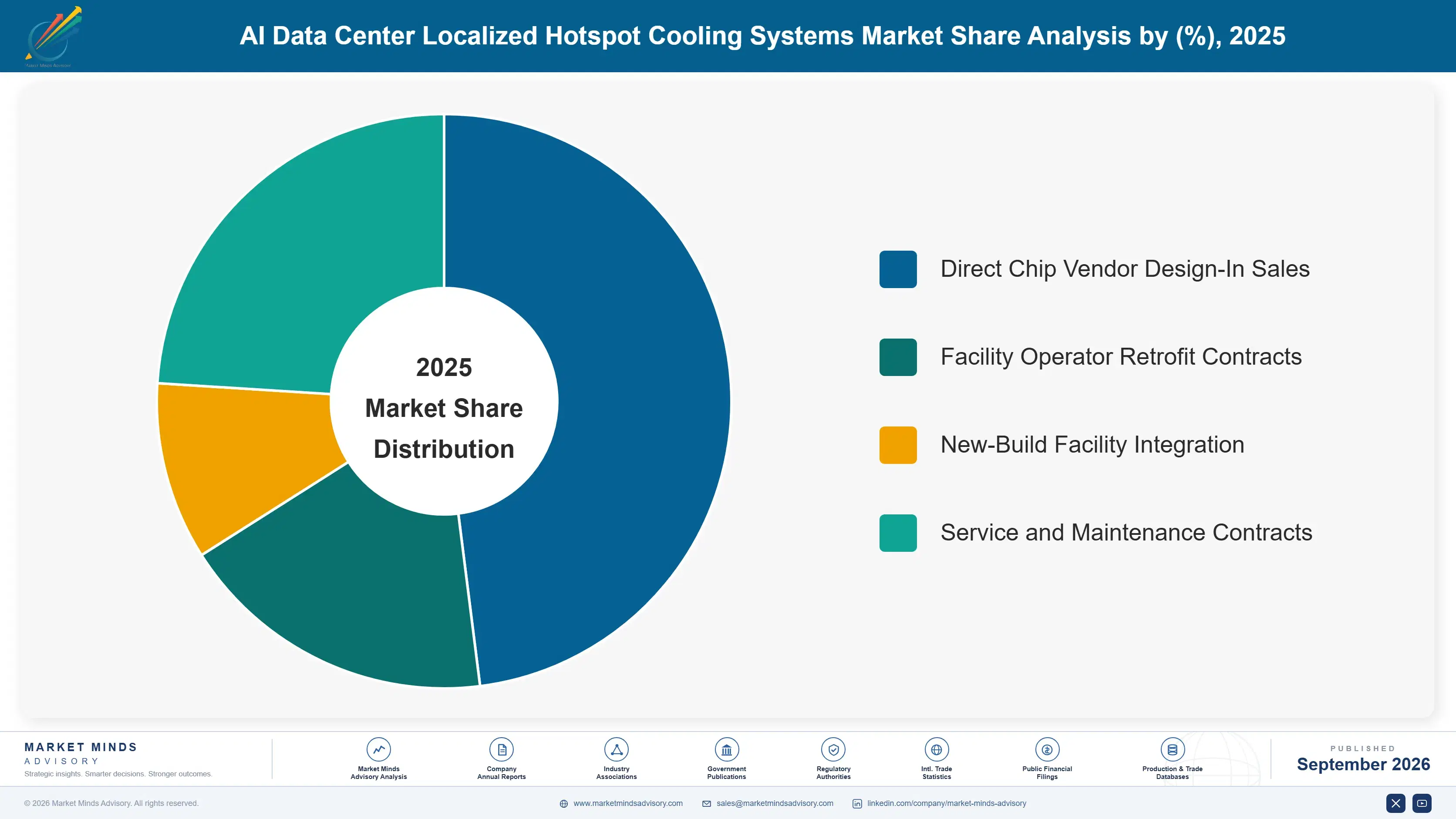
ai-data-center-localized-hotspot-cooling-systems-m-market-share-analysis-1788413531185

Two-Phase Direct-to-Chip Cooling

Two-phase direct-to-chip cooling, using dielectric fluid phase change to absorb substantially more heat per unit volume than single-phase liquid systems, is the fastest-growing segment as the highest-density AI accelerators exceed what conventional cold plates can dissipate reliably. Adoption concentrates among hyperscalers deploying the most advanced accelerator generations, where thermal design power has climbed steeply enough to make two-phase systems a practical necessity rather than a performance optimization. Vendors including LiquidStack and JetCool have moved rapidly from pilot deployments to commercial-scale shipments over the past two years as hyperscaler demand accelerated meaningfully. Chip vendor reference designs increasingly specify two-phase compatibility for their most power-hungry accelerator variants, reinforcing the segment's growth trajectory.
CAGR 22.0%

Localized Immersion Cooling Pods

Localized immersion cooling pods submerge specific high-density racks or chip clusters in dielectric fluid rather than requiring facility-wide immersion infrastructure, appealing to operators seeking maximum cooling capacity for isolated hotspots without committing to full-facility immersion architecture. This segment benefits from simplified deployment relative to whole-room immersion systems, since pods can be installed within existing air-cooled facilities as self-contained units requiring minimal supporting infrastructure modification. Adoption remains concentrated among specialized high-performance computing and AI research facilities pushing the absolute limits of chip density. Cost per kilowatt of cooling capacity remains higher than direct-to-chip alternatives, limiting broader adoption beyond the most extreme density applications currently deployed. Vendors continue working to close this cost gap.
CAGR 17.5%
Full segment breakdown across 7 segments available in the complete report.

Regional Architecture and Country Demand Map

North America leads global localized hotspot cooling deployment, anchored by concentrated hyperscaler AI data center buildout across the United States and its extensive chip design and supply base, while South Asia and Pacific posts the fastest regional growth rate as new AI infrastructure investment expands rapidly through 2036.

North America

The United States hosts the world's largest concentration of hyperscale AI data center capacity, with Microsoft, Google, Meta, and Amazon collectively committing hundreds of billions of dollars toward new AI infrastructure requiring extensive localized liquid cooling deployment. Texas, Virginia, and increasingly the Pacific Northwest anchor the largest construction pipelines, drawing on proximity to power generation and existing fiber infrastructure. Canada's smaller but growing data center sector benefits from cooler ambient climates that partially reduce cooling infrastructure requirements. Chip vendor proximity, given NVIDIA and AMD's domestic headquarters, gives North American cooling vendors early access to next-generation accelerator thermal specifications. Grid interconnection queue delays increasingly shape which projects reach commissioning fastest. Momentum remains strong.
Share: 32% | CAGR: 15.5% (2026 to 2036)

Western Europe

Ireland and the Netherlands host the region's largest concentration of hyperscale data center capacity, though both markets face growing regulatory and grid capacity constraints limiting further expansion in their most established locations. Germany and the Nordic countries increasingly attract new AI infrastructure investment given renewable electricity availability and cooler ambient climates favorable to cooling efficiency. Regulatory scrutiny over data center energy and water consumption is more intense in Western Europe than most other regions, pushing operators toward liquid cooling technologies that reduce overall facility energy consumption relative to legacy air cooling approaches. Nordic countries in particular benefit from naturally cool climates reducing overall cooling energy demand. Momentum remains solid overall.
Share: 19% | CAGR: 14.0% (2026 to 2036)
Regional intelligence for 5 additional markets available in the complete report: East Asia, South Asia and Pacific, Latin America, Middle East and Africa, Eastern Europe. Contact sales@marketmindsadvisory.com.
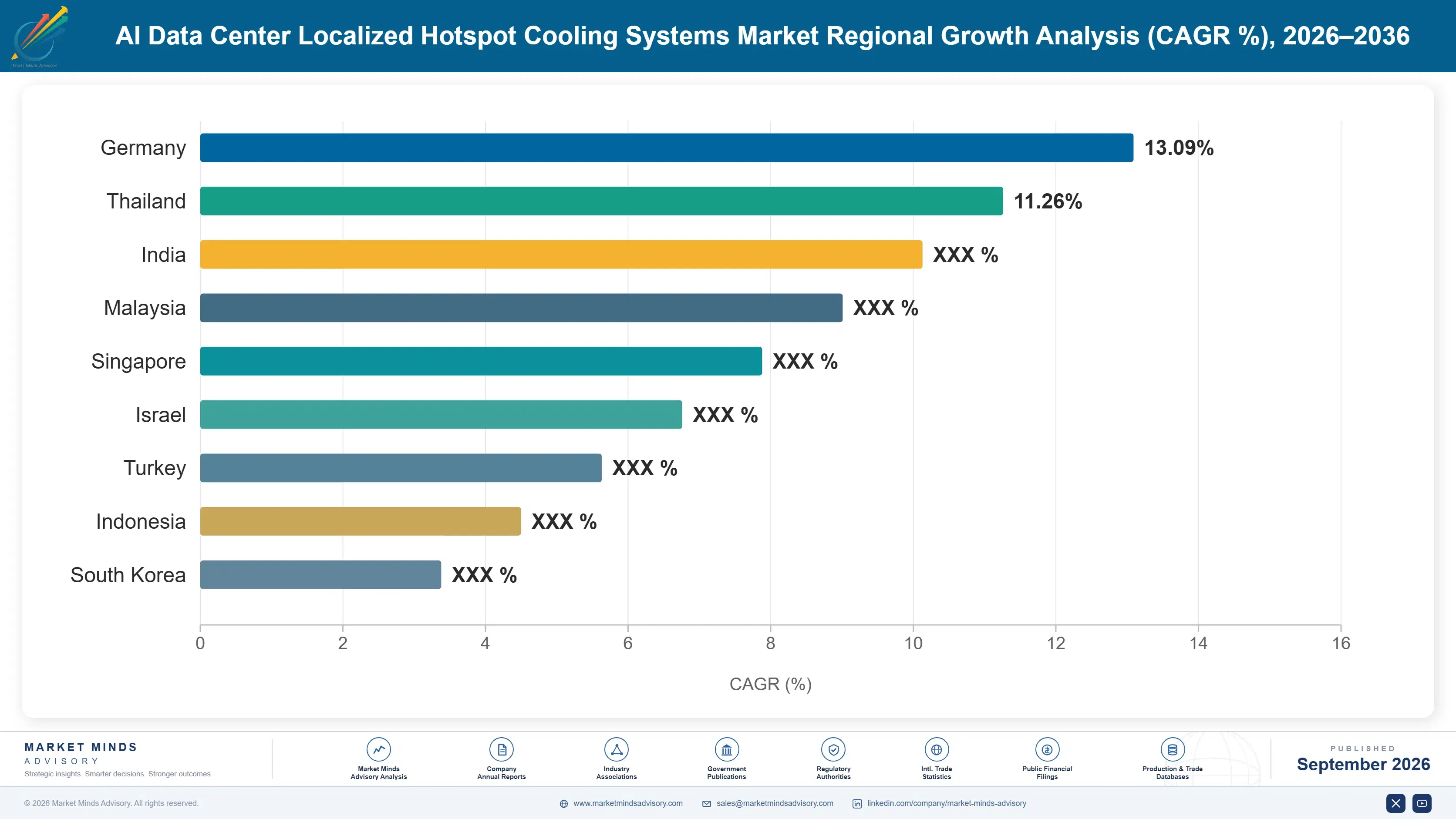
ai-data-center-localized-hotspot-cooling-systems-m-country-cagr-analysis-1788413531727

Chip Co-Design and Retrofit Speed Priorities

Vendors generate outsized returns not from cooling hardware alone but from chip vendor co-design relationships, rapid retrofit deployment capability, and recurring service contracts. Four levers stand out as the clearest paths to margin expansion across the forecast period, each requiring distinct engineering and relationship investment. Adoption timing and technical depth increasingly separate winners from laggards across the vendor landscape.

Secure Chip Vendor Co-Design Relationships Early

Establishing design-in relationships with major accelerator manufacturers before new chip generations launch captures disproportionate share of the resulting design wins, since cooling vendors integrated into reference designs enjoy meaningfully faster customer qualification than late-arriving competitors. This positioning has compressed typical qualification timelines from 18 months to under 9 months for vendors with established chip vendor relationships, creating a durable advantage that later entrants struggle to overcome given how tightly chip vendors control access to pre-launch thermal specifications. Fewer than a handful of vendors currently hold this preferred status across the leading chip platforms.
Market Impact: Cuts qualification time down to just 9 months

Develop Rapid Retrofit Deployment Capability Broadly

Building standardized retrofit deployment methodologies that compress installation timelines from a typical year or more down to under six months captures share from facility operators racing to bring new AI capacity online ahead of competitors. This capability commands premium pricing of 15 to 20 percent over slower-deploying competitors, since deployment speed directly determines how quickly operators can begin generating revenue from newly commissioned AI compute capacity. Facility operators increasingly factor deployment speed directly into vendor selection scoring criteria alongside traditional cost and performance metrics. Vendors with proven fast-deployment track records increasingly win preferred-supplier status.
Market Impact: Commands a 15 to 20% speed pricing premium

Offer Multi-Vendor Interoperability Integration Services Broadly

Providing integration services that let facility operators mix cooling components from multiple vendors within the same deployment addresses a genuine customer pain point around proprietary interface fragmentation, capturing service revenue that facility operators would otherwise struggle to source independently. Vendors offering this capability report customer retention rates 20 to 30 percent higher than hardware-only competitors, since interoperability services create switching costs that favor the integrator over any single hardware component supplier. Facility operators increasingly view interoperability as essential rather than optional when evaluating vendor proposals. This differentiation matters increasingly at scale.
Market Impact: Improves customer retention by up to 30% overall

Secure Long-Term Facility Maintenance Service Contracts

Long-term maintenance contracts covering coolant replacement, leak monitoring, and performance optimization generate recurring revenue that smooths the project-based revenue pattern characteristic of initial equipment sales. These contracts typically span 3 to 5 years and provide vendors ongoing relationship value and early visibility into facility expansion plans, supporting more predictable long-term revenue forecasting for vendors pursuing this service-oriented business model across their installed customer base. Renewal rates for these contracts remain historically high across the vendor's most established customer relationships. Contract expansion often follows facility growth closely. Vendors track this metric closely.
Market Impact: Spans service contracts of 3 to 5 years

Who Controls the Margin Pool

The market remains fragmented despite rapid growth, with the top five vendors holding an estimated 42 percent combined installed-capacity share globally. Vertiv and CoolIT Systems lead through established data center relationships, while newer two-phase specialists compete for share in the highest-density deployment segment across most hyperscale accounts. Smaller regional integrators compete mainly through localized service and installation speed advantages rather than proprietary hardware technology.
Current competitive activity centers on chip vendor co-design relationships, deployment speed capability, and multi-vendor interoperability services rather than pure hardware price competition alone. Established data center infrastructure incumbents face growing competition from specialized thermal management startups that entered the market purely focused on two-phase and immersion technology development. Warranty terms and demonstrated reliability at hyperscale deployment volumes increasingly serve as key differentiators across most vendor selection processes.

Rankings could shift meaningfully as chip vendors increasingly favor specific cooling partners for reference designs, effectively picking winners years before broader market competition plays out across the industry. Vendors without design-in relationships to leading accelerator manufacturers risk losing access to the highest-growth segment of the market entirely and permanently. Providers with strong balance sheets increasingly acquire smaller technology specialists rather than developing comparable capability organically.
ai-data-center-localized-hotspot-cooling-systems-m-company-positioning-matrix-1788413532288

Competitive Moat and Risk Dimensions

VERTIV

Moat: Established Data Center Relationship Depth

Vertiv's decades-deep relationships with hyperscalers and colocation operators across its broader power and cooling infrastructure portfolio give it distribution advantages that pure-play thermal specialists cannot easily replicate, supporting cross-selling opportunities into new liquid cooling deployments and existing facility upgrade programs. This bundled infrastructure approach appeals particularly to operators seeking single-vendor accountability across their entire facility.
VERTIV

Risk: Specialist Technology Development Lag

Vertiv's broad infrastructure portfolio approach risks falling behind pure-play two-phase and immersion specialists on the most advanced cooling technology, potentially disadvantaging it in design-win competitions for the highest-density next-generation accelerator deployments requiring specialized engineering expertise. Chip vendors increasingly favor partners demonstrating deep technical expertise over generalist infrastructure providers.
COOLIT SYSTEMS

Moat: Direct-to-Chip Engineering Specialization

CoolIT Systems' exclusive focus on direct-to-chip liquid cooling technology gives it deep engineering specialization and chip vendor relationships that broader infrastructure companies struggle to match, supporting strong design-win performance across multiple accelerator generations and hyperscaler customer relationships. Chip manufacturers increasingly value this narrow focus when selecting reference design partners for critical thermal specifications.
COOLIT SYSTEMS

Risk: Scale Disadvantage Against Diversified Rivals

CoolIT Systems' narrower product focus leaves it more exposed to shifts in cooling technology preference than diversified competitors with broader infrastructure portfolios that can absorb technology transition risk across multiple product lines simultaneously and geographic markets. A sudden shift toward an alternative cooling architecture could meaningfully erode its current market position.

Players Tracked

Prominent Players

Vertiv
CoolIT Systems
Boyd Corporation
LiquidStack
nVent

Other Key Players

Schneider Electric
Asetek
JetCool Technologies
Motivair
Chilldyne
Iceotope
Submer
Green Revolution Cooling
Delta Electronics
Rittal
STULZ
Envicool
Airedale International
ZutaCore
Accelsius

Recent Developments

MARCH 2026

Vertiv announced a design-win partnership with a major AI accelerator manufacturer to supply reference cooling designs for its next-generation chip platform, reinforcing its position across multiple hyperscaler deployment programs and strengthening its broader chip vendor relationship portfolio considerably. Financial terms of the agreement were not disclosed publicly.
Signal: Signals established infrastructure vendors are winning major chip vendor design partnerships over specialists today and going forward
NOVEMBER 2025

CoolIT Systems expanded its manufacturing capacity to meet growing direct-to-chip cooling demand from hyperscale customers, adding significant production capability across multiple facility locations to reduce delivery lead times amid persistent industry-wide component shortages. Financial terms of the expansion were not disclosed publicly. Analysts view this as significant.
Signal: Signals capacity constraints remain a meaningful competitive factor across the direct-to-chip cooling segment overall and going forward
JUNE 2025

LiquidStack secured a commercial supply agreement with a major cloud provider for two-phase cooling systems supporting its highest-density AI training clusters, marking a significant commercial milestone for the emerging technology segment industry-wide and beyond. Financial terms of the agreement were not disclosed publicly. Analysts view this positively.
Signal: Signals two-phase cooling technology has reached genuine commercial-scale validation among leading hyperscalers today and going forward

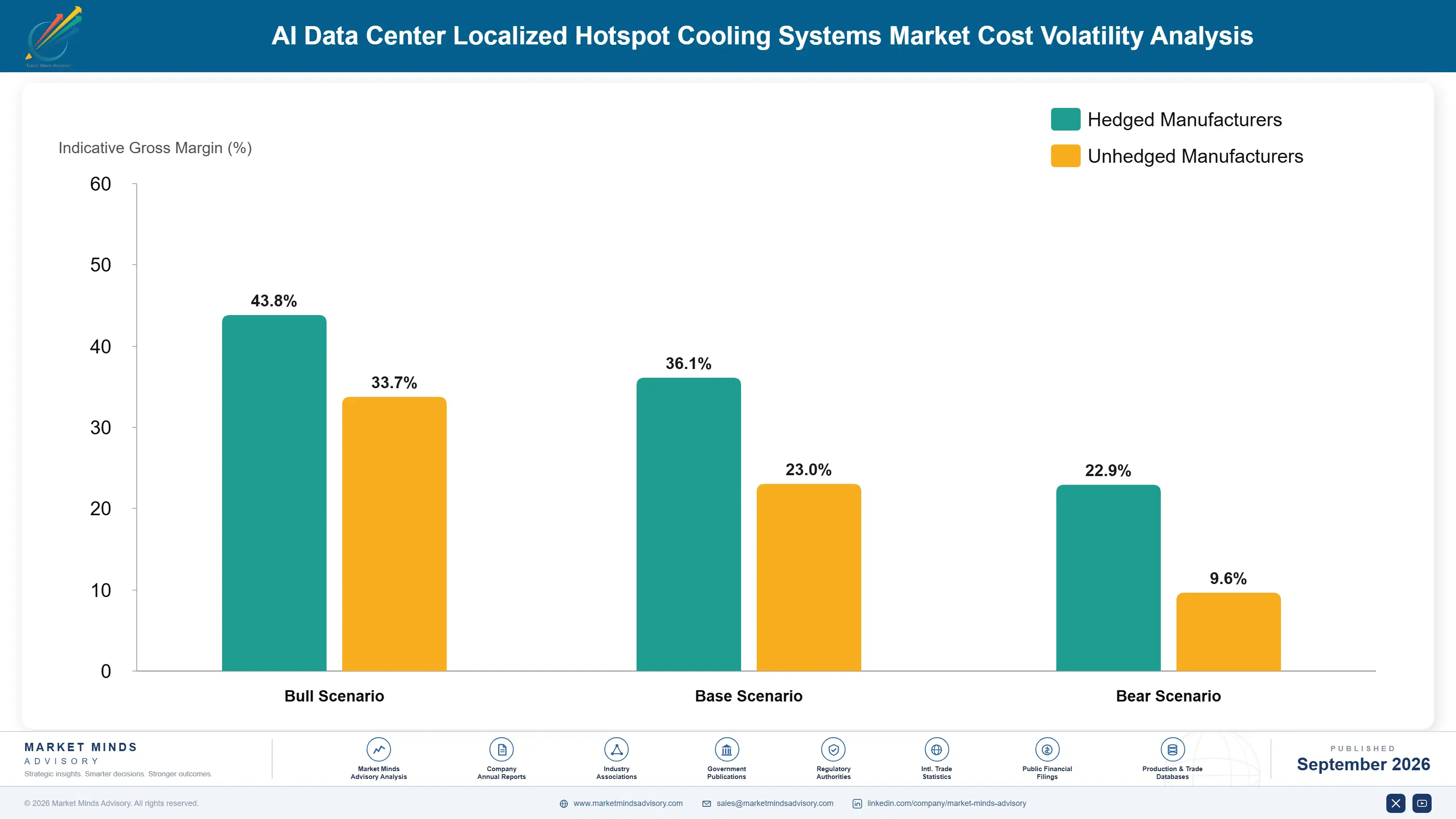
Copper and Coolant Costs Shape Margins

Copper cold plates, specialized coolant fluids, and precision-machined manifold components represent 55 to 65 percent of total system production cost, with copper sourced predominantly from established industrial metal refiners while dielectric coolant fluids increasingly come from specialized chemical manufacturers. Vendors increasingly negotiate multi-year procurement contracts spanning both copper and coolant fluid categories to smooth cost volatility across their broader supply chain.
Copper prices rose more than 25 percent during 2024 amid supply constraints and rising demand from electric vehicles and renewable energy competing for the same refined copper output, according to industry pricing data, squeezing cooling vendor margins during peak price months considerably. This episode prompted several vendors to reassess their copper procurement strategy and pursue longer-term supply arrangements going forward. European vendors faced particularly acute exposure given the region's own concurrent energy cost volatility.

Vendors without long-term copper supply agreements face considerably higher cost exposure than larger competitors with dedicated procurement capability and forward-purchasing arrangements. This dynamic increasingly favors scaled vendors like Vertiv and CoolIT Systems over smaller specialists dependent on spot-market component purchasing at unpredictable prices. Independent specialists increasingly pursue joint purchasing arrangements with industry partners to capture comparable volume discount pricing.
ai-data-center-localized-hotspot-cooling-systems-m-cost-volatility-analysis-1788413532503

Secure Long-Term Copper Supply Contracts

Forward-purchasing agreements with copper suppliers smooth input cost volatility, trading some upside during favorable price periods for protection against the sharp spikes that have repeatedly compressed vendor margins during recent supply-constrained years. Manufacturers with established multi-source qualification programs weathered the last shortage cycle considerably better than single-source-dependent competitors. Contract terms vary by market. Adoption grows.

Qualify Alternative Coolant Fluid Suppliers

Establishing qualified relationships with multiple dielectric coolant fluid suppliers reduces exposure to single-source supply disruption, protecting production continuity during component shortage events affecting any single specialized chemical supplier. This flexibility becomes particularly valuable during periods of concentrated chemical manufacturer capacity constraints affecting the broader industry. Adoption continues rising steadily. Interest remains selective for now.

Standardize Manifold Component Designs

Standardizing precision-machined manifold component designs across product lines enables larger volume procurement and reduces per-unit machining cost, following the same manufacturing scale economics common across precision engineering categories. This standardization approach requires more upfront engineering investment but pays back considerably during high-volume production runs. Costs decline steadily over time. Interest remains selective for now.

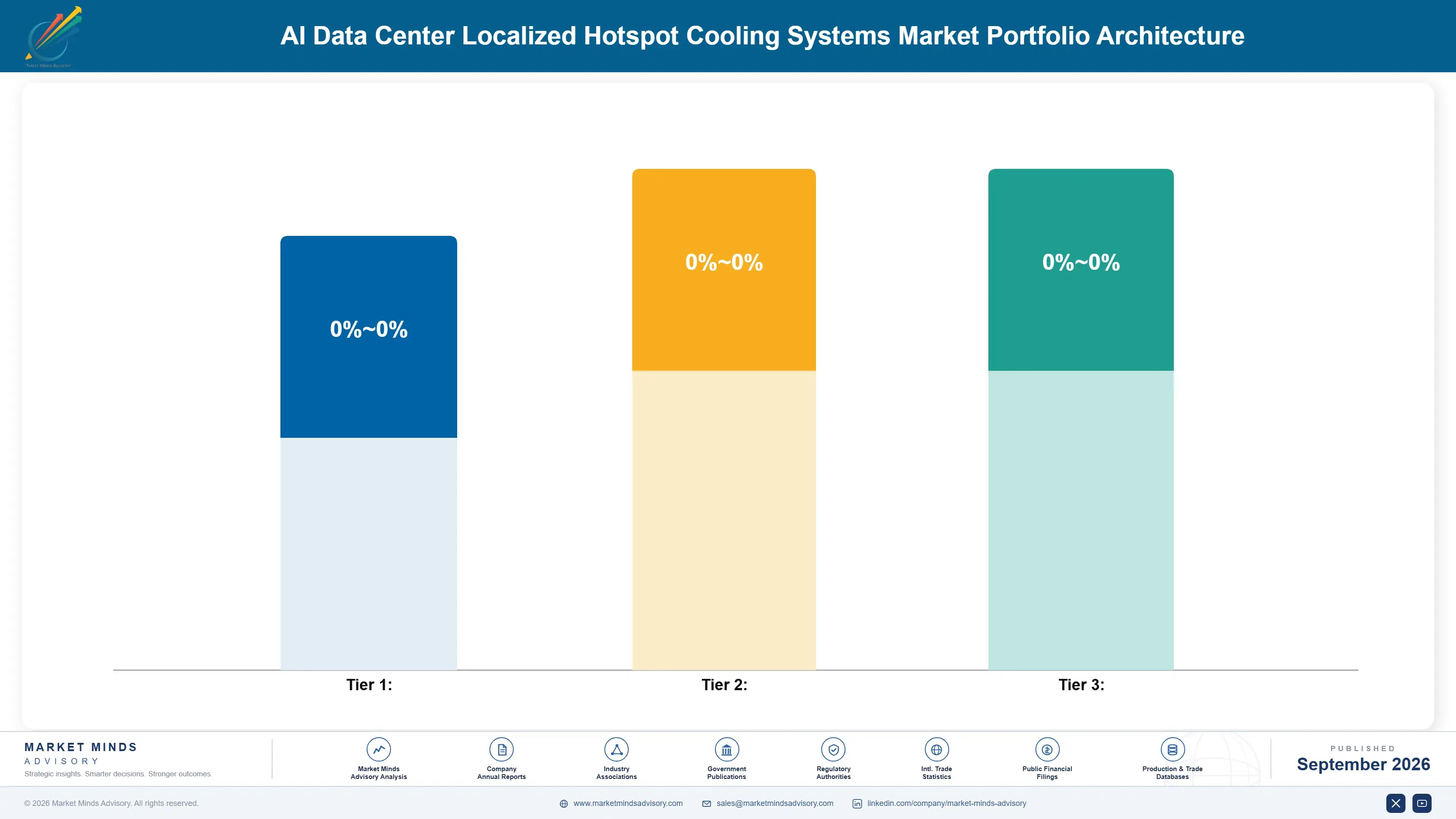
Portfolio Architecture for Margin Defence

Vendor portfolios split across three tiers: commodity rear-door heat exchangers competing on price, certified direct-to-chip cold plate systems commanding design-win premiums, and next-generation two-phase and immersion technology still scaling commercially across the highest-density deployments. Margin economics diverge considerably between tiers, and the gap continues widening as chip density escalates further. Investment follows this margin logic across vendor roadmaps.
Commodity cooling hardware competes almost entirely on manufacturing cost and installation reliability, with thin margins that leave little room for differentiation beyond price and warranty terms built over years of market presence. Direct-to-chip and two-phase systems capture meaningfully wider margins through chip vendor co-design relationships and specialized engineering, insulating vendors from pure hardware price competition that defines the volume tier. Vendors without a credible technology roadmap increasingly struggle to defend premium pricing.

High-value pools concentrate in two-phase cooling and chip vendor design-win relationships, where technical differentiation and early-mover positioning reward vendors willing to invest in specialized engineering capability over multiple product cycles. Commodity rear-door heat exchangers remain the volume anchor but offer limited margin upside absent meaningful technology differentiation or chip vendor relationship investment across the broader competitive field. Investment allocation increasingly follows this margin logic across most vendor strategic plans.

Rear-door heat exchangers and basic cold plate systems competing primarily on manufacturing cost and installation reliability for lower-density deployments. Price competition among established manufacturers keeps margins thin across most deployment scenarios.
Gross Margin

Direct-to-chip cold plate systems with chip vendor design-win status commanding premium engineering and integration pricing from hyperscale customers. Demand grows steadily as more racks require dedicated liquid cooling infrastructure at scale.
Gross Margin

Two-phase and immersion cooling technology still scaling commercially among the highest-density accelerator deployments requiring specialized engineering capability. Early adoption remains concentrated among the largest, most technically sophisticated hyperscale operators. Adoption grows steadily.
Gross Margin
ai-data-center-localized-hotspot-cooling-systems-m-portfolio-architecture-1788413533016

High-value Sub-segments and Strategic Watch-out

Two-Phase Direct-to-Chip Cooling

The clearest high-value, high-growth pool, combining strong technical margins with a 22 percent CAGR as commercial deployment accelerates across leading hyperscale accounts and chip platforms. Engineering firms report a growing project pipeline across most leading hyperscaler accounts globally. Momentum remains strong. Adoption continues expanding. Momentum holds.

Localized Immersion Cooling Pods

Strong margins and steady growth from operators seeking maximum cooling capacity for isolated hotspots without full-facility immersion commitment or infrastructure overhaul requirements. Adoption remains concentrated among specialized high-performance computing and AI research facilities pushing absolute density limits. Interest keeps rising. Adoption continues expanding. Growth continues.

Direct-to-Chip Cold Plate Liquid Cooling

The volume core, generating most industry revenue despite thinner margins, anchored by proven reliability and widespread hyperscaler adoption across most current deployments. Price competition remains intense here as differentiation opportunities narrow considerably relative to premium alternatives. Volume stays high. Demand remains resilient. Volume grows slowly.

Rear-Door Heat Exchanger Systems

A strategic watch-out given declining relevance as chip power density increasingly exceeds what rear-door exchangers can adequately dissipate at scale. Vendors still serving this niche increasingly focus on lower-density retrofit applications rather than new deployments. Decline continues steadily. Interest keeps fading. Focus narrows further. Watch closely.

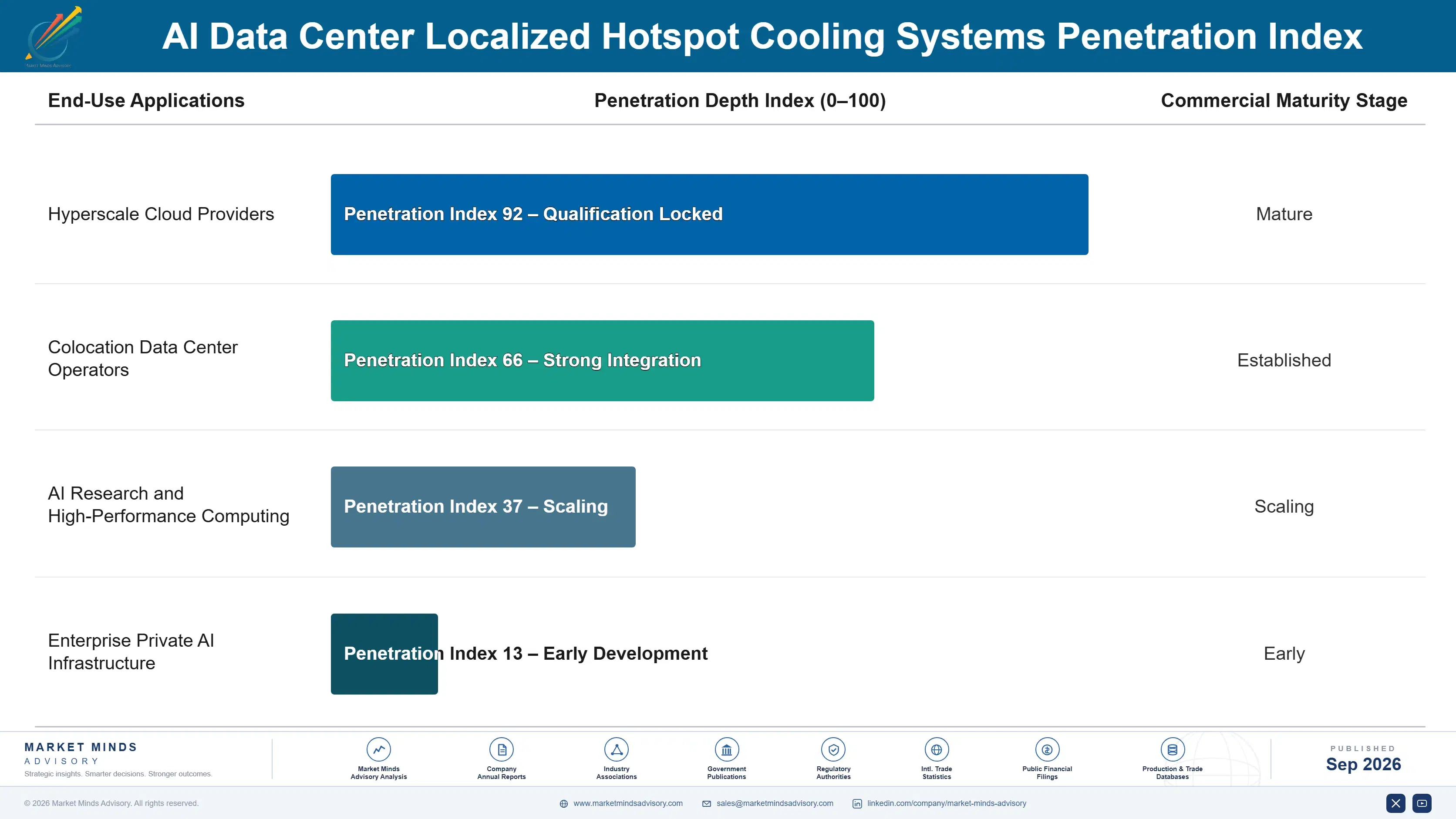
Chip Roadmaps Anchor Multi-Year Demand

Demand for localized cooling behaves as an engineering necessity rather than a discretionary upgrade, since operators deploying the latest AI accelerators simply cannot run them reliably on air cooling alone, creating a demand floor tied directly to accelerator generation adoption rather than broader IT spending cycles. This engineering-necessity framing insulates demand from the discretionary spending cuts hitting other data center equipment categories.
Adoption depth varies considerably by accelerator generation and deployment scale: the highest-density training clusters show near-universal liquid cooling adoption, while lower-density inference workloads still run substantially on air cooling, meaning demand architecture tracks compute intensity as much as raw data center square footage. Operators increasingly plan cooling capacity per accelerator generation rather than per facility, reflecting how quickly chip thermal requirements now change relative to typical facility construction timelines.

Buyer profiles are shifting as chip vendors increasingly specify preferred cooling partners in reference designs, pulling procurement decisions earlier into the chip design cycle and giving cooling vendors with established chip relationships a durable advantage over vendors still selling purely to facility operators after chip selection is finalized. Vendors without these relationships increasingly find themselves competing only for lower-density deployments where chip vendor influence over cooling selection remains limited.
ai-data-center-localized-hotspot-cooling-systems-m-end-use-penetration-index-1788413533519

Co-Design and Deployment Speed Priorities

These are among the four positions where our research anticipates prominent divergence between winners and laggards over the coming forecast period. Each is grounded in the demand model, the regulatory perimeter, and the announced capacity pipeline.
01 / CHIP VENDOR RELATIONSHIP STRATEGY

Secure design-in status before next chip generation launches

Cooling vendors without established chip vendor relationships face a widening qualification gap against competitors already integrated into reference cooling designs, since chip vendors increasingly control access to pre-launch thermal specifications that determine who wins new accelerator generation business. Building these relationships takes years of technical collaboration that vendors cannot compress by simply offering lower prices after a chip generation already launches, and this investment window keeps narrowing quickly. Vendors that delay this investment risk permanent exclusion from the highest-growth segment of the entire market.
02 / TWO-PHASE TECHNOLOGY INVESTMENT

Develop two-phase cooling capability ahead of density escalation

Chip thermal design power continues climbing faster than single-phase cold plate cooling can practically accommodate, meaning vendors without two-phase capability will increasingly lose access to the highest-density accelerator deployments as chip generations advance further. Two-phase engineering expertise takes years to develop given the specialized fluid dynamics and materials science involved, making early investment considerably more valuable than reactive development once competitors already dominate the segment, and timing matters enormously here. Vendors investing now position themselves ahead of the broader industry transition already clearly underway.
03 / RETROFIT DEPLOYMENT SPEED

Build standardized retrofit methodologies to compress timelines

Facility operators racing to bring new AI capacity online increasingly favor vendors capable of compressing retrofit deployment timelines from a year or more down to under six months, since deployment speed directly determines how quickly operators can begin generating revenue from newly commissioned compute capacity. Vendors lacking standardized retrofit methodologies struggle to compete on this dimension regardless of their underlying hardware quality or pricing competitiveness, and this capability gap keeps widening steadily. Building this capability now positions vendors favorably as retrofit demand continues accelerating industry-wide.
04 / INTEROPERABILITY SERVICE STRATEGY

Offer multi-vendor integration services to build customer loyalty

Facility operators managing complex multi-vendor cooling deployments increasingly value integration services that reduce the interoperability friction created by proprietary vendor interfaces across different hardware components. Vendors offering these services capture switching-cost advantages that pure hardware suppliers cannot replicate, since customers who rely on integration support become considerably more difficult for competitors to displace, and early movers increasingly capture disproportionate share of these lucrative service relationships. Building this service capability now, ahead of broader industry standardization efforts, positions vendors favorably for the coming several years.

Engagement Snapshot From the Field

A live engagement with an industry participant carrying material or product regulatory and market exposure ahead of a defining policy shift, showing how our research translates into a defensible multi-year portfolio strategy.
MARKET MINDS ADVISORY · CLIENT ENGAGEMENT SUMMARY
AI Data Center Localized Hotspot Cooling Systems Producer Strategic Portfolio Review and Transition Roadmap 2026·Investment Scenario on AI Data Center Localized Hotspot Cooling Systems Exposure Evaluation 2025-26
CLIENT PROFILE
A mid-sized colocation provider operating several air-cooled facilities across North America sought to evaluate whether retrofitting localized liquid cooling around specific high-density AI racks made commercial sense given growing customer demand for AI compute hosting and the physical limits of its existing air cooling infrastructure at current facility sites. The client's leadership needed a data-driven business case before committing capital to any specific retrofit approach.
STRATEGIC CHALLENGE
The client's facilities were designed around conventional air cooling assumptions that could not support the power density of modern AI accelerator racks, while competing colocation providers were already offering liquid-cooled capacity and winning customer contracts the client's existing infrastructure simply could not fulfill without substantial and costly modification. Delaying the decision further risked permanent competitive disadvantage in the fast-growing AI hosting segment.
MMA APPROACH
MMA benchmarked retrofit approaches from three completed colocation cooling projects, modeled capital cost and revenue potential for direct-to-chip versus rear-door heat exchanger options, and evaluated phased deployment strategies that would let the client begin serving AI customers before completing a full facility-wide cooling retrofit program. Interviews with prospective AI hosting customers informed the final phasing recommendation.
KEY FINDINGS
  1. Direct-to-chip retrofit costs ran approximately 30 percent lower than comparable rear-door heat exchanger deployment across similar rack density (client-reported, unverified by MMA).
  2. Phased deployment targeting a single high-density zone let the client begin serving AI customers within roughly five months (client-reported, unverified by MMA).
  3. Customer demand for liquid-cooled capacity exceeded the client's initial retrofit capacity plans within the very first fiscal quarter (client-reported, unverified by MMA).
  4. Competing colocation providers without liquid cooling capability lost several major AI customer contracts during that same fiscal period (client-reported, unverified by MMA).
CLIENT PROFILE
A mid-sized colocation provider operating several air-cooled facilities across North America sought to evaluate whether retrofitting localized liquid cooling around specific high-density AI racks made commercial sense given growing customer demand for AI compute hosting and the physical limits of its existing air cooling infrastructure at current facility sites. The client's leadership needed a data-driven business case before committing capital to any specific retrofit approach.
STRATEGIC CHALLENGE
The client's facilities were designed around conventional air cooling assumptions that could not support the power density of modern AI accelerator racks, while competing colocation providers were already offering liquid-cooled capacity and winning customer contracts the client's existing infrastructure simply could not fulfill without substantial and costly modification. Delaying the decision further risked permanent competitive disadvantage in the fast-growing AI hosting segment.
MMA APPROACH
MMA benchmarked retrofit approaches from three completed colocation cooling projects, modeled capital cost and revenue potential for direct-to-chip versus rear-door heat exchanger options, and evaluated phased deployment strategies that would let the client begin serving AI customers before completing a full facility-wide cooling retrofit program. Interviews with prospective AI hosting customers informed the final phasing recommendation.
KEY FINDINGS
  1. Direct-to-chip retrofit costs ran approximately 30 percent lower than comparable rear-door heat exchanger deployment across similar rack density (client-reported, unverified by MMA).
  2. Phased deployment targeting a single high-density zone let the client begin serving AI customers within roughly five months (client-reported, unverified by MMA).
  3. Customer demand for liquid-cooled capacity exceeded the client's initial retrofit capacity plans within the very first fiscal quarter (client-reported, unverified by MMA).
  4. Competing colocation providers without liquid cooling capability lost several major AI customer contracts during that same fiscal period (client-reported, unverified by MMA).
RECOMMENDED STRATEGY
Phase 1: Phase one: retrofit a single high-density zone with direct-to-chip cooling to begin serving AI customers quickly. Speed to market mattered considerably here. Phase 2: Phase two: expand liquid cooling capacity based on actual customer demand rather than speculative facility-wide investment. Demand signals should drive the pace of expansion. Phase 3: Phase three: evaluate two-phase cooling for the highest-density future zones once initial deployment proves successful commercially. Technology selection should follow proven commercial validation first.
OUTCOME
The client completed its initial retrofit zone within five months and fully leased the new liquid-cooled capacity within six weeks of commissioning, prompting an accelerated second-phase expansion earlier than originally planned (client-reported, unverified by MMA). Additional customer inquiries continued arriving steadily after the initial launch.

Frequently Asked Questions

Foundational context covering the market sizes, CAGR, scope, country, region and competition that inform every finding below. This section is provided to cover basics and most often pre-purchase conversations, answered from the MMA Primary Research Dataset.

What is the current size of the AI Data Center Localized Hotspot Cooling Systems Market?

The global market reached an estimated $1.4 billion in 2025, driven by escalating AI accelerator power density that exceeds air cooling limits. North America hosts the largest share of installed capacity.

How large will the AI Data Center Localized Hotspot Cooling Systems Market be by 2036?

MMA projects the market will reach approximately $6.84 billion by 2036, up from $1.62 billion in 2026. That represents roughly a 4.22x expansion across the ten-year forecast window.

What is the CAGR for the AI Data Center Localized Hotspot Cooling Systems Market 2026 to 2036?

The base case forecast CAGR is 15.5% across 2026 to 2036, with a bull scenario of 16.8% and a bear scenario of 14.2% depending on accelerator density trends and capex pace.

Which segment is growing fastest?

Two-Phase Direct-to-Chip Cooling leads at a 22.0% CAGR, roughly 1.42 times the overall market rate, as the highest-density accelerators exceed single-phase cooling limits across the industry today.

Who are the major companies in the AI Data Center Localized Hotspot Cooling Systems Market?

Vertiv, CoolIT Systems, Boyd Corporation, LiquidStack, and nVent lead the market, together holding an estimated combined installed-capacity share of 42% measured globally across all deployments.

Which country is growing fastest?

Malaysia leads growth at a 19.5% CAGR, emerging as a major new AI data center hub as neighboring markets face land and power capacity constraints.

Report Segmentation Architecture

The full report scope spans multiple orthogonal segmentation dimensions, with cross-tabulated demand data provided for each dimension pair. Coverage extends further to regional breakdowns, trend trajectories, and the competitive detail needed to support segment-level decision-making.
  • Direct-to-Chip Cold Plate Liquid Cooling
  • Rear-Door Heat Exchanger Systems
  • Localized Immersion Cooling Pods
  • Two-Phase Direct-to-Chip Cooling
  • In-Row and In-Rack Precision Cooling Units
  • Hybrid Air-Liquid Spot Cooling Systems
  • Hyperscale Cloud Providers
  • Colocation Data Center Operators
  • AI Research and High-Performance Computing
  • Enterprise Private AI Infrastructure
  • Direct Chip Vendor Design-In Sales
  • Facility Operator Retrofit Contracts
  • New-Build Facility Integration
  • Service and Maintenance Contracts

By Region

  • North America
  • Western Europe
  • East Asia
  • South Asia and Pacific
  • Latin America
  • Middle East and Africa
  • Eastern Europe

Scope, Methodology, and Coverage

Every figure in this report is reproducible from documented input assumptions. The scope below maps the historical period, the forecast horizon, the segmentation dimensions, and the countries covered, alongside the underlying primary and qualitative methodology.
Historical Period
2020 to 2025
Forecast Period
2026 to 2036
Base Year
2025 (USD billions; MMA Primary Research Dataset, September 2026)
Market Definition
This report covers targeted liquid and hybrid cooling systems deployed around specific high-density racks or chips within AI data centers, including direct-to-chip cold plates, rear-door heat exchangers, and localized immersion pods, measured on a global installed-capacity basis. It excludes whole-facility HVAC and general-purpose data center air cooling infrastructure.
Quantitative Units
USD billions, cooled kilowatts of capacity, and percentage CAGR
Segmentation Dimensions
Cooling technology (direct-to-chip cold plate, rear-door heat exchanger, immersion pod, two-phase direct-to-chip, in-row/in-rack, hybrid air-liquid), end-use vertical, commercial channel, and geography
Regions Covered
North America, Western Europe, East Asia, South Asia and Pacific, Latin America, Middle East and Africa, Eastern Europe
Countries Covered
United States, China, Ireland, India, Malaysia, Saudi Arabia, and 20+ additional countries across seven global regions
Key Companies Profiled
Vertiv, CoolIT Systems, Boyd Corporation, LiquidStack, nVent, and 15 additional vendors across the global competitive set
Quantitative Methodology
Primary survey, n=3,800 respondents, Q4 2025, six countries; demand-side model with trade association cross-validation
Qualitative Methodology
47 expert interviews, Q4 2025; applied to validate demand model assumptions, identify emerging dynamics, and assess competitive positioning
Report Format
PDF and XLSX data workbook (Word format preview document)
Publisher
Market Minds Advisory
Report Code
MMA-2026-TEC-123
Published
September 2026
Contact
sales@marketmindsadvisory.com | www.marketmindsadvisory.com

Purchase the full AI Data Center Localized Hotspot Cooling Systems Market Report (2026 to 2036).

This report delivers a complete assessment of the global AI data center localized hotspot cooling market across the full 2026 to 2036 forecast period ahead. It combines primary survey data from 3,800 respondents with 47 expert interviews to quantify segment, regional, and competitive dynamics in careful detail. Coverage spans direct-to-chip, rear-door, immersion, and two-phase cooling technologies, alongside detailed vendor benchmarking across twenty companies. Analysts translate raw data into actionable chip co-design, deployment speed, and market entry guidance for vendors, investors, and operators evaluating this rapidly evolving thermal management category.
Ten-year global market sizing and forecast model
Seven-region demand, pricing, and share breakdown
Twenty-company competitive benchmarking and positioning analysis
Segment-level growth, margin, and pricing analysis
Copper and coolant cost exposure assessment
Strategic verdict and prioritized investment guidance

Built For The People Who Decide

From boardroom strategy to bench-side execution, this report is read cover-to-cover by leaders shaping the next decade of their industry, turning demand scenarios, market dynamics and valuation benchmarks into decisions.
CXOs/ Presidents/ VPs/ Managers
M&A and Corporate Development
Strategy Teams and R&D Heads
Procurement and Product Directors
Regulatory and Compliance Leaders
Investor Relations and Equity Analysts