

Market Minds Advisory
AI Content Creation Tool Market

AI Content Creation Tool Market: AI Content Creation Tool Market. Enterprise Workflow Adoption Meets Copyright Liability Pressure

Enterprise marketing teams scaling AI-generated video and copy are pushing content tool vendors toward defensible copyright provenance, forcing suppliers to balance generation speed against rising legal exposure and licensing costs.

Lead Analyst

Published

September 2026

Make Smarter Decisions with Customized Research Insights

Request a free sample report and evaluate market opportunities, growth trends, and competitive dynamics relevant to your business needs.

2025 MARKET VALUE$12.5BMarket Size 2025
2036 FORECAST VALUE$73.0BBase Case , 2026 to 2036
CAGR 2026 TO 203617.4 %Bull 18.7% / Bear 16.1%
INCREMENTAL OPPORTUNITY$58.3BNet 10- year value creation
EXPANSION MULTIPLE4.97x2036 value over 2026 base
Strategic Levers
M&A Pipeline
Regional Outlook
Country Rankings
Competitive Intelligence
Segmental Deep-dive
Call-Us : 91 93563 13602

Executive Snapshot and Market Trajectory.

Enterprise legal teams are quietly reshaping AI content creation tool demand by demanding defensible copyright provenance before approving vendor contracts, pulling adoption toward licensed training data faster than raw generation quality alone ever could achieve on its own merits. That expectation is now nearly universal across large enterprises.
AI video generation platforms are pulling ahead of text and image tools as the fastest-growing category, since marketing teams increasingly produce entire ad campaigns without traditional production crews or studio time at all. Adoption concentrates most heavily in North America, where enterprise marketing budgets and software vendor headquarters both cluster, and price competition remains fiercest among mid-tier text generation challengers there specifically. Studio production budgets are shrinking as a direct result of this shift.
Competitive character is shifting from general-purpose language model wrappers toward specialized workflow platforms capable of demonstrating licensed training data and enterprise content governance controls that procurement teams now require before signing. Copyright litigation risk and data provenance requirements shape which vendors can credibly compete for enterprise contracts, and rankings shift fastest among video challengers investing in licensing. Vendors slower on this front cede ground quickly.
Market Definition
This market covers software platforms that generate text, image, video, and audio content using artificial intelligence models for marketing, media, and enterprise communication applications. It excludes general-purpose large language model APIs sold without a dedicated content workflow or editing interface layered on top.
Base Year Value
$12.5B in 2025 (MMA Primary Research Dataset, September 2026)
Forecast Period
2026 to 2036, eleven discrete annual values
CAGR
17.4% base case. Bull 18.7%. Bear 16.1%.
Fastest Growth Segment
AI Video Generation Platforms: 26.8% CAGR
Fastest Growth Country
India: 21.6% CAGR
Fastest Growth Region
South Asia and Pacific: 19.4% CAGR
Largest Region
North America: 34% of 2025 global value
Market Leaders
OpenAI Inc, Adobe Inc, Canva Pty Ltd, Jasper AI Inc, Synthesia Ltd. Source: MMA Analysis based on company annual reports.
Primary Survey
n=3,800 procurement and R&D decision-makers, Q4 2025, six countries
Methodology
Demand-side build-up, cross-validated against public data, 47 expert interviews

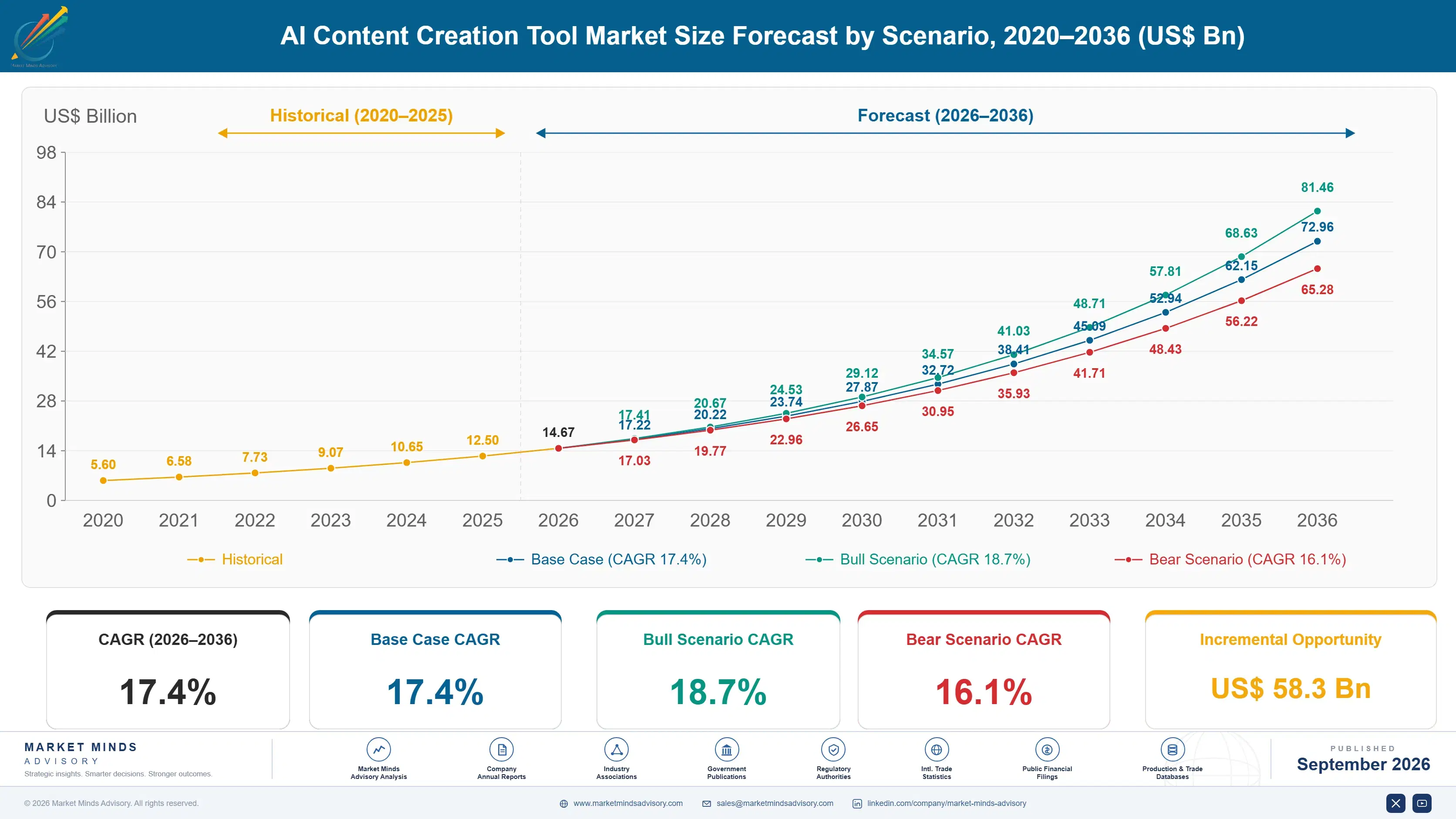
AI Content Creation Tool Market Forecast Scenarios

ai-content-creation-tool-market-size-forecast-scenario-1788419473566
AI content creation tools grew from a niche automation curiosity in 2020 into a mainstream marketing production layer by 2025, though the historical growth rate of 16.4 percent understated a sharper acceleration once large language models achieved commercially usable output quality in the final two years. Enterprise adoption barely existed at the start of this period.
The base case rests on three commercial mechanisms: enterprises replacing traditional agency production budgets with in-house AI generation workflows at scale, video generation quality improving enough to displace studio production entirely for many campaign formats, and licensed training data partnerships resolving copyright liability concerns that previously slowed enterprise procurement. Together these sustain strong double-digit growth through the forecast period even as generic text generation tools themselves commoditize rapidly. Vendors failing on any one of these fronts risk ceding share quickly.
The bull case assumes faster-than-expected enterprise budget reallocation from traditional production toward AI-native workflows pulls forward demand across multiple content formats simultaneously. The bear case centers on copyright litigation outcomes and platform-level content restrictions, which could slow enterprise adoption and push cautious brands back toward traditional production methods instead. Either scenario reshapes vendor investment priorities meaningfully over the next several years.

Where Generation Speed Meets Licensing Defensibility

AI content tool margin has historically compressed under generic text generation commoditization, but licensed video and image platforms now carry wider margin as legal defensibility barriers limit competitive entry. Enterprises increasingly negotiate multi-year platform contracts rather than per-seat monthly subscriptions alone. Vendors unable to demonstrate licensing risk being squeezed out by competitors offering broader content coverage at comparable pricing. Bids without that licensing story increasingly fail outright.
MARKET CONCENTRATIONCR5 36%Top five vendors control just over a third overall
AVERAGE SUBSCRIPTION PRICE$20-$5,000/monthPrice varies widely by seat count and content volume
LEADING ADOPTION COUNTRY SHAREUnited States 34%United States leads global enterprise adoption volume overall
LICENSED DATA ADOPTION RATE29%Share of platforms using fully licensed training data sources
CONTENT OUTPUT SPEED GAIN5-10xTypical production speed gain over traditional creative workflows
AVERAGE CONTRACT RENEWAL CYCLE12-18 monthsTypical duration before enterprises renegotiate platform vendor contracts
Licensing defensibility has become the primary purchase criterion for enterprise buyers ahead of raw generation quality, since legal teams weigh copyright exposure as heavily as creative output itself. Vendors investing in proven licensed data sourcing are winning enterprise contracts over competitors offering only unlicensed model access. That gap between licensing leaders and unlicensed laggards widens further each procurement cycle across most verticals. Scale matters too.
Marketing agencies and in-house enterprise creative teams dominate purchase volume, though media and entertainment companies are adopting AI video generation faster than any other vertical tracked, driven by production cost pressure. Small business content tools remain a smaller but steadily growing adjacent category. Vendors tailoring platform scale to enterprise governance needs are capturing share that consumer-only tools cannot easily serve. Timing matters here.
"Vendors that treat licensed training data as a core requirement rather than a legal afterthought are already ahead of competitors still comparing themselves on raw output speed alone. The liability gap it closes simply does not exist for unlicensed model wrappers."
Director, AI Content Technology and Media Practice · MMA Technology Practice · September 2026

Market Trends

Licensed Training Data Partnerships Reshape Vendor Positioning

Major AI content platforms have signed direct licensing agreements with stock media libraries, publishers, and entertainment studios to secure defensible training data ahead of mounting copyright litigation pressure across multiple jurisdictions. These deals allow vendors to market their platforms as enterprise-safe alternatives to competitors still training on scraped internet content of uncertain provenance. Enterprise legal teams increasingly require proof of licensing before approving procurement, making these partnerships a genuine competitive differentiator rather than a compliance afterthought. Vendors without such partnerships face growing pressure from procurement teams demanding written indemnification against copyright claims.
Market Impact: Agency budget share fell 18%

AI Video Generation Moves Into Enterprise Ad Production

AI video generation platforms have moved past short-form social content into full enterprise advertising campaigns, with several major consumer brands now producing television-quality spots without traditional production crews or studio rental costs. This shift barely existed three years ago when video generation quality remained visibly artificial to most viewers. Improved model quality and enterprise workflow integration have together made this a credible production alternative rather than a novelty experiment for marketing teams. Analysts expect this adoption curve to steepen further as rendering costs continue falling industry-wide. Traditional agencies are responding by building their own generation capability internally.
Market Impact: Governance-feature deals grew 3x since 2024

Market Opportunities and Growth Drivers

Marketing Budget Reallocation Toward AI Workflows

Enterprise marketing departments are reallocating budget away from traditional agency retainers and toward in-house AI content generation tools that produce campaign assets at a fraction of prior production costs. This shift accelerated as generation quality crossed a threshold where output became indistinguishable from traditionally produced content for most digital advertising placements. Agencies that fail to integrate AI generation into their own service offerings risk losing client budget entirely to platforms that enterprises now manage directly. Several major consumer brands have already cut external production spending by double digits over the past two years alone.
Market Impact: Legal reviews add 3-6 months

Enterprise Content Governance Feature Demand Rises

Large enterprises increasingly require content generation platforms to include built-in brand compliance checking, approval workflows, and audit trails before granting company-wide procurement approval for marketing team use. This has pushed vendors to build enterprise governance features well beyond the simple generation capability that satisfied early individual creator adopters. Vendors offering mature governance tooling are winning multi-department enterprise contracts that smaller, feature-thin competitors simply cannot qualify for at scale. Smaller vendors lacking dedicated compliance engineering teams are struggling to keep pace with this shifting enterprise requirement. This gap is widening each procurement cycle.
Market Impact: Review workflows add 20-30% overhead

Market Restraints and Challenges

Copyright Litigation Creates Enterprise Legal Uncertainty

Ongoing copyright infringement lawsuits against major AI model developers create persistent legal uncertainty for enterprises evaluating content generation platforms, since unfavorable rulings could retroactively expose commercial users to infringement liability. The root cause is that many foundational models were trained on scraped internet content without explicit licensing agreements from original rights holders. Vendors are responding by offering indemnification clauses and shifting toward fully licensed training data, though smaller vendors often lack the balance sheet to offer credible indemnification at scale. Enterprises without in-house legal counsel specializing in AI intellectual property face the steepest procurement delays as a result.
Market Impact: Licensed platforms saw enterprise wins double

Output Quality Inconsistency Limits High-Stakes Use Cases

AI-generated content still produces occasional factual errors, brand-inconsistent outputs, and visual artifacts that make fully unsupervised use risky for high-stakes applications like regulated financial or pharmaceutical marketing materials. The root cause traces to underlying model architecture limitations that improve incrementally rather than through any single breakthrough fix. Vendors are mitigating this through human-in-the-loop review workflows, though this partially offsets the labor cost savings that originally justified AI adoption for many enterprise buyers. Regulated industries in particular remain cautious about removing human oversight entirely from any customer-facing content pipeline. Adoption still proceeds steadily.
Market Impact: Video generation grew 4x since 2023
3 additional market trends, 4 additional growth drivers, and 2 additional restraints and challenges are covered in the full report. Contact sales@marketmindsadvisory.com to access the complete intelligence.

Segment CAGR and Growth Architecture

AI content creation splits across six format categories, each shaped by distinct generation technology and enterprise use case, from short-form text copy to full video production. Video generation platforms are pulling ahead as marketing teams replace studio production with AI-native workflows, and enterprise governance needs increasingly determine winners. Buyer priorities differ sharply by industry vertical and content format need.
Section default visual

AI Video Generation Platforms

AI video generation has moved from short social clips into full enterprise advertising production, with model quality now sufficient for television-grade output that satisfies most brand safety review standards. Marketing teams increasingly produce entire campaigns internally rather than commissioning traditional production houses, cutting turnaround time from weeks to days in many cases. Vendors offering licensed stock footage integration and brand-safe output controls are winning the largest enterprise contracts over competitors still relying on unlicensed training data sources. Retail and consumer packaged goods brands lead adoption, having shifted the largest share of production spend away from external agencies over the past two years. Analysts expect this shift to continue accelerating through the remainder of the decade.
CAGR 26.8%

AI Image and Graphic Design Tools

Image generation tools have become standard equipment for marketing and design teams producing social media assets, product mockups, and advertising creative at a fraction of traditional design agency costs. Enterprise adoption now extends well beyond early individual creator use into formal brand asset production pipelines with governance controls attached. Vendors offering fine-tuned brand style consistency are capturing disproportionate share of enterprise renewal contracts over generic, unbranded generation competitors. Small business adoption remains strong too, though enterprise renewal value concentrates heavily around vendors that can demonstrate consistent brand style adherence across large asset libraries. Adoption keeps rising steadily across nearly every industry vertical tracked. Vendors keep investing to widen this lead.
CAGR 20.2%
Full segment breakdown across 6 segments available in the complete report.

Regional Architecture and Country Demand Map

North America leads AI content creation tool demand on enterprise marketing budget concentration and vendor headquarters presence, while East Asia follows on rapid enterprise digital marketing adoption and manufacturing brand content needs. South Asia and Pacific posts the fastest regional growth as smaller agencies adopt generation tools directly.

North America

North America holds an outsized share of global AI content creation demand, reflecting a genuine market concentration rather than a modeling default: the majority of leading platform vendors are headquartered here, and enterprise marketing budgets in the United States alone exceed those of most other regions combined. United States enterprises drive the overwhelming majority of regional demand, with Canada contributing a smaller but growing share tied to its own media and advertising sector. Enterprise legal teams here move fastest on licensing requirements, reflecting heightened copyright litigation exposure domestically. Vendor concentration around Silicon Valley and New York advertising hubs further reinforces this regional dominance structurally, and established vendor risk review processes accelerate procurement further.
Share: 34% | CAGR: 18.4% (2026 to 2036)

Western Europe

Western Europe's AI content creation demand grows more cautiously than North America's, shaped by stricter data protection regulation and ongoing debate over AI training data copyright rules at the European Union level. The United Kingdom and Germany lead regional volume, driven by large advertising and media sectors experimenting with AI-native production workflows. France and the Nordic countries show particular strength in enterprise governance tooling adoption, reflecting strong data privacy compliance traditions across the region generally. Vendors here compete heavily on demonstrated licensing rather than price, since regulatory scrutiny weighs heavily on procurement decisions. Nordic insurers and public broadcasters are beginning to pilot smaller-scale licensing frameworks that could gradually accelerate regional adoption if early results prove favorable.
Share: 21% | CAGR: 15.9% (2026 to 2036)
Regional intelligence for 5 additional markets available in the complete report: East Asia, South Asia and Pacific, Latin America, Middle East and Africa, Eastern Europe. Contact sales@marketmindsadvisory.com.
ai-content-creation-tool-market-market-share-analysis-1788419474104

Licensing Defensibility Drives Enterprise Pricing Power

AI content creation vendors capture disproportionate margin through four commercial levers tied to licensing defensibility, workflow depth, and enterprise governance features that raw generation quality alone cannot sustain. Certification and licensing investment increasingly separate premium vendors from commodity competitors chasing volume on price alone. Vendors that build these advantages early are proving difficult for later, feature-thin entrants to displace quickly.

Who Controls the Margin Pool

ai-content-creation-tool-market-country-cagr-analysis-1788419474628

Input cost volatility and margin defence.

ai-content-creation-tool-market-company-positioning-matrix-1788419474824

Portfolio Architecture for Margin Defence

Section default visual

End-use penetration and the annuity logic.

Section default visual

Four calls that define the decade.

These are among the four positions where our research anticipates prominent divergence between winners and laggards over the coming forecast period. Each is grounded in the demand model, the regulatory perimeter, and the announced capacity pipeline.

Engagement Snapshot From the Field

A live engagement with an industry participant carrying material or product regulatory and market exposure ahead of a defining policy shift, showing how our research translates into a defensible multi-year portfolio strategy.
MARKET MINDS ADVISORY · CLIENT ENGAGEMENT SUMMARY
AI Content Creation Tool Producer Strategic Portfolio Review and Transition Roadmap 2026·Investment Scenario on AI Content Creation Tool Exposure Evaluation 2025-26
CLIENT PROFILE
STRATEGIC CHALLENGE
MMA APPROACH
KEY FINDINGS
    CLIENT PROFILE
    STRATEGIC CHALLENGE
    MMA APPROACH
    KEY FINDINGS
      RECOMMENDED STRATEGY
      OUTCOME

      Frequently Asked Questions

      Foundational context covering the market sizes, CAGR, scope, country, region and competition that inform every finding below. This section is provided to cover basics and most often pre-purchase conversations, answered from the MMA Primary Research Dataset.

      Report Segmentation Architecture

      The full report scope spans multiple orthogonal segmentation dimensions, with cross-tabulated demand data provided for each dimension pair. Coverage extends further to regional breakdowns, trend trajectories, and the competitive detail needed to support segment-level decision-making.

      By Region

      • North America
      • Western Europe
      • East Asia
      • South Asia and Pacific
      • Latin America
      • Middle East and Africa
      • Eastern Europe

      Scope, Methodology, and Coverage

      Every figure in this report is reproducible from documented input assumptions. The scope below maps the historical period, the forecast horizon, the segmentation dimensions, and the countries covered, alongside the underlying primary and qualitative methodology.
      Historical Period
      2020 to 2025
      Forecast Period
      2026 to 2036
      Base Year
      2025 (USD billions; MMA Primary Research Dataset, September 2026)
      Market Definition
      This market covers software platforms that generate text, image, video, and audio content using artificial intelligence models for marketing, media, and enterprise communication applications. It excludes general-purpose large language model APIs sold without a dedicated content workflow or editing interface layered on top.
      Quantitative Units
      USD billions
      Segmentation Dimensions
      Regions Covered
      North America, Western Europe, East Asia, South Asia and Pacific, Latin America, Middle East and Africa, Eastern Europe
      Countries Covered
      Key Companies Profiled
      Quantitative Methodology
      Primary survey, n=3,800 respondents, Q4 2025, six countries; demand-side model with trade association cross-validation
      Qualitative Methodology
      47 expert interviews, Q4 2025; applied to validate demand model assumptions, identify emerging dynamics, and assess competitive positioning
      Report Format
      PDF and XLSX data workbook (Word format preview document)
      Publisher
      Market Minds Advisory
      Report Code
      MMA-2026-TEC-190
      Published
      September 2026
      Contact
      sales@marketmindsadvisory.com | www.marketmindsadvisory.com

      Purchase the full AI Content Creation Tool Market Report (2026 to 2036).

      Built For The People Who Decide

      From boardroom strategy to bench-side execution, this report is read cover-to-cover by leaders shaping the next decade of their industry, turning demand scenarios, market dynamics and valuation benchmarks into decisions.
      CXOs/ Presidents/ VPs/ Managers
      M&A and Corporate Development
      Strategy Teams and R&D Heads
      Procurement and Product Directors
      Regulatory and Compliance Leaders
      Investor Relations and Equity Analysts