Market Minds Advisory
AI Consulting Services Market

AI Consulting Services Market: AI Consulting Services Market. Turning Pilot Projects Into Defensible Production Deployments

Enterprises are moving past experimental AI pilots toward governed production deployments, pushing demand toward consultancies that can prove measurable return on investment rather than deliver yet another abandoned proof of concept.

Lead Analyst

Published

September 2026

Make Smarter Decisions with Customized Research Insights

Request a free sample report and evaluate market opportunities, growth trends, and competitive dynamics relevant to your business needs.

2025 MARKET VALUE$14.5BMarket Size 2025
2036 FORECAST VALUE$46.6BBase Case , 2026 to 2036
CAGR 2026 TO 203611.2 %Bull 12.5% / Bear 9.8%
INCREMENTAL OPPORTUNITY$30.5BNet 10- year value creation
EXPANSION MULTIPLE2.89x2036 value over 2026 base
Strategic Levers
M&A Pipeline
Regional Outlook
Country Rankings
Competitive Intelligence
Segmental Deep-dive
Call-Us : 91 93563 13602

Executive Snapshot and Market Trajectory.

Enterprises that spent 2023 and 2024 running scattered AI pilots are now demanding consultancies that can deliver governed, production-grade deployments with measurable return on investment rather than another isolated proof of concept that never scales beyond a single department or pilot team.
Accenture, McKinsey, and Deloitte dominate the large-enterprise engagement layer, while North America's dense concentration of technology headquarters and enterprise AI budget anchors the single largest share of consulting spend worldwide. Generative AI implementation and AI governance advisory are growing fastest of all six tracked segments, as boards demand both faster deployment and defensible risk controls rather than treating the two priorities as separate workstreams. Mid-size firms follow with a lag.
Competitive intensity centers on proprietary implementation methodology rather than headcount alone, since clients increasingly select firms based on demonstrated deployment speed and measurable outcome tracking across comparable prior engagements. Regulatory pressure around AI governance and model risk management is pulling incremental demand into industries that previously treated AI adoption as a purely technical, IT-led initiative rather than a board-level strategic priority. Firms unable to demonstrate this speed risk losing engagements entirely to faster-moving rivals.
Market Definition
The AI Consulting Services Market covers advisory, implementation, and governance services that help organizations design, deploy, and manage artificial intelligence systems across business functions. It excludes AI software licensing, cloud infrastructure hosting fees, and general management consulting unrelated to artificial intelligence strategy or deployment.
Base Year Value
$14.5B in 2025 (MMA Primary Research Dataset, September 2026)
Forecast Period
2026 to 2036, eleven discrete annual values
CAGR
11.2% base case. Bull 12.5%. Bear 9.8%.
Fastest Growth Segment
Generative AI Implementation Services: 15.6% CAGR
Fastest Growth Country
India: 14.9% CAGR
Fastest Growth Region
South Asia and Pacific: 13.4% CAGR
Largest Region
North America: 31% of 2025 global value
Market Leaders
Accenture, McKinsey and Company, Deloitte, IBM Consulting, and Boston Consulting Group lead the field. Source: MMA Analysis, July 2026.
Primary Survey
n=3,800 procurement and R&D decision-makers, Q4 2025, six countries
Methodology
Demand-side build-up, cross-validated against public data, 47 expert interviews

AI Consulting Services Market Forecast Scenarios

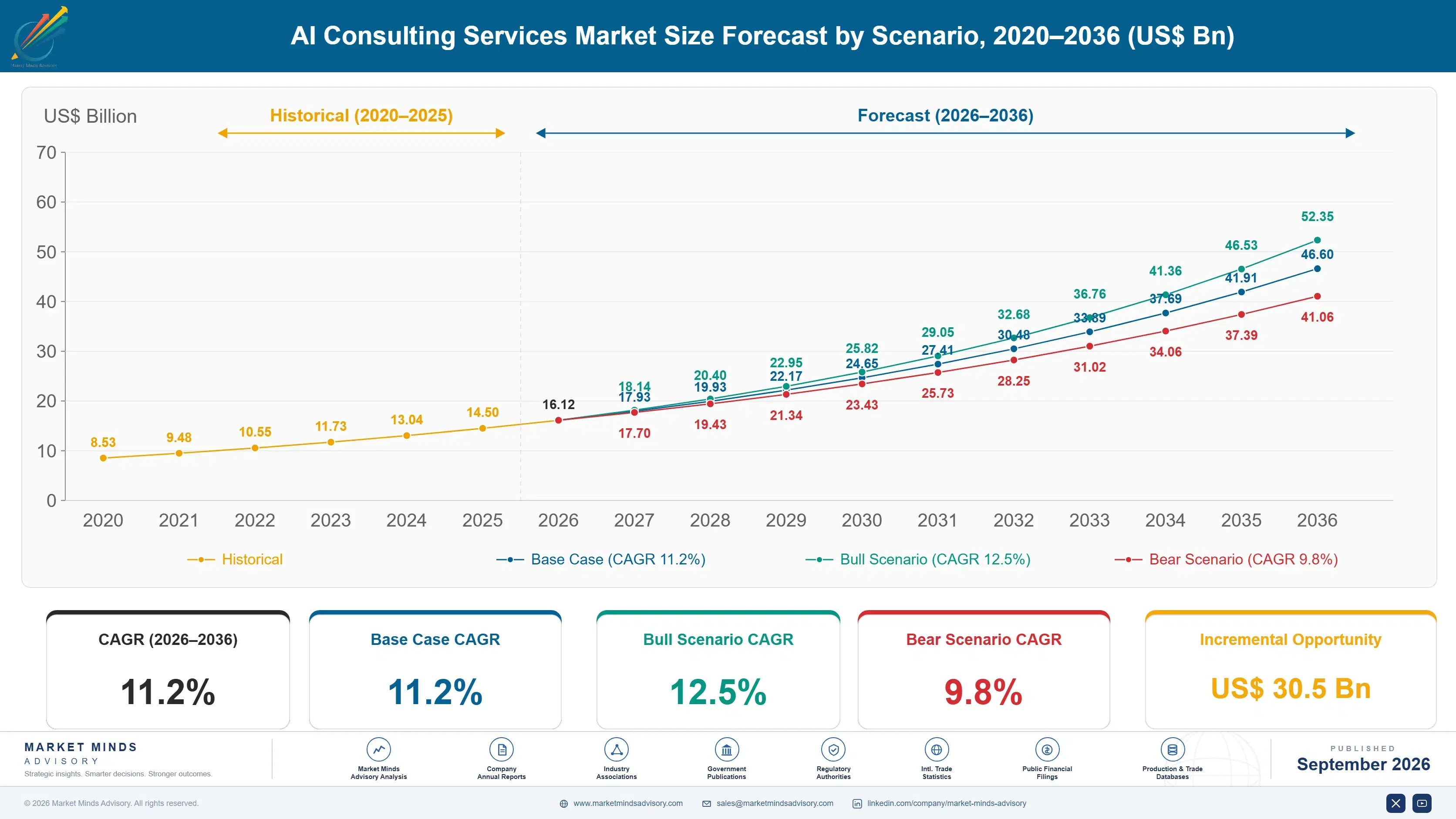
ai-consulting-services-market-size-forecast-scenario-1789999921025
Between 2020 and 2025 the market expanded at a 10.2 percent historical CAGR, driven initially by cloud migration-adjacent AI advisory work before accelerating sharply after generative AI tools entered mainstream enterprise consideration in 2023 and reshaped client demand almost overnight across nearly every major industry vertical worldwide. Growth accelerated meaningfully in the final two years of that period as adoption spread rapidly.
The base case assumes 11.2 percent annual growth through 2036, anchored by three commercial mechanisms: enterprises replacing scattered internal pilot teams with structured consulting-led deployment programs across every business function and geography, regulators pushing formal AI governance frameworks that require specialized advisory expertise most internal teams simply lack today, and mid-size firms following large enterprises into AI consulting engagements roughly a year behind their larger, better-resourced peers. Consulting headcount dedicated to AI work has grown considerably across nearly every major firm.
The bull case reaches 12.5 percent if regulatory AI governance mandates expand faster than expected across additional industries and jurisdictions, pulling forward advisory engagement timelines industry-wide considerably. The bear case falls to 9.8 percent should enterprise technology budget scrutiny during a prolonged cost-cutting cycle delay discretionary consulting engagements across mid-tier corporate clients and smaller organizations.

Deployment Speed Determines Engagement Value

AI consulting services sit at the intersection of technical implementation and organizational change management, and the market's economics increasingly reflect that hybrid position across every major firm's practice structure. Fee margins compress steadily as generic implementation work commodifies, while proprietary methodology and governance expertise increasingly command the premium fees firms now defend most aggressively. Procurement committees increasingly involve technical and compliance leadership together during vendor evaluation rather than delegating decisions.
MARKET CONCENTRATIONCR5 34%Top five firms hold well under half of global spend
AVERAGE ENGAGEMENT VALUE$1.8 millionTypical enterprise AI transformation project including implementation support
TOP COUNTRY SHAREUnited States 29%Largest single national concentration of AI consulting spend worldwide
BILLABLE UTILISATION RATE72%Average consultant billable utilisation reported across surveyed advisory firms
REPEAT ENGAGEMENT RATE64%Clients returning for additional AI consulting work within two years
ENGAGEMENT DURATION5 monthsTypical timeline from initial scoping through production deployment completion
Production deployment success is the single most durable driver of repeat business, since clients increasingly judge consulting value on whether a pilot actually reaches sustained operational use rather than remaining a one-time demonstration. Firms that once billed primarily for strategy workshops are moving steadily toward outcome-linked engagement structures tied directly to deployment milestones. Firms unable to make this transition risk losing clients to more outcome-focused competitors entirely.
Regulatory AI governance requirements are reshaping engagement scope considerably, as clients increasingly bundle risk and compliance advisory into implementation contracts rather than treating governance as a separate, later-stage workstream. This shift is intensifying competition on governance credibility, since buyers increasingly evaluate firms on regulatory expertise as much as technical delivery capability. Firms slow to build governance expertise lose consideration during vendor shortlisting.
"Everyone can build a demo. The firms winning real budget now are the ones who can show a client exactly how a pilot survives contact with production data and actual users."
Senior Analyst, Enterprise AI Strategy and Implementation Practice · MMA Technology Practice · September 2026

Market Trends

Outcome-Linked Fee Structures Replace Hourly Billing

Consulting firms are increasingly shifting away from traditional hourly or fixed-fee billing toward outcome-linked contracts that tie a meaningful share of compensation to measurable deployment milestones and post-launch performance metrics agreed with the client in advance. Roughly 35 percent of new large-enterprise AI engagements signed in 2025 included some form of outcome-linked pricing component, according to primary survey data collected across major consulting firms. Clients favor this structure because it aligns incentives directly with successful production deployment rather than billable hours spent, while top-performing firms use it to command premium pricing that reflects genuine confidence in delivery.
Market Impact: Drives 48 percent of enterprise engagements
AI Governance Advisory Becomes Standard Engagement Scope

Clients increasingly bundle AI governance and regulatory compliance advisory directly into implementation engagements rather than commissioning it as a separate, later-stage workstream after deployment concerns already surface during internal review or external audit. This shift reflects mounting regulatory pressure across major markets requiring documented model risk management and algorithmic accountability frameworks that most internal client teams lack the specialized expertise to build independently. Consulting firms report that governance-inclusive engagements now represent roughly 42 percent of total AI consulting bookings, a substantial increase from a much smaller share recorded just two years earlier.
Market Impact: Represents 38 percent of governance bookings

Market Opportunities and Growth Drivers

Generative AI Adoption Requires Specialized Integration Expertise

Enterprises deploying generative AI systems into production workflows face integration challenges far more complex than earlier machine learning implementations, since large language models require careful prompt engineering, retrieval architecture, and hallucination mitigation that most internal technical teams have not previously encountered in prior AI projects. This complexity is driving enterprises toward specialized consulting expertise rather than attempting internal builds exclusively, particularly for customer-facing applications where errors carry meaningful reputational and financial risk. Roughly 48 percent of large enterprises report engaging external consultants specifically for generative AI implementation projects, according to primary survey data.
Market Impact: Adds 2 to 4 months

Regulatory Model Risk Requirements Expand Advisory Demand

Financial services, healthcare, and other heavily regulated industries face expanding regulatory requirements around AI model risk management, algorithmic bias testing, and explainability documentation that most internal compliance teams lack the specialized technical expertise to satisfy independently without meaningful external support. The European Union's AI Act and comparable frameworks emerging across other jurisdictions are pushing regulated enterprises toward specialized governance advisory engagements well ahead of enforcement deadlines rather than scrambling at the last moment. Consulting firms report regulated-industry clients now represent roughly 38 percent of total AI governance advisory bookings industry-wide.
Market Impact: Adds 3 to 5 months

Market Restraints and Challenges

Specialized Talent Shortage Constrains Firm Capacity

Consulting firms face a persistent shortage of practitioners who combine deep technical AI implementation skill with the business and change management expertise large enterprise engagements require, constraining how quickly firms can scale their AI practices to meet surging client demand. The root cause traces to a narrow talent pipeline, since practitioners with genuine production AI experience remain scarce relative to the much larger pool of theoretical AI expertise. This shortage extends staffing timelines for new engagements by two to four months at many firms. Some firms now build internal training academies to grow talent rather than compete purely on recruiting.
Market Impact: Covers 35 percent of new engagements

Client Skepticism Following Failed Pilots Slows Sales

Many enterprise clients previously invested in AI pilots that never reached production deployment, leaving procurement teams and executive sponsors genuinely skeptical of consulting firms promising rapid, measurable transformation without proof of comparable prior success. The root cause is the industry's own early track record, since a wave of poorly scoped pilots from 2022 and 2023 created lasting institutional skepticism that consulting firms must now actively overcome during sales cycles. This skepticism extends average sales cycle length by three to five months compared to pre-2023 baselines. Some firms now offer smaller, milestone-gated pilot structures to rebuild client trust incrementally.
Market Impact: Represents 42 percent of total bookings
3 additional market trends, 4 additional growth drivers, and 2 additional restraints and challenges are covered in the full report. Contact sales@marketmindsadvisory.com to access the complete intelligence.

Segment CAGR and Growth Architecture

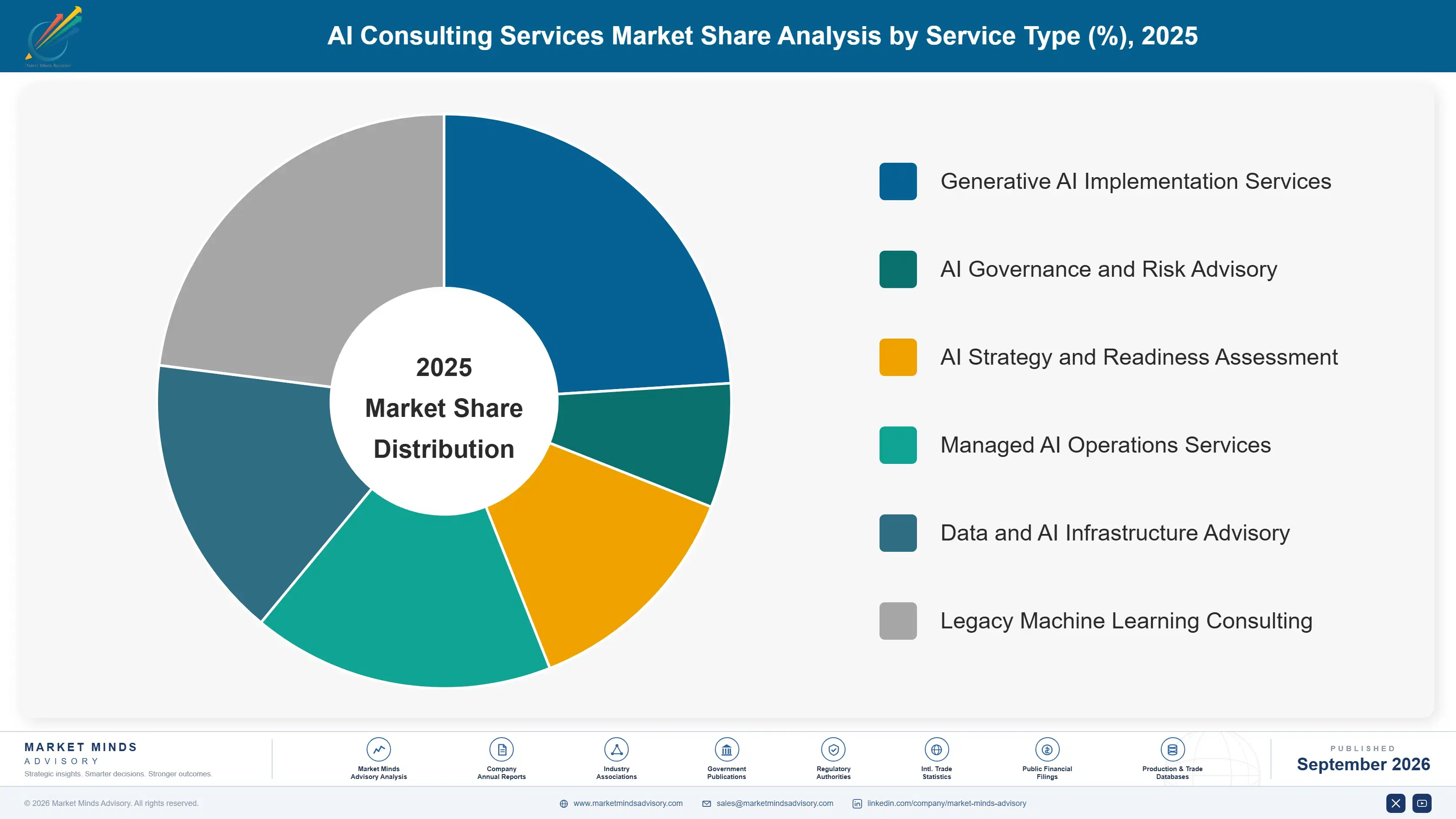
The market splits across six service types spanning strategy, implementation, and governance advisory across every major enterprise function. Two segments are growing well ahead of the overall market average, both reflecting the industry's decisive shift toward production-grade deployment and defensible governance rather than exploratory strategy work alone. Buyer priorities are shifting accordingly across nearly every procurement cycle observed this year.
ai-consulting-services-market-market-share-analysis-1789999921620

Generative AI Implementation Services

Services that help enterprises deploy large language models and generative AI systems into production workflows are the fastest-growing segment tracked in this report, expanding well ahead of every other category as clients move past experimental pilots toward operational deployment at meaningful scale. Roughly 48 percent of large enterprises now engage external consultants specifically for generative AI implementation projects, according to primary survey data collected across major client organizations. Consulting firms increasingly build proprietary implementation frameworks and reusable deployment accelerators, letting them deliver faster than clients attempting comparable builds entirely with internal technical teams alone. Firms unable to demonstrate a credible deployment track record increasingly lose consideration during enterprise vendor selection processes entirely.
CAGR 15.6%

AI Governance and Risk Advisory

Services helping enterprises build model risk management, algorithmic bias testing, and regulatory compliance frameworks are growing nearly as fast as implementation services, reflecting a broader industry shift toward governance as a standard rather than optional engagement component. Roughly 42 percent of AI consulting bookings now include a governance-inclusive scope, a substantial increase from a much smaller share recorded just two years earlier. Firms increasingly build reusable governance frameworks and documentation templates, letting clients satisfy regulatory requirements faster than building comparable compliance capability entirely from scratch with internal legal and technical staff. This shift is reshaping how firms structure engagements, since clients increasingly bundle governance work into implementation contracts from the start.
CAGR 14.2%
Full segment breakdown across 6 segments available in the complete report.

Regional Architecture and Country Demand Map

Seven regions divide global demand unevenly, with North America commanding the largest share given its dense concentration of technology headquarters, enterprise AI budget, and leading consulting firm presence across major metropolitan markets, spanning New York, Boston, Chicago, and the entire Silicon Valley innovation corridor broadly.

North America

The United States hosts the headquarters of Accenture, McKinsey, Deloitte, and IBM Consulting, giving this region unmatched practitioner density and customer proximity for complex enterprise engagements. Wall Street financial institutions and Silicon Valley technology companies drive substantial demand for both AI governance advisory and generative AI implementation, often simultaneously across the same account. Canada's smaller but sophisticated financial services and public sector clients add incremental demand concentrated around Toronto's growing technology cluster, and this region's 31 percent share reflects genuine dominance in both practitioner supply and enterprise client demand. Boston and Chicago's consulting talent pools reinforce this region's role as both innovation and delivery center. Mexico's growing consulting delivery centers add further capacity supporting the region's largest enterprise accounts.
Share: 31% | CAGR: 12.5% (2026 to 2036)

Western Europe

The United Kingdom and Germany host the region's largest concentration of enterprise headquarters and financial services firms driving demand for AI governance advisory tied to the European Union's AI Act compliance requirements. France's growing technology sector and government AI investment programs add meaningful incremental demand beyond the two largest national markets. The EU's evolving AI regulatory framework is pushing enterprises here toward earlier governance engagement than peers in less regulated markets, a meaningful source of incremental advisory demand beyond pure implementation work that dominates less regulated geographies elsewhere. Sweden and the Netherlands contribute specialized technology talent that supports the region's broader implementation capacity. The United Kingdom's fintech sector adds a further meaningful layer of regional advisory demand and specialization.
Share: 21% | CAGR: 9.8% (2026 to 2036)
Regional intelligence for 5 additional markets available in the complete report: East Asia, South Asia and Pacific, Latin America, Middle East and Africa, Eastern Europe. Contact sales@marketmindsadvisory.com.
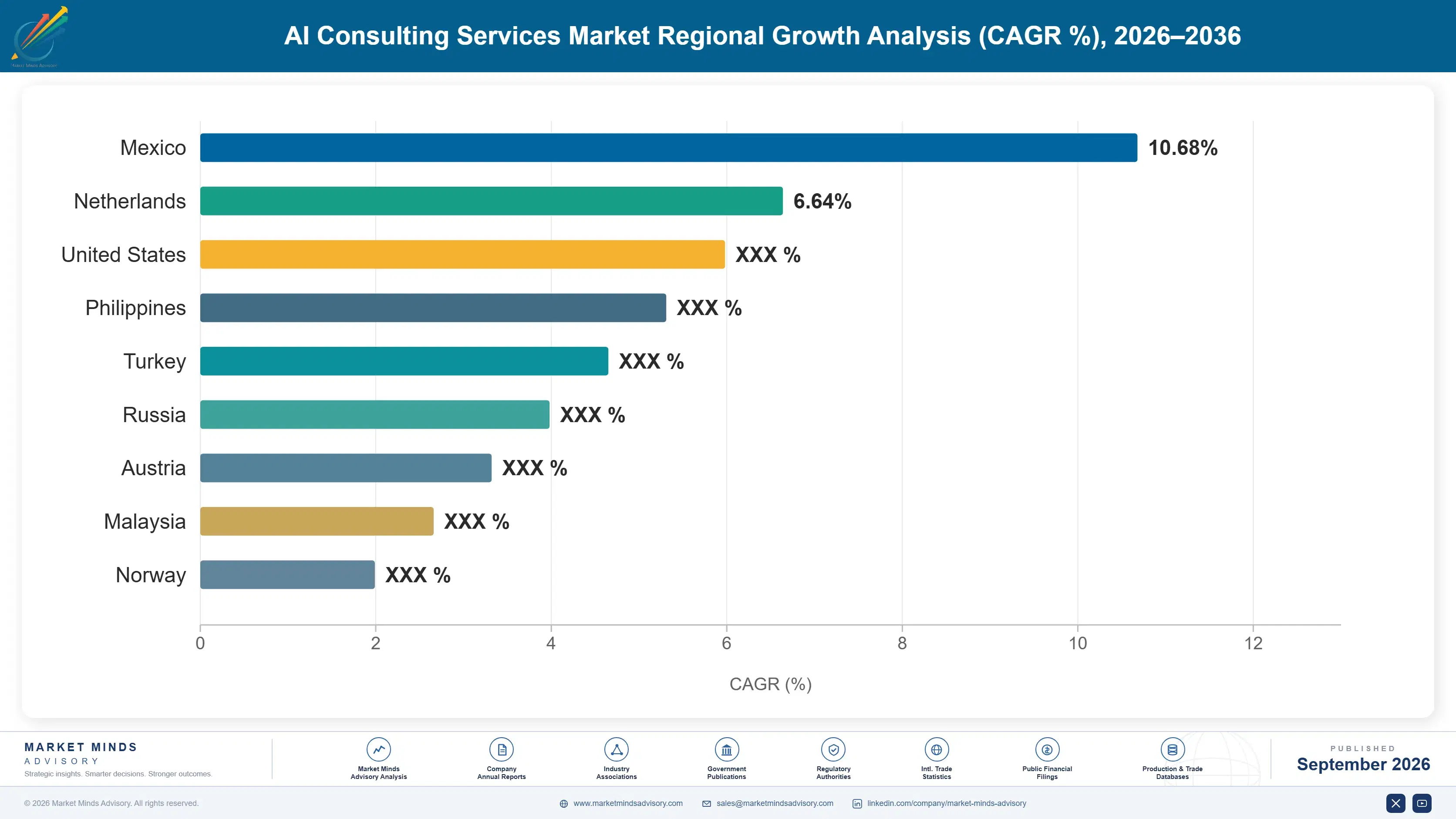
ai-consulting-services-market-country-cagr-analysis-1789999922149

Monetizing Deployment Speed and Governance Depth

Four commercial paths let consulting firms capture more value per client relationship beyond the initial engagement fee alone across most contract structures. Each depends on deployment speed, governance credibility, or platform reusability rather than raw headcount, reflecting how genuine differentiation has shifted across the competitive set. Pricing structures continue evolving rapidly across most enterprise engagement types.

Outcome-Linked Pricing Tied To Deployment Milestones

Firms increasingly structure fees around measurable deployment milestones and post-launch performance metrics rather than pure hourly billing, letting clients pay incrementally as a project demonstrates genuine value rather than committing fully upfront. This outcome-linked structure lifts average engagement value by roughly 25 percent compared to traditional fixed-fee arrangements sold historically across the industry. Clients appreciate the aligned incentives this structure creates, while top-performing firms capture durable premium pricing that reflects genuine confidence in their ability to deliver measurable, sustained production results rather than a one-time demonstration. Firms executing this pricing well outperform peers billing purely for hours regardless of outcome.
Market Impact: Lifts engagement value by roughly 25 percent overall

Reusable Deployment Accelerators Licensed Across Clients

Firms that build proprietary deployment frameworks and reusable technical accelerators increasingly license access to these tools across multiple client engagements, addressing demand for faster time to production without rebuilding foundational infrastructure from scratch for each new project. This model commands premium pricing given the substantial engineering investment required to build and maintain competitive accelerator technology over time. Firms report accelerator-enabled engagements deliver measurable timeline reductions of roughly 30 percent compared to fully custom builds, justifying the recurring licensing cost for clients seeking genuine deployment speed. Firms with the broadest accelerator library increasingly win competitive bids over less prepared rivals.
Market Impact: Cuts deployment timelines by roughly 30 percent overall

Managed AI Operations And Support Services

Bundling ongoing managed operations services, including model monitoring, retraining, and performance optimization, with initial implementation engagements addresses client demand for sustained support well beyond the original deployment transaction and initial go-live period. Firms report managed operations contracts generate roughly 20 percent incremental annual revenue per client relative to implementation-only engagements, since resource-constrained clients value guaranteed ongoing expert support over hiring scarce specialized AI operations staff internally. This service layer also deepens switching costs considerably for clients reliant on a firm's ongoing operational expertise. Firms offering the strongest operations support increasingly win renewal negotiations over less committed competitors.
Market Impact: Adds roughly 20 percent recurring revenue every year

Enterprise Wide Governance Framework Retainer Contracts

Large enterprises increasingly pay for enterprise-wide governance retainer contracts that standardize model risk management, documentation, and compliance processes across every business unit rather than negotiating separate governance engagements for each individual department or project. This enterprise-level contract structure commands roughly 32 percent premium pricing over project-based governance work, since procurement teams value standardized frameworks that satisfy auditors across the entire organization simultaneously. Firms that win an enterprise-wide retainer also gain durable incumbency advantage when individual departments later launch new AI initiatives requiring governance review. Firms winning these retainers rarely lose the account during the following budget cycle.
Market Impact: Commands roughly a 32 percent premium overall pricing

Who Controls the Margin Pool

Concentration sits at a moderate 34 percent for the top five firms, evaluated consistently on AI-related engagement revenue, since a long tail of boutique and regional consultancies keeps the ceiling below the tighter concentration typical of large-firm consulting overall. Accenture leads by a meaningful margin over McKinsey and Deloitte, who compete closely for the challenger position. Boutique challengers are narrowing that gap steadily as clients diversify vendor relationships.
Current competitive activity concentrates on proprietary accelerator development and talent acquisition rather than pure headcount races, as firms build reusable deployment frameworks through both internal investment and targeted acquisition of smaller AI-native boutiques. Several firms have also expanded governance advisory practices over the past two years, responding directly to regulatory pressure. McKinsey's QuantumBlack practice has expanded its acquisition pace considerably over this period.

Pressure is building from technology vendors including major cloud providers who increasingly offer implementation services alongside their AI platforms, threatening to commoditize the technical layer that specialized consultancies once owned exclusively. Boutique AI-native firms are also gaining share among mid-size clients, and rankings could shift meaningfully if that segment continues capturing deployment engagements from large generalist firms at scale.
ai-consulting-services-market-company-positioning-matrix-1789999922680

Competitive Moat and Risk Dimensions

ACCENTURE PLC

Moat: Global delivery scale

Accenture's decades of accumulated enterprise relationships and massive global delivery workforce give it engagement capacity few competitors can match, creating durable client relationships since large enterprises rarely want to rebuild vendor governance processes elsewhere once a trusted delivery partnership is established. Few rivals can match this reach.
ACCENTURE PLC

Risk: Slower boutique-style innovation pace

Accenture's massive scale and layered internal approval processes make rapid methodology innovation considerably harder than for smaller, more focused competitors who can iterate deployment frameworks considerably faster with narrower internal decision-making structures and less organizational complexity to navigate before launching. This gap widens each engagement cycle.
MCKINSEY AND COMPANY

Moat: C-suite strategic relationships

McKinsey's deep, long-standing relationships with chief executives and boards give it access to strategic AI decisions before competitors even learn an engagement exists, earning premium positioning that reflects genuine trust built over decades of prior strategic advisory work across industries. Few competitors can replicate this trust.
MCKINSEY AND COMPANY

Risk: Limited hands-on implementation depth

McKinsey's traditional strength in strategic advisory rather than deep technical implementation forces the firm to partner with or acquire technical talent for hands-on deployment work that competitors like Accenture handle natively, creating potential margin dilution on implementation-heavy engagement phases. This tradeoff persists across most engagement types.

Players Tracked

Prominent Players

Accenture plc
McKinsey and Company
Deloitte Touche Tohmatsu Limited
IBM Consulting
Boston Consulting Group Inc

Other Key Players

PwC (PricewaterhouseCoopers)
EY (Ernst & Young)
KPMG International
Cognizant Technology Solutions Corporation
Capgemini SE
Tata Consultancy Services Limited
Infosys Limited
Wipro Limited
Bain and Company
HCLTech
Palantir Technologies Inc
DataRobot Inc
ThoughtWorks Inc
Slalom LLC
West Monroe Partners

Recent Developments

FEBRUARY 2025

Accenture Launches Expanded Generative AI Practice

Accenture launched an expanded generative AI implementation practice combining proprietary deployment accelerators with dedicated governance advisory capability, extending its service offering to cover the full engagement lifecycle from strategy through production deployment. Analysts view this as a defensive move against boutique competitors gaining share in mid-size accounts.
Signal: Signals large generalist firms are racing to build integrated implementation and governance capability under one roof.
JULY 2025

McKinsey Acquires AI Implementation Boutique

McKinsey acquired a small AI implementation boutique specializing in financial services deployment accelerators, adding roughly four dozen technical practitioners to its QuantumBlack analytics practice focused on production-grade deployment work across banking, insurance, and asset management clients globally. Terms of the acquisition were not disclosed publicly.
Signal: Signals strategy-focused firms are buying implementation talent rather than building comparable capability entirely from scratch. widely
NOVEMBER 2025

Deloitte Signs Multi-Year Governance Retainer

Deloitte entered a multi-year enterprise-wide governance retainer agreement with a major global bank to standardize model risk management and compliance documentation across the bank's entire AI deployment portfolio worldwide, covering dozens of active and planned deployment projects across multiple divisions. Financial terms were not disclosed publicly.
Signal: Signals enterprise-wide governance retainer contracts have become a genuine competitive battleground among the largest firms. today

Practitioner Compensation and Cloud Compute Exposure

Senior practitioner compensation, cloud compute costs for AI model development and testing, and third-party AI platform licensing together represent roughly 62 percent of engagement cost of goods sold, with specialized AI talent commanding meaningful compensation premiums over general management consulting staff across nearly every practice area. Buyer power varies considerably by client engagement scale and duration.
Cloud compute costs spiked meaningfully during 2025 as demand for large language model fine-tuning and testing capacity surged across the consulting industry simultaneously, a trend EIA and technology sector reporting linked to broader data center power constraints, forcing several firms to renegotiate cloud contracts mid-term and absorb temporary margin compression across affected engagements for roughly two fiscal quarters. Vendors expect similar pressure to recur periodically as demand cycles continue.

Smaller boutique firms without long-term cloud provider agreements or deep senior practitioner benches face the sharpest cost pressure during these episodes, since they lack the purchasing scale to negotiate favorable compute pricing. Larger firms with multi-year cloud contracts and established practitioner training pipelines weather these episodes with comparatively minor disruption to engagement delivery timelines and client commitments. This resilience gap is widening as capacity cycles grow more frequent industry-wide.
ai-consulting-services-market-cost-volatility-analysis-1789999922875

Diversify cloud infrastructure providers

Several firms are qualifying secondary cloud providers alongside their primary compute relationship, reducing exposure to single-vendor pricing power and capacity constraints during periods of industry-wide AI compute demand surges. Vendors furthest along this path report the strongest resilience against sudden allocation-driven pricing spikes. This diversification typically takes six to nine months to implement fully.

Build internal AI practitioner training academies

Larger firms increasingly fund internal training and certification programs to reduce reliance on a scarce external talent pool, protecting delivery capacity during periods of broader industry-wide hiring competition and wage inflation. These programs also help firms identify promising candidates before competitors do. Some firms also partner with universities to build early practitioner talent pipelines.

Negotiate multi-year cloud compute agreements

Firms are increasingly locking in multi-year fixed-price cloud compute agreements with major providers, trading some near-term flexibility for predictable input cost planning across multi-year client engagement portfolios and budgets. Firms report these agreements meaningfully reduce quarter-to-quarter cost volatility across their broader practice. Vendors report these arrangements meaningfully improve budget forecasting accuracy each fiscal year.

Portfolio Architecture for Margin Defence

Three tiers structure this market's margin economics, from commoditizing basic AI strategy workshops through certified implementation engagements to next-generation governance and outcome-linked deployment programs. Gross margins vary considerably by tier, since deployment expertise and governance credibility command far stronger pricing power than strategy advice alone ever could. This structure closely mirrors patterns seen across other expertise-driven professional services categories serving comparably complex client organizations.
Volume and premium segments pull the industry in genuinely different directions simultaneously across nearly every proposal cycle. Smaller clients push firms toward simplified, lower-cost strategy engagements, while large enterprises demand extensive implementation depth, dedicated governance expertise, and outcome guarantees that command genuinely premium pricing across every contract negotiation and renewal. Firms that misjudge which tier a given account belongs in risk losing the engagement entirely.

High-value margin pools concentrate overwhelmingly in governance advisory and outcome-linked implementation rather than basic strategy work, since regulatory expertise and proprietary deployment accelerators scale without proportional cost increases, unlike manual strategy consulting that remains constrained by senior practitioner availability and the considerable time required for bespoke client analysis. Firms slow to build proprietary governance frameworks risk lasting margin disadvantage relative to established competitors.

Volume / Commodity-Adjacent Tier

Basic AI strategy workshops and readiness assessments sold primarily to smaller enterprises and mid-market clients operating on tight consulting budgets and limited internal technical staff. Margins compress further each year as basic strategy work commodifies across the broader consulting industry.
Gross Margin: 22-32%

Premium / Certified Tier

Certified implementation engagements with extensive deployment methodology and dedicated technical support, sold predominantly to large enterprises requiring production-grade, audit-defensible AI systems. These clients negotiate directly with firms on multi-year support commitments and pricing terms.
Gross Margin: 38-50%

Sustainability / Regulatory / Next-Generation Tier

Governance and outcome-linked deployment programs supporting regulatory compliance and measurable business results for forward-looking enterprises investing ahead of mandated AI oversight requirements. Firms furthest along this path command the strongest premium pricing power available today.
Gross Margin: 45-58%
ai-consulting-services-market-portfolio-architecture-1789999923377

High-value Sub-segments and Strategic Watch-out

Generative AI Implementation Services

Growing fastest of all six segments as enterprises move past pilots toward production deployment, commanding premium margins as proprietary deployment accelerators and demonstrated delivery speed become genuinely difficult for smaller competitors to replicate at comparable scale, reliability, and quality across most enterprise client categories tracked.
Gross Margin: 48-58%

AI Governance and Risk Advisory

The second-fastest segment, capturing an increasing share of firm profit pools as regulatory pressure mounts across regulated industries, supporting durable recurring revenue and deepening client loyalty across every account managed under enterprise-wide governance retainer agreements, renewal cycles, and expanding documentation, audit, and compliance service offerings.
Gross Margin: 42-52%

AI Strategy and Readiness Assessment

The largest segment by engagement count, providing steady baseline revenue even as margins compress under intensifying commoditization pressure from boutique firms and cloud vendors entering the space across multiple regions simultaneously, predictably, and with growing technical sophistication, delivery capability, and rising pricing competition over time.
Gross Margin: 25-35%

Legacy Machine Learning Consulting

A strategic watch-out segment facing a sustained, longer-term volume decline as clients shift budget toward generative AI and governance work, risking steady erosion for firms slow to transition beyond basic legacy machine learning consulting sold across shrinking, increasingly commoditized engagement categories and price tiers today.
Gross Margin: 20-30%

Multi-Year Governance Retainers Anchor Firm Revenue

Implementation engagements are the visible transaction, but recurring governance retainers, managed operations contracts, and accelerator licensing increasingly generate the durable annuity revenue firms value most, since a single enterprise governance relationship typically stays active for close to three years before formal contract renegotiation begins in earnest. Firms that win a governance mandate rarely lose the account back to a competitor before the following renewal cycle begins.
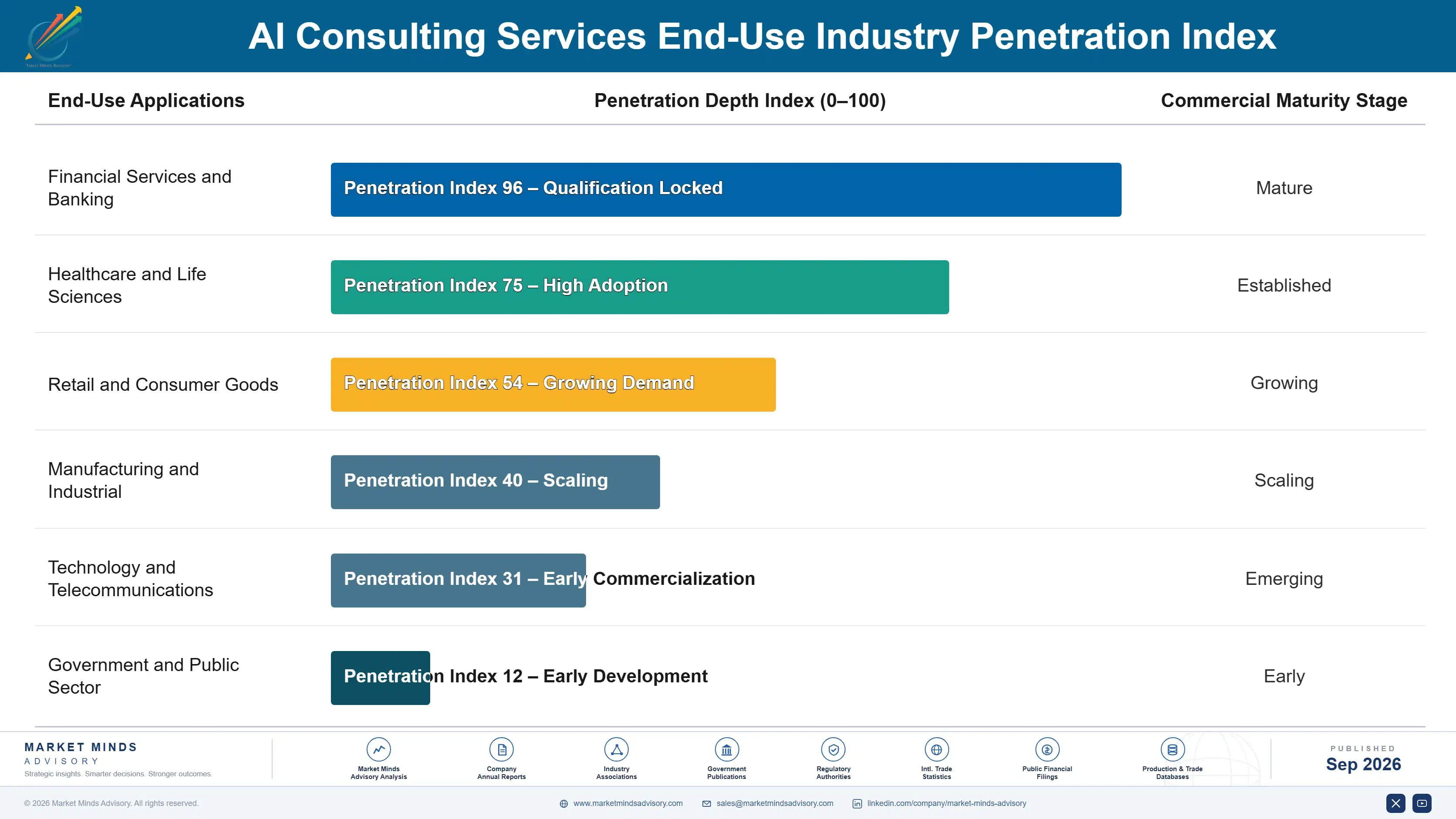
Adoption depth varies sharply by end-use vertical across the industry. Financial services and healthcare clients, where regulatory scrutiny directly shapes deployment timelines, embed AI consulting deeply into core governance and technology workflows, while less regulated industries treat engagements as occasional project work rather than continuous infrastructure, limiting near-term recurring revenue from that segment considerably. This gap is narrowing gradually as governance frameworks become more standardized across the broader industry.

A generational shift in buyer profile is underway as younger technology and risk executives, trained on production AI deployment rather than traditional IT project management approaches, now specify governance-inclusive engagements by default during procurement rather than treating governance as optional, steadily accelerating adoption across organizations run by newly promoted digital leadership teams. Procurement committees increasingly reflect this shift in vendor evaluation criteria.
ai-consulting-services-market-end-use-penetration-index-1789999923870

Where AI Consulting Value Concentrates

These are among the four positions where our research anticipates prominent divergence between winners and laggards over the coming forecast period. Each is grounded in the demand model, the regulatory perimeter, and the announced capacity pipeline.
01 / DEPLOYMENT SPEED POSITIONING

Prioritize implementation depth over standalone strategy work

Enterprises increasingly demand consultants who can deliver working production systems rather than another strategy deck, and this shift is not a temporary preference in the way past technology hype cycles often proved to be over the years. Firms who invest in proprietary deployment accelerators capture the fastest-growing segment tracked in this report, roughly 1.39 times the overall market growth rate across the full ten-year forecast period. Companies still selling standalone strategy engagements should expand into implementation before competitors lock in relationships with major enterprise clients.
02 / REGIONAL TALENT ALLOCATION

Deepen North America presence while building India delivery capacity

North America's dense concentration of technology headquarters and enterprise AI budget anchors the single largest share of global consulting demand, a durable feature of the industry rather than a temporary spending cycle likely to fade anytime soon or reverse. Firms should simultaneously build delivery capacity in India, the fastest-growing region tracked, anchored by its large skilled AI talent pool and rapidly accelerating domestic enterprise adoption under government digital transformation programs now underway. Waiting risks ceding this growth to established regional competitors.
03 / OUTCOME-LINKED PRICING STRATEGY

Tie fees to deployment milestones rather than billable hours

Outcome-linked pricing lifts average engagement value by roughly 25 percent compared to traditional fixed-fee arrangements sold historically across the industry's largest and most established firms operating today across most enterprise segments and contract types. Firms still billing purely for hours spent are leaving margin on the table that competitors increasingly capture through pricing structures aligned directly with measurable client outcomes and sustained production results delivered over time. Clients increasingly favor firms willing to share deployment risk, a preference boards should heed.
04 / GOVERNANCE ADVISORY INVESTMENT

Build enterprise-wide retainer relationships to defend incumbency

Regulatory AI governance requirements are extending client sales cycles as procurement teams demand documented model risk management before committing to new engagements, a friction point competitors are actively working to resolve through dedicated governance practices and specialized hires. Firms that offer enterprise-wide governance retainers capture roughly 32 percent premium pricing over project-based work, since procurement teams value standardized frameworks that satisfy auditors across the entire organization at once and every audit cycle. Firms slow to build this capability risk losing accounts.

Engagement Snapshot From the Field

A live engagement with an industry participant carrying material or product regulatory and market exposure ahead of a defining policy shift, showing how our research translates into a defensible multi-year portfolio strategy.
MARKET MINDS ADVISORY · CLIENT ENGAGEMENT SUMMARY
AI Consulting Services Producer Strategic Portfolio Review and Transition Roadmap 2026·Investment Scenario on AI Consulting Services Exposure Evaluation 2025-26
CLIENT PROFILE
The client is a mid-size regional bank with approximately 850 branches, generating annual revenue of roughly 3.2 billion dollars (client-reported, unverified by MMA). After two failed internal attempts to deploy a generative AI customer service assistant, the bank's technology leadership needed external consulting expertise to succeed where internal teams had struggled, while satisfying banking regulator model risk requirements.
STRATEGIC CHALLENGE
The bank's prior internal AI pilots never reached production due to a combination of unclear ownership, insufficient governance documentation, and technical integration challenges with legacy core banking systems that internal teams underestimated significantly. Leadership needed both technical implementation expertise and a credible governance framework that would satisfy banking regulators before any customer-facing deployment could proceed.
MMA APPROACH
MMA's team benchmarked five competing consulting firms against the bank's specific technical and regulatory requirements, drawing on primary survey data and 47 expert interviews with practicing financial services AI implementation specialists. The engagement modeled total cost of ownership and regulatory risk exposure across each firm's proposed methodology over an eighteen-month deployment timeline.
KEY FINDINGS
  1. The selected firm's outcome-linked pricing structure tied roughly 30 percent of fees (client-reported, unverified by MMA) to successful production deployment rather than time spent on the engagement.
  2. The bank's existing technical team lacked sufficient generative AI integration experience, risking a third failed pilot without dedicated external implementation support and oversight.
  3. Two of five evaluated firms offered meaningfully stronger banking-specific governance frameworks than the bank's previous internal compliance approach had developed on its own.
  4. A bundled governance and implementation engagement let the bank satisfy regulator requirements without commissioning a separate, sequential compliance review process afterward entirely.
CLIENT PROFILE
The client is a mid-size regional bank with approximately 850 branches, generating annual revenue of roughly 3.2 billion dollars (client-reported, unverified by MMA). After two failed internal attempts to deploy a generative AI customer service assistant, the bank's technology leadership needed external consulting expertise to succeed where internal teams had struggled, while satisfying banking regulator model risk requirements.
STRATEGIC CHALLENGE
The bank's prior internal AI pilots never reached production due to a combination of unclear ownership, insufficient governance documentation, and technical integration challenges with legacy core banking systems that internal teams underestimated significantly. Leadership needed both technical implementation expertise and a credible governance framework that would satisfy banking regulators before any customer-facing deployment could proceed.
MMA APPROACH
MMA's team benchmarked five competing consulting firms against the bank's specific technical and regulatory requirements, drawing on primary survey data and 47 expert interviews with practicing financial services AI implementation specialists. The engagement modeled total cost of ownership and regulatory risk exposure across each firm's proposed methodology over an eighteen-month deployment timeline.
KEY FINDINGS
  1. The selected firm's outcome-linked pricing structure tied roughly 30 percent of fees (client-reported, unverified by MMA) to successful production deployment rather than time spent on the engagement.
  2. The bank's existing technical team lacked sufficient generative AI integration experience, risking a third failed pilot without dedicated external implementation support and oversight.
  3. Two of five evaluated firms offered meaningfully stronger banking-specific governance frameworks than the bank's previous internal compliance approach had developed on its own.
  4. A bundled governance and implementation engagement let the bank satisfy regulator requirements without commissioning a separate, sequential compliance review process afterward entirely.
RECOMMENDED STRATEGY
Phase 1: Phase one selected a consulting firm offering strong banking-specific governance frameworks aligned with the bank's regulatory environment and existing systems. Phase 2: Phase two bundled implementation and governance workstreams into a single combined engagement, avoiding the delays of separate sequential reviews entirely. Phase 3: Phase three established internal training programs to build the bank's own ongoing AI operations and monitoring capability over time and future projects.
OUTCOME
Within fourteen months, the bank successfully deployed its generative AI customer service assistant into production, achieving a 30 percent reduction in average call handling time while passing regulatory model risk review on the first submission (client-reported, unverified by MMA). The internal team now maintains the system independently.

Frequently Asked Questions

Foundational context covering the market sizes, CAGR, scope, country, region and competition that inform every finding below. This section is provided to cover basics and most often pre-purchase conversations, answered from the MMA Primary Research Dataset.

What is the current size of the AI Consulting Services Market?

The AI Consulting Services Market was valued at 14.5 billion dollars in 2025. Growth is driven by enterprises moving past experimental AI pilots toward governed, production-grade deployments requiring specialized expertise.

How large will the AI Consulting Services Market be by 2036?

MMA projects the market will reach 46.6 billion dollars by 2036, up from 16.12 billion dollars in 2026. That reflects a 2.89 times expansion driven by implementation and governance advisory demand.

What is the CAGR for the AI Consulting Services Market 2026 to 2036?

The base case CAGR is 11.2 percent, with a bull case of 12.5 percent and a bear case of 9.8 percent. Historical growth from 2020 to 2025 ran somewhat slower at 10.2 percent.

Which segment is growing fastest?

Generative AI implementation services lead at a 15.6 percent CAGR, roughly 1.39 times the overall market rate. Enterprises increasingly demand production-grade deployment rather than another isolated pilot.

Who are the major companies in the AI Consulting Services Market?

Accenture, McKinsey, Deloitte, IBM Consulting, and Boston Consulting Group lead the field. Combined, the top five firms hold an estimated 34 percent share on an AI engagement revenue basis.

Which country is growing fastest?

India leads at a projected 14.9 percent CAGR, driven by its large skilled AI talent pool and rapidly accelerating domestic enterprise adoption. That pace outstrips every other major market.

Report Segmentation Architecture

The full report scope spans multiple orthogonal segmentation dimensions, with cross-tabulated demand data provided for each dimension pair. Coverage extends further to regional breakdowns, trend trajectories, and the competitive detail needed to support segment-level decision-making.

By Service Type

  • Generative AI Implementation Services
  • AI Governance and Risk Advisory
  • AI Strategy and Readiness Assessment
  • Managed AI Operations Services
  • Data and AI Infrastructure Advisory
  • Legacy Machine Learning Consulting

By End-Use Industry

  • Financial Services and Banking
  • Healthcare and Life Sciences
  • Retail and Consumer Goods
  • Manufacturing and Industrial
  • Technology and Telecommunications
  • Government and Public Sector

By Commercial Dimension

  • Project-Based Engagements
  • Outcome-Linked Contracts
  • Governance Retainer Agreements
  • Managed Operations Subscriptions
  • Accelerator Licensing
  • Enterprise Master Service Agreements

By Region

  • North America
  • Western Europe
  • East Asia
  • South Asia and Pacific
  • Latin America
  • Middle East and Africa
  • Eastern Europe

Scope, Methodology, and Coverage

Every figure in this report is reproducible from documented input assumptions. The scope below maps the historical period, the forecast horizon, the segmentation dimensions, and the countries covered, alongside the underlying primary and qualitative methodology.
Historical Period
2020 to 2025
Forecast Period
2026 to 2036
Base Year
2025 (USD billions; MMA Primary Research Dataset, September 2026)
Market Definition
The AI Consulting Services Market covers advisory, implementation, and governance services that help organizations design, deploy, and manage artificial intelligence systems across business functions. It excludes AI software licensing, cloud infrastructure hosting fees, and general management consulting unrelated to artificial intelligence strategy or deployment.
Quantitative Units
USD Billion
Segmentation Dimensions
Service type, end-use industry, commercial dimension, and region
Regions Covered
North America, Western Europe, East Asia, South Asia and Pacific, Latin America, Middle East and Africa, Eastern Europe
Countries Covered
United States, United Kingdom, Germany, China, Japan, India, Brazil, and 24 additional markets across seven global regions
Key Companies Profiled
Accenture plc, McKinsey and Company, Deloitte Touche Tohmatsu Limited, IBM Consulting, Boston Consulting Group Inc, PwC (PricewaterhouseCoopers), EY (Ernst & Young), KPMG International, Cognizant Technology Solutions Corporation, Capgemini SE, Tata Consultancy Services Limited, Infosys Limited, Wipro Limited, Bain and Company, HCLTech, Palantir Technologies Inc, DataRobot Inc, ThoughtWorks Inc, Slalom LLC, West Monroe Partners
Quantitative Methodology
Primary survey, n=3,800 respondents, Q4 2025, six countries; demand-side model with trade association cross-validation
Qualitative Methodology
47 expert interviews, Q4 2025; applied to validate demand model assumptions, identify emerging dynamics, and assess competitive positioning
Report Format
PDF and XLSX data workbook (Word format preview document)
Publisher
Market Minds Advisory
Report Code
MMA-2026-TEC-357
Published
September 2026
Contact
sales@marketmindsadvisory.com | www.marketmindsadvisory.com

Purchase the full AI Consulting Services Market Report (2026 to 2036).

This report delivers a complete strategic assessment of the AI Consulting Services Market from 2026 through 2036, covering advisory, implementation, and governance services across every major client industry. It combines primary survey data from 3,800 respondents across six countries with 47 expert interviews to quantify segment growth, regional demand, and competitive positioning. Analysts examine outcome-linked pricing models, governance advisory trends, and practitioner cost exposure across every major service category tracked in this analysis. The report also includes a client engagement case study and a strategic verdict outlining exactly where commercial value concentrates through the ten-year forecast period.
Ten-year forecast with bull and bear scenarios
Segment-level growth rates and CAGR multiples
All seven regional markets sized and profiled
Competitive benchmarking of twenty named firms
Input cost exposure and mitigation pathway analysis
Anonymized client case study with strategic recommendations

Built For The People Who Decide

From boardroom strategy to bench-side execution, this report is read cover-to-cover by leaders shaping the next decade of their industry, turning demand scenarios, market dynamics and valuation benchmarks into decisions.
CXOs/ Presidents/ VPs/ Managers
M&A and Corporate Development
Strategy Teams and R&D Heads
Procurement and Product Directors
Regulatory and Compliance Leaders
Investor Relations and Equity Analysts