Market Minds Advisory
AI-based Clinical Trials Solution Provider Market

AI-based Clinical Trials Solution Provider Market: Patient Recruitment and Protocol Design Automation

Sponsors and contract research organizations are deploying machine learning across patient recruitment, protocol design, and real-world evidence synthesis as trial costs keep rising, converting AI from a pilot-stage experiment into budgeted infrastructure across development programs.

Lead Analyst

Alice Ballenger

Published

September 2026

Make Smarter Decisions with Customized Research Insights

Request a free sample report and evaluate market opportunities, growth trends, and competitive dynamics relevant to your business needs.

2025 MARKET VALUE$2.1BMarket Size 2025
2036 FORECAST VALUE$10.9BBase Case , 2026 to 2036
CAGR 2026 TO 203616.2 %Bull 17.5% / Bear 14.8%
INCREMENTAL OPPORTUNITY$8.5BNet 10- year value creation
EXPANSION MULTIPLE4.48x2036 value over 2026 base
Strategic Levers
M&A Pipeline
Regional Outlook
Country Rankings
Competitive Intelligence
Segmental Deep-dive
Call-Us : 91 93563 13602

Executive Snapshot and Market Trajectory

AI-based clinical trial solutions are moving from isolated pilot programs into standard sponsor infrastructure, as rising trial costs and chronic patient recruitment delays finally give development teams budget authority to deploy machine learning at production scale. That shift is reshaping how sponsors evaluate technology procurement decisions.
Patient recruitment and matching AI leads every other solution category on growth as sponsors chase the largest source of trial delay. India has become the fastest-growing single country, anchored by expanding trial volume and deep domestic AI talent, while North America still commands the largest share of spending given its concentration of major sponsors. Protocol design and data analytics platforms remain the largest categories by current revenue across nearly every market tracked here.
Competitive character splits between established clinical technology incumbents extending existing platforms with AI capability and a wave of AI-native startups built specifically around a single trial workflow problem. Regulatory pressure cuts in the industry's favor here: the FDA and European Medicines Agency are publishing AI validation frameworks that give sponsors a clearer compliance path than existed even two years ago, accelerating enterprise adoption decisions. Laggards risk losing momentum.
Market Definition
The AI-based clinical trials solution provider market covers software platforms and services applying machine learning to patient recruitment, protocol design, clinical data management, remote monitoring, regulatory submission, and real-world evidence generation for pharmaceutical and medical device development programs. It excludes general-purpose electronic data capture systems without embedded AI functionality and excludes contract research organization staffing services sold independently of a software platform.
Base Year Value
$2.1B in 2025 (MMA Primary Research Dataset, August 2026)
Forecast Period
2026 to 2036, eleven discrete annual values
CAGR
16.2% base case. Bull 17.5%. Bear 14.8%.
Fastest Growth Segment
Patient Recruitment and Matching AI: 19.5% CAGR
Fastest Growth Country
India: 18.8% CAGR
Fastest Growth Region
South Asia and Pacific: 18.4% CAGR
Largest Region
North America: 32% of 2025 global value
Market Leaders
Veeva Systems Inc., Medidata Solutions, IQVIA Holdings Inc., Saama Technologies, Inc., Unlearn.AI, Inc. Source: MMA Analysis based on company annual reports.
Primary Survey
n=3,800 procurement and R&D decision-makers, Q4 2025, six countries
Methodology
Demand-side build-up, cross-validated against public data, 47 expert interviews

AI-based Clinical Trials Solution Provider Market Forecast Scenarios

ai-based-clinical-trials-solution-provider-market-size-forecast-scenario-1787303159600
AI-based clinical trial solution adoption grew unevenly between 2020 and 2025. Pandemic-era decentralized trial experimentation briefly accelerated remote monitoring adoption, then budget caution through 2022 slowed broader enterprise rollout before validated recruitment and analytics tools restored momentum, lifting historical growth to an estimated 14.7% compound rate. That budget caution took longer to lift in some sponsor organizations than vendors initially expected.
The base case assumes 16.2% annual growth through 2036, anchored on three mechanisms. First, chronic patient recruitment delays keep pushing sponsors toward AI-based matching tools that shorten enrollment timelines across therapeutic areas. Second, regulatory agencies are publishing clearer AI validation frameworks that reduce compliance uncertainty and accelerate enterprise procurement decisions across major sponsors. Third, real-world evidence and synthetic control arm methodologies are gaining regulatory acceptance, opening new budget categories beyond traditional software.
A bull case builds if regulatory acceptance of synthetic control arms accelerates faster than currently expected, pushing growth toward 17.5%. The bear risk is validation friction: if regulators slow AI model validation requirements more than sponsors currently anticipate, enterprise procurement could stall on compliance uncertainty, capping growth near 14.8% across the forecast period. Either outcome depends heavily on how quickly regulators finalize model validation standards.

From Pilot Programs to Production Trial Infrastructure

AI-based clinical trial solutions remain a small fraction of the broader clinical technology category by current revenue, but the market is undergoing a genuine, lasting shift as validated recruitment and analytics tools convert pilot budgets into standard enterprise infrastructure spending. Platform capability still matters, but demonstrated timeline and cost impact increasingly decides which vendor wins a sponsor's long-term procurement relationship. That shift is reshaping how vendors structu
MARKET CONCENTRATION34% CR5Five providers hold roughly a third of total category revenue
AVERAGE CONTRACT VALUE$1.4 million per enterprise deploymentBlended price across recruitment, analytics, and monitoring platforms
LEADING SPONSOR SEGMENT SHARELarge pharma, 58%One buyer category still dominates total platform spending
PLATFORM UTILISATION RATE61%Deployed platforms run below typical mature enterprise software norms
RECRUITMENT TIMELINE REDUCTION34% average improvementAI-matched trials enroll measurably faster than traditional methods
INPUT COST SHARE42% of platform COGSCloud computing and model training expense dominates delivery cost
Providers compete less on raw feature breadth than on demonstrated trial outcome impact: sponsors specify vendors with documented enrollment timeline and cost reduction data rather than switching for marginal capability advantages on unproven platforms. Development remains concentrated in the United States and increasingly India, while European vendors compete on regulatory compliance depth given the region's stringent data protection requirements.
The next decade will be shaped by two forces pulling in the same direction: rising trial costs pushing sponsors toward measurable AI efficiency gains, and regulatory clarity finally opening budget categories that compliance uncertainty previously constrained. Both push investment toward validated, outcome-proven platforms even as newer entrants without established sponsor relationships struggle to displace incumbents. Vendors slow to adapt risk ceding share to faster-moving rivals.
"Every sponsor has run an AI pilot. The market shifted the moment CFOs started asking why the pilot never became a line item in next year's budget."
Director, Clinical Technology and Digital Health Practice · MMA Healthcare Pract

Market Trends

Regulatory AI Validation Frameworks Reduce Compliance Uncertainty

The FDA's published guidance on AI and machine learning model validation for clinical trial applications, alongside similar European Medicines Agency frameworks, is giving sponsors a clearer compliance pathway than existed even two years ago, converting AI adoption from a legally uncertain experiment into a defensible procurement decision. This is pushing enterprise buyers who previously delayed AI investment pending regulatory clarity to move forward with production-scale deployment across major development programs. Vendors with platforms already aligned to published validation frameworks are capturing disproportionate share of new enterprise contracts as this regulatory clarity continues expanding across additional use cases.
Market Impact: Adds 340,000 AI-matched patient enr

Real-World Evidence and Synthetic Control Arms Gain Acceptance

Regulatory acceptance of synthetic control arms constructed from real-world evidence and historical trial data, reducing the number of patients requiring placebo assignment in certain therapeutic areas, is opening a genuinely new budget category beyond traditional trial operations software entirely. This is converting real-world evidence platforms from an exploratory research tool into a core trial design input that sponsors budget for during protocol planning rather than after enrollment challenges emerge. Vendors with regulatory-accepted synthetic control methodologies are capturing disproportionate share of this emerging budget category as acceptance continues expanding across additional indications.
Market Impact: Cuts average trial operating cost 1

Market Opportunities and Growth Drivers

Chronic Patient Recruitment Delays Sustain Matching Tool Demand

Patient recruitment remains the single largest source of clinical trial timeline delay across nearly every therapeutic area, with a substantial share of trials failing to meet original enrollment targets on schedule, sustaining AI-based matching tools as the category's largest and most durable demand driver regardless of vendor-specific approach. Sponsors are increasingly building recruitment AI evaluation into standard trial planning processes rather than treating it as an optional add-on considered only after enrollment problems emerge. This demand base, while sensitive to pharmaceutical pipeline activity, has proven resilient enough to justify sustained vendor investment across every major therapeutic area tracked here.
Market Impact: Delays 22% of multi-country deploym

Rising Trial Costs Push Sponsors Toward Measurable AI Efficiency

Average trial costs, driven by increasingly complex protocols and expanding regulatory documentation requirements, continue rising faster than general pharmaceutical development budgets, pushing sponsors toward AI tools that demonstrate measurable cost and timeline efficiency rather than platforms offering only qualitative improvements. This cost pressure is converting AI procurement decisions from an innovation-budget experiment into a core operational efficiency investment evaluated against the same return-on-investment criteria applied to other trial spending. Vendors publishing rigorous cost and timeline impact data are converting that evidence into faster enterprise procurement cycles across major sponsor organizations.
Market Impact: Limits training data access to 31%

Market Restraints and Challenges

Data Privacy Regulation Complicates Cross-Border Model Training

Data protection regulation, particularly the European Union's General Data Protection Regulation and increasingly similar frameworks elsewhere, creates genuine complexity for vendors seeking to train AI models across multi-country trial data, since patient-level data often cannot cross certain jurisdictional boundaries even in de-identified form. The root cause is that clinical trial data protection frameworks were largely written before AI model training became a common secondary use case, leaving vendors navigating ambiguous compliance requirements that vary meaningfully by jurisdiction. Some vendors are mitigating this by developing federated learning approaches that train models without moving underlying patient data across borders directly.
Market Impact: Adds 28% to enterprise procurement

Sponsor Data Silos Limit Model Training Effectiveness

Clinical trial data remains fragmented across sponsor-specific systems and historical trial archives that were never designed for AI model training, creating genuine technical friction for vendors seeking to build models on sufficiently broad and representative training data sets. The underlying cause is decades of trial data accumulated in inconsistent formats across different electronic data capture systems and paper-based legacy archives that require substantial cleanup before AI applications can use them reliably. Vendors are mitigating this by building data harmonization and cleanup services directly into their platform offering rather than requiring sponsors to solve data quality problems independently first.
Market Impact: Lifts synthetic control arm adoptio
3 additional market trends, 4 additional growth drivers, and 2 additional restraints and challenges are covered in the full report. Contact sales@marketmindsadvisory.com to access the complete intelligence.

Segment CAGR and Growth Architecture

MMA segments the market by solution type, the classification sponsors and contract research organizations use when specifying platforms and comparing vendor capability across competing procurement decisions. This avoids blending upstream AI model architecture with the downstream workflow categories that define how a given platform is actually purchased and deployed across every major sponsor procurement decision made today.
ai-based-clinical-trials-solution-provider-market-market-share-analysis-1787303160160

Patient Recruitment and Matching AI

Patient recruitment and matching AI, applying machine learning to identify and screen eligible trial participants against protocol criteria, remains the fastest-growing solution category as sponsors chase the single largest source of trial timeline delay across nearly every therapeutic area. Growth concentrates wherever electronic health record access intersects with sponsor willingness to integrate matching platforms directly into site workflow, particularly across North America and India. Saama and Unlearn.AI have each expanded recruitment platform capability substantially, recognizing that demonstrated enrollment timeline reduction, not algorithm sophistication alone, decides which vendor captures a sponsor's long-term procurement relationship. At a 19.5% forecast CAGR, roughly 1.2 times the market average, this segment is pulling capital investment toward validated matching capability faster than any other category.
CAGR 19.5%

Real-World Evidence and Synthetic Control Arms

Real-world evidence and synthetic control arm platforms, constructing comparator groups from historical trial and real-world data rather than enrolling new placebo patients, track regulatory acceptance more directly than any other segment, making regulatory validation depth a disproportionate growth driver for this category specifically. IQVIA and Medidata lead on real-world data breadth, while newer entrants increasingly compete on methodology transparency and regulatory engagement depth rather than raw data volume alone. Demand here is tied more closely to regulatory acceptance milestones than to overall trial volume, since a single favorable regulatory decision can open an entire therapeutic area to synthetic control adoption. This segment's growth trajectory now depends heavily on how quickly additional regulatory acceptance decisions expand eligible use cases.
CAGR 18.2%
Full segment breakdown across 6 segments available in the complete report.

Regional Architecture and Country Demand Map

North America commands the largest share of total spending given its concentration of major sponsors and contract research organizations, while India's expanding trial infrastructure and East Asia's growing biotech investment anchor the fastest-growing regional pipelines. Western Europe and Latin America contribute steady, more gradually expanding demand of their own.

North America

The United States anchors regional demand through its concentration of major pharmaceutical sponsors and contract research organization headquarters, giving domestic vendors direct access to the largest concentration of enterprise procurement decision-makers globally. Canada contributes a smaller, steadily growing demand base benefiting from proximity to the same vendor network and a favorable environment for clinical AI research partnerships. Higher trial volume and deeper venture capital availability for clinical AI startups give the region durable innovation leadership even as unit growth moderates relative to faster-growing emerging trial markets. Growth stays healthy but trails East Asia and South Asia and Pacific because the region's largest sponsors have already completed much of their initial platform adoption.
Share: 32% | CAGR: 15.5% (2026 to 2036)

Western Europe

Germany anchors both regional biotech investment and platform demand, home to a growing cluster of clinical AI startups and established pharmaceutical sponsors increasingly specifying AI-enabled trial platforms in procurement decisions. France and the United Kingdom follow with steady demand tied to national life sciences strategies that increasingly favor digital trial infrastructure investment. Regulatory pressure compounds adoption directly: European Medicines Agency AI validation guidance is pushing sponsors toward compliant platforms regardless of any cost premium involved relative to conventional trial operations software. Growth trails East Asia and South Asia and Pacific because the region's stringent data protection requirements slow cross-border model training relative to less restrictive jurisdictions. Belgium and Switzerland add smaller, steady demand of their own.
Share: 20% | CAGR: 14.6% (2026 to 2036)
Regional intelligence for 5 additional markets available in the complete report: East Asia, South Asia and Pacific, Latin America, Middle East and Africa, Eastern Europe. Contact sales@marketmindsadvisory.com.
ai-based-clinical-trials-solution-provider-market-country-cagr-analysis-1787303160678

Where AI Clinical Trial Vendors Actually Capture Margin

Standard platform licensing increasingly competes on price alone as more vendors enter the category, so the vendors protecting margin monetize outcome evidence: validated efficiency data, regulatory compliance depth, and long-term sponsor partnership agreements. The four levers below reflect where MMA's interviews with sponsor procurement teams show real, sustained willingness to pay a premium across every major sponsor procurement cycle.

Validated Timeline and Cost Reduction Evidence Generation

Sponsors increasingly require documented enrollment timeline and cost reduction evidence before approving platform procurement, and vendors that invest in rigorous outcome measurement are converting what used to be a purely feature-based purchasing decision into an evidence-driven relationship commanding meaningful premium pricing over unproven alternatives. This is becoming the primary differentiator in sponsor procurement decisions, where buyers increasingly select platforms based on documented trial outcome impact rather than feature breadth alone, and MMA interviews suggest vendors with strong validated evidence capture roughly 31% higher win rates in competitive procurement processes across the category overall.
Market Impact: Adds 31 percent higher procurement

Regulatory Compliance and AI Validation Framework Alignment

Sponsors increasingly prefer vendors whose platforms are pre-aligned with published FDA and European Medicines Agency AI validation frameworks rather than requiring custom compliance work for each deployment, since regulatory risk falls heavily on the sponsor when platform validation gaps surface during trial review. Vendors offering pre-validated compliance capture meaningfully higher contract value than platforms requiring custom validation work, worth roughly 27% more per enterprise deployment, since compliance depth commands premium pricing sponsors readily accept given the regulatory risk reduction delivered. Adoption of pre-validated platforms continues accelerating as more sponsors prioritize regulatory risk reduction in procurement criteria.
Market Impact: Adds 27 percent higher compliant de

Long-Term Enterprise Partnership and Data Access Agreements

Large sponsors increasingly sign multi-year enterprise partnership agreements granting platform vendors ongoing access to trial data for continued model improvement, converting what used to be a series of individual project engagements into predictable recurring revenue worth roughly 23% of a vendor's forward revenue base across an extended partnership term. Vendors offering these agreements gain access to expanding training data that improves platform performance over time, while sponsors gain preferential pricing and dedicated support, a combination increasingly standard in large sponsor vendor relationships active across the industry today. That share keeps growing as sponsors seek greater platform continuity.
Market Impact: Locks in partnership revenue for 4

Custom Model Development and Therapeutic Area Specialization

Vendors offering custom model development tailored to specific therapeutic areas, including rare disease and oncology trial design, capture meaningfully higher margin than general-purpose platform sales, since therapeutic area specialization requires deep clinical domain expertise most sponsors cannot easily replicate through generic platform configuration alone. For sponsors running complex trials in specialized therapeutic areas, the value proposition is meaningfully better model performance on the specific patient populations and endpoints relevant to their program. Early adopters report therapeutic-specialization attach rates approaching 26% among large pharmaceutical sponsor accounts, growing steadily each year. Adoption continues expanding as sponsors prioritize therapeutic-specific model performance.
Market Impact: Reaches nearly 26 percent specializ

Who Controls the Margin Pool

CR5 sits at 34%, reflecting a category fragmented between established clinical technology incumbents and a wave of AI-native startups, evaluated here on a revenue basis across software licensing and services combined. Veeva Systems and Medidata lead on enterprise platform scale, with a meaningful gap separating them from smaller challengers, including IQVIA and Saama, each strong in specific solution categories rather than across the board universally.
Current activity centers on three dimensions: validated timeline and cost reduction evidence generation, regulatory compliance and AI validation framework alignment, and long-term enterprise partnership depth for major sponsor customers. Vendors lacking validated outcome evidence are increasingly partnering with academic medical centers for independent validation studies rather than losing procurement decisions on unproven-platform grounds alone. Smaller vendors increasingly struggle to match larger evidence budgets.

Emerging pressure comes from AI-native startups built specifically around a single trial workflow problem, expanding aggressively into procurement processes historically dominated by established clinical technology platforms. If AI-native startups continue converting focused technical depth into enterprise sponsor relationships, expect rankings among the next several challengers to shift by 2030, as specialized new entrants displace slower-moving incumbents across specific solution categories worldwide. Established incumbents have limited time to respond.
ai-based-clinical-trials-solution-provider-market-company-positioning-matrix-1787303161231

Competitive Moat and Risk Dimensions

VEEVA SYSTEMS INC.

Moat: Integrated Clinical Platform Breadth

Veeva's broad, integrated clinical technology platform spanning data management, regulatory, and increasingly AI-enabled capability gives it switching-cost advantages that narrower point-solution vendors cannot easily replicate across a sponsor's full trial operations stack. That combined platform breadth makes Veeva the default vendor for sponsors seeking a single integrated technology relationship.
VEEVA SYSTEMS INC.

Risk: AI-Native Startup Disruption Risk

Veeva's broad platform approach leaves it more exposed than focused AI-native startups to disruption in specific high-value solution categories where narrower competitors can iterate faster on specialized capability. Maintaining competitive AI depth across every solution category requires sustained research investment competing directly with continued platform breadth expansion.
MEDIDATA SOLUTIONS

Moat: Largest Historical Trial Data Asset

Medidata's decades of accumulated historical trial data, spanning thousands of studies across nearly every therapeutic area, gives it a training data advantage for AI model development that newer entrants cannot quickly replicate regardless of technical sophistication. That data asset increasingly functions as a competitive moat in its own right for synthetic control and real-world evidence applications specifically.
MEDIDATA SOLUTIONS

Risk: Legacy Platform Modernization Risk

Medidata's substantial legacy platform architecture, built before AI capability became a core buyer expectation, creates modernization complexity that newer, AI-native competitors do not carry as technical debt. Managing this transition requires balancing continued legacy platform support against sustained AI capability investment across the full product portfolio.

Players Tracked

Prominent Players

Veeva Systems Inc.
Medidata Solutions
IQVIA Holdings Inc.
Saama Technologies, Inc.
Unlearn.AI, Inc.

Other Key Players

Oracle Corporation
ICON plc
Parexel International Corporation
Merative L.P.
Tempus AI, Inc.
Deep 6 AI, Inc.
Formation Bio, Inc.
Antidote Technologies, Inc.
Reify Health, Inc.
Signant Health
ObvioHealth
THREAD Research
Vial, Inc.
Faro Health, Inc.
Suvoda LLC

Recent Developments

MARCH 2025

Saama Launches Expanded Patient Recruitment AI Platform

Saama Technologies announced the commercial launch of an expanded patient recruitment AI platform incorporating electronic health record matching across a broader network of health systems, addressing sponsor demand following favorable enrollment timeline data. The launch targets faster deployment for large pharmaceutical sponsor customers specifically across multiple therapeutic areas.
Signal: Signals Saama prioritizing recruitment pla
JULY 2025

Medidata Expands Synthetic Control Arm Regulatory Acceptance

Medidata announced expanded regulatory acceptance of its synthetic control arm methodology across additional therapeutic areas following successful engagement with European regulators, broadening the platform's addressable use cases beyond its initial oncology focus. The expansion targets sponsors evaluating trial designs with reduced placebo enrollment requirements across multiple markets.
Signal: Signals regulators continuing to expand ac
NOVEMBER 2025

Unlearn.AI Signs Enterprise Partnership With Major Pharmaceutical Sponsor

Unlearn.AI signed a multi-year enterprise partnership agreement with a major pharmaceutical sponsor, granting ongoing platform access across the sponsor's development pipeline in exchange for continued data access supporting model improvement. The agreement covers synthetic control arm applications across multiple therapeutic areas, across its full development portfolio going forward.
Signal: Signals large sponsors increasingly commit

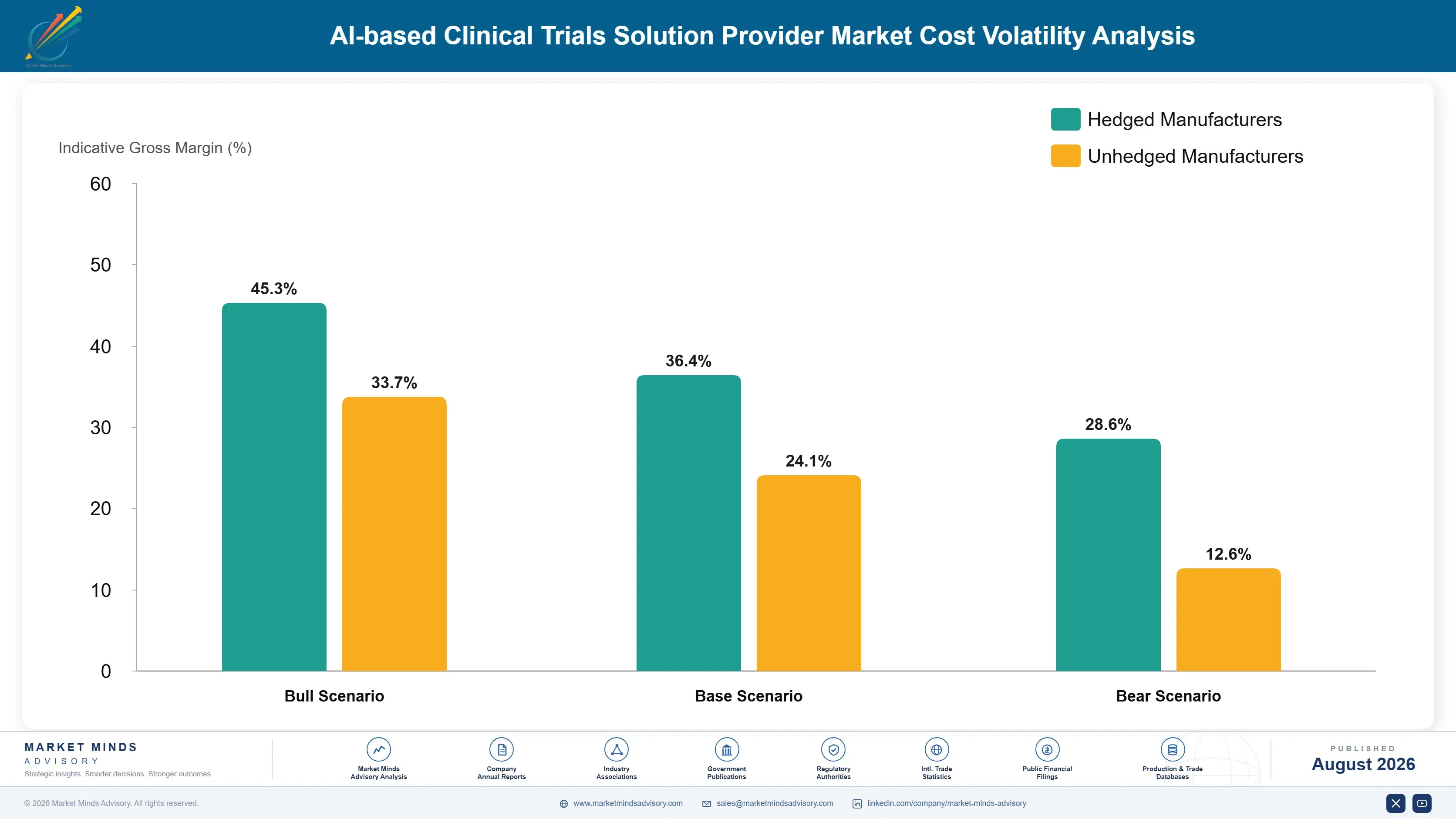
Cloud Computing and Model Training Costs

Cloud computing infrastructure and AI model training expense together account for roughly 42% of platform delivery cost of goods sold, making compute the dominant cost driver in the category ahead of software development and support labor. Training costs vary significantly by model complexity and required data processing scale, with cost structure depending on the underlying cloud provider pricing and specialized AI hardware availability.
Specialized AI training compute costs spiked through 2023 as broader industry demand for graphics processing unit capacity outpaced available supply faster than cloud providers could expand capacity, according to company disclosures citing constrained hardware availability. Vendors without long-term cloud capacity agreements or reserved compute commitments saw training costs rise faster than they could pass through to existing enterprise contract pricing signed before the spike occurred.

Smaller AI-native vendors without reserved compute capacity or long-term cloud agreements absorb input cost volatility directly into thin margins, while larger players like Veeva and Medidata use established cloud provider relationships and scale purchasing power to insulate margins from compute price swings. Vendors dependent on spot-market compute pricing carry additional exposure compared with vertically integrated competitors who capture more favorable capacity commitments themselves.
ai-based-clinical-trials-solution-provider-market-cost-volatility-analysis-1787303161484

Reserved Compute Capacity Agreements

The largest vendors are locking multi-year reserved compute capacity agreements directly with cloud providers rather than relying entirely on spot-market pricing, securing priority access and more predictable costs across major model training cycles and forecast periods ahead, reinforcing scale advantages already present. This approach requires strong cloud provider relationships built over multiple years of sustained collaboration and trust.

Model Efficiency and Compute Optimization Investment

Vendors are investing in model architecture efficiency improvements that reduce required training compute per model iteration, capturing meaningful cost savings that partially offset rising per-unit compute pricing across the category's most compute-intensive model development programs currently underway. This optimization work has become increasingly common among the largest AI vendors operating across multiple model architectures simultaneously.

Multi-Cloud Provider Diversification Strategies

Vendors are diversifying compute sourcing across multiple cloud providers rather than depending on a single vendor relationship, reducing exposure to provider-specific capacity constraints and pricing changes that have affected specific compute categories during recent volatility episodes across the industry. This diversification strategy has become increasingly common among the largest vendors operating across multiple cloud regions simultaneously.

Portfolio Architecture for Margin Defence

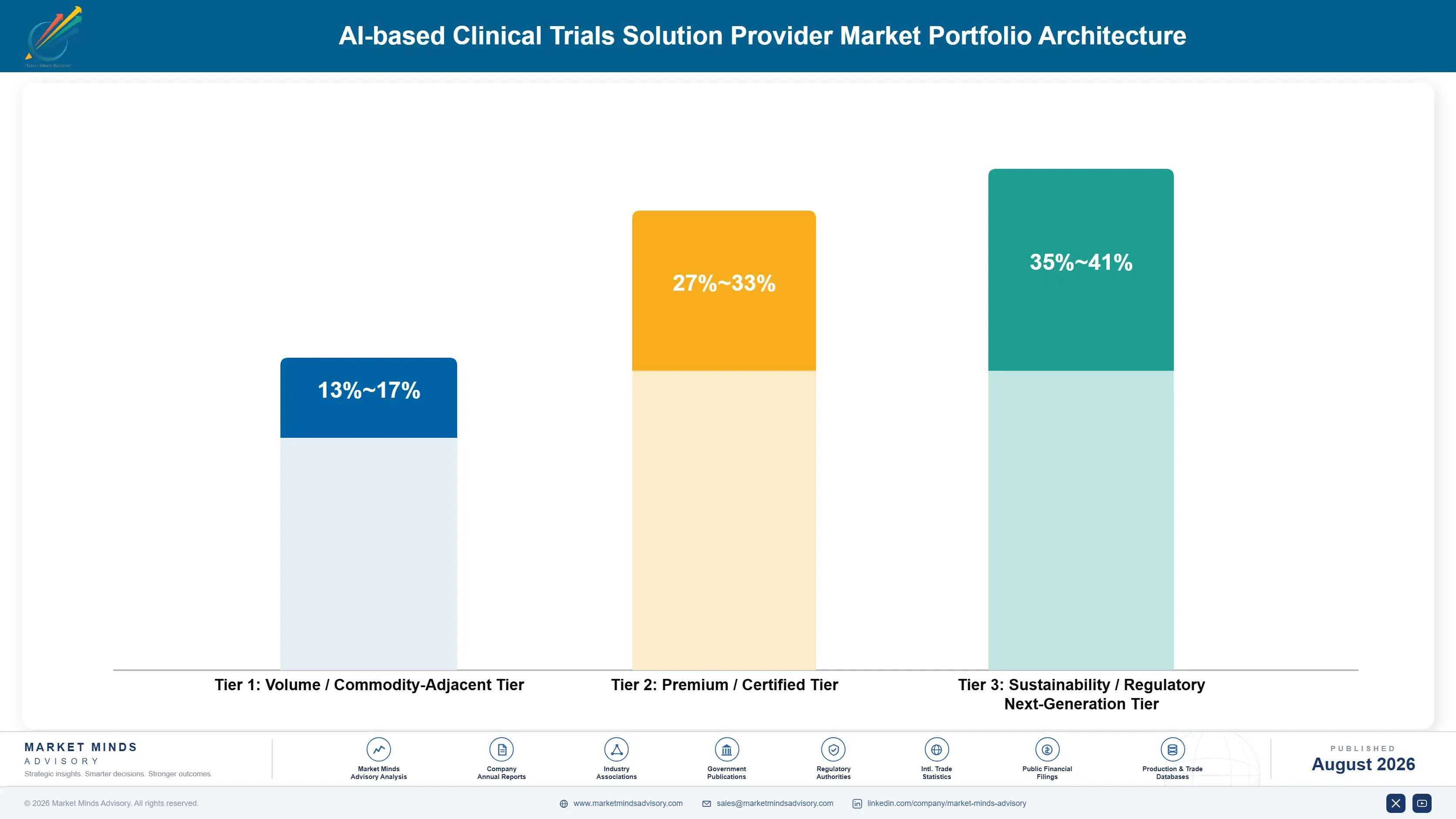
MMA's tier architecture separates the category into three margin bands. Volume and commodity-adjacent standard platform licensing competes on price against widely available point solutions and carries thin margin, premium and certified validated-outcome platforms carry higher margin on documented efficiency evidence and regulatory compliance depth, and sustainability-linked next-generation solutions, including synthetic control arm and federated learning capability, command the highest margin as
The tension between volume and premium plays out most visibly among mid-sized sponsors, who want validated-outcome platform capability at closer to standard licensing pricing, and vendors most want to move these buyers up-tier through evidence generation and long-term partnership bundling over time. That up-tier migration remains slow given how cautiously smaller sponsors evaluate unproven AI investment. Vendors that fail to bundle these services risk losing share to more capable rivals.

High-value margin pools concentrate in large sponsor enterprise partnerships bundled with validated evidence, regulatory compliance support, and long-term data access agreements, where partnership and compliance-attach revenue increasingly outweighs the margin earned on any individual platform license alone. That concentration is pulling investment steadily toward evidence generation and compliance capability rather than incremental feature development alone.

Volume / Commodity-Adjacent Tier

Standard platform licensing and point solutions sold primarily on price against widely available alternatives, serving smaller sponsors and pilot programs where gross margin stays thin and competition is driven almost entirely by licensing cost.
Gross Margin: 13%-17%

Premium / Certified Tier

Validated-outcome platforms specified by sponsors requiring documented efficiency evidence, regulatory compliance depth, and long-term partnership agreements, commanding meaningfully higher margin on evidence depth and proven reliability achieved across the category's growing enterprise adoption base.
Gross Margin: 27%-33%

Sustainability / Regulatory / Next-Generation Tier

Synthetic control arm and federated learning platforms positioned for sponsors chasing regulatory acceptance and data privacy compliance, where methodology depth and regulatory engagement support the category's highest margin overall across most major markets today.
Gross Margin: 35%-41%
ai-based-clinical-trials-solution-provider-market-portfolio-architecture-1787303162326

Enterprise Partnership Economics and Sponsor Depth

A platform sale is rarely a single transaction for the largest sponsor accounts. Validated evidence generation, regulatory compliance support, and long-term data access agreements convert what used to be a one-time software purchase into a recurring partnership relationship spanning a sponsor's development pipeline. Vendors that capture the evidence and compliance attachment at time of first deployment retain more lifetime value per sponsor than those competing on licensing price.
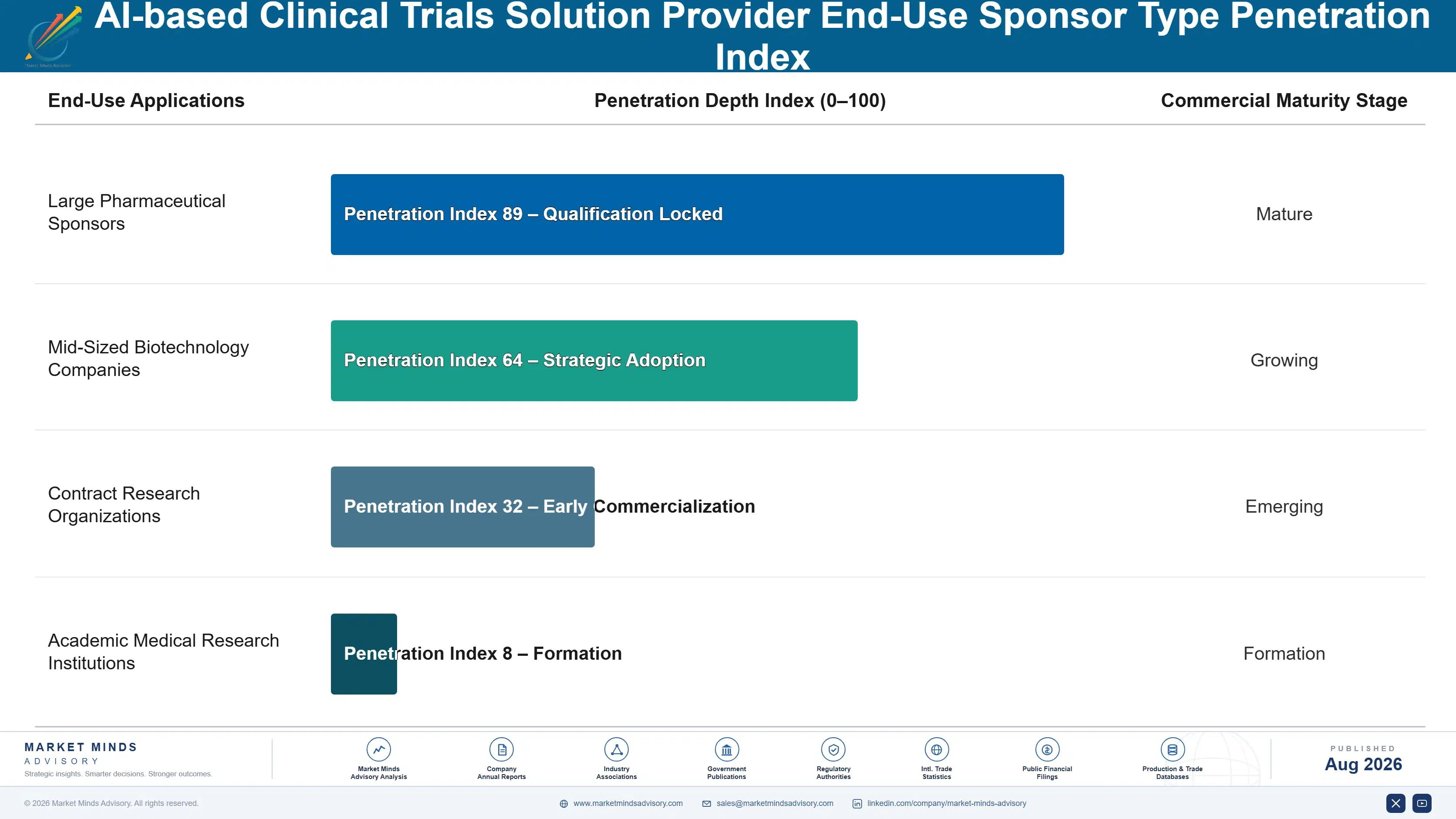
Adoption depth varies sharply by sponsor type. Large pharmaceutical sponsors running multi-program development pipelines convert fastest and most completely, standardizing an entire pipeline onto validated, evidence-backed vendors once a pilot deployment proves out, making them the highest-value account type despite competitive pricing. Smaller biotech sponsors convert more slowly, often relying on point solutions for years before adopting integrated AI-enabled platform relationships.

A generational shift in trial leadership is compounding the evidence-driven shift. Younger clinical operations professionals entering sponsor organizations increasingly expect documented AI efficiency evidence as standard procurement justification, a purchasing expectation an older generation of buyers, who evaluated primarily on vendor reputation and relationship history, rarely required as rigorously. That shift is accelerating premium-tier adoption even among sponsors that have not yet faced direct competitive pressure from AI-enabled rivals.
ai-based-clinical-trials-solution-provider-market-end-use-penetration-index-1787303162962

What Matters Most Through 2036

These are among the four positions where our research anticipates prominent divergence between winners and laggards over the coming forecast period. Each is grounded in the demand model, the regulatory perimeter, and the announced capacity pipeline.
01 / VALIDATED OUTCOME EVIDENCE INVESTMENT

Build rigorous efficiency evidence before procurement cycles tighten

Documented timeline and cost reduction evidence is converting procurement decisions from a purely feature-based comparison into an evidence-driven relationship, and vendors with established validated evidence are already capturing disproportionate share of enterprise deployments ahead of broader market maturation. Vendors that invest in rigorous evidence generation now will secure preferred-vendor status with major sponsors before competitors catch up on the outcome measurement investment required. Continuing to treat evidence generation as a future concern risks ceding the fastest-growing, most differentiated segment to competitors already building validated evidence.
02 / REGULATORY COMPLIANCE DEPTH

Align platforms with AI validation frameworks ahead of the next cycle

Regulatory compliance depth increasingly decides purchasing decisions as much as raw platform capability, and vendors that align early with published validation frameworks will capture disproportionate share of enterprise procurement as regulatory clarity continues expanding sponsor confidence. Vendors that invest in compliance depth now will build switching costs that protect installed base better than competitors relying on capability breadth alone. This compliance investment requires sustained regulatory engagement years before any single validation cycle fully rewards that patient positioning across every procurement cycle.
03 / ENTERPRISE PARTNERSHIP CAPTURE

Bundle data access and evidence into every large sponsor agreement

Long-term data access agreements and validated evidence already generate meaningfully higher recurring revenue than standard licensing sales, yet many vendors still sell these as separate negotiations rather than a default part of every quote presented to large sponsor buyers. Vendors that make partnership and evidence attachment the default, requiring buyers to actively opt out rather than opt in, will capture materially more lifetime value per sponsor than competitors treating these arrangements as an afterthought. This remains underexploited by every vendor outside the two largest players currently active in the category.
04 / AI-NATIVE STARTUP COMPETITION

Deepen platform integration ahead of continued startup fragmentation

AI-native startups continue expanding aggressively into specific high-value solution categories, and vendors overly dependent on broad, undifferentiated platform sales face real competitive risk across the forecast period covered in this report from more focused rivals. Vendors that deepen integration and evidence depth in categories where they hold genuine advantage will protect share better than competitors continuing to compete primarily on platform breadth alone. This repositioning requires sustained investment in evidence generation and integration capability well before startup fragmentation pressure fully materializes in each affected category.

Engagement Snapshot From the Field

A live engagement with an industry participant carrying material or product regulatory and market exposure ahead of a defining policy shift, showing how our research translates into a defensible multi-year portfolio strategy.
MARKET MINDS ADVISORY · CLIENT ENGAGEMENT SUMMARY
AI-based Clinical Trials Solution Provider Producer Strategic Portfolio Review and Transition Roadmap 2026·Investment Scenario on AI-based Clinical Trials Solution Provider Exposure Evaluation 2025-26
CLIENT PROFILE
The client is a mid-sized biotech sponsor running three concurrent Phase 2 and Phase 3 oncology trials, with a stated goal of reducing patient enrollment timelines that had consistently run behind original protocol projections. Annual clinical technology procurement spend exceeds $6 million (client-reported, unverified by MMA), concentrated primarily across data management and emerging recruitment platform evaluation. The company had limited prior experience evaluating AI-specific vendor capability at the engagement's outset.
STRATEGIC CHALLENGE
The client faced a crowded vendor landscape with limited internal expertise to evaluate competing AI recruitment platform claims, while enrollment delays on its current lead program threatened a critical regulatory milestone timeline. Leadership needed a structured evaluation framework balancing vendor-reported efficiency claims against independently verifiable evidence before committing to a platform switch.
MMA APPROACH
MMA conducted a structured evaluation of five candidate recruitment AI vendors against the client's specific therapeutic area and site network, benchmarked vendor-reported outcome claims against MMA's proprietary clinical AI vendor performance database, and facilitated reference calls with comparable sponsor deployments. The engagement combined primary interviews with vendor technical teams alongside independent outcome data verification.
KEY FINDINGS
  1. Two of five evaluated vendors could not independently verify their published enrollment timeline reduction claims when benchmarked against comparable oncology trial deployments.
  2. The client's specific site network characteristics meaningfully affected which vendor's matching algorithm performed best, contradicting generic vendor marketing claims, across all three concurrent trial programs evaluated.
  3. Selecting a therapeutic-area-specialized vendor reduced projected enrollment timeline by an estimated 26% relative to the client's current general-purpose platform, based on comparable historical trial benchmarks.
  4. Data integration complexity with the client's existing electronic data capture system emerged as a meaningfully underestimated implementation risk factor, requiring additional budget beyond the original vendor estimate.
CLIENT PROFILE
The client is a mid-sized biotech sponsor running three concurrent Phase 2 and Phase 3 oncology trials, with a stated goal of reducing patient enrollment timelines that had consistently run behind original protocol projections. Annual clinical technology procurement spend exceeds $6 million (client-reported, unverified by MMA), concentrated primarily across data management and emerging recruitment platform evaluation. The company had limited prior experience evaluating AI-specific vendor capability at the engagement's outset.
STRATEGIC CHALLENGE
The client faced a crowded vendor landscape with limited internal expertise to evaluate competing AI recruitment platform claims, while enrollment delays on its current lead program threatened a critical regulatory milestone timeline. Leadership needed a structured evaluation framework balancing vendor-reported efficiency claims against independently verifiable evidence before committing to a platform switch.
MMA APPROACH
MMA conducted a structured evaluation of five candidate recruitment AI vendors against the client's specific therapeutic area and site network, benchmarked vendor-reported outcome claims against MMA's proprietary clinical AI vendor performance database, and facilitated reference calls with comparable sponsor deployments. The engagement combined primary interviews with vendor technical teams alongside independent outcome data verification.
KEY FINDINGS
  1. Two of five evaluated vendors could not independently verify their published enrollment timeline reduction claims when benchmarked against comparable oncology trial deployments.
  2. The client's specific site network characteristics meaningfully affected which vendor's matching algorithm performed best, contradicting generic vendor marketing claims, across all three concurrent trial programs evaluated.
  3. Selecting a therapeutic-area-specialized vendor reduced projected enrollment timeline by an estimated 26% relative to the client's current general-purpose platform, based on comparable historical trial benchmarks.
  4. Data integration complexity with the client's existing electronic data capture system emerged as a meaningfully underestimated implementation risk factor, requiring additional budget beyond the original vendor estimate.
RECOMMENDED STRATEGY
Phase 1: Phase 1 (Months 1 to 3): Complete structured vendor evaluation and select an oncology-specialized recruitment AI platform for the highest-priority trial. Phase 2: Phase 2 (Months 4 to 8): Deploy the selected platform on the lead program while closely tracking enrollment timeline and cost impact against baseline. Phase 3: Phase 3 (Months 9 to 14): Expand deployment across the remaining two trials pending validated results from the initial deployment.
OUTCOME
The client's lead oncology trial achieved enrollment completion four months ahead of the pre-deployment projected timeline (client-reported, unverified by MMA), supporting the regulatory milestone that had originally motivated the vendor evaluation engagement. The remaining two trials are scheduled for platform deployment within the following two quarters.

Frequently Asked Questions

Foundational context covering the market sizes, CAGR, scope, country, region and competition that inform every finding below. This section is provided to cover basics and most often pre-purchase conversations, answered from the MMA Primary Research Dataset.

What is the current size of the AI-based Clinical Trials Solution Provider Market?

MMA estimates the global AI-based clinical trials solution provider market at $2.1 billion in 2025. Growth concentrates in patient recruitment and real-world evidence platforms, driven by regulatory clarity and rising trial costs.

How large will the AI-based Clinical Trials Solution Provider Market be by 2036?

MMA forecasts the market reaching $10.94 billion by 2036, up from $2.44 billion in 2026. That represents roughly a 4.48 times expansion over the full ten-year forecast period covered.

What is the CAGR for the AI-based Clinical Trials Solution Provider Market 2026 to 2036?

MMA's base case forecasts a 16.2% compound annual growth rate, with a bull case of 17.5% and a bear case of 14.8% depending on regulatory validation timing.

Which segment is growing fastest?

Patient recruitment and matching AI leads at a 19.5% CAGR, roughly 1.2 times the overall market rate, as sponsors chase the single largest source of trial timeline delay.

Who are the major companies in the AI-based Clinical Trials Solution Provider Market?

Veeva Systems, Medidata, IQVIA, Saama Technologies, and Unlearn.AI lead the category, together holding an estimated 34% combined share on a revenue basis across software and services.

Which country is growing fastest?

India leads at an estimated 18.8% CAGR, outpacing the global average as expanding trial infrastructure and deep domestic AI engineering talent continue attracting global sponsor trial volume.

Report Segmentation Architecture

The full report scope spans multiple orthogonal segmentation dimensions, with cross-tabulated demand data provided for each dimension pair. Coverage extends further to regional breakdowns, trend trajectories, and the competitive detail needed to support segment-level decision-making.

By Solution Type

  • Patient Recruitment and Matching AI
  • Protocol Design and Optimization Software
  • Clinical Data Management and Analytics Platforms
  • Remote Patient Monitoring and Digital Endpoints
  • Regulatory Submission and Compliance Automation
  • Real-World Evidence and Synthetic Control Arms

By End-Use Sponsor Type

  • Large Pharmaceutical Sponsors
  • Mid-Sized Biotechnology Companies
  • Contract Research Organizations
  • Academic Medical Research Institutions

By Commercial Dimension

  • Enterprise Licensing Agreements
  • Per-Trial Project Engagements
  • Long-Term Data Partnership Contracts
  • Managed Service Arrangements

By Region

  • North America
  • Western Europe
  • East Asia
  • South Asia and Pacific
  • Latin America
  • Middle East and Africa
  • Eastern Europe

Scope, Methodology, and Coverage

Every figure in this report is reproducible from documented input assumptions. The scope below maps the historical period, the forecast horizon, the segmentation dimensions, and the countries covered, alongside the underlying primary and qualitative methodology.
Historical Period
2020 to 2025
Forecast Period
2026 to 2036
Base Year
2025 (USD billions; MMA Primary Research Dataset, August 2026)
Market Definition
The AI-based clinical trials solution provider market covers software platforms and services applying machine learning to patient recruitment, protocol design, clinical data management, remote monitoring, regulatory submission, and real-world evidence generation for pharmaceutical and medical device development programs. It excludes general-purpose electronic data capture systems without embedded AI functionality and excludes contract research organization staffing services sold independently of a software platform.
Quantitative Units
USD billions (current prices); enterprise deployment count and platform seat volume where applicable
Segmentation Dimensions
By Solution Type; By End-Use Sponsor Type; By Commercial Dimension; By Region
Regions Covered
North America, Western Europe, East Asia, South Asia and Pacific, Latin America, Middle East and Africa, Eastern Europe
Countries Covered
USA, China, Germany, France, UK, Japan, South Korea, India, Australia, Canada, Brazil, Mexico, Indonesia, Vietnam, Thailand, Malaysia, UAE, Saudi Arabia, South Africa, Nigeria, Turkey, Poland, Netherlands, Italy, Spain, Sweden, Switzerland, Argentina, Colombia, Singapore, and additional markets relevant to this sector
Key Companies Profiled
Veeva Systems Inc., Medidata Solutions, IQVIA Holdings Inc., Saama Technologies, Inc., Unlearn.AI, Inc., Oracle Corporation, ICON plc, Parexel International Corporation, Merative L.P., Tempus AI, Inc., Deep 6 AI, Inc., Formation Bio, Inc., Antidote Technologies, Inc., Reify Health, Inc., Signant Health, ObvioHealth, THREAD Research, Vial, Inc., Faro Health, Inc., Suvoda LLC
Quantitative Methodology
Primary survey, n=3,800 respondents, Q4 2025, six countries; demand-side model with trade association cross-validation
Qualitative Methodology
47 expert interviews, Q4 2025; applied to validate demand model assumptions, identify emerging dynamics, and assess competitive positioning
Report Format
PDF and XLSX data workbook (Word format preview document)
Publisher
Market Minds Advisory
Report Code
MMA-2026-HLT-202
Published
August 2026
Contact
sales@marketmindsadvisory.com | www.marketmindsadvisory.com

Purchase the full AI-based Clinical Trials Solution Provider Market Report (2026 to 2036).

The full AI-based Clinical Trials Solution Provider Market report delivers granular five-year and ten-year forecasts across all six solution segments, regulatory framework tracking by region, and vendor benchmarking drawn from MMA's proprietary clinical AI vendor performance database. It includes detailed profiles of all twenty companies covered here, extended regional analysis across every major sponsor and trial market, and a regulatory tracker spanning FDA and European Medicines Agency AI validation guidance. Subscribers receive quarterly data refreshes through the full forecast period. Buyers also gain direct analyst access for engagement-specific questions throughout the subscription term.
Regulatory framework tracker by region and agency
Ten-year segment-level forecasts across all solutions
Vendor benchmarking data across outcome evidence claims
AI validation guidance tracking module for major markets
Twenty-company competitive profiles with moat analysis
Quarterly data refresh access throughout subscription

Built For The People Who Decide

From boardroom strategy to bench-side execution, this report is read cover-to-cover by leaders shaping the next decade of their industry, turning demand scenarios, market dynamics and valuation benchmarks into decisions.
CXOs/ Presidents/ VPs/ Managers
M&A and Corporate Development
Strategy Teams and R&D Heads
Procurement and Product Directors
Regulatory and Compliance Leaders
Investor Relations and Equity Analysts