Market Minds Advisory
Agricultural Grade Zinc Chemicals Market

Agricultural Grade Zinc Chemicals Market: Deficient Soils, the European Feed Oxide Ban, and Why Chelate Choice Decides Everything

Roughly half the world's cereal soils test zinc deficient, yet most of what farmers apply is the cheapest sulphate available, and a large share of that never reaches the plant at all.

Lead Analyst

Bilal Shaikh

Published

September 2026

Make Smarter Decisions with Customized Research Insights

Request a free sample report and evaluate market opportunities, growth trends, and competitive dynamics relevant to your business needs.

2025 MARKET VALUE$1.9BMarket Size 2025
2036 FORECAST VALUE$4.0BBase Case , 2026 to 2036
CAGR 2026 TO 20366.9 %Bull 8.2% / Bear 5.6%
INCREMENTAL OPPORTUNITY$1.9BNet 10- year value creation
EXPANSION MULTIPLE1.95x2036 value over 2026 base
Strategic Levers
M&A Pipeline
Regional Outlook
Country Rankings
Competitive Intelligence
Segmental Deep-dive
Call-Us : 91 93563 13602

Executive Snapshot and Market Trajectory

Zinc deficiency limits cereal yields across roughly half the world's cropping soils, and the correction costs very little relative to the loss it prevents. What the market argues about is not whether to apply zinc but which chemical form, because bioavailability varies enormously and price does not track it.
Commercial power sits with suppliers who can demonstrate uptake rather than tonnage. Cheap zinc sulphate dominates volume while a substantial share of applied zinc becomes unavailable in alkaline and calcareous soils, which is exactly where deficiency concentrates. Amino acid complexes grow fastest at 11.6%, roughly 1.68 times the market, because they stay available where sulphate does not. East Asia holds 30% of value.
Concentration is low at roughly 24% for the top five, since zinc sulphate production is straightforward and hundreds of regional operators serve local fertiliser markets. Regulation has cut one channel and opened another: the European Union ended medicinal zinc oxide in piglet feed during 2022 over resistance and soil accumulation concerns, while agronomic biofortification programmes now treat zinc fertiliser as a human nutrition instrument rather than only a yield input. The payer is changing here.
Market Definition
This report covers zinc chemicals manufactured for agricultural use, spanning zinc sulphate, zinc oxide, zinc EDTA and synthetic chelates, zinc amino acid and organic complexes, zinc nitrate and chloride, and zinc oxysulphate and blended granular forms. Value is measured at producer level as supplied to fertiliser blenders, feed mills, distributors, and growers. Zinc metal and industrial zinc chemicals for non-agricultural use, zinc-containing fungicides, and finished compound fertilisers containing zinc as one component fall outside scope.
Base Year Value
$1.9B in 2025 (MMA Primary Research Dataset, August 2026)
Forecast Period
2026 to 2036, eleven discrete annual values
CAGR
6.9% base case. Bull 8.2%. Bear 5.6%.
Fastest Growth Segment
Zinc Amino Acid and Organic Complexes: 11.6% CAGR
Fastest Growth Country
India: 10.4% CAGR
Fastest Growth Region
South Asia and Pacific: 9.1% CAGR
Largest Region
East Asia: 30% of 2025 global value
Market Leaders
Yara International, EverZinc, US Zinc, Coromandel International, Compass Minerals. Source: MMA Analysis based on company annual reports.
Primary Survey
n=3,800 procurement and R&D decision-makers, Q4 2025, six countries
Methodology
Demand-side build-up, cross-validated against public data, 47 expert interviews

Agricultural Grade Zinc Chemicals Market Forecast Scenarios

agricultural-grade-zinc-chemicals-market-size-forecast-scenario-1787463974707
The 2020 to 2025 period was shaped by one regulatory decision and by metal pricing. The European Union withdrew medicinal zinc oxide from piglet feed in June 2022, removing a reliable demand pool almost overnight. Refined zinc pricing swung sharply through 2021 and 2022 on European smelter curtailments, which passed directly into product cost. The 5.7% historical growth mixes fertiliser demand with feed channel contraction and metal cost pass-through.
The 6.9% base case rests on three mechanisms. Indian and Chinese micronutrient application keeps rising as soil testing programmes document deficiency that growers previously did not measure. Chelated and complexed forms keep taking share from sulphate as agronomists demonstrate that applied zinc and available zinc are different quantities in alkaline soils. And agronomic biofortification programmes keep adding demand driven by human nutrition policy rather than by yield economics, which behaves quite differently commercially.
The 8.2% bull case assumes zinc biofortification enters national nutrition programmes at scale, funding application that yield economics alone would not justify. The 5.6% bear case reflects grain price weakness cutting discretionary micronutrient spend, alongside continued adulteration in price-led markets that undermines confidence in the category generally. Programme funding decisions will decide which of those cases arrives.

Why Soil Deficiency Sets the Ceiling

Three things decide this market and tonnage applied is the least informative of them. Soil chemistry comes first, because alkaline conditions immobilise applied zinc rapidly, and those are precisely where deficiency is worst. Product form comes second, since sulphate, chelate, and complex behave very differently once they meet that chemistry. Metal price comes third, and it moves 58% of production cost without warning.
TOP-FIVE CONCENTRATION24%Share of agricultural zinc chemical supply held collectively
AVERAGE SELLING PRICE$1,180/tonneBlended price across sulphate, oxide, and chelated forms
DEFICIENT SOIL SHARE49%Proportion of cereal cropping soils testing below adequacy
ZINC METAL COST SHARE58%Refined metal input as proportion of production cost
CHELATED PRODUCT SHARE17%Portion of volume supplied in chelated or complexed form
FOLIAR APPLICATION SHARE31%Volume applied to leaves rather than incorporated into soil
The commercial character is unusual for a fertiliser input. A grower buying zinc sulphate on price per tonne is frequently buying a correction that will not work in his own soil, and he cannot know without tissue testing that most farms never do. Suppliers investing in soil and tissue diagnostics sell a solution rather than a compound, and price accordingly. Those selling tonnage compete against adulterated product in several major markets.
The next decade tests whether nutrition policy becomes a demand driver in its own right. Agronomic biofortification raises grain zinc concentration measurably, and health ministries in South Asia and Africa have begun treating that as a public health intervention. If those programmes scale and are funded from health budgets, the demand behaves entirely differently from yield-driven purchasing, since the payer is not the farmer.
"Half the zinc sulphate applied to calcareous soils might as well be spread on a car park. The grower paid for zinc, the invoice says zinc, and the plant never sees a useful fraction of it."
Director, Crop Nutrition and Micronutrients Practice · MMA Crop Inputs / Micronutrients and Feed Additives Practice · August 2026

Market Trends

Agronomic Biofortification Turns Fertiliser Into Nutrition Policy

Applying zinc fertiliser raises grain zinc concentration measurably, and health authorities across South Asia and parts of Sub-Saharan Africa have begun evaluating that as a population nutrition intervention rather than as an agricultural input decision. Trials across Indian, Pakistani, and Turkish wheat systems have documented the effect consistently. Where health budgets rather than farm budgets fund the application, the purchasing logic changes completely and price sensitivity falls away. The programmes remain small relative to commercial fertiliser volume, but they represent the only demand in this market not governed by crop economics.
Market Impact: Documents deficiency across 49% soils
Complexed Forms Displace Sulphate in Alkaline Soil Systems

Amino acid complexes and synthetic chelates keep zinc plant-available in alkaline and calcareous conditions where sulphate precipitates rapidly into forms roots cannot access. Agronomists across India, Turkey, Australia, and the American West have documented the difference in tissue testing rather than arguing it theoretically. Complexed products cost several times more per kilogram of contained zinc, which growers accept once tissue results demonstrate the gap. Growth of 11.6% in amino acid complexes reflects that evidence spreading through advisory channels rather than any change in the underlying soil chemistry involved. Manufacturer trial plots persuade nobody who farms alkaline ground.
Market Impact: Covers 31% of applied volume

Market Opportunities and Growth Drivers

Soil Testing Programmes Document Deficiency Growers Never Measured

Government and cooperative soil testing schemes across India, China, Brazil, and Turkey have surveyed cropping soils at a scale that individual farms never attempt, and the results consistently show zinc deficiency across roughly half of cereal-growing land. Indian soil health card programmes alone have tested tens of millions of holdings. Growers who previously had no reason to suspect a deficiency now hold a document naming it, which converts a theoretical agronomic argument into a purchase decision. Correction costs a fraction of the yield loss involved, so the economics rarely need explaining twice.
Market Impact: Removed 8,000 tonnes annual demand

Fertigation and Foliar Systems Favour Soluble Zinc Chemistry

Drip fertigation across horticulture, protected cropping, and increasingly broadacre irrigation demands fully soluble products that will not block emitters, and foliar programmes need chemistry that penetrates leaf surfaces without scorching. Both requirements exclude coarse oxide and favour soluble sulphate, chelates, and complexes at higher price points. Irrigated area under fertigation keeps expanding across Spain, Israel, India, China, and the American Southwest. Foliar application now accounts for roughly 31% of agricultural zinc volume, and that share rises wherever irrigation infrastructure improves. Coarse oxide is excluded from both systems on physical grounds alone, which narrows the qualified product list considerably.
Market Impact: Affects 22% of Indian volume

Market Restraints and Challenges

European Feed Oxide Withdrawal Removed a Reliable Channel

The European Union ended medicinal zinc oxide use in piglet feed during June 2022, citing antimicrobial resistance concerns and zinc accumulation in soils receiving pig slurry, and that decision removed a substantial demand pool that had been dependable for two decades. The root cause is environmental and public health rather than agronomic. Producers serving feed-grade oxide found the volume disappeared inside a single year. Responses include redirecting oxide capacity toward fertiliser and industrial grades, developing lower-dose organic zinc alternatives for piglet nutrition, and pursuing markets outside European jurisdiction entirely. None of those responses replaces the volume that disappeared.
Market Impact: Raises grain zinc 40% typically

Adulteration Undermines Confidence in Price-Led Markets

Zinc sulphate sold below plausible cost in several South Asian and African markets frequently contains less zinc than declared, and growers who apply it see no response and conclude micronutrients do not work. The root cause is weak enforcement of fertiliser control specifications combined with a product whose effect a farmer cannot observe directly within a season. Legitimate suppliers respond by pursuing quality certification, by supplying through cooperative and institutional channels with testing, and by moving toward complexed products that adulterators find harder to imitate convincingly. Complexed products are considerably harder to imitate convincingly than sulphate.
Market Impact: Lifts tissue zinc 3x versus sulphate
3 additional market trends, 2 additional growth drivers, and 4 additional restraints and challenges are covered in the full report. Contact sales@marketmindsadvisory.com to access the complete intelligence.

Segment CAGR and Growth Architecture

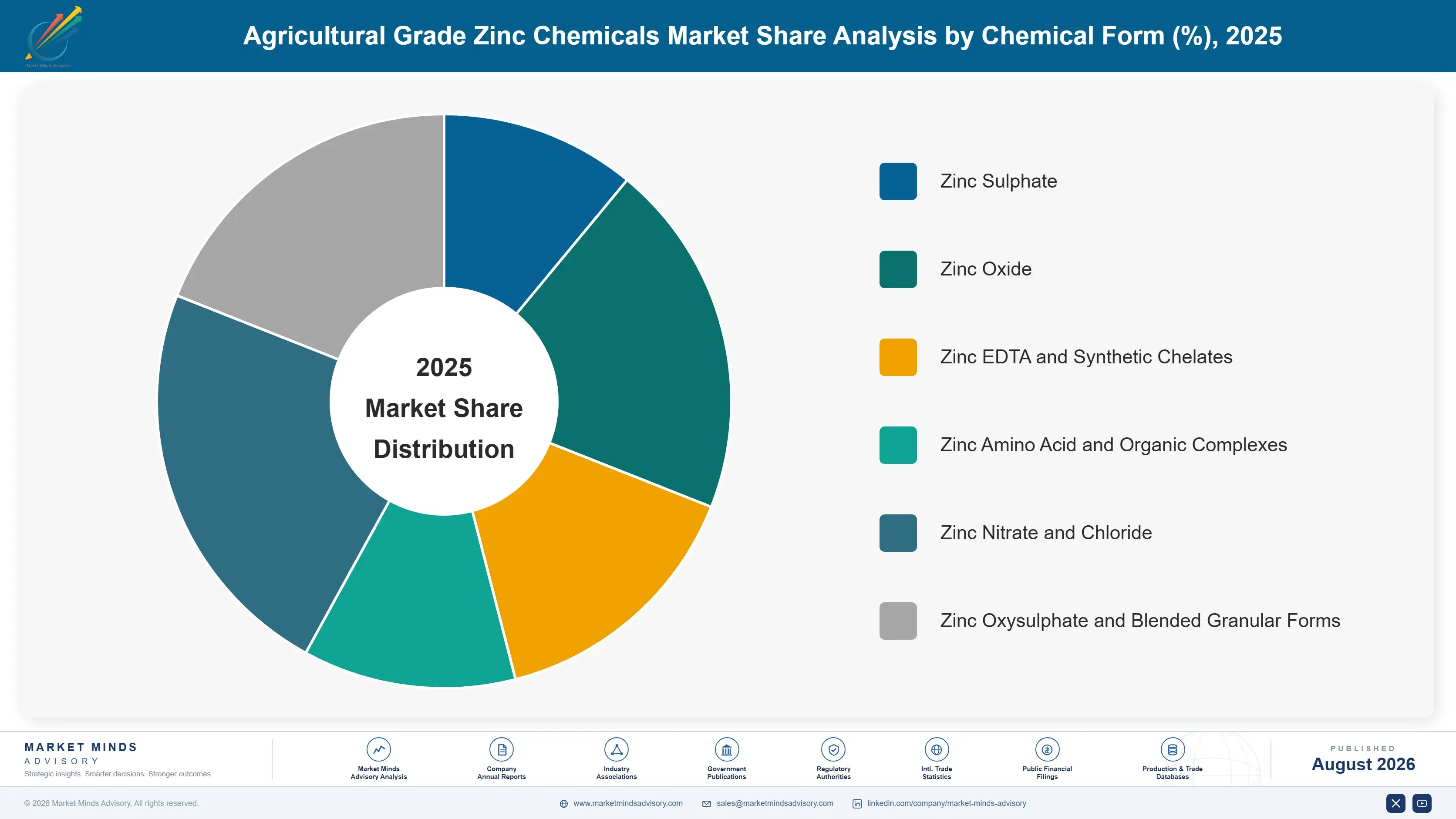
Segmentation follows chemical form, the single logic determining solubility, soil behaviour, plant availability, and price per unit of contained zinc. Form decides whether applied zinc reaches the plant in a given soil chemistry, which no other dimension captures at all. Crop application, delivery method, and channel structure appear separately in the framework as commercial dimensions rather than parallel segments.
agricultural-grade-zinc-chemicals-market-market-share-analysis-1787463975249

Zinc Amino Acid and Organic Complexes

Complexing zinc with amino acids, lignosulphonates, or organic acids keeps it plant-available in the alkaline and calcareous soils where deficiency concentrates and where sulphate precipitates within days of application. Growth of 11.6%, roughly 1.68 times the market, follows tissue testing evidence spreading through advisory channels rather than any new chemistry. These products carry organic certification in several jurisdictions that synthetic chelates cannot obtain, which opens a channel entirely closed to EDTA. Cost per kilogram of contained zinc runs several times sulphate, and growers accept it once they have seen tissue results from their own fields rather than from a manufacturer's trial plot. Organic certification is a channel synthetic chelates cannot enter at all.
CAGR 11.6%

Zinc Oxysulphate and Blended Granular Forms

Oxysulphate granules blend water-soluble and slowly available zinc fractions into a physical form that bulk blenders can handle alongside urea, phosphate, and potash without segregation. Growth of 9.2% follows the practicalities of large-scale broadacre application rather than any agronomic advantage over soluble products. The commercial value lies in blending compatibility and spreader performance, which matters enormously to a cooperative filling a thirty-tonne truck. Water-soluble fraction varies considerably between products and is poorly disclosed, so agronomically informed buyers specify it explicitly while price-led purchasers frequently do not and receive material that behaves far worse than expected. Agronomically informed buyers specify soluble fraction explicitly, and price-led purchasers almost never do at all.
CAGR 9.2%
Full segment breakdown across 6 segments available in the complete report.

Regional Architecture and Country Demand Map

East Asia holds the largest share at 30%, combining Chinese zinc chemical production scale with substantial domestic agricultural application. South Asia and Pacific grows fastest as Indian soil testing documents deficiency, while North America and Western Europe hold higher-value chelated demand. Latin America is shifting toward better forms.

North America

Calcareous soils across the American West and High Plains make zinc availability a genuine agronomic problem rather than a theoretical one, and corn producers across Nebraska, Kansas, and Colorado apply zinc routinely as a result. Retail agronomy networks run tissue testing at scale, which supports chelated and complexed product sales at prices that soil-applied sulphate never commands. Compass Minerals and Koch Agronomic Services supply substantial regional volume through those channels. Canadian prairie application is lighter but growing with soil test adoption. Regional growth of 6.2% is carried by product mix improvement toward chelates rather than by any increase in treated area. Tissue testing at retail scale is what makes the premium mix possible.
Share: 22% | CAGR: 6.2% (2026 to 2036)

Western Europe

The June 2022 withdrawal of medicinal zinc oxide from piglet feed removed the region's most reliable demand pool and reshaped the supplier base accordingly, with several producers redirecting oxide capacity toward fertiliser and industrial applications. What remains is a high-specification fertiliser market operating under the European Fertilising Products Regulation, which sets cadmium and contaminant limits that favour suppliers with clean zinc metal sources. Spanish, Italian, and Greek horticulture applies chelated zinc through fertigation systems extensively. Northern European arable application is modest because soils are generally adequate. Growth of 5.3% is the slowest of any region and reflects the feed channel loss more than any weakness in fertiliser demand. Contaminant limits favour clean metal sources.
Share: 18% | CAGR: 5.3% (2026 to 2036)
Regional intelligence for 5 additional markets available in the complete report: East Asia, South Asia and Pacific, Latin America, Middle East and Africa, Eastern Europe. Contact sales@marketmindsadvisory.com.
agricultural-grade-zinc-chemicals-market-country-cagr-analysis-1787463975763

Where Zinc Micronutrient Margin Actually Sits

Selling zinc sulphate on price per tonne means competing against adulterated product in several major markets and Chinese cost everywhere else. The four moves below shift revenue toward what a grower cannot verify alone: tissue evidence, complexed chemistry that survives alkaline soils, blending performance, and biofortification programmes funded by somebody other than the farm.

Sell Tissue Test Evidence Rather Than Contained Zinc Percentage

A grower comparing products on zinc content is comparing the wrong number, because applied zinc and plant-available zinc diverge sharply in alkaline soils. Running tissue testing programmes across customer fields, showing uptake rather than asserting it, costs roughly $1.4 million annually across an agronomy team and laboratory contract. It supports pricing 40% to 60% above commodity sulphate on complexed products, and it converts a commodity transaction into an advisory relationship that competitors quoting analysis alone cannot displace easily. Growers believe results from their own fields and almost nothing else. Manufacturer plot data changes nothing.
Market Impact: Supports a 40 to 60% pricing premium overall

Build Amino Acid Complex Capability for Organic Channels

Amino acid and organic acid complexes hold organic certification in jurisdictions where synthetic chelates cannot, which opens a channel entirely closed to EDTA products and growing faster than conventional agriculture. They also outperform sulphate in exactly the alkaline soils where deficiency concentrates. Establishing production and certification costs around $4.5 million including approvals across major jurisdictions. Growth of 11.6% in the segment reflects agronomic evidence spreading rather than fashion, which makes the demand considerably more durable than most organic input categories. Certification takes longer than the plant build in most jurisdictions.
Market Impact: Opens an organic channel now growing at 11.6%

Specify and Guarantee Water-Soluble Fraction in Granular Products

Oxysulphate granules vary enormously in water-soluble zinc fraction and most suppliers disclose it vaguely or not at all, which lets poor product hide behind an adequate total zinc analysis. Guaranteeing a minimum soluble fraction, with batch certificates, differentiates against competitors selling on total content alone. Agronomically informed cooperatives and large growers specify it once they understand the difference, and they pay 15% to 25% more for the guarantee. The production adjustment is modest; the disclosure discipline is what competitors find difficult. Total zinc analysis conceals exactly what the grower needs to know.
Market Impact: Earns 15 to 25% above unspecified granular product

Position Early in Biofortification Programmes Funded by Health Budgets

Agronomic biofortification raises grain zinc concentration by around 40% and health authorities in South Asia and Sub-Saharan Africa are evaluating it as a population nutrition intervention, which means the payer is a ministry rather than a farmer. Programme procurement rewards documented efficacy, supply reliability, and quality assurance rather than lowest price. Positioning requires trial participation and institutional relationship building over two to three years. Suppliers inside those programmes when funding arrives capture volume that commercial channels would never generate at comparable pricing. Tenders cannot be won from a standing start once issued.
Market Impact: Accesses public budgets funding a 40% zinc uplift

Who Controls the Margin Pool

The top five hold roughly 24% of supply, measured consistently as agricultural grade zinc chemical revenue at supplier level. Yara and Compass Minerals lead through agronomy-supported micronutrient portfolios, while EverZinc and US Zinc bring zinc chemistry manufacturing scale and Coromandel serves the large Indian market directly. Hundreds of regional producers supply commodity sulphate into local fertiliser channels, which is why concentration stays low.
Competition runs along three lines. Agronomic evidence is the first and increasingly decisive, since tissue testing separates suppliers who can demonstrate uptake from those quoting analysis. Chemistry capability is the second, covering chelation, complexing, and granulation that commodity sulphate producers do not operate. The third is channel position, where retail agronomy networks and cooperative relationships determine whether a supplier reaches growers with advice attached or only through price-led distribution.

Two pressures will reshape positions. Chinese sulphate capacity sets commodity pricing globally and keeps compressing the volume tier that most regional producers occupy. Meanwhile agronomic advisory capability is becoming the entry requirement for the growing complexed segment, which favours suppliers with field teams over those with reactors. The exposed position is a regional sulphate producer with no chelation capability, no agronomy resource, and price-led distribution only.
agricultural-grade-zinc-chemicals-market-company-positioning-matrix-1787463976290

Competitive Moat and Risk Dimensions

YARA INTERNATIONAL

Moat: Agronomy Network and Portfolio Breadth

Yara supplies micronutrients alongside a full crop nutrition portfolio through an agronomy network that reaches growers with advice rather than only with product, which lets zinc sell as part of a programme rather than a line item. Tissue testing and field trial capability across many geographies generates evidence competitors cannot assemble. Distribution reach also carries new forms into markets quickly.
YARA INTERNATIONAL

Risk: Micronutrient Portfolio Priority

Zinc chemicals sit within a portfolio dominated by nitrogen and compound fertilisers many times larger, so they compete internally for commercial attention and development capital. Specialist micronutrient companies move faster on new complexing chemistry and organic certification. Where a grower wants a specific complexed product quickly, a focused competitor frequently wins the business outright.
COMPASS MINERALS

Moat: Coated Micronutrient Technology Position

Compass Minerals holds micronutrient coating and delivery technology that improves distribution across a blended fertiliser spread pattern, addressing a practical problem cooperatives face with granular micronutrients at low inclusion rates. That technical position is protected and difficult to work around. It also gives access to bulk blend channels where uncoated products distribute poorly and deliver inconsistent field results.
COMPASS MINERALS

Risk: Narrow Geographic Concentration

The micronutrient business is heavily weighted toward North American row crop markets, which limits exposure to the faster-growing Indian, Chinese, and Brazilian demand pools where deficiency is most severe. Building distribution and agronomy presence in those markets means competing against established local suppliers with far deeper channel relationships and considerably lower cost bases.

Players Tracked

Prominent Players

Yara International
EverZinc
US Zinc
Coromandel International
Compass Minerals

Other Key Players

Nouryon
BASF
Haifa Group
Valagro
Koch Agronomic Services
Aries Agro
Rubamin
Old Bridge Chemicals
Zochem
Grillo-Werke
Hakusui Tech
Shandong Wanlong Chemical
Balchem
Sulphur Mills
Tata Chemicals

Recent Developments

FEBRUARY 2025

Indian soil health programmes extend micronutrient testing coverage

Indian agricultural authorities extended soil health testing coverage across additional districts, documenting zinc deficiency across a large share of cereal-growing land and issuing recommendations to individual holdings. Micronutrient suppliers reported increased enquiry volumes from cooperative and retail channels in districts where testing results had recently been distributed to growers.
Signal: Documented deficiency converts agronomic theory into actual purchase decisions faster than any commercial promotion ever achieves.
SEPTEMBER 2024

European producers redirect zinc oxide capacity after feed withdrawal

European zinc chemical producers continued redirecting oxide capacity toward fertiliser and industrial applications following the 2022 withdrawal of medicinal zinc oxide from piglet feed. Several also advanced lower-dose organic zinc alternatives for piglet nutrition, targeting the performance gap the withdrawal created without the environmental accumulation concerns.
Signal: A regulatory withdrawal removed one channel entirely and created development pressure toward a technically harder replacement.
JUNE 2025

Biofortification trials extend across South Asian wheat systems

Agronomic biofortification trials measuring grain zinc concentration response to fertiliser application extended across additional South Asian wheat systems, generating data for health authorities evaluating population nutrition interventions. Suppliers participating in the trials position for procurement should the programmes reach funded implementation at national scale. Results are expected during 2026.
Signal: Health ministry budgets would fund zinc application on economics that no farm business could ever justify.

Zinc Metal, Acid, and Granulation

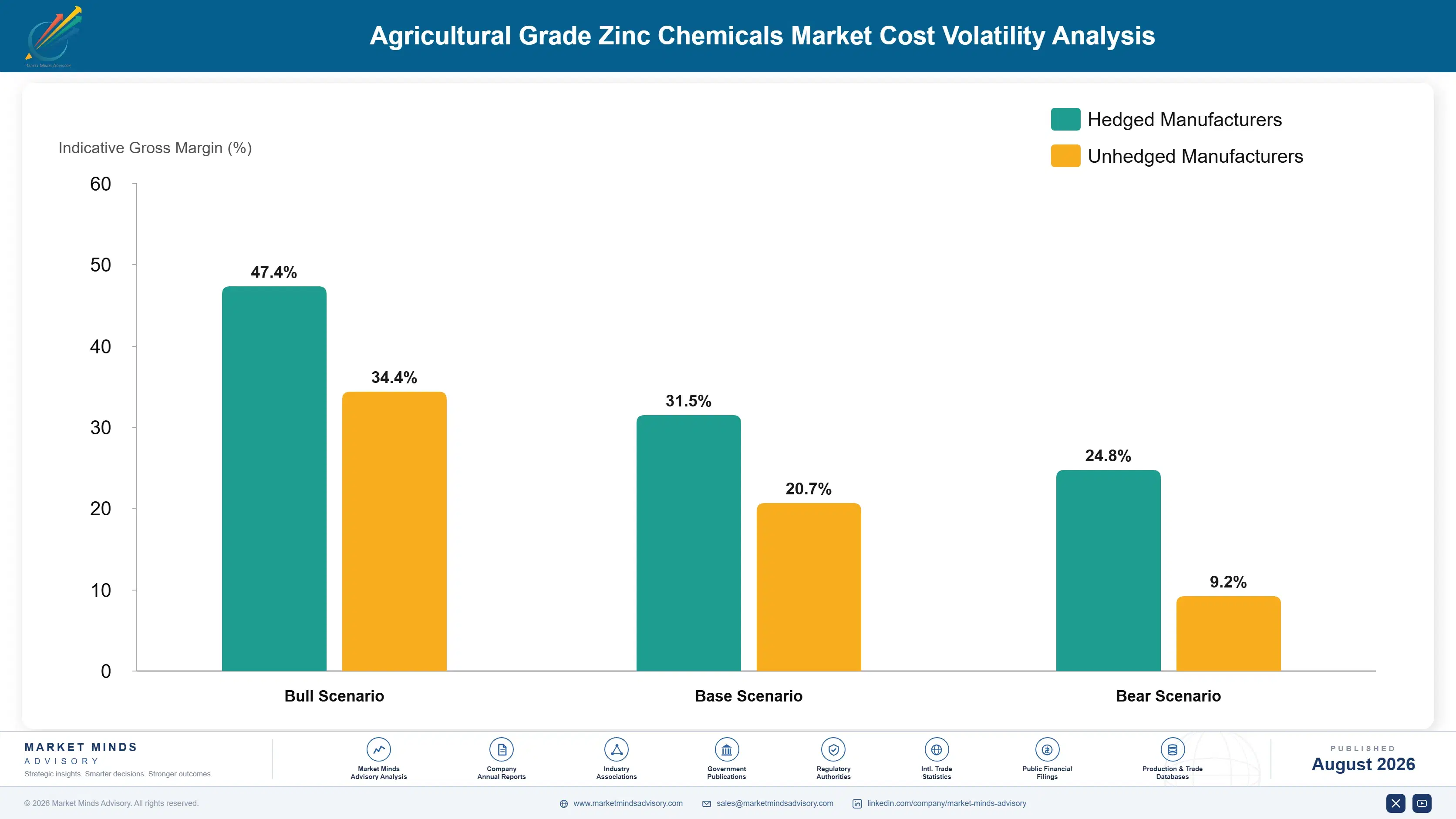
Refined zinc metal and zinc-bearing secondary material account for roughly 58% of production cost, purchased against London Metal Exchange pricing from smelters and recyclers across Asia, Europe, and the Americas. Sulphuric acid contributes 11%, sourced largely as a by-product of metal smelting. Energy for reaction, crystallisation, drying, and granulation takes 14%, and chelating agents, packaging, and quality testing absorb the remaining balance.
Refined zinc prices swung sharply through 2021 and 2022 as European smelters curtailed output under energy costs documented by IEA reporting, and agricultural chemical producers passed the movement through with difficulty because fertiliser buyers negotiate seasonally rather than continuously. Sulphuric acid availability tightened alongside smelter curtailment, compounding the problem for producers without integrated supply. Yara and Compass Minerals both referenced input cost pressure across their 2022 and 2023 reporting periods.

Exposure varies with metal sourcing and contract structure rather than with scale. Producers using zinc-bearing secondary and recycled material held cost position better than those buying refined metal on exchange pricing. Those on seasonal fertiliser contracts absorbed mid-season movements with no recourse. Chinese producers, beside domestic smelting with cheaper energy, held delivered cost advantage and still set global reference pricing for commodity sulphate.
agricultural-grade-zinc-chemicals-market-cost-volatility-analysis-1787463976497

Source zinc-bearing secondary material alongside refined metal

Galvanising residues, flue dusts, and other secondary zinc streams price on different drivers than refined metal on exchange, and processing capability for them converts a commodity exposure into a sourcing advantage. Quality control is the demanding part, since contaminant limits under fertiliser regulation are strict. Producers who built that capability held position through the 2022 squeeze.

Index seasonal fertiliser contracts against published metal benchmarks

Fertiliser buyers negotiate seasonally while zinc metal prices move continuously, which guarantees a mismatch whenever the market runs against the producer. Writing indexation against published exchange benchmarks into seasonal agreements removes the exposure, and buyers accept it once the alternative is explained as mid-season renegotiation. Distributors resist harder than growers do, which is itself informative.

Shift mix toward complexed forms where metal is a smaller cost share

Chelated and complexed products carry chelating agent and formulation cost alongside contained zinc, so metal represents a considerably smaller proportion of their total cost than it does for commodity sulphate. Moving portfolio mix toward those forms therefore reduces metal price sensitivity at the portfolio level, independent of any hedging. It also improves margin, which makes the shift easy to justify.

Portfolio Architecture for Margin Defence

Three tiers separate on demonstrated availability rather than on contained zinc. Commodity sulphate and unspecified granular product sold on analysis earns 11% to 19%, competing against Chinese cost and, in several markets, against adulterated material. Guaranteed soluble fraction granular and synthetic chelates earn 24% to 34%, because the buyer is purchasing performance they can verify. Amino acid complexes and biofortification-qualified supply earn most, and that gap widens as tissue evidence spreads.
The tension is that commodity volume keeps reactors loaded while teaching growers exactly the wrong lesson. A farmer who applies cheap sulphate to a calcareous soil, sees no response, and concludes micronutrients do not work is a customer the whole category has lost, not just that supplier. Several producers have concluded that selling commodity sulphate into alkaline soil regions actively damages the market they are trying to build, which is an unusual reason to decline volume.

High-value pools sit where the grower cannot judge the product from the bag. Tissue-demonstrated uptake, guaranteed soluble fraction, and organic certification all address exactly that gap, which is why they resist the price comparison that contained zinc percentage invites so readily. Nothing on the bag communicates any of it.

Volume / Commodity-Adjacent Tier

Zinc sulphate and unspecified oxysulphate granular sold on declared analysis into price-led fertiliser channels. Competes against Chinese cost and adulterated material in several markets. The wide range reflects large differences in metal sourcing and regional cost position.
Gross Margin: 11%-19%

Premium / Certified Tier

Guaranteed water-soluble fraction granular products and synthetic chelates supplied with batch certification and blending performance data. Buyers verify what they receive. Range width separates specified granular supply from fully chelated products within the same tier.
Gross Margin: 24%-34%

Sustainability / Regulatory / Next-Generation Tier

Amino acid and organic complexes carrying organic certification, plus supply qualified into biofortification programmes funded outside farm economics. Agronomic evidence and certification, rather than production cost, sustain the margin structure across this tier.
Gross Margin: 38%-52%
agricultural-grade-zinc-chemicals-market-portfolio-architecture-1787463977029

High-value Sub-segments and Strategic Watch-out

Amino Acid and Organic Complexes

Highest value in the market with 11.6% growth, holding organic certification that synthetic chelates cannot obtain anywhere. They outperform sulphate in exactly the alkaline soils where deficiency concentrates. Tissue evidence rather than marketing drives adoption through advisory channels. Advisory channels rather than promotion drive adoption here.
Gross Margin: 42%-52%

Biofortification Programme Supply

High value with unusual demand characteristics, since health ministry budgets rather than farm economics fund the application. Procurement rewards documented efficacy and supply reliability over price. Positioning requires trial participation and institutional relationships built over several years. Nothing else in this market escapes farm economics entirely.
Gross Margin: 34%-46%

Guaranteed Soluble Fraction Granular

The workable middle tier, differentiated by disclosure discipline that competitors find harder than the production adjustment itself. Informed cooperatives pay 15% to 25% more once they understand what total zinc analysis conceals about actual field performance. The disclosure discipline is the genuine differentiator here. Competitors rarely follow.
Gross Margin: 26%-34%

Commodity Zinc Sulphate

The strategic watch-out. Chinese capacity sets pricing and adulterated material competes below plausible cost in several major markets. Worse, selling it into alkaline soils produces no response and teaches growers that micronutrients generally do not work. Withdrawing from alkaline districts is a defensible commercial decision.
Gross Margin: 9%-17%

Why Agronomy Programmes Repeat Seasonally

Zinc revenue behaves as a seasonal annuity once a product enters a documented nutrition programme, which is different from most agricultural inputs. A grower or agronomist who has established zinc as part of a crop nutrition plan, seen tissue results confirming uptake, and observed yield response repeats that application every season without revisiting the decision. Typical programme tenure runs five to eight years with a retail agronomy relationship, considerably longer where a cooperative writes the recommendation centrally.
Stickiness varies sharply with how the product was sold. Supply established through tissue testing and demonstrated uptake is the most durable, because the grower has evidence from his own fields that a competitor cannot contradict cheaply. Cooperative and institutional programme supply comes next, protected by procurement processes and quality specifications. Commodity sulphate sold through price-led distribution is the least sticky of all, repurchased on landed cost each season with no attachment whatsoever to the supplier.

Buyer profiles have shifted with soil testing adoption. Growers increasingly arrive holding a soil report naming the deficiency, which changes the conversation from persuasion to product selection entirely. Persuasion has largely moved out of the conversation, and product selection has moved in.
agricultural-grade-zinc-chemicals-market-end-use-penetration-index-1787463977532

Where Zinc Micronutrient Capital Belongs

These are among the four positions where our research anticipates prominent divergence between winners and laggards over the coming forecast period. Each is grounded in the demand model, the regulatory perimeter, and the announced capacity pipeline.
01 / AGRONOMIC EVIDENCE CAPABILITY

Sell demonstrated uptake, because contained zinc tells growers nothing

Applied zinc and plant-available zinc diverge sharply in the alkaline and calcareous soils where deficiency actually concentrates, so a grower comparing products on contained percentage is comparing entirely the wrong number altogether. Running tissue testing across customer fields, demonstrating uptake rather than asserting it, costs roughly $1.4 million annually across an agronomy team and laboratory contract. It supports pricing 40% to 60% above commodity sulphate and converts an ordinary transaction into an advisory relationship that competitors quoting analysis alone cannot displace.
02 / COMPLEXED CHEMISTRY INVESTMENT

Build amino acid capability for soils where sulphate simply fails

Amino acid and organic acid complexes stay plant-available in exactly the conditions that immobilise sulphate within days, and they hold organic certification in jurisdictions where synthetic chelates cannot legally be used at all. Establishing production and securing the necessary approvals across major jurisdictions costs around $4.5 million. Growth of 11.6% in the segment follows tissue testing evidence spreading through advisory channels rather than any fashion cycle, which makes the resulting demand considerably more durable than most organic input categories ever prove.
03 / SOLUBLE FRACTION DISCLOSURE

Guarantee what dissolves, not just what the analysis says

Oxysulphate granules vary enormously in water-soluble zinc fraction, and most suppliers disclose it vaguely or not at all, which lets poor product hide comfortably behind a perfectly adequate total zinc analysis printed on the certificate. Guaranteeing a minimum soluble fraction backed by batch certification differentiates immediately against competitors selling on total content, and agronomically informed cooperatives pay 15% to 25% more for it. The production adjustment is modest; the disclosure discipline is what competitors consistently find most difficult to match.
04 / BIOFORTIFICATION PROGRAMME POSITIONING

Get inside nutrition programmes before the funding actually arrives

Agronomic biofortification raises grain zinc concentration by around 40%, and health authorities across South Asia and Sub-Saharan Africa are now evaluating it as a population nutrition intervention rather than as an ordinary agricultural input decision. Where a health ministry funds the application, procurement rewards documented efficacy and reliable supply rather than the lowest delivered price available. Positioning requires trial participation and institutional relationship building across two to three years, which simply cannot be compressed once tenders have actually been issued.

Engagement Snapshot From the Field

A live engagement with an industry participant carrying material or product regulatory and market exposure ahead of a defining policy shift, showing how our research translates into a defensible multi-year portfolio strategy.
MARKET MINDS ADVISORY · CLIENT ENGAGEMENT SUMMARY
Agricultural Grade Zinc Chemicals Producer Strategic Portfolio Review and Transition Roadmap 2026·Investment Scenario on Agricultural Grade Zinc Chemicals Exposure Evaluation 2025-26
CLIENT PROFILE
A South Asian micronutrient producer manufacturing zinc sulphate and blended granular products across two plants, serving retail dealers and cooperative channels in seven states, with annual revenue near USD 84 million (client-reported, unverified by MMA). Commodity zinc sulphate supplied roughly 79% of volume, no chelated or complexed capability existed, and the company employed three agronomists across the entire distribution footprint.
STRATEGIC CHALLENGE
Adulterated sulphate priced below plausible production cost had taken share across two states, gross margin had fallen to 13%, and dealer feedback indicated growers in alkaline districts were reporting no visible response and reducing repeat purchase. Management was weighing a capacity expansion to compete on cost against building capability the company did not currently possess.
MMA APPROACH
MMA analysed field response and repeat purchase by district against soil pH data, isolating where commodity sulphate was and was not performing agronomically. Complexed product entry was costed against licensing and toll options. Agronomy resourcing was benchmarked against competitors capturing premium volume, and cooperative and institutional channel access was assessed, with findings tested through 47 expert interviews during Q4 2025.
KEY FINDINGS
  1. Repeat purchase in districts with soil pH above 7.8 was 31% lower than in neutral districts, and those alkaline districts represented 44% of the company's addressable area.
  2. Competitors selling complexed products with tissue testing support were realising prices 52% above the client's sulphate while operating in the same districts and channels.
  3. Adulterated material was concentrated entirely in unorganised dealer channels, while cooperative and institutional purchasing tested incoming product and paid closer to fair value.
  4. Amino acid complex production could be established through a toll arrangement for roughly a fifth of the capital a dedicated plant would require initially.
CLIENT PROFILE
A South Asian micronutrient producer manufacturing zinc sulphate and blended granular products across two plants, serving retail dealers and cooperative channels in seven states, with annual revenue near USD 84 million (client-reported, unverified by MMA). Commodity zinc sulphate supplied roughly 79% of volume, no chelated or complexed capability existed, and the company employed three agronomists across the entire distribution footprint.
STRATEGIC CHALLENGE
Adulterated sulphate priced below plausible production cost had taken share across two states, gross margin had fallen to 13%, and dealer feedback indicated growers in alkaline districts were reporting no visible response and reducing repeat purchase. Management was weighing a capacity expansion to compete on cost against building capability the company did not currently possess.
MMA APPROACH
MMA analysed field response and repeat purchase by district against soil pH data, isolating where commodity sulphate was and was not performing agronomically. Complexed product entry was costed against licensing and toll options. Agronomy resourcing was benchmarked against competitors capturing premium volume, and cooperative and institutional channel access was assessed, with findings tested through 47 expert interviews during Q4 2025.
KEY FINDINGS
  1. Repeat purchase in districts with soil pH above 7.8 was 31% lower than in neutral districts, and those alkaline districts represented 44% of the company's addressable area.
  2. Competitors selling complexed products with tissue testing support were realising prices 52% above the client's sulphate while operating in the same districts and channels.
  3. Adulterated material was concentrated entirely in unorganised dealer channels, while cooperative and institutional purchasing tested incoming product and paid closer to fair value.
  4. Amino acid complex production could be established through a toll arrangement for roughly a fifth of the capital a dedicated plant would require initially.
RECOMMENDED STRATEGY
Phase 1: Phase 1 (months one to six): withdraw commodity sulphate from the highest pH districts and redirect that volume toward cooperative and institutional channels. Phase 2: Phase 2 (months seven to eighteen): establish amino acid complex supply through toll manufacture and recruit agronomists for tissue testing in alkaline districts. Phase 3: Phase 3 (months nineteen to thirty): pursue state biofortification programme qualification and build guaranteed soluble fraction certification across granular products.
OUTCOME
The producer withdrew commodity sulphate from four alkaline districts and reported gross margin improving from 13% to 22% within fifteen months (client-reported, unverified by MMA). Complexed products reached 14% of revenue in their first full season. Two cooperative supply agreements were signed and one state programme qualification is progressing.

Frequently Asked Questions

Foundational context covering the market sizes, CAGR, scope, country, region and competition that inform every finding below. This section is provided to cover basics and most often pre-purchase conversations, answered from the MMA Primary Research Dataset.

What is the current size of the Agricultural Grade Zinc Chemicals Market?

The market was valued at USD 1.90 billion in 2025, rising to an estimated USD 2.03 billion in 2026. East Asia holds the largest regional share at 30% of global value.

How large will the Agricultural Grade Zinc Chemicals Market be by 2036?

MMA forecasts USD 3.96 billion by 2036 under the base case, an expansion multiple of 1.95 times the 2026 level. Incremental value creation across the period reaches USD 1.93 billion.

What is the CAGR for the Agricultural Grade Zinc Chemicals Market 2026 to 2036?

The base case CAGR is 6.9%, with a bull case of 8.2% and a bear case of 5.6%. Historical growth between 2020 and 2025 ran at 5.7% despite the European feed channel loss.

Which segment is growing fastest?

Zinc amino acid and organic complexes, at 11.6%, roughly 1.68 times the overall market rate. They stay plant-available in alkaline soils where conventional sulphate precipitates within days.

Who are the major companies in the Agricultural Grade Zinc Chemicals Market?

Yara International, EverZinc, US Zinc, Coromandel International, and Compass Minerals lead, holding roughly 24% of supply between them. Hundreds of regional producers serve local channels.

Which country is growing fastest?

India, at 10.4%, driven by soil health card programmes documenting zinc deficiency across tens of millions of holdings and converting agronomic argument into actual purchase decisions.

Report Segmentation Architecture

The full report scope spans multiple orthogonal segmentation dimensions, with cross-tabulated demand data provided for each dimension pair. Coverage extends further to regional breakdowns, trend trajectories, and the competitive detail needed to support segment-level decision-making.

By Chemical Form

  • Zinc Sulphate
  • Zinc Oxide
  • Zinc EDTA and Synthetic Chelates
  • Zinc Amino Acid and Organic Complexes
  • Zinc Nitrate and Chloride
  • Zinc Oxysulphate and Blended Granular Forms

By End-Use Industry

  • Cereal and Broadacre Crop Production
  • Horticulture and Protected Cropping
  • Plantation and Perennial Crops
  • Animal Feed and Nutrition
  • Turf and Amenity Applications

By Commercial Dimension

  • Fertiliser Blender Direct Supply
  • Retail Agronomy and Dealer Channel
  • Cooperative and Institutional Procurement
  • Government and Programme Tenders

By Region

  • North America
  • Western Europe
  • East Asia
  • South Asia and Pacific
  • Latin America
  • Middle East and Africa
  • Eastern Europe

Scope, Methodology, and Coverage

Every figure in this report is reproducible from documented input assumptions. The scope below maps the historical period, the forecast horizon, the segmentation dimensions, and the countries covered, alongside the underlying primary and qualitative methodology.
Historical Period
2020 to 2025
Forecast Period
2026 to 2036
Base Year
2025 (USD billions; MMA Primary Research Dataset, August 2026)
Market Definition
The market comprises zinc chemicals manufactured and supplied for agricultural use, covering zinc sulphate, zinc oxide, zinc EDTA and synthetic chelates, zinc amino acid and organic complexes, zinc nitrate and chloride, and zinc oxysulphate and blended granular forms. Value is measured at producer level as supplied to fertiliser blenders, feed mills, distributors, cooperatives, and growers. Zinc metal and industrial zinc chemicals for non-agricultural use, zinc-containing fungicides, and finished compound fertilisers containing zinc as one component fall outside scope.
Quantitative Units
USD billions (current prices); tonnes of product; USD per tonne average selling price
Segmentation Dimensions
By Chemical Form; By End-Use Industry; By Commercial Dimension; By Region
Regions Covered
North America, Western Europe, East Asia, South Asia and Pacific, Latin America, Middle East and Africa, Eastern Europe
Countries Covered
USA, China, Germany, France, UK, Japan, South Korea, India, Australia, Canada, Brazil, Mexico, Indonesia, Vietnam, Thailand, Malaysia, UAE, Saudi Arabia, South Africa, Nigeria, Turkey, Poland, Netherlands, Italy, Spain, Sweden, Switzerland, Argentina, Colombia, Singapore, and additional markets relevant to this sector
Key Companies Profiled
Yara International, EverZinc, US Zinc, Coromandel International, Compass Minerals, Nouryon, BASF, Haifa Group, Valagro, Koch Agronomic Services, Aries Agro, Rubamin, Old Bridge Chemicals, Zochem, Grillo-Werke, Hakusui Tech, Shandong Wanlong Chemical, Balchem, Sulphur Mills, Tata Chemicals
Quantitative Methodology
Primary survey, n=3,800 respondents, Q4 2025, six countries; demand-side model with trade association cross-validation
Qualitative Methodology
47 expert interviews, Q4 2025; applied to validate demand model assumptions, identify emerging dynamics, and assess competitive positioning
Report Format
PDF and XLSX data workbook (Word format preview document)
Publisher
Market Minds Advisory
Report Code
MMA-2026-AGR-224
Published
August 2026
Contact
sales@marketmindsadvisory.com | www.marketmindsadvisory.com

Purchase the full Agricultural Grade Zinc Chemicals Market Report (2026 to 2036).

The full report sizes agricultural zinc chemical demand across six chemical forms and seven regions with 2026 to 2036 forecasts under base, bull, and bear cases. It maps soil pH and documented deficiency against product form performance, showing precisely where commodity sulphate fails and complexed chemistry earns its premium. Competitive profiles cover twenty suppliers assessed consistently on agricultural zinc revenue, chemistry capability, and agronomy resource. Regulatory analysis covers feed restrictions, fertiliser product rules, and contaminant limits by jurisdiction. Commercial guidance addresses agronomic evidence, complexed chemistry investment, soluble fraction disclosure, and biofortification positioning.
Six chemical forms sized and forecast separately
Soil pH mapped against product form field performance
Twenty supplier profiles on consistent revenue basis
Adulteration incidence estimated by market and channel
Biofortification programme pipeline tracked by country
Zinc metal price pass-through modelled across product forms

Built For The People Who Decide

From boardroom strategy to bench-side execution, this report is read cover-to-cover by leaders shaping the next decade of their industry, turning demand scenarios, market dynamics and valuation benchmarks into decisions.
CXOs/ Presidents/ VPs/ Managers
M&A and Corporate Development
Strategy Teams and R&D Heads
Procurement and Product Directors
Regulatory and Compliance Leaders
Investor Relations and Equity Analysts