Market Minds Advisory
Agricultural Adjuvant Market

Agricultural Adjuvant Market: Precision Spray Technology Meets Drift Regulation

Adjuvant suppliers are racing to reformulate around drone and low-volume precision spraying while regulators tighten drift control requirements, reshaping which surfactant, oil-based, and silicone chemistries actually capture premium contract value from applicators.

Lead Analyst

Lisa Gevelber

Published

September 2026

Make Smarter Decisions with Customized Research Insights

Request a free sample report and evaluate market opportunities, growth trends, and competitive dynamics relevant to your business needs.

2025 MARKET VALUE$4.1BMarket Size 2025
2036 FORECAST VALUE$8.5BBase Case , 2026 to 2036
CAGR 2026 TO 20366.8 %Bull 8.1% / Bear 5.5%
INCREMENTAL OPPORTUNITY$4.1BNet 10- year value creation
EXPANSION MULTIPLE1.93x2036 value over 2026 base
Strategic Levers
M&A Pipeline
Regional Outlook
Country Rankings
Competitive Intelligence
Segmental Deep-dive
Call-Us : 91 93563 13602

Executive Snapshot and Market Trajectory

Agricultural adjuvant suppliers are shifting from commodity surfactant sales toward precision-formulation partnerships, as row-crop applicators adopt drone and low-volume spraying that standard oil-based and wetting-agent chemistries were never engineered to support consistently across increasingly demanding field conditions and tightening drift regulations.
Growth concentrates in silicone-based adjuvants formulated for drone and low-volume application, and in drift control and deposition aids as regulators tighten spray drift requirements across major row-crop regions. North America and East Asia together host the largest formulation and distribution capacity, while Brazil's rapidly expanding precision spraying and drone application industry is pulling demand faster than any other country tracked as row-crop acreage scales and precision equipment adoption spreads nationwide.
Competitive character splits between integrated chemical giants like BASF that supply adjuvants alongside broader crop protection portfolios and specialty innovators like Croda that lead on bio-based and novel surfactant chemistry. Regulatory pressure around drift control mandates and toxicology standards is rising steadily, pushing suppliers toward reformulation investment that smaller regional blenders increasingly cannot match without losing volume elsewhere in their broader chemical operations across multiple product lines, regions, and customer segments worldwide each fiscal year.
Market Definition
This report covers surfactants, oil-based adjuvants, drift control agents, water conditioners, silicone-based adjuvants, and defoaming or compatibility agents added to pesticide, herbicide, and fungicide tank mixes to improve spray performance. It excludes the active pesticide ingredients themselves and finished, pre-formulated pesticide products that already include adjuvant chemistry internally.
Base Year Value
$4.1B in 2025 (MMA Primary Research Dataset, August 2026)
Forecast Period
2026 to 2036, eleven discrete annual values
CAGR
6.8% base case. Bull 8.1%. Bear 5.5%.
Fastest Growth Segment
Silicone-Based Adjuvants: 10.5% CAGR
Fastest Growth Country
Brazil: 9.5% CAGR
Fastest Growth Region
South Asia and Pacific: 8.8% CAGR
Largest Region
North America: 28% of 2025 global value
Market Leaders
BASF SE, Corteva Agriscience, Evonik Industries, Solvay SA, Croda International. Source: MMA Analysis based on company annual reports.
Primary Survey
n=3,800 procurement and R&D decision-makers, Q4 2025, six countries
Methodology
Demand-side build-up, cross-validated against public data, 47 expert interviews

Agricultural Adjuvant Market Forecast Scenarios

agricultural-adjuvant-market-trends-growth-size-forecast-scenario-1787462053288
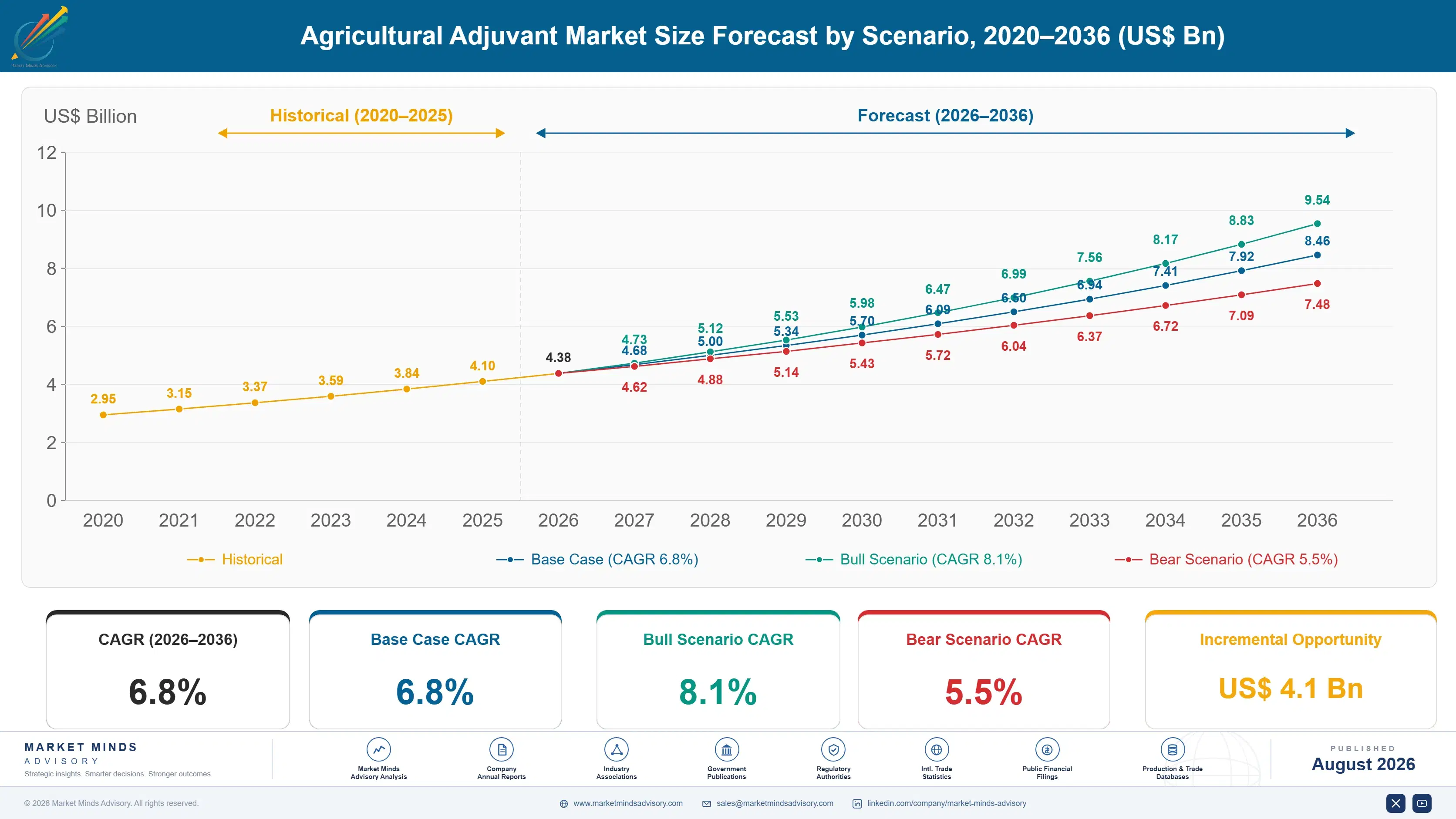
Agricultural adjuvant demand grew steadily between 2020 and 2025 as row-crop acreage held broadly stable and precision spraying adoption began accelerating from a modest base. A historical CAGR of 5.5% reflects that steady build, with silicone-based and drift control chemistries gaining share fastest as applicators sought formulations engineered for drone and low-volume equipment rather than legacy boom sprayers.
The base case assumes 6.8% annual growth through 2036, anchored by three mechanisms: continued drone and low-volume spraying adoption requiring silicone-based adjuvant chemistry, tightening drift control regulation across major row-crop regions pushing deposition aid demand, and expanding precision agriculture infrastructure across Brazil and other fast-growing row-crop economies. Together these push suppliers to serve both a stable commodity surfactant base and an increasingly demanding precision-formulation tier simultaneously, without letting either segment starve the other of needed capacity.
A bull scenario assumes drone spraying adoption accelerates faster than expected across major row-crop regions, pushing growth toward 8.1%. The bear case turns on crop protection input cost pressure and softening commodity crop prices reducing applicator willingness to pay for premium adjuvant chemistry, dragging growth down toward roughly 5.5% across the most exposed suppliers lacking diversified feedstock and distribution relationships.

Precision Spray Technology and the Reformulation Curve

Agricultural adjuvants sit downstream of the broader crop protection industry, supplying the surfactant, oil-based, and specialty chemistry that determines whether an active pesticide ingredient actually reaches and adheres to the target plant surface. This function gives adjuvants outsized influence over applicator outcomes relative to their modest share of total crop protection spending, a dynamic few other input categories share as directly across the broader crop protection value chain.
MARKET CONCENTRATION (CR5)38%Integrated chemical giants hold meaningful combined market scale
AVERAGE FORMULATION PRICE$4.80 per literBlended surfactant and oil-based adjuvant pricing across major markets
TOP PRODUCING COUNTRY SHAREUnited States, 24%Largest single national base for adjuvant formulation capacity
PRECISION FORMAT PENETRATION21% of revenueSilicone and drift control chemistries capture rising revenue share
APPLICATOR ADOPTION RATE34% drone-compatibleRow-crop applicators now using drone-compatible spray formulations nationwide
KEY INPUT COST SHARE52% of COGSSpecialty surfactant and silicone feedstock dominate total production cost
Commercially, the category splits between standard surfactant and oil-based adjuvants sold on tight tonnage contracts to distributors, and a smaller but rapidly growing precision tier built on silicone-based and drift control chemistry. Suppliers with dedicated precision formulation capability, Croda among them, capture disproportionate margin even where their standard tonnage share stays flat against integrated giants like BASF and Corteva year after year.
Over the next decade, capacity additions concentrate around dedicated precision formulation lines serving drone and low-volume applicators rather than expanding standard surfactant capacity, since row-crop acreage growth alone does not justify new commodity volume at the pace precision demand is growing. Rising drift control regulation will keep separating credible reformulated suppliers from blenders treating adjuvants as a secondary revenue stream rather than a genuine strategic priority.
"Adjuvants used to be the part of the tank mix nobody thought about. Now the suppliers winning drone-era contracts are the ones who reformulated years before applicators asked for it."
Director, Crop Protection and Specialty Agrochemicals Practice · MMA Agriculture & Crop Protection Chemicals Practice · August 2026

Market Trends

Silicone-Based Adjuvants for Drone and Low-Volume Spraying

Agricultural drone spraying and low-volume ground application are pulling demand for silicone-based adjuvants engineered to maintain spray coverage and droplet control at spray volumes far below what legacy boom sprayers use, a specification standard oil-based adjuvants cannot reliably meet. Evonik and similar specialty suppliers have invested in dedicated silicone and silica formulation lines separate from standard surfactant production, since the two chemistries require entirely different manufacturing processes and quality control standards. This demand is concentrated among applicators transitioning fastest to drone technology, since drone operators cannot use legacy adjuvant chemistry without risking inconsistent coverage across the field.
Market Impact: Adds 6-8% drone-driven demand growth
Drift Control Adoption Ahead of Regulatory Mandates

Regulators across major row-crop regions are tightening spray drift requirements following documented off-target pesticide movement incidents, pulling demand for deposition aids and drift control adjuvants that reduce fine droplet formation during application. Suppliers including Solvay have expanded dedicated drift control product lines ahead of anticipated regulatory mandates, positioning themselves before compliance becomes a baseline requirement rather than a competitive differentiator. This trend is pulling adjuvant demand toward measurable droplet-size performance specifications that most legacy surfactant formulations were never engineered to satisfy consistently across the wider applicator base each growing season.
Market Impact: Adds 9.5% Brazil demand growth

Market Opportunities and Growth Drivers

Expanding Drone Spraying Across Major Row-Crop Regions

Row-crop applicators across North America, Brazil, and China continue expanding drone spraying adoption to cut labor cost and improve application timing during narrow weather windows, each new drone fleet requiring adjuvant chemistry qualified for low-volume, high-precision application. Evonik and similar suppliers have expanded silicone-based production capacity to meet this rising qualified customer base, since formulation qualification with drone equipment manufacturers takes considerable testing time. This driver is measurable in precision adjuvant revenue growth consistently outpacing standard surfactant volume growth across every major row-crop region tracked in this report each successive year.
Market Impact: Raises feedstock cost volatility 10-16%

Brazil's Rapidly Expanding Precision Agriculture Base

Brazil's rapidly growing soybean and row-crop acreage is pulling new adjuvant demand domestically as the country's precision agriculture and drone application industry scales faster than any other market tracked in this report. Government agricultural modernization programs are supporting continued mechanization and precision spraying investment among large-scale Brazilian growers, indirectly expanding demand for qualified adjuvant chemistry across the country's expanding acreage. International suppliers have expanded distribution relationships with Brazilian applicators to capture this demand ahead of domestic formulation capacity fully maturing across the region, positioning early movers before local competitors close the gap entirely.
Market Impact: Adds 9-14% compliance cost burden

Market Restraints and Challenges

Specialty Surfactant and Silicone Feedstock Volatility

Specialty surfactant and silicone feedstock pricing tracks volatile global petrochemical and specialty silicone markets, squeezing supplier margins during periods when applicators resist passing higher adjuvant costs through to already thin row-crop profitability. The root cause is the category's dependence on globally traded specialty chemical inputs whose pricing is set well outside the agricultural adjuvant industry's own supply and demand dynamics. The commercial impact falls hardest on smaller regional blenders without long-term feedstock contracts or diversified sourcing relationships. Larger suppliers are mitigating exposure through multi-year supply agreements and geographic sourcing diversification across multiple producing regions.
Market Impact: Adds 10.5% silicone segment growth

Regulatory Reformulation Compliance Burden Keeps Rising

Tightening drift control mandates and toxicology standards across major row-crop regions require suppliers to reformulate and re-register adjuvant products, a compliance burden that smaller regional blenders were never built to carry at the pace regulators now demand. The root cause is that regulators face pressure to address off-target pesticide movement, pushing compliance requirements down through the supply chain quickly. The commercial impact falls hardest on smaller suppliers without dedicated regulatory capability, who face meaningful capital investment to requalify products across jurisdictions. Larger suppliers are mitigating exposure by building dedicated regulatory and reformulation teams separate from standard product development.
Market Impact: Adds 8.2% drift control segment growth
3 additional market trends, 2 additional growth drivers, and 4 additional restraints and challenges are covered in the full report. Contact sales@marketmindsadvisory.com to access the complete intelligence.

Segment CAGR and Growth Architecture

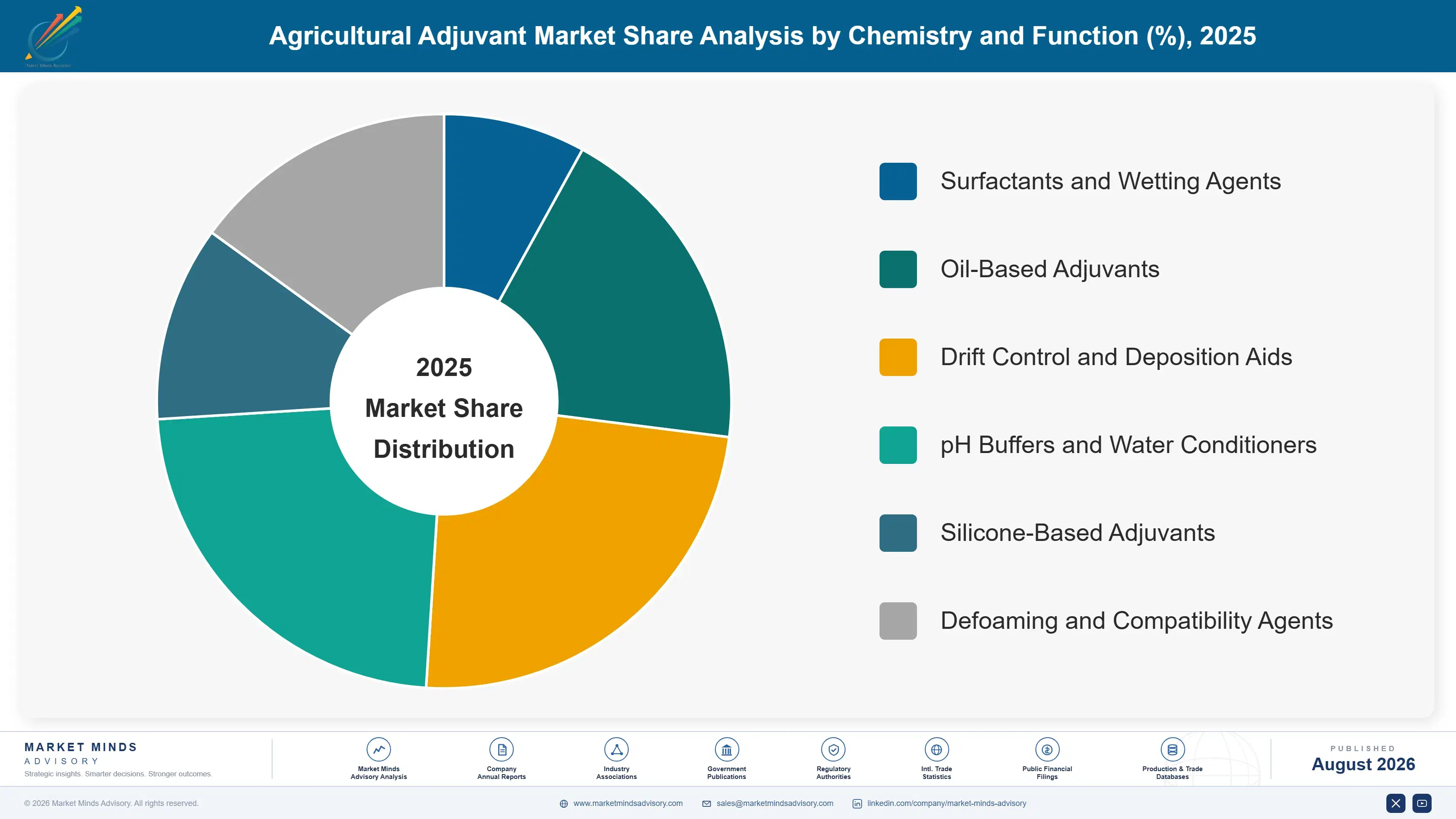
MMA segments the agricultural adjuvant market by chemistry and function rather than by crop type, since formulation chemistry, not the crop being sprayed, determines cost structure and margin more than any single downstream application across row crops, specialty crops, or turf and ornamental uses today across every single producing country this report tracks in detail.
agricultural-adjuvant-market-trends-growth-market-share-analysis-1787462053851

Silicone-Based Adjuvants

Silicone-based adjuvants form the fastest-growing segment, pulled by drone and low-volume ground application that requires spray coverage and droplet control performance standard oil-based chemistry cannot reliably deliver at reduced spray volumes. Evonik and similar specialty suppliers have built dedicated silicone and silica formulation lines entirely separate from standard surfactant production, since the two chemistries require different manufacturing processes and quality standards. This segment commands the strongest price premium in the category, since precision specifications justify pricing applicators readily accept given labor savings drone spraying delivers. Demand concentrates in North America, Brazil, and China, where drone spraying adoption is advancing fastest across large-scale row-crop operations, though the format is beginning to appear across smaller specialty crop operations as well.
CAGR 10.5%

Drift Control and Deposition Aids

Drift control and deposition aids are the second-fastest segment, driven by tightening regulatory drift requirements across major row-crop regions following documented off-target pesticide movement incidents affecting neighboring farmland and sensitive areas. Solvay and similar suppliers have expanded dedicated drift control product lines ahead of anticipated regulatory mandates, positioning early movers before compliance becomes a baseline market requirement rather than a genuine differentiator. This segment commands meaningful margin over standard surfactants, since measurable droplet-size performance specifications require formulation science investment that commodity blenders cannot easily replicate. Growth concentrates in North America and Western Europe, where regulatory drift mandates are most advanced and enforcement is most consistently applied across applicator operations of every scale and crop type.
CAGR 8.2%
Full segment breakdown across 6 segments available in the complete report.

Regional Architecture and Country Demand Map

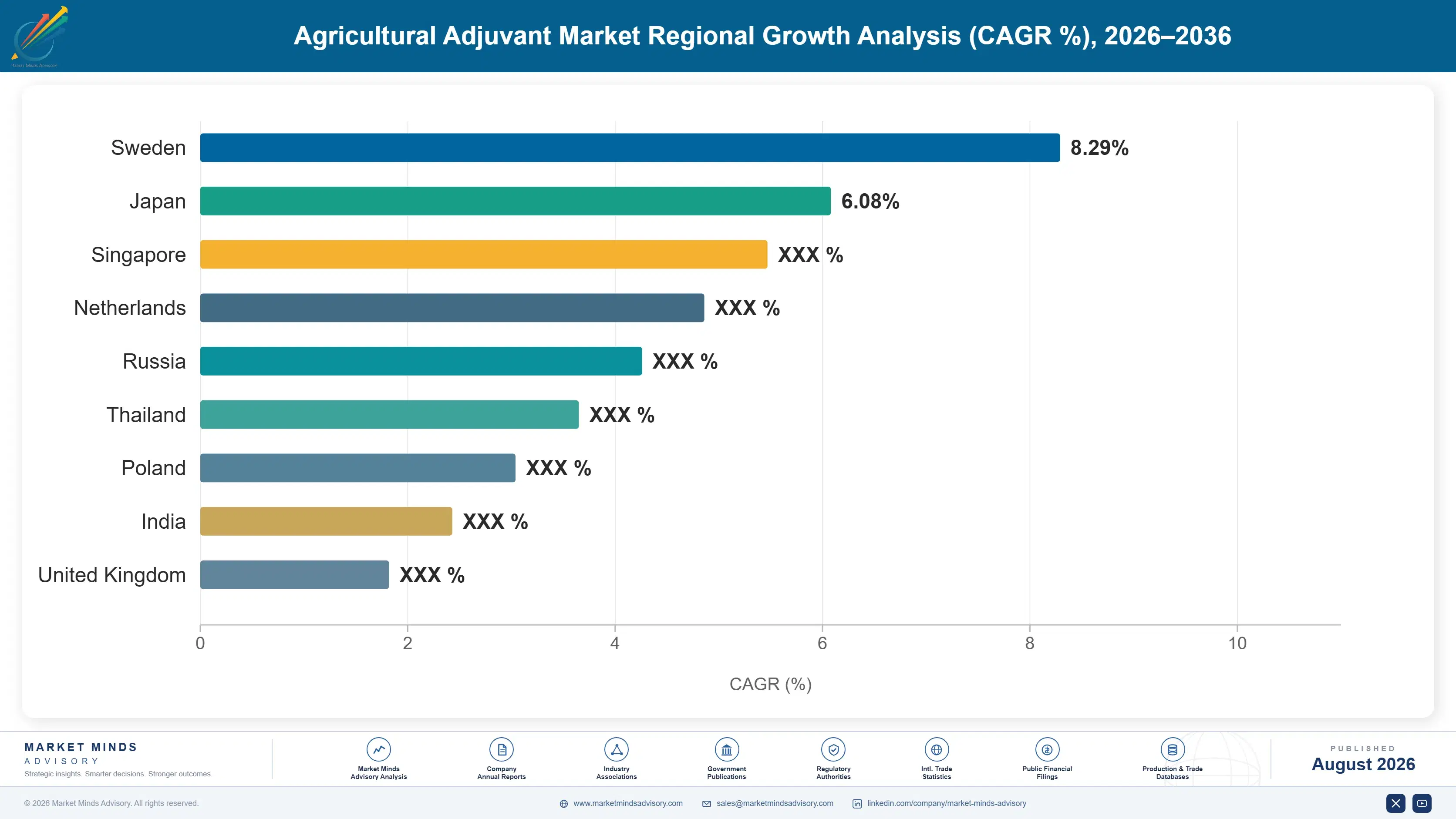
Agricultural adjuvant demand concentrates across North America and East Asia's large row-crop and formulation bases, while Brazil's rapidly expanding precision spraying and drone application industry is growing faster than any other country tracked in this analysis across the entire forecast period that lies directly ahead.

North America

The United States anchors the largest agricultural adjuvant base anywhere, built on decades of row-crop applicator relationships and the deepest bench of formulation capacity serving both standard surfactant and precision silicone-based chemistry. Winfield United and Loveland Products both distribute extensively across the Corn Belt, giving the region a direct logistics advantage that import-dependent markets elsewhere cannot easily match. Precision format penetration runs highest here of any region, tracking rapid drone spraying adoption across large-scale Midwest row-crop operations. Canada contributes a smaller but meaningful formulation base, closely integrated with United States supply chains through cross-border distribution relationships and shared regulatory frameworks across both countries' major growing regions and applicator networks each season.
Share: 28% | CAGR: 7.2% (2026 to 2036)

Western Europe

Germany and France host the region's largest agricultural adjuvant markets, with BASF and Clariant anchoring established formulation infrastructure tied to the region's mature row-crop and specialty crop base. The region's stricter regulatory environment around drift control and toxicology standards has pushed suppliers toward documentation and reformulation capability as a genuine competitive requirement rather than a background cost. Private label and generic adjuvant penetration runs higher here than in North America, since European distributors have built sophisticated own-brand programs applicators trust as closely comparable to branded formulations. Growth trails North America and East Asia since the region's row-crop acreage is essentially fixed and volume gains depend on reformulation rather than expansion.
Share: 20% | CAGR: 5.2% (2026 to 2036)
Regional intelligence for 5 additional markets available in the complete report: East Asia, South Asia and Pacific, Latin America, Middle East and Africa, Eastern Europe. Contact sales@marketmindsadvisory.com.
agricultural-adjuvant-market-trends-growth-country-cagr-analysis-1787462054474

Precision Formulation and Compliance Value Capture

Agricultural adjuvant suppliers extract more value from existing distribution relationships by moving into precision formulation and drift compliance rather than competing purely on standard surfactant tonnage. The levers below concentrate on capturing silicone-based premium, drift control margin, and regulatory compliance value that commodity-only blenders cannot easily replicate without dedicated capital investment of their own.

Silicone Formulation Investment for Drone-Compatible Contracts

Suppliers that built dedicated silicone-based formulation capacity separate from standard surfactant production are capturing drone applicator contracts worth roughly 30 to 40% more per liter than standard oil-based adjuvants, since precision performance specifications justify pricing applicators readily accept given labor savings. This capacity requires meaningful capital investment and typically takes 2 to 3 years to fully commission and qualify with drone equipment manufacturers, but it lets suppliers serve a buyer base standard formulators cannot reach. Suppliers without silicone formulation capability increasingly lose drone-compatible contracts entirely to established competitors already validated with equipment manufacturers.
Market Impact: Adds a 30 to 40% precision price premium overall

Drift Control Certification Ahead of Regulatory Mandates

Suppliers that built dedicated drift control product lines ahead of anticipated regulatory mandates are winning applicator contracts that competitors without comparable certified chemistry cannot fulfill once compliance deadlines take effect across major row-crop regions. These certified drift control contracts generate roughly 18 to 24% higher margin than standard surfactant tonnage, since applicators value regulatory certainty enough to pay a specification-driven premium ahead of enforcement. Suppliers without drift control certification increasingly lose this growing compliance-driven customer base entirely to better-positioned competitors already serving regulated applicators across multiple jurisdictions and crop categories.
Market Impact: Adds 18 to 24% drift control margin overall

Multi-Region Feedstock Diversification for Supply Security

Suppliers that diversify specialty surfactant and silicone feedstock sourcing across multiple producing regions rather than depending on a single source reduce their exposure to sudden petrochemical or silicone supply tightness that can strand smaller competitors mid-contract with distributors. Building this diversified sourcing base typically takes 3 to 4 years of supplier qualification across multiple regions, but it lets a supplier maintain formulation continuity for applicator customers when any single feedstock source faces disruption. Suppliers without diversified sourcing risk losing distributor contracts during supply disruptions, since applicators cannot pause spraying schedules waiting for a single blocked source to reopen.
Market Impact: Cuts supply disruption risk by roughly 32% overall

Regulatory Affairs Investment for Multi-Jurisdiction Access

Suppliers that build dedicated regulatory affairs teams win preferential access to applicators across multiple jurisdictions who increasingly require pre-registered, compliant adjuvant chemistry before adopting a new formulation ahead of tightening drift control enforcement. This regulatory investment requires meaningful upfront cost and typically takes 2 years to fully implement registration across a supplier's target jurisdictions, but it pays back through access to markets non-compliant competitors cannot enter. Suppliers without dedicated regulatory capability remain confined to commodity-tier contracts regardless of their underlying formulation quality, since documentation increasingly determines market access more than raw chemistry alone.
Market Impact: Wins 14 to 19% more multi-jurisdiction contracts overall

Who Controls the Margin Pool

CR5 in agricultural adjuvants sits near 38%, reflecting meaningful concentration among integrated crop protection giants alongside a long tail of regional blenders and distributors. BASF leads through integrated crop protection scale, with Croda close behind through its bio-based innovation leadership, while the gap to smaller regional blenders remains wide enough that drift control certification requirements continue raising the capital bar to compete effectively.
Current competitive activity centers on three fronts: silicone-based formulation investment to capture drone applicator contracts, drift control certification to get ahead of tightening regulatory mandates, and multi-jurisdiction regulatory affairs investment to access compliant markets faster than competitors. Larger suppliers with formulation and regulatory capability are moving fastest on all three, while smaller regional blenders without capital access risk losing both precision contracts and compliance-driven distributor relationships.

Emerging pressure comes from Brazilian and Chinese domestic formulators scaling precision adjuvant capacity fast enough to reduce their historical dependence on Western imports for drone-compatible chemistry. Evonik's continued silicone system investment signals established specialty suppliers are treating precision formulation as a genuine strategic priority rather than a niche side business within their broader agricultural portfolio and long-term growth strategy.
agricultural-adjuvant-market-trends-growth-company-positioning-matrix-1787462055085

Competitive Moat and Risk Dimensions

BASF SE

Moat: Integrated Crop Protection Scale

BASF's integrated crop protection portfolio gives it distribution relationships and formulation scale that specialty-only adjuvant suppliers cannot match, letting it bundle adjuvant chemistry alongside active ingredient sales to the same applicator customer base. This scale also funds precision formulation investment that smaller integrated competitors cannot easily justify.
BASF SE

Risk: Formulation Commoditization Risk

BASF's standard surfactant and oil-based adjuvant lines face meaningful commoditization pressure from regional blenders replicating similar chemistry at lower cost, meaning the company must continually reformulate toward precision and drift control tiers to defend margin across its broader adjuvant portfolio each successive product cycle and regional market.
CRODA INTERNATIONAL

Moat: Bio-Based Innovation Leadership

Croda's early investment in bio-based and novel surfactant chemistry gives it a genuine innovation lead that competitors focused on legacy petrochemical-based formulations have struggled to match, particularly as sustainability-focused customers increasingly favor renewable adjuvant chemistry across their procurement decisions and long-term supplier relationships spanning multiple growing seasons.
CRODA INTERNATIONAL

Risk: Premium Price Sensitivity Risk

Croda's premium bio-based positioning depends on applicators continuing to pay more for sustainability credentials, and any softening in commodity crop prices could push cost-conscious applicators back toward cheaper conventional adjuvant chemistry, pressuring Croda's premium pricing structure across several of its most important row-crop accounts and distributor relationships worldwide.

Players Tracked

Prominent Players

BASF SE
Corteva Agriscience
Evonik Industries
Solvay SA
Croda International

Other Key Players

Clariant
Wilbur-Ellis Company
Helena Agri-Enterprises
Precision Laboratories
Winfield United (Land O'Lakes)
Loveland Products (Nutrien)
Brandt Consolidated
Huntsman Corporation
Stepan Company
Nufarm Limited
Innvictis Crop Care
Interagro
De Sangosse
Adjuvants Plus Inc.
CHS Inc.

Recent Developments

MARCH 2025

Evonik Expands Silicone Adjuvant Production for Drone Applications

Evonik expanded dedicated silicone-based adjuvant production capacity at one of its European facilities, adding equipment separate from standard surfactant lines to meet rising demand from drone spraying applicators worldwide. The expansion supports formulation qualification work with several major drone equipment manufacturers across multiple regions and crop categories.
Signal: Confirms leading specialty chemical suppliers are dedicating separate capacity to precision spray chemistry rather than shared lines.
JULY 2025

Croda Launches Bio-Based Drift Control Adjuvant Line

Croda launched a new bio-based drift control adjuvant product line targeting row-crop applicators in North America and Western Europe ahead of anticipated regulatory drift mandates taking effect. The launch reflects the company's continued investment in renewable surfactant chemistry across its broader agricultural portfolio and customer base.
Signal: Signals specialty suppliers are combining sustainability positioning with regulatory compliance readiness across new product launches each season.
JANUARY 2026

Solvay Expands Drift Control Manufacturing Capacity in Brazil

Solvay expanded its drift control and deposition aid manufacturing capacity in Brazil to serve the country's rapidly growing precision spraying applicator base directly rather than through import channels. The expansion followed sustained order growth from Brazilian distributors over the prior two growing seasons across multiple states.
Signal: Confirms major suppliers are localizing precision formulation production closer to Brazil's fast-growing applicator base overall each year.

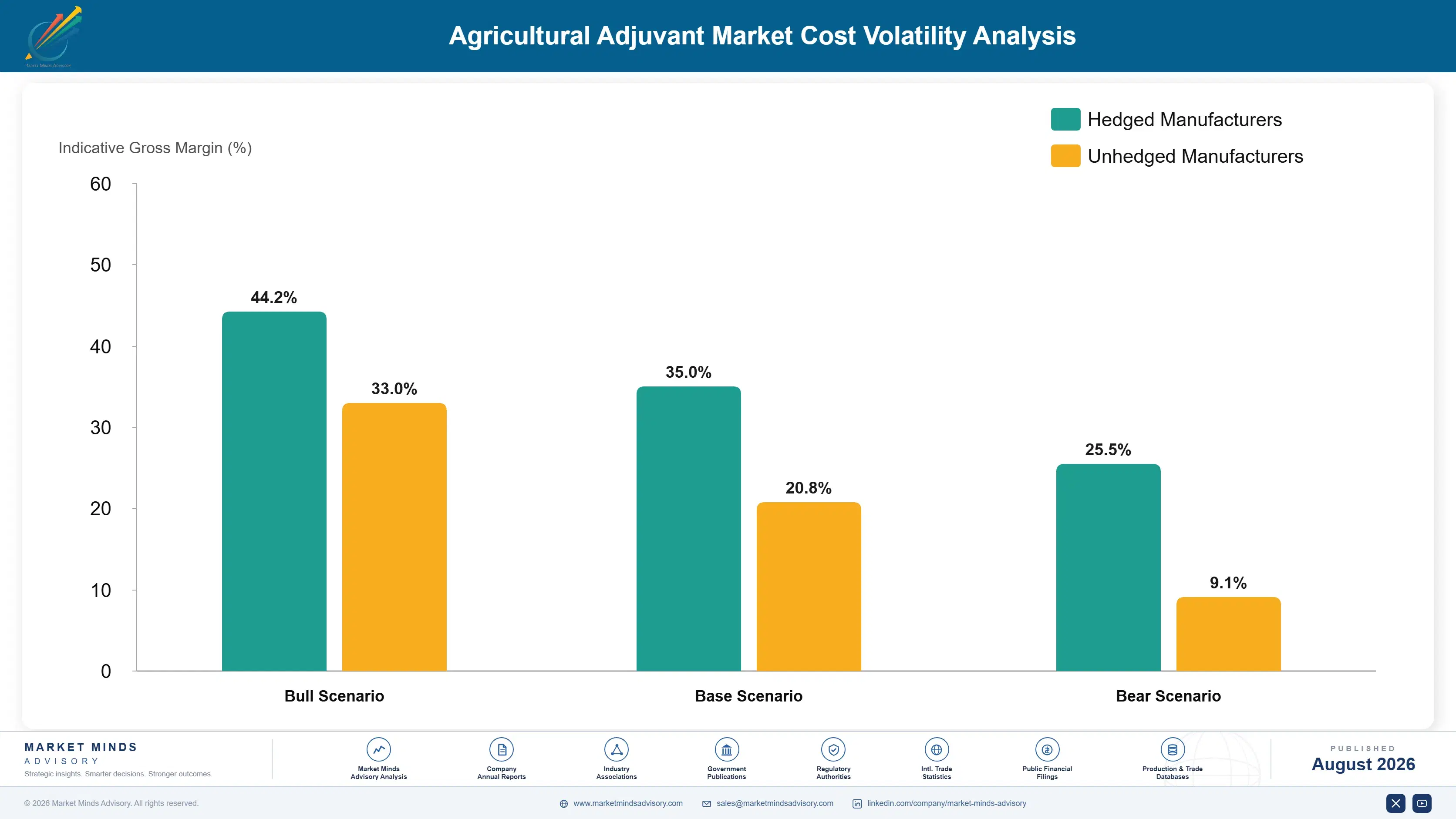
Specialty Surfactant and Silicone Feedstock Exposure

Specialty surfactant and silicone feedstock account for roughly 52% of processor cost of goods sold, sourced from global petrochemical and specialty silicone producers whose pricing tracks broader commodity and energy markets rather than agricultural adjuvant-specific demand alone. This exposure sits meaningfully higher than in more mechanized agricultural input categories, given how concentrated the category's core specialty inputs remain among a small number of global suppliers.
Global silicone and specialty surfactant prices rose sharply following energy market volatility across 2022 and 2023, with the IEA's industrial energy market reports documenting sustained cost pressure across major specialty chemical producing regions through 2024. Suppliers without long-term feedstock agreements or diversified sourcing absorbed meaningfully higher per-liter production costs than competitors with existing multi-year supply contracts already established well before the volatility began, according to company disclosures from that period.

Exposure varies by supplier type: large integrated chemical producers with captive feedstock production and multi-region sourcing absorb volatility more evenly than smaller regional blenders dependent on spot market purchasing. Precision formulation suppliers with dedicated silicone production capacity face additional processing cost layers that standard surfactant-only producers do not carry, widening the margin gap between the two supplier types during sustained feedstock inflation.
agricultural-adjuvant-market-trends-growth-cost-volatility-analysis-1787462055293

Multi-Year Feedstock Supply Agreements

Larger suppliers increasingly lock in multi-year specialty surfactant and silicone feedstock agreements directly with producers, trading some pricing flexibility for predictable long-term input cost visibility across consecutive production cycles. Smaller suppliers without the volume commitments to negotiate multi-year terms remain more exposed to spot feedstock price spikes during periods of tight supply each cycle.

Captive Silicone and Surfactant Production Integration

Some larger suppliers increasingly maintain captive silicone and surfactant production rather than depending entirely on merchant feedstock purchasing, reducing exposure to spot market volatility that drives specialty chemical cost swings sharply. This integration requires substantial upfront capital but meaningfully smooths input cost volatility across consecutive years of energy market cycles and feedstock price swings alike.

Multi-Region Feedstock Sourcing Diversification

Suppliers are increasingly sourcing specialty surfactant and silicone feedstock from multiple producing regions rather than depending on a single source, reducing exposure to localized supply disruption or regional feedstock cost spikes. This diversification requires supplier qualification investment but meaningfully smooths input cost volatility across multiple sourcing regions and feedstock categories over time each year.

Portfolio Architecture for Margin Defence

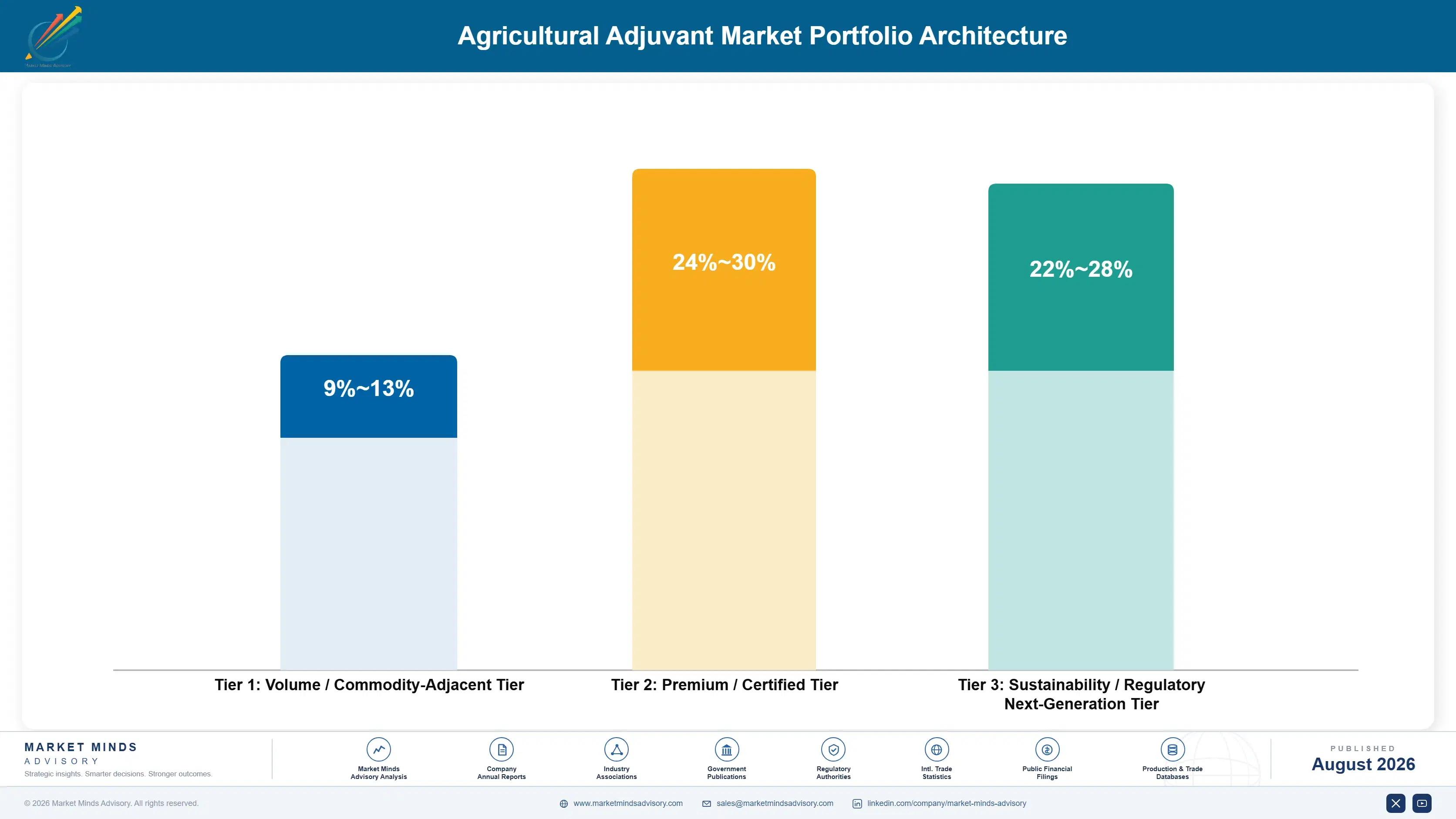
Agricultural adjuvant portfolios split across three tiers with different margin economics: a volume tier built on standard surfactant and oil-based adjuvants sold to distributors, a premium tier built on silicone-based and drift control chemistry, and an emerging next-generation tier tied to bio-based and fully compliant formulations that applicators are only beginning to pay a defined premium for consistently across every major contract.
The tension between volume and premium runs deep in how suppliers allocate limited precision formulation capacity: every liter dedicated to silicone-based or drift control output is a liter unavailable for standard surfactant volume that still generates the bulk of category revenue today. Get the mix wrong and a supplier either misses premium precision contracts or overinvests in specialty capacity that outpaces actual applicator demand for it right now across the wider category.

High-value margin pools concentrate overwhelmingly in silicone-based and drift control chemistry sold to precision-focused applicators, not in standard surfactant tonnage alone. Suppliers that built formulation and regulatory capability early, Croda and Evonik among them, now capture a share of total category profit well above their share of total tonnage sold each year across their combined product lines and regions.

Volume / Commodity-Adjacent Tier

Standard surfactant and oil-based adjuvants sold on tight tonnage contracts to distributors and applicators, priced close to petrochemical feedstock benchmarks with thin processing margin above input cost across most accounts.
Gross Margin: 9-13%

Premium / Certified Tier

Silicone-based and drift control adjuvants sold to precision applicators requiring drone-compatible or regulatory-compliant chemistry, commanding meaningful price premiums through formulation science and certification capability that commodity blenders cannot easily replicate at comparable cost.
Gross Margin: 24-30%

Sustainability / Regulatory / Next-Generation Tier

Bio-based and fully compliant adjuvant formulations aimed at applicators and distributors with public sustainability and regulatory transparency commitments, still a small volume tier but growing as compliance expectations rise across major markets.
Gross Margin: 22-28%
agricultural-adjuvant-market-trends-growth-portfolio-architecture-1787462055808

High-value Sub-segments and Strategic Watch-out

Silicone-Based Adjuvants (High-Value, High-Growth)

Silicone-based adjuvants combine the fastest unit growth in the category with meaningfully above-average margins, making it the single most attractive segment for suppliers with dedicated formulation capacity already in place. Demand continues to outpace available certified capacity across North America, Brazil, and China combined each year.
Gross Margin: 24-30%

Drift Control and Deposition Aids (High-Value, Moderate-Growth)

Drift control chemistry carries better margin than standard surfactants and continues gaining regulatory-driven contracts, though growth is more moderate than silicone-based formats since it depends on regulatory enforcement timelines that vary meaningfully by jurisdiction, region, crop type, and applicator scale across each growing season worldwide.
Gross Margin: 20-26%

Standard Surfactants and Oil-Based Adjuvants (Volume Core)

Standard surfactant and oil-based adjuvants remain the largest single category by volume and the backbone of supplier cash flow, even though margin sits well below the specialty tiers. Nearly every supplier depends on this volume base to fund precision investment elsewhere in the wider portfolio each fiscal year.
Gross Margin: 9-13%

Non-Compliant Legacy Formulations (Strategic Watch-Out)

Adjuvant formulations without updated drift control certification or regulatory registration carry the thinnest margin in the portfolio and face the most direct exposure to being excluded from contracts as compliance requirements continue tightening across major row-crop jurisdictions each year, especially in the most heavily regulated markets tracked.
Gross Margin: 5-9%

Application Season Cycles and Switching Costs

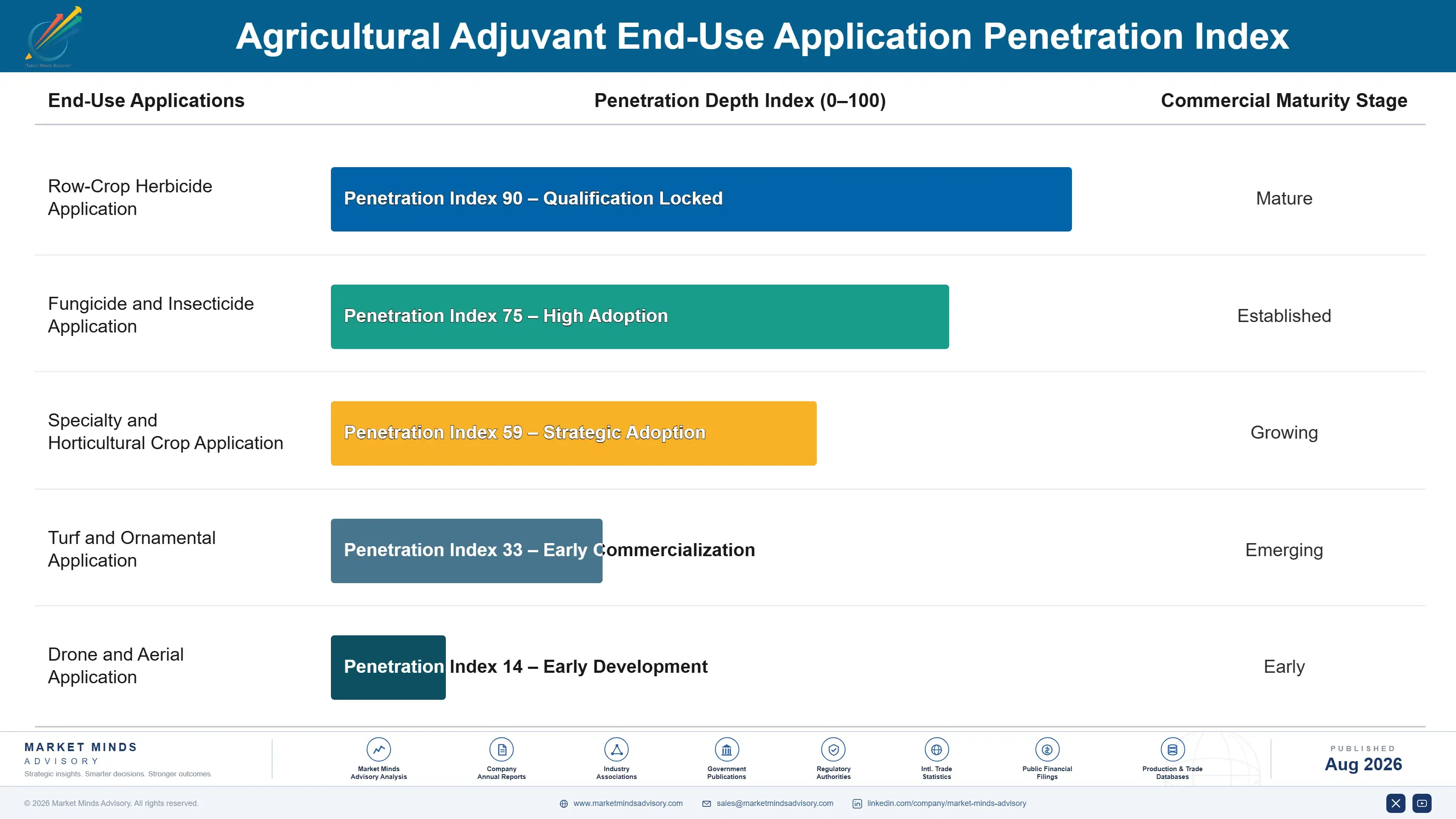
Agricultural adjuvant demand runs on seasonal application cycles tied to planting and spray timing rather than year-round contracts, since applicators purchase adjuvant chemistry ahead of each growing season based on planned tank mix formulations for that year's crop plan. This gives incumbent suppliers a meaningful retention advantage once an applicator's standard tank mix depends on their specific formulation and compatibility profile across multiple active ingredients.
Adoption depth varies sharply by applicator type: large-scale row-crop operations with dedicated agronomy staff treat adjuvant suppliers as relatively interchangeable within performance specifications, switching more readily on price ahead of each season, while drone and precision applicators show far stronger supplier lock-in since switching means requalifying formulation compatibility across their entire equipment fleet. Applicators operating under strict regulatory drift mandates show the least willingness to switch of any group, given the compliance risk of adopting an unfamiliar formulation.

A generational shift is underway among applicators too: younger, technology-focused operators increasingly treat adjuvant chemistry as a precision input tied to equipment compatibility and data-driven spray optimization, rewarding suppliers that invested early in drone-compatible formulation over those still positioning adjuvants as a generic tank mix afterthought.
agricultural-adjuvant-market-trends-growth-end-use-penetration-index-1787462056365

Where Agricultural Adjuvant Margin Concentrates

These are among the four positions where our research anticipates prominent divergence between winners and laggards over the coming forecast period. Each is grounded in the demand model, the regulatory perimeter, and the announced capacity pipeline.
01 / PRECISION FORMULATION TIMING

Early silicone investment now defends a durable drone contract lead

Suppliers that built dedicated silicone-based formulation capacity ahead of rising drone spraying demand now hold applicator relationships that later movers cannot quickly replicate, since drone operators rarely switch away from a qualified, validated adjuvant supplier once equipment compatibility has been confirmed. This timing advantage matters more than raw distribution scale, because precision applicator contracts increasingly require silicone formulation capability as a baseline qualification rather than a differentiator. Suppliers without early silicone investment now face a multi-year capital and qualification process before they can compete for the same premium drone contracts.
02 / FEEDSTOCK VOLATILITY EXPOSURE

Single-source suppliers face the sharpest specialty feedstock disruption risk

Suppliers dependent on a single specialty surfactant or silicone feedstock source face the sharpest exposure to sudden supply tightness when that specific producer faces disruption, since specialty chemical supply chains remain far more concentrated than commodity agricultural inputs generally are. This risk concentrates specifically among smaller regional blenders lacking the capital to diversify sourcing across multiple producing regions simultaneously. Suppliers that diversified feedstock sourcing early face meaningfully less disruption during supply tightness than those still dependent on a single source for the bulk of their specialty chemistry.
03 / EMERGING MARKET CAPACITY RACE

Brazil is where the next wave of precision spraying demand gets built

Brazil's rapidly expanding drone and precision spraying adoption is pulling adjuvant demand faster than any other market tracked in this report, as the country's massive row-crop base modernizes its application technology ahead of most global peers. This capacity race reflects genuinely new precision demand formation rather than share shifting among already-established Western competitors fighting over a mature applicator base. Suppliers and distributors that build relationships in Brazil now will be better positioned than those waiting for the shift to become obvious in import and equipment sales data.
04 / REGULATORY COMPLIANCE GAP

Non-certified suppliers are quietly being excluded from premium contracts

Suppliers without updated drift control certification increasingly find themselves excluded from premium applicator contracts regardless of their underlying formulation quality, since regulatory enforcement is turning certification into a baseline requirement rather than a differentiator across major row-crop jurisdictions. This compliance gap compounds over time, since applicators rarely revisit uncertified suppliers once a compliant, validated relationship has been established elsewhere in their operation. Suppliers investing in certification now will close this gap faster than competitors waiting for regulators to force the issue outright.

Engagement Snapshot From the Field

A live engagement with an industry participant carrying material or product regulatory and market exposure ahead of a defining policy shift, showing how our research translates into a defensible multi-year portfolio strategy.
MARKET MINDS ADVISORY · CLIENT ENGAGEMENT SUMMARY
Agricultural Adjuvant Producer Strategic Portfolio Review and Transition Roadmap 2026·Investment Scenario on Agricultural Adjuvant Exposure Evaluation 2025-26
CLIENT PROFILE
The client is a mid-sized regional adjuvant blender supplying standard surfactant and oil-based products to row-crop distributors across a single national market, with no silicone-based or drift control certified product lines. Revenue approached $110 million in the most recent fiscal year (client-reported, unverified by MMA), though margins had compressed steadily as larger integrated competitors expanded precision formulation capacity the client had not pursued.
STRATEGIC CHALLENGE
The blender had no silicone-based formulation capability and no drift control certification, leaving it entirely dependent on standard surfactant pricing at a moment when drone applicators and regulated distributors were consolidating purchases with certified, precision-qualified suppliers. Leadership needed to decide whether to invest in silicone formulation capacity, drift control certification, or both simultaneously given limited available capital.
MMA APPROACH
MMA benchmarked the blender's cost structure against precision-diversified competitors, modeled the capital and timeline required for both silicone formulation capacity and drift control certification, and evaluated a phased sequencing that would let certification-driven contract wins help fund the larger silicone capital investment over time without straining existing working capital reserves.
KEY FINDINGS
  1. The blender's standard surfactant margin had compressed meaningfully faster than regional peers already diversified into silicone-based or drift control certified products over the prior several years.
  2. Drift control certification required substantially less upfront capital than silicone formulation capacity, making it the faster near-term path to premium contract qualification.
  3. Regional drone applicators confirmed that formulation qualification, not price, was the binding constraint on awarding new supply contracts to the regional blender.
  4. Competitors that invested earliest in both certification and silicone capacity already held multi-year distributor contracts that would be difficult to displace quickly.
CLIENT PROFILE
The client is a mid-sized regional adjuvant blender supplying standard surfactant and oil-based products to row-crop distributors across a single national market, with no silicone-based or drift control certified product lines. Revenue approached $110 million in the most recent fiscal year (client-reported, unverified by MMA), though margins had compressed steadily as larger integrated competitors expanded precision formulation capacity the client had not pursued.
STRATEGIC CHALLENGE
The blender had no silicone-based formulation capability and no drift control certification, leaving it entirely dependent on standard surfactant pricing at a moment when drone applicators and regulated distributors were consolidating purchases with certified, precision-qualified suppliers. Leadership needed to decide whether to invest in silicone formulation capacity, drift control certification, or both simultaneously given limited available capital.
MMA APPROACH
MMA benchmarked the blender's cost structure against precision-diversified competitors, modeled the capital and timeline required for both silicone formulation capacity and drift control certification, and evaluated a phased sequencing that would let certification-driven contract wins help fund the larger silicone capital investment over time without straining existing working capital reserves.
KEY FINDINGS
  1. The blender's standard surfactant margin had compressed meaningfully faster than regional peers already diversified into silicone-based or drift control certified products over the prior several years.
  2. Drift control certification required substantially less upfront capital than silicone formulation capacity, making it the faster near-term path to premium contract qualification.
  3. Regional drone applicators confirmed that formulation qualification, not price, was the binding constraint on awarding new supply contracts to the regional blender.
  4. Competitors that invested earliest in both certification and silicone capacity already held multi-year distributor contracts that would be difficult to displace quickly.
RECOMMENDED STRATEGY
Phase 1: Phase 1 (Year 1): Implement drift control certification across existing surfactant production to qualify for regulated distributor contract consideration and evaluation. Phase 2: Phase 2 (Years 2 to 3): Use improved certified contract volume and margin to fund dedicated silicone-based formulation capacity investment. Phase 3: Phase 3 (Years 3 to 4): Pursue multi-year drone applicator supply contracts using newly certified and precision-formulated capacity as proof of qualification.
OUTCOME
Within eighteen months, the blender's certified contract volume reached a meaningful share of total revenue and funded silicone formulation capacity planning ahead of the original timeline (client-reported, unverified by MMA). The phased approach let the business diversify without straining working capital, positioning it to compete for precision contracts it could not have pursued previously.

Frequently Asked Questions

Foundational context covering the market sizes, CAGR, scope, country, region and competition that inform every finding below. This section is provided to cover basics and most often pre-purchase conversations, answered from the MMA Primary Research Dataset.

What is the current size of the Agricultural Adjuvant Market?

The global agricultural adjuvant market was valued at approximately $4.1 billion in 2025. This covers surfactants, oil-based adjuvants, drift control agents, and silicone-based chemistry sold to row-crop and specialty crop applicators.

How large will the Agricultural Adjuvant Market be by 2036?

MMA projects the market will reach approximately $8.5 billion by 2036, up from roughly $4.4 billion in 2026. That represents an expansion multiple of about 1.93 times over the ten-year forecast period.

What is the CAGR for the Agricultural Adjuvant Market 2026 to 2036?

The base case CAGR is 6.8% annually, with a bull scenario near 8.1% and a bear scenario near 5.5%. This range reflects sensitivity to feedstock costs and drone spraying adoption pace.

Which segment is growing fastest?

Silicone-based adjuvants are the fastest-growing segment, expanding at roughly 10.5% annually, about 1.5 times the overall market's pace. Drift control and deposition aids follow at approximately 8.2% annually.

Who are the major companies in the Agricultural Adjuvant Market?

Leading players include BASF SE, Corteva Agriscience, Evonik Industries, Solvay SA, and Croda International. Together these five hold an estimated 38% combined market concentration today.

Which country is growing fastest?

Brazil is the fastest-growing national market, expanding near 9.5% annually as its precision spraying and drone application industry rapidly scales. China follows as a significant secondary growth center in the region.

Report Segmentation Architecture

The full report scope spans multiple orthogonal segmentation dimensions, with cross-tabulated demand data provided for each dimension pair. Coverage extends further to regional breakdowns, trend trajectories, and the competitive detail needed to support segment-level decision-making.

By Chemistry and Function

  • Surfactants and Wetting Agents
  • Oil-Based Adjuvants
  • Drift Control and Deposition Aids
  • pH Buffers and Water Conditioners
  • Silicone-Based Adjuvants
  • Defoaming and Compatibility Agents

By End-Use Application

  • Row-Crop Herbicide Application
  • Fungicide and Insecticide Application
  • Specialty and Horticultural Crop Application
  • Turf and Ornamental Application
  • Drone and Aerial Application

By Commercial Dimension

  • Direct Distributor Supply Contracts
  • Private Label and Generic Blending
  • Formulation Licensing Agreements
  • Export and Cross-Border Trade

By Region

  • North America
  • Western Europe
  • East Asia
  • South Asia and Pacific
  • Latin America
  • Middle East and Africa
  • Eastern Europe

Scope, Methodology, and Coverage

Every figure in this report is reproducible from documented input assumptions. The scope below maps the historical period, the forecast horizon, the segmentation dimensions, and the countries covered, alongside the underlying primary and qualitative methodology.
Historical Period
2020 to 2025
Forecast Period
2026 to 2036
Base Year
2025 (USD billions; MMA Primary Research Dataset, August 2026)
Market Definition
This report defines the agricultural adjuvant market as surfactants, oil-based adjuvants, drift control agents, water conditioners, silicone-based adjuvants, and defoaming or compatibility agents added to pesticide, herbicide, and fungicide tank mixes globally. It excludes the active pesticide ingredients themselves and finished, pre-formulated pesticide products that already include adjuvant chemistry internally.
Quantitative Units
USD billions (current prices); metric tonnes product weight where cited
Segmentation Dimensions
By Chemistry and Function; By End-Use Application; By Commercial Dimension; By Region
Regions Covered
North America, Western Europe, East Asia, South Asia and Pacific, Latin America, Middle East and Africa, Eastern Europe
Countries Covered
USA, China, Germany, France, UK, Japan, South Korea, India, Australia, Canada, Brazil, Mexico, Indonesia, Vietnam, Thailand, Malaysia, UAE, Saudi Arabia, South Africa, Nigeria, Turkey, Poland, Netherlands, Italy, Spain, Sweden, Switzerland, Argentina, Colombia, Singapore, and additional markets relevant to this sector
Key Companies Profiled
BASF SE, Corteva Agriscience, Evonik Industries, Solvay SA, Croda International, Clariant, Wilbur-Ellis Company, Helena Agri-Enterprises, Precision Laboratories, Winfield United (Land O'Lakes), Loveland Products (Nutrien), Brandt Consolidated, Huntsman Corporation, Stepan Company, Nufarm Limited, Innvictis Crop Care, Interagro, De Sangosse, Adjuvants Plus Inc., CHS Inc.
Quantitative Methodology
Primary survey, n=3,800 respondents, Q4 2025, six countries; demand-side model with trade association cross-validation
Qualitative Methodology
47 expert interviews, Q4 2025; applied to validate demand model assumptions, identify emerging dynamics, and assess competitive positioning
Report Format
PDF and XLSX data workbook (Word format preview document)
Publisher
Market Minds Advisory
Report Code
MMA-2026-AGR-108
Published
August 2026
Contact
sales@marketmindsadvisory.com | www.marketmindsadvisory.com

Purchase the full Agricultural Adjuvant Market Report (2026 to 2036).

The full Agricultural Adjuvant Market report delivers detailed sizing and forecasts across all six chemistry and function segments, all seven world regions, and twenty profiled companies through 2036. It includes granular regional data tables, competitive benchmarking on a consistent production volume basis, and input cost sensitivity modeling tied to global specialty surfactant and silicone markets. Subscribers receive access to the underlying primary survey dataset (n=3,800 respondents, Q4 2025, six countries) and qualitative expert interview findings (n=47 interviews, Q4 2025). The report also includes segment-level margin analysis and a portfolio tiering framework analysts can apply directly to company assessments.
Full segmentation across six chemistry and function categories
Seven-region market sizing with growth forecasts
Twenty-company competitive benchmarking on consistent basis
Input cost sensitivity modeling tied to specialty chemical markets
Access to primary survey dataset of 3,800 respondents
Portfolio tiering framework for margin benchmarking

Built For The People Who Decide

From boardroom strategy to bench-side execution, this report is read cover-to-cover by leaders shaping the next decade of their industry, turning demand scenarios, market dynamics and valuation benchmarks into decisions.
CXOs/ Presidents/ VPs/ Managers
M&A and Corporate Development
Strategy Teams and R&D Heads
Procurement and Product Directors
Regulatory and Compliance Leaders
Investor Relations and Equity Analysts