Market Minds Advisory
Agricultural Activator Adjuvant Market

Agricultural Activator Adjuvant Market: Formulation Chemistry Behind Herbicide Performance

Dicamba label requirements now dictate which adjuvant chemistries qualify for tank mixing, turning volatility reduction and water conditioning formulations from optional additives into a mandatory line item on every compliant application.

Lead Analyst

Lisa Gevelber

Published

September 2026

Make Smarter Decisions with Customized Research Insights

Request a free sample report and evaluate market opportunities, growth trends, and competitive dynamics relevant to your business needs.

2025 MARKET VALUE$2.3BMarket Size 2025
2036 FORECAST VALUE$4.6BBase Case , 2026 to 2036
CAGR 2026 TO 20366.4 %Bull 7.6% / Bear 5.2%
INCREMENTAL OPPORTUNITY$2.1BNet 10- year value creation
EXPANSION MULTIPLE1.86x2036 value over 2026 base
Strategic Levers
M&A Pipeline
Regional Outlook
Country Rankings
Competitive Intelligence
Segmental Deep-dive
Call-Us : 91 93563 13602

Executive Snapshot and Market Trajectory

Adjuvant selection has stopped being a formulation afterthought and become a compliance decision, as dicamba and other volatile herbicide labels now name specific approved adjuvant chemistries growers must use to stay legal.
Water conditioning and volatility reduction adjuvants sell against a hard label requirement rather than discretionary yield-boosting appeal, which explains why this narrow segment now grows faster than the broader crop protection input category. North America accounts for the largest single share of demand, concentrated among Midwest row crop operations applying herbicide-tolerant soybean and corn systems across tens of millions of acres annually.
Formulation chemistry expertise and label registration breadth separate the leading five suppliers from a long tail of regional blenders who compete mainly on price for older surfactant chemistries. Regulatory tightening around spray drift, not new pest pressure, is what is reshaping which adjuvant categories gain share fastest.
Market Definition
The agricultural activator adjuvant market covers surfactants, oils, water conditioners, and buffering agents added to pesticide and herbicide tank mixes to improve uptake, coverage, or compatibility. It excludes the herbicides and pesticides themselves, seed treatments, and fertilizers sold as standalone products.
Base Year Value
$2.3B in 2025 (MMA Primary Research Dataset, August 2026)
Forecast Period
2026 to 2036, eleven discrete annual values
CAGR
6.4% base case. Bull 7.6%. Bear 5.2%.
Fastest Growth Segment
Organosilicone Surfactants: 9.8% CAGR
Fastest Growth Country
Brazil: 9.4% CAGR
Fastest Growth Region
South Asia and Pacific: 8.4% CAGR
Largest Region
North America: 33% of 2025 global value
Market Leaders
Croda International, Clariant, Evonik Industries, Solvay, WinField United. Source: MMA Analysis based on company annual reports.
Primary Survey
n=3,800 procurement and R&D decision-makers, Q4 2025, six countries
Methodology
Demand-side build-up, cross-validated against public data, 47 expert interviews

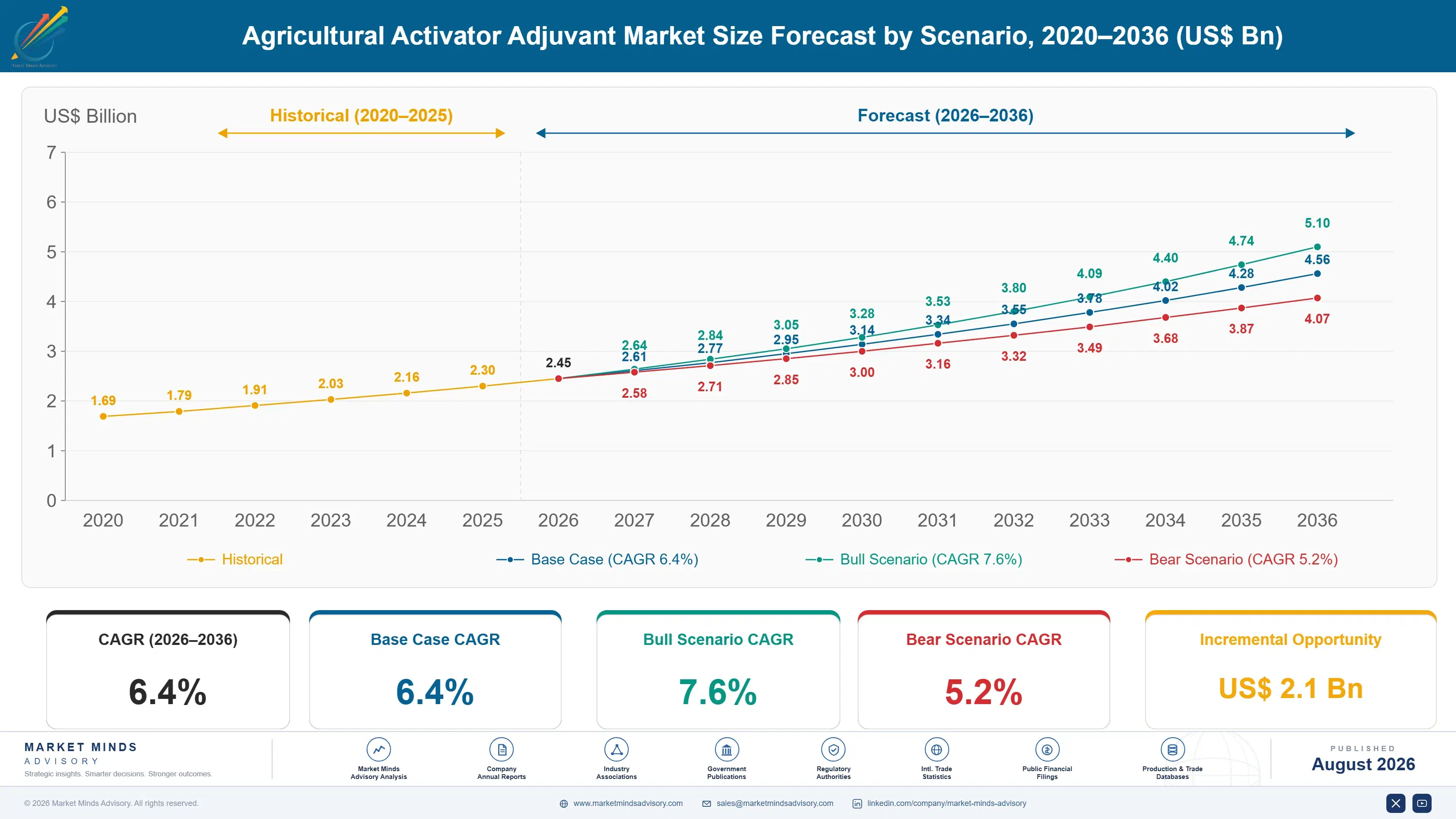
Agricultural Activator Adjuvant Market Forecast Scenarios

agricultural-activator-adjuvant-market-2-size-forecast-scenario-1787463839832
Activator adjuvant demand grew steadily from 2020 to 2025 as herbicide-tolerant cropping systems expanded acreage and dicamba-related label changes phased in gradually across major row crop growing regions in North America and South America.
The base case assumes continued expansion driven by three mechanisms: broader adoption of volatility reduction agents under tightening spray drift regulation, incremental acreage growth in herbicide-tolerant soybean and corn systems across Brazil and Argentina, and gradual replacement of older surfactant chemistries with organosilicone formulations that command meaningfully higher per-unit pricing across every major geography.
The bull case hinges on additional US states adopting stricter dicamba volatility reduction mandates, forcing faster adjuvant reformulation across the entire application base. The bear case centers on any federal restriction or outright cancellation of dicamba registration, which would eliminate the single largest driver of recent segment growth almost overnight.

Formulation Compliance Reshapes a Once-Discretionary Input

Three forces converge on this market today. Regulators increasingly name specific adjuvant chemistries directly on herbicide labels rather than leaving tank-mix partner selection to grower discretion, growers facing tighter spray windows want formulations that reduce drift and volatility without sacrificing weed control efficacy, and input suppliers see adjuvant premiumization as one of the few remaining margin levers in an otherwise commoditized crop protection supply chain.
MARKET CONCENTRATIONCR5 38%top five suppliers hold moderate combined share
AVERAGE SELLING PRICEUSD 4.80/literorganosilicone formulations command steep premium
TOP PRODUCING COUNTRYUnited States 29%concentrated Midwest formulation and blending capacity
CAPACITY UTILIZATION74%seasonal spray-window demand limits year-round throughput
FEEDSTOCK COST SHARE48% of COGSspecialty oleochemical and silicone input dependency
TRADE INTENSITY31% cross-borderformulated product shipped across regional blending hubs
The commercial character sits closer to a specialty formulation business than a bulk agrochemical trade, since winning label-referenced status requires meaningful registration investment and ongoing efficacy data generation that smaller regional blenders often cannot fund. That dynamic keeps pricing power concentrated among suppliers with genuine formulation chemistry depth.
The next decade turns on how far volatility reduction requirements extend beyond dicamba into other herbicide classes, and on whether organosilicone chemistry keeps commanding a premium as more producers develop competing formulations. Both outcomes shape how quickly this segment outgrows the broader adjuvant category.
"The real product here isn't the surfactant, it's the label compliance data behind it. Growers aren't buying chemistry, they're buying the right to spray legally."
Director, Crop Protection Inputs Practice · MMA Agriculture / Crop Protection Inputs Practice · August 2026

Market Trends

Dicamba Volatility Reduction Adjuvant Mandates Expand

Herbicide labels covering dicamba-tolerant soybean and cotton systems now specify approved volatility reduction adjuvant chemistries by name, a departure from the historical practice of leaving tank-mix partner selection to grower or retailer discretion. Roughly 55 million acres of dicamba-tolerant soybeans were planted across the United States in the 2025 season, and every one of those acres requires a labeled volatility reduction agent to remain compliant. Suppliers that achieve label-referenced status gain a captive demand pool competitors cannot easily contest, since growers who deviate from the named chemistry risk enforcement action and yield loss from off-target drift onto neighboring sensitive crops.
Market Impact: Adds 2.1 million hectares of demand
Organosilicone Chemistry Displaces Conventional Surfactants

Organosilicone-based surfactants spread across leaf surfaces far more effectively than conventional nonionic surfactants, cutting the volume of spray solution needed to achieve full leaf coverage while improving rainfastness within thirty minutes of application. Precision application equipment increasingly calibrated for lower spray volumes favors this chemistry directly, since organosilicone formulations achieve target coverage at output rates conventional surfactants cannot match. Adoption has moved beyond specialty horticulture into mainstream row crop use over the past three seasons, pulling average selling prices upward as the mix shifts toward premium chemistry across every major herbicide-tolerant cropping system in North and South America.
Market Impact: Settlements exceeded 400 million dollars

Market Opportunities and Growth Drivers

Herbicide-Tolerant Cropping System Acreage Expansion

Herbicide-tolerant soybean, corn, and cotton acreage keeps expanding across Brazil, Argentina, and the United States, and every additional acre planted to these systems represents incremental activator adjuvant demand tied directly to application frequency. Brazil alone added roughly 2.1 million hectares of dicamba and glyphosate-tolerant soybean acreage over the past three growing seasons, each requiring adjuvant-supported tank mixes for effective weed control under increasingly resistant weed pressure. Multiple applications per season, often three to four passes across a single field, multiply adjuvant volume demand well beyond simple acreage growth alone, reinforcing the segment's tie to broader herbicide-tolerant trait adoption trends across every major growing region tracked.
Market Impact: Risks 55 million compliant acres

Spray Drift Litigation Pressure Forces Reformulation

Successful off-target drift litigation involving dicamba damage to sensitive crops and ornamental plantings has pushed applicators and retailers toward adjuvant systems with documented volatility reduction performance, since demonstrable compliance now serves as a legal defense as much as an agronomic practice. Settlements exceeding 400 million dollars across consolidated dicamba drift litigation in the United States have made retailers considerably more risk-averse about which adjuvant chemistries they recommend to growers. Manufacturers are responding by generating expanded field efficacy and volatility data packages, and by pursuing broader state-level label approval to reduce customer exposure to regional compliance gaps.
Market Impact: Affects 60% of legacy volume

Market Restraints and Challenges

Dicamba Registration Uncertainty Threatens Core Demand

Dicamba's federal registration has faced repeated legal challenges and at least two court-ordered vacaturs since 2020, creating genuine uncertainty about whether the herbicide system driving most recent activator adjuvant growth will remain legally available in coming seasons. The root cause is that dicamba's off-target volatility, the very problem activator adjuvants are formulated to mitigate, has proven difficult to control reliably enough to satisfy federal court scrutiny under the underlying pesticide statute. The commercial impact falls hardest on suppliers whose product portfolios concentrate narrowly around dicamba-specific volatility reduction chemistry rather than broader herbicide-tolerant systems. Producers are diversifying registration efforts toward adjuvant chemistries compatible with multiple herbicide modes of action to reduce single-product regulatory exposure.
Market Impact: Covers 55 million compliant acres annually

Regional Blender Price Competition Compresses Margins

A large population of regional and national blenders compete for conventional surfactant and crop oil concentrate volume largely on price, since these older chemistries carry minimal formulation differentiation and face few switching costs for growers. The root cause is that patent protection on legacy surfactant and oil concentrate chemistry has long since expired, leaving formulation know-how as the only meaningful barrier smaller blenders can overcome with modest investment. The impact shows up as compressed margins across roughly 60% of adjuvant volume that has not migrated toward premium organosilicone or volatility reduction chemistry. Leading suppliers are responding by concentrating investment in label-referenced premium categories where formulation barriers remain durable.
Market Impact: Commands 3x pricing over conventional NIS
3 additional market trends, 4 additional growth drivers, and 3 additional restraints and challenges are covered in the full report. Contact sales@marketmindsadvisory.com to access the complete intelligence.

Segment CAGR and Growth Architecture

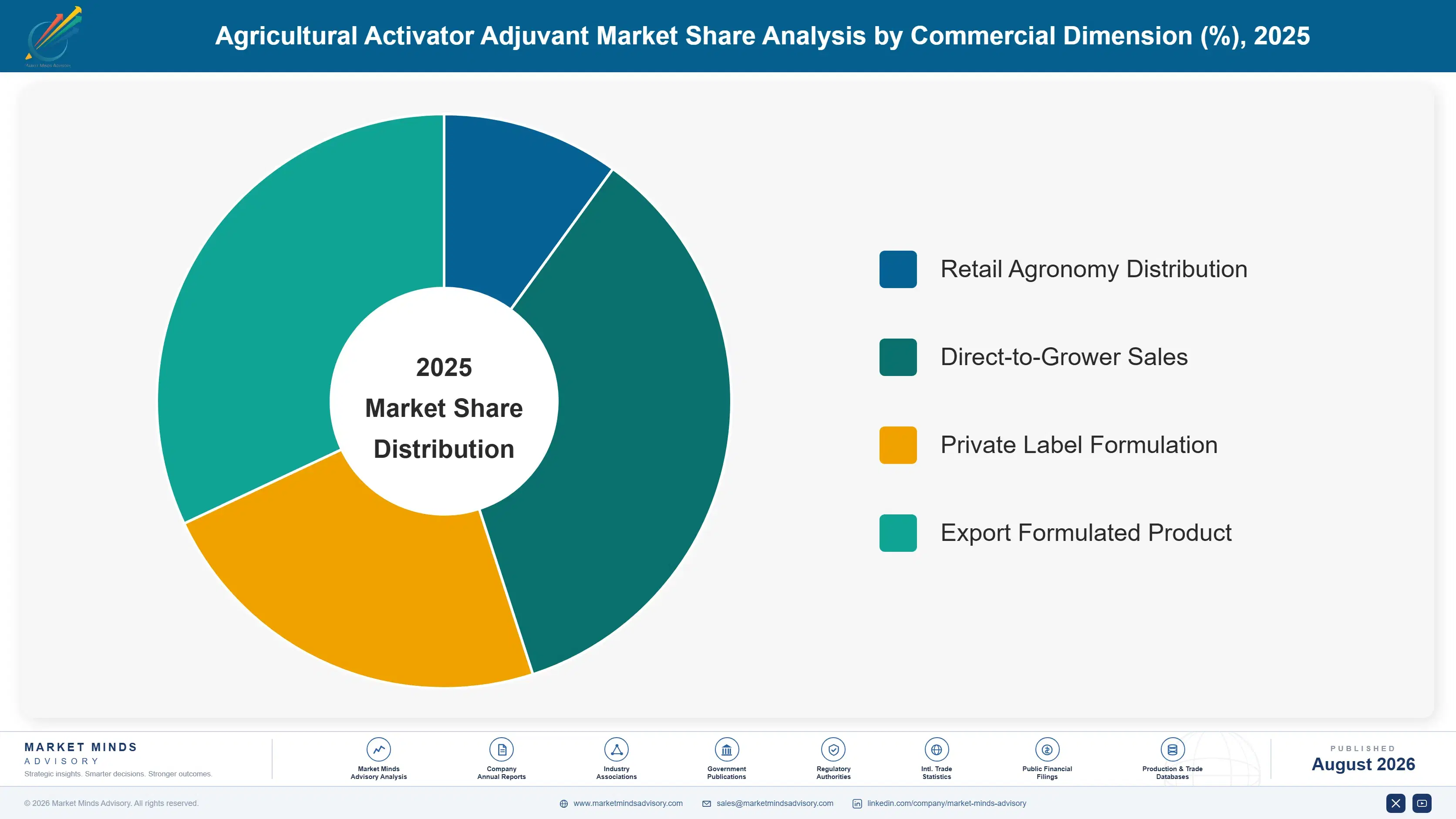
The market segments by adjuvant chemistry and formulation technology, the dimension that determines both regulatory status and pricing power, rather than by crop type or application method, which cut across every chemistry category equally.
agricultural-activator-adjuvant-market-2-market-share-analysis-1787463840502

Organosilicone Surfactants

Organosilicone surfactants are the fastest-growing segment, expanding at roughly 1.5 times the overall market rate as precision application equipment and rainfastness requirements favor superior spreading chemistry over conventional nonionic surfactants. Pricing runs meaningfully above legacy chemistry, reflecting genuine formulation complexity and patent protection that smaller regional blenders cannot easily replicate. Adoption has moved well beyond specialty horticulture into mainstream row crop weed control programs across every major herbicide-tolerant growing region, particularly where drift-sensitive neighboring crops make coverage efficiency a real commercial necessity rather than a marginal agronomic preference. Croda International and Evonik Industries lead commercial development of this chemistry at meaningful global scale.
CAGR 9.8%

Water Conditioning and Volatility Reduction Adjuvants

This segment sells directly against dicamba and other volatile herbicide label requirements rather than discretionary agronomic appeal, which explains its position as the second-fastest-growing category despite covering a comparatively narrow chemistry range. Hard water antagonism reduces herbicide efficacy meaningfully, and labeled water conditioning agents address this directly while simultaneously suppressing droplet volatility that drives off-target drift. Demand concentrates overwhelmingly in geographies growing dicamba-tolerant soybean and cotton, making this segment's growth trajectory unusually dependent on a single regulatory and litigation outcome relative to every other adjuvant category tracked across the broader portfolio.
CAGR 8.9%
Full segment breakdown across 6 segments available in the complete report.

Regional Architecture and Country Demand Map

North America leads on concentrated dicamba-tolerant row crop acreage and label-driven adjuvant requirements, while Latin America's expanding herbicide-tolerant soybean base pushes it well above its typical regional weight in this category specifically.

North America

Dicamba-tolerant soybean and cotton acreage across the American Midwest and Mid-South concentrates activator adjuvant demand in this region well above its usual band, at 33% of value against a typical 22 to 32% range, because federal label requirements name specific volatility reduction chemistries growers must use here and nowhere else at this scale. WinField United and Loveland Products both operate extensive regional blending and distribution networks serving row crop retailers directly. Canadian demand contributes a smaller additional base tied to glyphosate-tolerant canola and soybean systems across the Prairie provinces. The share sits above its usual band because dicamba's federal registration and litigation history are uniquely American regulatory phenomena. Growth of 6.9% tracks continued herbicide-tolerant acreage expansion and volatility reduction adjuvant mandate compliance.
Share: 33% | CAGR: 6.9% (2026 to 2036)

Western Europe

Restrictive pesticide authorization policy across the European Union holds Western Europe to 18% of value, near the floor of its 18 to 26% band, since dicamba itself carries limited registration across most member states and broader herbicide use faces mounting regulatory pressure under the bloc's pesticide reduction targets. Clariant and Solvay both maintain substantial regional formulation capacity serving conventional surfactant and buffering adjuvant demand. German and French growers continue purchasing established crop oil concentrate and nonionic surfactant chemistries at steady but unexciting volume. Growth of 4.7%, the slowest of the seven regions, reflects a market constrained more by policy than by any lack of grower interest in adjuvant technology.
Share: 18% | CAGR: 4.7% (2026 to 2036)
Regional intelligence for 5 additional markets available in the complete report: East Asia, South Asia and Pacific, Latin America, Middle East and Africa, Eastern Europe. Contact sales@marketmindsadvisory.com.
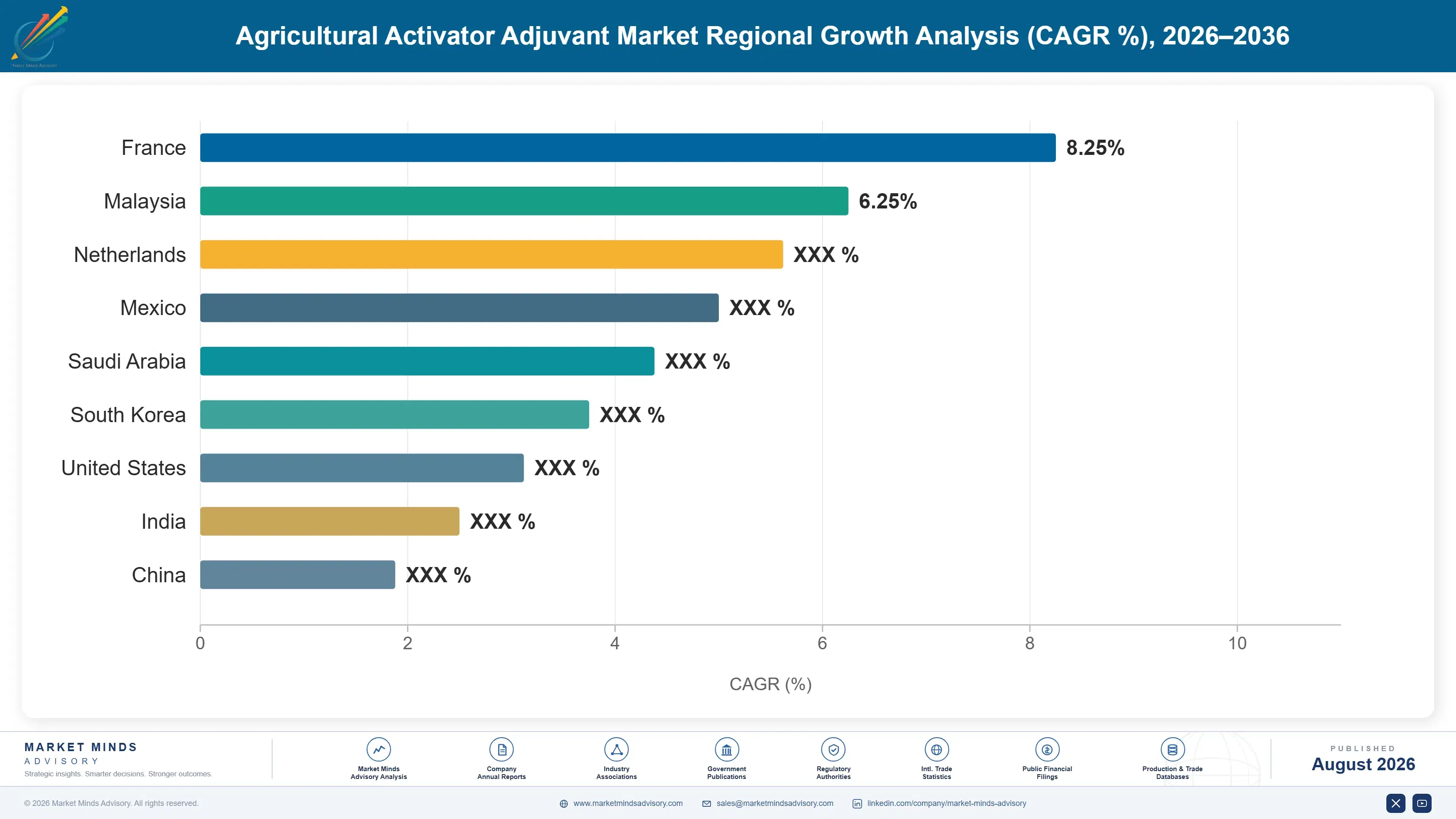
agricultural-activator-adjuvant-market-2-country-cagr-analysis-1787463841074

Where Formulation Suppliers Can Still Expand Margin

Margin expansion in this market concentrates around label-referenced chemistry, formulation services, and geographic registration breadth rather than volume growth alone, since commoditized legacy chemistry offers little room left to expand pricing power meaningfully.

Pursue Label-Referenced Status for Premium Chemistry

Suppliers that achieve explicit naming on herbicide labels as an approved tank-mix partner gain a captive demand pool competitors cannot easily contest, since growers deviating from named chemistry risk both enforcement exposure and off-target drift liability. Winning this status requires substantial field efficacy and volatility data generation, typically a multi-year, multi-million-dollar investment few regional blenders can fund. The payoff runs 25% to 40% above unreferenced chemistry pricing for functionally similar formulations, a premium that persists as long as label language names specific approved products rather than generic chemistry classes.
Market Impact: Commands 25% to 40% pricing premium

Expand Organosilicone Formulation Capacity

Organosilicone surfactant demand is outgrowing overall market volume by a wide margin, and suppliers with proprietary silicone chemistry and adequate manufacturing capacity capture disproportionate share of this premium segment's expansion. Capacity constraints currently limit some suppliers from fully meeting order volume during peak spring application windows, leaving unmet demand for competitors to absorb. Producers investing in dedicated organosilicone production lines position themselves to capture 15% to 25% incremental margin relative to conventional surfactant manufacturing given the chemistry's considerably higher realized selling price per liter shipped.
Market Impact: Adds 15% to 25% incremental margin

Build Multi-Herbicide Registration Breadth

Concentrating adjuvant registration narrowly around dicamba-specific volatility reduction chemistry exposes suppliers heavily to a single litigation and regulatory outcome that could eliminate demand almost overnight if federal registration is vacated again. Suppliers diversifying registration across multiple herbicide-tolerant systems, including glufosinate and 2,4-D-tolerant crops, reduce single-product exposure meaningfully while capturing incremental demand from growers rotating between herbicide modes of action. This diversification typically costs 10% to 15% of annual registration budget but meaningfully de-risks revenue concentration across the broader adjuvant product portfolio.
Market Impact: Reduces single-product exposure by design

Capture Latin American Growth Through Local Blending

Brazil and Argentina's rapidly expanding herbicide-tolerant acreage represents the fastest incremental demand growth tracked anywhere in this market, and suppliers establishing local blending capacity avoid the import duties and logistics costs that erode margin on formulated product shipped from North American or European facilities. Local blending typically improves landed cost competitiveness by 12% to 20% relative to imported finished product, a meaningful advantage in a region where growers remain considerably more price-sensitive than their North American counterparts on comparable chemistry.
Market Impact: Improves landed cost by 12% to 20%

Who Controls the Margin Pool

Concentration sits at a moderate 38%, evaluated on formulated product revenue, with Croda International and Clariant holding the clearest leads on formulation chemistry breadth while a meaningful gap separates them from mid-tier regional blenders competing mainly on price for legacy surfactant chemistry.
Current competitive activity centers on three dimensions: pursuing label-referenced status for volatility reduction chemistry, expanding organosilicone manufacturing capacity to meet outgrowing premium segment demand, and building distribution partnerships across Latin America's rapidly expanding herbicide-tolerant acreage base. Suppliers lacking formulation chemistry depth increasingly struggle to compete outside commoditized legacy categories.

Emerging pressure comes from specialty chemical majors entering adjuvant formulation from adjacent surfactant businesses, bringing formulation science and capital regional blenders cannot match. Rankings could shift meaningfully if dicamba registration is vacated again, since that single event would reshuffle which suppliers hold the strongest remaining chemistry portfolios across the broader herbicide-tolerant adjuvant category overall.
agricultural-activator-adjuvant-market-2-company-positioning-matrix-1787463841817

Competitive Moat and Risk Dimensions

CRODA INTERNATIONAL

Moat: Proprietary Silicone Chemistry

Croda's decades of specialty surfactant and biosurfactant formulation expertise, combined with patent-protected organosilicone chemistry, give it genuine pricing power in the fastest-growing segment of this market that regional blenders cannot easily replicate through generic formulation efforts alone.
CRODA INTERNATIONAL

Risk: Specialty Oleochemical Exposure

Croda's premium chemistry depends heavily on specialty oleochemical feedstocks whose pricing has grown considerably more volatile in recent years, exposing margin to input cost swings that commodity surfactant producers using simpler feedstock chains face to a meaningfully lesser degree.
CLARIANT

Moat: Global Registration Footprint

Clariant's extensive multi-country regulatory registration portfolio lets it serve label-referenced chemistry demand across far more geographies than smaller competitors, a genuine barrier given how slow and expensive individual country registration processes remain across major agricultural markets.
CLARIANT

Risk: Petrochemical Feedstock Volatility

A meaningful share of Clariant's conventional surfactant portfolio still depends on petrochemical feedstock pricing, leaving that segment of its business exposed to crude oil volatility in a way its more specialty-weighted organosilicone competitors have partially insulated themselves against structurally.

Players Tracked

Prominent Players

Croda International
Clariant
Evonik Industries
Solvay
WinField United

Other Key Players

Wilbur-Ellis Company
Helena Agri-Enterprises
Loveland Products
Brandt Consolidated
Precision Laboratories
Innvictis Crop Care
CHS Inc
Actagro
Redox Bio-Nutrients
Yara International
Nufarm
UPL Limited
BASF
Huntsman Corporation
Stepan Company

Recent Developments

MARCH 2025

Croda Launches Expanded Organosilicone Line

Croda International launched an expanded organosilicone surfactant product line targeting precision application equipment compatibility, adding formulations optimized for lower spray volume requirements. This was an organic product launch funded through existing research and development operations, not an acquisition or joint venture.
Signal: Signals continued premium chemistry investment ahead of expanding organosilicone demand across major herbicide-tolerant growing regions.
SEPTEMBER 2024

Evonik Acquires Specialty Adjuvant Formulator

Evonik Industries acquired a specialty adjuvant formulation company to expand its organosilicone manufacturing capacity and North American distribution reach. This was a full acquisition, not a joint venture or minority equity stake, giving Evonik direct control over the acquired formulation technology and customer relationships.
Signal: Signals consolidation pressure as larger specialty chemical producers pursue formulation capacity through acquisition rather than organic buildout.
JANUARY 2025

WinField United Enters Water Conditioner Supply Deal

WinField United entered a multi-year supply agreement with a specialty chemical producer to secure water conditioning adjuvant ingredient volume ahead of expanding dicamba-tolerant acreage. This was a supply agreement, not an acquisition, joint venture, or merger between the two companies involved.
Signal: Signals retailers locking in ingredient supply ahead of anticipated volatility reduction adjuvant demand growth across coming seasons.

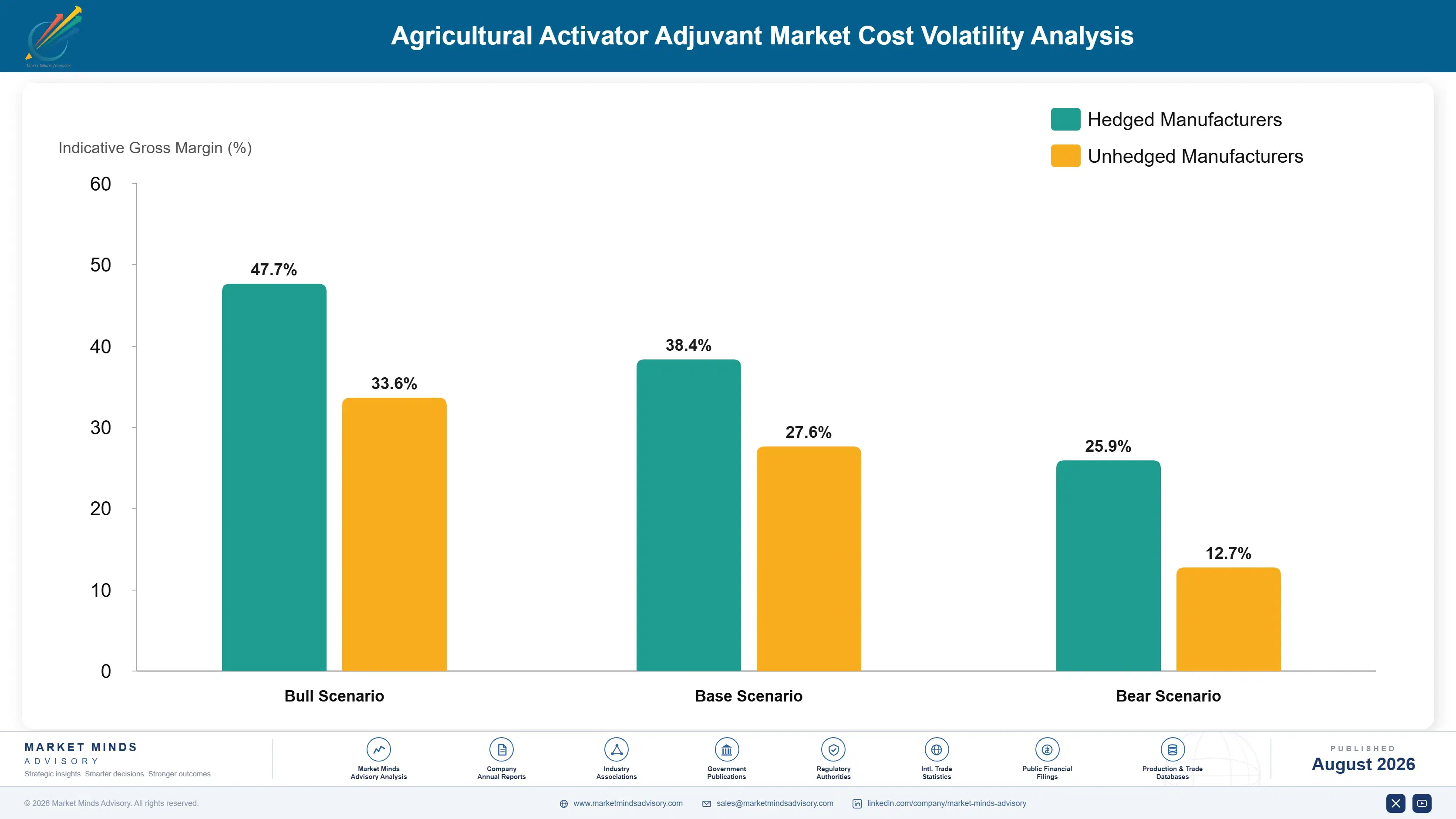
Specialty Feedstock Exposure Behind Formulation Margins

Specialty oleochemical derivatives and silicone intermediates together represent roughly 48% of cost of goods sold for premium adjuvant formulations, sourced primarily from palm and coconut oil processing in Southeast Asia and silicone monomer production concentrated in the United States, Germany, and China.
Silicone intermediate pricing spiked considerably during 2022 as Chinese production curtailments tied to energy rationing policy reduced global supply, according to IEA industrial energy demand reporting on that period. Formulators dependent on Chinese silicone monomer supply faced meaningful cost pass-through pressure during that stretch, with some unable to fully recover margin through pricing for several quarters afterward.

Suppliers with vertically integrated silicone production, primarily the larger specialty chemical majors, weather feedstock volatility considerably better than formulators purchasing intermediates on the open market. Regional blenders lacking scale to negotiate long-term supply contracts face the sharpest margin compression during volatility episodes, reinforcing the competitive gap between formulation leaders and smaller price-taking competitors across the broader adjuvant supply chain.
agricultural-activator-adjuvant-market-2-cost-volatility-analysis-1787463842105

Long-Term Silicone Supply Contracts

Larger suppliers increasingly lock in multi-year silicone intermediate supply agreements with fixed or collared pricing, reducing exposure to the kind of spot market volatility that hit formulators hardest during the 2022 supply disruption specifically.

Vertical Integration Into Intermediates

Several specialty chemical majors have invested in backward integration toward silicone monomer production, capturing margin previously paid to third-party intermediate suppliers while insulating formulation operations from feedstock price swings.

Alternative Biosurfactant Feedstock Sourcing

Some formulators are qualifying alternative plant-derived surfactant feedstocks beyond traditional palm and coconut oil sources, diversifying supply geography and reducing single-region sourcing concentration risk across the broader formulation portfolio.

Portfolio Architecture for Margin Defence

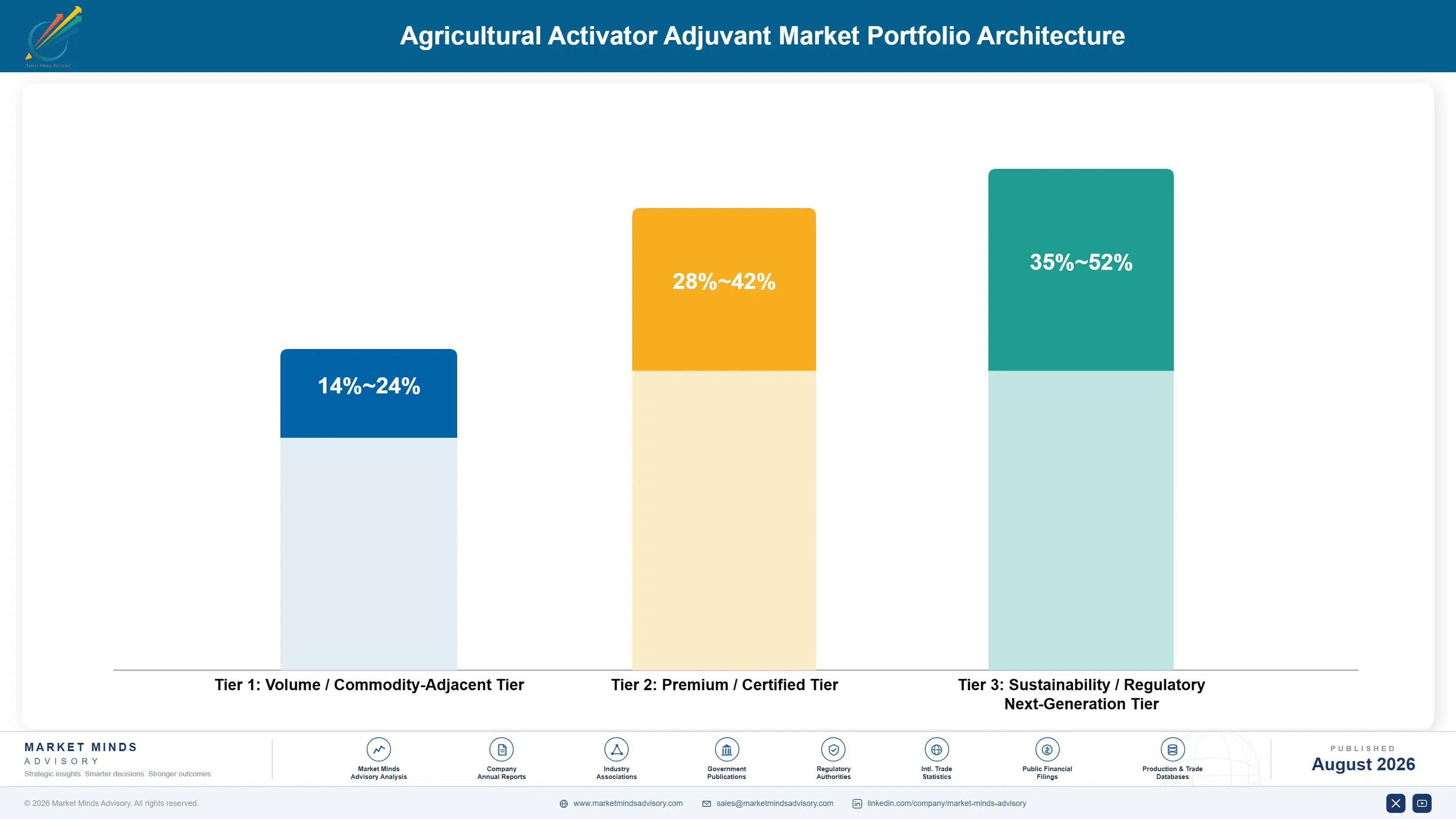
The portfolio splits into three tiers by formulation sophistication and regulatory status. Conventional surfactants and crop oil concentrates compete largely on price against decades-old chemistry with minimal differentiation. Label-referenced volatility reduction and water conditioning adjuvants earn considerably more, since regulatory naming creates genuine captive demand. Organosilicone and next-generation biosurfactant chemistry sits at the top, priced against formulation science and patent protection rather than bulk commodity benchmarks.
The tension runs between volume that keeps blending plants running and margin that rewards genuine chemistry investment. Conventional chemistry sales fund plant utilization but face intensifying price competition as more regional blenders enter basic supply. Label-referenced and organosilicone volume carries considerably better returns but depends on registration investment and formulation depth smaller producers often cannot fund.

High-value pools concentrate wherever regulation names a specific chemistry or precision application equipment demands superior spreading performance. Conventional surfactant and crop oil concentrate volume sold into undifferentiated tank mixes competes on price alone and earns the thinnest margin across the entire adjuvant category tracked.

Volume / Commodity-Adjacent Tier

Conventional nonionic surfactants and crop oil concentrates sold into basic tank mixes, priced against decades-old chemistry with minimal formulation differentiation across competing suppliers.
Gross Margin: 14-24%

Premium / Certified Tier

Label-referenced water conditioning and volatility reduction adjuvants sold under specific regulatory naming, commanding real premium pricing because growers have no legal substitute chemistry option available.
Gross Margin: 28-42%

Sustainability / Regulatory / Next-Generation Tier

Organosilicone surfactants and next-generation biosurfactant chemistry sold into precision application programs, priced against formulation science and patent protection built over years of research investment.
Gross Margin: 35-52%
agricultural-activator-adjuvant-market-2-portfolio-architecture-1787463842781

High-value Sub-segments and Strategic Watch-out

Organosilicone Surfactants

High value and the fastest growth at 9.8%, converting precision application equipment adoption into durable pricing power across mainstream row crop weed control. Croda International and Evonik Industries lead commercial development at meaningful scale.
Gross Margin: 35-52%

Water Conditioning and Volatility Reduction Adjuvants

High value with strong growth at 8.9%, selling directly against dicamba label requirements rather than discretionary agronomic appeal, though concentrated demand exposure to a single herbicide system carries genuine regulatory risk.
Gross Margin: 28-42%

Nonionic Surfactants

The volume core at 5.6% growth, built on decades of established chemistry and broad grower familiarity across every major herbicide-tolerant cropping system tracked in this report worldwide.
Gross Margin: 16-26%

Crop Oil Concentrates

The strategic watch-out at 4.1% growth, the slowest segment, constrained by intensifying price competition and gradual grower migration toward organosilicone chemistry offering superior coverage performance per application.
Gross Margin: 14-22%

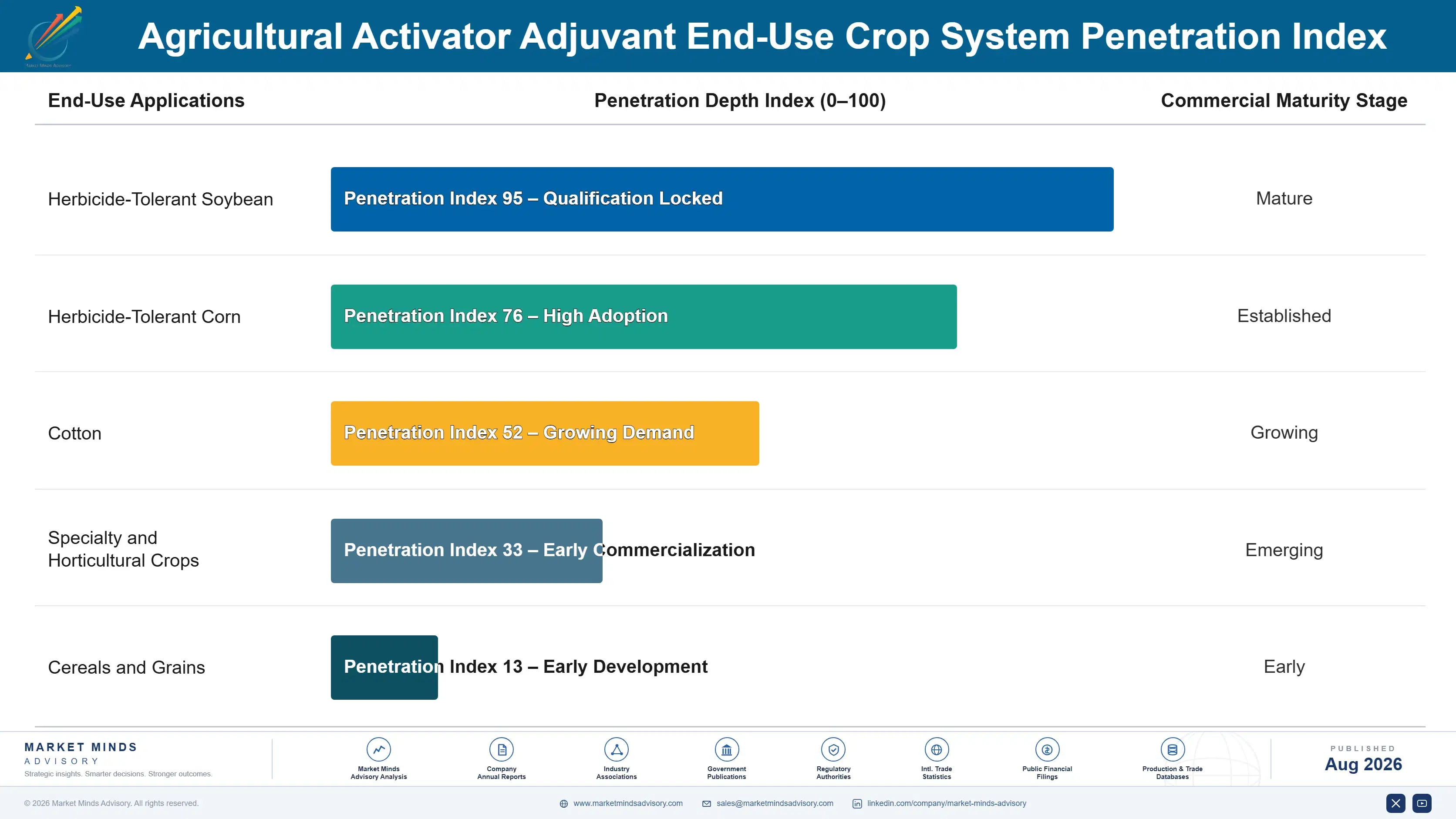
Regulation-Anchored Repeat Purchasing

Activator adjuvant purchasing behaves closer to an annuity than a discretionary input decision once a specific chemistry earns label-referenced status, since growers must repurchase the named product every season to remain compliant regardless of price movement or competitive alternatives entering the market.
Adoption depth varies meaningfully by end-use vertical. Row crop growers running herbicide-tolerant soybean and corn systems show the deepest, most locked-in purchasing patterns given direct label requirements, while specialty crop and horticulture applications retain considerably more discretionary chemistry choice absent comparable regulatory naming across their respective label frameworks.

A generational shift is underway as younger farm operators, often managing larger consolidated acreage than their predecessors, increasingly delegate adjuvant selection to retailer agronomists rather than making independent chemistry decisions themselves. This consolidation of purchasing influence favors suppliers with strong retailer relationships over those relying on direct grower marketing alone.
agricultural-activator-adjuvant-market-2-end-use-penetration-index-1787463843436

Chemistry Depth Over Volume Scale

These are among the four positions where our research anticipates prominent divergence between winners and laggards over the coming forecast period. Each is grounded in the demand model, the regulatory perimeter, and the announced capacity pipeline.
01 / FORMULATION INVESTMENT PRIORITY

Chase label-referenced chemistry over commodity volume expansion

Suppliers that win explicit naming on herbicide labels as an approved tank-mix partner secure genuinely captive demand no amount of price competition from regional blenders can erode. This status takes years and meaningful capital to earn through field efficacy and volatility data generation. Producers still competing primarily on legacy chemistry volume are fighting for margin that keeps shrinking as more entrants commoditize that segment further.
02 / REGULATORY RISK MANAGEMENT

Diversify beyond dicamba-specific chemistry now

Concentrating growth strategy around dicamba volatility reduction chemistry alone exposes suppliers to a single litigation and regulatory outcome that has already produced two federal registration vacaturs since 2020. Suppliers building registration breadth across multiple herbicide-tolerant systems protect revenue from any single adverse court ruling. Those who fail to diversify risk losing their primary growth driver almost overnight if dicamba registration is vacated again nationally.
03 / GEOGRAPHIC EXPANSION FOCUS

Prioritize Brazilian and Argentine blending capacity

Latin America's herbicide-tolerant acreage is expanding faster than any other region tracked in this report, driven by resistant weed pressure requiring multiple adjuvant-supported applications per season. Suppliers establishing local blending capacity avoid import duties and logistics costs eroding margin on shipped finished product. Those relying solely on export from North American or European facilities will cede share to competitors building genuine regional manufacturing presence there.
04 / FEEDSTOCK RISK MITIGATION

Lock in silicone supply before the next volatility episode

Silicone intermediate pricing has already spiked once this decade during Chinese production curtailments, and organosilicone chemistry now represents the fastest-growing, highest-margin segment of this entire market category. Suppliers without long-term supply contracts or vertical integration into intermediates remain exposed to the same margin compression that hit undersupplied formulators hardest during 2022. Securing feedstock now protects the segment generating the strongest returns across the whole portfolio.

Engagement Snapshot From the Field

A live engagement with an industry participant carrying material or product regulatory and market exposure ahead of a defining policy shift, showing how our research translates into a defensible multi-year portfolio strategy.
MARKET MINDS ADVISORY · CLIENT ENGAGEMENT SUMMARY
Agricultural Activator Adjuvant Producer Strategic Portfolio Review and Transition Roadmap 2026·Investment Scenario on Agricultural Activator Adjuvant Exposure Evaluation 2025-26
CLIENT PROFILE
The client is a mid-sized regional adjuvant blending and distribution company operating across the American Midwest, generating approximately 85 million dollars (client-reported, unverified by MMA) in annual revenue primarily from conventional surfactant and crop oil concentrate sales to retail agronomy customers across a five-state territory.
STRATEGIC CHALLENGE
The client faced eroding margins on its core conventional chemistry portfolio as national blenders undercut pricing, while lacking the formulation science or registration budget to pursue label-referenced volatility reduction chemistry independently within a reasonable competitive timeframe against far larger rivals.
MMA APPROACH
MMA conducted a formulation portfolio audit and competitive gap analysis, evaluating licensing partnerships with specialty chemistry holders as an alternative to costly in-house formulation development given the client's limited research and development budget relative to national competitors.
KEY FINDINGS
  1. Conventional chemistry volume carried gross margins roughly 15 percentage points below label-referenced product lines across comparable order volumes.
  2. Licensing an established organosilicone formulation required roughly 40% less upfront capital than independent in-house development over a comparable timeline.
  3. Retailer relationships, not direct grower marketing, drove over 70% of the client's existing volume across its five-state territory.
  4. Competing national blenders had already secured label-referenced status on three major volatility reduction chemistries the client currently lacked entirely.
CLIENT PROFILE
The client is a mid-sized regional adjuvant blending and distribution company operating across the American Midwest, generating approximately 85 million dollars (client-reported, unverified by MMA) in annual revenue primarily from conventional surfactant and crop oil concentrate sales to retail agronomy customers across a five-state territory.
STRATEGIC CHALLENGE
The client faced eroding margins on its core conventional chemistry portfolio as national blenders undercut pricing, while lacking the formulation science or registration budget to pursue label-referenced volatility reduction chemistry independently within a reasonable competitive timeframe against far larger rivals.
MMA APPROACH
MMA conducted a formulation portfolio audit and competitive gap analysis, evaluating licensing partnerships with specialty chemistry holders as an alternative to costly in-house formulation development given the client's limited research and development budget relative to national competitors.
KEY FINDINGS
  1. Conventional chemistry volume carried gross margins roughly 15 percentage points below label-referenced product lines across comparable order volumes.
  2. Licensing an established organosilicone formulation required roughly 40% less upfront capital than independent in-house development over a comparable timeline.
  3. Retailer relationships, not direct grower marketing, drove over 70% of the client's existing volume across its five-state territory.
  4. Competing national blenders had already secured label-referenced status on three major volatility reduction chemistries the client currently lacked entirely.
RECOMMENDED STRATEGY
Phase 1: Phase 1 (Months 1-4): License an established organosilicone and volatility reduction formulation portfolio rather than pursue costly independent development. Phase 2: Phase 2 (Months 5-10): Deepen retailer agronomist relationships to defend the distribution channel driving most existing volume. Phase 3: Phase 3 (Months 11-18): Pursue state-level label registration expansion for licensed chemistry across the client's core five-state territory.
OUTCOME
Within eighteen months of implementation, the client reported (client-reported, unverified by MMA) a 22% increase in blended average selling price and roughly 12 million dollars in incremental annual revenue from newly licensed premium chemistry lines sold through existing retailer relationships.

Frequently Asked Questions

Foundational context covering the market sizes, CAGR, scope, country, region and competition that inform every finding below. This section is provided to cover basics and most often pre-purchase conversations, answered from the MMA Primary Research Dataset.

What is the current size of the Agricultural Activator Adjuvant Market?

The market reached USD 2.3 billion in base year 2025. It is projected to reach USD 2.45 billion in 2026 as adoption continues expanding.

How large will the Agricultural Activator Adjuvant Market be by 2036?

MMA projects the market will reach USD 4.56 billion by 2036 under the base case scenario. That represents 1.86 times its 2026 value.

What is the CAGR for the Agricultural Activator Adjuvant Market 2026 to 2036?

The base case CAGR is 6.4%, with a bull case of 7.6% and a bear case of 5.2%. Regulatory outcomes around dicamba registration meaningfully influence which scenario materializes.

Which segment is growing fastest?

Organosilicone surfactants lead at a 9.8% CAGR, about 1.53 times the overall market rate. Water conditioning and volatility reduction adjuvants follow closely at 8.9%.

Who are the major companies in the Agricultural Activator Adjuvant Market?

Croda International, Clariant, Evonik Industries, Solvay, and WinField United lead the competitive field. Combined they hold a moderate 38% concentration on a formulated product revenue basis.

Which country is growing fastest?

Brazil leads at a 9.4% CAGR, driven by rapidly expanding herbicide-tolerant soybean acreage and intensifying resistant weed pressure. Multiple adjuvant-supported applications per season amplify this growth beyond simple acreage expansion alone.

Report Segmentation Architecture

The full report scope spans multiple orthogonal segmentation dimensions, with cross-tabulated demand data provided for each dimension pair. Coverage extends further to regional breakdowns, trend trajectories, and the competitive detail needed to support segment-level decision-making.

By Adjuvant Chemistry Type

  • Organosilicone Surfactants
  • Water Conditioning and Volatility Reduction Adjuvants
  • Methylated Seed Oil Adjuvants
  • Nonionic Surfactants
  • Crop Oil Concentrates
  • Buffering and pH Modifying Adjuvants

By End-Use Crop System

  • Herbicide-Tolerant Soybean
  • Herbicide-Tolerant Corn
  • Cotton
  • Specialty and Horticultural Crops
  • Cereals and Grains

By Commercial Dimension

  • Retail Agronomy Distribution
  • Direct-to-Grower Sales
  • Private Label Formulation
  • Export Formulated Product

By Region

  • North America
  • Western Europe
  • East Asia
  • South Asia and Pacific
  • Latin America
  • Middle East and Africa
  • Eastern Europe

Scope, Methodology, and Coverage

Every figure in this report is reproducible from documented input assumptions. The scope below maps the historical period, the forecast horizon, the segmentation dimensions, and the countries covered, alongside the underlying primary and qualitative methodology.
Historical Period
2020 to 2025
Forecast Period
2026 to 2036
Base Year
2025 (USD billions; MMA Primary Research Dataset, August 2026)
Market Definition
This report covers surfactants, oils, water conditioners, and buffering agents formulated as activator adjuvants for tank-mix addition to agricultural herbicides and pesticides. It excludes the crop protection active ingredients themselves, seed treatments, fertilizers, and adjuvants formulated for non-agricultural industrial applications.
Quantitative Units
USD billions (current prices); volume in million liters where applicable
Segmentation Dimensions
By Adjuvant Chemistry Type; By End-Use Crop System; By Commercial Dimension; By Region
Regions Covered
North America, Western Europe, East Asia, South Asia and Pacific, Latin America, Middle East and Africa, Eastern Europe
Countries Covered
USA, China, Germany, France, UK, Japan, South Korea, India, Australia, Canada, Brazil, Mexico, Indonesia, Vietnam, Thailand, Malaysia, UAE, Saudi Arabia, South Africa, Nigeria, Turkey, Poland, Netherlands, Italy, Spain, Sweden, Switzerland, Argentina, Colombia, Singapore, and additional markets relevant to this sector
Key Companies Profiled
Croda International, Clariant, Evonik Industries, Solvay, WinField United, Wilbur-Ellis Company, Helena Agri-Enterprises, Loveland Products, Brandt Consolidated, Precision Laboratories, Innvictis Crop Care, CHS Inc, Actagro, Redox Bio-Nutrients, Yara International, Nufarm, UPL Limited, BASF, Huntsman Corporation, Stepan Company
Quantitative Methodology
Primary survey, n=3,800 respondents, Q4 2025, six countries; demand-side model with trade association cross-validation
Qualitative Methodology
47 expert interviews, Q4 2025; applied to validate demand model assumptions, identify emerging dynamics, and assess competitive positioning
Report Format
PDF and XLSX data workbook (Word format preview document)
Publisher
Market Minds Advisory
Report Code
MMA-2026-AGR-110
Published
August 2026
Contact
sales@marketmindsadvisory.com | www.marketmindsadvisory.com

Purchase the full Agricultural Activator Adjuvant Market Report (2026 to 2036).

The full report delivers a comprehensive assessment of the agricultural activator adjuvant market, covering chemistry-level segmentation, regional demand drivers, and competitive positioning across all twenty profiled companies. It includes detailed regulatory tracking of dicamba and other volatile herbicide label requirements shaping adjuvant selection. Buyers receive quantified feedstock cost exposure analysis and margin benchmarking across all three portfolio tiers. The report supports both formulation investment planning and geographic expansion decisions.
Chemistry-level segment sizing to 2036
Twenty-company competitive benchmark
Dicamba label compliance tracker
Regional blending capacity assessment
Feedstock cost exposure model
Latin American expansion opportunity screen

Built For The People Who Decide

From boardroom strategy to bench-side execution, this report is read cover-to-cover by leaders shaping the next decade of their industry, turning demand scenarios, market dynamics and valuation benchmarks into decisions.
CXOs/ Presidents/ VPs/ Managers
M&A and Corporate Development
Strategy Teams and R&D Heads
Procurement and Product Directors
Regulatory and Compliance Leaders
Investor Relations and Equity Analysts