

Market Minds Advisory
Age-Related Macular Degeneration (AMD) Market

Age-Related Macular Degeneration (AMD) Market: Durable Dosing Reshapes Retina Specialist Prescribing

Anti-VEGF biosimilar competition intensifies as patent cliffs approach for leading branded therapies, gene therapy candidates for geographic atrophy near pivotal readouts, and manufacturers without durable dosing formulations lose retina specialist prescribing share outright.

Lead Analyst

Alice Ballenger

Published

September 2026

Make Smarter Decisions with Customized Research Insights

Request a free sample report and evaluate market opportunities, growth trends, and competitive dynamics relevant to your business needs.

2025 MARKET VALUE$12.5BMarket Size 2025
2036 FORECAST VALUE$25.8BBase Case , 2026 to 2036
CAGR 2026 TO 20366.8 %Bull 8.0% / Bear 5.5%
INCREMENTAL OPPORTUNITY$12.4BNet 10- year value creation
EXPANSION MULTIPLE1.93x2036 value over 2026 base
Strategic Levers
M&A Pipeline
Regional Outlook
Country Rankings
Competitive Intelligence
Segmental Deep-dive
Call-Us : 91 93563 13602

Executive Snapshot and Market Trajectory

Retina specialists increasingly treat durable dosing intervals as the deciding prescribing factor rather than efficacy data alone, since documented treatment burden reduction now determines which anti-VEGF therapies actually qualify for standard-of-care status across most major markets simultaneously and without costly switching delay across every affected patient's treatment plan.
Gene therapy candidates lead growth at 13.5%, roughly 1.99 times the overall rate, as one-time dosing potential expands faster than chronic injection regimens alone can satisfy across every treatment-burdened patient population and caregiver support system. North America now holds the largest regional share at 30%, driven by concentrated retina specialist infrastructure and the world's highest per-patient anti-VEGF treatment volume across the country's leading ophthalmology centers and their surrounding specialty pharmacy networks entirely.
Competitive intensity stays elevated at 68% held by five participants, since biologics manufacturing complexity and extensive clinical trial requirements fragment share far less than most other therapeutic categories, concentrating supply around a handful of proven biologics developers rather than dozens of generic manufacturers competing broadly across the wider ophthalmology landscape and its specialty pharmacy channels. Buyers increasingly select therapies on durability data rather than injection frequency alone.
Market Definition
This report covers therapeutics for age-related macular degeneration, spanning anti-VEGF injection therapy, photodynamic therapy, complement inhibitors, gene therapy, combination therapy, and nutritional supplements. It excludes surgical intervention and unrelated retinal disorders.
Base Year Value
$12.5B in 2025 (MMA Primary Research Dataset, August 2026)
Forecast Period
2026 to 2036, eleven discrete annual values
CAGR
6.8% base case. Bull 8.0%. Bear 5.5%.
Fastest Growth Segment
Gene Therapy Candidates: 13.5% CAGR
Fastest Growth Country
China: 9.0% CAGR
Fastest Growth Region
South Asia and Pacific: 8.8% CAGR
Largest Region
North America: 30% of 2025 global value
Market Leaders
Regeneron, Roche (Genentech), Bayer, Novartis, Apellis Pharmaceuticals. Source: MMA Analysis, July 2026.
Primary Survey
n=3,800 procurement and R&D decision-makers, Q4 2025, six countries
Methodology
Demand-side build-up, cross-validated against public data, 47 expert interviews

Age-Related Macular Degeneration (AMD) Market Forecast Scenarios

age-related-macular-degeneration-amd-market-size-forecast-scenario-1787303527838
Between 2020 and 2025 the market grew at an estimated 5.9% annually, as post-pandemic ophthalmology visit recovery and expanding anti-VEGF treatment access pushed prescribers toward sustained injection volume faster than the industry's typical multi-year adoption cycle would otherwise dictate across most major retina specialist markets worldwide, a pace that held steady even through supply chain disruption.
Three mechanisms carry the base case to 6.8%. First, aging population demographics keep expanding globally, and every additional diagnosed AMD patient adds to sustained anti-VEGF injection volume across most major healthcare systems worldwide and their surrounding specialty clinics. Second, geographic atrophy treatment adoption keeps expanding as complement inhibitor therapies address a previously untreated disease stage. Third, durable dosing formulations keep reducing treatment burden, sustaining patient adherence that shorter-acting therapies could not achieve.
The bull case at 8.0% assumes accelerating gene therapy approval and geographic atrophy treatment adoption across additional major markets pulls forward therapeutic demand faster than currently planned by most manufacturers. The bear case at 5.5% assumes budget-constrained healthcare reimbursement environments delay planned treatment expansion, slowing the pace of new AMD therapeutic demand growth across affected patient populations and their broader payer budgets.

Durable Dosing Reshapes Retina Specialist Prescribing

AMD therapeutics sit at an unusual inflection point in ophthalmology: anti-VEGF injection therapy transformed a previously untreatable blinding disease into a manageable chronic condition, yet the treatment burden of monthly office visits has become the primary barrier to sustained real-world efficacy. Retina specialists now request documented durability and treatment interval data alongside traditional visual acuity outcomes, and manufacturers without extended-dosing formulations risk losing pr
MARKET CONCENTRATION68%Top five participants hold more than two-thirds global revenue
AVERAGE ANNUAL TREATMENT COST$14,500/patientReflects typical anti-VEGF injection regimen expenditure across major markets
TOP PRESCRIBING COUNTRY SHARE30%One country dominates global anti-VEGF treatment volume by far
TYPICAL INJECTION INTERVAL8 to 16 weeksDurable formulations now extend well beyond monthly dosing intervals
BIOSIMILAR PENETRATION RATE24% of volumeLower-cost alternatives increasingly capture share from branded originator products
MANUFACTURING COST SHARE26-34% of COGSComplex biologics production processes weigh heavily on overall costs
Demand now splits along two distinct tracks. Wet AMD treatment relies on established anti-VEGF therapy where durability and biosimilar competition increasingly determine market share, while geographic atrophy treatment remains a newly opened therapeutic category where complement inhibitors compete for first-mover prescribing relationships. These tracks are starting to command genuinely different economics, since geographic atrophy therapies enter a market with no established generic competition yet.
Supply discipline remains tight because biologics manufacturing capacity expansion takes years and requires substantial capital, while aging population growth keeps accelerating diagnosed patient volume faster than treatment infrastructure can absorb. That gap keeps injection volume elevated and rewards manufacturers who invested in durable formulation research early. Biosimilar approvals are reshaping competitive dynamics faster than most participants expected, pushing originator manufacturers toward next-generation differentiation strategies.
"Treatment burden, not efficacy alone, is now the real battleground in this category. Manufacturers without a genuinely durable dosing formulation are increasingly fighting for a shrinking share of prescribing relationships."
Director, Ophthalmology and Retinal Therapeutics Practice · MMA Healthcare / Oph

Market Trends

Extended-Dosing Formulations Substantially Reduce Treatment Burden

Anti-VEGF manufacturers are increasingly developing extended-dosing formulations capable of sustaining therapeutic effect for sixteen weeks or longer, since reducing office visit frequency directly addresses the primary barrier to sustained real-world treatment adherence that shorter-acting therapies could not overcome. This shift accelerated after several major manufacturers reported clinical trial data demonstrating non-inferior outcomes at extended intervals, pushing competitors to accelerate their own durability research programs. Manufacturers lacking extended-dosing data are being excluded from retina specialist prescribing consideration even when their efficacy profile is comparable, since physicians increasingly treat treatment burden reduction as a non-negotiable prescribing criterion.
Market Impact: AMD diagnoses rise 6% annually

Geographic Atrophy Treatment Category Opens for First Time

Complement inhibitor therapies approved for geographic atrophy have created an entirely new treatable disease category that previously had no approved pharmacological intervention, since this advanced dry AMD stage historically offered patients no treatment options beyond vision rehabilitation support and counseling. This trend directly benefits manufacturers who secured first-mover regulatory approval, forcing later entrants to compete against established prescriber relationships and clinical experience. Roughly two million patients globally now qualify for geographic atrophy treatment, a population that keeps expanding each year as diagnostic screening improves and awareness grows among retina specialists.
Market Impact: Biosimilars cut costs 35% per injec

Market Opportunities and Growth Drivers

Aging Population Demographics Sustain Diagnosis Growth

Global aging population demographics keep expanding across most major healthcare systems, and each additional diagnosed AMD patient adds to sustained anti-VEGF and complement inhibitor treatment volume regardless of region or income level served. Health systems are locking in multi-year specialty pharmacy supply agreements well ahead of anticipated demand growth, since biologics manufacturing capacity expansion takes eighteen to twenty-four months and cannot be rushed once patient volume materializes. Manufacturers targeting aging population markets continue specifying expanded manufacturing capacity precisely because demographic trends make sustained volume growth essentially certain across the coming decade.
Market Impact: Discontinuation reaches 30% by year

Biosimilar Approval Sustains Broader Access Expansion

Regulatory approval of anti-VEGF biosimilars is expanding treatment access to healthcare systems and patient populations that originator pricing previously excluded from receiving sustained ongoing biologic care, since biosimilar competition typically reduces per-injection cost substantially compared with branded originator products. Health systems in cost-constrained markets are increasingly favoring biosimilar formularies specifically because expanded access lets more diagnosed patients receive treatment within fixed reimbursement budgets. This driver is particularly pronounced across emerging markets, where biosimilar availability is determining whether AMD treatment becomes accessible at scale rather than remaining limited to wealthy patients.
Market Impact: Originator pricing fell 28% since b

Market Restraints and Challenges

Injection Treatment Burden Limits Real-World Adherence

Even with durable formulations, anti-VEGF therapy still requires periodic in-office injections that many elderly patients find logistically challenging given transportation limitations, caregiver availability, and physical mobility constraints common in this age demographic. The root cause is administration route: intravitreal injection cannot yet be self-administered or delivered through less invasive methods, unlike many other chronic disease therapies patients can manage independently at home. That burden causes meaningful real-world treatment discontinuation despite strong clinical trial efficacy data. Manufacturers are responding by developing longer-acting formulations and exploring alternative delivery devices to further reduce visit frequency.
Market Impact: Extended dosing covers 45% of injec

Biosimilar Price Erosion Pressures Originator Margins

Anti-VEGF biosimilar entry is eroding pricing for originator branded products faster than manufacturers anticipated, since payers increasingly mandate biosimilar-first prescribing protocols once clinical equivalence is established through regulatory review and post-market surveillance. The root cause is payer economics: healthcare systems facing budget constraints have strong incentives to mandate lower-cost alternatives once therapeutic equivalence removes clinical justification for premium branded pricing. This pressure compresses originator margins meaningfully in markets with aggressive biosimilar substitution policies. Originator manufacturers are responding by accelerating next-generation differentiated formulation development to maintain premium positioning ahead of broader biosimilar erosion.
Market Impact: 2 million patients now qualify
3 additional market trends, 4 additional growth drivers, and 3 additional restraints and challenges are covered in the full report. Contact sales@marketmindsadvisory.com to access the complete intelligence.

Segment CAGR and Growth Architecture

AMD therapeutics segmentation follows treatment modality rather than disease stage alone, since the same manufacturer pool pursues distinct mechanisms across most therapeutic categories available today worldwide and across every affected market. Six segments span anti-VEGF injection, photodynamic therapy, complement inhibitors, gene therapy, combination therapy, and nutritional supplements, each carrying a distinct regulatory pathway and prescribing pattern.
age-related-macular-degeneration-amd-market-market-share-analysis-1787303528378

Gene Therapy Candidates

Gene therapy candidates are growing fastest overall as developers pursue one-time or infrequent dosing approaches capable of sustaining therapeutic protein expression without repeated intravitreal injection, offering genuine relief from the treatment burden that limits real-world anti-VEGF adherence today. Retina specialists and academic research centers are driving most of this growth, since gene therapy programs benefit disproportionately from viral vector platform technology validated in other ophthalmology indications. Manufacturers with proven gene therapy regulatory track records are capturing disproportionate share of new partnership and licensing discussions as larger pharmaceutical companies increasingly specify this modality explicitly when evaluating acquisition targets, particularly across leading academic retina research centers in the United States and Europe.
CAGR 13.5%

Complement Inhibitor Therapeutics

Complement inhibitor therapeutics grow second-fastest overall today, favored for their status as the first approved pharmacological treatment for geographic atrophy, a previously untreatable advanced dry AMD stage affecting a substantial and steadily growing patient population worldwide today. Retina specialists worldwide increasingly specify complement inhibitors for geographic atrophy patients given the absence of any prior treatment alternative, since this modality directly addresses the underlying disease mechanism rather than simply managing downstream vision loss symptoms. Manufacturers offering fully validated complement inhibitor formulations with established injection protocols are capturing meaningful share from earlier-stage competitors, since retina specialists increasingly prefer partners with proven real-world safety data across comparable geographic atrophy patient populations and treatment centers.
CAGR 11.2%
Full segment breakdown across 6 segments available in the complete report.

Regional Architecture and Country Demand Map

North America commands the largest share on concentrated retina specialist infrastructure and the world's highest per-patient anti-VEGF treatment volume, followed by East Asia and Western Europe on aging population demographics and established ophthalmology reimbursement systems respectively across their major and rapidly aging national healthcare markets.

North America

North American demand is anchored by concentrated retina specialist infrastructure and the world's highest per-patient anti-VEGF treatment volume, giving the region genuine prescribing leadership that other regions have not yet replicated at comparable scale, reimbursement depth, or clinical trial access today or in the near term. The United States dominates regional treatment volume, where major ophthalmology practices increasingly deploy extended-dosing protocols to reduce patient treatment burden and improve adherence. Canada's smaller ophthalmology sector follows comparable prescribing patterns at smaller absolute scale, anchored by its own provincial reimbursement framework. Growth of 7.5% outpaces the global rate as aging population growth and geographic atrophy treatment adoption compound across an already substantial installed prescribing base.
Share: 30% | CAGR: 7.5% (2026 to 2036)

Western Europe

Germany and the United Kingdom anchor most of Western Europe's demand, where established national health system reimbursement frameworks support broad anti-VEGF treatment access ahead of many other mature markets globally and across the wider continent's healthcare landscape, regulatory environment, and reimbursement infrastructure and systems today and going forward. The European Medicines Agency's biosimilar approval pathway is shaping which manufacturers actually capture prescribing share across the bloc's cost-conscious reimbursement systems and member states. France's concentrated ophthalmology infrastructure sustains steady demand tied to established specialist referral networks built over multiple decades. Growth of 5.2% trails the global average because the region's mature treatment base has already captured most feasible near-term prescribing volume growth.
Share: 22% | CAGR: 5.2% (2026 to 2036)
Regional intelligence for 5 additional markets available in the complete report: East Asia, South Asia and Pacific, Latin America, Middle East and Africa, Eastern Europe. Contact sales@marketmindsadvisory.com.
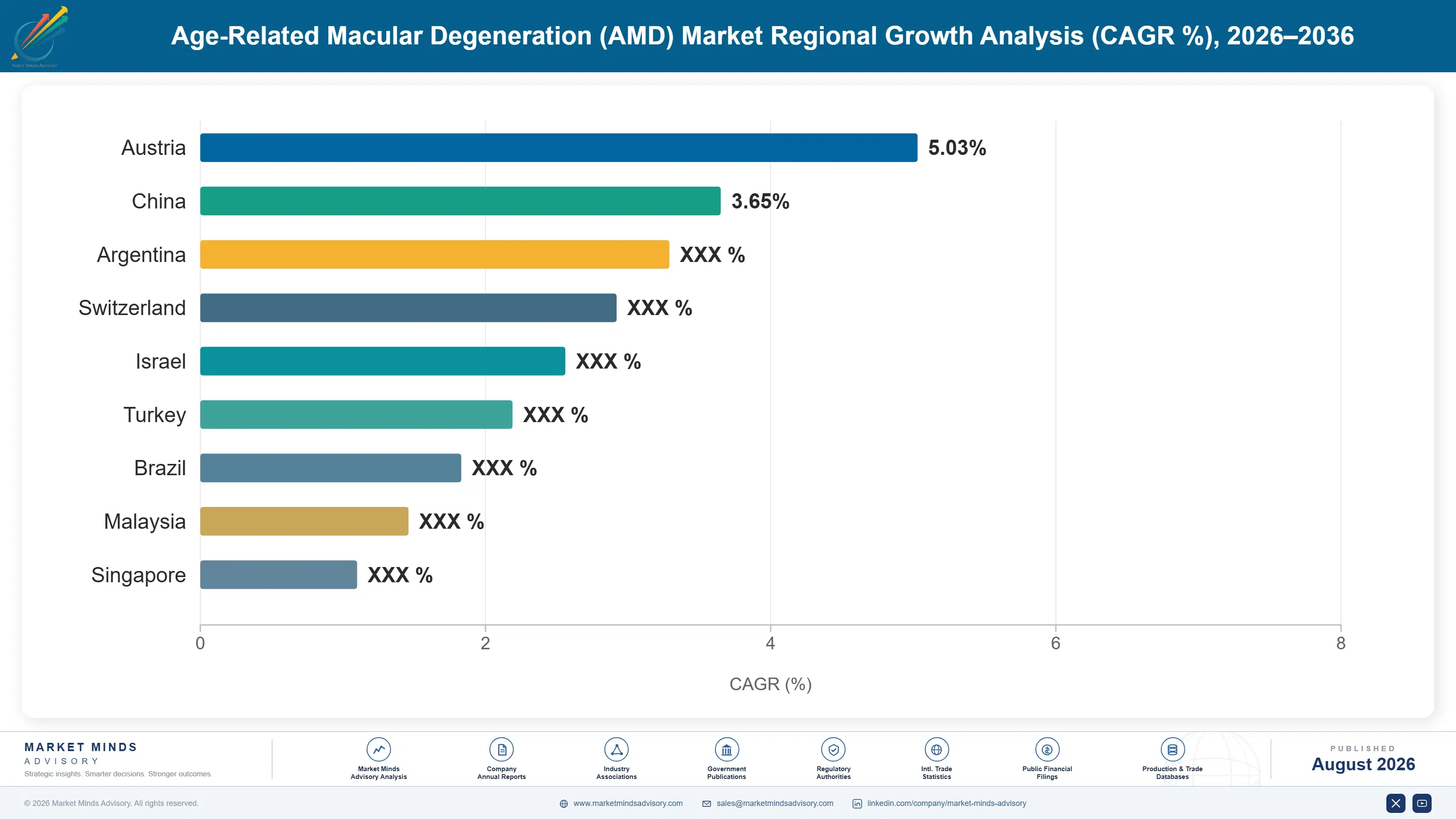
age-related-macular-degeneration-amd-market-country-cagr-analysis-1787303528896

Where AMD Manufacturers Can Defend Margin

AMD manufacturers capture margin unevenly across therapeutic categories, and the biggest opportunities sit in durable dosing innovation, geographic atrophy first-mover positioning, and biosimilar defense strategy rather than volume growth alone. Four commercial levers stand out as genuinely actionable across most manufacturer types, regardless of whether the underlying portfolio serves wet AMD or geographic atrophy patients.

Lead Extended-Dosing Formulation Development Ahead of Rivals

Manufacturers who develop extended-dosing formulations capable of sustaining sixteen-week or longer intervals capture premium pricing of 15% to 25% over competitors offering only monthly injection regimens, since retina specialists increasingly treat treatment burden reduction as a non-negotiable prescribing criterion across most major markets and reimbursement systems worldwide. This advantage compounds as aging patient populations increasingly prioritize reduced office visit frequency over marginal efficacy differences between competing therapies. Manufacturers who have built this durability data over multiple clinical trial generations cannot be quickly replicated by competitors starting extended-dosing validation from scratch.
Market Impact: Extended dosing commands a 15 to 25

Secure First-Mover Geographic Atrophy Prescribing Relationships

Manufacturers who secured early regulatory approval for geographic atrophy treatment capture prescriber relationships and clinical experience that later entrants cannot quickly replicate, since retina specialists build treatment protocols around whichever therapy they first adopted for this previously untreatable disease stage entirely across their broader patient population. This first-mover advantage can sustain premium pricing 20% to 30% above later entrants even after competitive approval, since switching an established treatment protocol carries genuine clinical inertia and administrative burden. Manufacturers who delay entry risk permanently ceding this newly opened category to faster-moving competitors.
Market Impact: First-mover geographic atrophy shar

Build Biosimilar Defense Through Next-Generation Reformulation

Originator manufacturers who invest in next-generation reformulation ahead of biosimilar patent expiry capture continued premium positioning that competitors relying solely on brand loyalty cannot sustain once cost-conscious payers mandate biosimilar substitution across most reimbursement systems, markets, formulary structures, and broader payer negotiation frameworks worldwide. This defense strategy can preserve 25% to 40% of originator pricing power compared with manufacturers who allow biosimilar competition to fully commoditize their existing formulation before reformulation completes. Manufacturers who delay reformulation investment risk losing meaningful revenue to biosimilar erosion faster than reformulation timelines can recover.
Market Impact: Reformulation defense preserves 25

Expand Biosimilar Manufacturing Into Emerging Markets

Manufacturers who expand biosimilar manufacturing capacity specifically for emerging market healthcare systems capture volume growth that originator-focused competitors leave largely unaddressed, since cost-constrained payers in these markets prioritize access over brand premium entirely across most reimbursement decisions, formulary policies, public health budgets, and national procurement programs. This expansion can add 30% to 45% incremental volume compared with manufacturers focused exclusively on mature market originator competition, effectively opening a distinct growth channel with limited existing competition. This lever is particularly attractive for manufacturers with established biosimilar manufacturing scale seeking geographic diversification.
Market Impact: Emerging market expansion adds 30 t

Who Controls the Margin Pool

Concentration stays elevated at sixty-eight percent held by five participants, evaluated on branded and biosimilar AMD therapeutic revenue specifically. Regeneron and Roche lead decisively on established anti-VEGF franchise scale and prescriber relationships, while Bayer, Novartis, and Apellis compete across different modality specialties and geographic strongholds, leaving a meaningful gap between the top two and everyone else.
Current competitive activity centers on three dimensions. Manufacturers are racing to develop extended-dosing formulations, since treatment burden reduction increasingly determines retina specialist prescribing loyalty. Geographic atrophy first-mover positioning has become a genuine differentiator, with several manufacturers investing heavily in complement inhibitor development to capture the newly opened category. And biosimilar defense strategy is the third, as originator manufacturers pursue next-generation reformulation ahead of patent expiry.

Emerging pressure comes from biosimilar manufacturers, who are scaling production capability fast enough to challenge established originators for share in cost-conscious healthcare markets within the next several years. Rankings could shift meaningfully if a major biosimilar manufacturer secures extended-dosing formulation approval, since that would combine cost competitiveness with durability that pure originator competitors currently charge premium pricing for. Gene therapy specialists riding the durable dosing wave also stand to gain incremental share.
age-related-macular-degeneration-amd-market-company-positioning-matrix-1787303529455

Competitive Moat and Risk Dimensions

REGENERON PHARMACEUTICALS, INC.

Moat: Largest Established Prescriber Relationship Base

Regeneron maintains the broadest retina specialist prescribing relationships of any AMD manufacturer, built over more than a decade of continuous anti-VEGF franchise leadership, giving it clinical trust and formulary positioning that newer entrants cannot quickly replicate. This relationship depth lets the company introduce extended-dosing updates and secure adoption faster than competitors building prescriber trust from scratch.
REGENERON PHARMACEUTICALS, INC.

Risk: Facing Direct Biosimilar Competition

Regeneron's flagship anti-VEGF franchise faces direct biosimilar competition now that key patents have expired, pressuring pricing in markets with aggressive biosimilar substitution mandates. The company must balance defending existing franchise value against cannibalizing its own next-generation formulation revenue, a tension biosimilar-only competitors do not face.
ROCHE HOLDING AG (GENENTECH)

Moat: Deepest Global Ophthalmology Commercial Reach

Roche's global commercial infrastructure across ophthalmology markets gives it distribution and reimbursement negotiation reach that smaller specialized competitors cannot match, letting it launch new formulations across dozens of markets simultaneously. This scale also lets the company absorb pricing pressure in any single market that would meaningfully threaten smaller, less diversified competitors.
ROCHE HOLDING AG (GENENTECH)

Risk: Aging Core Franchise Faces Displacement

Roche's core anti-VEGF franchise faces displacement risk from extended-dosing competitor formulations and emerging gene therapy alternatives that could reduce injection frequency more dramatically than Roche's current pipeline offers. Competitors with more advanced durability data risk capturing prescriber share before Roche's next-generation formulations reach commercial availability.

Players Tracked

Prominent Players

Regeneron Pharmaceuticals, Inc.
Roche Holding AG (Genentech)
Bayer AG
Novartis AG
Apellis Pharmaceuticals, Inc.

Other Key Players

AbbVie Inc.
Astellas Pharma Inc. (Iveric Bio)
4D Molecular Therapeutics, Inc.
Adverum Biotechnologies, Inc.
REGENXBIO Inc.
Ocular Therapeutix, Inc.
Kodiak Sciences Inc.
Outlook Therapeutics, Inc.
Samsung Bioepis Co., Ltd.
Amgen Inc.
Coherus BioSciences, Inc.
Formycon AG
Bio-Thera Solutions, Ltd.
Sandoz Group AG
Alcon Inc.

Recent Developments

APRIL 2026

Regeneron Receives FDA Approval for Extended Sixteen-Week Dosing

Regeneron received FDA approval for an extended sixteen-week dosing regimen of its lead anti-VEGF therapy, expanding its durability data portfolio ahead of broader retina specialist adoption nationwide. This was a regulatory approval milestone, not a corporate transaction, extending Regeneron's extended-dosing roadmap significantly across its franchise.
Signal: Shows leading manufacturers continuing to
NOVEMBER 2025

Roche Acquires Ophthalmology Gene Therapy Technology Developer

Roche completed the acquisition of a specialty gene therapy technology developer focused on ophthalmology indications, for an undisclosed sum. The acquisition was a full corporate purchase, not a licensing arrangement or joint venture, giving Roche direct ownership of the underlying gene therapy technology and intellectual property.
Signal: Indicates manufacturers increasingly prefe
FEBRUARY 2026

Apellis Signs European Retina Specialist Distribution Agreement

Apellis signed a multi-year distribution agreement with a major European retina specialist network to expand access to its geographic atrophy complement inhibitor therapy across several countries and healthcare systems. The arrangement was a distribution agreement, not an acquisition or merger, extending Apellis's European commercial footprint meaningfully.
Signal: Signals geographic atrophy manufacturers i

Biologics Manufacturing Sets the Cost Floor

Biologics manufacturing, including cell culture production, purification, and fill-finish processing, typically accounts for roughly 26% to 34% of anti-VEGF product cost, concentrated among specialized contract manufacturers in the United States, Ireland, and Singapore across regulated facilities. Quality assurance testing and sterile packaging add a further meaningful share, reflecting the stringent standards intravitreal biologics require before commercial release.
Biologics manufacturing capacity pricing rose meaningfully through 2024 as anti-VEGF and complement inhibitor demand competed directly with broader biologics production for the same limited specialized capacity, according to industry reporting. Regeneron's 2024 annual report disclosed higher manufacturing costs attributable to production and quality testing intermediate inflation, noting that costs rose meaningfully faster than the company could pass through to healthcare payers without meaningful margin compression across its ophthalmology segment specifically.

Manufacturers with owned biologics manufacturing capacity absorb cost volatility far more easily than those reliant on third-party contract manufacturing, since ownership locks in predictable capital costs regardless of market tightness. Larger diversified pharmaceutical companies with broader biologics portfolios also carry lower effective exposure than single-product specialists, widening the competitive gap. Smaller biosimilar manufacturers lacking either advantage face the sharpest margin compression during volatile periods.
age-related-macular-degeneration-amd-market-cost-volatility-analysis-1787303529666

Lock Manufacturing Capacity Through Long-Term Contracts

Biologics manufacturing capacity is the largest single volatile input across most AMD therapeutic production and increasingly competed for by broader biologics demand across multiple therapeutic categories worldwide. Long-term supply agreements with fixed or collared pricing, common practice among larger diversified manufacturers, smooth quarter-to-quarter volatility and let commercial teams quote payer contracts with genuine confidence.

Diversify Manufacturing Across Multiple Facilities

Reliance on a single manufacturing facility concentrates both capacity and quality risk unnecessarily across an entire product line and broader patient population served. Qualifying secondary manufacturing sites across multiple countries, even at modestly higher coordination cost, protects continuity when any single facility faces regulatory inspection findings or a sudden capacity constraint from competing demand.

Invest in Owned Manufacturing Over Contract Capacity

Manufacturers relying heavily on third-party contract manufacturing face the sharpest exposure to sudden capacity pricing spikes during periods of tight biologics production availability worldwide. Building owned manufacturing capacity, even gradually, locks in predictable capital costs and reduces dependence on a contract market that has repeatedly proven volatile during periods of tight global biologics demand.

Portfolio Architecture for Margin Defence

The AMD therapeutics portfolio splits into three tiers with meaningful margin separation tied to differentiation depth and modality risk. Volume tier products carry standard-interval anti-VEGF and biosimilar formulations for conventional wet AMD treatment, competing largely on price against a crowded field of biosimilar manufacturers. Premium certified products carry extended-dosing formulations backed by proven durability data. Sustainability products, including gene therapy and next-generation
The tension between volume and premium runs through nearly every manufacturer's product roadmap. Volume products fund the manufacturing scale premium products eventually depend on, yet volume margins keep compressing as biosimilar manufacturers scale aggressively on conventional formulations. Manufacturers that under-invest in durability and differentiation risk commoditization within their own category, while those chasing premium exclusively struggle to fund the production base needed to serve routine treatment demand.

High-value margin pools concentrate specifically in extended-dosing and geographic atrophy formulations where durability data and regulatory first-mover status carry the largest commercial stakes, and where differentiation commands genuine pricing power. Conventional standard-interval anti-VEGF equipment generates steadier volume but thinner margin, since that segment competes against a wider set of lower-cost biosimilar manufacturers with adequate but unremarkable differentiation.

Volume / Commodity-Adjacent

Standard-interval anti-VEGF and biosimilar formulations for conventional wet AMD treatment, competing largely on price against a crowded field of biosimilar manufacturers offering broadly comparable efficacy, dosing coverage, and safety profiles.
Gross Margin: 18-26%

Premium / Certified

Extended-dosing formulations backed by proven durability data and formal regulatory qualification, commanding meaningful pricing premiums over conventional equivalents across major global reimbursement systems, prescriber accounts, and specialty pharmacy networks worldwide.
Gross Margin: 32-42%

Sustainability / Regulatory / Next-Generation

Gene therapy and next-generation geographic atrophy candidates still scaling across newly opened treatment categories, targeting durability and mechanism outcomes conventional anti-VEGF therapy simply cannot achieve for affected patients and families.
Gross Margin: 36-48%
age-related-macular-degeneration-amd-market-portfolio-architecture-1787303530210

AMD's Chronic Treatment Relationship Economics

AMD therapeutic demand carries genuine annuity-like characteristics once a manufacturer establishes a patient on a chronic treatment regimen, since retina specialists rarely switch therapies mid-treatment given the risk of vision loss during any transition period. A single prescribing relationship typically locks in five to ten years or more of predictable injection volume, giving established manufacturers revenue visibility that newer market entrants attempting to displace existing regimens sim
Adoption depth varies sharply by disease stage. Wet AMD treatment relationships are deep and sticky, since switching anti-VEGF therapies mid-regimen risks disease progression that patients and physicians both want to avoid. Geographic atrophy treatment relationships are shallower in tenure but rapidly deepening, since this newly opened category is still establishing which prescribing patterns and manufacturer relationships will become the long-term standard of care.

Buyer profiles are shifting generationally as value-based care administrators and health system pharmacy directors gain real influence over formulary decisions once handled purely by individual physician prescribing preference alone. This newer buyer cohort weighs total cost of care and biosimilar cost-effectiveness alongside clinical outcomes, fundamentally reshaping which manufacturers even reach the final formulary shortlist for major health system contracts.
age-related-macular-degeneration-amd-market-end-use-penetration-index-1787303530719

Where AMD Strategy Should Focus Next

These are among the four positions where our research anticipates prominent divergence between winners and laggards over the coming forecast period. Each is grounded in the demand model, the regulatory perimeter, and the announced capacity pipeline.
01 / DURABLE DOSING INVESTMENT PRIORITY

Develop extended-dosing formulations before treatment burden loses prescribers

Retina specialists increasingly treat treatment burden reduction as a non-negotiable prescribing criterion, and manufacturers lacking extended-dosing data are already being excluded from serious formulary consideration regardless of underlying efficacy profile or clinical trial results and outcomes. Durability investment commands a 15 to 25 percent pricing premium while widening the gap against monthly-injection competitors, and delay risks permanent exclusion from the fastest-growing prescribing relationships in this category. The window for building credible durability data is narrowing as competitors accelerate their own programs.
02 / GEOGRAPHIC ATROPHY FIRST-MOVER POSITIONING

Secure geographic atrophy prescribing relationships before category consolidates

Geographic atrophy represents a newly opened treatment category where retina specialists are actively forming their first prescribing habits, and manufacturers who secure early adoption capture relationship advantages that later entrants cannot easily displace given clinical switching inertia, administrative burden, and established prescribing patterns. First-mover positioning can sustain premium pricing 20 to 30 percent above later entrants even after competitive approval arrives. Manufacturers who delay entry into this category risk permanently ceding prescribing share to faster-moving competitors already building clinical experience.
03 / BIOSIMILAR DEFENSE STRATEGY

Next-generation reformulation defends originator revenue against biosimilar erosion

Biosimilar competition is eroding originator pricing faster than manufacturers anticipated, and companies without reformulation strategies risk losing meaningful revenue once payers mandate biosimilar-first prescribing protocols across cost-conscious healthcare systems, reimbursement structures, formulary committees, and national procurement bodies worldwide today. Next-generation reformulation ahead of patent expiry can preserve 25 to 40 percent of pricing power that biosimilar-exposed originator products otherwise lose entirely and permanently. Manufacturers who delay reformulation investment risk losing revenue to biosimilar erosion faster than any reformulation timeline can recover.
04 / EMERGING MARKET ACCESS EXPANSION

Biosimilar manufacturing expansion captures underserved emerging market volume

Cost-constrained healthcare systems in emerging markets remain largely unaddressed by originator-focused manufacturers, and biosimilar producers who expand manufacturing capacity for these markets capture volume growth that mature-market competitors leave on the table entirely, without contest, without meaningful investment, and without serious strategic attention. This expansion can add 30 to 45 percent incremental volume compared with manufacturers focused exclusively on originator competition in wealthy markets. Manufacturers with established biosimilar scale should prioritize this underserved growth channel over further mature-market share battles.

Engagement Snapshot From the Field

A live engagement with an industry participant carrying material or product regulatory and market exposure ahead of a defining policy shift, showing how our research translates into a defensible multi-year portfolio strategy.
MARKET MINDS ADVISORY · CLIENT ENGAGEMENT SUMMARY
Age-Related Macular Degeneration (AMD) Producer Strategic Portfolio Review and Transition Roadmap 2026·Investment Scenario on Age-Related Macular Degeneration (AMD) Exposure Evaluation 2025-26
CLIENT PROFILE
The client is a regional retina specialist group operating eight ophthalmology clinics across a major metropolitan area, treating a substantial wet AMD and geographic atrophy patient population. The group generated approximately 95 million dollars in annual revenue (client-reported, unverified by MMA) and faced pressure to rationalize its anti-VEGF formulary strategy ahead of expanding biosimilar options.
STRATEGIC CHALLENGE
The client's existing formulary relied primarily on originator branded anti-VEGF products, exposing the practice to rising per-injection costs as payer reimbursement increasingly favored biosimilar-first prescribing protocols across its patient base. Leadership needed to determine which biosimilar and extended-dosing options could realistically replace originator products without compromising clinical outcomes or patient satisfaction.
MMA APPROACH
MMA conducted a formulary optimization assessment across six anti-VEGF products, evaluating durability data, biosimilar cost savings, and patient switching risk against the group's clinical protocols and full payer mix carefully. The engagement modeled total practice economics under several formulary scenarios rather than per-injection price alone, incorporating patient retention risk explicitly.
KEY FINDINGS
  1. Switching sixty percent of eligible patients to biosimilar formulations could reduce practice-wide anti-VEGF costs by roughly 24 percent without compromising documented clinical outcomes.
  2. Two of six candidate biosimilar products lacked sufficient extended-dosing data for the group's preferred sixteen-week treatment protocol, narrowing realistic options considerably ahead of the deadline.
  3. The leading biosimilar candidate's manufacturer support program eliminated a costly patient transition period the group's initial switching plan would have otherwise required.
  4. A phased switching approach prioritizing newly diagnosed patients first reduced clinical risk considerably compared with switching the group's entire existing patient panel simultaneously.
CLIENT PROFILE
The client is a regional retina specialist group operating eight ophthalmology clinics across a major metropolitan area, treating a substantial wet AMD and geographic atrophy patient population. The group generated approximately 95 million dollars in annual revenue (client-reported, unverified by MMA) and faced pressure to rationalize its anti-VEGF formulary strategy ahead of expanding biosimilar options.
STRATEGIC CHALLENGE
The client's existing formulary relied primarily on originator branded anti-VEGF products, exposing the practice to rising per-injection costs as payer reimbursement increasingly favored biosimilar-first prescribing protocols across its patient base. Leadership needed to determine which biosimilar and extended-dosing options could realistically replace originator products without compromising clinical outcomes or patient satisfaction.
MMA APPROACH
MMA conducted a formulary optimization assessment across six anti-VEGF products, evaluating durability data, biosimilar cost savings, and patient switching risk against the group's clinical protocols and full payer mix carefully. The engagement modeled total practice economics under several formulary scenarios rather than per-injection price alone, incorporating patient retention risk explicitly.
KEY FINDINGS
  1. Switching sixty percent of eligible patients to biosimilar formulations could reduce practice-wide anti-VEGF costs by roughly 24 percent without compromising documented clinical outcomes.
  2. Two of six candidate biosimilar products lacked sufficient extended-dosing data for the group's preferred sixteen-week treatment protocol, narrowing realistic options considerably ahead of the deadline.
  3. The leading biosimilar candidate's manufacturer support program eliminated a costly patient transition period the group's initial switching plan would have otherwise required.
  4. A phased switching approach prioritizing newly diagnosed patients first reduced clinical risk considerably compared with switching the group's entire existing patient panel simultaneously.
RECOMMENDED STRATEGY
Phase 1: Phase 1 (Months 1-2): Complete the full formulary assessment and finalize the biosimilar product selection against clinical and cost criteria. Phase 2: Phase 2 (Months 3-8): Transition all newly diagnosed patients to the selected biosimilar formulation, carefully monitoring outcomes before wider rollout. Phase 3: Phase 3 (Months 9-14): Extend the biosimilar transition to eligible existing patients based on validated clinical outcome monitoring data collected.
OUTCOME
The group completed its formulary transition across all eight clinics, achieving meaningful cost savings while maintaining documented clinical outcomes comparable to the originator formulary. The client reported (client-reported, unverified by MMA) that the phased switching approach and manufacturer support program proved particularly valuable during the transition, avoiding significant patient disruption.

Frequently Asked Questions

Foundational context covering the market sizes, CAGR, scope, country, region and competition that inform every finding below. This section is provided to cover basics and most often pre-purchase conversations, answered from the MMA Primary Research Dataset.

What is the current size of the Age-Related Macular Degeneration (AMD) Market?

The global AMD therapeutics market is valued at $12.5 billion in 2025. Growth is driven primarily by extended-dosing formulation adoption and geographic atrophy treatment expansion.

How large will the Age-Related Macular Degeneration (AMD) Market be by 2036?

MMA projects the market will reach approximately $25.77 billion by 2036. This represents a 1.93 times expansion over the ten-year forecast period beginning in 2026.

What is the CAGR for the Age-Related Macular Degeneration (AMD) Market 2026 to 2036?

The base case CAGR is 6.8%, with a bull case of 8.0% and a bear case of 5.5%. Gene therapy and complement inhibitor segments grow meaningfully faster than this average.

Which segment is growing fastest?

Gene therapy candidates lead at 13.5% CAGR, roughly 1.99 times the overall market rate. Durable dosing potential and treatment burden reduction drive this accelerating pace.

Who are the major companies in the Age-Related Macular Degeneration (AMD) Market?

Leading participants include Regeneron, Roche, Bayer, Novartis, and Apellis Pharmaceuticals. Together these five leading industry participants hold roughly sixty-eight percent of the total global market.

Which country is growing fastest?

China leads regional growth at 9.0% CAGR, driven by rapidly aging population demographics and expanding retina specialist access across the entire nation today and beyond.

Report Segmentation Architecture

The full report scope spans multiple orthogonal segmentation dimensions, with cross-tabulated demand data provided for each dimension pair. Coverage extends further to regional breakdowns, trend trajectories, and the competitive detail needed to support segment-level decision-making.

By Primary Market Dimension

  • Anti-VEGF Injection Therapeutics
  • Photodynamic Therapy
  • Complement Inhibitor Therapeutics
  • Gene Therapy Candidates
  • Combination Therapeutics
  • Nutritional Supplements and AREDS Formulations

By End-Use Industry

  • Retina Specialist and Ophthalmology Clinics
  • Hospital Outpatient Treatment Centers
  • Academic and Clinical Research Institutions
  • Health System Formulary Management
  • Specialty Pharmacy Distribution

By Commercial Dimension

  • Direct Manufacturer Contract Sales
  • Biosimilar and Generic Distribution
  • Specialty Pharmacy Agreements
  • Health System Formulary Contracts

By Region

  • North America
  • Western Europe
  • East Asia
  • South Asia and Pacific
  • Latin America
  • Middle East and Africa
  • Eastern Europe

Scope, Methodology, and Coverage

Every figure in this report is reproducible from documented input assumptions. The scope below maps the historical period, the forecast horizon, the segmentation dimensions, and the countries covered, alongside the underlying primary and qualitative methodology.
Historical Period
2020 to 2025
Forecast Period
2026 to 2036
Base Year
2025 (USD billions; MMA Primary Research Dataset, August 2026)
Market Definition
This report covers therapeutics for age-related macular degeneration, spanning anti-VEGF injection therapy, photodynamic therapy, complement inhibitors, gene therapy, combination therapy, and nutritional supplements. It excludes surgical intervention and unrelated retinal disorders.
Quantitative Units
USD billions (current prices); injection volume where applicable
Segmentation Dimensions
By Primary Market Dimension; By End-Use Industry; By Commercial Dimension; By Region
Regions Covered
North America, Western Europe, East Asia, South Asia and Pacific, Latin America, Middle East and Africa, Eastern Europe
Countries Covered
USA, China, Germany, France, UK, Japan, South Korea, India, Australia, Canada, Brazil, Mexico, Indonesia, Vietnam, Thailand, Malaysia, UAE, Saudi Arabia, South Africa, Nigeria, Turkey, Poland, Netherlands, Italy, Spain, Sweden, Switzerland, Argentina, Colombia, Singapore, and additional markets relevant to this sector
Key Companies Profiled
Regeneron Pharmaceuticals, Inc., Roche Holding AG (Genentech), Bayer AG, Novartis AG, Apellis Pharmaceuticals, Inc., AbbVie Inc., Astellas Pharma Inc. (Iveric Bio), 4D Molecular Therapeutics, Inc., Adverum Biotechnologies, Inc., REGENXBIO Inc., Ocular Therapeutix, Inc., Kodiak Sciences Inc., Outlook Therapeutics, Inc., Samsung Bioepis Co., Ltd., Amgen Inc., Coherus BioSciences, Inc., Formycon AG, Bio-Thera Solutions, Ltd., Sandoz Group AG, Alcon Inc.
Quantitative Methodology
Primary survey, n=3,800 respondents, Q4 2025, six countries; demand-side model with trade association cross-validation
Qualitative Methodology
47 expert interviews, Q4 2025; applied to validate demand model assumptions, identify emerging dynamics, and assess competitive positioning
Report Format
PDF and XLSX data workbook (Word format preview document)
Publisher
Market Minds Advisory
Report Code
MMA-2026-HLT-503
Published
August 2026
Contact
sales@marketmindsadvisory.com | www.marketmindsadvisory.com

Purchase the full Age-Related Macular Degeneration (AMD) Market Report (2026 to 2036).

The full Age-Related Macular Degeneration Market report delivers comprehensive analysis across all seven MMA-covered regions. It provides complete segment-level sizing and forecasts through 2036, plus detailed competitive profiling of twenty leading global participants across the anti-VEGF, complement inhibitor, and gene therapy value chain. The report includes proprietary MMA primary survey data drawn from 3,800 respondents and forty-seven expert interviews conducted in the fourth quarter of 2025. It also delivers detailed input cost analysis, revenue lever assessment, and portfolio tier economics. Buyers receive full data tables, editable charts, and a structured executive briefing deck.
Full seven-region market sizing and forecast tables
Twenty-company competitive profiling and benchmarking analysis
Editable data tables and full chart package
Segment-level CAGR and value breakdowns detailed
Biologics manufacturing cost structure and volatility analysis
Executive-ready briefing deck for board presentations

Built For The People Who Decide

From boardroom strategy to bench-side execution, this report is read cover-to-cover by leaders shaping the next decade of their industry, turning demand scenarios, market dynamics and valuation benchmarks into decisions.
CXOs/ Presidents/ VPs/ Managers
M&A and Corporate Development
Strategy Teams and R&D Heads
Procurement and Product Directors
Regulatory and Compliance Leaders
Investor Relations and Equity Analysts