Market Minds Advisory
Agave Syrup Market

Agave Syrup Market: Cultivation Cycles Shape a Clean Label Sweetener Race

Agave syrup producers are shifting toward less-processed dark grades and certified organic sourcing as clean label demand, low-glycemic positioning, and Mexican cultivation investment reshape a sweetener category recovering from prior blue agave shortages.

Lead Analyst

Lisa Gevelber

Published

September 2026

Make Smarter Decisions with Customized Research Insights

Request a free sample report and evaluate market opportunities, growth trends, and competitive dynamics relevant to your business needs.

2025 MARKET VALUE$0.8BMarket Size 2025
2036 FORECAST VALUE$1.7BBase Case , 2026 to 2036
CAGR 2026 TO 20366.5 %Bull 7.7% / Bear 5.2%
INCREMENTAL OPPORTUNITY$0.8BNet 10- year value creation
EXPANSION MULTIPLE1.88x2036 value over 2026 base
Strategic Levers
M&A Pipeline
Regional Outlook
Country Rankings
Competitive Intelligence
Segmental Deep-dive
Call-Us : 91 93563 13602

Executive Snapshot and Market Trajectory

Agave syrup demand is splitting between mainstream light amber grades sold into mass retail and darker, less-processed grades commanding clean label premiums across most Western retail markets today. Mexican cultivation capacity constraints tied to blue agave maturation cycles continue shaping medium-term supply planning across the category worldwide.
Retail and foodservice channels anchor volume demand, but dark and raw agave syrup is the fastest-expanding segment as clean label consumers seek minimally processed natural sweeteners over conventional refined alternatives across every major retail channel. Latin America hosts the overwhelming majority of global cultivation and processing capacity, concentrated almost entirely in Mexico, while North American and European buyers pay premiums for certified organic, traceable syrup sourced under fair trade and sustainable harvesting programs.
Competition splits between large diversified natural sweetener houses with established Mexican sourcing relationships and numerous smaller regional bottlers competing mainly on price for standard light syrup grades. Regulatory attention around low-glycemic and natural sweetener labeling claims is tightening in the United States and European Union, while agave cultivation cycle volatility continues shaping supply contracts as blue agave plants require years to mature before harvest even begins.
Market Definition
The Agave Syrup Market comprises sweetener products derived from blue agave and related agave species, including light, dark, raw, and organic certified grades, sold as natural sugar alternatives for retail, foodservice, and industrial food manufacturing applications. It excludes tequila, mezcal, and other distilled agave spirits and unrelated agave fiber textile products.
Base Year Value
$0.8B in 2025 (MMA Primary Research Dataset, August 2026)
Forecast Period
2026 to 2036, eleven discrete annual values
CAGR
6.5% base case. Bull 7.7%. Bear 5.2%.
Fastest Growth Segment
Dark and Raw Agave Syrup: 9.2% CAGR
Fastest Growth Country
Mexico: 7.2% CAGR
Fastest Growth Region
South Asia and Pacific: 8.6% CAGR
Largest Region
North America: 24% of 2025 global value
Market Leaders
Wholesome Sweeteners, Madhava Natural Sweeteners, Ingredion, Tate & Lyle, and Cargill lead by global bottled syrup production volume and grower relationship depth. Source: MMA Analysis based on company annual reports.
Primary Survey
n=3,800 procurement and R&D decision-makers, Q4 2025, six countries
Methodology
Demand-side build-up, cross-validated against public data, 47 expert interviews

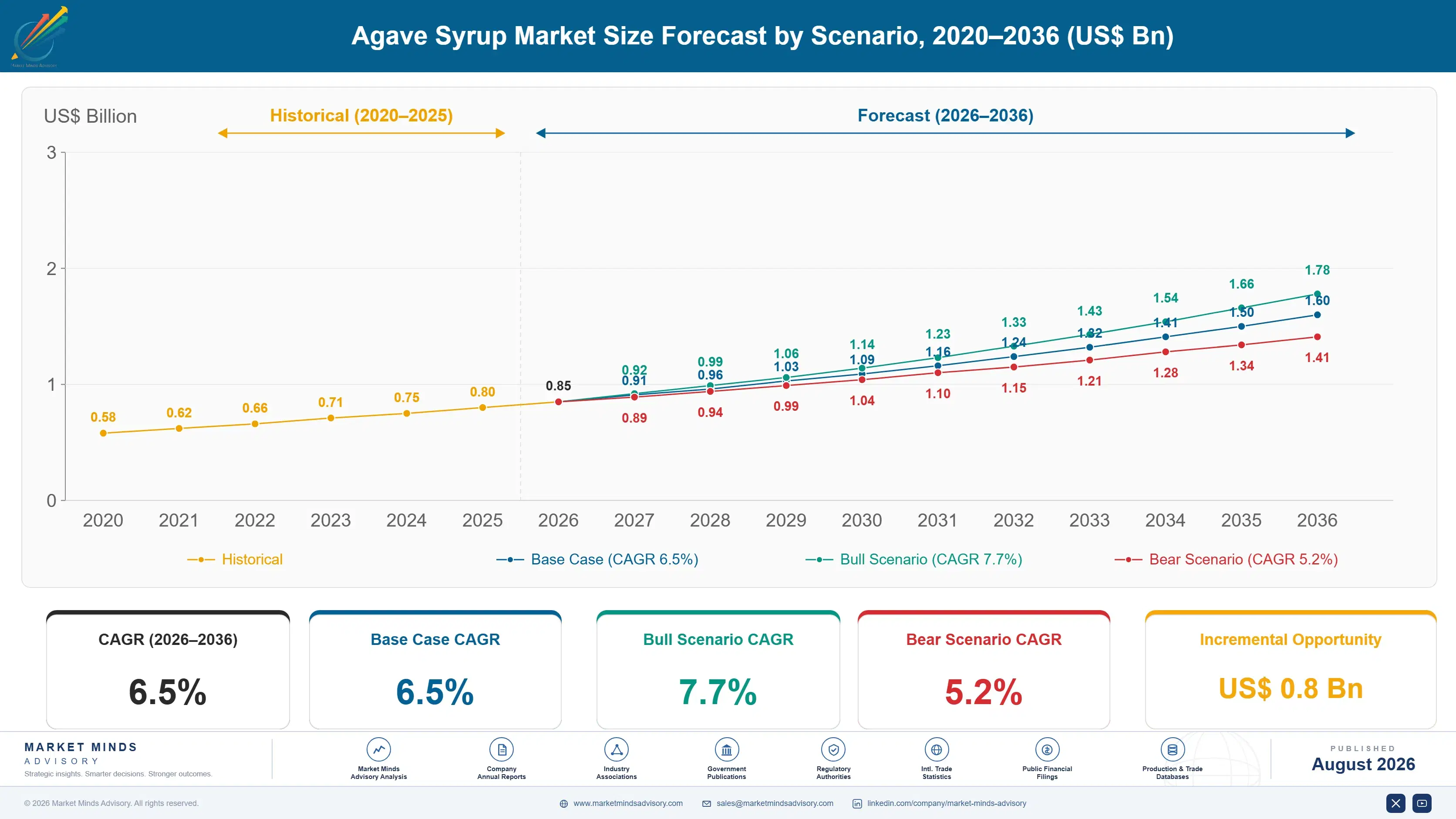
Agave Syrup Market Forecast Scenarios

agave-syrup-market-size-forecast-scenario-1787463801785
Between 2020 and 2025, agave syrup volumes grew at an estimated 5.5% compound rate as natural sweetener demand recovered from a prior blue agave supply shortage that had constrained cultivation output across Mexico. Organic certified volume grew steadily through this period, while mainstream light syrup demand expanded more slowly amid competition from other natural sweetener categories.
The base case assumes continued expansion as three mechanisms compound: clean label reformulation pushing food and beverage manufacturers toward less-processed dark agave grades, expanding blue agave cultivation acreage in Jalisco and Oaxaca easing prior supply constraints, and organic certification programs scaling to meet premium retail demand. Foodservice and cocktail bar channels are expected to sustain steady syrup demand, while bottlers expand direct sourcing relationships with Mexican growers to secure supply ahead of anticipated demand growth.
The bull case turns on clean label reformulation accelerating faster than expected across mainstream retail, pulling dark and organic agave syrup volumes sharply higher as manufacturers reformulate broadly. The bear case centers on cultivation cycle risk: blue agave plants require six to eight years to mature, so a renewed planting shortfall today could recreate the supply shortage and price spikes the category experienced previously.

Cultivation Cycles and the Clean Label Sweetener Race

Agave syrup sits at the intersection of two converging forces: enduring demand for a mild-flavored natural sweetener alternative to refined sugar and an emerging clean label mandate pushing formulators toward darker, less-processed grades. Bottlers that once treated agave syrup as a commodity health food aisle product are now investing in direct sourcing and traceability programs to serve premium retail demand, betting that certified organic and minimally processed positioning will command durable premiums over standard light syrup within the next decade.
MARKET CONCENTRATIONCR5 32%Leading five bottlers hold under a third of supply
AVERAGE SELLING PRICE$4.20 per kgOrganic certified grades command substantial price above standard syrup
TOP PRODUCING COUNTRY SHAREMexico 90%+Single country cultivation and processing anchors overwhelming supply concentration
CAPACITY UTILIZATION77%Processing plants run near full rates amid rising demand
FEEDSTOCK SHARE OF COGS48%Raw agave cultivation costs dominate total production expense heavily
EXPORT TRADE INTENSITY62%Meaningful cross border shipment volume links producers to distant buyers
Commercially, the market still behaves partly like an agricultural commodity: light amber syrup trades on delivered price and cultivation cost, with thin margins and long-standing supplier relationships across mainstream retail and foodservice channels. Dark, raw, and organic certified grades command a distinctly different economics, priced on traceability and minimal processing credentials rather than commodity input cost, giving bottlers who master direct grower relationships a genuinely differentiated margin position across premium natural food channels.
Looking ahead, the decade defining forces are agricultural and regulatory: how quickly Mexican cultivation acreage expands to meet growing demand will determine supply stability, while clean label labeling standards and organic certification programs determine which bottlers capture the fastest-growing premium segments of the category worldwide.
"Agave syrup's biggest risk isn't demand, it's biology. A plant that takes six to eight years to mature doesn't care how fast clean label trends move, and the last shortage proved that the hard way."
Director, Natural Sweeteners and Specialty Ingredients Practice · MMA Specialty Food Ingredients and Natural Sweeteners Practice · August 2026

Market Trends

Clean Label Demand Favors Darker Agave Grades

Major natural food brands across North America and Western Europe are reformulating sweetener declarations to favor darker, less-processed agave syrup grades, responding to retailer clean label scorecards and consumer scrutiny of highly refined ingredient processing methods similar to broader sugar reduction trends. Several leading bottlers have disclosed expanded dark and raw grade product lines during 2024 and 2025, targeting premium natural food and beverage manufacturers specifically. This shift is compressing the addressable market available to bottlers selling only standard light amber syrup, pushing suppliers toward deeper direct grower sourcing relationships and traceability documentation capability.
Market Impact: Low glycemic positioning drives 10%+ growth
Blue Agave Cultivation Acreage Expands Steadily

Blue agave cultivation acreage across Jalisco and Oaxaca is expanding as growers respond to sustained demand recovery following the prior supply shortage that constrained the category for several years, with new plantings expected to reach harvest maturity over the next six to eight years given the crop's extended growth cycle. Industry associations have reported meaningful new planting activity during 2024 and 2025, aiming to build a supply buffer against future demand spikes. This expansion is gradually easing the cultivation cycle volatility that has historically constrained syrup bottlers' ability to plan multi-year supply contracts confidently.
Market Impact: Foodservice channel grows roughly 8% yearly

Market Opportunities and Growth Drivers

Natural Sweetener Preference Expands Category Demand

Consumer preference for natural, minimally processed sweeteners continues expanding across North America and Western Europe as shoppers increasingly scrutinize added sugar and artificial sweetener content in packaged food and beverage products sold across nearly every retail category. Agave syrup benefits from a low glycemic index positioning relative to refined sugar, giving it credibility with health-conscious consumers that newer synthetic alternatives lack entirely. This directly expands addressable demand for agave syrup beyond what general natural sweetener category growth alone would suggest, benefiting bottlers across both mainstream and premium organic product segments simultaneously.
Market Impact: Maturation takes 6 to 8 years

Cocktail Culture Boosts Foodservice Syrup Demand

Rising cocktail culture and premium bar programs across North America and Western Europe are driving foodservice demand for agave-based syrups as a defining ingredient in tequila and mezcal-adjacent cocktail categories experiencing sustained consumer interest across major urban markets. Every incremental premium bar program incorporating agave-forward cocktails requires reliable syrup supply, and bartenders increasingly specify raw or dark grades for their more complex flavor profile compared to standard light syrup. This expands addressable demand for premium agave syrup beyond what retail category growth alone would suggest, benefiting suppliers with dedicated foodservice distribution capability.
Market Impact: Fructose content exceeds 70% of sugars

Market Restraints and Challenges

Agave Maturation Cycle Limits Supply Responsiveness

Blue agave plants require six to eight years to mature before harvest, creating a cultivation cycle that cannot respond quickly to demand increases, an inherent characteristic of the crop rather than a temporary supply issue. This dynamic caused a significant supply shortage and price spike in the prior decade when tequila industry demand competed directly with syrup bottlers for the same agave harvest, and a repeat of that competition remains a persistent risk given tequila's own growth trajectory. Bottlers with long-term grower contracts secured years in advance are better insulated than spot-market buyers facing the greatest exposure during tight periods.
Market Impact: Dark grade demand grows roughly 20%

High Fructose Content Draws Nutrition Scrutiny

Agave syrup carries a notably high fructose content compared to some other natural sweeteners, drawing scrutiny from nutrition researchers and health advocates concerned about fructose's metabolic effects when consumed in excess, a debate rooted in broader nutrition science rather than agave-specific findings unique to this ingredient. This scrutiny complicates marketing positioning for bottlers who have historically emphasized agave's low glycemic index without addressing fructose content directly, risking consumer confusion if messaging is not carefully balanced. Bottlers are increasingly pairing glycemic index messaging with moderation guidance to address this narrative gap proactively across their marketing materials.
Market Impact: New plantings mature within 6 years
3 additional market trends, 2 additional growth drivers, and 4 additional restraints and challenges are covered in the full report. Contact sales@marketmindsadvisory.com to access the complete intelligence.

Segment CAGR and Growth Architecture

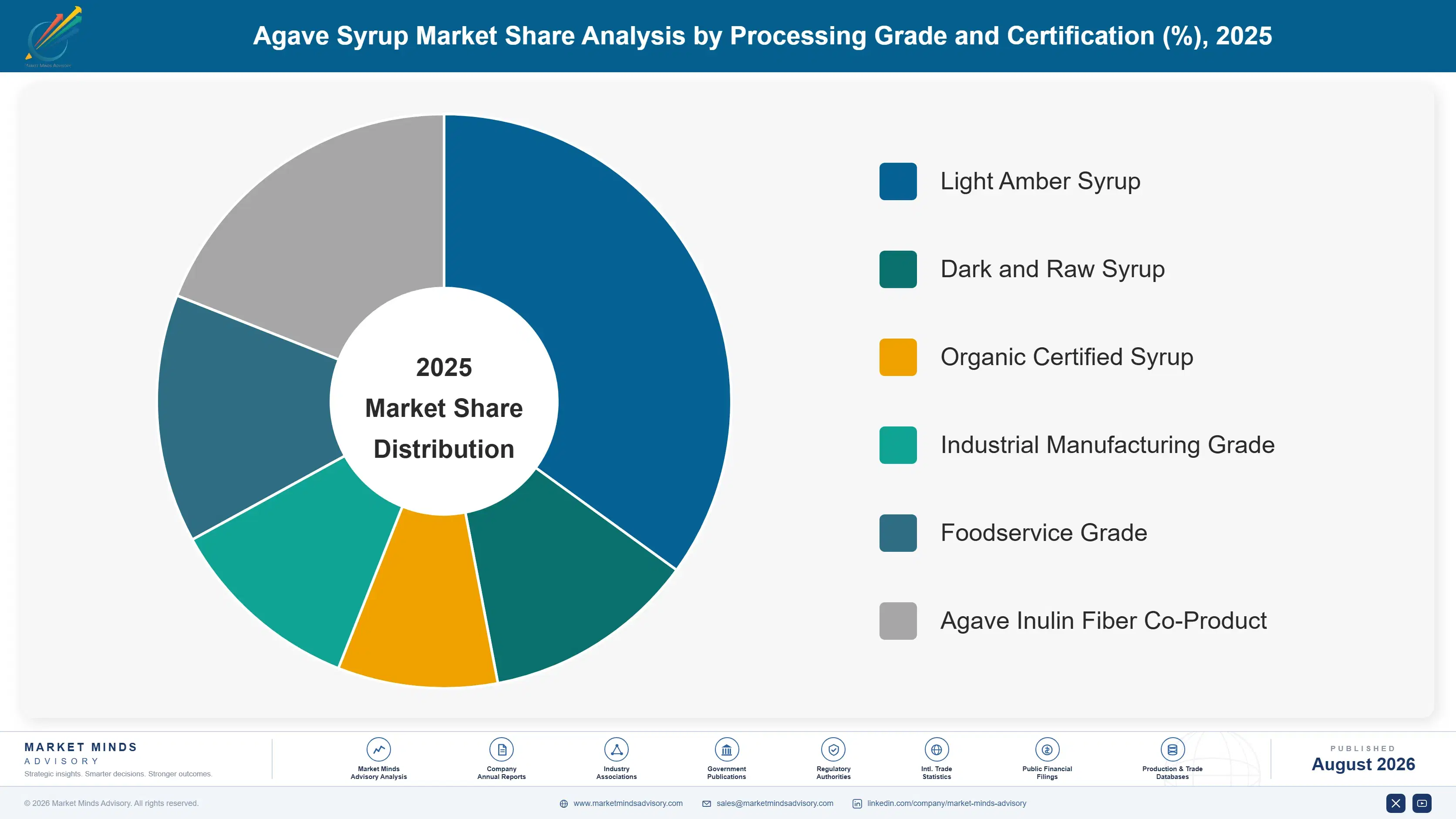
Agave Syrup Market segments by processing grade and certification status rather than end-use application, since the degree of processing and certification determines cost structure, flavor profile, and premium positioning across retail, foodservice, and industrial manufacturing channels. Six categories span mainstream light syrup and newer, less-processed premium grades, each carrying distinct margin profiles and demand growth across bottlers and customer segments.
agave-syrup-market-market-share-analysis-1787463802319

Dark and Raw Agave Syrup

Dark and raw agave syrup undergoes less filtration and heat processing than standard light amber grades, retaining a bolder, caramel-like flavor profile and marginally higher mineral content that clean label consumers increasingly associate with authenticity and minimal processing across the category. This is the fastest-growing category, expanding at an estimated 9.2 percent annually as natural food brands and premium foodservice operators favor less-processed grades over standard light syrup for their perceived clean label credentials. Bottlers with direct grower relationships and minimal-processing capability are capturing outsized share of this category's growth, while larger industrial bottlers optimized for standard light syrup production struggle to pivot quickly toward smaller-batch dark grade output nationwide.
CAGR 9.2%

Organic Certified Agave Syrup

Organic certified agave syrup carries third-party certification confirming cultivation and processing methods meet recognized organic standards, commanding a premium from retail and foodservice buyers who require documented certification to support their own natural or organic product claims across every major global retail channel worldwide today still. This is the second-fastest category, expanding at an estimated 8.3 percent annually as certified organic retail categories continue outgrowing conventional grocery overall across major consuming markets. Bottlers with established organic grower networks and certification infrastructure are winning premium retail contracts fastest, since certification audits and traceability documentation require sustained investment that smaller regional bottlers often cannot commit at comparable scale nationwide and well beyond.
CAGR 8.3%
Full segment breakdown across 6 segments available in the complete report.

Regional Architecture and Country Demand Map

Agave syrup demand spans all major regions, with Latin America overwhelmingly dominant on cultivation and processing given Mexico's near-exclusive control of blue agave supply, while North America and Western Europe drive premium organic and clean label demand for finished syrup products worldwide today and beyond.

North America

US natural food and beverage manufacturers increasingly demand traceable, certified organic agave syrup as retailer clean label scorecards push formulators toward documented sourcing across the country's large natural foods retail base and well beyond it entirely and quite consistently indeed still. Foodservice and cocktail bar programs drive substantial additional demand for dark and raw grades favored by bartenders for their complex flavor profile in agave-forward cocktails nationwide and well beyond. Canada's natural food manufacturers follow similar sourcing patterns and premium grade adoption trends on a smaller scale. Demand concentrates in health food retail, premium beverage formulation, and foodservice categories where documented natural sourcing supports price positioning above conventional sweeteners nationwide.
Share: 24% | CAGR: 6.0% (2026 to 2036)

Western Europe

Germany and the United Kingdom anchor European agave syrup demand given their large natural and organic food retail sectors, both increasingly favoring certified organic grades with documented traceability to Mexican growers and cooperatives nationwide and quite well beyond. France follows closely, where premium natural food brands have expanded dark and raw agave syrup product lines faster than the broader natural sweetener category overall this cycle across most retail channels. The European Union's organic certification and novel food labeling regulations are pushing suppliers toward better-documented sourcing and traceability across the entire supply chain. Growth trails North America given the region's comparatively smaller cocktail and foodservice consumption base for agave-based syrups specifically.
Share: 19% | CAGR: 5.0% (2026 to 2036)
Regional intelligence for 5 additional markets available in the complete report: East Asia, South Asia and Pacific, Latin America, Middle East and Africa, Eastern Europe. Contact sales@marketmindsadvisory.com.
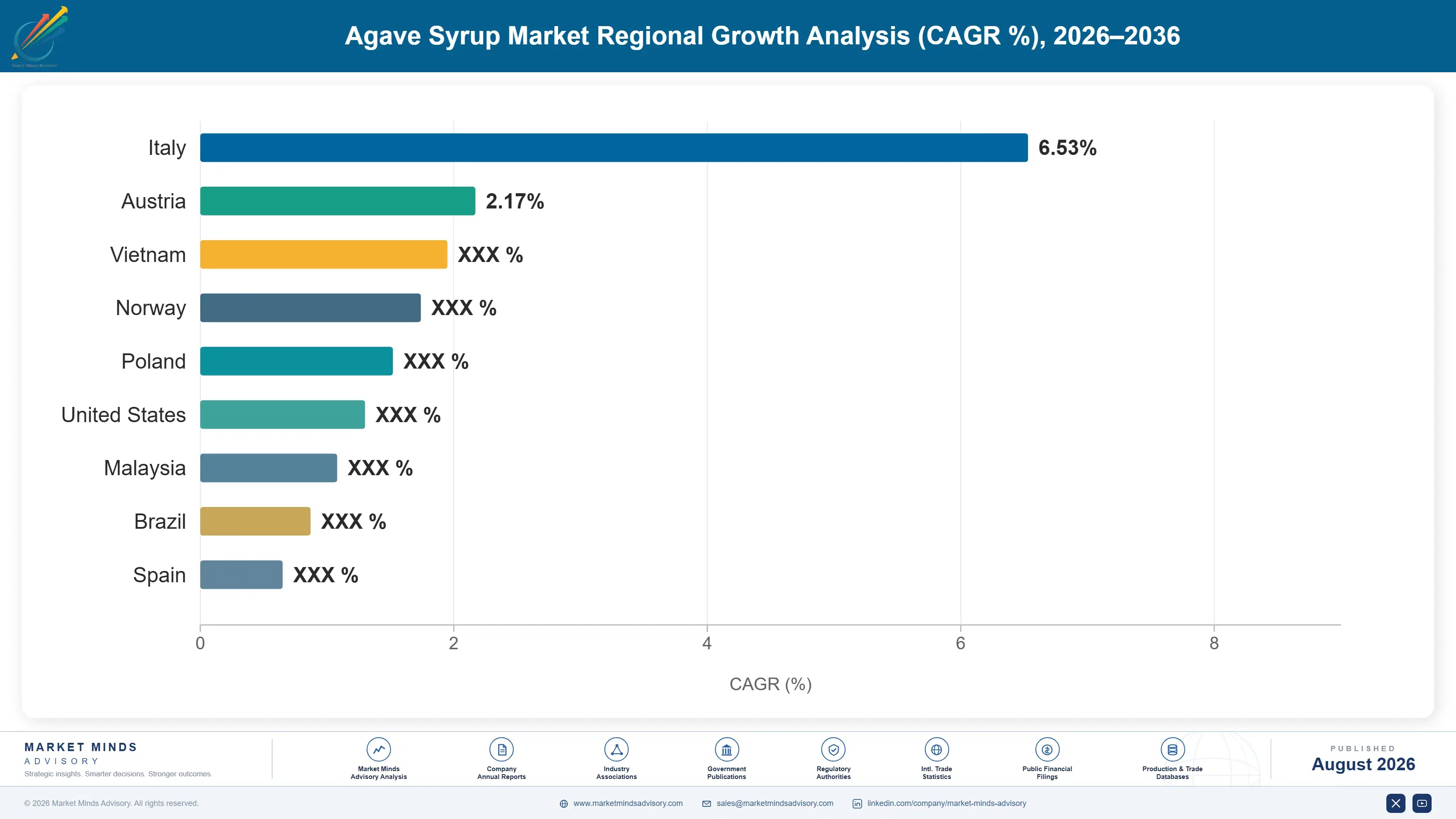
agave-syrup-market-country-cagr-analysis-1787463802839

Where Agave Syrup Margins Concentrate

Margin expansion in agave syrup flows through four distinct commercial levers: dark and raw grade premiums over standard light syrup, certified organic supply contracts, direct grower relationships that secure long-term cultivation capacity, and foodservice channel development targeting premium cocktail programs across major hospitality markets across the entire wider world today and well beyond that.

Dark Grade Premium Over Standard Light Syrup

Dark and raw agave syrup commands a price premium of roughly 1.4 to 1.8 times standard light amber syrup, reflecting both lower processing throughput and the clean label credibility minimal processing provides to natural food brand customers. Bottlers who develop dedicated small-batch dark grade production capture pricing power that industrial light syrup producers competing purely on volume cannot access. This premium has proven durable because minimal-processing production lines require different equipment and quality control than high-volume light syrup lines, giving early movers a multi-year head start over competitors still building comparable dark grade capability.
Market Impact: Dark syrup prices 1.4 to 1.8 times standard

Securing Exclusive Organic Grower Supply Contracts

Retailers and natural food brands increasingly fund exclusive, long-term supply contracts with certified organic agave growers rather than purchasing standardized syrup off a broker market, with disclosed contracts often spanning 3 to 5 years and covering entire private label product ranges. Bottlers that secure these grower relationships gain both certified organic supply security and pricing stability difficult for spot-market competitors to match once a retailer's private label range has launched. This lever favors bottlers with dedicated grower relationship teams and requires sustained investment that smaller regional bottlers often cannot commit at comparable scale.
Market Impact: Organic supply contracts often span 3 to 5 years

Direct Grower Relationships Secure Supply Stability

Bottlers with direct, long-term contracts with Mexican blue agave growers secure feedstock at meaningfully more stable pricing than competitors purchasing through spot-market brokers, particularly during periods of cultivation cycle volatility when spot prices can spike more than 30 percent within a single harvest season across the affected supply chain. This integration lever requires sustained relationship investment with growers across multiple growing regions that smaller bottlers typically lack, reinforcing a durable supply security advantage for bottlers who have already built these relationships across Jalisco and Oaxaca over many years of continued investment.
Market Impact: Spot market prices can spike over 30 percent

Foodservice Channel Development Targets Premium Bars

Bottlers developing dedicated foodservice distribution capability targeting premium cocktail bar programs capture a growing customer base among hospitality operators that standard retail-focused distribution channels cannot serve efficiently given different packaging, volume, and delivery requirements across most metropolitan markets nationwide and beyond. Suppliers with this foodservice-specific distribution infrastructure are winning premium bar and restaurant contracts at a pace roughly 8 percent faster than the broader retail syrup market, since hospitality buyers strongly prefer dedicated account service over standard retail distribution channels. This lever requires specialized distribution investment that most retail-focused bottlers have not yet made.
Market Impact: Foodservice channel contracts grow roughly 8 percent faster

Who Controls the Margin Pool

Agave Syrup Market concentration sits at a CR5 of 32 percent, evaluated on global bottled syrup production volume, with Wholesome Sweeteners and Madhava Natural Sweeteners holding the largest positions built on established Mexican grower relationships and diversified grade portfolios spanning light, dark, and organic certified syrup. The gap between these established leaders and numerous smaller regional bottlers remains wide on grower relationship depth, though narrower on delivered cost position for standard light syrup categories.
Current competitive activity concentrates in three areas: direct grower relationship investment to secure long-term Mexican cultivation capacity ahead of anticipated demand growth, dark and raw grade product line expansion to meet clean label reformulation demand, and foodservice channel development targeting premium cocktail bar and restaurant programs.

Rankings are most likely to shift as clean label reformulation becomes standard practice across premium natural food retail, a dynamic that could let bottlers with the strongest direct grower relationships pull meaningfully ahead of spot-market-dependent regional competitors. Smaller bottlers without dedicated grower relationship capability face the greatest pressure, and several are pursuing supply partnership arrangements with larger bottlers rather than building direct sourcing relationships internally, a defensive posture that could reshape the competitive leaderboard within the next five years.
agave-syrup-market-company-positioning-matrix-1787463803361

Competitive Moat and Risk Dimensions

WHOLESOME SWEETENERS

Moat: Deep Organic Grower Network

Wholesome Sweeteners has built one of the deepest certified organic grower networks in Mexico over more than two decades, supported by dedicated fair trade and sustainability certification programs serving major natural food retailers globally. This established grower network lets Wholesome offer documented, traceable organic supply that smaller regional bottlers without comparable grower relationships cannot match at comparable scale and consistency.
WHOLESOME SWEETENERS

Risk: Weaker Commodity Price Position

Wholesome's premium organic positioning and certification cost structure leave it less competitive on price in commodity light syrup applications, ceding volume share to lower-cost regional bottlers in price-sensitive mainstream retail channels. Sustained cultivation cost inflation could further pressure margins across its certified organic supply chain specifically.
MADHAVA NATURAL SWEETENERS

Moat: Established Retail Brand Trust

Madhava's decades of natural sweetener category leadership and established retail brand recognition give it distinctive credibility with natural food buyers seeking documented, trusted agave syrup brands nationwide. This established reputation and existing retail relationships give Madhava a durable position in the premium retail segment specifically.
MADHAVA NATURAL SWEETENERS

Risk: Limited Foodservice Distribution

Madhava's retail brand focus means it has less direct foodservice distribution infrastructure relative to competitors more narrowly focused on hospitality channels, potentially limiting its exposure to the fastest-growing cocktail bar segment specifically. Intensifying competition from foodservice-focused specialists could erode Madhava's relative growth rate over time.

Players Tracked

Prominent Players

Wholesome Sweeteners
Madhava Natural Sweeteners
Ingredion Incorporated
Tate & Lyle PLC
Cargill Incorporated

Other Key Players

NOW Health Group
Suncore Foods
Terrasoul Superfoods
Trilliant Food & Nutrition
Domino Foods Inc.
Imperial Sugar Company
Rogers Sugar Inc. (Lantic)
Golden Barrel
Sucro Can Sourcing LLC
Batory Foods
Best Sweet Inc.
GLC Direct
Nature's Flavors Inc.
Windmill Health Products
Steviva Brands Inc.

Recent Developments

FEBRUARY 2025

Wholesome Sweeteners Expands Organic Agave Syrup Sourcing In Jalisco

Wholesome Sweeteners announced an expansion of its organic agave syrup sourcing network across Jalisco, adding certified grower relationships to increase supply security ahead of anticipated demand growth from natural food retail customers. The expansion adds meaningful annual sourcing capacity without requiring new bottling facility investment.
Signal: Signals established bottlers are prioritizing grower relationship expansion ahead of anticipated clean label reformulation demand growth.
SEPTEMBER 2024

Madhava Natural Sweeteners Launches Dark Raw Agave Syrup Line

Madhava Natural Sweeteners launched a new dark raw agave syrup product line targeting clean label consumers seeking minimally processed natural sweeteners, responding to retailer scorecard pressure to remove highly refined ingredients nationwide and beyond. The launch includes documented processing method disclosure supporting clean label marketing claims.
Signal: Signals established brands are prioritizing dark grade product development as a distinct clean label reformulation battleground.
APRIL 2025

Ingredion Announces Agave Inulin Fiber Co-Product Facility Expansion

Ingredion announced an expansion of its agave inulin fiber co-product facility to increase functional fiber ingredient output alongside existing syrup production, responding to sustained demand from functional food manufacturers across multiple product categories nationwide. The expansion adds meaningful annual processing capacity at an existing site.
Signal: Signals diversified ingredient houses are prioritizing co-product fiber extraction as an additional revenue stream from agave processing.

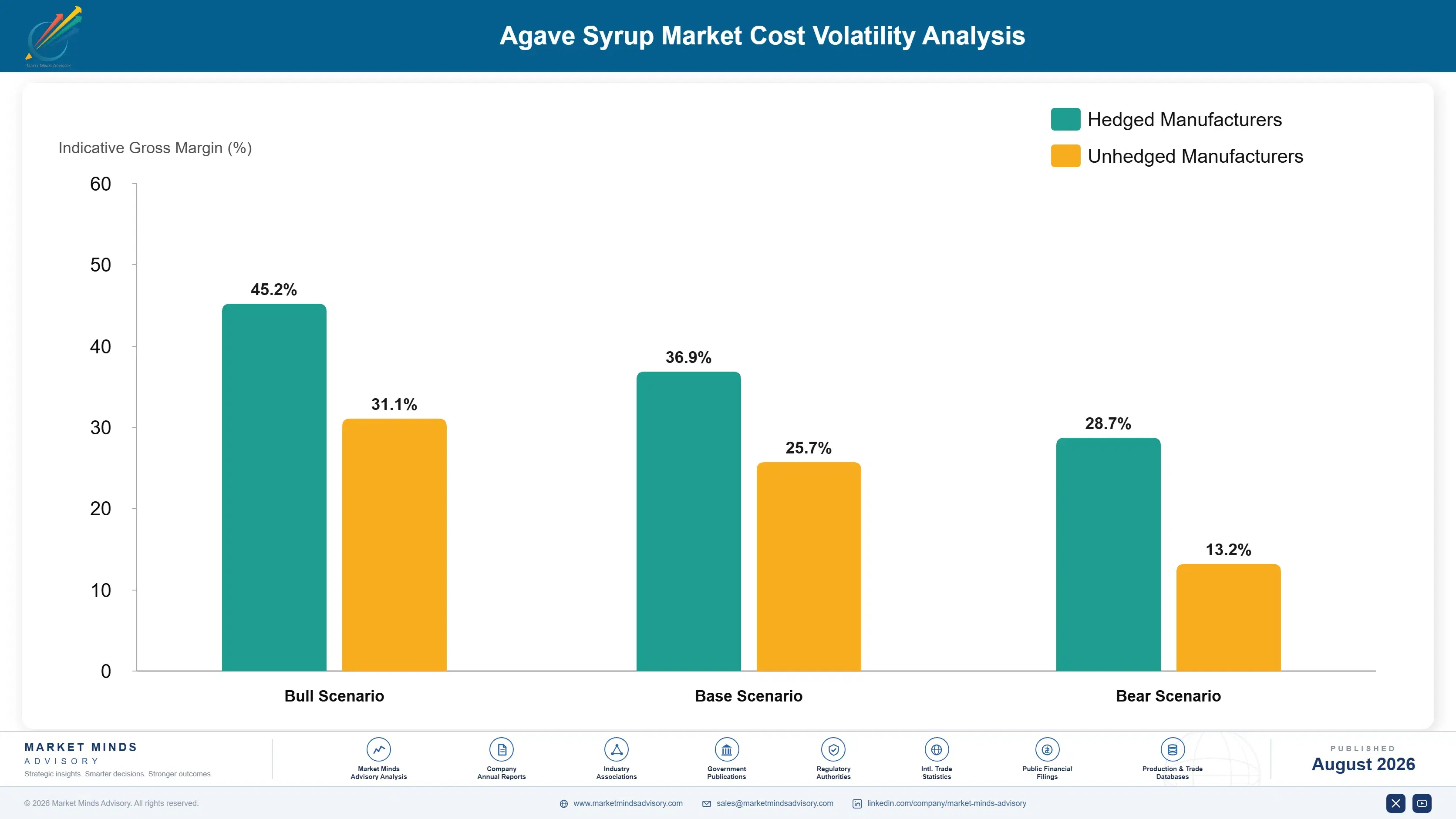
Blue Agave Cultivation And Harvest Costs

Raw blue agave cultivation and harvesting costs account for an estimated 45 to 52 percent of cost of goods sold for standard syrup production, while processing, filtration, and bottling represent the remaining formulation cost across most major retail and foodservice product lines nationwide. Feedstock originates almost entirely from cultivation regions in Jalisco and Oaxaca, Mexico.
Blue agave prices spiked sharply during the prior decade following a severe supply shortage when tequila industry demand competed directly with syrup bottlers for the same harvest, according to Mexican agricultural authority reporting cited by industry associations, pushing costs up substantially and squeezing margins for bottlers who could not pass costs through mid-contract. Several bottlers disclosed cultivation-linked cost inflation as a specific pressure on segment margins in recent reporting periods, prompting wider adoption of indexed pricing clauses.

Producers without long-term grower contracts secured years in advance face a persistent cost disadvantage during cultivation cycle tightness, since blue agave's six to eight year maturation cycle prevents meaningful short-term supply response to price spikes. Exposure concentrates most heavily among spot-market bottlers who lack the contractual relationships that larger diversified competitors maintain across multiple growing regions and multi-year grower agreements.
agave-syrup-market-cost-volatility-analysis-1787463803559

Diversify Grower Contracts Across Growing Regions

Bottlers are securing long-term grower contracts across multiple growing regions within Jalisco and Oaxaca, locking in supply years in advance of anticipated harvest cycles to reduce spot-market price exposure considerably. This diversification adds contractual complexity but meaningfully lowers the probability that a single regional harvest shortfall disrupts total production volume across a bottler's portfolio.

Build Direct Grower Relationships Ahead Of Demand

Capital allocation is shifting toward direct grower relationship investment precisely because long-term contracts provide more predictable feedstock volume and pricing than relying entirely on open spot-market purchases from independent growers directly. Bottlers pursuing this path reduce long-run exposure to cultivation cycle volatility, even though direct grower relationships require sustained relationship-building investment over multiple years.

Negotiate Indexed Cost Pass-Through Clauses In Contracts

Bottlers are increasingly building indexed cost pass-through mechanisms into multi-year supply agreements, tying pricing to published agave cost benchmarks rather than fixed unit prices negotiated years in advance. This protects margins during volatility events but requires buyers accustomed to fixed pricing to accept periodic adjustment clauses, a negotiation that favors bottlers with strong bargaining position and grower relationships.

Portfolio Architecture for Margin Defence

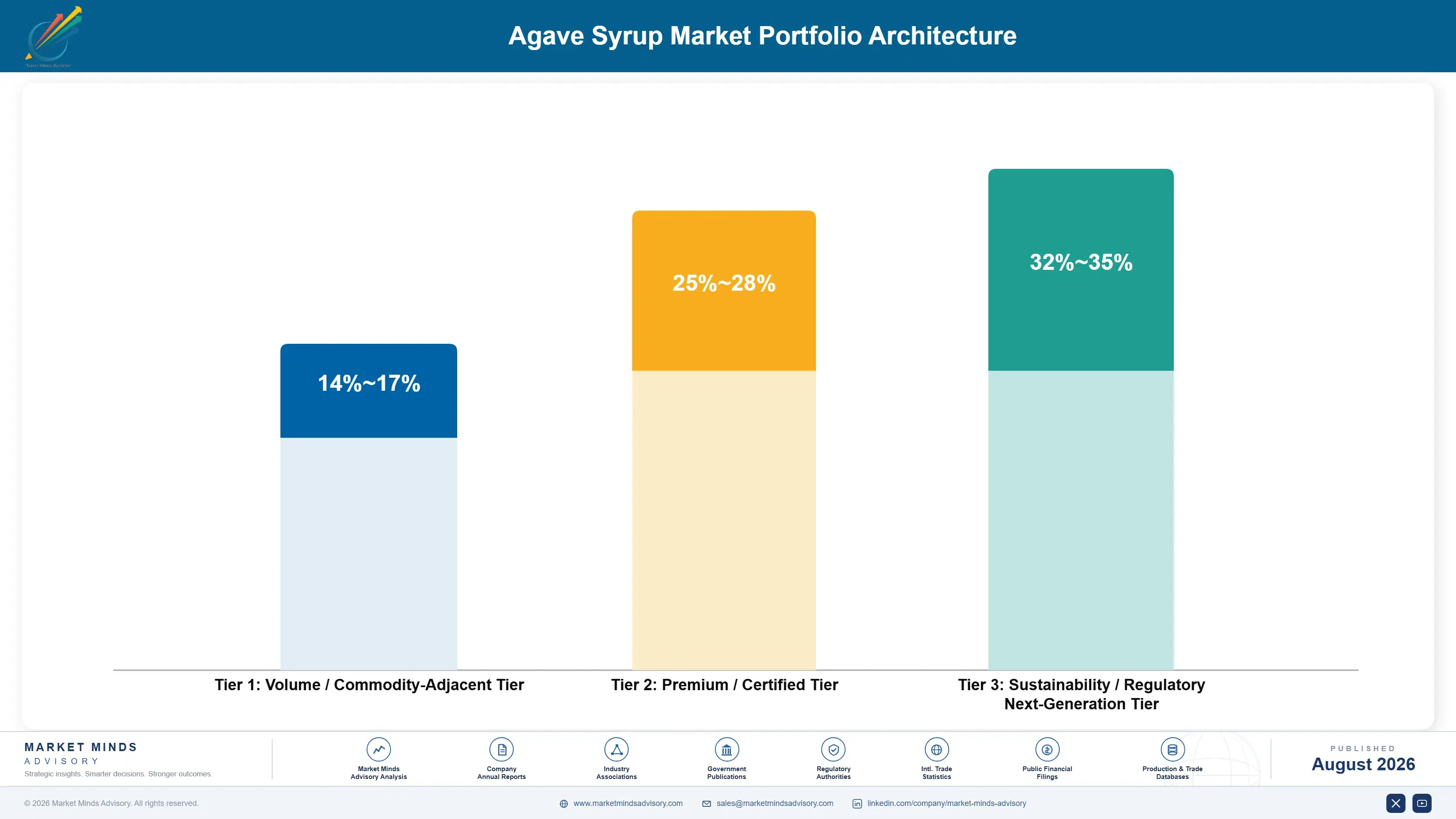
Agave Syrup Market splits into three commercial tiers with different margin economics: a volume tier built on standard light amber syrup sold into mainstream retail manufacturing, a premium tier built on dark, raw, and organic certified grades commanding processing premiums, and a next-generation tier built on foodservice and cocktail channel development still scaling toward full commercial economics. Gross margins range from roughly 15 percent at the volume end to over 34 percent for differentiated grades sold under exclusive agreements.
Volume-tier producers compete primarily on price and reliable delivery into commodity light syrup formulations, where processing credentials matter less than consistent supply at the lowest deliverable cost. Premium-tier producers instead compete on certification depth and traceability for brand owners unwilling to compromise on clean label credibility, accepting higher grower relationship costs in exchange for pricing power volume-tier competitors cannot access.

High-value margin pools concentrate in organic certified and dark grade formulation contracts sold under exclusive multi-year agreements to premium natural food and foodservice brands, where buyers pay for documented sourcing and grower relationship security together. Standard light syrup remains the volume backbone of the market, but its margin ceiling is capped by a competitive set of regional bottlers entering the segment.

Volume / Commodity-Adjacent Tier

Standard light amber agave syrup sold into mainstream retail and industrial food manufacturing at competitive pricing, prioritizing reliable volume delivery over processing sophistication, serving private label and mid-tier branded manufacturers across mature natural sweetener categories.
Gross Margin: 14-17%

Premium / Certified Tier

Dark, raw, and organic certified agave syrup with documented minimal processing and grower traceability sold to premium natural food and beverage manufacturers requiring verified clean label credentials, commanding higher unit prices than standard light syrup equivalents under multi-year contracts.
Gross Margin: 25-28%

Sustainability / Regulatory / Next-Generation Tier

Foodservice and cocktail channel development marketed on premium hospitality distribution and grower relationship security, targeting bar and restaurant customers pursuing distinctive cocktail programs, commanding the highest margins as dedicated distribution infrastructure continues expanding across major hospitality markets.
Gross Margin: 32-35%
agave-syrup-market-portfolio-architecture-1787463804063

High-value Sub-segments and Strategic Watch-out

Foodservice And Cocktail Channel Development

Foodservice and cocktail channel development is both the highest-margin and fastest-growing segment as premium bar programs fund dedicated distribution relationships to secure reliable dark and raw grade supply, attracting the bulk of all new investment from leading agave syrup bottlers worldwide during this current cycle.
Gross Margin: 32-35%

Dark, Raw, And Organic Certified Retail Syrup

Dark, raw, and organic certified syrup for conventional retail applications continues generating strong margins even as growth moderates relative to foodservice channel development, supported by established customer relationships and grower networks that newer entrants still need years to replicate credibly with major retail buyers globally.
Gross Margin: 25-28%

Standard Light Syrup Core Volume

Standard light amber syrup sold at competitive volume pricing into mainstream retail and industrial manufacturing remains the market's core revenue base even as margins compress under rising competition from lower-cost regional bottlers entering the segment at a very meaningful scale across many different geographies worldwide.
Gross Margin: 14-17%

Blue Agave Cultivation Cycle Risk

Blue agave cultivation supply tied to six to eight year maturation cycles in Mexico represents the segment producers and investors should watch most closely, since a sustained multi-year planting shortfall could recreate the supply shortage and price spikes the category experienced previously and quite severely.
Gross Margin: 9-12%

Why Agave Syrup Contracts Renew Reliably

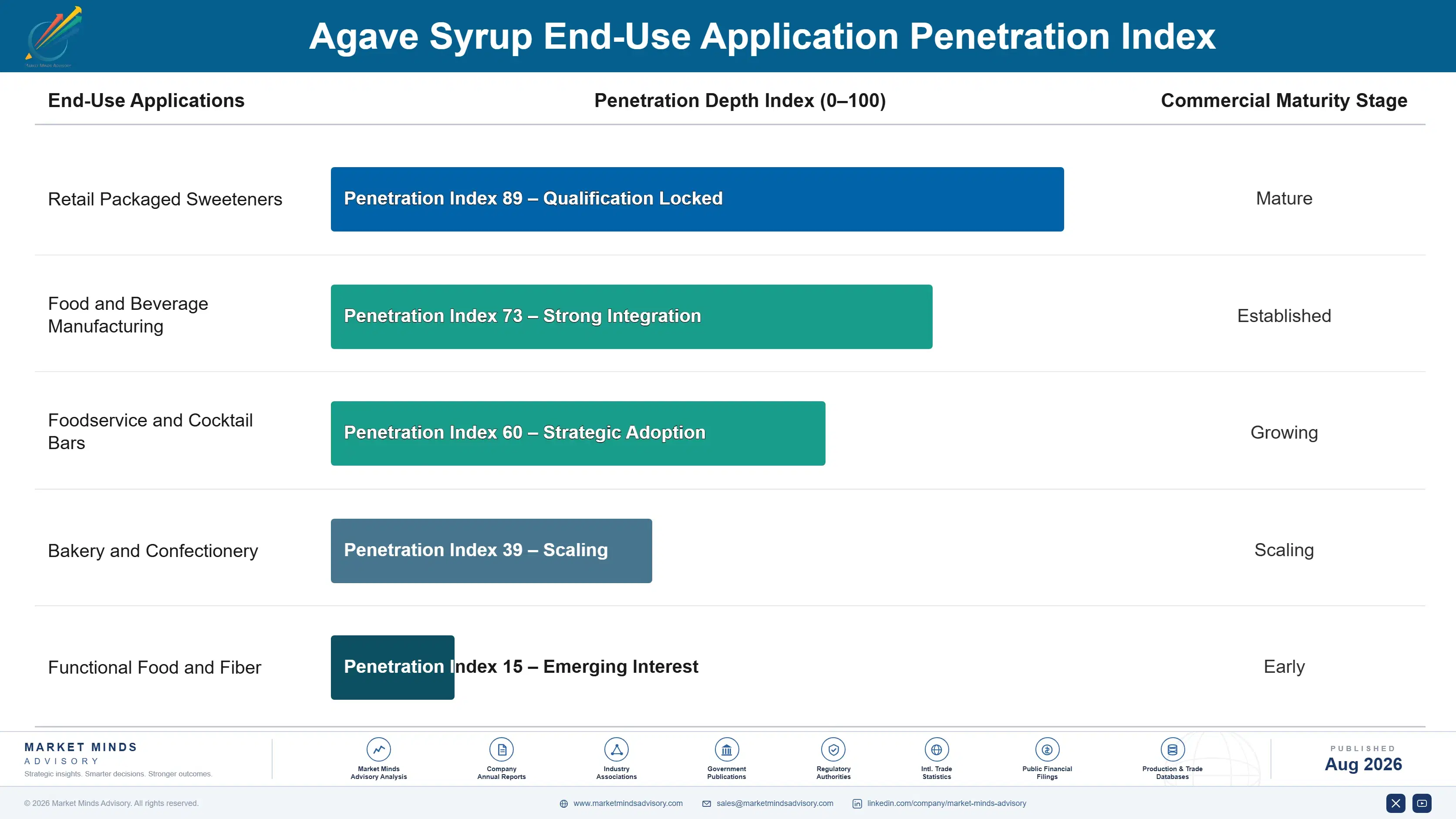
Once a natural food brand or foodservice operator qualifies an agave syrup supplier against its grade and certification benchmarks, the relationship tends to persist for years rather than being re-tendered annually, since re-qualification carries real cost and supply risk for the buyer. This qualification stickiness gives incumbent suppliers reliable, repeat revenue once a contract is won, a dynamic that rewards established grower relationships more than aggressive price competition alone.
Adoption runs deepest in premium natural food and cocktail bar programs, where documented grade and sourcing credentials are a defining determinant of brand credibility that manufacturers cannot easily substitute without risking trust, and shallowest in industrial bulk food manufacturing, where formulators retain more sourcing flexibility. Retail private label and foodservice sit between these extremes, adopting premium grades selectively across flagship lines while retaining simpler formulations for value-tier products within the same portfolio.

A younger cohort of product development managers at natural food brands and hospitality groups, now negotiating supply contracts, treats documented grower traceability as a baseline requirement rather than a differentiator their predecessors debated case by case. This generational shift is compressing the qualification timeline for new premium grade formulations at brands that previously relied on standard light syrup exclusively.
agave-syrup-market-end-use-penetration-index-1787463804564

Where To Place Agave Syrup Bets

These are among the four positions where our research anticipates prominent divergence between winners and laggards over the coming forecast period. Each is grounded in the demand model, the regulatory perimeter, and the announced capacity pipeline.
01 / DARK GRADE PRODUCTION INVESTMENT

Back Dark Grade Production Before Rivals Do

Dark and raw agave syrup is growing faster than any other grade as clean label consumers demand documented minimal processing that regulators and retailers increasingly reward through shelf placement and scorecard rankings. Bottlers that invest in dedicated small-batch dark grade production now will lock in preferential access to premium natural food contracts before mainstream competitors complete their own capability build-out. Waiting for clean label demand to plateau before investing risks ceding the most defensible long-term position to competitors who moved earlier and already control the strongest dark grade production capability.
02 / ORGANIC GROWER PARTNERSHIPS

Secure Organic Grower Partnerships Now

Certified organic supply contracts secured directly with Mexican growers offer bottlers a durable advantage as retailer clean label mandates increasingly require documented, traceable sourcing that spot-market purchases cannot reliably provide across every major retail channel. Bottlers that lock in long-term organic grower relationships now protect both supply security and pricing stability during the next inevitable cultivation cycle tightening, rather than competing for scarce organic volume after prices have already moved higher across the market. This relationship-building investment takes years, rewarding bottlers who started earliest.
03 / CULTIVATION SUPPLY DIVERSIFICATION

Diversify Grower Relationships Across Growing Regions

Blue agave's six to eight year maturation cycle means cultivation cannot respond quickly to demand spikes, and the category has already experienced one severe shortage when tequila and syrup demand collided over the same harvest. Bottlers that diversify grower relationships across multiple regions within Jalisco and Oaxaca now protect margin during the next inevitable cultivation tightening rather than scrambling for alternative supply after prices have already moved sharply higher. This diversification is a comparatively low-cost hedge relative to the downside it protects against.
04 / FOODSERVICE CHANNEL DEVELOPMENT

Build Foodservice Distribution Capability Ahead Of Rivals

Foodservice and cocktail bar channel development offers bottlers a distinct growth path beyond commodity retail competition, since premium hospitality buyers pay for dedicated distribution service that standard retail-focused bottlers cannot provide efficiently at comparable scale or speed. Suppliers that build this specialized distribution infrastructure now capture preferential access to premium bar and restaurant contracts before mainstream competitors recognize the opportunity and respond with their own dedicated channel investment. Building this capability takes time, making it a strategic priority best pursued now rather than later.

Engagement Snapshot From the Field

A live engagement with an industry participant carrying material or product regulatory and market exposure ahead of a defining policy shift, showing how our research translates into a defensible multi-year portfolio strategy.
MARKET MINDS ADVISORY · CLIENT ENGAGEMENT SUMMARY
Agave Syrup Producer Strategic Portfolio Review and Transition Roadmap 2026·Investment Scenario on Agave Syrup Exposure Evaluation 2025-26
CLIENT PROFILE
The client is a multinational natural food and beverage manufacturer generating approximately 690 million dollars (client-reported, unverified by MMA) in annual branded product revenue across North America and Western Europe. The company had committed publicly to sourcing certified organic, traceable agave syrup across its entire premium product range within an eighteen-month supply security initiative following a prior industry-wide shortage scare.
STRATEGIC CHALLENGE
The client's existing spot-market syrup sourcing left it exposed to cultivation cycle volatility and lacked the documented grower traceability increasingly demanded by retail partners. Management needed an independent assessment of direct grower relationship models to determine which could realistically deliver both supply security and organic certification within the required timeline.
MMA APPROACH
MMA conducted primary interviews with sourcing and quality leadership across five agave syrup bottlers, benchmarking grower relationship depth, organic certification infrastructure, and prior large-scale retail supply experience against the client's supply security requirements. The analysis included cultivation capacity assessment and stress-tested each candidate's supply scale-up timeline against the client's sourcing initiative deadline.
KEY FINDINGS
  1. Two of five evaluated bottlers had prior commercial experience securing long-term direct grower contracts for comparably sized natural food manufacturers within a twelve-month transition window.
  2. Grower network assessment showed meaningful supply security variance across candidates, ranging from single-region dependence to fully diversified multi-region contract arrangements across Jalisco and Oaxaca.
  3. Certification transition timelines across candidates ranged from six to sixteen months, with the fastest candidate requiring meaningfully less lead time before full organic supply readiness.
  4. Pricing structures varied significantly across candidates, with delivered cost premiums ranging from 15 to 35 percent above spot-market syrup depending on contract length and volume commitments.
CLIENT PROFILE
The client is a multinational natural food and beverage manufacturer generating approximately 690 million dollars (client-reported, unverified by MMA) in annual branded product revenue across North America and Western Europe. The company had committed publicly to sourcing certified organic, traceable agave syrup across its entire premium product range within an eighteen-month supply security initiative following a prior industry-wide shortage scare.
STRATEGIC CHALLENGE
The client's existing spot-market syrup sourcing left it exposed to cultivation cycle volatility and lacked the documented grower traceability increasingly demanded by retail partners. Management needed an independent assessment of direct grower relationship models to determine which could realistically deliver both supply security and organic certification within the required timeline.
MMA APPROACH
MMA conducted primary interviews with sourcing and quality leadership across five agave syrup bottlers, benchmarking grower relationship depth, organic certification infrastructure, and prior large-scale retail supply experience against the client's supply security requirements. The analysis included cultivation capacity assessment and stress-tested each candidate's supply scale-up timeline against the client's sourcing initiative deadline.
KEY FINDINGS
  1. Two of five evaluated bottlers had prior commercial experience securing long-term direct grower contracts for comparably sized natural food manufacturers within a twelve-month transition window.
  2. Grower network assessment showed meaningful supply security variance across candidates, ranging from single-region dependence to fully diversified multi-region contract arrangements across Jalisco and Oaxaca.
  3. Certification transition timelines across candidates ranged from six to sixteen months, with the fastest candidate requiring meaningfully less lead time before full organic supply readiness.
  4. Pricing structures varied significantly across candidates, with delivered cost premiums ranging from 15 to 35 percent above spot-market syrup depending on contract length and volume commitments.
RECOMMENDED STRATEGY
Phase 1: Phase 1 (0 to 3 months): Complete grower network assessment across shortlisted bottlers and select a partner based on supply security and timeline fit. Phase 2: Phase 2 (3 to 12 months): Transition supply toward direct grower contracts, running quality and consistency validation across each new sourcing relationship. Phase 3: Phase 3 (12 to 18 months): Complete full organic certification transition across the premium product range, finalizing long-term supply pricing terms.
OUTCOME
Within sixteen months, the client completed its supply security transition, achieving documented organic certification across 88 percent (client-reported, unverified by MMA) of its premium product range sourced under direct grower contracts. The initiative was completed on schedule, with syrup now sourced under long-term exclusive supply agreements.

Frequently Asked Questions

Foundational context covering the market sizes, CAGR, scope, country, region and competition that inform every finding below. This section is provided to cover basics and most often pre-purchase conversations, answered from the MMA Primary Research Dataset.

What is the current size of the Agave Syrup Market?

The Agave Syrup Market was valued at approximately 0.85 billion dollars in 2025. Growth is driven by clean label reformulation and rising demand for certified organic, traceable natural sweeteners.

How large will the Agave Syrup Market be by 2036?

The market is projected to reach approximately 1.70 billion dollars by 2036, up from 0.91 billion dollars in 2026. That represents roughly a 1.88 times expansion over the ten-year forecast window.

What is the CAGR for the Agave Syrup Market 2026 to 2036?

The market is forecast to expand at a compound annual growth rate of 6.5 percent between 2026 and 2036. Bull and bear scenarios range from 7.7 percent to 5.2 percent depending on cultivation supply stability.

Which segment is growing fastest?

Dark and raw agave syrup is the fastest-growing segment, expanding at an estimated 9.2 percent annually, roughly 1.4 times the overall market rate. Organic certified syrup follows as the second-fastest segment at 8.3 percent.

Who are the major companies in the Agave Syrup Market?

Wholesome Sweeteners, Madhava Natural Sweeteners, Ingredion, Tate & Lyle, and Cargill lead the market by global bottled syrup production volume. Combined, the top five suppliers hold a CR5 of approximately 32 percent.

Which country is growing fastest?

Mexico is the fastest-growing single country and dominates global supply, expanding at an estimated 7.2 percent annually as cultivation acreage scales to meet global demand. No other country cultivates blue agave at comparable scale.

Report Segmentation Architecture

The full report scope spans multiple orthogonal segmentation dimensions, with cross-tabulated demand data provided for each dimension pair. Coverage extends further to regional breakdowns, trend trajectories, and the competitive detail needed to support segment-level decision-making.

By Processing Grade and Certification

  • Light Amber Syrup
  • Dark and Raw Syrup
  • Organic Certified Syrup
  • Industrial Manufacturing Grade
  • Foodservice Grade
  • Agave Inulin Fiber Co-Product

By End-Use Application

  • Retail Packaged Sweeteners
  • Food and Beverage Manufacturing
  • Foodservice and Cocktail Bars
  • Bakery and Confectionery
  • Functional Food and Fiber

By Commercial Dimension

  • Direct Brand Contracts
  • Distributor Supply
  • Private Label Co-Development
  • Export Trade

By Region

  • North America
  • Western Europe
  • East Asia
  • South Asia and Pacific
  • Latin America
  • Middle East and Africa
  • Eastern Europe

Scope, Methodology, and Coverage

Every figure in this report is reproducible from documented input assumptions. The scope below maps the historical period, the forecast horizon, the segmentation dimensions, and the countries covered, alongside the underlying primary and qualitative methodology.
Historical Period
2020 to 2025
Forecast Period
2026 to 2036
Base Year
2025 (USD billions; MMA Primary Research Dataset, August 2026)
Market Definition
The Agave Syrup Market comprises sweetener products derived from blue agave and related agave species, including light, dark, raw, and organic certified grades, sold as natural sugar alternatives for retail, foodservice, and industrial food manufacturing applications. It excludes tequila, mezcal, and other distilled agave spirits and unrelated agave fiber textile products.
Quantitative Units
USD billions (current prices); metric tons of production volume where disclosed
Segmentation Dimensions
Processing Grade and Certification; End-Use Application; Commercial Dimension; By Region
Regions Covered
North America, Western Europe, East Asia, South Asia and Pacific, Latin America, Middle East and Africa, Eastern Europe
Countries Covered
USA, China, Germany, France, UK, Japan, South Korea, India, Australia, Canada, Brazil, Mexico, Indonesia, Vietnam, Thailand, Malaysia, UAE, Saudi Arabia, South Africa, Nigeria, Turkey, Poland, Netherlands, Italy, Spain, Sweden, Switzerland, Argentina, Colombia, Singapore, and additional markets relevant to this sector
Key Companies Profiled
Wholesome Sweeteners, Madhava Natural Sweeteners, Ingredion Incorporated, Tate & Lyle PLC, Cargill Incorporated, NOW Health Group, Suncore Foods, Terrasoul Superfoods, Trilliant Food & Nutrition, Domino Foods Inc., Imperial Sugar Company, Rogers Sugar Inc. (Lantic), Golden Barrel, Sucro Can Sourcing LLC, Batory Foods, Best Sweet Inc., GLC Direct, Nature's Flavors Inc., Windmill Health Products, Steviva Brands Inc.
Quantitative Methodology
Primary survey, n=3,800 respondents, Q4 2025, six countries; demand-side model with trade association cross-validation
Qualitative Methodology
47 expert interviews, Q4 2025; applied to validate demand model assumptions, identify emerging dynamics, and assess competitive positioning
Report Format
PDF and XLSX data workbook (Word format preview document)
Publisher
Market Minds Advisory
Report Code
MMA-2026-CHM-201
Published
August 2026
Contact
sales@marketmindsadvisory.com | www.marketmindsadvisory.com

Purchase the full Agave Syrup Market Report (2026 to 2036).

The full Agave Syrup Market report delivers a complete processing grade segmentation model spanning light, dark, raw, organic certified, industrial, and foodservice syrup categories. It includes detailed regional demand and cultivation feedstock data across all seven world regions. The report profiles twenty producers, including detailed capacity, grower relationship positioning, and moat and risk assessment for the top five, supported by primary interviews with sourcing and procurement leadership. It also includes ten-year forecast scenarios under base, bull, and bear cases, cultivation cost exposure analysis by region and player type, and a strategic verdict framework for sourcing and channel development decisions.
Ten-Year Base, Bull, and Bear Forecasts
Processing Grade Segmentation Across Six Categories
Full Seven-Region Demand and Feedstock Breakdown
Twenty-Company Competitive Profiles With Moat Analysis
Cultivation Cost Exposure and Mitigation Playbook
Primary Interview Data From Sourcing Leadership Teams

Built For The People Who Decide

From boardroom strategy to bench-side execution, this report is read cover-to-cover by leaders shaping the next decade of their industry, turning demand scenarios, market dynamics and valuation benchmarks into decisions.
CXOs/ Presidents/ VPs/ Managers
M&A and Corporate Development
Strategy Teams and R&D Heads
Procurement and Product Directors
Regulatory and Compliance Leaders
Investor Relations and Equity Analysts