Market Minds Advisory
Agar Market

Agar Market: Gelidium Scarcity, Bacteriological Specifications, and the Agarose Business Hiding Inside a Food Ingredient

The same seaweed extract sells for twenty dollars a kilogram as a dessert gelling agent and several thousand as purified agarose, and the difference is measured entirely in ash content and clarity.

Lead Analyst

Lisa Gevelber

Published

September 2026

Make Smarter Decisions with Customized Research Insights

Request a free sample report and evaluate market opportunities, growth trends, and competitive dynamics relevant to your business needs.

2025 MARKET VALUE$0.6BMarket Size 2025
2036 FORECAST VALUE$1.2BBase Case , 2026 to 2036
CAGR 2026 TO 20366.4 %Bull 7.6% / Bear 5.2%
INCREMENTAL OPPORTUNITY$0.6BNet 10- year value creation
EXPANSION MULTIPLE1.86x2036 value over 2026 base
Strategic Levers
M&A Pipeline
Regional Outlook
Country Rankings
Competitive Intelligence
Segmental Deep-dive
Call-Us : 91 93563 13602

Executive Snapshot and Market Trajectory

Agar is one product name covering an enormous price range. Food grade sells at commodity hydrocolloid levels, bacteriological grade at a substantial premium for gel strength and clarity, and purified agarose at several thousand dollars a kilogram from frequently identical seaweed. Nothing else in hydrocolloids behaves this way.
Commercial power sits with processors holding Gelidium access rather than with those buying Gracilaria on the open market. Gelidium is wild-harvested under quota across Morocco, Spain, Portugal, Japan, and Korea, delivers the gel strength that bacteriological and purified grades require, and cannot be farmed at commercial scale. Agarose grows fastest at 9.8%, roughly 1.53 times the market. East Asia holds 30% of value.
Concentration is moderate at roughly 34% for the top five, with Spanish, Japanese, Moroccan, and Chinese processors holding most extraction capacity and life science distributors capturing much of the downstream agarose value. The category has a memory: the 2015 and 2016 supply squeeze left microbiology laboratories worldwide short of culture media plates, and buyers who lived through it now contract very differently than they did before. That memory now shapes every laboratory purchase order.
Market Definition
This report covers agar and agarose extracted from red seaweeds, spanning food grade, bacteriological grade, pharmaceutical grade, agarose, plant tissue culture grade, and technical and industrial grade material. Value is measured at producer and supplier level on a dry powder equivalent basis. Carrageenan, alginates, and other seaweed hydrocolloids fall outside scope, as do prepared culture media plates and broths, finished electrophoresis kits, and chromatography resins sold as assembled products.
Base Year Value
$0.6B in 2025 (MMA Primary Research Dataset, August 2026)
Forecast Period
2026 to 2036, eleven discrete annual values
CAGR
6.4% base case. Bull 7.6%. Bear 5.2%.
Fastest Growth Segment
Agarose: 9.8% CAGR
Fastest Growth Country
India: 9.1% CAGR
Fastest Growth Region
South Asia and Pacific: 8.5% CAGR
Largest Region
East Asia: 30% of 2025 global value
Market Leaders
Hispanagar, Ina Food Industry, Setexam, B&V Srl, Fujian Global Ocean Biotechnology. Source: MMA Analysis based on company annual reports.
Primary Survey
n=3,800 procurement and R&D decision-makers, Q4 2025, six countries
Methodology
Demand-side build-up, cross-validated against public data, 47 expert interviews

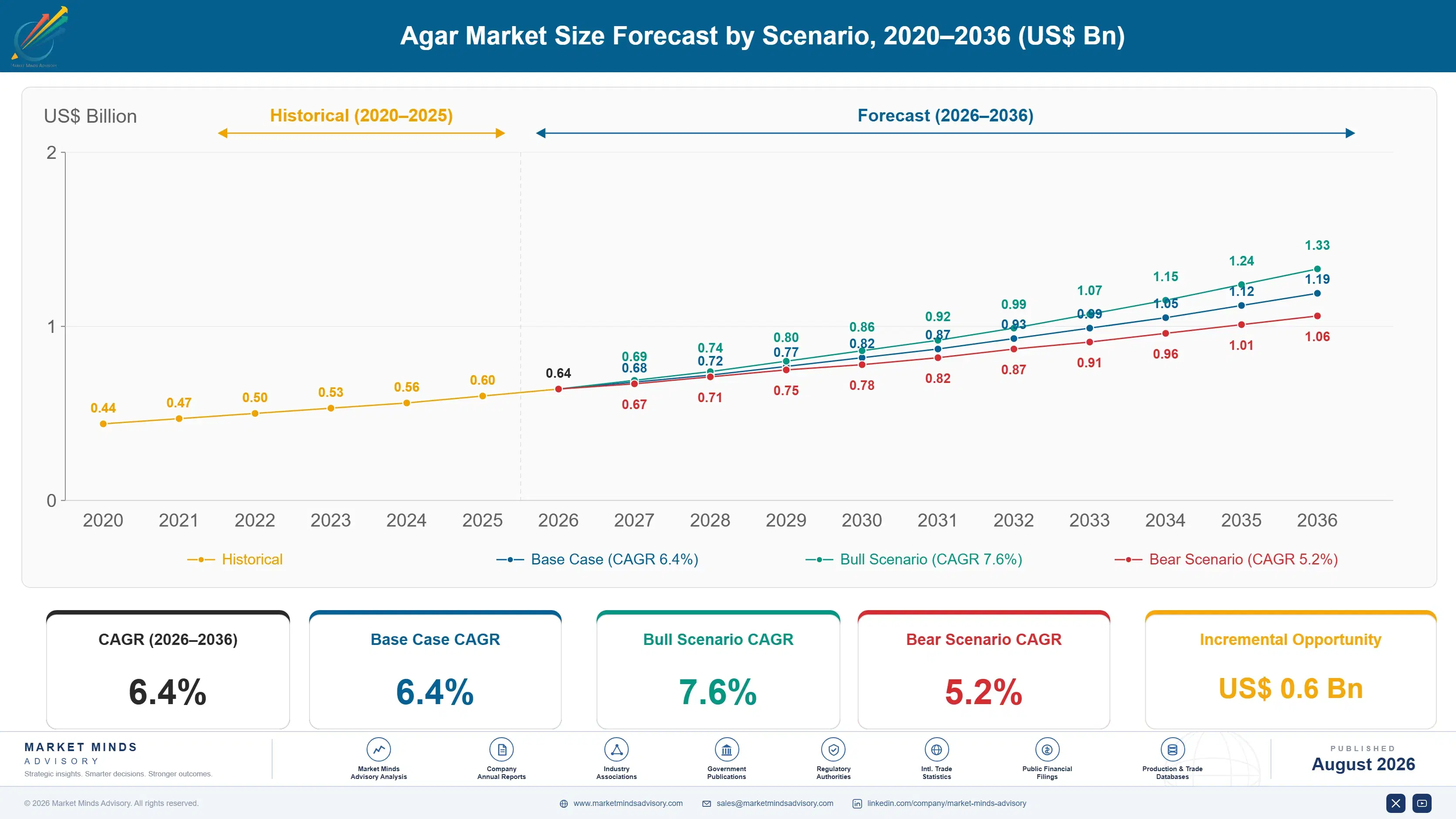
Agar Market Forecast Scenarios

agar-market-size-forecast-scenario-1787463951290
The 2020 to 2025 period was shaped by a demand spike and a raw material squeeze arriving together. Pandemic diagnostic testing lifted bacteriological demand sharply through 2020 and 2021, then fell back as volumes normalised. Moroccan Gelidium harvest restrictions tightened across the same window, keeping high gel strength material scarce even as food grade demand softened. The 5.3% historical growth mixes those movements and reflects neither cleanly.
The 6.4% base case rests on three mechanisms. Molecular biology and diagnostics keep expanding across Asian research and clinical infrastructure, which drives agarose and bacteriological grade demand at prices food applications never approach. Plant tissue culture keeps growing as micropropagation scales for banana, potato, orchid, and forestry planting material. And vegan confectionery keeps substituting agar for gelatin in gummies and jellies, adding food grade volume that is small in value but genuinely incremental.
The 7.6% bull case assumes cell therapy and chromatography applications scale agarose demand faster than purification capacity currently anticipates. The 5.2% bear case reflects further Gelidium harvest restriction combined with Chinese Gracilaria capacity pushing food grade pricing down, squeezing processors from both ends simultaneously. Harvest quota decisions will decide which of those two cases actually arrives here.

Why Gel Strength Sets Everything

Three things decide outcomes here and consumer demand is the least of them. Raw material species comes first, because Gelidium delivers the gel strength purified grades require while farmed Gracilaria generally does not without alkali treatment. Harvest quota comes second, since Gelidium is wild-collected and regulators in Morocco, Spain, and Portugal cap what may be taken. Purification capability comes third, separating a commodity processor from a life science supplier.
TOP-FIVE CONCENTRATION34%Share of global agar and agarose supply held collectively
AVERAGE SELLING PRICE$21.40/kgBlended price across food, bacteriological, and purified grades
GEL STRENGTH BENCHMARK900 g/sq cmTypical bacteriological grade requirement measured on standard basis
WILD HARVEST SHARE38%Portion of raw seaweed taken from wild natural stands
RAW MATERIAL COST SHARE46%Dried seaweed as proportion of total production cost
CAPACITY UTILISATION69%Average loading across extraction and dewatering plant assets
The commercial character is a ladder rather than a market. A processor with good Gelidium access and purification capability can climb from food grade through bacteriological to agarose, multiplying realised value per tonne of seaweed at each step. One buying Gracilaria on the open market and selling gelling agent cannot climb at all, and competes against Chinese capacity that will always be cheaper. Very few companies occupy the middle comfortably.
The next decade turns on whether purification capacity keeps pace with life science demand. Agarose for chromatography, cell culture, and cell therapy commands pricing food applications cannot imagine, and the constraint is neither seaweed nor extraction but downstream purification and characterisation. Processors treating agarose as a food business by-product under-invest in exactly the capability that would change their economics.
"Every agar processor says they are in the life science business. Most of them are running a food ingredient plant with a small purification line attached, and the difference shows up immediately when a chromatography customer audits them."
Director, Hydrocolloids and Life Science Ingredients Practice · MMA Specialty Chemicals / Hydrocolloids and Life Science Ingredients Practice · August 2026

Market Trends

Agarose Demand Shifts From Electrophoresis Toward Chromatography

Traditional gel electrophoresis consumption has grown slowly as sequencing and capillary methods displaced slab gels for many applications, while crosslinked agarose bead resins for protein chromatography have grown considerably faster on biologics manufacturing expansion. Cell culture scaffolds and emerging cell therapy applications add a third demand stream at even higher specification. Each of these requires purification and characterisation depth well beyond food or bacteriological production. Processors who invested in that capability have watched realised value per tonne of seaweed multiply, while those who did not remain commodity gelling agent suppliers.
Market Impact: Delivers 12x food grade pricing

Micropropagation Scales Plant Tissue Culture Grade Demand

Commercial micropropagation of banana, potato, orchid, sugarcane, and forestry planting material has industrialised across India, China, Southeast Asia, and Latin America, and every culture vessel needs a gelling agent with tightly controlled purity and consistent gel strength. Laboratories reject material that varies between batches because a failed culture run costs weeks. Demand grows at 8.4% and buyers are technically literate, testing incoming material rather than accepting certificates. Suppliers with consistent low-impurity production capture the segment; those selling food grade into it lose accounts after the first inconsistent batch. Certificates alone persuade nobody in this segment any more.
Market Impact: Adds 4,200 tonnes annual demand

Market Opportunities and Growth Drivers

Diagnostic and Research Infrastructure Expands Across Asia

Clinical microbiology laboratories, university research capacity, and diagnostic manufacturing have all expanded substantially across India, China, and Southeast Asia, and each new facility consumes bacteriological agar and agarose continuously rather than in campaigns. Indian laboratory chemical consumption has risen consistently through 2024 and 2025 alongside new institutional capacity. These buyers purchase on specification and reorder predictably, which makes the demand unusually stable. The volumes are small against food applications but the pricing sits at multiples that make the segment commercially decisive for any processor serving it. Reordering follows laboratory throughput rather than any purchasing cycle.
Market Impact: Caps supply at 38% wild

Vegan Confectionery Substitutes Agar for Gelatin

Gummy, jelly, and marshmallow manufacturers reformulating away from bovine and porcine gelatin have adopted agar and pectin systems, driven by vegetarian, halal, and kosher positioning rather than by any functional advantage. Agar sets firmer and melts at higher temperature than gelatin, which changes texture noticeably, so formulation work is required rather than straight substitution. European and Asian confectionery launches have carried most of this volume. The tonnage is meaningful and the pricing is not, but it absorbs food grade capacity that would otherwise compete harder on price. Halal and kosher requirements drive much of this reformulation.
Market Impact: Cuts food grade pricing 30%

Market Restraints and Challenges

Gelidium Cannot Be Farmed and Harvest Is Capped

Gelidium delivers the gel strength that bacteriological, pharmaceutical, and agarose grades require, and it grows slowly on rocky substrate in ways that have defeated repeated cultivation attempts. Harvest is therefore wild collection under quota across Morocco, Spain, Portugal, Japan, and Korea, and Moroccan restrictions have tightened noticeably. The root cause is biological rather than commercial. Responses include alkali treatment of farmed Gracilaria to raise gel strength, blending strategies that stretch Gelidium across more output, and long-term harvest contracts with cooperatives that secure access when supply tightens. Cultivation research continues without producing anything commercially viable so far.
Market Impact: Lifts realised value 40x food grade

Chinese Gracilaria Capacity Compresses Food Grade Pricing

Chinese processors operating beside enormous farmed Gracilaria supply produce food grade agar at delivered costs European, Moroccan, and Japanese producers cannot approach on the commodity tier. The root cause is raw material proximity and labour cost rather than any processing advantage. Commercially this removes food grade as a viable growth strategy for Western processors and turns it into capacity ballast at best. Participants respond by climbing the grade ladder toward bacteriological and purified material, by exiting commodity tenders, and by accepting lower utilisation for better mix. Competing on cost here has never worked for anyone outside China.
Market Impact: Grows 8.4% on micropropagation scale
3 additional market trends, 2 additional growth drivers, and 4 additional restraints and challenges are covered in the full report. Contact sales@marketmindsadvisory.com to access the complete intelligence.

Segment CAGR and Growth Architecture

Segmentation follows grade specification, the single commercial logic that determines gel strength requirement, purity threshold, regulatory treatment, and price per kilogram. Grade decides which customers may legally or practically buy the material, and the same seaweed can serve several depending on processing depth. Application industries and channel structures appear separately in the framework as commercial dimensions rather than parallel segments.
agar-market-market-share-analysis-1787463951987

Agarose

Agarose is where the money is and where most agar processors are barely present. Purified from agar by removing agaropectin, it sells at several thousand dollars a kilogram against roughly twenty for food grade, serving electrophoresis, protein chromatography resins, cell culture scaffolds, and emerging cell therapy applications. Growth of 9.8%, roughly 1.53 times the market, comes from biologics manufacturing and diagnostics rather than from any traditional agar use. The constraint is neither seaweed nor extraction capacity but purification and characterisation depth, which requires analytical capability and quality systems that a food ingredient plant does not possess. Life science distributors currently capture much of the downstream value from processors who supply crude material.
CAGR 9.8%

Plant Tissue Culture Grade Agar

Micropropagation laboratories culturing banana, potato, orchid, sugarcane, and forestry planting material need a gelling agent with tightly controlled impurity levels and gel strength that does not vary between batches. Growth of 8.4% follows industrialisation of commercial micropropagation across India, China, Southeast Asia, and Latin America. Buyers are technically capable and test incoming material rather than trusting certificates, because a failed culture run costs weeks of laboratory time and irreplaceable explant material. That makes the segment unusually loyal once qualified and unusually unforgiving of inconsistency. Suppliers selling food grade into these accounts typically lose them after a single variable batch, and rarely get a second hearing. Qualification is slow but the resulting relationship is unusually durable.
CAGR 8.4%
Full segment breakdown across 6 segments available in the complete report.

Regional Architecture and Country Demand Map

East Asia holds the largest share at 30%, combining Chinese Gracilaria processing scale with Japanese and Korean production and traditional consumption. South Asia and Pacific grows fastest on laboratory and micropropagation expansion, while Western Europe holds purified grade capability. Morocco supplies much of the critical raw material worldwide.

North America

This region consumes far more agar than it produces, and almost all of that consumption sits at the high end. Clinical microbiology laboratories, diagnostic manufacturers, biotechnology research, and biologics production drive bacteriological and agarose demand at prices food applications never approach, purchased largely through life science distributors rather than directly from processors. Food grade demand is modest and served by imports. The 2015 and 2016 supply squeeze left a lasting mark on institutional purchasing, and laboratory buyers now hold safety stock and contract further ahead than they once did. Regional growth of 5.7% is carried entirely by life science applications rather than by food. Nothing here is bought on price once a method is validated.
Share: 22% | CAGR: 5.7% (2026 to 2036)

Western Europe

Spanish and Portuguese processors sit beside Atlantic Gelidium stands and have built purification capability that few competitors match, which makes this region the centre of gravity for agarose and high specification bacteriological material. Hispanagar and regional peers supply life science customers globally from that position. Harvest quotas constrain how much Gelidium may be taken, and those limits have tightened rather than loosened. Food grade production has largely conceded to Chinese and Moroccan supply on cost. European pharmacopoeial requirements shape pharmaceutical grade specifications used well beyond the bloc. Growth of 4.9% is the slowest of any region and reflects raw material constraint more than demand weakness. Purification depth, not extraction scale, is what still matters here.
Share: 20% | CAGR: 4.9% (2026 to 2036)
Regional intelligence for 5 additional markets available in the complete report: East Asia, South Asia and Pacific, Latin America, Middle East and Africa, Eastern Europe. Contact sales@marketmindsadvisory.com.
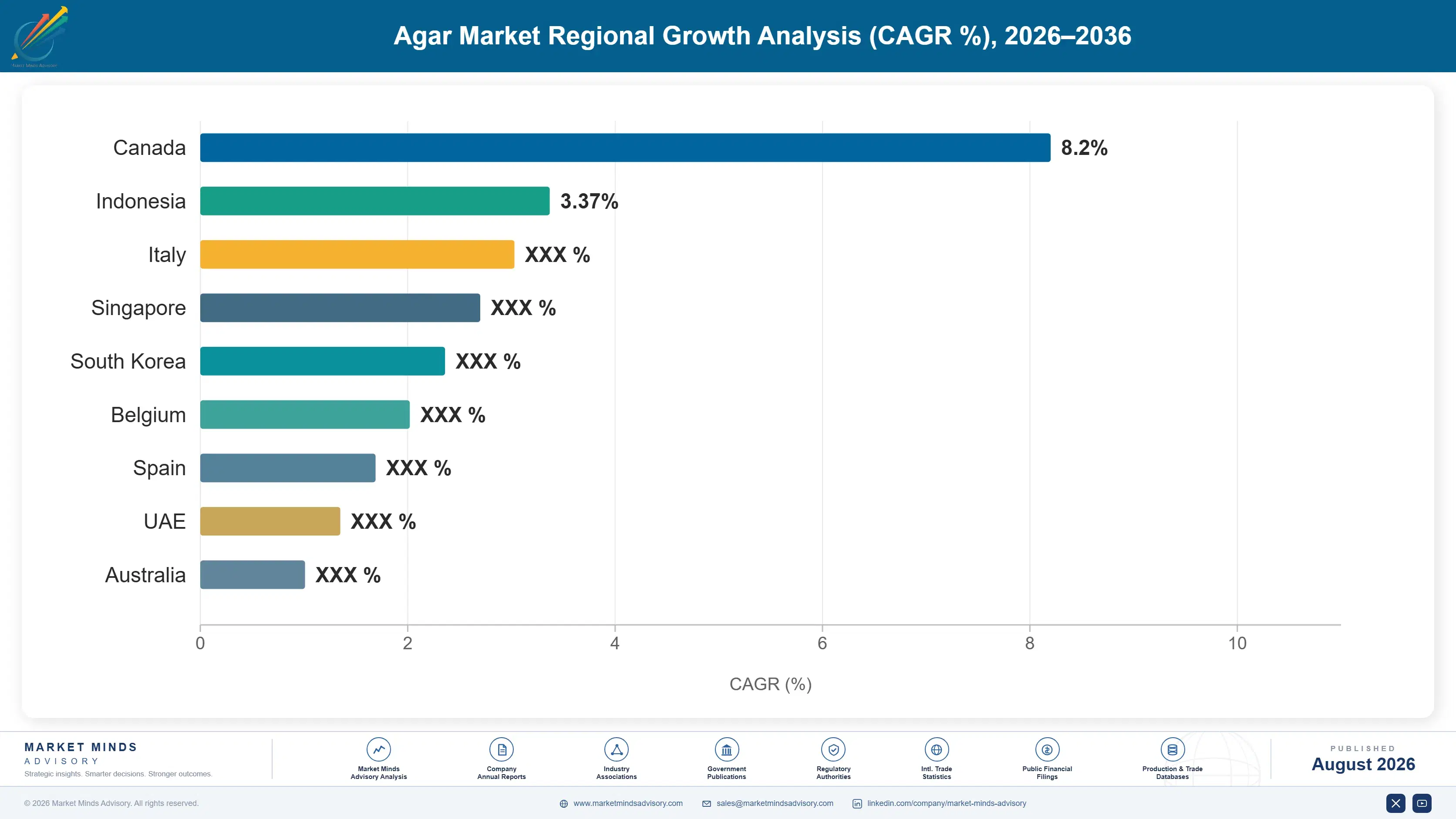
agar-market-country-cagr-analysis-1787463952497

Where Agar Value Actually Concentrates

Selling food grade gelling agent against Chinese Gracilaria capacity is a position with no future and a visible end date. The four moves below climb the grade ladder that the same seaweed already permits: purification capability, secured Gelidium access, tissue culture consistency, and direct life science relationships that currently sit with distributors. None of the four needs new seaweed.

Build Purification Capability to Reach Agarose Pricing

Agarose sells at several thousand dollars a kilogram against roughly twenty for food grade, from seaweed that is frequently identical. The barrier is purification and characterisation depth, requiring analytical capability, quality systems, and customer audit readiness that a food ingredient plant does not have. Investment runs around $8 million for a commercial purification line plus laboratory build. Processors who made it report realised value per tonne of seaweed multiplying by a factor near forty, which no improvement in extraction yield or food grade pricing could ever approach. Food grade pricing improvements simply cannot compete with that arithmetic.
Market Impact: Multiplies realised value per tonne by roughly 40x

Contract Gelidium Harvest Access Across Multiple Coastlines

Gelidium cannot be farmed and is collected under quota across Morocco, Spain, Portugal, Japan, and Korea, which makes access a durable position rather than a purchase decision. Multi-year agreements with harvest cooperatives across at least three coastlines secure the high gel strength material that bacteriological and purified grades require, and those quotas rarely tighten everywhere at once. Processors holding contracted access kept plants running through the 2015 squeeze while spot buyers rationed customers, and several of those customers never returned afterwards. Quota policy is set by governments, not by any market.
Market Impact: Secures access to the 38% wild harvested supply

Serve Tissue Culture Laboratories on Batch Consistency

Micropropagation laboratories test incoming material rather than trusting certificates, because a failed culture run costs weeks of work and irreplaceable explant material. A supplier delivering genuinely consistent low-impurity gelling agent wins accounts that stay for years and pay 8 to 12 times food grade pricing. The requirement is process control and batch analytics rather than new chemistry. Suppliers selling food grade into these accounts lose them after a single variable batch and rarely get a second hearing, which tells you how much the consistency is worth. Batch analytics cost far less than a lost account does.
Market Impact: Earns 8 to 12x the food grade pricing

Reach Life Science Buyers Directly Instead of Through Distributors

Life science distributors currently capture a large share of downstream agarose and bacteriological value from processors supplying crude or semi-purified material. Building direct technical sales into diagnostic manufacturers, chromatography resin producers, and biopharmaceutical quality functions costs perhaps $2.2 million annually in specialist headcount and audit preparation. It recovers margin of roughly 20 to 30 points that currently sits with the channel. It also gives visibility of specification changes years before they reach a processor through a distributor purchase order. Distributors have no particular reason to volunteer any of that information either.
Market Impact: Recovers 20 to 30 points of gross margin

Who Controls the Margin Pool

The top five hold roughly 34% of supply, measured consistently as agar and agarose product revenue at supplier level. Hispanagar, Ina Food, Setexam, and B&V operate extraction and purification capacity built around Gelidium access, while Chinese processors including Fujian Global Ocean dominate farmed Gracilaria volume. Life science distributors capture much of the downstream value without extracting anything themselves, which is a permanent feature of the market.
Competition runs along three lines. Raw material access is the first and most durable, since Gelidium quota holdings cannot be bought on a spot market and cannot be farmed around. Purification depth is the second, separating suppliers who reach agarose pricing from those who sell gelling agent. The third is life science qualification, where audit readiness and batch documentation decide whether a chromatography or diagnostics customer will even begin evaluation.

Two pressures will reshape positions. Chinese processors keep moving up from food grade into bacteriological specifications, compressing the tier that Western producers retreated into. Meanwhile biologics and cell therapy demand keeps raising the specification ceiling at the top, rewarding purification investment. The exposed position is a mid-sized processor with Gracilaria supply, food and bacteriological grades only, and no purification capability to climb toward.
agar-market-company-positioning-matrix-1787463953019

Competitive Moat and Risk Dimensions

HISPANAGAR

Moat: Gelidium Access and Purification Depth

Hispanagar combines Atlantic Gelidium harvest access with agarose purification capability and life science qualification built over decades, which lets it serve chromatography and molecular biology customers directly rather than through crude material sales. That combination is rare because it requires both a quota position and analytical infrastructure. Competitors typically hold one or the other rather than both together.
HISPANAGAR

Risk: Harvest Quota Dependence

The purified business rests on Gelidium that cannot be farmed and is collected under quotas set by authorities in Morocco, Spain, and Portugal, all of which have tightened rather than relaxed. A further restriction would constrain exactly the highest-value output. Alkali-treated Gracilaria narrows the gap for some grades but does not reach agarose specifications reliably enough to substitute.
INA FOOD INDUSTRY

Moat: Japanese Domestic Market Integration

Ina Food serves a Japanese kanten market where agar is an everyday food carrying dietary fibre positioning rather than a technical ingredient, giving it a domestic volume base with cultural durability that no importer can contest. That base funds industrial and high specification production alongside it. Long-standing relationships with Japanese food manufacturers and laboratories are effectively closed to outside entrants.
INA FOOD INDUSTRY

Risk: Domestic Demographic Contraction

Japanese food consumption tracks a shrinking and ageing population, and traditional kanten demand has not grown for years despite health positioning efforts. The domestic base is durable but not expanding. Without meaningful export development into life science or industrial markets outside Japan, an advantaged position gradually applies to a slowly contracting pool of demand.

Players Tracked

Prominent Players

Hispanagar
Ina Food Industry
Setexam
B&V Srl
Fujian Global Ocean Biotechnology

Other Key Players

Agarmex
MSC Co.
Roko
Norevo
Marine Hydrocolloids
Bengbu Fuyang Food Science
Zhejiang Yinuo Biotechnology
Fooding Group
Lonza
Bio-Rad Laboratories
Thermo Fisher Scientific
Merck KGaA
Condalab
Titan Biotech
HiMedia Laboratories

Recent Developments

MARCH 2025

Moroccan authorities maintain restricted Gelidium harvest allocations

Moroccan authorities maintained restricted allocations for Atlantic Gelidium collection, continuing a tightening trend that has constrained availability of the high gel strength raw material on which bacteriological and purified agar grades depend. Processors reliant on Moroccan supply extended sourcing across Iberian and East Asian coastlines during the following quarters.
Signal: Quota policy in one country continues to set the availability ceiling for laboratory grades used worldwide.
OCTOBER 2024

Chinese processors extend bacteriological grade production capability

Chinese agar processors continued moving up from food grade into bacteriological specifications, investing in clarity, ash reduction, and gel strength consistency to serve domestic and regional laboratory demand. The capability shift pressures the mid-tier position that Western producers retreated toward after conceding commodity food grade on cost.
Signal: The tier Western processors retreated into is now being contested from below, which leaves purification as the remaining refuge.
JULY 2025

Agarose demand rises with biologics chromatography resin production

Producers of crosslinked agarose bead resins for protein chromatography reported continued demand growth alongside biologics manufacturing expansion, absorbing purified agarose volume at specifications well above electrophoresis requirements. Purification capacity rather than raw seaweed availability remained the constraint on supply throughout the period. Capacity additions were announced during the period.
Signal: Purification capability, not seaweed access, is now what limits participation in the highest value agar applications.

Seaweed, Freeze-Thaw Energy, and Alkali

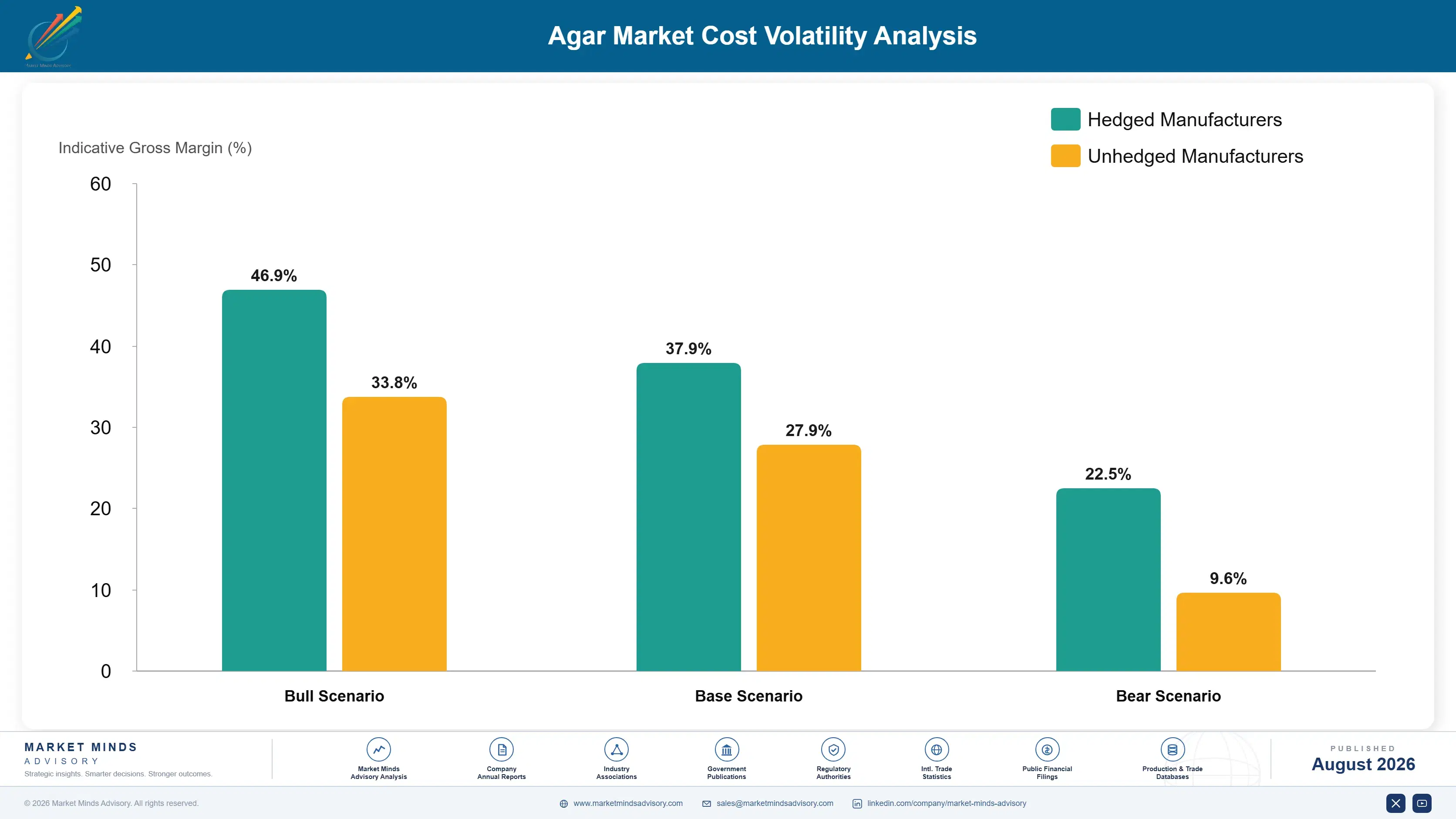
Dried red seaweed accounts for roughly 46% of production cost, split between wild-harvested Gelidium from Morocco, Iberia, Japan, and Korea and farmed Gracilaria from China, Indonesia, Chile, and Vietnam. Energy for extraction, freeze-thaw or press dewatering, and drying takes a further 23%, since dewatering agar gel is unavoidably intensive. Alkali, acid, filtration media, and effluent treatment absorb the balance.
European industrial energy prices rose steeply through 2022 and 2023 according to IEA reporting, and agar extraction felt it acutely because dewatering cannot be reduced without compromising the product. Moroccan Gelidium restrictions raised high gel strength raw material costs across the same period, so energy and feedstock inflated together for producers serving premium grades. Several smaller European and Moroccan processors reduced output rather than run at negative contribution during that window.

Exposure divides on raw material species and on energy siting rather than on scale. Processors holding contracted Gelidium and operating where power is cheap absorbed the squeeze inside normal pricing. Spot Gelidium buyers on European tariffs did not, and several lost laboratory accounts held for years. Chinese processors beside farmed Gracilaria, on cheaper power, held cost position and funded the move into bacteriological grades.
agar-market-cost-volatility-analysis-1787463953214

Contract Gelidium harvest across three or more coastlines

Quota decisions in Morocco, Iberia, Japan, and Korea are made independently and rarely tighten together, so contracted access across several coastlines smooths availability in a way spot purchasing cannot. Cooperatives value multi-year commitment and technical support on drying and grading. Processors with that structure kept plants running through the last squeeze while spot buyers rationed customers and lost them permanently.

Invest in dewatering efficiency before extraction yield improvement

Removing water from agar gel dominates the energy line at roughly a quarter of total cost, and marginal gains there outweigh most extraction yield improvements in absolute terms. Press dewatering upgrades and heat recovery typically pay back within four years at post-2022 European energy pricing. Neither changes the product specification, which is why both survive customer scrutiny without requalification.

Use alkali-treated Gracilaria deliberately by grade rather than universally

Alkali treatment raises Gracilaria gel strength enough for many food and some bacteriological applications while never reaching agarose specification reliably. Applying it deliberately by grade stretches scarce Gelidium across more high-value output instead of blending it away into commodity product. The discipline matters most when quotas tighten, which is exactly when processors are tempted to blend indiscriminately.

Portfolio Architecture for Margin Defence

Three tiers separate on purity and documentation rather than on chemistry. Food and technical grade agar sold on gel strength alone earns 14% to 22%, competing directly against Chinese Gracilaria capacity with nothing defensible available. Bacteriological and pharmaceutical grades carrying clarity, ash, and pharmacopoeial documentation earn 30% to 42%, because the buyer is purchasing consistency they cannot verify cheaply. Agarose and tissue culture grades earn most of all, and the gap between tiers is unusually wide.
The tension is that the commodity tier consumes the scarce raw material. Every tonne of Gelidium blended into food grade to meet a volume contract is a tonne unavailable for bacteriological or purified output where it would earn many times more. Processors under utilisation pressure make that trade routinely and then wonder why mix never improves. The discipline required is refusing commodity volume that consumes high gel strength material, which is uncomfortable when a plant is running at 69%.

High-value pools sit where the buyer cannot verify quality without cost. Chromatography resin producers, diagnostic manufacturers, and micropropagation laboratories all test incoming material and all pay heavily for suppliers who never fail those tests, which is why consistency rather than price governs those relationships entirely.

Volume / Commodity-Adjacent Tier

Food and technical grade agar sold on gel strength into confectionery, dairy, canned goods, and industrial applications. Competes directly against Chinese Gracilaria capacity. The wide range reflects large differences in raw material proximity and energy cost between producing regions.
Gross Margin: 14%-22%

Premium / Certified Tier

Bacteriological and pharmaceutical grade material carrying clarity, ash, gel strength, and pharmacopoeial documentation for laboratory and pharmaceutical use. Range width separates standard bacteriological supply from fully pharmacopoeial certified material within the same tier.
Gross Margin: 30%-42%

Sustainability / Regulatory / Next-Generation Tier

Purified agarose for chromatography, cell culture, and cell therapy applications, plus tissue culture grade with batch-level consistency guarantees. Purification depth and audit readiness, rather than seaweed access, sustain the margin structure throughout this tier.
Gross Margin: 48%-66%
agar-market-portfolio-architecture-1787463953708

High-value Sub-segments and Strategic Watch-out

Purified Agarose for Chromatography

Highest value in the market by a wide margin, selling at several thousand dollars a kilogram from seaweed that also makes twenty dollar food grade. Purification and audit capability is the barrier. Biologics manufacturing growth keeps raising the specification ceiling steadily. Very few processors have made that investment.
Gross Margin: 54%-66%

Plant Tissue Culture Grade Agar

High value with 8.4% growth, serving micropropagation laboratories that test every incoming batch rather than trusting certificates. Consistency, not price, decides these accounts entirely. One variable batch typically ends a supply relationship for good, which tells you the value. Testing regimes in this segment punish inconsistency immediately.
Gross Margin: 38%-50%

Bacteriological Grade Agar

The reliable middle tier, protected by specification and documentation but now contested from below as Chinese processors move up from food grade. Laboratory buyers reorder predictably and hold safety stock after the last squeeze, which supports volume stability. Defending it now requires clarity and ash discipline.
Gross Margin: 30%-40%

Food Grade Gelling Agent

The strategic watch-out. Chinese Gracilaria capacity sets pricing and nothing about the product is defensible on technical grounds anywhere. Worse, filling volume contracts here consumes scarce Gelidium that would earn many times more in purified grades instead. Exit it deliberately rather than losing it slowly instead.
Gross Margin: 12%-20%

Why Media Specifications Never Move

Agar revenue behaves as a long annuity in every application above food grade, and the reasons are procedural rather than commercial. A clinical microbiology laboratory validating a culture medium runs comparative growth studies, documents performance against reference organisms, and writes the supplier into standard operating procedures, and having done that will not revisit the decision while supply holds. Typical qualified laboratory tenure runs eight to twelve years, longer where accreditation bodies audit the documentation trail behind it.
Stickiness varies sharply by application. Chromatography resin producers are the most durable of all, since changing an agarose source can alter bead performance and trigger requalification across every downstream biologics process using that resin. Diagnostic manufacturers and tissue culture laboratories come next, protected by validation cost and by testing regimes that punish inconsistency. Food grade supply is the least sticky, retendered annually against Chinese delivered pricing with no attachment whatsoever to the incumbent supplier.

Buyer profiles have changed since 2016. Laboratory procurement now holds safety stock, contracts further ahead, and asks about raw material species and harvest quota exposure before discussing price at all. Species and quota exposure now appear in supplier questionnaires that never mentioned them before.
agar-market-end-use-penetration-index-1787463954197

Where Agar Capital Should Go

These are among the four positions where our research anticipates prominent divergence between winners and laggards over the coming forecast period. Each is grounded in the demand model, the regulatory perimeter, and the announced capacity pipeline.
01 / PURIFICATION CAPABILITY INVESTMENT

Build agarose capability, because the seaweed is already there

Agarose sells at several thousand dollars a kilogram against roughly twenty for food grade produced from frequently identical raw material, and the barrier is purification and characterisation depth rather than any access to seaweed. A commercial purification line plus the analytical build behind it costs around $8 million, which is modest against realised value per tonne multiplying by a factor near forty. No improvement in extraction yield or food grade pricing has ever delivered anything approaching that return for a processor.
02 / GELIDIUM ACCESS CONTRACTING

Secure wild harvest across coastlines that never tighten together

Gelidium cannot be farmed, delivers the gel strength that bacteriological and purified grades require, and is collected under quotas set independently in Morocco, Iberia, Japan, and Korea that rarely tighten simultaneously in any given year. Multi-year agreements with harvest cooperatives spread across at least three separate coastlines convert an ordinary purchasing exposure into a durable competitive position. Processors holding contracted access kept plants running through the last squeeze while spot buyers rationed laboratory customers, several of whom never came back to them afterwards.
03 / COMMODITY TIER DISCIPLINE

Refuse food grade volume that consumes scarce high strength seaweed

Chinese Gracilaria capacity sets food grade pricing at levels Western and Moroccan processors cannot match, and nothing about that product is technically defensible in any market anywhere. Worse than the thin margin is the raw material cost: every tonne of Gelidium blended into commodity output to fill a volume contract is unavailable for purified grades that would earn many times more. Refusing that volume is uncomfortable at 69% utilisation, and it remains the single decision that most improves portfolio mix.
04 / DIRECT LIFE SCIENCE CHANNEL

Sell to chromatography and diagnostics buyers without a distributor

Life science distributors currently capture a very large share of downstream agarose and bacteriological value from processors supplying only crude or semi-purified material into their channel each year. Building direct technical sales into diagnostic manufacturers, resin producers, and biopharmaceutical quality functions costs roughly $2.2 million annually in specialist headcount and audit preparation, and recovers roughly 20 to 30 points of gross margin. It also surfaces customer specification changes years earlier than a distributor purchase order ever reveals them to anyone.

Engagement Snapshot From the Field

A live engagement with an industry participant carrying material or product regulatory and market exposure ahead of a defining policy shift, showing how our research translates into a defensible multi-year portfolio strategy.
MARKET MINDS ADVISORY · CLIENT ENGAGEMENT SUMMARY
Agar Producer Strategic Portfolio Review and Transition Roadmap 2026·Investment Scenario on Agar Exposure Evaluation 2025-26
CLIENT PROFILE
A Southern European agar processor operating a single extraction plant supplying food, bacteriological, and small volumes of semi-purified material across twenty-two countries, with annual revenue near EUR 38 million (client-reported, unverified by MMA). Roughly 64% of output went to food grade customers in confectionery and dairy, Gelidium was purchased largely on spot from Moroccan and Iberian traders, and no agarose capability existed.
STRATEGIC CHALLENGE
Food grade pricing had fallen 26% across three years under Chinese competition while Moroccan Gelidium costs rose under tightening harvest quotas, compressing gross margin to 12%. Two laboratory customers had been lost during a supply interruption when spot Gelidium was unavailable, and the board was weighing extraction capacity expansion against exiting bacteriological grades entirely.
MMA APPROACH
MMA rebuilt margin by grade and by customer using actual delivered raw material costs, then traced Gelidium consumption across the output mix to quantify what commodity contracts were consuming. Purification entry was costed against licensing and toll arrangements. Harvest contracting options were assessed across four coastlines, with findings tested through 47 expert interviews conducted during Q4 2025.
KEY FINDINGS
  1. Food grade contracts consumed 31% of the plant's Gelidium intake while generating 9% of gross contribution, effectively diverting scarce raw material away from grades earning far more.
  2. Semi-purified material sold to two life science distributors was resold at roughly 4.1 times the client's realised price after their own finishing and documentation work.
  3. Spot Gelidium purchasing had cost an estimated EUR 3.9 million more than formula-priced cooperative contracts across three years, before counting the two accounts lost during interruption.
  4. Purification entry required around EUR 7.2 million in equipment and analytical capability, recoverable within four years on existing semi-purified volume alone at direct pricing.
CLIENT PROFILE
A Southern European agar processor operating a single extraction plant supplying food, bacteriological, and small volumes of semi-purified material across twenty-two countries, with annual revenue near EUR 38 million (client-reported, unverified by MMA). Roughly 64% of output went to food grade customers in confectionery and dairy, Gelidium was purchased largely on spot from Moroccan and Iberian traders, and no agarose capability existed.
STRATEGIC CHALLENGE
Food grade pricing had fallen 26% across three years under Chinese competition while Moroccan Gelidium costs rose under tightening harvest quotas, compressing gross margin to 12%. Two laboratory customers had been lost during a supply interruption when spot Gelidium was unavailable, and the board was weighing extraction capacity expansion against exiting bacteriological grades entirely.
MMA APPROACH
MMA rebuilt margin by grade and by customer using actual delivered raw material costs, then traced Gelidium consumption across the output mix to quantify what commodity contracts were consuming. Purification entry was costed against licensing and toll arrangements. Harvest contracting options were assessed across four coastlines, with findings tested through 47 expert interviews conducted during Q4 2025.
KEY FINDINGS
  1. Food grade contracts consumed 31% of the plant's Gelidium intake while generating 9% of gross contribution, effectively diverting scarce raw material away from grades earning far more.
  2. Semi-purified material sold to two life science distributors was resold at roughly 4.1 times the client's realised price after their own finishing and documentation work.
  3. Spot Gelidium purchasing had cost an estimated EUR 3.9 million more than formula-priced cooperative contracts across three years, before counting the two accounts lost during interruption.
  4. Purification entry required around EUR 7.2 million in equipment and analytical capability, recoverable within four years on existing semi-purified volume alone at direct pricing.
RECOMMENDED STRATEGY
Phase 1: Phase 1 (months one to six): exit food grade contracts consuming Gelidium and negotiate multi-year harvest agreements across three separate coastlines. Phase 2: Phase 2 (months seven to twenty): commission purification and analytical capability, and qualify two diagnostic manufacturers directly rather than through distributors. Phase 3: Phase 3 (months twenty-one to thirty-four): extend into tissue culture grade supply for regional micropropagation laboratories on documented batch consistency.
OUTCOME
The processor exited most food grade volume and reported gross margin improving from 12% to 24% within sixteen months on lower revenue (client-reported, unverified by MMA). Harvest contracts covered 78% of Gelidium requirement by the second season. Purification commissioning is on schedule and one diagnostic manufacturer has qualified the material.

Frequently Asked Questions

Foundational context covering the market sizes, CAGR, scope, country, region and competition that inform every finding below. This section is provided to cover basics and most often pre-purchase conversations, answered from the MMA Primary Research Dataset.

What is the current size of the Agar Market?

The market was valued at USD 0.60 billion in 2025, rising to an estimated USD 0.64 billion in 2026. East Asia holds the largest regional share at 30% of global value.

How large will the Agar Market be by 2036?

MMA forecasts USD 1.19 billion by 2036 under the base case, an expansion multiple of 1.86 times the 2026 level. Incremental value creation across the period reaches USD 0.55 billion.

What is the CAGR for the Agar Market 2026 to 2036?

The base case CAGR is 6.4%, with a bull case of 7.6% and a bear case of 5.2%. Historical growth between 2020 and 2025 ran at 5.3%, mixing a testing spike with raw material scarcity.

Which segment is growing fastest?

Agarose, at 9.8%, roughly 1.53 times the overall market rate. Growth comes from biologics chromatography, diagnostics, and cell culture rather than from any traditional agar application.

Who are the major companies in the Agar Market?

Hispanagar, Ina Food Industry, Setexam, B&V, and Fujian Global Ocean Biotechnology lead, holding roughly 34% of supply between them. Life science distributors capture much downstream value.

Which country is growing fastest?

India, at 9.1%, driven by expanding clinical microbiology and pharmaceutical quality control alongside one of the world's largest commercial micropropagation sectors serving planting material demand.

Report Segmentation Architecture

The full report scope spans multiple orthogonal segmentation dimensions, with cross-tabulated demand data provided for each dimension pair. Coverage extends further to regional breakdowns, trend trajectories, and the competitive detail needed to support segment-level decision-making.

By Grade Specification

  • Food Grade Agar
  • Bacteriological Grade Agar
  • Pharmaceutical Grade Agar
  • Agarose
  • Plant Tissue Culture Grade Agar
  • Technical and Industrial Grade Agar

By End-Use Industry

  • Confectionery and Food Manufacturing
  • Clinical and Research Microbiology
  • Pharmaceutical Manufacturing and Quality Control
  • Biotechnology and Molecular Biology
  • Plant Micropropagation and Horticulture

By Commercial Dimension

  • Direct Industrial Supply
  • Laboratory Distributor Channel
  • Contract and Toll Processing
  • Life Science Original Equipment Supply

By Region

  • North America
  • Western Europe
  • East Asia
  • South Asia and Pacific
  • Latin America
  • Middle East and Africa
  • Eastern Europe

Scope, Methodology, and Coverage

Every figure in this report is reproducible from documented input assumptions. The scope below maps the historical period, the forecast horizon, the segmentation dimensions, and the countries covered, alongside the underlying primary and qualitative methodology.
Historical Period
2020 to 2025
Forecast Period
2026 to 2036
Base Year
2025 (USD billions; MMA Primary Research Dataset, August 2026)
Market Definition
The market comprises agar and agarose extracted from red seaweeds of the Gelidium, Gracilaria, and related genera, covering food grade, bacteriological grade, pharmaceutical grade, agarose, plant tissue culture grade, and technical and industrial grade material. Value is measured at producer and supplier level on a dry powder equivalent basis. Carrageenan, alginates, and other seaweed hydrocolloids fall outside scope, as do prepared culture media plates and broths, assembled electrophoresis kits, and finished chromatography resin products.
Quantitative Units
USD billions (current prices); tonnes dry powder equivalent; USD per kilogram average selling price
Segmentation Dimensions
By Grade Specification; By End-Use Industry; By Commercial Dimension; By Region
Regions Covered
North America, Western Europe, East Asia, South Asia and Pacific, Latin America, Middle East and Africa, Eastern Europe
Countries Covered
USA, China, Germany, France, UK, Japan, South Korea, India, Australia, Canada, Brazil, Mexico, Indonesia, Vietnam, Thailand, Malaysia, UAE, Saudi Arabia, South Africa, Nigeria, Turkey, Poland, Netherlands, Italy, Spain, Sweden, Switzerland, Argentina, Colombia, Singapore, and additional markets relevant to this sector
Key Companies Profiled
Hispanagar, Ina Food Industry, Setexam, B&V Srl, Fujian Global Ocean Biotechnology, Agarmex, MSC Co., Roko, Norevo, Marine Hydrocolloids, Bengbu Fuyang Food Science, Zhejiang Yinuo Biotechnology, Fooding Group, Lonza, Bio-Rad Laboratories, Thermo Fisher Scientific, Merck KGaA, Condalab, Titan Biotech, HiMedia Laboratories
Quantitative Methodology
Primary survey, n=3,800 respondents, Q4 2025, six countries; demand-side model with trade association cross-validation
Qualitative Methodology
47 expert interviews, Q4 2025; applied to validate demand model assumptions, identify emerging dynamics, and assess competitive positioning
Report Format
PDF and XLSX data workbook (Word format preview document)
Publisher
Market Minds Advisory
Report Code
MMA-2026-CHM-166
Published
August 2026
Contact
sales@marketmindsadvisory.com | www.marketmindsadvisory.com

Purchase the full Agar Market Report (2026 to 2036).

The full report sizes agar demand across six grade specifications and seven regions with 2026 to 2036 forecasts under base, bull, and bear cases. It traces Gelidium harvest quota allocations by coastline and models how those limits constrain bacteriological and purified grade availability worldwide. Competitive profiles cover twenty suppliers assessed consistently on agar and agarose revenue, raw material access, and purification depth. Value ladder analysis quantifies realised return per tonne of seaweed at each grade. Commercial guidance addresses purification investment, harvest contracting, commodity tier discipline, and direct life science channel development.
Six grade specifications sized and forecast separately
Gelidium harvest quotas tracked across producing coastlines
Twenty supplier profiles on consistent revenue basis
Value per tonne of seaweed modelled by grade
Purification investment cost and payback benchmarks provided
Life science distributor margin capture quantified by application

Built For The People Who Decide

From boardroom strategy to bench-side execution, this report is read cover-to-cover by leaders shaping the next decade of their industry, turning demand scenarios, market dynamics and valuation benchmarks into decisions.
CXOs/ Presidents/ VPs/ Managers
M&A and Corporate Development
Strategy Teams and R&D Heads
Procurement and Product Directors
Regulatory and Compliance Leaders
Investor Relations and Equity Analysts