

Market Minds Advisory
Affiliate Marketing Software Market

Affiliate Marketing Software Market: Affiliate Marketing Software Market. Trends and Forecast 2026 to 2036

Retailers are shifting affiliate budgets away from generic coupon sites toward creator and influencer partnerships, forcing legacy network platforms to add attribution and fraud detection capability or lose share to newer performance-marketing software.

Lead Analyst

Published

September 2026

Make Smarter Decisions with Customized Research Insights

Request a free sample report and evaluate market opportunities, growth trends, and competitive dynamics relevant to your business needs.

2025 MARKET VALUE$1.3BMarket Size 2025
2036 FORECAST VALUE$3.9BBase Case , 2026 to 2036
CAGR 2026 TO 203610.5 %Bull 11.8% / Bear 9.2%
INCREMENTAL OPPORTUNITY$2.5BNet 10- year value creation
EXPANSION MULTIPLE2.72x2036 value over 2026 base
Strategic Levers
M&A Pipeline
Regional Outlook
Country Rankings
Competitive Intelligence
Segmental Deep-dive
Call-Us : 91 93563 13602

Executive Snapshot and Market Trajectory.

Affiliate software vendors are racing to add creator-specific attribution and payout automation as brands redirect budgets from coupon and cashback sites toward influencer and content-driven partnerships across most major e-commerce advertiser categories, product verticals, regional markets, merchant segments, and retail sectors worldwide today across most channels.
Commercial activity concentrates around fraud detection and multi-touch attribution capability, since brands increasingly demand proof that affiliate spend drives incremental sales rather than cannibalizing organic search and direct traffic already occurring naturally. Creator and influencer management tools show the fastest growth, with India's expanding e-commerce and social commerce base absorbing a disproportionate share of new platform adoption given its young digital-native consumer population and rapidly growing creator economy across most metropolitan regions.
Competitive intensity sits moderately concentrated among five vendors controlling roughly two-fifths of platform revenue, while dozens of smaller specialized tools compete for niche creator and fraud detection use cases across most advertiser segments, product categories, and vertical industries served today. Regulatory scrutiny around affiliate disclosure requirements and rising demand for first-party data tracking amid cookie deprecation are reshaping which platforms win enterprise contracts over the next several years.
Market Definition
The Affiliate Marketing Software Market covers platforms and tools that manage, track, and pay commissions for performance-based partnerships between brands and publishers, influencers, or content creators, including attribution, fraud detection, and payout automation capability. It excludes broader digital advertising platforms and social media management software sold as separate product categories.
Base Year Value
$1.3B in 2025 (MMA Primary Research Dataset, September 2026)
Forecast Period
2026 to 2036, eleven discrete annual values
CAGR
10.5% base case. Bull 11.8%. Bear 9.2%.
Fastest Growth Segment
Influencer and Creator Affiliate Management Tools: 15.5% CAGR
Fastest Growth Country
India: 14.5% CAGR
Fastest Growth Region
South Asia and Pacific: 12.5% CAGR
Largest Region
North America: 31% of 2025 global value
Market Leaders
Leading participants include Impact.com, Partnerize, Awin, Rakuten Advertising, and CJ Affiliate. Source: MMA Analysis based on company annual reports.
Primary Survey
n=3,800 procurement and R&D decision-makers, Q4 2025, six countries
Methodology
Demand-side build-up, cross-validated against public data, 47 expert interviews

Affiliate Market Forecast Scenarios

affiliate-marketing-software-market-size-forecast-scenario-1789986586528
Between 2020 and 2025 the market grew at a milder 9.3% historical rate as affiliate marketing matured beyond coupon and cashback models, with brands gradually adopting dedicated software for tracking and payout rather than relying on manual spreadsheet processes and basic network dashboards common a decade earlier across most advertiser categories and merchant segments during this period.
The base case assumes 10.5% annual growth through 2036, driven by three mechanisms: accelerating creator and influencer partnership adoption replacing traditional coupon site relationships across most e-commerce categories and product verticals, expanding fraud detection and attribution capability demanded by brands facing tighter marketing budget scrutiny and board-level accountability, and rapid platform adoption across India's fast-growing e-commerce and social commerce sector as digital-native consumers and creators scale rapidly nationwide across most metropolitan regions.
A bull scenario near 11.8% growth would require accelerated enterprise adoption of first-party attribution tools amid continued cookie deprecation pressure across most advertising channels. A bear case near 9.2% reflects slower than expected creator economy monetization and continued brand budget caution toward performance marketing spend, compressing platform subscription growth across smaller and mid-market advertiser segments considerably.

Where Affiliate Software Vendors Are Chasing Creators

Affiliate marketing software is converging with the creator economy, as platforms originally built to manage coupon and cashback publisher relationships now compete to onboard influencers, content creators, and niche media personalities demanding real-time payout and performance data. This shift is forcing legacy network operators to rebuild core product architecture around creator workflows rather than the batch reporting cycles that defined the category for over a decade.
MARKET CONCENTRATIONCR5 38%Share held by five largest global vendors combined
AVERAGE CONTRACT VALUE$42,000 annuallyTypical enterprise subscription spend on affiliate platform tools
TOP ADOPTING COUNTRYUnited States, 34% shareShare of global platform revenue generated by advertisers there
PLATFORM RETENTION RATE88%Annual customer renewal rate across major enterprise platform contracts
FRAUD DETECTION ADOPTION61% of enterprise accountsPortion of large advertisers using dedicated fraud screening tools
CREATOR CHANNEL SHARE29% of affiliate spendPortion of total affiliate budget now directed toward creators
Commercial character centers on proving incrementality: brands under budget pressure increasingly demand multi-touch attribution showing that affiliate spend genuinely drives new sales rather than simply capturing purchases that would have happened anyway through direct or organic search channels. Vendors offering server-side tracking and clean-room data integration are winning enterprise renewals over competitors still reliant on browser cookies alone, since marketing leaders now face board-level scrutiny over channel efficiency.
Over the next decade, cookie deprecation and first-party data requirements will likely determine which platforms retain enterprise contracts, as advertisers favor vendors offering server-side tracking and fraud detection over legacy cookie-dependent attribution models nearing obsolescence. Platforms that fail to modernize risk losing renewal business to newer entrants purpose-built around creator commerce and privacy-compliant measurement standards gaining adoption across most major retail categories.
"The affiliate industry spent a decade optimizing coupon codes, and now it has to relearn everything for creators who expect same-day payout and dashboards that look nothing like a spreadsheet."
Director, Performance Marketing and Retail Technology Practice · MMA Technology Practice · September 2026

Market Trends

Creator Commerce Consolidates Under Dedicated Software Platforms

Affiliate software vendors are launching creator-specific modules bundling content licensing, same-day payout, and social platform integration as brands shift budget away from generic coupon and cashback publishers toward individual influencers with engaged niche audiences across most retail categories and merchant segments nationwide. Impact.com and Partnerize both expanded creator management features significantly since 2024, adding automated contract negotiation and usage-rights tracking that traditional affiliate networks never required when managing static coupon code publishers exclusively, a shift accelerating fastest among fashion and beauty advertisers specifically across most Western markets today. Fashion buyers report this transition happening faster than any prior platform shift.
Market Impact: Creator base surpasses 200 million globally
Server-Side Tracking Replaces Cookie-Dependent Attribution Models

Browser cookie deprecation across major platforms is pushing affiliate software vendors to rebuild attribution infrastructure around server-side tracking and clean-room data collaboration, protecting measurement accuracy as third-party identifiers disappear from digital advertising entirely across most channels and publisher networks worldwide today across most regions. Enterprise advertisers report choosing platform vendors specifically based on server-side tracking readiness, with roughly 61% of large accounts now requiring fraud detection and identity resolution capability as standard contract terms before signing renewal agreements each cycle. Many vendors now market compliance readiness as a primary differentiator.
Market Impact: Marketing budget scrutiny rose roughly 8%

Market Opportunities and Growth Drivers

Creator Economy Growth Expands Affiliate Software Demand

Global creator economy participation surpassed 200 million active content creators in 2025, according to industry survey estimates, with a growing share monetizing through affiliate commission arrangements rather than sponsored posts alone across most social platforms and content categories worldwide. This shift is forcing brands to adopt dedicated software capable of managing thousands of individual creator relationships simultaneously, tracking unique commission structures, and processing frequent small-dollar payouts that legacy network platforms built for a few hundred coupon publishers were never designed to handle efficiently. Vendors that once served hundreds of publishers now support catalogs numbering in the tens of thousands.
Market Impact: Fraud costs advertisers 1.2 billion annually

Marketing Budget Accountability Pressure Drives Attribution Investment

Corporate marketing budgets faced roughly 8% average scrutiny increases in 2025 as finance departments demanded clearer proof of channel-level return on investment before approving renewal spend across most advertiser organizations and product categories nationwide. Affiliate software vendors offering multi-touch and incrementality-focused attribution have captured disproportionate enterprise contract wins as chief marketing officers seek defensible data to justify continued affiliate program investment against competing digital channels facing similar scrutiny pressure from company leadership and finance teams across most industries. Renewal negotiations increasingly hinge on demonstrated incremental sales data rather than raw click volume.
Market Impact: Commission rates dropped roughly 15%

Market Restraints and Challenges

Affiliate Fraud Erodes Advertiser Trust in Attribution

Affiliate fraud, including cookie stuffing and fake influencer engagement, cost advertisers an estimated 1.2 billion dollars globally in wasted spend during 2025, undermining confidence in platform-reported performance metrics across most advertiser categories. The root cause lies in weak identity verification across smaller affiliate networks lacking dedicated fraud screening infrastructure comparable to larger vendors. Leading platforms are mitigating this by adding machine learning fraud detection and mandatory identity verification requirements before onboarding new publisher or creator accounts onto their networks. Some smaller networks still lack the engineering resources needed to deploy comparable protection quickly.
Market Impact: Creator tools capture 29% of spend

Commission Rate Compression Squeezes Publisher Economics

Average affiliate commission rates declined roughly 15% between 2021 and 2025 as brands negotiated more aggressively amid broader marketing budget pressure, squeezing margins for smaller publishers and affiliate agencies operating on thin overhead across most categories. The root cause traces to consolidating advertiser bargaining power as procurement teams centralize affiliate program management across multiple brands under single contracts. Some publishers are mitigating this by diversifying into sponsored content and direct brand partnerships alongside traditional commission-based relationships. Agencies representing multiple smaller creators report the steepest margin pressure across the entire industry.
Market Impact: Server-side adoption reaches 61%
3 additional market trends, 4 additional growth drivers, and 2 additional restraints and challenges are covered in the full report. Contact sales@marketmindsadvisory.com to access the complete intelligence.

Segment CAGR and Growth Architecture

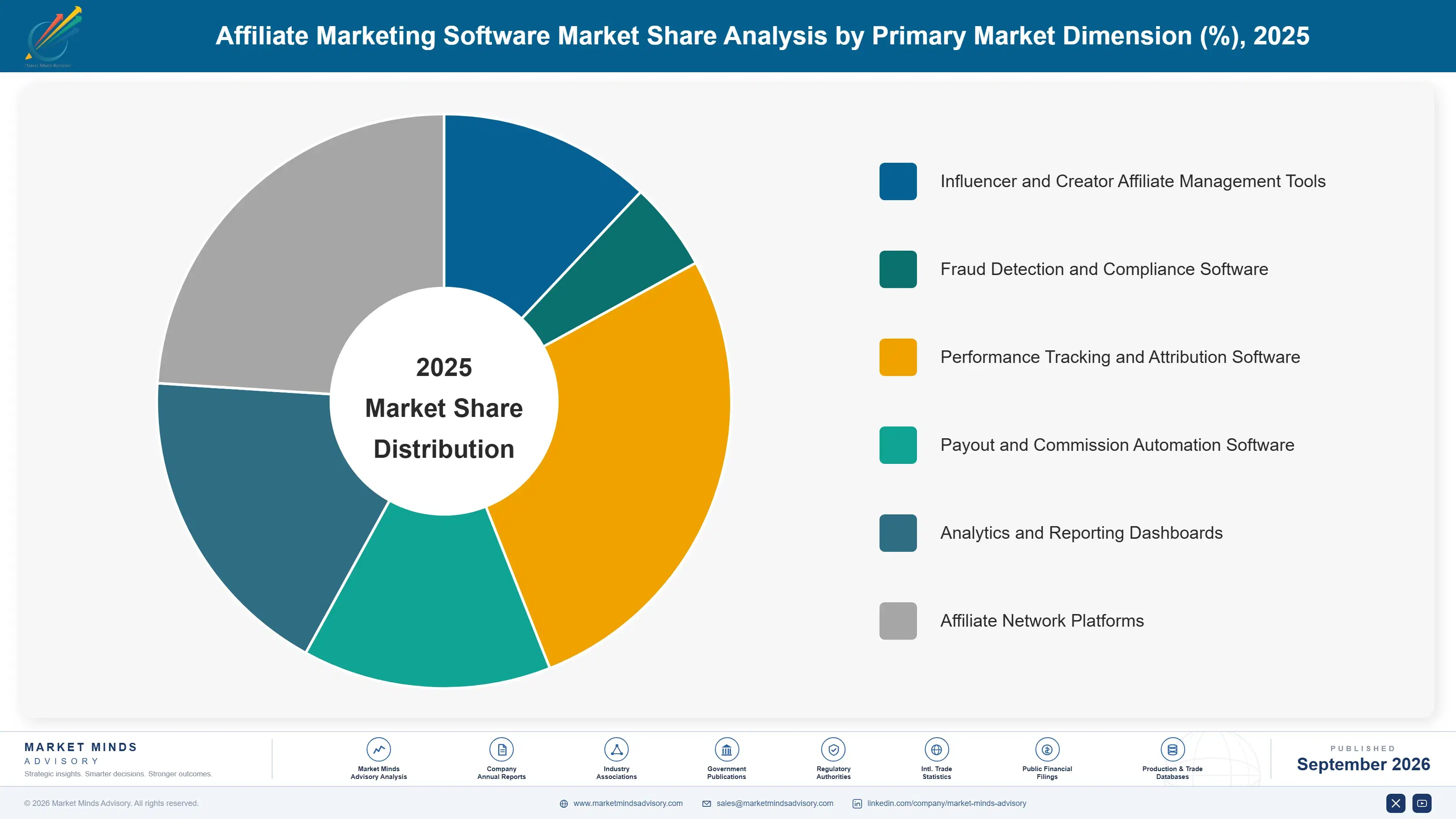
This report segments the Affiliate Marketing Software Market by software function, the classification brands and publishers actually use when selecting tools for tracking, payout, fraud prevention, or creator relationship management across distinct commercial and technical needs within their broader marketing technology environment, annual budget planning cycle, and internal executive-level reporting stack requirements considerably today.
affiliate-marketing-software-market-market-share-analysis-1789986587111

Influencer and Creator Affiliate Management Tools

Creator and influencer affiliate management tools are the fastest-growing software category, expanding at 15.5% annually as brands redirect budget from generic coupon publishers toward individual content creators with engaged niche audiences across most social platforms today and across most retail advertiser categories. These platforms bundle content licensing, same-day payout, and social media integration features that legacy affiliate networks never required when managing static coupon codes exclusively for years. Impact.com and Partnerize both lead this category with dedicated creator modules launched since 2024, while newer entrants like Grin and Aspire are capturing meaningful share among fashion and beauty advertisers specifically across most Western markets. Beauty brands in particular report the steepest reallocation of budget toward this category.
CAGR 15.5%

Fraud Detection and Compliance Software

Fraud detection and compliance software, the second-fastest-growing category at 13.0% annually, benefits from rising advertiser demand for identity verification and cookie stuffing prevention as affiliate fraud costs mount considerably across the industry, advertiser categories, and geographic markets served. Enterprise advertisers increasingly require dedicated fraud screening as a standard contract term before signing renewal agreements with any affiliate platform vendor operating in their market. Companies specializing in this category, including Forensiq and Anura, are winning enterprise contracts by demonstrating measurable fraud reduction rates against documented baseline spending levels across comparable client accounts and advertiser segments. Adoption is accelerating fastest among advertisers with the largest historical fraud exposure. Insurance-style pricing models tied to fraud outcomes are also gaining early traction.
CAGR 13.0%
Full segment breakdown across 6 segments available in the complete report.

Regional Architecture and Country Demand Map

North America and East Asia together drive most platform revenue given concentrated vendor headquarters and advertiser spend, while South Asia and Pacific gains ground the fastest as India's e-commerce and creator economy scale up rapidly across most metropolitan regions, industries, and product categories nationwide today.

North America

The United States anchors global demand through concentrated vendor headquarters, including Impact.com and CJ Affiliate, alongside the largest base of e-commerce advertisers spending on performance marketing across most retail categories and merchant segments nationwide. Enterprise adoption of fraud detection and server-side attribution runs ahead of other regions given earlier cookie deprecation pressure from major browser vendors affecting most advertising technology providers. Canada contributes modest additional demand through mid-market retail and subscription commerce advertisers adopting similar platform capabilities across most provinces. Marketing agencies managing multi-brand affiliate programs increasingly consolidate spend onto fewer, more capable platform vendors. Vendors headquartered domestically also benefit from proximity to major advertiser marketing organizations when negotiating enterprise contract renewals and pilot programs.
Share: 31% | CAGR: 10.0% (2026 to 2036)

Western Europe

The United Kingdom drives regional demand through Awin's headquarters presence and a mature affiliate publisher network serving retail and travel advertisers across most major metropolitan markets and consumer categories. Germany and France contribute meaningful additional demand through fashion and consumer goods advertisers adopting creator-focused affiliate tools at a steady and accelerating pace. Growth trails the global average as privacy regulation compliance costs weigh more heavily on smaller regional vendors than on larger established competitors with dedicated legal teams. Nordic markets add incremental demand through design-focused retail brand advertisers. Regulatory bodies across the region continue tightening influencer disclosure requirements, adding compliance features that vendors must build directly into core platform functionality.
Share: 22% | CAGR: 9.0% (2026 to 2036)
Regional intelligence for 5 additional markets available in the complete report: East Asia, South Asia and Pacific, Latin America, Middle East and Africa, Eastern Europe. Contact sales@marketmindsadvisory.com.
affiliate-marketing-software-market-country-cagr-analysis-1789986587630

Where Platforms Can Capture Margin From Creators

As affiliate budgets shift from coupon publishers toward individual creators, platforms must build capability adjacent to core tracking: fraud detection, first-party attribution, instant payout, and creator-specific tools that generic dashboards cannot easily replicate given fundamentally different workflow requirements and expectations from individual content creators across most social media platforms, demographics, and geographic markets today.

Fraud Detection as a Premium Add-On Service

Vendors offering dedicated fraud detection and identity verification as a premium add-on service capture meaningfully higher revenue per account than platforms bundling basic screening into standard subscription tiers across most enterprise contracts. Enterprise accounts paying for advanced fraud protection generate roughly 25% higher average contract values than those on standard plans given the demonstrated cost savings from reduced fraudulent commission payouts each quarter. Forensiq and Anura have both built profitable standalone businesses around this exact premium positioning strategy. Smaller vendors lacking this capability struggle to compete for the largest enterprise accounts.
Market Impact: Fraud detection add-ons lift contract value by 25%

Creator Payout Speed as Competitive Differentiation

Platforms offering same-day or instant creator payout, rather than standard thirty to sixty day net terms, are winning disproportionate creator signups since individual influencers value cash flow predictability far more than enterprise publishers historically did across most content categories. Vendors with instant payout capability report roughly 40% higher creator retention rates compared with platforms still using legacy monthly batch payment cycles common a few years ago. This capability increasingly determines which platforms creators choose when multiple brands offer similar commission structures. Younger creators in particular cite payout speed as a primary platform selection factor.
Market Impact: Instant payout lifts creator retention by 40% overall

First-Party Attribution for Enterprise Renewal Contracts

Vendors offering server-side, cookie-independent attribution are capturing enterprise renewal contracts at meaningfully higher rates than competitors still reliant on browser-based tracking facing continued deprecation across most advertising platforms and publisher networks. Roughly 61% of large advertiser accounts now specifically require server-side tracking readiness as a contract term before signing renewal agreements each cycle. Platforms investing early in this capability report renewal rates nearly 15 percentage points above the broader market average across comparable enterprise account segments. Late movers face growing pressure to catch up before losing further ground. Advertisers weigh this readiness heavily during vendor selection reviews.
Market Impact: Server-side vendors see 15 point higher renewal rates

Multi-Currency Payout for Cross-Border Creator Partnerships

Platforms supporting multi-currency, localized payout across emerging creator economy markets including India, Brazil, and Southeast Asia are capturing disproportionate share of new international account growth as brands expand affiliate programs globally beyond their home markets and traditional advertiser categories. Vendors with strong cross-border payout capability report new account growth rates roughly 30% above competitors limited to single-currency processing across comparable client segments. This capability matters increasingly as the fastest-growing creator populations sit outside traditional English-speaking advertiser markets entirely today. Regional payment partnerships have become a meaningful part of vendor expansion strategy.
Market Impact: Multi-currency vendors see 30% faster account growth overall

Who Controls the Margin Pool

Concentration sits moderate, with a CR5 near 38% on a platform revenue basis and a meaningful gap separating Impact.com and Partnerize from mid-tier challengers like Awin and CJ Affiliate, who compete on regional distribution reach and specific vertical expertise rather than broad platform capability breadth across all advertiser segments and creator categories served today.
Current competitive activity centers on three dimensions: creator management module launches replacing legacy coupon-focused architecture across most retail categories, fraud detection capability positioned as a premium differentiator commanding meaningfully higher contract values, and server-side attribution investment racing ahead of continued browser cookie deprecation across most major advertising platforms and publisher networks. Instant payout capability has also become a meaningful competitive lever among vendors targeting individual creator signups directly.

Emerging pressure comes from social media platforms building native affiliate-style commission tools directly into their applications, potentially disintermediating standalone software vendors entirely for smaller creator accounts. Vendors slow to add fraud detection or first-party attribution risk losing enterprise renewal contracts to better-prepared competitors already established in regulated attribution channels, while regional payout capability increasingly determines which challengers gain meaningful share in fast-growing emerging creator economy markets.
affiliate-marketing-software-market-company-positioning-matrix-1789986588151

Competitive Moat and Risk Dimensions

IMPACT.COM

Moat: Enterprise Attribution Data Depth

Impact.com's years of accumulated multi-touch attribution data across large enterprise advertiser accounts give it a measurement accuracy advantage that newer entrants cannot replicate without comparable transaction volume and years of accumulated historical performance benchmarking data across categories, geographies, advertiser verticals, and campaign types served consistently today across most industries.
IMPACT.COM

Risk: Creator Segment Execution Speed

Impact.com's enterprise-oriented platform architecture, built originally for large publisher relationships, requires meaningful redesign to match the speed and simplicity smaller creator-focused competitors offer, risking share loss among fast-growing individual influencer accounts that increasingly prefer simpler, faster onboarding processes overall across most content categories and creator segments today.
PARTNERIZE

Moat: Global Publisher Network Scale

Partnerize's established relationships across a large global publisher and affiliate network base give it negotiating leverage and reach that smaller regional platforms cannot match without years of accumulated partnership building across multiple international markets, advertiser categories, and publisher relationship types built over many years of sustained investment.
PARTNERIZE

Risk: Legacy Architecture Modernization Cost

Partnerize's core platform architecture, built for traditional coupon and cashback publisher relationships, requires substantial ongoing investment to add creator-specific and server-side attribution features that newer, purpose-built competitors already offer natively from day one without legacy technical debt to manage across most product lines and features.

Players Tracked

Prominent Players

Impact.com
Partnerize
Awin
Rakuten Advertising
CJ Affiliate

Other Key Players

Tapfiliate
Everflow
Refersion
ShareASale
Post Affiliate Pro
Trackier
Affise
LeadDyno
PartnerStack
Tune
Voluum
Kevel
Grin
Aspire
Forensiq

Recent Developments

FEBRUARY 2025

Impact.com Launches Dedicated Creator Payout Module

Impact.com introduced a dedicated creator payout module offering same-day settlement and social platform content licensing tracking, targeting individual influencers previously underserved by its enterprise publisher-focused platform architecture. The launch directly targets fashion and beauty advertisers shifting budget toward creator partnerships fastest across most retail advertiser categories tracked.
Signal: Signals Impact.com's strategic pivot toward creator-first product architecture and away from legacy publisher-only commission tracking entirely.
JUNE 2025

Awin Expands Server-Side Attribution Across Enterprise Accounts

Awin rolled out server-side, cookie-independent attribution tracking across its enterprise advertiser accounts, responding to accelerating browser cookie deprecation pressure affecting measurement accuracy across the industry. The expansion positions Awin favorably ahead of the 61% of large accounts now requiring this capability as a standard contract term.
Signal: Signals vendors racing to modernize attribution infrastructure ahead of continued cookie deprecation timelines across most advertising platforms.
OCTOBER 2025

Rakuten Advertising Acquires Fraud Detection Startup

Rakuten Advertising acquired a smaller fraud detection software startup specializing in cookie stuffing and fake engagement identification, integrating the capability directly into its core enterprise platform offering across all account tiers. The acquisition strengthens Rakuten's positioning against the estimated 1.2 billion dollars in annual industry-wide affiliate fraud losses.
Signal: Signals consolidation as larger platforms acquire specialized fraud detection capability rather than building comparable tools internally.

Cloud Infrastructure and Data Processing Cost Exposure

Cloud infrastructure and data processing costs represent roughly 18 to 24% of total operating cost of goods sold for affiliate software platforms, given the transaction volume required to track billions of clicks and conversions across large publisher and creator networks daily and continuously, with the remainder split across engineering talent, customer support staffing, and fraud detection technology licensing costs.
Cloud compute costs rose an estimated 12% between 2023 and 2025 as platforms scaled infrastructure to handle growing transaction volume from creator commerce, according to company annual reports from AWS and Microsoft Azure citing sustained enterprise demand growth across most software-as-a-service categories, including performance marketing infrastructure specifically, as data processing volumes climbed alongside rapidly expanding creator account bases globally and across most advertiser segments served.

This exposure disadvantages smaller platforms lacking negotiated enterprise cloud pricing agreements, forcing them to absorb higher per-transaction processing costs than larger competitors with committed-use discounts across their infrastructure spend and vendor contracts. Vertically integrated platforms with proprietary fraud detection and attribution technology built in-house gain a meaningful and durable cost advantage over competitors still licensing third-party tracking infrastructure at retail pricing.
affiliate-marketing-software-market-cost-volatility-analysis-1789986588347

Negotiated Multi-Year Cloud Infrastructure Contracts

Larger platforms increasingly negotiate committed-use cloud infrastructure agreements with AWS and Microsoft Azure spanning multiple years, locking in discounted per-transaction processing rates well below standard published pricing tiers offered to smaller customers today. This reduces exposure to compute cost inflation while providing budget predictability across annual planning cycles and product roadmap investment decisions considerably.

In-House Fraud Detection Technology Development

Some vendors are building proprietary fraud detection and identity verification technology internally rather than licensing third-party tools, reducing ongoing licensing costs while improving detection accuracy tailored specifically to their own platform's transaction patterns and customer base entirely. This investment pays off meaningfully over time as transaction volume continues scaling across most enterprise account tiers.

Serverless Architecture Migration for Variable Workloads

Several platforms are migrating tracking infrastructure to serverless computing architecture that scales processing costs directly with actual transaction volume rather than fixed capacity provisioning that sits idle much of the year entirely without use. This reduces wasted spend during lower-traffic periods while maintaining performance during peak shopping seasons and promotional events across most advertiser categories.

Portfolio Architecture for Margin Defence

Vendors operate across three margin tiers: entry-level self-service platforms serving small merchants generate gross margins around 55 to 62%, while enterprise platforms bundling fraud detection and attribution command 68 to 75% given technical differentiation competitors cannot quickly replicate without years of investment. The gap between these tiers has widened considerably as enterprise buyers pay substantially more for measurement confidence and reliability.
Entry-level self-service platforms still represent the largest share of subscriber count, particularly among small e-commerce merchants managing modest affiliate programs directly through simple dashboards, but the highest value creation now concentrates in enterprise contracts bundling fraud detection, attribution, and creator management capability together. Vendors must balance product investment between broad self-service accessibility and premium enterprise feature depth without overextending limited resources.

High-value margin pools concentrate specifically around fraud detection, server-side attribution, and creator-specific tooling, all requiring engineering investment that smaller regional competitors struggle to replicate quickly at comparable quality and reliability. Vendors positioned across all three tiers, rather than concentrated purely in self-service subscriptions, are best placed to capture disproportionate profit as the broader market keeps shifting toward creator commerce and enterprise measurement demands.

Entry-level self-service affiliate tracking sold on price to small e-commerce merchants managing basic publisher relationships, generating gross margins of 55 to 62% amid intense competition among numerous low-cost self-service tools.
Gross Margin

Enterprise platforms bundling fraud detection, server-side attribution, and creator management commanding gross margins of 68 to 75% given technical differentiation and regulatory compliance features that meaningfully limit competitive entry from smaller vendors.
Gross Margin

Privacy-compliant, cookie-independent attribution and creator disclosure compliance tools responding to tightening data regulation and influencer marketing transparency requirements, generating gross margins around 62 to 70% as early movers capture premium contracts.
Gross Margin
affiliate-marketing-software-market-portfolio-architecture-1789986588854

High-value Sub-segments and Strategic Watch-out

Influencer and Creator Affiliate Management Tools

Fastest-growing and highest-margin segment as brands redirect budget from coupon publishers toward individual content creators demanding real-time payout and dedicated relationship management tools across most retail categories today. Vendors with established creator modules are capturing premium positioning ahead of competitors still reliant on legacy publisher-only architecture and batch payment cycles.

Fraud Detection and Compliance Software

Second-fastest growing segment tied to rising advertiser demand for identity verification and cookie stuffing prevention as affiliate fraud costs mount considerably across the industry and advertiser categories tracked closely. Vendors building deeper fraud detection credentials here can capture disproportionate value as enterprise procurement cycles increasingly require this capability as standard.

Performance Tracking and Attribution Software

Core revenue segment representing steady subscription renewal demand across most active enterprise and mid-market deployments currently tracked across most advertiser categories and geographic regions, generating stable margins as competitive pricing pressure persists moderately. This segment remains commercially essential even as growth shifts toward creator-specific alternatives over the coming forecast period.

Affiliate Network Platforms

Strategic watch-out segment facing steady displacement as brands shift toward direct creator relationships and dedicated attribution software rather than traditional intermediary network models. Vendors overexposed to this legacy category risk meaningful margin erosion absent diversification into creator or fraud detection product lines over the coming years.

Why Affiliate Platform Contracts Renew Reliably

Revenue durability comes primarily from subscription and transaction fee models tied to affiliate program size, since brands rarely dismantle affiliate tracking infrastructure once integrated into checkout and analytics systems given the switching cost involved in migrating publisher relationships and historical attribution data across finance and marketing reporting systems. Vendors renewing multi-year enterprise contracts capture predictable recurring revenue even as new customer acquisition slows.
Adoption depth varies meaningfully by vertical: fashion and beauty advertisers show the deepest engagement, running large creator programs with hundreds of active influencer relationships managed through dedicated internal teams, while business-to-business advertisers use affiliate software far more sparingly, often limited to a handful of referral partner integrations managed with minimal dedicated staffing and lighter reporting requirements overall across their organization.

Younger marketing managers entering brand and agency roles increasingly expect creator-native workflows and instant payout as standard platform features, rather than accepting the batch reporting cycles and manual reconciliation processes that defined the category for the prior decade of affiliate marketing practice. This generational shift pressures vendors still selling legacy coupon-focused tools to modernize product architecture quickly or risk losing meaningful renewal business to competitors.
affiliate-marketing-software-market-end-use-penetration-index-1789986589339

Rebuild Around Creators Before Rivals Do

These are among the four positions where our research anticipates prominent divergence between winners and laggards over the coming forecast period. Each is grounded in the demand model, the regulatory perimeter, and the announced capacity pipeline.
01 / CREATOR MODULE INVESTMENT

Rebuild core architecture around creator payout and licensing

Vendors still architected around static coupon publisher relationships face inevitable share loss as brands redirect budget toward individual creators demanding same-day payout and content licensing tracking across most retail categories and advertiser segments worldwide today and going forward. Building dedicated creator management capability now captures the fastest-growing segment, currently expanding at 15.5% annually, well ahead of legacy competitors still retrofitting older platforms slowly and cautiously. Delaying this investment risks permanent share loss to purpose-built creator-first entrants already gaining meaningful traction among advertisers.
02 / FRAUD DETECTION MONETIZATION

Position fraud detection as a premium revenue-generating feature

Affiliate fraud costs the industry an estimated 1.2 billion dollars annually, creating genuine willingness among enterprise advertisers to pay premium pricing for demonstrated fraud reduction capability across their affiliate programs and publisher networks worldwide and across most account tiers. Vendors offering dedicated fraud detection as an add-on capture roughly 25% higher contract values than those bundling basic screening into standard subscription tiers offered broadly to most customers. Competitors treating fraud detection as a cost center rather than a revenue opportunity are leaving meaningful margin on the table.
03 / SERVER-SIDE ATTRIBUTION MODERNIZATION

Complete server-side attribution migration before enterprise renewals

Roughly 61% of large advertiser accounts now require server-side, cookie-independent tracking as a standard contract term before signing renewal agreements, given accelerating browser cookie deprecation across most major advertising platforms and publisher networks worldwide today. Vendors completing this migration early report renewal rates nearly 15 percentage points above the broader market average across comparable enterprise account segments and contract tiers overall. Platforms still reliant primarily on browser-based tracking risk losing enterprise contracts to better-prepared, already-modernized competitors within the next renewal cycle.
04 / EMERGING MARKET PAYMENT EXPANSION

Build multi-currency payout infrastructure for emerging creator markets

India's creator economy and e-commerce sector are expanding at 14.5% annually, the fastest of any major market, yet many platforms still lack meaningful local payment rail integration and multi-currency payout capability needed to serve this demand effectively across most creator segments. Vendors with strong cross-border payout capability report new account growth rates roughly 30% above competitors limited to single-currency processing across comparable client segments and account tiers. Platforms absent from this expansion risk ceding the fastest-growing regional opportunity to better-positioned rivals already established.

Engagement Snapshot From the Field

A live engagement with an industry participant carrying material or product regulatory and market exposure ahead of a defining policy shift, showing how our research translates into a defensible multi-year portfolio strategy.
MARKET MINDS ADVISORY · CLIENT ENGAGEMENT SUMMARY
Affiliateing Software Producer Strategic Portfolio Review and Transition Roadmap 2026·Investment Scenario on Affiliateing Software Exposure Evaluation 2025-26
CLIENT PROFILE
The client is a mid-market direct-to-consumer beauty and personal care retailer operating primarily across North America and Western Europe. The company reported (client-reported, unverified by MMA) annual affiliate channel revenue of approximately $65 million and had historically relied on a coupon and cashback publisher network for the large majority of its total affiliate program spend.
STRATEGIC CHALLENGE
The retailer faced declining affiliate channel efficiency as coupon publishers increasingly captured purchases customers would have made regardless, while competitors shifted budget successfully toward influencer partnerships generating genuinely incremental sales. Leadership needed an independent assessment of platform vendors and program restructuring before the next annual marketing budget planning cycle began.
MMA APPROACH
MMA conducted a comparative assessment of affiliate software vendors' creator management and attribution capability, benchmarking against primary survey data covering platform adoption patterns among comparable beauty and consumer goods advertisers. The engagement combined expert interviews with the client's marketing leadership alongside MMA's regional demand data to identify the vendor and program structure best suited to the company's specific creator partnership goals.
KEY FINDINGS
  1. Coupon publisher relationships generated meaningfully lower incremental sales lift than influencer partnerships, based on multi-touch attribution analysis of the client's own historical transaction data (client-reported, unverified by MMA).
  2. Competitors in the beauty category had shifted an average of 40% of affiliate budget toward creator partnerships over the preceding two years, well ahead of the client's own allocation.
  3. The client's existing platform vendor lacked native creator payout and content licensing capability entirely, requiring manual workarounds that limited program scalability significantly over time.
  4. Fraud-related commission losses represented a meaningfully larger share of total affiliate spend than industry benchmarks suggested was typical for comparable mid-market retailers.
CLIENT PROFILE
The client is a mid-market direct-to-consumer beauty and personal care retailer operating primarily across North America and Western Europe. The company reported (client-reported, unverified by MMA) annual affiliate channel revenue of approximately $65 million and had historically relied on a coupon and cashback publisher network for the large majority of its total affiliate program spend.
STRATEGIC CHALLENGE
The retailer faced declining affiliate channel efficiency as coupon publishers increasingly captured purchases customers would have made regardless, while competitors shifted budget successfully toward influencer partnerships generating genuinely incremental sales. Leadership needed an independent assessment of platform vendors and program restructuring before the next annual marketing budget planning cycle began.
MMA APPROACH
MMA conducted a comparative assessment of affiliate software vendors' creator management and attribution capability, benchmarking against primary survey data covering platform adoption patterns among comparable beauty and consumer goods advertisers. The engagement combined expert interviews with the client's marketing leadership alongside MMA's regional demand data to identify the vendor and program structure best suited to the company's specific creator partnership goals.
KEY FINDINGS
  1. Coupon publisher relationships generated meaningfully lower incremental sales lift than influencer partnerships, based on multi-touch attribution analysis of the client's own historical transaction data (client-reported, unverified by MMA).
  2. Competitors in the beauty category had shifted an average of 40% of affiliate budget toward creator partnerships over the preceding two years, well ahead of the client's own allocation.
  3. The client's existing platform vendor lacked native creator payout and content licensing capability entirely, requiring manual workarounds that limited program scalability significantly over time.
  4. Fraud-related commission losses represented a meaningfully larger share of total affiliate spend than industry benchmarks suggested was typical for comparable mid-market retailers.
RECOMMENDED STRATEGY
Phase 1: Phase one: migrate to a platform vendor with native creator payout and content licensing capability within a six-month transition window. Phase 2: Phase two: reallocate affiliate budget progressively toward influencer partnerships, targeting a meaningfully higher creator spend share within the next twelve months. Phase 3: Phase three: implement dedicated fraud detection screening across all publisher and creator accounts to reduce wasted commission spend considerably each quarter.
OUTCOME
Within one year of platform migration, the client reported (client-reported, unverified by MMA) affiliate channel revenue growth of roughly 18%, driven primarily by expanded creator partnerships generating measurably higher incremental sales than the legacy coupon-focused program. Fraud-related commission losses declined by more than half following the fraud detection rollout.

Frequently Asked Questions

Foundational context covering the market sizes, CAGR, scope, country, region and competition that inform every finding below. This section is provided to cover basics and most often pre-purchase conversations, answered from the MMA Primary Research Dataset.

What is the current size of the Affiliate Marketing Software Market?

The Affiliate Marketing Software Market is valued at $1.3 billion in 2025. This reflects global spend on platforms managing tracking, payout, and fraud detection for performance-based partnerships.

How large will the Affiliate Marketing Software Market be by 2036?

The market is projected to reach $3.91 billion by 2036. Growth is anchored by creator economy expansion and rising demand for fraud detection and server-side attribution.

What is the CAGR for the Affiliate Marketing Software Market 2026 to 2036?

The market is forecast to grow at a 10.5% compound annual growth rate between 2026 and 2036. This reflects accelerating creator partnership adoption across most advertiser categories.

Which segment is growing fastest?

Influencer and Creator Affiliate Management Tools is the fastest-growing segment at a 15.5% CAGR, roughly 1.48x the overall market rate. Same-day payout and content licensing capability are driving this shift.

Who are the major companies in the Affiliate Marketing Software Market?

Leading companies include Impact.com, Partnerize, Awin, Rakuten Advertising, and CJ Affiliate. These five firms compete on attribution accuracy, fraud detection, and creator management breadth across most advertiser segments.

Which country is growing fastest?

India is the fastest-growing country at a 14.5% CAGR. Its expanding e-commerce sector and rapidly scaling creator economy drive outsized platform adoption nationwide across most metropolitan cities.

Report Segmentation Architecture

The full report scope spans multiple orthogonal segmentation dimensions, with cross-tabulated demand data provided for each dimension pair. Coverage extends further to regional breakdowns, trend trajectories, and the competitive detail needed to support segment-level decision-making.

By Primary Market Dimension

  • Influencer and Creator Affiliate Management Tools
  • Fraud Detection and Compliance Software
  • Performance Tracking and Attribution Software
  • Payout and Commission Automation Software
  • Analytics and Reporting Dashboards
  • Affiliate Network Platforms

By End-Use Industry

  • Fashion and Beauty
  • Consumer Electronics
  • Travel and Hospitality
  • Financial Services
  • Health and Wellness

By Commercial Dimension

  • Enterprise Direct Contracts
  • Self-Service Subscription
  • Agency-Managed Programs
  • Marketplace Integration

By Region

  • North America
  • Western Europe
  • East Asia
  • South Asia and Pacific
  • Latin America
  • Middle East and Africa
  • Eastern Europe

Scope, Methodology, and Coverage

Every figure in this report is reproducible from documented input assumptions. The scope below maps the historical period, the forecast horizon, the segmentation dimensions, and the countries covered, alongside the underlying primary and qualitative methodology.
Historical Period
2020 to 2025
Forecast Period
2026 to 2036
Base Year
2025 (USD billions; MMA Primary Research Dataset, September 2026)
Market Definition
The Affiliate Marketing Software Market covers platforms and tools that manage, track, and pay commissions for performance-based partnerships between brands and publishers, influencers, or content creators, including attribution, fraud detection, and payout automation capability. It excludes broader digital advertising platforms and social media management software sold as separate product categories.
Quantitative Units
Value in USD Billion, Subscriber Count in Thousand Accounts
Segmentation Dimensions
By Software Function, By End-Use Industry, By Commercial Dimension, By Region
Regions Covered
North America, Western Europe, East Asia, South Asia and Pacific, Latin America, Middle East and Africa, Eastern Europe
Countries Covered
United States, Canada, United Kingdom, Germany, France, Japan, South Korea, China, India, Indonesia, Vietnam, Australia, Brazil, Mexico, Saudi Arabia, United Arab Emirates, South Africa, Poland
Key Companies Profiled
Impact.com, Partnerize, Awin, Rakuten Advertising, CJ Affiliate, Tapfiliate, Everflow, Refersion, ShareASale, Post Affiliate Pro, Trackier, Affise, LeadDyno, PartnerStack, Tune, Voluum, Kevel, Grin, Aspire, Forensiq
Quantitative Methodology
Primary survey, n=3,800 respondents, Q4 2025, six countries; demand-side model with trade association cross-validation
Qualitative Methodology
47 expert interviews, Q4 2025; applied to validate demand model assumptions, identify emerging dynamics, and assess competitive positioning
Report Format
PDF and XLSX data workbook (Word format preview document)
Publisher
Market Minds Advisory
Report Code
MMA-2026-TEC-921
Published
September 2026
Contact
sales@marketmindsadvisory.com | www.marketmindsadvisory.com

Purchase the full Affiliate Marketing Software Market Report (2026 to 2036).

This report provides a comprehensive assessment of the global Affiliate Marketing Software Market, covering market sizing, segmentation, and regional dynamics through 2036. It examines competitive positioning among leading platform vendors, the shift toward creator-first product architecture, and revenue opportunities within fraud detection and server-side attribution. The analysis draws on primary survey data, expert interviews, and company disclosures to quantify demand shifts across enterprise, self-service, and creator economy channels. Readers gain a data-grounded view of where platform investment and vendor selection decisions carry the greatest commercial return.
Ten-year market sizing and forecast model
Six-segment software function segmentation with growth rates
Seven-region demand and competitive share breakdown
Twenty-company competitive landscape and moat assessment
Cloud infrastructure cost and volatility risk analysis
Portfolio margin and revenue lever guidance

Built For The People Who Decide

From boardroom strategy to bench-side execution, this report is read cover-to-cover by leaders shaping the next decade of their industry, turning demand scenarios, market dynamics and valuation benchmarks into decisions.
CXOs/ Presidents/ VPs/ Managers
M&A and Corporate Development
Strategy Teams and R&D Heads
Procurement and Product Directors
Regulatory and Compliance Leaders
Investor Relations and Equity Analysts