

Market Minds Advisory
Aerospace Pressure Gauge Market

Aerospace Pressure Gauge Market: Aerospace Pressure Gauge Market: Digital Sensor Migration Reshapes Legacy Instrumentation Demand

Digital smart sensor migration is colliding with a substantial installed base of legacy mechanical gauges still requiring certified spares, forcing established instrumentation suppliers to serve both aging fleets and next-generation digital retrofit demand simultaneously.

Lead Analyst

Published

September 2026

Make Smarter Decisions with Customized Research Insights

Request a free sample report and evaluate market opportunities, growth trends, and competitive dynamics relevant to your business needs.

2025 MARKET VALUE$0.9BMarket Size 2025
2036 FORECAST VALUE$1.5BBase Case , 2026 to 2036
CAGR 2026 TO 20364.5 %Bull 5.7% / Bear 3.3%
INCREMENTAL OPPORTUNITY$0.5BNet 10- year value creation
EXPANSION MULTIPLE1.55x2036 value over 2026 base
Strategic Levers
M&A Pipeline
Regional Outlook
Country Rankings
Competitive Intelligence
Segmental Deep-dive
Call-Us : 91 93563 13602

Executive Snapshot and Market Trajectory.

Aerospace pressure gauge suppliers face genuine pressure to migrate toward digital sensor technology while still sustaining a substantial installed base of legacy mechanical gauges across aging commercial and military fleets. Cabin pressure sensors and hydraulic gauges alike face this same certification burden industry-wide currently.
Digital and smart pressure sensors are growing fastest of six categories as manufacturers pursue continuous monitoring and predictive maintenance capability, while cabin pressure sensors follow closely on rising safety monitoring requirements. North America concentrates the bulk of demand given its outsized legacy fleet and instrumentation supplier base. Suppliers with established qualification credentials are winning disproportionate share of new retrofit contracts nationally. Mexico's expanding aerospace manufacturing cluster is shaping which suppliers can scale production fast enough.
Five suppliers hold roughly fifty-five percent of market revenue, led by Ametek and Honeywell Aerospace's decades of instrumentation expertise. Mexico's growing aerospace manufacturing cluster is driving the fastest national growth as component production accelerates. Smaller specialized suppliers without comparable qualification scale increasingly struggle to compete on standard mechanical gauge pricing. That gap widens further with every new digital sensor standard major suppliers clear successfully across the industry.
Market Definition
This report covers revenue from pressure gauges and pressure sensors sold for hydraulic, pneumatic, fuel, oil, and cabin pressure monitoring applications on commercial and military aircraft. It excludes flight instruments unrelated to pressure measurement, ground support test equipment, and pressure gauges sold for automotive or industrial process applications.
Base Year Value
$0.9B in 2025 (MMA Primary Research Dataset, August 2026)
Forecast Period
2026 to 2036, eleven discrete annual values
CAGR
4.5% base case. Bull 5.7%. Bear 3.3%.
Fastest Growth Segment
Digital and Smart Pressure Sensors: 8.5% CAGR
Fastest Growth Country
Mexico: 7.0% CAGR
Fastest Growth Region
South Asia and Pacific: 6.5% CAGR
Largest Region
North America: 30% of 2025 global value
Market Leaders
Ametek Inc., Honeywell Aerospace, Parker Hannifin, Crane Co., TransDigm Group. Source: MMA Analysis based on company disclosures and aerospace supply chain data.
Primary Survey
n=3,800 procurement and R&D decision-makers, Q4 2025, six countries
Methodology
Demand-side build-up, cross-validated against public data, 47 expert interviews

Aerospace Pressure Gauge Market Forecast Scenarios

aerospace-pressure-gauge-market-size-forecast-scenario-1788022801877
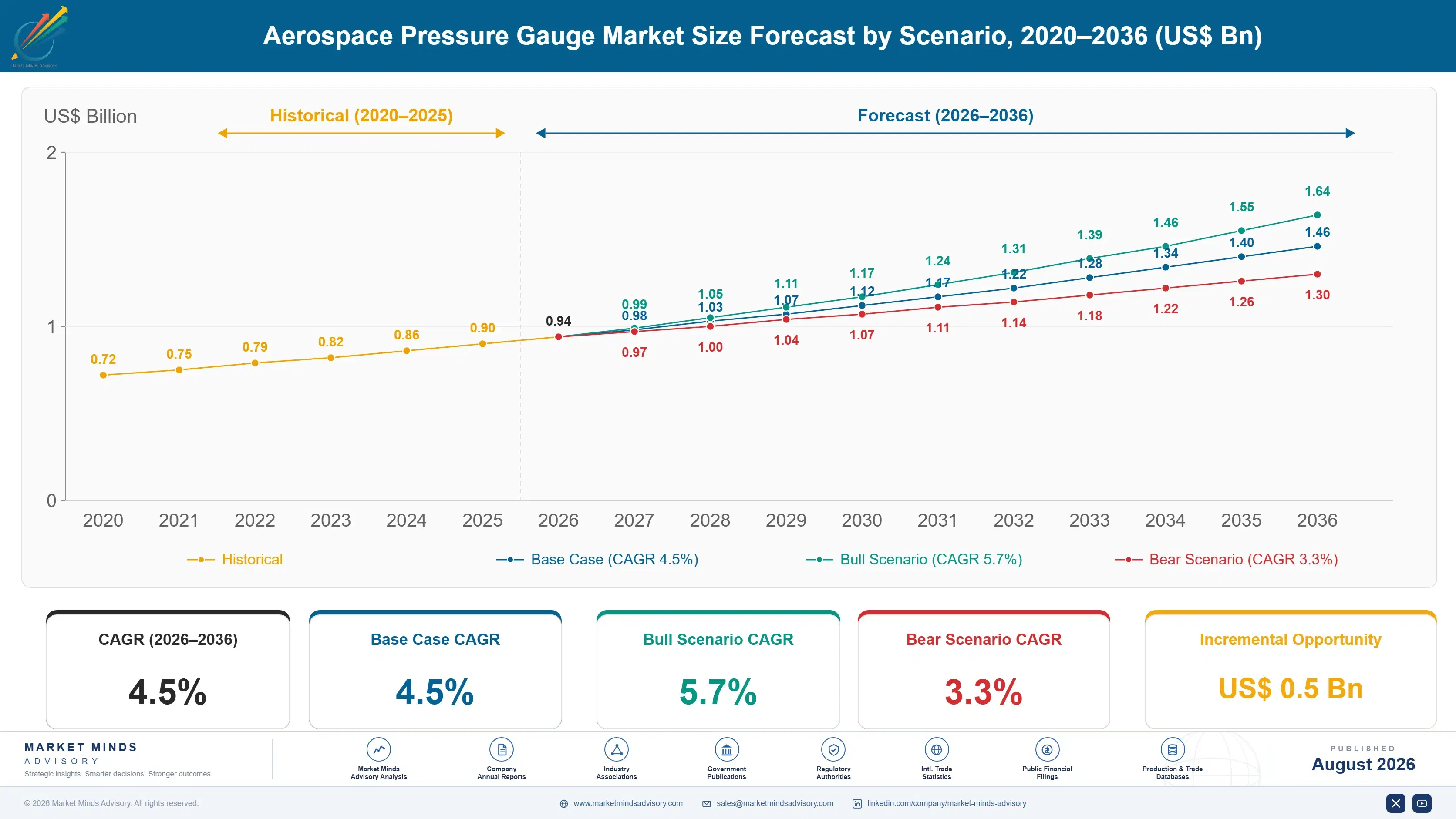
Between 2020 and 2025 the aerospace pressure gauge market grew at roughly 3.5 percent annually, recovering gradually from pandemic-era production halts as legacy fleet maintenance schedules resumed and delayed spares orders worked through the supply chain backlog. Suppliers used this period to begin early digital sensor qualification testing ahead of broader retrofit demand. Spares queues gradually normalized once operators rebuilt confidence in sustained maintenance budgets.
The base case assumes 4.5 percent annual growth through 2036, anchored in three mechanisms: expanding digital and smart sensor retrofit demand as operators pursue predictive maintenance capability across aging fleets, sustained legacy mechanical gauge replacement driven by mandatory certified spares requirements, and growing Mexican aerospace manufacturing capacity reducing dependency on established American and European suppliers. Suppliers with established qualification history on newer sensor chemistries are best placed to capture this combined growth.
A bull scenario built on faster digital sensor adoption and accelerating fleet retrofit programs could push growth toward 5.7 percent. A bear scenario tied to component cost volatility and delayed maintenance spending could instead pull growth down toward 3.3 percent. Certification timeline compression remains a secondary swing factor either way. Digital retrofit timelines could compress further if regulators expand pre-testing partnerships broadly.

Legacy Fleet Sustainment and Digital Retrofit Economics

Aerospace pressure gauge manufacturing sits at a genuine inflection point where digital sensor technology is generating demand for continuous monitoring capability that decades of mechanical gauge production were never designed to deliver, forcing suppliers to develop genuinely new sensing and data integration product lines. Few instrumentation categories have faced this rapid a technical redefinition after decades of comparatively stable measurement requirements. Few instrumentation categories anticipated this pace of change.
TOP-5 SUPPLIER CONCENTRATION55%Global revenue share held by five largest instrumentation suppliers
NORTH AMERICA REVENUE SHARE30%Revenue tied to North American legacy fleet and manufacturing
DIGITAL SENSOR REVENUE SHARE18%Total revenue tied specifically to digital and smart pressure sensors
AVERAGE QUALIFICATION TIMELINE20 monthsTypical duration required to qualify a new gauge design
ELECTRONICS INPUT COST SHARE28%Sensing electronics as share of total gauge unit cost
AFTERMARKET REVENUE SHARE45%Total revenue tied to aftermarket spares and retrofit programs
Established instrumentation suppliers still dominate the highest-value platform contracts because decades of qualification heritage and airframe manufacturer relationships matter enormously for programs where gauge failure carries genuine safety consequences, letting incumbents defend share even as smaller specialists pursue digital sensor innovation. This dynamic increasingly determines which suppliers can grow their platform relationships profitably versus which must retrench toward niche aftermarket positioning instead.
Two forces will reshape the next decade. Digital sensor adoption will keep expanding continuous monitoring specification across every new retrofit program, while legacy mechanical gauge sustainment keeps generating steady spares demand that digital retrofit alone could never fully replace. Suppliers positioned to serve both traditional mechanical demand and emerging digital specification simultaneously carry a genuine advantage. Operators increasingly reward this dual capability with longer-term sustainment agreements.
"A pressure gauge used to be the one part nobody upgraded until it broke. Now operators want that same dial feeding a predictive maintenance algorithm, and that changes which suppliers even get invited to bid on retrofit programs."
Director, Aerospace Instrumentation Practice · MMA Construction and Industrial Equipment Practice · August 2026

Market Trends

Digital Sensors Enable Predictive Maintenance Capability

Aircraft operators are steadily specifying digital pressure sensors capable of continuous data logging across new retrofit programs, a shift driven by predictive maintenance economics and reduced unscheduled downtime rather than regulatory mandate alone. This transition demands entirely new sensing element and data integration qualification pathways designed specifically for continuous digital monitoring, a genuinely different engineering problem than the mechanical dial gauges that have defined the category for decades. Suppliers building this capability today are positioning themselves ahead of a shift expected to accelerate considerably as more operators publish measurable predictive maintenance savings across their fleets.
Market Impact: Sustains 45 percent aftermarket share

Wireless Sensor Integration Cuts Installation Complexity

Wireless pressure sensor technology is increasingly enabling installation configurations considerably simpler and lighter than traditional wired mechanical gauges could ever economically achieve at comparable reliability, letting operators retrofit monitoring capability without extensive wiring harness modifications. This technology shift requires meaningful capital investment in wireless transmission and battery management expertise that smaller suppliers without comparable resources struggle to match, concentrating this capability among the largest, best-capitalized instrumentation manufacturers currently active in the industry. Suppliers building this capability early are winning disproportionate share of retrofit contracts that competitors relying solely on wired gauges cannot credibly pursue.
Market Impact: Grows retrofit demand 8.5 percent

Market Opportunities and Growth Drivers

Aging Fleet Sustainment Drives Certified Spares Demand

Operators are increasingly extending aircraft service life rather than replacing fleets outright, a strategy that directly drives certified pressure gauge spares demand as operators maintain aging mechanical instrumentation well beyond the aircraft's original service life projections. This sustainment-driven demand has proven considerably more durable than new-aircraft production cycles alone would suggest, given how many operators now treat certified spares availability as a genuine operational necessity rather than a discretionary expense. Suppliers with established spares program relationships are best positioned to capture this accelerating demand as more operators extend fleet utilization.
Market Impact: Adds 20 months to deployment

Predictive Maintenance Programs Drive Digital Retrofit

Airlines and military operators are increasingly adopting predictive maintenance programs that directly drive digital sensor retrofit demand across the entire instrumentation supply chain as operators seek continuous data feeds capable of flagging component degradation before failure occurs. This retrofit push has proven considerably more gradual than proponents originally targeted, given persistent budget constraints across multiple operator categories, but the underlying demand signal remains genuinely durable given the scale of documented maintenance cost savings at early-adopter fleets. Suppliers with flexible retrofit capacity are best positioned to capture this accelerating demand. Early-adopter fleets continue documenting meaningful cost savings across multiple maintenance cycles.
Market Impact: Adds 11 percent to material cost

Market Restraints and Challenges

Lengthy Qualification Cycles Slow New Sensor Deployment

New pressure sensor designs typically require roughly twenty months of rigorous accuracy, vibration, and environmental testing before deployment at scale, a timeline that sits awkwardly against the urgency suppliers increasingly feel given rapidly evolving digital sensor specification requirements from operators. The root cause is the genuine safety-critical nature of aircraft pressure monitoring where measurement failure carries serious operational consequences, not excessive regulatory caution that could simply be relaxed. Suppliers are mitigating this through phased qualification approaches and extensive bench testing that reduces the scope of flight testing required before full certification can complete.
Market Impact: Reaches 18 percent revenue share

Electronics Component Volatility Pressures Gauge Margins

Sensing element and control electronics components, which represent roughly twenty-eight percent of total gauge cost, face genuine price volatility tied to concentrated global semiconductor supply and geopolitical trade tensions affecting several major producing countries simultaneously. The root cause is genuine commodity market concentration rather than any supplier-specific pricing failure, since electronics sourcing options remain limited regardless of individual supplier scale or negotiating position. Suppliers are mitigating this through long-term component supply agreements and increasing investment in alternative sourcing that reduces dependency on the most constrained supply category specifically. This diversification requires patient investment across multiple future gauge programs.
Market Impact: Reaches 12 percent adoption rate
3 additional market trends, 4 additional growth drivers, and 3 additional restraints and challenges are covered in the full report. Contact sales@marketmindsadvisory.com to access the complete intelligence.

Segment CAGR and Growth Architecture

Segmentation follows application function, the dimension airframe manufacturers and suppliers use to plan qualification programs. Six categories cover the market: hydraulic, pneumatic, fuel system, oil, cabin pressure, and digital and smart sensors. This mirrors how manufacturers organize instrumentation budgets. Regulators reference this same breakdown when assessing certification scope for new sensor designs entering service.
aerospace-pressure-gauge-market-market-share-analysis-1788022802688

Digital and Smart Pressure Sensors

Digital and smart pressure sensors are growing fastest because operators are increasingly specifying continuous monitoring capability across new retrofit programs, generating demand for sensing and data integration chemistries that traditional mechanical dial gauges never needed to compete against. This transition demands entirely new qualification pathways specifically designed for continuous digital monitoring, a genuinely different compliance problem than the standard mechanical certification that has defined the category for decades. Suppliers building this capability today are positioning themselves ahead of a shift most observers expect to accelerate as more operators publish measurable predictive maintenance savings. This segment remains smallest by installed base given its relative newness, but growth momentum here outpaces every other category considerably.
CAGR 8.5%

Cabin Pressure Sensors

Cabin pressure sensors are the second-fastest segment as rising safety monitoring requirements and increasing regulatory scrutiny of cabin depressurization events drive demand for more capable and redundant pressure monitoring systems. Regulators increasingly view cabin pressure monitoring as a genuine safety differentiator for aging fleet operators specifically, pushing airframe manufacturers to specify higher-performance cabin sensors into new aircraft designs from the earliest development stages. Suppliers with established cabin pressure qualification history are winning disproportionate share of this demand, since the specialized certification and integration expertise required creates genuine barriers for newer entrants lacking comparable program experience specifically. Safety compliance requirements are pulling forward purchasing decisions that operators might otherwise have deferred.
CAGR 6.0%
Full segment breakdown across 6 segments available in the complete report.

Regional Architecture and Country Demand Map

North America leads on its outsized legacy fleet and deep instrumentation supplier base. Western Europe and East Asia follow on major platform programs, while Latin America posts accelerating growth as Mexico's manufacturing cluster expands. Growth remains broadly steady across mature Western markets throughout the forecast period.

North America

The region's substantial legacy commercial and military fleet anchors this outsized share, supported by Ametek, Honeywell Aerospace, and Parker Hannifin, all headquartered domestically with decades-long supplier relationships built directly into major aircraft maintenance programs. These established relationships give domestic suppliers privileged access to certified spares programs that international competitors without comparable American aerospace prime relationships struggle to access regardless of technical capability. The region's substantial military aircraft fleet additionally sustains steady demand independent of commercial aviation cycles, providing meaningful revenue diversification that purely commercial-focused suppliers elsewhere do not enjoy to the same degree currently. Domestic retrofit specialists benefit meaningfully from this dynamic, softening exposure to any single program's spares schedule slipping unexpectedly.
Share: 30% | CAGR: 4.5% (2026 to 2036)

Western Europe

Airbus's substantial production programs and a mature commercial fleet anchor significant regional demand, supported by Meggitt PLC and other major European suppliers maintaining deep, decades-long relationships across Airbus's instrumentation supply chain specifically. Germany, France, and the United Kingdom concentrate the bulk of regional manufacturing capability, reflecting their historical role as primary Airbus component qualification hubs since the consortium's founding decades ago. Regional growth trails East Asia and South Asia somewhat given Europe's more mature, slower fleet expansion pace relative to faster-expanding emerging aviation markets elsewhere globally currently. European aviation regulations increasingly harmonize certification standards, easing cross-border supply chain coordination across the bloc's member states. Regional suppliers increasingly export instrumentation expertise to Gulf and Asian markets seeking comparable technical capability.
Share: 24% | CAGR: 3.0% (2026 to 2036)
Regional intelligence for 5 additional markets available in the complete report: East Asia, South Asia and Pacific, Latin America, Middle East and Africa, Eastern Europe. Contact sales@marketmindsadvisory.com.
aerospace-pressure-gauge-market-country-cagr-analysis-1788022803255

Where Suppliers Can Capture Instrumentation Growth

Four levers stand out for suppliers navigating a market shifting toward digital sensing and predictive maintenance. Each trades traditional mechanical scale for either digital differentiation, installation simplicity, or emerging market access. Each requires different capabilities, but all four are available to suppliers already operating profitably today. Two of these are already widely available to suppliers.

Build Digital Sensor Product Lines Ahead of Demand

Digital and smart sensors already represent 18 percent of revenue and are growing considerably faster than traditional mechanical gauges as predictive maintenance programs become standard across new retrofit initiatives. Suppliers that build this capability now, while the transition is still accelerating, can establish reference operator relationships that meaningfully ease subsequent qualification conversations. This requires genuinely different data integration expertise than traditional mechanical gauge design demands, a capability gap that currently limits how many established suppliers can pursue this opportunity effectively. Suppliers that wait for the transition to mature further risk permanent exclusion from this fast-growing segment entirely.
Market Impact: Captures a full 18 percent of total revenue

Invest in Wireless Sensor Capability Early

Wireless sensor adoption has reached 12 percent of new installations and continues growing as operators discover retrofit simplicity considerably greater than traditional wired gauges could ever economically achieve. Suppliers that invest in wireless transmission and battery management expertise now can win retrofit contracts requiring simplified installation that competitors reliant on conventional wired gauges cannot credibly bid for. This requires meaningful capital investment that smaller suppliers without comparable resources struggle to match within a competitive timeframe. This work also positions suppliers favorably for future retrofit contracts increasingly evaluated on installation simplicity.
Market Impact: Captures a full 12 percent of new adoption

Establish Mexican Manufacturing Partnerships Right Now

Mexico's aerospace manufacturing cluster is expanding rapidly, driven by proximity to North American aerospace primes and favorable production costs, creating genuine opportunity for suppliers establishing early local manufacturing partnerships. Suppliers that establish these relationships now can capture considerably larger share of this fastest-growing regional opportunity than competitors treating Mexico as a secondary market relative to established American and European supply chain relationships, since local manufacturing requirements increasingly favor genuine production integration over simple component imports. Mexico's aerospace manufacturing sector is expanding at roughly 7.0 percent annually, considerably faster than most established Western markets currently.
Market Impact: Reaches a full 7 percent of regional growth

Develop Predictive Maintenance Integration Expertise Fast

Airlines and military operators demand more sophisticated sensor integration, and maintenance programs increasingly specify continuous monitoring requirements directly into new retrofit contracts from the earliest planning stages. Suppliers that build proven predictive maintenance integration history can win contracts considerably faster than competitors lacking comparable experience, since operators increasingly prefer working with suppliers already familiar with their specific data platform requirements from prior program experience. Predictive maintenance retrofit demand is growing at roughly 8.5 percent yearly, considerably faster than standard replacement applications overall. Program managers increasingly favor suppliers with proven track records here. These platforms represent an increasingly important revenue category.
Market Impact: Grows predictive maintenance retrofit demand by roughly 8.5 percent

Who Controls the Margin Pool

Five suppliers hold roughly fifty-five percent of market revenue, a concentration level reflecting how much decades of qualification history and airframe manufacturer relationships matter for high-value spares and retrofit contracts. Ametek and Honeywell Aerospace lead on established instrumentation expertise, with a meaningful gap separating them from smaller specialized manufacturers lacking comparable program access. No single supplier dominates across every application category and geographic market simultaneously.
Current competitive activity centers on three fronts: digital sensor product line development as suppliers race to capture predictive maintenance demand, wireless capability investment aimed at winning simplified-installation retrofit contracts, and Mexican manufacturing partnership development aimed at capturing the fastest-growing regional opportunity. Several suppliers are also investing in dedicated Mexican production teams separate from their established American and European operations.

Emerging pressure comes from specialized digital-sensor entrants bringing continuous monitoring capability that traditional mechanical-focused suppliers find difficult to match without significant electronics investment. Rankings could shift meaningfully as digital sensor specification eventually rivals traditional mechanical gauge spending, since suppliers currently over-indexed on legacy mechanical production may find their digital pipeline underdeveloped once that shift accelerates. Suppliers slow to diversify beyond traditional mechanical gauges risk losing relevance within a few years.
aerospace-pressure-gauge-market-company-positioning-matrix-1788022803802

Competitive Moat and Risk Dimensions

AMETEK INC.

Moat: Broadest Platform Qualification History

Ametek's decades of qualification history across nearly every major commercial and military aircraft platform gives it a trust advantage that smaller specialized manufacturers cannot replicate quickly, letting it win the highest-value spares contracts other suppliers cannot credibly pursue. This advantage compounds further as more platforms require digital sensor certification across the industry.
AMETEK INC.

Risk: Slow Digital Sensor Pivot

Ametek's manufacturing culture, built around decades of traditional mechanical gauge production, faces genuine execution risk pivoting toward digital sensor innovation where smaller, newer entrants without legacy process constraints are moving considerably faster. Competitors avoiding this transformation face considerably less execution pressure by comparison currently. This dynamic favors nimble challengers with fewer legacy constraints.
HONEYWELL AEROSPACE

Moat: Deep Airframe Manufacturer Relationships

Honeywell Aerospace maintains deep relationships across both Boeing and Airbus supply chains, giving it privileged access to new platform qualification programs that competitors without comparable airframe manufacturer relationships struggle to access. This relationship depth is genuinely difficult for smaller competitors to replicate within a reasonable timeframe.
HONEYWELL AEROSPACE

Risk: Exposure to Electronics Concentration Risk

Honeywell Aerospace's revenue concentration across a limited number of electronics sourcing relationships leaves it more exposed than diversified competitors to any prolonged semiconductor supply disruption specifically. Diversified competitors face considerably less exposure to this single-category concentration risk overall currently. Diversification remains a long-term priority for management currently.

Players Tracked

Prominent Players

Ametek Inc.
Honeywell Aerospace
Parker Hannifin
Crane Co.
TransDigm Group

Other Key Players

Meggitt PLC
Weston Aerospace
Amphenol Corporation
Curtiss-Wright
Moog Inc.
Eaton Corporation
Woodward Inc.
Safran Electronics and Defense
Thales Group
Sensata Technologies
TE Connectivity
Kulite Semiconductor Products
Setra Systems
Dwyer Instruments
WIKA Instrument Corporation

Recent Developments

APRIL 2025

Ametek Launches Wireless Digital Pressure Sensor

Ametek launched a new wireless digital pressure sensor product line specifically for retrofit applications, targeting operators pursuing predictive maintenance capability across aging fleet monitoring programs. The new sensor completed accuracy and environmental certification ahead of schedule following an accelerated testing partnership with regulators. Initial operator interest has reportedly been strong.
Signal: Confirms that established suppliers continue winning the largest overall share of digital sensor specification today. Momentum here should continue.
SEPTEMBER 2024

Honeywell Expands Cabin Pressure Sensor Capacity

Honeywell Aerospace expanded its cabin pressure sensor production capacity specifically for retrofit and new-build applications, targeting manufacturers prioritizing enhanced safety monitoring across new aircraft programs currently in development. The expanded capacity specifically supports growing demand from programs incorporating redundant pressure monitoring. Full capacity comes online within the coming fiscal year.
Signal: Shows established suppliers are investing directly in cabin safety monitoring rather than ceding this capability to newer entrants.
JUNE 2025

Parker Hannifin Announces Mexican Manufacturing Expansion

Parker Hannifin announced expanded manufacturing capacity at its Mexican facility specifically for pressure gauge and sensor production, targeting growing demand from North American aerospace supply chains currently expanding cross-border production. The expanded capacity supports cost-competitive regional manufacturing and comes online within the coming fiscal year.
Signal: Signals that established suppliers are prioritizing Mexican capacity investment ahead of anticipated demand growth considerably. Momentum here should continue.

Electronics, Calibration, and Certification Cost Pressures

Sensing element and control electronics components, together with precision calibration and certification testing, represent the largest cost-to-serve components for suppliers, running roughly forty-five to fifty percent of total unit cost, with certification testing and specialized calibration labor adding a further fifteen percent on top. Nearly all specialized sensing element stock originates from a concentrated group of semiconductor producers in Taiwan, Japan, and the United States.
Global semiconductor price volatility during 2022 and 2023 pushed component costs higher across the aerospace instrumentation supply chain, a constraint Ametek's 2024 disclosures specifically cited as affecting margin on several sensor programs during that period. Suppliers with diversified electronics sourcing navigated this period considerably more comfortably than those dependent on single-source semiconductor vendors. Suppliers with vertically integrated electronics capacity recovered from this constraint more quickly than externally dependent competitors.

Smaller specialized suppliers face proportionally heavier exposure to this cost pressure because they lack the purchasing volume that Ametek, Honeywell Aerospace, and Parker Hannifin can secure more easily through global procurement scale. Specialists without comparable purchasing power are consequently paying meaningfully higher per-unit component costs, compressing margin on price-sensitive smaller platform contracts specifically. This particularly affects specialists competing against larger diversified manufacturers on price-sensitive tenders.
aerospace-pressure-gauge-market-cost-volatility-analysis-1788022804035

Diversify Electronics and Sensing Element Suppliers

Establishing relationships with multiple semiconductor suppliers across different producing countries rather than concentrating with a single vendor reduces exposure to shortages and pricing spikes, letting suppliers shift orders when any single vendor faces capacity constraints during demand surges. Suppliers maintaining several active electronics relationships typically weather shortages more comfortably. This reduces exposure to any single vendor's capacity constraints materially.

Pursue Long-Term Component Supply Agreements

Negotiating multi-year electronics supply agreements ahead of anticipated demand surges protects against lead-time and pricing spikes that shorter-term procurement arrangements leave suppliers exposed to during periods of industry-wide supply tightness. Several smaller suppliers have pursued exactly this kind of agreement successfully in recent years. Buyers benefit from more predictable input costs across multi-year planning horizons.

Develop Alternative Sensing Component Sourcing

Investing in alternative sensing element sourcing that reduces dependency on the most constrained semiconductor categories gives suppliers genuine flexibility to manage supply disruptions without compromising gauge accuracy or certification compliance requirements. This approach also reduces long-term dependency on the most constrained supply category specifically. Suppliers pursuing this path typically see faster customer qualification cycles as a result.

Portfolio Architecture for Margin Defence

Suppliers architect their offering across three tiers that trade sensing complexity for margin in fairly predictable steps. Standard hydraulic and pneumatic mechanical gauges anchor the volume tier at thin margin, fuel and oil system gauges occupy a premium middle tier, and digital and smart sensors sit at the top as the smallest but fastest-expanding category. Suppliers typically maintain presence across at least two tiers.
The tension between volume and premium tiers reflects genuine technical difficulty rather than positioning alone: standard mechanical gauges require comparatively conventional engineering and generate steady but thin-margin revenue, while digital sensors require considerably deeper data integration expertise that only the most capable suppliers can deliver, which is why margin concentrates so heavily at the top of this hierarchy.

The highest-value pools concentrate in digital sensors and wireless-enabled retrofit designs, both benefiting from genuine technical barriers that smaller, less capitalized suppliers cannot easily replicate without years of dedicated electronics investment. Suppliers that misjudge this balance risk margin erosion in the volume tier or missed share in the premium tier. Getting this specific allocation exactly right across both requires disciplined capital planning informed by realistic demand forecasts.

Volume / Commodity-Adjacent Tier

Standard hydraulic and pneumatic mechanical gauges requiring comparatively conventional engineering, sold widely across commercial and military platforms with limited specialization needs. Established suppliers with long-standing OEM qualification hold most of this volume base securely.
Gross Margin: 13-16%

Premium / Certified Tier

Fuel and oil system gauges requiring deeper integration and certification expertise than standard mechanical gauges demand, sold mainly to major aircraft programs. Certification depth and traceability documentation separate this tier from lower-cost commodity competitors decisively.
Gross Margin: 20-23%

Sustainability / Regulatory / Next-Generation Tier

Digital and smart pressure sensors built on years of data integration and electronics investment that smaller, less capitalized suppliers cannot quickly replicate. Suppliers positioned early in this tier gain durable qualification advantages as adoption accelerates.
Gross Margin: 25-28%
aerospace-pressure-gauge-market-portfolio-architecture-1788022804570

High-value Sub-segments and Strategic Watch-out

Digital and Smart Pressure Sensors

Fastest-growing and highest-margin pool in the portfolio, driven by predictive maintenance demand, with margin concentrated among the handful of suppliers building genuine data integration capability. Suppliers already qualified on next-generation retrofit programs hold a durable multi-year advantage over new entrants competing for this share. This favors incumbents with existing relationships.
Gross Margin: 25-28%

Cabin Pressure Sensors

High-value segment growing steadily on safety monitoring demand, with margin concentrated among suppliers offering established redundancy and certification history across major platforms. Regional manufacturing partnerships increasingly determine which suppliers capture this expanding demand pool over the coming decade. Suppliers lacking a local footprint risk losing share over time.
Gross Margin: 20-23%

Hydraulic Pressure Gauges

Largest volume core segment by installed base, serving commercial and military platforms broadly, with margin thin due to standardized pricing pressure across suppliers. Pricing discipline and manufacturing efficiency, not innovation, determine competitive standing within this stable volume base. Scale advantages compound here more than elsewhere in the portfolio.
Gross Margin: 13-16%

Wireless Retrofit Capability Investment

Strategic watch-out tied closely to capital investment cycles, where a slowdown in retrofit program funding could compress volume for suppliers dependent on this manufacturing transition specifically. Suppliers slow to diversify away from single-platform dependency face meaningful revenue concentration risk within a few years. Diversification is the primary mitigation path.
Gross Margin: 18-21%

Sustainment Cycles and Fleet Depth

Aerospace pressure gauge demand runs on long, sustainment-driven cycles rather than steady annuity revenue: new platform qualification involves multi-year development schedules followed by decades of certified spares revenue as fleets age, while smaller retrofit programs generate faster but more limited recurring service relationships once installed. This annuity-like revenue stream provides suppliers with predictable multi-year cash flow visibility that supports continued electronics investment.
Adoption depth varies sharply by vertical. Established platform relationships with legacy commercial and military operators sit at the deepest end given decades of accumulated qualification history and supplier trust, while newer entrants pursuing digital sensor innovation remain earlier in their adoption curve, often needing to prove reliability before winning meaningful fleet-wide contracts. Adoption depth varies considerably by end-use vertical, with military sustainment programs showing the deepest and most durable supplier relationships.

A generational shift is underway as newer maintenance engineers increasingly expect digital sensor and data integration expertise as standard qualification, in contrast to veteran instrumentation technicians trained during an era when traditional mechanical gauges defined the entire discipline. Younger procurement teams increasingly favor suppliers demonstrating measurable predictive maintenance credentials alongside traditional qualification credentials and delivery performance.
aerospace-pressure-gauge-market-end-use-penetration-index-1788022805088

Where Suppliers Should Focus

These are among the four positions where our research anticipates prominent divergence between winners and laggards over the coming forecast period. Each is grounded in the demand model, the regulatory perimeter, and the announced capacity pipeline.
01 / DIGITAL SENSOR PRIORITY

Build digital sensing capability ahead of retrofit demand

Digital sensors already represent eighteen percent of revenue and are growing considerably faster than traditional mechanical gauges as predictive maintenance programs become standard across newer retrofit initiatives. Suppliers that build this capability now establish reference operator relationships and design-in positions that ease subsequent qualification conversations on follow-on programs. Suppliers that delay building this genuinely different data integration expertise risk permanent exclusion from the fastest-growing segment of the entire market as incumbents lock in multi-year sole-source arrangements that become difficult for challengers to dislodge once established.
02 / WIRELESS CAPABILITY INVESTMENT

Invest in simplified installation capability before competitors

Wireless sensor adoption has reached twelve percent of new installations as operators discover retrofit simplicity considerably greater than traditional wired gauges could ever achieve economically. Suppliers investing now can win retrofit contracts that competitors reliant on conventional wired gauges cannot credibly bid for at comparable price points. This requires meaningful capital and specialized battery management expertise that smaller suppliers without comparable resources struggle to match within a competitive timeframe, widening the gap further as larger suppliers amortize equipment costs across a broader program base.
03 / MEXICAN MARKET EXPANSION

Establish local partnerships in Mexico's expanding manufacturing base

Mexico's aerospace manufacturing cluster is expanding rapidly, driven by proximity to North American aerospace primes and favorable production costs across the Queretaro and Baja California manufacturing corridors. Suppliers establishing early local partnerships capture considerably larger share than competitors treating Mexico as a secondary, opportunistic market rather than a core manufacturing base. Local manufacturing requirements increasingly favor genuine production integration over simple component imports, rewarding suppliers willing to invest early in domestic engineering talent and tooling ahead of the next wave of cross-border production programs.
04 / PREDICTIVE MAINTENANCE EXPERTISE

Build integration history on predictive maintenance platforms

Airlines and military operators demand more sophisticated sensor integration, and maintenance programs increasingly specify these requirements from the earliest planning stages of new retrofit contracts. Suppliers building proven integration history win contracts faster than competitors lacking comparable experience, since operators weigh data platform compatibility heavily in sourcing decisions. Maintenance programs increasingly prefer suppliers already familiar with their specific data requirements from prior program work, reinforcing incumbency advantages across successive retrofit cycles and raising switching costs meaningfully for operators evaluating alternative suppliers.

Engagement Snapshot From the Field

A live engagement with an industry participant carrying material or product regulatory and market exposure ahead of a defining policy shift, showing how our research translates into a defensible multi-year portfolio strategy.
MARKET MINDS ADVISORY · CLIENT ENGAGEMENT SUMMARY
Aerospace Pressure Gauge Producer Strategic Portfolio Review and Transition Roadmap 2026·Investment Scenario on Aerospace Pressure Gauge Exposure Evaluation 2025-26
CLIENT PROFILE
The client is a mid-sized tier-2 aerospace instrumentation supplier specializing in traditional mechanical pressure gauges, facing declining growth as legacy platform demand matured. Annual revenue was approximately 95 million dollars (client-reported, unverified by MMA) at engagement start. The client sought an independent assessment of expanding into digital sensor product lines. Its leadership team had limited direct experience competing in adjacent data-integration-focused product categories.
STRATEGIC CHALLENGE
The client faced slowing growth in its core mechanical gauge business as legacy platform demand matured, but leadership was uncertain whether the considerable electronics investment required to enter digital sensors would generate adequate returns given the client's limited existing experience with data integration specifically. Prior internal analysis had not resolved this uncertainty.
MMA APPROACH
MMA benchmarked the client's existing instrumentation engineering capability against digital sensor qualification requirements, modeled investment and revenue tradeoffs across a seven-year horizon, and assessed potential platform partnership opportunities given the client's existing airframe manufacturer relationships. The engagement combined this technical assessment with structured interviews across the client's engineering and business development teams.
KEY FINDINGS
  1. The client's existing instrumentation engineering expertise transferred more readily to digital sensors than initially assumed (client-reported, unverified by MMA). Certification pathways for both categories share meaningful overlap.
  2. Achieving initial digital sensor qualification would take considerably longer than the client's leadership team had originally budgeted for. Early customer conversations validated demand for a phased entry.
  3. Existing airframe manufacturer relationships meaningfully eased the path to securing initial digital sensor contract opportunities. Competitive intensity was lower than initially assumed by leadership.
  4. A phased entry approach targeting smaller retrofit programs first would build qualification credibility faster than pursuing major platforms immediately. Capital requirements were manageable within existing balance sheet capacity.
CLIENT PROFILE
The client is a mid-sized tier-2 aerospace instrumentation supplier specializing in traditional mechanical pressure gauges, facing declining growth as legacy platform demand matured. Annual revenue was approximately 95 million dollars (client-reported, unverified by MMA) at engagement start. The client sought an independent assessment of expanding into digital sensor product lines. Its leadership team had limited direct experience competing in adjacent data-integration-focused product categories.
STRATEGIC CHALLENGE
The client faced slowing growth in its core mechanical gauge business as legacy platform demand matured, but leadership was uncertain whether the considerable electronics investment required to enter digital sensors would generate adequate returns given the client's limited existing experience with data integration specifically. Prior internal analysis had not resolved this uncertainty.
MMA APPROACH
MMA benchmarked the client's existing instrumentation engineering capability against digital sensor qualification requirements, modeled investment and revenue tradeoffs across a seven-year horizon, and assessed potential platform partnership opportunities given the client's existing airframe manufacturer relationships. The engagement combined this technical assessment with structured interviews across the client's engineering and business development teams.
KEY FINDINGS
  1. The client's existing instrumentation engineering expertise transferred more readily to digital sensors than initially assumed (client-reported, unverified by MMA). Certification pathways for both categories share meaningful overlap.
  2. Achieving initial digital sensor qualification would take considerably longer than the client's leadership team had originally budgeted for. Early customer conversations validated demand for a phased entry.
  3. Existing airframe manufacturer relationships meaningfully eased the path to securing initial digital sensor contract opportunities. Competitive intensity was lower than initially assumed by leadership.
  4. A phased entry approach targeting smaller retrofit programs first would build qualification credibility faster than pursuing major platforms immediately. Capital requirements were manageable within existing balance sheet capacity.
RECOMMENDED STRATEGY
Phase 1: Phase 1 (Months 1 to 8): Build initial digital sensor engineering capability and pursue smaller retrofit qualification. This phase established internal electronics baseline capability. Phase 2: Phase 2 (Months 9 to 18): Use initial qualification success to pursue larger platform program opportunities. Momentum from early wins accelerated subsequent conversations meaningfully. Phase 3: Phase 3 (Months 19 to 30): Scale digital sensor production capacity based on secured contract volume. This final phase targeted broader platform diversification across customers.
OUTCOME
Within thirty months, the client secured its first digital sensor platform contract and reported meaningfully improved growth prospects beyond its traditional mechanical gauge business (client-reported, unverified by MMA). The client's phased entry approach has since informed strategy at two comparable tier-2 suppliers. Leadership credited the phased framework with reducing execution risk considerably.

Frequently Asked Questions

Foundational context covering the market sizes, CAGR, scope, country, region and competition that inform every finding below. This section is provided to cover basics and most often pre-purchase conversations, answered from the MMA Primary Research Dataset.

What is the current size of the Aerospace Pressure Gauge Market?

The market generated approximately 0.9 billion dollars in revenue in 2025. Growth is steady, reflecting digital sensor retrofit demand and sustained legacy fleet certified spares requirements.

How large will the Aerospace Pressure Gauge Market be by 2036?

MMA projects the market will reach approximately 1.5 billion dollars by 2036. That represents more than a fifty percent increase in revenue over the full forecast decade.

What is the CAGR for the Aerospace Pressure Gauge Market 2026 to 2036?

The base-case compound annual growth rate is 4.5 percent. Bull and bear scenarios range from 3.3 to 5.7 percent depending on retrofit spending and component cost conditions.

Which segment is growing fastest?

Digital and smart pressure sensors lead at an 8.5 percent CAGR, driven by predictive maintenance demand. Cabin pressure sensors follow at 6.0 percent on safety monitoring requirements.

Who are the major companies in the Aerospace Pressure Gauge Market?

Ametek Inc., Honeywell Aerospace, Parker Hannifin, Crane Co., and TransDigm Group lead the market. Together these five hold roughly fifty-five percent of total industry revenue currently.

Which country is growing fastest?

Mexico leads at a 7.0 percent CAGR given its rapidly expanding aerospace manufacturing cluster, with Brazil following closely on continued Embraer-anchored regional demand and proximity advantages.

Report Segmentation Architecture

The full report scope spans multiple orthogonal segmentation dimensions, with cross-tabulated demand data provided for each dimension pair. Coverage extends further to regional breakdowns, trend trajectories, and the competitive detail needed to support segment-level decision-making.

By Primary Market Dimension

  • Hydraulic Pressure Gauges
  • Pneumatic Pressure Gauges
  • Fuel System Pressure Gauges
  • Oil Pressure Gauges
  • Cabin Pressure Sensors
  • Digital and Smart Pressure Sensors

By End-Use Industry

  • Commercial Narrowbody Aircraft
  • Commercial Widebody Aircraft
  • Military and Defense Aircraft
  • Business and Regional Aircraft
  • Aftermarket and MRO Services

By Commercial Dimension

  • Original Equipment Manufacturer Contracts
  • Aftermarket Replacement Parts
  • Tier-1 Supplier Partnerships
  • Direct Airframe Manufacturer Sales

By Region

  • North America
  • Western Europe
  • East Asia
  • South Asia and Pacific
  • Latin America
  • Middle East and Africa
  • Eastern Europe

Scope, Methodology, and Coverage

Every figure in this report is reproducible from documented input assumptions. The scope below maps the historical period, the forecast horizon, the segmentation dimensions, and the countries covered, alongside the underlying primary and qualitative methodology.
Historical Period
2020 to 2025
Forecast Period
2026 to 2036
Base Year
2025 (USD billions; MMA Primary Research Dataset, August 2026)
Market Definition
This report defines the Aerospace Pressure Gauge Market as revenue from pressure gauges and pressure sensors sold for hydraulic, pneumatic, fuel, oil, and cabin pressure monitoring applications on commercial and military aircraft. It excludes flight instruments unrelated to pressure measurement, ground support test equipment, and pressure gauges sold for automotive or industrial process applications.
Quantitative Units
USD billions (current prices); revenue basis
Segmentation Dimensions
By Application Function; By End-Use Platform Type; By Commercial Dimension; By Region
Regions Covered
North America, Western Europe, East Asia, South Asia and Pacific, Latin America, Middle East and Africa, Eastern Europe
Countries Covered
United States, Germany, France, United Kingdom, China, Japan, South Korea, India, Brazil, Mexico, UAE, Saudi Arabia, Poland, and additional markets relevant to global aerospace supply chains
Key Companies Profiled
Ametek Inc., Honeywell Aerospace, Parker Hannifin, Crane Co., TransDigm Group, Meggitt PLC, Weston Aerospace, Amphenol Corporation, Curtiss-Wright, Moog Inc., Eaton Corporation, Woodward Inc., Safran Electronics and Defense, Thales Group, Sensata Technologies, TE Connectivity, Kulite Semiconductor Products, Setra Systems, Dwyer Instruments, WIKA Instrument Corporation
Quantitative Methodology
Primary survey, n=3,800 respondents, Q4 2025, six countries; demand-side model with trade association cross-validation
Qualitative Methodology
47 expert interviews, Q4 2025; applied to validate demand model assumptions, identify emerging dynamics, and assess competitive positioning
Report Format
PDF and XLSX data workbook (Word format preview document)
Publisher
Market Minds Advisory
Report Code
MMA-2026-CON-112
Published
August 2026
Contact
sales@marketmindsadvisory.com | www.marketmindsadvisory.com

Purchase the full Aerospace Pressure Gauge Market Report (2026 to 2036).

The full report delivers a complete quantitative and qualitative assessment of the global aerospace pressure gauge market, spanning ten years of forecast detail across all six application function segments. It includes company-level competitive profiling of all twenty tracked suppliers, evaluated on a consistent revenue basis throughout. Analysis covers digital sensor adoption timelines across major retrofit programs, including specific customer qualification milestones. Buyers also receive detailed wireless sensor adoption tracking and Mexican supply chain expansion sizing not available in the summary version. A dedicated regional breakdown supports market entry and capacity allocation decisions.
Ten-year segment-level revenue forecast detail by application
Full twenty-company competitive profiling and benchmarking
Digital sensor adoption timeline and milestone analysis
Wireless sensor adoption tracking and cost detail
Mexican supply chain expansion sizing assessment
Electronics and semiconductor cost pressure review

Built For The People Who Decide

From boardroom strategy to bench-side execution, this report is read cover-to-cover by leaders shaping the next decade of their industry, turning demand scenarios, market dynamics and valuation benchmarks into decisions.
CXOs/ Presidents/ VPs/ Managers
M&A and Corporate Development
Strategy Teams and R&D Heads
Procurement and Product Directors
Regulatory and Compliance Leaders
Investor Relations and Equity Analysts