Market Minds Advisory
Aerospace and Defense Connectors Market

Aerospace and Defense Connectors Market: Aerospace and Defence Connectors: Qualified Parts Lists, Aftermarket Economics and The First Requalification Event In Decades

A few dollars of metal and plastic that can ground an aircraft, sold into approved parts lists that outlive the engineers who wrote them, and finally facing a data rate the old families cannot carry.

Lead Analyst

Published

September 2026

Make Smarter Decisions with Customized Research Insights

Request a free sample report and evaluate market opportunities, growth trends, and competitive dynamics relevant to your business needs.

2025 MARKET VALUE$3.4BMarket Size 2025
2036 FORECAST VALUE$7.3BBase Case , 2026 to 2036
CAGR 2026 TO 20367.2 %Bull 8.4% / Bear 6.0%
INCREMENTAL OPPORTUNITY$3.7BNet 10- year value creation
EXPANSION MULTIPLE2.01x2036 value over 2026 base
Strategic Levers
M&A Pipeline
Regional Outlook
Country Rankings
Competitive Intelligence
Segmental Deep-dive
Call-Us : 91 93563 13602

Executive Snapshot and Market Trajectory.

Nothing in this market is won on engineering merit. A part number reaching a platform's approved parts list stays specified for the life of that platform, and platform lives run near 38 years, so design-in decides everything that follows for several decades afterwards.
The economics follow directly from that. Aftermarket spares and repair already produce 44% of revenue at margins the original build never approaches, because an operator replacing a connector on a twenty year old airframe has exactly one approved part number and no negotiating position whatsoever. Winning the design-in is therefore worth several times the value of the shipset it appears on. Every manufacturer in this market understands that particular piece of arithmetic perfectly well.
Data rate is now forcing the first genuine requalification event in decades. Aircraft backbones are moving from megabit to gigabit, and connector families qualified in the 1970s cannot carry that traffic at any price. Fibre optic and optoelectronic connectors grow fastest at 10.8%, and every incumbent part number they displace was previously considered entirely permanent by everybody. Mechanical pedigree is counting for considerably less here than anybody involved had expected.
Market Definition
Revenue from electrical, optical and radio frequency connectors qualified for aerospace and defence applications, including contacts, backshells, accessories and integrated termination hardware. Excludes wire and cable, complete wiring harness assembly labour, printed circuit board connectors used in ground support equipment, and commercial-grade connectors not qualified to any aerospace or defence specification.
Base Year Value
$3.4B in 2025 (MMA Primary Research Dataset, August 2026)
Forecast Period
2026 to 2036, eleven discrete annual values
CAGR
7.2% base case. Bull 8.4%. Bear 6.0%.
Fastest Growth Segment
Fibre Optic and Optoelectronic Connectors: 10.8% CAGR
Fastest Growth Country
India: 9.2% CAGR
Fastest Growth Region
South Asia and Pacific: 9.2% CAGR
Largest Region
North America: 31% of 2025 global value
Market Leaders
Amphenol, TE Connectivity, Eaton, Glenair and Radiall lead on qualified aerospace and defence connector revenue. Source: company annual reports and MMA Primary Research Dataset, July 2026.
Primary Survey
n=3,800 procurement and R&D decision-makers, Q4 2025, six countries
Methodology
Demand-side build-up, cross-validated against public data, 47 expert interviews

Aerospace and Defense Connectors Market Forecast Scenarios

aerospace-and-defense-connectors-market-size-forecast-scenario-1787997689762
The 2020 to 2025 period split cleanly at its midpoint. Commercial build rates collapsed in 2020 and took several years to recover, while defence and space demand rose through the same window and partially offset it. Consolidation continued throughout, with one major interconnect business acquired outright during 2024. Revenue compounded near 6.2% across the period, carried substantially by aftermarket sales that new build could not have delivered.
Three mechanisms support the base case. Commercial build rates continue recovering toward and beyond pre-pandemic levels, adding roughly 6,400 connectors on every widebody shipset. Defence spending growth across allied nations raises demand for ruggedised circular and radio frequency families. And the continuing shift toward gigabit avionics backbones forces fibre optic and high-speed data qualification onto platforms whose existing connectors simply cannot carry the traffic those aircraft now need to move.
The bull catalyst is a next generation single aisle programme launching with a gigabit backbone specified from the outset, which would settle the qualification question for a generation and hand enormous design-in value to whoever wins it. The bear risk is regulatory: further restriction on cadmium plating without a qualified alternative would disrupt the largest connector family in service.

Approved Parts Lists Outlive Their Authors

The governing mechanism is the qualified parts list. A connector approved against a military or airframe specification enters a list, and every subsequent purchase for that application draws from it, because substituting an unlisted part means requalification the buyer will not fund. Approval takes around 22 months and, once obtained, holds for the platform's service life. Engineering superiority arriving in year three of a programme is commercially worthless.
MARKET CONCENTRATION CR557%Share of qualified connector revenue held by leaders
PLATFORM DESIGN LIFE38 yearsTypical period a qualified part number remains specified
AFTERMARKET REVENUE SHARE44%Sales into spares and repair rather than new build
QUALIFICATION CYCLE LENGTH22 monthsElapsed time from submission to approved parts listing
GOLD PLATING COST SHARE17%Portion of contact cost carried by precious metal
SHIPSET CONNECTOR COUNT6,400Discrete connectors fitted across a modern widebody airframe
That produces aftermarket economics found in very few component markets. Roughly 44% of revenue comes from spares and repair on aircraft already flying, sold to operators with one approved part number and no alternative, at prices bearing little relationship to what the same connector cost the airframer at build. Manufacturers understand this perfectly and price the original shipset accordingly, sometimes at very little margin at all.
What has changed is bandwidth. Avionics networks built around hundred megabit architectures are being replaced by gigabit backbones as aircraft carry more sensors, more cameras and considerably more data between them. Connector families qualified in the 1970s were never designed for those signal integrity requirements. That has opened the first real requalification opportunity in decades, and incumbency confers rather less than the incumbents expected.
"This industry sells the aftermarket and gives away the shipset, which works beautifully until somebody changes the data rate and every approved parts list opens at once."
Director, Aerospace Electronics and Interconnect Practice · MMA Aerospace and Defence Components Practice · August 2026

Market Trends

Gigabit Backbones Reopen Approved Parts Lists

Avionics architectures are moving from hundred megabit networks toward gigabit backbones as sensor counts, camera feeds and health monitoring data all rise together. Connector families qualified decades ago cannot meet the signal integrity requirements those speeds demand, whatever their mechanical pedigree. Airframers are therefore qualifying new part numbers on applications that had been settled since the 1970s. For incumbents this is the first serious threat to positions they regarded as permanent, and several have discovered their pedigree carries less weight than they assumed. Fifty years of incumbency is proving surprisingly thin protection.
Market Impact: Fits 6,400 connectors per shipset
Consolidation Buys Qualified Positions Rather Than Capacity

The largest interconnect acquisitions of recent years were not about manufacturing capacity, which is abundant, but about acquiring qualified part numbers already sitting on approved parts lists across hundreds of platforms. One substantial transaction completed during 2024 transferred exactly that. Buying a position on a list is considerably faster than qualifying onto it, and the target's revenue is protected by the same requalification cost that protects everybody else. The logic is sound and the prices paid reflect how well understood it now is. Nobody buys interconnect capacity, because capacity was never scarce.
Market Impact: Orders 3,000 units per constellation

Market Opportunities and Growth Drivers

More Electric Architectures Multiply Connector Count

Airframers replacing hydraulic and pneumatic systems with electrical ones add motors, controllers, power distribution and the connectors joining all of them, and a modern widebody now carries around 6,400 discrete connectors against a fraction of that on airframes designed in the 1980s. Power distribution families benefit most because higher voltages and currents demand connectors that simply did not exist previously. This growth requires no new aircraft type and no new technology, only the continued substitution airframers are already committed to. Substitution airframers already committed to is the most reliable growth available.
Market Impact: Affects 38% of installed shells

Satellite Constellations Buy Connectors In Unfamiliar Volumes

Mass-produced satellites are ordered in thousands rather than dozens, which is a volume this industry has never served under space qualification rules. Manufacturers have responded by offering lot acceptance and reduced screening against shorter design lives, which traditional space customers find uncomfortable and constellation builders regard as obvious. The margins are thinner and the volumes are unlike anything else here. Suppliers who declined the business on qualification grounds have watched competitors build genuine positions in a segment growing considerably faster than the rest. Qualification purity is expensive when nobody will pay for it.
Market Impact: Requires 22 months before shipping

Market Restraints and Challenges

Cadmium Plating Restriction Threatens The Largest Family

The most widely used military circular connector family relies on cadmium plated shells for corrosion resistance and conductivity, and European chemical regulation continues tightening around cadmium under aerospace exemptions that are periodically reviewed. The root cause is that no alternative plating fully matches cadmium's performance across salt fog, conductivity and galvanic compatibility at once. Manufacturers mitigate through zinc-nickel and aluminium based alternatives already qualified on some applications, dual-plating catalogues, and lobbying for exemption continuation while alternatives mature further. No single alternative plating matches cadmium across every property all at once.
Market Impact: Opens 1,200 part numbers annually

Qualification Cost Blocks Entry And Protects Nobody Forever

Reaching an approved parts list takes around 22 months and substantial testing expense before a single unit ships, which deters entrants and rewards incumbents. The root cause is a safety regime that treats an unproven connector as an unacceptable risk, correctly. Commercially it means the market resists competition until a technical change forces requalification, at which point incumbency counts for surprisingly little. Manufacturers mitigate by qualifying families rather than individual parts, reusing test evidence across derivatives, and pre-qualifying against anticipated requirements. Protection lasts exactly until the technology underneath it changes.
Market Impact: Transferred 2.0 billion transaction
3 additional market trends, 4 additional growth drivers, and 2 additional restraints and challenges are covered in the full report. Contact sales@marketmindsadvisory.com to access the complete intelligence.

Segment CAGR and Growth Architecture

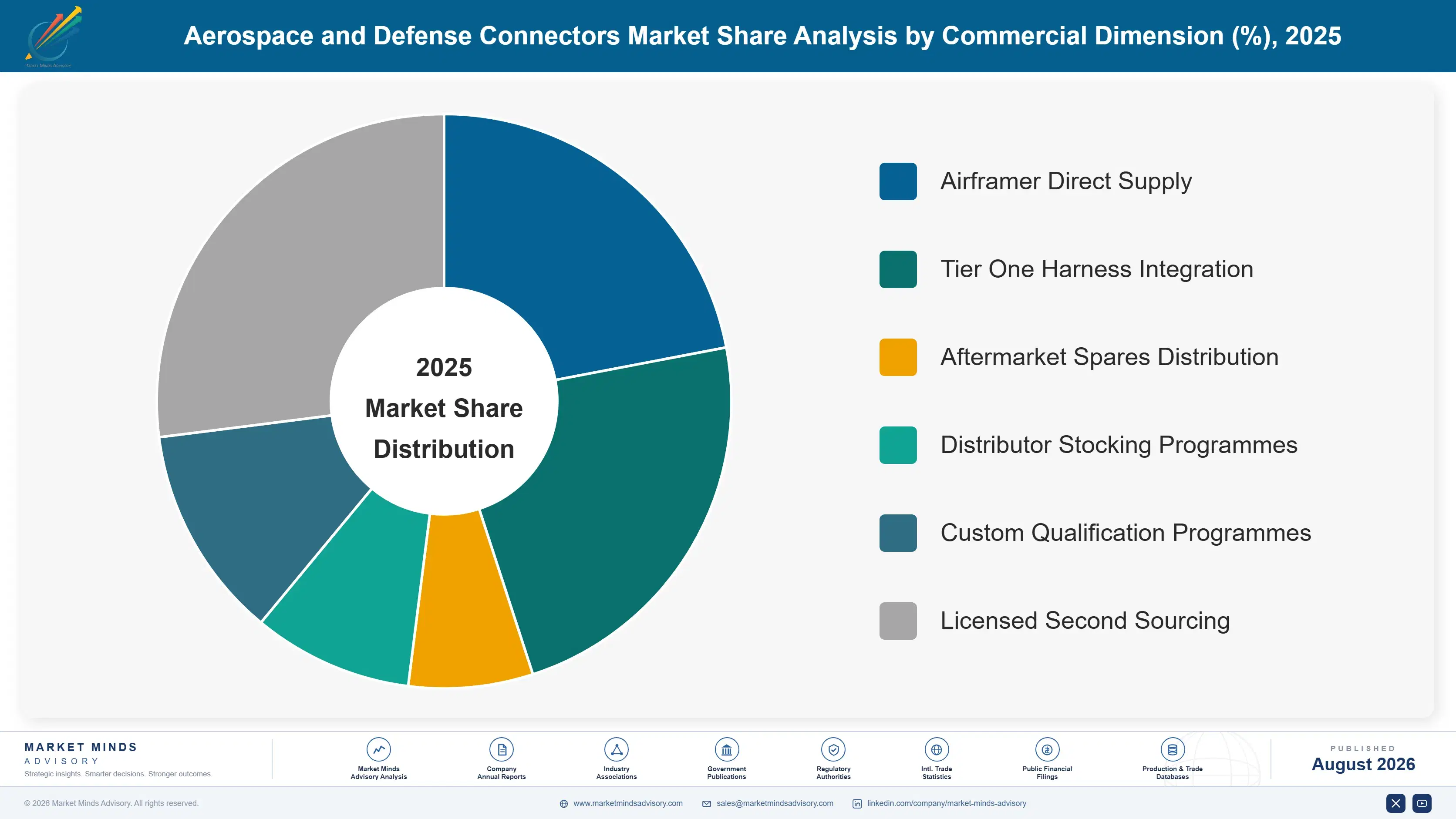
Segmentation follows connector family, since that determines the specification a part is qualified against, the applications it can serve and the price it commands. Six families describe the market completely, from the circular environmental connectors that dominate installed volume through to the fibre optic families now displacing part numbers everybody assumed were settled permanently.
aerospace-and-defense-connectors-market-market-share-analysis-1787997690297

Fibre Optic and Optoelectronic Connectors

The fastest family grows at 10.8%, half again the market rate of 7.2%, and it grows by displacing incumbents rather than by expanding into empty space. Gigabit avionics backbones cannot be carried on connector families qualified in the 1970s, so airframers are opening approved parts lists that had been closed for decades. Termination is the difficulty: fibre in an aerospace environment demands cleanliness, alignment tolerance and field repairability that copper never required, and several early programmes learned that expensively. Manufacturers holding both the optical capability and the mechanical qualification pedigree are winning positions that will hold for another platform lifetime once settled. Copper never demanded any of that, which is precisely the difficulty.
CAGR 10.8%

High-Speed Data Connectors

High-speed copper grows at 9.4% and serves the same bandwidth pressure through a considerably less disruptive route. Where fibre demands new termination skills and new field procedures, a qualified high-speed copper connector delivers gigabit performance within maintenance practices that already exist, which airframers value more than the specification sheets suggest. Signal integrity across shielding, contact geometry and backshell design is where the engineering actually sits. The competitive risk is being displaced later by fibre on the same application, so manufacturers treat these positions as valuable and finite rather than as permanent in the way older families were. Maintenance practice matters more in these selections than the specification sheets ever suggest.
CAGR 9.4%
Full segment breakdown across 6 segments available in the complete report.

Regional Architecture and Country Demand Map

Connector demand follows aircraft and defence electronics production closely, so it distributes across every major manufacturing region. North America leads on combined commercial airframe, defence and space production, with Western Europe and East Asia each close behind on airframe assembly and on electronics manufacture respectively.

North America

The largest share sits here at 31%, carried by commercial airframe assembly, the deepest defence electronics procurement anywhere and a space sector ordering connectors in volumes this industry had never seen. The two largest interconnect manufacturers are headquartered here and set the qualification agenda through their positions on military specifications. Constellation builders have separately forced acceptance of lot screening against shorter design lives, which traditional customers dislike and which has become a genuine commercial segment regardless of their objections. The combination of specification authority, manufacturing scale and a customer base willing to challenge established screening practice makes this the region where the rules of this market are actually written today.
Share: 31% | CAGR: 7.0% (2026 to 2036)

Western Europe

Airframe assembly anchors this region alongside a genuinely strong specialist manufacturing base, with French, German and Swiss suppliers holding qualified positions across commercial and military applications that American competitors have never displaced. European chemical regulation is the region's most consequential influence on the whole market, since cadmium plating restriction applies to families installed worldwide rather than only to those built here. Defence rearmament is lifting ruggedised circular and radio frequency demand faster than commercial recovery alone would have done. A region that sets chemical regulation affecting part numbers installed on every continent holds influence considerably beyond its share of production, and that influence is exercised through committees rather than through any commercial negotiation.
Share: 24% | CAGR: 5.8% (2026 to 2036)
Regional intelligence for 5 additional markets available in the complete report: East Asia, South Asia and Pacific, Latin America, Middle East and Africa, Eastern Europe. Contact sales@marketmindsadvisory.com.
aerospace-and-defense-connectors-market-country-cagr-analysis-1787997690819

Where Connector Margin Actually Lives

Four levers work on qualification position, aftermarket capture and family strategy rather than on unit price, which airframers compress very hard at design-in knowing exactly what follows. Family qualification, aftermarket channel control, bandwidth positioning and plating alternatives each address something a manufacturer controls before any platform configuration freezes. Unit price is not among them.

Qualify Families Rather Than Individual Part Numbers

Reaching an approved parts list takes around 22 months and substantial test expense, and a manufacturer doing that separately for every variant carries the cost repeatedly against very few units each. Qualifying a family with shared shells, contacts and test evidence, then approving derivatives against that base, cuts per-variant qualification cost by 45% to 60% where the authority accepts the reuse. The engineering is straightforward and the test planning is not. Manufacturers who structured catalogues this way early now qualify onto new platforms considerably faster than competitors can. Test planning is the barrier.
Market Impact: Cuts the per-variant qualification cost by around 50%

Control The Aftermarket Channel Instead Of Ceding It

Aftermarket spares and repair produce 44% of revenue at margins the original shipset never approaches, because an operator has one approved part number and no alternative supplier. Manufacturers selling through uncontrolled distribution surrender much of that premium to intermediaries who add nothing but inventory. Establishing authorised distribution with pricing discipline and stocking commitments typically recovers 15% to 22% of aftermarket value that was previously leaking outward. The work is commercial rather than technical, which is exactly why engineering-led businesses so consistently neglect it. Engineering-led businesses find this unglamorous and leave the money outside.
Market Impact: Recovers around 18% of the leaked aftermarket value

Position For Bandwidth Before The Platform Freezes

Gigabit backbones are opening approved parts lists that had been closed since the 1970s, and a position won during architecture definition holds for a platform life near 38 years. Manufacturers engaging airframer systems engineers two years before configuration freeze win design-in at roughly three times the rate of those responding to a released specification. That engagement costs application engineers rather than capital. Competitors treating requirements definition as unpaid pre-sales activity are surrendering positions that will not reopen within any commercially relevant timeframe. Two years early is the whole difference here.
Market Impact: Wins design-in at around 3 times the rate

Qualify Plating Alternatives Before Exemptions Lapse

Cadmium plated shells dominate the largest military circular family and sit under chemical regulation whose aerospace exemptions are periodically reviewed rather than permanent. Zinc-nickel and aluminium based alternatives are already qualified on some applications and take roughly 2 years to approve on others. Manufacturers holding dual-plated catalogues can respond to a restriction within a quarter, while those holding only cadmium versions face a 2 year gap during which the affected part numbers cannot ship into regulated markets at all. Nobody has priced that exposure into anything at all yet. Nobody in this market is ready.
Market Impact: Protects around 38% of the installed shell base

Who Controls the Margin Pool

Concentration is moderate at around 57% across the five largest manufacturers, and it has risen through acquisition rather than through competitive displacement. Buying a company that already holds qualified positions is faster than qualifying onto lists directly, and one substantial interconnect transaction completed during 2024 followed exactly that reasoning. Below them sit specialists in radio frequency, miniature and optical families competing on capability.
Competition runs on three dimensions and price is barely one of them. Qualification position is first and decisive, since an unlisted connector cannot be bought at all. Catalogue breadth is the second, because airframers consolidate toward suppliers covering many applications rather than managing dozens of relationships. Application engineering reach is third, deciding who is present when architecture is defined rather than after release.

Pressure arrives from bandwidth, not from any new competitor. Gigabit requirements are opening approved parts lists that protected incumbents for fifty years, and optical capability matters more there than mechanical pedigree. Constellation builders meanwhile buy at volumes this industry never served. Rankings will shift against manufacturers holding neither optical capability nor a family qualification structure, because both decide who reaches the new lists first.
aerospace-and-defense-connectors-market-company-positioning-matrix-1787997691341

Competitive Moat and Risk Dimensions

AMPHENOL

Moat: Catalogue breadth across qualified families

Amphenol holds qualified positions across circular, rectangular, radio frequency, optical and high-speed families simultaneously, which lets an airframer consolidate interconnect procurement rather than managing many specialist relationships. Acquisition has deliberately widened that catalogue rather than adding manufacturing capacity. Assembling comparable breadth organically would require qualification work across hundreds of part numbers that no competitor has undertaken at that scale.
AMPHENOL

Risk: Legacy family requalification exposure

A large installed base across older circular and rectangular families is exactly what gigabit requirements are now displacing, and mechanical pedigree carries less weight in optical competitions than in the ones that built the position. Scale in legacy part numbers becomes a liability when approved parts lists reopen. Defending it needs optical capability bought rather than built.
TE CONNECTIVITY

Moat: High-speed engineering and volume manufacture

TE Connectivity combines aerospace qualification with genuine high-speed signal integrity engineering developed across commercial data markets at volumes no aerospace specialist approaches. That capability positions it well for the bandwidth transition now reopening approved parts lists. Manufacturing scale also lets it serve constellation volumes under lot screening that traditional aerospace suppliers find culturally difficult to accept.
TE CONNECTIVITY

Risk: Aerospace share of group revenue

Aerospace and defence represent a modest portion of a group whose larger businesses serve automotive and industrial markets with entirely different cycle characteristics and investment logic. Qualification programmes requiring 22 months and no revenue compete internally against opportunities returning faster. Sustained aerospace investment depends on group priorities that aerospace customers cannot influence at all.

Players Tracked

Prominent Players

Amphenol
TE Connectivity
Eaton
Glenair
Radiall

Other Key Players

ITT Cannon
Smiths Interconnect
Molex
Carlisle Interconnect Technologies
Japan Aviation Electronics
Hirose Electric
Fischer Connectors
LEMO
Positronic
Cinch Connectivity Solutions
Nicomatic
Axon Cable
Rosenberger
Times Microwave Systems
Winchester Interconnect

Recent Developments

MAY 2024

Amphenol completed its acquisition of an interconnect business

Amphenol completed the purchase of Carlisle Interconnect Technologies, adding qualified aerospace part numbers, cable assembly capability and approved parts list positions across a wide range of platforms. This was an acquisition rather than a merger or joint venture, and it bought qualified positions rather than manufacturing capacity.
Signal: Buying a place on the approved parts lists is considerably faster than ever qualifying onto them yourself.
JANUARY 2025

European chemical regulation tightened around cadmium exemptions

Continued review of aerospace exemptions covering cadmium plating under European chemical regulation increased pressure on the plating used across the most widely installed military circular connector family. This was regulatory review by a European authority rather than any commercial arrangement between manufacturers or their customers.
Signal: A plating decision taken in Europe affects connector part numbers installed on aircraft absolutely everywhere else.
SEPTEMBER 2024

Constellation programmes drove lot screening acceptance

Satellite constellation builders continued ordering connectors in volumes and against screening regimes unlike traditional space procurement, accepting lot acceptance testing against shorter design lives. These were independent purchasing decisions by several operators rather than any coordinated commercial arrangement between any of the parties at all.
Signal: Volume buyers rewrote space screening practice simply by refusing to pay for the traditional version of it.

What A Qualified Connector Costs

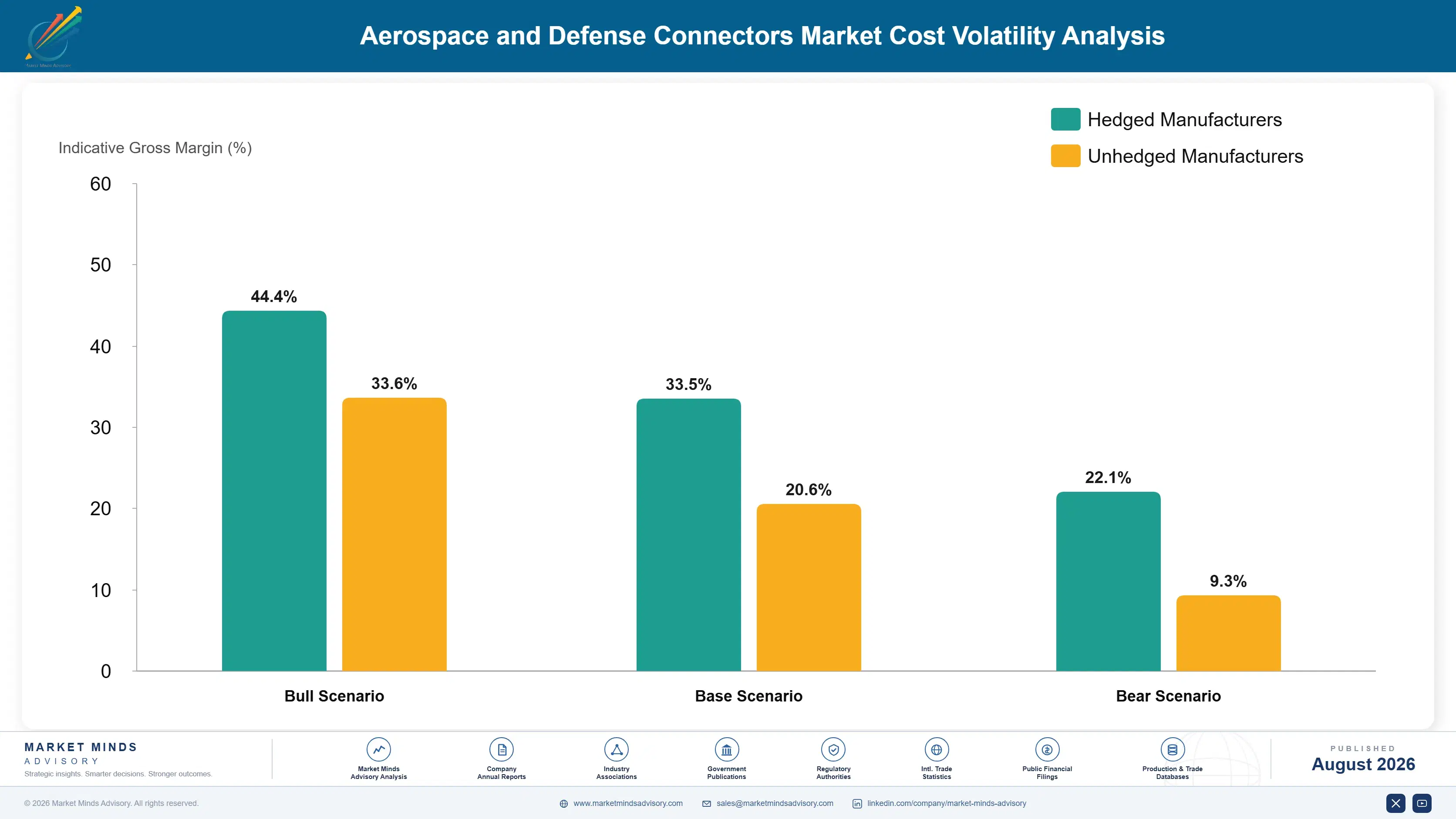
Unit cost divides into four components across a typical qualified connector. Machined shells, inserts and mechanical hardware absorb roughly 38% of production cost. Contacts including precious metal plating run near 26%, with gold alone carrying about 17% of contact cost, assembly and test near 22%, and qualification amortisation with documentation accounts for the remaining 14% across a family.
Precious metal price movement through 2024 and 2025 demonstrated how directly contact cost responds to commodity conditions. Gold rose sharply, plating thickness is specified by the qualification rather than chosen commercially, and manufacturers could not substitute without requalifying the part. Amphenol and TE Connectivity both discussed commodity input pressure across that period in their annual reporting. The cost passed through to new build slowly and to aftermarket pricing rather more readily than that.

Exposure varies by family and by where qualification cost sits. Manufacturers qualifying families rather than individual parts spread the 14% component across many variants, while those qualifying separately carry it fully on each. Precious metal exposure concentrates in high contact count families. Cadmium plated catalogues carry a regulatory exposure that alternative-plated ones do not, and that exposure is not priced into anything currently.
aerospace-and-defense-connectors-market-cost-volatility-analysis-1787997691538

Family qualification spreading test amortisation widely

Shared shells, contacts and environmental test evidence reused across derivative part numbers spread qualification cost across many variants rather than loading it onto each separately. Authorities accept the reuse where the design delta is documented properly. The test planning discipline required is what deters most manufacturers from structuring their catalogues this way from the start.

Dual plated catalogues held against regulatory change

Maintaining zinc-nickel or aluminium based alternatives alongside cadmium versions on high-volume part numbers allows a response to restriction within a quarter rather than across two years of requalification. Carrying both costs inventory and qualification effort against a risk that may not crystallise. Manufacturers holding only cadmium versions are carrying the opposite risk without having priced it.

Precious metal specification review at qualification stage

Plating thickness is fixed by qualification and cannot be reduced commercially afterwards, so the only opportunity to optimise precious metal content arrives during initial qualification. Specifying conservatively at that point locks cost into the part number for decades. Very few manufacturers treat plating specification as a cost decision at the moment it is actually made.

Portfolio Architecture for Margin Defence

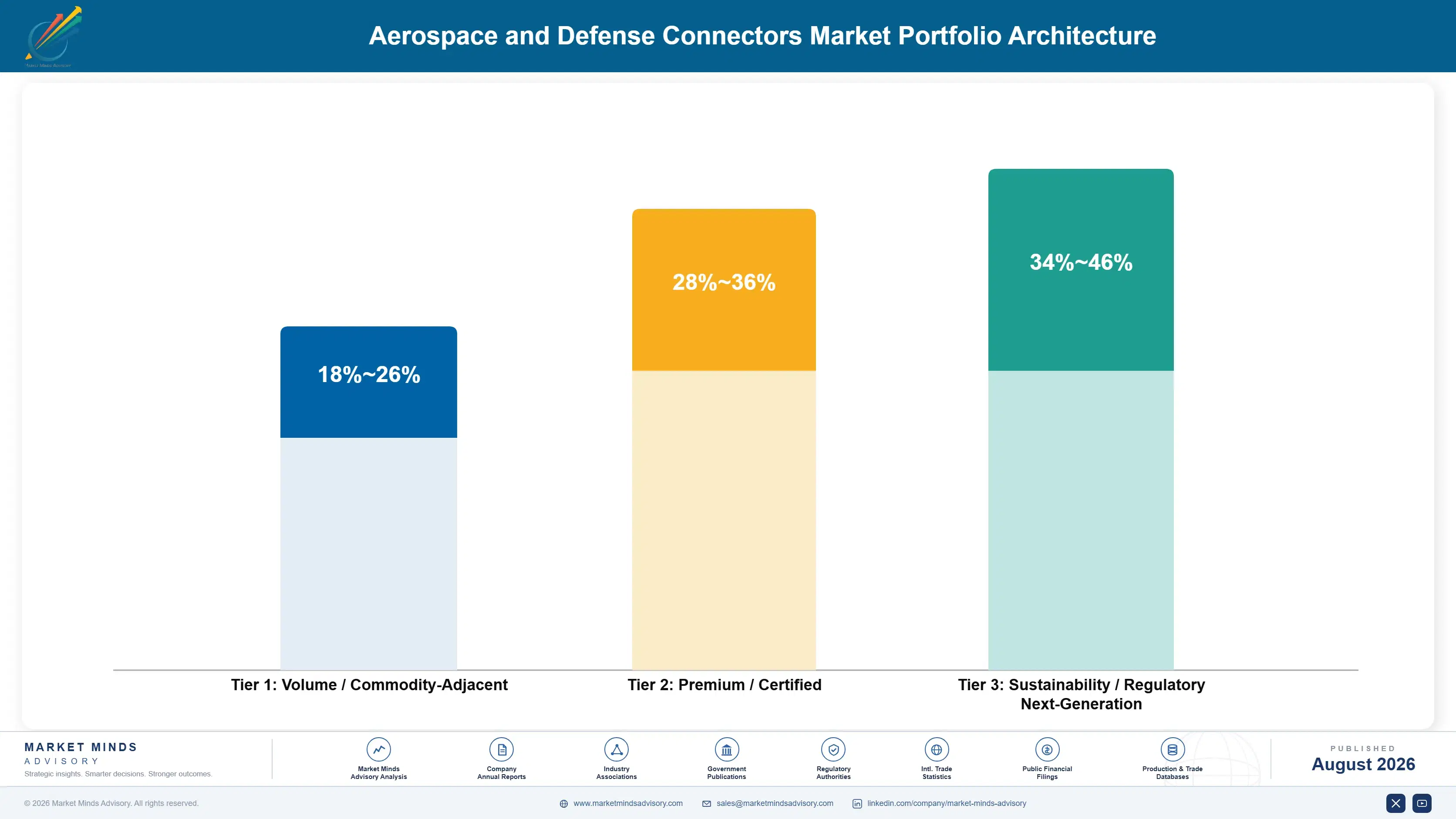
The portfolio separates by whether the part number is settled or contestable. Circular environmental and rectangular families form the volume core: enormous installed bases, positions held for decades, and pricing compressed at new build because manufacturers know the aftermarket follows. They exist because they carry the volume that funds qualification capability and because catalogue breadth is exactly what airframers consolidate around in the end. Nobody loves it.
Margin concentrates where signal performance rather than mechanical durability decides selection. Radio frequency, high-speed data and power distribution families all require engineering that a general connector manufacturer cannot supply, and they price accordingly. The tension is that these positions are less permanent than the older families, because a further bandwidth step displaces them the same way gigabit is displacing what came before it right now. That cycle repeats.

The most valuable position is fibre optic capability combined with mechanical qualification pedigree, and very few manufacturers hold both. Optical suppliers lack aerospace qualification history and aerospace suppliers lack optical engineering, which is why the acquisitions of recent years have generally been attempts to assemble one capability from the other. Buying is faster than building here.

Volume / Commodity-Adjacent

Circular environmental and rectangular families with large settled installed bases. Range spans eight points because aftermarket channel control differs enormously between manufacturers holding authorised distribution and those selling through uncontrolled intermediaries.
Gross Margin: 18-26%

Premium / Certified

Radio frequency, microwave and power distribution families where electrical performance decides selection. Range spans eight points because application engineering depth and qualification breadth vary considerably between generalists and genuine specialists.
Gross Margin: 28-36%

Sustainability / Regulatory / Next-Generation

Fibre optic, optoelectronic and high-speed data families addressing gigabit backbones. Range spans twelve points because very few manufacturers hold both optical capability and mechanical qualification pedigree together at the same time.
Gross Margin: 34-46%
aerospace-and-defense-connectors-market-portfolio-architecture-1787997692035

High-value Sub-segments and Strategic Watch-out

Fibre Optic and Optoelectronic

High value and high growth at 10.8%, displacing part numbers that had been settled since the 1970s entirely. The ten point range separates manufacturers holding both optical and mechanical qualification capability from those holding only one of them. Very few manufacturers hold both at all.
Gross Margin: 36-46%

High-Speed Data Connectors

High value with moderate growth at 9.4%, delivering gigabit performance within maintenance practices that already exist. The eight point range reflects signal integrity engineering depth, which separates genuine specialists from catalogue suppliers quite sharply. These positions are valuable and genuinely finite rather than permanent ones.
Gross Margin: 32-40%

Circular Environmental Connectors

The volume core and the largest installed base in the market by a wide margin. New build pricing is compressed deliberately because manufacturers know that aftermarket spares at far better margins follow for several decades afterwards. The shipset is simply the entry ticket, nothing more.
Gross Margin: 18-26%

Cadmium Plated Legacy Shells

The strategic watch-out rather than a growth pool. European chemical regulation continues reviewing aerospace exemptions, and manufacturers holding only cadmium versions face a two year requalification gap that nothing currently prices in. Several competitors already hold qualified plating alternatives on exactly the same shells today.
Gross Margin: Variable

Why Part Numbers Never Change

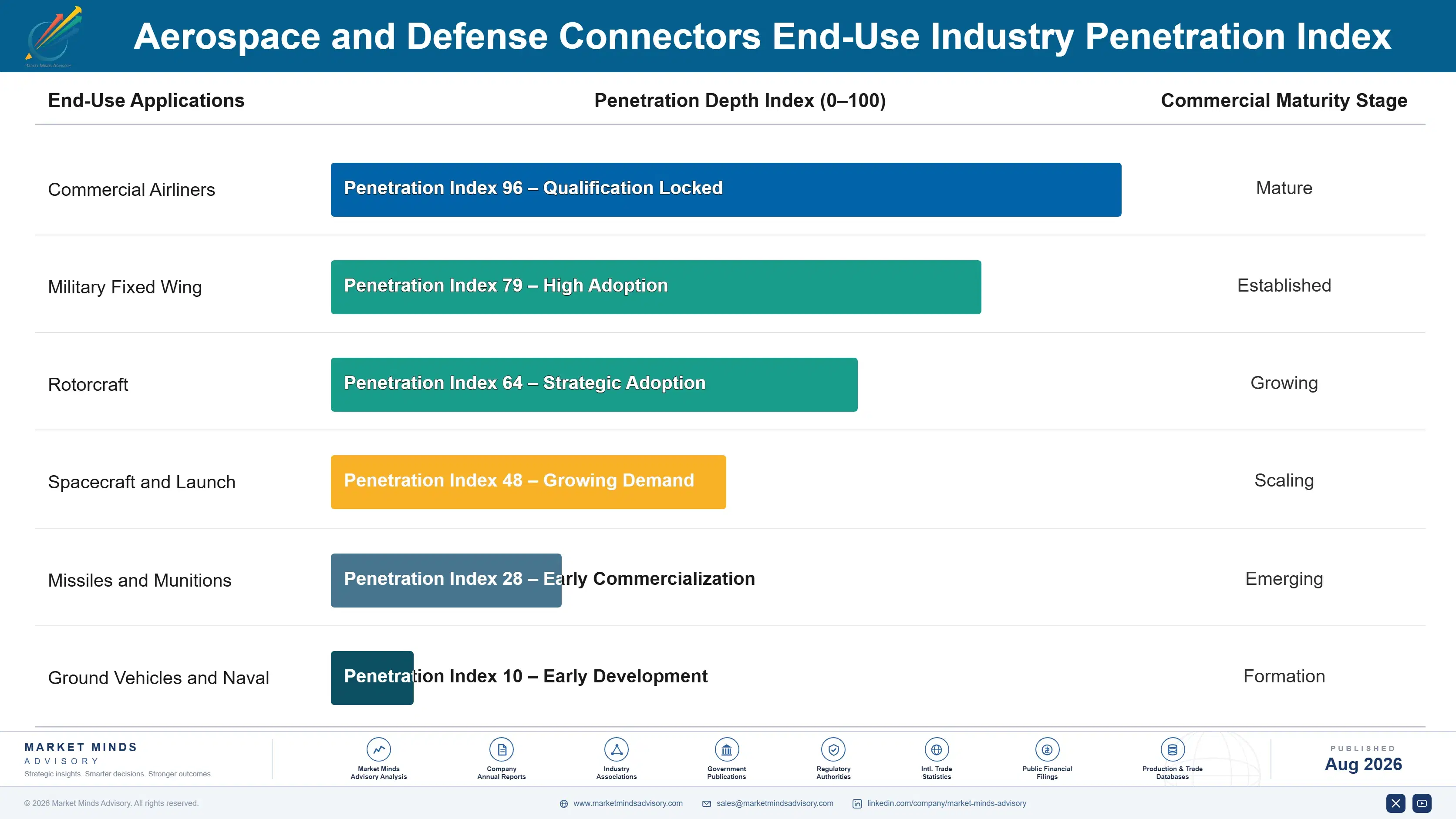
A qualified part number produces the longest annuity in aerospace components. Once specified it ships with every aircraft built for the programme, then generates spares and repair demand across a service life near 38 years, and substituting it means requalification that no operator or airframer will fund without a technical reason. Aftermarket at 44% of revenue arrives on exactly that basis, and it arrives whether the manufacturer does anything further or not.
Stickiness varies by what forces a change. Mechanical families are effectively permanent, since nothing about corrosion resistance or vibration tolerance improves fast enough to justify requalification. Electrical performance families move when a bandwidth or power step makes the incumbent inadequate, which is happening now. Space connectors for constellation programmes are the least sticky of all, because those buyers requalify readily and treat supplier relationships commercially rather than reverentially.

Buyer profiles are diverging in ways that reward different capabilities. Traditional airframers and defence primes still buy on qualification pedigree and consolidate toward broad catalogues. Constellation builders buy on price and delivery against reduced screening. Very few manufacturers serve both convincingly, and the ones attempting it find that the sales approaches contradict each other more than the products do.
aerospace-and-defense-connectors-market-end-use-penetration-index-1787997692531

Where Connector Makers Should Commit

These are among the four positions where our research anticipates prominent divergence between winners and laggards over the coming forecast period. Each is grounded in the demand model, the regulatory perimeter, and the announced capacity pipeline.
01 / FAMILY QUALIFICATION STRUCTURE

Qualify a family or pay for every variant separately

Reaching an approved parts list takes around 22 months and substantial test expense, and a manufacturer doing that separately for each variant carries the full cost repeatedly against very few units. Qualifying a family with shared shells, contacts and environmental evidence, then approving derivatives against that base, cuts per-variant cost by 45% to 60% wherever the authority accepts the reuse. The engineering is straightforward and the test planning discipline required is what deters almost everybody from ever attempting it properly.
02 / AFTERMARKET CHANNEL CONTROL

Forty-four percent of revenue is leaking through distribution

Aftermarket spares and repair produce 44% of total revenue at margins the original shipset never approaches, because an operator holds exactly one approved part number and no alternative supplier anywhere. Manufacturers selling through uncontrolled distribution surrender much of that premium to intermediaries adding nothing at all beyond inventory. Establishing authorised distribution with proper pricing discipline and stocking commitments typically recovers some 15% to 22% of that aftermarket value, and the work is commercial rather than technical, which is why engineering-led businesses neglect it.
03 / BANDWIDTH DESIGN-IN TIMING

Approved parts lists open once every fifty years

Gigabit backbones are reopening approved parts lists that had been closed since the 1970s, and a position won during architecture definition then holds for a full platform life near 38 years afterwards. Manufacturers engaging airframer systems engineers two years before configuration freeze win design-in at roughly three times the rate of those responding to a released specification instead. That engagement costs application engineers rather than capital, and competitors treating it as unpaid pre-sales work are quietly surrendering decades of revenue.
04 / PLATING ALTERNATIVE READINESS

A two year gap arrives whenever the exemption does not

Cadmium plated shells dominate the largest military circular family and sit under chemical regulation whose aerospace exemptions get periodically reviewed rather than permanently granted to anybody at all. Zinc-nickel and aluminium based alternatives are already qualified on some applications and take roughly two years to approve on everything else. Manufacturers holding dual-plated catalogues can respond within a single quarter, while those holding only cadmium versions face two years during which affected part numbers cannot ship into any regulated market at all.

Engagement Snapshot From the Field

A live engagement with an industry participant carrying material or product regulatory and market exposure ahead of a defining policy shift, showing how our research translates into a defensible multi-year portfolio strategy.
MARKET MINDS ADVISORY · CLIENT ENGAGEMENT SUMMARY
Aerospace and Defense Connectors Producer Strategic Portfolio Review and Transition Roadmap 2026·Investment Scenario on Aerospace and Defense Connectors Exposure Evaluation 2025-26
CLIENT PROFILE
A European manufacturer of qualified aerospace connectors holding positions across circular, rectangular and radio frequency families on commercial and military platforms, selling largely through independent distribution. Revenue had grown steadily while margin declined for four consecutive years, and management attributed the decline to airframer pricing pressure at new build rather than to anything happening after the aircraft entered service.
STRATEGIC CHALLENGE
The board needed to understand why margin was falling while its installed base and aftermarket volumes were both growing, which appeared contradictory on the reporting it received. It also faced gigabit requirements on two platform architectures where it held no optical capability at all, and had no view on whether to build, buy or concede those positions to competitors.
MMA APPROACH
MMA traced realised pricing from factory gate through distribution to end operator across the twenty highest volume part numbers, separating new build from aftermarket, and assessed qualification cost per variant against a family-based alternative. Expert interviews with airframer systems engineers, distributors and operators established what aftermarket pricing the market actually bore and when architecture decisions were genuinely taken.
KEY FINDINGS
  1. Aftermarket parts sold at an average 3.4 times factory price by the time they reached operators, and the client captured none of that uplift beyond its own gate price.
  2. Qualification was being carried separately on forty-one part numbers that shared enough shell and contact architecture to have been approved as six families instead.
  3. Both gigabit architecture decisions had been effectively settled eighteen months before any specification was released, and the client had engaged only after release on each.
  4. No zinc-nickel alternative existed for the client's highest volume cadmium plated shell, against two competitors already holding qualified alternatives on the same part number.
CLIENT PROFILE
A European manufacturer of qualified aerospace connectors holding positions across circular, rectangular and radio frequency families on commercial and military platforms, selling largely through independent distribution. Revenue had grown steadily while margin declined for four consecutive years, and management attributed the decline to airframer pricing pressure at new build rather than to anything happening after the aircraft entered service.
STRATEGIC CHALLENGE
The board needed to understand why margin was falling while its installed base and aftermarket volumes were both growing, which appeared contradictory on the reporting it received. It also faced gigabit requirements on two platform architectures where it held no optical capability at all, and had no view on whether to build, buy or concede those positions to competitors.
MMA APPROACH
MMA traced realised pricing from factory gate through distribution to end operator across the twenty highest volume part numbers, separating new build from aftermarket, and assessed qualification cost per variant against a family-based alternative. Expert interviews with airframer systems engineers, distributors and operators established what aftermarket pricing the market actually bore and when architecture decisions were genuinely taken.
KEY FINDINGS
  1. Aftermarket parts sold at an average 3.4 times factory price by the time they reached operators, and the client captured none of that uplift beyond its own gate price.
  2. Qualification was being carried separately on forty-one part numbers that shared enough shell and contact architecture to have been approved as six families instead.
  3. Both gigabit architecture decisions had been effectively settled eighteen months before any specification was released, and the client had engaged only after release on each.
  4. No zinc-nickel alternative existed for the client's highest volume cadmium plated shell, against two competitors already holding qualified alternatives on the same part number.
RECOMMENDED STRATEGY
Phase 1: Phase one: establish authorised distribution agreements with pricing discipline and stocking commitments across the highest volume aftermarket part numbers in the catalogue. Phase 2: Phase two: restructure the forty-one separate qualifications into six families and negotiate test evidence reuse with the certifying authorities directly. Phase 3: Phase three: begin zinc-nickel qualification on the highest volume shells and place application engineers with airframer systems teams ahead of the next architecture cycle.
OUTCOME
The client reported gross margin improving 5.3 points within six quarters (client-reported, unverified by MMA), with roughly two thirds attributable to aftermarket channel control. Family restructuring cut qualification cost per new variant by 48%. Zinc-nickel qualification completed on two shell sizes during the review period.

Frequently Asked Questions

Foundational context covering the market sizes, CAGR, scope, country, region and competition that inform every finding below. This section is provided to cover basics and most often pre-purchase conversations, answered from the MMA Primary Research Dataset.

What is the current size of the Aerospace and Defense Connectors Market?

The market is valued at USD 3.4 billion in 2025, measured as revenue from electrical, optical and radio frequency connectors qualified for aerospace and defence applications worldwide.

How large will the Aerospace and Defense Connectors Market be by 2036?

MMA forecasts USD 7.30 billion by 2036, up from USD 3.64 billion in 2026. That represents incremental revenue of USD 3.66 billion and an expansion multiple of 2.01 times.

What is the CAGR for the Aerospace and Defense Connectors Market 2026 to 2036?

The base case CAGR is 7.2%, with a bull case of 8.4% and a bear case of 6.0%. Gigabit backbone requalification and more electric architectures supply most of that growth.

Which segment is growing fastest?

Fibre optic and optoelectronic connectors grow at 10.8%, half again the market rate of 7.2%. They grow by displacing part numbers settled since the 1970s rather than expanding into empty applications.

Who are the major companies in the Aerospace and Defense Connectors Market?

Amphenol, TE Connectivity, Eaton, Glenair and Radiall lead the market on qualified connector revenue, holding around 57% between them right across the whole global market.

Which country is growing fastest?

India grows fastest at 9.2%, driven by aerospace manufacturing expansion and defence indigenisation policy requiring local content in electronic assemblies. North America holds the largest regional share.

Report Segmentation Architecture

The full report scope spans multiple orthogonal segmentation dimensions, with cross-tabulated demand data provided for each dimension pair. Coverage extends further to regional breakdowns, trend trajectories, and the competitive detail needed to support segment-level decision-making.

By Connector Family

  • Circular Environmental Connectors
  • Rectangular and Rack-and-Panel Connectors
  • RF and Microwave Connectors
  • Fibre Optic and Optoelectronic Connectors
  • High-Speed Data Connectors
  • Power Distribution and Busbar Connectors

By End-Use Industry

  • Commercial Airliners
  • Military Fixed Wing
  • Rotorcraft
  • Spacecraft and Launch
  • Missiles and Munitions
  • Ground Vehicles and Naval

By Commercial Dimension

  • Airframer Direct Supply
  • Tier One Harness Integration
  • Aftermarket Spares Distribution
  • Distributor Stocking Programmes
  • Custom Qualification Programmes
  • Licensed Second Sourcing

By Region

  • North America
  • Western Europe
  • East Asia
  • South Asia and Pacific
  • Latin America
  • Middle East and Africa
  • Eastern Europe

Scope, Methodology, and Coverage

Every figure in this report is reproducible from documented input assumptions. The scope below maps the historical period, the forecast horizon, the segmentation dimensions, and the countries covered, alongside the underlying primary and qualitative methodology.
Historical Period
2020 to 2025
Forecast Period
2026 to 2036
Base Year
2025 (USD billions; MMA Primary Research Dataset, August 2026)
Market Definition
Revenue from electrical, optical and radio frequency connectors qualified for aerospace and defence applications, spanning circular environmental, rectangular and rack-and-panel, radio frequency and microwave, fibre optic and optoelectronic, high-speed data, and power distribution families, and including contacts, backshells, accessories and integrated termination hardware. Original equipment supply, aftermarket spares and custom qualification programmes are included. Wire and cable, complete harness assembly labour, ground support equipment connectors and commercial-grade parts not qualified to an aerospace or defence specification are excluded.
Quantitative Units
USD billions, qualified connector revenue
Segmentation Dimensions
Connector family, end-use platform industry, commercial supply dimension, region
Regions Covered
North America, Western Europe, East Asia, South Asia and Pacific, Latin America, Middle East and Africa, Eastern Europe
Countries Covered
United States, France, Germany, Switzerland, United Kingdom, China, Japan, South Korea, India, Australia, Brazil, Poland, United Arab Emirates
Key Companies Profiled
Amphenol, TE Connectivity, Eaton, Glenair, Radiall, ITT Cannon, Smiths Interconnect, Japan Aviation Electronics, Fischer Connectors, Carlisle Interconnect Technologies
Quantitative Methodology
Primary survey, n=3,800 respondents, Q4 2025, six countries; demand-side model with trade association cross-validation
Qualitative Methodology
47 expert interviews, Q4 2025; applied to validate demand model assumptions, identify emerging dynamics, and assess competitive positioning
Report Format
PDF and XLSX data workbook (Word format preview document)
Publisher
Market Minds Advisory
Report Code
MMA-2026-CON-251
Published
August 2026
Contact
sales@marketmindsadvisory.com | www.marketmindsadvisory.com

Purchase the full Aerospace and Defense Connectors Market Report (2026 to 2036).

The full report treats aerospace connectors as a qualification business rather than a manufacturing one, and shows why design-in decides everything that follows for decades. It quantifies aftermarket capture across the distribution chain, models family qualification against per-variant approval cost, and assesses which manufacturers hold both optical capability and mechanical pedigree as gigabit backbones reopen approved parts lists. Segment analysis covers all six connector families, with particular attention to fibre optic displacement of part numbers settled since the 1970s. Competitive assessment ranks twenty manufacturers on qualified connector revenue across every producing region.
Six connector family segmentation with growth rates
Aftermarket capture traced through the distribution chain
Twenty manufacturer assessment on qualified revenue
Family qualification cost against per-variant approval
Gigabit displacement exposure by connector family
Cadmium plating regulatory exposure across installed shells

Built For The People Who Decide

From boardroom strategy to bench-side execution, this report is read cover-to-cover by leaders shaping the next decade of their industry, turning demand scenarios, market dynamics and valuation benchmarks into decisions.
CXOs/ Presidents/ VPs/ Managers
M&A and Corporate Development
Strategy Teams and R&D Heads
Procurement and Product Directors
Regulatory and Compliance Leaders
Investor Relations and Equity Analysts