Market Minds Advisory
Aerospace Accumulator Market

Aerospace Accumulator Market: Qualification Barriers, Aftermarket Economics and the Shift Toward Bellows Construction

Titanium forging supply has tightened while narrowbody build rates recover, and metal bellows construction is taking flight-critical positions that bladder units held for forty years on elastomer service life alone.

Lead Analyst

David Horsley

Published

September 2026

Make Smarter Decisions with Customized Research Insights

Request a free sample report and evaluate market opportunities, growth trends, and competitive dynamics relevant to your business needs.

2025 MARKET VALUE$0.7BMarket Size 2025
2036 FORECAST VALUE$1.4BBase Case , 2026 to 2036
CAGR 2026 TO 20366.2 %Bull 7.4% / Bear 5.0%
INCREMENTAL OPPORTUNITY$0.6BNet 10- year value creation
EXPANSION MULTIPLE1.83x2036 value over 2026 base
Strategic Levers
M&A Pipeline
Regional Outlook
Country Rankings
Competitive Intelligence
Segmental Deep-dive
Call-Us : 91 93563 13602

Executive Snapshot and Market Trajectory

Qualification is the whole barrier here. An accumulator holding pressure for landing gear extension takes three to four years to certify onto a platform, and once it is on it stays for the life of that programme, routinely forty years, returning far more in spares than in fitment.
Metal bellows accumulators grow at 9.3%, a full 1.50 times the market rate, because a welded metal separator eliminates the elastomer that ages, permeates and eventually fails in bladder units, which matters enormously on high-cycle and long-interval applications. North America holds 39% of global value, outside the standard regional band, because the United States operates the largest fleet, hosts most of the qualified hydraulic manufacturing base and processes the majority of world overhaul volume.
Concentration runs at 58% for the top five, and that figure understates how closed this market really is. Platform qualification locks a supplier in place for decades, so competition happens at programme launch and almost nowhere else at all. Aftermarket revenue now comfortably exceeds original equipment revenue for most participants, and that mix is precisely what makes the business worth holding through a production downturn.
Market Definition
This report covers hydraulic and pneumatic accumulators qualified for aerospace applications, including bladder, piston, diaphragm, metal bellows and spring-loaded construction types fitted to commercial aircraft, military aircraft, rotorcraft and launch vehicles. Ground support equipment accumulators, industrial hydraulic accumulators and complete hydraulic power packs are excluded. Accumulator overhaul and repair services are included where performed by the original component manufacturer or an approved repair station.
Base Year Value
$0.7B in 2025 (MMA Primary Research Dataset, August 2026)
Forecast Period
2026 to 2036, eleven discrete annual values
CAGR
6.2% base case. Bull 7.4%. Bear 5.0%.
Fastest Growth Segment
Metal Bellows Accumulator: 9.3% CAGR
Fastest Growth Country
India: 9.2% CAGR
Fastest Growth Region
South Asia and Pacific: 8.4% CAGR
Largest Region
North America: 39% of 2025 global value
Market Leaders
Parker Hannifin, Eaton, Collins Aerospace, Safran and Liebherr-Aerospace lead on qualified platform positions held. Source: MMA Analysis, July 2026.
Primary Survey
n=3,800 procurement and R&D decision-makers, Q4 2025, six countries
Methodology
Demand-side build-up, cross-validated against public data, 47 expert interviews

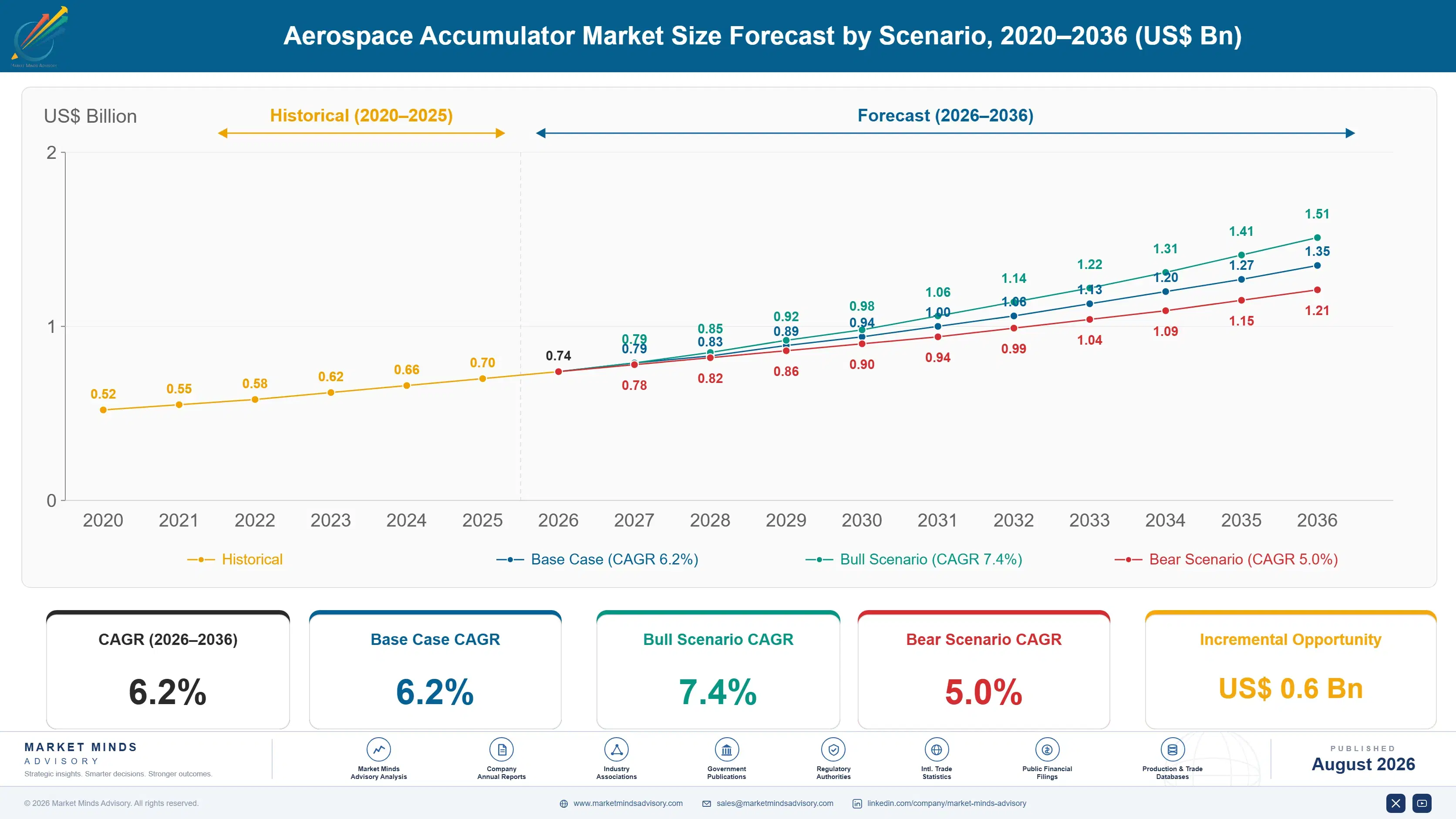
Aerospace Accumulator Market Forecast Scenarios

aerospace-accumulator-market-size-forecast-scenario-1787313451986
Between 2020 and 2025 the market compounded at 5.0%, and that number hides two very different periods. Commercial original equipment demand collapsed in 2020 and did not recover to pre-pandemic build rates until 2024. What carried suppliers through was aftermarket and defence: parked aircraft still required calendar-driven overhaul, and military programmes ran to schedule regardless of what commercial aviation was doing.
The base case at 6.2% rests on three mechanisms. Narrowbody build rate recovery at both major airframers pulls original equipment volume up through the decade, with single-aisle rates targeting levels neither manufacturer has previously sustained. Defence procurement across Europe and Asia has stepped up materially and carries decades of sustainment obligation behind it. The third mechanism is fleet age: a large installed base is passing through the overhaul intervals where accumulators get replaced rather than inspected.
The bull case at 7.4% turns on airframers holding announced rate increases, which would lift original equipment volume well above the base assumption and pull qualification work forward for new suppliers. The bear case at 5.0% is a repeat of supply chain constraint: titanium forging capacity and certified castings both remain tight, and a shortage caps deliveries regardless of what order books say.

What Actually Governs Aerospace Accumulator Value

An accumulator is a pressure vessel with a separator inside it. That is the entire device. What makes it an aerospace product rather than an industrial one is the qualification file behind it, which runs to thousands of pages and takes three to four years to assemble.
TOP FIVE CONCENTRATION58%Share held by the five largest qualified aerospace suppliers
AVERAGE UNIT PRICE$4,200Typical realised price for a qualified flight-critical accumulator
AFTERMARKET REVENUE SHARE54%Portion of supplier revenue from spares and overhaul
QUALIFICATION LEAD TIME36 to 48 monthsTime from design freeze to certified production release
INSTALLED BASE31,500 aircraftCommercial and military platforms carrying qualified accumulator hardware
ALLOY COST SHARE44% of COGSForged alloy content as portion of manufactured unit cost
The commercial consequence is that this market barely competes on product. Once a part number sits on a type certificate, changing it means requalification, and no airframer or operator undertakes that without a compelling reason such as an obsolescence notice or a repeated service failure. Suppliers therefore compete intensely at programme launch, then hold the position for the platform's entire production and service life. Spares pricing across that period carries very little pressure, which is why aftermarket now supplies more than half of most participants' revenue.
Construction type is where genuine technical change is happening. Bladder accumulators depend on an elastomer diaphragm that permeates nitrogen slowly, hardens with thermal cycling and eventually requires replacement on a calendar interval regardless of flight hours. Welded metal bellows remove that failure mode entirely, at higher unit cost and greater weight, and they are winning positions on new high-cycle applications and on spacecraft where servicing is impossible.
"The uncomfortable truth in this business is that the best commercial outcome comes from designing a part in 2027 that somebody still has to buy in 2065. Nobody in industrial hydraulics thinks that way, and it is exactly why industrial suppliers keep failing to cross over."
Practice Director, Aerospace Components and Systems, Market Minds Advisory · MMA

Market Trends

Metal Bellows Construction Displaces Elastomer On High-Cycle Applications

Welded metal bellows separators are taking positions that bladder accumulators held for four decades, and the reason is service interval rather than performance. An elastomer bladder permeates nitrogen, hardens under thermal cycling and requires replacement on a calendar schedule whether or not the aircraft has flown. A bellows unit removes that failure mode and extends the interval substantially, which matters most on high-utilisation commercial fleets and on spacecraft where no servicing is possible at all. Unit cost runs roughly 2.5 times a comparable bladder accumulator, and operators increasingly accept it on total cost of ownership grounds.
Market Impact: Adds 12 accumulators per airframe
Additive Manufacturing Enters Certified Accumulator Housing Production

Laser powder bed fusion has moved from prototype work into qualified production for accumulator housings and manifold blocks, and several suppliers now hold Federal Aviation Administration approval for additively manufactured pressure-containing parts. The commercial driver is titanium buy-to-fly ratio: conventional forging and machining discards a large share of an expensive billet, while additive builds close to net shape. Qualification remains slow and process control requirements are demanding, but the material saving on titanium components is substantial enough that every major participant now runs a certified additive programme alongside conventional manufacturing.
Market Impact: Generates 40 years sustainment reve

Market Opportunities and Growth Drivers

Narrowbody Production Rate Recovery Drives Original Equipment Volume

Both major airframers are working toward single-aisle build rates above anything either has previously sustained, and every airframe carries between four and twelve accumulators across landing gear, flight control, braking and emergency systems. Supplier release schedules now run well ahead of delivery, so accumulator demand leads aircraft handover by roughly nine months. Rotorcraft and business jet production add further volume on top. The genuine constraint is not order intake but qualified capacity, since certified forging and welding capability cannot be added quickly and no supplier will risk a rate break.
Market Impact: Requires 48 months to qualify

Defence Procurement Expansion Creates Decades Of Sustainment Demand

European defence spending has risen sharply since 2022, and Asian procurement has followed on a similar trajectory. Fighter, transport and rotorcraft acquisitions all carry accumulator content, but the more valuable consequence is sustainment: a military platform generates spares and overhaul revenue for thirty to forty years after delivery, at pricing that faces very little competitive pressure because the part number is locked to the type certificate. Fleet life extension programmes on existing aircraft add a second stream, and those programmes typically replace accumulators outright rather than overhauling the existing units.
Market Impact: Lead times exceed 60 weeks

Market Restraints and Challenges

Qualification Timelines Block New Entry And Freeze Incumbency

Certifying an accumulator onto a platform takes 36 to 48 months and costs several million dollars before a single unit ships. The root cause is regulatory: pressure-containing flight-critical hardware requires burst testing, fatigue cycling, environmental qualification and full material traceability, none of which can be compressed meaningfully. Commercially this protects incumbents and starves the market of pricing pressure, but it also means airframers cannot second-source quickly when a supplier stumbles. Participants are responding by pre-qualifying designs ahead of programme launch and by holding certified capacity in reserve for airframer rate increases.
Market Impact: Extends service interval 3 times

Titanium And Forged Alloy Supply Remains Persistently Tight

Forged alloy content is roughly 44% of manufactured unit cost, and the qualified supply base for aerospace-grade titanium and stainless forgings is small. The root cause is that sanctions on Russian titanium removed a substantial share of world supply from Western programmes after 2022, and replacement capacity requires years of qualification before it can ship flight hardware. Commercially this caps output regardless of order intake. Participants are responding by qualifying additive manufacturing routes, by extending forging contracts to five and seven year terms, and by redesigning parts around available billet sizes.
Market Impact: Cuts titanium waste by 65%
4 additional market trends, 3 additional growth drivers, and 2 additional restraints and challenges are covered in the full report. Contact sales@marketmindsadvisory.com to access the complete intelligence.

Segment CAGR and Growth Architecture

Segmentation follows accumulator construction type, because the separator design determines service interval, operating pressure ceiling, weight, unit cost and which applications a part can legally be qualified onto. Every commercial decision in this market, from platform positioning through to aftermarket pricing and overhaul interval, follows directly from that one engineering choice made at design.
aerospace-accumulator-market-market-share-analysis-1787313452516

Metal Bellows Accumulator

The fastest segment at 9.3%, a full 1.50 times the market rate, covering accumulators using a welded metal bellows as the separator between gas and hydraulic fluid instead of an elastomer bladder or a sealed piston. The commercial argument is service interval. Metal permeates no nitrogen, hardens under no thermal cycling and carries no calendar-driven replacement requirement, which removes the maintenance event that bladder units impose whether or not the aircraft has flown. Unit cost runs roughly 2.5 times a comparable bladder accumulator and the assembly weighs more, both of which airframers resist. What is winning positions anyway is spacecraft and satellite work, where servicing is impossible, and high-utilisation commercial fleets where total cost of ownership decides.
CAGR 9.3%

Piston Accumulator

Growing at 7.1% on accumulators using a sealed piston running in a honed cylinder bore, which handles the highest operating pressures in this market and tolerates large volume displacement without fatigue. Landing gear extension and emergency braking systems favour them for exactly that reason. Growth comes from rising system pressures on newer platforms: as airframers move hydraulic architecture toward 5,000 pounds per square inch and above, bladder construction reaches its practical ceiling and piston units take the application by default. What limits the segment is seal friction and the wear that follows it, since dynamic seals in a piston bore degrade in a way that a welded metal separator simply does not, and overhaul intervals reflect that difference clearly.
CAGR 7.1%
Full segment breakdown across 5 segments available in the complete report.

Regional Architecture and Country Demand Map

North America holds 39% of value on fleet size, qualified manufacturing concentration and overhaul volume combined, while Western Europe follows closely on Airbus and a deep tier structure. Growth runs fastest across South Asia and Pacific, where defence offset policy is actively building domestic capability.

North America

Note: North America holds 39% against a 22 to 32% band because the United States operates the world's largest commercial and military fleet and hosts the majority of qualified hydraulic component manufacturing. Boeing narrowbody and widebody rate recovery drives original equipment demand, while the defence budget sustains a separate and less cyclical order stream across fighter, rotorcraft and transport programmes. The aftermarket matters more here than anywhere else: American carriers and third-party overhaul shops process a very large share of world accumulator repair and replacement volume, and Federal Aviation Administration part approval rules keep that work inside a qualified supplier base that took decades to build. No other region combines all three advantages.
Share: 39% | CAGR: 5.8% (2026 to 2036)

Western Europe

Airbus final assembly at Toulouse and Hamburg anchors this region, and the tiered supply structure beneath it is unusually deep. Safran and Liebherr-Aerospace both manufacture accumulators for landing gear and flight control applications, and Hydro Leduc supplies the French rotorcraft programmes. Military demand has firmed considerably since 2022, with Eurofighter, Rafale and A400M order books extending and several national air forces funding fleet life extension work that pulls accumulator overhaul volume forward. European Union Aviation Safety Agency certification requirements mirror American practice closely enough that suppliers holding both approvals move product across the Atlantic without redesign, which most of the established participants do. Rotorcraft content is disproportionately important to the regional total.
Share: 26% | CAGR: 4.8% (2026 to 2036)
Regional intelligence for 5 additional markets available in the complete report: East Asia, South Asia and Pacific, Latin America, Middle East and Africa, Eastern Europe. Contact sales@marketmindsadvisory.com.
aerospace-accumulator-market-country-cagr-analysis-1787313453043

Where Accumulator Margin Is Actually Made

Four positions separate suppliers earning aerospace margins from those running machine shops at industrial rates: winning qualification at programme launch rather than chasing it later, owning the aftermarket channel behind the installed base, holding certified additive capability for titanium parts, and building welded bellows manufacturing capability before the applications that require it are actually awarded.

Win Qualification At Programme Launch Not After

Qualification takes 36 to 48 months and costs several million dollars, and once a part number sits on a type certificate it stays there for the platform's entire life. Suppliers positioned during airframer design definition capture that position at development pricing; those arriving afterwards face requalification economics that almost nobody accepts. The difference in lifetime programme value between winning at launch and winning nothing runs to 15 to 25 times the original equipment revenue, because spares and overhaul follow the type certificate rather than following any competitive process at all afterwards.
Market Impact: Returns up to 25 times original pro

Own The Aftermarket Channel Behind Installed Hardware

Aftermarket already supplies 54% of revenue across this market, and it earns gross margins roughly double original equipment work, because spares pricing on a locked part number faces almost no competitive test at all. Suppliers operating their own approved repair stations capture the overhaul labour as well as the parts, adding 18 to 24 points of margin on every unit that comes back. The alternative is watching independent shops take the work using surplus parts, which erodes both the revenue and the accumulated service data that informs the next design generation entirely.
Market Impact: Adds 24 margin points across all ov

Qualify Additive Routes For Titanium Pressure Housings

Forged alloy is roughly 44% of manufactured cost, and conventional machining discards a very large share of every titanium billet long before the finished part exists. Certified laser powder bed fusion builds close to net shape and cuts material consumption by around 65% on complex housings, which converts directly into gross margin on an input that has been tightly supply-constrained since 2022. Qualification remains slow and process control is demanding, but those suppliers already holding regulatory approval are protected from exactly the billet shortage that currently caps their competitors' output.
Market Impact: Cuts material cost roughly 65% per

Build Bellows Capability Ahead Of Application Awards

Metal bellows accumulators grow at 9.3% and are steadily taking new high-cycle and spacecraft positions away from bladder construction, but welded bellows manufacturing requires specialist equipment, process qualification and welding expertise that all take years to establish properly. Suppliers building that capability well before the awards arrive win those applications outright; those responding afterwards find the qualification window has already closed on them. Bellows units realise roughly 2.5 times bladder pricing at comparable capacity, so the segment carries the best unit economics available anywhere in this market as things currently stand.
Market Impact: Realises 2.5 times standard bladder

Who Controls the Margin Pool

Concentration sits at 58% for the top five measured on qualified platform positions held, the basis used throughout this section. Parker Hannifin and Eaton lead on breadth of qualification across commercial and military airframes, with Collins Aerospace, Safran and Liebherr-Aerospace holding strong but more programme-specific positions. The gap to the next tier is wide and has not moved much, because qualification incumbency does not erode the way ordinary commercial share does.
Competitive activity runs on three fronts. Bellows manufacturing capability is the first, with several participants investing in welded separator capacity ahead of application awards. Certified additive manufacturing is the second, driven by titanium cost and availability rather than by any performance argument. The third is repair station coverage, where suppliers are buying or building approved overhaul capacity to keep aftermarket work from drifting to independent shops.

Pressure is emerging from two directions. Chinese and Indian suppliers are qualifying domestic accumulator production under content and offset requirements that foreign primes cannot refuse. Separately, independent repair stations using surplus parts continue to take overhaul volume from original manufacturers. Rankings shift slowly here, but they shift on the next generation of platform awards rather than on anything happening in the current fleet.
aerospace-accumulator-market-company-positioning-matrix-1787313453553

Competitive Moat and Risk Dimensions

PARKER HANNIFIN

Moat: Breadth of qualified positions

Qualification across a very large number of commercial and military platforms means no single programme loss materially damages the position, and airframers designing new aircraft find an existing qualified supplier already holding comparable applications. That incumbency compounds, because prior qualification files shorten the certification path on the next programme considerably.
PARKER HANNIFIN

Risk: Industrial portfolio capital competition

Aerospace competes internally for capital against a very large industrial hydraulics and motion control business, and investment cases are judged against returns available elsewhere in the group. Bellows capacity and certified additive capability both require patient capital ahead of revenue, which is precisely the profile that loses internal competitions when industrial demand is strong.
EATON

Moat: Integrated hydraulic system position

Supplying complete hydraulic power generation and distribution systems rather than discrete components puts the accumulator specification decision inside the company rather than out at an airframer procurement desk. That architectural position is far harder to displace than a component win, and it carries the rest of the hydraulic content along with it on every new platform.
EATON

Risk: Exposure to airframer rate breaks

System-level positions concentrate revenue on a smaller number of platforms, so a rate reduction at a single airframer flows through more sharply than it would for a supplier spread across many programmes. Recent build rate volatility at both major manufacturers has shown how quickly that exposure translates into unabsorbed certified capacity.

Players Tracked

Prominent Players

Parker Hannifin
Eaton
Collins Aerospace
Safran
Liebherr-Aerospace

Other Key Players

Moog
Triumph Group
Arkwin Industries
Hydro Leduc
HYDAC International
Servotronics
Sitec Aerospace
Senior Aerospace
Ducommun
AMETEK
Meggitt
Bosch Rexroth
Nabtesco
Sumitomo Precision Products
Hindustan Aeronautics Limited

Recent Developments

FEBRUARY 2025

Certified additive production approved for titanium accumulator housings

A leading supplier received full regulatory approval covering laser powder bed fusion production of titanium pressure-containing accumulator housings at its main plant, which moves additive manufacturing out of prototype work and directly into certified flight hardware for the first time on this particular class of pressure-containing component.
Signal: Titanium billet cost rather than any perfo
MAY 2025

Welded bellows accumulator capacity commissioned for spacecraft applications

A European participant commissioned dedicated welded metal bellows manufacturing capacity at its French site, targeting launch vehicle and satellite propulsion applications where no in-service maintenance of any kind is possible and elastomer separators are therefore excluded from consideration entirely by mission planners at the outset.
Signal: Bellows capability is being built ahead of
SEPTEMBER 2025

Indian offset agreement places accumulator work with domestic supplier

A foreign prime placed hydraulic accumulator manufacturing with an Indian partner under defence offset obligations attached to a fighter procurement, transferring full qualification support and process documentation alongside the work package itself in an arrangement that runs across several years and covers subsequent production batches.
Signal: Offset and content policy rather than comm

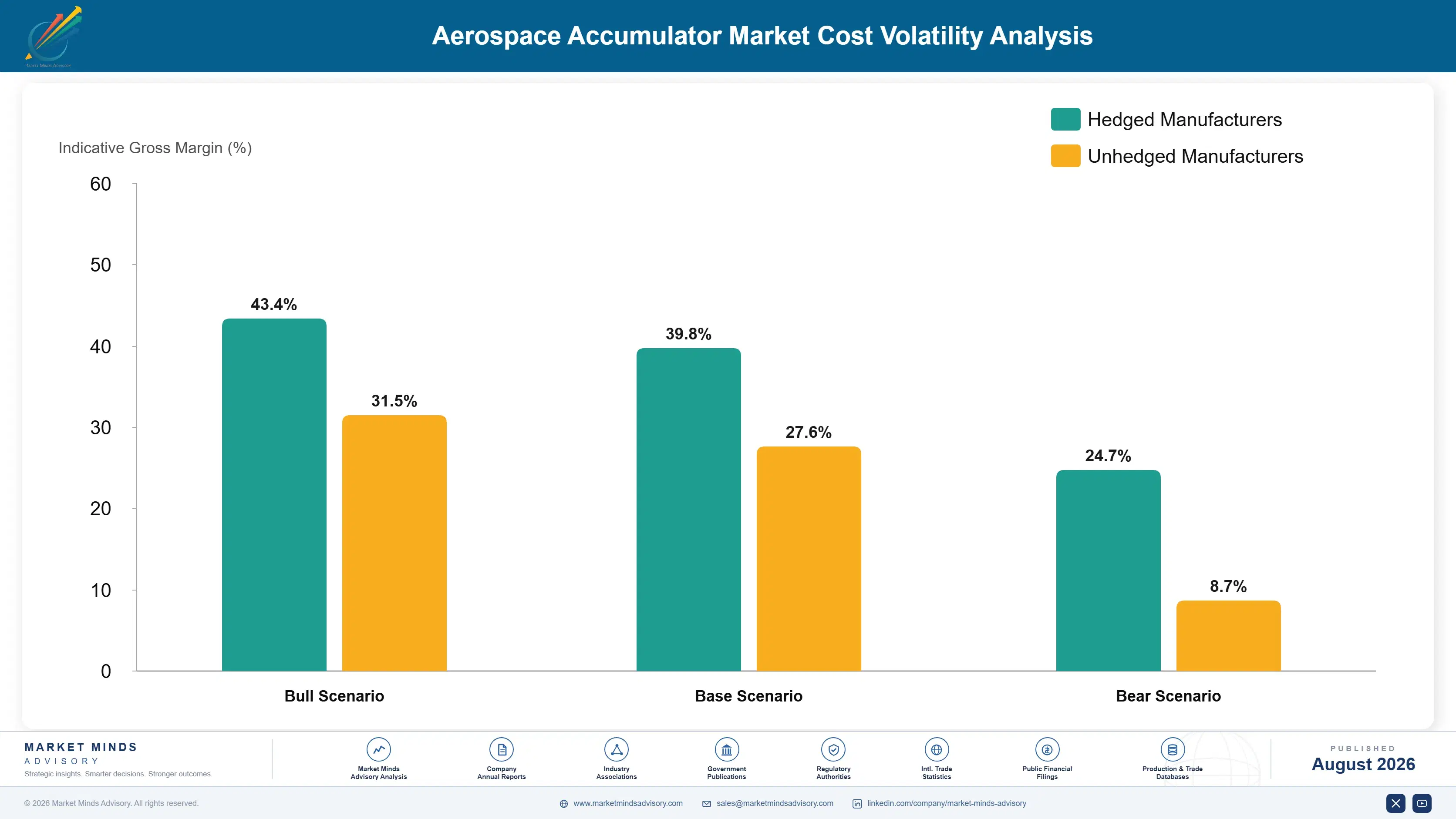
What Drives Accumulator Input Cost

Forged titanium and stainless alloy make up roughly 44% of manufactured unit cost, and the qualified supply base is narrow. Most aerospace-grade titanium billet comes from a handful of mills in the United States, Japan and Western Europe. Elastomer bladders add around 9%, sourced from specialist compounders holding aerospace material approvals, and precision machining, welding and testing labour account for a further 21%.
Sanctions on Russian titanium after 2022 removed a substantial share of Western programme supply, and lead times for aerospace-grade billet extended past sixty weeks while pricing rose sharply. Suppliers holding long-term forging contracts absorbed the disruption; those buying on shorter terms found allocation cut. Safran Annual Report 2025 and Parker Hannifin Annual Report 2025 both identify raw material availability and inflation as continuing constraints on component output rather than a resolved issue.

The disadvantage mechanism is contract tenure rather than price. Suppliers holding five and seven year forging agreements at qualified mills ship to schedule while competitors buying on annual terms get allocated and miss delivery dates, which in aerospace damages the customer relationship far more than the cost difference does. Exposure varies by geography too: Japanese and Chinese suppliers source domestically and were far less affected.
aerospace-accumulator-market-cost-volatility-analysis-1787313453747

Secure multi-year forging agreements at qualified mills

Five and seven year commitments at approved mills convert an allocation risk into a contractual entitlement, which matters more than price when billet is short. The cost is take-or-pay exposure if build rates fall below plan. Suppliers that held such agreements through the post-2022 squeeze shipped to schedule while shorter-term buyers missed airframer delivery dates repeatedly.

Qualify additive manufacturing routes for complex housings

Certified laser powder bed fusion builds close to net shape and cuts titanium consumption by around 65% on complex pressure housings, which reduces exposure to billet pricing and availability at the same time. Qualification takes years and demands rigorous process control, but approved suppliers are insulated from precisely the shortage that constrains competitors without the capability.

Redesign parts around commonly available billet dimensions

Components engineered to consume standard billet sizes rather than bespoke forgings widen the qualified mill options considerably and shorten lead times. The engineering effort is modest at design stage and effectively impossible once a part is certified, so the decision has to be taken during development. Several participants now apply the constraint as a formal design rule.

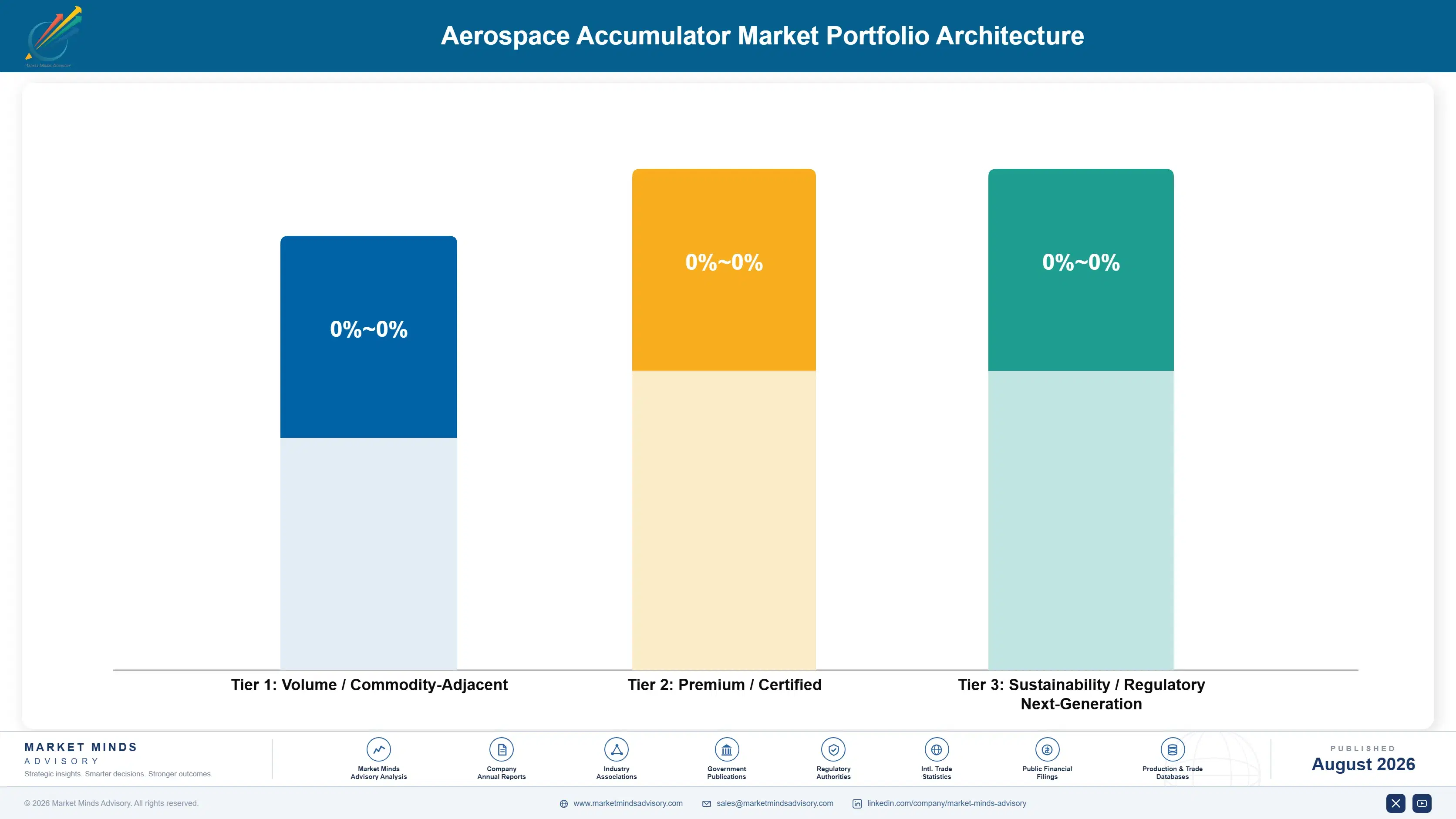
Portfolio Architecture for Margin Defence

Portfolio economics here divide on qualification status and revenue timing rather than on product sophistication. Original equipment accumulator supply into a competitively awarded programme earns gross margins in the high teens to low twenties, because airframer procurement negotiates hard at launch and that development pricing then carries forward into the initial production years across the full delivery schedule.
The premium tier is aftermarket. Spares and overhaul on qualified installed hardware face almost no competitive test, since the part number is locked to the type certificate and an operator replacing it has one approved source. Margins run in the high thirties to mid forties, and the revenue arrives on schedule regardless of what current airframer production rates happen to be doing that year.

Above both sits specialised construction: metal bellows units for spacecraft and high-cycle applications, and accumulators qualified for extreme environmental envelopes. Volumes are small and qualification cost per position is high, but pricing runs at multiples of standard bladder product and the customer base treats availability as more important than unit cost, which holds margins in the high forties right across the whole category.

Volume / Commodity-Adjacent

Original equipment supply into competitively awarded commercial programmes. Airframer procurement negotiates development pricing hard at launch and it carries into early production years, holding margin well below what the same part earns later as a spare.
Gross Margin: 17 to 23%

Premium / Certified

Spares and overhaul on qualified installed hardware. The range is wide because it spans straight parts sales through to full repair station work where the supplier captures labour, and because military spares price differently from commercial.
Gross Margin: 36 to 45%

Sustainability / Regulatory / Next-Generation

Metal bellows units, spacecraft-qualified accumulators and extreme envelope hardware. The range reflects the gap between commercial bellows applications and single-mission space products, where availability outweighs unit cost entirely and always has.
Gross Margin: 44 to 52%
aerospace-accumulator-market-portfolio-architecture-1787313454237

High-value Sub-segments and Strategic Watch-out

Spacecraft And Launch Vehicle Bellows Units

High value and high growth together. Servicing is impossible once a vehicle launches, so elastomer separators are excluded outright, and launch cadence has risen faster than any commercial aviation metric while buyers weigh availability and reliability far above delivered unit cost in every procurement decision.
Gross Margin: 46 to 54%

Military Spares And Sustainment Contracts

High value on moderate growth. Military platforms generate spares demand for thirty to forty years at pricing that faces almost no genuine competitive test at all, and European and Asian procurement expansion since 2022 has extended those sustainment obligations considerably further out than previous planning assumptions allowed.
Gross Margin: 38 to 46%

Commercial Original Equipment Supply

The volume core that keeps certified capacity loaded and secures the far richer aftermarket position sitting behind it. Margins sit low because airframer procurement negotiates development pricing hard, but no supplier ever reaches the far more profitable spares business without first winning the position here.
Gross Margin: 17 to 23%

Legacy Bladder Accumulator Product

The strategic watch-out in this portfolio. The installed base is enormous and still generates dependable annual replacement revenue, but the new high-cycle applications are all moving toward bellows and piston construction, so the installed base slowly shrinks as the older platforms carrying it retire from service.
Gross Margin: 20 to 27%

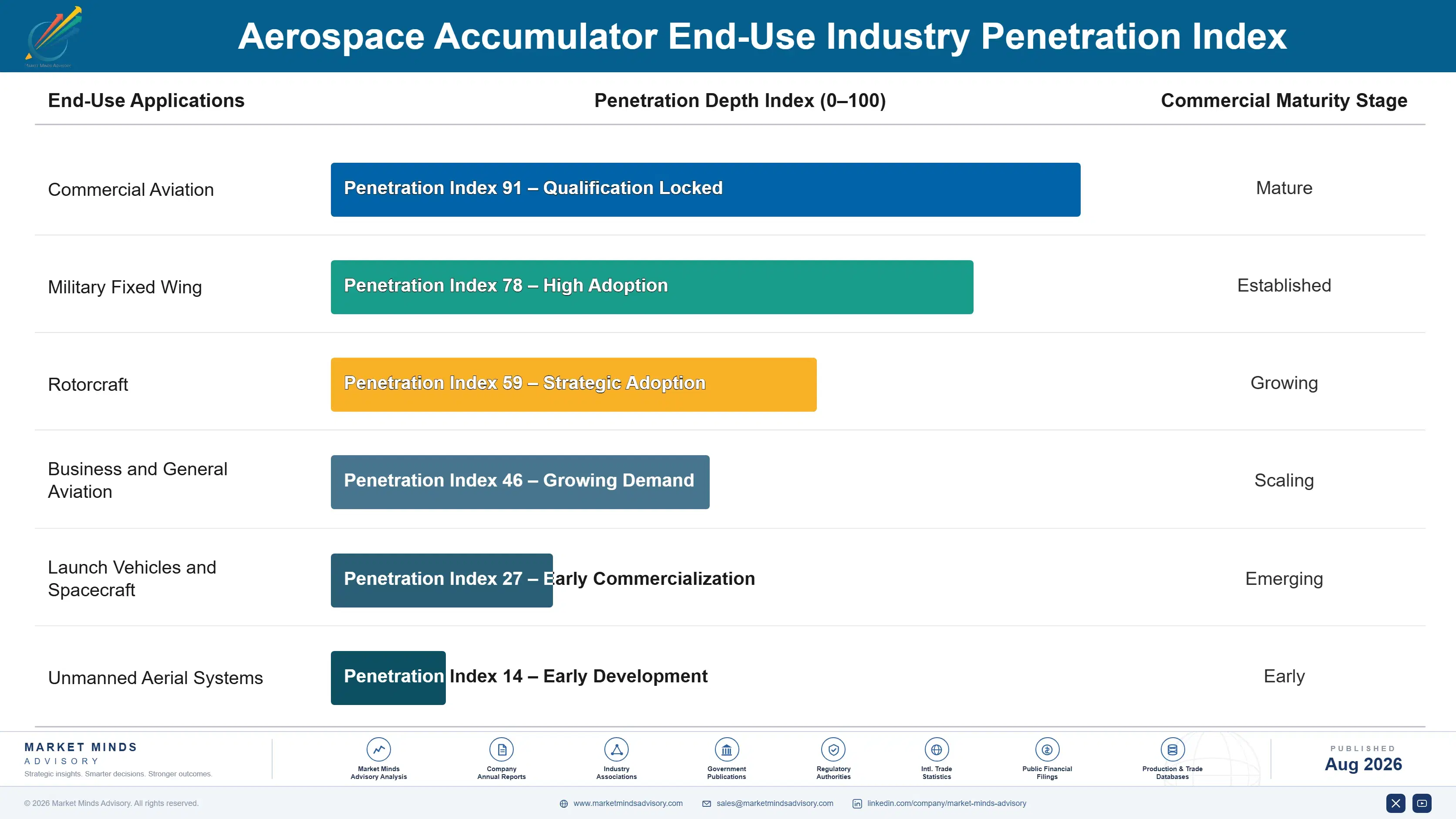
How Accumulator Demand Repeats

The annuity in this business is written into the type certificate. An accumulator qualified onto a platform generates spares and overhaul revenue for the entire production and service life of that aircraft, which routinely runs forty years, and the pricing on that revenue faces no competitive test because the operator has exactly one approved source. Original equipment supply is effectively the cost of acquiring the annuity.
Stickiness varies by end-use rather more than the certification logic suggests. Military sustainment is the deepest, since programme offices contract spares provision for decades and rarely requalify. Commercial airline demand is nearly as sticky but leaks to independent repair stations using surplus parts, which take overhaul labour that the original manufacturer would otherwise capture. Business aviation and rotorcraft operators sit between the two, and spacecraft customers are the stickiest of all because no alternative qualified source generally exists.

The buyer profile has shifted generationally. Procurement decisions once sat with airframer component engineers who knew the hydraulic architecture intimately. Today integrated system contracts push the choice to programme managers evaluating whole subsystems on weight, cost and schedule, which favours suppliers offering system-level scope over component specialists.
aerospace-accumulator-market-end-use-penetration-index-1787313454722

Where To Compete And Why

These are among the four positions where our research anticipates prominent divergence between winners and laggards over the coming forecast period. Each is grounded in the demand model, the regulatory perimeter, and the announced capacity pipeline.
01 / PROGRAMME LAUNCH QUALIFICATION

Win the certificate or win nothing at all

Qualification takes 36 to 48 months and locks a part number onto a type certificate for the platform's entire life, which routinely means forty years of spares revenue at pricing nobody contests. Suppliers positioned during airframer design definition capture that annuity; those arriving later face requalification economics that operators and airframers almost never accept. Lifetime programme value runs 15 to 25 times original equipment revenue, which makes launch positioning the only decision anybody takes in this business that genuinely compounds over time.
02 / AFTERMARKET CHANNEL CONTROL

Spares and overhaul carry the entire business

Aftermarket already supplies 54% of market revenue and earns gross margins roughly double original equipment work, because a locked part number leaves the operator with exactly one approved source. Suppliers running their own approved repair stations capture overhaul labour alongside parts, adding 18 to 24 points of margin on every returned unit. The alternative is watching independent repair shops take that work using surplus parts, which costs both the revenue and the accumulated field data behind the next design generation.
03 / CERTIFIED ADDITIVE CAPABILITY

Titanium economics now decide who can ship

Forged alloy is roughly 44% of manufactured cost and qualified billet has been allocated rather than freely available since 2022, which caps supplier output regardless of order intake. Certified laser powder bed fusion builds close to net shape, cuts material consumption by around 65% on complex housings and insulates the holder from exactly that constraint. Qualification is slow and process control demanding, but suppliers without the capability will keep missing delivery dates that airframers plainly remember at the next award.
04 / BELLOWS MANUFACTURING INVESTMENT

Build welded capacity before the awards arrive

Metal bellows accumulators grow at 9.3% and are taking the high-cycle and spacecraft positions that bladder construction simply cannot defend on service interval grounds. Welded bellows manufacturing needs specialist equipment, process qualification and welding expertise that all take years to establish, so responding after an award has been announced simply arrives far too late. Bellows units realise roughly 2.5 times standard bladder pricing at comparable capacity, which gives the segment the best unit economics available anywhere in this market today.

Engagement Snapshot From the Field

A live engagement with an industry participant carrying material or product regulatory and market exposure ahead of a defining policy shift, showing how our research translates into a defensible multi-year portfolio strategy.
MARKET MINDS ADVISORY · CLIENT ENGAGEMENT SUMMARY
Aerospace Accumulator Producer Strategic Portfolio Review and Transition Roadmap 2026·Investment Scenario on Aerospace Accumulator Exposure Evaluation 2025-26
CLIENT PROFILE
A European manufacturer of hydraulic components for commercial and military aircraft, with annual revenue of roughly $240 million (client-reported, unverified by MMA), of which accumulators represented about 18%. The business held strong bladder accumulator positions on legacy narrowbody and rotorcraft platforms but had won no new qualification on any clean-sheet programme in nine years, and management could see the installed base ageing beneath them.
STRATEGIC CHALLENGE
Revenue was holding on spares from platforms approaching the end of their production runs, and the replacement programmes were being qualified with competitors. The board needed to decide whether to invest in welded bellows manufacturing capability, pursue certified additive capacity for titanium housings, or accept a managed decline and harvest the existing aftermarket for as long as it lasted.
MMA APPROACH
MMA mapped every accumulator qualification position across 41 active and announced platforms, modelled spares revenue decay against published retirement forecasts for the client's installed base, and assessed the capital and timeline requirements for both capability options. Twenty-three expert interviews with airframer engineers, programme managers and repair station operators tested where the next awards would actually be decided.
KEY FINDINGS
  1. Spares revenue from the client's three largest legacy positions would decline by roughly 40% before 2034 on published fleet retirement schedules, considerably faster than management's internal planning assumption had allowed for.
  2. Eleven of the fourteen forthcoming high-cycle applications identified in the study specified or preferred welded metal bellows construction, a capability the client did not hold and could not acquire quickly.
  3. Certified additive capacity improved margin on existing product but won no new qualification positions, making it a cost programme rather than the growth programme management had been treating it as.
  4. Repair station acquisition offered faster payback than either manufacturing option, capturing overhaul labour on installed hardware the client already supplied but did not service itself.
CLIENT PROFILE
A European manufacturer of hydraulic components for commercial and military aircraft, with annual revenue of roughly $240 million (client-reported, unverified by MMA), of which accumulators represented about 18%. The business held strong bladder accumulator positions on legacy narrowbody and rotorcraft platforms but had won no new qualification on any clean-sheet programme in nine years, and management could see the installed base ageing beneath them.
STRATEGIC CHALLENGE
Revenue was holding on spares from platforms approaching the end of their production runs, and the replacement programmes were being qualified with competitors. The board needed to decide whether to invest in welded bellows manufacturing capability, pursue certified additive capacity for titanium housings, or accept a managed decline and harvest the existing aftermarket for as long as it lasted.
MMA APPROACH
MMA mapped every accumulator qualification position across 41 active and announced platforms, modelled spares revenue decay against published retirement forecasts for the client's installed base, and assessed the capital and timeline requirements for both capability options. Twenty-three expert interviews with airframer engineers, programme managers and repair station operators tested where the next awards would actually be decided.
KEY FINDINGS
  1. Spares revenue from the client's three largest legacy positions would decline by roughly 40% before 2034 on published fleet retirement schedules, considerably faster than management's internal planning assumption had allowed for.
  2. Eleven of the fourteen forthcoming high-cycle applications identified in the study specified or preferred welded metal bellows construction, a capability the client did not hold and could not acquire quickly.
  3. Certified additive capacity improved margin on existing product but won no new qualification positions, making it a cost programme rather than the growth programme management had been treating it as.
  4. Repair station acquisition offered faster payback than either manufacturing option, capturing overhaul labour on installed hardware the client already supplied but did not service itself.
RECOMMENDED STRATEGY
Phase 1: Phase one: acquire an approved repair station serving the client's own installed base, capturing overhaul labour and generating cash for the capability investment. Phase 2: Phase two: commission welded bellows manufacturing and begin pre-qualification against the two nearest forthcoming high-cycle applications identified in the mapping work. Phase 3: Phase three: qualify certified additive routes for titanium housings once bellows capacity is operating and billet exposure can be quantified accurately.
OUTCOME
The client acquired a repair station within eight months and reported aftermarket revenue up $19 million in the first full year (client-reported, unverified by MMA). Bellows capacity was commissioned nine months later, and the business has since been selected for pre-qualification on two high-cycle applications it would otherwise have been excluded from entirely.

Frequently Asked Questions

Foundational context covering the market sizes, CAGR, scope, country, region and competition that inform every finding below. This section is provided to cover basics and most often pre-purchase conversations, answered from the MMA Primary Research Dataset.

What is the current size of the Aerospace Accumulator Market?

The global aerospace accumulator market was valued at $0.70 billion in 2025, reaching an estimated $0.74 billion in 2026. That covers qualified hydraulic and pneumatic accumulators across commercial, military, rotorcraft and launch vehicle applications.

How large will the Aerospace Accumulator Market be by 2036?

MMA forecasts the market reaching $1.35 billion by 2036, an increase of $0.61 billion over the 2026 base. That represents an expansion multiple of 1.83 times across the forecast period.

What is the CAGR for the Aerospace Accumulator Market 2026 to 2036?

The base case compound annual growth rate is 6.2%, with a bull case of 7.4% and a bear case of 5.0%. Historical growth between 2020 and 2025 ran at 5.0% annually.

Which segment is growing fastest?

Metal bellows accumulators grow at 9.3%, a full 1.50 times the market rate, on service interval and spacecraft suitability. Piston accumulators follow at 7.1% as system pressures rise on newer platforms.

Who are the major companies in the Aerospace Accumulator Market?

Parker Hannifin, Eaton, Collins Aerospace, Safran and Liebherr-Aerospace lead on qualified platform positions held. Together they account for roughly 58% of qualified accumulator positions across active programmes.

Which country is growing fastest?

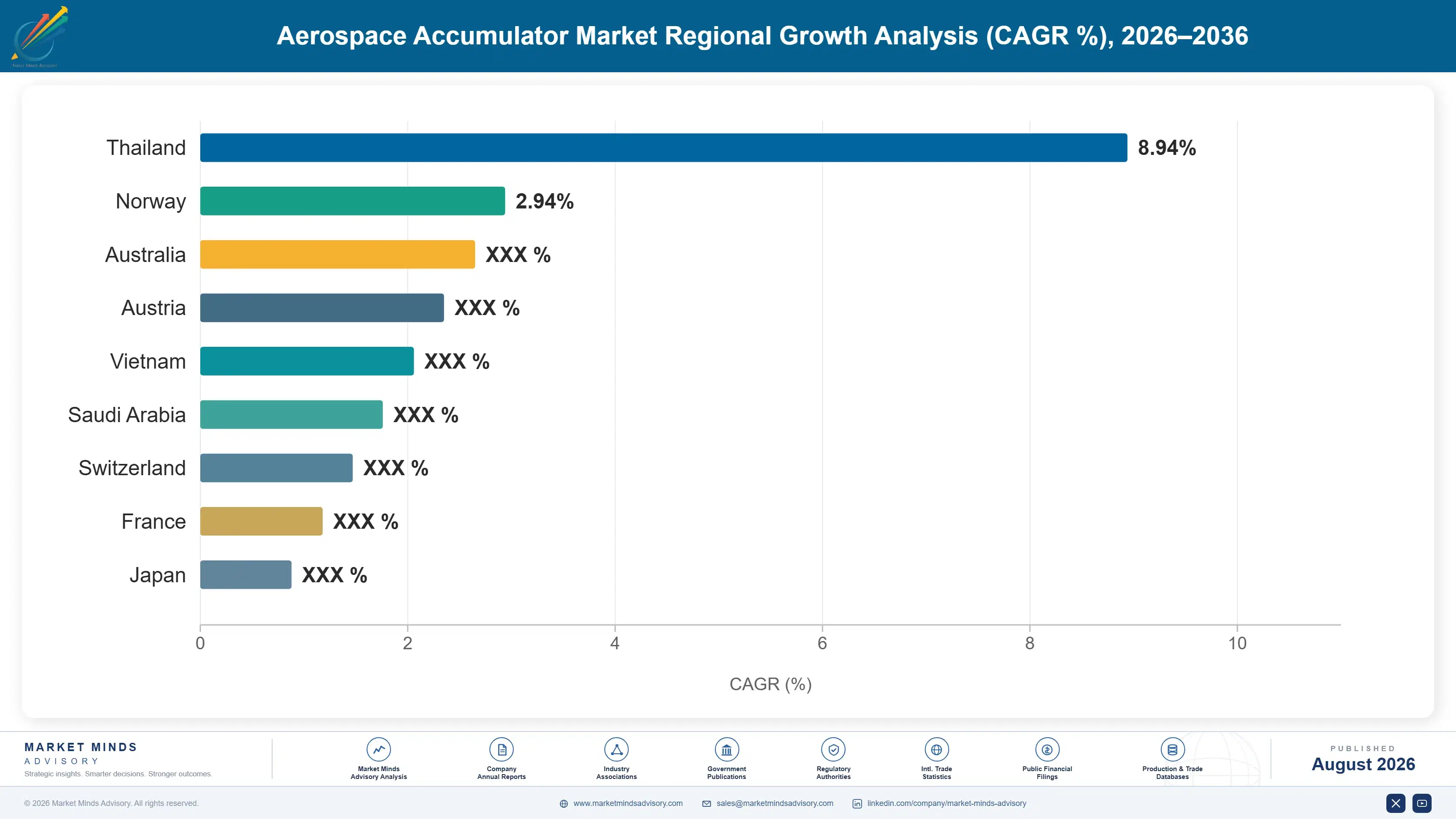
India grows fastest at 9.2% annually, driven by defence offset obligations that force foreign primes to place accumulator work with domestic suppliers. China follows closely on COMAC content localisation requirements.

Report Segmentation Architecture

The full report scope spans multiple orthogonal segmentation dimensions, with cross-tabulated demand data provided for each dimension pair. Coverage extends further to regional breakdowns, trend trajectories, and the competitive detail needed to support segment-level decision-making.

By Accumulator Construction Type

  • Metal Bellows Accumulator
  • Piston Accumulator
  • Bladder Accumulator
  • Diaphragm Accumulator
  • Spring-Loaded and Gas Cylinder Type

By End-Use Industry

  • Commercial Aviation
  • Military Fixed Wing
  • Rotorcraft
  • Business and General Aviation
  • Launch Vehicles and Spacecraft
  • Unmanned Aerial Systems

By Commercial Dimension

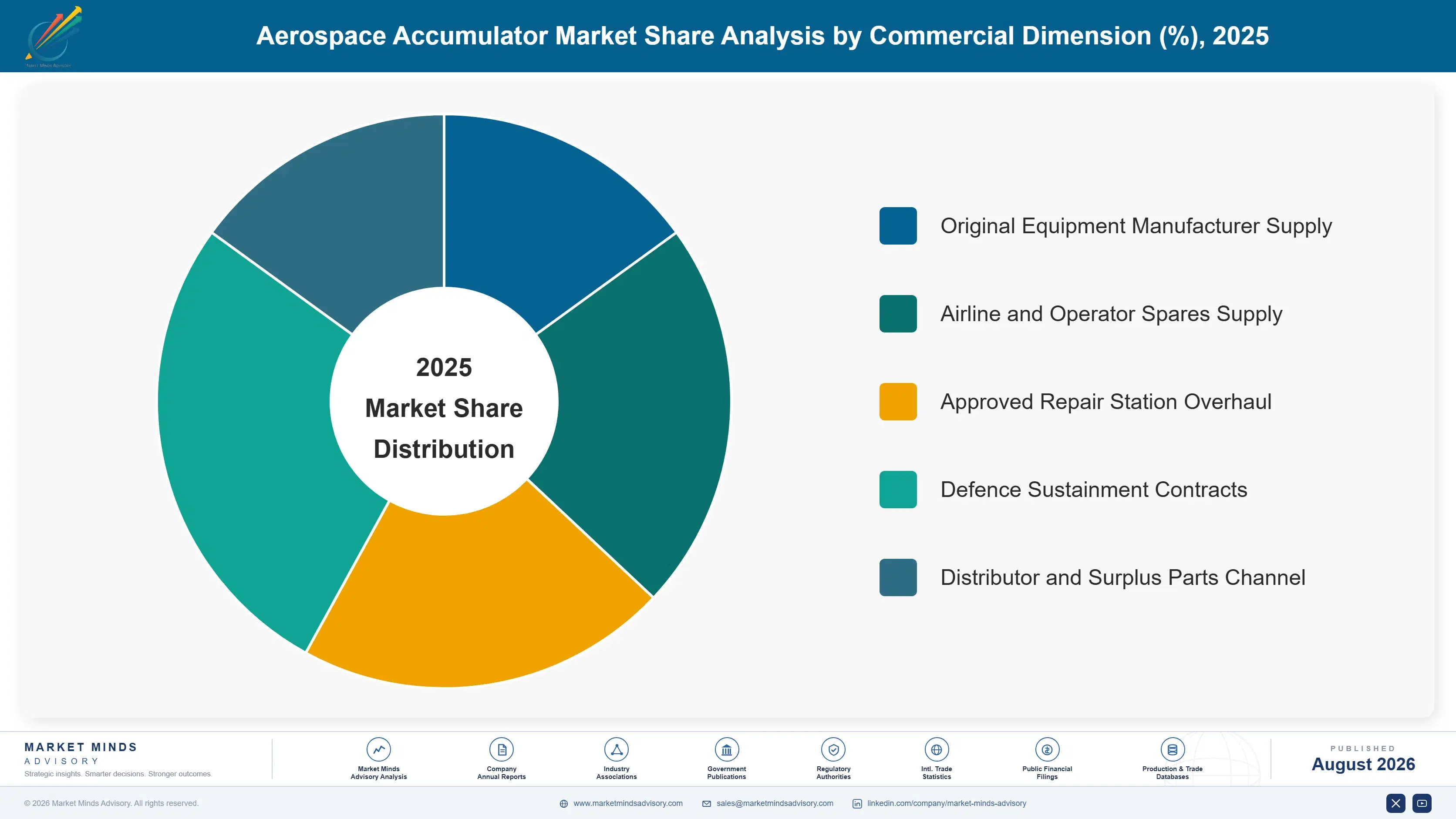
  • Original Equipment Manufacturer Supply
  • Airline and Operator Spares Supply
  • Approved Repair Station Overhaul
  • Defence Sustainment Contracts
  • Distributor and Surplus Parts Channel

By Region

  • North America
  • Western Europe
  • East Asia
  • South Asia and Pacific
  • Latin America
  • Middle East and Africa
  • Eastern Europe

Scope, Methodology, and Coverage

Every figure in this report is reproducible from documented input assumptions. The scope below maps the historical period, the forecast horizon, the segmentation dimensions, and the countries covered, alongside the underlying primary and qualitative methodology.
Historical Period
2020 to 2025
Forecast Period
2026 to 2036
Base Year
2025 (USD billions; MMA Primary Research Dataset, August 2026)
Market Definition
This report covers hydraulic and pneumatic accumulators qualified for aerospace service, spanning bladder, piston, diaphragm, welded metal bellows and spring-loaded construction fitted to commercial aircraft, military fixed wing platforms, rotorcraft, business aviation and launch vehicles. Ground support equipment accumulators, industrial hydraulic accumulators, complete hydraulic power packs and reservoir assemblies are excluded from the sizing. Overhaul and repair revenue is included where performed by the original component manufacturer or an approved repair station.
Quantitative Units
USD billions at supplier realised value; unit shipments in thousands; average realised price in USD per accumulator.
Segmentation Dimensions
By accumulator construction type; by end-use industry; by commercial dimension; by region.
Regions Covered
North America, Western Europe, East Asia, South Asia and Pacific, Latin America, Middle East and Africa, Eastern Europe
Countries Covered
United States, Canada, United Kingdom, France, Germany, Italy, Spain, Japan, South Korea, China, Australia, India, Singapore, Brazil, Mexico, United Arab Emirates, Saudi Arabia, South Africa, Poland, Czech Republic.
Key Companies Profiled
Parker Hannifin, Eaton, Collins Aerospace, Safran, Liebherr-Aerospace, Moog, Triumph Group, Arkwin Industries, Hydro Leduc, HYDAC International, Servotronics, Sitec Aerospace, Nabtesco, Sumitomo Precision Products and others.
Quantitative Methodology
Primary survey, n=3,800 respondents, Q4 2025, six countries; demand-side model with trade association cross-validation
Qualitative Methodology
47 expert interviews, Q4 2025; applied to validate demand model assumptions, identify emerging dynamics, and assess competitive positioning
Report Format
PDF and XLSX data workbook (Word format preview document)
Publisher
Market Minds Advisory
Report Code
MMA-2026-CON-872
Published
August 2026
Contact
sales@marketmindsadvisory.com | www.marketmindsadvisory.com

Purchase the full Aerospace Accumulator Market Report (2026 to 2036).

The full report sizes the aerospace accumulator market across five construction types, six end-use industries and seven regions, with qualified platform position mapping behind every value estimate. It profiles twenty global suppliers on qualification breadth, aftermarket channel control and certified manufacturing capability. Regional chapters cover certification regime differences, defence offset policy and the qualified forging supply base. Aftermarket analysis quantifies spares and overhaul economics against original equipment margins by platform age. Input cost analysis tracks titanium billet availability and certified additive qualification progress across participants.
Qualified platform position mapping across active programmes
Aftermarket versus original equipment margin analysis
Construction type adoption forecasts through 2036
Titanium billet availability and lead time tracking
Competitive position assessments across twenty global suppliers
Defence offset policy impact by regional market

Built For The People Who Decide

From boardroom strategy to bench-side execution, this report is read cover-to-cover by leaders shaping the next decade of their industry, turning demand scenarios, market dynamics and valuation benchmarks into decisions.
CXOs/ Presidents/ VPs/ Managers
M&A and Corporate Development
Strategy Teams and R&D Heads
Procurement and Product Directors
Regulatory and Compliance Leaders
Investor Relations and Equity Analysts