Market Minds Advisory
Advanced Gear Shifter System Market

Advanced Gear Shifter System Market: Shift-by-Wire Adoption and the EV Interface Redesign

Advanced gear shifter systems now face a rapid shift-by-wire adoption curve driven by electric vehicle interior redesigns, a semiconductor sourcing squeeze affecting electronic control units, and mounting safety scrutiny over ambiguous shifter feedback design.

Lead Analyst

David Horsley

Published

September 2026

Make Smarter Decisions with Customized Research Insights

Request a free sample report and evaluate market opportunities, growth trends, and competitive dynamics relevant to your business needs.

2025 MARKET VALUE$2.1BMarket Size 2025
2036 FORECAST VALUE$5.8BBase Case , 2026 to 2036
CAGR 2026 TO 20369.6 %Bull 10.9% / Bear 8.3%
INCREMENTAL OPPORTUNITY$3.5BNet 10- year value creation
EXPANSION MULTIPLE2.50x2036 value over 2026 base
Strategic Levers
M&A Pipeline
Regional Outlook
Country Rankings
Competitive Intelligence
Segmental Deep-dive
Call-Us : 91 93563 13602

Executive Snapshot and Market Trajectory

Automakers are specifying shift-by-wire electronic gear selectors faster than tier-one suppliers can qualify the semiconductor-dependent control units these systems require, creating a widening gap between vehicle program timelines and component supply readiness. Few suppliers currently serve both priorities equally well. Program timelines increasingly reflect this widening capability gap.
Touchscreen and digital integrated shifters are pulling category growth well ahead of traditional stalk-mounted and column-mounted electronic designs, as automakers redesign vehicle interiors around electric vehicle platforms lacking a mechanical transmission tunnel. East Asia commands the largest and fastest-growing volume base, anchored in China's electric vehicle production scale, while North America and Western Europe drive premium rotary dial and push-button shifter adoption in traditional automakers' flagship models. That base continues expanding steadily each year.
Competitive structure remains moderately concentrated among established automotive electronics suppliers, with the top five holding meaningful combined share. Regulatory scrutiny over shifter design ambiguity following documented rollaway incidents is compounding qualification complexity, pushing automakers toward suppliers who can demonstrate both semiconductor supply security and proven safety validation track records. Rankings among established suppliers could shift meaningfully as this scrutiny intensifies further. Timing matters greatly here.
Market Definition
The advanced gear shifter system market covers electronic and shift-by-wire gear selector systems for passenger vehicles, including rotary dial, push-button, stalk-mounted, column-mounted, console-mounted electronic, and touchscreen-integrated designs, along with their associated electronic control units and software. It excludes traditional mechanical cable-actuated shifters and excludes transmission internals downstream of the shifter interface itself.
Base Year Value
$2.1B in 2025 (MMA Primary Research Dataset, August 2026)
Forecast Period
2026 to 2036, eleven discrete annual values
CAGR
9.6% base case. Bull 10.9%. Bear 8.3%.
Fastest Growth Segment
Touchscreen and Digital Integrated Shifters: 12.5% CAGR
Fastest Growth Country
China: 10.5% CAGR
Fastest Growth Region
South Asia and Pacific: 11.6% CAGR
Largest Region
East Asia: 36% of 2025 global value
Market Leaders
ZF Friedrichshafen, Kostal Group, DURA Automotive Systems, SL Corporation, and Ficosa International. Source: MMA Analysis based on company annual reports.
Primary Survey
n=3,800 procurement and R&D decision-makers, Q4 2025, six countries
Methodology
Demand-side build-up, cross-validated against public data, 47 expert interviews

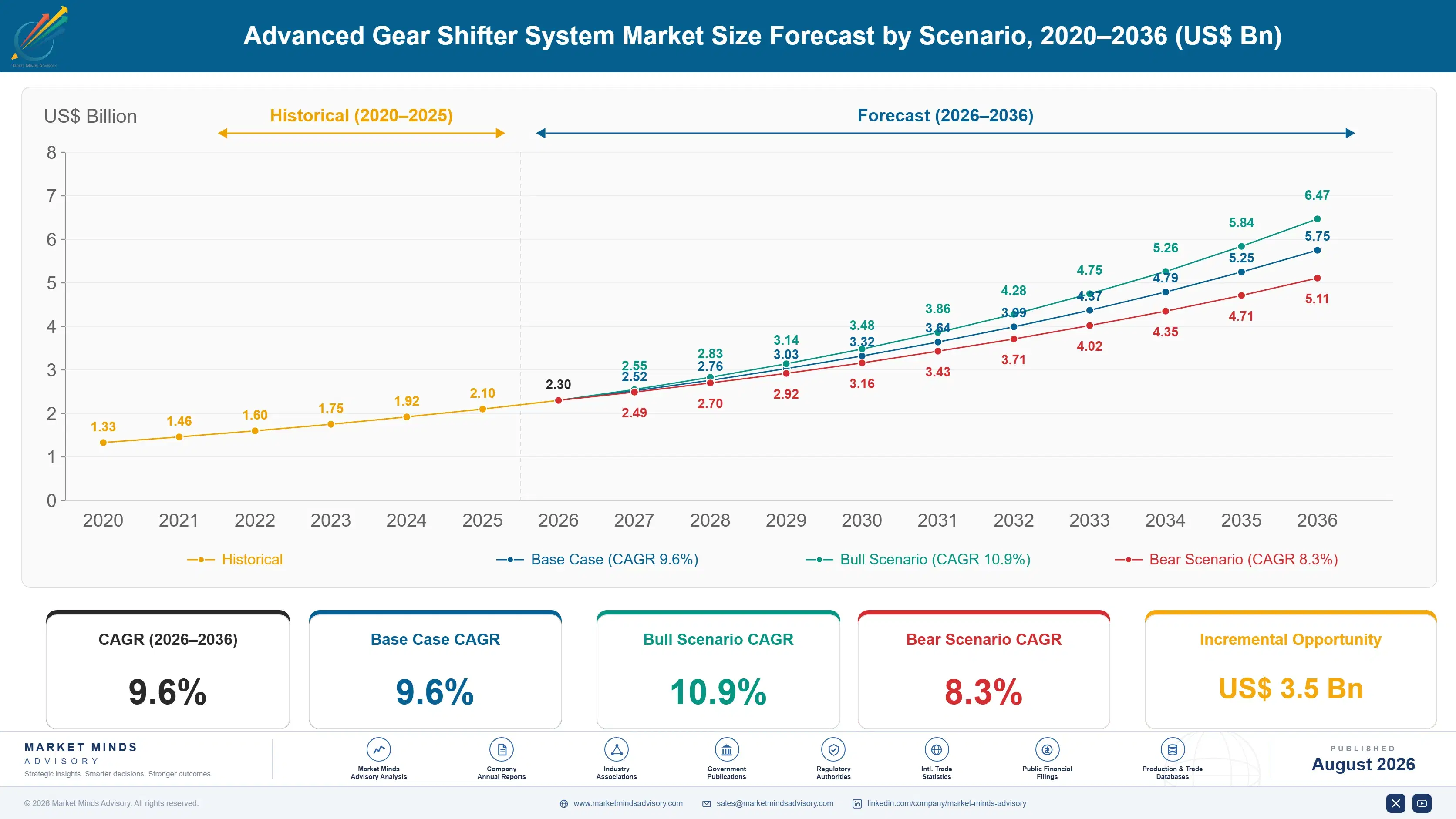
Advanced Gear Shifter System Market Forecast Scenarios

advanced-gear-shifter-system-market-trends-size-forecast-scenario-1787464252339
Between 2020 and 2025 the market grew at a historical pace of roughly 8.2 percent annually, as electric vehicle platform launches accelerated shift-by-wire adoption while semiconductor supply constraints during the middle of the period temporarily slowed several planned electronic shifter program launches across multiple automakers. Recovery in program launch pace only became evident in the final year of this period.
The base case assumes growth near 9.6 percent annually through 2036, anchored in three commercial mechanisms: expanding electric vehicle production requiring shift-by-wire interfaces given the absence of a traditional mechanical transmission tunnel, automaker interior redesign programs favoring digital and touchscreen-integrated shifter controls, and continued semiconductor supply chain stabilization enabling faster qualification of electronic shifter programs across mainstream vehicle segments. These mechanisms increasingly reinforce each other as automakers, suppliers, and regulators coordinate more closely around shared safety standards.
A bull scenario builds on faster regulatory harmonization around shifter design safety standards accelerating standardized shift-by-wire adoption across more vehicle segments, while a bear scenario centers on renewed semiconductor supply disruption or continued rollaway incident litigation slowing automaker willingness to specify electronic shifters over proven mechanical alternatives. Several suppliers are already preparing contingency plans should either scenario materialize.

Interface Redesign Racing Semiconductor Supply

Three forces are converging on the category at once: automakers are specifying shift-by-wire systems for electric vehicle platforms lacking a mechanical transmission tunnel, interior design teams are favoring digital and touchscreen-integrated shifter controls that free up console space, and semiconductor supply constraints are forcing suppliers to redesign control units around whichever automotive-grade chips remain available at acceptable lead times. This convergence is compressing decision timelines that once unfolded over multiple platform generations.
MARKET CONCENTRATIONCR5 52%top five suppliers hold a substantial combined share
ELECTRIC VEHICLE PENETRATION38%share of new electric vehicles specifying shift-by-wire systems
LEADING PRODUCING COUNTRYChinalargest single national manufacturing and assembly base overall
SEMICONDUCTOR LEAD TIME26-40 weekstypical wait time for automotive-grade control unit chips
WARRANTY CLAIM RATE1.8-2.4%share of units returned under warranty within three years
CONTROL UNIT COST SHARE44% of COGSsemiconductor and control electronics as portion of total cost
Commercially the category increasingly behaves like an automotive electronics business layered on top of traditional mechanical component manufacturing, since a supplier's ability to win new vehicle programs now depends as much on semiconductor sourcing relationships and software validation capability as on mechanical design expertise, a shift that is rewarding suppliers with broader automotive electronics portfolios over specialists in mechanical shifter hardware alone. Automakers increasingly select suppliers based on demonstrated electronics capability alone.
Over the next decade, suppliers most likely to capture disproportionate value are those investing in semiconductor supply diversification and rigorous safety validation testing ahead of regulatory scrutiny intensifying further, since automakers increasingly select shifter suppliers based on demonstrated safety track record rather than component cost alone. Suppliers slow to invest risk losing awards to competitors.
"A gear shifter used to be the simplest mechanical part in the car. Now it's a software validated, semiconductor dependent safety system that happens to also move a lever."
Director, Automotive Electronics and Drivetrain Practice · MMA Automotive Components / Electronic Drivetrain Controls Practice · August 2026

Market Trends

Touchscreen and Digital Shifter Integration Accelerating

Automakers are increasingly integrating gear selection directly into touchscreen infotainment interfaces or dedicated digital control panels, eliminating the traditional physical shifter lever entirely in favor of software-controlled selection paired with haptic or visual feedback confirmation. Several premium electric vehicle programs have launched with fully digital shifter interfaces within the past two years, signaling the design approach has moved beyond concept vehicles into mainstream commercial production. Regulatory bodies in several major markets are reviewing whether digital-only interfaces meet existing safety standards originally written for physical shifter mechanisms, creating some near-term design uncertainty for automakers pursuing this approach.
Market Impact: Lifts shift-by-wire demand by 14%
Semiconductor Supply Diversification Reshaping Supplier Selection

Tier-one suppliers are diversifying automotive-grade semiconductor sourcing across multiple chip foundries following recent supply disruption that delayed several shifter program launches, a shift that is directly influencing which suppliers automakers select for new vehicle programs. Suppliers demonstrating multi-source semiconductor sourcing are winning new program awards faster than single-source competitors, even when single-source competitors offer marginally lower component pricing. This has elevated semiconductor sourcing strategy from a procurement detail into a core competitive differentiator directly affecting new business win rates across the supplier base. Buyers increasingly treat diversified sourcing as a baseline procurement requirement.
Market Impact: Adds 9% to premium segment adoption

Market Opportunities and Growth Drivers

Electric Vehicle Production Growth Requiring Shift-by-Wire Interfaces

Continued global electric vehicle production growth is directly expanding the addressable market for shift-by-wire systems, since electric vehicle platforms typically lack the mechanical transmission tunnel that traditional cable-actuated shifters require, making electronic gear selection the default engineering approach for most new electric vehicle architectures. This platform difference means electric vehicle production growth translates almost directly into shift-by-wire system demand growth, unlike internal combustion vehicles where automakers retain a genuine choice between mechanical and electronic shifter designs based on cost and positioning considerations. Automakers increasingly plan platform architecture around this expectation from the earliest design stage.
Market Impact: Adds 18 months to validation cycles

Interior Redesign Programs Favoring Digital Console Space

Automaker interior design teams are increasingly prioritizing console space flexibility that compact electronic shifters enable relative to bulkier traditional mechanical shift levers, freeing up space for larger storage compartments, wireless charging pads, and additional cupholders that consumer research consistently identifies as valued interior features. This design preference is accelerating electronic shifter specification even in vehicle segments and price points where cost considerations might otherwise favor retaining simpler mechanical shifter designs. Automakers describe this design preference as increasingly non-negotiable across new vehicle platform reviews. Suppliers responding early to this preference capture disproportionate share of new interior design contracts.
Market Impact: Caps scaling at 12% quarterly growth

Market Restraints and Challenges

Rollaway Incident Litigation Increases Safety Validation Costs

Documented vehicle rollaway incidents linked to ambiguous electronic shifter feedback design, where drivers believed the vehicle was in park when it was not, have triggered regulatory investigations and product liability litigation across several automakers, a problem rooted in electronic shifters lacking the direct mechanical feedback traditional cable-actuated designs inherently provide. The commercial impact is that automakers and suppliers now require substantially more extensive safety validation testing before launching new electronic shifter programs, extending development timelines and adding cost relative to earlier program generations. Suppliers are increasingly incorporating redundant feedback mechanisms, including haptic and audible confirmation, as a mitigation path.
Market Impact: Lifts digital shifter adoption by 16%

Semiconductor Supply Constraints Limit Production Scaling

Automotive-grade semiconductor supply has not fully recovered to pre-disruption lead times, a constraint rooted in automotive chip manufacturing representing a small and less profitable share of overall semiconductor foundry capacity relative to consumer electronics and computing applications that foundries prioritize during periods of constrained capacity. The commercial impact is that suppliers cannot always scale production as quickly as order volumes would support, forcing occasional launch delays. Several suppliers are qualifying redundant chip sources as a mitigation path, though qualification typically requires twelve to eighteen months per source. Several automakers accept longer lead times over compromised qualification standards.
Market Impact: Shifts 11% to diversified suppliers
3 additional market trends, 4 additional growth drivers, and 3 additional restraints and challenges are covered in the full report. Contact sales@marketmindsadvisory.com to access the complete intelligence.

Segment CAGR and Growth Architecture

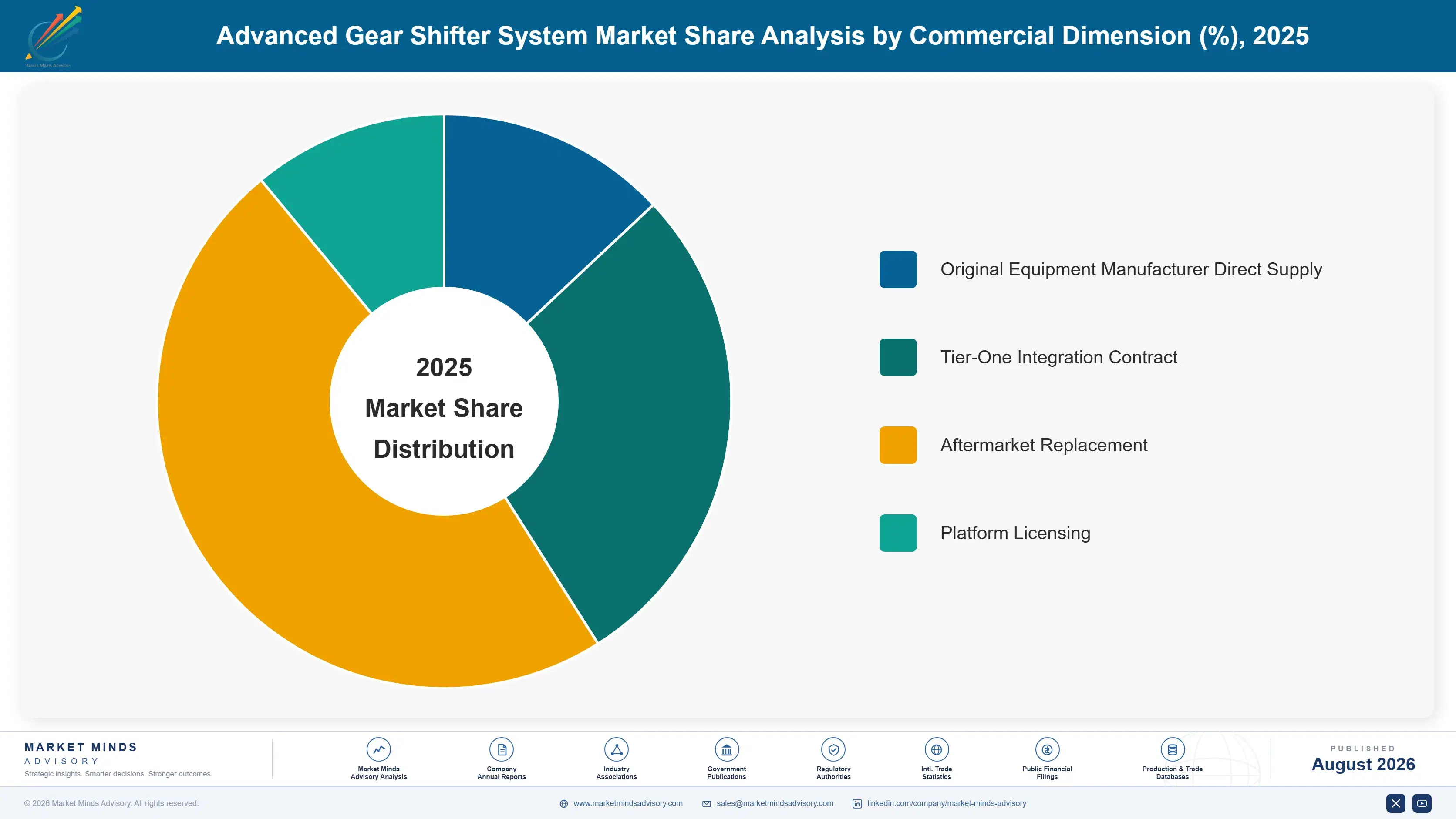
Segmentation follows shifter interface technology, since rotary dial, push-button, stalk-mounted, column-mounted, console-mounted electronic, and touchscreen-integrated designs each carry distinct engineering requirements, cost structures, and vehicle interior integration approaches despite sharing similar underlying electronic control unit architecture. Vehicle interior packaging constraints and validation requirements differ enough between these interface types that cross-segment substitution remains limited in practice.
advanced-gear-shifter-system-market-trends-market-share-analysis-1787464253244

Touchscreen and Digital Integrated Shifters

Touchscreen and digital integrated shifters are growing fastest as automakers pursue interior designs that eliminate the physical shifter lever entirely, integrating gear selection into existing infotainment displays or dedicated digital control panels to maximize console space flexibility. This segment carries the highest software validation burden among shifter technologies, since eliminating physical feedback mechanisms requires more sophisticated confirmation systems to address safety concerns regulators have raised about driver certainty regarding actual gear selection status. Premium electric vehicle programs are adopting this technology fastest, while mainstream vehicle segments remain more cautious given the additional validation cost and ongoing regulatory uncertainty surrounding fully digital interface designs. Regulatory review timelines remain the primary constraint on faster mainstream adoption across additional segments.
CAGR 12.5%

Push-Button Shifters

Push-button shifters are the second fastest growing segment, offering automakers a simpler and lower-cost path to console space savings than fully digital interfaces while still providing more direct tactile feedback than touchscreen-based selection. This design has achieved broader mainstream vehicle segment adoption than touchscreen interfaces, since push-button mechanisms require less extensive safety validation testing while still delivering meaningful interior design flexibility benefits automakers value. Several mainstream automakers have standardized push-button shifters across multiple vehicle platforms simultaneously, accelerating volume growth faster than premium-focused touchscreen designs limited to flagship models. Several automakers plan to expand this format across additional platforms. Cost-conscious mainstream buyers increasingly view this format as a meaningful upgrade over basic mechanical designs.
CAGR 10.8%
Full segment breakdown across 6 segments available in the complete report.

Regional Architecture and Country Demand Map

East Asia dominates global production and consumption volume through China's electric vehicle manufacturing scale, while North America and Western Europe anchor premium shifter technology adoption among established automakers. South Asia and Pacific scales fastest as electric vehicle and premium segment production expands regionally.. with premium adoption continuing across Western markets.

North America

United States automakers anchor regional demand, with electric vehicle programs from both established manufacturers and newer entrants driving strong shift-by-wire adoption across new vehicle launches. Premium rotary dial shifters remain popular among traditional luxury automakers seeking a distinctive tactile brand signature, while mainstream manufacturers increasingly favor push-button designs for cost efficiency. Canada follows similar adoption patterns at smaller scale, relying primarily on the same North American supplier base serving both markets. Regulatory scrutiny from the National Highway Traffic Safety Administration following documented rollaway incidents is shaping supplier safety validation requirements that increasingly influence practices in other consuming regions as well. Suppliers increasingly favor documented validation history when competing for new program awards.
Share: 24% | CAGR: 9.8% (2026 to 2036)

Western Europe

Germany, France, and the United Kingdom anchor regional demand, supported by an established premium automotive manufacturing base where rotary dial and sophisticated electronic shifter designs serve as a distinctive brand differentiation feature for luxury and performance vehicle segments. European Union vehicle safety regulations are among the most rigorous globally regarding shifter design and driver feedback requirements, pushing suppliers serving this market toward more extensive validation testing than in less regulated consuming regions. Germany's concentrated premium automotive manufacturing base gives the country outsized influence on regional shifter design trends relative to its population and overall vehicle production volume. Regional regulators increasingly coordinate standards to harmonize validation. Premium automaker brand positioning continues reinforcing this differentiation strategy across model lineups.
Share: 22% | CAGR: 8.0% (2026 to 2036)
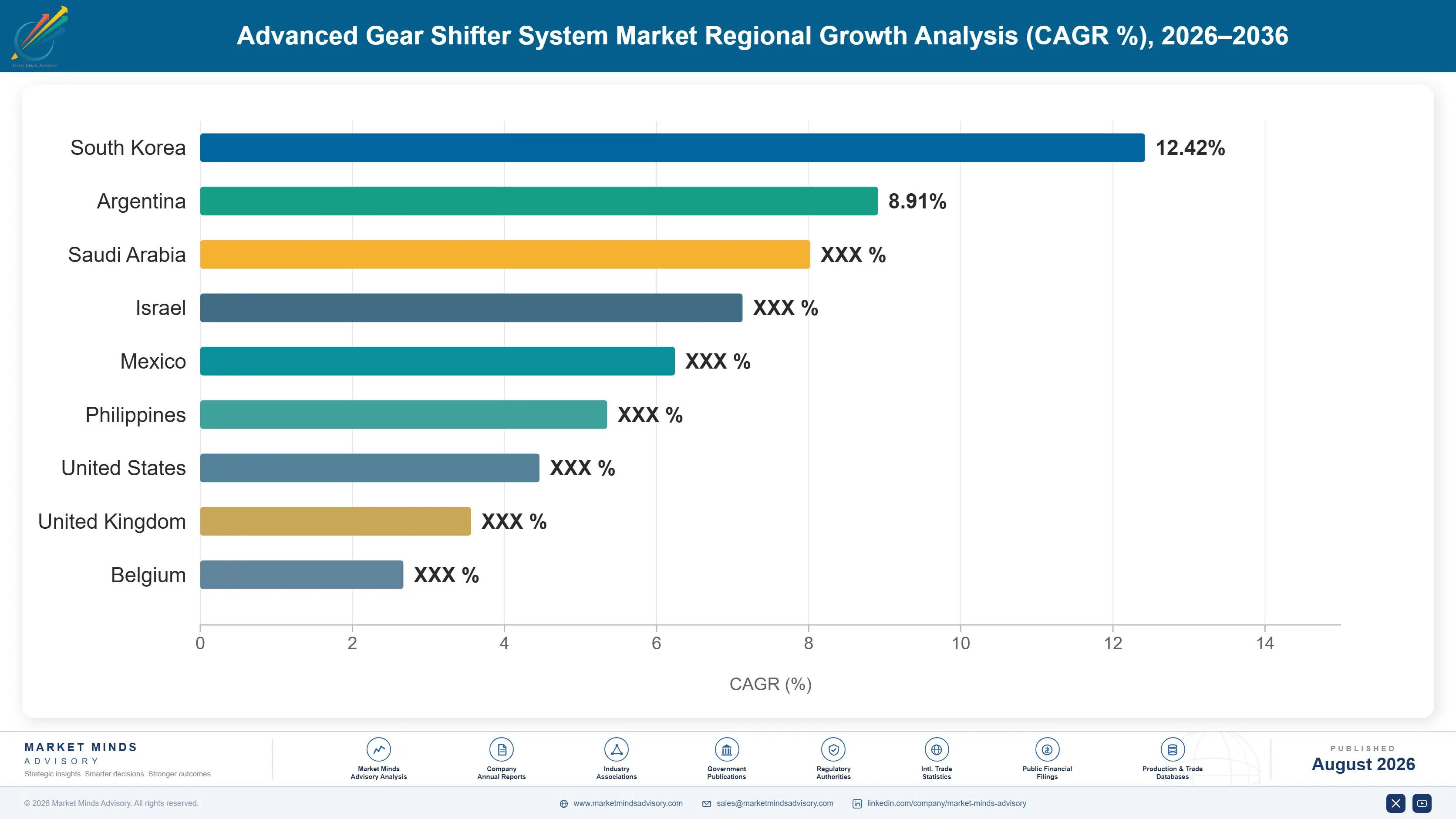
Regional intelligence for 5 additional markets available in the complete report: East Asia, South Asia and Pacific, Latin America, Middle East and Africa, Eastern Europe. Contact sales@marketmindsadvisory.com.
advanced-gear-shifter-system-market-trends-country-cagr-analysis-1787464254161

Semiconductor Security and Safety Validation Levers

Suppliers are pulling four commercial levers at once: semiconductor supply diversification, safety validation investment, digital interface software capability, and platform standardization across vehicle programs, each addressing a distinct margin opportunity created by the category's rapid electronics-driven transformation. These levers increasingly overlap, since suppliers pursuing semiconductor diversification often simultaneously expand safety validation and software capability.

Multi-Source Semiconductor Sourcing Qualification Program Overall

Qualifying automotive-grade semiconductor components from multiple foundry sources rather than relying on a single chip supplier allows tier-one suppliers to maintain production continuity during the periodic supply disruptions that have repeatedly affected the automotive semiconductor category in recent years. This qualification requires meaningful upfront engineering investment across each additional chip source but has demonstrably protected production schedules for suppliers with diversified sourcing during recent disruption events. Suppliers with diversified sourcing report winning new program awards at rates roughly 22 percent higher than single-source competitors. This diversification advantage is expected to widen further as disruption risk continues affecting the broader industry.
Market Impact: Lifts new program win rate by 22 percent

Comprehensive Safety Validation Testing Investment Program

Investing in extensive safety validation testing, including redundant feedback mechanisms and driver confirmation systems, addresses the ambiguous feedback risk that has driven recent rollaway incident litigation and regulatory scrutiny across the category. This investment requires meaningful upfront testing cost and extended development timelines but reduces long-term liability exposure and increasingly serves as a differentiating credential when automakers select suppliers for new vehicle programs. Suppliers with documented comprehensive validation report meaningfully lower warranty claim rates than competitors with less extensive testing protocols. This is estimated to cut claim exposure by roughly 15 percent.
Market Impact: Cuts warranty claim rates by roughly 15 percent

Digital Interface Software Development Capability Program

Building dedicated software development capability for touchscreen and digital shifter interfaces positions suppliers to capture the fastest-growing segment within the category, since this technology requires software validation expertise that differs meaningfully from the mechanical and basic electronic engineering capability most established shifter suppliers historically maintained. This capability requires significant talent investment in automotive software validation but opens access to premium electric vehicle programs specifying fully digital interfaces. Early movers report capturing roughly 19 percent more premium program awards than suppliers lacking comparable software capability. This software advantage is expected to widen further as more premium programs specify fully digital interfaces.
Market Impact: Captures roughly 19 percent more premium program awards

Platform Standardization Across Multiple Vehicle Programs

Developing standardized shifter platforms that can be adapted across multiple vehicle programs with minimal engineering customization reduces per-program development cost and accelerates time to market relative to fully bespoke shifter designs developed independently for each vehicle platform. This standardization requires upfront platform engineering investment but has enabled suppliers pursuing this approach to win multiple program awards from the same automaker simultaneously, capturing efficiency gains automakers directly reward through preferred supplier status and volume commitments. This has already cut per-program development spending by roughly 24 percent. Suppliers pursuing this win repeat business across successive generations.
Market Impact: Cuts per-program development cost by roughly 24 percent

Who Controls the Margin Pool

Concentration remains moderate, with the top five suppliers holding a combined 52 percent share on a revenue basis, reflecting a market where established automotive electronics suppliers with deep automaker relationships compete alongside a growing number of specialized software and semiconductor capability entrants targeting the digital shifter segment specifically. This concentration persists even as consolidation among larger integrated suppliers continues accelerating steadily.
Current competitive activity centers on three dimensions: semiconductor supply diversification to protect production continuity, safety validation investment to address regulatory scrutiny and litigation exposure, and digital interface software capability development to capture the fastest-growing touchscreen and digital shifter segment ahead of competitors. These three dimensions are increasingly pursued simultaneously by the largest suppliers competing for new program awards.

Emerging pressure comes from specialized automotive software developers entering the digital shifter segment from adjacent infotainment and human-machine interface backgrounds, and from semiconductor companies expanding directly into control unit development, threatening to redistribute share away from traditional mechanical shifter suppliers reliant primarily on hardware manufacturing scale over the coming decade. Rankings among current leading suppliers could shift meaningfully as these dynamics continue playing out across the coming decade.
advanced-gear-shifter-system-market-trends-company-positioning-matrix-1787464254991

Competitive Moat and Risk Dimensions

ZF FRIEDRICHSHAFEN

Moat: Integrated Drivetrain Systems Expertise

ZF Friedrichshafen's broad drivetrain systems expertise spanning transmissions, electronic controls, and shifter mechanisms gives it integrated engineering capability that specialized shifter-only competitors cannot easily replicate, supporting deeper automaker relationships across multiple vehicle systems simultaneously. This integrated capability is difficult for narrowly focused competitors to replicate quickly.
ZF FRIEDRICHSHAFEN

Risk: Broader Transition Risk Exposure

ZF Friedrichshafen's diversified drivetrain portfolio exposes it to broader electrification transition risks affecting traditional transmission business lines, a complexity that more narrowly focused shifter specialists competing only in this specific category do not face to the same degree. This risk grows as electrification continues reshaping the broader drivetrain component landscape.
KOSTAL GROUP

Moat: Established Electronic Control Unit Expertise

Kostal Group's deep automotive electronic control unit engineering expertise, developed across multiple vehicle electronics categories beyond shifters specifically, gives it semiconductor integration and software validation capability that mechanically-focused competitors must still build from an earlier stage of development. This engineering depth is difficult for mechanically-focused competitors to replicate without comparable investment.
KOSTAL GROUP

Risk: Family-Owned Structure Limits Capital Access

Kostal Group's family-owned corporate structure limits its access to public capital markets relative to publicly traded competitors, potentially constraining the pace of capacity expansion investment needed to fully capture accelerating shift-by-wire demand growth. This constraint could limit competitiveness against better-capitalized publicly traded rivals over time.

Players Tracked

Prominent Players

ZF Friedrichshafen
Kostal Group
DURA Automotive Systems
SL Corporation
Ficosa International

Other Key Players

Kuster Holding
Fuji Kiko
Marelli Holdings
DongFeng Electronic Technology
Continental AG
Hyundai Kefico
Kongsberg Automotive
Sensata Technologies
Methode Electronics
Grupo Antolin
Yura Corporation
Hi-Lex Corporation
Shanghai Yanfeng
WABCO Holdings
Hella GmbH

Recent Developments

MARCH 2026

ZF Friedrichshafen Expands Shift-by-Wire Production Capacity

ZF Friedrichshafen commissioned expanded shift-by-wire production capacity at its European manufacturing facility, aimed at meeting rising electric vehicle program demand as automakers accelerate platform launches requiring electronic shifter interfaces across multiple vehicle segments and price points. Additional capacity expansions are reportedly under evaluation at other facilities.
Signal: Signals continued capacity investment ahead of accelerating electric vehicle program launches as electric vehicle programs continue scaling rapidly
OCTOBER 2025

Kostal Group Qualifies Second Semiconductor Foundry Source

Kostal Group completed qualification of a second semiconductor foundry source for its shifter electronic control units, reducing single-source supply risk following recent industry-wide disruption that had delayed several customer program launches across the broader automotive electronics sector. reducing exposure to the single-source risk that had previously constrained production.
Signal: Confirms supply diversification accelerating as a standard industry risk mitigation practice as diversification becomes standard industry practice
JUNE 2025

SL Corporation Launches Touchscreen-Integrated Shifter Platform

SL Corporation launched a new touchscreen-integrated shifter platform targeting premium electric vehicle programs, incorporating redundant haptic feedback confirmation systems designed to address regulatory concerns about driver certainty regarding gear selection status in fully digital interfaces. Early feedback from automaker partners has reportedly been favorable across initial testing.
Signal: Demonstrates safety-focused design investment scaling ahead of anticipated regulatory review as safety-focused design becomes a key differentiator

Semiconductor and Electronic Control Exposure

Automotive-grade semiconductor components and electronic control unit hardware together represent roughly 44 percent of cost of goods sold for advanced gear shifter systems, sourced primarily from Taiwanese and South Korean semiconductor foundries, with control unit assembly concentrated in Chinese and Mexican manufacturing facilities serving regional automaker customers. with a smaller residual share of components sourced from European semiconductor specialty suppliers.
Automotive semiconductor lead times spiked sharply in 2021 and 2022 following broader global chip supply disruption, a volatility event documented in Semiconductor Industry Association market reporting, delaying several planned shifter program launches and forcing automakers to temporarily revert to simpler control unit designs while supply stabilized. Several smaller suppliers reported continued delays into 2023 as chip lead times remained elevated longer than expected. Several automakers reported delaying vehicle launches into 2023 as chip availability remained constrained longer than initially expected.

Exposure varies considerably by player type: large suppliers with direct semiconductor foundry relationships and diversified sourcing have absorbed volatility more easily than smaller suppliers reliant on distributor-based chip purchasing, a disadvantage that is accelerating consolidation of smaller shifter suppliers into larger integrated automotive electronics operations. This consolidation trend is expected to continue as semiconductor supply volatility persists across the industry.
advanced-gear-shifter-system-market-trends-cost-volatility-analysis-1787464255221

Direct Semiconductor Foundry Supply Agreements

Larger suppliers are securing direct multi-year supply agreements with semiconductor foundries, protecting production continuity during volatility events, though this approach requires accurate long-term demand forecasting that smaller suppliers with less established program pipelines often find difficult to commit to with confidence. Adoption of this approach has expanded meaningfully since the 2021 disruption across the industry.

Multi-Source Chip Qualification Across Foundries

Qualifying automotive-grade chips from multiple foundry sources reduces exposure to any single supplier's capacity constraints or geopolitical disruption, though it requires significant engineering validation investment across each additional source that smaller suppliers often cannot justify given program volume. Several large suppliers have already formalized multi-foundry qualification covering most of their production requirements. Smaller suppliers increasingly pool resources through consortiums.

Simplified Control Unit Design for Chip Flexibility

Designing control units around more widely available, less specialized semiconductor components rather than highly customized chips reduces exposure to any single component's supply constraints, though this approach can limit some advanced feature capability relative to purpose-built chip designs. This approach remains most common among suppliers serving cost-sensitive mainstream vehicle segments. This tradeoff suits cost-sensitive programs more than premium platforms.

Portfolio Architecture for Margin Defence

Portfolio economics split across three tiers: mechanical and basic electronic shifters competing largely on price and manufacturing scale, mid-tier electronic shifters including rotary dial and push-button designs commanding meaningful premium pricing, and touchscreen-integrated digital shifter systems capturing the highest margin as automakers pay for both software sophistication and safety validation depth. This split increasingly determines which suppliers can access the most attractive long-term program awards.
The tension between volume and premium positioning is sharpest as electric vehicle platforms increasingly mandate electronic shifter designs regardless of vehicle price point, compressing the traditional segmentation between mechanical shifters for economy vehicles and electronic shifters for premium models, pushing suppliers to defend margin through software and safety differentiation rather than hardware exclusivity alone. Suppliers investing early in software and safety differentiation are increasingly better positioned than those competing on hardware alone.

High value margin pools concentrate in touchscreen-integrated digital shifter systems and comprehensive safety validation packages sold to premium electric vehicle programs, where software sophistication and documented safety credentials limit competition to suppliers with established automotive electronics engineering capability. Suppliers without comparable engineering capability increasingly risk losing access to the most attractive premium programs entirely.

Volume / Commodity-Adjacent Tier

Mechanical and basic electronic shifters competing primarily on price and manufacturing scale across mainstream vehicle segments. Margins here depend heavily on manufacturing scale and cost efficiency rather than on software differentiation.
Gross Margin: 14-20%

Premium / Certified Tier

Rotary dial and push-button electronic shifters commanding premium pricing from automakers seeking interior design differentiation. Buyers in this tier increasingly value tactile brand differentiation alongside proven reliability records. Interior design teams increasingly specify this tier for mid-range and upper mainstream vehicle trims.
Gross Margin: 26-34%

Sustainability / Regulatory / Next-Generation Tier

Touchscreen-integrated digital shifter systems with comprehensive safety validation serving premium electric vehicle programs. Capacity here remains concentrated among a small number of suppliers, keeping margins durably elevated for now. Regulatory documentation requirements increasingly shape which suppliers can compete for these premium contracts.
Gross Margin: 36-44%
advanced-gear-shifter-system-market-trends-portfolio-architecture-1787464255765

High-value Sub-segments and Strategic Watch-out

Touchscreen-Integrated Digital Shifter Systems

Scaling fastest as premium electric vehicle programs eliminate physical shifter levers entirely, this segment commands the highest per-unit pricing but remains constrained by extensive safety validation requirements across current regulatory frameworks. Suppliers investing early in validation infrastructure are best positioned to capture this accelerating demand.
Gross Margin: 38-44%

Push-Button Electronic Shifters

Mainstream automakers increasingly specify this format for interior space savings, supporting durable volume growth for suppliers with established manufacturing scale over smaller specialized competitors. Adoption continues broadening as more mainstream automakers standardize this format. Suppliers with established manufacturing scale continue capturing the bulk of this expanding volume opportunity.
Gross Margin: 26-32%

Traditional Stalk-Mounted Electronic Shifters

The largest volume segment by unit count, competing primarily on price and manufacturing reliability across established vehicle platforms, and gradually losing share to newer interface designs over time. Suppliers here compete mainly on manufacturing reliability rather than technology differentiation. Pricing pressure keeps intensifying as newer designs capture share.
Gross Margin: 16-22%

Legacy Mechanical Cable-Actuated Shifters

Facing accelerating displacement as electric vehicle platforms mandate electronic alternatives, this segment requires diversification investment or faces continued volume decline across the coming decade. Diversification investment now offers the clearest path to sustained relevance. Suppliers investing now avoid the steepest volume decline affecting slower-moving competitors.
Gross Margin: 12-18%

Platform Qualification Cycle Economics

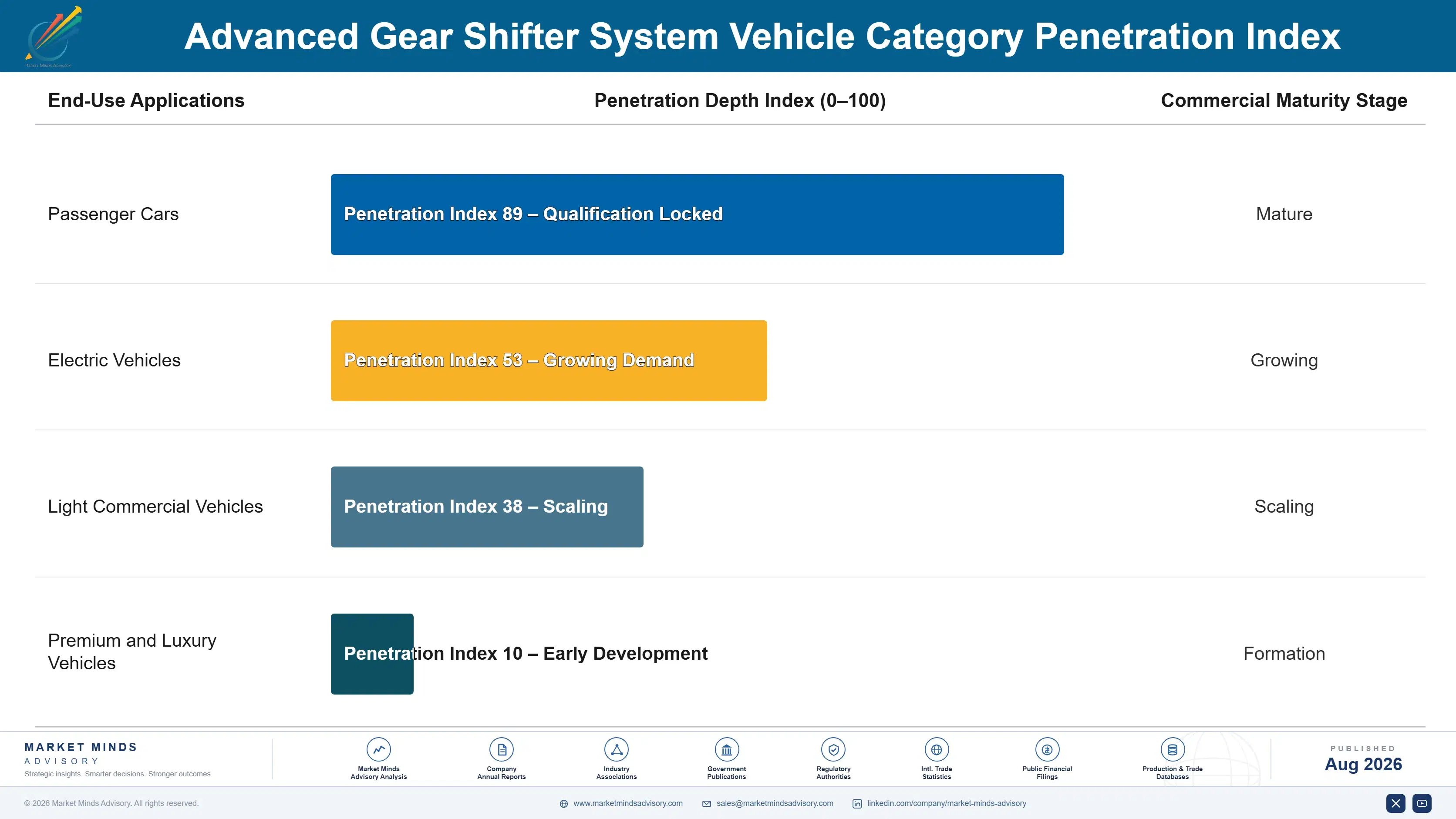
Demand in this category increasingly resembles a multi-year platform qualification relationship rather than a recurring component purchase, since automakers select shifter suppliers during vehicle platform development years before production launch and rarely switch suppliers mid-program, creating a form of annuity demand for suppliers that win initial platform qualification. Suppliers embedded early in a platform's qualification cycle capture disproportionate follow-on volume.
Adoption depth varies considerably by end use vertical: premium and electric vehicle programs show the deepest and most consistent adoption of advanced digital shifter technology, mainstream mass-market vehicle programs show moderate but accelerating adoption tied to interior redesign cycles, and budget-segment vehicle programs remain the shallowest adopters, still specifying simpler mechanical or basic electronic shifter designs to control cost. Budget segment adoption is expected to remain limited for the foreseeable future given persistent cost sensitivity.

Younger vehicle program engineers and interior design managers entering procurement roles increasingly expect digital shifter integration as a baseline design expectation rather than a premium differentiator, a generational shift that is gradually normalizing electronic shifter specification across a broader range of vehicle segments and price points. Suppliers slow to adapt risk losing relevance with this increasingly digital-expectation younger cohort of engineers.
advanced-gear-shifter-system-market-trends-end-use-penetration-index-1787464256298

Where Shifter Supplier Capital Should Concentrate

These are among the four positions where our research anticipates prominent divergence between winners and laggards over the coming forecast period. Each is grounded in the demand model, the regulatory perimeter, and the announced capacity pipeline.
01 / SEMICONDUCTOR DIVERSIFICATION PRIORITY

Qualify multiple chip sources before the next supply disruption

Automotive semiconductor supply has already demonstrated its disruption potential multiple times this decade, and suppliers without diversified sourcing remain persistently exposed to the next shortage regardless of current market conditions. Suppliers with diversified sourcing already report winning new program awards at meaningfully higher rates than single-source competitors. This advantage compounds with each additional disruption cycle, since automakers increasingly favor suppliers who can demonstrate proven resilience across multiple sourcing categories during vendor selection, an advantage that widens considerably with each additional disruption cycle across the broader supply base.
02 / SAFETY VALIDATION INVESTMENT TIMING

Invest in comprehensive validation before regulatory requirements tighten further

Regulatory scrutiny over shifter design safety is intensifying faster than many suppliers currently plan for within their development timelines, making early comprehensive safety validation investment a more defensible strategy than reactive testing after regulatory requirements change. Suppliers with documented comprehensive validation already report meaningfully lower warranty claim rates than less rigorously tested competitors. Suppliers delaying this investment risk losing new program awards to competitors who can demonstrate superior safety credentials during increasingly rigorous selection processes, an advantage that grows more pronounced as scrutiny intensifies across additional vehicle segments.
03 / DIGITAL SOFTWARE CAPABILITY BUILDING

Build software validation expertise before premium programs close out

Touchscreen and digital shifter interfaces represent the fastest-growing segment within the category, yet require software validation expertise that many established mechanical shifter suppliers have not yet fully developed. Early movers building this capability are already capturing meaningfully more premium program awards than suppliers lacking comparable software depth. Suppliers delaying this investment risk permanently ceding the premium digital shifter segment to competitors with stronger software engineering credentials already established, an advantage compounding further as more premium programs specify digital-only interfaces exclusively.
04 / PLATFORM STANDARDIZATION STRATEGY

Standardize shifter platforms across programs rather than pursuing bespoke designs

Developing standardized shifter platforms adaptable across multiple vehicle programs reduces per-program development cost and accelerates time to market relative to fully bespoke designs developed independently for each program. Suppliers pursuing standardization already report winning multiple program awards from the same automaker simultaneously, capturing efficiency automakers directly reward. Suppliers continuing fully bespoke development risk losing cost competitiveness as automakers increasingly favor suppliers offering demonstrated platform efficiency across concurrent programs, an advantage compounding further as more automakers standardize platform requirements industry wide.

Engagement Snapshot From the Field

A live engagement with an industry participant carrying material or product regulatory and market exposure ahead of a defining policy shift, showing how our research translates into a defensible multi-year portfolio strategy.
MARKET MINDS ADVISORY · CLIENT ENGAGEMENT SUMMARY
Advanced Gear Shifter System Producer Strategic Portfolio Review and Transition Roadmap 2026·Investment Scenario on Advanced Gear Shifter System Exposure Evaluation 2025-26
CLIENT PROFILE
The client is a mid-sized North American automotive electronics supplier generating approximately 210 million dollars in annual revenue (client-reported, unverified by MMA), historically supplying traditional stalk-mounted electronic shifters to two major automakers without touchscreen or digital interface capability of its own. The client operates two manufacturing facilities serving both automaker customers directly. Its leadership team has extensive prior experience in automotive electronics manufacturing.
STRATEGIC CHALLENGE
Facing declining new program awards as automakers increasingly specified touchscreen-integrated digital shifters the client could not offer, the client needed to evaluate whether to build internal software capability or acquire it externally, without sufficient capital to pursue both approaches simultaneously within its available investment timeline. Leadership required a clear roadmap before committing meaningful capital toward either path.
MMA APPROACH
MMA conducted a build-versus-acquire feasibility assessment for digital shifter software capability, incorporating automaker buyer interviews, capital cost modeling, and competitive benchmarking against established digital shifter suppliers, then developed a phased two year capability development roadmap sequenced to the client's available capital. Recommendations were validated against both automaker customers' stated program timeline requirements.
KEY FINDINGS
  1. Acquiring a small specialized software firm offered a faster path to market than building capability internally given the client's limited existing software engineering talent.
  2. Two automaker customers expressed preliminary interest in awarding digital shifter programs contingent on demonstrated software validation capability within eighteen months. pending final technical evaluation results.
  3. Existing customer relationships could be used to secure initial digital shifter program commitments once capability was established. once the acquisition was fully integrated.
  4. Safety validation testing infrastructure required significant additional investment beyond the software acquisition itself to meet current regulatory expectations. beyond the initial software acquisition budget.
CLIENT PROFILE
The client is a mid-sized North American automotive electronics supplier generating approximately 210 million dollars in annual revenue (client-reported, unverified by MMA), historically supplying traditional stalk-mounted electronic shifters to two major automakers without touchscreen or digital interface capability of its own. The client operates two manufacturing facilities serving both automaker customers directly. Its leadership team has extensive prior experience in automotive electronics manufacturing.
STRATEGIC CHALLENGE
Facing declining new program awards as automakers increasingly specified touchscreen-integrated digital shifters the client could not offer, the client needed to evaluate whether to build internal software capability or acquire it externally, without sufficient capital to pursue both approaches simultaneously within its available investment timeline. Leadership required a clear roadmap before committing meaningful capital toward either path.
MMA APPROACH
MMA conducted a build-versus-acquire feasibility assessment for digital shifter software capability, incorporating automaker buyer interviews, capital cost modeling, and competitive benchmarking against established digital shifter suppliers, then developed a phased two year capability development roadmap sequenced to the client's available capital. Recommendations were validated against both automaker customers' stated program timeline requirements.
KEY FINDINGS
  1. Acquiring a small specialized software firm offered a faster path to market than building capability internally given the client's limited existing software engineering talent.
  2. Two automaker customers expressed preliminary interest in awarding digital shifter programs contingent on demonstrated software validation capability within eighteen months. pending final technical evaluation results.
  3. Existing customer relationships could be used to secure initial digital shifter program commitments once capability was established. once the acquisition was fully integrated.
  4. Safety validation testing infrastructure required significant additional investment beyond the software acquisition itself to meet current regulatory expectations. beyond the initial software acquisition budget.
RECOMMENDED STRATEGY
Phase 1: Phase 1 (Months 1 to 8): Complete acquisition of specialized software firm and integrate engineering teams. with dedicated integration management oversight established. Phase 2: Phase 2 (Months 9 to 18): Develop and validate initial touchscreen shifter platform with safety testing infrastructure. while maintaining existing mechanical shifter production volume. Phase 3: Phase 3 (Months 19 to 24): Secure program awards from interested automaker customers and begin production planning. to formalize long-term program volume commitments.
OUTCOME
Within twenty-four months of implementation, the client reported securing two new digital shifter program awards representing roughly 24 percent of projected future revenue and establishing a durable software engineering capability beyond its historical mechanical and basic electronic shifter business (client-reported, unverified by MMA). Employee retention through the acquisition also exceeded initial expectations considerably.

Frequently Asked Questions

Foundational context covering the market sizes, CAGR, scope, country, region and competition that inform every finding below. This section is provided to cover basics and most often pre-purchase conversations, answered from the MMA Primary Research Dataset.

What is the current size of the Advanced Gear Shifter System Market?

The Advanced Gear Shifter System Market is valued at approximately 2.1 billion dollars in 2025, spanning rotary dial, push-button, and touchscreen-integrated electronic shifter systems worldwide.

How large will the Advanced Gear Shifter System Market be by 2036?

The market is projected to reach roughly 5.75 billion dollars by 2036, driven by expanding electric vehicle production and accelerating digital interface adoption. across all shifter interface technologies combined.

What is the CAGR for the Advanced Gear Shifter System Market 2026 to 2036?

The market is expected to grow at a compound annual growth rate of approximately 9.6 percent between 2026 and 2036, among the faster rates in automotive components.

Which segment is growing fastest?

Touchscreen and digital integrated shifters are the fastest growing segment, expanding at roughly 1.3 times the overall market rate as automakers eliminate physical shifter levers entirely.

Who are the major companies in the Advanced Gear Shifter System Market?

Leading companies include ZF Friedrichshafen, Kostal Group, DURA Automotive Systems, SL Corporation, and Ficosa International, each investing in semiconductor and software capability. each investing heavily in semiconductor and software capability.

Which country is growing fastest?

China is the fastest growing single country, as its electric vehicle production scale drives shift-by-wire adoption across an expanding range of vehicle platforms. ahead of most other automotive manufacturing nations.

Report Segmentation Architecture

The full report scope spans multiple orthogonal segmentation dimensions, with cross-tabulated demand data provided for each dimension pair. Coverage extends further to regional breakdowns, trend trajectories, and the competitive detail needed to support segment-level decision-making.

By Shifter Interface Technology

  • Rotary Dial Shifters
  • Push-Button Shifters
  • Stalk-Mounted Electronic Shifters
  • Column-Mounted Electronic Shifters
  • Console-Mounted Electronic Shifters
  • Touchscreen and Digital Integrated Shifters

By Vehicle Category

  • Passenger Cars
  • Electric Vehicles
  • Light Commercial Vehicles
  • Premium and Luxury Vehicles

By Commercial Dimension

  • Original Equipment Manufacturer Direct Supply
  • Tier-One Integration Contract
  • Aftermarket Replacement
  • Platform Licensing

By Region

  • North America
  • Western Europe
  • East Asia
  • South Asia and Pacific
  • Latin America
  • Middle East and Africa
  • Eastern Europe

Scope, Methodology, and Coverage

Every figure in this report is reproducible from documented input assumptions. The scope below maps the historical period, the forecast horizon, the segmentation dimensions, and the countries covered, alongside the underlying primary and qualitative methodology.
Historical Period
2020 to 2025
Forecast Period
2026 to 2036
Base Year
2025 (USD billions; MMA Primary Research Dataset, August 2026)
Market Definition
The advanced gear shifter system market covers electronic and shift-by-wire gear selector systems for passenger vehicles, including rotary dial, push-button, stalk-mounted, column-mounted, console-mounted electronic, and touchscreen-integrated designs, along with their associated electronic control units and software. It excludes traditional mechanical cable-actuated shifters and excludes transmission internals downstream of the shifter interface itself.
Quantitative Units
USD billions (current prices); unit shipments for select volume metrics
Segmentation Dimensions
By Shifter Interface Technology; By Vehicle Category; By Commercial Dimension; By Region
Regions Covered
North America, Western Europe, East Asia, South Asia and Pacific, Latin America, Middle East and Africa, Eastern Europe
Countries Covered
USA, China, Germany, France, UK, Japan, South Korea, India, Australia, Canada, Brazil, Mexico, Indonesia, Vietnam, Thailand, Malaysia, UAE, Saudi Arabia, South Africa, Nigeria, Turkey, Poland, Netherlands, Italy, Spain, Sweden, Switzerland, Argentina, Colombia, Singapore, and additional markets relevant to this sector
Key Companies Profiled
ZF Friedrichshafen, Kostal Group, DURA Automotive Systems, SL Corporation, Ficosa International, Kuster Holding, Fuji Kiko, Marelli Holdings, DongFeng Electronic Technology, Continental AG, Hyundai Kefico, Kongsberg Automotive, Sensata Technologies, Methode Electronics, Grupo Antolin, Yura Corporation, Hi-Lex Corporation, Shanghai Yanfeng, WABCO Holdings, Hella GmbH
Quantitative Methodology
Primary survey, n=3,800 respondents, Q4 2025, six countries; demand-side model with trade association cross-validation
Qualitative Methodology
47 expert interviews, Q4 2025; applied to validate demand model assumptions, identify emerging dynamics, and assess competitive positioning
Report Format
PDF and XLSX data workbook (Word format preview document)
Publisher
Market Minds Advisory
Report Code
MMA-2026-AUT-301
Published
August 2026
Contact
sales@marketmindsadvisory.com | www.marketmindsadvisory.com

Purchase the full Advanced Gear Shifter System Market Report (2026 to 2036).

The full report delivers a complete quantitative and qualitative assessment of the advanced gear shifter system market, including detailed segment level forecasts through 2036, regional analyses across all seven covered geographies, and profiles of twenty leading suppliers. It incorporates primary survey data from 3,800 respondents and 47 expert interviews conducted in the fourth quarter of 2025. Buyers receive editable data tables, a customizable Excel forecast model, and access to MMA analysts for follow up questions during a defined post purchase support window. The report also includes detailed semiconductor cost sensitivity analysis calibrated to current foundry lead time benchmarks.
Detailed segment-level market forecasts through 2036
All seven regional market analyses included
Twenty profiled leading component suppliers overall
Editable Excel based forecast data model
Primary survey and expert interview data
Extended post-purchase analyst support access included

Built For The People Who Decide

From boardroom strategy to bench-side execution, this report is read cover-to-cover by leaders shaping the next decade of their industry, turning demand scenarios, market dynamics and valuation benchmarks into decisions.
CXOs/ Presidents/ VPs/ Managers
M&A and Corporate Development
Strategy Teams and R&D Heads
Procurement and Product Directors
Regulatory and Compliance Leaders
Investor Relations and Equity Analysts