Market Minds Advisory
Advanced Empty Capsule Market

Advanced Empty Capsule Market: The Cheapest Component That Decides Whether A Drug Passes

Gelatin cross-links with trace aldehydes and fails dissolution at twenty-four months for reasons that have nothing at all to do with the active ingredient. That single failure mode built this market.

Lead Analyst

Alice Ballenger

Published

September 2026

Make Smarter Decisions with Customized Research Insights

Request a free sample report and evaluate market opportunities, growth trends, and competitive dynamics relevant to your business needs.

2025 MARKET VALUE$1.5BMarket Size 2025
2036 FORECAST VALUE$3.4BBase Case , 2026 to 2036
CAGR 2026 TO 20367.6 %Bull 8.8% / Bear 6.4%
INCREMENTAL OPPORTUNITY$1.7BNet 10- year value creation
EXPANSION MULTIPLE2.08x2036 value over 2026 base
Strategic Levers
M&A Pipeline
Regional Outlook
Country Rankings
Competitive Intelligence
Segmental Deep-dive
Call-Us : 91 93563 13602

Executive Snapshot and Market Trajectory

A capsule shell is the cheapest thing in a finished dose and one of the very few that can fail an entire batch on its own. Gelatin cross-links with trace aldehydes and misses dissolution specification on stability. That is what built this market. It reaches USD 1.5 billion in 2025.
Enteric polymer capsules grow fastest at 11.4%, exactly 1.50 times the market rate, because an intrinsically enteric shell removes a coating step, a solvent, and a whole validation burden from the production line. East Asia holds 28% of value on Chinese manufacturing scale and export volume together. South Asia and Pacific takes 20%, above the band this framework applies, because India is the second largest capsule producer anywhere.
Concentration reaches 58% across the top five, with the global capsule makers leading against a very long tail of smaller regional producers spread across three continents. Competition turns on dissolution consistency batch to batch, on moisture tolerance, and on the quality of regulatory documentation supporting a filing. Roughly 52% of advanced capsule volume goes into nutraceuticals, where a vegetarian shell is really a marketing claim rather than any kind of technical requirement at all.
Market Definition
The advanced empty capsule market covers two-piece hard capsule shells made from materials other than conventional gelatin or engineered for functional performance, spanning hypromellose, pullulan, intrinsically enteric polymer, starch and alternative polymer, and modified gelatin shells. Softgel capsules, conventional unmodified gelatin capsules, capsule filling and sealing equipment, coatings applied after filling, tablets, sachets, and the fill formulations themselves are excluded.
Base Year Value
$1.5B in 2025 (MMA Primary Research Dataset, August 2026)
Forecast Period
2026 to 2036, eleven discrete annual values
CAGR
7.6% base case. Bull 8.8%. Bear 6.4%.
Fastest Growth Segment
Enteric Polymer Capsules: 11.4% CAGR
Fastest Growth Country
India: 10.6% CAGR
Fastest Growth Region
South Asia and Pacific: 9.8% CAGR
Largest Region
East Asia: 28% of 2025 global value
Market Leaders
Lonza, ACG, Qualicaps, Suheung Capsule, CapsCanada. Source: MMA Primary Research Dataset, July 2026.
Primary Survey
n=3,800 procurement and R&D decision-makers, Q4 2025, six countries
Methodology
Demand-side build-up, cross-validated against public data, 47 expert interviews

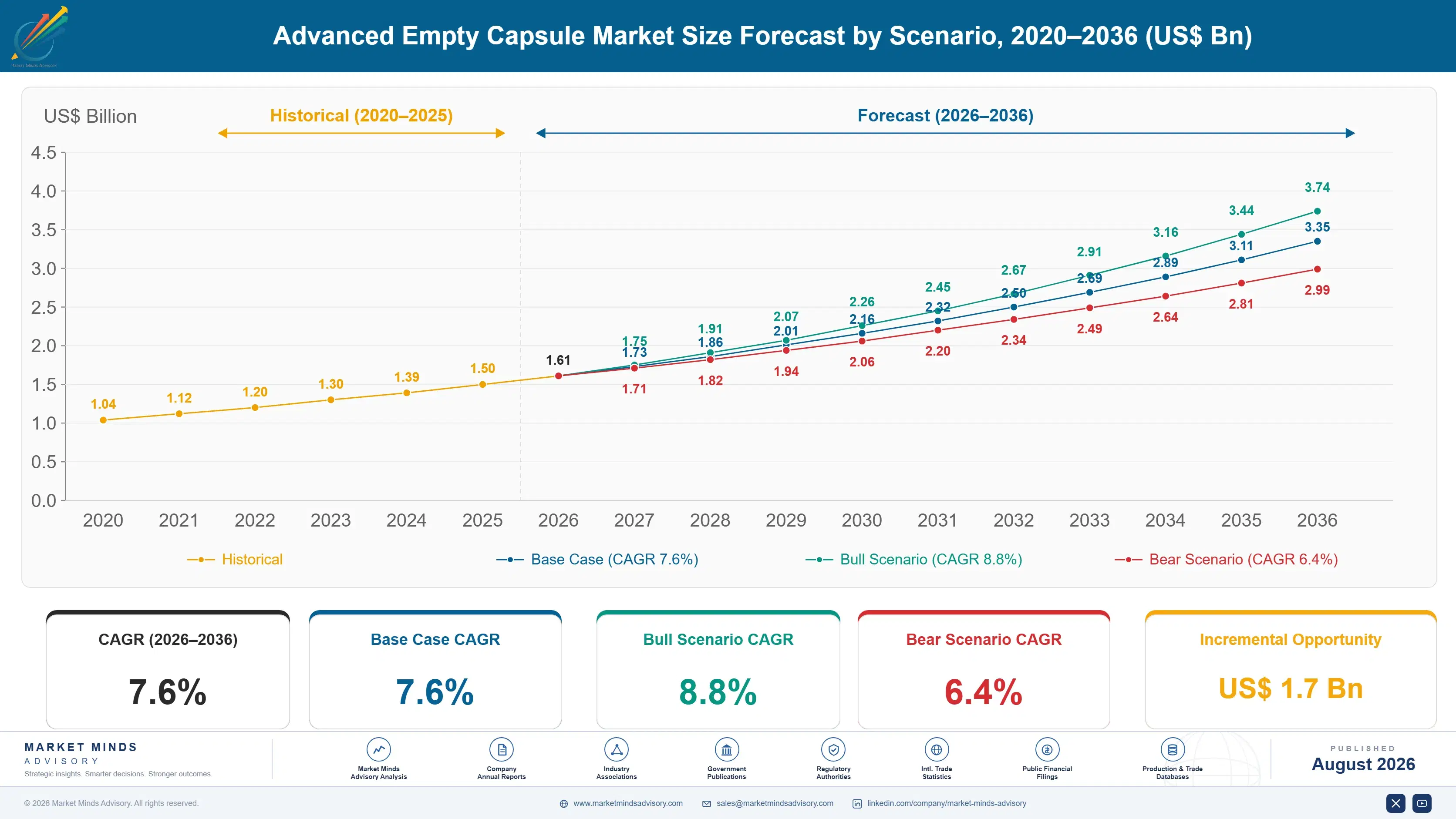
Advanced Empty Capsule Market Forecast Scenarios

advanced-empty-capsule-market-size-forecast-scenario-1787297634733
Between 2020 and 2025 the market grew steadily while its composition shifted underneath. Pandemic-driven supplement demand pulled vegetarian shell volumes up sharply through 2021 and 2022 before correcting, and pharmaceutical adoption of hypromellose continued regardless of that swing. Gelatin pricing volatility pushed several formulators to evaluate alternatives. A 6.5% historical CAGR blends steady conversion with a consumer surge that did not last.
Three mechanisms carry the 7.6% base case. Cross-linking avoidance is the largest, since a gelatin shell failing dissolution at twenty-four months costs a formulator far more than a shell premium ever will. Enteric shell substitution is the second, removing an entire coating operation from the line. And vegetarian positioning in nutraceuticals is the third, driven by consumer preference rather than by anything happening inside the capsule. Only one of those three is a technical argument.
The 8.8% bull case rests on intrinsically enteric shells displacing applied coatings at scale, which would convert a shell decision into a manufacturing process decision worth considerably more. The 6.4% bear case is nutraceutical demand softening further, since half of advanced capsule volume sits in a consumer market that has already corrected once and carries none of the switching costs a filing does.

Why Anybody Pays More For A Shell

Gelatin makes an excellent capsule right up until it meets an aldehyde. Trace amounts from excipients, packaging, or the active ingredient itself cross-link the protein over months, and a shell that dissolved in ten minutes at release takes an hour at twenty-four months. The formulation has not changed at all. The stability study fails anyway, and the reason has nothing to do with the drug.
TOP FIVE CONCENTRATION58%Global capsule makers lead against a very long regional tail
CAPSULES PER MACHINE HOUR200,000Output from a single high-speed dipping and stripping line
PRICE PREMIUM45%Additional cost against a standard gelatin shell of equivalent size
VEGETARIAN SHELL SHARE34%Portion of capsules supplied in non-animal shell material
MOISTURE CONTENT TOLERANCE3 to 6 percentShell water range avoiding both brittleness and deformation in storage
NUTRACEUTICAL VOLUME SHARE52%Share of advanced capsule volume filled outside prescription medicine
Hypromellose does not do that, and neither does pullulan. That single property is what a formulator is actually buying, and it explains why a component costing a fraction of a cent per dose commands a 45% premium without much argument at all. Moisture behaviour matters too, since hypromellose stays flexible at low humidity where gelatin turns brittle and splits open.
The enteric shells are a different proposition again. An intrinsically enteric capsule removes an entire coating operation, its solvent handling, its drying step, and its validation from the line, which is worth considerably more than the shell itself costs. That is a manufacturing decision rather than a materials one, and it reaches a completely different person inside the customer organisation.
"Nobody has ever been promoted for choosing a capsule shell. Plenty of people have had a very bad year because a gelatin capsule cross-linked eighteen months into a stability study. That asymmetry is the entire commercial case."
Director, Pharmaceutical Delivery Practice · MMA Healthcare Practice &midd

Market Trends

Intrinsically Enteric Shells Remove A Unit Operation

An enteric coating applied after filling requires a coating suite, solvent or aqueous dispersion handling, drying, and its own validation and release testing. A shell that is intrinsically enteric removes all of that from the process flow. For a manufacturer under capacity pressure the freed suite time is worth considerably more than the shell premium, and the removed solvent step simplifies environmental compliance as well. Adoption is fastest among contract manufacturers who measure everything in suite hours, and this is the fastest-growing segment at 11.4%. Procurement rarely sees any of that value.
Market Impact: Reformulation costs exceed 2 million
Nutraceutical Volume Behaves Like A Consumer Market

Roughly 52% of advanced capsule volume is filled outside prescription medicine, where a vegetarian or clean-label shell is a claim printed on a bottle rather than a technical requirement anybody validated. That half of the market switches on price and marketing fashion, carries no filing switching cost, and swung violently through the pandemic supplement surge and the correction after it. Suppliers who read that volume as evidence of technical adoption misjudged their capacity planning badly, and several are still working through the consequences. Pharmaceutical volume never moved at all through either the surge or the correction.
Market Impact: Inhalation grades price 3 times higher

Market Opportunities and Growth Drivers

Cross-Linking Failures Cost Far More Than Shell Premiums

A gelatin capsule that passes dissolution at release and fails at twenty-four months forces a formulator into investigation, possible reformulation, and delayed filing, none of which the shell supplier pays for. Hypromellose and pullulan do not cross-link, which removes a failure mode that carries no warning until the stability data arrives. Formulation groups increasingly specify alternative shells at development stage rather than discovering the problem later. The premium looks large against the component and negligible against a repeated stability programme. No formulation change resolves an aldehyde in the active itself. The shell is the only available answer.
Market Impact: Variations take 9 to 18 months

Inhalation Grade Capsules Follow Dry Powder Growth

Dry powder inhalers meter their dose from a capsule that must pierce cleanly, release powder completely, and shed no fragments into the airstream, which is a considerably harder specification than any oral shell faces. Hypromellose performs better than gelatin here because it stays flexible at the low humidity these products require and pierces without splintering. Inhaled respiratory portfolios continue expanding, and generic entry into established inhaler products adds further volume. The grade commands premium pricing and very few producers qualify for it. Qualification takes years and very few producers attempt it. The grade is priced accordingly.
Market Impact: Regional grades price 30% below

Market Restraints and Challenges

Filing Changes Deter Switching In Marketed Products

Changing the capsule shell on an approved product means a regulatory variation, comparative dissolution data, and in some jurisdictions stability data on the new configuration, which nobody undertakes without a reason. The root cause is that the shell is part of the approved specification rather than a packaging component. Commercially this confines conversion largely to new development programmes and leaves a very large marketed installed base on gelatin indefinitely. Suppliers are mitigating by targeting formulation groups at development stage and by supporting variation filings with prepared comparative data packages. Nobody files a variation without a reason.
Market Impact: Removes 1 full coating operation

Regional Producers Compete Hard On Undifferentiated Grades

Standard hypromellose capsules are no longer difficult to manufacture, and Chinese and Indian producers supply them at prices global makers cannot approach on nutraceutical business. The root cause is that dipping technology has diffused and the polymer itself is a commodity. Commercially this compresses margin on exactly the volume that fills a plant, pushing global suppliers toward enteric, inhalation, and pharmaceutical grades where documentation matters. Participants are mitigating through regulatory support packages, audited quality systems, and grades that regional producers cannot yet qualify. The polymer itself is now a commodity. Documentation is the only remaining differentiator.
Market Impact: Nutraceuticals carry 52% of volume
3 additional market trends, 2 additional growth drivers, and 4 additional restraints and challenges are covered in the full report. Contact sales@marketmindsadvisory.com to access the complete intelligence.

Segment CAGR and Growth Architecture

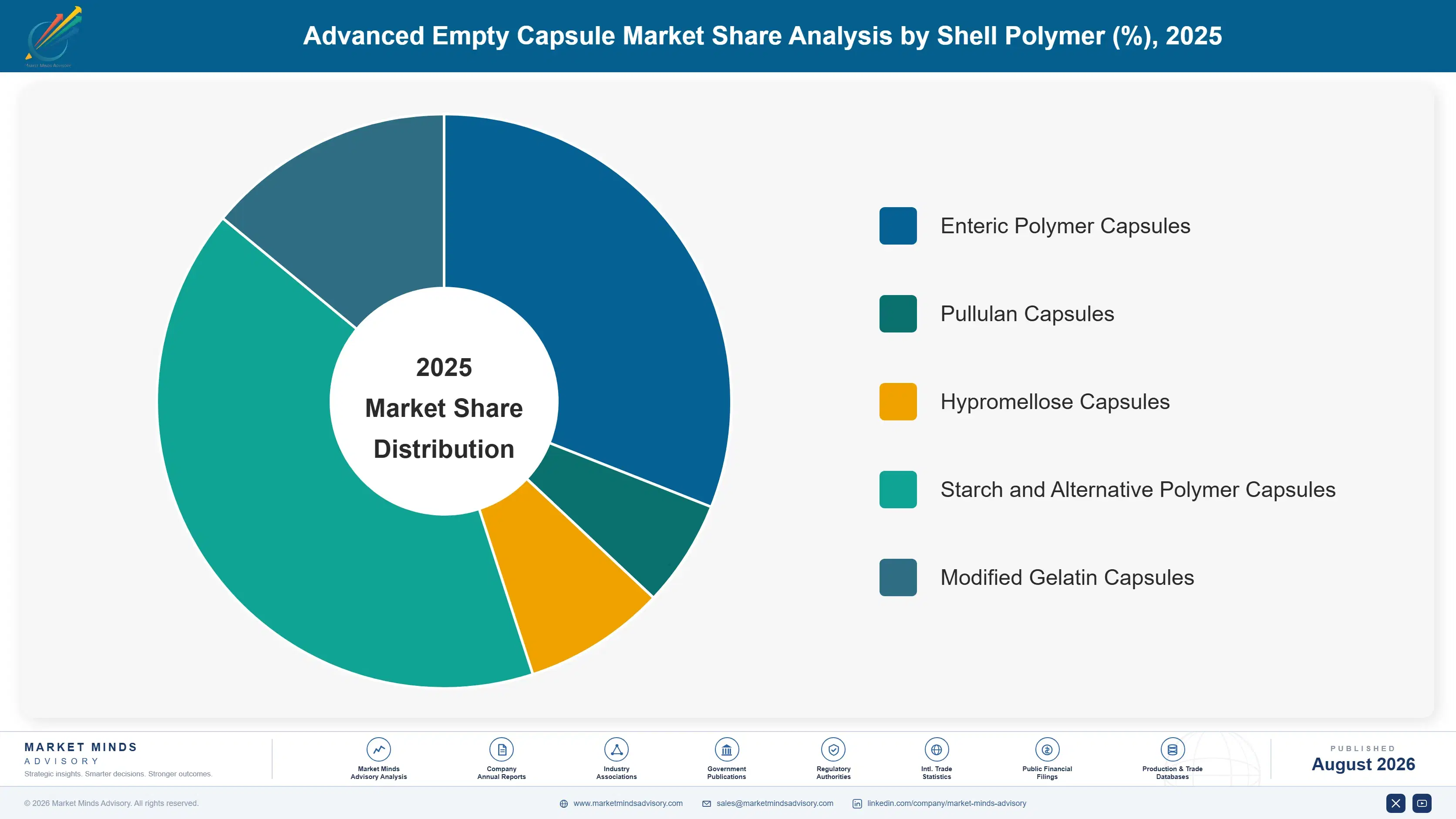
Segmentation follows the shell polymer used, because the material decides dissolution behaviour, moisture tolerance, cross-linking risk, whether the shell can be made intrinsically functional, and what documentation a regulatory filing will eventually require. Capsule size, fill type, and end market are handled in the framework and commentary rather than being treated as segments here.
advanced-empty-capsule-market-market-share-analysis-1787297635274

Enteric Polymer Capsules

Enteric polymer shells grow fastest at 11.4%, exactly 1.50 times the market rate, and manufacturing economics rather than materials science explain the whole rate. A shell built from hypromellose acetate succinate or a similar enteric polymer resists gastric acid on its own, which removes the coating suite, the solvent handling, the drying step, and a validation package from the process flow. Contract manufacturers measuring capacity in suite hours value that far above the shell premium. The constraint is that enteric performance must be demonstrated for each fill, since the shell and its contents interact. Adoption is fastest in probiotics, enzymes, and acid-labile actives. Contract manufacturers convert fastest because they measure everything in suite hours.
CAGR 11.4%

Pullulan Capsules

Pullulan shells grow at 10.2%, made from a fermentation-derived polysaccharide that gives very low oxygen permeability alongside a genuinely clean label. Oxygen sensitivity matters for omega oils, probiotics, and several vitamins, where a hypromellose shell allows enough ingress to shorten shelf life measurably. The material is considerably more expensive than hypromellose and the supply base is narrow, which keeps it in premium nutraceutical and specialised pharmaceutical use. Clean-label positioning drives more of the demand than the barrier property does, which makes this segment more exposed to consumer fashion than its technical merits would suggest. Supply concentration in a handful of fermentation plants adds risk that buyers now ask about directly.
CAGR 10.2%
Full segment breakdown across 5 segments available in the complete report.

Regional Architecture and Country Demand Map

Regional shares here follow capsule production and formulation activity together, because shells get made close to where the doses are filled. Nutraceutical consumption and pharmaceutical manufacturing pull in quite different directions, which is why the map looks unlike either of those markets on its own.

East Asia

East Asia takes 28% of value, at the ceiling of the band this framework applies, and Chinese manufacturing scale explains most of it. Capsule production concentrates heavily around Xinchang in Zhejiang province, where a dense cluster of producers supplies domestic pharmaceutical and nutraceutical filling at costs nobody outside the region approaches. Hypromellose conversion has been rapid because domestic producers made the switch cheaply rather than because formulators demanded it. Japanese and Korean producers, Qualicaps and Suheung among them, hold technically strong positions and export widely. Growth at 8.4% exceeds the global rate on domestic volume and rising export share together. Cost rather than specification drives most of the domestic conversion. Export grades are held to a different standard.
Share: 28% | CAGR: 8.4% (2026 to 2036)

South Asia and Pacific

South Asia and Pacific holds 20% of value against a 12% ceiling in this framework, and Indian capsule manufacturing explains the entire breach. India is the second largest capsule producer anywhere and the largest generic medicine manufacturer, which puts shell demand and shell supply in the same country at very large scale. ACG alone is among the world's biggest capsule makers, and a long tail of domestic producers supplies both local filling and export. Nutraceutical manufacturing for export markets adds substantially. Growth at 9.8% is the highest of any region, driven by generic volume and by conversion away from gelatin. Very few countries have both sides of this market at home.
Share: 20% | CAGR: 9.8% (2026 to 2036)
Regional intelligence for 5 additional markets available in the complete report: North America, Western Europe, Latin America, Middle East and Africa, Eastern Europe. Contact sales@marketmindsadvisory.com.
advanced-empty-capsule-market-country-cagr-analysis-1787297635791

Where Capsule Makers Actually Earn Margin

A standard hypromellose shell is no longer difficult to make and regional producers price it accordingly. Margin comes from reaching the formulation group before a shell is written into a specification, from shells that remove a manufacturing step rather than replacing a material, and from documentation that a regulatory filing can be built on.

Get Specified During Formulation Development Work

Changing a shell on an approved product needs a regulatory variation taking nine to eighteen months, so the decision is effectively permanent once a filing is made. Suppliers engaged with formulation groups during development write themselves into a specification that then ships for the product's entire commercial life, typically 20 years at stable pricing. Applications support at that stage costs technical time with no immediate order attached to it. Competitors arriving afterwards are asking a customer to file a variation for no clinical reason at all. Formulation groups are the only audience that matters here.
Market Impact: Specifications typically hold for a full 20 years

Sell The Removed Coating Step, Not The Shell

An intrinsically enteric capsule removes a coating suite, solvent handling, drying, and a validation package from the process flow, and a contract manufacturer values freed suite time at USD 8,000 to USD 20,000 per day. Presented as a shell the product carries an awkward premium. Presented as a removed unit operation it reaches manufacturing and operations rather than procurement, and the arithmetic reverses completely. Very few suppliers have reorganised their selling around that comparison despite it being the strongest argument they hold. Procurement will never accept the premium on its own terms.
Market Impact: Suite time worth 8,000 to 20,000 dollars daily

Supply The Regulatory Package With The Capsule

A formulator adopting an alternative shell needs comparative dissolution data, extractables information, and drug master file support, and generating that internally costs months of laboratory time. Suppliers providing prepared packages remove that work and become the path of least resistance, defending 15% to 25% of price against regional producers who supply an equivalent shell with nothing attached. It is documentation rather than manufacturing, which means the cost is fixed and the margin scales with every customer who uses it. Regional producers ship an identical shell with nothing attached at all.
Market Impact: Documentation defends 15 to 25 percent of price

Who Controls the Margin Pool

Concentration reaches 58% across the top five measured on empty capsule revenue, which is high for a component this widely manufactured and reflects documentation and qualification rather than any production capability. Lonza leads on pharmaceutical grades and regulatory support, with ACG holding enormous scale from an Indian base and a genuinely global footprint behind it. Qualicaps, Suheung, and CapsCanada follow. Below them sits a very long tail of regional producers.
Competition currently turns on dissolution consistency batch to batch, on the regulatory documentation supplied alongside the capsule, and on whether the supplier reached the formulator during development. Price decides nutraceutical business almost entirely and pharmaceutical business hardly at all, which splits this market into two separate contests with quite different winners in each.

Pressure is building from Chinese and Indian producers who have closed the manufacturing gap on standard hypromellose and are working through pharmaceutical qualification now. Functional shells are the counter-move, since an enteric or inhalation grade requires process control and documentation that regional producers have not yet matched. Rankings will shift wherever those qualification barriers fall rather than wherever pricing happens to move.
advanced-empty-capsule-market-company-positioning-matrix-1787297636315

Competitive Moat and Risk Dimensions

LONZA

Moat: Regulatory documentation and formulation reach

Lonza pairs capsule supply with drug master files, dissolution data packages, and formulation support that reaches development groups years before a filing exists. Once a shell is written into an approved specification a competitor needs the customer to file a variation for no clinical reason, which nobody does. The documentation rather than the capsule is what holds the position.
LONZA

Risk: Cost exposure on standard grades

Standard hypromellose shells are no longer technically demanding and regional producers supply them at prices Lonza cannot match on nutraceutical volume. As those producers work through pharmaceutical qualification the protected ground narrows toward enteric, inhalation, and heavily documented grades, which is a smaller market than the one Lonza currently serves.
ACG

Moat: Scale and integrated Indian position

ACG manufactures capsules at very large scale from an Indian base that sits inside the world's largest generic medicine industry, and it supplies filling equipment and inspection systems alongside the shells. That integration gives it visibility into customer processes that a shell supplier alone never gets, and a cost base global competitors cannot approach on volume grades.
ACG

Risk: Premium grade documentation depth

ACG's position is strongest in volume and value grades, while the highest-margin business sits in enteric, inhalation, and heavily documented pharmaceutical shells where Western formulators still default to established suppliers. Building equivalent regulatory support depth takes years of filings and reference products, and generic-led scale does not shorten that path.

Players Tracked

Prominent Players

Lonza
ACG
Qualicaps
Suheung Capsule
CapsCanada

Other Key Players

Sunil Healthcare
Bright Pharma Caps
Natural Capsules
Erawat Pharma
Medi-Caps
Healthcaps India
Farmacapsulas
Snail Pharma
Roxlor
Nectar Lifesciences
Shanxi Guangsheng Medicinal Capsule
Huangshan Capsule
Lefan Capsule
Yuwang Group
Shaoxing Kangke Capsule

Recent Developments

MARCH 2025

Contract manufacturer replaced coating line with enteric capsules

A contract manufacturer moved several products from applied enteric coating to intrinsically enteric capsule shells, freeing a coating suite for other work and removing solvent handling from the process. The change was justified on capacity released rather than on any product performance improvement at all.
Signal: Freed suite capacity rather than any product performance gain is what actually sells an enteric shell.
SEPTEMBER 2024

Indian producer qualified inhalation grade capsules for export

An Indian capsule manufacturer qualified an inhalation grade shell for dry powder inhaler applications in regulated export markets, meeting the piercing and fragment specifications that very few producers can satisfy. The qualification took several years and opens a grade priced well above standard oral shells.
Signal: Grade qualification rather than raw manufacturing capability is the barrier that regional producers are now crossing.
DECEMBER 2024

Formulator switched shells after stability dissolution failure

A pharmaceutical formulator moved a development programme from gelatin to hypromellose after cross-linking caused a dissolution failure at twenty-four months, having passed comfortably at release. The active ingredient itself proved to be the aldehyde source, which no formulation change of any kind would have resolved.
Signal: Cross-linking arrives without warning, and no formulation change fixes an aldehyde present in the active itself.

Polymer, Water, Energy, And Inspection

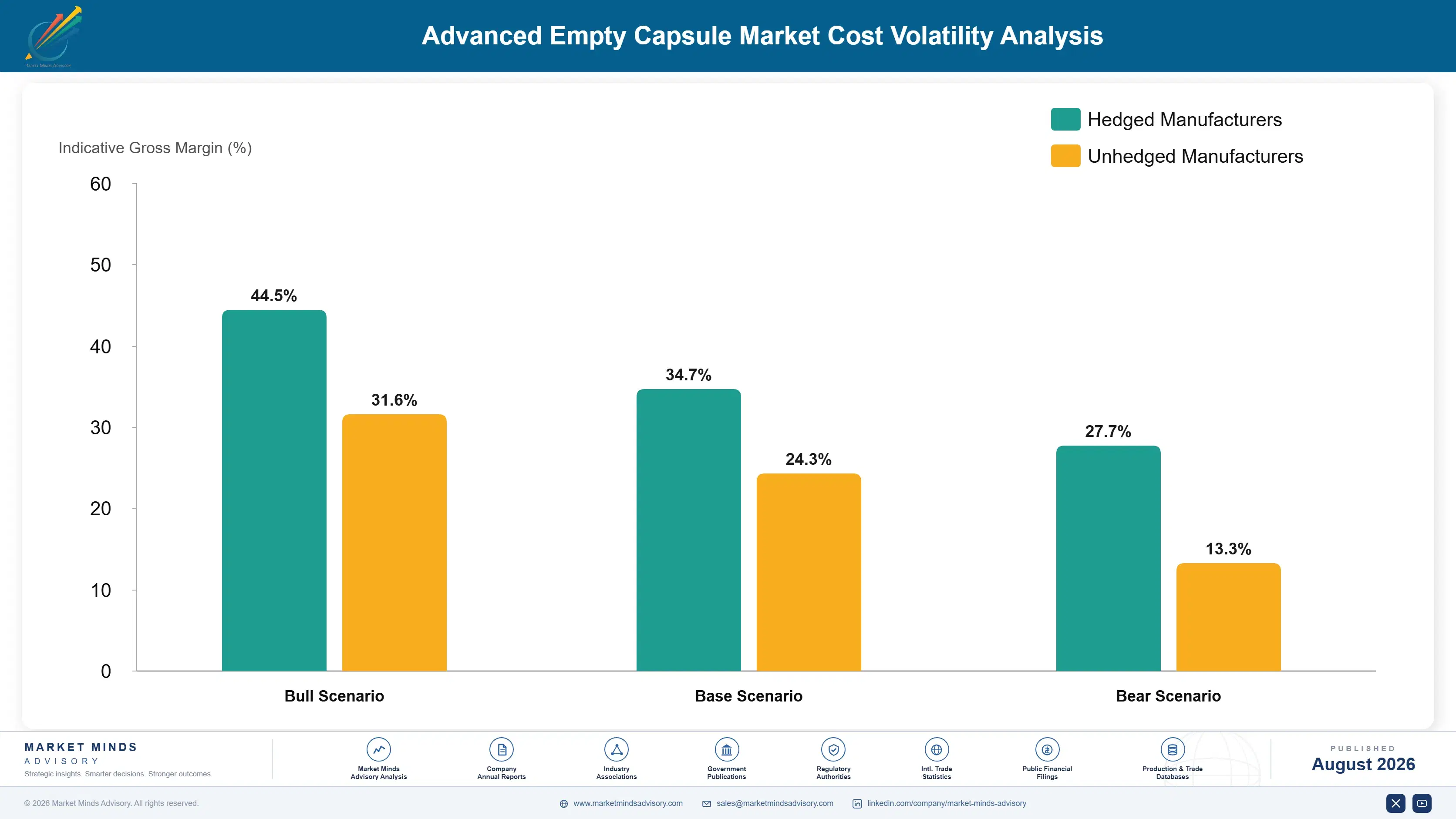
Shell polymer carries roughly 38% to 48% of cost of goods, whether hypromellose from cellulose ether producers, pullulan from a very narrow fermentation supply base, or enteric grades from speciality polymer houses. Colourants, opacifiers, and gelling agents add 8% to 14%. Energy for dipping, drying, and conditioning accounts for a substantial share of the remainder, alongside the inspection systems that reject defective shells at very high line speeds.
Cellulose ether pricing rose sharply through 2021 and 2022 as construction and pharmaceutical demand competed for the same capacity, and European gas costs roughly doubled at the 2022 peak according to European Commission energy statistics. Drying is continuous and energy intensive, so both inputs hit at once. Lonza and Ashland each noted raw material and energy pressure across that period, and producers holding annual customer price lists absorbed most of it themselves.

Exposure divides by polymer choice rather than by geography. Hypromellose producers source from several cellulose ether suppliers across three continents and negotiate accordingly. Pullulan depends on a fermentation supply base narrow enough that one plant issue moves availability. Enteric grades sit between the two, with more suppliers than pullulan and considerably fewer than commodity hypromellose.
advanced-empty-capsule-market-cost-volatility-analysis-1787297636512

Qualify cellulose ether suppliers across several regions

Pharmaceutical grade cellulose ether requires customer-visible qualification, so alternatives have to be approved before a shortage rather than found during one. Running approved sources across three continents removes both regional supply risk and the pricing position a sole supplier eventually takes. Most producers have done considerably less of this than their exposure warrants. Exposure only becomes visible during a shortage.

Recover drying energy across the conditioning stage

Dipping and drying run continuously and consume the largest energy line in the plant, while conditioning air is exhausted at temperature. Heat recovery between the two stages cuts consumption meaningfully against a cost that has roughly doubled. Payback runs inside three years at current European and Japanese industrial rates. Payback runs considerably longer where energy stays cheap.

Shift mix toward documented pharmaceutical grades

Regulatory documentation, drug master files, and formulation support carry no polymer content and defend price against regional producers supplying an identical shell. Growing that share reduces exposure to cellulose ether pricing without changing anything about manufacturing. It requires regulatory affairs capability that volume-focused producers have historically declined to build for themselves. Volume producers have historically declined to build it.

Portfolio Architecture for Margin Defence

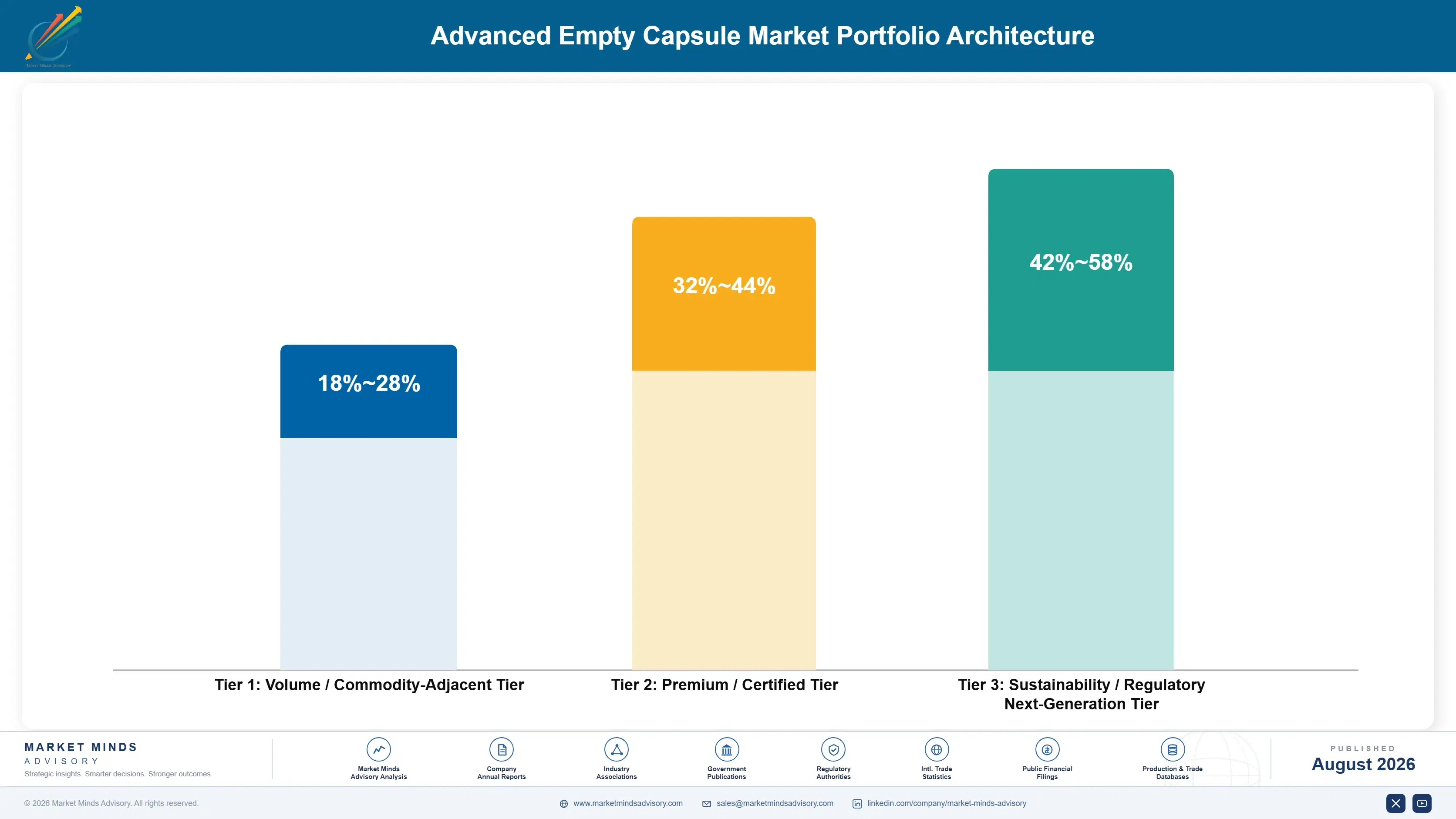
Margin here tracks how much of a customer's problem the shell actually solves. A vegetarian shell for a supplement bottle is a label claim competing against identical shells from anywhere in the world, and it earns commodity margins accordingly. A shell that removes a coating operation, survives a stability programme, or pierces cleanly inside an inhaler is solving something expensive, and it prices against that cost.
The volume tension sits between the two halves of the customer base. Nutraceutical filling is the larger volume, keeps dipping lines loaded, and switches on price at every renewal with no regulatory friction whatsoever. Pharmaceutical business is smaller, slower to win, effectively permanent once filed, and carries the documentation cost that regional competitors will not fund. Giving up either one of them weakens the other considerably.

High-value pools sit in three places. Intrinsically enteric shells sold on the manufacturing steps they remove, inhalation grades where piercing and fragment specifications exclude most producers outright, and regulatory documentation packages that make a supplier the path of least resistance for a formulator. None of those three is really about the polymer at all, which is the point most producers still miss.

Volume / Commodity-Adjacent Tier

Standard hypromellose and modified gelatin shells sold into nutraceutical and generic filling on price. Regional producers compete directly, and the range reflects how differently Asian and Western cost bases carry an identical capsule.
Gross Margin: 18-28%

Premium / Certified Tier

Pharmaceutical grade shells supplied with drug master file support, comparative dissolution data, and formulation assistance. Documentation and qualification history rather than manufacturing capability sustain the margin against equivalent regional product.
Gross Margin: 32-44%

Sustainability / Regulatory / Next-Generation Tier

Intrinsically enteric shells, inhalation grades, and pullulan barrier capsules. The wide range reflects genuinely different economics between a shell removing a manufacturing step and a premium material sold on consumer positioning.
Gross Margin: 42-58%
advanced-empty-capsule-market-portfolio-architecture-1787297637015

High-value Sub-segments and Strategic Watch-out

Intrinsically Enteric Shells

Growing at 11.4% because removing a coating suite, its solvent handling, and its validation is worth far more than the shell premium costs. It reaches manufacturing and operations rather than procurement, which is a considerably better conversation to be having. Operations rather than procurement decides these conversions.
Gross Margin: 44-58%

Inhalation Grade Capsules

Piercing cleanly without fragmenting at low humidity is a specification very few producers can hold consistently across batches. Dry powder inhaler portfolios keep expanding and generic entry adds volume, while the qualified supplier field stays extremely narrow. Nothing in the pipeline widens that supplier field. Pricing reflects the scarcity accordingly.
Gross Margin: 48-62%

Standard Vegetarian Shells

The volume base of this market and the part regional producers contest most effectively on price alone. It keeps dipping lines loaded and provides the scale that documented pharmaceutical grades are costed against, so exiting it raises cost everywhere else. Exiting it raises unit cost across every other grade.
Gross Margin: 18-28%

Regulatory Support Packages

Drug master files, dissolution data, and extractables documentation that make a supplier the easiest option for a formulator. The watch-out is that the cost is fixed and entirely wasted if the development programme never reaches commercial filing. Programmes fail, and the documentation cost is sunk.
Gross Margin: 52-68%

What Follows The Specification Decision

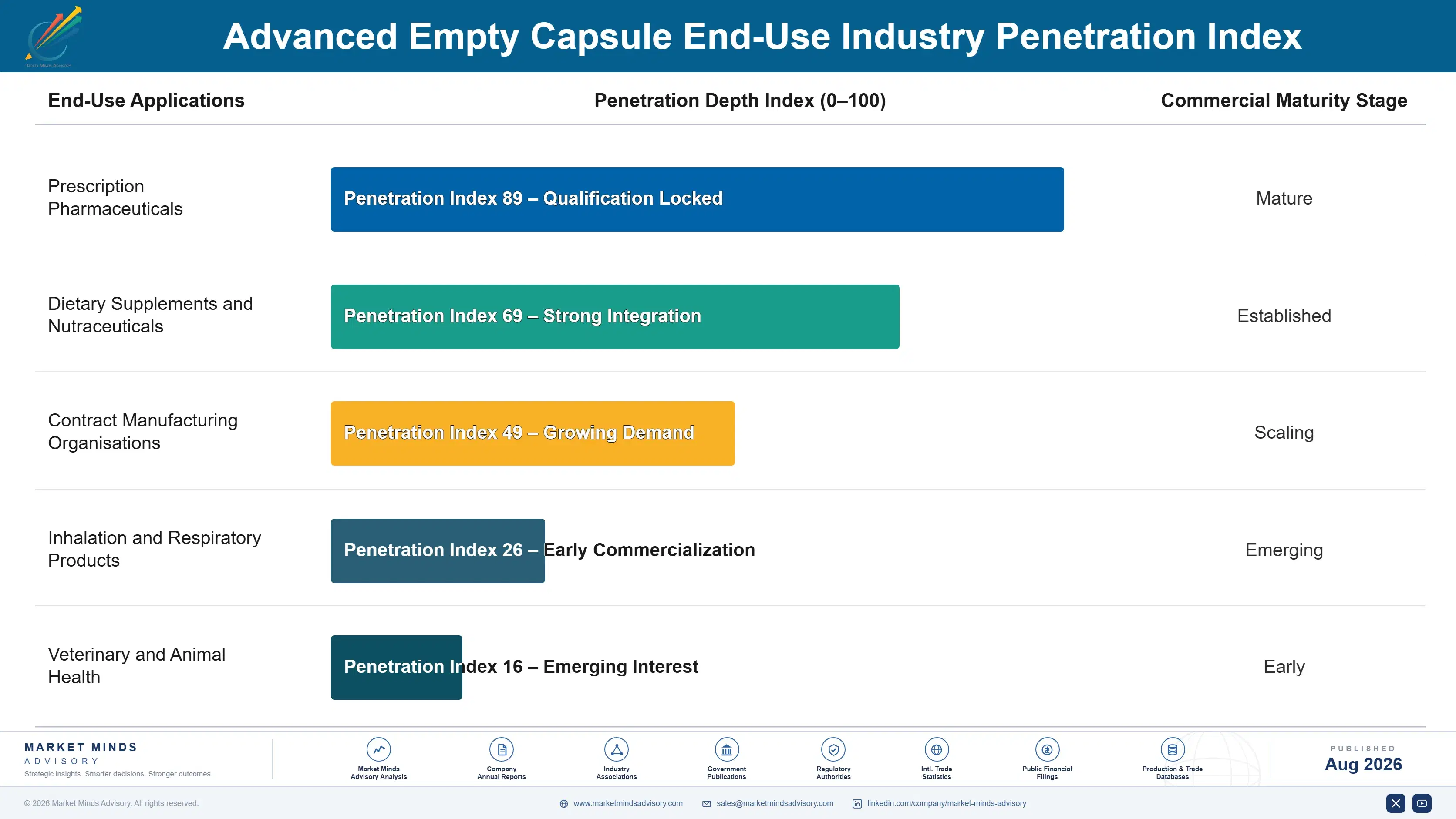
A capsule specification is one of the longest annuities in pharmaceutical supply. Once a shell is written into an approved filing it ships for the product's whole commercial life, frequently twenty years, and nobody reopens it without a compelling reason because changing it means a regulatory variation taking nine to eighteen months. What suppliers under-collect is price escalation, since annual negotiations run against them while polymer and energy costs move freely.
Stickiness differs completely between the two customer types. Pharmaceutical filings are effectively locked, and even a substantially cheaper equivalent shell cannot displace one without the customer choosing to file a variation for no clinical benefit. Nutraceutical business is the opposite and moves at every contract renewal on price alone. Suppliers reporting both as one revenue line consistently mislead themselves about the quality of it.

Buyer profiles split the same way. Pharmaceutical shells are chosen by formulation scientists during development who care about dissolution, moisture behaviour, and what documentation exists. Supplement shells are chosen by procurement and marketing, who care about the label claim and the price. The two decisions share a product and share almost nothing else, and a sales organisation built for one performs badly at the other.
advanced-empty-capsule-market-end-use-penetration-index-1787297637512

Where To Compete Here

These are among the four positions where our research anticipates prominent divergence between winners and laggards over the coming forecast period. Each is grounded in the demand model, the regulatory perimeter, and the announced capacity pipeline.
01 / DEVELOPMENT STAGE ENGAGEMENT

Win the specification before anybody files it

Changing a shell on an approved product requires a regulatory variation taking nine to eighteen months, which means the decision made during development is effectively permanent for the product's whole commercial life. Suppliers engaged with formulation groups at that point write themselves into a specification that then ships for twenty years at stable pricing. Competitors arriving later are asking a customer to file a regulatory variation for no clinical benefit whatsoever, and no formulator has ever once agreed to that.
02 / REMOVED OPERATION SELLING

Price the coating suite, not the capsule

An intrinsically enteric shell removes a coating suite, its solvent handling, its drying step, and an entire validation package from the production flow, and a contract manufacturer values freed suite time at several thousand dollars every day. Sold simply as a capsule the product carries an awkward premium that procurement resists more or less automatically. Sold as a removed unit operation it reaches manufacturing and operations, where the arithmetic reverses completely and the premium stops being the subject of the conversation.
03 / DOCUMENTATION AS MOAT

Supply the filing, not just the shell

A formulator adopting an alternative shell needs comparative dissolution data, extractables information, and drug master file support, and generating all of that internally costs months of laboratory time that nobody has budgeted for. Suppliers providing prepared packages become the path of least resistance and defend a sixth to a quarter of price against regional producers offering an identical capsule. The cost of building that package is fixed once, and the margin then scales with every single customer who comes to rely on it.
04 / TWO MARKET RECOGNITION

Stop reporting supplements and pharma together

Roughly 52% of advanced capsule volume goes into nutraceuticals, where the shell is simply a label claim bought by procurement and switched at every renewal on price alone with no friction at all. The remainder sits in pharmaceutical filings that are effectively permanent once they are made. Suppliers reporting both of those as a single growth line consistently misread their own business, as several discovered when the pandemic supplement surge corrected sharply and their pharmaceutical volume did not move at all.

Engagement Snapshot From the Field

A live engagement with an industry participant carrying material or product regulatory and market exposure ahead of a defining policy shift, showing how our research translates into a defensible multi-year portfolio strategy.
MARKET MINDS ADVISORY · CLIENT ENGAGEMENT SUMMARY
Advanced Empty Capsule Producer Strategic Portfolio Review and Transition Roadmap 2026·Investment Scenario on Advanced Empty Capsule Exposure Evaluation 2025-26
CLIENT PROFILE
A specialty pharmaceutical manufacturer producing modified-release oral solid products across two European sites, with annual revenue near USD 620 million (client-reported, unverified by MMA). Coating suite capacity had become the binding constraint on total output, and three product launches had already slipped because no suite time was available when the batches were scheduled to run.
STRATEGIC CHALLENGE
The obvious answer was building another coating suite, which carried a large capital cost and a two-year construction and qualification timeline. Management wanted to know whether any of the constrained products could avoid coating altogether, and what regulatory work moving an approved product to an intrinsically enteric shell would actually require in practice.
MMA APPROACH
MMA reviewed every coated product against whether its enteric performance could be delivered by shell rather than by coating, testing fill and shell interaction on the shortlisted candidates. Regulatory pathways for variation on marketed products were assessed separately from new development programmes. Suite hours released were then modelled against the launch schedule that had been slipping.
KEY FINDINGS
  1. Six of nineteen coated products had fills compatible with an intrinsically enteric shell without any reformulation of the contents at all (client-reported, unverified by MMA).
  2. Converting those six would release roughly 40% of coating suite capacity, which exceeded the requirement the proposed new suite had been sized against.
  3. Regulatory variation for the marketed products required comparative dissolution data but no new stability programme at all in the client's principal markets.
  4. Two development-stage products could adopt enteric shells before filing, avoiding the variation route entirely and removing coating from their whole process design.
CLIENT PROFILE
A specialty pharmaceutical manufacturer producing modified-release oral solid products across two European sites, with annual revenue near USD 620 million (client-reported, unverified by MMA). Coating suite capacity had become the binding constraint on total output, and three product launches had already slipped because no suite time was available when the batches were scheduled to run.
STRATEGIC CHALLENGE
The obvious answer was building another coating suite, which carried a large capital cost and a two-year construction and qualification timeline. Management wanted to know whether any of the constrained products could avoid coating altogether, and what regulatory work moving an approved product to an intrinsically enteric shell would actually require in practice.
MMA APPROACH
MMA reviewed every coated product against whether its enteric performance could be delivered by shell rather than by coating, testing fill and shell interaction on the shortlisted candidates. Regulatory pathways for variation on marketed products were assessed separately from new development programmes. Suite hours released were then modelled against the launch schedule that had been slipping.
KEY FINDINGS
  1. Six of nineteen coated products had fills compatible with an intrinsically enteric shell without any reformulation of the contents at all (client-reported, unverified by MMA).
  2. Converting those six would release roughly 40% of coating suite capacity, which exceeded the requirement the proposed new suite had been sized against.
  3. Regulatory variation for the marketed products required comparative dissolution data but no new stability programme at all in the client's principal markets.
  4. Two development-stage products could adopt enteric shells before filing, avoiding the variation route entirely and removing coating from their whole process design.
RECOMMENDED STRATEGY
Phase 1: Phase one: convert the two development-stage products to intrinsically enteric shells before filing, where no variation is required at all. Phase 2: Phase two: file variations for the marketed products with the best dissolution comparability, releasing suite capacity ahead of the delayed launches. Phase 3: Phase three: cancel the proposed coating suite and redirect that capital toward filling capacity, which the released suite hours now expose as the real constraint.
OUTCOME
The client cancelled the planned coating suite and reported avoiding roughly USD 24 million of capital expenditure (client-reported, unverified by MMA). Two development products moved to enteric shells before filing, variations were submitted for four marketed products, and the delayed launches were rescheduled once suite capacity was released.

Frequently Asked Questions

Foundational context covering the market sizes, CAGR, scope, country, region and competition that inform every finding below. This section is provided to cover basics and most often pre-purchase conversations, answered from the MMA Primary Research Dataset.

What is the current size of the Advanced Empty Capsule Market?

The market reached USD 1.5 billion in 2025 and is forecast at USD 1.61 billion for 2026. Roughly 52% of that volume is filled outside prescription medicine.

How large will the Advanced Empty Capsule Market be by 2036?

MMA forecasts USD 3.36 billion by 2036, an increase of USD 1.74 billion over 2026. That represents an expansion multiple of 2.08 times across the forecast period.

What is the CAGR for the Advanced Empty Capsule Market 2026 to 2036?

The base case CAGR is 7.6%, with a bull case at 8.8% and a bear case at 6.4%. The bear case reflects nutraceutical demand softening further after its pandemic correction.

Which segment is growing fastest?

Enteric polymer capsules grow fastest at 11.4%, exactly 1.50 times the market rate. An intrinsically enteric shell removes a coating suite, its solvents, and a validation package from the line.

Who are the major companies in the Advanced Empty Capsule Market?

Lonza, ACG, Qualicaps, Suheung Capsule, and CapsCanada lead the market. The top five hold roughly 58% of empty capsule revenue, sustained by documentation and qualification rather than by any manufacturing barrier.

Which country is growing fastest?

India grows fastest at 10.6%, driven by generic medicine manufacturing volume alongside a domestic capsule industry that is the second largest anywhere. Shell demand and shell supply sit in the same country at very large scale.

Report Segmentation Architecture

The full report scope spans multiple orthogonal segmentation dimensions, with cross-tabulated demand data provided for each dimension pair. Coverage extends further to regional breakdowns, trend trajectories, and the competitive detail needed to support segment-level decision-making.

By Shell Polymer

  • Enteric Polymer Capsules
  • Pullulan Capsules
  • Hypromellose Capsules
  • Starch and Alternative Polymer Capsules
  • Modified Gelatin Capsules

By End-Use Industry

  • Prescription Pharmaceuticals
  • Dietary Supplements and Nutraceuticals
  • Contract Manufacturing Organisations
  • Inhalation and Respiratory Products
  • Veterinary and Animal Health

By Commercial Dimension

  • Direct Pharmaceutical Supply
  • Contract Manufacturer Supply
  • Distributor and Trader Channel
  • Private Label Supplement Supply
  • Development and Clinical Trial Volume

By Region

  • East Asia
  • South Asia and Pacific
  • North America
  • Western Europe
  • Latin America
  • Middle East and Africa
  • Eastern Europe

Scope, Methodology, and Coverage

Every figure in this report is reproducible from documented input assumptions. The scope below maps the historical period, the forecast horizon, the segmentation dimensions, and the countries covered, alongside the underlying primary and qualitative methodology.
Historical Period
2020 to 2025
Forecast Period
2026 to 2036
Base Year
2025 (USD billions; MMA Primary Research Dataset, August 2026)
Market Definition
The advanced empty capsule market comprises two-piece hard capsule shells manufactured from materials other than conventional unmodified gelatin, or engineered to deliver functional performance beyond simple containment, valued at producer selling prices to pharmaceutical manufacturers, contract manufacturing organisations, supplement brands, and distributors. It spans hypromellose, pullulan, intrinsically enteric polymer, starch and alternative polymer, and modified gelatin shells across oral and inhalation grades, together with the drug master file support, comparative dissolution data, and formulation assistance supplied alongside them. Softgel and one-piece capsules, conventional unmodified gelatin capsules, capsule filling, sealing, banding, and inspection equipment, coatings applied after filling, tablets, sachets and stick packs, and the fill formulations themselves are excluded.
Quantitative Units
USD billions (current prices); volume in billions of capsules shipped
Segmentation Dimensions
By Shell Polymer; By End-Use Industry; By Commercial Dimension; By Region
Regions Covered
East Asia, South Asia and Pacific, North America, Western Europe, Latin America, Middle East and Africa, Eastern Europe
Countries Covered
China, Japan, South Korea, Taiwan, India, Indonesia, Vietnam, Thailand, Australia, USA, Canada, Mexico, Brazil, Colombia, Argentina, Chile, Germany, Switzerland, Italy, Ireland, France, UK, Spain, Netherlands, Denmark, Poland, Hungary, Croatia, Slovenia, Romania, Saudi Arabia, United Arab Emirates, Egypt, Morocco, South Africa, and additional markets relevant to this sector
Key Companies Profiled
Lonza, ACG, Qualicaps, Suheung Capsule, CapsCanada, Sunil Healthcare, Bright Pharma Caps, Natural Capsules, Erawat Pharma, Medi-Caps, Healthcaps India, Farmacapsulas, Snail Pharma, Roxlor, Nectar Lifesciences, Shanxi Guangsheng Medicinal Capsule, Huangshan Capsule, Lefan Capsule, Yuwang Group, Shaoxing Kangke Capsule
Quantitative Methodology
Primary survey, n=3,800 respondents, Q4 2025, six countries; demand-side model with trade association cross-validation
Qualitative Methodology
47 expert interviews, Q4 2025; applied to validate demand model assumptions, identify emerging dynamics, and assess competitive positioning
Report Format
PDF and XLSX data workbook (Word format preview document)
Publisher
Market Minds Advisory
Report Code
MMA-2026-HLT-680
Published
August 2026
Contact
sales@marketmindsadvisory.com | www.marketmindsadvisory.com

Purchase the full Advanced Empty Capsule Market Report (2026 to 2036).

The full report examines advanced empty capsule demand across seven regions and five shell polymers, separating pharmaceutical filings that hold for twenty years from nutraceutical volume that switches on price every renewal. It quantifies what an intrinsically enteric shell is worth in released coating suite capacity rather than in materials cost. Competitive analysis covers twenty participants assessed on empty capsule revenue, including how far regional producers have progressed through pharmaceutical qualification. Regional chapters map capsule production against filling activity, because the two concentrate in different places entirely.
Seven-region production and filling demand analysis
Five shell polymer segmentation with growth rates
Twenty participant competitive assessment and qualification positioning
Enteric shell value measured in released suite capacity
Cross-linking failure incidence and reformulation cost benchmarking
Pharmaceutical against nutraceutical revenue quality comparison

Built For The People Who Decide

From boardroom strategy to bench-side execution, this report is read cover-to-cover by leaders shaping the next decade of their industry, turning demand scenarios, market dynamics and valuation benchmarks into decisions.
CXOs/ Presidents/ VPs/ Managers
M&A and Corporate Development
Strategy Teams and R&D Heads
Procurement and Product Directors
Regulatory and Compliance Leaders
Investor Relations and Equity Analysts