Market Minds Advisory
Advanced Composites Market

Advanced Composites Market: Qualification Cycles Longer Than Product Cycles, And Recyclability Now A Design Constraint

A commercial reading of advanced composites, where an aerospace qualification can outlast the aircraft programme it was written for, and end-of-life recyclability has moved from afterthought to binding design requirement.

Lead Analyst

Bilal Shaikh

Published

September 2026

Make Smarter Decisions with Customized Research Insights

Request a free sample report and evaluate market opportunities, growth trends, and competitive dynamics relevant to your business needs.

2025 MARKET VALUE$118.0BMarket Size 2025
2036 FORECAST VALUE$292.4BBase Case , 2026 to 2036
CAGR 2026 TO 20368.6 %Bull 9.8% / Bear 7.4%
INCREMENTAL OPPORTUNITY$164.3BNet 10- year value creation
EXPANSION MULTIPLE2.28x2036 value over 2026 base
Strategic Levers
M&A Pipeline
Regional Outlook
Country Rankings
Competitive Intelligence
Segmental Deep-dive
Call-Us : 91 93563 13602

Executive Snapshot and Market Trajectory

A composite material qualified onto an aircraft programme in the 1990s is often still flying today, unchanged, because requalifying a replacement costs more than the aircraft's remaining production run can justify. That inertia protects incumbents far more durably than any patent. That inertia protects position for decades.
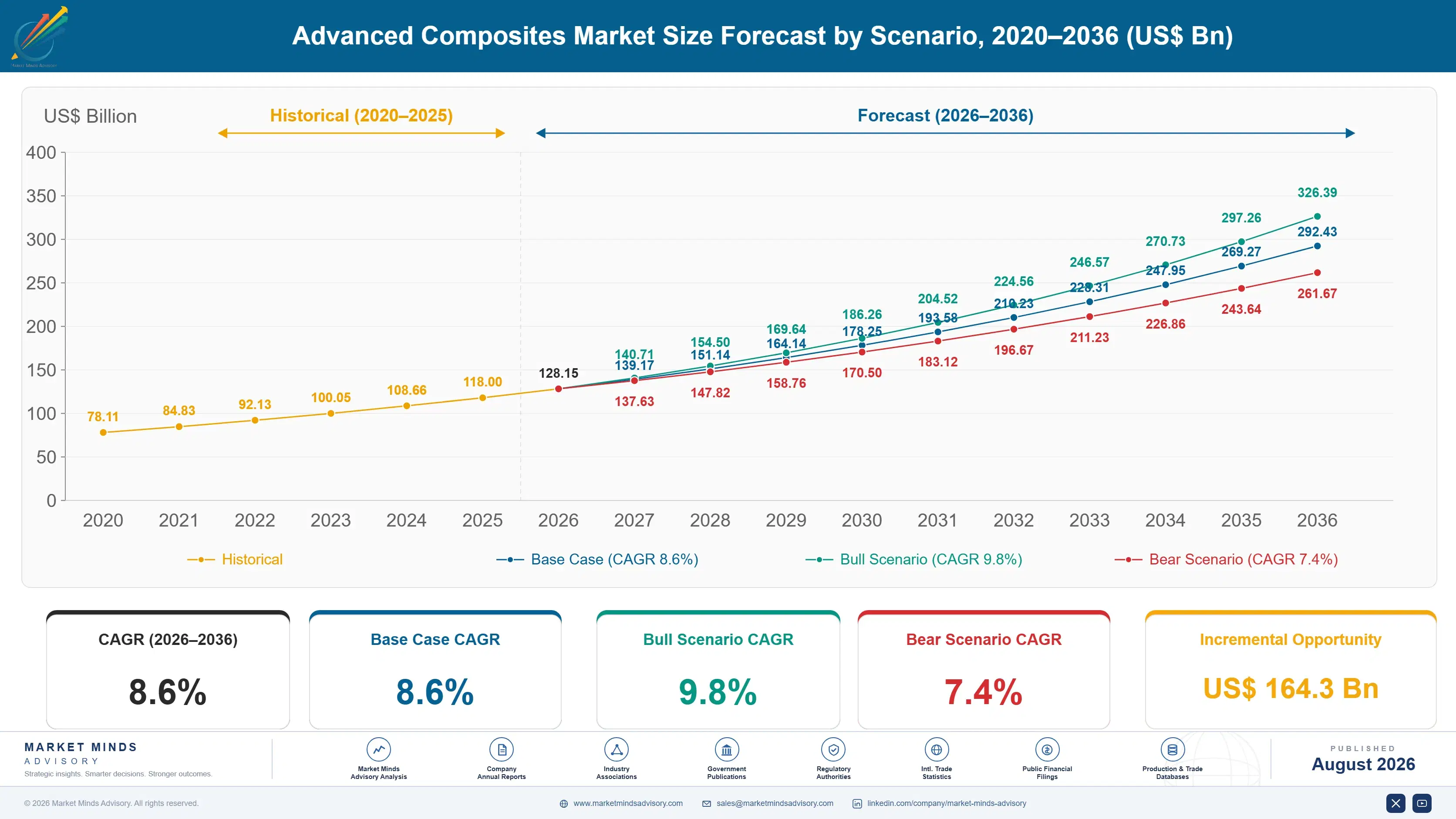
The market stands at USD 118.0 billion in 2025 and reaches USD 292.42 billion by 2036 at an 8.6% CAGR. Carbon fibre reinforced thermoplastics grow fastest at 13.2%, about 1.53 times the overall rate, as manufacturers seek faster processing and genuine recyclability that thermosets cannot offer. North America holds 27% of value on aerospace and wind demand, while Morocco posts the quickest national growth at 12.4% as aerospace suppliers relocate fabrication capacity there.
Concentration is moderate at roughly 29%, split between fibre producers, resin formulators, and vertically integrated composite fabricators serving different value chain stages. Two forces now dominate the direction of travel. End-of-life recyclability is moving from a sustainability talking point into a binding specification requirement on wind blades and automotive parts, and thermoplastic composite systems are challenging the thermoset chemistry that has dominated the industry for decades.
Market Definition
The advanced composites market covers fibre-reinforced structural materials combining carbon, glass, aramid, or natural fibres with thermoset or thermoplastic resin matrices, spanning carbon fibre composites, glass fibre composites, aramid fibre composites, natural fibre composites, and the resin and prepreg systems used to fabricate them, valued at manufacturer and fabricator selling prices. Basic fibreglass insulation and non-structural glass fibre products, metal matrix and ceramic matrix composites, standalone carbon fibre tow sold without composite fabrication, and finished end products such as aircraft or wind turbines are excluded.
Base Year Value
$118.0B in 2025 (MMA Primary Research Dataset, August 2026)
Forecast Period
2026 to 2036, eleven discrete annual values
CAGR
8.6% base case. Bull 9.8%. Bear 7.4%.
Fastest Growth Segment
Carbon Fibre Reinforced Thermoplastics: 13.2% CAGR
Fastest Growth Country
Morocco: 12.4% CAGR
Fastest Growth Region
South Asia and Pacific: 10.6% CAGR
Largest Region
North America: 27% of 2025 global value
Market Leaders
Toray Industries, Hexcel, Teijin, Solvay, Owens Corning. Source: MMA Analysis based on company annual reports.
Primary Survey
n=3,800 procurement and R&D decision-makers, Q4 2025, six countries
Methodology
Demand-side build-up, cross-validated against public data, 47 expert interviews

Advanced Composites Market Forecast Scenarios

advanced-composites-market-size-forecast-scenario-1787324869110
Growth from 2020 to 2025 compounded near 7.3%, and the period split sharply by end market. Aerospace composite demand collapsed during 2020 and 2021 as commercial aircraft production halted, then recovered steadily as delivery rates climbed back toward pre-pandemic levels. Wind energy composite demand grew almost without interruption throughout, as blade manufacturing scaled to meet renewable capacity targets across every major market simultaneously, largely independent of the broader industrial cycle.
Three mechanisms carry the base case to 8.6%. First, aerospace production rate recovery and the continued shift toward higher composite content on new aircraft programmes replacing older metal-intensive designs. Second, wind turbine blade length increasing steadily to capture more energy per installation, which raises material intensity per megawatt installed faster than turbine count alone suggests. Third, automotive lightweighting for electric vehicles, where range anxiety makes every kilogram saved commercially meaningful.
The bull case at 9.8% assumes aerospace production rates exceed current guidance and thermoplastic composite adoption accelerates in automotive manufacturing. The bear case at 7.4% assumes aircraft delivery schedules slip further, wind installation growth moderates as subsidy regimes tighten in several major markets, and carbon fibre cost fails to fall enough to broaden adoption beyond premium vehicle segments.

Why A 1990s Qualification Still Beats A Better Material

Three forces set demand. Aerospace production drives the highest-value volume, because composite content per aircraft keeps rising and every new programme locks in decades of material demand once a qualification is secured. Wind energy drives the largest tonnage, as blade length keeps growing to capture more energy per turbine installed. Automotive lightweighting drives a third stream, expanding as electric vehicle manufacturers chase efficiency gains fuel-only vehicles never needed.
MARKET CONCENTRATIONCR5: 29%Moderately fragmented across fibre, resin, and fabrication suppliers
AEROSPACE QUALIFICATION TIME5 to 10 yearsTime to certify a new composite onto an aircraft
CARBON FIBRE PRICE PREMIUM10 to 20 timesCarbon fibre cost against equivalent structural steel by weight
WEIGHT REDUCTION VERSUS METAL20 to 50%Typical weight saving achieved replacing aluminium or steel structures
RECYCLED CONTENT MANDATEUp to 65%Blade recyclability target specified in leading turbine markets
WIND BLADE LENGTH GROWTHAbout 3% yearlyAverage annual increase in installed offshore turbine blade length
The commercial character is set by qualification cost rather than by material performance. Aerospace certification alone takes five to ten years and tens of millions of dollars, and once a material is designed into an airframe it typically stays there for the programme's entire production life, which can span decades. That timeline dwarfs material science progress, meaning superior materials routinely lose to already-qualified incumbents on cost grounds.
The decade turns on two forces converging simultaneously. End-of-life recyclability is moving from voluntary commitment into binding specification, particularly on wind turbine blades where landfill disposal is becoming legally restricted in several jurisdictions. And thermoplastic composite systems, reheatable and reshapeable unlike irreversibly cured thermosets, are gaining ground because they answer that recyclability question directly.
"Everyone talks about carbon fibre strength-to-weight ratios and nobody talks about the fact that half this industry's revenue sits behind a qualification wall that took a decade to build and will take another decade to tear down, if it ever gets torn down at all."
Director, Advanced Materials and Aerospace Composites Practice · MMA Chemicals a

Market Trends

Thermoplastic Composites Challenge Decades Of Thermoset Dominance

Thermoset resins have dominated advanced composites for decades because they deliver excellent mechanical properties once cured, but that cure is irreversible, which makes parts genuinely difficult to recycle and slow to manufacture at automotive volumes. Thermoplastic composite systems can be reheated, reshaped, and welded rather than bonded, cutting cycle times considerably and offering a credible end-of-life recycling pathway that regulators increasingly require of manufacturers. Automotive manufacturers building electric vehicles at volume have led adoption, since thermoplastic processing suits high-rate manufacturing far better than batch autoclave curing typically demands. Aerospace adoption is progressing more cautiously given the qualification burden involved.
Market Impact: Composite content exceeds 50%
Wind Blade Recyclability Becomes A Binding Specification

Landfill disposal of retired wind turbine blades has attracted growing regulatory restriction and public criticism, particularly in Europe, where several countries have moved toward banning composite blade landfilling outright within defined timelines. That regulatory pressure has converted recyclability from a sustainability marketing claim into a binding procurement specification that turbine manufacturers must satisfy to win utility-scale contracts at all. Resin systems designed for chemical or thermal recyclability, and thermoplastic blade construction more broadly, are gaining specification share as a direct consequence. The commercial effect reaches upstream into resin formulation decisions made years before any blade reaches end of life.
Market Impact: Blades now exceed 100 metres

Market Opportunities and Growth Drivers

Aircraft Composite Content Keeps Rising Programme Over Programme

Each new commercial aircraft generation has carried a higher proportion of composite structure than the one before it, moving from secondary structures toward primary fuselage and wing components on the most recent widebody programmes. That progression reflects genuine performance advantages in fuel efficiency and maintenance cost that airlines value directly, and it locks in composite material demand for the multi-decade production run of every programme that adopts it. Manufacturers who win qualification on a new aircraft programme secure a demand stream lasting as long as that aircraft remains in production, which can extend beyond twenty years from first delivery.
Market Impact: Costs above USD 10 million

Offshore Wind Blade Length Drives Material Intensity Upward

Offshore wind turbines are growing larger to capture more energy per installation and improve project economics against fixed foundation and grid connection costs, and blade length has increased considerably faster than turbine count over the past several years. Longer blades require proportionally more composite material and increasingly sophisticated structural engineering to manage the loads involved, which raises material intensity per megawatt installed well beyond what simple capacity growth figures suggest. Manufacturers supplying blade material for the largest offshore platforms currently in development capture demand growth considerably steeper than the underlying wind capacity expansion figures alone indicate.
Market Impact: Costs 10 to 20 times steel

Market Restraints and Challenges

Qualification Timelines Lock Out Superior New Materials

Aerospace material qualification takes five to ten years and tens of millions of dollars, and once secured onto an airframe design a material typically stays there for the programme's entire production life regardless of subsequent material science advances. The root cause is that recertifying a structural change carries genuine safety risk that manufacturers are reluctant to reopen without compelling reason. The commercial impact is that superior materials routinely lose to already-qualified incumbents on cost and schedule grounds. Mitigation runs through positioning for genuinely new aircraft programmes, where the qualification slate opens completely.
Market Impact: Cuts cycle time 60 to 80%

Carbon Fibre Cost Limits Automotive Adoption Beyond Premium Vehicles

Carbon fibre costs ten to twenty times equivalent structural steel by weight, which confines its automotive use largely to premium and performance vehicles where customers accept the cost for weight and handling benefits. The root cause is an energy-intensive precursor and carbonisation process that has resisted the cost reduction curves seen in other advanced materials over recent decades. The commercial impact is that mass-market vehicle adoption remains limited to glass fibre composites, costing considerably less but delivering correspondingly less weight saving. Mitigation runs through lower-cost precursor development and recycled carbon fibre.
Market Impact: Targets reach 65% recyclability
3 additional market trends, 4 additional growth drivers, and 2 additional restraints and challenges are covered in the full report. Contact sales@marketmindsadvisory.com to access the complete intelligence.

Segment CAGR and Growth Architecture

Segmentation follows fibre and matrix technology, a single material logic describing what reinforcement and resin chemistry the composite actually combines together in service. Each combination carries its own performance profile, cost point, processing method, and qualification pathway, so commercial position tracks the material system rather than the end product it eventually becomes. That distinction matters most in aerospace.
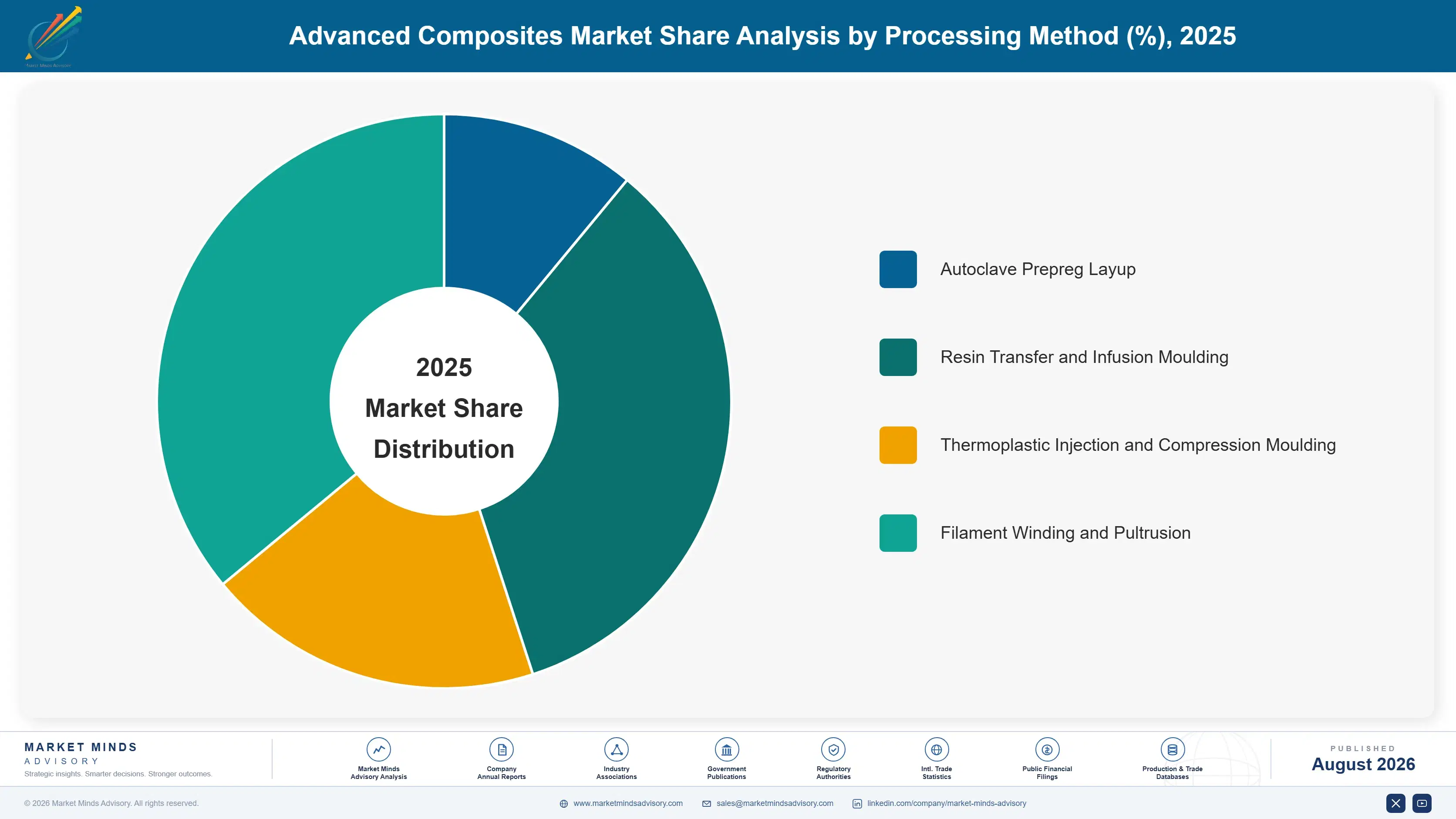
advanced-composites-market-market-share-analysis-1787324869644

Carbon Fibre Reinforced Thermoplastics

Carbon fibre reinforced thermoplastics grow fastest at 13.2%, about 1.53 times the overall 8.6% rate, combining carbon fibre reinforcement with thermoplastic resins that can be reheated and reshaped rather than cured irreversibly like conventional thermosets. That reversibility delivers both faster processing suited to high-volume automotive manufacturing and a genuine recycling pathway that regulators increasingly require on end-of-life components. Growth concentrates in electric vehicle structural components and, more cautiously, in aerospace interior and secondary structure applications where qualification burden is lighter than primary structure work. Toray, Celanese, and Covestro hold established positions in the resin and composite system supply chain. Weld line strength and long-term fatigue performance remain active areas of ongoing material development.
CAGR 13.2%

Carbon Fibre Reinforced Thermosets

Carbon fibre reinforced thermosets grow at 10.8%, remaining the dominant chemistry across aerospace primary structure and high-performance applications where decades of qualification history and proven long-term fatigue performance still outweigh thermoplastic processing advantages. Epoxy resin systems deliver the mechanical property combination that aerospace certification bodies have accumulated the deepest performance database against, which matters enormously in a qualification-driven industry where unproven alternatives carry genuine career and safety risk for engineers specifying them. Hexcel, Toray, and Solvay anchor aerospace-grade supply specifically. Growth tracks aircraft production rates and continued adoption on new commercial and defence aerospace programmes entering production over the coming years. Growth also depends on continued adoption across new defence aerospace programmes entering production over the coming decade.
CAGR 10.8%
Full segment breakdown across 6 segments available in the complete report.

Regional Architecture and Country Demand Map

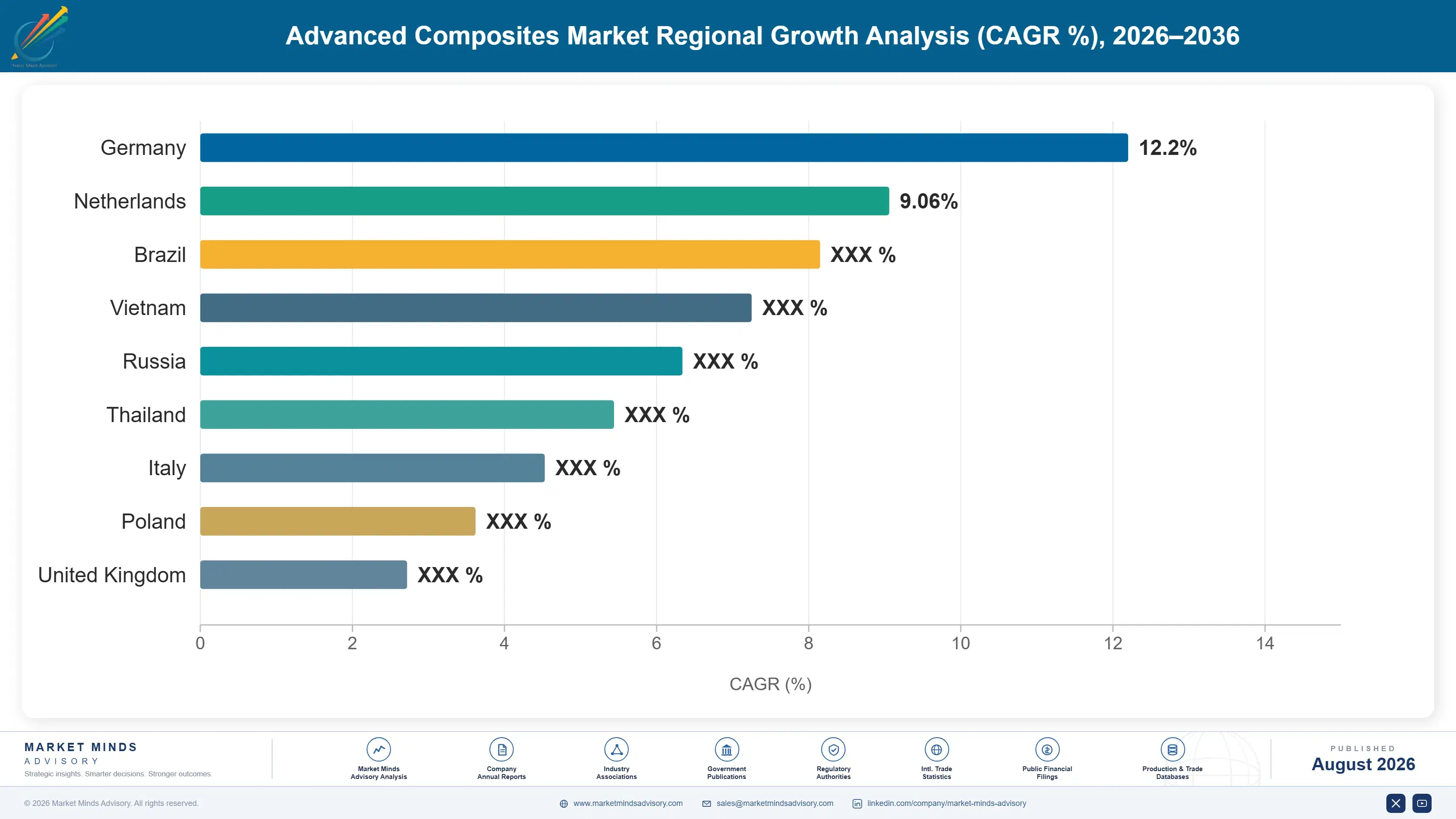
Aerospace and wind energy manufacturing footprint rather than population sets this distribution. North America and East Asia lead on comparable but differently sourced demand, Western Europe follows on aerospace and offshore wind depth, and Morocco grows fastest as global suppliers relocate fabrication capacity there deliberately.

North America

Aerospace and wind energy manufacturing give North America 27% of value at 8.2% growth. Boeing's commercial aircraft programmes and extensive defence aerospace production anchor the highest-value composite demand anywhere, supported by a deep domestic supplier base spanning fibre, resin, and fabrication capability built over decades. Hexcel and Solvay hold strong positions built on aerospace qualification depth that competitors elsewhere struggle to replicate quickly. Wind energy demand is significant though policy-sensitive, moving with federal incentive structures that have shifted meaningfully in recent years. Automotive composite adoption is expanding steadily as domestic electric vehicle manufacturing scales, though it trails Asian and European volumes considerably. Federal policy shifts have introduced genuine uncertainty into medium-term wind investment planning.
Share: 27% | CAGR: 8.2% (2026 to 2036)

Western Europe

Aerospace and offshore wind depth give Western Europe 24% of value at 7.0% growth. Airbus's commercial aircraft programmes drive comparable aerospace demand to North America, supported by a dense composite supplier cluster across France, Germany, and the United Kingdom built around decades of joint programme development. Europe leads global offshore wind installation, and blade manufacturers here face the earliest and most demanding recyclability regulation anywhere, which has pushed thermoplastic and recyclable resin adoption ahead of other regions considerably. Toray's European operations and Solvay's home market position both anchor regional supply. Growth reflects steady rather than rapid expansion across a genuinely mature industrial base. Joint programme development between France and Germany continues to anchor regional supplier relationships.
Share: 24% | CAGR: 7.0% (2026 to 2036)
Regional intelligence for 5 additional markets available in the complete report: East Asia, South Asia and Pacific, Latin America, Middle East and Africa, Eastern Europe. Contact sales@marketmindsadvisory.com.
advanced-composites-market-country-cagr-analysis-1787324870154

Where Composite Suppliers Actually Defend Margin

Selling fibre or resin as a commodity input competes on cost against every other qualified supplier holding the same certification and market access today. The four moves below shift earnings toward what commodity competition cannot reach: qualification depth, recyclable chemistry, thermoplastic processing, and design-in relationships built early. Formulation alone rarely wins accounts. That gap is the whole opportunity.

Win Qualification On New Aircraft Programmes Early

Aerospace qualification takes five to ten years and tens of millions of dollars, and once secured a material typically stays designed into the airframe for the programme's entire production life, which can span more than twenty years from first delivery. Suppliers who invest in qualification ahead of a new programme's material selection decision capture demand competitors cannot access once the design freezes, regardless of subsequent cost or performance improvements offered later. That USD 10 million-plus investment is the highest-return capital allocation decision available anywhere in this industry. Once won, that position is almost impossible for any competitor to dislodge later.
Market Impact: Locks in demand for 20 or more year

Position Recyclable Chemistry Ahead Of Regulatory Deadlines

Wind blade landfilling restrictions are moving from proposal into binding regulation across several major markets, and resin suppliers who have already developed and validated recyclable formulations qualify for specification decisions that unreformulated competitors cannot bid on at all. That development work takes years, which means starting ahead of the regulatory deadline converts compliance cost into genuine competitive advantage rather than a scramble under pressure. Recyclable resin systems currently command meaningful premiums over conventional thermoset formulations precisely because qualified supply remains scarce relative to tightening demand. Recyclable resin systems currently command 15% to 25% premiums over conventional thermoset formulations.
Market Impact: Recyclable resin commands 15 to 25%

Build Thermoplastic Processing Capability For High-Volume Manufacturing

Automotive electric vehicle manufacturers need composite processing that matches production line rates thermoset autoclave curing simply cannot deliver, and thermoplastic systems cut cycle times by 60% to 80% while offering the recyclability pathway carbon-conscious manufacturers increasingly require of every material they specify today across the industry. Suppliers who build genuine thermoplastic processing capability now are positioning ahead of a demand shift that vehicle electrification makes essentially unavoidable across the whole industry. That capability requires different equipment and expertise than thermoset processing, which is precisely why the qualified supplier field remains genuinely narrow.
Market Impact: Thermoplastic processing cuts cycle

Cultivate Design-In Relationships Before Specification Freezes

Material selection on a new aircraft, wind turbine platform, or vehicle programme happens years before production begins, and suppliers embedded in that early design work shape specifications toward their own material properties in ways later competitors, no matter how capable, simply cannot replicate afterward. Engineering collaboration during concept and prototype phases builds relationships that persist through qualification and into decades of production volume ahead. That early engagement, typically spanning 2 to 3 years, costs considerably less than winning a competitive bid later against an already-specified incumbent. That relationship depth compounds across the entire subsequent programme life afterward.
Market Impact: Engagement starts 2 to 3 years ahea

Who Controls the Margin Pool

Concentration is moderate at roughly 29% for the top five, split between fibre producers, resin formulators, and vertically integrated fabricators serving different parts of the value chain. The gap between leaders and challengers is qualification depth rather than raw material access, broadly available across chemical supply chains. All participants are assessed on one basis, revenue from advanced composite fibre, resin, and fabricated material supply, excluding insulation and finished end prod
Competition runs along three lines. First, aerospace qualification breadth, since certified positions persist for decades and determine who can bid on the highest-value demand. Second, recyclable and thermoplastic chemistry development, increasingly a binding requirement rather than an optional differentiator. Third, application engineering depth, since customers want a design partner embedded early rather than a supplier engaged after specifications are fixed.

Pressure is building from two directions. Chinese fibre producers are expanding capacity and improving quality fast enough to compete internationally beyond their traditionally domestic base. Meanwhile specialty chemical companies are entering through thermoplastic resins, bringing polymer science depth traditional fibre suppliers are still building. Rankings should favour suppliers combining qualification depth with genuine thermoplastic capability over those holding fibre scale alone.
advanced-composites-market-company-positioning-matrix-1787324870672

Competitive Moat and Risk Dimensions

TORAY INDUSTRIES

Moat: Vertically integrated fibre leadership

Toray operates the deepest vertical integration in the industry, spanning carbon fibre production through prepreg and composite fabrication, giving cost and quality control that competitors sourcing fibre externally cannot match easily. Its aerospace qualification portfolio spans multiple major commercial and defence programmes across both Boeing and Airbus supply chains simultaneously.
TORAY INDUSTRIES

Risk: Capital intensity and cycle exposure

Carbon fibre production requires enormous capital investment with long payback periods, exposing Toray directly to aerospace and wind demand cycles entirely beyond its own control. Chinese fibre producers are narrowing the quality gap while competing aggressively on price in less demanding application categories worldwide. Diversification across many end markets means capital competes internally for investment.
HEXCEL

Moat: Deep aerospace qualification portfolio

Hexcel holds among the deepest aerospace-specific qualification portfolios in the industry, built through decades of programme relationships with commercial and defence aircraft manufacturers across multiple platforms. Its high-performance prepreg and honeycomb core products command premium pricing that broader-portfolio competitors struggle to match on comparable specification depth.
HEXCEL

Risk: Aerospace concentration and cyclicality

Heavy aerospace concentration leaves Hexcel exposed directly to production rate decisions and delivery schedule slips entirely outside its own control. Limited diversification into automotive and wind means it captures less benefit from the fastest-growing segments of the broader composites market overall. Thermoplastic transition risk is real, given its thermoset-weighted portfolio today.

Players Tracked

Prominent Players

Toray Industries
Hexcel
Teijin
Solvay
Owens Corning

Other Key Players

SGL Carbon
Mitsubishi Chemical
Celanese
Covestro
Huntsman Corporation
Gurit Holding
Zoltek
Kordsa
Jushi Group
China Jushi
Nippon Electric Glass
Johns Manville
Cytec Solvay Group
Renegade Materials
Plasan Carbon Composites

Recent Developments

MARCH 2023

European wind industry advances blade landfill restrictions

Several European countries advanced regulatory restrictions on landfill disposal of retired wind turbine blades, moving toward binding recyclability requirements within defined transition timelines. This was regulatory action rather than any corporate transaction, and it converted composite recyclability from a marketing claim into a genuine procurement requirement for turbine manufacturers.
Signal: Regulation is forcing resin reformulation
OCTOBER 2023

Global aerospace suppliers expand Moroccan composite manufacturing capacity

Several international aerospace component manufacturers expanded composite fabrication capacity in Morocco, adding to an already growing regional supply base serving European aircraft programmes directly. These were organic capacity investments rather than acquisitions. They built genuine fabrication capability where little previously existed at all. This deepened its export role.
Signal: Aerospace supply chains are diversifying g
JULY 2025

Major automotive manufacturer commits to thermoplastic composite structural components

A major global automotive manufacturer committed to thermoplastic composite structural components across an upcoming electric vehicle platform, moving beyond earlier limited pilot applications into full production specification. This was a procurement specification decision rather than a corporate transaction, and it signalled thermoplastic readiness for genuine high-volume automotive manufacturing.
Signal: One major manufacturer committing to produ

Precursor, Carbon Fibre, Resin, Energy

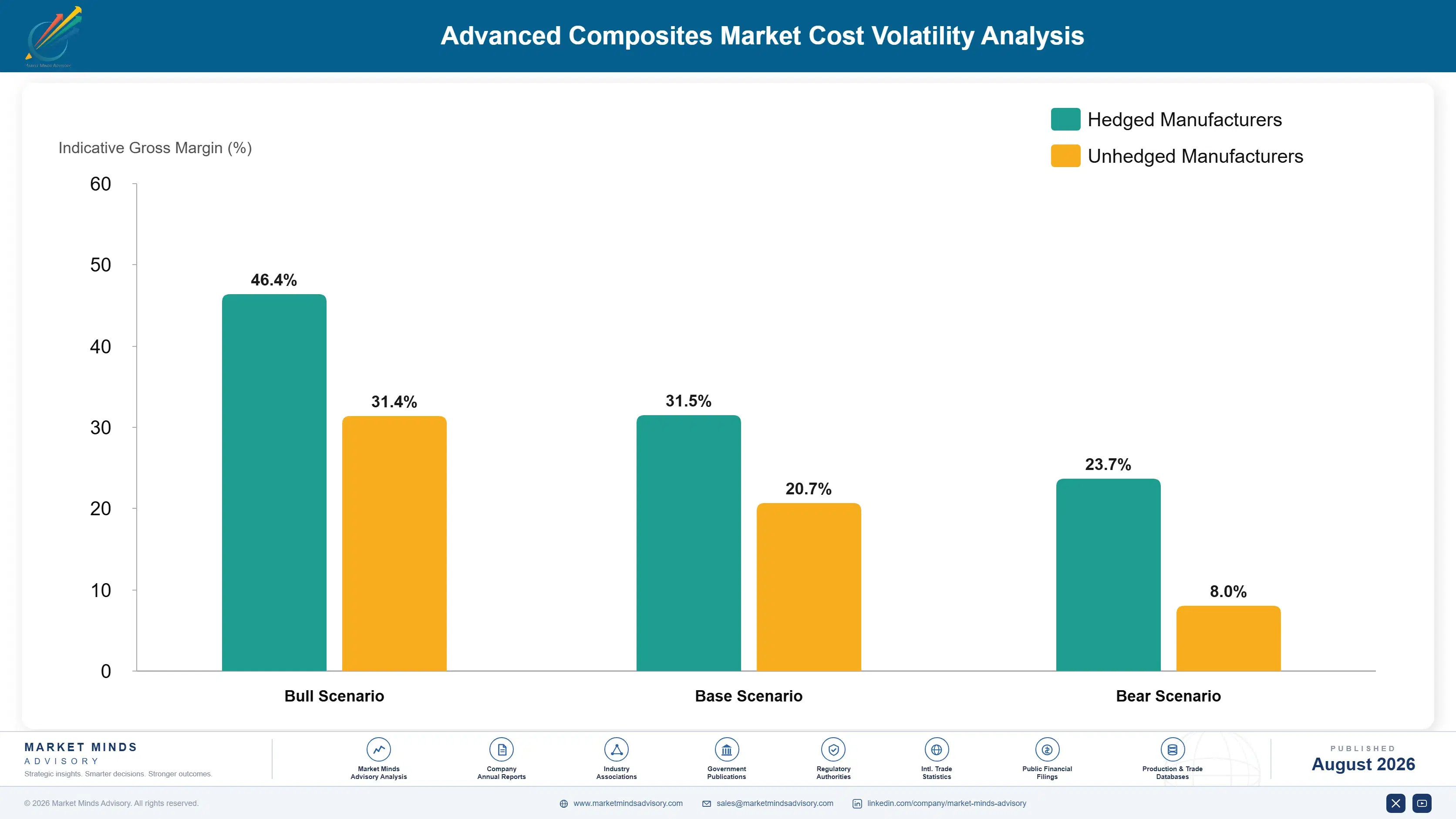
Cost structure varies sharply by fibre type. Carbon fibre precursor and the energy-intensive carbonisation process together account for the majority of production cost, with energy representing 20% to 30% of that figure given the extreme processing temperatures involved throughout. Resin systems add 25% to 40% of finished composite cost depending on chemistry and performance grade selected.
Energy prices rose sharply through 2021 and 2022 as European natural gas markets tightened severely following supply disruption, and carbon fibre production is particularly energy-intensive given the extreme carbonisation furnace temperatures the process requires throughout. Several producers disclosed the resulting margin pressure across their 2022 annual reporting, and EIA data recorded the parallel natural gas and electricity movement that drove both carbon fibre and resin production costs considerably higher than in prior comparable periods across the industry.

Exposure divides sharply by production location and vertical integration rather than by end market served. European carbon fibre producers faced the steepest energy exposure given regional gas dynamics, while Asian producers weathered the period somewhat better on relative terms. Integrated producers held margin considerably better than those buying intermediate materials on open markets into a tightening cycle.
advanced-composites-market-cost-volatility-analysis-1787324870866

Secure long-term energy contracts for fibre production

Carbon fibre carbonisation is extraordinarily energy-intensive, and spot energy exposure during a tightening market destroys margin faster than almost any other cost line in this business. Multi-year energy supply agreements cost a premium in stable periods but protect production economics precisely when volatility hits hardest. Producers who secured supply before the 2021 spike maintained profitability while unhedged competitors did not.

Diversify fibre production across multiple regions

Concentrating fibre production in a single energy market ties the entire cost base to that region's specific volatility, which European producers learned expensively through the recent gas crisis. Geographic production diversification spreads that exposure across different energy markets and regulatory regimes. It also provides supply continuity when any single region faces disruption or extreme pricing.

Index long-term aerospace contracts to material benchmarks

Multi-year aerospace supply agreements signed before recent volatility left fibre and resin producers absorbing cost increases with no ability to pass them through mid-contract to aircraft manufacturers. Indexing pricing to published energy and precursor benchmarks shares that volatility with the customer instead. Aerospace buyers accept this once shown that unindexed suppliers eventually cannot sustain long production commitments.

Portfolio Architecture for Margin Defence

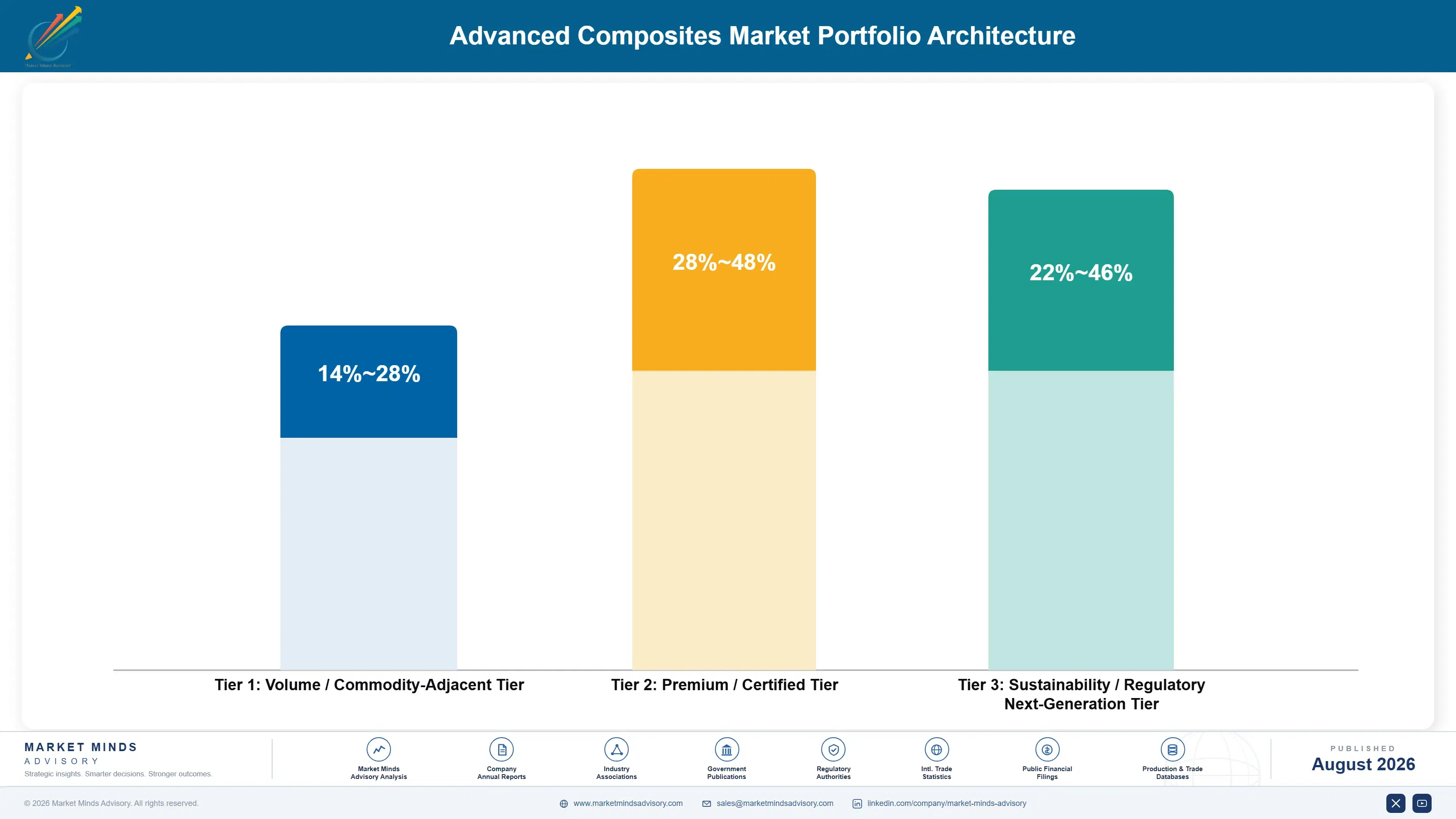
The portfolio splits into three tiers with quite different economics. Glass fibre composites and standard resin systems are the volume tier, where competition is genuine and material specification is broadly commoditised across the industry. Aerospace-qualified carbon fibre earns considerably more, because certification depth and accumulated performance data narrow the qualified field. Thermoplastic and recyclable chemistry systems sit differently again, priced against a specification requiremen
The tension runs between volume that keeps fibre lines loaded and qualified aerospace work that earns the return. Glass fibre and standard resin generate tonnage and keep production assets running near capacity. Yet it competes directly on cost against every qualified alternative. Producers managing this well treat commodity volume as capacity utilisation and direct capital deliberately toward aerospace qualification and recyclable chemistry development.

High-value pools concentrate where qualification or chemistry innovation limits competition genuinely: aerospace primary structure carbon fibre carrying decades of certified performance history, recyclable resin systems meeting tightening wind blade regulation, and thermoplastic systems suited to high-volume automotive manufacturing. All three resist the price competition defining commodity glass fibre, because the qualified supplier field is narrow and customers purchase certified capability rather than comparing raw specifications.

Volume / Commodity-Adjacent Tier

Standard glass fibre composites and conventional resin systems sold into general industrial and construction applications. The range is wide because vertically integrated producers earn respectably while those buying fibre or resin on open markets frequently do not.
Gross Margin: 14-28%

Premium / Certified Tier

Aerospace-qualified carbon fibre prepreg systems and high-performance resins carrying multi-decade certification history across major commercial and defence aircraft programmes worldwide, sold at considerable premiums. Certification depth and decades of flight history sustain this premium durably.
Gross Margin: 28-48%

Sustainability / Regulatory / Next-Generation Tier

Thermoplastic composite systems, recyclable resin chemistry meeting wind blade regulation, and recycled carbon fibre products. The range is wide because thermoplastic economics depend heavily on production volume achieved and process maturity reached.
Gross Margin: 22-46%
advanced-composites-market-portfolio-architecture-1787324871368

High-value Sub-segments and Strategic Watch-out

Carbon Fibre Reinforced Thermoplastics

High value and the fastest growth at 13.2%, delivering both faster processing suited to automotive volume and a genuine recycling pathway regulators increasingly require. Aerospace adoption is progressing more cautiously given the heavier qualification burden involved there. Growth reflects both automotive volume manufacturing needs and tightening end-of-life recyclability regulation together.
Gross Margin: 26-46%

Aerospace-Qualified Carbon Fibre Thermosets

High value with strong growth at 10.8%, protected by decades of accumulated performance data that qualification bodies weigh far more heavily than any unproven alternative material offers today. Growth tracks aircraft production rates and continued adoption on new programmes entering service. Aerospace remains the deepest application here.
Gross Margin: 30-48%

Glass Fibre Composites

The volume core across construction, marine, and general industrial applications worldwide. Growth is steady at 6.4% but specification is broadly commoditised, and price competition is direct wherever certification is lighter. Competition on price is direct wherever certification burden is genuinely lighter than aerospace demands. Pricing remains under constant pressure.
Gross Margin: 14-28%

Aramid Fibre Composites

The strategic watch-out, growing slowest at 5.8% as carbon fibre displaces aramid in applications where cost gaps have narrowed. Ballistic protection retains genuine advantages that carbon fibre still cannot fully replicate. Volume remains meaningful in defence applications where carbon fibre has not yet fully displaced it.
Gross Margin: 20-38%

How Composite Specifications Actually Lock In

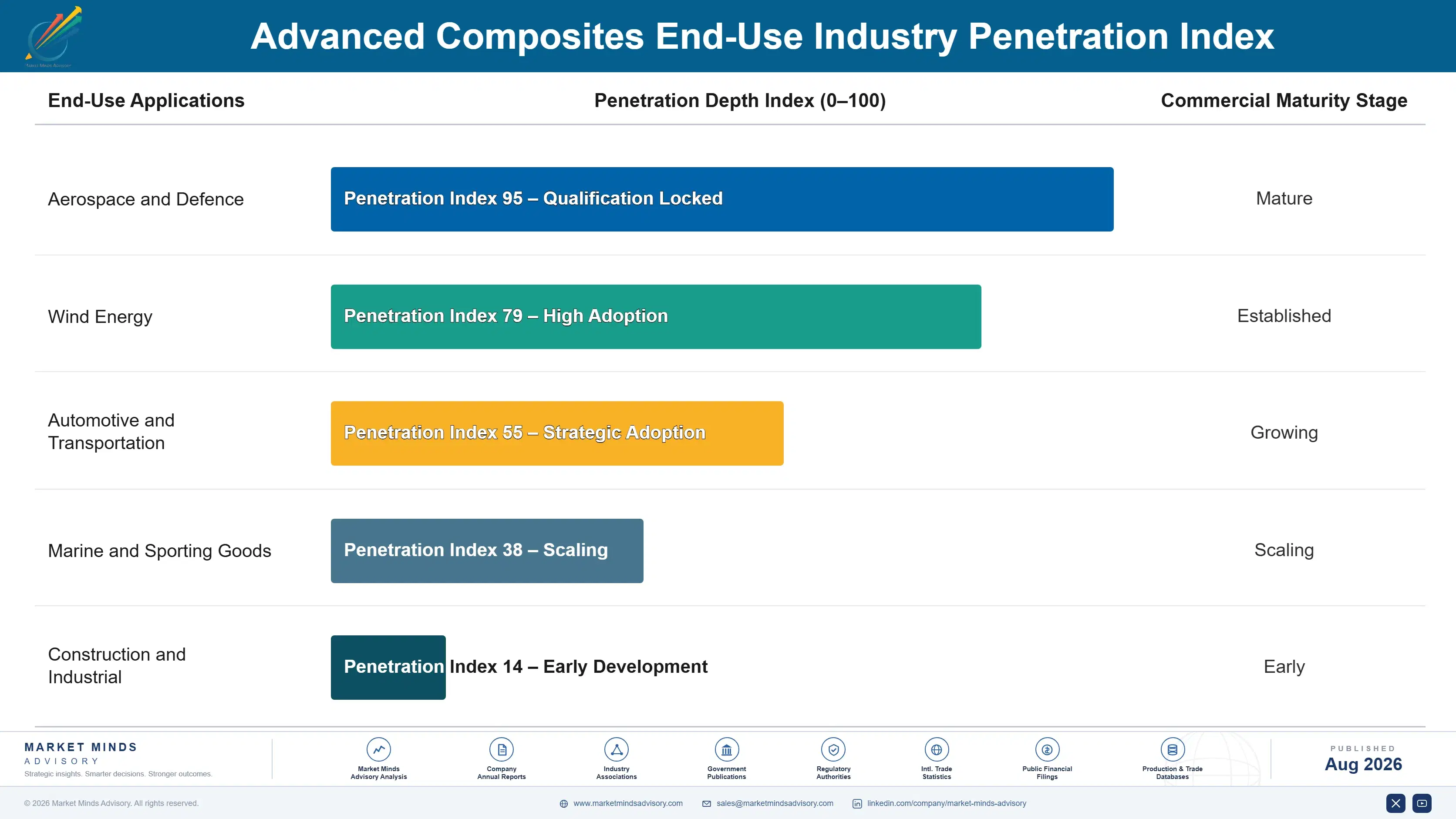
Revenue is annuity-like once qualification completes, and largely absent before it. An aerospace material designed into an airframe reorders for the programme's entire production life, which can extend beyond twenty years, without further competitive evaluation. Wind and automotive specifications persist for a platform's model life, typically five to eight years, before facing reconsideration. That asymmetry shapes where suppliers should concentrate qualification investment.
Adoption depth varies sharply by end market. Aerospace manufacturers go deepest, running formal qualification processes that lock suppliers in for decades once completed successfully. Wind turbine manufacturers specify materials against performance and increasingly recyclability requirements, reconsidering at each platform generation. Automotive manufacturers specify against cost, weight, and manufacturing rate simultaneously, switching more readily given shorter model cycles. Sporting goods and marine buyers specify on performance with less formal process.

Buyer profiles have shifted from purchasing engineers toward materials specialists, sustainability officers, and manufacturing process engineers with distinct priorities. A purchasing engineer once compared material price directly; a materials specialist now models total lifecycle performance, and a sustainability officer now requires documented recyclability pathways the older relationship never demanded. Suppliers still competing purely on fibre price find decisions made by people who never saw their quotation.
advanced-composites-market-end-use-penetration-index-1787324871856

Our Call On Advanced Composites

These are among the four positions where our research anticipates prominent divergence between winners and laggards over the coming forecast period. Each is grounded in the demand model, the regulatory perimeter, and the announced capacity pipeline.
01 / NEW PROGRAMME QUALIFICATION

New programmes are the only real entry point available

Aerospace qualification takes five to ten years and tens of millions of dollars, and once secured a material stays designed into the airframe for the programme's entire production life, spanning more than twenty years from first delivery. Suppliers who invest ahead of a new programme's material selection capture demand competitors cannot access once the design freezes, regardless of any subsequent cost or performance improvement they might later offer. That qualification investment is genuinely the highest-return capital allocation decision available anywhere across this entire industry.
02 / RECYCLABILITY AS GATE

Wind blade regulation is rewriting resin chemistry priorities

Wind blade landfilling restrictions are moving from proposal into binding regulation across several major markets, and resin suppliers who developed recyclable formulations ahead of the deadline qualify for specification decisions that unreformulated competitors simply cannot bid on. That development work takes years, so starting early converts a compliance cost into genuine competitive advantage rather than a scramble under deadline pressure later. Recyclable resin systems currently command 15% to 25% premiums over conventional thermoset formulations precisely because qualified supply remains scarce relative to tightening demand.
03 / THERMOPLASTIC CHEMISTRY SHIFT

Automotive volume is forcing a chemistry shift thermosets cannot follow

Electric vehicle manufacturers need composite processing that matches production line rates thermoset autoclave curing simply cannot deliver, and thermoplastic systems cut cycle times by 60% to 80% while offering the recyclability pathway carbon-conscious manufacturers increasingly require. Suppliers building genuine thermoplastic processing capability now are positioning ahead of a demand shift that vehicle electrification makes essentially inevitable across the whole industry. That capability requires different equipment and expertise than thermoset processing, which is exactly why the qualified supplier field remains genuinely narrow today.
04 / EARLY DESIGN ENGAGEMENT

Engineering relationships decided years before any tender

Material selection on a new aircraft, wind platform, or vehicle programme happens years before production begins, and suppliers embedded in that early design work shape specifications toward their own material properties in ways later competitors simply cannot replicate afterward. Engineering collaboration during concept and prototype phases builds relationships persisting through qualification and into decades of subsequent production volume. That early engagement costs considerably less than winning a competitive bid against an already-specified incumbent much later, and that relationship depth compounds across the entire programme life.

Engagement Snapshot From the Field

A live engagement with an industry participant carrying material or product regulatory and market exposure ahead of a defining policy shift, showing how our research translates into a defensible multi-year portfolio strategy.
MARKET MINDS ADVISORY · CLIENT ENGAGEMENT SUMMARY
Advanced Composites Producer Strategic Portfolio Review and Transition Roadmap 2026·Investment Scenario on Advanced Composites Exposure Evaluation 2025-26
CLIENT PROFILE
A wind turbine blade manufacturer supplying utility-scale projects across Europe and North America engaged MMA while planning its response to tightening recyclability regulation. The client reported annual blade production exceeding 2,000 units and had built its resin supply chain around conventional thermoset epoxy systems with no established recycling pathway (client-reported, unverified by MMA). and had built its entire supply chain around conventional thermoset epoxy systems lacking recycling
STRATEGIC CHALLENGE
Several European markets were moving toward binding landfill restrictions on retired blades, and the client's entire installed material base and current production specification relied on resin systems with no credible end-of-life solution. Switching resin chemistry meant requalifying blade designs against structural certification bodies, and nobody had established which recyclable alternatives could actually meet performance requirements at scale.
MMA APPROACH
MMA assessed available recyclable and thermoplastic resin systems against the client's structural performance requirements and manufacturing process constraints specifically. We modelled requalification timeline and cost against the regulatory deadlines the client actually faced across its served markets. We also benchmarked resin suppliers on demonstrated production-scale recyclable formulations rather than laboratory-stage claims alone.
KEY FINDINGS
  1. Only two of six assessed recyclable resin systems met the client's structural fatigue performance requirements at the blade lengths currently in production across its main product lines.
  2. Requalification against European structural certification would take approximately thirty months, which meant starting immediately was necessary to meet the earliest binding regulatory deadline (client-reported, unverified by MMA).
  3. One supplier's recyclable system carried a genuine cost premium of roughly 18%, though its chemical recycling process demonstrated compatibility with the client's existing manufacturing equipment without modification.
  4. The client's current supply agreements contained no provision addressing recyclability requirements at all, exposing it to renegotiation risk regardless of which resin path it ultimately chose.
CLIENT PROFILE
A wind turbine blade manufacturer supplying utility-scale projects across Europe and North America engaged MMA while planning its response to tightening recyclability regulation. The client reported annual blade production exceeding 2,000 units and had built its resin supply chain around conventional thermoset epoxy systems with no established recycling pathway (client-reported, unverified by MMA). and had built its entire supply chain around conventional thermoset epoxy systems lacking recycling
STRATEGIC CHALLENGE
Several European markets were moving toward binding landfill restrictions on retired blades, and the client's entire installed material base and current production specification relied on resin systems with no credible end-of-life solution. Switching resin chemistry meant requalifying blade designs against structural certification bodies, and nobody had established which recyclable alternatives could actually meet performance requirements at scale.
MMA APPROACH
MMA assessed available recyclable and thermoplastic resin systems against the client's structural performance requirements and manufacturing process constraints specifically. We modelled requalification timeline and cost against the regulatory deadlines the client actually faced across its served markets. We also benchmarked resin suppliers on demonstrated production-scale recyclable formulations rather than laboratory-stage claims alone.
KEY FINDINGS
  1. Only two of six assessed recyclable resin systems met the client's structural fatigue performance requirements at the blade lengths currently in production across its main product lines.
  2. Requalification against European structural certification would take approximately thirty months, which meant starting immediately was necessary to meet the earliest binding regulatory deadline (client-reported, unverified by MMA).
  3. One supplier's recyclable system carried a genuine cost premium of roughly 18%, though its chemical recycling process demonstrated compatibility with the client's existing manufacturing equipment without modification.
  4. The client's current supply agreements contained no provision addressing recyclability requirements at all, exposing it to renegotiation risk regardless of which resin path it ultimately chose.
RECOMMENDED STRATEGY
Phase 1: Phase 1 (0 to 12 months): Begin structural requalification on the two qualifying recyclable resin systems immediately against the earliest regulatory deadline the client faces. Phase 2: Phase 2 (12 to 30 months): Complete certification and transition production on the primary blade platform to the recyclable system requiring no equipment modification. Phase 3: Phase 3 (30 to 48 months): Renegotiate supply agreements to include explicit recyclability provisions, and extend transition across remaining blade platforms.
OUTCOME
The client began requalification immediately on the compatible recyclable resin system, positioning it to meet the earliest regulatory deadline with margin to spare. Supply agreement renegotiation is underway, and the client has been cited by one national wind association as an early mover on blade recyclability compliance (client-reported, unverified by MMA).

Frequently Asked Questions

Foundational context covering the market sizes, CAGR, scope, country, region and competition that inform every finding below. This section is provided to cover basics and most often pre-purchase conversations, answered from the MMA Primary Research Dataset.

What is the current size of the Advanced Composites Market?

The global advanced composites market is valued at USD 118.0 billion in 2025, covering carbon, glass, aramid, and natural fibre composites along with resin systems. Finished end products are excluded.

How large will the Advanced Composites Market be by 2036?

The market is forecast to reach USD 292.42 billion by 2036 in the base case, about 2.28 times the 2026 level. That represents incremental value of roughly USD 164.27 billion across the forecast decade.

What is the CAGR for the Advanced Composites Market 2026 to 2036?

The market grows at an 8.6% CAGR in the base case, with bull and bear scenarios at 9.8% and 7.4%. The spread turns mainly on aerospace production rates and thermoplastic composite adoption speed in automotive manufacturing.

Which segment is growing fastest?

Carbon fibre reinforced thermoplastics grow fastest at 13.2%, about 1.53 times the overall rate, offering faster processing and genuine recyclability. Carbon fibre reinforced thermosets follow at 10.8% on continued aerospace production growth.

Who are the major companies in the Advanced Composites Market?

Leading suppliers include Toray Industries, Hexcel, Teijin, Solvay, and Owens Corning, holding roughly 29% between them. The field splits between fibre producers, resin formulators, and vertically integrated composite fabricators.

Which country is growing fastest?

Morocco grows fastest at a 12.4% CAGR, as global aerospace suppliers relocate composite fabrication capacity there to serve European aircraft programmes. India follows on expanding wind installation and supply chain participation.

Report Segmentation Architecture

The full report scope spans multiple orthogonal segmentation dimensions, with cross-tabulated demand data provided for each dimension pair. Coverage extends further to regional breakdowns, trend trajectories, and the competitive detail needed to support segment-level decision-making.

By Fibre and Matrix Technology

  • Carbon Fibre Reinforced Thermosets
  • Carbon Fibre Reinforced Thermoplastics
  • Glass Fibre Composites
  • Aramid Fibre Composites
  • Natural Fibre Composites
  • Resin and Prepreg Systems

By End-Use Industry

  • Aerospace and Defence
  • Wind Energy
  • Automotive and Transportation
  • Marine and Sporting Goods
  • Construction and Industrial

By Processing Method

  • Autoclave Prepreg Layup
  • Resin Transfer and Infusion Moulding
  • Thermoplastic Injection and Compression Moulding
  • Filament Winding and Pultrusion

By Region

  • North America
  • Western Europe
  • East Asia
  • South Asia and Pacific
  • Latin America
  • Middle East and Africa
  • Eastern Europe

Scope, Methodology, and Coverage

Every figure in this report is reproducible from documented input assumptions. The scope below maps the historical period, the forecast horizon, the segmentation dimensions, and the countries covered, alongside the underlying primary and qualitative methodology.
Historical Period
2020 to 2025
Forecast Period
2026 to 2036
Base Year
2025 (USD billions; MMA Primary Research Dataset, August 2026)
Market Definition
The advanced composites market comprises fibre-reinforced structural materials combining carbon, glass, aramid, or natural fibre reinforcement with thermoset or thermoplastic resin matrices, valued at manufacturer and fabricator selling prices for fibre, resin, prepreg, and fabricated composite products. It spans carbon fibre composites across both thermoset and thermoplastic chemistry, glass fibre composites for general industrial and transportation applications, aramid fibre composites for ballistic and high-impact applications, natural fibre composites for lower-load applications, and the resin and prepreg systems supplied to fabricators. Basic fibreglass insulation and non-structural glass fibre products, metal matrix and ceramic matrix composites, standalone carbon fibre tow sold without composite fabrication, and finished end products such as complete aircraft, wind turbines, or vehicles are excluded.
Quantitative Units
USD billions (current prices); production volume in metric tonnes of fibre and composite material by category where applicable
Segmentation Dimensions
By Fibre and Matrix Technology; By End-Use Industry; By Processing Method; By Region
Regions Covered
North America, Western Europe, East Asia, South Asia and Pacific, Latin America, Middle East and Africa, Eastern Europe
Countries Covered
USA, Canada, Germany, France, UK, Italy, Spain, Netherlands, Japan, South Korea, China, Taiwan, India, Australia, Indonesia, Vietnam, Brazil, Mexico, Argentina, UAE, Saudi Arabia, Morocco, Egypt, South Africa, Turkey, Poland, Czechia, Romania, and additional markets relevant to this sector
Key Companies Profiled
Toray Industries, Hexcel, Teijin, Solvay, Owens Corning, SGL Carbon, Mitsubishi Chemical, Celanese, Covestro, Huntsman Corporation, Gurit Holding, Zoltek, Kordsa, Jushi Group, China Jushi, Nippon Electric Glass, Johns Manville, Cytec Solvay Group, Renegade Materials, Plasan Carbon Composites
Quantitative Methodology
Primary survey, n=3,800 respondents, Q4 2025, six countries; demand-side model with trade association cross-validation
Qualitative Methodology
47 expert interviews, Q4 2025; applied to validate demand model assumptions, identify emerging dynamics, and assess competitive positioning
Report Format
PDF and XLSX data workbook (Word format preview document)
Publisher
Market Minds Advisory
Report Code
MMA-2026-CHM-218
Published
August 2026
Contact
sales@marketmindsadvisory.com | www.marketmindsadvisory.com

Purchase the full Advanced Composites Market Report (2026 to 2036).

The full MMA Advanced Composites report sizes the market across six fibre and matrix technologies, five end-use industries, four processing methods, and seven regions through 2036. It profiles 20 suppliers on a consistent basis of composite fibre, resin, and fabrication revenue, scoring each on aerospace qualification depth, thermoplastic and recyclable chemistry capability, application engineering strength, and vertical integration. Scenario models quantify how aerospace production rates, wind blade regulation, and automotive electrification move both volume and achievable margin by technology. The report also includes aerospace qualification timeline and cost benchmarking, wind blade recyclability regulation tracking by jurisdiction, and thermoplastic adoption readiness assessment across automotive manufacturers.
Six-technology and four-method market sizing through 2036
Twenty-supplier benchmark on composite material revenue
Aerospace qualification timeline and cost benchmarking by programme
Wind blade recyclability regulation tracking by jurisdiction
Thermoplastic adoption readiness assessment by automotive manufacturer
Carbon fibre cost curve and precursor supply chain analysis

Built For The People Who Decide

From boardroom strategy to bench-side execution, this report is read cover-to-cover by leaders shaping the next decade of their industry, turning demand scenarios, market dynamics and valuation benchmarks into decisions.
CXOs/ Presidents/ VPs/ Managers
M&A and Corporate Development
Strategy Teams and R&D Heads
Procurement and Product Directors
Regulatory and Compliance Leaders
Investor Relations and Equity Analysts