Market Minds Advisory
Advanced Automotive Materials Market

Advanced Automotive Materials Market: Advanced Automotive Materials Market: Weight Becomes A Compliance Variable Again

Electrification made vehicles heavier, not lighter, and turned lightweighting from a fuel economy argument into a range and brake particulate argument that steel and aluminium producers are now fighting over all over again.

Lead Analyst

Published

September 2026

Make Smarter Decisions with Customized Research Insights

Request a free sample report and evaluate market opportunities, growth trends, and competitive dynamics relevant to your business needs.

2025 MARKET VALUE$96.4BMarket Size 2025
2036 FORECAST VALUE$229.4BBase Case , 2026 to 2036
CAGR 2026 TO 20368.2 %Bull 9.4% / Bear 7.0%
INCREMENTAL OPPORTUNITY$125.1BNet 10- year value creation
EXPANSION MULTIPLE2.20x2036 value over 2026 base
Strategic Levers
M&A Pipeline
Regional Outlook
Country Rankings
Competitive Intelligence
Segmental Deep-dive
Call-Us : 91 93563 13602

Executive Snapshot and Market Trajectory.

Material choice in a vehicle gets locked five years before job one and stays locked for the platform's life. That means the aluminium, steel and composite decisions being signed this year determine supplier revenue through 2035, and nobody gets a second attempt. The platform decides.
East Asia takes 38% of value on Chinese vehicle output alone, and the same plants that build the cars increasingly make the alloys. Thermal interface and dielectric materials grow at 12.3%, half again the market rate of 8.2%, because every battery pack needs them and no internal combustion vehicle ever did. Aluminium content per vehicle keeps rising while steel defends its position on cost rather than on weight.
Concentration is low at 24% for the five largest suppliers, because no single firm competes across steel, aluminium, composites and polymers at once. Euro 7 brings brake and tyre particulate limits that penalise vehicle mass directly, which reopens a weight argument electrification had briefly closed. Gigacasting changed which alloys matter by removing the joints they were designed around. Both forces reward suppliers who moved early and punish everyone else slowly. Punishment takes a platform cycle.
Market Definition
The market covers materials specified for vehicle structures, closures, powertrain and battery systems where performance exceeds conventional mild steel, cast iron or commodity plastics, including advanced high-strength steel, aluminium and magnesium alloys, fibre-reinforced composites, engineering thermoplastics and thermal interface materials. Tyres, glass, paints, coatings, lubricants and battery cell active materials are excluded. Raw metal trading and scrap collection fall outside scope.
Base Year Value
$96.4B in 2025 (MMA Primary Research Dataset, August 2026)
Forecast Period
2026 to 2036, eleven discrete annual values
CAGR
8.2% base case. Bull 9.4%. Bear 7.0%.
Fastest Growth Segment
Thermal Interface and Dielectric Materials: 12.3% CAGR
Fastest Growth Country
China: 11.2% CAGR
Fastest Growth Region
South Asia and Pacific: 10.4% CAGR
Largest Region
East Asia: 38% of 2025 global value
Market Leaders
ArcelorMittal, POSCO, Novelis, BASF, Toray Industries. Source: MMA Analysis based on disclosed automotive segment revenue, company annual reports 2025.
Primary Survey
n=3,800 procurement and R&D decision-makers, Q4 2025, six countries
Methodology
Demand-side build-up, cross-validated against public data, 47 expert interviews

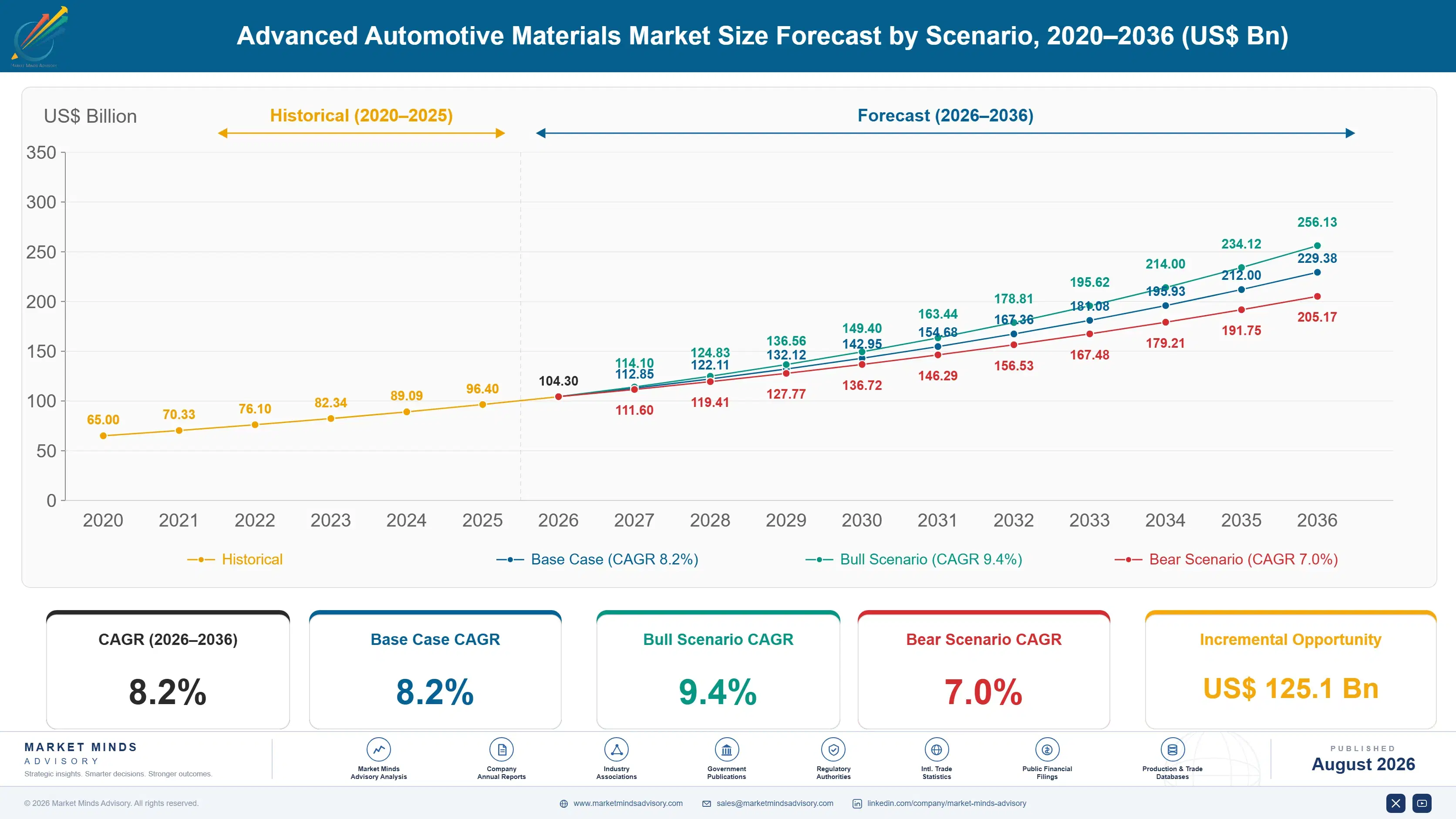
Advanced Automotive Materials Market Forecast Scenarios

advanced-automotive-materials-market-size-forecast-scenario-1787676712401
The 2020 to 2025 stretch compounded at 7.0%, and it was a messy five years. Semiconductor shortages cut vehicle build volumes while material content per vehicle kept rising, so tonnage and revenue moved in opposite directions. Aluminium prices spiked in 2022 on European smelter curtailments. Chinese EV output then grew fast enough to absorb capacity that Western programmes had deferred.
The 8.2% base case rests on three mechanisms. Battery pack enclosures and thermal management add material content that has no equivalent in a combustion vehicle, roughly doubling non-ferrous content on comparable platforms. Euro 7 brake and tyre particulate limits from 2026 make vehicle mass a compliance variable. And gigacasting is converting dozens of stamped steel parts into single aluminium castings, which shifts value between material classes without changing the vehicle at all. None of the three depends on total vehicle volumes growing.
The bull case at 9.4% turns on carbon fibre reaching cost parity for battery enclosures, which would move a large volume of aluminium content in one step. The bear case at 7.0% is slower EV adoption in Europe and North America, where combustion platforms carry materially less advanced content per vehicle than their electric replacements.

What The Platform Decision Actually Buys

A vehicle platform is a material decision dressed up as an engineering programme. Once the body-in-white architecture is set, the steel grades, aluminium alloys and joining methods follow from it, and changing any of them means changing tooling that costs more than the material ever will. Suppliers understand this better than they let on: winning a platform is worth eight years of guaranteed volume.
FIVE-FIRM CONCENTRATION24%Share of automotive material revenue held by leading suppliers
MATERIAL COST SHARE31%Portion of vehicle bill of materials by value
TOP PRODUCING COUNTRYChina 36%Chinese share of global advanced automotive material output
ALUMINIUM PER VEHICLE212 kgAverage mass of aluminium in a new vehicle
PLATFORM QUALIFICATION CYCLE58 monthsInterval from material selection to start of production
RECYCLED CONTENT SHARE34%Secondary metal proportion in automotive aluminium supply today
The steel-versus-aluminium argument did not end the way 2015 predicted. Third-generation advanced high-strength steels closed much of the weight gap at roughly a third of the cost per kilogram, and steel kept the majority of body structures it was expected to lose. Aluminium won the closures, the battery enclosures and anything gigacast. Both materials are growing, which is not what either side forecast.
Gigacasting deserves more attention than it gets from material suppliers. Replacing 70 stamped and welded parts with one casting eliminates the joints, and joints were where half the engineering effort went. It also demands alloys that hold ductility without heat treatment, because a casting that size distorts in a furnace. Very few alloy houses can supply them, which is a narrow opportunity and a real one.
"Everyone models material substitution as if a purchasing manager decides it. A body engineer decided it four years ago and has already moved to another programme."
Director, Automotive Materials and Lightweighting Practice · MMA Automotive Practice · August 2026

Market Trends

Gigacasting Rewrites Which Aluminium Alloys Get Specified

A single rear underbody casting replaces around 70 stamped parts, and the alloy has to fill a mould several metres across without cracking or needing heat treatment afterward. Conventional die-cast alloys cannot do it. The grades that can are proprietary, high-purity and supplied by a handful of producers who developed them alongside the press builders. Chinese vehicle makers adopted the technique fastest, and Chinese alloy suppliers grew with them. European and North American programmes are following on later platforms, which means the qualification advantage is already several years old by the time competitors arrive.
Market Impact: Reopens 40 kg mass targets
Recycled Content Requirements Enter Platform Material Specifications

European end-of-life vehicle rules and voluntary manufacturer commitments have put recycled content targets into material specifications for the first time, and the targets sit at levels current secondary supply cannot fully meet. Aluminium is the pressure point: closed-loop scrap from stamping operations is already recovered, and post-consumer secondary metal carries alloy contamination that load-bearing applications will not accept. Suppliers who invested in sorting and refining capacity now hold something scarce. Everyone else buys certified recycled content at a premium from those who did, which is an uncomfortable position to be in for a decade.
Market Impact: Adds 84 kg of content

Market Opportunities and Growth Drivers

Euro 7 Particulate Limits Make Vehicle Mass Compliance

Brake dust and tyre wear now fall under European Commission emission limits, and both scale with vehicle mass. A heavier electric SUV generates measurably more particulate than a lighter one regardless of how clean its powertrain is, which is the first time weight has carried a direct regulatory penalty rather than an indirect fuel economy one. Vehicle makers responded by reopening mass targets that electrification had quietly abandoned. Material suppliers who spent five years being told weight no longer mattered are now fielding the opposite brief on the same platforms.
Market Impact: Locks decisions 58 months ahead

Battery Enclosures Add Material Content Combustion Vehicles Never Had

A battery pack needs a crash-rated enclosure, thermal interface material between cells and cooling plates, dielectric barriers, fire-resistant compartment separation and structural adhesive holding it together. None of that exists in a combustion vehicle. Content per platform runs materially higher on comparable vehicle sizes, and the materials involved are higher value per kilogram than the steel they displace. Chinese pack makers set most of the current specification because they build most of the packs. Western suppliers competing here are qualifying into architectures designed around materials that were already selected in Shenzhen.
Market Impact: Raises repair cost by 34%

Market Restraints and Challenges

Platform Qualification Cycles Lock Out New Material Entrants

A material qualified onto a vehicle platform takes 58 months from selection to start of production, and the selection happens before most suppliers know the programme exists. Root cause is validation: crash performance, corrosion, joining compatibility and supply security all get tested sequentially, and none of it compresses. Commercially this means a supplier missing one platform waits the better part of a decade for another chance at that manufacturer. The mitigation being tried is pre-qualification, where suppliers fund testing on generic architectures before any programme opens, so the data exists when the brief arrives.
Market Impact: Consolidates 70 parts into 1

Mixed Material Bodies Defeat Established Joining And Repair

Steel welds to steel and aluminium does not weld to either, so mixed-material bodies depend on rivets, structural adhesive and flow-drill screws that add cost and complexity at every joint. Root cause is metallurgical rather than commercial: galvanic corrosion between dissimilar metals requires isolation that adds process steps. The commercial impact lands hardest in repair, where insurers price bodyshop capability and write off vehicles that a steel body would have survived. Manufacturers are mitigating through repair network training and joint designs that tolerate simpler methods, and neither fully solves it. Insurance data keeps making the point.
Market Impact: Targets 25% post-consumer recycled content
3 additional market trends, 4 additional growth drivers, and 2 additional restraints and challenges are covered in the full report. Contact sales@marketmindsadvisory.com to access the complete intelligence.

Segment CAGR and Growth Architecture

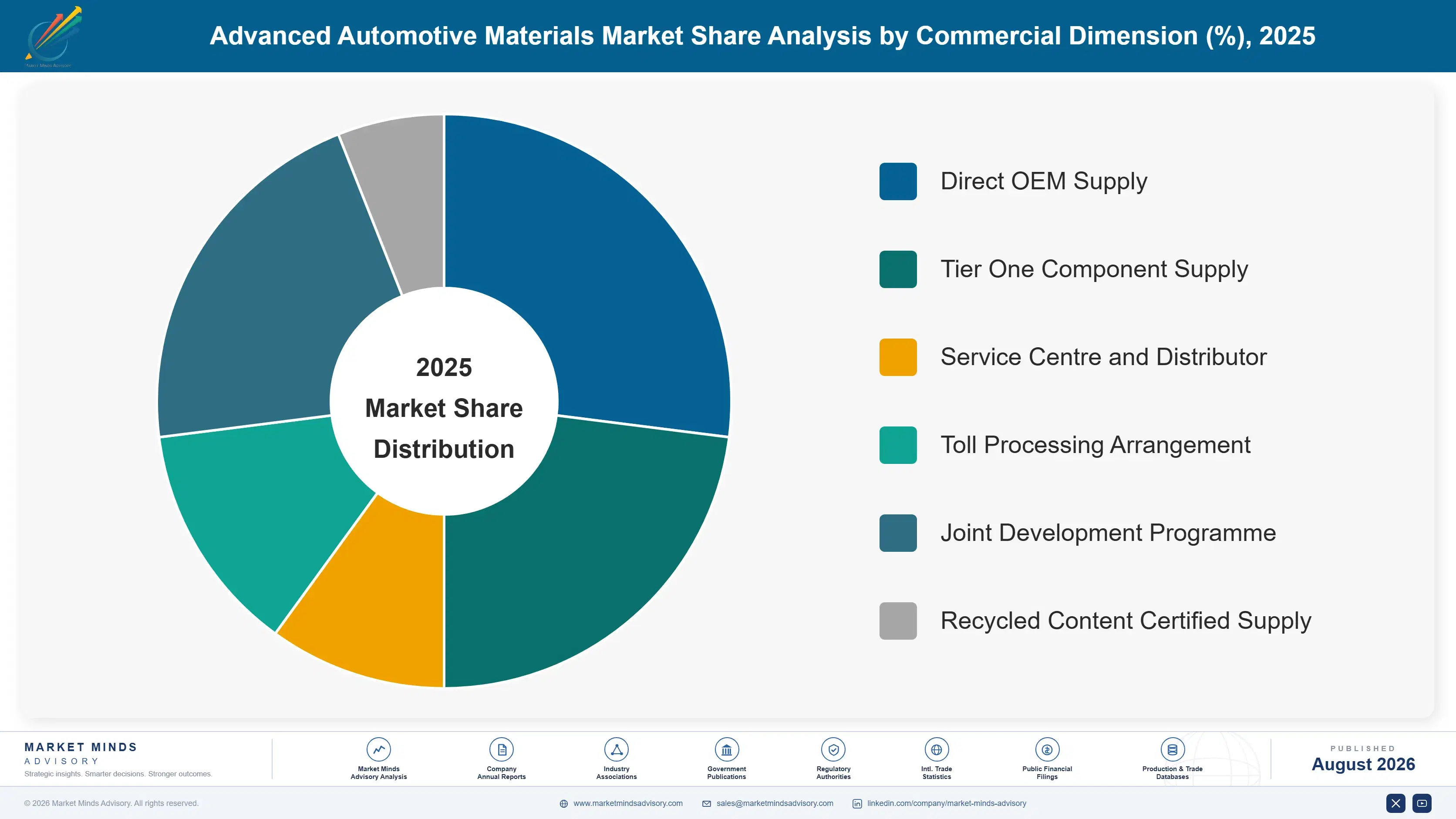
Segmentation follows material class: what the substance is and how it behaves, rather than which component it ends up in or which manufacturer buys it. Six classes cover the market without overlap, from advanced high-strength steel through to thermal interface materials. Vehicle application and supply route are treated separately, because both cut across every material class.
advanced-automotive-materials-market-market-share-analysis-1787676712974

Thermal Interface and Dielectric Materials

Every battery pack needs material between the cells and the cooling plate, dielectric barriers to prevent arcing and compartment separation that slows thermal propagation. None of it existed in combustion vehicles, which is why growth at 12.3%, half again the market rate of 8.2%, reflects a category being created rather than one taking share. Value per kilogram is high and volumes are modest, so this rewards formulation capability more than tonnage. Chinese pack manufacturers set most specifications today because they assemble most packs, and their suppliers were qualified before Western competitors knew the requirement existed. That is a harder sale than it sounds. Qualification here is measured in years, not quarters.
CAGR 12.3%

Carbon and Glass Fibre Composites

Composites have promised more than they delivered in automotive for 30 years, and the reason is cycle time rather than cost per kilogram. A steel panel stamps in seconds and a carbon fibre panel cures in minutes, which no volume assembly line accommodates. Growth at 10.2% comes from where that constraint does not bind: battery enclosure covers, leaf springs, pressure vessels for hydrogen vehicles and load-bearing components on premium platforms with lower volumes. Glass fibre carries most of the tonnage and carbon fibre most of the attention. Resin transfer moulding cycle times have fallen enough to open mid-volume applications that were closed a decade ago. Cycle time remains the whole argument.
CAGR 10.2%
Full segment breakdown across 6 segments available in the complete report.

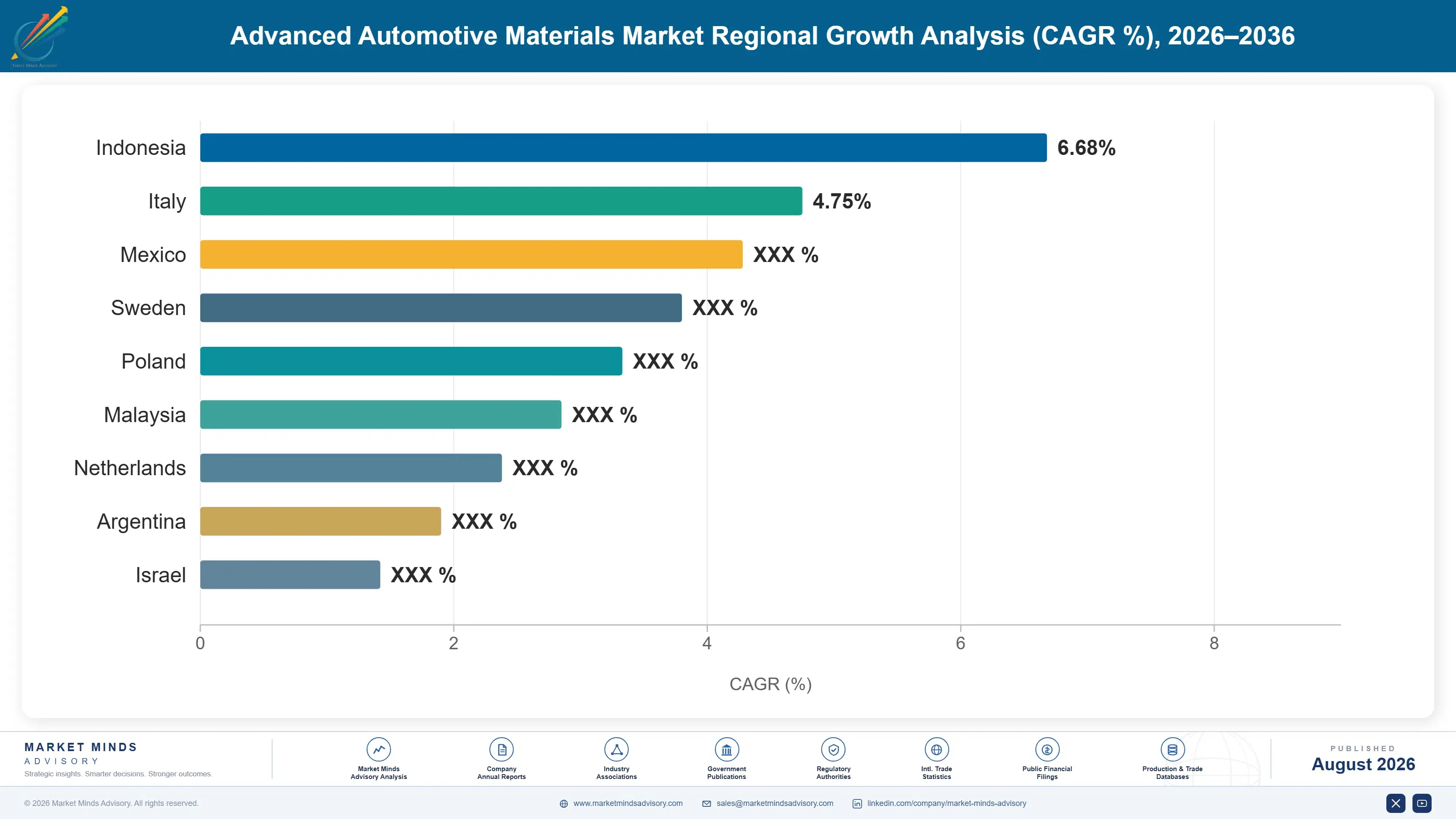
Regional Architecture and Country Demand Map

Geography follows vehicle assembly, and assembly has concentrated further rather than dispersing. East Asia builds more vehicles than everywhere else combined and increasingly supplies its own advanced materials. North America and Western Europe hold value share through premium platforms, while South Asia grows fastest on domestic production.

North America

Light trucks and full-size SUVs dominate American volume, and they carry more material per vehicle than anything sold in Europe or Asia. That mix alone lifts the region's value share above its unit share. Aluminium body structures established themselves here earlier than elsewhere, largely because one manufacturer committed to a full-size pickup in aluminium and the rest had to respond. Mexican assembly plants build a large share of North American vehicles and increasingly source material regionally under content requirements. Canadian aluminium smelting supplies the region with hydroelectric primary metal carrying a carbon footprint European buyers now specifically want. That metal increasingly leaves the continent rather than staying in it. European buyers now pay for the difference.
Share: 22% | CAGR: 7.4% (2026 to 2036)

Western Europe

Europe writes the rules that reshape material specification globally, and Euro 7 particulate limits are the current example. German premium manufacturers remain the most demanding customers in the world for advanced materials, running mixed-material bodies that nobody else attempts at volume. French and Italian demand is weighted toward smaller vehicles where cost discipline limits how much advanced content any platform carries. Spanish assembly plants build for export across the continent and specify to foreign parent standards. Nordic and Benelux activity is concentrated in materials supply rather than assembly. Recycled content requirements bite hardest here, and European suppliers have invested in sorting capacity accordingly. That investment now looks better than it did.
Share: 20% | CAGR: 6.5% (2026 to 2036)
Regional intelligence for 5 additional markets available in the complete report: East Asia, South Asia and Pacific, Latin America, Middle East and Africa, Eastern Europe. Contact sales@marketmindsadvisory.com.
advanced-automotive-materials-market-country-cagr-analysis-1787676713560

Winning The Platform Before Anyone Bids

Material tenders are decided years before they are issued, in engineering conversations nobody in sales attends. Four levers change that outcome, and three of them cost money long before any revenue appears. The fourth costs a relationship with a customer who would rather not hear it. All four take a platform cycle to pay back.

Fund Pre-Qualification Testing Before Programmes Open

Platform material selection happens 58 months before production and suppliers usually learn about it too late to generate data. Pre-qualification reverses that: the supplier funds crash, corrosion and joining validation on generic architectures, so when a brief arrives the answer already exists. Costs run into seven figures per material family and produce nothing directly. What they produce indirectly is a place in the specification before competitors are contacted. Suppliers doing this consistently win a materially higher share of platforms than their capacity share would suggest, which is the only measure that matters here.
Market Impact: Wins specification 58 months before any tender issues

Sell Certified Recycled Content As A Separate Product

Recycled content targets sit above what secondary supply can deliver, which makes certified material scarce rather than cheap. Suppliers who invested in sorting and refining sell it at a premium of roughly 14% over primary equivalent, and customers pay because their own commitments depend on it. The counterintuitive part is that recycled aluminium costs less to produce and sells for more, which reverses every assumption purchasing teams brought to the conversation. Capacity is the constraint and it takes three years to build, so the window for entering this is closing.
Market Impact: Earns roughly 14% premium over equivalent primary metal

Develop Gigacasting Alloys With Press Builders Directly

The alloys that fill a several-metre casting without heat treatment were developed alongside the presses, not for them, and the producers who did that work hold positions no tender process can dislodge. Getting there now means engineering partnership with press builders rather than sales calls to vehicle makers. Development runs 3 years and the output is a proprietary grade with a narrow customer list. That narrowness is the point: a handful of qualified suppliers serving a technique that keeps spreading is a better position than broad qualification in a contested alloy.
Market Impact: Takes roughly 3 years to develop each grade

Price Material Against Assembly Cost, Not Kilograms

A material that eliminates a joining operation saves the manufacturer more than the material costs. Suppliers quoting per kilogram hand that saving to the customer for free. Quoting against installed cost, including tooling, joining steps and cycle time, supports pricing 20 to 25% above weight-based benchmarks and shifts the conversation to engineers who understand the argument. Procurement teams resist this because it removes their comparison basis, which is exactly why it works. The requirement is application engineering capability most material suppliers have historically underfunded. Building it takes years and pays for decades.
Market Impact: Supports pricing 20 to 25% above weight-based benchmarks

Who Controls the Margin Pool

Measured on disclosed automotive segment revenue, the five largest suppliers hold a CR5 of 24%, which is low for an industrial market and misleading as a guide to competition. Nobody competes across every material class. Within steel, within aluminium sheet and within carbon fibre, concentration is far higher than the headline suggests. ArcelorMittal and POSCO lead on scale, and the challenger gap depends entirely on which material you are counting.
Three contests define activity now. The first is qualification depth on electric platforms, where suppliers are spending heavily to be in specifications that will run to 2035. The second is recycled content certification, a contest fought through capital investment in sorting rather than through product development. The third is application engineering, where suppliers compete to be the party a vehicle maker calls when a design problem appears. That last one decides more business than pricing does.

Chinese material suppliers are the pressure everyone else is managing. They grew alongside domestic vehicle makers rather than selling to them, which produced qualification positions on platforms now being exported worldwide. Rankings shift wherever a Chinese platform reaches a Western market carrying its original material specification intact.
advanced-automotive-materials-market-company-positioning-matrix-1787676714100

Competitive Moat and Risk Dimensions

ARCELORMITTAL

Moat: Advanced Steel Grade Portfolio

ArcelorMittal develops and qualifies more advanced high-strength steel grades than any competitor, and each grade qualified onto a platform locks volume for that programme's life. The research base behind third-generation grades took decades to build and cannot be shortcut. Vehicle makers designing a body structure work from that catalogue, which puts the company in the room before any tender exists.
ARCELORMITTAL

Risk: Electric Platform Content Erosion

Battery electric platforms shift content toward aluminium castings and away from stamped steel assemblies, and gigacasting accelerates that shift by removing exactly the joints steel structures were designed around. ArcelorMittal's answer is better steel, which works where cost dominates and not where packaging does. The exposure grows with every platform that gigacasts more of its underbody.
POSCO

Moat: Integrated Battery Materials Position

POSCO supplies advanced steel and holds positions in lithium and nickel processing, which lets it engage vehicle makers on body materials and battery supply in the same conversation. Few can do both. That breadth matters most with Korean and Chinese manufacturers who prefer consolidated supply relationships, and it has won positions its steel business alone would not reach.
POSCO

Risk: Commodity Steel Cycle Drag

Most of POSCO's revenue comes from steel sold into construction, shipbuilding and general industry, businesses that move with cycles automotive materials do not follow. When those turn down, capital and management attention get pulled toward defending them. Competitors focused on automotive alone face no such distraction and can commit to programme development through a downturn.

Players Tracked

Prominent Players

ArcelorMittal
POSCO
Novelis
BASF
Toray Industries

Other Key Players

Nippon Steel
Baoshan Iron and Steel
Hyundai Steel
Constellium
Norsk Hydro
Alcoa
Covestro
Celanese
DuPont
Solvay
SGL Carbon
Teijin
Hexcel
LyondellBasell
Sumitomo Chemical

Recent Developments

JANUARY 2025

Novelis commissions automotive aluminium recycling capacity in Alabama

Novelis brought new automotive aluminium recycling and rolling capacity online in Alabama, an organic investment rather than an acquisition or joint venture. The facility targets closed-loop scrap from stamping operations and certified post-consumer content, addressing recycled content requirements that vehicle makers have written into supply specifications for coming platforms.
Signal: Recycled content capacity is being built ahead of demand, which tells you the specifications are already signed.
MAY 2025

ArcelorMittal opens third-generation steel qualification centre in Germany

ArcelorMittal opened a qualification and application engineering centre in Germany focused on third-generation advanced high-strength steel, funded organically. The facility runs crash and joining validation for vehicle makers during early platform design, positioning the company inside material decisions that are made years before any purchase order is issued.
Signal: Steel is defending its position through application engineering rather than through price, which is a more durable strategy.
SEPTEMBER 2025

Toray expands carbon fibre capacity for hydrogen pressure vessels

Toray Industries commissioned additional carbon fibre production capacity aimed at hydrogen pressure vessels and battery enclosure applications, an organic expansion funded from operating cash flow. The company cited automotive and commercial vehicle demand specifically, noting that pressure vessel applications tolerate composite cycle times that volume body panels do not.
Signal: Composites are growing where cycle time does not bind, which is a narrower opportunity than the material's advocates claim.

What Sits Under The Material Price

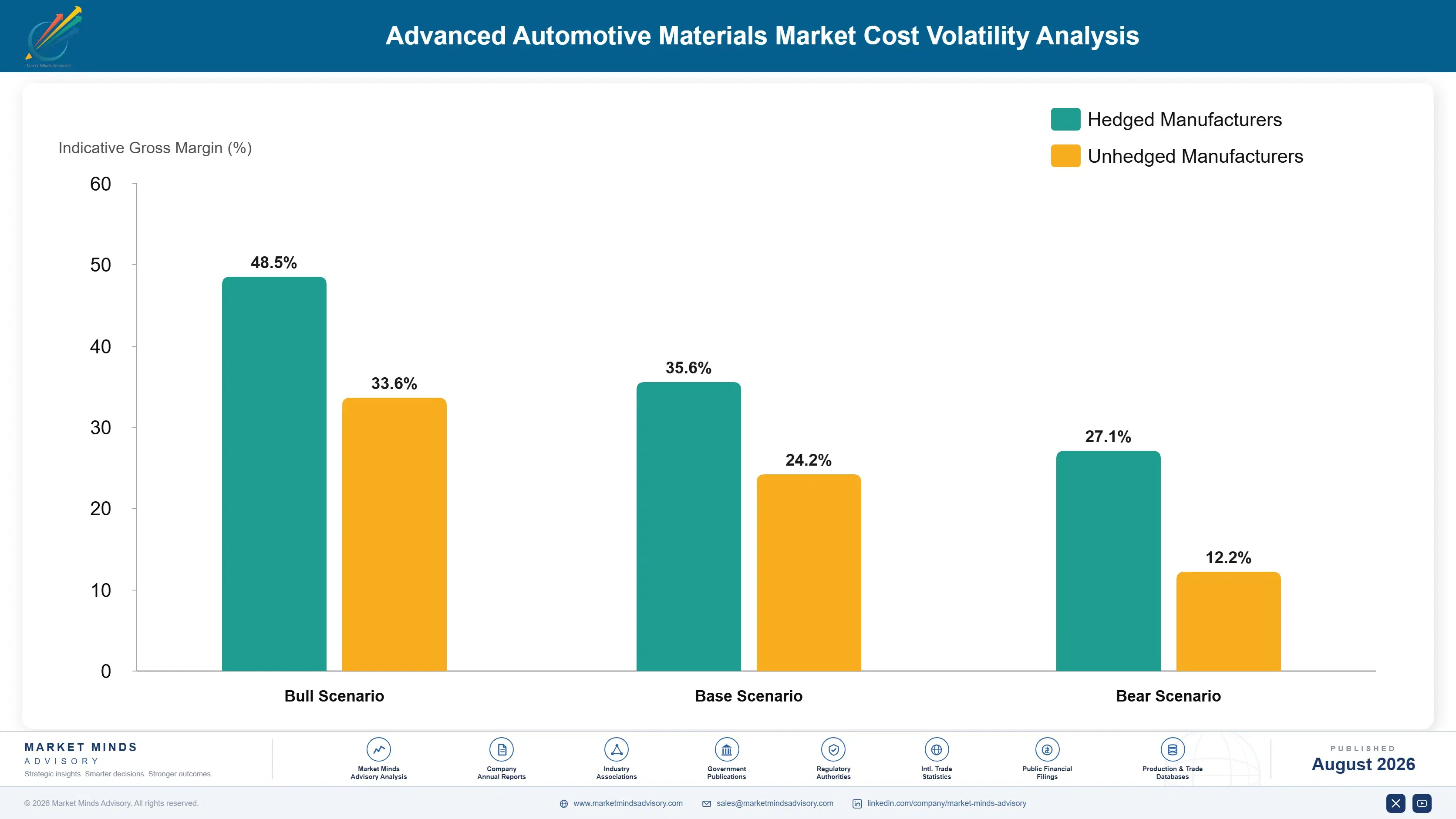
Energy and feedstock dominate differently by material. Primary aluminium carries electricity at 33 to 36% of production cost, sourced wherever power is cheapest, which is why smelter geography follows hydroelectricity and stranded gas rather than customers. Steel carries iron ore, coking coal and increasingly scrap. Carbon fibre carries acrylonitrile precursor and the energy to carbonise it, which together run well above half of cost.
The 2022 European aluminium curtailments are the clearest recent case. IEA and EIA energy data document power prices that made European smelting uneconomic, and roughly a million tonnes of annual capacity went offline. Norsk Hydro and Alcoa annual reports for that year describe the curtailment decisions and the regional premium that followed. Vehicle makers with European sheet contracts absorbed price increases they could not pass to consumers, and several deferred aluminium-intensive programme content quietly.

Exposure divides by where the metal comes from. Producers with hydroelectric or captive power were untouched and gained share. Rolling mills buying primary ingot at market took the full move with no offset. Vehicle makers with recycled content already in specification were partly insulated, because secondary aluminium uses a fraction of the energy and its cost did not follow.
advanced-automotive-materials-market-cost-volatility-analysis-1787676714299

Contract power ahead of smelting capacity commitments

Aluminium producers who signed long-term hydroelectric or nuclear power agreements before 2021 ran through the crisis untouched while competitors curtailed. The commitment looks expensive in calm years and decides survival in bad ones. Power contracting is the single largest lever on primary aluminium cost, and it is decided a decade before the metal ships. Nothing else comes close.

Build secondary metal supply into platform specifications early

Secondary aluminium uses a fraction of the energy of primary and its cost did not follow the 2022 spike. Writing recycled content into a specification therefore hedges energy exposure while satisfying a regulatory commitment, which is unusual and worth exploiting. The constraint is alloy purity, so the work belongs in design rather than in purchasing.

Index material contracts to published metal and energy benchmarks

Fixed-price multi-year material contracts looked like risk management until 2022 proved they were the risk. Indexed contracts tied to published metal exchange prices and regional energy benchmarks share volatility rather than concentrating it, and both sides now prefer them. The discipline is symmetry: an index that only moves upward gets renegotiated at the first opportunity.

Portfolio Architecture for Margin Defence

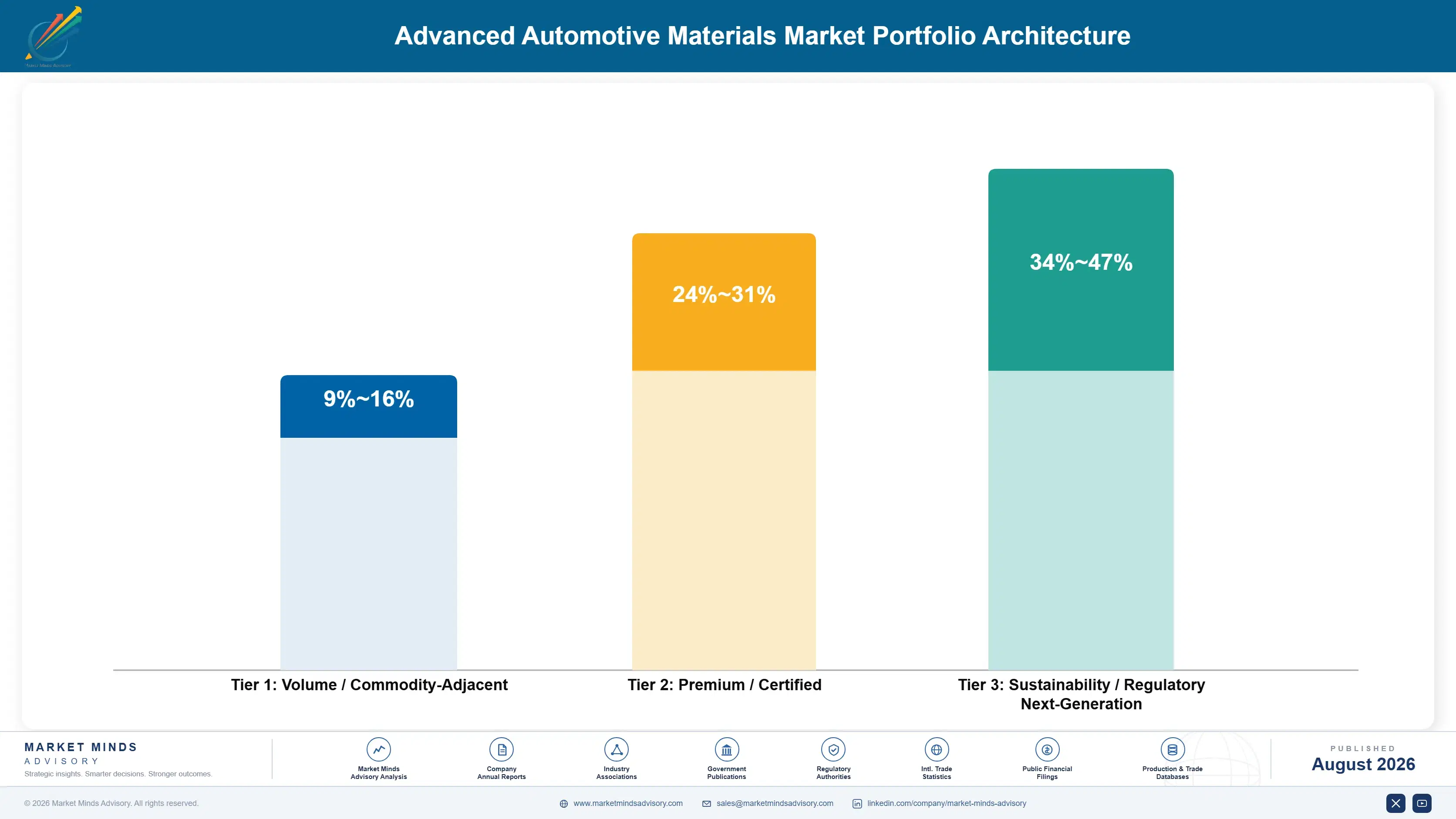
Margin in automotive materials follows qualification, not chemistry. Commodity-grade aluminium sheet sold against an exchange price earns rolling margins that barely cover capital. A proprietary gigacasting alloy qualified onto one manufacturer's platform earns several times that, and the difference is entirely the qualification, not the metallurgy. Everything in this market sits somewhere on that line.
The tension is that vehicle makers buy volume and premium from the same supplier under one agreement. A producer discounting commodity sheet to hold tonnage then finds its specialty grades benchmarked against that price. Suppliers who separated the two commercially, quoting proprietary grades outside the volume agreement, have held margin at the cost of some tonnage. Those who did not are running large revenue at returns that would embarrass a distributor, and several have said so publicly.

High-value pools sit in three places. Thermal interface and dielectric materials for battery packs, where formulation capability rather than tonnage decides the winner. Certified recycled content, which is scarce for regulatory reasons and priced accordingly. And proprietary casting alloys, where a handful of grades serve a technique spreading across the industry. None of the three carries the volume that body sheet does.

Volume / Commodity-Adjacent

Commodity aluminium sheet, standard high-strength steel and general-purpose polymer compounds sold against exchange or index pricing. The 7-point range separates integrated producers with captive power or scrap from those buying inputs at market. Volume is enormous and pricing is not negotiable.
Gross Margin: 9-16%

Premium / Certified

Third-generation advanced high-strength steel, automotive-grade aluminium sheet with surface qualification, and engineering thermoplastics validated for crash applications. The 7-point spread reflects the difference between qualified commodity grades and proprietary formulations. Platform qualification rather than material performance holds this pricing in place.
Gross Margin: 24-31%

Sustainability / Regulatory / Next-Generation

Certified recycled content, proprietary gigacasting alloys, thermal interface materials and carbon fibre for pressure vessels. The 13-point range is unusually wide because regulatory scarcity prices recycled content while formulation scarcity prices battery materials, and the two mechanisms behave differently through a cycle.
Gross Margin: 34-47%
advanced-automotive-materials-market-portfolio-architecture-1787676714817

High-value Sub-segments and Strategic Watch-out

Battery Thermal Interface Materials

Highest value and fastest growth, created entirely by electrification rather than taken from any incumbent material. Formulation capability decides the winner and tonnage barely matters. The risk is that Chinese pack makers set most specifications, so Western suppliers qualify into architectures they did not help design.
Gross Margin: 42-45%

Certified Recycled Aluminium

High value with steady growth, scarce because regulatory targets exceed what secondary supply currently delivers. Sorting and refining capacity is the constraint and takes three years to build. Demand is regulatory rather than discretionary, which makes forecasting unusually reliable and the premium unusually durable. Few materials offer both.
Gross Margin: 26-29%

Standard Automotive Body Sheet

The volume core, carrying most tonnage shipped and the least margin per tonne. Exchange pricing sets the floor and integrated producers with captive inputs set the competitive reference. Most established suppliers run this line for mill utilisation rather than for return, which is rational and uncomfortable.
Gross Margin: 10-13%

Stamped Steel Body Structure Grades

The strategic watch-out. These grades carry substantial current revenue and perform well against cost, but gigacasting removes exactly the joints they were designed around and every new electric platform consolidates further. The risk is capacity investment in grades that platform architecture strands before amortisation completes.
Gross Margin: 18-21%

Why Platform Wins Last Decades

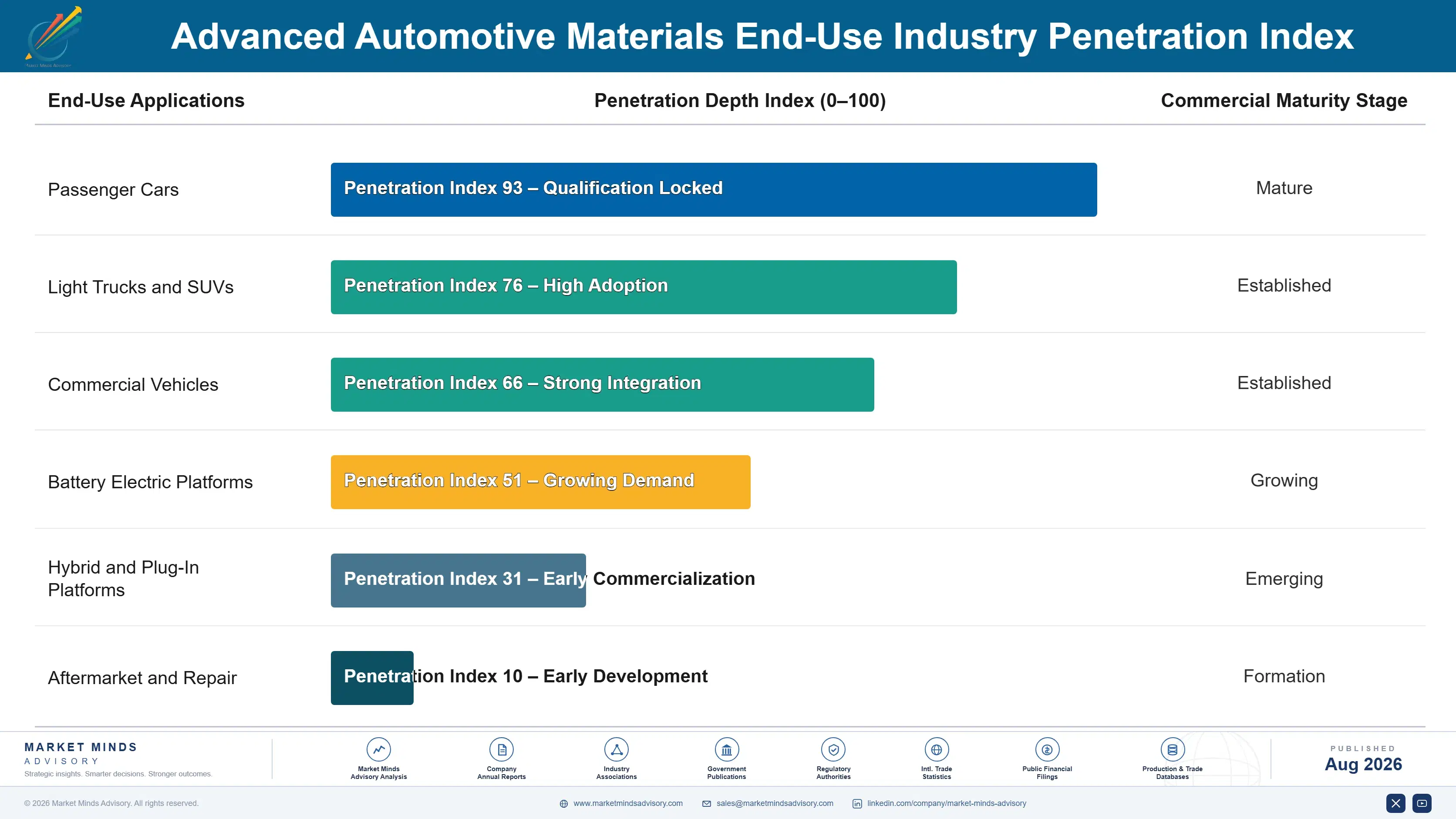
A material qualified onto a platform ships for that platform's entire production life, which runs seven to nine years and often longer with facelifts. Volumes are contracted, forecast quarterly and rarely revised downward by much. Revenue therefore behaves like an annuity with a known expiry date, which is why suppliers value platform wins far above their first-year revenue contribution.
Stickiness varies sharply by where the material sits. Crash structure grades essentially never change mid-platform, because revalidation means recertifying the whole body. Battery pack materials are almost as fixed, since thermal validation is expensive and safety-critical. Interior polymers change readily on price, and purchasing teams move them annually. Body panel aluminium sits in between, changing when a supplier fails on quality rather than on price. Each of those behaves like a different business.

The buying centre has shifted toward engineering and away from purchasing, reversing 20 years of the opposite trend. Electrification made material selection a performance problem again rather than a cost problem, and body engineers reclaimed decisions that procurement had gradually absorbed. Suppliers who cut application engineering headcount during the cost-down years are now rebuilding it expensively, and they are rebuilding it against competitors who never cut.
advanced-automotive-materials-market-end-use-penetration-index-1787676715318

Where The Platform Money Goes

These are among the four positions where our research anticipates prominent divergence between winners and laggards over the coming forecast period. Each is grounded in the demand model, the regulatory perimeter, and the announced capacity pipeline.
01 / PLATFORM QUALIFICATION INVESTMENT

Fund testing before the programme brief exists

Material selection locks 58 months before start of production, and most suppliers hear about a programme long after the decision that mattered has been taken by a body engineer. Pre-qualification testing on generic architectures costs seven figures per material family and generates no direct revenue, which is exactly why competitors underfund it. Suppliers who carry that cost consistently win a share of platforms well above their capacity share, and the advantage compounds because each qualification makes the next one cheaper to demonstrate.
02 / RECYCLED CONTENT CAPACITY

Build sorting capacity now or buy certified metal later

Recycled content targets in European and manufacturer specifications sit above what secondary supply can currently deliver, which turns certified recycled aluminium into a scarce product priced at roughly 14% above primary equivalent. That is an unusual position: the material costs less to make and sells for more, and the constraint is sorting and refining capacity rather than scrap availability. Building that capacity takes three years, so the decision window for participating rather than paying closes well before the targets take effect.
03 / CASTING ALLOY POSITIONING

Develop gigacasting grades with press builders, not customers

Gigacasting consolidates around 70 stamped parts into a single casting, and the alloys that survive that process without heat treatment were developed alongside the presses rather than specified afterward. Producers who did that engineering hold positions no competitive tender can dislodge, because the grade and the process were designed together. Entering now takes roughly 3 years of joint development with press builders, which is a long commitment against a narrow customer list and still the better use of research capital than defending contested alloys.
04 / INSTALLED COST PRICING

Stop quoting per kilogram and start quoting installed

A material that removes a joining operation saves the manufacturer more than the material itself costs, and suppliers quoting per kilogram hand that saving over without charging for it. Quoting against installed cost, counting tooling, joining steps and cycle time, supports pricing 20 to 25% above weight-based benchmarks and moves the conversation to engineers who accept the logic. Procurement resists precisely because it destroys their comparison basis, which is the strongest available evidence that the approach works exactly as intended.

Engagement Snapshot From the Field

A live engagement with an industry participant carrying material or product regulatory and market exposure ahead of a defining policy shift, showing how our research translates into a defensible multi-year portfolio strategy.
MARKET MINDS ADVISORY · CLIENT ENGAGEMENT SUMMARY
Advanced Automotive Materials Producer Strategic Portfolio Review and Transition Roadmap 2026·Investment Scenario on Advanced Automotive Materials Exposure Evaluation 2025-26
CLIENT PROFILE
A European vehicle manufacturer producing roughly 1.4 million units annually across five plants, with automotive revenue reported at 34 billion euros (client-reported, unverified by MMA). The company was preparing two electric platforms for launch in 2029 and 2030, with material selection due to close within nine months. Its existing supplier base had been built around combustion architectures over the previous 15 years.
STRATEGIC CHALLENGE
Euro 7 particulate limits made platform mass a compliance variable the programme had not budgeted for, arriving after architecture freeze. Meeting the mass target meant more aluminium and more gigacasting, which the existing supplier base could not support. Qualifying new suppliers inside nine months was not possible under normal validation timelines. Nobody had established which parts of the target were negotiable.
MMA APPROACH
MMA mapped every mass reduction option by kilograms saved against qualification months required, rather than by cost per kilogram, since time was the binding constraint. Sixteen expert interviews with alloy producers and press builders established which suppliers held pre-qualified data that could compress validation. The analysis treated the nine-month selection window, not material cost, as the governing limit on every option.
KEY FINDINGS
  1. Three of the 11 mass reduction options could be qualified inside the window, all of them using suppliers holding pre-qualified crash data on comparable architectures.
  2. Gigacasting the rear underbody saved 41 kilograms and removed 68 joining operations, but required an alloy only two producers could supply at volume.
  3. Existing steel suppliers offered third-generation grades saving 18 kilograms at a fraction of the aluminium cost, which nobody in the programme had requested.
  4. Combining gigacasting with upgraded steel met the mass target at roughly 60% of the cost of an aluminium-intensive body (client-reported, unverified by MMA).
CLIENT PROFILE
A European vehicle manufacturer producing roughly 1.4 million units annually across five plants, with automotive revenue reported at 34 billion euros (client-reported, unverified by MMA). The company was preparing two electric platforms for launch in 2029 and 2030, with material selection due to close within nine months. Its existing supplier base had been built around combustion architectures over the previous 15 years.
STRATEGIC CHALLENGE
Euro 7 particulate limits made platform mass a compliance variable the programme had not budgeted for, arriving after architecture freeze. Meeting the mass target meant more aluminium and more gigacasting, which the existing supplier base could not support. Qualifying new suppliers inside nine months was not possible under normal validation timelines. Nobody had established which parts of the target were negotiable.
MMA APPROACH
MMA mapped every mass reduction option by kilograms saved against qualification months required, rather than by cost per kilogram, since time was the binding constraint. Sixteen expert interviews with alloy producers and press builders established which suppliers held pre-qualified data that could compress validation. The analysis treated the nine-month selection window, not material cost, as the governing limit on every option.
KEY FINDINGS
  1. Three of the 11 mass reduction options could be qualified inside the window, all of them using suppliers holding pre-qualified crash data on comparable architectures.
  2. Gigacasting the rear underbody saved 41 kilograms and removed 68 joining operations, but required an alloy only two producers could supply at volume.
  3. Existing steel suppliers offered third-generation grades saving 18 kilograms at a fraction of the aluminium cost, which nobody in the programme had requested.
  4. Combining gigacasting with upgraded steel met the mass target at roughly 60% of the cost of an aluminium-intensive body (client-reported, unverified by MMA).
RECOMMENDED STRATEGY
Phase 1: Phase one: commit to gigacasting the rear underbody immediately, dual-sourcing the alloy from both qualified producers to remove single-supplier exposure. Phase 2: Phase two: upgrade body structure steel grades with existing suppliers, using their pre-qualified data to avoid extending the validation timeline. Phase 3: Phase three: begin pre-qualification with three new suppliers now, targeting the 2033 platform rather than attempting to force them into this one.
OUTCOME
Both platforms met the Euro 7 mass target without extending the launch timeline. The combined approach came in at roughly 62% of the modelled aluminium-intensive cost, and the rear underbody casting removed 68 joining operations from the assembly line (client-reported, unverified by MMA). Pre-qualification with the three new suppliers is running against the 2033 programme.

Frequently Asked Questions

Foundational context covering the market sizes, CAGR, scope, country, region and competition that inform every finding below. This section is provided to cover basics and most often pre-purchase conversations, answered from the MMA Primary Research Dataset.

What is the current size of the Advanced Automotive Materials Market?

The market was worth 96.4 billion dollars in 2025, covering advanced steels, aluminium and magnesium alloys, composites, engineering polymers and thermal materials. It reaches 104.3 billion dollars in 2026.

How large will the Advanced Automotive Materials Market be by 2036?

MMA forecasts 229.4 billion dollars by 2036, an increase of 125.1 billion dollars over the 2026 base. That represents an expansion multiple of 2.20 times across the forecast period.

What is the CAGR for the Advanced Automotive Materials Market 2026 to 2036?

The base case compounds at 8.2% annually. MMA's bull case reaches 9.4% if carbon fibre reaches cost parity for battery enclosures, while the bear case sits at 7.0% on slower Western electrification.

Which segment is growing fastest?

Thermal interface and dielectric materials, at 12.3%, half again the market rate of 8.2%. Every battery pack requires them and no combustion vehicle ever did, so the category was created rather than taken.

Who are the major companies in the Advanced Automotive Materials Market?

ArcelorMittal, POSCO, Novelis, BASF and Toray Industries lead on disclosed automotive segment revenue. Nippon Steel, Baoshan Iron and Steel, Constellium, Norsk Hydro and Covestro compete strongly within specific material classes.

Which country is growing fastest?

China at 11.2%, driven by domestic electric platform volume and by alloy suppliers that grew alongside their customers. India follows on rising advanced content per vehicle.

Report Segmentation Architecture

The full report scope spans multiple orthogonal segmentation dimensions, with cross-tabulated demand data provided for each dimension pair. Coverage extends further to regional breakdowns, trend trajectories, and the competitive detail needed to support segment-level decision-making.

By Material Class

  • Advanced High-Strength and Ultra-High-Strength Steel
  • Aluminium Sheet, Extrusion and Castings
  • Magnesium Alloys
  • Carbon and Glass Fibre Composites
  • Engineering Thermoplastics and Polymer Compounds
  • Thermal Interface and Dielectric Materials

By End-Use Industry

  • Passenger Cars
  • Light Trucks and SUVs
  • Commercial Vehicles
  • Battery Electric Platforms
  • Hybrid and Plug-In Platforms
  • Aftermarket and Repair

By Commercial Dimension

  • Direct OEM Supply
  • Tier One Component Supply
  • Service Centre and Distributor
  • Toll Processing Arrangement
  • Joint Development Programme
  • Recycled Content Certified Supply

By Region

  • North America
  • Western Europe
  • East Asia
  • South Asia and Pacific
  • Latin America
  • Middle East and Africa
  • Eastern Europe

Scope, Methodology, and Coverage

Every figure in this report is reproducible from documented input assumptions. The scope below maps the historical period, the forecast horizon, the segmentation dimensions, and the countries covered, alongside the underlying primary and qualitative methodology.
Historical Period
2020 to 2025
Forecast Period
2026 to 2036
Base Year
2025 (USD billions; MMA Primary Research Dataset, August 2026)
Market Definition
Scope covers materials specified into vehicle bodies, closures, chassis, powertrain and battery systems where performance requirements exceed conventional mild steel, cast iron or commodity plastics, spanning advanced and ultra-high-strength steels, aluminium and magnesium alloys, carbon and glass fibre composites, engineering thermoplastics and thermal interface materials. Tyres, glazing, paints, coatings, lubricants and battery cell active materials are excluded. Raw metal trading, scrap collection and vehicle assembly operations fall outside the boundary.
Quantitative Units
USD billions (current prices); tonnes consumed; content per vehicle in kilograms; platforms qualified; recycled content share
Segmentation Dimensions
By Material Class; By End-Use Industry; By Commercial Dimension; By Region
Regions Covered
North America, Western Europe, East Asia, South Asia and Pacific, Latin America, Middle East and Africa, Eastern Europe
Countries Covered
USA, China, Germany, France, UK, Japan, South Korea, India, Brazil, Mexico, Italy, Spain, Poland, Saudi Arabia, South Africa
Key Companies Profiled
ArcelorMittal, POSCO, Novelis, BASF, Toray Industries, Nippon Steel, Baoshan Iron and Steel, Hyundai Steel, Constellium, Norsk Hydro, Alcoa, Covestro, Celanese, DuPont, Solvay, SGL Carbon, Teijin, Hexcel, LyondellBasell, Sumitomo Chemical
Quantitative Methodology
Primary survey, n=3,800 respondents, Q4 2025, six countries; demand-side model with trade association cross-validation
Qualitative Methodology
47 expert interviews, Q4 2025; applied to validate demand model assumptions, identify emerging dynamics, and assess competitive positioning
Report Format
PDF and XLSX data workbook (Word format preview document)
Publisher
Market Minds Advisory
Report Code
MMA-2026-AUT-106
Published
August 2026
Contact
sales@marketmindsadvisory.com | www.marketmindsadvisory.com

Purchase the full Advanced Automotive Materials Market Report (2026 to 2036).

The full report runs to 240 pages and covers all six material class segments, seven regions and 20 profiled companies in detail. It includes the complete segment CAGR set, regional content-per-vehicle data, and platform qualification analysis across electric and combustion architectures. Company profiles carry evaluation on disclosed automotive segment revenue, with moat and risk assessment for the top five suppliers. The competitive section extends to 19 tracked corporate developments across 2024 and 2025, each with commercial interpretation. Primary research inputs include a quantitative survey of 3,800 respondents and 47 expert interviews conducted in Q4 2025.
Six material class segments with individual CAGR forecasts
Seven regional markets with content per vehicle data
Twenty company profiles on consistent revenue evaluation basis
Nineteen tracked corporate developments with commercial interpretation notes
Platform qualification analysis across electric and combustion architectures
Recycled content supply and certification capacity assessment

Built For The People Who Decide

From boardroom strategy to bench-side execution, this report is read cover-to-cover by leaders shaping the next decade of their industry, turning demand scenarios, market dynamics and valuation benchmarks into decisions.
CXOs/ Presidents/ VPs/ Managers
M&A and Corporate Development
Strategy Teams and R&D Heads
Procurement and Product Directors
Regulatory and Compliance Leaders
Investor Relations and Equity Analysts