Market Minds Advisory
Advance Battery Technologies Market

Advance Battery Technologies Market: Advanced Battery Technologies Market. Solid-State Commercialization Races Reshape Chemistry Investment.

Automakers racing to commercialize solid-state batteries by 2027 are pulling capital away from incremental lithium-ion improvements, reshaping which next-generation chemistries attract gigafactory-scale investment across the entire global battery supply chain.

Lead Analyst

Published

September 2026

Make Smarter Decisions with Customized Research Insights

Request a free sample report and evaluate market opportunities, growth trends, and competitive dynamics relevant to your business needs.

2025 MARKET VALUE$22.0BMarket Size 2025
2036 FORECAST VALUE$97.6BBase Case , 2026 to 2036
CAGR 2026 TO 203614.5 %Bull 15.8% / Bear 13.2%
INCREMENTAL OPPORTUNITY$72.4BNet 10- year value creation
EXPANSION MULTIPLE3.87x2036 value over 2026 base
Strategic Levers
M&A Pipeline
Regional Outlook
Country Rankings
Competitive Intelligence
Segmental Deep-dive
Call-Us : 91 93563 13602

Executive Snapshot and Market Trajectory.

Automakers and battery manufacturers are redirecting capital away from incremental lithium-ion chemistry improvements toward solid-state and sodium-ion pilot production lines faster than most industry analysts anticipated even two full years ago, betting heavily on 2027 commercialization timelines that keep slipping industry-wide, a shift few predicted quite this soon.
Automotive range anxiety and grid storage cost pressure are the dominant commercial forces, with solid-state batteries growing fastest as automakers chase energy density and safety improvements that conventional lithium-ion chemistry cannot deliver at scale. East Asia dominates manufacturing and pilot production investment overwhelmingly given South Korea's Samsung SDI and LG Energy Solution, Japan's Toyota and Panasonic, and China's CATL scale. Developers without dedicated solid-state chemistry expertise are struggling to keep pace.
Competitive intensity concentrates among a handful of well-capitalized chemistry developers, none commanding dominant overall share, since commercialization risk remains genuinely high across every next-generation chemistry pursued simultaneously by multiple competing teams. Automakers continue signing exclusive supply agreements with preferred chemistry developers, forcing smaller startups to compete on licensing partnerships rather than standalone commercial production capacity. Rankings shift slowly given how long qualification cycles lock in supply relationships.
Market Definition
The advanced battery technologies market covers next-generation battery chemistries beyond conventional liquid-electrolyte lithium-ion, including solid-state, lithium-sulfur, sodium-ion, silicon anode, lithium metal, and semi-solid-state batteries sold as cells or licensed chemistry platforms. It excludes conventional lithium-ion cells using established graphite anode and liquid electrolyte chemistry.
Base Year Value
$22.0B in 2025 (MMA Primary Research Dataset, September 2026)
Forecast Period
2026 to 2036, eleven discrete annual values
CAGR
14.5% base case. Bull 15.8%. Bear 13.2%.
Fastest Growth Segment
Solid-State Batteries: 24.0% CAGR
Fastest Growth Country
South Korea: 17.0% CAGR
Fastest Growth Region
South Asia and Pacific: 16.5% CAGR
Largest Region
East Asia: 38% of 2025 global value
Market Leaders
QuantumScape, Solid Power, CATL, Samsung SDI, LG Energy Solution lead the field. Source: MMA Primary Research Dataset, July 2026.
Primary Survey
n=3,800 procurement and R&D decision-makers, Q4 2025, six countries
Methodology
Demand-side build-up, cross-validated against public data, 47 expert interviews

Advance Battery Technologies Market Forecast Scenarios

advance-battery-technologies-market-size-forecast-scenario-1788421019728
Between 2020 and 2025 the advanced battery technologies market grew rapidly as electric vehicle range demands and grid storage cost pressure pushed automakers and utilities to fund next-generation chemistry development at a pace few forecasters had modeled at the decade's start across the industry. The historical annual growth rate held near 13.0 percent across the full period.
The base case assumes automakers keep funding solid-state pilot lines toward 2027 commercialization targets, sodium-ion chemistry keeps displacing a growing share of stationary storage demand given its lower raw material cost, and silicon anode improvements keep extending conventional lithium-ion competitiveness against newer chemistries. These three mechanisms together sustain a forecast compound annual growth rate near 14.5 percent through 2036, with solid-state batteries capturing an outsized share of incremental revenue across every major automotive market.
The bull case assumes solid-state commercialization arrives ahead of the 2027 target automakers have publicly committed to, pushing growth toward 15.8 percent as production scales faster than expected across multiple gigafactories. The bear case assumes solid-state manufacturing yield problems persist longer than anticipated, capping growth near 13.2 percent as automakers delay volume production commitments industry-wide.

Manufacturing Yield Determines Chemistry Winners

Chemistry economics hinge on the trade-off between energy density improvement and manufacturing yield risk, since next-generation chemistries that promise the biggest performance leap also carry the highest commercialization uncertainty and capital cost per unit produced. Developers that de-risk manufacturing scale-up capture premium licensing valuations over pure laboratory-stage chemistry claims, even when theoretical performance specifications are otherwise comparable between competing approaches. Buyers increasingly frame this premium as insurance against costly production yield collapse.
MARKET CONCENTRATION48% CR5Top five developers dominate global revenue share considerably
AVERAGE CELL COST PREMIUM180% versus lithium-ionTypical cost gap over conventional cells at current scale
TOP PRODUCING COUNTRY SHARE29%South Korea accounts for largest single-country pilot capacity
COMMERCIALIZATION TIMELINE LENGTH6 yearsAverage years from pilot line to volume production start
LICENSING DEAL ATTACH RATE58%Share of chemistry developers pursuing licensing over direct manufacturing
ENERGY DENSITY IMPROVEMENT40% higherTypical gain over conventional lithium-ion cells at maturity
Market concentration remains moderately high, with the top five developers controlling roughly 48 percent of revenue, reflecting the enormous capital investment required to build pilot production lines capable of validating chemistry performance at automotive-relevant scale. Automaker qualification cycles run considerably longer than typical component purchases because vehicle manufacturers validate battery safety and cycle life performance over years before committing to volume production contracts.
Average selling prices vary enormously by chemistry maturity and production scale, from early pilot-line cells commanding research premiums to scaled commercial cells approaching conventional lithium-ion cost parity over time. Developers increasingly license chemistry platforms to established battery manufacturers rather than building standalone gigafactory capacity themselves, since manufacturing scale-up capital requirements exceed what most chemistry-focused startups can raise independently.
"Everyone wants to talk about energy density, but the real story is manufacturing yield, since a chemistry that works beautifully in the lab and fails at gigafactory scale is worth nothing to an automaker. The teams solving yield first will own this decade."
Lead Analyst, Energy Storage Technology Practice · MMA Energy Practice · September 2026

Market Trends

Solid State Pilot Lines Approach Automotive Scale

Multiple automakers and chemistry developers announced pilot production line capacity expansions targeting 2027 volume commercialization, moving solid-state battery manufacturing beyond laboratory demonstration into genuinely automotive-relevant production volumes for the very first time. Developers report pilot line capacity commitments growing over 60 percent faster in 2025 than during the prior two years combined, confirming the category's accelerating momentum toward commercial scale. This shift is pushing supply chain partners to invest in specialized manufacturing equipment for solid electrolyte processing that barely existed as a commercial product category just a few years earlier.
Market Impact: Density gains reach 40 percent higher
Sodium Ion Chemistry Gains Grid Storage Traction

Utility-scale grid storage operators increasingly specify sodium-ion battery chemistry for stationary applications where energy density matters less than raw material cost and supply chain security, given sodium's relative abundance compared to scarce lithium and cobalt reserves worldwide across most producing regions. Sodium-ion deployment volume grew roughly 55 percent in 2025 as several major Chinese and international grid storage developers moved beyond pilot projects into commercial-scale procurement contracts. This shift is expanding the addressable chemistry market beyond automotive applications into stationary storage use cases previously dominated entirely by conventional lithium-ion chemistry.
Market Impact: Sodium-ion contracts reach 18 percent share

Market Opportunities and Growth Drivers

Electric Vehicle Range Anxiety Drives Density Demand

Consumer surveys consistently identify driving range as the top purchase concern among prospective electric vehicle buyers, pushing automakers to pursue chemistry improvements that deliver meaningfully more range without proportionally increasing battery pack weight or cost. Solid-state chemistry promises energy density improvements averaging 40 percent over conventional lithium-ion cells at comparable pack volume, directly addressing this consumer concern that has slowed broader electric vehicle adoption in several key markets. This demand pull is reshaping automaker capital allocation priorities, with several manufacturers now co-funding chemistry development directly rather than waiting for suppliers to bring products to market independently.
Market Impact: Delays commercialization by 2 years

Grid Storage Cost Pressure Expands Sodium Ion Demand

Utility-scale renewable energy deployment continues expanding globally, creating rising demand for grid-scale battery storage that smooths intermittent solar and wind generation output across both daily and longer seasonal weather cycles worldwide each year. Sodium-ion chemistry offers meaningfully lower raw material costs than lithium-based alternatives for these stationary applications where energy density matters less than total installed cost per kilowatt-hour of storage capacity delivered. Grid storage procurement specifying sodium-ion chemistry now represents roughly 18 percent of new utility-scale contracts signed, up considerably from negligible levels just two years earlier across the industry.
Market Impact: Capital needs exceed 300 million dollars

Market Restraints and Challenges

Manufacturing Yield Problems Delay Commercialization Timelines

Solid-state battery manufacturing at automotive scale requires precisely controlling solid electrolyte layer thickness and interface quality across millions of cells, a manufacturing challenge that has repeatedly pushed back commercialization timelines several developers originally announced years earlier. The root cause is that laboratory-scale chemistry breakthroughs do not automatically translate into high-yield mass manufacturing processes, a gap that has historically surprised even well-funded chemistry teams. Developers are mitigating this through incremental pilot line scale-up steps rather than jumping directly from laboratory demonstration to full gigafactory volume, a mitigation path that extends timelines but reduces catastrophic failure risk.
Market Impact: Pilot capacity grew 60 percent faster

Capital Intensity Limits Smaller Developer Survival

Building pilot production lines and securing automaker qualification requires hundreds of millions of dollars in capital investment before any commercial revenue materializes, a funding requirement that has already forced several smaller chemistry startups into bankruptcy or distressed acquisition deals. The root cause is that battery chemistry development combines the capital intensity of semiconductor fabrication with the multi-year qualification timelines of automotive supply chains, a combination few startups can fund independently. Startups are mitigating this by pursuing licensing partnerships with established battery manufacturers rather than attempting standalone commercial production capacity themselves.
Market Impact: Sodium-ion deployment grew 55 percent
4 additional market trends, 3 additional growth drivers, and 2 additional restraints and challenges are covered in the full report. Contact sales@marketmindsadvisory.com to access the complete intelligence.

Segment CAGR and Growth Architecture

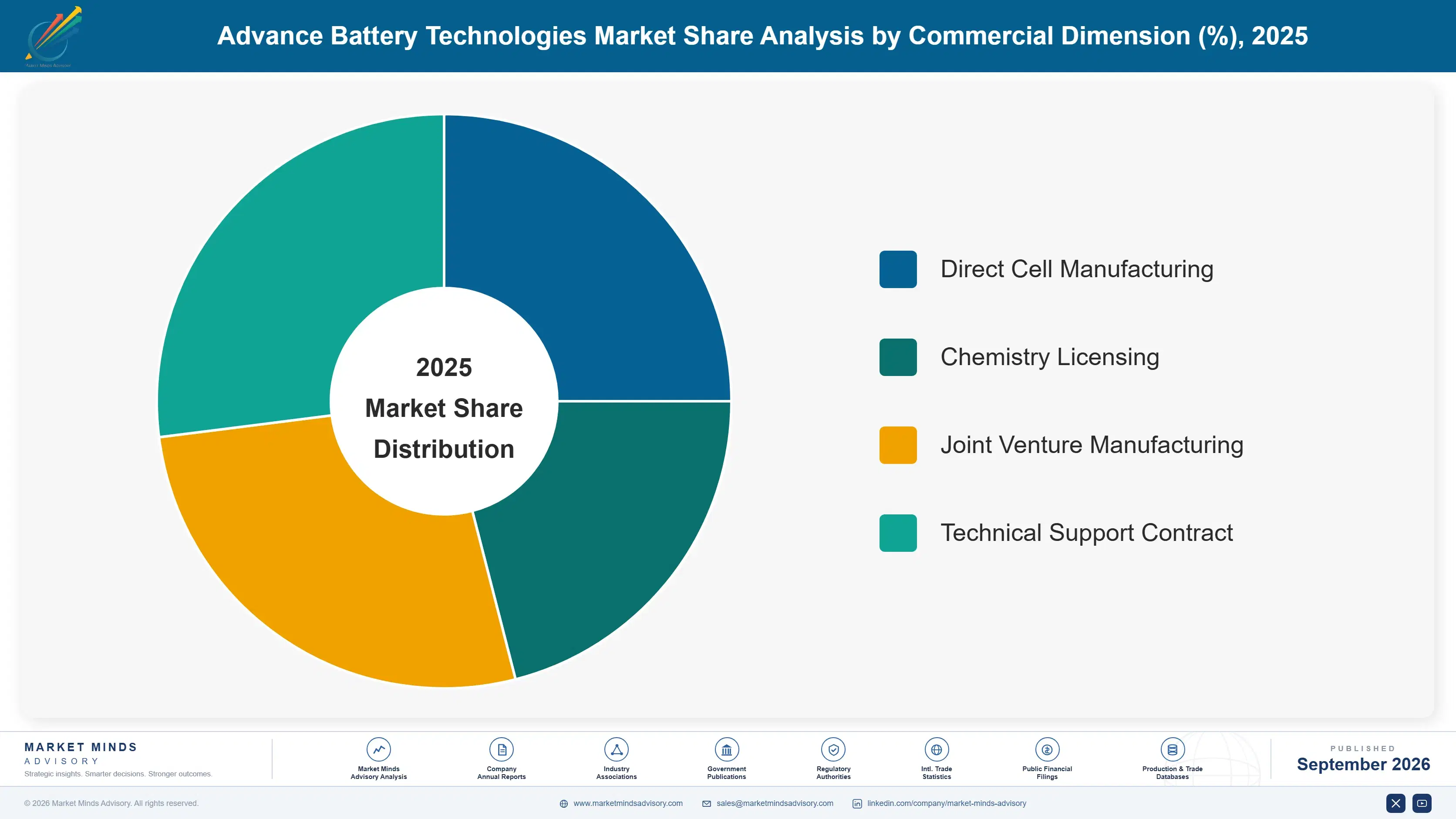
The advanced battery technologies market segments by chemistry and cell architecture, spanning solid-state, lithium-sulfur, sodium-ion, silicon anode lithium-ion, lithium metal, and semi-solid-state batteries, each offering distinct trade-offs between energy density, cost, safety, and manufacturing maturity across automotive and stationary storage applications worldwide. Commercialization timelines vary considerably across all six chemistries tracked very closely here.
advance-battery-technologies-market-market-share-analysis-1788421020292

Solid-State Batteries

Solid-state batteries replace the liquid electrolyte in conventional lithium-ion cells with a solid ceramic or polymer material, eliminating the flammability risk that liquid electrolytes carry while enabling higher energy density through lithium metal anode compatibility. This segment is growing fastest because it directly addresses both the safety and range concerns that most limit broader electric vehicle adoption, unlike incremental lithium-ion improvements that offer smaller performance gains. Developers have invested heavily in pilot production lines validating manufacturing yield at automotive-relevant scale, closing the gap between laboratory demonstration and commercial viability that historically stalled prior solid-state chemistry attempts. Pricing for this segment carries a substantial premium over conventional lithium-ion given the added manufacturing complexity involved.
CAGR 24.0%

Sodium-Ion Batteries

Sodium-ion batteries use sodium ions instead of lithium ions as the charge carrier, trading modest energy density reduction for substantially lower raw material cost and elimination of lithium and cobalt supply chain dependency entirely. Growth is strong as grid storage operators increasingly prioritize total installed cost over energy density for stationary applications where battery weight and volume matter far less than for vehicle applications. Manufacturers increasingly demand chemistry platforms that use widely available raw materials, reducing exposure to the price volatility and geopolitical supply risk that lithium and cobalt sourcing has historically carried. Several major Chinese battery manufacturers have already standardized on sodium-ion chemistry for their entry-level product lines today.
CAGR 20.0%
Full segment breakdown across 7 segments available in the complete report.

Regional Architecture and Country Demand Map

East Asia dominates chemistry development and pilot production investment through South Korea's Samsung SDI and LG Energy Solution, Japan's Toyota and Panasonic, and China's CATL scale, well beyond typical regional bands given gigafactory concentration, while North America leads solid-state licensing deal activity among automaker partners.

East Asia

South Korea's Samsung SDI, LG Energy Solution, and SK On, alongside Japan's Toyota and Panasonic and China's CATL, together give this region an unusually dominant 38 percent share, exceeding the standard regional band because chemistry research, pilot production, and gigafactory capital investment all concentrate heavily in these three countries rather than distributing globally. This share genuinely reflects where battery engineering talent and manufacturing capacity physically concentrate, a distinction that matters more for this category than for many other technology markets. China's domestic sodium-ion leadership through CATL further reinforces the region's dominant position across multiple competing chemistries simultaneously. Taiwan and Vietnam add supporting supply chain activity feeding into major chemistry manufacturing hubs nearby.
Share: 38% | CAGR: 15.5% (2026 to 2036)

North America

The United States hosts significant chemistry startup activity and automaker co-investment, including QuantumScape and Solid Power, even though gigafactory-scale manufacturing capacity increasingly concentrates in East Asian partner facilities. Domestic automakers value close engineering collaboration with chemistry developers during safety and cycle life qualification programs, favoring developers with local application engineering support. Canada contributes a smaller mining and raw material processing presence tied to shared North American battery supply chain ambitions. The region's growth rate slightly outpaces the global average as solid-state licensing deal activity keeps expanding among domestic automaker partners. Financing structures common in this market let mid-size chemistry startups join without heavy balance sheet strain. This baseline demand remains steady each budget cycle.
Share: 23% | CAGR: 15.5% (2026 to 2036)
Regional intelligence for 5 additional markets available in the complete report: Western Europe, South Asia and Pacific, Latin America, Middle East and Africa, Eastern Europe. Contact sales@marketmindsadvisory.com.
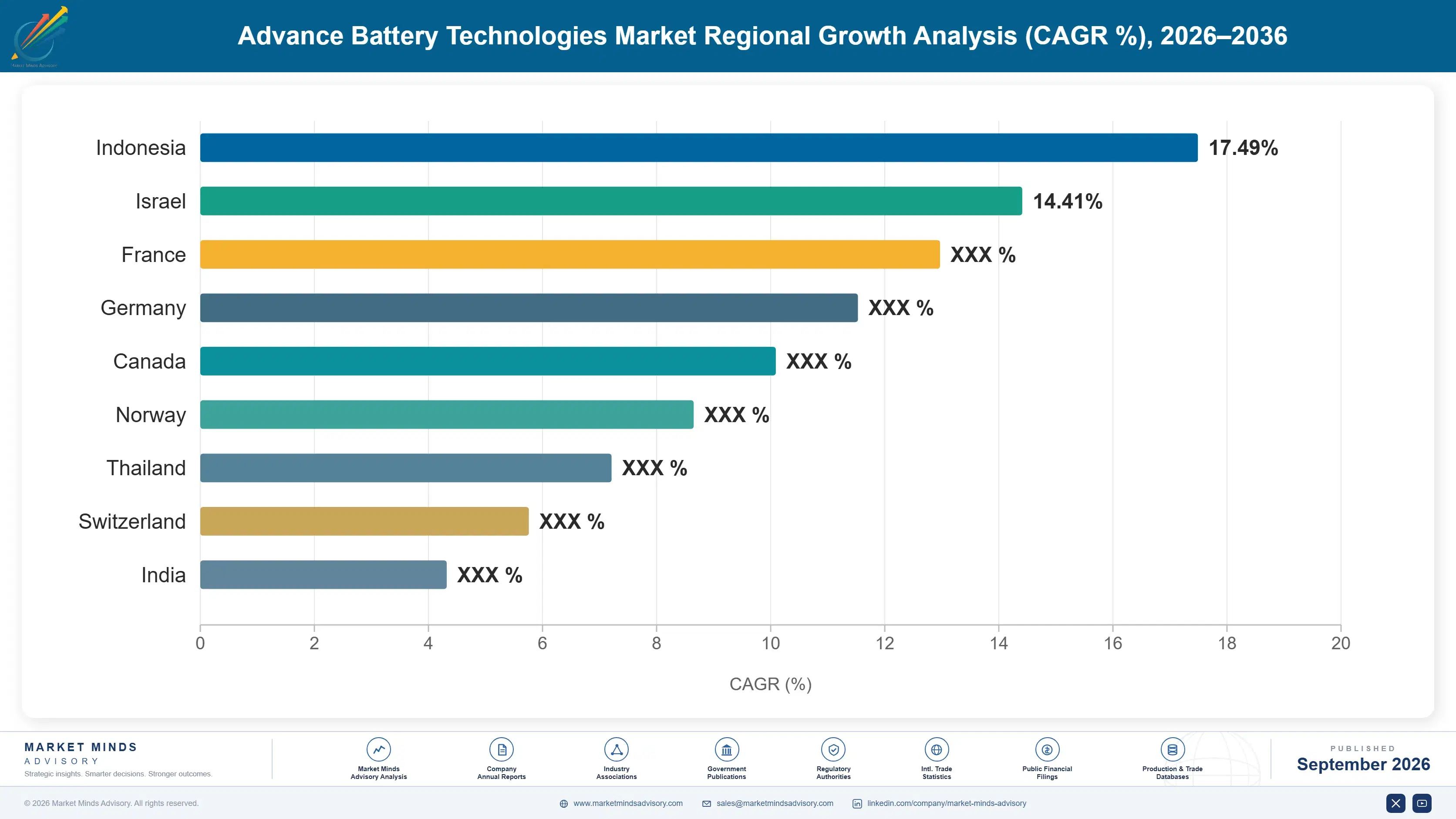
advance-battery-technologies-market-country-cagr-analysis-1788421020805

Where Battery Chemistry Margins Concentrate

Developer profitability increasingly concentrates in licensing royalties and technical support fees rather than one-time chemistry sale transactions, as leading developers bundle manufacturing process expertise into multi-year automaker partnerships that reduce reliance on upfront payment structures. This shift rewards developers with the deepest manufacturing scale-up expertise. Fewer developers compete effectively across every one of these dimensions simultaneously today.

Charging Ongoing Royalties On Licensed Chemistry Volume

Developers that structure licensing agreements around per-cell royalty payments tied to manufacturing volume capture recurring revenue that grows automatically as licensee production scales, rather than negotiating a single fixed upfront payment regardless of eventual commercial success. This shifts developer economics toward a revenue-share model that aligns incentives between chemistry developer and manufacturing partner more closely than flat licensing fees historically did. Developers report royalty-structured deals now representing roughly 45 percent of new licensing agreements signed, a figure growing steadily as manufacturing partners prefer volume-aligned payment structures. Developers extend this royalty model to smaller manufacturing partners each year as terms standardize.
Market Impact: Royalty deals now reach 45 percent of licenses

Providing Technical Support Retainers For Manufacturing Partners

Developers offering ongoing technical support retainers to manufacturing partners navigating production scale-up capture incremental revenue independent of the underlying chemistry licensing fee, protecting against the risk that manufacturing yield problems delay commercial revenue realization. This retainer structure requires deep manufacturing process expertise that only developers with genuine pilot-line experience can credibly deliver to skeptical manufacturing partners. Technical support retainers now average 15 percent of total contract value on complex solid-state licensing programs, rewarding developers willing to invest in this ongoing support capability. Few competitors possess comparable manufacturing scale-up track records to compete confidently here.
Market Impact: Support retainers now reach roughly 15 percent of value

Securing Exclusive Automaker Supply Agreements For Premium Pricing

Developers securing exclusive supply agreements with major automakers command meaningfully higher contract values than developers pursuing non-exclusive multi-customer licensing strategies, since exclusivity gives automakers competitive differentiation they are willing to pay a premium to protect. This exclusivity commitment requires developers to concentrate manufacturing capacity behind a single automotive partner, a strategic bet that pays off handsomely if that automaker's vehicle platform succeeds commercially at scale. Exclusive automaker agreements now command pricing premiums averaging 35 percent above comparable non-exclusive licensing arrangements across the industry. Few developers possess comparable automaker relationship depth across multiple vehicle platforms.
Market Impact: Exclusive deals now command a 35 percent premium

Diversifying Into Stationary Storage Chemistry Applications

Developers expanding beyond automotive applications into stationary grid storage chemistry variants are capturing revenue diversification that reduces dependence on automotive qualification timelines and automaker capital expenditure cycles specifically. This stationary storage revenue stream often reaches commercial deployment faster than automotive applications, since grid storage customers accept somewhat lower energy density in exchange for faster qualification and lower safety certification requirements. Developers with stationary storage product lines report revenue diversification now representing roughly 22 percent of total company revenue, reducing automotive cycle dependency meaningfully across their business. Adoption keeps accelerating among utility customers each quarter.
Market Impact: Stationary storage now reaches roughly 22 percent of revenue

Who Controls the Margin Pool

Competitive concentration sits at a moderately high 48 percent CR5, reflecting the substantial capital investment required to advance chemistry from laboratory demonstration through automotive-relevant pilot production. Participants are evaluated here on revenue, the most commercially consistent basis across developers with very different licensing and manufacturing business models. The gap between CATL, the clear leader through its manufacturing scale, and the fifth-ranked developer remains wide.
Current activity centers on solid-state pilot line scale-up, as developers race to demonstrate manufacturing yield fast enough to meet automaker 2027 commercialization commitments already publicly announced. Several developers have also expanded sodium-ion product lines targeting grid storage customers growing faster than automotive-focused chemistry segments. Exclusive automaker supply agreement negotiations have intensified as developers seek revenue certainty. Manufacturing scale-up partnerships with established battery makers have also become more common.

Emerging pressure is coming from established battery manufacturers building in-house next-generation chemistry capability, threatening standalone chemistry startups that built their entire business on licensing intellectual property to third-party manufacturers. This threatens smaller developers' negotiating leverage during licensing renewal discussions specifically. Rankings are most likely to shift as manufacturing yield capability, not laboratory-stage performance claims, increasingly determines which developers win automaker commercialization contracts.
advance-battery-technologies-market-company-positioning-matrix-1788421021348

Competitive Moat and Risk Dimensions

QUANTUMSCAPE CORPORATION

Moat: Longest Automotive Chemistry Track Record

QuantumScape maintains the longest publicly documented solid-state chemistry development track record among pure-play startups, giving it credibility with automaker partners that newer entrants without comparable multi-year performance data struggle to establish quickly. This track record continues expanding as the company publishes additional pilot line performance data each year across successive product generations.
QUANTUMSCAPE CORPORATION

Risk: Repeated Commercialization Delays Erode Confidence

QuantumScape has repeatedly pushed back commercialization timelines originally announced years earlier, creating meaningful investor and automaker partner skepticism about whether manufacturing yield challenges can actually be solved on the aggressive timeline management continues to project publicly to shareholders and industry observers each successive quarter of operations.
CATL

Moat: Massive Manufacturing Scale And Cost

CATL operates manufacturing scale that dwarfs pure-play chemistry startups, letting it pursue next-generation chemistry development while amortizing research costs across an enormous existing conventional lithium-ion production base that funds ongoing innovation. This scale advantage continues expanding as the company reinvests conventional battery profits into next-generation chemistry research programs.
CATL

Risk: Geopolitical Exposure Limits Market Access

CATL faces mounting geopolitical scrutiny and restricted market access in the United States and some European markets, creating a genuine opening for Western-headquartered competitors to win automaker partnerships CATL simply cannot pursue given political and regulatory constraints imposed by national security policy considerations affecting supply chains.

Players Tracked

Prominent Players

QuantumScape Corporation
Solid Power Inc
CATL
Samsung SDI
LG Energy Solution

Other Key Players

SK On Co Ltd
Toyota Motor Corporation
Panasonic Holdings Corporation
Northvolt AB
ProLogium Technology Co
StoreDot Ltd
Sila Nanotechnologies Inc
Group14 Technologies
Natron Energy Inc
Factorial Energy Inc
SES AI Corporation
Ilika plc
24M Technologies Inc
American Battery Technology Company
Faradion Ltd

Recent Developments

FEBRUARY 2026

QuantumScape Reports Solid State Manufacturing Milestone

QuantumScape reported achieving a key manufacturing yield milestone at its pilot production facility, demonstrating progress toward the consistent cell quality required for automotive-scale volume production. The milestone responds directly to investor and automaker partner concerns about whether manufacturing yield challenges can be solved on the announced commercialization timeline.
Signal: Signals that leading chemistry developers are now making measurable progress toward automotive manufacturing scale readiness broadly.
SEPTEMBER 2025

CATL Signs Sodium Ion Supply Agreement

CATL secured a brand-new multi-year supply agreement with a major grid storage developer to provide sodium-ion battery cells for utility-scale stationary storage projects launching across several new international markets soon. The agreement covers multiple project sites across the developer's expanding global renewable energy storage portfolio.
Signal: Signals that grid storage developers are now increasingly specifying sodium-ion chemistry over conventional lithium-ion cells broadly.
DECEMBER 2025

Toyota Expands Solid State Pilot Line Investment

Toyota announced additional capital investment in its solid-state battery pilot production line, targeting expanded manufacturing capacity ahead of its previously announced commercialization timeline for next-generation vehicle platforms. The investment strengthens Toyota's position among automakers pursuing in-house chemistry development rather than relying entirely on external licensing partners.
Signal: Signals that established automakers are now investing directly in chemistry development rather than relying on licensing.

Solid Electrolyte Raw Material Exposure

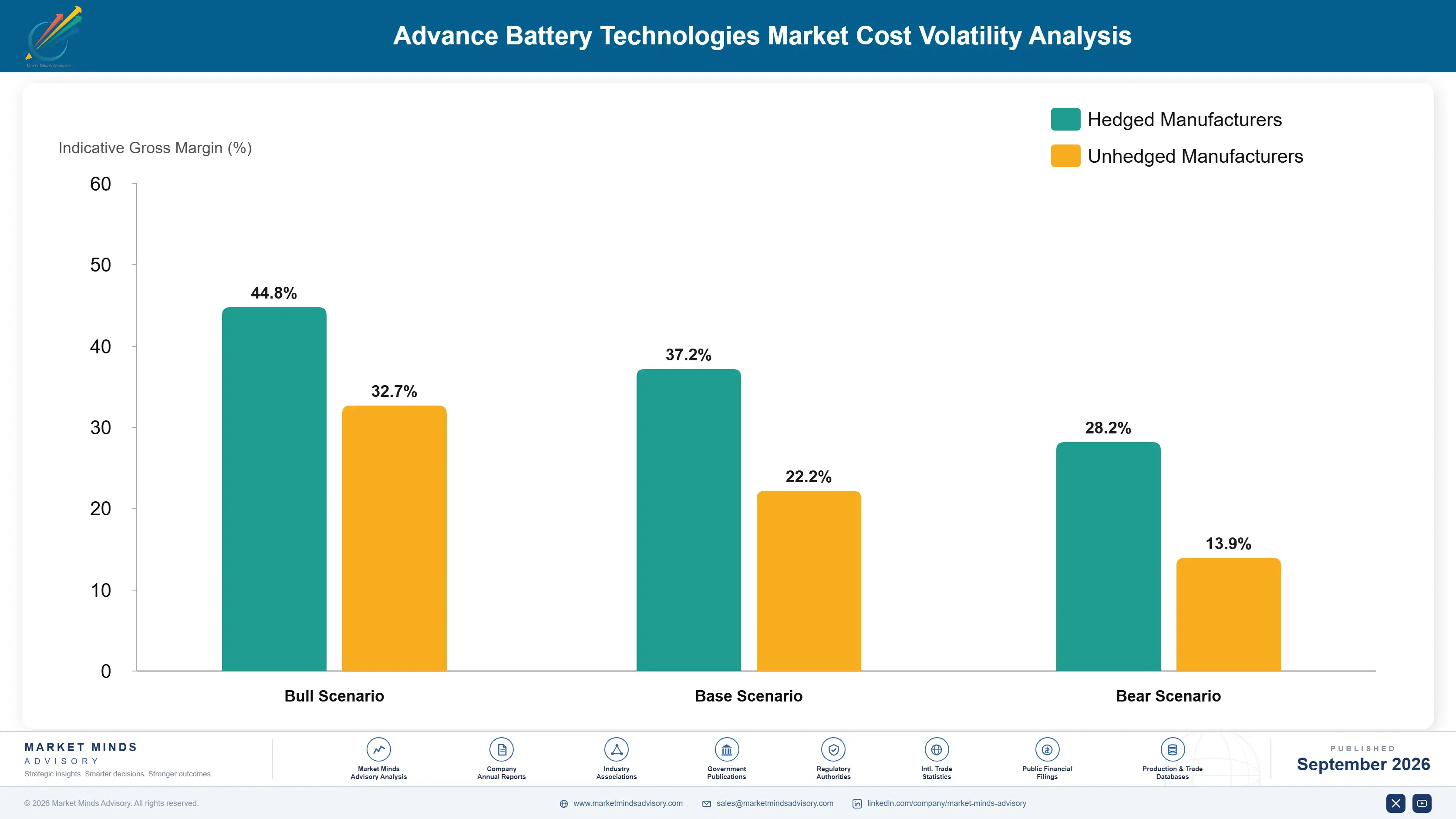
Solid electrolyte materials, particularly lithium lanthanum zirconium oxide and sulfide-based compounds, account for roughly 42 percent of solid-state cell material cost, with production concentrated among a small number of specialty chemical suppliers in Japan and South Korea. Lithium metal anode materials and specialty separator films make up most of the remainder, sourced from established battery material suppliers.
Lithium carbonate prices experienced significant volatility during 2022 through 2024, documented across producer annual reports and referenced in IEA critical minerals market analyses, briefly compressing chemistry developer margins as raw material costs fluctuated faster than long-term supply agreements could adjust pricing terms. This volatility particularly affected developers without long-term lithium supply contracts, forcing several smaller developers to renegotiate customer pricing terms mid-contract during the worst price spike periods.

Developers without long-term raw material supply agreements face a meaningful competitive disadvantage during price volatility periods, since solid electrolyte and specialty anode materials remain a small customer segment relative to broader lithium-ion supply chains competing for the same upstream material sources. This exposure varies by developer scale: larger developers like CATL can negotiate volume-based material contracts that smaller specialists simply cannot access on comparable favorable terms.
advance-battery-technologies-market-cost-volatility-analysis-1788421021562

Securing Long-Term Raw Material Supply Agreements

Leading developers now negotiate multi-year supply agreements with lithium and specialty material producers years ahead of planned volume production, locking in pricing before customer deployment scale grows further and material demand increases meaningfully across the industry. This requires committing to minimum purchase volumes ahead of confirmed revenue, a trade-off only well-capitalized developers can consistently afford.

Developing Lower Material Intensity Chemistry Variants

Developers are researching chemistry variants requiring less solid electrolyte material per cell while maintaining comparable performance, reducing long-term raw material cost exposure meaningfully across successive product generations and platforms. This research requires extensive validation testing before customers will accept modified chemistry formulations, but meaningfully reduces ongoing material cost volatility once qualified across production volumes.

Portfolio Architecture for Margin Defence

Portfolio economics split across three tiers running from established silicon anode improvements sold near conventional lithium-ion pricing up through licensed chemistry platforms and next-generation solid-state cells bundled with manufacturing support services. Gross margin widens dramatically moving up this ladder, since manufacturing complexity and licensing structures create defensibility that pure chemistry claims alone cannot provide. Investors increasingly value developers by their revenue mix across these three tiers.
Volume tier chemistry competes almost entirely on cost per kilowatt-hour, leaving developers with thin and cyclical margins that depend heavily on manufacturing scale to remain profitable across a full multi-year cycle. Premium tier chemistry instead competes on performance differentiation and automaker partnership depth, letting developers charge meaningfully more per licensing deal while facing far less commodity price pressure during industry downturns.

High-value margin pools concentrate almost entirely in the next-generation tier, where solid-state and sodium-ion chemistry generate premium licensing revenue unavailable to developers still selling standalone silicon anode improvements. Developers positioned only in the volume tier face real profitability ceilings that next-generation-tier competitors do not share, regardless of chemistry volume licensed across any given fiscal year of operation. This concentration keeps becoming more pronounced each year.

Volume / Commodity-Adjacent Tier

Established silicon anode and incremental lithium-ion chemistry improvements sold mainly into consumer electronics and general industrial applications, competing almost entirely on cost per kilowatt-hour against several large-scale global manufacturers operating at scale.
Gross Margin: 16-24%

Premium / Certified Tier

Licensed chemistry platforms tested to stricter automotive safety and cycle life standards than commercial parts, commanding premium licensing fees from customers requiring long product lifecycles and rigorous multi-year testing programs.
Gross Margin: 32-42%

Sustainability / Regulatory / Next-Generation Tier

Next-generation solid-state and sodium-ion chemistry platforms bundled with manufacturing support services, positioned for automakers and grid storage customers prioritizing energy density and cost well above pure chemistry considerations entirely today.
Gross Margin: 45-58%
advance-battery-technologies-market-portfolio-architecture-1788421022095

High-value Sub-segments and Strategic Watch-out

Solid-State Batteries

Solid-state batteries sit in the high-value high-growth quadrant, combining the fastest unit growth rate tracked with the widest gross margin band once manufacturing complexity premiums layer on top of licensing pricing, making it the clearest priority for developer capital allocation across this entire decade of investment.
Gross Margin: 45-58%

Sodium-Ion Batteries

Sodium-ion batteries occupy the high-value moderate-growth quadrant, generating strong licensing margin from grid storage adoption even though growth trails solid-state, because automotive applications still strongly prioritize much higher energy density over the modest cost advantages sodium-ion chemistry primarily offers to stationary storage customers globally today.
Gross Margin: 32-42%

Silicon Anode Lithium-Ion Batteries

Silicon anode lithium-ion batteries remain the volume core segment, generating the bulk of current chemistry licensing at thinner margins, still essential for developer scale economics even as growth slows relative to solid-state and sodium-ion alternatives entering the category more aggressively with each successive generation today.
Gross Margin: 18-26%

Lithium-Sulfur Batteries

Lithium-sulfur batteries form the strategic watch-out segment, facing real commercialization risk as solid-state and silicon anode chemistry increasingly capture the majority of automaker research investment natively at comparable performance levels, threatening standalone developers that never diversified beyond simple sulfur cathode chemistry into richer categories over time.
Gross Margin: 16-24%

Licensing Agreements Extend Chemistry Developer Relationships

Chemistry developers increasingly license their intellectual property to established battery manufacturers under multi-year royalty and technical support agreements, converting what was once a single technology transfer transaction into a longer-tail relationship spanning multiple product generations. This licensing model gives developers recurring revenue visibility through manufacturing volume growth rather than relying entirely on one-time upfront licensing payments. Investors increasingly value developers on this recurring licensing revenue mix rather than one-time payment size alone.
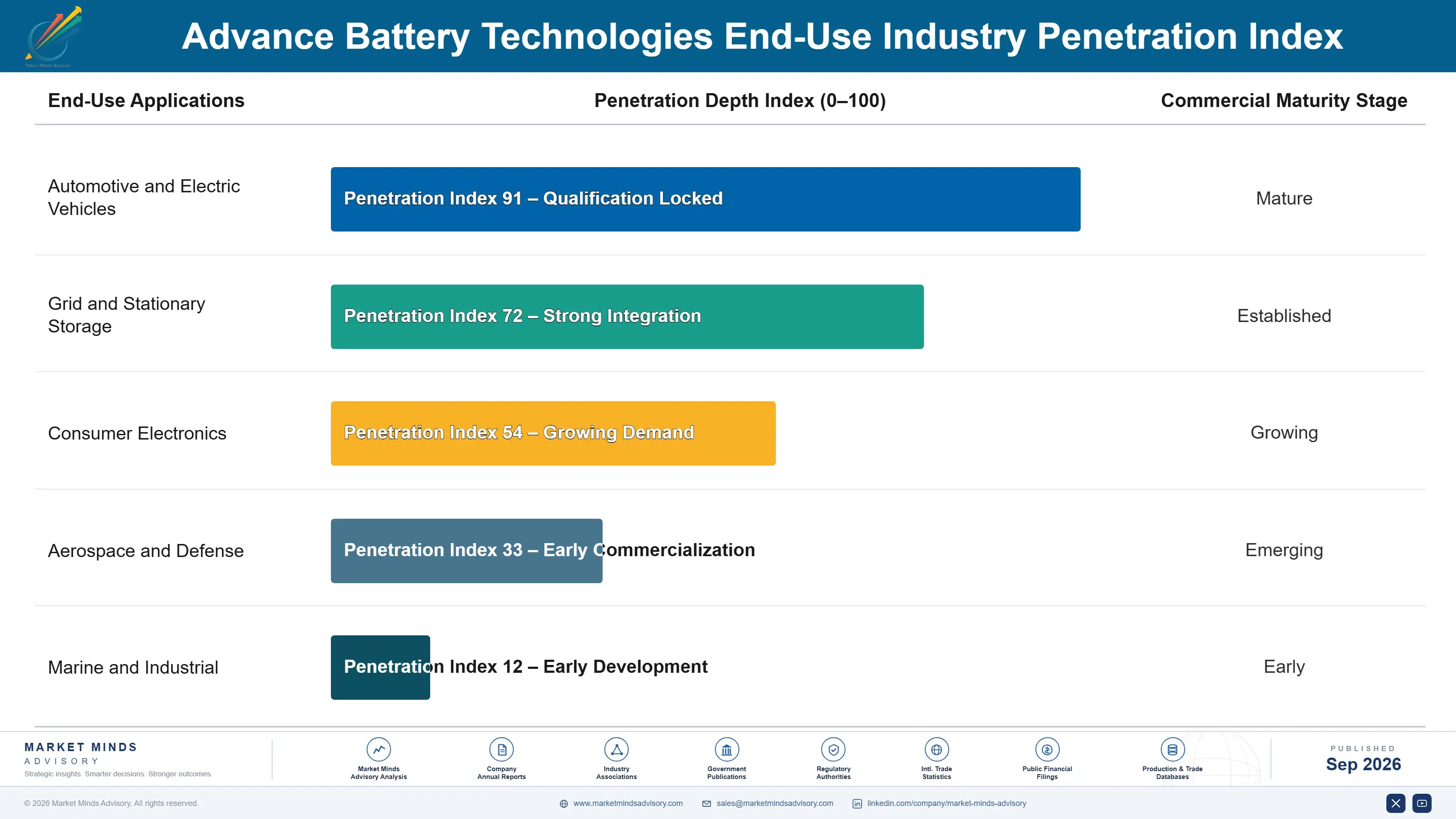
Adoption depth varies sharply by end-use vertical: automotive customers commit to multi-year chemistry qualification programs and rarely switch suppliers once safety and cycle life validation is complete, while consumer electronics customers operate on much shorter product cycles and remain more price-sensitive at each refresh. Grid storage customers sit between these extremes, valuing total cost of ownership over pure energy density. This tension shapes capital allocation priorities across every developer's roadmap.

Buyer profiles are shifting generationally as battery systems engineers, rather than traditional powertrain engineers, increasingly drive chemistry selection given growing emphasis on total pack-level safety and thermal management alongside pure cell-level performance metrics. This generational shift is reshaping which chemistry attributes automakers prioritize, favoring manufacturing scalability over the laboratory-stage performance records that historically dominated early chemistry selection decisions.
advance-battery-technologies-market-end-use-penetration-index-1788421022612

Where Battery Developers Should Focus Now

These are among the four positions where our research anticipates prominent divergence between winners and laggards over the coming forecast period. Each is grounded in the demand model, the regulatory perimeter, and the announced capacity pipeline.
01 / MANUFACTURING YIELD INVESTMENT

Prioritize Manufacturing Yield Over Laboratory Performance Claims

Developers still emphasizing laboratory-stage performance records over demonstrated manufacturing yield are missing what automakers actually need, since pilot line capacity commitments are growing over 60 percent faster than laboratory chemistry announcements across the industry this year and every quarter since. Developers with early manufacturing scale-up investment are capturing automaker commercialization contracts that competitors focused on theoretical performance simply cannot secure today. Developers slow to prioritize manufacturing yield risk ceding automaker partnerships entirely to faster-moving competitors within the next two qualification cycles.
02 / SODIUM-ION CHEMISTRY DIVERSIFICATION

Expand Into Sodium-Ion Before Grid Storage Consolidates

Developers concentrated purely on automotive solid-state chemistry are missing sodium-ion deployment growing over 55 percent in grid storage applications, a segment less exposed to automaker qualification timelines and capital expenditure cycles specifically across most utility customers served worldwide right now. Developers establishing early sodium-ion positions are capturing grid storage relationships before established lithium-ion suppliers extend their reach into this faster-growing, cost-sensitive stationary storage segment entirely. Developers should build this capability now, before competitors consolidate the largest utility-scale storage contracts entirely.
03 / LICENSING ROYALTY STRUCTURING

Structure Licensing Around Volume Royalties Not Flat Fees

Developers still negotiating flat upfront licensing fees are missing revenue upside that royalty-structured deals now capture, representing roughly 45 percent of new licensing agreements signed as manufacturing partners increasingly prefer volume-aligned payment structures over fixed payments across the industry this year. Developers offering royalty structures are capturing manufacturing partners who value aligned incentives during the uncertain early stages of chemistry commercialization specifically. Developers should shift toward royalty-based licensing now, since flat-fee structures increasingly disadvantage developers relative to manufacturing partners during scale-up negotiations.
04 / CAPITAL EFFICIENCY POSITIONING

Pursue Manufacturing Partnerships Before Capital Runway Narrows

Developers without established manufacturing partnerships face a persistent capital disadvantage, given that pilot production lines require hundreds of millions of dollars in investment before any commercial revenue materializes for standalone chemistry startups operating independently across the industry. Developers partnering with established battery manufacturers are capturing manufacturing scale-up capability that independent capital raising simply cannot match at comparable speed or cost efficiency. Developers should pursue these partnerships now, before capital markets tighten further and independent commercialization becomes considerably harder to fund.

Engagement Snapshot From the Field

A live engagement with an industry participant carrying material or product regulatory and market exposure ahead of a defining policy shift, showing how our research translates into a defensible multi-year portfolio strategy.
MARKET MINDS ADVISORY · CLIENT ENGAGEMENT SUMMARY
Advance Battery Technologies Producer Strategic Portfolio Review and Transition Roadmap 2026·Investment Scenario on Advance Battery Technologies Exposure Evaluation 2025-26
CLIENT PROFILE
The client designs and manufactures electric vehicles for the premium segment across North America, competing against larger automakers with greater in-house battery development resources. Facing pressure to differentiate on range and charging speed for an upcoming vehicle platform, leadership needed a framework for selecting a next-generation chemistry development partner. Annual revenue was reported at approximately 2.2 billion dollars (client-reported, unverified by MMA).
STRATEGIC CHALLENGE
Leadership faced a choice between partnering with an established chemistry developer offering proven track record but slower customization and a newer specialist developer offering more aggressive performance targets but higher execution risk. Engineering teams worried about committing to a partner whose commercialization timeline might slip past the vehicle platform launch date.
MMA APPROACH
MMA conducted a comparative technical due diligence and execution risk assessment across three candidate chemistry developers, incorporating primary interview data on each developer's pilot line performance history and prior commercialization timeline accuracy. The analysis modeled platform launch risk under multiple chemistry readiness scenarios. Findings were presented to the client's executive team alongside a recommended dual-track development strategy.
KEY FINDINGS
  1. The established developer's proven track record was offset by meaningfully more conservative performance targets than the newer specialist developer proposed for the same vehicle platform.
  2. The newer specialist developer's aggressive performance targets carried real execution risk given its comparatively limited pilot production scale-up history at automotive volumes.
  3. Pursuing a dual-track development strategy across both developers reduced platform launch risk without meaningfully increasing total development budget commitments significantly for the client.
  4. Developer commercialization timeline accuracy correlated closely with pilot line investment scale, confirming manufacturing readiness as a more reliable predictor than performance claims alone.
CLIENT PROFILE
The client designs and manufactures electric vehicles for the premium segment across North America, competing against larger automakers with greater in-house battery development resources. Facing pressure to differentiate on range and charging speed for an upcoming vehicle platform, leadership needed a framework for selecting a next-generation chemistry development partner. Annual revenue was reported at approximately 2.2 billion dollars (client-reported, unverified by MMA).
STRATEGIC CHALLENGE
Leadership faced a choice between partnering with an established chemistry developer offering proven track record but slower customization and a newer specialist developer offering more aggressive performance targets but higher execution risk. Engineering teams worried about committing to a partner whose commercialization timeline might slip past the vehicle platform launch date.
MMA APPROACH
MMA conducted a comparative technical due diligence and execution risk assessment across three candidate chemistry developers, incorporating primary interview data on each developer's pilot line performance history and prior commercialization timeline accuracy. The analysis modeled platform launch risk under multiple chemistry readiness scenarios. Findings were presented to the client's executive team alongside a recommended dual-track development strategy.
KEY FINDINGS
  1. The established developer's proven track record was offset by meaningfully more conservative performance targets than the newer specialist developer proposed for the same vehicle platform.
  2. The newer specialist developer's aggressive performance targets carried real execution risk given its comparatively limited pilot production scale-up history at automotive volumes.
  3. Pursuing a dual-track development strategy across both developers reduced platform launch risk without meaningfully increasing total development budget commitments significantly for the client.
  4. Developer commercialization timeline accuracy correlated closely with pilot line investment scale, confirming manufacturing readiness as a more reliable predictor than performance claims alone.
RECOMMENDED STRATEGY
Phase 1: Phase 1 (Months 1 to 4): Begin parallel technical qualification with both chemistry development partners simultaneously for the entire platform. Phase 2: Phase 2 (Months 5 to 12): Evaluate pilot line performance data from both partners against platform launch requirements very closely. Phase 3: Phase 3 (Months 13 to 18): Select the primary chemistry partner based on demonstrated manufacturing readiness for full volume production.
OUTCOME
The client adopted the recommended dual-track development strategy, avoiding an estimated 40 million dollars (client-reported, unverified by MMA) in projected platform delay costs by identifying manufacturing readiness risk early. The selected chemistry partner met the platform launch timeline, and engineering leadership reported improved confidence heading into production.

Frequently Asked Questions

Foundational context covering the market sizes, CAGR, scope, country, region and competition that inform every finding below. This section is provided to cover basics and most often pre-purchase conversations, answered from the MMA Primary Research Dataset.

What is the current size of the Advanced Battery Technologies Market?

The advanced battery technologies market reached approximately 25.19 billion dollars in 2026, according to MMA Primary Research Dataset, July 2026. This figure covers solid-state, sodium-ion, silicon anode, and other next-generation chemistry revenue combined globally.

How large will the Advanced Battery Technologies Market be by 2036?

MMA projects the market will reach approximately 97.56 billion dollars by 2036 under the base case scenario. That represents roughly a 3.87 times expansion over the ten-year forecast period from 2026 through 2036.

What is the CAGR for the Advanced Battery Technologies Market 2026 to 2036?

The base case compound annual growth rate is 14.5 percent through 2036. Bull and bear scenarios range from 15.8 percent to 13.2 percent depending on solid-state commercialization and manufacturing yield conditions.

Which segment is growing fastest?

Solid-state batteries are growing fastest at 24.0 percent CAGR, roughly 1.66 times the overall market rate. Automotive safety and energy density demands are driving this segment's outsized expansion versus conventional lithium-ion chemistry.

Who are the major companies in the Advanced Battery Technologies Market?

Leading companies include QuantumScape, Solid Power, CATL, Samsung SDI, and LG Energy Solution. These five players hold a combined 48 percent share on a revenue basis.

Which country is growing fastest?

South Korea is growing fastest at approximately 17.0 percent CAGR, driven by aggressive solid-state investment from Samsung SDI, LG Energy Solution, and SK On. This outpaces China and other established production centers considerably.

Report Segmentation Architecture

The full report scope spans multiple orthogonal segmentation dimensions, with cross-tabulated demand data provided for each dimension pair. Coverage extends further to regional breakdowns, trend trajectories, and the competitive detail needed to support segment-level decision-making.

By Primary Market Dimension

  • Solid-State Batteries
  • Lithium-Sulfur Batteries
  • Sodium-Ion Batteries
  • Silicon Anode Lithium-Ion Batteries
  • Lithium Metal Batteries
  • Semi-Solid-State Batteries

By End-Use Industry

  • Automotive and Electric Vehicles
  • Grid and Stationary Storage
  • Consumer Electronics
  • Aerospace and Defense
  • Marine and Industrial

By Commercial Dimension

  • Direct Cell Manufacturing
  • Chemistry Licensing
  • Joint Venture Manufacturing
  • Technical Support Contract

By Region

  • North America
  • Western Europe
  • East Asia
  • South Asia and Pacific
  • Latin America
  • Middle East and Africa
  • Eastern Europe

Scope, Methodology, and Coverage

Every figure in this report is reproducible from documented input assumptions. The scope below maps the historical period, the forecast horizon, the segmentation dimensions, and the countries covered, alongside the underlying primary and qualitative methodology.
Historical Period
2020 to 2025
Forecast Period
2026 to 2036
Base Year
2025 (USD billions; MMA Primary Research Dataset, September 2026)
Market Definition
The advanced battery technologies market covers next-generation battery chemistries beyond conventional liquid-electrolyte lithium-ion, including solid-state, lithium-sulfur, sodium-ion, silicon anode, lithium metal, and semi-solid-state batteries sold as cells or licensed chemistry platforms. It excludes conventional lithium-ion cells using established graphite anode and liquid electrolyte chemistry.
Quantitative Units
USD billions (current prices); cell shipments and licensing agreements where applicable
Segmentation Dimensions
By Chemistry Type; By End-Use Industry; By Commercial Dimension; By Region
Regions Covered
North America, Western Europe, East Asia, South Asia and Pacific, Latin America, Middle East and Africa, Eastern Europe
Countries Covered
USA, China, Germany, France, UK, Japan, South Korea, India, Australia, Canada, Brazil, Mexico, Indonesia, Vietnam, Thailand, Malaysia, UAE, Saudi Arabia, South Africa, Nigeria, Turkey, Poland, Netherlands, Italy, Spain, Sweden, Switzerland, Argentina, Colombia, Singapore, and additional markets relevant to this sector
Key Companies Profiled
QuantumScape Corporation, Solid Power Inc, CATL, Samsung SDI, LG Energy Solution, SK On Co Ltd, Toyota Motor Corporation, Panasonic Holdings Corporation, Northvolt AB, ProLogium Technology Co, StoreDot Ltd, Sila Nanotechnologies Inc, Group14 Technologies, Natron Energy Inc, Factorial Energy Inc, SES AI Corporation, Ilika plc, 24M Technologies Inc, American Battery Technology Company, Faradion Ltd
Quantitative Methodology
Primary survey, n=3,800 respondents, Q4 2025, six countries; demand-side model with trade association cross-validation
Qualitative Methodology
47 expert interviews, Q4 2025; applied to validate demand model assumptions, identify emerging dynamics, and assess competitive positioning
Report Format
PDF and XLSX data workbook (Word format preview document)
Publisher
Market Minds Advisory
Report Code
MMA-2026-ENE-801
Published
September 2026
Contact
sales@marketmindsadvisory.com | www.marketmindsadvisory.com

Purchase the full Advance Battery Technologies Market Report (2026 to 2036).

This report delivers a comprehensive assessment of the global advanced battery technologies market, covering historical performance from 2020 through 2025 and forecasts through 2036 across all seven major world regions. It profiles the twenty leading developers shaping solid-state, sodium-ion, and silicon anode chemistry, including detailed competitive positioning and recent commercialization developments. The analysis quantifies segment-level growth across six chemistry categories and evaluates revenue diversification opportunities including licensing royalties and stationary storage diversification. Primary research draws on a 3,800-respondent survey and 47 expert interviews conducted in Q4 2025.
Ten-year revenue forecast by segment and region
Competitive benchmarking of twenty profiled developers
Regional demand driver analysis across seven markets
Solid electrolyte raw material cost risk assessment
Revenue diversification and licensing royalty lever analysis
Anonymized client case study with strategic recommendations

Built For The People Who Decide

From boardroom strategy to bench-side execution, this report is read cover-to-cover by leaders shaping the next decade of their industry, turning demand scenarios, market dynamics and valuation benchmarks into decisions.
CXOs/ Presidents/ VPs/ Managers
M&A and Corporate Development
Strategy Teams and R&D Heads
Procurement and Product Directors
Regulatory and Compliance Leaders
Investor Relations and Equity Analysts