Market Minds Advisory
Adserver Software Market

Adserver Software Market: Adserver Software Market. Campaign Delivery Infrastructure for Programmatic and Direct Digital Advertising

Expanding retail media network deployment, tightening privacy-driven identity resolution requirements, and rising demand for cross-channel campaign orchestration push publishers and advertisers toward AI-optimized adserver platforms that legacy systems cannot match.

Lead Analyst

Published

September 2026

Make Smarter Decisions with Customized Research Insights

Request a free sample report and evaluate market opportunities, growth trends, and competitive dynamics relevant to your business needs.

2025 MARKET VALUE$6.5BMarket Size 2025
2036 FORECAST VALUE$15.9BBase Case , 2026 to 2036
CAGR 2026 TO 20368.5 %Bull 9.7% / Bear 7.3%
INCREMENTAL OPPORTUNITY$8.9BNet 10- year value creation
EXPANSION MULTIPLE2.26x2036 value over 2026 base
Strategic Levers
M&A Pipeline
Regional Outlook
Country Rankings
Competitive Intelligence
Segmental Deep-dive
Call-Us : 91 93563 13602

Executive Snapshot and Market Trajectory.

Adserver software demand is shifting from basic ad delivery infrastructure toward AI-optimized yield management as publishers and advertisers chase higher fill rates across increasingly fragmented digital advertising inventory and channels spanning web, mobile, connected television, and rapidly emerging retail media placements today.
AI-optimized bid and yield management tools are pulling ahead of static waterfall configurations as publishers chase faster revenue optimization across programmatic and direct-sold inventory simultaneously across most digital advertising formats. North America's concentrated ad tech vendor headquarters and digital advertising spend keep the fastest deployment activity there, well ahead of comparable adoption in most other regions globally today, particularly among publishers operating large-scale retail media networks and premium video inventory portfolios.
Established ad tech platforms compete against newer specialist adserver providers winning deals on retail media network integration depth and identity resolution capability, but AI-based yield optimization is becoming the decisive purchase criterion as publishers consolidate multiple point tools onto fewer unified adserver platforms each contract cycle, pressuring static-configuration vendors to differentiate sharply on price alone, an increasingly difficult position to sustain across most publisher account sizes, geographies, and revenue channels heading into 2026 and beyond.
Market Definition
The Adserver Software Market covers platforms that deliver, target, track, and optimize digital advertisements across web, mobile, and connected television inventory for publishers and advertisers. It excludes standalone demand-side and supply-side bidding exchanges sold without ad delivery functionality, creative design tools, and traditional linear television advertising traffic systems.
Base Year Value
$6.5B in 2025 (MMA Primary Research Dataset, September 2026)
Forecast Period
2026 to 2036, eleven discrete annual values
CAGR
8.5% base case. Bull 9.7%. Bear 7.3%.
Fastest Growth Segment
AI-Optimized Bid and Yield Management Software: 13.5% CAGR
Fastest Growth Country
India: 11.5% CAGR
Fastest Growth Region
South Asia and Pacific: 10.5% CAGR
Largest Region
North America: 30% of 2025 global value
Market Leaders
Google Ad Manager, Kevel, Xandr, Equativ, and Broadstreet Ads lead the market. Source: MMA Analysis, July 2026.
Primary Survey
n=3,800 procurement and R&D decision-makers, Q4 2025, six countries
Methodology
Demand-side build-up, cross-validated against public data, 47 expert interviews

Adserver Software Market Forecast Scenarios

adserver-software-market-size-forecast-scenario-1789982480969
The adserver software market expanded at an estimated 7.5 percent historical CAGR between 2020 and 2025, as publishers migrated legacy ad serving infrastructure onto cloud native platforms and programmatic direct deals steadily displaced manual insertion order workflows. Header bidding standardization and first party data mandates pushed mid-market publishers toward consolidated adserver stacks rather than fragmented point tools.
The base case assumes eight point five percent CAGR through 2036, driven by three commercial mechanisms operating together: retail media networks building dedicated adserver instances for onsite and offsite commerce inventory, publishers replacing cookie dependent targeting with contextual and identity graph based delivery logic, and agencies consolidating campaign trafficking onto fewer platforms to cut operational overhead. Together these mechanisms sustain double digit demand from mid-sized publishers even as large platforms internalize more delivery infrastructure.
The bull case centers on accelerated retail media network adoption pulling adserver spend upward faster than modeled, with connected television inventory monetization acting as the named catalyst. The bear case centers on walled garden platforms such as large demand side platforms absorbing adserver functionality natively, compressing the addressable market for independent vendors and slowing new contract signings industrywide.

Campaign Delivery Infrastructure Enters a Consolidation Phase

Adserver software sits at the operational center of digital publishing, arbitrating which creative renders, at what price, and through which auction path for every impression a publisher sells. The category has moved well beyond simple ad rotation. Modern platforms now unify direct sold, programmatic guaranteed, and open auction demand inside a single decisioning layer, and that consolidation is reshaping vendor selection criteria across the buyer base far more than pricing alone.
MARKET CONCENTRATION47% CR5share of market revenue held by top vendors
AVERAGE CONTRACT VALUE$185Ktypical annual spend for enterprise publisher platform deployment
US VENDOR SHARE62%share of enterprise contracts won by domestic vendors
PLATFORM REPLACEMENT CYCLE3.5 Yearsaverage interval before publishers re-tender their adserver contracts
PROGRAMMATIC DIRECT MIX58%share of impressions transacted outside open auction pathways
HEADER BIDDING PENETRATION74%publishers running unified header bidding wrapper logic today
Retail media has become the sharpest growth vector, pulling adserver demand from a category once dominated by publishers and broadcasters into grocery, pharmacy, and marketplace operators building owned advertising businesses. These buyers demand tighter integration with commerce data, onsite search, and offsite retargeting than legacy media adservers were built to support, forcing incumbents to rearchitect around commerce-native data models rather than page-view counting.
Identity fragmentation compounds the shift. As third party cookies recede and regulators tighten consent requirements, adserver vendors compete increasingly on the strength of their contextual, cohort, and clean room integrations rather than raw delivery reliability alone, and that repositioning is redrawing which vendors publishers shortlist for renewal cycles, particularly among mid-sized publishers weighing a platform switch for the first time in years.
"The vendors winning right now are the ones who stopped selling delivery reliability and started selling identity resolution. That is the entire negotiation in enterprise renewals today."
Senior Director, Digital Advertising Technology Practice · MMA Digital Advertising Delivery and Campaign Management Software Practice · September 2026

Market Trends

Retail Media Networks Build Dedicated Adserver Infrastructure

Retail media has moved from pilot budget lines to board-level revenue targets at most major grocery and marketplace operators, and each of these programs requires adserver infrastructure purpose-built for commerce data rather than repurposed publisher tooling. Operators running onsite sponsored placements alongside offsite retargeting now need unified decisioning across owned and paid media, a requirement that legacy media adservers were never architected to support. Vendors that shipped commerce-native adserver modules over the past two years are winning multi-year contracts worth eight figures annually from operators previously running spreadsheets and manual insertion orders, and the buildout continues through 2027.
Market Impact: Drives 65 percent of renewal decisions
AI Driven Yield Optimization Replaces Static Waterfall Logic

Publishers historically configured adserver waterfalls manually, ranking demand sources by historical average price and revisiting the order weekly at best. Machine learning based yield engines now re-rank demand paths in real time using live bid density, device signal, and time of day patterns, lifting effective CPMs measurably against static configurations in head to head testing. Adoption has moved from experimental to default among enterprise publishers over the past eighteen months, and vendors without a credible AI yield module are increasingly excluded from shortlists during renewal cycles. This single capability gap is now the leading cause of vendor churn industrywide.
Market Impact: Expands CTV spend 22 percent

Market Opportunities and Growth Drivers

Cookie Deprecation Pushes Publishers Toward Contextual Delivery Logic

Chrome third party cookie restrictions and expanding state level privacy statutes have forced publishers to rebuild targeting logic around contextual signal, first party identity graphs, and clean room matching rather than cross-site tracking. Adserver platforms that shipped native contextual scoring and clean room connectors ahead of the transition captured outsized enterprise renewal share over the past two years, while vendors still dependent on third party identifiers lost shortlist position quickly. Publishers report meaningfully higher yield from contextual-first delivery when tuned correctly, and procurement teams now treat privacy-durable targeting architecture as a baseline requirement rather than a differentiator during vendor evaluation.
Market Impact: Erodes 15 percent of large accounts

Connected Television Inventory Growth Expands Adserver Scope

Streaming platforms and broadcasters have shifted a growing share of premium video inventory into programmatic channels, and connected television buys require server-side ad insertion, frequency capping across devices, and dynamic ad replacement that traditional display adservers cannot handle without significant re-engineering. Vendors that built dedicated CTV delivery stacks are now winning broadcaster contracts worth tens of millions annually, a category that barely existed five years ago. Ad load per household keeps climbing as streaming replaces linear hours, and adserver platforms lacking certified CTV support are excluded from most premium video RFPs entering the market this cycle.
Market Impact: Adds 18 percent to compliance cost

Market Restraints and Challenges

Walled Garden Platforms Internalize Adserver Functionality

Large demand side platforms and retail marketplaces increasingly build adserver-equivalent delivery logic natively rather than licensing third party software, a friction point rooted in their scale: once transaction volume crosses a certain threshold, the economics of owning delivery infrastructure outright beat paying per-impression platform fees. The impact falls hardest on mid-market vendors serving large accounts, who see contract value erode as clients migrate delivery in-house while keeping only specialized modules. Independent vendors are mitigating the pressure by repositioning around capabilities walled gardens rarely replicate: cross-platform measurement, multi-vendor identity resolution, and independent verification, pitched as the durable value proposition going forward.
Market Impact: Adds 40 new enterprise retail accounts

Consent Fragmentation Raises Integration and Compliance Cost

Divergent state, national, and regional privacy statutes force adserver vendors to maintain separate consent handling logic across markets, a friction point whose root cause is the absence of any unified global consent standard. The commercial impact shows up as rising engineering headcount devoted purely to compliance maintenance rather than product development, squeezing margins hardest at smaller vendors without dedicated legal and compliance teams. Leading vendors are mitigating the burden by adopting shared consent management platform standards and pooling compliance engineering across product lines, while some exit smaller jurisdictions entirely rather than maintain bespoke logic for markets contributing negligible revenue.
Market Impact: Lifts effective CPM by 12 percent
3 additional market trends, 4 additional growth drivers, and 2 additional restraints and challenges are covered in the full report. Contact sales@marketmindsadvisory.com to access the complete intelligence.

Segment CAGR and Growth Architecture

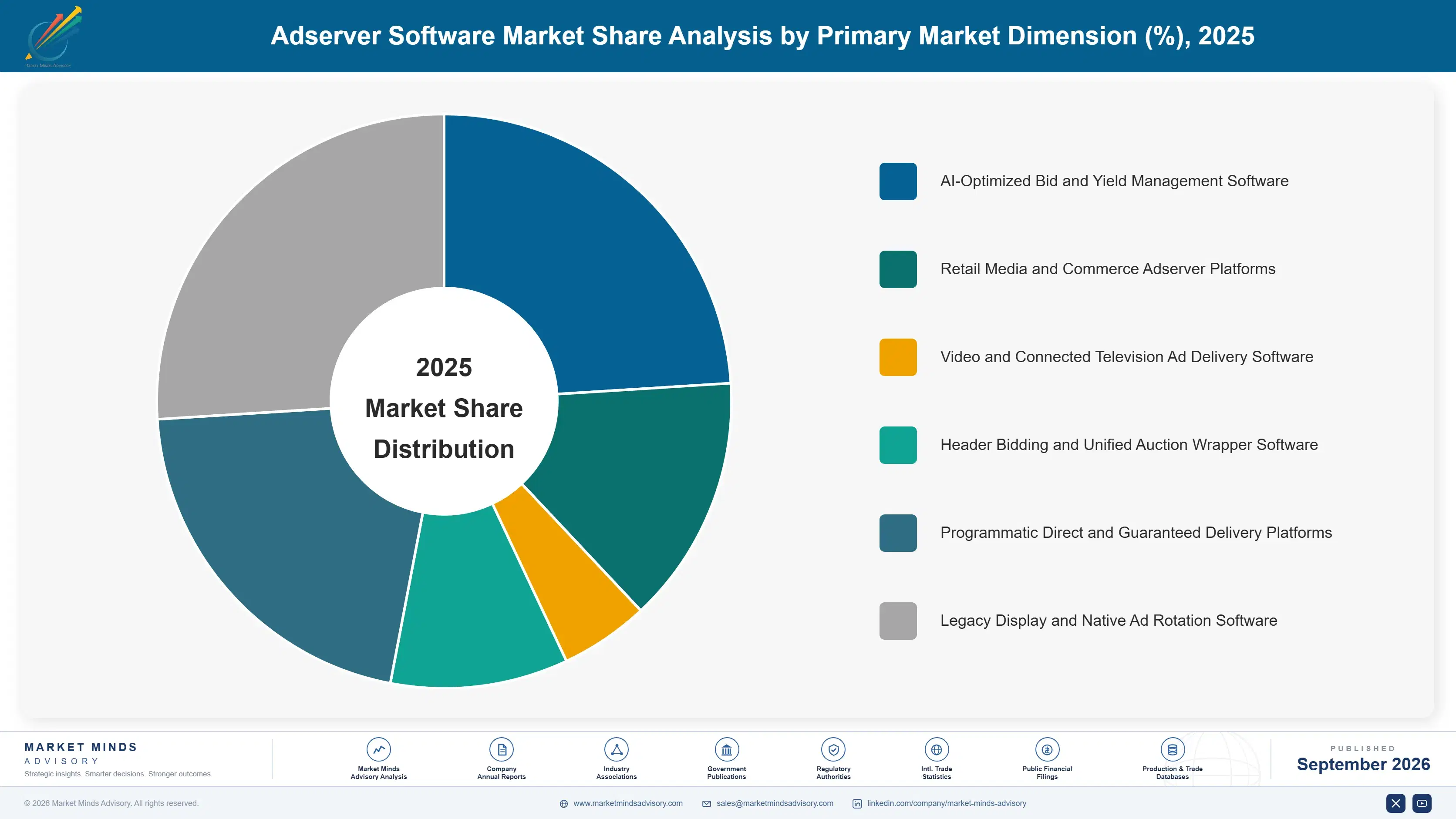
The adserver software market splits into six segments by underlying delivery technology, spanning core auction infrastructure, yield optimization layers, and channel-specific delivery engines. AI-optimized yield management and retail media commerce platforms are pulling ahead of legacy display rotation and standard programmatic direct tooling as publishers redirect technology budgets toward the highest-margin inventory types available to them.
adserver-software-market-market-share-analysis-1789982481589

AI-Optimized Bid and Yield Management Software

This segment covers machine learning based yield engines that re-rank demand paths in real time using live bid density, device signal, and historical price data rather than static waterfall configuration. Adoption has moved from a differentiator to a baseline expectation among enterprise publishers over the past two years, and vendors report measurable CPM lift when these engines are tuned correctly against comparable static configurations. Growth here outpaces the broader market by a wide margin because the technology directly addresses the single largest source of publisher revenue leakage: mispriced impressions sold through suboptimal demand ordering. Vendors without a credible AI yield module are increasingly excluded from enterprise renewal shortlists entirely, a pattern procurement teams now cite openly during vendor scoring rounds.
CAGR 13.5%

Retail Media and Commerce Adserver Platforms

This segment covers adserver infrastructure purpose-built for grocery, pharmacy, and marketplace operators running onsite sponsored placements alongside offsite retargeting campaigns tied to first party purchase data. Demand is expanding fastest here because retail media budgets are growing from a small base as operators shift ad spend from board-level pilot programs into permanent revenue lines with dedicated headcount. Commerce-native platforms require different data models than legacy media adservers, built around SKU-level purchase signal rather than page-view counting, and vendors that shipped this capability early are capturing outsized share of a category that barely existed five years ago and continues expanding across new verticals and geographies each year, from grocery into travel and financial services.
CAGR 12.0%
Full segment breakdown across 6 segments available in the complete report.

Regional Architecture and Country Demand Map

North America leads adserver software adoption on concentrated ad tech vendor headquarters and the deepest enterprise digital ad spend base globally, while South Asia and Pacific and East Asia post the fastest regional growth as retail media and mobile-first programmatic delivery scale rapidly across expanding publisher bases.

North America

North America holds the largest adserver software share on the strength of concentrated vendor headquarters presence, the deepest enterprise digital ad spend pool globally, and the earliest retail media network buildouts among grocery and marketplace operators. US publishers were first to adopt unified header bidding wrappers at scale, and that early infrastructure investment now anchors long enterprise contract renewal cycles running three to five years. Canadian broadcasters are following a similar programmatic direct adoption curve roughly two years behind their US counterparts. Regulatory attention on data privacy, particularly California consumer privacy enforcement, is pushing vendors here toward contextual delivery architecture faster than almost any other region tracked in this report.
Share: 30% | CAGR: 9.0% (2026 to 2036)

Western Europe

Regulatory structure shapes demand across Western Europe more directly than anywhere else, since GDPR consent requirements and the Digital Markets Act push publishers toward adserver platforms with strong native consent management integration. German and French publishers lead adoption of clean room based measurement, replacing cookie dependent targeting faster than most peer markets given stricter enforcement posture. UK publishers, still adjusting to a post-Brexit regulatory track separate from the EU, show slightly slower platform replacement cycles. Nordic broadcasters have emerged as an unusually strong niche for connected television adserver deployment relative to their modest population base, reflecting high streaming penetration regionwide and household broadband quality among the strongest in the world.
Share: 21% | CAGR: 7.2% (2026 to 2036)
Regional intelligence for 5 additional markets available in the complete report: East Asia, South Asia and Pacific, Latin America, Middle East and Africa, Eastern Europe. Contact sales@marketmindsadvisory.com.
adserver-software-market-country-cagr-analysis-1789982482117

Where Adserver Vendors Can Capture Incremental Margin

Adserver economics reward vendors who move beyond flat platform licensing toward usage-linked and outcome-linked pricing. Four levers stand out for capturing incremental revenue over the forecast window: yield-based pricing, retail media specialization, identity infrastructure bundling, and geographic licensing expansion through regional integration partners across underserved markets where direct enterprise sales investment is not yet economically justified.

Shift Pricing to Yield Performance Fees

Vendors moving from flat annual licensing toward yield-linked fee structures, typically a small percentage of incremental revenue their optimization engine generates above a client baseline, are seeing materially higher account expansion rates at renewal. This model aligns vendor and publisher incentives directly and removes the budget approval friction that flat fee increases face during procurement cycles. Early adopters report roughly 20 percent higher net revenue retention among accounts moved onto performance pricing versus those still on flat licensing, and the approach is spreading fastest among mid-market publishers who previously resisted large fixed platform fees.
Market Impact: Lifts net revenue retention by roughly 20 points

Build Dedicated Retail Media Commerce Modules

Vendors investing engineering resources into commerce-native adserver modules, built around SKU-level purchase data and onsite sponsored placement logic rather than generic display delivery, are winning multi-year retail media contracts worth eight figures annually from operators previously running manual processes. This is the single fastest-growing revenue pool available to adserver vendors today, expanding at roughly 12 percent annually, well ahead of the broader market average. Vendors without a dedicated retail media offering are largely locked out of this buyer segment entirely, since generic display adservers cannot handle the commerce data integration these buyers require at scale.
Market Impact: Captures roughly 30 percent higher retail media contract value

Bundle Identity Resolution With Core Delivery

As cookie deprecation forces publishers toward contextual and identity graph based targeting, vendors bundling native identity resolution and clean room connectors directly into their core adserver platform, rather than requiring a separate integration, are capturing a larger share of client technology budgets per contract. This bundling strategy raises average contract value by roughly 25 percent versus stand-alone delivery licensing and shortens the sales cycle since publishers no longer need to separately evaluate and integrate third party identity vendors. Vendors that bundle well are increasingly displacing point-solution identity vendors entirely during enterprise renewal negotiations across most major markets.
Market Impact: Raises average contract value by about 25 percent

License Platform Technology To Regional Integration Partners

Rather than building direct sales infrastructure in every market, several vendors are licensing core platform technology to regional systems integrators and local ad tech partners across South Asia, Latin America, and Eastern Europe, collecting royalty and support fees while local partners handle sales, implementation, and compliance. This model lets vendors capture revenue from markets where direct enterprise sales investment would not otherwise be justified given account size, while partners gain access to platform capability they could not replicate independently. Early licensing deals generate royalty revenue equal to roughly 10 percent of partner contract value at near-zero incremental delivery cost.
Market Impact: Adds about 10 percent margin at low cost

Who Controls the Margin Pool

Adserver software concentration sits at moderate levels, with the top five vendors holding an estimated 47 percent combined revenue share on a platform-license-plus-managed-service basis, the yardstick applied throughout. Google Ad Manager holds a clear leadership position given its default integration with the broader Google advertising stack, while challengers Kevel, Xandr, Equativ, and Broadstreet Ads compete on flexibility and specialized commerce or CTV capability the largest platform has been slower to prioritize.
Competitive activity currently centers on retail media module development, AI-driven yield optimization, and identity infrastructure partnerships rather than price competition on core licensing fees. Vendors are racing to ship native clean room integrations and contextual targeting engines ahead of further cookie deprecation, and several announced connected television delivery capability within the past year to capture streaming ad budgets before rivals lock in default broadcaster positions.

Rankings are most likely to shift where challengers out-execute the market leader on retail media and CTV specialization, since large commerce operators and streaming platforms increasingly favor vendors architected natively for their data models over generalist platforms retrofitted after the fact. Smaller independent vendors focused narrowly on one buyer category are gaining share fastest among enterprise accounts prioritizing depth over platform breadth.
adserver-software-market-company-positioning-matrix-1789982482658

Competitive Moat and Risk Dimensions

GOOGLE AD MANAGER

Moat: Default Stack Integration

Deep native integration with Google Ads, Google Analytics, and the broader Google demand stack gives Ad Manager a default position most publishers never seriously reconsider, since switching costs include re-integrating an entire measurement and demand stack rather than just a delivery layer, a barrier few pure-play challengers can overcome quickly.
GOOGLE AD MANAGER

Risk: Antitrust Regulatory Exposure

Ongoing antitrust scrutiny of Google ad tech practices across multiple jurisdictions creates real uncertainty for enterprise publishers evaluating long-term platform dependency, and any structural remedy imposed by regulators could force meaningful changes to how Ad Manager integrates with the rest of the Google advertising stack.
KEVEL

Moat: API-First Developer Flexibility

Kevel built its platform around a headless, API-first architecture that lets technically sophisticated publishers and retail media operators customize delivery logic far more deeply than templated competitors allow, a positioning that has made it the default choice among commerce platforms building bespoke onsite advertising experiences from scratch.
KEVEL

Risk: Requires Strong Engineering Resources

The API-first model that differentiates Kevel from templated competitors also limits its addressable market to publishers with real engineering capacity to build against its platform, excluding smaller publishers who need turnkey delivery tools and effectively capping the segment of the market Kevel can realistically serve at scale.

Players Tracked

Prominent Players

Google Ad Manager
Kevel
Xandr
Equativ
Broadstreet Ads

Other Key Players

OpenX
PubMatic
Magnite
Index Exchange
Sharethrough
Basis Technologies
Adform
FreeWheel
AdButler
Revive Adserver
Setupad
Admixer
Yieldmo
AdGlare
AdSpeed

Recent Developments

MARCH 2026

Equativ Acquires Identity Resolution Specialist

Equativ completed the acquisition of a smaller European identity resolution specialist to strengthen its clean room and cross-device matching capability ahead of further cookie deprecation across major browsers, adding roughly 40 engineers and an established publisher client base concentrated in France and Germany to its existing platform team.
Signal: Signals accelerating consolidation around identity infrastructure as core delivery differentiation continues to narrow across the category.
NOVEMBER 2025

Xandr Signs Multi-Year CTV Supply Deal

Xandr announced a multi-year supply agreement with a major connected television broadcaster group to serve as preferred programmatic adserver for streaming inventory across several national markets, expanding its footprint in a category it had previously served only through smaller regional partnerships and limited pilot programs across fewer markets.
Signal: Confirms connected television delivery has become a primary battleground for major enterprise contract wins across the industry.
JUNE 2026

Broadstreet Ads Launches Retail Media Module

Broadstreet Ads launched a dedicated retail media module targeting mid-market grocery and specialty commerce operators priced meaningfully below enterprise platform tiers to win volume, positioning itself directly against larger competitors focused mainly on the largest national retail chains and marketplace operators with dedicated in-house technology budgets and staff.
Signal: Shows smaller vendors deliberately targeting underserved mid-market retail media segments larger competitors have mostly overlooked so far.

Cloud Infrastructure and Data Licensing Exposure

Cloud compute and bandwidth make up an estimated 35 to 40 percent of adserver vendor cost of goods sold, since real-time bidding decisions require low-latency processing at massive request volume across globally distributed data centers. Most vendors source this capacity from Amazon Web Services, Google Cloud, or Microsoft Azure, concentrating cost exposure in three hyperscale suppliers whose pricing decisions ripple through margins.
Cloud compute pricing rose meaningfully across major hyperscale providers through 2024 and into 2025 as data center capacity tightened under surging AI workload demand, a dynamic documented in provider capital expenditure disclosures and corroborated by IEA analysis of global data center electricity consumption trends. Adserver vendors running high request volume at thin per-impression margins felt this directly, with several smaller vendors reporting compressed gross margins as they absorbed higher hosting bills rather than repricing client contracts immediately.

The disadvantage falls hardest on smaller vendors lacking negotiating leverage with hyperscale cloud providers, who pay meaningfully higher per-unit compute rates than scaled competitors able to commit to large multi-year capacity agreements. Vendors concentrated in regions with fewer data center options, particularly parts of Latin America and Africa, face added latency and cost penalties that erode competitiveness against better-connected rivals.
adserver-software-market-cost-volatility-analysis-1789982482855

Negotiate Multi-Year Committed Use Cloud Contracts

Vendors are locking in multi-year committed use discounts with hyperscale providers rather than paying on-demand rates, trading flexibility for meaningfully lower unit compute costs. This works best for vendors with predictable request volume growth, letting them forecast capacity needs accurately enough to commit without overpaying for unused reserved capacity they cannot ultimately use during slower demand periods.

Diversify Across Multiple Cloud Providers

Running workloads across two or more cloud providers reduces dependency on any single vendor pricing decision and creates negotiating leverage during contract renewal. The approach adds engineering complexity managing multiple environments, but vendors report the pricing leverage gained outweighs the added operational overhead for most enterprise-scale deployments running at meaningful sustained request volume today.

Shift Compute-Heavy Workloads to Edge Locations

Processing bid decisions closer to end users through edge computing infrastructure cuts both latency and centralized data center compute demand simultaneously, lowering cost per served impression. Vendors adopting edge architecture report meaningful infrastructure savings alongside faster page load times, a rare case where cost reduction and product performance improve together rather than trading off against one another.

Portfolio Architecture for Margin Defence

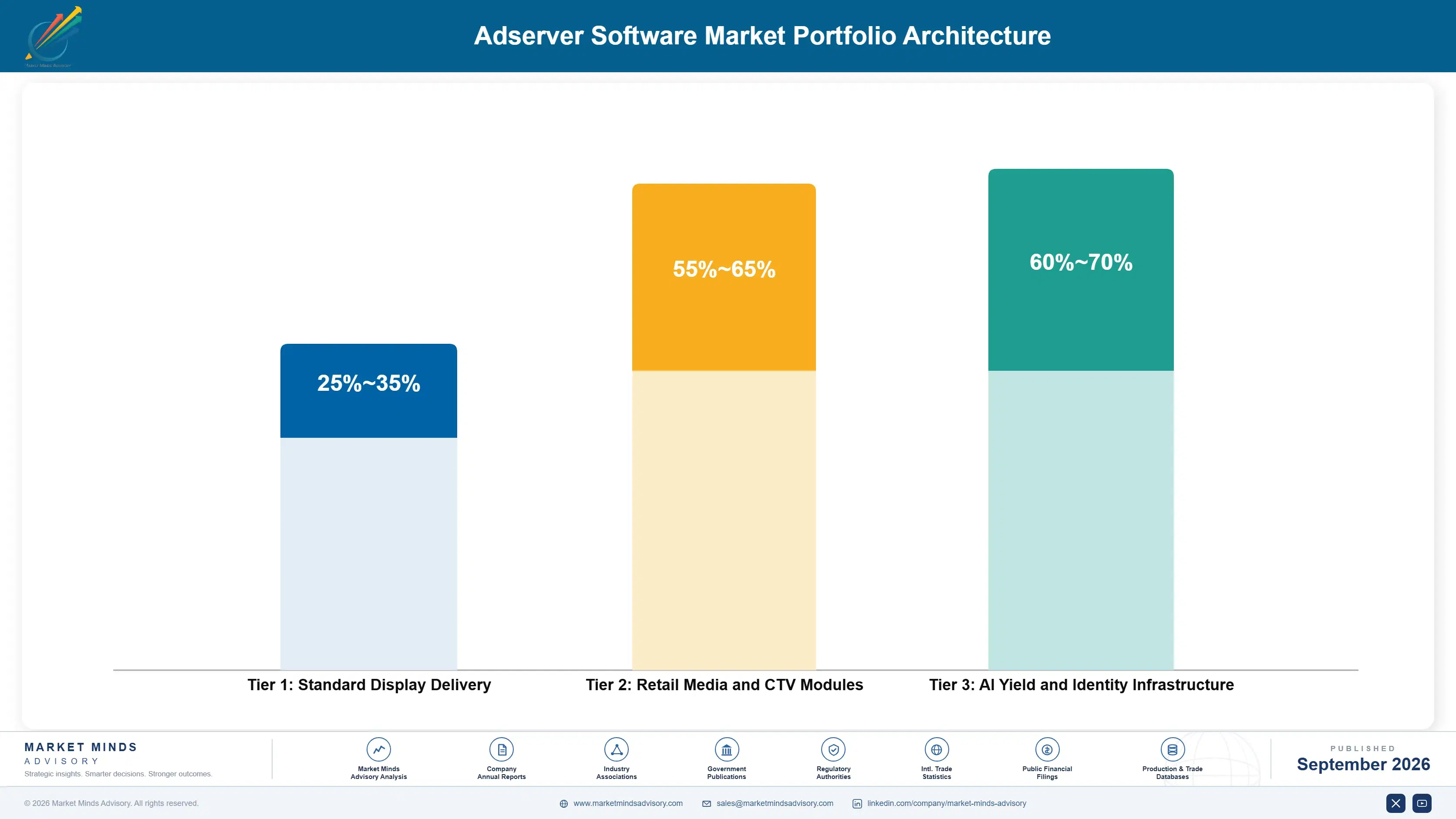
Adserver software margin economics split sharply by tier. Commodity display delivery competes largely on price against open source alternatives and bundled hyperscaler tooling, compressing gross margin toward the lower end of enterprise software norms, while premium retail media and connected television modules command materially higher margins, reflecting specialized engineering investment competitors cannot easily replicate without years of dedicated development effort behind them.
The volume versus premium tension shows up clearest in how vendors allocate engineering resources: teams chasing enterprise retail media and CTV contracts pull investment away from legacy display tooling, gradually letting commodity delivery margins compress further as vendors deprioritize that layer of the business relative to higher-margin specialty modules winning the largest enterprise contracts and driving most new bookings growth this cycle.

High-value margin pools concentrate overwhelmingly in AI-driven yield optimization and identity infrastructure bundling, where technical differentiation remains real and defensible for now against both open source competition and hyperscaler bundling pressure. Vendors positioned only in commodity display delivery face the steepest long-term margin pressure as buyers increasingly expect these baseline capabilities included in platform pricing rather than paid for separately going forward.

Standard Display Delivery

Core waterfall and open auction display delivery competing largely on price against open source alternatives and bundled hyperscaler tools, with thin per-impression margins and limited differentiation beyond reliability, uptime, and basic reporting depth.
Gross Margin: 25-35%

Retail Media and CTV Modules

Commerce-native and connected television delivery infrastructure commanding premium pricing given specialized data integration and engineering investment competitors cannot easily replicate at comparable quality within a short development timeline, a gap that keeps widening as buyer requirements grow more demanding each renewal cycle.
Gross Margin: 55-65%

AI Yield and Identity Infrastructure

Machine learning yield optimization and privacy-durable identity resolution bundling, the highest-margin layer given real technical differentiation and its growing role as the leading driver of enterprise renewal decisions across the buyer base today.
Gross Margin: 60-70%
adserver-software-market-portfolio-architecture-1789982483358

High-value Sub-segments and Strategic Watch-out

AI-Optimized Yield Management

The clearest high-value, high-growth pool in the category, combining premium pricing with the fastest unit growth as enterprise publishers treat AI yield capability as a baseline renewal requirement rather than an optional add-on module purchased separately from core delivery, and vendors lacking it are losing shortlist position quickly.
Gross Margin: 55-65%

Retail Media Commerce Modules

A high-value pool growing at a more moderate pace than AI yield tooling, anchored by durable multi-year contracts with grocery, pharmacy, and marketplace operators scaling owned advertising businesses steadily as retail media budgets keep expanding from a still-small base across most geographies tracked in this report.
Gross Margin: 50-60%

Standard Programmatic Direct Delivery

The volume core of the market, generating dependable recurring revenue at thinner margins, serving as the baseline offering most vendors bundle premium modules on top of rather than compete on directly against rival platforms in most enterprise deals this cycle across nearly every geography tracked.
Gross Margin: 25-35%

Legacy Display Rotation Tooling

A strategic watch-out segment facing steady margin erosion as open source alternatives and bundled hyperscaler tools commoditize basic delivery further, pressuring vendors still dependent on this layer for meaningful revenue heading into the back half of the forecast window through 2036 as buyer expectations continue rising.
Gross Margin: 15-25%

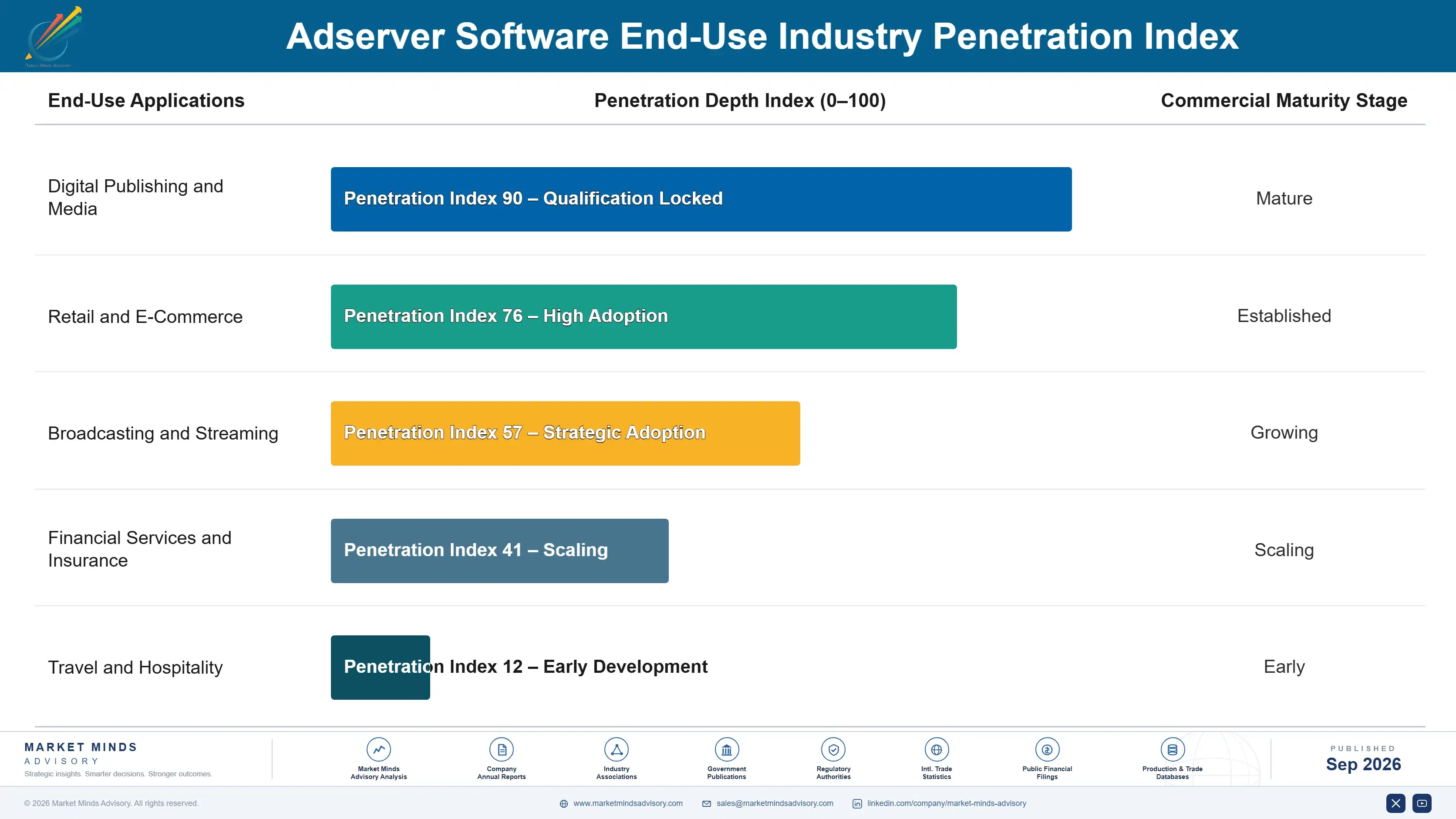
The Anatomy of Recurring Adserver Revenue

Adserver software runs almost entirely on annuity economics. Enterprise publisher contracts typically span three to five years with automatic renewal clauses, and switching costs, including re-integrating an entire demand stack and retraining operations staff, keep churn low once a platform is embedded. This structure gives vendors unusually visible multi-year revenue even in a category still expanding its core technology quickly.
Adoption stickiness varies meaningfully by end-use vertical. Broadcasters and large publishers embed adserver platforms deeply into editorial and sales workflows, producing the lowest churn of any buyer segment tracked. Retail media operators, newer to the category, show somewhat higher switching willingness as they are still evaluating vendors against evolving commerce data requirements, while smaller independent publishers churn fastest, driven mainly by price sensitivity and simpler integration needs than enterprise accounts.

Buyer profiles are shifting generationally as digital-native retail and commerce operators, rather than traditional media companies, increasingly drive net new adserver demand. These buyers evaluate platforms on commerce data integration and measurement rigor rather than legacy display metrics, pushing vendors to hire commercialization and product teams with retail and e-commerce backgrounds rather than pure ad tech pedigrees to serve this expanding buyer base effectively.
adserver-software-market-end-use-penetration-index-1789982483850

Where Adserver Vendors Should Focus Next

These are among the four positions where our research anticipates prominent divergence between winners and laggards over the coming forecast period. Each is grounded in the demand model, the regulatory perimeter, and the announced capacity pipeline.
01 / YIELD TECHNOLOGY INVESTMENT

Treat AI Yield Optimization As Baseline, Not Differentiator

AI-driven yield management has moved from optional upgrade to default renewal requirement across enterprise publisher accounts within roughly two years. Vendors still selling static waterfall configuration are losing shortlist position quickly, regardless of how strong their core delivery reliability remains, because procurement teams now treat yield sophistication as table stakes rather than a premium feature. Any vendor without a credible roadmap here should prioritize this capability over nearly every other product investment available to them right now, ahead of geographic expansion or new channel partnerships.
02 / RETAIL MEDIA SPECIALIZATION

Build Commerce-Native Modules Before Competitors Lock In Accounts

Retail media represents the fastest-growing revenue pool in this market, and commerce operators are actively selecting long-term technology partners right now rather than revisiting the decision annually. Vendors without dedicated commerce-native modules are effectively excluded from this buyer segment entirely, since generic display adservers cannot handle SKU-level purchase data integration these operators require. Moving early captures multi-year contracts before rivals establish default positions with the largest grocery, pharmacy, and marketplace operators expanding advertising businesses this cycle across multiple geographies simultaneously.
03 / IDENTITY INFRASTRUCTURE POSITIONING

Bundle Identity Resolution Rather Than Partner Externally

Cookie deprecation and tightening consent requirements are pushing publishers toward vendors offering native contextual and identity graph capability rather than requiring separate third party integrations. Bundling this functionality directly into core delivery raises average contract value and shortens sales cycles measurably compared to point-solution partnerships requiring separate procurement approval. Vendors that delay this investment risk losing renewal negotiations to competitors who can offer a single integrated platform covering delivery, identity, and measurement without additional vendor complexity, procurement friction, or a longer implementation timeline.
04 / REGIONAL GROWTH ALLOCATION

Prioritize South Asia and East Asia Over Mature Markets

South Asia and Pacific and East Asia post the fastest regional growth in this report, driven by expanding mobile-first publisher bases and accelerating retail media buildout across the region. Vendors over-indexed on North American and Western European sales investment risk missing the fastest-growing accounts of the entire forecast window, particularly among Southeast Asian marketplace operators scaling advertising businesses from a near-zero starting base. Building regional partnerships or local sales presence now positions vendors ahead of slower-moving competitors still focused primarily on mature markets.

Engagement Snapshot From the Field

A live engagement with an industry participant carrying material or product regulatory and market exposure ahead of a defining policy shift, showing how our research translates into a defensible multi-year portfolio strategy.
MARKET MINDS ADVISORY · CLIENT ENGAGEMENT SUMMARY
Adserver Software Producer Strategic Portfolio Review and Transition Roadmap 2026·Investment Scenario on Adserver Software Exposure Evaluation 2025-26
CLIENT PROFILE
The client operates a portfolio of regional news and lifestyle publishing properties across North America, generating digital advertising revenue in the low tens of millions annually (client-reported, unverified by MMA). The organization was running a legacy adserver platform installed nearly a decade earlier, with limited programmatic direct capability and no native support for header bidding or connected television inventory monetization.
STRATEGIC CHALLENGE
Declining programmatic yield and rising operational overhead from manual waterfall management were compressing margins steadily, while competitors with modern adserver infrastructure captured a growing share of regional advertiser budgets. Leadership needed to evaluate whether to migrate platforms entirely or invest in incremental upgrades to the existing legacy system, weighing near-term disruption against long-term yield recovery.
MMA APPROACH
MMA conducted a structured vendor evaluation across five candidate adserver platforms, benchmarking each against the client existing yield performance, integration complexity, and total cost of ownership over a five-year horizon. The engagement included primary interviews with the client sales and operations teams to surface workflow requirements the vendor evaluation needed to weigh appropriately.
KEY FINDINGS
  1. Legacy platform yield underperformed modern AI-optimized alternatives by a wide margin in side-by-side testing across comparable inventory segments over a four-week evaluation window.
  2. Header bidding wrapper integration alone was projected to lift effective CPM meaningfully within the first two quarters following migration, based on comparable publisher benchmarks reviewed during the engagement.
  3. Migration cost and operational disruption risk were concentrated almost entirely in the first ninety days, after which integration complexity dropped sharply according to vendor reference calls.
  4. None of the five evaluated platforms offered meaningfully differentiated pricing once yield lift was factored into total cost of ownership across the full five-year contract horizon.
CLIENT PROFILE
The client operates a portfolio of regional news and lifestyle publishing properties across North America, generating digital advertising revenue in the low tens of millions annually (client-reported, unverified by MMA). The organization was running a legacy adserver platform installed nearly a decade earlier, with limited programmatic direct capability and no native support for header bidding or connected television inventory monetization.
STRATEGIC CHALLENGE
Declining programmatic yield and rising operational overhead from manual waterfall management were compressing margins steadily, while competitors with modern adserver infrastructure captured a growing share of regional advertiser budgets. Leadership needed to evaluate whether to migrate platforms entirely or invest in incremental upgrades to the existing legacy system, weighing near-term disruption against long-term yield recovery.
MMA APPROACH
MMA conducted a structured vendor evaluation across five candidate adserver platforms, benchmarking each against the client existing yield performance, integration complexity, and total cost of ownership over a five-year horizon. The engagement included primary interviews with the client sales and operations teams to surface workflow requirements the vendor evaluation needed to weigh appropriately.
KEY FINDINGS
  1. Legacy platform yield underperformed modern AI-optimized alternatives by a wide margin in side-by-side testing across comparable inventory segments over a four-week evaluation window.
  2. Header bidding wrapper integration alone was projected to lift effective CPM meaningfully within the first two quarters following migration, based on comparable publisher benchmarks reviewed during the engagement.
  3. Migration cost and operational disruption risk were concentrated almost entirely in the first ninety days, after which integration complexity dropped sharply according to vendor reference calls.
  4. None of the five evaluated platforms offered meaningfully differentiated pricing once yield lift was factored into total cost of ownership across the full five-year contract horizon.
RECOMMENDED STRATEGY
Phase 1: Phase one: run a parallel pilot on a subset of inventory to validate yield lift claims before committing to full platform migration. Phase 2: Phase two: migrate remaining inventory in stages by property, prioritizing highest-traffic properties first to capture yield gains as quickly as possible. Phase 3: Phase three: retire the legacy platform entirely once full migration completes and renegotiate demand partner integrations under the new platform.
OUTCOME
The client selected a modern adserver platform and completed migration within the recommended phased timeline, reporting improved effective CPM performance within the first two quarters post-migration (client-reported, unverified by MMA). Operational headcount previously dedicated to manual waterfall management was reallocated to yield strategy and commercial partnership work.

Frequently Asked Questions

Foundational context covering the market sizes, CAGR, scope, country, region and competition that inform every finding below. This section is provided to cover basics and most often pre-purchase conversations, answered from the MMA Primary Research Dataset.

What is the current size of the Adserver Software Market?

The global adserver software market reached an estimated 6.5 billion dollars in 2025. This figure reflects platform licensing and managed service revenue across enterprise, mid-market, and retail media buyers worldwide.

How large will the Adserver Software Market be by 2036?

The market is projected to reach approximately 15.9 billion dollars by 2036. This reflects sustained demand from retail media buildout, connected television delivery, and AI-driven yield optimization adoption industrywide.

What is the CAGR for the Adserver Software Market 2026 to 2036?

The market is projected to grow at an 8.5 percent compound annual growth rate through the forecast period. Bull and bear scenarios range from roughly 7.3 to 9.7 percent depending on adoption pace.

Which segment is growing fastest?

AI-optimized bid and yield management software is the fastest-growing segment, expanding at roughly 13.5 percent annually. That is close to 1.6 times the overall market growth rate through 2036.

Who are the major companies in the Adserver Software Market?

Google Ad Manager, Kevel, Xandr, Equativ, and Broadstreet Ads lead the market. These five vendors hold an estimated 47 percent combined revenue share on a consistent platform-license basis.

Which country is growing fastest?

India is the fastest-growing country market, expanding at roughly 11.5 percent annually. Growth is driven by a fast-expanding mobile-first publisher base building programmatic revenue from a near-zero starting point.

Report Segmentation Architecture

The full report scope spans multiple orthogonal segmentation dimensions, with cross-tabulated demand data provided for each dimension pair. Coverage extends further to regional breakdowns, trend trajectories, and the competitive detail needed to support segment-level decision-making.

By Primary Market Dimension

  • AI-Optimized Bid and Yield Management Software
  • Retail Media and Commerce Adserver Platforms
  • Video and Connected Television Ad Delivery Software
  • Header Bidding and Unified Auction Wrapper Software
  • Programmatic Direct and Guaranteed Delivery Platforms
  • Legacy Display and Native Ad Rotation Software

By End-Use Industry

  • Digital Publishing and Media
  • Retail and E-Commerce
  • Broadcasting and Streaming
  • Financial Services and Insurance
  • Travel and Hospitality

By Commercial Dimension

  • Enterprise Direct Licensing
  • Managed Service Contracts
  • Self-Serve SaaS Subscription
  • Regional Partner and Reseller Channel

By Region

  • North America
  • Western Europe
  • East Asia
  • South Asia and Pacific
  • Latin America
  • Middle East and Africa
  • Eastern Europe

Scope, Methodology, and Coverage

Every figure in this report is reproducible from documented input assumptions. The scope below maps the historical period, the forecast horizon, the segmentation dimensions, and the countries covered, alongside the underlying primary and qualitative methodology.
Historical Period
2020 to 2025
Forecast Period
2026 to 2036
Base Year
2025 (USD billions; MMA Primary Research Dataset, September 2026)
Market Definition
The adserver software market covers platform technology that manages, prices, and delivers digital advertising creative across owned and third party inventory, including auction logic, yield optimization, and campaign trafficking. It excludes demand-side bidding platforms, creative production tools, and standalone measurement or verification products sold independently of delivery infrastructure.
Quantitative Units
USD billions, base year 2025, forecast period 2026 to 2036
Segmentation Dimensions
Product/technology type, end-use industry, commercial licensing model, region
Regions Covered
North America, Western Europe, East Asia, South Asia and Pacific, Latin America, Middle East and Africa, Eastern Europe
Countries Covered
United States, Canada, Germany, United Kingdom, France, China, Japan, South Korea, India, Australia, Brazil, Mexico, United Arab Emirates, South Africa, Poland
Key Companies Profiled
Google Ad Manager, Kevel, Xandr, Equativ, Broadstreet Ads, OpenX, PubMatic, Magnite
Quantitative Methodology
Primary survey, n=3,800 respondents, Q4 2025, six countries; demand-side model with trade association cross-validation
Qualitative Methodology
47 expert interviews, Q4 2025; applied to validate demand model assumptions, identify emerging dynamics, and assess competitive positioning
Report Format
PDF and XLSX data workbook (Word format preview document)
Publisher
Market Minds Advisory
Report Code
MMA-2026-TEC-274
Published
September 2026
Contact
sales@marketmindsadvisory.com | www.marketmindsadvisory.com

Purchase the full Adserver Software Market Report (2026 to 2036).

This report provides a comprehensive assessment of the global adserver software market, covering sizing, segmentation, regional dynamics, and competitive positioning through 2036. It examines the technology shift toward AI-driven yield optimization, retail media specialization, and identity infrastructure bundling reshaping vendor selection criteria across enterprise and mid-market publisher accounts. The analysis draws on primary survey data, expert interviews, and company disclosures to quantify demand across seven world regions and six product segments. Strategy and product leadership teams gain a grounded view of where competitive advantage is shifting and which capabilities merit near-term investment.
Segment-level sizing and ten-year growth forecasts
Regional demand mapping across seven world regions
Competitive landscape and detailed player profiling
Revenue lever analysis with margin impact figures
Input cost exposure and supply risk assessment
Strategic verdict with prioritized action recommendations

Built For The People Who Decide

From boardroom strategy to bench-side execution, this report is read cover-to-cover by leaders shaping the next decade of their industry, turning demand scenarios, market dynamics and valuation benchmarks into decisions.
CXOs/ Presidents/ VPs/ Managers
M&A and Corporate Development
Strategy Teams and R&D Heads
Procurement and Product Directors
Regulatory and Compliance Leaders
Investor Relations and Equity Analysts