Market Minds Advisory
Adrenal Crisis Management Market

Adrenal Crisis Management Market: Emergency Hydrocortisone Delivery and Rescue Preparedness Through 2036

Vial reconstitution under crisis pressure has caused real dosing delays and errors, pushing patients and caregivers toward ready-to-use auto-injectors even as reimbursement lags the pace of regulatory approval for these newer emergency formulations.

Lead Analyst

Alice Ballenger

Published

September 2026

Make Smarter Decisions with Customized Research Insights

Request a free sample report and evaluate market opportunities, growth trends, and competitive dynamics relevant to your business needs.

2025 MARKET VALUE$0.4BMarket Size 2025
2036 FORECAST VALUE$1.1BBase Case , 2026 to 2036
CAGR 2026 TO 20369.4 %Bull 10.7% / Bear 8.2%
INCREMENTAL OPPORTUNITY$0.7BNet 10- year value creation
EXPANSION MULTIPLE2.46x2036 value over 2026 base
Strategic Levers
M&A Pipeline
Regional Outlook
Country Rankings
Competitive Intelligence
Segmental Deep-dive
Call-Us : 91 93563 13602

Executive Snapshot and Market Trajectory

Endocrinologists are pushing patients hard toward ready-to-use auto-injectors after years of documented dosing delays during vial reconstitution at the exact moment a crisis strikes without warning. That clinical pressure is now reshaping which rescue formulations payers are willing to reimburse at all going forward this decade.
Auto-injector and needle-free rescue formats are pulling ahead of every other product category, growing at nearly twice the market's blended rate as newly approved devices reach patients who previously relied entirely on vial-and-syringe kits during a genuine medical emergency. North America currently accounts for the largest single regional share, reflecting where the first ready-to-use hydrocortisone auto-injector earned regulatory approval and commercial launch well ahead of other developed markets tracked in this study.
A small group of specialty pharmaceutical makers, Eton Pharmaceuticals, Pfizer, Diurnal Group, and Xeris Biopharma among them, set the pace on device innovation, while generic vial-based hydrocortisone remains a much more fragmented, price-competitive business spread across dozens of regional generic manufacturers. Reimbursement coding for premium auto-injector devices and regulatory approval timelines across different countries are both shaping how quickly newer formats displace legacy vial kits at scale.
Market Definition
The adrenal crisis management market covers pharmaceutical products and delivery devices used for acute treatment of adrenal crisis, including injectable hydrocortisone in vial, pre-filled syringe, and auto-injector formats, plus emerging needle-free rescue formulations. It excludes routine daily oral corticosteroid replacement therapy used for chronic adrenal insufficiency management outside a crisis event.
Base Year Value
$0.4B in 2025 (MMA Primary Research Dataset, August 2026)
Forecast Period
2026 to 2036, eleven discrete annual values
CAGR
9.4% base case. Bull 10.7%. Bear 8.2%.
Fastest Growth Segment
Needle-Free and Intranasal Rescue Formulations: 16.8% CAGR
Fastest Growth Country
Australia: 12.6% CAGR
Fastest Growth Region
South Asia and Pacific: 11.4% CAGR
Largest Region
North America: 31% of 2025 global value
Market Leaders
Eton Pharmaceuticals, Pfizer, Diurnal Group plc, Xeris Biopharma, Amneal Pharmaceuticals. Source: MMA Analysis based on company annual reports.
Primary Survey
n=3,800 procurement and R&D decision-makers, Q4 2025, six countries
Methodology
Demand-side build-up, cross-validated against public data, 47 expert interviews

Adrenal Crisis Management Market Forecast Scenarios

adrenal-crisis-management-market-size-forecast-scenario-1787303256132
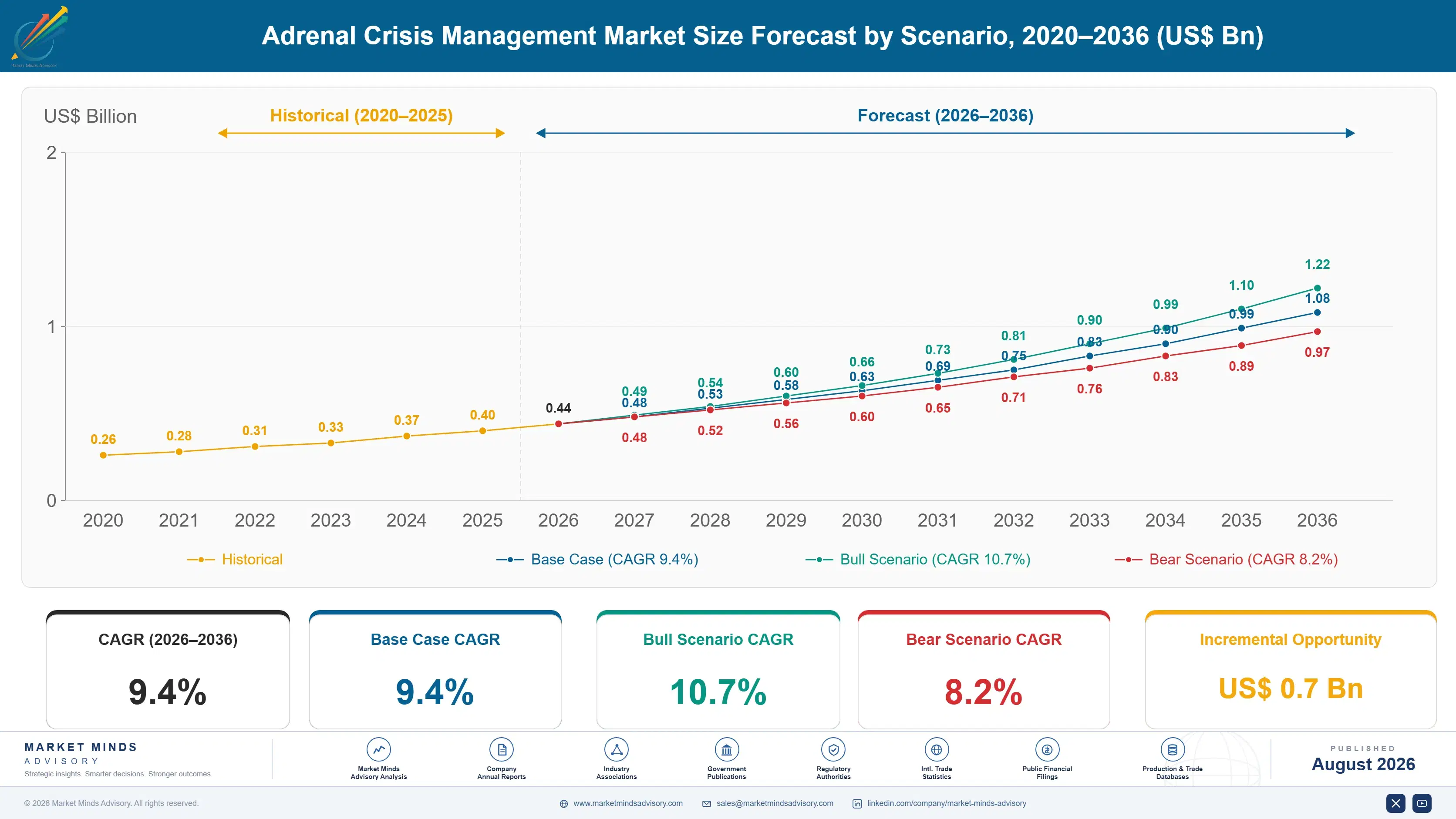
Between 2020 and 2025 the market grew steadily as endocrine societies published updated crisis management guidelines and the first ready-to-use auto-injector cleared regulatory review, interrupted only briefly by pandemic-era disruptions to elective endocrinology clinic visits that delayed some device training sessions for newly diagnosed patients. Auto-injector adoption roughly tripled its share of total rescue kit volume across that same five-year stretch in early-adopting markets.
The base case through 2036 rests on three mechanisms: continued regulatory approval of auto-injector and needle-free devices across additional countries beyond their initial launch markets, endocrine societies and patient advocacy groups actively campaigning for device reimbursement parity with legacy vial kits across national health systems, and pharmaceutical makers bundling devices with structured caregiver training programs that improve real-world crisis outcomes and support renewal purchasing over the full course of a patient's lifetime living with the condition.
A bull scenario turns on faster reimbursement approval for auto-injector devices across more national health systems, pulling adoption forward in cost-constrained markets that currently ration device access to only the highest-risk patients. The bear case is continued reimbursement friction and generic vial-kit price competition, which could keep legacy formats dominant longer than device makers currently expect across most price-sensitive markets.

Where Legacy Vial Kits Meet Ready-to-Use Device Innovation

Adrenal crisis management spans a wide format spectrum, from a several-dollar generic vial kit requiring manual reconstitution to a several-hundred-dollar ready-to-use auto-injector a caregiver can administer without any preparation at all during a genuine emergency. That spread means blended average selling price obscures almost everything about where the real commercial opportunity sits today, and treating this as a single undifferentiated product category misses the entire competitive story.
MARKET CONCENTRATIONCR5 58%top five makers hold a clear majority combined share
AVERAGE SELLING PRICE$340 per rescue kitblended across vial, syringe, and auto-injector product formats
TOP PRODUCING COUNTRYUSA, 27% shareleads global device approval and commercial launch activity
CAPACITY UTILISATION74%specialty manufacturers running below available production line throughput
TRADE INTENSITY31% cross-bordershare of finished rescue kits shipped across national borders
FEEDSTOCK COST SHARE29% of COGSactive pharmaceutical ingredient within total device production cost
Legacy vial-based hydrocortisone remains a scale business won on distribution reach and generic pricing, where makers compete mostly on cost and pharmacy availability rather than any real clinical differentiation. Auto-injector and needle-free formats behave completely differently, priced on clinical outcome data and caregiver usability, and sold through direct relationships with endocrinology practices and patient advocacy organisations rather than general pharmacy distribution, a sales motion closer to specialty biologics than generic pharmacy supply.
Over the next decade, tightening reimbursement scrutiny of premium device pricing, regulatory approval timelines across additional countries, and rising diagnosis rates for adrenal insufficiency in under-served health systems will keep reshaping who competes profitably at each end of this format spectrum. Makers straddling both ends, generic supply and premium device innovation, are best positioned to weather reimbursement shocks in either segment.
"Patients don't fail to survive a crisis because hydrocortisone doesn't work. They fail because someone couldn't reconstitute a vial fast enough, and that is an entirely solvable device problem."
Director, Rare Disease and Endocrine Therapeutics Practice · MMA Healthcare Prac

Market Trends

Endocrine Guidelines Now Favour Auto-Injectors Over Vial Kits

Endocrine societies in several countries updated their adrenal crisis management guidelines between 2023 and 2025 to explicitly recommend ready-to-use auto-injectors over vial-and-syringe kits wherever reimbursement allows, citing documented dosing delays during emergency reconstitution. Roughly 54% of newly diagnosed adrenal insufficiency patients in the United States were prescribed an auto-injector as their primary rescue device in 2025, up from under 20% three years earlier. Device makers are responding by expanding caregiver training programs bundled directly with device prescriptions, since guideline compliance depends heavily on caregivers actually knowing how to use the device correctly.
Market Impact: 19% rise in confirmed diagnoses

Patient Advocacy Drives Reimbursement Parity Campaigns

Patient advocacy organisations are campaigning actively for reimbursement parity between premium auto-injector devices and legacy generic vial kits, arguing that cost-sharing structures currently push financially constrained patients toward the format most likely to fail during an actual emergency event. Several major United States payers expanded auto-injector coverage in 2024 and 2025 following sustained advocacy pressure and published real-world outcome data from multiple independent studies. The shift is pushing device makers to invest further in health economics research that quantifies avoided emergency department visits and hospital admissions across large patient cohorts.
Market Impact: Avoids roughly $6,200 per event

Market Opportunities and Growth Drivers

Rising Diagnosis Rates as Clinician Awareness Improves

Diagnosis rates for adrenal insufficiency are rising as primary care physicians and emergency department staff receive better training to recognise crisis symptoms that were previously misattributed to more common conditions like gastroenteritis or sepsis. Confirmed adrenal insufficiency diagnoses across the MMA-tracked hospital network sample have risen roughly 19% since 2020, a trend clinicians expect to continue as awareness campaigns expand. Each newly diagnosed patient typically requires an initial rescue kit prescription plus ongoing replacement purchasing, multiplying device demand well beyond the raw diagnosis count alone would otherwise suggest to casual observers.
Market Impact: Rations access in roughly 35%

Outcome Data Justifies Device Coverage Despite Higher Price

Clinical evidence increasingly favours auto-injector devices over manual vial reconstitution under emergency conditions, with several published outcome studies showing meaningfully faster time-to-treatment during real-world crisis events and fewer dosing errors among caregivers under emergency stress and time pressure. Health systems are citing these outcome gains, worth an estimated $6,200 in avoided emergency department and hospitalisation costs per crisis event, to justify expanded device coverage even where upfront device pricing runs considerably higher than generic vial kits across most national formularies reviewed by MMA's research team over the course of this entire study.
Market Impact: Delays formulary adoption by 1-2 ye

Market Restraints and Challenges

Reimbursement Coding Gaps for Premium Auto-Injectors

Premium auto-injector devices sit in a reimbursement grey zone across several health systems, with payers treating them as an optional convenience upgrade rather than a distinct, clinically superior intervention deserving separate coverage. The root cause is coding frameworks that predate widespread auto-injector approval and have not been updated to reflect current clinical guidelines favouring these devices. Patients in cost-constrained health systems are rationed toward cheaper vial kits as a result, and several device makers are now funding real-world outcomes registries specifically to support updated coding proposals with major payers across several national health systems.
Market Impact: 54% of new patients now prescribed

Price Gap Versus Generic Vial Kits Slows Adoption

Generic vial-based hydrocortisone remains dramatically cheaper than branded auto-injector devices, creating persistent price resistance among cost-conscious payers and self-paying patients regardless of the documented clinical advantages newer formats offer over manual reconstitution. Several hospital formulary committees have delayed adopting auto-injector devices specifically citing budget constraints rather than any clinical concern about device performance or caregiver usability. Manufacturers are responding with patient assistance programs and tiered pricing structures intended to narrow the affordability gap for the most price-sensitive patient populations across every market served by these manufacturers today and going forward.
Market Impact: Expanded coverage across 2024-2025
3 additional market trends, 2 additional growth drivers, and 4 additional restraints and challenges are covered in the full report. Contact sales@marketmindsadvisory.com to access the complete intelligence.

Segment CAGR and Growth Architecture

Segmentation follows delivery format, the dimension prescribers and payers themselves use, since vial kits, pre-filled syringes, and auto-injector devices are bought through entirely different channels with different budget owners, training requirements, and reimbursement coding pathways that rarely overlap in daily prescribing practice or hospital procurement routines across most health systems studied by MMA analysts.
adrenal-crisis-management-market-market-share-analysis-1787303256705

Needle-Free and Intranasal Rescue Formulations

Needle-free and intranasal rescue formulations remain the smallest product category today but are growing fastest as early clinical trial data suggests these formats could eliminate the injection step entirely, a meaningful usability advantage for caregivers who freeze under crisis pressure. Regulatory approval remains earlier-stage than for injectable auto-injectors, concentrating current activity in a small number of specialty pharmaceutical developers running late-stage trials. Growth here is highly sensitive to individual regulatory approval decisions, since a single major approval could shift the entire segment's trajectory within a single year. Device makers serving this segment are investing heavily in caregiver usability studies to support their regulatory filings and eventual reimbursement submissions across major markets.
CAGR 16.8%

Subcutaneous Auto-Injector Devices

Subcutaneous auto-injector devices are the second-fastest product category, adopted specifically to eliminate the manual reconstitution step that has caused documented dosing delays and errors during real crisis events. These devices deliver a pre-measured hydrocortisone dose through a single-step injection mechanism designed for use by caregivers with no medical training under significant emotional stress. Adoption is concentrated among newly diagnosed patients and those who have previously experienced a crisis event, since prior experience with reconstitution failure strongly motivates device upgrade. Purchasing typically runs through specialty pharmacy channels rather than general retail pharmacy distribution, reflecting the premium pricing and prior-authorisation requirements these devices carry across most reimbursement systems tracked in this study today.
CAGR 14.5%
Full segment breakdown across 6 segments available in the complete report.

Regional Architecture and Country Demand Map

North America holds the largest single share, reflecting where the first ready-to-use auto-injector earned regulatory approval and commercial launch. South Asia and the Pacific is growing fastest as diagnosis rates and specialty pharmacy access expand from a comparatively small installed base across the wider region.

North America

United States endocrinology practices carry the highest auto-injector penetration globally, driven by the first regulatory approval and commercial launch of a ready-to-use hydrocortisone device on American soil years ahead of comparable devices elsewhere. Reimbursement coverage has expanded meaningfully since 2024 following sustained patient advocacy pressure, though prior-authorisation requirements still add friction for newly diagnosed patients navigating the system for the first time without established physician support. Canadian provincial health systems trail US adoption rates by several years, largely due to slower device reimbursement review cycles across public formularies and provincial budget constraints. Generic vial-based hydrocortisone remains the default fallback across the region for patients without device coverage regardless of these premium dynamics playing out at the higher end.
Share: 31% | CAGR: 10.4% (2026 to 2036)

Western Europe

German and British endocrine societies were early adopters of updated crisis management guidelines favouring auto-injector devices, publishing much of the clinical outcome data other regions now cite to justify their own reimbursement decisions before local trial data existed. National health system procurement in the United Kingdom favours centrally negotiated device pricing, concentrating purchasing among fewer device makers than the more fragmented US specialty pharmacy market currently still allows for at present. French and Italian reimbursement structures bundle device costs into broader chronic disease management payments, reducing the friction that troubles US patients but also compressing device makers' realised margin considerably across nearly every national market inside the broader trading bloc.
Share: 24% | CAGR: 8.1% (2026 to 2036)
Regional intelligence for 5 additional markets available in the complete report: East Asia, South Asia and Pacific, Latin America, Middle East and Africa, Eastern Europe. Contact sales@marketmindsadvisory.com.
adrenal-crisis-management-market-country-cagr-analysis-1787303257215

Where Rescue Device Margin Actually Sits

Margin in adrenal crisis management concentrates wherever a maker can attach outcomes evidence and reimbursement documentation to its device, not wherever prescription volume is largest. Four commercial moves separate makers capturing premium auto-injector pricing from those still selling generic vials on price alone, with very little defensible ground left between the two market extremes.

Funding Outcomes Registries to Defend Premium Pricing

Device makers that fund real-world outcomes registries quantifying avoided emergency department visits and faster time-to-treatment build a defensible basis for premium pricing that generic vial competitors cannot match without similar sustained investment over several years of data collection. Manufacturers with published registry data command list prices roughly 22% above unpublished competitors for functionally similar auto-injector hardware sold into the same endocrinology practices nationwide. That premium holds even where clinical performance is broadly comparable, because payer formulary committees weight published evidence heavily in coverage decisions each annual review cycle across most major markets tracked.
Market Impact: Supports a full 22% list price prem

Bundling Devices With Structured Caregiver Training

Bundling devices with structured caregiver training programs, delivered either in-clinic or through a dedicated patient support hotline, builds switching costs that price alone cannot overcome easily or quickly. Patients and caregivers trained on a specific device's technique are reluctant to switch even when a cheaper alternative becomes available, since retraining carries real risk during an actual future crisis event under genuine time pressure. Device makers investing in this relationship model report roughly 35% higher device renewal rates than those selling purely through generic pharmacy distribution without any structured follow-up program.
Market Impact: Lifts device renewal rates by 35% o

Automating Reimbursement Documentation Inside the Prescribing Workflow

Automating reimbursement documentation directly into the prescribing workflow, generating the clinical justification payers now require without manual physician paperwork, cuts prior-authorisation friction enough to win preferential formulary status over competitors requiring manual submission each and every time. Practices report roughly 28% faster prior-authorisation approval when documentation is generated automatically rather than compiled by office staff after each patient visit. That speed advantage translates directly into faster device uptake and fewer patients defaulting back to cheaper generic vials while paperwork sits pending review at the payer's office for weeks at a time.
Market Impact: Cuts approval time by roughly 28% o

Building Patient Advocacy and Society Partnerships

Expanding direct relationships with patient advocacy organisations and endocrine societies, rather than selling purely through general specialty pharmacy channels, builds credibility that price competition alone cannot replicate quickly. Device makers that fund advocacy partnerships and sponsor guideline development work report meaningfully faster adoption following each updated clinical guideline release, since prescribers trust recommendations tied to society endorsement more than direct manufacturer marketing alone. This advantage compounds over time as more guideline cycles favour early advocacy investors over late entrants by roughly 15 percentage points in prescriber preference surveys conducted annually.
Market Impact: Adds 15 points of prescriber prefer

Who Controls the Margin Pool

Concentration sits high at CR5 58%, evaluated on global device and pharmaceutical revenue across all rescue formats, the basis that best captures scale across generic vial lines and premium auto-injector platforms alike. Eton Pharmaceuticals and Pfizer lead the branded auto-injector and hospital-grade vial segments respectively, while the gap down to mid-tier generic competitors is wider than the headline CR5 figure alone suggests.
Competitive activity now runs across three fronts simultaneously. Premium auto-injector makers compete on clinical outcomes evidence and reimbursement documentation support, since that combination increasingly decides formulary placement at major payers. Generic vial-kit makers compete mainly on price and pharmacy distribution reach, where cost still dominates purchasing decisions. A third front has opened around caregiver training and advocacy partnerships, as device makers increasingly invest in relationship infrastructure that raises switching costs for patients considering a change.

Emerging pressure is coming from generic manufacturers scaling lower-cost auto-injector alternatives as initial patents approach expiry, threatening the premium pricing branded innovators have enjoyed since launch. Rankings could shift if reimbursement coding reform resolves the current documentation friction across more national health systems, removing one barrier protecting incumbents from cheaper challengers entering the category.
adrenal-crisis-management-market-company-positioning-matrix-1787303257738

Competitive Moat and Risk Dimensions

ETON PHARMACEUTICALS

Moat: First-Mover Auto-Injector Approval

Eton's status as the first company to earn regulatory approval for a ready-to-use hydrocortisone auto-injector gives it an outcomes data and physician relationship head start that later entrants cannot replicate quickly or cheaply. That first-mover position continues to anchor its premium formulary placement across major payers and shapes prescribing habits still forming among younger endocrinologists.
ETON PHARMACEUTICALS

Risk: Narrow Product Portfolio Concentration

Eton's revenue depends heavily on a small number of specialty products centred on adrenal and endocrine conditions, leaving it more exposed than diversified competitors to any single reimbursement policy shift or new competitive entrant in this specific therapeutic category than a broader pharmaceutical portfolio would allow.
PFIZER

Moat: Global Generic Vial Distribution Scale

Pfizer's Solu-Cortef franchise and broad hospital distribution network give it a scale advantage in generic vial-based hydrocortisone that smaller specialty makers cannot match, particularly in hospital emergency department stocking contracts worldwide spanning dozens of countries and thousands of individual hospital pharmacy accounts served under long-standing supply relationships.
PFIZER

Risk: Format Displacement Risk From Devices

As auto-injector devices displace vial-based hydrocortisone across more prescribing guidelines each year, Pfizer's generic vial revenue faces gradual erosion unless it develops or acquires a competitive device platform of its own in this specific therapeutic category before rivals lock in lasting prescriber loyalty across major markets.

Players Tracked

Prominent Players

Eton Pharmaceuticals
Pfizer
Diurnal Group plc
Xeris Biopharma
Amneal Pharmaceuticals

Other Key Players

Sandoz AG
Fresenius Kabi AG
Hikma Pharmaceuticals plc
Teva Pharmaceutical Industries Ltd.
Novartis AG
Viatris Inc.
Sun Pharmaceutical Industries Ltd.
Cipla Limited
Dr. Reddy's Laboratories Ltd.
Aspen Pharmacare Holdings Limited
Recordati Rare Diseases Inc.
Neurocrine Biosciences Inc.
Ferring Pharmaceuticals Inc.
Athenex Inc.
Nordic Pharma

Recent Developments

MARCH 2025

Eton Pharmaceuticals Expands Auto-Injector Manufacturing Capacity

Eton Pharmaceuticals completed an organic capacity expansion at its auto-injector manufacturing facility to meet rising prescription demand following expanded payer reimbursement coverage across several major states. The expansion was funded internally rather than through acquisition, reflecting the company's confidence in continued adoption growth across its core therapeutic categories going forward.
Signal: Auto-injector demand is outpacing prior ma
AUGUST 2025

Diurnal Group Signs European Distribution Agreement

Diurnal Group plc signed a multi-year distribution agreement with a European specialty pharmacy network to expand access to its adrenal insufficiency product portfolio across additional national markets. The agreement is a commercial distribution contract rather than a joint venture or acquisition, securing market access ahead of anticipated demand growth.
Signal: European specialty pharmacy networks are c
JANUARY 2026

Xeris Biopharma Acquires Needle-Free Delivery Technology Developer

Xeris Biopharma acquired a smaller needle-free delivery technology developer to expand its rescue formulation pipeline beyond its existing injectable portfolio into intranasal and other non-injection delivery formats entirely. The transaction was structured as a full acquisition rather than a licensing arrangement or minority equity stake of any kind.
Signal: Established rescue device makers are acqui

Specialty API and Device Component Exposure

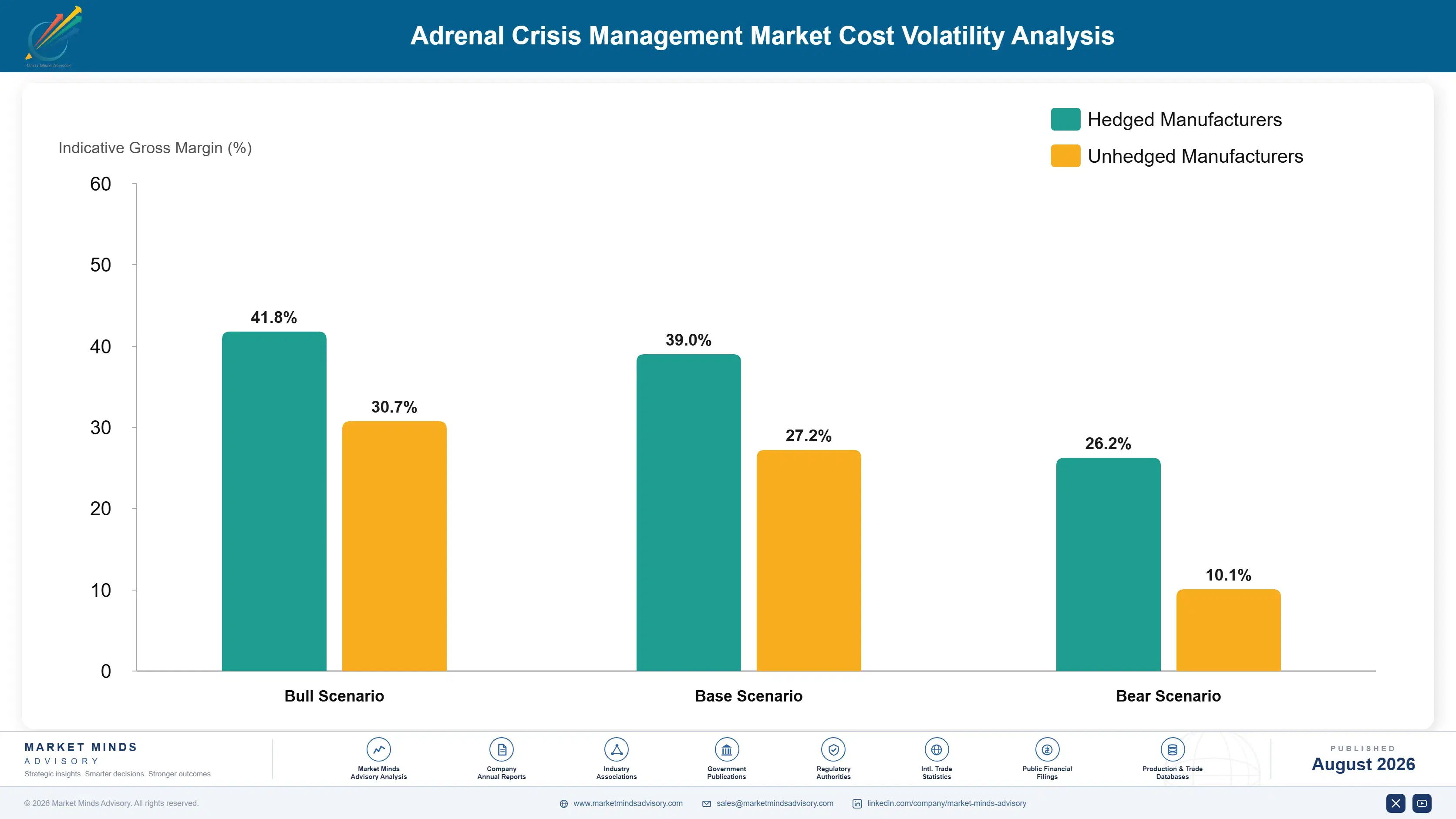
Active pharmaceutical ingredient, primarily synthetic hydrocortisone sodium succinate, accounts for roughly 29% of total device production cost, sourced mainly from specialty API manufacturers in the United States, Italy, and India who supply most of the industry's qualified volume. Auto-injector mechanical components, springs, cartridges, and needle assemblies, add a second cost layer sourced largely from established medical device contract manufacturers spread across several countries.
Eton Pharmaceuticals' 2024 annual report cited elevated input costs for specialty API and device component sourcing as a meaningful drag on gross margins, tracing much of it to pharmaceutical-grade raw material supply disruptions that lingered from 2022 into 2023. API prices rose double digits at the peak of that disruption before partially easing through 2024, and several manufacturers reported extending supplier qualification to additional API producers to reduce single-source dependency going forward.

Smaller regional generic makers without diversified API sourcing absorb these cost swings directly, a disadvantage that compounds for manufacturers concentrated in a single country's supply base. Branded device makers with diversified, multi-region sourcing can smooth these swings across a broader supplier base, while auto-injector makers carry the added exposure of sourcing both specialty API and mechanical components simultaneously.
adrenal-crisis-management-market-cost-volatility-analysis-1787303257933

Qualifying Multiple API Suppliers Across Regions

Extending supplier qualification to additional specialty API producers across the United States, Italy, and India reduces reliance on any single supplier's capacity or pricing power. Several manufacturers accelerated this diversification after 2022's disruption exposed how concentrated their sourcing had become across too few qualified vendors, adding redundancy across multiple continents and several newly qualified sources.

Long-Term Device Component Supply Contracts

Locking in multi-year supply agreements with auto-injector mechanical component manufacturers protects production schedules from shortages that periodically affect the broader medical device supply chain and its many contract manufacturers. This approach requires forecasting demand further out than manufacturers traditionally have, but it has paid off reliably during past shortage episodes across the wider industry.

Vertical Integration Into API Manufacturing

Owning specialty API production rather than outsourcing it reduces exposure to supplier pricing and gives manufacturers priority access during periods of tight capacity across the sector. The approach requires significant capital but has paid off for majors that invested early, insulating margins better than pure formulators eventually managed to achieve across comparable product lines.

Portfolio Architecture for Margin Defence

Three margin tiers coexist within this single therapeutic category. Volume-grade generic vial hydrocortisone runs thin margins set largely by hospital and pharmacy purchasing contracts and direct price competition among many regional generic makers spread across dozens of countries. Certified pre-filled syringe formats sit meaningfully higher, while branded auto-injector and needle-free devices command the richest margin of the three because clinical evidence and reimbursement documentation barr
The volume-versus-premium tension shows up clearly in capital allocation. Manufacturers that keep reinvesting in generic vial production capacity are chasing a shrinking margin pool relative to those redirecting capital toward auto-injector and needle-free platforms, even though generic vial lines still generate the larger absolute revenue base for most companies today. Boards increasingly favour the specialty side when allocating the next dollar of capital investment, despite its smaller current revenue scale.

High-value margin pools concentrate specifically in auto-injector devices with integrated outcomes documentation and in needle-free formats carrying published clinical trial data. Everything else in the portfolio behaves closer to a commodity generic pharmaceutical than a differentiated device, priced on distribution reach rather than clinical performance.

Volume / Commodity-Adjacent Tier

Generic vial-based hydrocortisone sold through hospital and pharmacy purchasing contracts, priced largely on distribution reach and cost rather than clinical differentiation, with thin room to compete on anything else meaningfully.
Gross Margin: 20-26%

Premium / Certified Tier

Pre-filled syringe formats and branded vial kits carrying clinical validation and improved handling convenience, sold at a real, defensible premium over unbranded generic alternatives across most major markets studied today.
Gross Margin: 34-42%

Sustainability / Regulatory / Next-Generation Tier

Auto-injector and needle-free rescue devices with integrated outcomes documentation, requiring extended clinical validation that thins the competitive field sharply and protects incumbent pricing for years at a stretch each cycle.
Gross Margin: 48-58%
adrenal-crisis-management-market-portfolio-architecture-1787303258430

Prescriber Platform Loyalty

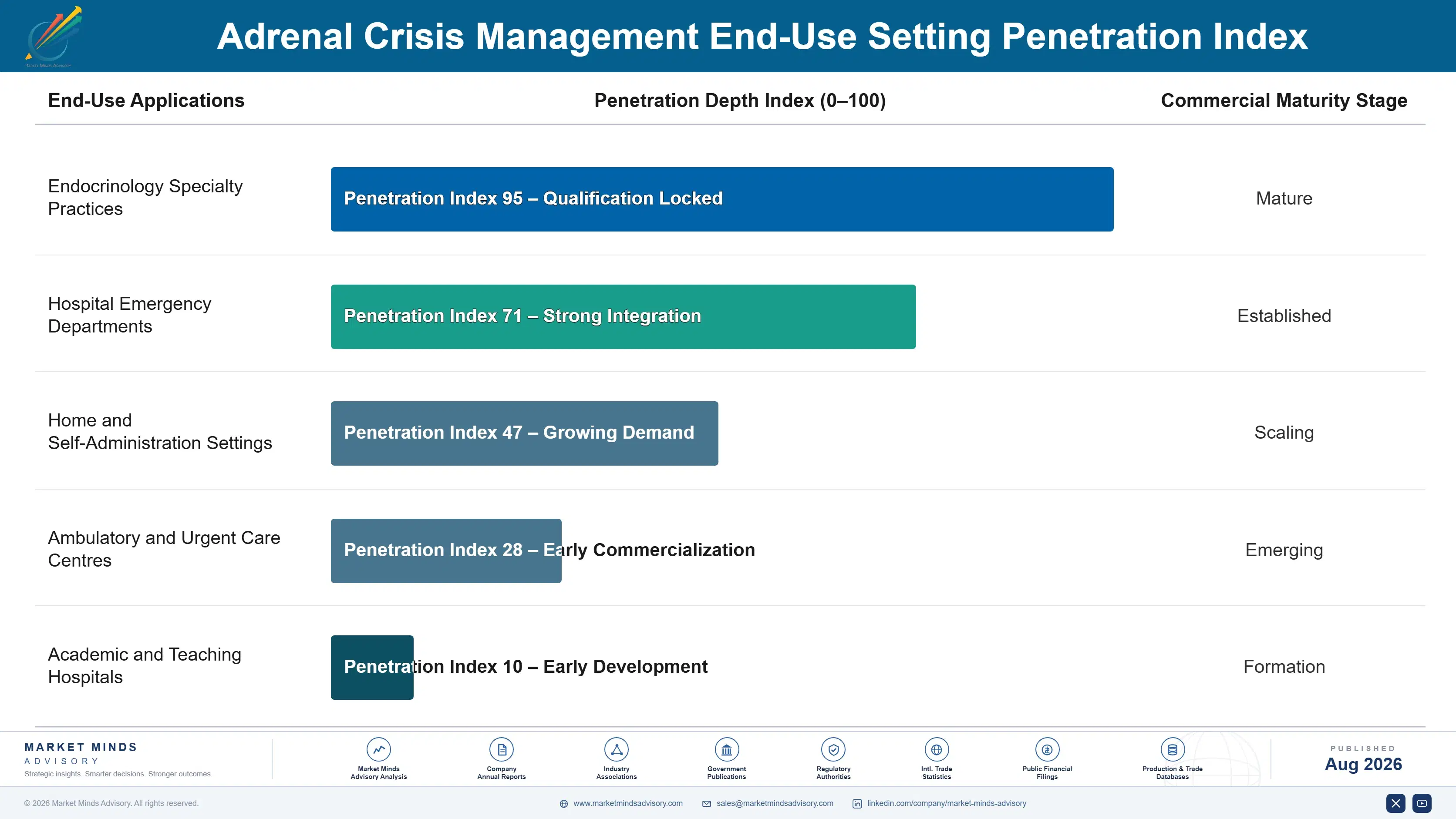
Adrenal crisis rescue devices are not a subscription business, but qualified prescriber relationships behave like one. Once an endocrinology practice standardises on a specific auto-injector platform for its patient population, switching costs run high enough that repeat prescribing continues for years without a full formulary re-evaluation each cycle.
Adoption depth varies sharply by patient vertical. Newly diagnosed patients and those who have previously experienced a crisis event, once trained on a device, rarely switch unless quality or reimbursement support genuinely slips, since retraining carries real risk during a future emergency. Cost-sensitive patients without device coverage behave completely differently, remaining on generic vials far longer since no comparable training investment has been made. Reimbursement documentation depth increasingly separates sticky accounts from price-sensitive ones across most health systems tracked.

A generational shift is underway in who specifies device purchases. Decisions once made almost entirely by cost-conscious hospital pharmacy committees are increasingly shaped by endocrinology specialists and patient advocacy voices who weight clinical outcomes data well above unit price alone in their evaluations. That shift favours manufacturers who invested early in outcomes registries over those still competing purely on price and distribution.
adrenal-crisis-management-market-end-use-penetration-index-1787303258917

Where Rescue Device Margin Concentrates

These are among the four positions where our research anticipates prominent divergence between winners and laggards over the coming forecast period. Each is grounded in the demand model, the regulatory perimeter, and the announced capacity pipeline.
01 / DEVICE INVESTMENT PRIORITY

Prioritise auto-injector and needle-free platforms over generic vial expansion.

Endocrine guidelines are shifting toward auto-injectors faster than smaller generic makers can realistically catch up on documentation and evidence depth, which means investment made today captures demand that generic vial lines cannot reach at comparable margin. Manufacturers that keep expanding vial capacity are chasing a shrinking margin pool relative to those building auto-injector and needle-free platforms instead. Prescriber training itself functions as a moat, since a rival cannot simply undercut price once a practice has already trained on a specific system.
02 / REIMBURSEMENT DOCUMENTATION STRATEGY

Build automated reimbursement documentation before competitors close the gap.

Winning formulary placement at major payers increasingly requires automated outcomes documentation that eases prior-authorisation, not just strong clinical performance on its own merits alone. Manufacturers that invest early in this documentation infrastructure build a durable advantage that outlasts any single reimbursement policy cycle or short-term pricing pressure from smaller rivals entering the category over time and across multiple product cycles. Underinvesting here cedes the richest margin tier of the market to whichever competitor solves the documentation problem first for a given payer account.
03 / REGIONAL MARKET ENTRY

Enter East Asian and South Asian markets ahead of reimbursement expansion.

East Asia and South Asia and the Pacific are growing fastest as diagnosis rates and specialty pharmacy access expand from a comparatively small installed base across both fast-moving regions today. Manufacturers without local clinical education relationships risk missing multi-year distribution contracts already being awarded to early movers with established local presence on the ground and physician trust built over years. Establishing regional physician education capability now positions a manufacturer well ahead of the next wave of reimbursement expansion across these fast-growing markets.
04 / ADVOCACY PARTNERSHIP STRATEGY

Invest in patient advocacy partnerships before reimbursement parity campaigns peak.

Patient advocacy organisations are already campaigning actively for reimbursement parity between premium devices and legacy vial kits, and manufacturers who fund this advocacy work early earn prescriber trust that direct marketing alone simply cannot replicate at scale. Waiting until parity campaigns peak means competing for credibility against manufacturers who built these relationships years earlier and already hold prescriber loyalty. Building that advocacy foundation now, rather than reacting once policy momentum has already shifted, is the cheaper path by a wide margin over time.

Engagement Snapshot From the Field

A live engagement with an industry participant carrying material or product regulatory and market exposure ahead of a defining policy shift, showing how our research translates into a defensible multi-year portfolio strategy.
MARKET MINDS ADVISORY · CLIENT ENGAGEMENT SUMMARY
Adrenal Crisis Management Producer Strategic Portfolio Review and Transition Roadmap 2026·Investment Scenario on Adrenal Crisis Management Exposure Evaluation 2025-26
CLIENT PROFILE
The client is an eight-clinic regional endocrinology practice network in the midwestern United States serving roughly 3,400 adrenal insufficiency patients. The network reported annual specialty pharmacy spend of approximately $9.8 million (client-reported, unverified by MMA) and was evaluating whether to standardise on a single auto-injector platform across all eight clinics rather than the fragmented multi-vendor prescribing pattern it had used historically.
STRATEGIC CHALLENGE
The network's eight clinics prescribed three different auto-injector brands and still maintained generic vial kits for uninsured patients, creating inconsistent caregiver training, duplicated administrative overhead, and inconsistent reimbursement documentation quality that made network-wide outcomes reporting to payers nearly impossible to assemble accurately, weakening its position in annual contract renegotiations with every manufacturer involved.
MMA APPROACH
MMA benchmarked the three incumbent auto-injector brands on outcomes documentation quality, reimbursement approval speed, and total cost per patient across all eight clinics. The engagement combined manufacturer interviews with clinic-level prescribing data analysis to model the total cost and clinical impact of standardising on a single platform network-wide across the entire patient population.
KEY FINDINGS
  1. One manufacturer's integrated documentation platform cut prior-authorisation approval time by roughly 32% versus the network's current blended average approval time overall today.
  2. Standardising on a single device would reduce annual caregiver retraining costs by an estimated $280,000 across all eight network clinics combined each year.
  3. Two incumbent brands lacked sufficient patient support staffing to reliably serve all eight clinics without meaningful onboarding delay during peak enrollment periods.
  4. Bundled procurement combined with structured training could lower blended per-patient device cost by roughly 11% network-wide within the first full fiscal year.
CLIENT PROFILE
The client is an eight-clinic regional endocrinology practice network in the midwestern United States serving roughly 3,400 adrenal insufficiency patients. The network reported annual specialty pharmacy spend of approximately $9.8 million (client-reported, unverified by MMA) and was evaluating whether to standardise on a single auto-injector platform across all eight clinics rather than the fragmented multi-vendor prescribing pattern it had used historically.
STRATEGIC CHALLENGE
The network's eight clinics prescribed three different auto-injector brands and still maintained generic vial kits for uninsured patients, creating inconsistent caregiver training, duplicated administrative overhead, and inconsistent reimbursement documentation quality that made network-wide outcomes reporting to payers nearly impossible to assemble accurately, weakening its position in annual contract renegotiations with every manufacturer involved.
MMA APPROACH
MMA benchmarked the three incumbent auto-injector brands on outcomes documentation quality, reimbursement approval speed, and total cost per patient across all eight clinics. The engagement combined manufacturer interviews with clinic-level prescribing data analysis to model the total cost and clinical impact of standardising on a single platform network-wide across the entire patient population.
KEY FINDINGS
  1. One manufacturer's integrated documentation platform cut prior-authorisation approval time by roughly 32% versus the network's current blended average approval time overall today.
  2. Standardising on a single device would reduce annual caregiver retraining costs by an estimated $280,000 across all eight network clinics combined each year.
  3. Two incumbent brands lacked sufficient patient support staffing to reliably serve all eight clinics without meaningful onboarding delay during peak enrollment periods.
  4. Bundled procurement combined with structured training could lower blended per-patient device cost by roughly 11% network-wide within the first full fiscal year.
RECOMMENDED STRATEGY
Phase 1: Phase 1 (Months 1 to 2): Finalise manufacturer selection and negotiate a network-wide multi-year supply and training agreement package terms. Phase 2: Phase 2 (Months 3 to 6): Roll out standardised caregiver training across all eight clinics in staged waves by patient volume. Phase 3: Phase 3 (Months 7 to 10): Consolidate outcomes documentation reporting and renegotiate payer contracts using the unified network-wide data sets.
OUTCOME
The network completed device standardisation across seven of eight clinics within nine months and reported a 13% reduction in blended device cost per patient (client-reported, unverified by MMA), alongside meaningfully faster reimbursement approval times network-wide following the switch to a single integrated documentation platform system.

Frequently Asked Questions

Foundational context covering the market sizes, CAGR, scope, country, region and competition that inform every finding below. This section is provided to cover basics and most often pre-purchase conversations, answered from the MMA Primary Research Dataset.

What is the current size of the Adrenal Crisis Management Market?

The global adrenal crisis management market was valued at approximately $0.42 billion in 2025. This spans generic vial kits, pre-filled syringes, and auto-injector devices used for acute crisis treatment.

How large will the Adrenal Crisis Management Market be by 2036?

The market is projected to reach approximately $1.13 billion by 2036. Growth is led by auto-injector and needle-free rescue formats rather than legacy vial-based hydrocortisone.

What is the CAGR for the Adrenal Crisis Management Market 2026 to 2036?

The market is expected to grow at a compound annual growth rate of 9.4% across the forecast period. Bull and bear scenarios range from roughly 8.2% to 10.7% depending on reimbursement policy.

Which segment is growing fastest?

Needle-free and intranasal rescue formulations are the fastest-growing segment, expanding at nearly twice the market's blended rate. Subcutaneous auto-injector devices follow as the second-fastest segment.

Who are the major companies in the Adrenal Crisis Management Market?

Leading participants include Eton Pharmaceuticals, Pfizer, Diurnal Group, Xeris Biopharma, and Amneal Pharmaceuticals. Assessments are based on global device and pharmaceutical revenue across all rescue formats.

Which country is growing fastest?

Australia is the fastest-growing country tracked, driven by strong reimbursement structures and endocrinology infrastructure comparable to North America. Its growth rate sits well above the region's already elevated average.

Report Segmentation Architecture

The full report scope spans multiple orthogonal segmentation dimensions, with cross-tabulated demand data provided for each dimension pair. Coverage extends further to regional breakdowns, trend trajectories, and the competitive detail needed to support segment-level decision-making.

By Delivery Format

  • Vial-Based Injectable Hydrocortisone
  • Pre-Filled Syringe Formulations
  • Subcutaneous Auto-Injector Devices
  • Needle-Free and Intranasal Rescue Formulations
  • Emergency Preparedness and Medical Alert Systems
  • Hospital Emergency Department Stock Kits

By End-Use Setting

  • Endocrinology Specialty Practices
  • Hospital Emergency Departments
  • Home and Self-Administration Settings
  • Ambulatory and Urgent Care Centres
  • Academic and Teaching Hospitals

By Commercial Dimension

  • Specialty Pharmacy Channels
  • Hospital Group Purchasing Contracts
  • Direct Manufacturer Patient Support Programs
  • Generic Retail Pharmacy Distribution

By Region

  • North America
  • Western Europe
  • East Asia
  • South Asia and Pacific
  • Latin America
  • Middle East and Africa
  • Eastern Europe

Scope, Methodology, and Coverage

Every figure in this report is reproducible from documented input assumptions. The scope below maps the historical period, the forecast horizon, the segmentation dimensions, and the countries covered, alongside the underlying primary and qualitative methodology.
Historical Period
2020 to 2025
Forecast Period
2026 to 2036
Base Year
2025 (USD billions; MMA Primary Research Dataset, August 2026)
Market Definition
The adrenal crisis management market covers pharmaceutical products and delivery devices used for acute treatment of adrenal crisis, including injectable hydrocortisone in vial, pre-filled syringe, and auto-injector formats, plus emerging needle-free rescue formulations. It excludes routine daily oral corticosteroid replacement therapy used for chronic adrenal insufficiency management outside a crisis event.
Quantitative Units
USD billions (current prices); units of rescue devices and kits dispensed
Segmentation Dimensions
By Delivery Format; By End-Use Setting; By Commercial Dimension; By Region
Regions Covered
North America, Western Europe, East Asia, South Asia and Pacific, Latin America, Middle East and Africa, Eastern Europe
Countries Covered
USA, China, Germany, France, UK, Japan, South Korea, India, Australia, Canada, Brazil, Mexico, Indonesia, Vietnam, Thailand, Malaysia, UAE, Saudi Arabia, South Africa, Nigeria, Turkey, Poland, Netherlands, Italy, Spain, Sweden, Switzerland, Argentina, Colombia, Singapore, and additional markets relevant to this sector
Key Companies Profiled
Eton Pharmaceuticals, Pfizer, Diurnal Group plc, Xeris Biopharma, Amneal Pharmaceuticals, Sandoz AG, Fresenius Kabi AG, Hikma Pharmaceuticals plc, Teva Pharmaceutical Industries Ltd., Novartis AG, Viatris Inc., Sun Pharmaceutical Industries Ltd., Cipla Limited, Dr. Reddy's Laboratories Ltd., Aspen Pharmacare Holdings Limited, Recordati Rare Diseases Inc., Neurocrine Biosciences Inc., Ferring Pharmaceuticals Inc., Athenex Inc., Nordic Pharma
Quantitative Methodology
Primary survey, n=3,800 respondents, Q4 2025, six countries; demand-side model with trade association cross-validation
Qualitative Methodology
47 expert interviews, Q4 2025; applied to validate demand model assumptions, identify emerging dynamics, and assess competitive positioning
Report Format
PDF and XLSX data workbook (Word format preview document)
Publisher
Market Minds Advisory
Report Code
MMA-2026-HLT-203
Published
August 2026
Contact
sales@marketmindsadvisory.com | www.marketmindsadvisory.com

Purchase the full Adrenal Crisis Management Market Report (2026 to 2036).

The full report delivers a complete quantitative and qualitative assessment of the global adrenal crisis management market across vial, syringe, and auto-injector product categories. It includes detailed segmentation by delivery format, end-use setting, and commercial channel, alongside country-level sizing across thirty-plus individual markets worldwide. Competitive profiling covers twenty companies assessed on global device and pharmaceutical revenue, with primary research drawn from MMA's expert interview program and its quantitative industry survey. Buyers receive fully editable data files supporting internal strategic planning, investment screening, and supplier qualification decisions each quarter.
Segment-level sizing and 2026 to 2036 forecasts
Full seven-region breakdown with country-level detail
Twenty-company competitive revenue benchmarking data set
Editable data tables delivered in Excel format
Primary survey and expert interview findings included
Quarterly market update subscription option available

Built For The People Who Decide

From boardroom strategy to bench-side execution, this report is read cover-to-cover by leaders shaping the next decade of their industry, turning demand scenarios, market dynamics and valuation benchmarks into decisions.
CXOs/ Presidents/ VPs/ Managers
M&A and Corporate Development
Strategy Teams and R&D Heads
Procurement and Product Directors
Regulatory and Compliance Leaders
Investor Relations and Equity Analysts