Market Minds Advisory
Additive Manufacturing Generative AI Copilots Market

Additive Manufacturing Generative AI Copilots Market: Additive Manufacturing Generative AI Copilots Market. Trends and Forecast 2026 to 2036

Design engineers are replacing weeks of manual lattice and topology optimization work with generative AI copilots that suggest print-ready geometry in minutes, compressing design cycles that previously required specialized simulation expertise most teams lacked.

Lead Analyst

Published

September 2026

Make Smarter Decisions with Customized Research Insights

Request a free sample report and evaluate market opportunities, growth trends, and competitive dynamics relevant to your business needs.

2025 MARKET VALUE$0.3BMarket Size 2025
2036 FORECAST VALUE$1.6BBase Case , 2026 to 2036
CAGR 2026 TO 203617.5 %Bull 18.8% / Bear 16.2%
INCREMENTAL OPPORTUNITY$1.3BNet 10- year value creation
EXPANSION MULTIPLE5.02x2036 value over 2026 base
Strategic Levers
M&A Pipeline
Regional Outlook
Country Rankings
Competitive Intelligence
Segmental Deep-dive
Call-Us : 91 93563 13602

Executive Snapshot and Market Trajectory.

Design engineers are abandoning weeks-long manual lattice and topology optimization work for generative AI copilots that suggest print-ready geometry within minutes, fundamentally compressing additive manufacturing design timelines that previously required specialized simulation expertise most engineering teams simply did not possess internally or affordably access at meaningful scale.
Natural language CAD-to-print conversion copilots are expanding fastest as engineers seek direct translation from design intent to manufacturable geometry, while metal additive manufacturing generative design tools capture substantial current enterprise spending among aerospace and industrial customers across multiple demanding applications and use cases nationwide. North America and East Asia together account for most deployment activity, reflecting concentrated AI software development talent and industrial additive manufacturing adoption trends.
Competitive intensity remains high as established CAD and simulation software vendors, dedicated AI-native startups, and additive manufacturing equipment makers all compete across overlapping platform functions, keeping differentiation focused on generative model quality rather than price alone across the entire global industry landscape and buyer segment. Regulatory attention remains minimal currently, though intellectual property questions around AI-generated design ownership are drawing increasing attention from manufacturers, legal departments, and industry trade associations broadly overall.
Market Definition
The Additive Manufacturing Generative AI Copilots Market covers artificial intelligence software that assists engineers in designing, optimizing, and preparing geometry specifically for 3D printing production processes, measured by software subscription and licensing revenue. It excludes general-purpose CAD software without generative AI capability and additive manufacturing hardware or materials.
Base Year Value
$0.3B in 2025 (MMA Primary Research Dataset, September 2026)
Forecast Period
2026 to 2036, eleven discrete annual values
CAGR
17.5% base case. Bull 18.8%. Bear 16.2%.
Fastest Growth Segment
Natural Language CAD-to-Print Conversion Copilots: 23.0% CAGR
Fastest Growth Country
India: 22.0% CAGR
Fastest Growth Region
South Asia and Pacific: 19.5% CAGR
Largest Region
North America: 30% of 2025 global value
Market Leaders
Leading participants include Autodesk, Siemens Digital Industries Software, Materialise, PTC, and Hyperganic. Source: MMA Primary Research Dataset, July 2026.
Primary Survey
n=3,800 procurement and R&D decision-makers, Q4 2025, six countries
Methodology
Demand-side build-up, cross-validated against public data, 47 expert interviews

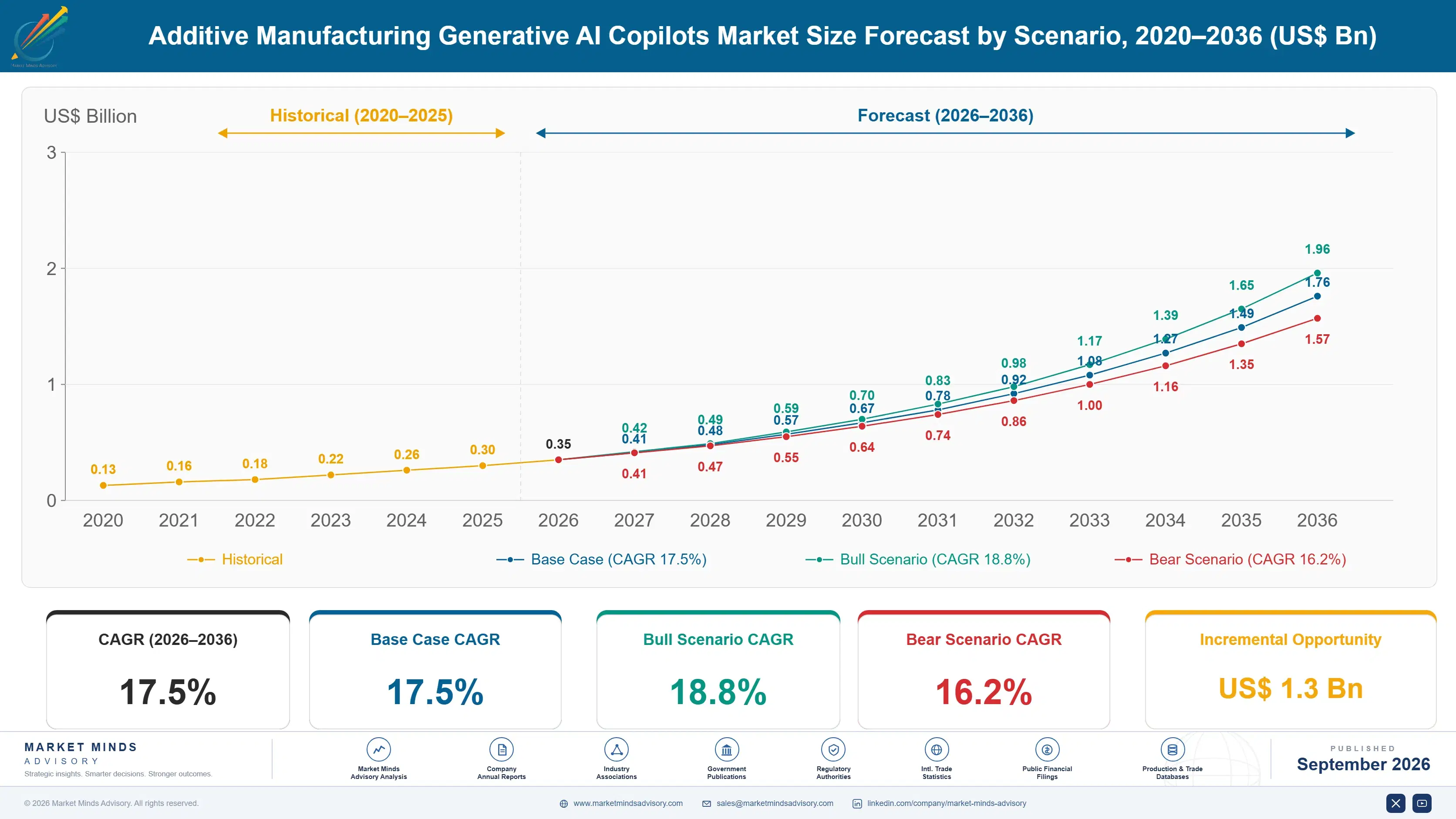
Additive Manufacturing Generative AI Copilots Market Forecast Scenarios

additive-manufacturing-generative-ai-copilots-mark-size-forecast-scenario-1788427095199
Between 2020 and 2025, generative AI copilot adoption for additive manufacturing grew from experimental research tools to commercially deployed enterprise software as large language model capability matured rapidly across the broader software industry and engineering technology sector. Historical growth ran near 15.5% annually through this period as adoption broadened considerably across most industrial sectors and applications.
The base case assumes continued large language model capability improvement, expanding enterprise engineering team adoption, and improving integration between generative copilots and established CAD and simulation software platforms, sustaining growth near 17.5% annually through 2036. Software vendors increasingly bundle generative design capability directly into existing engineering software suites rather than selling standalone copilot tools, broadening addressable customer budgets beyond dedicated additive manufacturing teams into mainstream mechanical engineering departments and broader product design organizations.
A bull scenario near 18.8% depends on faster enterprise trust development in AI-generated design outputs currently facing engineering validation and liability concerns limiting broader adoption. The bear case near 16.2% reflects the risk that persistent intellectual property and design ownership disputes around AI-generated geometry slow enterprise adoption until legal frameworks mature considerably across major manufacturing jurisdictions.

When the Software Starts Designing the Part

Generative AI copilots exist because manual topology optimization and lattice design work required specialized simulation expertise that most engineering teams could not economically maintain in-house, leaving substantial design potential unrealized across most manufacturing organizations before this technology fully matured, became commercially accessible, and grew affordable enough for widespread deployment.
MARKET CONCENTRATION35% CR5Share held by the five largest tracked software vendors
AVERAGE SUBSCRIPTION PRICE$18,000 per engineering seatTypical yearly software cost per licensed engineering user
TOP ADOPTING COUNTRY26% United StatesShare of global platform deployment concentrated in this market
DESIGN CYCLE REDUCTION40 to 60% improvementTypical decrease in design iteration time after adoption
METAL AM APPLICATION SHARE45% of total revenueShare of category revenue generated from metal print applications
AVERAGE ENTERPRISE CONTRACT LENGTH2 to 3 yearsTypical duration of enterprise software licensing and support agreements
Software vendors compete on generative model training data quality and manufacturing constraint accuracy rather than raw interface polish alone, since engineers evaluating competing copilots value designs that actually print successfully over impressive-looking geometry that fails during actual production runs, validation testing, and quality inspection. This accuracy-first competitive dynamic favors vendors with deep manufacturing process partnerships over pure software companies lacking direct additive manufacturing production experience and validation data.
Enterprise integration depth is reshaping platform economics as vendors embed generative copilots directly into established CAD and simulation software suites, commanding meaningfully higher licensing fees than standalone copilot tools lacking comparable workflow integration and deployment depth across the entire organization and broader engineering team. Vendors increasingly position deep CAD integration as a hedge against commodity AI feature pricing pressure facing persistent competition from open-source and lower-cost alternative tools.
"The engineer used to fight the software to get a printable design. Now the software suggests the design, and the engineer just has to trust it."
Senior Analyst, Additive Manufacturing and Design Software Practice · MMA Technology Practice · September 2026

Market Trends

Natural Language Design Interfaces Replace Manual Parameter Entry

Software vendors increasingly let engineers describe design intent through natural language prompts rather than manually configuring dozens of topology optimization parameters, letting the generative AI copilot translate plain language requirements directly into manufacturable geometry meeting specified structural and manufacturing constraints. This natural language capability meaningfully lowers the technical barrier to entry for engineers without specialized generative design training, expanding the addressable user base considerably beyond dedicated additive manufacturing specialists into mainstream mechanical engineering teams. Vendors report meaningfully accelerated adoption among engineering teams previously excluded from generative design work due to specialized skill requirements this year.
Market Impact: Specialized talent dependency fell roughly 30%
Manufacturing Constraint Validation Reduces Failed Print Attempts

Generative copilots increasingly incorporate real manufacturing constraint data, including overhang angles, support structure requirements, and material shrinkage behavior, directly into design suggestions rather than generating geometrically elegant designs that fail during actual production printing runs, quality inspection, and thorough dimensional validation checks. This constraint-aware design approach meaningfully reduces the costly trial-and-error cycle that historically characterized additive manufacturing design work, where engineers discovered manufacturability problems only after expensive failed print attempts. Manufacturers report meaningfully reduced failed print rates after adopting constraint-aware generative design copilots across their production design workflows this year.
Market Impact: Component weight reduction improved by 22%

Market Opportunities and Growth Drivers

Engineering Talent Shortages Increase Automation Reliance

Manufacturing organizations continue struggling to hire and retain engineers with specialized additive manufacturing design expertise, pushing them toward generative AI copilots that let less specialized engineers produce manufacturable designs without years of dedicated topology optimization training and experience accumulated over multiple production cycles. This talent shortage dynamic makes copilot software investment increasingly attractive relative to the cost and difficulty of hiring scarce specialized design talent competing for limited available positions across the industry. Organizations report meaningfully reduced dependency on specialized design talent after adopting generative copilot software across their engineering teams this year.
Market Impact: Validation requirements added 3 months delay

Aerospace and Medical Device Weight Reduction Demands

Aerospace and medical device manufacturers continue pursuing aggressive component weight reduction targets that manual design methods struggle to achieve efficiently, driving adoption of generative AI copilots capable of exploring vastly more design permutations than human engineers could evaluate manually within comparable project timelines. This weight reduction pressure directly translates into measurable performance and cost benefits for aerospace fuel efficiency and medical device patient outcomes, justifying premium software investment that would have been difficult to economically defend for less performance-critical applications. Manufacturers report meaningfully improved component weight reduction outcomes after adopting generative design copilots across their engineering workflows this year.
Market Impact: IP disputes delayed adoption by 25%

Market Restraints and Challenges

Engineering Trust Gaps Limit AI-Generated Design Adoption

Many engineering teams remain hesitant to deploy AI-generated designs in safety-critical or regulated applications without extensive independent validation, since generative AI outputs currently lack the transparent design rationale that traditional engineering methods provide for regulatory certification and liability documentation purposes. The root cause traces to generative AI models operating as effectively opaque systems where the underlying design logic cannot be easily explained or audited by human engineers seeking accountability in case of component failure. Some vendors are developing explainable AI features that document design rationale alongside generated geometry, aiming to build engineering trust incrementally over time.
Market Impact: Natural language adoption grew nearly 45%

Intellectual Property Ownership Disputes Around AI-Generated Designs

Legal uncertainty persists around who owns intellectual property rights to designs generated substantially by AI copilots rather than purely human engineering effort, creating hesitation among manufacturers concerned about defending patent claims on AI-assisted designs against potential future legal challenges. The root cause is that current intellectual property law frameworks were written before generative AI design tools existed and have not yet been updated to address AI-assisted invention ownership questions clearly. Some vendors are developing detailed design provenance tracking that documents the specific human engineering input contributed alongside AI suggestions throughout the design process.
Market Impact: Failed print attempts fell roughly 35%
3 additional market trends, 4 additional growth drivers, and 3 additional restraints and challenges are covered in the full report. Contact sales@marketmindsadvisory.com to access the complete intelligence.

Segment CAGR and Growth Architecture

The Additive Manufacturing Generative AI Copilots Market splits into six application-defined segments spanning design conversion, optimization, and workflow support functions. Natural language CAD-to-print conversion copilots lead growth as direct design translation gains favor, followed closely by metal AM generative design tools, since both command premium enterprise pricing. Post-processing workflow tools round out the mix.
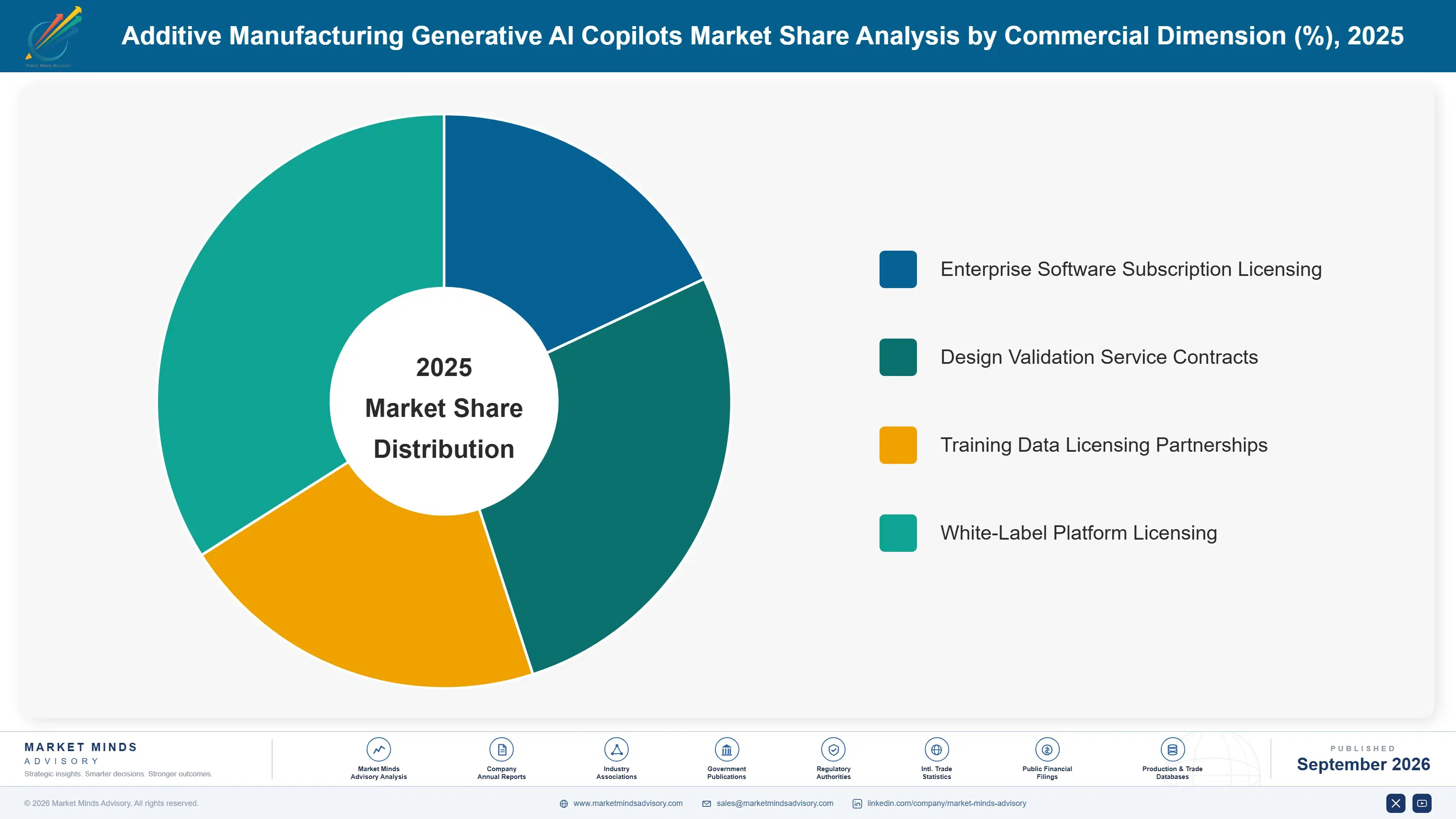
additive-manufacturing-generative-ai-copilots-mark-market-share-analysis-1788427095732

Natural Language CAD-to-Print Conversion Copilots

Natural language CAD-to-print conversion copilots lead all segments because they address the single biggest usability barrier facing generative design adoption: the specialized technical training previously required to configure topology optimization parameters correctly for successful manufacturable output across varied part geometries. Vendors standardizing on natural language interfaces increasingly treat conversational design capability as their primary competitive differentiator versus rivals still requiring engineers to master complex parameter configuration interfaces. This accessibility-first shift is reshaping vendor product development priorities industry wide as enterprise customers increasingly demand tools usable by broader engineering teams rather than narrow specialist groups. MMA estimates this segment will represent well over a third of total category revenue by 2036.
CAGR 23.0%

Generative Design Optimization Copilots for Metal AM

Generative design optimization copilots for metal additive manufacturing represent the second fastest-growing segment as aerospace, defense, and medical device manufacturers increasingly demand AI-assisted design capability specifically calibrated for the unique constraints and higher stakes associated with metal printing processes and demanding safety-critical applications across the entire global industry landscape. Vendors serving this segment increasingly invest in metal-specific manufacturing constraint training data, since generic design copilots trained primarily on polymer printing constraints often generate geometry unsuitable for metal production requirements without substantial modification and rework. This specialization premium is expanding the addressable high-margin segment considerably faster than overall market growth would suggest on its own, reflecting genuine technical differentiation and expertise.
CAGR 20.0%
Full segment breakdown across 6 segments available in the complete report.

Regional Architecture and Country Demand Map

North America leads on concentrated AI software development talent and established additive manufacturing enterprise adoption, while East Asia follows on expanding industrial additive manufacturing deployment scale. South Asia and Pacific grows fastest as generative design software adoption expands through previously underserved emerging engineering markets rapidly.

North America

The United States drives most North American demand through concentrated AI software development talent and established aerospace, defense, and medical device manufacturers already deeply invested in additive manufacturing production capability requiring sophisticated generative design tools across their engineering departments, research divisions, product development teams, quality assurance groups, executive leadership structures, and technology investment committees nationwide and internationally. Canada contributes smaller but steady volume through similar aerospace and industrial manufacturing technology adoption patterns across its major metropolitan centers, research institutions, and university partnerships nationwide and internationally. Domestic software development remains concentrated among established CAD and simulation vendors alongside dedicated AI-native startups headquartered primarily in major technology innovation hubs across the region.
Share: 30% | CAGR: 18.0% (2026 to 2036)

Western Europe

Germany, France, and the United Kingdom anchor Western European demand, driven by strong industrial engineering heritage and established aerospace and automotive manufacturing sectors increasingly adopting generative design tools for weight reduction and performance optimization applications across their entire product development lifecycle, manufacturing operations, quality control processes, executive strategy planning, and long-term technology roadmaps nationwide and beyond. Regional data governance rules shape platform deployment more visibly here than in less regulated markets elsewhere, particularly regarding intellectual property and design data handled by cloud-based generative AI platforms and third-party service providers. Software vendors serving this region increasingly invest in compliance infrastructure to navigate evolving national and pan-European data governance standards currently in force.
Share: 20% | CAGR: 16.0% (2026 to 2036)
Regional intelligence for 5 additional markets available in the complete report: East Asia, South Asia and Pacific, Latin America, Middle East and Africa, Eastern Europe. Contact sales@marketmindsadvisory.com.
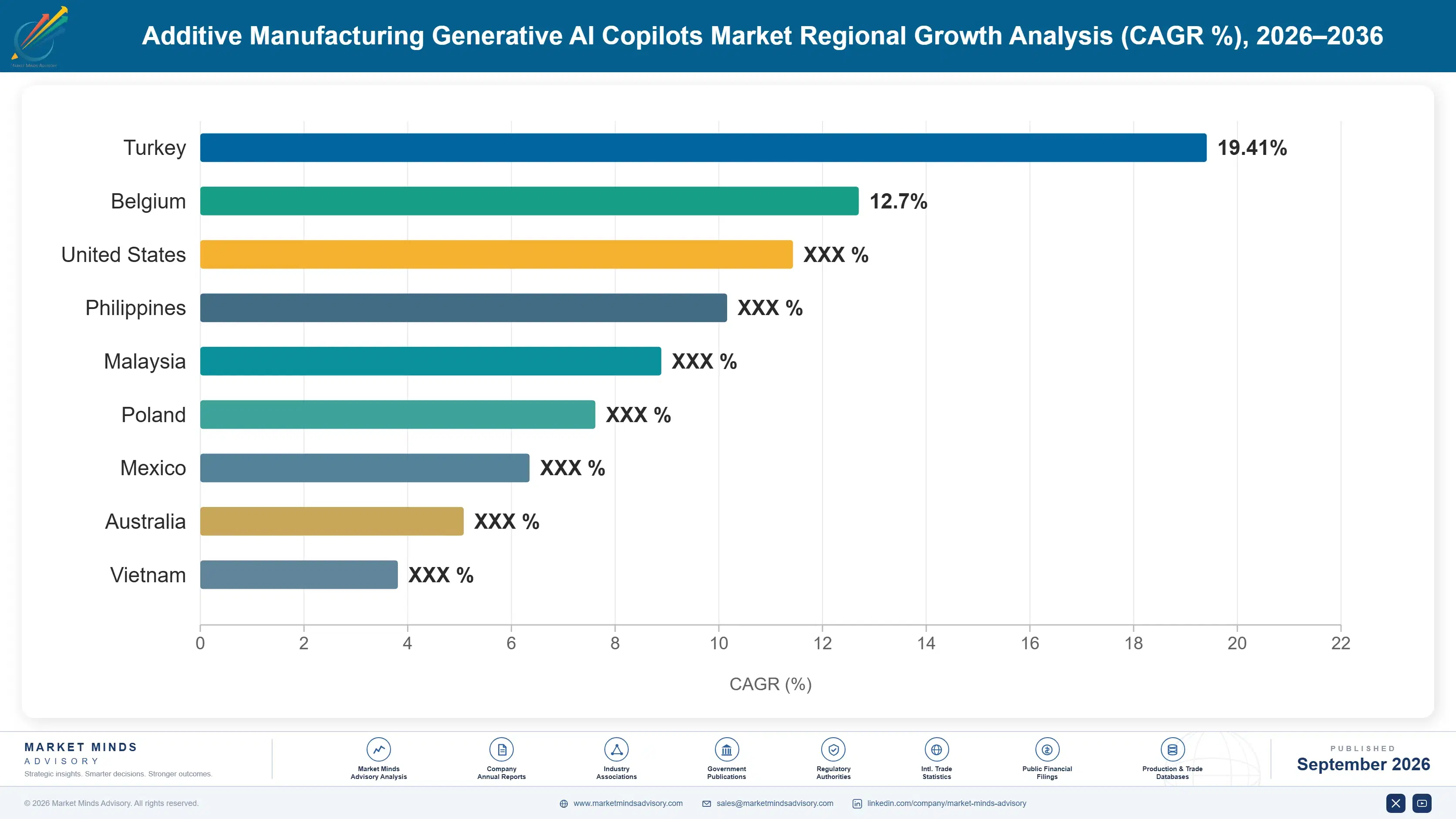
additive-manufacturing-generative-ai-copilots-mark-country-cagr-analysis-1788427096250

How Vendors Capture Value Beyond Licensing

Generative AI copilot vendors increasingly capture value beyond basic subscription licensing through design validation services, training data licensing, manufacturing partnership commissions, and enterprise platform licensing that customers increasingly view as essential rather than optional additions to their core generative design software purchase and ongoing long-term annual technology investment planning, forecasting, and overall budgeting strategy.

Design Validation and Certification Support Services

Vendors sell dedicated design validation services that provide documented engineering rationale and manufacturability certification for AI-generated designs used in regulated or safety-critical applications, capturing premium service revenue beyond basic software subscription fees charged to all customers. This validation service addresses a genuine enterprise pain point, since regulatory certification and internal engineering sign-off processes require documentation depth that raw AI-generated geometry alone cannot provide without additional human-reviewed validation work. Vendors report validation service revenue running roughly 35% higher than basic subscription-only accounts among their aerospace and medical device enterprise customers specifically.
Market Impact: Validation services command roughly 35% higher overall revenue

Manufacturing Constraint Training Data Licensing Partnerships

Vendors license proprietary manufacturing constraint and material behavior training data to competing software developers and equipment manufacturers seeking to improve their own generative design model accuracy without independently collecting comparable production validation data from scratch and extensive real-world field testing programs each year. This data licensing revenue stream generates income entirely separate from the underlying software subscription, effectively monetizing accumulated manufacturing knowledge that took years of production partnerships to compile and validate. Vendors report data licensing revenue adding roughly 20% to total platform revenue among their most data-rich enterprise customer relationships.
Market Impact: Data licensing adds roughly 20% overall platform revenue

Equipment Manufacturer Integration and Referral Partnerships

Vendors partner directly with additive manufacturing equipment makers to embed generative design copilots into equipment purchase packages, capturing referral commission revenue on hardware sales while equipment manufacturers gain differentiated software capability without independent AI development investment or research overhead and additional internal staffing costs. This partnership approach expands the software vendor's addressable customer base considerably beyond direct sales relationships while generating commission income on equipment transactions the vendor did not directly close. Vendors report equipment partnership commissions adding roughly 15% to total customer acquisition value across newly onboarded enterprise accounts.
Market Impact: Equipment partnerships add roughly 15% acquisition value overall

Enterprise Platform Licensing to CAD Software Vendors

Vendors license their entire generative design engine to established CAD and simulation software companies on a white-label basis, letting these companies offer branded generative AI capability within their existing product suites while the underlying vendor retains ownership of the core AI model and continues collecting recurring licensing fees. This arrangement suits established CAD vendors wanting to offer generative capability without the multi-year machine learning research investment required to build comparable technology internally from scratch. White-label licensing deals typically generate contract values running roughly 2 times higher than standard direct enterprise subscriptions given the exclusivity terms involved.
Market Impact: White-label licensing deals run roughly 2 times higher

Who Controls the Margin Pool

Five participants, evaluated on annual generative design copilot software and licensing revenue across all engineering applications, together account for an estimated 35% of tracked market revenue, reflecting a fragmented industry structure typical of nascent AI software categories attracting new entrants. Autodesk leads through established CAD platform distribution scale and integrated generative design capability, while Siemens Digital Industries Software and Materialise compete closely for enterprise manufacturing customer contracts that neither has fully secured.
Current competitive activity centers on natural language interface development, as vendors race to lower the technical barrier for mainstream engineering adoption before competitors capture the same broader engineering team customer base. CAD platform integration partnership announcements between generative AI startups and established engineering software vendors have become increasingly common over the past two years, as startups seek distribution reach without building comparable infrastructure independently.

Emerging pressure comes from large technology companies with substantial foundational AI model capability who could commoditize basic generative design functionality, potentially disintermediating specialized copilot vendors relying on narrower domain-specific model training. Rankings could shift meaningfully if a major cloud computing provider acquires a leading generative design startup outright, consolidating foundational model capability and manufacturing domain expertise that currently remains distributed across separate specialized companies.
additive-manufacturing-generative-ai-copilots-mark-company-positioning-matrix-1788427096781

Competitive Moat and Risk Dimensions

AUTODESK

Moat: Established CAD Platform Distribution

Autodesk's massive installed base of CAD software users gives its generative design copilot immediate distribution reach that standalone AI startups cannot replicate without years of independent customer acquisition investment. This distribution advantage lets Autodesk introduce generative capability directly to existing customers already embedded in its broader engineering software platform and workflow relationships.
AUTODESK

Risk: Legacy Architecture Slows AI Innovation

Autodesk's large legacy software codebase and enterprise customer commitments can slow the pace of AI model innovation compared to AI-native startups unencumbered by decades of existing platform architecture and backward compatibility requirements. Nimbler competitors could capture premium enterprise segments specifically seeking advanced generative capability that Autodesk's more conservative development pace struggles to match quickly.
MATERIALISE

Moat: Deep Additive Manufacturing Process Expertise

Materialise's decades of direct additive manufacturing production experience gives its generative design models genuinely validated manufacturing constraint accuracy that pure software companies lacking production experience cannot easily replicate. This manufacturing expertise translates directly into designs that print successfully on the first attempt more consistently than competitors relying primarily on theoretical simulation rather than actual production validation.
MATERIALISE

Risk: Smaller Scale Than Diversified Competitors

Materialise's narrower focus on additive manufacturing specifically limits its overall scale compared to diversified competitors like Autodesk and Siemens serving the entire engineering software market across multiple manufacturing technologies. This scale disadvantage could limit Materialise's research and development investment capacity relative to larger, better-capitalized competitors.

Players Tracked

Prominent Players

Autodesk
Siemens Digital Industries Software
Materialise
PTC
Hyperganic

Other Key Players

nTopology
ParaMatters
Desktop Metal
Stratasys
3D Systems
Dyndrite
Physna
Fathom Digital Manufacturing
Velo3D
Markforged
Sakuu
Ansys
Dassault Systemes
Formlabs
ICON Technology

Recent Developments

FEBRUARY 2025

Autodesk launched an expanded natural language interface for its generative design copilot, letting engineers describe design requirements in plain language rather than manually configuring topology optimization parameters across multiple software settings, interface panels, configuration menus, specialized dialog boxes, advanced options, preference screens, and workflow templates.
Signal: Signals established CAD vendors are prioritizing natural language accessibility to expand their addressable engineering user base.
JUNE 2025

Materialise announced a strategic partnership with a major aerospace manufacturer to co-develop metal-specific generative design training data, aiming to improve manufacturing constraint accuracy for safety-critical aerospace component applications, production runs, certification processes, quality audits, regulatory submissions, long-term compliance tracking, and thorough supplier qualification review programs.
Signal: Signals specialized vendors are securing flagship enterprise partnerships to validate domain-specific model training approaches more broadly.
OCTOBER 2025

Siemens acquired a smaller independent generative design startup specializing in natural language CAD conversion technology, adding conversational design capability to its existing simulation and manufacturing software portfolio, product offering, customer base, global distribution network, technical support organization, engineering training programs, and broader reseller partner network.
Signal: Signals established engineering software vendors are acquiring AI-native startups rather than building comparable capability entirely internally.

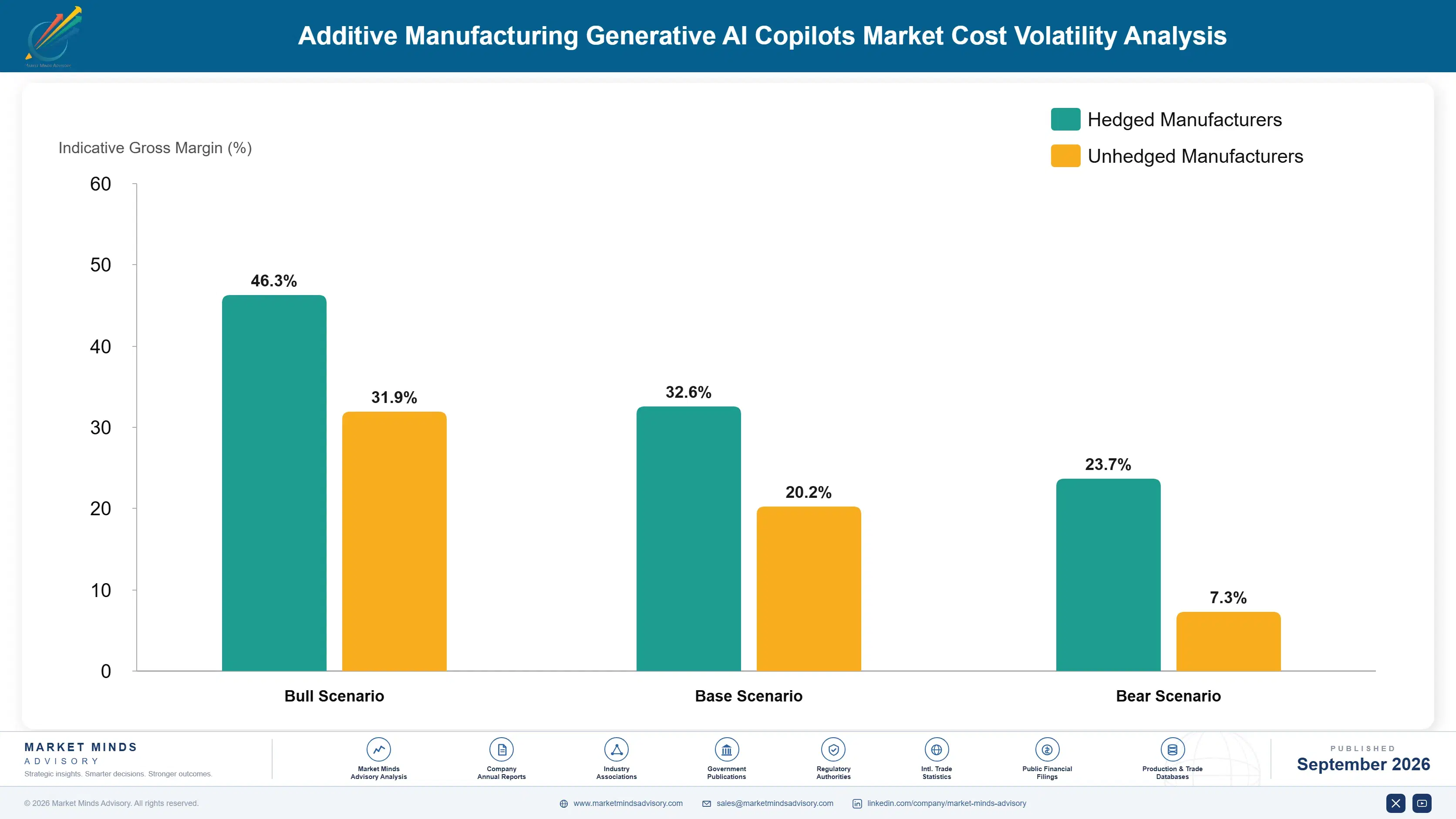
Compute Infrastructure and Training Data Cost Exposure

Cloud computing infrastructure supporting model training and inference accounts for roughly 40% of vendor cost of goods sold, with the large majority paid to major cloud providers operating specialized graphics processing unit clusters required for generative model computation. Manufacturing constraint training data acquisition and validation add another 20%, sourced through production partnerships and proprietary testing programs.
Graphics processing unit pricing and availability, documented in major cloud provider quarterly investor disclosures, tightened considerably during 2023 and 2024 as demand for AI model training compute capacity surged across the broader technology industry and sector. Generative design vendors absorbed rising compute costs during this period rather than passing full costs onto enterprise customers already committed to annual subscription agreements, compressing vendor margins industry wide temporarily.

Smaller independent AI startups carry meaningfully higher compute cost exposure per customer than large diversified technology companies who can negotiate favorable bulk cloud computing agreements across their much larger overall infrastructure spending base. This creates a durable cost disadvantage concentrated among vendors lacking scale, effectively pushing many smaller startups toward partnership arrangements with established CAD vendors rather than building independent infrastructure and go-to-market capability.
additive-manufacturing-generative-ai-copilots-mark-cost-volatility-analysis-1788427096980

Multi-Cloud Compute Procurement Strategies

Leading vendors now distribute model training workloads across multiple cloud providers rather than depending entirely on a single infrastructure partner, reducing exposure to pricing power and capacity constraints that amplified recent compute shortage impacts across the industry. This multi-cloud approach adds engineering complexity but meaningfully reduces future cost volatility, a tradeoff most large vendors now consider worthwhile given recent trends.

Shared Manufacturing Constraint Data Consortiums

Several vendors have formed data-sharing consortiums with manufacturing partners to jointly fund production validation testing rather than each vendor independently collecting comparable constraint data, reducing duplicate testing costs across the entire industry considerably. This collaborative approach requires competitive vendors to cooperate on foundational data while still competing on model architecture and user experience differentiation.

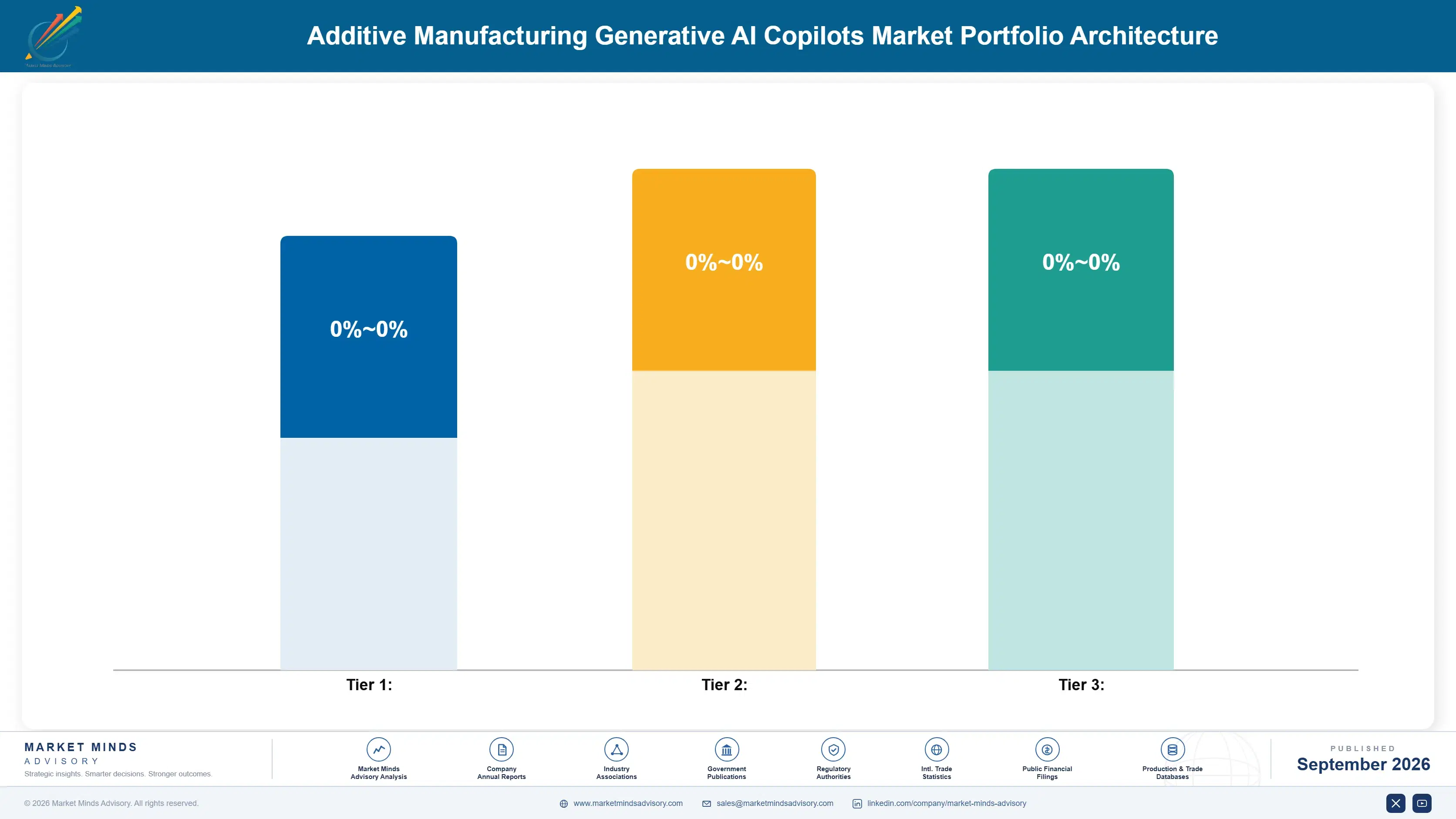
Portfolio Architecture for Margin Defence

Generative AI copilot vendors run a three-tier margin structure spanning basic single-application design suggestion tools, certified enterprise-grade platforms with manufacturing constraint validation, and next-generation integrated suites bundling design, validation, and licensing services. Gross margins range from roughly 25% on basic single-application tools facing intense open-source competition to over 55% on certified enterprise platforms carrying meaningfully higher validation and manufacturing partnership investment requirements.
Volume economics still matter for basic design suggestion tools, since most tracked deployments still prioritize accessible entry-level functionality over premium validation features, but the tension between volume and premium positioning has sharpened as manufacturing constraint accuracy and enterprise validation increasingly determine which vendors win large multi-year enterprise contracts. Vendors increasingly favor the certified enterprise tier, where validation depth and manufacturing partnership credibility provide more durable margin protection than basic design tools alone.

High-value margin pools concentrate specifically in design validation services and manufacturing constraint data licensing rather than in basic software subscription sales, reflecting the broader industry shift toward comprehensive design assurance as enterprise customers demand documented manufacturability confidence. Vendors capturing this premium validation and data licensing revenue early tend to retain large enterprise customer relationships longer than those competing purely on basic subscription pricing.

Basic single-application design suggestion tools sold primarily on price to smaller engineering teams prioritizing accessible entry-level functionality over premium validation and manufacturing constraint accuracy features, capabilities, depth, precision, and rigor.
Gross Margin

Certified enterprise-grade platforms with manufacturing constraint validation, bundled with technical support that large aerospace and medical device manufacturers increasingly require for safety-critical design applications each engineering project, cycle, and phase.
Gross Margin

Next-generation integrated suites bundling design generation, validation services, and manufacturing constraint data licensing, positioning vendors for recurring subscription revenue from customers facing complex certification requirements, standards, audits, reviews, and inspections.
Gross Margin
additive-manufacturing-generative-ai-copilots-mark-portfolio-architecture-1788427097481

High-value Sub-segments and Strategic Watch-out

Natural Language CAD-to-Print Conversion Copilots

Natural language CAD-to-print conversion copilots combine the fastest segment growth in the entire portfolio with the strongest margin expansion, as engineers pay premium subscription pricing for accessible conversational design capability across their entire engineering team, department, division, organization, enterprise, global operations, workforce, and executive leadership.

Generative Design Optimization Copilots for Metal AM

Generative design optimization copilots for metal AM carry the second fastest growth and strongest premium positioning, generating strong margin performance as aerospace and medical device manufacturers increasingly demand specialized validation, certification, documentation, audit trails, compliance records, traceability, quality assurance, regulatory reporting, risk management, and oversight.

AI-Powered Build Failure Prediction and Simulation Software

AI-powered build failure prediction and simulation software remains a steady mid-tier category as manufacturers increasingly recognize the commercial value of avoiding costly failed print attempts during production runs each manufacturing cycle, quarter, fiscal year, budget period, planning window, forecast horizon, strategic review, and executive assessment.

Automated Print Parameter Optimization Software

Automated print parameter optimization software warrants close monitoring, since continued commoditization of basic parameter tuning across equipment manufacturers could compress margins in this foundational but increasingly undifferentiated product category, offering, segment, revenue line, business unit, market, pricing tier, value proposition, competitive position, and long-term outlook.

The Ongoing Design Assistance Model

Roughly 45% of tracked vendor revenue now comes from recurring subscription and validation service contracts rather than one-time software licenses, reflecting the annuity-style economics that increasingly define successful generative design vendors once engineering teams build ongoing workflow dependency on continuous copilot assistance across every project, product line, and development cycle.
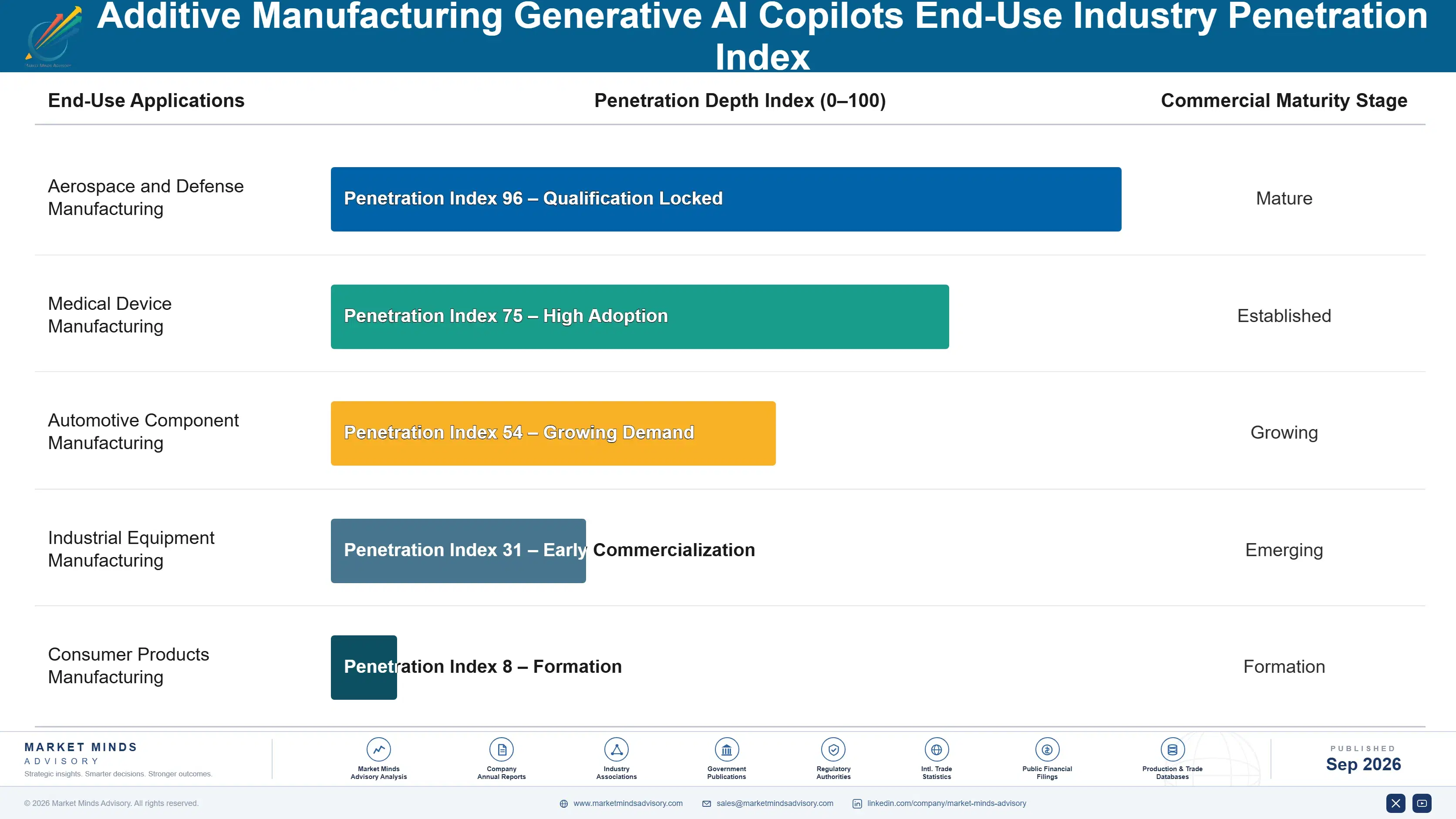
Adoption depth varies meaningfully by end-use vertical: aerospace and medical device engineering teams show the deepest platform stickiness given complex safety-critical certification requirements that manual design methods struggle to satisfy efficiently within compressed development timelines and regulatory review cycles, while general industrial manufacturing teams show comparatively shallower commitment since basic component design needs remain manageable through simpler and traditional CAD workflows and established engineering practices.

A generational shift in buyer profiles is underway as design responsibility moves from veteran engineers trained on manual topology optimization toward younger engineers who prioritize AI-assisted rapid iteration and data-driven design validation over traditional hand-calculated engineering approaches built over years of specialized training and mentorship, changing how vendors position new platform features toward procurement decision makers increasingly focused on measurable design cycle time reduction and quantifiable overall engineering productivity gains.
additive-manufacturing-generative-ai-copilots-mark-end-use-penetration-index-1788427097966

Where Generative Design Value Concentrates

These are among the four positions where our research anticipates prominent divergence between winners and laggards over the coming forecast period. Each is grounded in the demand model, the regulatory perimeter, and the announced capacity pipeline.
01 / NATURAL LANGUAGE INTERFACE PRIORITY

Build conversational design capability ahead of parameter-heavy tools

Vendors requiring engineers to master complex parameter configuration interfaces increasingly lose ground to competitors offering natural language design interaction that lowers technical barriers for mainstream engineering adoption across most organizations and teams. Vendors building genuinely conversational design capability capture disproportionate share among broader engineering teams previously excluded from generative design work due to specialized technical training requirements. This accessibility positioning becomes increasingly valuable as enterprise customers seek to expand generative design usage beyond narrow specialist teams into mainstream engineering departments.
02 / MANUFACTURING VALIDATION INVESTMENT

Prioritize production-validated accuracy over theoretical design elegance

Generative designs that look impressive but fail during actual production printing increasingly damage vendor credibility more than designs offering modest but reliably manufacturable geometry validated against real production constraints. Vendors investing in genuine manufacturing partnership relationships that generate authentic production validation data capture meaningfully higher enterprise trust than competitors relying primarily on theoretical simulation without corresponding real-world manufacturing verification. This validation-first differentiation strategy will become increasingly important as enterprise customers grow more sophisticated about distinguishing genuine manufacturability from impressive-looking but impractical geometry.
03 / EXPLAINABLE AI TRUST BUILDING

Develop transparent design rationale ahead of regulatory requirements

Engineering trust gaps around opaque AI-generated designs represent a genuine adoption constraint that pure model performance improvements alone cannot fully resolve without corresponding design rationale transparency and documentation capability across the entire industry. Vendors developing explainable AI features that document design decision logic alongside generated geometry secure meaningful competitive advantage among enterprise customers facing regulatory certification requirements demanding auditable design justification. This transparency advantage compounds as safety-critical industry adoption continues expanding faster than explainable AI capability development across most competing platforms.
04 / EMERGING MARKET LOCALIZATION TIMING

Enter India and Southeast Asia before competition intensifies

Rising engineering talent development and manufacturing technology investment across India and Southeast Asia represent the market's fastest-growing regional demand pools, yet most current vendor presence remains concentrated in North America and Western Europe serving comparatively mature markets. Vendors establishing local sales, support, and training infrastructure now, ahead of regional engineering talent pools reaching full maturity, position themselves to capture disproportionate share as these markets continue their rapid technology adoption trajectory. This expansion window will narrow considerably as domestic and international competitors recognize the same growth opportunity.

Engagement Snapshot From the Field

A live engagement with an industry participant carrying material or product regulatory and market exposure ahead of a defining policy shift, showing how our research translates into a defensible multi-year portfolio strategy.
MARKET MINDS ADVISORY · CLIENT ENGAGEMENT SUMMARY
Additive Manufacturing Generative AI Copilots Producer Strategic Portfolio Review and Transition Roadmap 2026·Investment Scenario on Additive Manufacturing Generative AI Copilots Exposure Evaluation 2025-26
CLIENT PROFILE
The client is a mid-sized aerospace component manufacturer producing structural brackets and housings for commercial aircraft using metal additive manufacturing processes across multiple production facilities. The company reported approximately $180 million (client-reported, unverified by MMA) in annual revenue, with engineering talent shortages and lengthy manual design cycles prompting evaluation of generative AI copilot software to accelerate component development.
STRATEGIC CHALLENGE
The manufacturer needed to evaluate whether generative AI copilot software could produce designs meeting stringent aerospace certification requirements, given genuine ongoing uncertainty about whether AI-generated geometry would satisfy regulatory documentation standards without extensive additional manual engineering validation work, thorough quality review processes, and internal sign-off procedures required by aviation regulators.
MMA APPROACH
MMA benchmarked available generative design copilot platforms against manufacturing constraint accuracy, certification documentation capability, and total design cycle time reduction, while carefully interviewing the manufacturer's own engineering and quality assurance teams to assess realistic validation requirements, implementation timelines, and available internal staffing needs specific to these aerospace applications and standards.
KEY FINDINGS
  1. Generative design copilots reduced initial design iteration time by an estimated 55% (client-reported, unverified by MMA) compared to the manufacturer's previous manual topology optimization process.
  2. Only a small subset of evaluated platforms, representing roughly 30% (client-reported, unverified by MMA) of options considered, offered documentation depth sufficient for aerospace certification purposes.
  3. AI-generated designs still required meaningful manual engineering review, consuming roughly 20% of the time previously spent on complete manual design from scratch.
  4. Component weight reduction achieved through generative design averaged notably higher than the manufacturer's previous manually optimized component weight targets across similar applications.
CLIENT PROFILE
The client is a mid-sized aerospace component manufacturer producing structural brackets and housings for commercial aircraft using metal additive manufacturing processes across multiple production facilities. The company reported approximately $180 million (client-reported, unverified by MMA) in annual revenue, with engineering talent shortages and lengthy manual design cycles prompting evaluation of generative AI copilot software to accelerate component development.
STRATEGIC CHALLENGE
The manufacturer needed to evaluate whether generative AI copilot software could produce designs meeting stringent aerospace certification requirements, given genuine ongoing uncertainty about whether AI-generated geometry would satisfy regulatory documentation standards without extensive additional manual engineering validation work, thorough quality review processes, and internal sign-off procedures required by aviation regulators.
MMA APPROACH
MMA benchmarked available generative design copilot platforms against manufacturing constraint accuracy, certification documentation capability, and total design cycle time reduction, while carefully interviewing the manufacturer's own engineering and quality assurance teams to assess realistic validation requirements, implementation timelines, and available internal staffing needs specific to these aerospace applications and standards.
KEY FINDINGS
  1. Generative design copilots reduced initial design iteration time by an estimated 55% (client-reported, unverified by MMA) compared to the manufacturer's previous manual topology optimization process.
  2. Only a small subset of evaluated platforms, representing roughly 30% (client-reported, unverified by MMA) of options considered, offered documentation depth sufficient for aerospace certification purposes.
  3. AI-generated designs still required meaningful manual engineering review, consuming roughly 20% of the time previously spent on complete manual design from scratch.
  4. Component weight reduction achieved through generative design averaged notably higher than the manufacturer's previous manually optimized component weight targets across similar applications.
RECOMMENDED STRATEGY
Phase 1: Phase one: select a generative design platform offering documented manufacturing constraint accuracy suitable for aerospace certification requirements and standards specifically. Phase 2: Phase two: establish an internal engineering review workflow combining AI-generated design suggestions with mandatory human validation before formal certification submission. Phase 3: Phase three: expand generative design adoption to additional component categories following successful validation of the initial pilot program results and outcomes.
OUTCOME
The manufacturer reported a 55% (client-reported, unverified by MMA) reduction in design iteration time and successfully achieved aerospace certification for its first generative-design-assisted component within the target production timeline, delivery schedule, and overall internal quality benchmarks established well beforehand by its senior company leadership team.

Frequently Asked Questions

Foundational context covering the market sizes, CAGR, scope, country, region and competition that inform every finding below. This section is provided to cover basics and most often pre-purchase conversations, answered from the MMA Primary Research Dataset.

What is the current size of the Additive Manufacturing Generative AI Copilots Market?

The global additive manufacturing generative AI copilots market reached an estimated $0.28 billion in 2025. Growth reflects rapid large language model capability improvement driving enterprise adoption across engineering teams.

How large will the Additive Manufacturing Generative AI Copilots Market be by 2036?

MMA projects the market will reach approximately $1.65 billion by 2036. This growth is driven by expanding natural language interface adoption and metal AM enterprise investment.

What is the CAGR for the Additive Manufacturing Generative AI Copilots Market 2026 to 2036?

The market is projected to grow at a compound annual growth rate of 17.5% between 2026 and 2036. This reflects a nascent but rapidly maturing AI software category.

Which segment is growing fastest?

Natural language CAD-to-print conversion copilots are the fastest-growing segment, expanding at roughly 23.0% annually through the forecast period. This significantly outpaces the overall market's projected growth rate.

Who are the major companies in the Additive Manufacturing Generative AI Copilots Market?

Leading companies include Autodesk, Siemens Digital Industries Software, Materialise, PTC, and Hyperganic across the industry. These five participants together account for an estimated 35% of tracked global revenue.

Which country is growing fastest?

India is the fastest-growing country market, expanding at approximately 22.0% annually. Expanding domestic engineering talent pools and growing manufacturing technology investment drive this sustained growth.

Report Segmentation Architecture

The full report scope spans multiple orthogonal segmentation dimensions, with cross-tabulated demand data provided for each dimension pair. Coverage extends further to regional breakdowns, trend trajectories, and the competitive detail needed to support segment-level decision-making.

By Primary Market Dimension

  • Natural Language CAD-to-Print Conversion Copilots
  • Generative Design Optimization for Metal AM
  • AI-Powered Build Failure Prediction and Simulation
  • Generative Design Optimization for Polymer AM
  • Automated Print Parameter Optimization Software
  • AI-Assisted Post-Processing and Finishing Workflow Software

By End-Use Industry

  • Aerospace and Defense Manufacturing
  • Medical Device Manufacturing
  • Automotive Component Manufacturing
  • Industrial Equipment Manufacturing
  • Consumer Products Manufacturing

By Commercial Dimension

  • Enterprise Software Subscription Licensing
  • Design Validation Service Contracts
  • Training Data Licensing Partnerships
  • White-Label Platform Licensing

By Region

  • North America
  • Western Europe
  • East Asia
  • South Asia and Pacific
  • Latin America
  • Middle East and Africa
  • Eastern Europe

Scope, Methodology, and Coverage

Every figure in this report is reproducible from documented input assumptions. The scope below maps the historical period, the forecast horizon, the segmentation dimensions, and the countries covered, alongside the underlying primary and qualitative methodology.
Historical Period
2020 to 2025
Forecast Period
2026 to 2036
Base Year
2025 (USD billions; MMA Primary Research Dataset, September 2026)
Market Definition
The Additive Manufacturing Generative AI Copilots Market covers artificial intelligence software that assists engineers in designing, optimizing, and preparing geometry specifically for 3D printing production processes, measured by software subscription and licensing revenue. It excludes general-purpose CAD software without generative AI capability and additive manufacturing hardware or materials.
Quantitative Units
USD Billion, CAGR (%), Share (%), 2020 to 2036
Segmentation Dimensions
By Primary Market Dimension; By End-Use Industry; By Commercial Dimension; By Region
Regions Covered
North America, Western Europe, East Asia, South Asia and Pacific, Latin America, Middle East and Africa, Eastern Europe
Countries Covered
United States, Canada, United Kingdom, Germany, France, China, Japan, South Korea, India, Indonesia, Vietnam, Australia, Brazil, Mexico, United Arab Emirates, Saudi Arabia, South Africa, Poland
Key Companies Profiled
Autodesk, Siemens Digital Industries Software, Materialise, PTC, Hyperganic, nTopology, ParaMatters, Desktop Metal, Stratasys, 3D Systems, Dyndrite, Physna, Fathom Digital Manufacturing, Velo3D, Markforged, Sakuu, Ansys, Dassault Systemes, Formlabs, ICON Technology
Quantitative Methodology
Primary survey, n=3,800 respondents, Q4 2025, six countries; demand-side model with trade association cross-validation
Qualitative Methodology
47 expert interviews, Q4 2025; applied to validate demand model assumptions, identify emerging dynamics, and assess competitive positioning
Report Format
PDF and XLSX data workbook (Word format preview document)
Publisher
Market Minds Advisory
Report Code
MMA-2026-TEC-639
Published
September 2026
Contact
sales@marketmindsadvisory.com | www.marketmindsadvisory.com

Purchase the full Additive Manufacturing Generative AI Copilots Market Report (2026 to 2036).

This report provides comprehensive coverage of the global additive manufacturing generative AI copilots market, including detailed sizing, segmentation, and regional analysis through 2036. It profiles the leading CAD and simulation software vendors shaping competitive dynamics as natural language interfaces and manufacturing constraint validation increasingly determine where industry margin concentrates. The analysis draws on primary survey data from 3,800 respondents and 47 expert interviews conducted in the fourth quarter of 2025. Readers gain actionable insight into where validation, data licensing, and platform licensing revenue concentrate over the coming decade.
Ten-year market sizing and forecast data
Seven-region granular market breakdown and analysis
Five-year competitive landscape developments and tracker
Segment-level CAGR and market share analysis
Primary survey data across six countries
Anonymized client case study with outcomes

Built For The People Who Decide

From boardroom strategy to bench-side execution, this report is read cover-to-cover by leaders shaping the next decade of their industry, turning demand scenarios, market dynamics and valuation benchmarks into decisions.
CXOs/ Presidents/ VPs/ Managers
M&A and Corporate Development
Strategy Teams and R&D Heads
Procurement and Product Directors
Regulatory and Compliance Leaders
Investor Relations and Equity Analysts