Market Minds Advisory
Active Spoiler Market

Active Spoiler Market: Range Economics, Actuator Warranty Exposure, and the Drag Race Electrification Started

Every hundredth of a drag coefficient buys a battery electric vehicle several kilometres of certified range, which is why deployable aerodynamics moved from supercar novelty to mainstream engineering requirement within one product cycle.

Lead Analyst

David Horsley

Published

September 2026

Make Smarter Decisions with Customized Research Insights

Request a free sample report and evaluate market opportunities, growth trends, and competitive dynamics relevant to your business needs.

2025 MARKET VALUE$4.2BMarket Size 2025
2036 FORECAST VALUE$10.7BBase Case , 2026 to 2036
CAGR 2026 TO 20368.9 %Bull 10.2% / Bear 7.6%
INCREMENTAL OPPORTUNITY$6.2BNet 10- year value creation
EXPANSION MULTIPLE2.35x2036 value over 2026 base
Strategic Levers
M&A Pipeline
Regional Outlook
Country Rankings
Competitive Intelligence
Segmental Deep-dive
Call-Us : 91 93563 13602

Executive Snapshot and Market Trajectory

Electrification turned aerodynamics from a marketing claim into an engineering budget line. A combustion car with a poor drag coefficient burned slightly more fuel; a battery electric vehicle loses certified range, and range sits on the window sticker where buyers compare. Nobody argues about aerodynamics any more.
Commercial power sits with suppliers who own the actuator and control integration rather than just the moulded panel. A deployable spoiler is a mechanism with a motor, linkage, position sensing, and vehicle software behind it, and the panel is the cheapest part. Multi-element adaptive assemblies grow fastest at 14.6%, roughly 1.64 times the market, on premium electric platforms. East Asia holds 30% of value.
Concentration is moderate at roughly 46% for the top five, since exterior systems suppliers with moulding scale compete against actuator specialists arriving from adjacent mechanisms. Chinese electric vehicle makers have moved active aerodynamics down the price ladder faster than European premium brands expected, fitting deployable elements on vehicles priced well below where the technology sat five years ago. Warranty exposure remains the industry's least discussed problem. Cost benchmarks have moved permanently as a result.
Market Definition
This report covers active spoiler systems fitted to light vehicles, meaning aerodynamic surfaces that deploy, retract, or change angle under vehicle control, spanning deployable rear lip spoilers, multi-position active rear wings, rear diffuser-integrated spoilers, roof-mounted active spoilers, airbrake-function spoilers, and multi-element adaptive assemblies. Value is measured at system level including actuator, mechanism, and control hardware. Fixed spoilers, active grille shutters, adjustable suspension, aircraft control surfaces, and aftermarket accessory spoilers fall outside scope.
Base Year Value
$4.2B in 2025 (MMA Primary Research Dataset, August 2026)
Forecast Period
2026 to 2036, eleven discrete annual values
CAGR
8.9% base case. Bull 10.2%. Bear 7.6%.
Fastest Growth Segment
Multi-Element Adaptive Spoiler Assemblies: 14.6% CAGR
Fastest Growth Country
India: 12.3% CAGR
Fastest Growth Region
South Asia and Pacific: 11.0% CAGR
Largest Region
East Asia: 30% of 2025 global value
Market Leaders
Magna International, OPmobility, Roechling Automotive, Motherson, Valeo. Source: MMA Analysis based on company annual reports.
Primary Survey
n=3,800 procurement and R&D decision-makers, Q4 2025, six countries
Methodology
Demand-side build-up, cross-validated against public data, 47 expert interviews

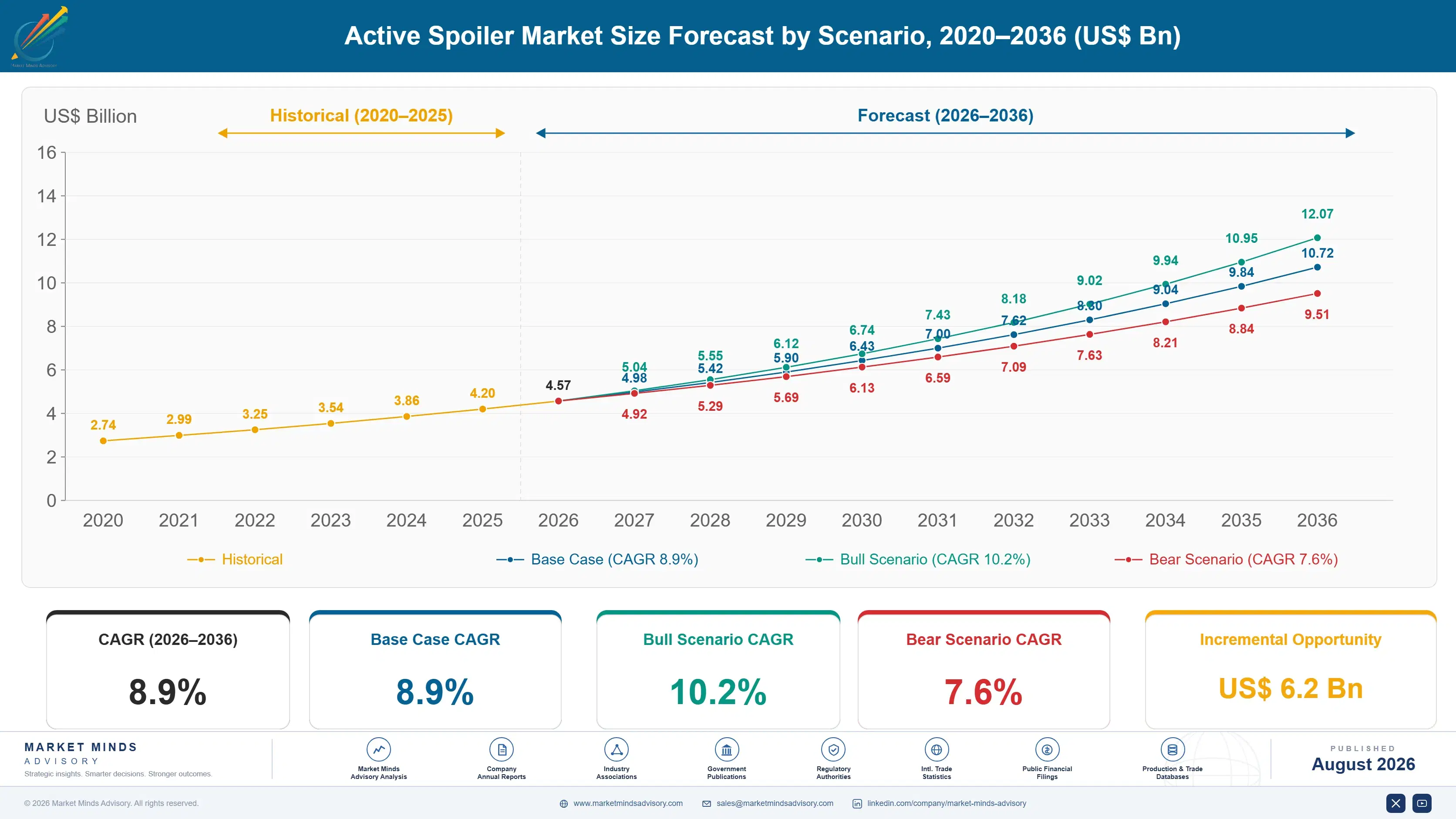
Active Spoiler Market Forecast Scenarios

active-spoiler-market-trends-size-forecast-scenario-1787463930554
The 2020 to 2025 period saw active aerodynamics escape the performance segment entirely. Deployable spoilers had been supercar equipment for two decades, and battery electric platforms pulled them into executive saloons, crossovers, and mid-market Chinese models chasing certified range. Semiconductor shortages through 2021 and 2022 delayed several launches carrying the systems. The 7.7% historical growth understates the fitment shift, because average system content rose alongside unit volume.
The 8.9% base case rests on three mechanisms. Battery electric fitment keeps rising as manufacturers compete on certified range under WLTP and CLTC cycles where drag matters more than it ever did on combustion test procedures. Chinese manufacturers keep pushing active aerodynamics down the price ladder, expanding addressable volume well beyond premium. And system content keeps growing as single deployable panels give way to coordinated multi-element assemblies with shared control hardware and software.
The 10.2% bull case assumes regulators tighten efficiency testing further while battery cost keeps range competition intense across mainstream segments. The 7.6% bear case reflects warranty experience deteriorating on early high-volume programmes, which would push manufacturers back toward fixed aerodynamic solutions on cost-sensitive platforms. Warranty experience over the next three years decides which case actually arrives here.

Why Range Anxiety Sells Aerodynamics

Three forces drive this market and none of them is styling. Certified range comes first, because a hundredth of a drag coefficient converts into several kilometres on a homologation cycle. Test procedure comes second, since WLTP and CLTC reward high-speed drag more heavily. Cost per gram of drag reduction comes third, and it decides whether a programme specifies an active element or a fixed one.
TOP-FIVE CONCENTRATION46%Share of global active spoiler supply held collectively
AVERAGE SYSTEM PRICE$268Installed cost per vehicle across deployable spoiler systems
DRAG COEFFICIENT REDUCTION0.014Typical improvement delivered against equivalent fixed spoiler configuration
FITMENT PENETRATION RATE9%Share of new light vehicles carrying deployable aerodynamic elements
WARRANTY CLAIM RATE1.8%Actuator and mechanism failures reported within warranty period
CAPACITY UTILISATION72%Average loading across moulding and assembly production lines
The commercial character has shifted underneath the category. Ten years ago an active spoiler was a moulded panel with a motor bolted on, awarded to whoever supplied the bumper. Today it is a mechanism with position sensing, fail-safe logic, validation, and domain controller integration, and the moulding is the least valuable element. Suppliers who treat it as a plastics job keep losing awards to those who treat it as a mechatronic system.
The next decade turns on warranty performance. Deployable mechanisms live outside the vehicle through freeze-thaw, road salt, and impact, and field failures are expensive because the parts are visible. Claim rates near 1.8% are tolerable on premium volumes and would be ruinous on mainstream ones. Whether the technology reaches genuine mass market depends on durability engineering more than on cost reduction.
"The spoiler is not the product. The product is a mechanism that has to work perfectly for eight years while being sprayed with brine, and every supplier who forgot that has a warranty file to show for it."
Director, Vehicle Exterior Systems Practice · MMA Automotive / Vehicle Exterior Systems Practice · August 2026

Market Trends

Chinese Electric Platforms Push Active Aero Down Market

Chinese manufacturers including NIO, Xpeng, Zeekr, and Li Auto have fitted deployable aerodynamic elements on vehicles priced well below where European premium brands positioned the technology, treating certified range under the CLTC cycle as a headline specification worth engineering cost. Domestic suppliers including Minth and Ningbo Huaxiang have built the moulding and actuation capability to serve that at volume. The result is fitment penetration rising fastest in a price band Western suppliers had written off. European and American programmes are now benchmarking against those cost points rather than against each other.
Market Impact: Delivers 8 kilometres per 0.01
Single Panels Give Way to Coordinated Multi-Element Systems

Early active spoilers moved one surface between two positions. Current premium electric platforms coordinate a rear wing, an underbody element, and sometimes a diffuser flap through shared control hardware, trading drag for downforce continuously according to speed, steering angle, and battery state. System content per vehicle rises accordingly, often doubling against a single deployable panel. Growth of 14.6% in multi-element assemblies reflects that content increase rather than any change in vehicle volume. The engineering demands favour suppliers with control software capability over moulding specialists. Moulding specialists increasingly subcontract exactly the part that earns the money here.
Market Impact: Weights drag across 131 km/h phase

Market Opportunities and Growth Drivers

Certified Range Converts Drag Reduction Into Visible Specification

A reduction of 0.01 in drag coefficient delivers roughly five to eight kilometres of additional WLTP range on a typical battery electric vehicle, and range is the number buyers compare directly when choosing between models. That arithmetic never applied to combustion vehicles, where the same improvement produced a fuel consumption change nobody noticed. Manufacturers therefore fund aerodynamic content that would previously have failed a cost case comfortably. Every kilometre gained through aerodynamics is also a kilometre that does not require additional battery capacity, which is a far more expensive way to buy the same result.
Market Impact: Runs 1.8% warranty claim rate

High-Speed Test Cycles Reward Aerodynamic Content Specifically

WLTP includes an extra-high speed phase reaching well above previous European test procedures, and the Chinese CLTC cycle similarly exposes high-speed behaviour, both of which weight aerodynamic drag more heavily than the older regimes they replaced. Deployable elements that reduce drag at cruising speed while providing stability at higher ones therefore score well on exactly the measurements that appear in homologation documents. Engineering teams optimise against the cycle because the cycle produces the published figure. That alignment between physics and paperwork is what makes the business case work. Older test procedures simply did not reward this content.
Market Impact: Costs $268 per vehicle installed

Market Restraints and Challenges

Actuator Warranty Exposure Limits Mainstream Fitment

Deployable mechanisms operate outside the vehicle through freeze-thaw cycling, road salt, high-pressure washing, and occasional impact, and warranty claim rates near 1.8% reflect that environment rather than any manufacturing defect. The root cause is exposure: no sealed cabin component faces comparable conditions across an eight-year warranty. Rectification is expensive because the parts are visible and customers notice a spoiler stuck half-deployed. Suppliers respond with redundant position sensing, fail-safe retraction logic, extended salt-spray and thermal cycling validation, and sacrificial design that fails safely rather than seizing. Mainstream fitment waits on durability rather than on cost reduction of any kind.
Market Impact: Extends fitment below $35,000 vehicles

Cost Per Gram of Drag Reduction Faces Cheaper Alternatives

Programme teams compare an active spoiler against flush door handles, wheel aerodynamic covers, underbody panelling, and mirror replacement cameras on cost per unit of drag reduced, and the active spoiler frequently loses that comparison on mainstream platforms. The root cause is mechanism cost: a motor, linkage, sensing, and control hardware carry expense that a fixed moulding does not. Suppliers respond by integrating control into existing vehicle domain controllers, by sharing actuator platforms across multiple applications, and by targeting programmes where downforce as well as drag matters. Downforce requirements are usually what tip the comparison back again.
Market Impact: Raises system content 2x per vehicle
3 additional market trends, 2 additional growth drivers, and 4 additional restraints and challenges are covered in the full report. Contact sales@marketmindsadvisory.com to access the complete intelligence.

Segment CAGR and Growth Architecture

Segmentation follows system architecture, the single engineering logic that determines actuator count, control complexity, package space requirement, and value per vehicle. Architecture decides what aerodynamic function the system can perform and what it costs to validate. Vehicle segment, powertrain type, and channel structure appear separately in the framework as commercial dimensions rather than as parallel segments.
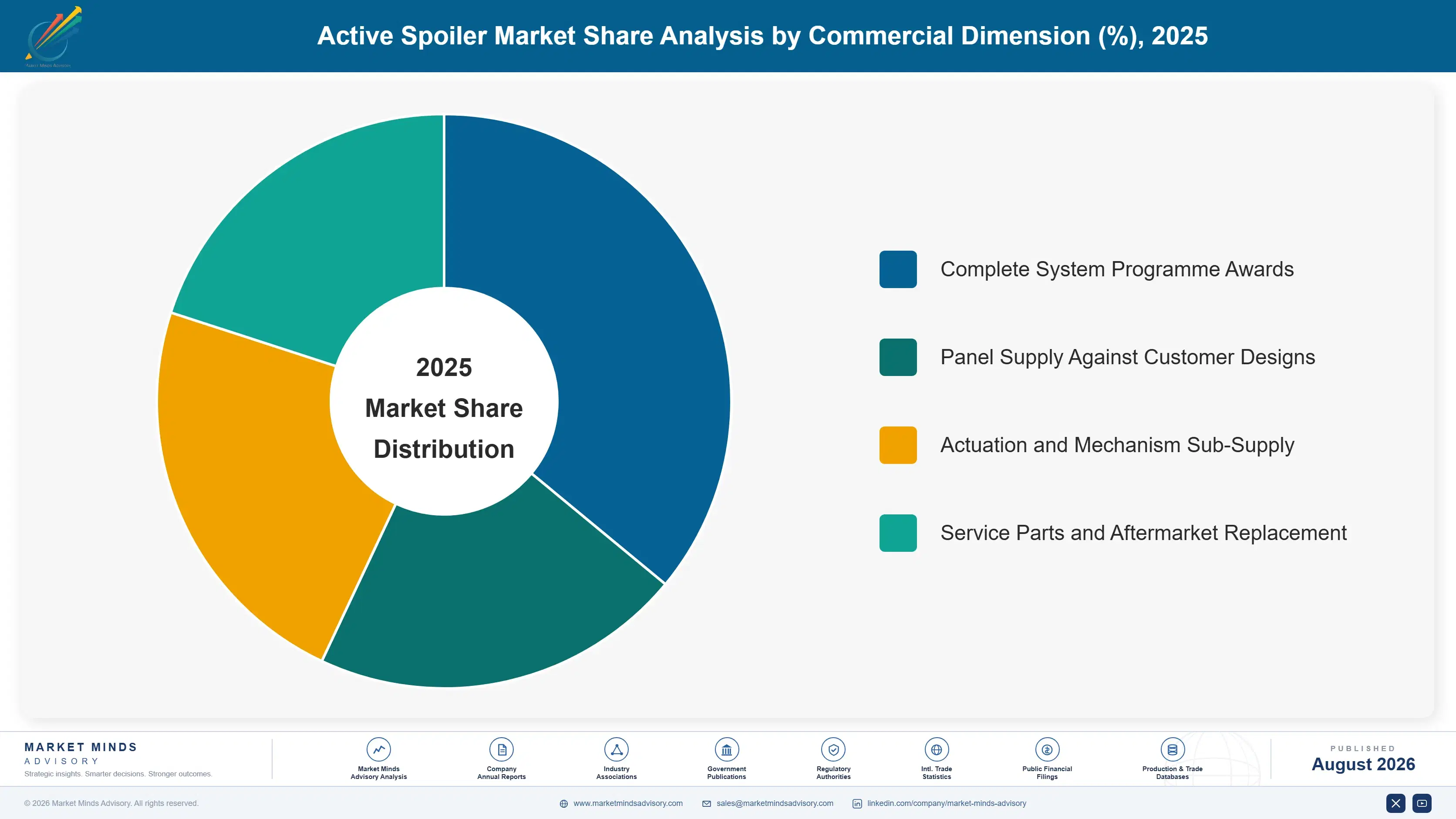
active-spoiler-market-trends-market-share-analysis-1787463931083

Multi-Element Adaptive Spoiler Assemblies

Coordinated systems moving a rear wing, an underbody element, and sometimes a diffuser flap together represent the highest content per vehicle and the fastest growth at 14.6%, roughly 1.64 times the market. Control logic trades drag against downforce continuously using speed, steering angle, braking demand, and increasingly battery state of charge, which means the value sits in software and sensing rather than in any moulded surface. Premium battery electric platforms across Germany, China, and California carry most current fitment. Validation cost is substantial because failure modes multiply with element count, and suppliers without control software capability find themselves subcontracting the part of the system that actually earns the margin. Subcontracting that is a costly habit.
CAGR 14.6%

Active Rear Diffuser-Integrated Spoilers

Integrating the deployable element with rear diffuser geometry lets a single mechanism influence both upper surface flow separation and underbody pressure recovery, which delivers more drag reduction per unit of actuator cost than a conventional lip spoiler achieves. Growth of 11.2% follows adoption on battery electric platforms where flat underbodies make diffuser geometry genuinely effective rather than decorative. Package constraints are the difficulty, since the mechanism competes for space with rear crash structure, towing provision, and increasingly with rear-facing sensors. Suppliers who can package within those constraints win awards that pure aerodynamic performance alone would not secure for them. Rear-end package space is contested by more systems every platform generation, and that trend is not reversing.
CAGR 11.2%
Full segment breakdown across 6 segments available in the complete report.

Regional Architecture and Country Demand Map

East Asia holds the largest share at 30%, reflecting Chinese electric vehicle volume and the aggressive range competition driving fitment down the price ladder. Western Europe and North America follow on premium platforms, while South Asia and Pacific grows fastest from a small base. Eastern Europe mostly builds.

North America

Fitment concentrates on premium battery electric platforms and performance derivatives, with Californian and Michigan engineering teams treating drag coefficient as a headline specification in exactly the way Chinese manufacturers do. Pickup and large sport utility programmes are the interesting development, since those body shapes carry enormous drag penalties and active elements deliver correspondingly large absolute range gains. Magna and Flex-N-Gate supply substantial regional volume from North American moulding and assembly capacity. Salt belt operating conditions across the Midwest and Northeast make durability validation more demanding here than in most markets. Regional growth of 8.2% follows electric platform launch cadence closely. Pickup and large sport utility aerodynamics remains the largest untapped regional opportunity.
Share: 24% | CAGR: 8.2% (2026 to 2036)

Western Europe

German premium manufacturers established active aerodynamics as a category and continue setting the engineering standard, with Porsche, Mercedes, BMW, and Audi programmes carrying the most sophisticated multi-element systems in production anywhere. WLTP homologation, including its extra-high speed phase, makes the business case explicit in a way that helps engineering teams justify content. Roechling, OPmobility, and Motherson operate substantial regional supply and development capability. The pressure is cost: Chinese benchmarks have made European programme teams considerably more demanding on system pricing than they were three years ago. Growth of 7.4% is the slowest of any region and reflects a mature premium base. Cost pressure has replaced technical ambition as the dominant programme conversation here.
Share: 24% | CAGR: 7.4% (2026 to 2036)
Regional intelligence for 5 additional markets available in the complete report: East Asia, South Asia and Pacific, Latin America, Middle East and Africa, Eastern Europe. Contact sales@marketmindsadvisory.com.
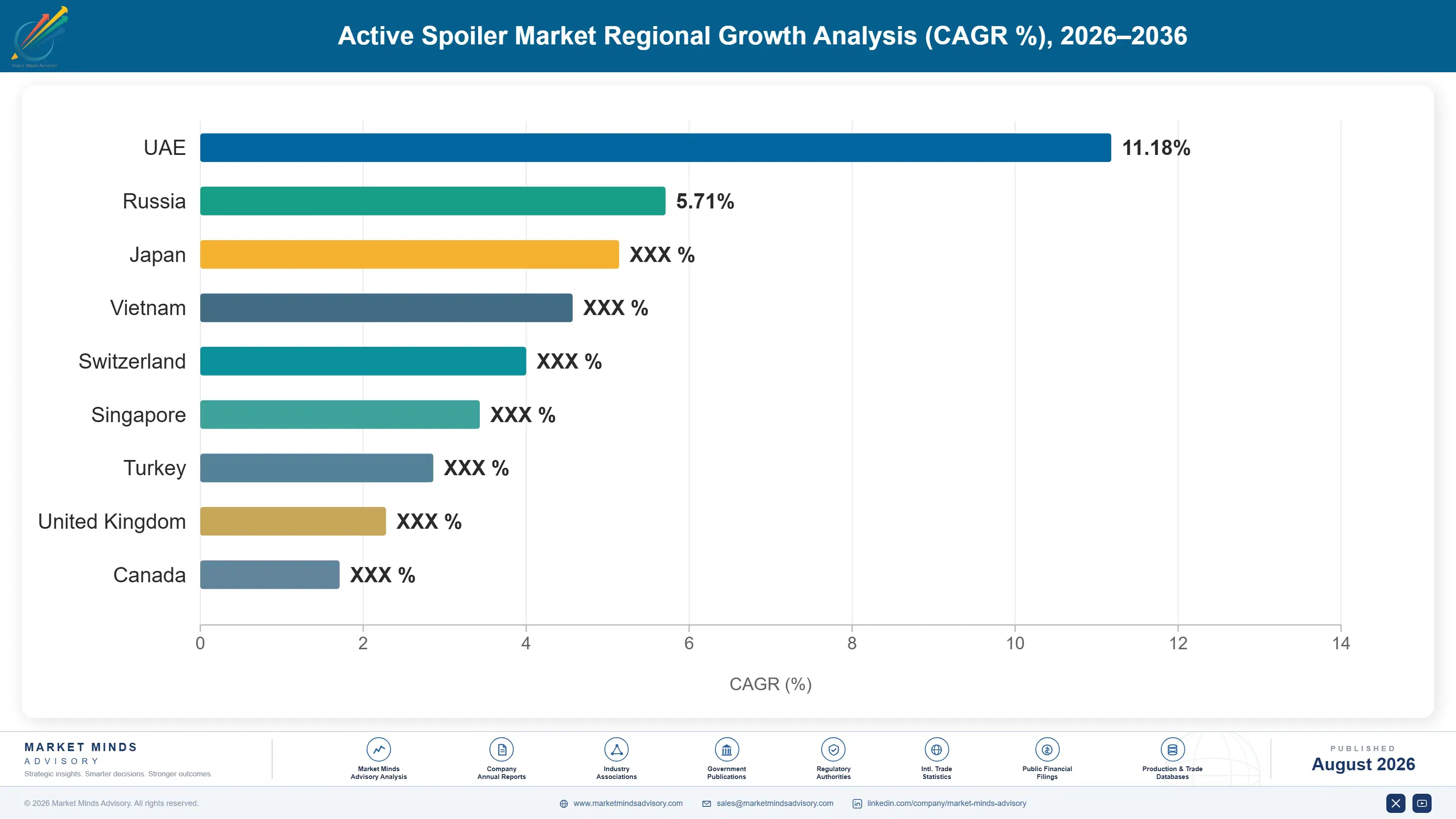
active-spoiler-market-trends-country-cagr-analysis-1787463931595

Where Active Spoiler Margin Actually Sits

Quoting a moulded panel with a motor attached is how suppliers lose awards to competitors who understood the brief. The four moves below shift value toward what manufacturers actually struggle to source: control software ownership, actuator platforms shared across applications, durability evidence that de-risks warranty, and packaging capability that wins programmes on constraint rather than performance.

Own the Control Software Rather Than Subcontracting It

The margin in a modern active spoiler sits in deployment logic, position sensing, fail-safe behaviour, and integration with the vehicle domain controller, not in the moulded surface. Suppliers subcontracting that work hand roughly 30% to 40% of system value to whoever writes it, and lose visibility of the requirement changes that drive the next programme specification. Building embedded software capability costs around $6 million in engineering headcount and toolchain. It also converts a component supplier into a system supplier in exactly the conversations where awards are decided. Awards are decided in those conversations, not on quotations.
Market Impact: Recovers 30 to 40% of total system value

Share Actuator Platforms Across Multiple Vehicle Applications

A motor, gearbox, and position sensor developed for a rear spoiler serves active grille shutters, deployable door handles, and charge port doors with modest adaptation, and amortising that development across several applications cuts unit cost by roughly 18% to 25%. Manufacturers increasingly value the reduced validation burden of a common actuator family as much as the price. It also improves service parts economics across the vehicle. Suppliers developing bespoke mechanisms for each application carry engineering cost their competitors have already spread across a portfolio. Bespoke mechanisms per application are an expensive habit to keep.
Market Impact: Cuts mechanism unit cost by 18 to 25%

Sell Durability Evidence to De-Risk Warranty Exposure

Warranty claim rates near 1.8% make programme teams cautious about active aerodynamics on high-volume platforms, and that caution is the principal barrier to mainstream fitment rather than piece price. A supplier arriving with extended salt-spray, freeze-thaw, and cycle test data from prior production programmes removes a risk the customer cannot quantify alone. That evidence typically supports pricing 8% to 14% above competitors quoting on specification only, and it wins awards on platforms where the engineering team has been burned before. Programme teams that have been burned before pay unusually close attention here.
Market Impact: Supports an 8 to 14% system price premium

Win Awards on Packaging Constraint Rather Than Aerodynamics

Rear deployable mechanisms compete for package space with crash structure, towing provision, rear-facing sensors, and increasingly with battery pack geometry, and many programmes select the supplier who fits rather than the one with the best aerodynamic result. Investing in package engineering capability and early concept collaboration costs perhaps $2.8 million annually and gets a supplier into the specification before the geometry is frozen. Once inside, the mechanism becomes difficult to substitute because surrounding components have been designed around it. Fitting the available space beats performing best more often than anyone admits publicly.
Market Impact: Enters programme specification roughly 18 months earlier typically

Who Controls the Margin Pool

The top five hold roughly 46% of supply, measured consistently as active spoiler system revenue at supplier level. Magna, OPmobility, Roechling, and Motherson bring exterior systems scale and moulding capability, while Valeo arrives from a mechatronics direction. Chinese suppliers including Minth and Ningbo Huaxiang have built substantial positions serving domestic electric platforms and are now quoting into European and North American programmes.
Competition runs along three lines. Control software and mechatronic integration is the first and increasingly decisive, since manufacturers award systems rather than panels. Durability evidence is the second, because warranty exposure rather than piece price limits mainstream fitment. The third is package engineering, where early concept collaboration determines whether a supplier is inside the specification before the surrounding geometry is frozen and substitution becomes impractical.

Two pressures will reshape positions. Chinese suppliers are entering Western programmes at cost points established serving domestic electric volume, which resets what programme teams expect to pay. Meanwhile actuator and mechatronic specialists are moving in from adjacent vehicle mechanisms with software capability that exterior moulding suppliers lack. The exposed position is a plastics-led supplier quoting panels with bought-in actuation and no embedded software or durability dataset.
active-spoiler-market-trends-company-positioning-matrix-1787463932111

Competitive Moat and Risk Dimensions

MAGNA INTERNATIONAL

Moat: Exterior Systems Integration Scale

Magna supplies complete exterior systems including fascias, liftgates, and aerodynamic elements across most major manufacturers, which means an active spoiler can be awarded within a broader package where interfaces are already controlled. That reduces integration risk for the customer considerably. The engineering and manufacturing footprint across three continents also lets it follow platforms wherever assembly happens to be located.
MAGNA INTERNATIONAL

Risk: Mechatronic Software Depth

The company's heritage is manufacturing and systems integration rather than embedded control software, and active aerodynamics is migrating toward exactly that capability. Competitors arriving from mechatronics can own deployment logic and vehicle integration natively. Building equivalent depth internally competes for investment against far larger businesses within the group portfolio.
VALEO

Moat: Mechatronic and Sensing Capability

Valeo brings actuator design, position sensing, and embedded control software from adjacent vehicle systems, which maps directly onto what a modern active spoiler actually requires. That lets it own the deployment logic and domain controller integration rather than subcontracting the part of the system carrying most of the value. Established relationships with manufacturer software teams reinforce the position considerably.
VALEO

Risk: Limited Exterior Moulding Scale

Large painted exterior surfaces demand moulding, painting, and logistics capability that exterior systems specialists operate at greater scale and lower cost. Competing on complete systems means either building that footprint or partnering, and partnering divides both the customer relationship and the margin. On price-led programmes that cost disadvantage shows up quickly in quotations.

Players Tracked

Prominent Players

Magna International
OPmobility
Roechling Automotive
Motherson
Valeo

Other Key Players

Toyoda Gosei
Flex-N-Gate
Montaplast
Rehau Automotive
Hutchinson
Yachiyo Industry
SMP Deutschland
Seoyon E-Hwa
Hanil E-Hwa
Ningbo Huaxiang Electronic
Minth Group
Jiangnan Mould and Plastic
Forvia
Brose Fahrzeugteile
Aisin Corporation

Recent Developments

MARCH 2025

Chinese suppliers quote active aero systems into European programmes

Chinese exterior systems suppliers began quoting active aerodynamic systems into European vehicle programmes at cost points established serving domestic electric volume, prompting programme teams to revise expectations on system pricing. Established European suppliers responded by unbundling software and durability validation as separately priced elements rather than defending complete system pricing.
Signal: Cost benchmarks set in Chinese domestic volume are now resetting what European programme teams expect to pay.
OCTOBER 2024

Premium manufacturers extend multi-element active aerodynamic systems

German premium manufacturers extended coordinated multi-element active aerodynamic systems across additional battery electric platforms, combining rear wing, underbody, and diffuser elements under shared control hardware. System content per vehicle roughly doubled against single deployable panels on the outgoing platform generations they replaced. Additional platforms are scheduled through 2027.
Signal: Content growth rather than fitment growth is where premium platform value increases are now coming from.
JULY 2025

Suppliers extend durability validation for salt belt operating conditions

Several exterior systems suppliers extended salt-spray, freeze-thaw, and mechanism cycle validation programmes for deployable aerodynamic systems, responding to programme team concerns about warranty exposure on higher-volume platforms. The additional evidence targets manufacturers evaluating active elements below premium price positioning for the first time. Results are being shared with programme teams.
Signal: Warranty confidence, not piece price, is the barrier standing between this technology and genuine mass fitment.

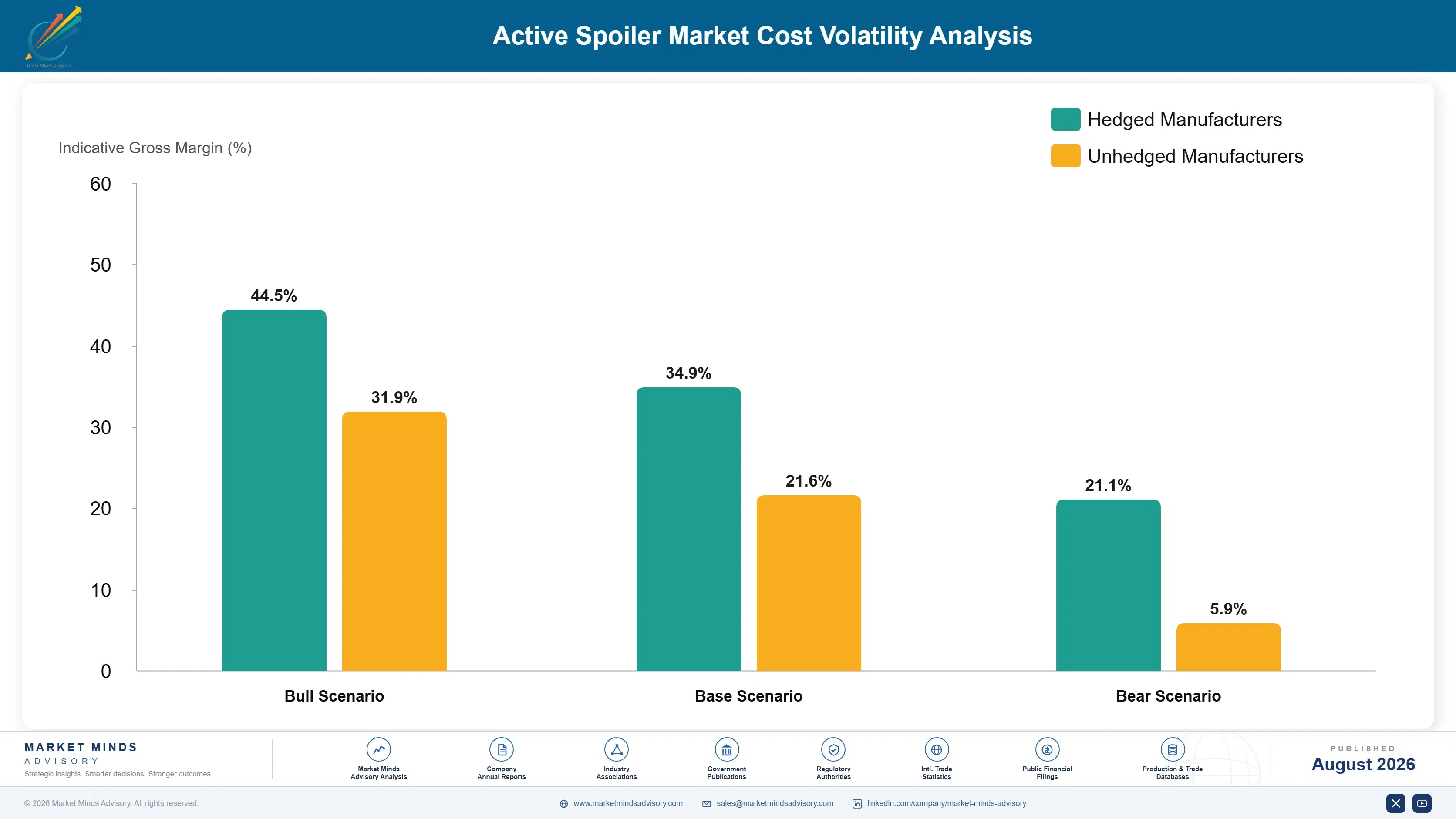
Resin, Actuators, and Tooling Amortisation

Actuator assemblies including motor, gearbox, and position sensing account for roughly 34% of system cost, sourced from mechatronic suppliers across Europe, Japan, and China. Engineering polymers, principally reinforced polypropylene and polyamide, contribute 21%, priced against petrochemical feedstock. Painting and surface finishing takes 14%, and tooling amortisation, control electronics, and assembly labour absorb the remaining balance across typical programmes.
European industrial energy prices rose steeply through 2022 and 2023 according to IEA reporting, which raised both polymer production costs and the energy-intensive painting operations that exterior parts require. Semiconductor availability constrained control electronics through 2021 and 2022, delaying several programmes carrying deployable systems. Magna and Forvia both referenced input cost and supply pressure across their reporting in that period, and suppliers on fixed programme pricing absorbed more than they recovered from manufacturers.

Exposure varies with contract structure far more than with scale. Suppliers holding raw material indexation clauses in programme agreements passed polymer movements through with a quarter of lag. Those on fixed programme pricing absorbed the full swing, and several awards taken aggressively in 2020 became loss-making by 2023. Chinese suppliers with local actuator supply and cheaper energy held cost position throughout.
active-spoiler-market-trends-cost-volatility-analysis-1787463932308

Negotiate raw material indexation into programme pricing agreements

Vehicle programme contracts running five to seven years against volatile polymer and energy inputs only work when indexation is written in at award. Manufacturers resist it during negotiation and accept it once the alternative is explained as repeated commercial reopening. Suppliers taking awards at aggressive fixed pricing in 2020 discovered by 2023 what the omission costs.

Standardise actuator platforms across several vehicle applications

Developing a common motor, gearbox, and sensing family for spoilers, grille shutters, door handles, and charge port doors spreads engineering and validation cost across far more volume than any single application supports. Unit cost falls by roughly a fifth. Manufacturers also value the reduced validation burden and better service parts economics, which makes standardisation easier to sell.

Design painted surfaces to tolerate reduced finishing energy intensity

Painting and surface finishing carries substantial energy load, and specifying colour-matched moulded-in finishes or lower-bake systems where the visible surface permits removes cost that customers never see. Not every exterior surface tolerates it, so the discipline is applying it selectively by part rather than universally. European suppliers hit hardest by 2022 energy pricing have pursued this most seriously since.

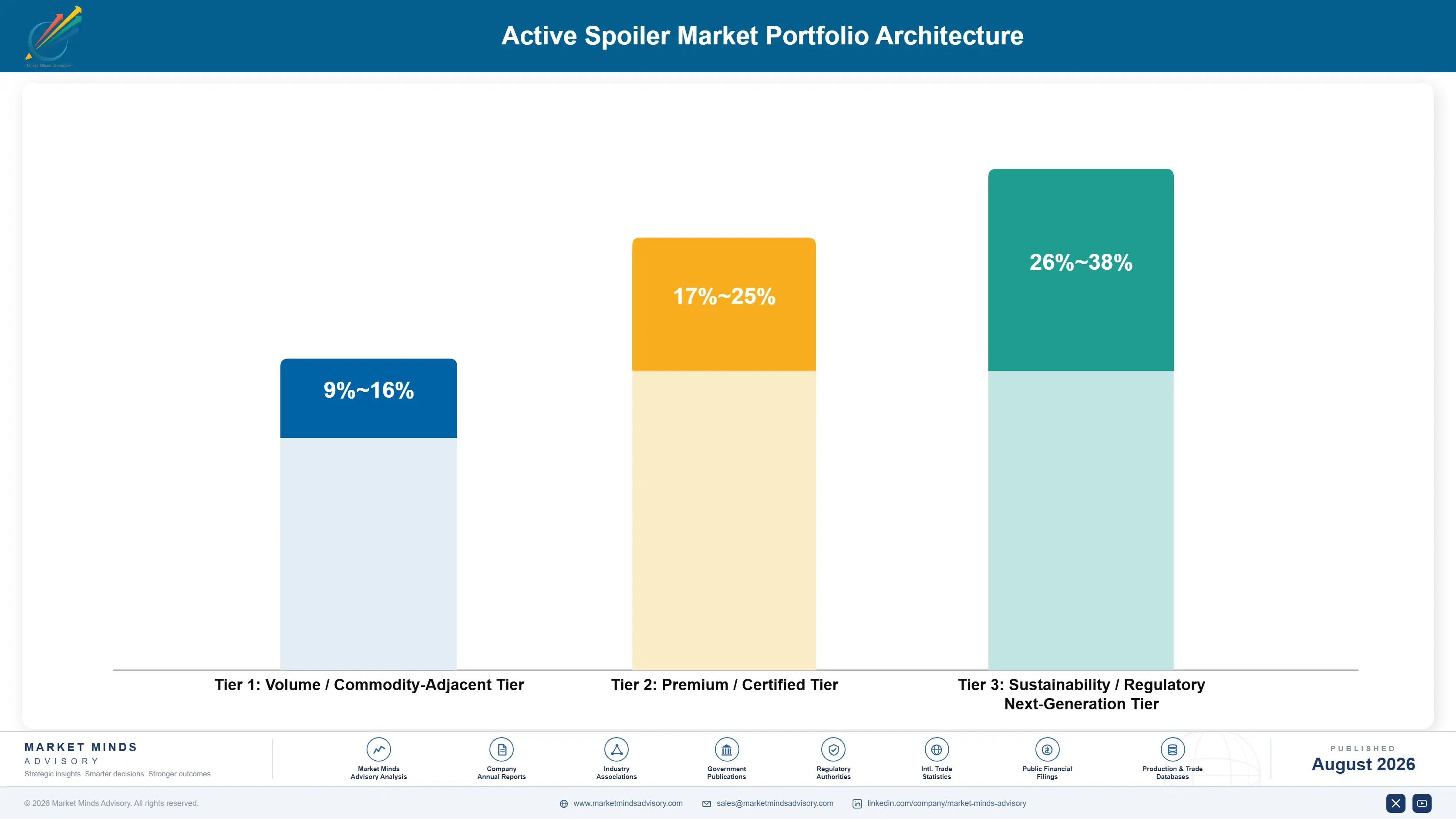
Portfolio Architecture for Margin Defence

Three tiers separate on how much of the system a supplier actually owns. Moulded panel and simple single-actuator supply earns 9% to 16%, because the customer is buying a part and comparing quotations directly. Complete deployable systems with supplier-owned actuation and validation earn 17% to 25%, since integration risk transfers with the award. Multi-element assemblies with owned control software and durability datasets earn most, and that gap keeps widening as systems get more complex.
The tension is between programme volume and content ownership. Panel supply fills moulding capacity and keeps utilisation near 72%, which matters given the capital in tooling and paint, yet it earns almost nothing and teaches the customer to treat the supplier as a converter. Suppliers who quoted panels to protect volume have watched software and actuation value migrate to competitors, and winning it back requires displacing an incumbent from a specification that surrounding geometry now depends on.

High-value pools sit where the manufacturer cannot easily verify or replicate what they are buying. Deployment logic, fail-safe behaviour, and multi-year durability evidence all require capability and history that a programme team cannot assemble internally, which is exactly why those elements resist the quotation comparison that panels invite.

Volume / Commodity-Adjacent Tier

Moulded spoiler panels and simple single-actuator assemblies supplied against manufacturer-owned designs and specifications. Competes on quotation directly. The wide range reflects large differences in moulding scale, paint capability, and regional labour cost between suppliers.
Gross Margin: 9%-16%

Premium / Certified Tier

Complete deployable systems where the supplier owns actuation design, mechanism validation, and durability testing under its own responsibility. Range width separates single-element systems from those carrying extended salt-spray and cycle evidence within the tier.
Gross Margin: 17%-25%

Sustainability / Regulatory / Next-Generation Tier

Multi-element adaptive assemblies with supplier-owned control software, domain controller integration, and multi-programme durability datasets. Software ownership and validation history, rather than manufacturing economics, sustain the margin structure across this tier.
Gross Margin: 26%-38%
active-spoiler-market-trends-portfolio-architecture-1787463932808

High-value Sub-segments and Strategic Watch-out

Multi-Element Adaptive Assemblies

Highest value in the market with 14.6% growth, where control logic and sensing carry the margin rather than any moulded surface. Validation cost rises with element count, which deters entry. Software capability decides participation more than moulding scale ever does. Very few plastics-led suppliers can participate at all.
Gross Margin: 30%-38%

Durability-Validated System Supply

High value, supported by salt-spray and cycle evidence that removes a warranty risk programme teams cannot quantify alone. Supports pricing 8% to 14% above specification-only quotations. Wins awards on platforms where the engineering team has been burned before. Nothing else removes that particular risk for a customer.
Gross Margin: 22%-32%

Single Deployable Rear Lip Spoilers

The volume core and the segment Chinese suppliers are entering most aggressively on cost. It fills moulding and paint capacity, which the capital base genuinely requires, but it teaches customers to treat the supplier as a converter rather than a system partner. Fill the presses, but expect nothing more.
Gross Margin: 10%-18%

Panel-Only Supply Against Customer Designs

The strategic watch-out. Quoting against a manufacturer-owned design surrenders actuation and software value permanently, and winning it back means displacing an incumbent from geometry the whole rear end now depends on. Decline these awards deliberately where possible. Declining these awards is easier than recovering from them.
Gross Margin: 8%-15%

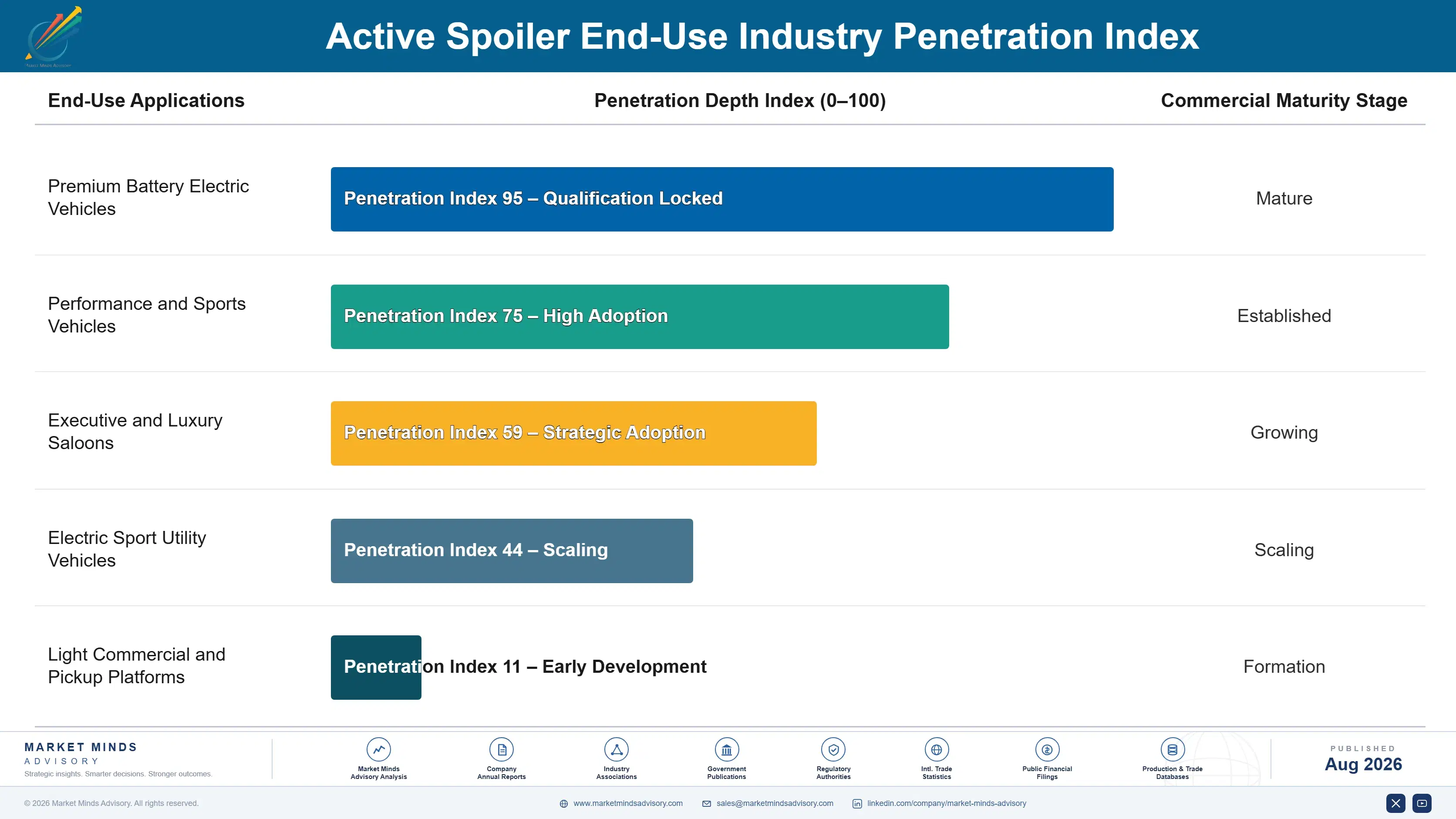
Why Platform Awards Last Years

Active spoiler revenue is programme revenue, which behaves as an annuity of unusual predictability once an award is made. A supplier selected at concept stage supplies that platform for its full production life, typically six to eight years plus a service parts tail running a decade beyond it, because tooling, homologation, and surrounding geometry all assume the specific mechanism. Manufacturers do not resource a running programme without a quality or supply failure severe enough to justify the disruption.
Stickiness varies with how early the supplier entered. Systems specified at concept stage before rear-end geometry froze are effectively unmovable, since crash structure, sensor positions, and battery pack packaging have all been designed around the mechanism. Suppliers awarded later against a fixed design are more exposed, particularly on facelift and derivative programmes. Panel-only supply against manufacturer-owned designs is the least sticky of all, retendered at every model action on quotation alone.

Buyer profiles have changed. Software and electrical architecture teams now sit in supplier selection alongside exterior engineering and purchasing, and questions about deployment logic ownership arrive well before piece price is discussed. Ownership of that logic increasingly decides which supplier is even asked to quote.
active-spoiler-market-trends-end-use-penetration-index-1787463933296

Where Active Aero Capital Belongs

These are among the four positions where our research anticipates prominent divergence between winners and laggards over the coming forecast period. Each is grounded in the demand model, the regulatory perimeter, and the announced capacity pipeline.
01 / CONTROL SOFTWARE OWNERSHIP

Own deployment logic or hand competitors the margin permanently

The value in a modern active spoiler sits in deployment logic, position sensing, fail-safe behaviour, and vehicle domain controller integration rather than in any moulded surface a customer can compare on quotation. Suppliers subcontracting that work hand roughly 30% to 40% of system value to whoever writes it, and lose sight of the requirement changes shaping the next programme specification entirely. Building embedded capability costs around $6 million in engineering headcount and toolchain, which is trivial against what it protects.
02 / ACTUATOR PLATFORM STANDARDISATION

Build one mechanism family across every deployable application

A motor, gearbox, and position sensor developed for a rear spoiler application serves grille shutters, deployable door handles, and charge port doors with modest adaptation, and spreading that development across applications cuts mechanism unit cost by roughly 18% to 25%. Manufacturers value the reduced validation burden and better service parts economics at least as much as they value the price improvement itself. Suppliers developing bespoke mechanisms for each application carry engineering cost that competitors have already amortised across a whole portfolio.
03 / DURABILITY EVIDENCE INVESTMENT

Sell warranty confidence, because piece price is not the barrier

Warranty claim rates near 1.8% make programme teams genuinely cautious about deployable aerodynamics on high-volume platforms, and that caution rather than cost is what keeps the technology above mainstream price positioning even today. A supplier that arrives holding extended salt-spray, freeze-thaw, and mechanism cycle data from prior production programmes elsewhere removes a risk the customer genuinely cannot quantify for themselves without that history. That evidence supports pricing 8% to 14% above competitors quoting on specification alone and wins awards outright.
04 / CONCEPT STAGE ENGAGEMENT

Get inside the geometry before the rear end is frozen

Deployable rear mechanisms compete for scarce package space with crash structure, towing provision, rear sensors, and battery geometry, and many programmes select whichever supplier fits rather than whichever one performs best aerodynamically. Investing in package engineering and early concept collaboration costs perhaps $2.8 million annually and gets a supplier specified roughly eighteen months earlier than any conventional quotation process would ever allow. Once surrounding components have been designed around a mechanism, substituting it becomes impractical for the whole remaining programme life.

Engagement Snapshot From the Field

A live engagement with an industry participant carrying material or product regulatory and market exposure ahead of a defining policy shift, showing how our research translates into a defensible multi-year portfolio strategy.
MARKET MINDS ADVISORY · CLIENT ENGAGEMENT SUMMARY
Active Spoiler Producer Strategic Portfolio Review and Transition Roadmap 2026·Investment Scenario on Active Spoiler Exposure Evaluation 2025-26
CLIENT PROFILE
A European tier one exterior systems supplier producing bumpers, liftgates, and spoiler assemblies across four plants for German and French manufacturers, with annual revenue near EUR 610 million (client-reported, unverified by MMA). Active spoiler work amounted to roughly EUR 71 million, almost entirely moulded panels and simple single-actuator assemblies built against manufacturer-owned designs with bought-in actuation and subcontracted control software.
STRATEGIC CHALLENGE
Two active spoiler awards taken at aggressive fixed pricing in 2020 had become loss-making by 2023 under polymer and energy inflation, and a Chinese supplier had just won a programme the client considered secure. Multi-element systems on the customer's next electric platform were being quoted, and the client could not credibly bid the control software element at all.
MMA APPROACH
MMA rebuilt programme profitability across every active spoiler award using actual material and energy costs against contracted pricing, isolating which contracts covered cash cost. Software and actuation value capture was quantified by comparing the client's realised content against complete system awards elsewhere. Actuator standardisation options were costed across the client's wider exterior portfolio, tested through 47 expert interviews during Q4 2025.
KEY FINDINGS
  1. Subcontracted control software and bought-in actuation together represented 37% of system value on awarded programmes, none of which the client captured at all.
  2. The two fixed-price awards from 2020 were running at negative contribution, and neither contained any raw material indexation clause covering polymer or energy movement.
  3. A common actuator family across spoilers, grille shutters, and charge port doors would cut mechanism cost by an estimated 21% across the client's exterior portfolio.
  4. The Chinese competitor had won on package integration and lead time rather than on price, contradicting the internal assumption that cost had decided the award.
CLIENT PROFILE
A European tier one exterior systems supplier producing bumpers, liftgates, and spoiler assemblies across four plants for German and French manufacturers, with annual revenue near EUR 610 million (client-reported, unverified by MMA). Active spoiler work amounted to roughly EUR 71 million, almost entirely moulded panels and simple single-actuator assemblies built against manufacturer-owned designs with bought-in actuation and subcontracted control software.
STRATEGIC CHALLENGE
Two active spoiler awards taken at aggressive fixed pricing in 2020 had become loss-making by 2023 under polymer and energy inflation, and a Chinese supplier had just won a programme the client considered secure. Multi-element systems on the customer's next electric platform were being quoted, and the client could not credibly bid the control software element at all.
MMA APPROACH
MMA rebuilt programme profitability across every active spoiler award using actual material and energy costs against contracted pricing, isolating which contracts covered cash cost. Software and actuation value capture was quantified by comparing the client's realised content against complete system awards elsewhere. Actuator standardisation options were costed across the client's wider exterior portfolio, tested through 47 expert interviews during Q4 2025.
KEY FINDINGS
  1. Subcontracted control software and bought-in actuation together represented 37% of system value on awarded programmes, none of which the client captured at all.
  2. The two fixed-price awards from 2020 were running at negative contribution, and neither contained any raw material indexation clause covering polymer or energy movement.
  3. A common actuator family across spoilers, grille shutters, and charge port doors would cut mechanism cost by an estimated 21% across the client's exterior portfolio.
  4. The Chinese competitor had won on package integration and lead time rather than on price, contradicting the internal assumption that cost had decided the award.
RECOMMENDED STRATEGY
Phase 1: Phase 1 (months one to seven): renegotiate the two loss-making awards toward indexation and decline further panel-only quotations without actuation content. Phase 2: Phase 2 (months eight to twenty-two): build embedded control software capability and develop a common actuator family across the exterior portfolio. Phase 3: Phase 3 (months twenty-three to thirty-six): pursue concept stage engagement on the next electric platform, bidding complete multi-element systems with owned software.
OUTCOME
The supplier renegotiated one of the two awards to indexed pricing and reported active spoiler contribution margin improving from 6% to 15% within eighteen months (client-reported, unverified by MMA). The actuator family entered validation. Concept engagement began on one electric platform, with a multi-element quotation submitted.

Frequently Asked Questions

Foundational context covering the market sizes, CAGR, scope, country, region and competition that inform every finding below. This section is provided to cover basics and most often pre-purchase conversations, answered from the MMA Primary Research Dataset.

What is the current size of the Active Spoiler Market?

The market was valued at USD 4.20 billion in 2025, rising to an estimated USD 4.57 billion in 2026. East Asia holds the largest regional share at 30% of global value.

How large will the Active Spoiler Market be by 2036?

MMA forecasts USD 10.73 billion by 2036 under the base case, an expansion multiple of 2.35 times the 2026 level. Incremental value creation across the period reaches USD 6.16 billion.

What is the CAGR for the Active Spoiler Market 2026 to 2036?

The base case CAGR is 8.9%, with a bull case of 10.2% and a bear case of 7.6%. Historical growth between 2020 and 2025 ran at 7.7%, understating the fitment shift considerably.

Which segment is growing fastest?

Multi-element adaptive spoiler assemblies, at 14.6%, roughly 1.64 times the overall market rate. Growth reflects rising content per vehicle rather than any increase in fitment volume.

Who are the major companies in the Active Spoiler Market?

Magna International, OPmobility, Roechling Automotive, Motherson, and Valeo lead, holding roughly 46% of supply between them. Minth and Ningbo Huaxiang hold growing Chinese positions in this space.

Which country is growing fastest?

India, at 12.3%, driven by domestic electric vehicle range competition and premium import volumes. Active elements remain rare below premium trim levels across the domestic market.

Report Segmentation Architecture

The full report scope spans multiple orthogonal segmentation dimensions, with cross-tabulated demand data provided for each dimension pair. Coverage extends further to regional breakdowns, trend trajectories, and the competitive detail needed to support segment-level decision-making.

By System Architecture

  • Deployable Rear Lip Spoilers
  • Multi-Position Active Rear Wings
  • Active Rear Diffuser-Integrated Spoilers
  • Roof-Mounted Active Spoilers
  • Airbrake-Function Active Spoilers
  • Multi-Element Adaptive Spoiler Assemblies

By End-Use Industry

  • Premium Battery Electric Vehicles
  • Performance and Sports Vehicles
  • Executive and Luxury Saloons
  • Electric Sport Utility Vehicles
  • Light Commercial and Pickup Platforms

By Commercial Dimension

  • Complete System Programme Awards
  • Panel Supply Against Customer Designs
  • Actuation and Mechanism Sub-Supply
  • Service Parts and Aftermarket Replacement

By Region

  • North America
  • Western Europe
  • East Asia
  • South Asia and Pacific
  • Latin America
  • Middle East and Africa
  • Eastern Europe

Scope, Methodology, and Coverage

Every figure in this report is reproducible from documented input assumptions. The scope below maps the historical period, the forecast horizon, the segmentation dimensions, and the countries covered, alongside the underlying primary and qualitative methodology.
Historical Period
2020 to 2025
Forecast Period
2026 to 2036
Base Year
2025 (USD billions; MMA Primary Research Dataset, August 2026)
Market Definition
The market comprises active spoiler systems fitted to light vehicles at original equipment level, meaning aerodynamic surfaces that deploy, retract, or change angle under vehicle control, covering deployable rear lip spoilers, multi-position active rear wings, rear diffuser-integrated spoilers, roof-mounted active spoilers, airbrake-function spoilers, and multi-element adaptive assemblies. Value is measured at system level including actuator, mechanism, and control hardware. Fixed spoilers, active grille shutters, adjustable suspension systems, aircraft control surfaces, and aftermarket accessory spoilers fall outside scope.
Quantitative Units
USD billions (current prices); units fitted per year; USD per vehicle installed system price
Segmentation Dimensions
By System Architecture; By End-Use Industry; By Commercial Dimension; By Region
Regions Covered
North America, Western Europe, East Asia, South Asia and Pacific, Latin America, Middle East and Africa, Eastern Europe
Countries Covered
USA, China, Germany, France, UK, Japan, South Korea, India, Australia, Canada, Brazil, Mexico, Indonesia, Vietnam, Thailand, Malaysia, UAE, Saudi Arabia, South Africa, Nigeria, Turkey, Poland, Netherlands, Italy, Spain, Sweden, Switzerland, Argentina, Colombia, Singapore, and additional markets relevant to this sector
Key Companies Profiled
Magna International, OPmobility, Roechling Automotive, Motherson, Valeo, Toyoda Gosei, Flex-N-Gate, Montaplast, Rehau Automotive, Hutchinson, Yachiyo Industry, SMP Deutschland, Seoyon E-Hwa, Hanil E-Hwa, Ningbo Huaxiang Electronic, Minth Group, Jiangnan Mould and Plastic, Forvia, Brose Fahrzeugteile, Aisin Corporation
Quantitative Methodology
Primary survey, n=3,800 respondents, Q4 2025, six countries; demand-side model with trade association cross-validation
Qualitative Methodology
47 expert interviews, Q4 2025; applied to validate demand model assumptions, identify emerging dynamics, and assess competitive positioning
Report Format
PDF and XLSX data workbook (Word format preview document)
Publisher
Market Minds Advisory
Report Code
MMA-2026-AUT-131
Published
August 2026
Contact
sales@marketmindsadvisory.com | www.marketmindsadvisory.com

Purchase the full Active Spoiler Market Report (2026 to 2036).

The full report sizes active spoiler demand across six system architectures and seven regions with 2026 to 2036 forecasts under base, bull, and bear cases. It models drag coefficient improvement against certified range gain by platform type, showing exactly where the aerodynamic content business case works and where it fails. Competitive profiles cover twenty suppliers assessed consistently on active spoiler system revenue, software capability, and actuation ownership. Warranty analysis traces claim rates and failure modes by mechanism architecture. Commercial guidance addresses software ownership, actuator standardisation, durability evidence, and concept stage programme engagement.
Six system architectures sized and forecast separately
Drag reduction modelled against certified range gain
Twenty supplier profiles on consistent system revenue basis
Warranty claim rates traced by mechanism architecture
Chinese cost benchmarks compared against European system pricing
Actuator standardisation savings quantified across exterior applications

Built For The People Who Decide

From boardroom strategy to bench-side execution, this report is read cover-to-cover by leaders shaping the next decade of their industry, turning demand scenarios, market dynamics and valuation benchmarks into decisions.
CXOs/ Presidents/ VPs/ Managers
M&A and Corporate Development
Strategy Teams and R&D Heads
Procurement and Product Directors
Regulatory and Compliance Leaders
Investor Relations and Equity Analysts