Market Minds Advisory
Active Electrical Cable Market

Active Electrical Cable Market: Active Electrical Cable Market. AI Cluster Bandwidth Turns a Copper Cable Into a Signal-Processing Component

Hyperscale data center operators increasingly demand documented signal integrity certification before qualifying a cable vendor, leaving suppliers of uncertified assemblies struggling to win rack deployment contracts as AI cluster bandwidth becomes the qualification filter.

Lead Analyst

Published

September 2026

Make Smarter Decisions with Customized Research Insights

Request a free sample report and evaluate market opportunities, growth trends, and competitive dynamics relevant to your business needs.

2025 MARKET VALUE$2.8BMarket Size 2025
2036 FORECAST VALUE$8.4BBase Case , 2026 to 2036
CAGR 2026 TO 203610.5 %Bull 11.8% / Bear 9.2%
INCREMENTAL OPPORTUNITY$5.3BNet 10- year value creation
EXPANSION MULTIPLE2.72x2036 value over 2026 base
Strategic Levers
M&A Pipeline
Regional Outlook
Country Rankings
Competitive Intelligence
Segmental Deep-dive
Call-Us : 91 93563 13602

Executive Snapshot and Market Trajectory.

Hyperscale data center operators increasingly demand documented signal integrity certification before qualifying an active electrical cable vendor, leaving suppliers of uncertified copper assemblies struggling to win rack deployment contracts as AI cluster bandwidth becomes a genuine qualification filter across nearly every major hyperscale facility today.
800G active electrical cables remain the largest category by shipped volume, but 1.6T and PCIe cables are both growing faster as AI training buildouts and disaggregated server architectures pull demand toward higher-bandwidth, shorter-reach interconnects. North America holds the deepest hyperscaler procurement base, anchored by concentrated AI cluster capital spending, while East Asia expands steadily as Taiwan's assembly base scales certified module production nationwide ahead of rival hubs.
Competition concentrates among a small group of established high-speed interconnect specialists competing on documented signal integrity performance and retimer chip integration depth, alongside smaller regional assemblers competing on price for lower-speed commodity cable runs sold into less demanding deployments. Signal integrity certification depth, retimer chip integration, and hyperscaler qualification relationships are reshaping which suppliers convert one-time cable sales into durable multi-generation rack refresh contracts across the coming decade of sustained AI infrastructure buildout worldwide.
Market Definition
The active electrical cable market covers 100G/200G, 400G, 800G, and 1.6T active electrical cables, PCIe active electrical cables, and InfiniBand active electrical cables used for high-speed copper interconnects in data center and high-performance computing environments. It excludes passive direct-attach copper cables, active optical cables, and fiber-based transceiver modules that do not use embedded signal-conditioning electronics within a copper cable assembly.
Base Year Value
$2.8B in 2025 (MMA Primary Research Dataset, August 2026)
Forecast Period
2026 to 2036, eleven discrete annual values
CAGR
10.5% base case. Bull 11.8%. Bear 9.2%.
Fastest Growth Segment
1.6T Active Electrical Cables: 24.0% CAGR
Fastest Growth Country
Singapore: 13.2% CAGR
Fastest Growth Region
South Asia and Pacific: 12.8% CAGR
Largest Region
North America: 32% of 2025 global value
Market Leaders
Amphenol Corporation, TE Connectivity Ltd, Molex LLC, Credo Technology Group, Astera Labs Inc. Source: MMA Analysis based on company annual reports.
Primary Survey
n=3,800 procurement and R&D decision-makers, Q4 2025, six countries
Methodology
Demand-side build-up, cross-validated against public data, 47 expert interviews

Active Electrical Cable Market Forecast Scenarios

active-electrical-cable-market-size-forecast-scenario-1788193440639
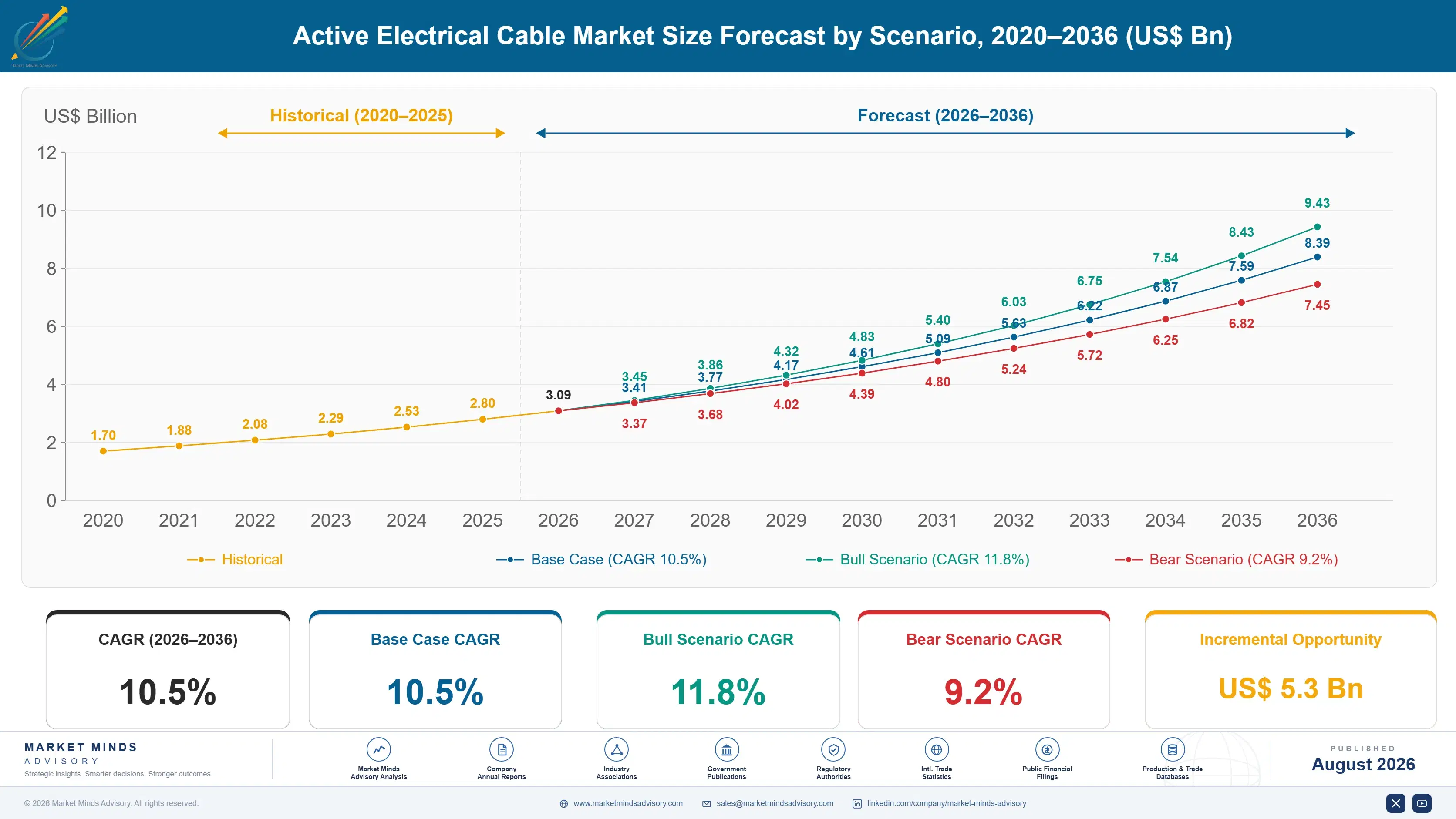
Between 2020 and 2025 the market grew near a 9.3% annual pace as data center Ethernet speed upgrades progressed gradually through 100G and 200G generations, before generative AI training cluster buildouts and 800G rack architecture adoption accelerated demand for active electrical cables sharply from 2023 onward as several hyperscale operators finalised next-generation cluster interconnect designs across newly commissioned facilities.
The base case carries the market to a 10.5% CAGR on three commercial mechanisms: 1.6T cable demand scaling as next-gen AI training clusters require higher per-lane bandwidth than optical can deliver at short reach, PCIe active electrical cable demand growing as disaggregated servers separate compute and memory resources across racks, and 400G cable replacement demand holding steady as enterprise data centers upgrade legacy Ethernet infrastructure across mature markets, a pattern visible across most major hyperscale buildouts tracked this year.
The bull case at 11.8% assumes AI training cluster capital spending accelerates faster than currently modelled across both hyperscale and enterprise facilities simultaneously. The bear case at 9.2% assumes optical interconnect cost declines continue displacing copper adoption longer than expected, holding category growth closer to legacy Ethernet replacement volume alone, a gap analysts will watch across the next several product generation cycles.

Signal Integrity Redraws a Commodity Cable

Three forces converge on this category at once. Budget-conscious enterprise buyers need affordable lower-speed cables that meet basic networking needs without added electronics cost, bandwidth-conscious hyperscale buyers need documented signal integrity and bit error rate data that satisfy demanding cluster reliability requirements, and assemblers need consistent retimer calibration that holds signal quality across thousands of installed cable runs without drifting from a fixed electrical specification.
TOP PRODUCER SHARETaiwan, 34%Share of global cable assembly output manufactured in Taiwanese facilities
AVERAGE UNIT PRICEUSD 420 per cableBlended average price across all active electrical cable speed categories
RETIMER CHIP COST SHARE38% of COGSRetimer and signal chip share of total unit cost
800G SEGMENT SHARE44% of volumeTotal unit volume shipped into flagship cable applications
QUALIFICATION APPROVAL CYCLE4 to 9 monthsTypical time required to certify a new hyperscale cable design
MARKET CONCENTRATIONCR5: 48%Combined share held by the five largest active cable suppliers
Commercially, the category increasingly rewards suppliers who can pair documented signal integrity certification with genuine hyperscaler qualification program relationships rather than relying on brand reputation alone. Suppliers that can demonstrate both certified bit error rate performance and consistent retimer calibration command premium rack deployment contracts that uncertified competitors cannot access, so operators increasingly default to established specialists over the cheapest uncertified assembly available. That preference has hardened as several budget assemblers failed extended qualification testing during recent cluster reliability reviews.
Over the next decade, signal integrity certification depth, retimer chip integration, and hyperscaler qualification program relationships will decide which suppliers convert one-time cable sales into durable multi-generation rack refresh contracts. Suppliers without genuine certification testing capability risk losing premium deployment placement entirely as AI cluster bandwidth requirements continue tightening across every major hyperscale facility worldwide.
"An active electrical cable used to be a commodity part. Now a hyperscaler wants a bit error rate certificate before the rack deployment contract even goes out for bid."
Director, High-Speed Interconnect and Data Center Practice · MMA Active Copper Interconnect Cable Systems Practice · August 2026

Market Trends

Documented Signal Integrity Becomes a Qualification Gatekeeper

Hyperscale operators increasingly commission independent signal integrity verification for flagship active electrical cable deployments as cluster reliability requirements demand documented, verifiable bit error rate data beyond simple manufacturer datasheets. Credo Technology and Astera Labs have both pursued dedicated qualification programmes specifically to serve this demand, since verification now requires laboratory partnerships that uncertified assemblers cannot provide without dedicated instrumentation investment. This shift is pulling deployment interest away from uncertified commodity cables toward certified assemblies that command substantially higher contract values, and the pattern is reinforcing itself as more hyperscalers formalize testing checklists into standard vendor qualification steps.
Market Impact: Adds 12% to AI cluster demand
PCIe Cables Differentiate Disaggregated Server Designs

Server architects increasingly favor PCIe active electrical cables that pair documented low-latency performance with flexible rack-scale resource disaggregation. Amphenol and TE Connectivity have both expanded PCIe cable product lines specifically to serve this demand, since latency-optimized engineering increasingly differentiates premium positioning from standard Ethernet cable alternatives sold at lower contract values. This shift is pulling supplier investment toward PCIe formats that carry meaningfully higher margin protection than conventional Ethernet cable sale typically provides, a gap widening every quarter as more server vendors add dedicated disaggregated compute zones to their platform roadmaps.
Market Impact: Adds 9% to Taiwanese cable demand

Market Opportunities and Growth Drivers

AI Training Cluster Buildouts Widen Bandwidth Demand

Sustained hyperscale investment in generative AI training cluster capacity continues driving demand for active electrical cables that match the per-lane bandwidth density modern GPU clusters now require inside rack and adjacent-rack reach. Multiple hyperscale operators have published updated cluster interconnect reference architectures specifically requiring documented signal integrity, giving suppliers with proven certification data a direct competitive advantage in securing deployment contracts. That buildout-driven demand has proven durable across multiple capital cycles rather than a passing trend, a durability already evident across at least three separate major cluster refresh cycles tracked by MMA.
Market Impact: Chip swings move margin 9 points

Taiwan's Assembly Base Sustains Production Growth

Taiwan's globally influential connector and cable assembly base, combined with rapid retimer chip integration expertise, sustains substantial category growth as domestic and international suppliers compete for hyperscaler contracts across newly commissioned assembly lines. Domestic assemblers have established dedicated signal integrity testing facilities specifically to serve this demand, since Taiwanese qualification standards increasingly track hyperscaler certification requirements more closely each product cycle. That base-driven growth has proven durable across multiple commissioning waves, reinforced further by expanding domestic testing capacity dedicated specifically to bit error rate verification, particularly across newly expanded southern Taiwan production campuses.
Market Impact: Certification costs delay entry 4 months

Market Restraints and Challenges

Retimer Chip Sourcing Volatility Compresses Supplier Margin

Advanced retimer chip costs used in active electrical cable assemblies have swung sharply in recent years as global semiconductor fabrication capacity moved independent of any change in downstream cable demand, since these chips share fabrication capacity with much larger networking and computing semiconductor sectors whose demand dwarfs the active cable category specifically. The root cause is broad semiconductor supply chain volatility rather than any category-specific issue, meaning suppliers absorb the same chip allocation swings affecting the entire industry. Suppliers are mitigating this through longer-term wafer allocation contracts and increased sourcing flexibility across foundries.
Market Impact: Certified cable demand grows 14% yearly

Qualification Testing Costs Constrain Small Assembler Entry

Independent bit error rate qualification costs well above basic assembly expenses continue constraining small assembler adoption of documented signal integrity across four to nine months longer than suppliers would otherwise prefer, limiting how quickly certified cables can actually reach hyperscale deployment regardless of assembler production capacity. The root cause is genuine laboratory testing cost structure rather than any assembler-side pricing strategy failure, since independent verification remains fundamentally more expensive to obtain than self-certified claims. Suppliers are mitigating this by pursuing shared testing consortiums and by expanding hyperscaler co-investment programmes designed to spread testing cost across multiple smaller assemblers simultaneously.
Market Impact: PCIe cable demand grows 16% yearly
4 additional market trends, 3 additional growth drivers, and 4 additional restraints and challenges are covered in the full report. Contact sales@marketmindsadvisory.com to access the complete intelligence.

Segment CAGR and Growth Architecture

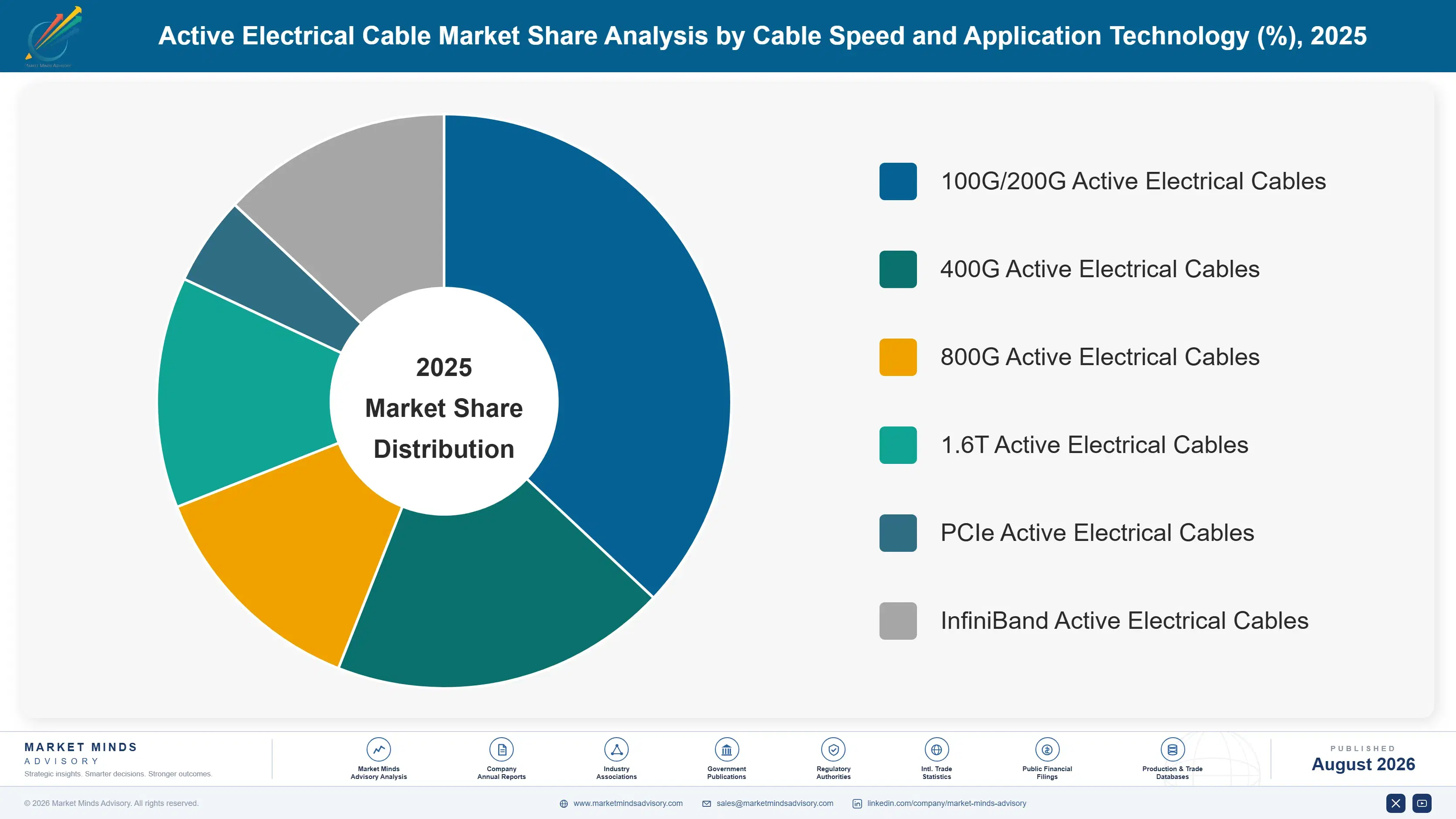
Segmentation follows cable speed and application technology, a single classification logic, since 100G/200G, 400G, 800G, 1.6T, PCIe, and InfiniBand active electrical cables each require distinct signal-conditioning disciplines rather than differing by price tier or distribution channel, and each dimension carries its own qualification profile that operators evaluate independently before committing to a supplier relationship.
active-electrical-cable-market-market-share-analysis-1788193441276

1.6T Active Electrical Cables

1.6T active electrical cables grow fastest at 24.0%, about 2.29 times the overall 10.5% rate, as next-generation AI training clusters increasingly demand per-lane bandwidth density that conventional 800G designs cannot reliably sustain across adjacent-rack reach. This segment demands retimer architecture and thermal management expertise that conventional assemblers cannot simply add without dedicated engineering investment. Credo Technology and Astera Labs lead qualified 1.6T supply, competing on documented bit error rate and thermal stability performance rather than price alone. Growth concentrates around flagship AI cluster applications, where documented performance increasingly justifies contract values well above conventional 800G units, and assemblers without proven testing data increasingly struggle to defend that pricing gap against better-certified competitors.
CAGR 24.0%

800G Active Electrical Cables

800G active electrical cables grow at 15.5%, the second-fastest segment, as current-generation AI training clusters increasingly demand proven bandwidth density that lower-speed designs cannot provide. Amphenol and TE Connectivity lead qualified 800G supply, competing on documented signal integrity and thermal consistency rather than raw unit price alone. Unlike lower-speed designs, this segment sells substantially into flagship hyperscale cluster applications rather than routine enterprise replacement, so retimer calibration and thermal management certification matter as much as bandwidth performance itself to an operator's purchase decision, since a supplier's ability to document consistent thermal performance across production units increasingly separates trusted interconnect specialists from smaller assemblers still refining their designs at scale, particularly across North American and East Asian hyperscale deployments.
CAGR 15.5%
Full segment breakdown across 6 segments available in the complete report.

Regional Architecture and Country Demand Map

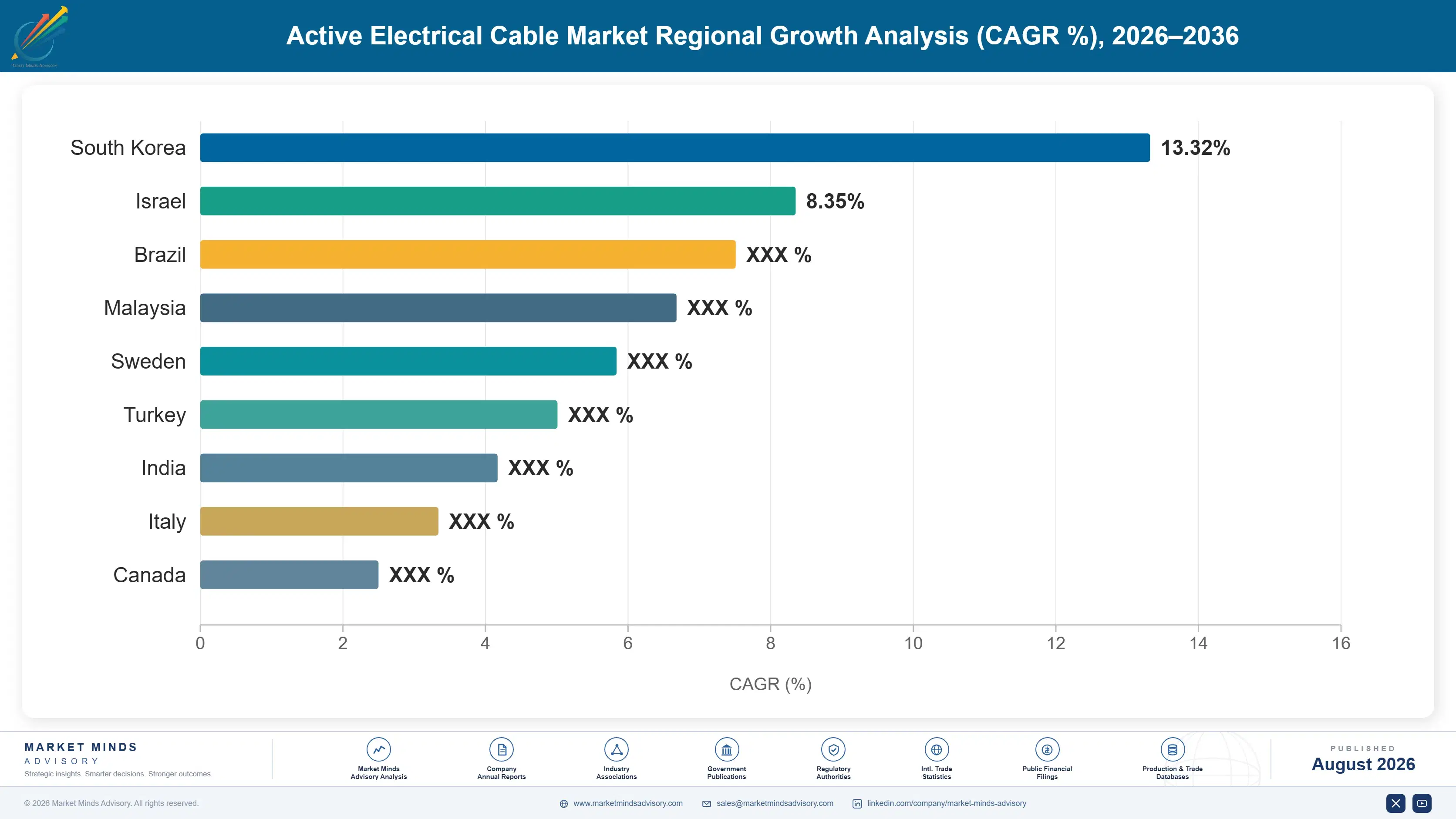
North America leads on concentrated hyperscaler AI cluster capital spending, while East Asia posts strong growth as Taiwan's connector assembly base scales certified production, and South Asia and Pacific expands fastest as Singapore's data center hub status pulls in new deployment demand, ahead of every other regional growth rate.

North America

United States hyperscaler AI training cluster capital spending, reinforced by concentrated Google, Meta, Microsoft, and Amazon data center buildout programmes, gives North America 32% of global value, the largest regional share in the category by a clear margin over every other region. Amphenol and Credo Technology's domestic manufacturing operations supply both hyperscale and enterprise customers through established qualified distribution networks. United States operators increasingly specify documented signal integrity before approving flagship cluster deployment budgets nationwide. Growth of 11.2% tracks AI capital spending more directly than any broader networking replacement cycle on its own, a position reinforced further by sustained hyperscale cluster capacity expansion across the next several cluster refresh generations.
Share: 32% | CAGR: 11.2% (2026 to 2036)

Western Europe

German and Irish data center modernisation programmes, combined with strict European Union energy efficiency requirements for hyperscale facilities, give Western Europe 19% of global value as operators retrofit aging networking infrastructure to meet tightening continental efficiency standards. TE Connectivity's substantial European operations hold deep engineering relationships across both legacy enterprise data centers and newer hyperscale campus sites. British and Dutch operators increasingly specify documented certification before approving flagship deployment placement. Growth of 9.0%, the slowest major region, reflects an already mature enterprise networking base rather than any underlying demand weakness, leaving suppliers focused mainly on service contracts across most legacy facilities rather than new hyperscale campus construction activity despite continued modernisation spending.
Share: 19% | CAGR: 9.0% (2026 to 2036)
Regional intelligence for 5 additional markets available in the complete report: East Asia, South Asia and Pacific, Latin America, Middle East and Africa, Eastern Europe. Contact sales@marketmindsadvisory.com.
active-electrical-cable-market-country-cagr-analysis-1788193442056

Where Signal Integrity Creates Deployment Margin

Margin in this category increasingly sits in documented signal integrity certification and hyperscaler qualification relationships rather than in raw assembly scale alone. Suppliers converting that capability into premium deployment contracts are pulling well ahead of competitors still selling uncertified cables into a shrinking price-sensitive replacement channel, particularly as more operators formalize supplier evaluation criteria around documented performance.

Build Documented Signal Integrity Certification Programmes

Suppliers that build documented signal integrity certification ahead of confirmed hyperscaler demand can access premium deployment contracts that unproven competitors cannot obtain regardless of the price they offer. Credo Technology's certification programme illustrates how testing investment made years before qualification scrutiny intensified converts directly into preferred-supplier status once operators expect documented bit error rate performance from a cluster-critical cable. That investment typically takes 4 to 9 months but opens the broadest possible premium hyperscale customer base available industry-wide That advantage compounds once a supplier's certification spans multiple hyperscaler programmes, reducing incremental testing cost per customer won.
Market Impact: Certification lifts average contract value by 21% overall

Develop Advanced Retimer Chip Integration Systems

Suppliers that develop documented retimer chip integration ahead of confirmed next-generation bandwidth demand capture premium contracts that competitors without advanced signal-conditioning expertise cannot fulfil once operators require guaranteed bit error rate performance across a cable's usable life. Astera Labs' engineering programme shows how design investment made before scrutiny intensified converts directly into preferred-supplier status once operators need proven bandwidth performance. That investment typically takes 6 to 12 months but lifts blended margin by roughly 18% once fully achieved Competitors lacking this capability typically lose bidding access to flagship cluster projects entirely once bandwidth density becomes a stated requirement.
Market Impact: Integration systems lift blended margin by 18% overall

Diversify Retimer Chip Sourcing Across Foundries

Suppliers that diversify retimer chip sourcing across multiple qualified foundries capture cost stability that single-source competitors cannot match when any one foundry's allocation tightens unexpectedly during a period of constrained global semiconductor demand. That diversification typically adds 4% to 8% to procurement cost but secures the delivery reliability that hyperscale deployment contracts increasingly require as a standing condition of the relationship itself. Suppliers ignoring this exposure absorb the allocation shortfall directly into delivery schedule slippage Suppliers ignoring this exposure typically absorb the allocation shortfall directly into delivery schedule slippage during peak demand periods across the industry.
Market Impact: Diversified sourcing adds roughly 4% to 8% cost

Establish Direct Hyperscaler Co-Investment Partnership Programmes

Suppliers that establish documented hyperscaler co-investment partnership programmes ahead of confirmed capacity planning cycles capture deployment slots that competitors without financing relationships cannot access once operators specify preferred supplier partners from the earliest capital planning stages. This approach typically adds 3% to 7% to contract administration cost relative to standard equipment sale, but lets suppliers secure deployment commitments years before a competing firm can intervene, a commitment operators increasingly treat as a baseline qualification step during vendor review Competitors slower to adopt financing typically lose deployment slots to better-prepared rivals entirely.
Market Impact: Co-investment partnerships add roughly 3% to 7% cost

Who Controls the Margin Pool

Concentration sits at a moderate CR5 of 48%, reflecting a category where documented signal integrity certification and hyperscaler qualification relationships, not raw assembly scale alone, separate a small group of established interconnect specialists from a longer tail of regional assemblers still building certification track record. Amphenol leads on documented certification breadth and installed base depth, and the gap to mid-tier challengers is measured in laboratory testing and retimer engineering investment rather than in assembly capacity alone.
All participants are assessed on unit shipment volume across hyperscale and enterprise deployment channels, a consistent basis given how widely certification and engineering depth vary by supplier across the category. Current competitive activity concentrates on three fronts: signal integrity certification development, retimer chip integration engineering, and chip sourcing diversification. That pattern spans every major supplier competing in the category.

Emerging pressure comes from Chinese assembly specialists scaling certification testing faster than legacy Western firms expected, backed by rapidly expanding domestic hyperscale supply chains and export ambition. Rankings are likely to shift toward suppliers combining certification credibility with retimer engineering depth, since neither installed base nor assembly scale alone decides premium deployment placement anymore in this category.
active-electrical-cable-market-company-positioning-matrix-1788193442742

Competitive Moat and Risk Dimensions

AMPHENOL CORPORATION

Moat: Deepest global qualification network

Amphenol's established global qualification network and documented certification history give it flagship deployment access that newer entrants cannot replicate without years of laboratory testing track record. That reach lets it serve multiple hyperscale and enterprise channels simultaneously with proven certification documentation across a very large installed base worldwide.
AMPHENOL CORPORATION

Risk: Retimer Integration Development Lag

Amphenol's connector-first engineering heritage leaves it comparatively less advanced in retimer chip integration than newer entrants purpose-built around signal-conditioning electronics from the outset, risking premium segment erosion as high-bandwidth formats become a genuine purchase driver, a gap that competitors with dedicated retimer engineering teams already purpose-built from inception are positioned to exploit over the coming several product cycles.
CREDO TECHNOLOGY GROUP

Moat: Strong retimer engineering depth

Credo Technology's established retimer chip engineering capability and documented bit error rate performance give it premium contract access that mass-market competitors must contest through lengthy certification processes that discerning hyperscalers increasingly require. That engineering depth also feeds testing data back into next-generation cable development ahead of competitors relying on simpler designs.
CREDO TECHNOLOGY GROUP

Risk: Limited Enterprise Channel Distribution

Credo Technology's hyperscale-first distribution heritage leaves it more exposed to enterprise channel relationship gaps than legacy suppliers serving broad networking markets across multiple decades already, limiting how quickly it can convert hyperscale credibility into the enterprise-channel scale that budget-conscious operators increasingly expect from a category leader.

Players Tracked

Prominent Players

Amphenol Corporation
TE Connectivity Ltd
Molex LLC
Credo Technology Group
Astera Labs Inc.

Other Key Players

Siemon Company
Leviton Manufacturing Co Inc
Belden Inc.
Corning Incorporated
Coherent Corp
Foxconn Interconnect Technology
Luxshare Precision Industry Co Ltd
Fujitsu Optical Components Ltd
Sumitomo Electric Industries Ltd
Prestolite Wire LLC
Southwire Company LLC
Nexans SA
Prysmian Group
Hisense Broadband
Radiall SA

Recent Developments

JANUARY 2025

Credo Technology Expands Signal Integrity Testing Facility

Credo Technology completed an organic capacity expansion at its independent signal integrity testing facility to meet growing demand from multiple cable product lines. The expansion was an organic capacity build, not an acquisition or joint venture, adding dedicated testing volume ahead of anticipated demand across two new test cells.
Signal: An organic expansion, not a transaction, shows suppliers investing well ahead of confirmed demand growth across the category.
MAY 2025

Amphenol Signs Hyperscaler Co-Investment Agreement

Amphenol signed a multi-year hyperscaler co-investment agreement with a leading cloud operator to provide financed cable deployment across an expanded cluster upgrade programme. The arrangement was a supply agreement, not an acquisition or joint venture, securing guaranteed volume directly ahead of the operator's capital schedule.
Signal: A supply agreement, not a merger, shows operator demand now drives multi-year sourcing decisions well ahead of schedule.
SEPTEMBER 2025

Astera Labs Acquires Minority Stake in Thermal Startup

Astera Labs acquired a minority equity stake in a thermal management startup developing novel cooling technology for high-bandwidth active cable applications. The transaction was an equity investment rather than a full acquisition or merger, giving Astera Labs early technology access without full development risk ahead of competitor moves.
Signal: A minority stake, not a full acquisition, shows suppliers hedging thermal technology bets rather than committing fully upfront.

Retimer Chip and Assembly Exposure

Retimer chips and signal-conditioning electronics account for roughly 38% of unit cost, sourced from established semiconductor foundries across Taiwan, the United States, and South Korea, with connector housings and precision assembly labor adding a further 16% to 22% depending on product category and bandwidth complexity required for the specific cable involved, with logistics and qualification testing adding further cost layers across the supply chain.
Retimer chip prices climbed sharply through 2022 and 2023 as global advanced semiconductor fabrication demand rebounded against constrained leading-edge foundry capacity across major producing regions. The International Energy Agency has documented semiconductor supply concentration as a persistent manufacturing concern given the limited number of qualified leading-edge foundries, and suppliers without long-term wafer allocation contracts absorbed the cost spike directly into margin during the worst months of that period.

Exposure varies considerably by supplier scale and sourcing diversity across the industry. Larger integrated suppliers like Amphenol hedge chip exposure through long-term foundry allocation partnerships, while smaller regional assemblers buying chips on constrained markets absorb price swings immediately into unit cost with no buffer available. That gap leaves smaller assemblers disadvantaged during volatile periods across every price tier.
active-electrical-cable-market-cost-volatility-analysis-1788193442961

Secure long-term wafer allocation contracts

Locking retimer chip volume through long-term foundry allocation contracts protects assembly schedules from constrained supply during periods of peak semiconductor demand across the industry. This trades some pricing flexibility for delivery certainty that hyperscale deployment contracts increasingly require as a standing condition of doing business. Suppliers that skip this step often regret it later, especially during constrained quarters.

Invest in flexible retimer design architecture

Suppliers shipping sufficient volume can justify investing in flexible design architecture that accommodates multiple chip generations, capturing supply flexibility currently unavailable to single-source competitors while gaining direct control over cost timing, a capability that smaller single-generation competitors typically cannot justify building on their own given the required capital outlay That flexibility pays for itself quickly.

Diversify chip sourcing across producing regions

Qualifying foundries across multiple regions simultaneously reduces exposure to any single region's trade policy disruption or fabrication capacity constraint event. Suppliers with diversified sourcing recovered from the 2022 to 2023 spike measurably faster than single-source buyers did, a lesson now shaping how most suppliers plan sourcing strategy for the coming decade Larger suppliers therefore hold a durable resilience advantage.

Portfolio Architecture for Margin Defence

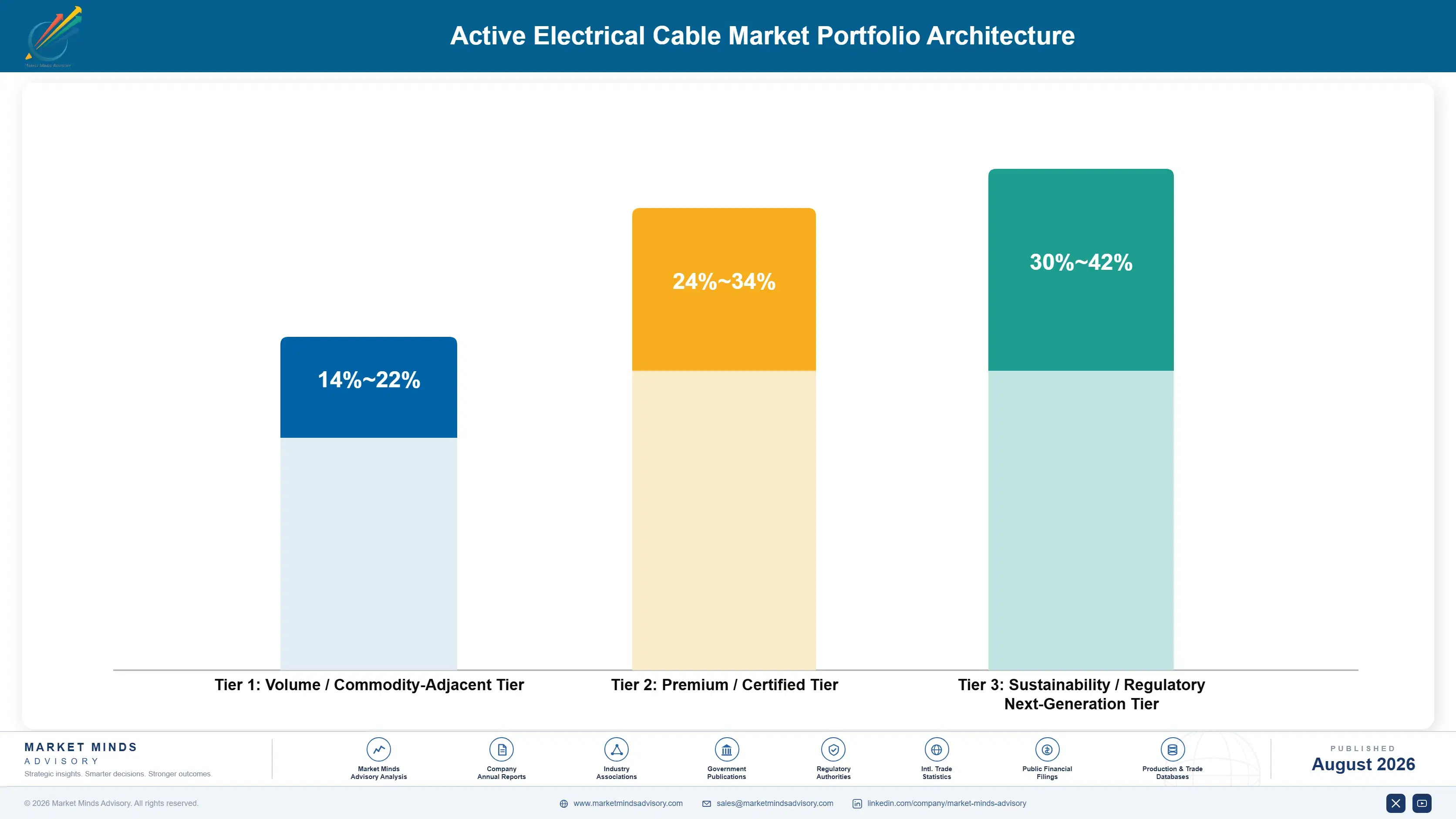
The portfolio splits into three tiers with clear margin separation tied to certification depth and product category served. Commodity-grade uncertified cables for basic replacement applications compete on price and earn thin margins, certified high-speed units earn considerably more, and premium 1.6T systems carry the highest margin given their engineering integration barriers and hyperscaler qualification relationship depth protecting that position from new entrants.
The tension between volume and premium reflects category directly: hyperscale operators and bandwidth-constrained clusters investing in certified platforms reward documented bit error rate performance and engineering quality over price, pulling suppliers toward sustained certification investment year after year, while much of the commodity replacement segment still buys on price alone with delivery speed mattering more than certification depth. Suppliers running multiple product lines must manage genuinely distinct engineering, testing, and qualification organisations without letting either investment starve the other of resources.

High-value margin pools concentrate in premium 1.6T and 800G certified contracts, where documented performance and engineering depth both reward proven supplier capability directly and consistently. The volume core of commodity replacement cable sale remains necessary for manufacturing scale but contributes comparatively little to blended margin across the portfolio as a whole.

Volume / Commodity-Adjacent Tier

Commodity-grade uncertified cables sold into basic enterprise replacement applications, competing primarily on price with limited certification investment behind them. Margins stay thin because delivery speed, not certification depth, decides most outcomes here.
Gross Margin: 14-22%

Premium / Certified Tier

Certified high-speed units sold under documented bit error rate performance into mainstream hyperscale deployment contracts across multiple operator segments worldwide. Suppliers earn meaningfully better margin here once operators trust documented certification claims fully.
Gross Margin: 24-34%

Sustainability / Regulatory / Next-Generation Tier

Premium 1.6T systems engineered specifically for the most demanding bandwidth and thermal requirements available in the category today. This tier commands strongest margin protection since engineering and certification barriers keep competitors from replicating it quickly.
Gross Margin: 30-42%
active-electrical-cable-market-portfolio-architecture-1788193443497

High-value Sub-segments and Strategic Watch-out

1.6T Active Electrical Cables

High value and the fastest-growing category at 24.0% CAGR, carrying both a certification premium and genuine engineering barriers to entry that protect early movers from new entrants over time in most flagship AI cluster markets, where hyperscalers increasingly treat documented performance as a baseline qualification condition, not a competitive extra.
Gross Margin: 30-42%

800G Active Electrical Cables

High value with strong growth, sustained by hyperscale operators specifying documented thermal and bandwidth consistency across multiple cluster applications. Margin varies with the engineering depth a supplier holds today across the category, and premium contracts increasingly require documented thermal evidence before any bid is even considered eligible for review.
Gross Margin: 24-34%

400G Active Electrical Cables

The volume core, competing on price and consistency across most mainstream enterprise replacement applications worldwide, since most buyers in this segment select on availability and unit price rather than any documented performance credential, leaving little room for differentiated positioning, leaving little room for meaningful margin improvement over time.
Gross Margin: 14-22%

100G/200G Active Electrical Cables

The strategic watch-out, where operator willingness to pay a certification premium remains largely unproven across niche legacy applications today, with some buyers already willing to pay a modest premium for consistently documented reliability data, though most legacy buyers still prioritize price over any documented performance credential.
Gross Margin: 16-26%

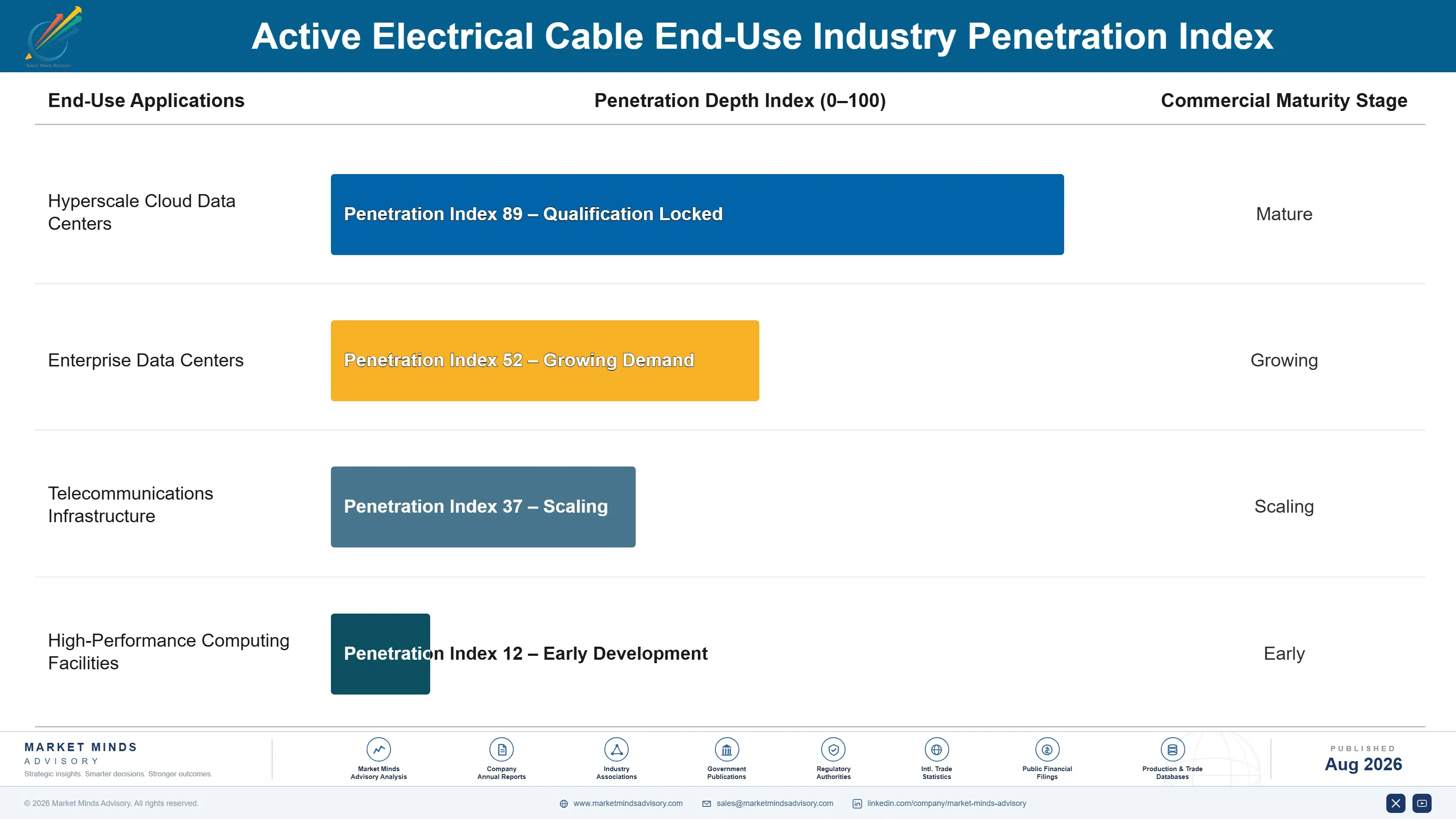
Hyperscaler Trust and Qualification Lock-In

Demand behaves like an annuity once a supplier wins hyperscale qualification status: operators rarely switch preferred cable partners mid-cluster-generation, since replacing a qualified line means repeating months of testing review against an already proven design. That repeat-purchase pattern gives incumbent qualified suppliers a durable revenue base that newer competitors cannot easily displace once qualification status is established across a cluster generation's commercial life.
Adoption depth varies sharply by operator category. Bandwidth-constrained hyperscalers have converted deepest, since documented certification and bit error rate requirements make qualified sourcing close to mandatory for responsible cluster deployment today. Mid-size enterprise data center operators adopt more selectively, weighing contract cost against bandwidth urgency on a project-by-project basis, while smaller colocation operators remain the shallowest adopters, often defaulting to whatever cable is available that budget cycle.

Buyer profiles are shifting generationally. Younger network engineering teams increasingly default to certification-verified suppliers without evaluating basic alternatives as heavily, treating documented signal integrity performance as a baseline requirement rather than an optional consideration. That default is spreading faster among first-time hyperscale project teams than among experienced engineers, who weigh proven reliability track record most heavily at the point of purchase decision.
active-electrical-cable-market-end-use-penetration-index-1788193444001

Certification Beats Legacy Assembly Scale

These are among the four positions where our research anticipates prominent divergence between winners and laggards over the coming forecast period. Each is grounded in the demand model, the regulatory perimeter, and the announced capacity pipeline.
01 / CERTIFICATION STRATEGY TIMING

Suppliers without signal data will lose deployment contracts by 2029

Operators increasingly default to suppliers holding documented signal integrity certification, since uncertified assemblers cannot supply the bit error rate evidence that qualification teams now require before approving flagship deployment budgets. Credo Technology's certification programme shows how addressable deployment access follows directly from testing investment completed years earlier rather than from any late reliability claim. That certification gap will only widen as more hyperscalers formalize testing requirements into standard qualification criteria, especially once cluster reliability risk enters into consideration, particularly among operators serving latency-sensitive AI training workloads.
02 / RETIMER ENGINEERING TIMING

Early engineering investment will decide long-term premium contract share

Premium operators increasingly require documented retimer engineering before approving any flagship cable purchase decision. Suppliers without that capability cannot bid on premium deployment contracts regardless of the price they offer during negotiation. Astera Labs' engineering investment shows how design work completed years before scrutiny intensified converts directly into preferred-supplier status, a trend already visible across multiple regional deployment partnerships now formalizing bandwidth requirements into standard evaluation criteria, especially as 1.6T designs become the default specification in new hyperscale builds, particularly among hyperscalers seeking documented bandwidth guarantees.
03 / CHIP DIVERSIFICATION APPROACH

Diversified sourcing will separate resilient suppliers from exposed rivals

Retimer chip volatility is exposing suppliers with concentrated single-foundry sourcing to recurring margin disruption that vertically integrated competitors largely avoid through in-house design control. Suppliers who invest in sourcing diversification now will capture premium contracts that increasingly demand documented cost stability from every bidder under consideration. That resilience gap will only widen as chip price volatility continues across the broader semiconductor sector worldwide, especially as foundries consolidate and fewer qualified suppliers remain available industry-wide overall, particularly as foundry capacity remains tightly allocated across competing customers.
04 / HYPERSCALER FINANCING INNOVATION

Financing programmes will determine which suppliers win deployment slots

Operators increasingly favour suppliers offering documented co-investment and financing partnership programmes over standard equipment sale, since deployment slot access increasingly decides which cable suppliers stay ahead of competitor products during the earliest capital planning stages. Suppliers without this financing approach cannot match deployment access regardless of any product quality advantage they might otherwise offer, and that advantage compounds further once operators lock in multi-generation deployment commitments across several cluster sites simultaneously. Operators that formalize this requirement early will likely see the fastest gains.

Engagement Snapshot From the Field

A live engagement with an industry participant carrying material or product regulatory and market exposure ahead of a defining policy shift, showing how our research translates into a defensible multi-year portfolio strategy.
MARKET MINDS ADVISORY · CLIENT ENGAGEMENT SUMMARY
Active Electrical Cable Producer Strategic Portfolio Review and Transition Roadmap 2026·Investment Scenario on Active Electrical Cable Exposure Evaluation 2025-26
CLIENT PROFILE
A hyperscale cloud operator approached MMA while evaluating active electrical cable supplier partnerships ahead of a multi-site AI training cluster deployment programme. The client reported annual cable procurement spend surpassing USD 40 million and a deployment deadline tied to a twelve-month cluster commissioning window (client-reported, unverified by MMA). The client flagged uncertainty around qualification timelines as a concern.
STRATEGIC CHALLENGE
Management wanted to complete the deployment ahead of the cluster commissioning deadline but had not benchmarked signal integrity certification and engineering capability across available suppliers, nor evaluated whether any single supplier could realistically supply the full multi-site scope within the planned window, risking budget overruns if the wrong supplier commitment locked in too early.
MMA APPROACH
MMA benchmarked signal integrity certification, engineering capability, and delivery capacity across the four suppliers the client was evaluating for its deployment programme. We modelled delivery timelines against the commissioning deadline and quantified realistic phasing scenarios using comparable hyperscale operator benchmarks. We also interviewed the client's network engineers to confirm realistic installation timelines against actual crew staffing levels.
KEY FINDINGS
  1. Only two of four evaluated suppliers offered documented independent bit error rate certification sufficient to satisfy the client's cluster reliability review (client-reported, unverified by MMA).
  2. Phasing the deployment across two cluster tiers added roughly 4% to total programme cost while meaningfully reducing supply risk across the multi-site scope.
  3. The fastest realistic single-supplier delivery timeline ran nine months, shorter than the client's twelve-month deadline allowed under the originally proposed deployment scope.
  4. Suppliers with existing hyperscaler co-investment infrastructure cleared the client's approval process measurably faster than suppliers lacking comparable programmes, reducing internal review time.
CLIENT PROFILE
A hyperscale cloud operator approached MMA while evaluating active electrical cable supplier partnerships ahead of a multi-site AI training cluster deployment programme. The client reported annual cable procurement spend surpassing USD 40 million and a deployment deadline tied to a twelve-month cluster commissioning window (client-reported, unverified by MMA). The client flagged uncertainty around qualification timelines as a concern.
STRATEGIC CHALLENGE
Management wanted to complete the deployment ahead of the cluster commissioning deadline but had not benchmarked signal integrity certification and engineering capability across available suppliers, nor evaluated whether any single supplier could realistically supply the full multi-site scope within the planned window, risking budget overruns if the wrong supplier commitment locked in too early.
MMA APPROACH
MMA benchmarked signal integrity certification, engineering capability, and delivery capacity across the four suppliers the client was evaluating for its deployment programme. We modelled delivery timelines against the commissioning deadline and quantified realistic phasing scenarios using comparable hyperscale operator benchmarks. We also interviewed the client's network engineers to confirm realistic installation timelines against actual crew staffing levels.
KEY FINDINGS
  1. Only two of four evaluated suppliers offered documented independent bit error rate certification sufficient to satisfy the client's cluster reliability review (client-reported, unverified by MMA).
  2. Phasing the deployment across two cluster tiers added roughly 4% to total programme cost while meaningfully reducing supply risk across the multi-site scope.
  3. The fastest realistic single-supplier delivery timeline ran nine months, shorter than the client's twelve-month deadline allowed under the originally proposed deployment scope.
  4. Suppliers with existing hyperscaler co-investment infrastructure cleared the client's approval process measurably faster than suppliers lacking comparable programmes, reducing internal review time.
RECOMMENDED STRATEGY
Phase 1: Phase 1 (0 to 3 months): Launch the certification-verified supplier at the two highest-priority cluster sites first to minimize early operational disruption. Phase 2: Phase 2 (3 to 7 months): Extend the deployment to remaining sites once initial installation data confirms performance across the remaining planned sites. Phase 3: Phase 3 (7 to 9 months): Reassess supplier performance annually against certification and delivery benchmarks achieved and adjust future planning accordingly each year.
OUTCOME
The client proceeded with the phased single-supplier deployment, completing cluster commissioning ahead of the internal deadline and finishing installation within its nine-month target window. The client reported avoiding an estimated two-month commissioning delay it had modelled under a multi-supplier scenario (client-reported, unverified by MMA). The operator has since renewed the supplier partnership for its next cluster generation.

Frequently Asked Questions

Foundational context covering the market sizes, CAGR, scope, country, region and competition that inform every finding below. This section is provided to cover basics and most often pre-purchase conversations, answered from the MMA Primary Research Dataset.

What is the current size of the Active Electrical Cable Market?

The Active Electrical Cable Market stood at USD 2.8 billion in 2025, based on MMA Primary Research Dataset estimates. AI training cluster buildouts and 800G rack adoption are the primary near-term growth drivers.

How large will the Active Electrical Cable Market be by 2036?

MMA projects the market reaching USD 8.39 billion by 2036 under the base case scenario. That represents a 2.72 times expansion over the 2026 base value.

What is the CAGR for the Active Electrical Cable Market 2026 to 2036?

The base case CAGR is 10.5% annually. The bull case reaches 11.8% and the bear case falls to 9.2%, depending on AI cluster capital spending and certification adoption.

Which segment is growing fastest?

1.6T active electrical cables grow fastest at 24.0% CAGR, about 2.29 times the overall market rate. Next-generation AI training cluster bandwidth demand drives that sustained pace across flagship deployments.

Who are the major companies in the Active Electrical Cable Market?

Amphenol, TE Connectivity, Molex, Credo Technology, and Astera Labs lead the category today. Combined, the top five hold a CR5 of 48%, leaving room for smaller regional assemblers to grow.

Which country is growing fastest?

Singapore grows fastest at 13.2% CAGR, driven by its established data center hub status. Rising regional interconnection demand is reinforcing that pace further each year.

Report Segmentation Architecture

The full report scope spans multiple orthogonal segmentation dimensions, with cross-tabulated demand data provided for each dimension pair. Coverage extends further to regional breakdowns, trend trajectories, and the competitive detail needed to support segment-level decision-making.

By Cable Speed and Application Technology

  • 100G/200G Active Electrical Cables
  • 400G Active Electrical Cables
  • 800G Active Electrical Cables
  • 1.6T Active Electrical Cables
  • PCIe Active Electrical Cables
  • InfiniBand Active Electrical Cables

By End-Use Industry

  • Hyperscale Cloud Data Centers
  • Enterprise Data Centers
  • Telecommunications Infrastructure
  • High-Performance Computing Facilities

By Commercial Dimension

  • Direct Hyperscaler Procurement
  • Original Equipment Manufacturer Sale
  • Distributor and Systems Integrator Sale
  • Co-Investment and Financing Programme Sale

By Region

  • North America
  • Western Europe
  • East Asia
  • South Asia and Pacific
  • Latin America
  • Middle East and Africa
  • Eastern Europe

Scope, Methodology, and Coverage

Every figure in this report is reproducible from documented input assumptions. The scope below maps the historical period, the forecast horizon, the segmentation dimensions, and the countries covered, alongside the underlying primary and qualitative methodology.
Historical Period
2020 to 2025
Forecast Period
2026 to 2036
Base Year
2025 (USD billions; MMA Primary Research Dataset, August 2026)
Market Definition
The active electrical cable market comprises 100G/200G, 400G, 800G, and 1.6T active electrical cables, PCIe active electrical cables, and InfiniBand active electrical cables used for high-speed copper interconnects in data center and high-performance computing environments. Passive direct-attach copper cables, active optical cables, and fiber-based transceiver modules that do not use embedded signal-conditioning electronics within a copper cable assembly are excluded.
Quantitative Units
USD billions (current prices); unit shipment volume where applicable
Segmentation Dimensions
By Cable Speed and Application Technology; By End-Use Industry; By Commercial Dimension; By Region
Regions Covered
North America, Western Europe, East Asia, South Asia and Pacific, Latin America, Middle East and Africa, Eastern Europe
Countries Covered
USA, Canada, Germany, Ireland, UK, Netherlands, China, Japan, Taiwan, South Korea, Singapore, India, Australia, Brazil, Mexico, Chile, UAE, Saudi Arabia, South Africa, Poland, Czech Republic, Romania, and additional markets relevant to this sector
Key Companies Profiled
Amphenol Corporation, TE Connectivity Ltd, Molex LLC, Credo Technology Group, Astera Labs Inc., Siemon Company, Leviton Manufacturing Co Inc, Belden Inc., Corning Incorporated, Coherent Corp, Foxconn Interconnect Technology, Luxshare Precision Industry Co Ltd, Fujitsu Optical Components Ltd, Sumitomo Electric Industries Ltd, Prestolite Wire LLC, Southwire Company LLC, Nexans SA, Prysmian Group, Hisense Broadband, Radiall SA
Quantitative Methodology
Primary survey, n=3,800 respondents, Q4 2025, six countries; demand-side model with trade association cross-validation
Qualitative Methodology
47 expert interviews, Q4 2025; applied to validate demand model assumptions, identify emerging dynamics, and assess competitive positioning
Report Format
PDF and XLSX data workbook (Word format preview document)
Publisher
Market Minds Advisory
Report Code
MMA-2026-TEC-217
Published
August 2026
Contact
sales@marketmindsadvisory.com | www.marketmindsadvisory.com

Purchase the full Active Electrical Cable Market Report (2026 to 2036).

The full MMA Active Electrical Cable report sizes the market across six speed and application categories, four end-use industries, four commercial dimensions, and seven regions through 2036. It profiles twenty suppliers on a consistent unit shipment volume basis, scoring each on certification capability, retimer engineering depth, and chip sourcing diversification. Scenario models quantify how AI cluster capital spending, certification adoption, and chip price cycles shift both volume and realised price across product tiers. The report also includes delivered-cost modelling by product category, a chip exposure screen, and deployment contract analysis built for engineering, procurement, and investment teams.
Six-category segmentation with cross-tabulated regional demand
Twenty-supplier competitive benchmarking on shipment volume
Signal integrity certification tracking by supplier and region
Retimer chip and thermal engineering adoption analysis
Advanced chip price scenario modelling through 2036
Country-level hyperscale buildout and deployment tracking

Built For The People Who Decide

From boardroom strategy to bench-side execution, this report is read cover-to-cover by leaders shaping the next decade of their industry, turning demand scenarios, market dynamics and valuation benchmarks into decisions.
CXOs/ Presidents/ VPs/ Managers
M&A and Corporate Development
Strategy Teams and R&D Heads
Procurement and Product Directors
Regulatory and Compliance Leaders
Investor Relations and Equity Analysts