Market Minds Advisory
Active and Modified Atmospheric Packaging Market

Active and Modified Atmospheric Packaging Market: Shelf Life Became A Sales Metric

A commercial reading of gas-flush and oxygen-scavenging packaging technology, where retailers now price shelf life directly into supplier contracts, and food waste regulation is converting a quality upgrade into a compliance requirement across fresh categories.

Lead Analyst

Bilal Shaikh

Published

September 2026

Make Smarter Decisions with Customized Research Insights

Request a free sample report and evaluate market opportunities, growth trends, and competitive dynamics relevant to your business needs.

2025 MARKET VALUE$9.4BMarket Size 2025
2036 FORECAST VALUE$23.3BBase Case , 2026 to 2036
CAGR 2026 TO 20368.6 %Bull 9.9% / Bear 7.3%
INCREMENTAL OPPORTUNITY$13.1BNet 10- year value creation
EXPANSION MULTIPLE2.28x2036 value over 2026 base
Strategic Levers
M&A Pipeline
Regional Outlook
Country Rankings
Competitive Intelligence
Segmental Deep-dive
Call-Us : 91 93563 13602

Executive Snapshot and Market Trajectory

Retailers stopped treating shelf life as a packaging engineer's problem and started writing it into supplier scorecards directly. A tray that holds fresh colour three days longer moves less waste off the shelf, and that arithmetic now shapes packaging specification before a single design meeting even happens.
The market stands at USD 9.4 billion in 2025 and reaches USD 23.30 billion by 2036 at an 8.6% CAGR. Active packaging with oxygen scavengers grows fastest at 11.8%, about 1.37 times the overall rate, as processors move beyond passive gas-flush toward technology that actively manages internal atmosphere throughout shelf life. India posts the quickest national growth at 11.2% as organised fresh food retail expands into markets that previously ran almost entirely on open-air sale.
Concentration is moderate at 39% for the top five, split between diversified packaging majors bundling gas-flush capability into broader flexible packaging lines and specialist active packaging developers selling technology depth those majors cannot easily replicate. Two forces are reshaping the field right now. Food waste regulation is converting shelf-life extension from a quality upgrade into a compliance expectation, and retailers are increasingly specifying gas mix performance directly in supplier contracts.
Market Definition
The active and modified atmospheric packaging market covers packaging technologies that alter or actively manage internal gas composition to extend the shelf life of perishable food, including gas-flush modified atmosphere packaging, oxygen scavengers, moisture regulators, and antimicrobial active packaging. Standard vacuum packaging without gas modification, packaging machinery sold separately, and non-food active packaging applications are excluded.
Base Year Value
$9.4B in 2025 (MMA Primary Research Dataset, August 2026)
Forecast Period
2026 to 2036, eleven discrete annual values
CAGR
8.6% base case. Bull 9.9%. Bear 7.3%.
Fastest Growth Segment
Active Packaging with Oxygen Scavengers: 11.8% CAGR
Fastest Growth Country
India: 11.2% CAGR
Fastest Growth Region
South Asia and Pacific: 10.6% CAGR
Largest Region
North America: 27% of 2025 global value
Market Leaders
Amcor, Sealed Air, Sonoco, Multivac, Winpak. Source: MMA Analysis based on company disclosures.
Primary Survey
n=3,800 procurement and R&D decision-makers, Q4 2025, six countries
Methodology
Demand-side build-up, cross-validated against public data, 47 expert interviews

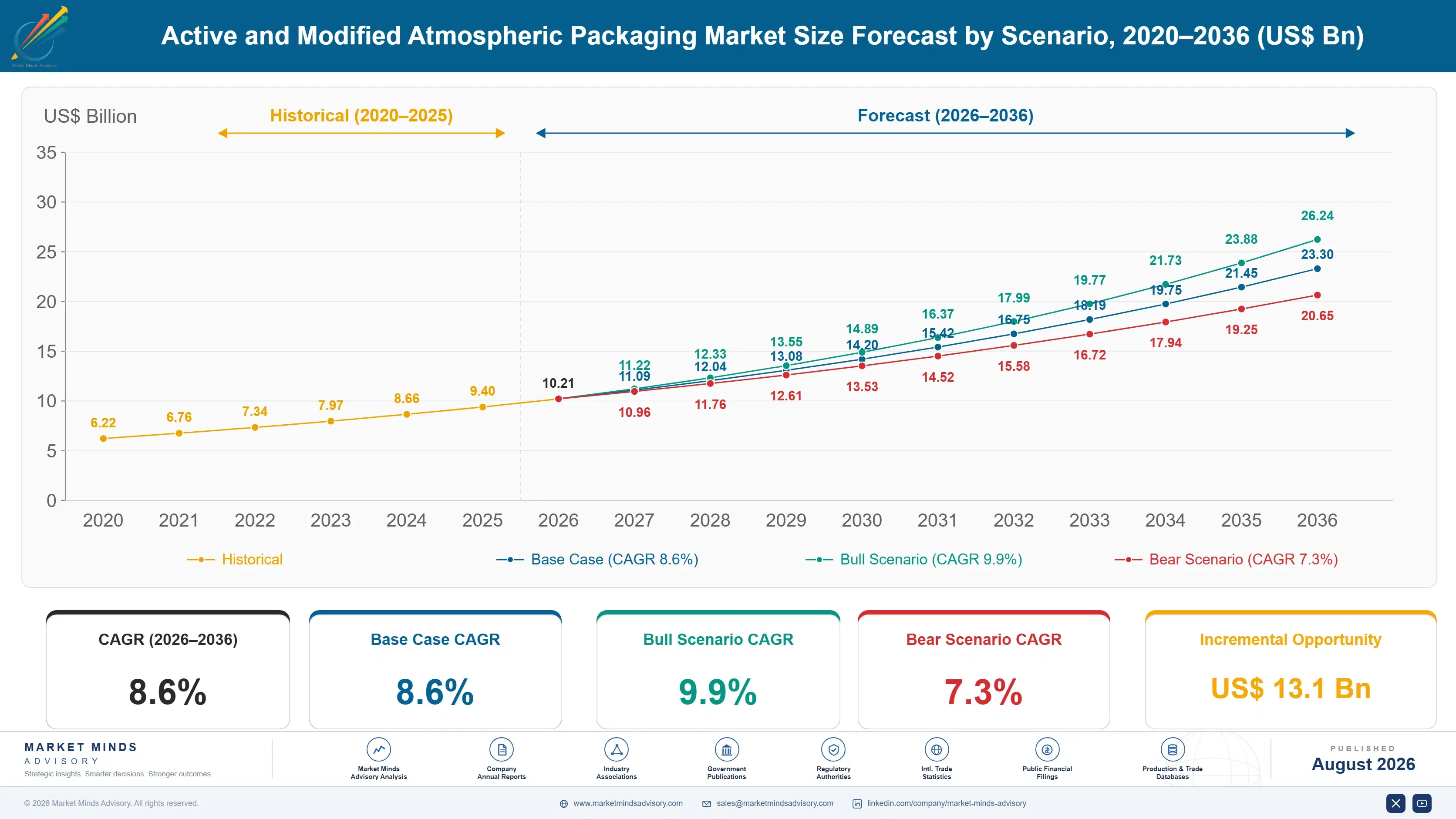
Active and Modified Atmospheric Packaging Market Forecast Scenarios

active-and-modified-atmospheric-packaging-market-size-forecast-scenario-1787332091734
Growth from 2020 to 2025 compounded near 7.4%, accelerated by pandemic-era supply chain disruption that pushed retailers and processors to prioritise shelf-life extension as a buffer against unpredictable delivery schedules and labour shortages across the fresh food supply chain, a lesson the industry has not forgotten and continues to price into capital planning decisions across most major processors and retail chains.
Three mechanisms carry the base case to 8.6%. First, retailer contract specification, as major grocery chains increasingly write minimum shelf-life performance directly into supplier agreements rather than leaving gas mix selection to the packer. Second, food waste regulation, as several jurisdictions add reporting or reduction targets that make shelf-life extension a compliance lever rather than a discretionary upgrade. Third, organised retail expansion in emerging markets, which brings fresh food categories into cold chains and packaging formats that barely existed before.
The bull case at 9.9% assumes food waste regulation tightens faster across more jurisdictions and organised retail expansion in South Asia outpaces current projections meaningfully. The bear case at 7.3% assumes processors delay technology upgrades during a period of margin pressure and retailers prioritise price over shelf-life performance in categories where consumers show limited willingness to pay a premium.

Why Retailers Now Write Shelf Life Into Contracts

Three forces set demand. Retailer contract specification provides the volume base, as grocery chains increasingly write minimum shelf-life performance into supplier agreements rather than leaving gas mix selection to individual packers. Food waste regulation provides a second, tightening layer of pressure, converting shelf-life extension into a compliance question rather than a purely commercial one. Organised retail expansion in emerging markets adds a third, faster-growing volume stream.
MARKET CONCENTRATIONCR5: 39%Moderately concentrated among diversified packaging majors and specialists
AVERAGE SELLING PRICEUSD 0.03 to 0.60 per unitUnit cost spread across basic gas-flush to active scavenging formats
TOP PRODUCING COUNTRY SHAREUnited States: about 22%Share of global active and modified atmosphere packaging output
SHELF-LIFE EXTENSION RANGE2 to 12 daysTypical additional shelf life delivered versus unmodified packaging formats
GAS AND FILM COSTAbout 30% of COGSPortion of production cost from gas mix and barrier film
RETAIL WASTE REDUCTION RATEAbout 18% to 25%Typical shrinkage reduction retailers report after adopting extended formats
The commercial character is set by gas and film cost more than by processing line sophistication. Gas mix and barrier film together account for roughly 30% of cost of goods sold, and that cost structure is exactly why active packaging, which commands meaningfully higher pricing than passive gas-flush, has become the segment processors invest in first once shelf-life performance becomes a genuine requirement rather than a nice-to-have feature.
The next decade turns on two things. Whether food waste regulation expands from its European and select American base into additional jurisdictions with binding reduction targets, since that expansion would convert discretionary spending into mandated investment overnight. And whether organised retail penetration in South Asia keeps accelerating, since that expansion is pulling new packaging categories into formats that barely existed five years ago.
"Every retailer used to talk about shelf life like it was a nice feature on the spec sheet. Now it shows up in the vendor scorecard next to price and fill rate, and a supplier who can't hit the shelf-life number loses the shelf space regardless of what the product actually tastes like."
Director, Food Packaging and Shelf-Life Technology Practice · MMA Packaging / Sh

Market Trends

Retailers Are Writing Shelf-Life Minimums Directly Into Contracts

Major grocery chains have moved from treating shelf life as a quality attribute they hope suppliers deliver toward specifying minimum shelf-life performance directly in supplier agreements, tied to measurable gas mix and barrier film requirements rather than vague quality language. That shift converts packaging specification from a packer's internal decision into a retailer-driven requirement processors must demonstrate compliance against during vendor audits. Sealed Air and Amcor have both disclosed expanded technical service teams specifically supporting retailer shelf-life compliance programmes through 2024 and 2025. Suppliers unable to document consistent shelf-life performance are losing shelf space to competitors who can.
Market Impact: Waste reduction runs 18% to 25%

Active Packaging Is Overtaking Passive Gas-Flush In Premium Categories

Oxygen scavenger sachets and active film technologies that continuously manage internal atmosphere throughout the shelf-life window are displacing passive gas-flush modified atmosphere packaging in premium meat, seafood, and ready-meal categories where extended freshness commands genuine price premium. Passive gas-flush sets the atmosphere once at packing and then lets it degrade, while active formats keep managing oxygen levels as the package ages on the shelf. Multivac and Winpak have both expanded active packaging production capacity specifically to meet this premium category demand. The technology gap between active and passive formats is becoming a genuine competitive dividing line industry-wide.
Market Impact: New rules arrive across 2024-2025

Market Opportunities and Growth Drivers

Retailer Waste Reduction Targets Make Shelf Life A Procurement Metric

Grocery chains report shrinkage reduction of roughly 18% to 25% after adopting extended shelf-life packaging formats across fresh categories, and that measurable financial return has moved shelf-life performance from a marketing claim into a genuine procurement metric finance teams track alongside price and fill rate. Major retailers including several large American and European chains have published public food waste reduction commitments that depend directly on supplier packaging performance to hit stated targets. That dependency gives packaging suppliers unusual leverage in renewal negotiations when they can document the waste reduction their format actually delivers.
Market Impact: Gas and film reach 30% share

Food Waste Regulation Is Expanding Beyond Its European Base

European Union food waste reduction targets and several American state-level reporting requirements are pushing retailers and processors to treat shelf-life extension as compliance infrastructure rather than discretionary spending, and that regulatory base keeps expanding into additional jurisdictions each year without exception. Each new requirement converts packaging upgrade spending that previously competed against other capital priorities into an effectively mandated investment processors must budget for directly rather than defer indefinitely against other priorities. Amcor and Sonoco both track pending food waste legislation across multiple jurisdictions as part of standard capacity planning now.
Market Impact: Active equipment can cost 2x more

Market Restraints and Challenges

Gas And Film Cost Volatility Squeezes Margin Against Fixed Contracts

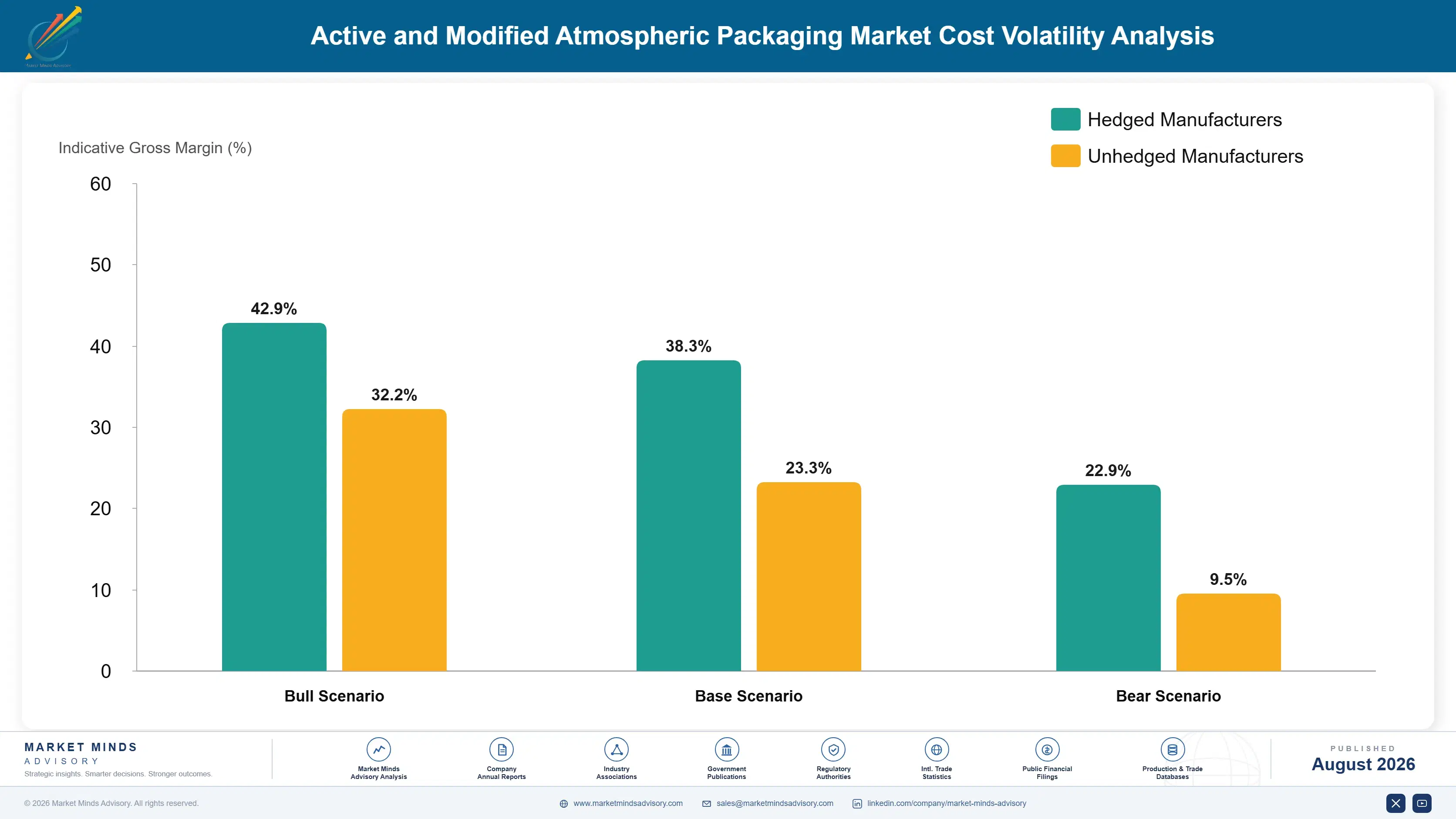
Gas mix and barrier film together account for roughly 30% of cost of goods sold, and that concentration is the root cause of margin compression when input costs spike while retailer contracts typically lock in pricing for a full year or longer at signing. Commercially this hits smaller processors hardest, since they lack the purchasing scale or hedging sophistication larger packaging suppliers use to smooth input cost swings across a broader supply base. Operators respond with longer-term gas and film supply agreements and index-linked contract clauses that pass volatility through rather than absorbing it against thin margin indefinitely.
Market Impact: Minimums now sit in 2025 contracts

Smaller Processors Cannot Afford Active Packaging Technology Upgrades

Active packaging technology carries meaningfully higher upfront equipment and per-unit cost than passive gas-flush formats, and that cost gap is the root cause of smaller regional processors remaining on older passive technology even as retailer specifications push toward active performance standards across premium categories broadly and consistently. Commercially this risks excluding smaller suppliers from premium category contracts entirely as retailer requirements tighten further. Equipment manufacturers respond with leasing and financing arrangements that lower the upfront capital barrier, though per-unit cost still runs higher than passive alternatives regardless of financing structure chosen.
Market Impact: Active formats grow at 11.8%
3 additional market trends, 4 additional growth drivers, and 2 additional restraints and challenges are covered in the full report. Contact sales@marketmindsadvisory.com to access the complete intelligence.

Segment CAGR and Growth Architecture

Segmentation follows technology type, a single engineering logic describing how the packaging manages internal gas atmosphere rather than which food category it protects. Each technology carries its own cost structure, performance profile, and equipment requirement, so commercial position tracks the underlying gas management approach rather than the end application served across categories and retail formats.
active-and-modified-atmospheric-packaging-market-market-share-analysis-1787332092274

Active Packaging with Oxygen Scavengers

Active packaging with oxygen scavengers grows fastest at 11.8%, about 1.37 times the overall 8.6% rate, covering sachet and film-integrated oxygen scavenging technology that continuously manages internal atmosphere throughout the shelf-life window rather than setting gas composition once at the point of packing. This technology commands meaningfully higher pricing than passive gas-flush formats, since it delivers measurably longer shelf life in exactly the premium meat, seafood, and ready-meal categories where retailers pay for that performance directly. Multivac and Winpak both compete strongly here alongside specialist active packaging developers supplying scavenger technology to converters. Adoption still concentrates among larger processors with the capital to invest in compatible packaging lines, which limits near-term penetration among smaller regional operators.
CAGR 11.8%

Passive Gas-Flush Modified Atmosphere Packaging

Passive gas-flush modified atmosphere packaging grows at 6.9%, the largest segment by volume though no longer the fastest, covering standard nitrogen and carbon dioxide gas mixes set once at packing for fresh meat, poultry, produce, and bakery categories across most retail formats. Growth has moderated as the segment matures and retailers increasingly push premium categories toward active formats where the shelf-life gain justifies the cost premium. Amcor and Sealed Air both bundle strong gas-flush capability into their broader flexible packaging platforms, which pressures standalone gas-flush specialists toward either scale or specialisation. This segment remains the volume foundation underneath the category even as growth concentrates in active formats across premium categories elsewhere.
CAGR 6.9%
Full segment breakdown across 5 segments available in the complete report.

Regional Architecture and Country Demand Map

Retail concentration and cold chain maturity together set this distribution more than raw food production volume does across most markets. North America and Western Europe lead on retailer contract specification and regulatory pressure, while share elsewhere tracks how far organised retail has displaced open-air fresh food sale.

North America

Retailer contract specification anchors North America's 27% share, as major American grocery chains increasingly write minimum shelf-life performance directly into supplier agreements tied to documented gas mix and barrier film requirements enforced at audit. Sealed Air and Sonoco both maintain extensive domestic manufacturing capacity serving this retailer-driven demand across meat, seafood, and ready-meal categories nationally. Canadian retail follows a similar trajectory, though somewhat more slowly given a smaller and more regionally concentrated grocery sector overall. Food waste reduction commitments from large retailers increasingly depend directly on supplier packaging performance to hit stated public targets. Growth of 8.2% tracks retailer contract specification and premium category expansion together across the country and its largest metropolitan grocery markets.
Share: 27% | CAGR: 8.2% (2026 to 2036)

Western Europe

Regulatory pressure shapes demand across Western Europe's 23% share more than retailer initiative alone, with European Union food waste reduction targets pushing both retailers and processors toward shelf-life extension as compliance infrastructure rather than discretionary spending across every member state. German and French retailers maintain some of the most stringent shelf-life specification requirements globally, reflecting both regulatory pressure and consumer expectation around freshness and quality. British retail follows a comparable trajectory independently of European Union regulation post-Brexit, maintaining similar shelf-life expectations. Growth of 6.9%, the slowest of the seven, reflects a mature market where active packaging penetration is already high across most premium categories nationally and across neighbouring member states too.
Share: 23% | CAGR: 6.9% (2026 to 2036)
Regional intelligence for 5 additional markets available in the complete report: East Asia, South Asia and Pacific, Latin America, Middle East and Africa, Eastern Europe. Contact sales@marketmindsadvisory.com.
active-and-modified-atmospheric-packaging-market-country-cagr-analysis-1787332092792

Where Shelf-Life Packaging Suppliers Actually Win Contracts

Selling gas-flush capability on price alone means competing against every converter with a flushing line and a film supplier nearby. The four moves below shift revenue toward positions a cheaper competitor cannot easily match: active technology depth, documented waste reduction data, gas cost discipline, and retailer contract compliance infrastructure built ahead of specification tightening.

Build Active Packaging Capability Ahead Of Premium Demand

Retailers increasingly push premium meat, seafood, and ready-meal categories toward active packaging where measurable shelf-life gain of 2 to 12 additional days justifies a genuine price premium over passive gas-flush formats set once at packing. Suppliers who invest in oxygen scavenger and active film compatible equipment ahead of retailer specification tightening capture premium category contracts before competitors can retool their existing production lines. Multivac and Winpak have both structured recent capital spending explicitly around anticipated active packaging demand growth specifically across multiple regions. Technology readiness is becoming as commercially important as price competitiveness in premium category evaluations.
Market Impact: Active formats can command a 30%+ p

Document Waste Reduction Data To Justify Premium Pricing

Grocery chains report shrinkage reduction of roughly 18% to 25% after adopting extended shelf-life packaging, and suppliers who document that specific financial return directly convert a packaging cost conversation into a value conversation finance teams actually approve without extensive internal debate or delay. Sealed Air has built meaningful commercial differentiation specifically around retailer waste reduction case studies and measured data across multiple categories. That documentation also strengthens contract renewal negotiations considerably, since suppliers can point to measured outcomes rather than theoretical performance claims alone, which finance teams increasingly discount in vendor evaluations regardless of how well they read.
Market Impact: Documented waste cuts run 18% to 25

Lock In Gas And Film Supply Agreements Ahead Of Volatility

Gas mix and barrier film together account for roughly 30% of cost of goods sold, and suppliers securing long-term supply agreements ahead of price spikes protect margin considerably better than competitors buying reactively once volatility has already begun affecting quoted pricing. That discipline also lets a supplier quote firmer multi-year retailer contract pricing, since input cost volatility no longer drives the bulk of cost uncertainty the way it does for less disciplined competitors reacting to spot prices only after they rise. Gas cost discipline is becoming a genuine competitive differentiator across the industry broadly.
Market Impact: Gas and film make up 30% of cost

Build Compliance Infrastructure Ahead Of Contract Audits

Retailers increasingly audit suppliers against documented shelf-life performance rather than accepting quality claims at face value, and suppliers who build testing and documentation infrastructure ahead of contract renewal audits avoid losing 100% of the contract value the disruption competitors face when a retailer suddenly demands compliance evidence on short notice with little lead time to respond. Amcor has expanded technical service teams specifically to support retailer compliance programmes across multiple regions and categories simultaneously. That infrastructure investment is becoming table stakes for retaining large retailer contracts through successive renewal cycles.
Market Impact: Compliance gaps can cost 100% of a

Who Controls the Margin Pool

Concentration is moderate: the top five hold roughly 39% of revenue, split between diversified packaging majors bundling gas-flush capability into broader flexible packaging lines and specialist active packaging developers selling technology depth those majors cannot easily replicate. The gap between leaders and challengers is active technology capability and retailer compliance infrastructure rather than raw manufacturing scale alone. All participants here are assessed on one basis, annual manu
Competition runs along three lines. First, active technology depth, since oxygen scavenger and active film capability increasingly wins premium category contracts that passive gas-flush cannot secure. Second, documented waste reduction data, as suppliers who can prove financial return convert cost conversations into value conversations. Third, retailer compliance infrastructure, particularly technical service capability supporting contract audit requirements.

Pressure is building from two directions. Diversified packaging majors including Amcor and Sealed Air are acquiring specialist active packaging developers rather than building capability organically, compressing the timeline independent developers have to scale before being absorbed. Meanwhile smaller regional processors unable to afford active technology upgrades risk exclusion from premium category contracts entirely. Rankings should favour suppliers combining active technology with genuine compliance infrastructure depth.
active-and-modified-atmospheric-packaging-market-company-positioning-matrix-1787332093319

Competitive Moat and Risk Dimensions

AMCOR

Moat: Global scale and retailer relationships

Amcor operates manufacturing capacity across multiple continents, letting it serve large multinational retailer and processor clients with consistent supply and compliance documentation across regulatory regimes. Its expanded technical service teams support retailer compliance programmes directly, a capability smaller competitors struggle to match. Deep relationships across major grocery chains provide distribution new entrants must build from nothing.
AMCOR

Risk: Breadth dilutes active technology focus

Amcor's breadth across conventional and active packaging means it invests less intensively in any single active technology than specialist developers focus on exclusively. Smaller, more agile competitors sometimes move faster on niche active packaging innovation specifically. Gas and film cost exposure across its broad packaging portfolio is considerable given the sheer scale involved across every category served.
SEALED AIR

Moat: Waste reduction data depth

Sealed Air has built meaningful commercial differentiation around documented retailer waste reduction case studies, converting packaging cost conversations into value conversations finance teams approve readily. Its technical service depth supporting retailer compliance audits is considered among the strongest in the industry currently. Established brand recognition in premium meat and seafood packaging shortens sales cycles considerably compared with newer entrants.
SEALED AIR

Risk: Premium positioning limits price flexibility

Sealed Air's premium positioning and technical service cost structure limit its ability to compete on price in standard gas-flush categories where regional converters undercut meaningfully. Smaller competitors without comparable service overhead can price more aggressively for price-sensitive processors. Concentration in premium categories also exposes it to demand softening if retailers prioritise price over shelf-life performance broadly.

Players Tracked

Prominent Players

Amcor
Sealed Air
Sonoco
Multivac
Winpak

Other Key Players

Berry Global
Coveris
Constantia Flexibles
Bemis Company
Uflex
Huhtamaki
ProAmpac
Mondi Group
Klockner Pentaplast
Linpac Packaging
Sirane
StePac
Freshmax
Peel Plastic Products
Cryovac

Recent Developments

APRIL 2025

Sealed Air expands active packaging capacity in North America

Sealed Air announced active packaging production capacity expansion across two North American facilities, targeting premium meat and seafood processor demand ahead of tightening retailer shelf-life specifications. This was an organic capacity expansion rather than an acquisition, extending capability the company had piloted successfully at a single site the previous year.
Signal: Capacity investment ahead of confirmed ret
SEPTEMBER 2024

Amcor acquires specialist oxygen scavenger technology developer

Amcor completed an acquisition of a smaller specialist developer of oxygen scavenger film technology, integrating the capability directly into its broader flexible packaging platform. This was a confirmed acquisition rather than a licensing arrangement, adding active technology depth Amcor's existing portfolio had lacked relative to specialist competitors.
Signal: Large packaging platforms are increasingly
FEBRUARY 2025

Multivac signs multi-year equipment agreement with major retailer supplier

Multivac signed a multi-year equipment and technical service agreement with a major fresh meat processor supplying multiple national retail chains, covering active packaging line installation and ongoing compliance support. This was a confirmed supply agreement rather than an acquisition, securing recurring service revenue alongside the initial equipment sale.
Signal: Equipment suppliers are increasingly bundl

Barrier Film, Gas Mix, Active Scavenger Chemistry

Gas mix and barrier film together account for roughly 30% of cost of goods sold, sourced from industrial gas suppliers and specialty film manufacturers whose pricing varies with petrochemical and industrial gas market conditions. Active packaging chemistry, including oxygen scavenger compounds, contributes a further 12% to 18% for active formats. Equipment depreciation and labour take 20% to 26%, with the remainder covering freight and overhead.
Industrial gas and specialty film pricing rose materially through 2022 as broader petrochemical feedstock costs spiked alongside energy market disruption tied to the European gas crisis specifically, affecting converters across the continent. Amcor's annual report disclosed material input cost pressure across that period, and several converters passed rising costs through to retailer and processor clients via index-linked contract clauses rather than absorbing the full increase against already thin margins.

Exposure varies by contract structure and technology mix. Suppliers with index-linked pricing clauses in retailer contracts pass volatility through directly, while those on fixed-price agreements absorb it until renewal arrives at the end of the contract term. Active packaging suppliers carry additional exposure to specialty scavenger chemistry pricing, which correlates less predictably with broader industrial gas and film markets than passive gas-flush inputs do.
active-and-modified-atmospheric-packaging-market-cost-volatility-analysis-1787332093519

Negotiate index-linked pricing with retailer and processor clients

Suppliers building input cost indexing directly into multi-year retailer and processor agreements pass volatility through rather than absorbing it against thin margin, a structure that protects profitability during price spikes though it requires negotiating leverage smaller converters sometimes struggle to secure with larger, better-resourced retail buyers holding considerably more purchasing power of their own.

Consolidate gas and film purchasing across multiple facilities

Suppliers running several manufacturing facilities are centralising gas and film procurement to negotiate volume discounts unavailable to any single site purchasing independently, a mitigation that favours scaled operators and is prompting smaller regional converters to explore purchasing cooperatives to compete on comparable input cost terms with larger, better-resourced rivals operating nearby competing manufacturing facilities.

Diversify active chemistry sourcing across multiple suppliers

Active packaging developers sourcing scavenger chemistry from multiple specialty suppliers rather than a single source reduce concentrated exposure to any one supplier's pricing or capacity constraints, a diversification strategy that protected several manufacturers during the 2022 industrial gas price spike more effectively than single-source competitors managed at the time it hit hardest across the industry.

Portfolio Architecture for Margin Defence

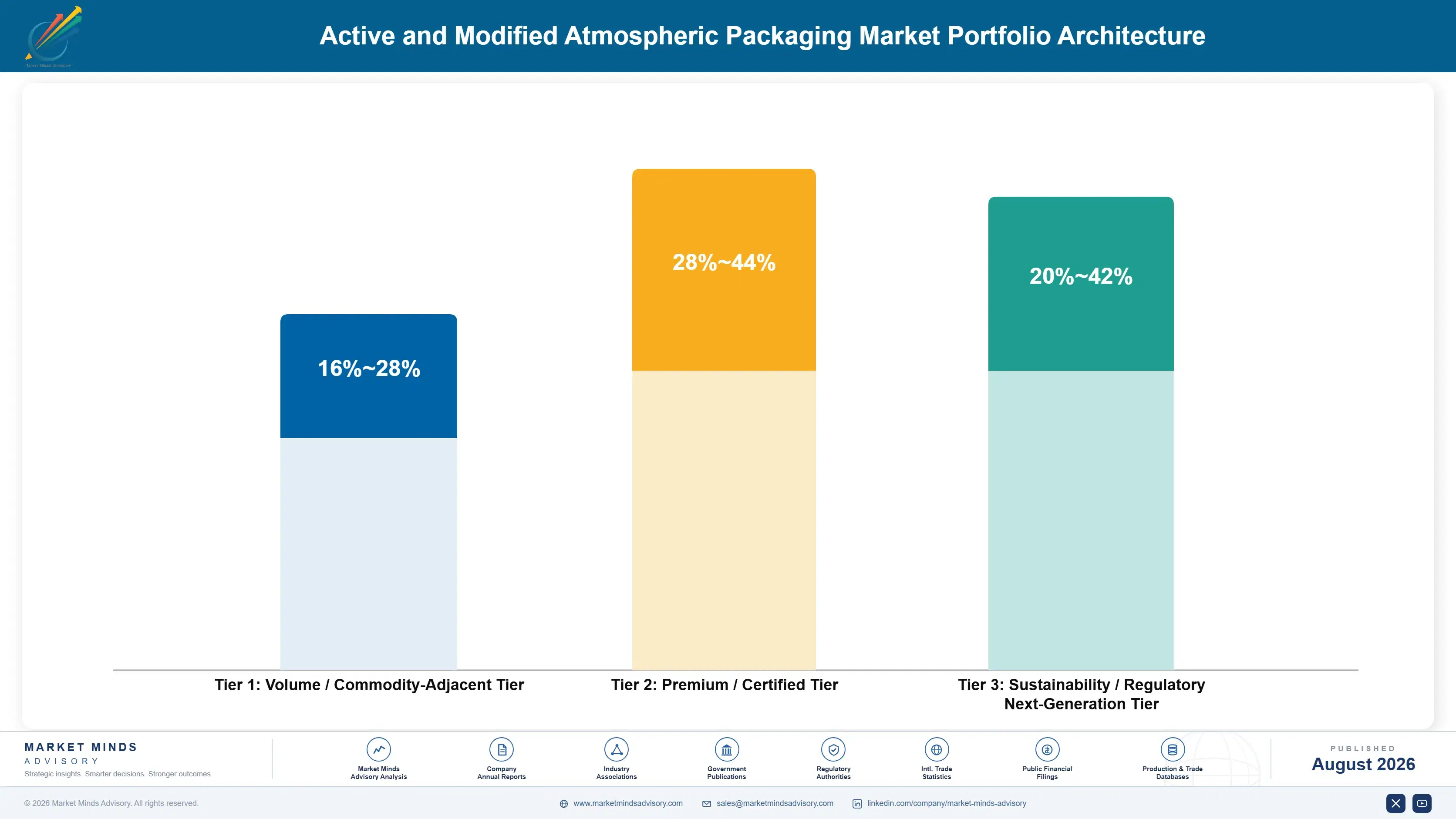
The portfolio splits into three tiers with sharply different economics. Standard passive gas-flush packaging forms the volume tier, competing largely on price with margin set by gas and film cost and manufacturing scale. Active packaging serving premium categories earns considerably more because measurable shelf-life performance and documented waste reduction both resist the commoditisation pressure hitting passive formats. Compliance-infrastructure-backed retailer programmes sit differently aga
The tension runs between winning standard gas-flush volume on price and building active technology capability that protects margin over the long run. A supplier chasing every passive gas-flush contract available eventually gets squeezed as retailer specifications tighten toward active performance, yet building active capability requires investment thin-margin passive production rarely funds adequately. Suppliers handling this well treat passive gas-flush as the volume base and active technology as the margin engine.

High-value pools concentrate where active technology, documented performance, or compliance infrastructure limit competition: premium meat and seafood programmes using active packaging, retailer contracts backed by documented waste reduction data, and compliance-audit-ready technical service relationships. Standard passive gas-flush sits at the other end, competing almost entirely on price against every regional converter with comparable equipment.

Volume / Commodity-Adjacent Tier

Standard passive gas-flush packaging for mainstream fresh meat, produce, and bakery categories competing largely on price. Margin is thin and set almost entirely by gas and film cost and manufacturing scale achieved.
Gross Margin: 16-28%

Premium / Certified Tier

Active packaging with oxygen scavengers and antimicrobial technology serving premium meat, seafood, and ready-meal categories under multi-year retailer contract terms. Margin reflects documented performance and genuine contract switching cost built up over time.
Gross Margin: 28-44%

Sustainability / Regulatory / Next-Generation Tier

Compliance-infrastructure-backed retailer programmes and next-generation biodegradable active packaging formats addressing both freshness and sustainability requirements together for regulated categories. The wide range reflects early-stage pricing still settling industry-wide as adoption grows.
Gross Margin: 20-42%
active-and-modified-atmospheric-packaging-market-portfolio-architecture-1787332094028

High-value Sub-segments and Strategic Watch-out

Active Packaging with Oxygen Scavengers

High value and high growth at 11.8%, the fastest technology, as processors move beyond passive gas-flush toward continuous atmosphere management that retailers increasingly specify directly in premium category supplier contracts and compliance audits nationwide and increasingly across export markets too, suppliers now consistently and reliably report.
Gross Margin: 28-44%

Antimicrobial and Moisture-Regulating Active Packaging

High value with strong growth at 9.8%, driven by ready-meal and prepared food category expansion requiring both freshness extension and microbial safety performance that passive gas-flush formats alone simply cannot reliably deliver across most premium retail channels and packaging formats sold nationally and abroad today.
Gross Margin: 26-40%

Passive Gas-Flush Modified Atmosphere Packaging

The volume core by unit count, growing at 6.9% as standard fresh meat, produce, and bakery formats remain the largest category by volume even as growth concentrates in active formats elsewhere. Bundled packaging platforms compete here mainly on scale and price alone still today across regions.
Gross Margin: 16-28%

Legacy Vacuum and Non-Gas-Modified Formats

The strategic watch-out, growing at just 3.1% and steadily displaced as retailer specifications tighten toward gas-modified and active formats across nearly every fresh category still using much older technology without genuine atmosphere management capability built into the packaging itself at all today nationally and abroad.
Gross Margin: 12-22%

How Shelf-Life Packaging Revenue Actually Repeats

Revenue depends on a supplier surviving the retailer's own contract renewal cycle, not on winning any single purchase order. A packaging programme tied to a documented retailer waste reduction commitment generates volume across the full multi-year contract term, so annuity value sits in that retailer relationship rather than in any individual shipment. Standard passive gas-flush programmes behave differently, generating steadier but thinner volume that depends more on price competitiveness than
Stickiness varies sharply by category and technology. Active packaging programmes under documented retailer compliance contracts stick hardest, since switching mid-contract risks audit failure and supply disruption across a retailer's entire premium category assortment simultaneously. Standard gas-flush programmes stick moderately, protected mainly by qualification time and equipment compatibility rather than genuine differentiation. Price-driven commodity categories switch most readily, since any converter meeting basic specification satisfies the requirement.

Buyer profiles have shifted generationally. Retailer procurement teams that once selected suppliers primarily on unit price increasingly weigh documented shelf-life performance and compliance infrastructure, given how much waste reduction commitments now depend on supplier packaging performance directly. Sustainability and operations leadership increasingly sit alongside procurement in supplier selection, a shift food waste commitments have made necessary rather than optional.
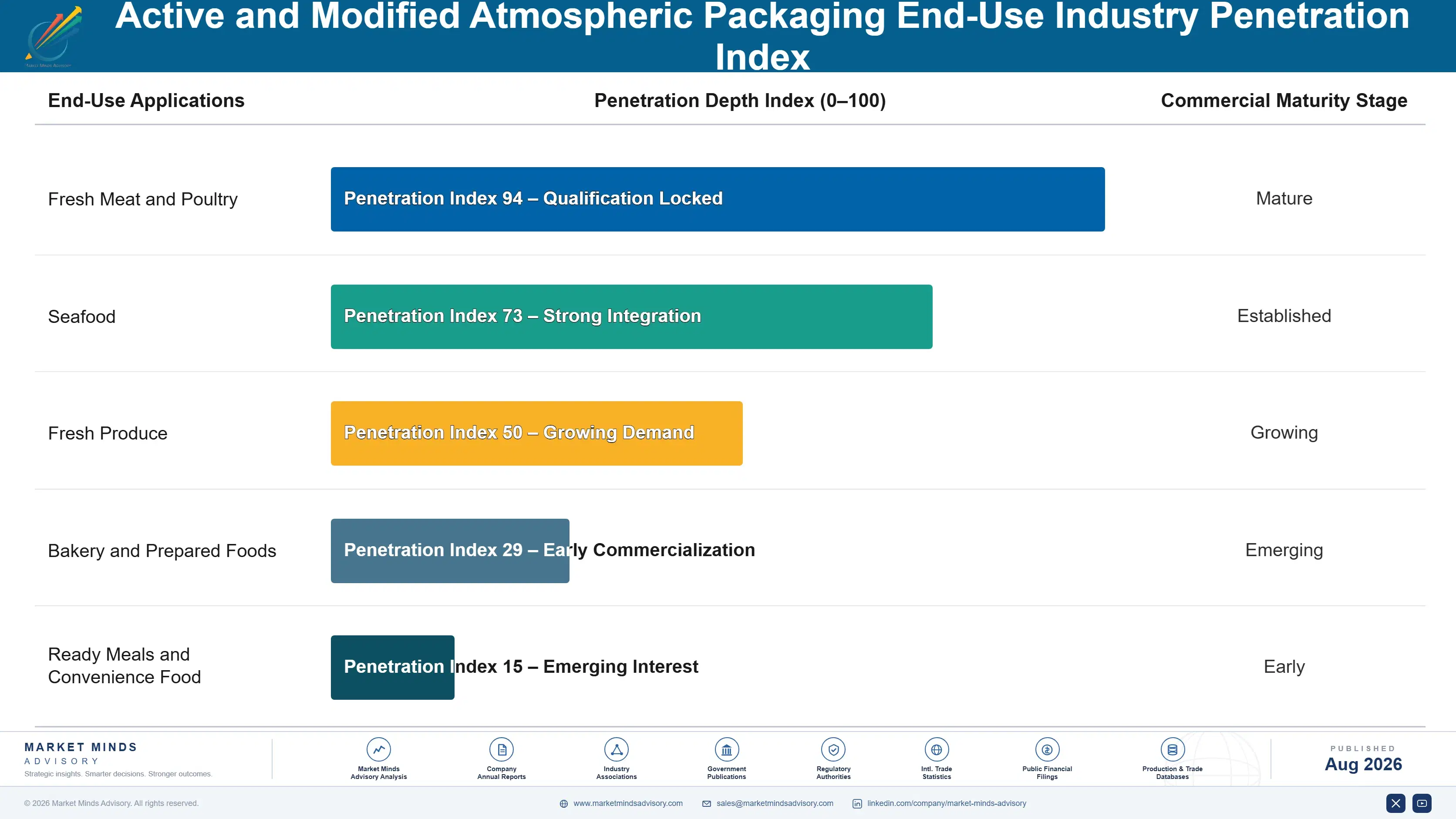
active-and-modified-atmospheric-packaging-market-end-use-penetration-index-1787332094523

Our Call On Shelf-Life Packaging

These are among the four positions where our research anticipates prominent divergence between winners and laggards over the coming forecast period. Each is grounded in the demand model, the regulatory perimeter, and the announced capacity pipeline.
01 / ACTIVE TECHNOLOGY WINS PREMIUM

Continuous atmosphere management beats passive setting

Retailers increasingly push premium meat, seafood, and ready-meal categories toward active packaging where measurable shelf-life gain justifies a genuine price premium over passive gas-flush formats set once at packing and never adjusted afterward. Suppliers who invest in oxygen scavenger and active film compatible equipment ahead of retailer specification tightening capture premium category contracts before competitors can retool their production lines to match. Technology readiness should be treated as a core investment priority rather than a discretionary upgrade suppliers can defer indefinitely.
02 / WASTE DATA JUSTIFIES PRICING

Documented shrinkage cuts convert cost into value

Grocery chains report shrinkage reduction of roughly 18% to 25% after adopting extended shelf-life packaging, and suppliers who document that specific financial return directly convert a packaging cost conversation into a value conversation finance teams actually approve without extensive internal debate or delay in the review cycle. That documentation also strengthens contract renewal negotiations considerably, since suppliers can point to measured outcomes rather than theoretical performance claims. Building this evidence base should rank as a commercial priority, not an afterthought left to marketing.
03 / INPUT COST DISCIPLINE

Gas and film hedging is now a standing requirement

Gas mix and barrier film together account for roughly 30% of cost of goods sold, and suppliers securing long-term supply agreements ahead of price spikes protect margin considerably better than competitors buying reactively once volatility has begun affecting quoted pricing across the industry. That discipline also lets a supplier quote firmer multi-year retailer contract pricing, since input cost volatility no longer drives cost uncertainty the way it does for less disciplined competitors. Suppliers still buying reactively should treat hedging as an urgent, not discretionary, priority.
04 / COMPLIANCE READINESS RETAINS CONTRACTS

Audit-ready documentation is the new baseline

Retailers increasingly audit suppliers against documented shelf-life performance rather than accepting quality claims at face value, and suppliers who build testing and documentation infrastructure ahead of contract renewal audits avoid the disruption competitors face when a retailer suddenly demands compliance evidence on short notice with little warning. That infrastructure investment is becoming table stakes for retaining large retailer contracts through successive renewal cycles rather than an optional service layer. Suppliers still treating compliance as reactive paperwork should rebuild that capability now, before the next audit arrives.

Engagement Snapshot From the Field

A live engagement with an industry participant carrying material or product regulatory and market exposure ahead of a defining policy shift, showing how our research translates into a defensible multi-year portfolio strategy.
MARKET MINDS ADVISORY · CLIENT ENGAGEMENT SUMMARY
Active and Modified Atmospheric Packaging Producer Strategic Portfolio Review and Transition Roadmap 2026·Investment Scenario on Active and Modified Atmospheric Packaging Exposure Evaluation 2025-26
CLIENT PROFILE
A regional fresh meat processor supplying three national grocery chains engaged MMA after two retail clients announced tightened shelf-life specifications ahead of updated food waste reduction commitments. The client reported annual packaging spend near USD 18 million, running entirely on passive gas-flush technology across all its production lines nationwide with no active capability installed at all (client-reported, unverified by MMA).
STRATEGIC CHALLENGE
Leadership needed to evaluate whether to invest in active packaging technology across its full production network or risk losing shelf space with two major retail clients whose new specifications the client's existing passive gas-flush lines could not reliably meet within the compliance deadline given, all without disrupting current committed production volume.
MMA APPROACH
MMA benchmarked three active packaging equipment vendors against the client's production volume and retail client specification requirements directly. We modelled the capital cost of a full versus phased line conversion against the revenue at risk from the two retail clients tightening specifications. We then assessed financing options that would lower the upfront capital barrier.
KEY FINDINGS
  1. Continuing on passive gas-flush technology risked losing an estimated 35% of revenue tied to the two retail clients within twelve months of the deadline.
  2. A phased conversion covering the two highest-volume production lines first would meet both retail clients' compliance deadlines within the required window comfortably.
  3. Equipment financing reduced the upfront capital requirement by roughly 60%, spreading cost across a multi-year lease the client's balance sheet could support.
  4. The third retail client had no comparable specification change planned, allowing that production line to convert on a slower, less urgent timeline.
CLIENT PROFILE
A regional fresh meat processor supplying three national grocery chains engaged MMA after two retail clients announced tightened shelf-life specifications ahead of updated food waste reduction commitments. The client reported annual packaging spend near USD 18 million, running entirely on passive gas-flush technology across all its production lines nationwide with no active capability installed at all (client-reported, unverified by MMA).
STRATEGIC CHALLENGE
Leadership needed to evaluate whether to invest in active packaging technology across its full production network or risk losing shelf space with two major retail clients whose new specifications the client's existing passive gas-flush lines could not reliably meet within the compliance deadline given, all without disrupting current committed production volume.
MMA APPROACH
MMA benchmarked three active packaging equipment vendors against the client's production volume and retail client specification requirements directly. We modelled the capital cost of a full versus phased line conversion against the revenue at risk from the two retail clients tightening specifications. We then assessed financing options that would lower the upfront capital barrier.
KEY FINDINGS
  1. Continuing on passive gas-flush technology risked losing an estimated 35% of revenue tied to the two retail clients within twelve months of the deadline.
  2. A phased conversion covering the two highest-volume production lines first would meet both retail clients' compliance deadlines within the required window comfortably.
  3. Equipment financing reduced the upfront capital requirement by roughly 60%, spreading cost across a multi-year lease the client's balance sheet could support.
  4. The third retail client had no comparable specification change planned, allowing that production line to convert on a slower, less urgent timeline.
RECOMMENDED STRATEGY
Phase 1: Phase 1 (0 to 5 months): Convert the two highest-volume production lines serving the retail clients with tightened specifications first. Phase 2: Phase 2 (5 to 11 months): Complete compliance documentation and testing required to pass both retail clients' audit requirements fully. Phase 3: Phase 3 (11 to 18 months): Convert the remaining production lines on a slower timeline aligned with equipment lease renewal cycles.
OUTCOME
The client completed the priority line conversion one month ahead of the earlier retail client's compliance deadline, retaining both at-risk contracts in full and without any production disruption. Equipment financing kept the transition within the client's approved capital budget throughout the process (client-reported, unverified by MMA).

Frequently Asked Questions

Foundational context covering the market sizes, CAGR, scope, country, region and competition that inform every finding below. This section is provided to cover basics and most often pre-purchase conversations, answered from the MMA Primary Research Dataset.

What is the current size of the Active and Modified Atmospheric Packaging Market?

The global active and modified atmospheric packaging market is valued at USD 9.4 billion in 2025, covering gas-flush, oxygen scavenger, and antimicrobial active packaging for perishable food. Standard vacuum packaging is excluded.

How large will the Active and Modified Atmospheric Packaging Market be by 2036?

The market is forecast to reach USD 23.30 billion by 2036 in the base case, about 2.28 times the 2026 level. That represents incremental value of roughly USD 13.09 billion across the decade.

What is the CAGR for the Active and Modified Atmospheric Packaging Market 2026 to 2036?

The market grows at an 8.6% CAGR in the base case, with bull and bear scenarios at 9.9% and 7.3%. The spread turns mainly on food waste regulation expansion and retailer specification pace.

Which segment is growing fastest?

Active packaging with oxygen scavengers grows fastest at 11.8%, about 1.37 times the overall rate, as processors move toward continuous atmosphere management. Antimicrobial and moisture-regulating formats follow at 9.8%.

Who are the major companies in the Active and Modified Atmospheric Packaging Market?

Leading companies include Amcor, Sealed Air, Sonoco, Multivac, and Winpak. Concentration is moderate, with the top five holding roughly 39% of total category revenue combined.

Which country is growing fastest?

India grows fastest at an 11.2% CAGR, as organised fresh food retail expands into markets that previously ran almost entirely on open-air sale. China follows on cold chain investment.

Report Segmentation Architecture

The full report scope spans multiple orthogonal segmentation dimensions, with cross-tabulated demand data provided for each dimension pair. Coverage extends further to regional breakdowns, trend trajectories, and the competitive detail needed to support segment-level decision-making.

By Technology Type

  • Active Packaging with Oxygen Scavengers
  • Antimicrobial and Moisture-Regulating Active Packaging
  • Passive Gas-Flush Modified Atmosphere Packaging
  • Legacy Vacuum and Non-Gas-Modified Formats
  • Intelligent and Sensor-Integrated Packaging

By End-Use Industry

  • Fresh Meat and Poultry
  • Seafood
  • Fresh Produce
  • Bakery and Prepared Foods
  • Ready Meals and Convenience Food

By Commercial Dimension

  • Direct Manufacturer Supply Contracts
  • Equipment and Technical Service Bundles
  • Retailer Compliance Programme Agreements
  • Distributor and Wholesale Channels

By Region

  • North America
  • Western Europe
  • East Asia
  • South Asia and Pacific
  • Latin America
  • Middle East and Africa
  • Eastern Europe

Scope, Methodology, and Coverage

Every figure in this report is reproducible from documented input assumptions. The scope below maps the historical period, the forecast horizon, the segmentation dimensions, and the countries covered, alongside the underlying primary and qualitative methodology.
Historical Period
2020 to 2025
Forecast Period
2026 to 2036
Base Year
2025 (USD billions; MMA Primary Research Dataset, August 2026)
Market Definition
The active and modified atmospheric packaging market comprises packaging technologies that alter or actively manage internal gas composition to extend perishable food shelf life, valued at manufacturer revenue from packaging material and associated technical services. It spans active packaging with oxygen scavengers, antimicrobial and moisture-regulating active packaging, passive gas-flush modified atmosphere packaging, legacy vacuum and non-gas-modified formats, and intelligent sensor-integrated packaging across fresh meat, seafood, produce, bakery, and ready-meal categories. Standard vacuum packaging without gas modification, packaging machinery sold separately, and non-food active packaging applications are excluded.
Quantitative Units
USD billions (current prices); unit shipments in billions where applicable
Segmentation Dimensions
By Technology Type; By End-Use Industry; By Commercial Dimension; By Region
Regions Covered
North America, Western Europe, East Asia, South Asia and Pacific, Latin America, Middle East and Africa, Eastern Europe
Countries Covered
USA, China, Germany, France, UK, Japan, South Korea, India, Canada, Australia, Brazil, Mexico, Chile, Argentina, UAE, Saudi Arabia, South Africa, Poland, Hungary, Romania, Vietnam, Indonesia, Italy, Spain, and additional markets relevant to this sector
Key Companies Profiled
Amcor, Sealed Air, Sonoco, Multivac, Winpak, Berry Global, Coveris, Constantia Flexibles, Bemis Company, Uflex, Huhtamaki, ProAmpac, Mondi Group, Klockner Pentaplast, Linpac Packaging, Sirane, StePac, Freshmax, Peel Plastic Products, Cryovac
Quantitative Methodology
Primary survey, n=3,800 respondents, Q4 2025, six countries; demand-side model with trade association cross-validation
Qualitative Methodology
47 expert interviews, Q4 2025; applied to validate demand model assumptions, identify emerging dynamics, and assess competitive positioning
Report Format
PDF and XLSX data workbook (Word format preview document)
Publisher
Market Minds Advisory
Report Code
MMA-2026-PAC-116
Published
August 2026
Contact
sales@marketmindsadvisory.com | www.marketmindsadvisory.com

Purchase the full Active and Modified Atmospheric Packaging Market Report (2026 to 2036).

The full MMA Active and Modified Atmospheric Packaging report sizes the market across five technology types, five end-use industries, four commercial dimensions, and seven regions through 2036. It profiles 20 companies on a consistent manufacturing revenue basis, scoring each on active technology depth, documented waste reduction data, and retailer compliance infrastructure. Scenario models quantify how retailer contract specification, food waste regulation, and gas and film cost volatility move both revenue and margin by technology. The report also includes shelf-life performance benchmarking, retailer waste reduction case study tracking, and gas and film cost analysis for commercial and technical leadership teams.
Five-technology and four-dimension market sizing to 2036
Twenty-company benchmark on manufacturing revenue basis
Shelf-life performance and waste reduction benchmarking by category
Retailer contract specification and compliance audit tracking
Gas and film cost benchmarking by region and technology
Active packaging technology adoption modelling by category

Built For The People Who Decide

From boardroom strategy to bench-side execution, this report is read cover-to-cover by leaders shaping the next decade of their industry, turning demand scenarios, market dynamics and valuation benchmarks into decisions.
CXOs/ Presidents/ VPs/ Managers
M&A and Corporate Development
Strategy Teams and R&D Heads
Procurement and Product Directors
Regulatory and Compliance Leaders
Investor Relations and Equity Analysts