Market Minds Advisory
Activated Alumina Market

Activated Alumina Market: Regulation Reshapes a Mature Adsorbent Market

Water utilities across South Asia and Africa are scaling fluoride removal capacity faster than desiccant demand is growing, even as molecular sieves and silica gel keep eroding activated alumina's traditional gas-drying stronghold in mature markets.

Lead Analyst

Bilal Shaikh

Published

September 2026

Make Smarter Decisions with Customized Research Insights

Request a free sample report and evaluate market opportunities, growth trends, and competitive dynamics relevant to your business needs.

2025 MARKET VALUE$1.1BMarket Size 2025
2036 FORECAST VALUE$2.2BBase Case , 2026 to 2036
CAGR 2026 TO 20366.2 %Bull 7.5% / Bear 4.9%
INCREMENTAL OPPORTUNITY$1.0BNet 10- year value creation
EXPANSION MULTIPLE1.83x2036 value over 2026 base
Strategic Levers
M&A Pipeline
Regional Outlook
Country Rankings
Competitive Intelligence
Segmental Deep-dive
Call-Us : 91 93563 13602

Executive Snapshot and Market Trajectory

Activated alumina is splitting into a slow-growth commodity desiccant business under real substitution pressure and a fast-growing water treatment adsorbent business driven almost entirely by regulatory mandate, with capital and innovation increasingly flowing toward whichever application segment can demonstrate the clearest near-term regulatory tailwind.
Water defluoridation and arsenic removal applications grow fastest at 9.8%, roughly 1.58 times the overall rate, as India's Jal Jeevan Mission and comparable programs across Africa and Latin America push municipal and rural water utilities toward proven adsorbent media. East Asia holds the largest regional share at 27%, anchored by China's petrochemical catalyst carrier demand, while gas and liquid desiccant drying still accounts for the largest single volume application worldwide despite slower growth.
Competitive intensity centers on roughly half the market held by five producers, with Honeywell UOP and Almatis leading on catalyst-grade and specialty adsorbent breadth respectively. Substitution pressure compounds the picture in mature applications, since molecular sieves and silica gel increasingly outperform activated alumina on drying capacity per unit volume, pushing manufacturers to defend share through cost and reliability rather than raw technical performance in commodity desiccant channels specifically.
Market Definition
The activated alumina market covers porous, high-surface-area aluminum oxide products manufactured for use as desiccants, catalyst supports, and adsorption media across industrial gas drying, water treatment, and petrochemical processing applications. It excludes non-activated calcined alumina used purely as a refractory or ceramic raw material, and unrelated adsorbents such as silica gel, zeolites, and activated carbon.
Base Year Value
$1.1B in 2025 (MMA Primary Research Dataset, August 2026)
Forecast Period
2026 to 2036, eleven discrete annual values
CAGR
6.2% base case. Bull 7.5%. Bear 4.9%.
Fastest Growth Segment
Water Defluoridation and Arsenic Removal: 9.8% CAGR
Fastest Growth Country
India: 13.2% CAGR
Fastest Growth Region
South Asia and Pacific: 8.3% CAGR
Largest Region
East Asia: 27% of 2025 global value
Market Leaders
Honeywell UOP, Almatis, BASF, Axens, Porocel. Source: MMA Analysis based on company annual reports.
Primary Survey
n=3,800 procurement and R&D decision-makers, Q4 2025, six countries
Methodology
Demand-side build-up, cross-validated against public data, 47 expert interviews

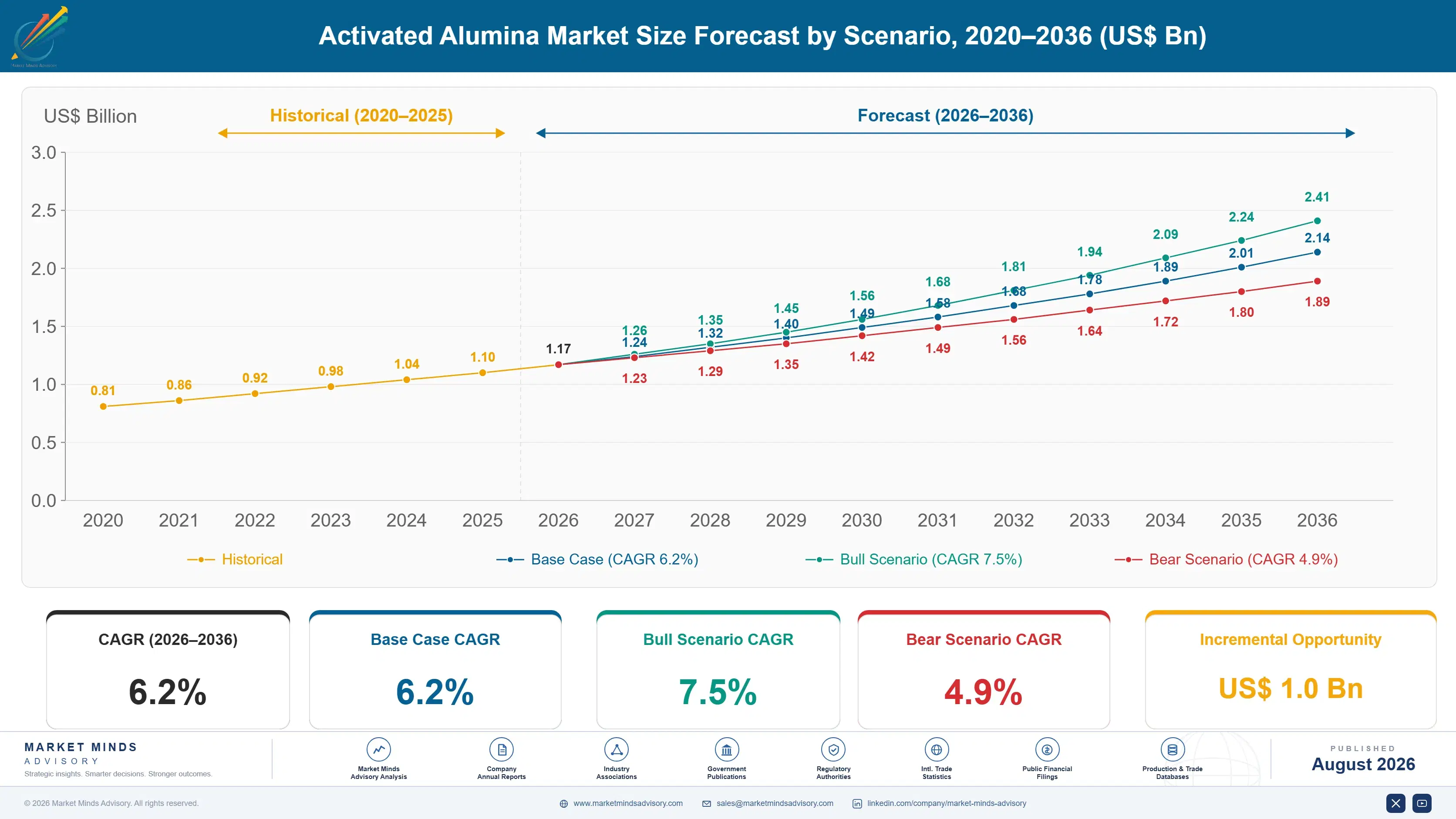
Activated Alumina Market Forecast Scenarios

activated-alumina-market-size-forecast-scenario-1787300657026
Between 2020 and 2025 the market grew at roughly 5.2% annually, held back early by pandemic-era industrial gas demand softness before accelerating as water utilities across South Asia and Sub-Saharan Africa scaled up fluoride removal programs. Petrochemical catalyst carrier demand also recovered steadily as refinery utilization normalized, adding a second demand stream that offset continued substitution pressure from molecular sieves in mature desiccant applications.
The base case carries the market to 6.2% annual growth through three mechanisms. First, water utilities across India, Africa, and Latin America keep expanding fluoride and arsenic removal infrastructure to meet tightening drinking water quality standards. Second, petrochemical and refining capacity additions across Asia keep lifting catalyst carrier demand independent of desiccant market dynamics. Third, pharmaceutical manufacturers increasingly specify chromatography-grade activated alumina for purification, adding a smaller but high-value channel that commands meaningfully better pricing than commodity desiccant grades.
The bull case, 7.5%, assumes accelerated water quality regulation across additional Sub-Saharan African and Southeast Asian countries pulls forward defluoridation infrastructure spending faster than currently planned. The bear case, 4.9%, assumes molecular sieve and silica gel substitution accelerates in commodity desiccant applications faster than water treatment demand can offset, compressing overall volume growth across mature industrial markets.

Regulation Reshapes a Mature Adsorbent Market

Three forces converge on this market simultaneously. Water quality regulation keeps expanding across new jurisdictions, converting fluoride and arsenic contamination concerns directly into guaranteed adsorbent demand regardless of underlying cost competitiveness. Petrochemical and refining capacity keeps growing across Asia, lifting catalyst carrier volume independent of water treatment dynamics. And molecular sieve and silica gel substitution keeps eroding the traditional commodity desiccant ap
MARKET CONCENTRATIONCR5: 48%Top five producers control roughly half global capacity
AVERAGE SELLING PRICEUSD 900 to 1,800 per tonnePrices vary sharply by grade and purity level
TOP PRODUCING COUNTRYChina: 29% of outputDomestic petrochemical demand anchors substantial local production capacity
CAPACITY UTILIZATION74%Production plants run comfortably below full nameplate capacity
BAUXITE COST SHARE38% of COGSRefined bauxite and alumina trihydrate dominate total input cost
ADSORBENT LIFE CYCLE2 to 5 yearsRegeneration cycles vary widely by application and water chemistry
Commercially, this market behaves like a specialty materials business layered onto both industrial process chemistry and public health infrastructure. Producers compete on particle size consistency, surface area, and regeneration performance as much as on price, since water utilities and refiners increasingly specify tight technical tolerances that commodity-grade material cannot reliably meet. That technical specification gap, more than brand recognition, increasingly separates competitors in higher-value applications.
Over the next decade expect continued bifurcation between commodity desiccant grades facing sustained substitution pressure and specialty water treatment and catalyst grades commanding durable pricing power. Regulatory enforcement of water quality standards will increasingly determine which markets convert fastest. And chromatography-grade demand from pharmaceutical manufacturing will keep growing as a smaller but genuinely high-margin niche.
"Nobody gets excited about a desiccant. But tell a water utility their fluoride levels are illegal, and activated alumina suddenly becomes the most interesting material in the plant."
Director, Specialty Chemicals and Materials Practice · MMA Chemicals and Materia

Market Trends

Water Utilities Scale Up Fluoride Removal Infrastructure

India's Jal Jeevan Mission and comparable national water security programs across several Sub-Saharan African and Latin American countries have accelerated procurement of activated alumina-based defluoridation systems for both municipal treatment plants and decentralized rural water points. The World Health Organization estimates fluoride contamination affects drinking water supplies for hundreds of millions of people globally, giving regulators a clear public health mandate to fund adsorbent-based treatment infrastructure. Manufacturers report multi-year order backlogs for water-treatment-grade activated alumina as procurement agencies specify proven, cost-effective adsorbent media over newer but less field-tested alternative technologies for large-scale rural deployment specifically.
Market Impact: Expands regulated coverage across 40-plus countries
Molecular Sieves Keep Eroding Desiccant Market Share

Molecular sieve manufacturers have steadily improved water capacity per unit volume relative to activated alumina in gas drying applications, prompting several large industrial gas producers to convert existing desiccant beds to molecular sieve media during scheduled maintenance cycles. This substitution pressure concentrates hardest in applications like natural gas dehydration and cryogenic air separation, where molecular sieve's superior capacity justifies its higher unit cost against activated alumina's lower price point. Activated alumina retains mechanical advantages in applications requiring durability and resistance to liquid water exposure, keeping it competitive in specific niches even as molecular sieve share keeps climbing.
Market Impact: Adds demand from 15 new refineries

Market Opportunities and Growth Drivers

Drinking Water Quality Standards Keep Tightening Worldwide

National and regional regulators across India, several African nations, and parts of Latin America have progressively tightened permissible fluoride and arsenic concentration limits in drinking water, directly expanding the population requiring treatment infrastructure. The World Health Organization's guideline values increasingly anchor national standards even in countries without previously enforced limits, creating a rolling wave of new regulatory mandate as additional countries adopt or tighten standards. Each tightened standard converts existing untreated water supply directly into activated alumina adsorbent demand, since utilities cannot delay compliance indefinitely once enforcement deadlines make non-compliance commercially untenable.
Market Impact: Cuts commodity desiccant volume by 8%

Petrochemical Capacity Growth Lifts Catalyst Carrier Demand

Refining and petrochemical capacity additions across China, India, and the Middle East keep expanding demand for activated alumina used as catalyst support in Claus sulfur recovery units and various hydrotreating processes. Each new refinery or petrochemical complex requires initial catalyst carrier loading and periodic replacement as catalyst beds deactivate over years of continuous operation, creating both new-build and recurring replacement demand streams simultaneously. Middle Eastern refining expansion specifically has added meaningful catalyst carrier volume as the region continues investing heavily in downstream petrochemical capacity rather than exporting crude oil and natural gas feedstock in unprocessed form as it did historically.
Market Impact: Raises feedstock costs by 12% yearly

Market Restraints and Challenges

Molecular Sieves And Silica Gel Erode Desiccant Share

Molecular sieve and silica gel desiccants increasingly outperform activated alumina on water capacity per unit volume in premium gas and air drying applications, eroding its traditional dominance in this historically largest volume segment. The root cause is genuine material science: molecular sieves offer superior selective adsorption properties activated alumina's broader pore structure cannot fully match. The commercial impact falls hardest on manufacturers focused narrowly on commodity desiccant grades, since premium industrial gas customers increasingly specify molecular sieve media despite its higher cost. Some manufacturers are shifting capacity toward water treatment and catalyst grades where alumina retains clearer advantages.
Market Impact: Adds 9.8% segment growth rate

Bauxite Feedstock Costs Remain Volatile And Rising

Refined bauxite and alumina trihydrate, the primary feedstock for activated alumina production, have experienced meaningful price volatility as global aluminum industry demand competes for the same upstream bauxite mining and refining capacity. The root cause is activated alumina's position as a byproduct-adjacent specialty market riding on infrastructure built primarily to serve the larger primary aluminum industry, giving producers limited pricing influence over their own key input. The commercial impact compresses margins whenever bauxite prices spike faster than producers can pass costs through. Some producers are securing longer-term bauxite supply agreements directly with mining companies to reduce spot exposure.
Market Impact: Cuts desiccant segment growth 5.0%
3 additional market trends, 2 additional growth drivers, and 4 additional restraints and challenges are covered in the full report. Contact sales@marketmindsadvisory.com to access the complete intelligence.

Segment CAGR and Growth Architecture

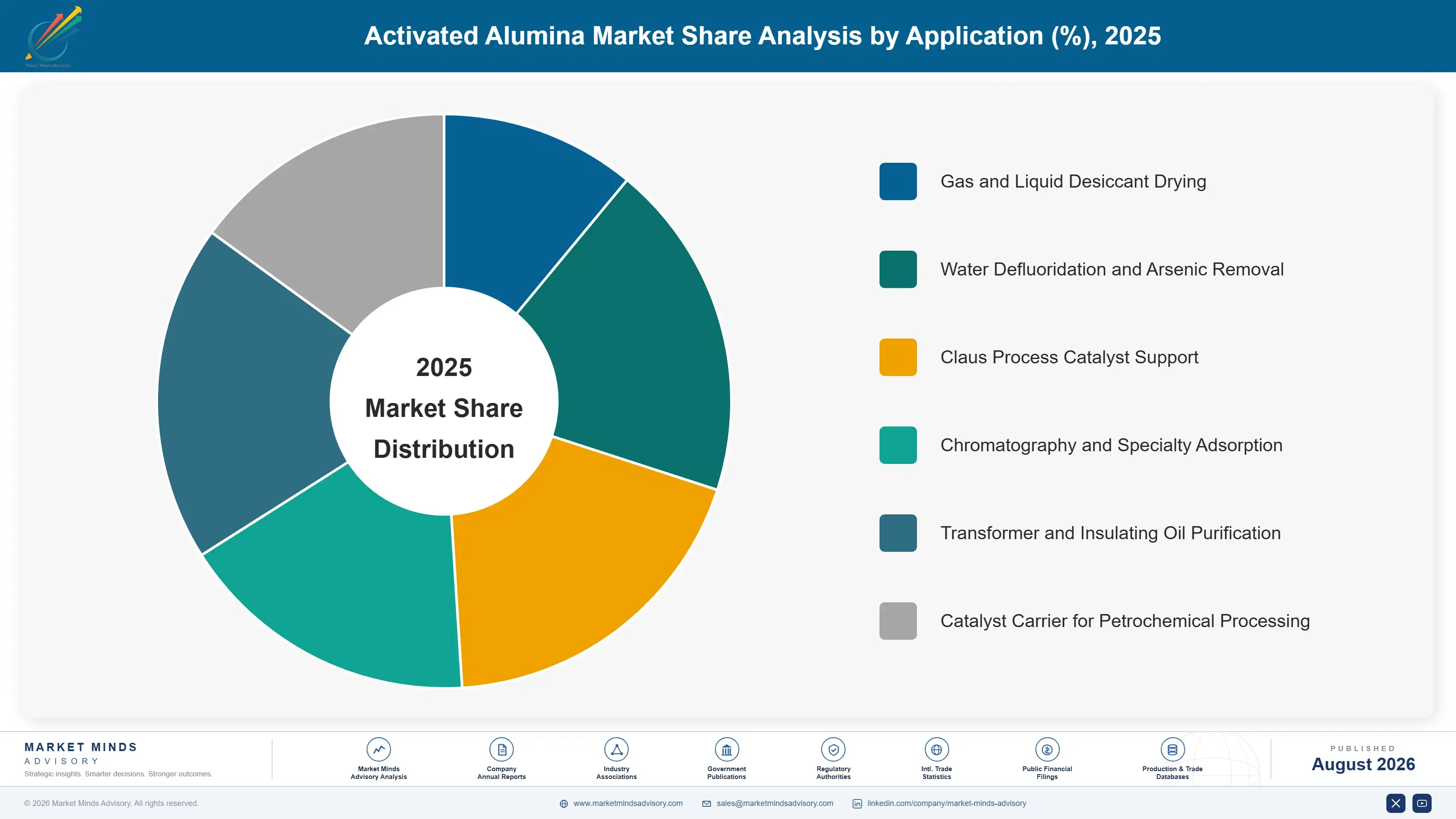
Segmentation follows application, the single classification logic that determines required particle size, surface area, and purity specification. Gas and liquid desiccant drying, water defluoridation, Claus catalyst support, chromatography adsorption, transformer oil purification, and petrochemical catalyst carriers each demand distinct technical grades, so commercial position tracks end-use performance requirement rather than production process or particle form specifically.
activated-alumina-market-market-share-analysis-1787300657556

Water Defluoridation and Arsenic Removal

Water defluoridation and arsenic removal applications grow fastest at 9.8%, roughly 1.58 times the overall market rate, as national water security programs across India, Sub-Saharan Africa, and parts of Latin America scale up treatment infrastructure to meet tightening drinking water quality standards. Activated alumina remains the most widely deployed adsorbent media for both centralized municipal treatment plants and decentralized rural water points, valued for proven field performance, regeneration capability, and relatively low unit cost compared with newer adsorbent technologies. Honeywell UOP and several specialized water treatment media manufacturers lead this segment, while regional producers across India and East Africa are scaling capacity to serve domestic procurement programs. Purity requirements are stricter here, since treated water ultimately reaches human consumption.
CAGR 9.8%

Chromatography and Specialty Adsorption

Chromatography and specialty adsorption applications grow second-fastest at 8.5%, about 1.37 times the overall rate, as pharmaceutical and biotechnology manufacturers increasingly specify chromatography-grade activated alumina for purification and separation processes across drug manufacturing workflows. This grade commands meaningfully higher unit pricing than commodity desiccant or water treatment grades, reflecting the tighter particle size distribution, surface area consistency, and purity specification pharmaceutical applications require for reproducible batch-to-batch separation performance. BASF and several specialty chemical manufacturers lead this segment's branded offerings, competing on documented quality consistency and regulatory compliance as much as on raw technical performance. Growing biotech manufacturing capacity across North America, Europe, and Asia continues expanding this segment's addressable base steadily.
CAGR 8.5%
Full segment breakdown across 6 segments available in the complete report.

Regional Architecture and Country Demand Map

East Asia leads on value at 27% of the global total, anchored by China's petrochemical catalyst carrier demand. North America follows closely on established oil and gas applications. South Asia and Pacific posts the fastest growth, while Western Europe, Latin America, the Middle East, and Eastern Europe complete the distribution.

North America

Established oil and gas refining infrastructure, more than water treatment demand, explains why North America holds 24% of global value, with Claus catalyst support and industrial gas drying applications anchoring the region's largest volume categories. The United States hosts the region's largest producer and consumer base, including Honeywell UOP's core specialty adsorbent operations and extensive refinery catalyst carrier demand across Gulf Coast petrochemical complexes specifically. Canada's oil sands processing and natural gas dehydration operations add meaningful incremental demand beyond American volume. Water treatment applications remain smaller here than in South Asia, since municipal fluoride and arsenic contamination affects a comparatively smaller share of the American population. Growth of 5.8% reflects steady industrial demand more than any single regulatory catalyst.
Share: 24% | CAGR: 5.8% (2026 to 2036)

Western Europe

Germany and the United Kingdom anchor this region's demand, both hosting substantial refining and specialty chemical manufacturing capacity that relies on activated alumina catalyst carriers and industrial desiccants. Almatis and BASF both run significant European production and research operations, giving the region genuine technical depth beyond pure consumption volume. The region's 19% share, near the lower half of its typical band, reflects mature market saturation: most addressable industrial and municipal water treatment applications already use some adsorbent technology today. Growth of 4.6%, the softest pace among the seven regions tracked, reflects this saturation combined with accelerating molecular sieve substitution in the region's desiccant applications specifically across most of the region's national markets today.
Share: 19% | CAGR: 4.6% (2026 to 2036)
Regional intelligence for 5 additional markets available in the complete report: East Asia, South Asia and Pacific, Latin America, Middle East and Africa, Eastern Europe. Contact sales@marketmindsadvisory.com.
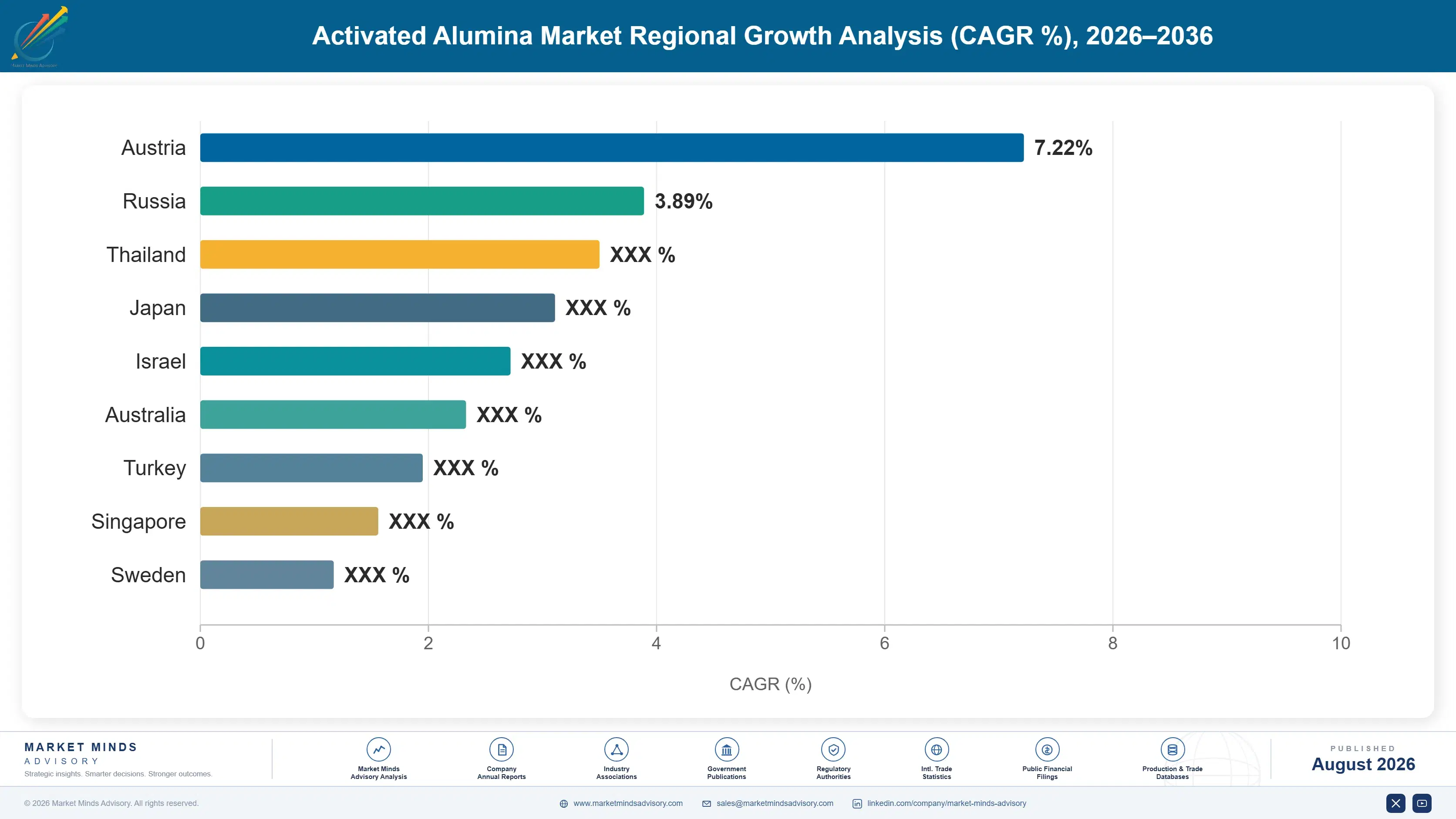
activated-alumina-market-country-cagr-analysis-1787300658066

How Alumina Producers Can Defend Margin

Margin increasingly depends on specification depth and application-specific technical support rather than raw production capacity alone, as commodity desiccant grades face constant substitution and price pressure. The four levers below target certification, technical service, and channel revenue that activated alumina producers have historically left underexploited, converting a commodity material sale into a more defensible, technically differentiated position.

Specify Water Treatment Grades For Government Contracts

Manufacturers who complete the specification and certification process required for government and multilateral water treatment procurement programs gain access to multi-year supply contracts that generalist commodity alumina producers cannot bid for without dedicated certification. Honeywell UOP and several specialized water treatment media manufacturers report that certification breadth directly determines which government tenders they can even qualify for, independent of raw price competitiveness. Certification requires meaningful upfront investment, often exceeding $500,000 across multiple testing bodies, but manufacturers who complete it early lock in multi-year government supply agreements before certification becomes table stakes rather than a genuine differentiator.
Market Impact: Wins multi-year government contracts worth over $5 million

Offer Regeneration And Reactivation Service Contracts

Producers increasingly offer on-site or centralized regeneration and reactivation services that restore spent activated alumina's adsorption capacity rather than requiring customers to purchase entirely fresh material for every replacement cycle. This service model captures recurring revenue that persists across a customer's full equipment operating life, smoothing income against the lumpy nature of initial equipment sales that otherwise concentrate revenue around installation events. Regeneration services typically cost 30% to 50% less than equivalent fresh material purchases, creating genuine customer value while capturing meaningful margin for the producer. Producers building this in-house capture revenue that pure material sellers leave to third parties.
Market Impact: Costs 30% to 50% less than fresh material

Bundle Technical Application Engineering With Material Sales

Producers increasingly bundle on-site technical engineering support, covering bed sizing, regeneration scheduling, and performance monitoring, alongside the physical material sale rather than selling raw activated alumina as an undifferentiated commodity. Industrial customers running complex drying or catalyst systems pay 10% to 20% more for material bundled with engineering support that optimizes system performance than for equivalent unbundled material purchased separately from a generic distributor. This premium reflects genuine value: getting bed design and regeneration timing wrong costs customers far more in downtime than the engineering support itself costs to provide. Producers building this capability in-house capture more margin.
Market Impact: Commands 10% to 20% premium on bundled sales

Secure Long-Term Bauxite Supply Agreements Directly

Bauxite and alumina trihydrate feedstock price volatility, driven by broader primary aluminum industry demand cycles, compresses margin whenever spot prices spike faster than producers can pass costs through to contracted customers. Manufacturers securing multi-year bauxite supply agreements directly with mining companies, rather than buying on the spot market, insulate margin from short-term feedstock volatility even at the cost of some pricing flexibility. This approach favors the largest producers disproportionately, since the minimum volume commitments required for favorable long-term terms, often exceeding 5,000 tonnes annually, sit well beyond what smaller regional producers can typically commit to reliably.
Market Impact: Cuts feedstock cost volatility by roughly 15% annually

Who Controls the Margin Pool

Five producers control roughly half of global production capacity, a moderately concentrated picture for a specialty materials category. Honeywell UOP and Almatis both lead on scale, though Honeywell UOP leads catalyst breadth while Almatis leads alumina production depth, occupying different points in the value chain. Production capacity, the basis used throughout this assessment, favors producers with the broadest certified range.
Competitive activity currently runs across three dimensions. Producers race to complete water treatment certification before rivals lock in government contracts requiring documented specification compliance. Regeneration and reactivation service offerings have become a genuine differentiator, as customers prefer producers who can extend material life rather than sell fresh product. Chinese domestic producers are winning export orders in desiccant grades once held by Western manufacturers.

Pressure is building from two directions that could reshuffle rankings within the decade. Indian and African regional producers, absent from the key player list, are scaling water treatment capacity closer to demand. Molecular sieve manufacturers, technically outside this market but competing for the same drying applications, are proving superior performance can command pricing that pure commodity producers struggle to match, forcing established players to decide whether to defend desiccant share on price or pivot toward higher-value applications.
activated-alumina-market-company-positioning-matrix-1787300658586

Competitive Moat and Risk Dimensions

HONEYWELL UOP LLC

Moat: Broadest Catalyst And Adsorbent Portfolio

Honeywell UOP holds one of the broadest activated alumina and adsorbent product portfolios of any producer, spanning catalyst support, water treatment, and specialty chromatography grades built on decades of refining and petrochemical process expertise. That breadth lets it bid on multi-application customer relationships that narrower specialty producers cannot match on technical depth alone.
HONEYWELL UOP LLC

Risk: Exposure To Refining Capital Cycles

A meaningful share of Honeywell UOP's activated alumina revenue ties to refining and petrochemical capital investment cycles, which move in multi-year waves tied to global energy demand and capacity utilization decisions. A prolonged downturn in refinery capacity additions would compress catalyst carrier demand meaningfully regardless of water treatment segment strength.
ALMATIS GMBH

Moat: Deep Alumina Production Technical Expertise

Almatis specializes narrowly in alumina-based specialty products, giving it manufacturing process expertise and product consistency that generalist chemical companies producing activated alumina as one product among many cannot easily replicate. That specialization depth supports premium positioning in demanding technical applications requiring tight specification tolerances across multiple industrial and municipal customer segments.
ALMATIS GMBH

Risk: Limited Water Treatment Segment Presence

Almatis has historically focused more on industrial and catalyst-grade applications than water treatment media, leaving it less positioned to capture the market's fastest-growing segment compared with competitors who built dedicated water treatment product lines and government certification earlier, a gap that will take years of investment to close.

Key Players

Honeywell UOP LLC
Almatis GmbH
BASF SE
Axens SA
Porocel Corporation

Others

W.R. Grace & Co.
Clariant AG
Sasol Limited
Sumitomo Chemical Co., Ltd.
Nippon Light Metal Co., Ltd.
CR Minerals Company LLC
Zibo Yinxiang Chemical Industry Co., Ltd.
Huber Engineered Materials
Zeochem AG
Dynamic Adsorbents Inc.
Sorbead India
Alcoa Corporation
Rio Tinto Alcan
LANXESS AG
Shandong Aopu New Materials Co., Ltd.

Recent Developments

FEBRUARY 2025

Honeywell UOP Expands Water Treatment Grade Production Capacity

Honeywell UOP expanded production capacity at an existing US facility specifically dedicated to water-treatment-grade activated alumina, aiming to meet growing government procurement demand across South Asia and Sub-Saharan Africa. The expansion adds meaningful annual capacity without requiring an entirely new greenfield manufacturing site or additional permitting.
Signal: Signals established specialty producers are prioritizing water treatment capacity investment ahead of continued commodity desiccant demand.
JUNE 2025

Almatis And A Regional Indian Producer Sign Supply Agreement

Almatis signed a multi-year supply agreement with a regional Indian producer to provide alumina feedstock for domestic water treatment grade manufacturing. The agreement was structured as a direct supply contract rather than any joint venture or equity arrangement between the two companies involved in the deal.
Signal: Signals established Western producers are supporting regional manufacturing rather than exporting finished product directly overseas each year.
OCTOBER 2025

BASF Acquires Specialty Chromatography Adsorbent Manufacturer

BASF completed the acquisition of a small specialty chromatography-grade adsorbent manufacturer, adding pharmaceutical-grade purification technology to its existing catalyst and materials portfolio. The transaction was a full acquisition, not a licensing or minority equity investment arrangement between the two parties involved in the completed deal.
Signal: Signals established chemical majors are acquiring specialty pharmaceutical-grade capability rather than developing it internally from scratch.

What Actually Drives Alumina Production Cost

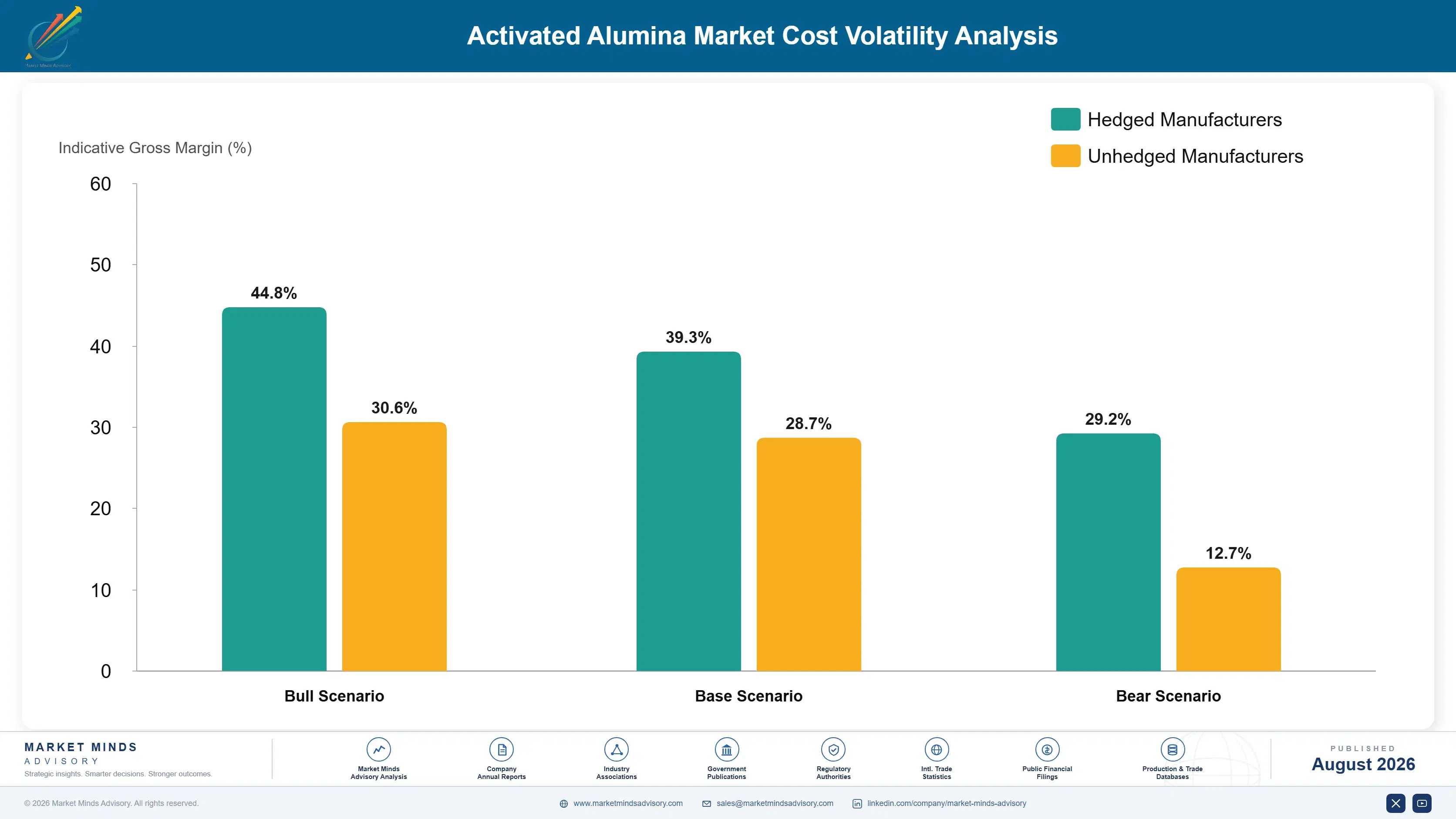
Refined bauxite and alumina trihydrate account for roughly 38% of production cost, sourced from bauxite mining and refining operations concentrated in Australia, Guinea, China, and Brazil. Energy for the calcination and activation process adds another 24%, since converting alumina trihydrate into the porous, high-surface-area activated form requires sustained high-temperature processing, while labor and packaging make up most of the remainder.
Bauxite and alumina feedstock prices spiked sharply in 2022 and 2023 as Guinea, a major global bauxite exporter, experienced political instability and export disruption that rippled through global alumina supply chains. Almatis's 2023 annual report cited elevated feedstock costs as a direct pressure on margins that year, and several activated alumina producers reported similar pressure, pushing some smaller manufacturers toward temporary production cutbacks until feedstock supply stabilized into 2024.

Smaller regional producers carry the sharpest exposure, since they lack the purchase volume to negotiate long-term bauxite supply contracts that Almatis and larger integrated producers secure directly with mining companies. Geographic exposure varies too: producers without integrated alumina refining operations face higher input cost than vertically integrated competitors, a gap that widens whenever global aluminum industry demand competes for the same upstream bauxite supply.
activated-alumina-market-cost-volatility-analysis-1787300658781

Lock Multi-Year Bauxite Supply Agreements Directly

Producers with sufficient purchase volume are negotiating multi-year bauxite supply agreements directly with mining companies, trading pricing flexibility for guaranteed allocation during industry-wide feedstock shortages. This approach favors the largest producers disproportionately, since minimum volume commitments required for favorable terms sit well beyond what smaller regional producers can commit to reliably given typical purchase volumes.

Diversify Bauxite Sourcing Across Multiple Regions

Some producers now qualify bauxite from multiple mining regions, Australia, Guinea, and Brazil among them, rather than depending on a single source, trading some processing consistency for meaningfully improved supply resilience during regional political or logistics disruptions affecting any single feedstock origin, keeping production lines running through most regional shortages and seasonal export restrictions.

Invest In Energy-Efficient Calcination Process Technology

Producers investing in more energy-efficient calcination and activation process technology reduce the energy cost share of total production cost meaningfully over time, even though the upfront capital investment in process equipment upgrades takes several years to fully recover through reduced ongoing energy expenditure across the full facility lifecycle, equipment depreciation schedule, and eventual replacement cycle.

Portfolio Architecture for Margin Defence

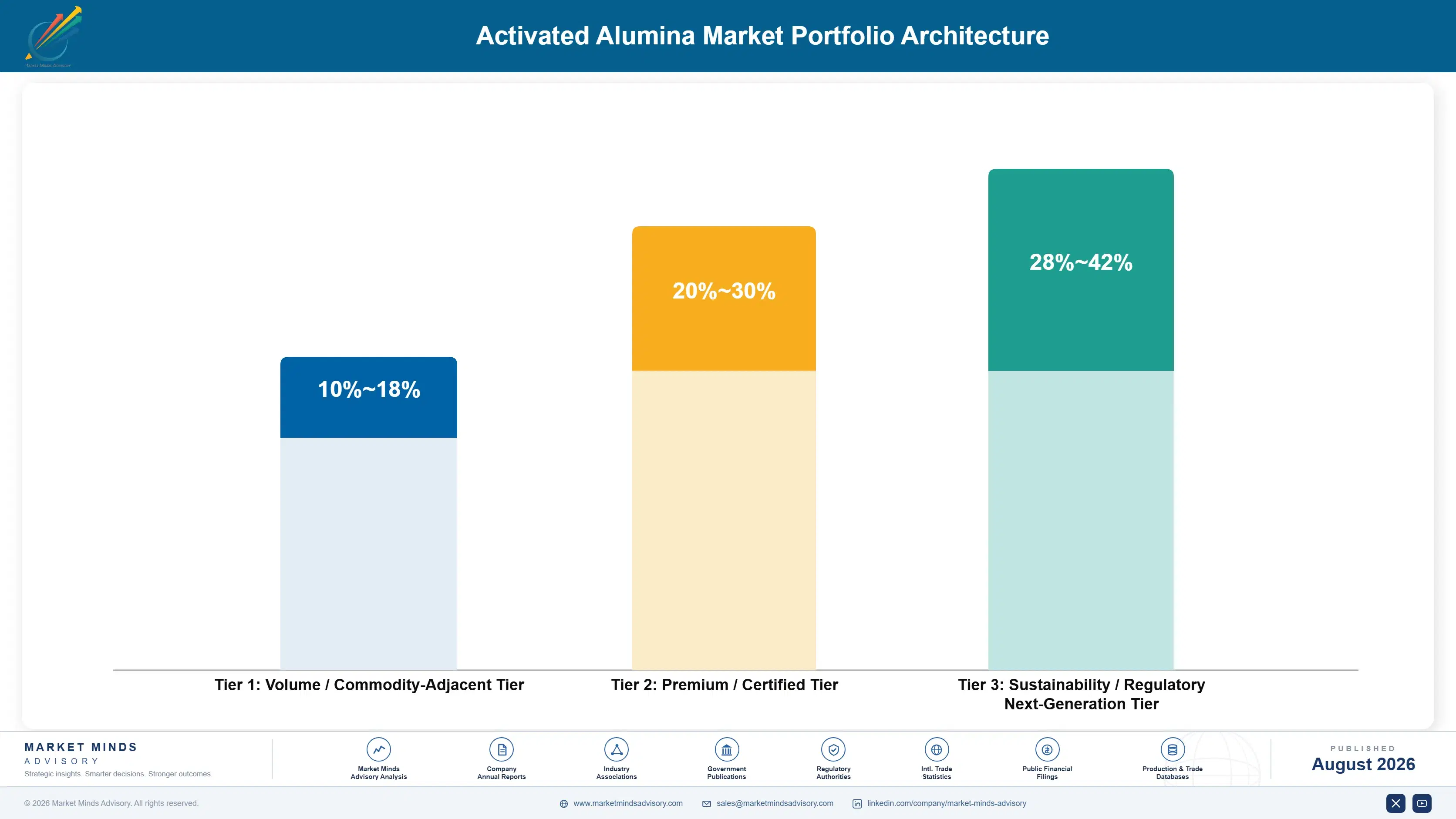
The portfolio splits into three tiers with margin separation. Volume-tier products, commodity-grade desiccant alumina sold on price into industrial gas drying applications, compete against molecular sieve substitution and earn modestly. Premium certified products, covering water treatment and Claus catalyst grades meeting documented specification requirements, earn more because certification supports pricing. Next-generation chromatography and specialty adsorption grades occupy the top tier, com
The tension here is familiar to any specialty materials business riding a mature commodity base: volume desiccant products fund the manufacturing scale and distribution relationships premium certified products depend on, yet volume growth alone cannot fund the certification and technical service investment next-generation grades require. Producers leaning too heavily into premium positioning risk losing the manufacturing scale that makes market entry viable in price-sensitive channels, while pure volume players cede the fastest-growing segment to rivals.

High-value pools concentrate where regulatory certification, technical specification depth, and application criticality intersect: water treatment programs and pharmaceutical manufacturing willing to pay for verified performance. That intersection is still a minority of production volume globally but expanding quickly, which is why the next-generation tier grows fastest even while representing a modest share of volume today.

Volume / Commodity-Adjacent Tier

Commodity-grade desiccant alumina sold largely on price into industrial gas and air drying applications, competing directly against molecular sieve and silica gel substitution across most mature industrial markets worldwide today.
Gross Margin: 10%-18%

Premium / Certified Tier

Water treatment and Claus catalyst grades meeting documented specification and certification requirements, sold to government procurement programs and refiners willing to pay for verified, consistent performance across every producing market tracked.
Gross Margin: 20%-30%

Sustainability / Regulatory / Next-Generation Tier

Chromatography and specialty adsorption grades representing the purity and documentation frontier, priced at a premium justified by pharmaceutical-grade consistency and regulatory compliance documentation across every major producing region worldwide today.
Gross Margin: 28%-42%
activated-alumina-market-portfolio-architecture-1787300659271

High-value Sub-segments and Strategic Watch-out

Water Defluoridation and Arsenic Removal

The fastest-growing and highest-value segment, expanding at 9.8% as national water security programs scale up treatment infrastructure across South Asia and Africa. Producers with government certification and proven field performance capture the majority of this segment's growth worldwide, well ahead of uncertified rivals still relying on generic biodegradability-style claims.
Gross Margin: 20%-30%

Chromatography and Specialty Adsorption

High value with strong growth as pharmaceutical and biotech manufacturers specify tighter purity grades, though overall expansion trails water treatment since biotech manufacturing capacity growth moves more gradually than public health infrastructure investment across most regions and national markets tracked in this year's full regional and competitive review.
Gross Margin: 28%-42%

Gas and Liquid Desiccant Drying

The volume core by production, covering the bulk of industrial drying applications worldwide, generating steady but thin margins under sustained molecular sieve substitution pressure across nearly every mature market tracked in this year's full segmentation, competitive, and regional review process across all producing countries and application categories tracked.
Gross Margin: 10%-18%

Claus Process Catalyst Support

The strategic watch-out, as refining capacity growth slows in mature markets and catalyst carrier demand increasingly concentrates in a smaller number of large-scale Asian and Middle Eastern petrochemical complexes tracked in this year's full competitive, regional, and application-level report across every segment and geography covered in this analysis.
Gross Margin: 16%-24%

How Activated Alumina Demand Actually Renews

Demand here commits through recurring replacement cycles rather than one-time capital purchases. A water treatment plant or industrial drying system typically requires periodic adsorbent replacement or regeneration every two to five years as material capacity degrades with continued use, creating steady recurring demand independent of any single new installation event. That replacement-cycle structure, more than population or industrial output growth alone, drives the bulk of steady-state volume
Adoption depth varies sharply by application. Water utilities adopt fastest once regulatory mandate forces compliance, since public health litigation risk and enforcement deadlines leave little room for delayed procurement decisions. Industrial gas and refining customers adopt more gradually, often waiting for scheduled maintenance cycles or capital equipment turnover before switching adsorbent grades or suppliers. Pharmaceutical and biotech buyers occupy a smaller but growing position, driven by expanding manufacturing capacity rather than any single regulatory event.

Younger procurement managers at water utilities and industrial facilities increasingly research adsorbent technical specifications and supplier certification directly rather than relying on distributor recommendations that previous purchasing generations accepted without independent verification. That shift is pushing producers toward more transparent technical documentation, even though distributors remain the actual purchasing channel for most transactions today.
activated-alumina-market-end-use-penetration-index-1787300659756

Where This Market Rewards Specialization

These are among the four positions where our research anticipates prominent divergence between winners and laggards over the coming forecast period. Each is grounded in the demand model, the regulatory perimeter, and the announced capacity pipeline.
01 / WATER TREATMENT CERTIFICATION

Winners will complete government certification before rivals do

Raw production capacity alone no longer separates leading producers, since most competitors can eventually match a given manufacturing scale within a few capital cycles. What actually separates winners is the speed of completing documented water treatment certification for government procurement programs, because a technically capable producer without certification cannot bid into the fastest-growing segment of this market regardless of underlying product quality. Producers building dedicated certification and regulatory affairs capability, rather than treating it as an afterthought, will out-earn technically comparable rivals over the coming decade.
02 / REGENERATION SERVICE STRATEGY

Recurring service revenue will matter more than fresh material sales

Producers still competing purely on fresh material price per tonne are leaving durable revenue on the table that regeneration and reactivation services already capture successfully for service-forward competitors. These recurring service relationships persist across a customer's full equipment operating life rather than concentrating narrowly around the lumpy, cyclical initial installation events that otherwise define this market's revenue pattern. Companies that build genuine regeneration service capability early will earn materially more per customer relationship over a decade than those still selling only fresh material.
03 / FEEDSTOCK SUPPLY SECURITY

Bauxite sourcing resilience will constrain margin more than demand

Even where water treatment demand and industrial procurement align favorably for a given producer, margin realization is capped by exposure to bauxite and alumina trihydrate feedstock price volatility, a constraint tied to the much larger primary aluminum industry that individual producers cannot control. Producers who invest early in multi-year bauxite supply agreements or vertically integrated alumina refining capacity will effectively protect margin ahead of competitors still exposed to spot-market feedstock volatility. This constraint will matter more to realized profitability over the next decade than any single demand driver alone.
04 / MOLECULAR SIEVE SUBSTITUTION DEFENSE

Application pivot will matter more than desiccant price competition

Competing purely on price against molecular sieve substitution in commodity desiccant applications is a genuinely losing long-term strategy for most producers, since molecular sieve's superior technical performance in premium drying applications is unlikely to reverse regardless of activated alumina pricing decisions. Producers who pivot capacity and technical investment toward water treatment, catalyst, and specialty adsorption applications where activated alumina retains genuine performance advantages will outperform those defending desiccant share through price alone. This strategic pivot will matter more to long-term producer profitability than any single pricing decision.

Engagement Snapshot From the Field

A live engagement with an industry participant carrying material or product regulatory and market exposure ahead of a defining policy shift, showing how our research translates into a defensible multi-year portfolio strategy.
MARKET MINDS ADVISORY · CLIENT ENGAGEMENT SUMMARY
Activated Alumina Producer Strategic Portfolio Review and Transition Roadmap 2026·Investment Scenario on Activated Alumina Exposure Evaluation 2025-26
CLIENT PROFILE
A consortium of regional water utilities across several Indian states approached MMA while evaluating supplier options for a large-scale fluoride removal infrastructure procurement tied to a national water security program. The consortium reported a combined procurement budget exceeding USD 40 million across its multi-year rollout, with roughly 60% allocated specifically to adsorbent media and associated treatment system components (client-reported, unverified by MMA).
STRATEGIC CHALLENGE
Leadership needed to select suppliers capable of meeting both technical specification requirements and delivery timelines across dozens of geographically dispersed rural treatment points, but faced meaningfully different pricing and lead-time proposals across five shortlisted suppliers with no clear internal framework for weighing total cost against delivery reliability risk across the full rollout.
MMA APPROACH
MMA benchmarked technical specification compliance and delivery track records across all five shortlisted suppliers, modeled total cost of ownership including regeneration and replacement cycles over a ten-year horizon, and interviewed procurement leads at three comparable state water programs on real-world supplier performance experience across multiple prior deployments and contract renewal cycles.
KEY FINDINGS
  1. The lowest-bid supplier's delivery track record across comparable prior programs showed meaningful timeline slippage, creating real deployment risk despite its attractive headline pricing (client-reported, unverified by MMA).
  2. A mid-priced supplier with strong regeneration service capability offered materially lower total cost of ownership over ten years than the lowest initial bid once replacement cycles were modeled.
  3. Splitting the procurement across two qualified suppliers reduced single-supplier dependency risk without meaningfully increasing blended unit pricing across the full multi-year rollout.
  4. Regional production capacity mattered more to delivery reliability than supplier size alone, since domestically manufactured material avoided import lead-time and customs delays entirely.
CLIENT PROFILE
A consortium of regional water utilities across several Indian states approached MMA while evaluating supplier options for a large-scale fluoride removal infrastructure procurement tied to a national water security program. The consortium reported a combined procurement budget exceeding USD 40 million across its multi-year rollout, with roughly 60% allocated specifically to adsorbent media and associated treatment system components (client-reported, unverified by MMA).
STRATEGIC CHALLENGE
Leadership needed to select suppliers capable of meeting both technical specification requirements and delivery timelines across dozens of geographically dispersed rural treatment points, but faced meaningfully different pricing and lead-time proposals across five shortlisted suppliers with no clear internal framework for weighing total cost against delivery reliability risk across the full rollout.
MMA APPROACH
MMA benchmarked technical specification compliance and delivery track records across all five shortlisted suppliers, modeled total cost of ownership including regeneration and replacement cycles over a ten-year horizon, and interviewed procurement leads at three comparable state water programs on real-world supplier performance experience across multiple prior deployments and contract renewal cycles.
KEY FINDINGS
  1. The lowest-bid supplier's delivery track record across comparable prior programs showed meaningful timeline slippage, creating real deployment risk despite its attractive headline pricing (client-reported, unverified by MMA).
  2. A mid-priced supplier with strong regeneration service capability offered materially lower total cost of ownership over ten years than the lowest initial bid once replacement cycles were modeled.
  3. Splitting the procurement across two qualified suppliers reduced single-supplier dependency risk without meaningfully increasing blended unit pricing across the full multi-year rollout.
  4. Regional production capacity mattered more to delivery reliability than supplier size alone, since domestically manufactured material avoided import lead-time and customs delays entirely.
RECOMMENDED STRATEGY
Phase 1: Phase 1 (0 to 6 months): Award the initial procurement tranche to two qualified suppliers with strong regeneration service capability and regional production presence. Phase 2: Phase 2 (6 to 24 months): Monitor delivery performance and total cost of ownership across both suppliers, adjusting future tranche allocation based on demonstrated results. Phase 3: Phase 3 (24 to 60 months): Expand the winning supplier relationships across the program's remaining rollout phases, prioritizing proven delivery reliability.
OUTCOME
The consortium adopted the dual-supplier strategy, avoiding the delivery risk MMA had flagged with the lowest-bid supplier while keeping blended procurement cost within budget. The program reported meeting its first-phase rural deployment targets on schedule, with total cost of ownership tracking roughly 12% below the original single-supplier projection (client-reported, unverified by MMA).

Frequently Asked Questions

Foundational context covering the market sizes, CAGR, scope, country, region and competition that inform every finding below. This section is provided to cover basics and most often pre-purchase conversations, answered from the MMA Primary Research Dataset.

What is the current size of the Activated Alumina Market?

The market stood at USD 1.15 billion in 2025, based on MMA Primary Research Dataset findings. Water treatment applications increasingly drive growth alongside established industrial demand.

How large will the Activated Alumina Market be by 2036?

MMA projects the market will reach USD 2.23 billion by 2036 under the base case scenario, representing roughly 1.83 times the 2026 opening value across the eleven-year forecast period.

What is the CAGR for the Activated Alumina Market 2026 to 2036?

The base case CAGR is 6.2% annually. MMA's bull scenario reaches 7.5% while the bear scenario, reflecting faster molecular sieve substitution, runs closer to 4.9%.

Which segment is growing fastest?

Water defluoridation and arsenic removal applications lead at 9.8% CAGR, roughly 1.58 times the overall market rate, as national water security programs scale up treatment infrastructure.

Who are the major companies in the Activated Alumina Market?

Honeywell UOP, Almatis, BASF, Axens, and Porocel lead the market, together controlling an estimated 48% of global production capacity on a consistent basis across all twenty profiled participants.

Which country is growing fastest?

India posts the fastest national growth at 13.2% CAGR, driven by its Jal Jeevan Mission water security program and widespread documented fluoride contamination across many rural districts.

Report Segmentation Architecture

The full report scope spans multiple orthogonal segmentation dimensions, with cross-tabulated demand data provided for each dimension pair. Coverage extends further to regional breakdowns, trend trajectories, and the competitive detail needed to support segment-level decision-making.

By Application

  • Gas and Liquid Desiccant Drying
  • Water Defluoridation and Arsenic Removal
  • Claus Process Catalyst Support
  • Chromatography and Specialty Adsorption
  • Transformer and Insulating Oil Purification
  • Catalyst Carrier for Petrochemical Processing

By End-Use Industry

  • Municipal and Rural Water Treatment
  • Oil, Gas, and Petrochemical Processing
  • Pharmaceutical and Biotechnology Manufacturing
  • Industrial Gas and Air Separation
  • Power Transmission and Electrical Equipment

By Commercial Dimension

  • Government and Public Procurement
  • Direct Industrial Supply Agreements
  • Distributor and Channel Sales
  • Regeneration and Reactivation Services

By Region

  • North America
  • Western Europe
  • East Asia
  • South Asia and Pacific
  • Latin America
  • Middle East and Africa
  • Eastern Europe

Scope, Methodology, and Coverage

Every figure in this report is reproducible from documented input assumptions. The scope below maps the historical period, the forecast horizon, the segmentation dimensions, and the countries covered, alongside the underlying primary and qualitative methodology.
Historical Period
2020 to 2025
Forecast Period
2026 to 2036
Base Year
2025 (USD billions; MMA Primary Research Dataset, August 2026)
Market Definition
The activated alumina market covers porous, high-surface-area aluminum oxide products manufactured for use as desiccants, catalyst supports, and adsorption media across industrial gas drying, water treatment, and petrochemical processing applications. It excludes non-activated calcined alumina used purely as a refractory or ceramic raw material, and unrelated adsorbents such as silica gel, zeolites, and activated carbon.
Quantitative Units
USD billions (current prices); production volume in metric tonnes where applicable
Segmentation Dimensions
By Application; By End-Use Industry; By Commercial Dimension; By Region
Regions Covered
North America, Western Europe, East Asia, South Asia and Pacific, Latin America, Middle East and Africa, Eastern Europe
Countries Covered
USA, China, Germany, France, UK, Japan, South Korea, India, Australia, Canada, Brazil, Mexico, Indonesia, Vietnam, Thailand, Malaysia, UAE, Saudi Arabia, South Africa, Nigeria, Turkey, Poland, Netherlands, Italy, Spain, Sweden, Switzerland, Argentina, Colombia, Singapore, and additional markets relevant to this sector
Key Companies Profiled
Honeywell UOP LLC, Almatis GmbH, BASF SE, Axens SA, Porocel Corporation, W.R. Grace & Co., Clariant AG, Sasol Limited, Sumitomo Chemical Co., Ltd., Nippon Light Metal Co., Ltd., CR Minerals Company LLC, Zibo Yinxiang Chemical Industry Co., Ltd., Huber Engineered Materials, Zeochem AG, Dynamic Adsorbents Inc., Sorbead India, Alcoa Corporation, Rio Tinto Alcan, LANXESS AG, Shandong Aopu New Materials Co., Ltd.
Quantitative Methodology
Primary survey, n=3,800 respondents, Q4 2025, six countries; demand-side model with trade association cross-validation
Qualitative Methodology
47 expert interviews, Q4 2025; applied to validate demand model assumptions, identify emerging dynamics, and assess competitive positioning
Report Format
PDF and XLSX data workbook (Word format preview document)
Publisher
Market Minds Advisory
Report Code
MMA-2026-CHM-142
Published
August 2026
Contact
sales@marketmindsadvisory.com | www.marketmindsadvisory.com

Purchase the full Activated Alumina Market Report (2026 to 2036).

The full MMA Activated Alumina report sizes the market across six application categories, five end-use verticals, four commercial channels, and seven regions through 2036. It profiles 20 participants on a consistent production capacity basis, scoring the top five on certification breadth, manufacturing footprint, and technical service capability. Scenario models quantify how water quality regulation, molecular sieve substitution, and bauxite feedstock volatility move both demand and realizable pricing. The report also includes delivered-cost modelling by application category, a regional water regulation and certification tracker, and a competitive benchmarking tool built for producer strategy, procurement planning, and investor due diligence teams.
Six-category application segmentation with regional cross-tabulation
Water regulation and certification tracker across twelve major markets
Competitive benchmarking on consistent production capacity basis
Delivered-cost modelling by application category and region
Scenario models for regulation and substitution pressure
Bauxite feedstock supply resilience analysis by producer

Built For The People Who Decide

From boardroom strategy to bench-side execution, this report is read cover-to-cover by leaders shaping the next decade of their industry, turning demand scenarios, market dynamics and valuation benchmarks into decisions.
CXOs/ Presidents/ VPs/ Managers
M&A and Corporate Development
Strategy Teams and R&D Heads
Procurement and Product Directors
Regulatory and Compliance Leaders
Investor Relations and Equity Analysts