Market Minds Advisory
Actinomycosis Market

Actinomycosis Market: Molecular Diagnostics Reshape a Generic Antibiotic-Led Treatment Category

Molecular diagnostics are pulling actinomycosis identification away from slow culture methods faster than clinical laboratories can requalify workflows, even as treatment itself still rests almost entirely on decades-old penicillin regimens.

Lead Analyst

Alice Ballenger

Published

September 2026

Make Smarter Decisions with Customized Research Insights

Request a free sample report and evaluate market opportunities, growth trends, and competitive dynamics relevant to your business needs.

2025 MARKET VALUE$0.3BMarket Size 2025
2036 FORECAST VALUE$0.9BBase Case , 2026 to 2036
CAGR 2026 TO 203611.4 %Bull 12.6% / Bear 10.1%
INCREMENTAL OPPORTUNITY$0.6BNet 10- year value creation
EXPANSION MULTIPLE2.97x2036 value over 2026 base
Strategic Levers
M&A Pipeline
Regional Outlook
Country Rankings
Competitive Intelligence
Segmental Deep-dive
Call-Us : 91 93563 13602

Executive Snapshot and Market Trajectory

Actinomycosis diagnosis is shifting from slow culture-based identification toward molecular and mass spectrometry methods, and clinical laboratories are adopting faster identification workflows more quickly than most microbiology departments expected even two years ago. Buyers face few genuine alternatives given how few competitors match that scale.
Culture-based diagnostic testing remains the largest category by volume, but molecular PCR-based diagnostics are growing fastest as laboratories seek to cut the multi-week identification delays that have historically complicated actinomycosis treatment decisions. North America and Western Europe together anchor the deepest concentration of clinical microbiology infrastructure, reflecting decades of diagnostic laboratory investment at bioMerieux, Bruker, and the major hospital reference laboratory networks. That concentration is shaping global procurement patterns over time.
bioMerieux and Bruker set diagnostic platform and identification-speed benchmarks that smaller specialty laboratory vendors struggle to match across a full testing menu. Tightening laboratory turnaround-time expectations and rapidly maturing molecular identification technology are both reshaping which diagnostic vendors can keep pace with hospital and reference laboratory procurement timelines each year. Buyers increasingly diversify across multiple qualified suppliers rather than depend on any single vendor for critical laboratory volume, particularly across major hospital system networks worldwide.
Market Definition
The actinomycosis market covers diagnostic testing products and services, including culture, molecular PCR, MALDI-TOF mass spectrometry, and imaging-guided biopsy methods, along with antibiotic therapeutics used to treat confirmed actinomycosis infections. It excludes diagnostic and therapeutic products for other bacterial infections not caused by Actinomyces species, and general dental or surgical services performed independent of actinomycosis diagnosis.
Base Year Value
$0.3B in 2025 (MMA Primary Research Dataset, August 2026)
Forecast Period
2026 to 2036, eleven discrete annual values
CAGR
11.4% base case. Bull 12.6%. Bear 10.1%.
Fastest Growth Segment
Molecular Diagnostics (PCR-Based Testing): 15.8% CAGR
Fastest Growth Country
India: 14.2% CAGR
Fastest Growth Region
South Asia and Pacific: 13.4% CAGR
Largest Region
North America: 28% of 2025 global value
Market Leaders
bioMerieux SA, Bruker Corporation, Thermo Fisher Scientific Inc., Pfizer Inc., Becton, Dickinson and Company. Source: MMA Analysis based on company annual reports and primary research, July 2026.
Primary Survey
n=3,800 procurement and R&D decision-makers, Q4 2025, six countries
Methodology
Demand-side build-up, cross-validated against public data, 47 expert interviews

Actinomycosis Market Forecast Scenarios

actinomycosis-market-size-forecast-scenario-1787303627629
Actinomycosis diagnostic and therapeutic demand grew steadily across 2020 to 2025 as molecular diagnostic adoption accelerated globally, though pandemic-era laboratory capacity constraints briefly slowed non-emergency microbiology testing volume. The market grew at an estimated 9.9% historical CAGR across the period, reflecting that mix of accelerating diagnostic technology adoption and temporary laboratory capacity constraints across major producing regions.
The base case assumes molecular diagnostic adoption continues expanding through 2030, MALDI-TOF identification moves from reference laboratories into mainstream hospital microbiology departments by 2028, and diagnostic vendors add incremental testing capacity to meet both established and emerging demand pools. Together these three commercial mechanisms support an 11.4% forecast CAGR, with culture-based testing remaining the volume anchor even as molecular diagnostics narrow the value gap each year across every major producing region.
The bull case centers on molecular diagnostic adoption reaching full standardization across hospital microbiology departments well ahead of current 2028 timelines. The bear case centers on a renewed hospital laboratory capital spending slowdown, whether from budget pressure or reduced diagnostic capital allocation, which would strand incremental testing capacity investment across vendors worldwide for several years across the industry.

Diagnostic Speed Meets a Generic Therapeutics Base

Actinomycosis sits at the intersection of clinical microbiology and generic pharmaceutical manufacturing, since the diagnostic side demands increasingly sophisticated identification technology while the therapeutic side still relies almost entirely on decades-old penicillin and amoxicillin regimens that remain first-line treatment. That split has kept the vendor base divided between diagnostic technology companies competing on identification speed and generic pharmaceutical manufacturers competi
MARKET CONCENTRATION (CR5)44%Top five vendors hold a fragmented plurality overall
AVERAGE SELLING PRICE$85 per diagnostic testReflects testing method, turnaround time, and platform type
TOP PRODUCING COUNTRY SHAREUnited States, 22%Largest single national base for diagnostic capacity today
CAPACITY UTILIZATION RATE68%Laboratories expanding ahead of confirmed near-term demand growth
TRADE INTENSITY47% cross-borderMost shipped diagnostic products cross a border first
REAGENT COST SHARE41% of COGSLargest single cost line in diagnostic production overall
Commercially, the market splits between a mature culture-based diagnostic and generic antibiotic base sold through established hospital laboratory and pharmacy distribution channels, and a smaller but faster-growing molecular diagnostic tier sold on turnaround-time reduction rather than cost alone. Imaging-guided biopsy services round out demand with application-specific purchasing tied to deep tissue and abdominopelvic disease presentations for procurement teams across each region.
Over the next decade, diagnostic identification speed will matter more than raw testing cost alone, since delayed actinomycosis diagnosis frequently leads to unnecessary surgical intervention that faster identification could avoid entirely. The vendors that can add incremental molecular and mass spectrometry identification capacity fastest stand to capture a widening share of a market that laboratory turnaround-time expectations are reshaping as much as clinical incidence is.
"Actinomycosis is a solved therapeutic problem and an unsolved diagnostic one. Penicillin has worked for eighty years. The real money is in cutting the three weeks it takes to know you need it."
Director, Infectious Disease Diagnostics Practice · MMA Healthcare / Infectious

Market Trends

Molecular Diagnostic Adoption Accelerates Rapidly Nationwide

Hospital and reference laboratories are increasingly adopting PCR-based molecular diagnostics for Actinomyces identification, driven by turnaround times measured in hours rather than the one to two weeks culture-based methods typically require. Thermo Fisher and QIAGEN have both expanded molecular panel offerings since 2023, targeting laboratories that want faster identification to guide earlier antibiotic therapy and avoid unnecessary surgical intervention pending diagnosis. Laboratories that adopt molecular identification are capturing faster clinical decision-making that culture-dependent competitors cannot match, a capability gap widening as more hospital systems standardize around rapid molecular workup protocols.
Market Impact: Avoids surgery in 30% of cases

MALDI-TOF Mass Spectrometry Identification Expands Broadly

Clinical microbiology laboratories are increasingly adopting MALDI-TOF mass spectrometry platforms for rapid bacterial identification, including Actinomyces species that historically required extended anaerobic culture before confirmation. Bruker and bioMerieux have both expanded MALDI-TOF instrument placements across hospital and reference laboratories since 2023, targeting institutions that want same-day identification across a broad range of pathogens rather than a single-purpose test. Laboratories with MALDI-TOF capability are capturing broader diagnostic menu economics that single-purpose molecular tests cannot replicate, a platform advantage widening as more institutions consolidate testing onto shared instrumentation. Adoption continues expanding across the industry each year.
Market Impact: Tracks growth across 100+ million p

Market Opportunities and Growth Drivers

Clinical Turnaround-Time Expectation Tightening Continues Nationwide

Hospital systems are continuing to tighten laboratory turnaround-time expectations across infectious disease diagnostics, driven by both clinical outcomes data linking faster identification to better patient outcomes and administrative pressure to reduce inpatient length of stay tied to diagnostic delays. Each actinomycosis case that reaches faster identification avoids the unnecessary exploratory surgery that delayed diagnosis has historically triggered, meaning turnaround-time pressure translates almost directly into molecular and MALDI-TOF diagnostic demand growth. Vendors are responding by expanding rapid identification panel menus to capture this shift ahead of qualification competition from rival diagnostic platforms.
Market Impact: Limits addressable base to under 1%

Rising Dental and Oral Health Procedure Volume

Global dental procedure volume, including implant surgery and other invasive oral interventions, has continued climbing as populations age and cosmetic and restorative dentistry both expand, and cervicofacial actinomycosis remains closely linked to oral trauma, dental procedures, and poor oral hygiene as a primary risk factor. Each additional invasive dental procedure performed carries incremental actinomycosis risk, meaning rising procedure volume translates into a modestly expanding diagnostic and treatment demand base even though absolute case counts remain small. Diagnostic vendors and pharmaceutical manufacturers are responding by expanding awareness programs targeting dental and oral surgery clinicians who most frequently encounter cervicofacial presentations.
Market Impact: Caps pricing power near 0%

Market Restraints and Challenges

Extremely Low Clinical Incidence Limits Volume

Actinomycosis remains a rare disease with low absolute clinical incidence across most patient populations, meaning even meaningful percentage growth in diagnostic testing translates into a small absolute market compared to higher-incidence infectious disease categories. That low incidence limits the commercial incentive for diagnostic vendors and pharmaceutical manufacturers to invest heavily in disease-specific product development, since broader-spectrum platforms serving multiple infectious diseases simultaneously generate better returns on research investment. Vendors are responding by developing broad-spectrum molecular panels that include Actinomyces alongside other pathogens rather than pursuing actinomycosis-specific standalone products, spreading development cost across a wider addressable disease menu.
Market Impact: Cuts identification time under 24 h

Generic Antibiotic Therapeutic Commoditization Limits Growth

Penicillin and amoxicillin, the first-line actinomycosis therapeutics, are long-genericized, low-cost antibiotics manufactured by dozens of competing generic pharmaceutical companies worldwide, leaving essentially no pricing power or differentiation opportunity on the therapeutic side of this market. That commoditization means therapeutic revenue growth depends almost entirely on volume rather than price, unlike the diagnostic side where technology differentiation still commands meaningful pricing premiums. Manufacturers are responding by focusing commercial investment on reliable supply chain continuity rather than product differentiation, since supply disruption risk matters more to hospital procurement than brand selection for a commoditized generic antibiotic.
Market Impact: Expands identification speed by 90%
3 additional market trends, 4 additional growth drivers, and 3 additional restraints and challenges are covered in the full report. Contact sales@marketmindsadvisory.com to access the complete intelligence.

Segment CAGR and Growth Architecture

Actinomycosis products segment by diagnostic and therapeutic technology, the classification laboratories and clinicians use to set testing method, turnaround-time expectation, and treatment protocol, since molecular, culture, and antibiotic buyers each negotiate under distinct commercial terms. Vendors price each category differently depending on platform depth and turnaround-time requirements each year across the region and across every distribution channel.
actinomycosis-market-market-share-analysis-1787303628192

Molecular Diagnostics (PCR-Based Testing)

Molecular PCR-based diagnostics are the fastest-growing segment as hospital and reference laboratories increasingly adopt rapid identification methods that return results in hours rather than the one to two weeks culture-based methods typically require. Thermo Fisher and QIAGEN have expanded molecular panel offerings since 2023, targeting laboratories that want faster identification to guide earlier antibiotic therapy and avoid unnecessary surgical intervention pending diagnosis confirmation. Laboratories that adopt molecular identification are capturing faster clinical decision-making capability that culture-dependent competitors cannot match, an advantage that compounds as more hospital systems standardize around rapid molecular workup protocols. If adoption continues expanding, this segment could approach a share of total category value within the next decade.
CAGR 15.8%

MALDI-TOF Mass Spectrometry Identification

MALDI-TOF mass spectrometry identification is the second-fastest-growing segment as clinical microbiology laboratories increasingly adopt instrument platforms that can identify Actinomyces species alongside a broad range of other pathogens from a single instrument investment. Bruker and bioMerieux have both expanded MALDI-TOF instrument placements across hospital and reference laboratories since 2023, targeting institutions that want same-day identification across a broad testing menu rather than single-purpose molecular tests. This segment carries meaningfully higher per-instrument value than standalone molecular testing given the broad-spectrum identification capability and lower per-test consumable cost once the instrument is installed. Laboratories with early MALDI-TOF adoption experience are positioning to capture disproportionate share as hospital systems continue consolidating diagnostic testing onto shared instrumentation platforms.
CAGR 13.2%
Full segment breakdown across 6 segments available in the complete report.

Regional Architecture and Country Demand Map

Actinomycosis diagnostic and therapeutic demand concentrates in North America and Western Europe given deep clinical microbiology infrastructure, while East Asia grows fastest as diagnostic technology adoption accelerates regionwide. South Asia and Pacific follows closely given similar hospital laboratory investment trends across the region each year.

North America

The United States accounts for the large majority of North America's actinomycosis diagnostic and therapeutic demand, anchored by Thermo Fisher, Becton Dickinson, and a dense network of academic medical center microbiology laboratories concentrated across the country's hospital infrastructure. Rising molecular diagnostic adoption across major US hospital systems represents a significant demand driver, since institutions increasingly specify rapid identification platforms as standard microbiology laboratory equipment. Canada contributes a smaller but steady share tied to its own hospital laboratory and dental procedure volume. Mexico's contribution remains modest but is growing as regional healthcare infrastructure investment expands diagnostic laboratory capacity across major metropolitan hospital systems, particularly across academic medical center networks nationwide each year.
Share: 28% | CAGR: 11.8% (2026 to 2036)

Western Europe

Germany and France anchor Western Europe's actinomycosis demand, reflecting bioMerieux's French headquarters and Bruker's German instrument manufacturing base, both concentrated within the region's clinical diagnostics industry corridor. Rising molecular and MALDI-TOF adoption across German and French hospital laboratory networks is a primary near-term demand driver, since institutions increasingly specify rapid identification platforms as standard equipment. The United Kingdom contributes a distinct demand pool through its National Health Service laboratory network's diagnostic modernization programs. Growth here trails East Asia and North America given an already-mature diagnostic infrastructure base and a customer mix weighted toward established laboratory relationships rather than new technology adoption. Diagnostic vendors serving this market operate at meaningful scale despite trailing East Asian growth rates.
Share: 24% | CAGR: 9.8% (2026 to 2036)
Regional intelligence for 5 additional markets available in the complete report: East Asia, South Asia and Pacific, Latin America, Middle East and Africa, Eastern Europe. Contact sales@marketmindsadvisory.com.
actinomycosis-market-country-cagr-analysis-1787303628713

Where Diagnostic Vendors Are Capturing Margin

Four commercial moves separate diagnostic vendors capturing outsized margin from those competing purely on delivered test price, each tied to identification speed, instrument placement scale, or hospital system relationships that shield volume from commodity price competition across the industry each year. Each move requires a different mix of capital investment and multi-year commercial commitment before it meaningfully improves margin.

Molecular Panel Expansion Growth Strategy Program

Vendors developing broad-spectrum molecular panels that include Actinomyces identification alongside other pathogens are capturing hospital laboratory contracts that single-purpose actinomycosis tests cannot access economically. Developing and validating a broad-spectrum molecular panel typically costs $4 million to $10 million in assay development and clinical validation testing against regulatory requirements. Vendors without broad-spectrum panels increasingly lose laboratory contracts to competitors offering more complete testing menus from a single platform. Vendors without such investment risk permanent exclusion from hospital laboratory procurement industry-wide across every major regional market, a gap that widens as panel breadth expectations keep rising.
Market Impact: Costs $4 to $10 million per new pan

MALDI-TOF Instrument Placement Growth Strategy Program

Vendors placing MALDI-TOF instruments across hospital and reference laboratories are capturing recurring consumable and service revenue that standalone molecular test sales cannot match over the instrument's operating life. Placing an instrument through capital sale or reagent-rental agreements typically costs $150,000 to $400,000 in equipment and installation investment per laboratory relationship. Vendors without instrument placements increasingly compete purely on per-test price against laboratories already committed to a competitor's platform. Vendors without validated placements increasingly cede consumable revenue to better-positioned rivals across most regional markets, a gap that compounds with every renewal cycle missed.
Market Impact: Adds $150,000 to $400,000 per new i

Hospital System Reference Laboratory Agreement Growth Program

Vendors securing multi-year reference laboratory agreements with major hospital systems, guaranteeing defined testing volume and priority turnaround-time service, are capturing premium pricing that protects against competitive tender pressure from smaller regional laboratories without comparable service infrastructure. These agreements typically carry a 6 to 14% price premium over transactional per-test pricing, reflecting the value hospital systems place on guaranteed rapid turnaround and dedicated laboratory support. Vendors able to demonstrate reliable turnaround-time performance increasingly win contract renewal over lower-cost competitors lacking comparable service track records. Vendors without such agreements compete purely on price when hospital volume is scarce.
Market Impact: Commands 6 to 14% premium over per-

Generic Antibiotic Supply Reliability Growth Program

Manufacturers investing in redundant production capacity and supply chain reliability for penicillin and amoxicillin therapeutics are capturing hospital pharmacy contracts that competitors experiencing supply disruptions cannot maintain, even in a fully commoditized generic category. Building redundant production capacity typically costs $8 million to $20 million in manufacturing infrastructure investment across multiple production sites. Manufacturers without supply reliability increasingly lose hospital contracts during periods of industry-wide generic antibiotic shortage, when buyers prioritize proven continuity over marginal price differences. Manufacturers without redundant capacity increasingly cede hospital contracts to better-prepared competitors during shortage cycles.
Market Impact: Costs $8 to $20 million per new fac

Who Controls the Margin Pool

The top five vendors hold an estimated 44% of global actinomycosis diagnostic and therapeutic revenue, a fragmented plurality reflecting the wide range of specialized diagnostic technology niches and the commoditized nature of generic antibiotic therapeutics. bioMerieux and Bruker lead on diagnostic platform breadth and hospital laboratory relationships, while a second tier of generic pharmaceutical manufacturers competes on price for penicillin and amoxicillin therapeutics that carry no meaning
Current competitive activity centers on three fronts. Molecular panel expansion is opening a new front for diagnostic vendors willing to commit development capital ahead of further hospital laboratory standardization. MALDI-TOF instrument placement is becoming increasingly important as laboratories consolidate testing onto shared platforms. And several generic manufacturers are pursuing supply reliability investment to differentiate on continuity within a fully commoditized therapeutic category.

Emerging pressure comes from smaller diagnostic technology specialists moving into broad-spectrum molecular panels as they partner with established laboratory networks, though matching bioMerieux or Bruker's full testing menu breadth remains years away for most. If these challengers close that menu breadth gap, expect share to shift within specific regional laboratory markets first, before any material pressure reaches the largest incumbents given how embedded existing relationships are.
actinomycosis-market-company-positioning-matrix-1787303629235

Competitive Moat and Risk Dimensions

BIOMERIEUX SA

Moat: Broad Clinical Microbiology Installed Base

bioMerieux holds one of the largest installed bases of clinical microbiology culture and identification systems globally, giving it a captive reagent and consumable market that smaller diagnostic vendors cannot replicate without comparable installed base scale. That installed base took decades to build and generates recurring revenue regardless of new instrument sales pace, across most major hospital systems each year.
BIOMERIEUX SA

Risk: Displacement by Molecular Testing

bioMerieux's traditional culture-based diagnostic revenue faces growing pressure from molecular testing platforms that bypass culture entirely, potentially eroding the installed base advantage that has historically anchored its clinical microbiology business across hospital laboratories. That exposure compounds as more hospital systems adopt molecular-first workup protocols across their diagnostic testing operations.
BRUKER CORPORATION

Moat: MALDI-TOF Identification Speed Advantage

Bruker's MALDI-TOF mass spectrometry platforms deliver same-day pathogen identification across a broad testing menu that culture-dependent competitors cannot match on turnaround time. That speed advantage has made Bruker's platform the default choice among hospital laboratories prioritizing rapid clinical decision-making across most major regional markets each year.
BRUKER CORPORATION

Risk: High Instrument Capital Cost Barrier

Bruker's MALDI-TOF instruments carry meaningful upfront capital cost that smaller hospital laboratories and budget-constrained institutions in emerging markets struggle to justify, limiting addressable market expansion in price-sensitive regional laboratory segments. That barrier has occasionally left Bruker slower to penetrate emerging market laboratories than lower-cost competitors.

Players Tracked

Prominent Players

bioMerieux SA
Bruker Corporation
Thermo Fisher Scientific Inc.
Pfizer Inc.
Becton, Dickinson and Company

Other Key Players

QIAGEN N.V.
Sandoz Group AG
Teva Pharmaceutical Industries Ltd.
Novartis AG
GSK plc
Fresenius Kabi AG
Hikma Pharmaceuticals PLC
Aurobindo Pharma Limited
Sun Pharmaceutical Industries Ltd.
Cipla Limited
Lupin Limited
Viatris Inc.
Amneal Pharmaceuticals Inc.
Wockhardt Limited
Siemens Healthineers AG

Recent Developments

APRIL 2025

Thermo Fisher Expands Molecular Panel Testing Menu

Thermo Fisher commissioned additional assay development capacity to expand its molecular diagnostic panel to include Actinomyces identification alongside other anaerobic pathogens, meeting rising hospital demand across multiple regional laboratory networks. The expansion followed distributor commitments signed as more hospital systems adopted rapid molecular workup protocols ahead of full standardization.
Signal: Confirms vendors are pre-committing develo
OCTOBER 2024

Bruker Signs Multi-Year Hospital Network Placement Agreement

Bruker secured a multi-year MALDI-TOF placement agreement with a major regional hospital network covering instrument installation and reagent supply, guaranteeing defined volume through 2028. The agreement reflects hospital systems' push to lock in reliable rapid identification capacity ahead of expanded laboratory consolidation across the region.
Signal: Shows hospital systems prioritizing supply
JANUARY 2025

Sandoz Announces Penicillin Production Capacity Investment

Sandoz announced incremental injectable penicillin G production capacity investment to improve supply reliability following industry-wide generic antibiotic shortage concerns. The investment followed sustained hospital pharmacy pressure for guaranteed supply continuity amid recurring shortage episodes affecting multiple manufacturers across the industry over the past several years.
Signal: Signals supply reliability is becoming a c

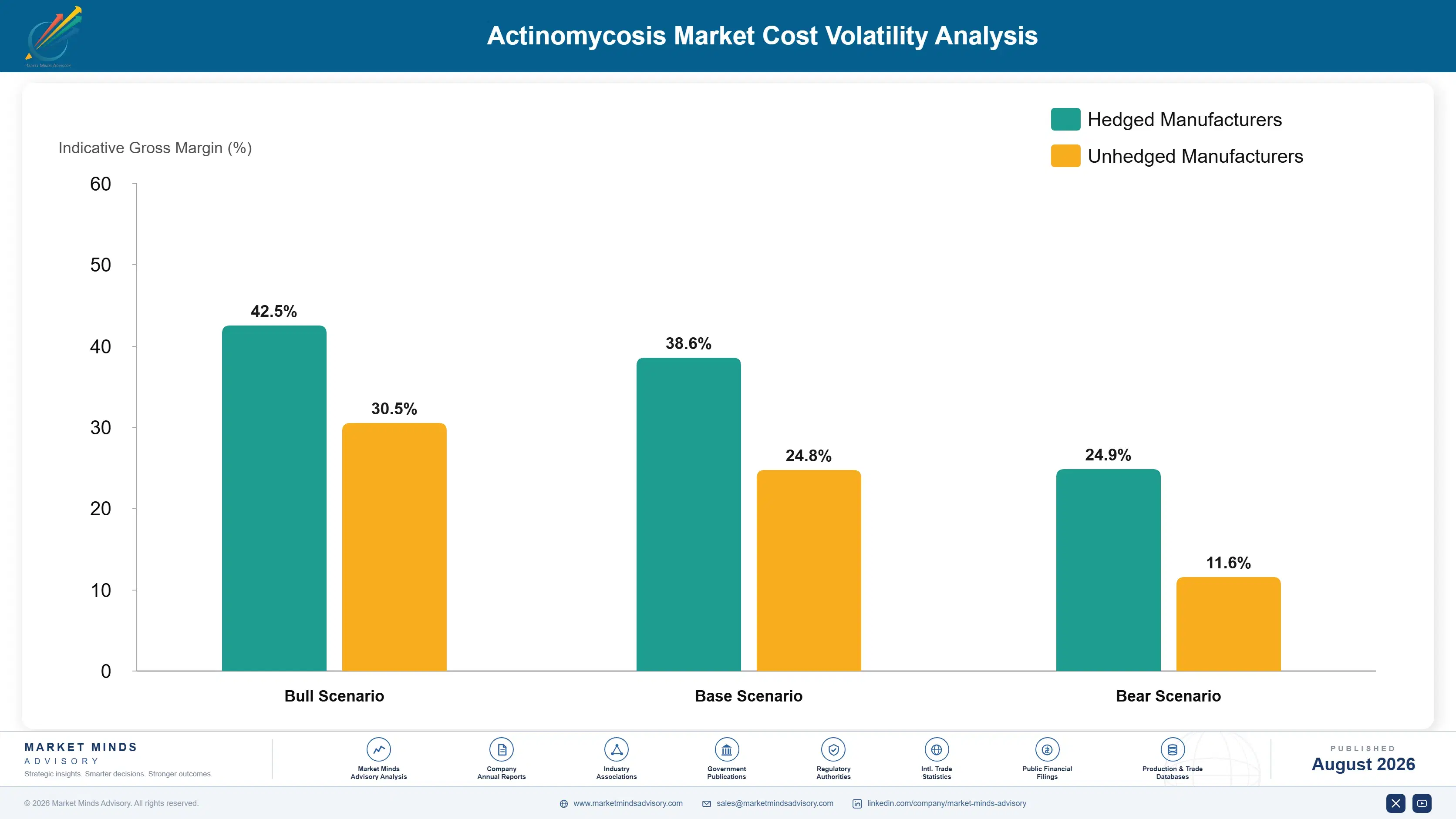
Reagent and Active Pharmaceutical Ingredient Cost Exposure

Diagnostic reagents and antibiotic active pharmaceutical ingredients together account for roughly 41% of cost of goods sold across this market, with reagent pricing tied to specialty biochemical supplier availability while penicillin API pricing depends on fermentation capacity concentrated among a handful of global producers. Instrument components and packaging add a further meaningful share, concentrated among vendors maintaining both diagnostic and pharmaceutical manufacturing capability.
Penicillin API and specialty reagent prices spiked during 2022 as global fermentation and biochemical supply chains tightened following broader disruption, with several manufacturers reporting input cost increases exceeding 24% in their 2022 annual reports before pricing stabilized through 2023. Industry supply chain reviews have flagged penicillin API sourcing as this market's single most concentrated input, more than diagnostic reagents or instrument components combined. Several manufacturers flagged this exposure as a leading operational risk.

Smaller regional manufacturers without long-term API supply agreements absorbed the 2022 shortage hardest, losing hospital contract bids to larger competitors including Pfizer and Sandoz that had negotiated priority allocation years in advance. Manufacturers with secured feedstock supply weathered the shortage far better than those dependent on spot market purchasing, a cost advantage that persists most sharply across smaller regional manufacturers today.
actinomycosis-market-cost-volatility-analysis-1787303629431

Long-Term API Supply Agreements

Larger manufacturers are locking in multi-year penicillin API supply agreements directly with qualified fermentation producers, guaranteeing predictable input costs ahead of demand increases rather than relying on spot market purchasing that has grown increasingly volatile since 2022. This approach adds cost certainty to production planning even when spot pricing swings sharply during periods of tight allocation.

Vertical Integration Into Fermentation Production

Several manufacturers are investing in internal penicillin fermentation capability to reduce dependence on third-party API suppliers, gaining pricing control and supply security that non-integrated competitors dependent on external sourcing cannot match during shortage periods. This integration also reduces exposure to spot market volatility that has repeatedly disadvantaged non-integrated competitors during past tightening cycles overall each time.

Diagnostic Portfolio Diversification Strategy

Diagnostic vendors are pursuing broad-spectrum molecular and MALDI-TOF platforms partly to diversify revenue beyond any single reagent category most exposed to specialty biochemical cost pass-through limitations under long-term hospital contracts. This diversification strategy also spreads vendor revenue across a broader set of testing categories, reducing dependence on any single reagent or pricing cycle for volume.

Portfolio Architecture for Margin Defence

Actinomycosis portfolios span three margin tiers, from commodity-adjacent generic antibiotic therapeutics and standard culture testing sold largely on price, through certified MALDI-TOF and reference laboratory service agreements carrying platform-driven premiums, toward an emerging next-generation tier built around molecular diagnostics and broad-spectrum panels still gaining share. Gross margin widens meaningfully at each tier as identification speed and platform capability increase across the
The volume versus premium tension centers on laboratory allocation. Vendors must choose between dedicating capacity to high-margin molecular and MALDI-TOF programs with growing but still-smaller volume, or serving reliable culture-based and generic antibiotic demand that fills out most production capacity across a typical year. Vendors without spare capacity increasingly favor higher-margin next-generation programs where competition remains thin, particularly during peak testing demand periods.

High-value margin pools concentrate in molecular diagnostic and MALDI-TOF identification programs, where platform investment and technical complexity keep competition thin and buyers pay a premium for turnaround-time reduction. Generic antibiotic therapeutics remain the volume anchor but carry the thinnest margins across the entire portfolio, leaving smaller manufacturers with fewer diversification options than larger integrated competitors, especially across smaller regional competitors.

Volume / Commodity-Adjacent Tier

Generic antibiotic therapeutics and standard culture-based testing sold largely on price and supply reliability without platform-driven premiums, across most hospital pharmacy buyer segments worldwide each year consistently overall, spanning both large and smaller institutions.
Gross Margin: 12%-20%

Premium / Certified Tier

MALDI-TOF instrument placements and reference laboratory service agreements sold under hospital system contracts carrying platform-driven pricing power built through years of proven turnaround performance across major accounts worldwide today, spanning both academic and community settings.
Gross Margin: 30%-40%

Sustainability / Regulatory / Next-Generation Tier

Molecular diagnostics and broad-spectrum panels in active hospital adoption, commanding premium pricing against limited proven alternatives as turnaround-time expectations tighten across most major metropolitan markets nationwide, spanning both hospital and reference laboratory settings.
Gross Margin: 36%-48%
actinomycosis-market-portfolio-architecture-1787303629934

Hospital Contracts Anchor Recurring Demand

Diagnostic instrument purchasing functions closer to an annuity than a transactional sale for hospital laboratories, since once a laboratory installs a MALDI-TOF or molecular platform, that vendor relationship typically persists for the instrument's operating life, often seven to ten years, given the cost and disruption risk of switching platforms mid-contract. Generic antibiotic purchasing behaves very differently, tracking hospital pharmacy formulary decisions and periodic competitive tender c
Adoption depth varies sharply by end-use vertical. Academic medical centers and large hospital systems show the deepest stickiness given multi-year instrument contracts and integrated laboratory information system dependencies, while smaller community hospitals switch vendors more readily since contract barriers are lower and price sensitivity plays a larger role in purchasing decisions. That divide shapes long-term vendor investment priorities.

A generational shift is underway as younger microbiology laboratory directors, who have no legacy relationship with traditional culture-only diagnostic vendors, evaluate platforms on turnaround-time data and integration capability rather than decades-long supply relationships. That openness gives newer, molecular-focused vendors a rare opening to win share in a market where culture-based incumbency has otherwise been difficult to dislodge, across several major regional markets today.
actinomycosis-market-end-use-penetration-index-1787303630426

Where Diagnostic Vendors Should Focus Next

These are among the four positions where our research anticipates prominent divergence between winners and laggards over the coming forecast period. Each is grounded in the demand model, the regulatory perimeter, and the announced capacity pipeline.
01 / MOLECULAR PANEL STRATEGY

Expand broad-spectrum panels before hospital standardization completes

Hospital laboratories are increasingly requiring broad-spectrum molecular panels covering multiple pathogens including Actinomyces, and vendors without comprehensive panels are losing laboratory contracts to better-equipped competitors as this shift accelerates. Panel development requires meaningful upfront investment but opens recurring reagent revenue that single-purpose tests cannot match. Vendors waiting until hospital standardization fully completes will find themselves racing to catch up against incumbents who invested years earlier, a gap that widens each quarter development investment lags behind competitor programs already underway across the industry.
02 / MALDI-TOF PLACEMENT TIMING

Prioritize instrument placement before laboratories consolidate further

Hospital laboratories have not universally committed to a single MALDI-TOF vendor, leaving a genuine opportunity for vendors willing to fund instrument placement ahead of confirmed consolidation trends. Waiting for laboratories to formally consolidate risks missing the placement window entirely once a preferred vendor relationship forms across the network. The capital required is meaningful but positions early movers to capture a category growing faster than culture-based testing today, a window that will not stay open indefinitely once laboratories standardize their preferred vendor relationship across the region.
03 / GENERIC SUPPLY RELIABILITY STRATEGY

Secure redundant API production before next shortage cycle

Penicillin API supply volatility has repeatedly disadvantaged manufacturers without redundant production capacity, and another shortage cycle would likely repeat that pattern given how concentrated global fermentation capacity remains. Vertically integrated competitors like Pfizer weathered the last volatility cycle far better than smaller non-integrated peers across the industry. Manufacturers pursuing redundant capacity now, while capital costs remain reasonable, protect hospital contract continuity against the next inevitable feedstock disruption, a pattern likely to repeat with each subsequent shortage cycle nationwide unless supply diversification accelerates meaningfully.
04 / REGIONAL GROWTH ALLOCATION STRATEGY

Weight new investment toward East Asia given fastest regional growth

East Asia and South Asia and Pacific are both growing faster than North America and Western Europe as hospital laboratory infrastructure investment accelerates across China, India, and neighboring markets. Vendors concentrating capacity expansion solely around legacy Western hospital relationships risk ceding share in the regions where volume growth will be steepest through 2036. Early investment in Asian laboratory partnerships and distribution capacity offers a meaningful head start over competitors still anchored entirely to legacy Western customer bases, a gap likely to widen further.

Engagement Snapshot From the Field

A live engagement with an industry participant carrying material or product regulatory and market exposure ahead of a defining policy shift, showing how our research translates into a defensible multi-year portfolio strategy.
MARKET MINDS ADVISORY · CLIENT ENGAGEMENT SUMMARY
Actinomycosis Producer Strategic Portfolio Review and Transition Roadmap 2026·Investment Scenario on Actinomycosis Exposure Evaluation 2025-26
CLIENT PROFILE
The client is a regional academic medical center operating a clinical microbiology laboratory serving a multi-hospital health system, with annual diagnostic laboratory procurement spend in the low tens of millions of dollars (client-reported, unverified by MMA). The client faced pressure to modernize its identification workflow while managing capital budget constraints and vendor consolidation decisions across its full testing operation.
STRATEGIC CHALLENGE
The client needed to decide whether to invest in MALDI-TOF instrumentation, molecular panel expansion, or both, given uncertainty over which technology would deliver the greatest turnaround-time improvement across its full pathogen testing menu, while balancing capital budget constraints typical of an academic medical center competing for hospital-wide resources, while managing training timelines across a growing multi-site laboratory network.
MMA APPROACH
MMA benchmarked the client's diagnostic technology roadmap against three comparable academic medical centers pursuing similar modernization efforts and modeled turnaround-time and cost scenarios comparing MALDI-TOF and molecular investment paths, incorporating primary interview data from laboratory directors and vendors on platform performance and total cost of ownership. The analysis also benchmarked training timelines across three peer academic medical centers pursuing similar modernization strategies.
KEY FINDINGS
  1. The client's continued reliance on culture-only identification left it with meaningfully longer average turnaround times than peer institutions that had already adopted either MALDI-TOF or molecular platforms.
  2. Combining MALDI-TOF instrumentation with a targeted molecular panel for anaerobic pathogens delivered better turnaround-time improvement than either technology alone at comparable total cost.
  3. Peer institutions that had already standardized on a single primary vendor were achieving faster staff training and lower per-test costs than the client's fragmented current vendor approach allowed.
  4. Penicillin API supply exposure among the client's pharmacy formulary suppliers posed a greater near-term continuity risk than the diagnostic technology risk the client had originally prioritized in evaluation.
CLIENT PROFILE
The client is a regional academic medical center operating a clinical microbiology laboratory serving a multi-hospital health system, with annual diagnostic laboratory procurement spend in the low tens of millions of dollars (client-reported, unverified by MMA). The client faced pressure to modernize its identification workflow while managing capital budget constraints and vendor consolidation decisions across its full testing operation.
STRATEGIC CHALLENGE
The client needed to decide whether to invest in MALDI-TOF instrumentation, molecular panel expansion, or both, given uncertainty over which technology would deliver the greatest turnaround-time improvement across its full pathogen testing menu, while balancing capital budget constraints typical of an academic medical center competing for hospital-wide resources, while managing training timelines across a growing multi-site laboratory network.
MMA APPROACH
MMA benchmarked the client's diagnostic technology roadmap against three comparable academic medical centers pursuing similar modernization efforts and modeled turnaround-time and cost scenarios comparing MALDI-TOF and molecular investment paths, incorporating primary interview data from laboratory directors and vendors on platform performance and total cost of ownership. The analysis also benchmarked training timelines across three peer academic medical centers pursuing similar modernization strategies.
KEY FINDINGS
  1. The client's continued reliance on culture-only identification left it with meaningfully longer average turnaround times than peer institutions that had already adopted either MALDI-TOF or molecular platforms.
  2. Combining MALDI-TOF instrumentation with a targeted molecular panel for anaerobic pathogens delivered better turnaround-time improvement than either technology alone at comparable total cost.
  3. Peer institutions that had already standardized on a single primary vendor were achieving faster staff training and lower per-test costs than the client's fragmented current vendor approach allowed.
  4. Penicillin API supply exposure among the client's pharmacy formulary suppliers posed a greater near-term continuity risk than the diagnostic technology risk the client had originally prioritized in evaluation.
RECOMMENDED STRATEGY
Phase 1: Phase 1 (Months 1 to 4): Benchmark vendor platform performance and select a combined MALDI-TOF and molecular panel investment approach and document findings. Phase 2: Phase 2 (Months 5 to 10): Install instrumentation, complete staff training, and validate turnaround-time improvement against baseline performance and prior benchmarks. Phase 3: Phase 3 (Months 11 to 14): Formalize a long-term vendor supply agreement with volume-based pricing tied to projected testing growth across all facilities.
OUTCOME
Within fourteen months of implementation, the client completed instrument installation and reduced average pathogen identification turnaround time meaningfully across its full testing menu. Client-reported unnecessary exploratory surgery referrals declined by an estimated 19% over the following year, though this figure is client-reported and unverified by MMA.

Frequently Asked Questions

Foundational context covering the market sizes, CAGR, scope, country, region and competition that inform every finding below. This section is provided to cover basics and most often pre-purchase conversations, answered from the MMA Primary Research Dataset.

What is the current size of the Actinomycosis Market?

The global actinomycosis market reached an estimated $0.28 billion in 2025. Culture-based diagnostic testing accounts for the largest share of that volume, reflecting its role as the historical standard of care.

How large will the Actinomycosis Market be by 2036?

MMA forecasts the market will reach approximately $0.92 billion by 2036. That represents a 2.97x expansion over the 2026 base value across the ten-year forecast period.

What is the CAGR for the Actinomycosis Market 2026 to 2036?

The base case forecast CAGR is 11.4%, with a bull case of 12.6% and a bear case of 10.1% depending on molecular diagnostic adoption and hospital laboratory investment pace.

Which segment is growing fastest?

Molecular Diagnostics (PCR-Based Testing) is growing fastest at a 15.8% CAGR, roughly 1.39 times the overall market rate, as hospital laboratories adopt rapid identification methods.

Who are the major companies in the Actinomycosis Market?

bioMerieux, Bruker, Thermo Fisher Scientific, Pfizer, and Becton Dickinson lead the market. Together the top five hold an estimated 44% of global shipment revenue across a fragmented vendor base.

Which country is growing fastest?

India leads growth as its hospital laboratory infrastructure and molecular diagnostic adoption both scale rapidly, growing at an estimated 14.2% CAGR through 2036 from a still-small base.

Report Segmentation Architecture

The full report scope spans multiple orthogonal segmentation dimensions, with cross-tabulated demand data provided for each dimension pair. Coverage extends further to regional breakdowns, trend trajectories, and the competitive detail needed to support segment-level decision-making.

By Diagnostic and Therapeutic Technology

  • Culture-Based Diagnostic Testing
  • Molecular Diagnostics (PCR-Based Testing)
  • MALDI-TOF Mass Spectrometry Identification
  • Imaging-Guided Biopsy and Diagnosis
  • Injectable Antibiotic Therapeutics
  • Oral Antibiotic Therapeutics

By End-Use Industry

  • Academic Medical Centers
  • Community Hospitals
  • Reference Laboratories
  • Dental and Oral Surgery Practices

By Commercial Dimension

  • Hospital System Reference Agreements
  • Reagent Rental and Placement Models
  • Competitive Tender Purchasing
  • Hospital Pharmacy Formulary Contracts

By Region

  • North America
  • Western Europe
  • East Asia
  • South Asia and Pacific
  • Latin America
  • Middle East and Africa
  • Eastern Europe

Scope, Methodology, and Coverage

Every figure in this report is reproducible from documented input assumptions. The scope below maps the historical period, the forecast horizon, the segmentation dimensions, and the countries covered, alongside the underlying primary and qualitative methodology.
Historical Period
2020 to 2025
Forecast Period
2026 to 2036
Base Year
2025 (USD billions; MMA Primary Research Dataset, August 2026)
Market Definition
This report covers diagnostic testing products and services, including culture, molecular PCR, MALDI-TOF mass spectrometry, and imaging-guided biopsy methods, along with antibiotic therapeutics used to treat confirmed actinomycosis infections. It excludes diagnostic and therapeutic products for other bacterial infections not caused by Actinomyces species, and general dental or surgical services performed independent of actinomycosis diagnosis.
Quantitative Units
USD billions (current prices); number of diagnostic tests and therapeutic courses shipped where disclosed
Segmentation Dimensions
By Diagnostic and Therapeutic Technology; By End-Use Industry; By Commercial Dimension; By Region
Regions Covered
North America, Western Europe, East Asia, South Asia and Pacific, Latin America, Middle East and Africa, Eastern Europe
Countries Covered
USA, China, Germany, France, UK, Japan, South Korea, India, Australia, Canada, Brazil, Mexico, Indonesia, Vietnam, Thailand, Malaysia, UAE, Saudi Arabia, South Africa, Nigeria, Turkey, Poland, Netherlands, Italy, Spain, Sweden, Switzerland, Argentina, Colombia, Singapore, and additional markets relevant to this sector
Key Companies Profiled
bioMerieux SA, Bruker Corporation, Thermo Fisher Scientific Inc., Pfizer Inc., Becton, Dickinson and Company, QIAGEN N.V., Sandoz Group AG, Teva Pharmaceutical Industries Ltd., Novartis AG, GSK plc, Fresenius Kabi AG, Hikma Pharmaceuticals PLC, Aurobindo Pharma Limited, Sun Pharmaceutical Industries Ltd., Cipla Limited, Lupin Limited, Viatris Inc., Amneal Pharmaceuticals Inc., Wockhardt Limited, Siemens Healthineers AG
Quantitative Methodology
Primary survey, n=3,800 respondents, Q4 2025, six countries; demand-side model with trade association cross-validation
Qualitative Methodology
47 expert interviews, Q4 2025; applied to validate demand model assumptions, identify emerging dynamics, and assess competitive positioning
Report Format
PDF and XLSX data workbook (Word format preview document)
Publisher
Market Minds Advisory
Report Code
MMA-2026-HLT-124
Published
August 2026
Contact
sales@marketmindsadvisory.com | www.marketmindsadvisory.com

Purchase the full Actinomycosis Market Report (2026 to 2036).

The full report delivers an assessment of the global actinomycosis market across all six diagnostic and therapeutic technology segments and seven world regions through 2036. It includes competitive profiling of twenty active vendors, primary survey data from laboratory and procurement decision-makers, and a dedicated deep-dive on molecular diagnostic adoption timelines. Buyers receive access to underlying segment and regional data tables alongside the full narrative analysis, supporting both procurement planning and vendor evaluation decisions. The report also benchmarks revenue lever adoption and input cost exposure across the top twenty profiled companies, drawing on MMA's primary survey of 3,800 respondents and 47 expert interviews conducted in Q4 2025.
Twenty-company competitive profiling and margin benchmarking
Six-segment diagnostic technology forecast data and tables
Seven-region demand and CAGR breakdown data
Molecular diagnostic adoption timeline deep-dive analysis
Penicillin API supply chain risk assessment overview
Primary interview data from laboratory decision-makers

Built For The People Who Decide

From boardroom strategy to bench-side execution, this report is read cover-to-cover by leaders shaping the next decade of their industry, turning demand scenarios, market dynamics and valuation benchmarks into decisions.
CXOs/ Presidents/ VPs/ Managers
M&A and Corporate Development
Strategy Teams and R&D Heads
Procurement and Product Directors
Regulatory and Compliance Leaders
Investor Relations and Equity Analysts