Market Minds Advisory
Acoustic Wall Coverings Market

Acoustic Wall Coverings Market: Acoustic Wall Coverings Market: Declared Absorption, Installed Coverage and Recycled Feedstock Competition, 2026 to 2036

Every panel in this market is sold on a laboratory absorption figure measured at a mounting condition that the finished building will almost never manage to reproduce anywhere at all.

Lead Analyst

Published

September 2026

Make Smarter Decisions with Customized Research Insights

Request a free sample report and evaluate market opportunities, growth trends, and competitive dynamics relevant to your business needs.

2025 MARKET VALUE$2.9BMarket Size 2025
2036 FORECAST VALUE$6.0BBase Case , 2026 to 2036
CAGR 2026 TO 20366.8 %Bull 8.0% / Bear 5.6%
INCREMENTAL OPPORTUNITY$2.9BNet 10- year value creation
EXPANSION MULTIPLE1.94x2036 value over 2026 base
Strategic Levers
M&A Pipeline
Regional Outlook
Country Rankings
Competitive Intelligence
Segmental Deep-dive
Call-Us : 91 93563 13602

Executive Snapshot and Market Trajectory.

Absorption ratings in this market are measured with panels suspended away from the wall, then quoted for products that get glued flat against it. The gap between the two conditions averages 0.22 NRC and almost nobody discloses it. Specifiers rarely ask which condition produced it.
PET and polyester felt panels grow at 10.2%, half again the market rate of 6.8%, and they won on manufacturability rather than acoustics. Felt cuts, mills, and machines cleanly, needs no facing, and does not irritate installers, which mineral wool cannot claim. Perforated and slatted wood follows at 8.4%, carried by an appearance specifiers want. Mineral wool absorbs as well and costs less, which makes that an unusual outcome.
Coverage is the other unspoken problem. Completed offices typically carry 16% of wall area treated where speech privacy targets need closer to 28%, so rooms underperform against expectations set at specification stage. The shortfall is rarely traced back to quantity, and the panels get blamed instead of the calculation that sized them. Acoustic consultants size projects properly; designers working from an occupant survey generally do not, and they now make more of these decisions.
Market Definition
This market covers wall-mounted acoustic absorption products, including PET and polyester felt panels, mineral and glass wool faced panels, fabric wrapped acoustic panels, perforated and slatted wood panels, acoustic plaster and spray applied finishes, and acoustic textile wallcoverings. It excludes suspended ceiling tiles and baffles, floor coverings, acoustic doors and glazing, sound isolation and barrier products such as mass loaded vinyl and resilient channels, and outdoor noise barriers.
Base Year Value
$2.9B in 2025 (MMA Primary Research Dataset, September 2026)
Forecast Period
2026 to 2036, eleven discrete annual values
CAGR
6.8% base case. Bull 8.0%. Bear 5.6%.
Fastest Growth Segment
PET And Polyester Felt Panels: 10.2% CAGR
Fastest Growth Country
India: 9.4% CAGR
Fastest Growth Region
South Asia and Pacific: 8.8% CAGR
Largest Region
East Asia: 30% of 2025 global value
Market Leaders
Saint-Gobain Ecophon, Armstrong World Industries, Knauf Ceiling Solutions, Autex Industries, and Kvadrat Acoustics lead the field. Source: MMA Primary Research Dataset, July 2026.
Primary Survey
n=3,800 procurement and R&D decision-makers, Q4 2025, six countries
Methodology
Demand-side build-up, cross-validated against public data, 47 expert interviews

Acoustic Wall Coverings Market Forecast Scenarios

acoustic-wall-coverings-market-size-forecast-scenario-1790012652466
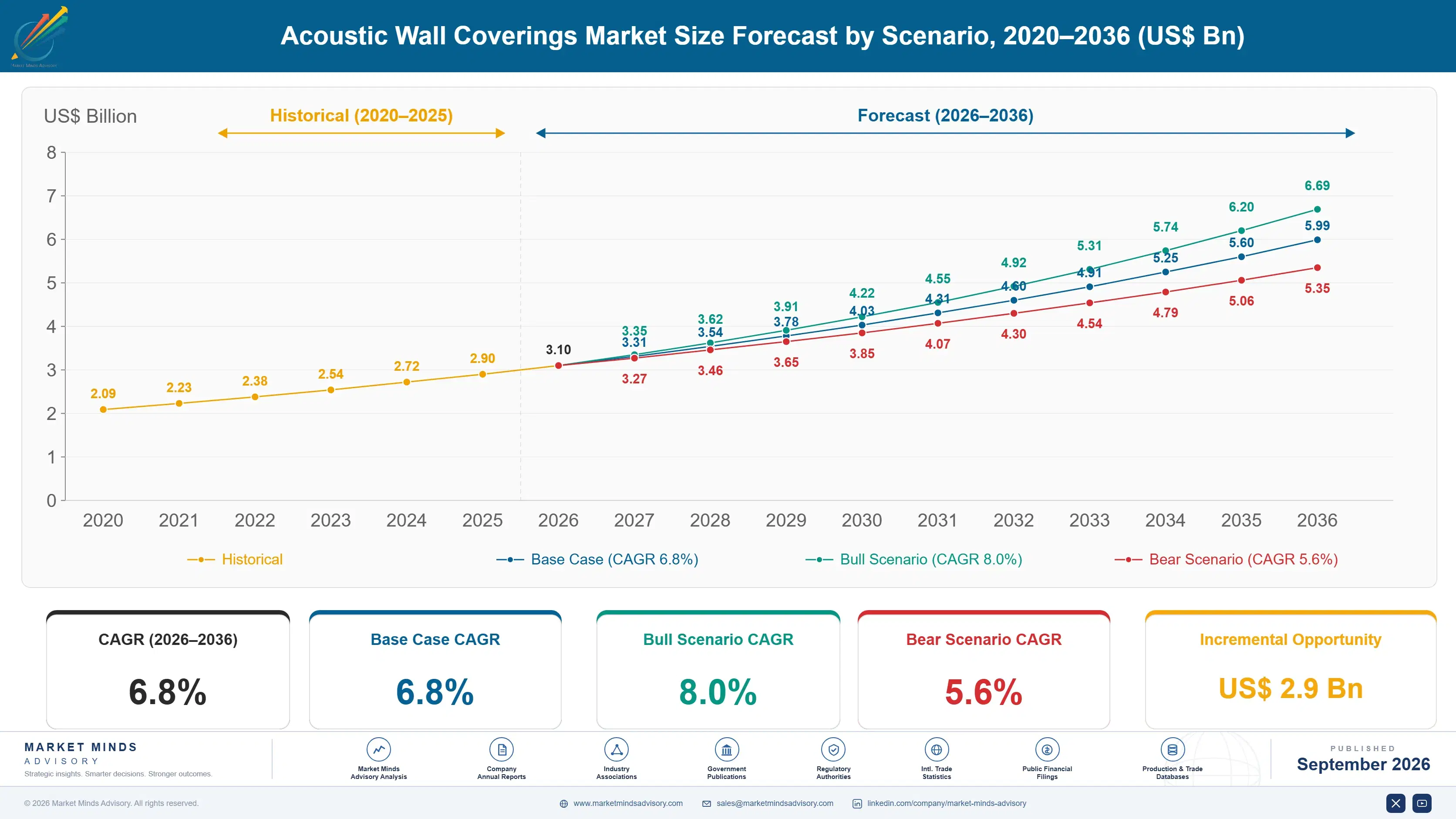
Between 2020 and 2025 the category grew at 5.6% through an unusual sequence. Office construction paused, then restarted with entirely different priorities as hybrid working made speech privacy and video call intelligibility the dominant complaints in every occupant survey. Fit-out demand recovered faster than new build, and PET felt took share from mineral wool throughout the period on fabrication ease.
The base case at 6.8% rests on three mechanisms. Office reconfiguration for hybrid patterns continues generating retrofit demand independent of new construction cycles. School and healthcare acoustic requirements tighten in more jurisdictions, following the pattern established in Britain and Germany. And PET felt manufacturing capacity expands fast enough to hold prices while volumes rise, which mineral wool economics never permitted. None of the three depends on new office construction returning to the volumes seen before 2020.
The bull case at 8.0% depends on speech privacy entering workplace standards as a measurable requirement rather than a design aspiration. The bear case at 5.6% is recycled PET feedstock: beverage packaging mandates now compete directly for the same post-consumer bottle flake, and panel manufacturers hold far weaker purchasing positions than the drinks industry does in that contest.

The Number On The Datasheet

Absorption coefficients come from reverberation room testing under standardised mounting conditions, and the condition that produces the best number suspends the panel with an air cavity behind it. Wall panels are then installed glued flat against plasterboard, where the same product absorbs considerably less across the frequencies that matter for speech. The average gap runs to 0.22 NRC and datasheets rarely mention which mounting produced the figure.
TOP FIVE CONCENTRATION24%Share of category revenue held by the leading manufacturers
DECLARED VERSUS INSTALLED GAP0.22 NRCAbsorption lost between laboratory mounting and actual wall installation
TYPICAL WALL COVERAGE16%Proportion of wall area treated in a completed office
COVERAGE ACTUALLY REQUIRED28%Wall area needed to reach speech privacy targets reliably
RECYCLED CONTENT SHARE71%Post-consumer material within a typical polyester felt panel
FREIGHT COST SHARE24%Delivered cost consumed by transporting low density bulky goods
Quantity compounds the problem. A room reaches its reverberation target through total absorption area, not through the rating of any single panel, and completed offices typically carry around 16% of wall area treated against a requirement nearer 28% for speech privacy. Specifiers size installations against budget and appearance, then the room disappoints and the product takes the blame rather than the sum.
PET felt reshaped supply for reasons that have little to do with sound. It cuts on a CNC router, holds a machined edge, needs no facing fabric, and does not irritate the people installing it. Mineral wool absorbs at least as well at equivalent thickness and costs less per square metre, yet it keeps losing specification to a material that is simply easier to work with.
"Every datasheet in this category quotes a mounting condition the building will never reproduce, and the whole industry knows it. The honest fix is publishing both figures, which one or two manufacturers have started doing. The rest are waiting to see whether specifiers actually notice the difference."
Practice Director, Building Products and Interior Systems · MMA Construction and Industrial Equipment Practice · September 2026

Market Trends

Hybrid Working Made Speech Privacy The Complaint

Occupant surveys across reconfigured offices now put speech intelligibility and call privacy above temperature and lighting as the leading dissatisfaction, which reverses two decades of ranking. Video calls conducted at open desks created a problem open-plan design never anticipated and cannot resolve through layout alone. Retrofit acoustic treatment therefore runs on a cycle independent of new construction, and fit-out demand has recovered considerably faster than new build across every mature market covered here. Property owners facing occupancy pressure treat acoustic treatment as a way of making returned-to space tolerable. The budget line differs entirely.
Market Impact: Raises quantity 2.4 times
PET Felt Wins On Fabrication Rather Than Absorption

Polyester felt grows at 10.2% because it machines cleanly on a CNC router, holds a cut edge without fraying, requires no facing fabric, and does not irritate installers who handle it all day. Mineral wool matches or beats it acoustically at equivalent thickness and costs less per square metre. The material winning specification is therefore the one that is easier to fabricate and finish, which is an unusual outcome for a performance-led building product. Felt also accepts printing and three-dimensional milling, which opens design possibilities that a faced mineral board cannot approach at any price.
Market Impact: Country grows at 9.4%

Market Opportunities and Growth Drivers

School Acoustic Requirements Spread Across More Jurisdictions

Britain and Germany established measurable reverberation limits for teaching spaces, and further jurisdictions have followed with comparable requirements written into school building standards rather than left to guidance. Compliance requires a calculated absorption area rather than a token installation, which raises quantity per project substantially above discretionary commercial fit-out. Education demand also proves far less cyclical than offices, since building programmes run on public capital cycles rather than on corporate property decisions. Verification by measurement after completion, where it is required, removes the option of treating the specification as advisory.
Market Impact: Affects 71% of content

Indian Commercial Construction Expands At Pace

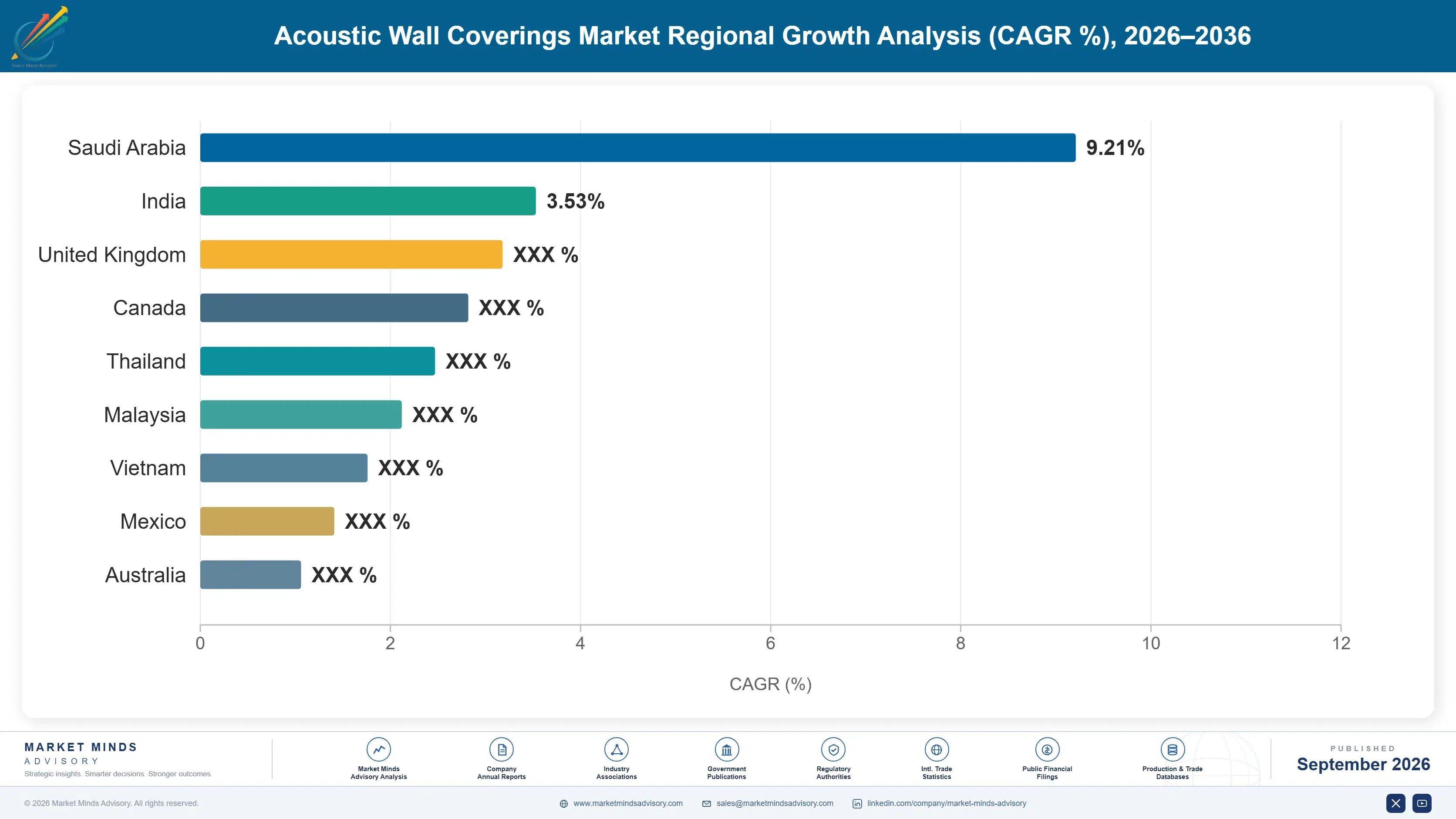
Indian growth of 9.4% leads every country covered here, driven by commercial office construction across Bengaluru, Hyderabad, and the National Capital Region at volumes no mature market matches. Occupier specifications increasingly follow international standards where the tenant is a multinational, which pulls acoustic treatment into projects that would previously have omitted it entirely. Domestic PET panel manufacture has grown alongside, reducing dependence on imported product considerably over the past three years. Fit-out contractors in these cities now carry acoustic treatment as standard scope rather than as a variation and generally increases the quantity specified.
Market Impact: Coverage falls 12 points short

Market Restraints and Challenges

Recycled Bottle Flake Competes With Beverage Packaging

Polyester felt depends on post-consumer bottle flake, and beverage packaging recycled content mandates now bid for the same feedstock with considerably deeper pockets. The root cause is that food-grade rPET commands a premium panel manufacturers cannot match on any volume they buy. Commercially it puts a floor under panel input costs that did not previously exist. Manufacturers respond by contracting flake supply directly, by qualifying non-food-grade streams, and by blending virgin fibre where colour permits. None of those approaches removes the competition, since the feedstock pool is finite. The pool is finite and demand for it keeps rising.
Market Impact: Retrofit covers 61% demand

Undersized Installations Damage The Category's Credibility

Offices typically receive 16% wall coverage where speech privacy targets require nearer 28%, and the room then fails to perform as the specification promised anybody. The root cause is that coverage gets sized against budget and appearance rather than against a calculated absorption requirement. Commercially the product absorbs blame that belongs to the quantity. Manufacturers respond with specification tools, coverage calculators, and design services that put the arithmetic in front of the specifier early. Selling quantity properly turns out to be a larger commercial opportunity than selling absorption. Very few manufacturers have organised around that insight.
Market Impact: Segment grows at 10.2%
3 additional market trends, 4 additional growth drivers, and 2 additional restraints and challenges are covered in the full report. Contact sales@marketmindsadvisory.com to access the complete intelligence.

Segment CAGR and Growth Architecture

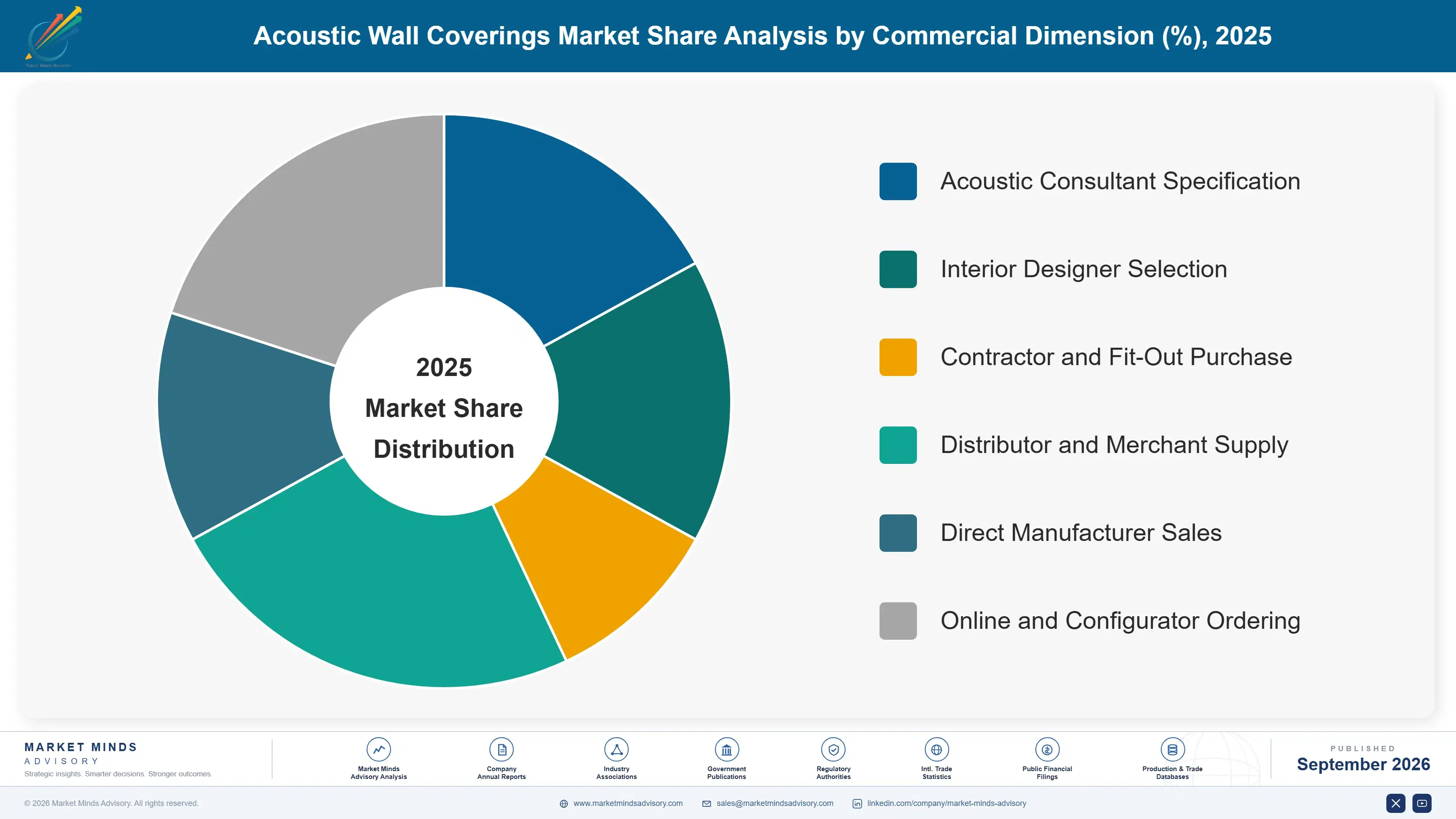
Segmentation follows material and product type across six categories: PET and polyester felt panels, mineral and glass wool faced panels, fabric wrapped acoustic panels, perforated and slatted wood panels, acoustic plaster and spray applied finishes, and acoustic textile wallcoverings. Building type, specification route, and distribution channel are treated as separate dimensions entirely. Backing materials are counted within the panel system.
acoustic-wall-coverings-market-market-share-analysis-1790012653024

PET And Polyester Felt Panels

Polyester felt grows at 10.2%, half again the market rate of 6.8%, on properties that have almost nothing to do with sound. The material machines cleanly on a CNC router, holds a cut edge without fraying or requiring a facing fabric, accepts printing and three-dimensional milling, and does not irritate the people who install it. Mineral wool absorbs as well or better at equivalent thickness and costs less per square metre, yet keeps losing specification. Recycled bottle flake supplies about 71% of the content, which is both the environmental argument and the segment's clearest supply risk. Manufacturers with in-house milling and printing hold the margin here, while converters buying finished board compete on freight position alone.
CAGR 10.2%

Perforated And Slatted Wood Panels

Slatted and perforated timber grows at 8.4% almost entirely on appearance, since specifiers want visible warmth in spaces that felt panels render flat and uniform. Absorption comes from the backing material behind the slats rather than from the timber itself, which is a point the marketing rarely makes clear to anybody. Performance therefore varies enormously between products that look broadly identical on a wall. The premium over felt is substantial, and it holds because the alternative appearance simply does not exist in any other absorbing material. Fire performance requirements complicate timber specification in several jurisdictions, and treated products carry cost that plain slats avoid. Installation skill also matters more here than in any other part of this market.
CAGR 8.4%
Full segment breakdown across 6 segments available in the complete report.

Regional Architecture and Country Demand Map

Regional shares here reflect commercial construction and interior fit-out activity rather than manufacturing location, since panel freight economics on low density goods push production close to consumption in every market. All seven regions sit inside the standard bands for both share and growth across this market.

East Asia

Commercial construction volume across China, Japan, and South Korea exceeds any other region by a wide margin, and acoustic treatment now appears in specifications that would have omitted it a decade ago. Growth of 7.8% runs above the world rate. Japanese and Korean projects specify to considerably higher acoustic standards than Chinese equivalents, while Chinese demand comes predominantly from volume rather than specification depth. Domestic PET panel manufacture supplies most of the region and exports into Southeast Asia at competitive landed cost. Freight economics keep that trade regional rather than global. Korean and Japanese specifiers increasingly ask for direct-fix absorption data. That request was almost unheard of five years ago.
Share: 30% | CAGR: 7.8% (2026 to 2036)

Western Europe

Regulation originated here and still drives more demand than anywhere else, with British school building standards and German room acoustics requirements both setting measurable reverberation limits rather than offering guidance. Growth of 5.4% is the slowest of the seven regions, reflecting a mature commercial property stock where retrofit rather than new build carries the volume. Nordic manufacturers hold disproportionate specification influence given their long involvement in acoustic product development and testing. Acoustic consultants hold more specification authority here than in any other region, which makes declared performance data matter commercially rather than merely technically. Textile entrants have found the region harder to penetrate for exactly that reason, and several have bought acoustic competence rather than claiming it.
Share: 24% | CAGR: 5.4% (2026 to 2036)
Regional intelligence for 5 additional markets available in the complete report: North America, South Asia and Pacific, Latin America, Middle East and Africa, Eastern Europe. Contact sales@marketmindsadvisory.com.
acoustic-wall-coverings-market-country-cagr-analysis-1790012653565

Where Manufacturers Build Defensible Value

Four commercial moves separate manufacturers building specification positions from those competing on price per square metre against imported felt. Each addresses either the honesty gap in declared performance or the quantity gap in what actually gets installed, which are this category's two open problems. Two of them require no product development whatsoever, only disclosure and arithmetic.

Publish Both Mounting Conditions On Every Datasheet

Declared absorption comes from suspended mounting while wall panels install flat, and the gap averages 0.22 NRC across the products tested. Manufacturers publishing both figures report specification win rates 1.6 times higher among acoustic consultants, who already know the gap exists and reward the disclosure. It costs one additional test per product line and converts a widely understood industry evasion into a genuine differentiator that competitors then have to answer. Consultants carry professional liability for measured room performance, which is why they reward it. The first mover in each market gains disproportionately from being the one who said it first.
Market Impact: Raises consultant specification wins to 1.6 times higher

Put Coverage Arithmetic In Front Of Specifiers

Offices receive 16% wall coverage against a requirement nearer 28%, and the shortfall is sized by budget rather than by calculation at the design stage. Manufacturers providing coverage calculators and design services report average order values 34% to 52% higher on projects where the tool was used early. Selling the correct quantity is a larger revenue opportunity than selling a better panel, and it also removes the disappointment that follows undersized work. It also removes the disappointment that undersized installations reliably produce afterwards. Specifiers welcome the arithmetic rather than resenting the intervention in their work.
Market Impact: Lifts average project order values by 34 to 52%

Contract Recycled Flake Supply Ahead Of Mandates

Beverage packaging recycled content requirements now compete directly for post-consumer bottle flake, and panel manufacturers hold far weaker purchasing positions than the drinks industry in that contest. Producers holding contracted multi-year flake supply report input cost variance 2.8 times lower than spot buyers across the same period. The competition for this feedstock intensifies annually, and positions taken now will look considerably cheaper in five years than they do today. Non-food-grade streams remain available and panels have no reason to compete for food-grade material. Colour limitations from mixed streams barely matter on muted palettes.
Market Impact: Cuts input cost variance to 2.8 times lower

Convert Close To Where Panels Get Installed

Freight consumes 24% of delivered cost on low density panels, which makes long-distance supply uncompetitive against regional converting almost regardless of manufacturing cost differences. Producers operating regional conversion within their main markets report delivered cost advantages of 11% to 19% over importers. The economics reward converting near demand rather than concentrating production, which is the opposite of what most building product categories reward at comparable scale. Scale concentration is the wrong instinct here, and several international producers have learned it expensively. Conversion capacity is also considerably cheaper to establish than fibre manufacturing.
Market Impact: Delivers an 11 to 19% delivered cost advantage

Who Controls the Margin Pool

Concentration is low. Five manufacturers hold 24% of category revenue, measured consistently on that basis across all participants, and the remainder spreads across regional converters, textile houses that entered from adjacent categories, and specialist timber panel producers. Freight economics on low density goods keep regional players viable against international scale in a way most building products do not. Barriers to entry are low on plain board and considerably higher on milled, printed, and timber systems.
Competition currently turns on three dimensions: specification influence with acoustic consultants and architects, which decides whether a product reaches the drawing at all; fabrication capability, particularly CNC milling and printing on felt; and regional conversion footprint, which determines delivered cost against imported alternatives across every project. Testing and data disclosure has recently become a fourth dimension, which nobody expected to matter commercially until it did.

Pressure builds from two directions. Textile and furniture manufacturers keep entering on appearance rather than acoustics. Meanwhile recycled feedstock competition tightens input positions annually. Rankings will shift toward producers holding contracted flake supply and publishing honest mounting data, since neither is quickly assembled by a late arrival. Consultant-specified work carries better margins than designer-led work by a meaningful gap.
acoustic-wall-coverings-market-company-positioning-matrix-1790012654105

Competitive Moat and Risk Dimensions

SAINT-GOBAIN ECOPHON

Moat: Specification Influence With Consultants

Decades of acoustic research and involvement in standards development give the business unusual standing with acoustic consultants, who specify by name far more often here than in most building product categories. That relationship survives price competition because the consultant carries professional liability for the room's measured performance rather than for its cost.
SAINT-GOBAIN ECOPHON

Risk: Mineral Wool Heritage Position

Product heritage sits in mineral wool at exactly the moment specification is moving toward polyester felt on fabrication grounds. Defending that position requires competing in a material where the business holds no particular advantage, against converters whose entire operation was built around routing and finishing felt efficiently.
AUTEX INDUSTRIES

Moat: Polyester Felt Manufacturing Depth

Vertical capability in polyester felt from fibre through to finished panel gives control over colour, density, and thickness that converters buying board stock cannot match. The business built this position while mineral wool still dominated specification, and it now supplies the material that is taking share fastest across every region covered.
AUTEX INDUSTRIES

Risk: Recycled Feedstock Exposure Concentrated

Depth in a single material means full exposure to post-consumer bottle flake pricing at exactly the point beverage packaging mandates are bidding the same feedstock away. Manufacturers running multiple material platforms can shift specification emphasis when one input tightens, and this business simply cannot. Diversification would mean building competence in materials the business deliberately left behind.

Players Tracked

Prominent Players

Saint-Gobain Ecophon
Armstrong World Industries
Knauf Ceiling Solutions
Autex Industries
Kvadrat Acoustics

Other Key Players

ROCKWOOL Group
Texaa
BAUX
Woven Image
Caimi Brevetti
Vicoustic
Troldtekt
Gustafs
Hunter Douglas Architectural
Wolf-Gordon
Carnegie Fabrics
Acoustical Surfaces
Primacoustic
Impact Acoustic
Soundtect

Recent Developments

JANUARY 2026

Autex Industries Expands Polyester Felt Panel Capacity

Autex Industries completed an organic capacity expansion for polyester felt panel manufacture, funded internally with no partner involved, after CNC-milled and printed panel demand outran available finishing throughput across its existing operations. The expansion targets milling and printing capacity specifically rather than base felt production.
Signal: Finishing capacity rather than felt production constrains growth across this segment. Fabrication has become the margin position in felt.
AUGUST 2025

Kvadrat Acquires Specialist Acoustic Panel Manufacturer

Kvadrat completed an acquisition of a specialist acoustic panel manufacturer, adding absorption engineering and testing capability to a textile business that had previously competed largely on appearance and colour range alone. The acquired operation brings reverberation testing facilities and specification relationships with consultants across several European markets.
Signal: Textile entrants are buying the acoustic competence they could not credibly claim. Appearance alone no longer wins consultant specification.
APRIL 2025

Saint-Gobain Publishes Dual Mounting Absorption Data Across Wall Range

Saint-Gobain began declaring absorption coefficients under both suspended and direct-fix mounting conditions across its wall panel range, disclosing the performance difference that datasheets across this category have historically presented as a single figure. The declaration covers both suspended and direct-fix conditions across every product in the wall range.
Signal: Disclosure of the mounting gap becomes a competitive weapon rather than a liability. Competitors must now answer the disclosure directly.

What A Panel Costs Delivered

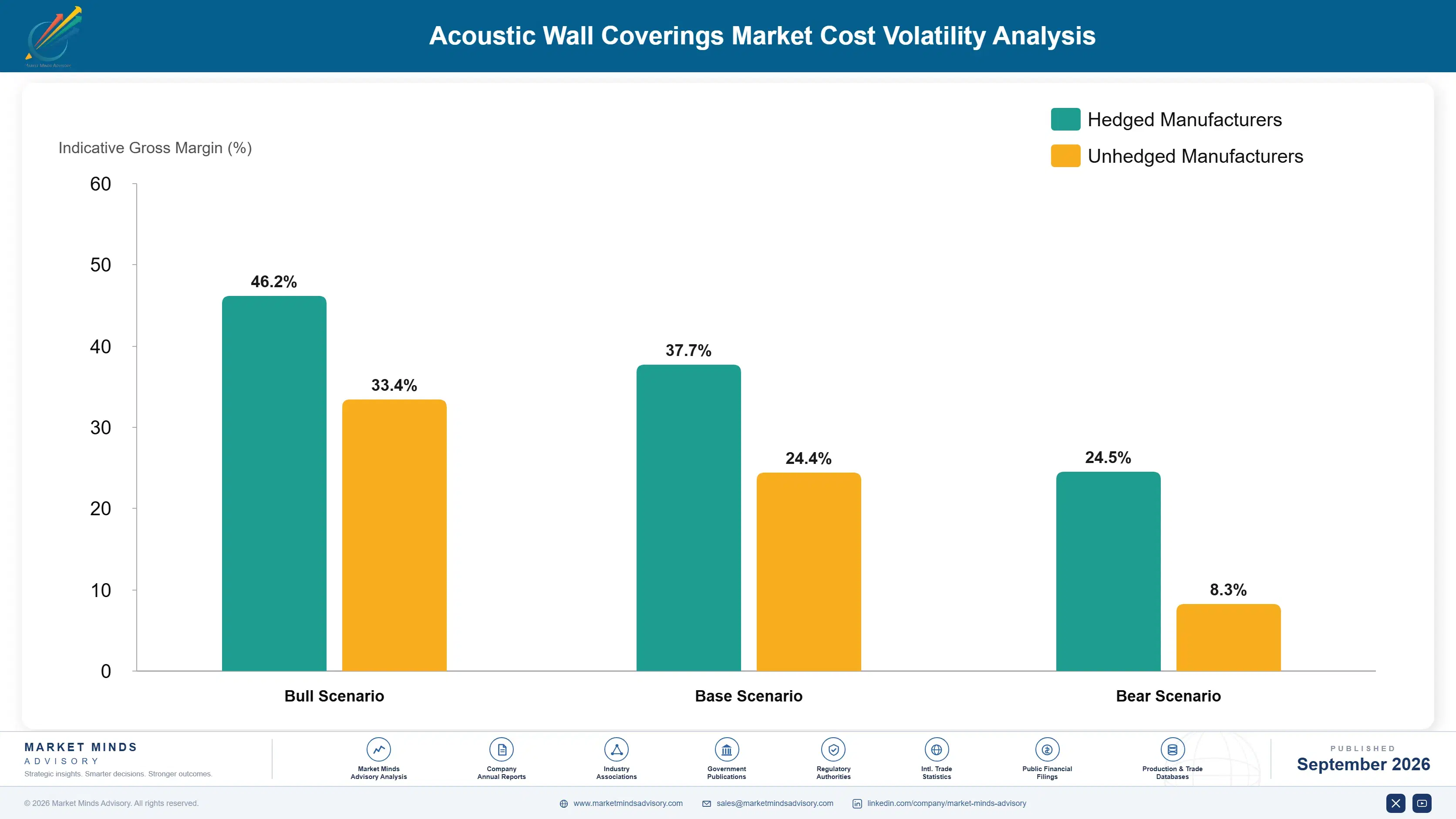
Three input groups dominate cost. Fibre and board stock runs 30% to 38% of cost of goods sold, with recycled polyester flake and mineral wool at opposite ends of that range on price per unit volume. Facing fabric, adhesives, and framing take 16% to 22%. Freight and handling add 20% to 28%, unusually high for a manufactured product.
Post-consumer bottle flake prices moved sharply through 2024 and 2025 as beverage packaging recycled content requirements under European Commission packaging rules brought new demand into the same feedstock pool, and several panel manufacturers described the resulting input pressure in their annual reports for those years. Food-grade streams command premiums that panel producers cannot match on the volumes they purchase. Mineral wool inputs followed energy prices instead.

The competitive disadvantage mechanism runs through freight rather than manufacturing. A producer converting close to demand delivers considerably cheaper than one shipping finished panels across an ocean, almost regardless of factory cost, because the product is mostly air by volume. Exposure varies sharply by footprint: regional converters hold the advantage on standard products, while specialist timber and printed felt absorb freight on higher value.
acoustic-wall-coverings-market-cost-volatility-analysis-1790012654303

Contract Post-Consumer Flake On Multi-Year Terms

Beverage packaging mandates now bid for the same bottle flake with purchasing power panel manufacturers cannot match on any volume. Contracted multi-year supply gives cost variance several times lower than spot buying, and the security of allocation matters more than the unit price achieved in any single year of the agreement. Very few panel producers have contracted properly.

Qualify Non-Food-Grade Recycled Streams Deliberately

Panels do not require food-grade material, yet many manufacturers buy from the same pool as beverage packaging out of habit rather than necessity. Qualifying coloured, mixed, and lower-grade post-consumer streams removes the direct competition entirely, and colour limitations matter far less on products sold in deliberately muted palettes. Most producers have simply not examined the question.

Convert Regionally Rather Than Concentrate Production

Freight consumes up to 28% of delivered cost on low density panels, which rewards conversion near demand over concentrated manufacturing scale. Producers operating regional finishing within their main markets deliver considerably cheaper than importers, and the advantage holds even where the regional operation runs at a smaller scale. Proximity beats factory efficiency in this category consistently.

Portfolio Architecture for Margin Defence

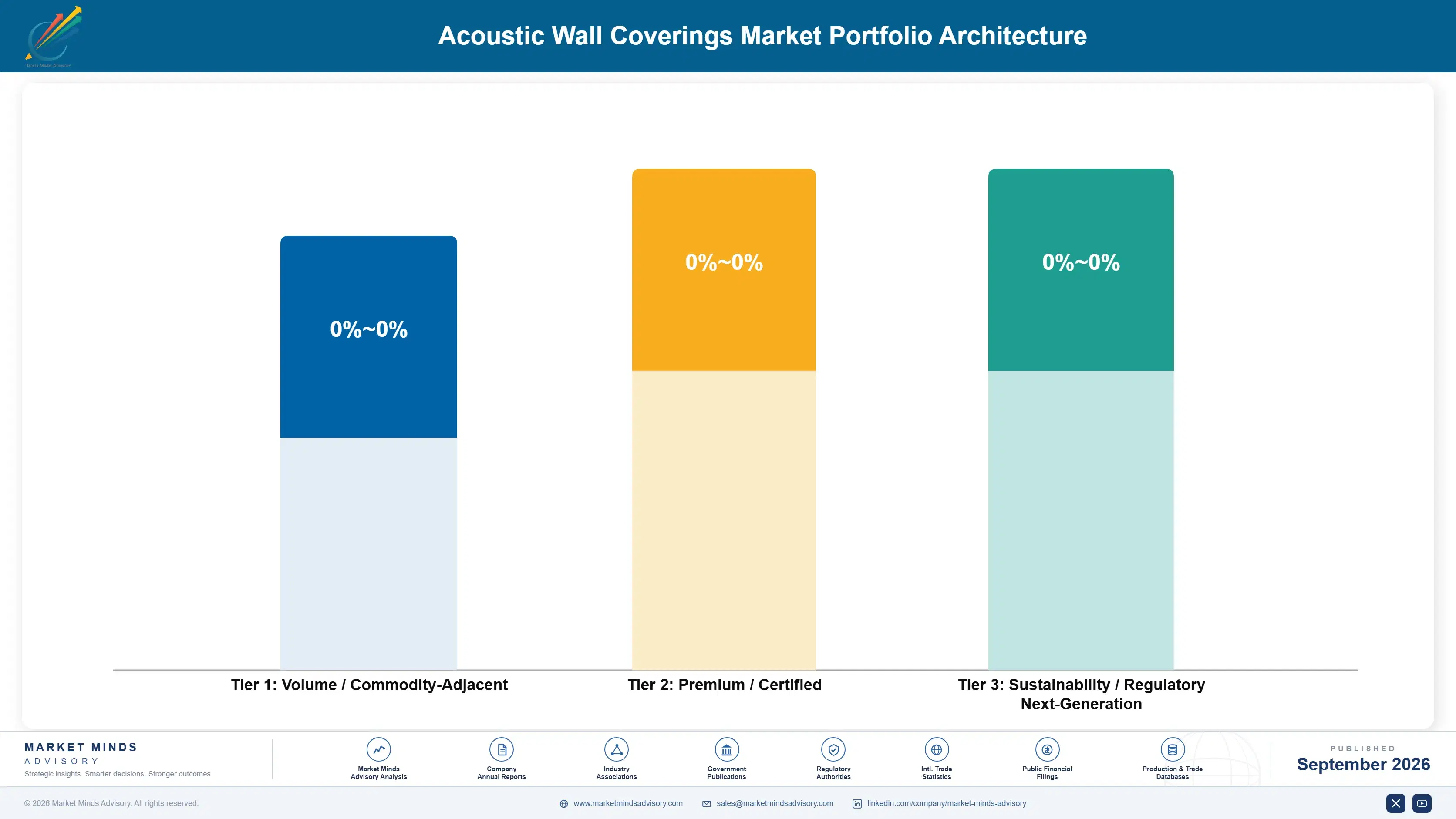
Margin follows how hard the product is to copy at a distance. Plain felt board competes on price per square metre against imports and regional converters alike, with freight as the only real defence. Printed and CNC-milled felt earns considerably better on fabrication capability. Timber slat systems and acoustic plaster earn most, on appearance and application skill respectively. The spread between the cheapest and dearest routes to the same room performance is considerable.
The tension between volume and premium runs through the specification route. Products reaching the drawing through an acoustic consultant compete on declared performance and command better prices for it. Products chosen by an interior designer compete on appearance and colour, where textile entrants press hardest and where measured absorption barely enters the decision at all. That divide explains most of the margin variation across otherwise comparable manufacturers.

High-value pools concentrate where the buyer has a measurable obligation: school and healthcare projects with reverberation limits written into building standards, and corporate projects where speech privacy has been specified rather than hoped for. Where treatment is discretionary decoration, price decides and the category behaves like any other interior finish. Regulated work is also considerably less cyclical than corporate fit-out.

Volume / Commodity-Adjacent

Plain felt board and standard mineral wool faced panels sold on price per square metre against regional converters and imports. The ten-point range reflects conversion scale and freight position rather than any product difference specifiers can identify.
Gross Margin: 20% to 30%

Premium / Certified

Printed, CNC-milled, and fabric wrapped panels sold on fabrication capability and finish quality that plain board cannot match. The twelve-point range separates producers with in-house milling and printing from those outsourcing the finishing operation entirely.
Gross Margin: 34% to 46%

Sustainability / Regulatory / Next-Generation

Timber slat systems, acoustic plaster, and products carrying dual mounting absorption declarations for regulated spaces. The fourteen-point range reflects application skill requirements and whether performance data is published honestly or presented selectively.
Gross Margin: 48% to 62%
acoustic-wall-coverings-market-portfolio-architecture-1790012654806

High-value Sub-segments and Strategic Watch-out

Timber Slat And Perforated Systems

Highest value in the category, growing at 8.4% on an appearance that no other absorbing material provides. The sixteen-point range reflects whether the backing absorber is engineered properly or specified as an afterthought behind attractive timber. Installation skill limits how fast the segment can scale.
Gross Margin: 46% to 62%

Printed And Milled Polyester Felt

High value where fabrication capability rather than acoustics sets the price achieved. The twelve-point range separates in-house CNC and printing operations from converters outsourcing finishing, which removes most of the available margin from the transaction. Design possibility rather than absorption sets the price here. Outsourced finishing removes most of it.
Gross Margin: 36% to 48%

Standard Felt And Mineral Panels

Volume core competing on delivered price where freight decides the winner more often than manufacturing cost. The ten-point range reflects regional conversion footprint, which is the only durable defence available in this part of the range. Import competition presses hardest on exactly these products. Nothing else defends this position durably.
Gross Margin: 22% to 32%

Imported Plain Board Supply

The strategic watch-out. Freight consumes up to 28% of delivered cost on low density goods, so long-distance supply of undifferentiated board loses to regional converting almost regardless of factory economics. The ten-point range reflects scale alone. Regional converting removes the position almost entirely over time.
Gross Margin: 14% to 24%

How This Demand Recurs

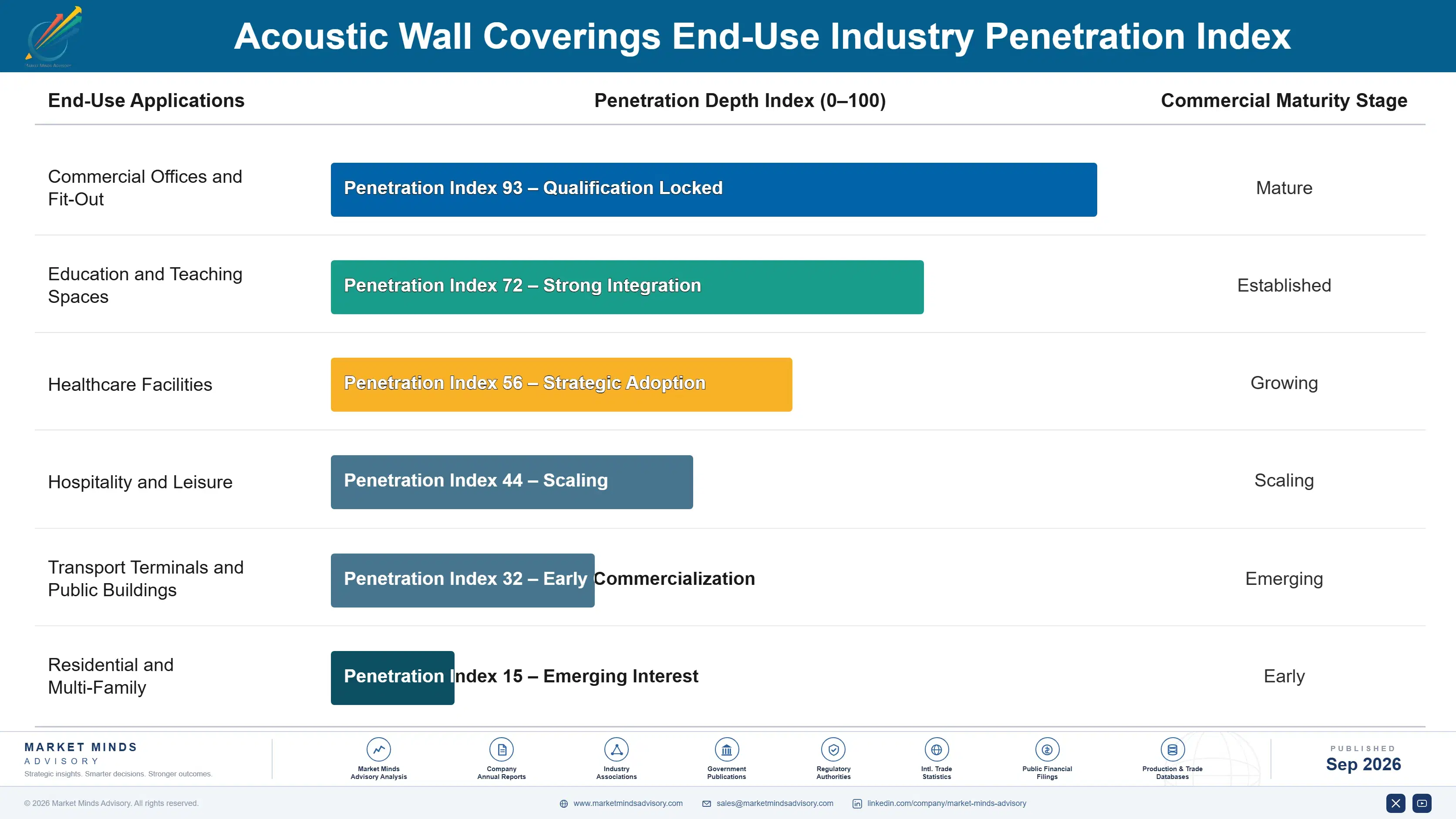
Recurring revenue in this category comes from fit-out cycles rather than from product replacement, since panels outlast the interiors they sit in by a wide margin. Commercial tenancies turn over every seven to twelve years and the walls get stripped each time, which produces a demand rhythm tied to property leasing rather than to any material performance limit the panels themselves reach.
Adoption depth varies sharply by building type. Schools and healthcare facilities treat acoustic performance as a compliance obligation with a measured target, so treatment is specified, calculated, and verified. Corporate offices treat it as a design preference that survives value engineering only when an occupant complaint prompted the project. Hospitality sits between, specifying for atmosphere rather than for intelligibility.

The specifier profile has shifted with hybrid working. Acoustic consultants historically arrived on projects with a measurable brief; increasingly the decision sits with interior designers responding to occupant surveys about video calls. That change favours appearance over declared absorption, which is precisely why textile and furniture manufacturers have found this category so accessible to enter. Winning back the consultant route is therefore a margin decision as much as a technical one.
acoustic-wall-coverings-market-end-use-penetration-index-1790012655298

Where This Market Rewards

These are among the four positions where our research anticipates prominent divergence between winners and laggards over the coming forecast period. Each is grounded in the demand model, the regulatory perimeter, and the announced capacity pipeline.
01 / MOUNTING DATA DISCLOSURE

Publish the number the wall actually delivers

Declared absorption comes from suspended laboratory mounting while wall panels install flat against plasterboard, and the difference averages 0.22 NRC across products tested. Manufacturers publishing both figures report specification win rates 1.6 times higher among acoustic consultants who already know perfectly well that the gap exists. One additional test per product line converts a widely understood industry evasion into a genuine differentiator that competitors are then forced to answer, and the disclosure costs nothing beyond the testing itself once it is done.
02 / COVERAGE QUANTITY SELLING

Sell the calculation, not the panel

Completed offices carry roughly 16% of wall area treated where speech privacy targets require nearer 28%, and the shortfall gets sized by budget rather than by any calculation. Manufacturers providing coverage calculators and design support report average order values 34% to 52% higher on projects where the arithmetic ran early. Selling the correct quantity turns out to be a considerably larger commercial opportunity than selling a marginally better absorbing product, and it removes the disappointment that undersized rooms reliably produce for everybody involved.
03 / FEEDSTOCK POSITION BUILDING

Bottle flake will only get scarcer

Beverage packaging recycled content mandates bid for the same post-consumer flake that supplies 71% of a typical felt panel, with purchasing power no panel maker can match. Producers holding contracted multi-year flake supply arrangements report input cost variance 2.8 times lower than spot buyers over the same period. Positions taken now will look considerably cheaper in five years than they appear today, and the pool itself is finite, since the competition for this feedstock intensifies with every packaging deadline that passes.
04 / REGIONAL CONVERSION FOOTPRINT

Freight beats factory cost every time

Freight consumes 24% of delivered cost on goods that are mostly air by volume once packed, which makes long-distance supply uncompetitive almost regardless of manufacturing cost differences between origins. Producers operating their own regional conversion inside each main market report delivered cost advantages of 11% to 19% against importers serving the same projects. This category rewards proximity to demand rather than concentrated manufacturing scale, which is the opposite of what most building products reward, which several international producers have now learned at considerable expense.

Engagement Snapshot From the Field

A live engagement with an industry participant carrying material or product regulatory and market exposure ahead of a defining policy shift, showing how our research translates into a defensible multi-year portfolio strategy.
MARKET MINDS ADVISORY · CLIENT ENGAGEMENT SUMMARY
Acoustic Wall Coverings Producer Strategic Portfolio Review and Transition Roadmap 2026·Investment Scenario on Acoustic Wall Coverings Exposure Evaluation 2025-26
CLIENT PROFILE
A European acoustic panel manufacturer with annual revenue near EUR 96 million (client-reported, unverified by MMA), supplying polyester felt and fabric wrapped wall panels across commercial fit-out, education, and healthcare projects in eight countries. Specification win rates with acoustic consultants had fallen for three years while designer-led sales grew, and margin had followed the mix downward.
STRATEGIC CHALLENGE
Management read the shift as a marketing problem and had proposed heavier investment in design press and showroom presence. Nobody had asked the acoustic consultants who were specifying competitors why they had moved, or tested whether the products were losing on performance data rather than on visibility. The distinction determined where the next investment belonged.
MMA APPROACH
MMA interviewed forty acoustic consultants across six countries on specification decisions, compared declared absorption data across competing products against independent direct-fix testing commissioned for the study, and modelled revenue under three scenarios covering data disclosure, coverage tooling, and design-led investment. Margin was compared across specification routes to establish whether the growing part of the mix was actually the profitable part.
KEY FINDINGS
  1. Consultants had moved toward two competitors that published direct-fix absorption data, citing professional liability for measured room performance as the deciding factor.
  2. Independent testing showed the client's panels performed comparably to those competitors under direct-fix conditions, so the specification loss reflected disclosure rather than any real performance deficit.
  3. Projects where the client provided coverage calculations carried order values 44% above those where quantity was set by the contractor against a budget figure.
  4. Designer-led sales carried gross margins 11 points below consultant-specified projects, so the growing part of the mix was the less profitable one.
CLIENT PROFILE
A European acoustic panel manufacturer with annual revenue near EUR 96 million (client-reported, unverified by MMA), supplying polyester felt and fabric wrapped wall panels across commercial fit-out, education, and healthcare projects in eight countries. Specification win rates with acoustic consultants had fallen for three years while designer-led sales grew, and margin had followed the mix downward.
STRATEGIC CHALLENGE
Management read the shift as a marketing problem and had proposed heavier investment in design press and showroom presence. Nobody had asked the acoustic consultants who were specifying competitors why they had moved, or tested whether the products were losing on performance data rather than on visibility. The distinction determined where the next investment belonged.
MMA APPROACH
MMA interviewed forty acoustic consultants across six countries on specification decisions, compared declared absorption data across competing products against independent direct-fix testing commissioned for the study, and modelled revenue under three scenarios covering data disclosure, coverage tooling, and design-led investment. Margin was compared across specification routes to establish whether the growing part of the mix was actually the profitable part.
KEY FINDINGS
  1. Consultants had moved toward two competitors that published direct-fix absorption data, citing professional liability for measured room performance as the deciding factor.
  2. Independent testing showed the client's panels performed comparably to those competitors under direct-fix conditions, so the specification loss reflected disclosure rather than any real performance deficit.
  3. Projects where the client provided coverage calculations carried order values 44% above those where quantity was set by the contractor against a budget figure.
  4. Designer-led sales carried gross margins 11 points below consultant-specified projects, so the growing part of the mix was the less profitable one.
RECOMMENDED STRATEGY
Phase 1: Phase one: commission direct-fix absorption testing across the full range and publish both mounting figures on every datasheet immediately. Testing cost was modest against the position recovered. Phase 2: Phase two: build a coverage calculation service and put it in front of consultants and designers at concept stage rather than at tender. Phase 3: Phase three: rebalance commercial effort toward regulated education and healthcare work where quantity is calculated rather than negotiated. Those projects also prove far less cyclical.
OUTCOME
Consultant specification win rate recovered 18 points within three quarters of publishing the dual mounting data (client-reported, unverified by MMA). Average project value rose 27% where the coverage service was used. Two competitors published equivalent data within the following year. Margin mix improved as consultant-specified work grew faster than designer-led sales.

Frequently Asked Questions

Foundational context covering the market sizes, CAGR, scope, country, region and competition that inform every finding below. This section is provided to cover basics and most often pre-purchase conversations, answered from the MMA Primary Research Dataset.

What is the current size of the Acoustic Wall Coverings Market?

The market was worth USD 2.9 billion in 2025 and reaches USD 3.1 billion in 2026. Value covers wall-mounted absorption products across all material types.

How large will the Acoustic Wall Coverings Market be by 2036?

MMA forecasts USD 6.0 billion by 2036, an increase of USD 2.9 billion across the forecast period. That represents 1.94 times the 2026 base of USD 3.1 billion.

What is the CAGR for the Acoustic Wall Coverings Market 2026 to 2036?

The base case compound annual growth rate is 6.8%, with a bull case at 8.0% and a bear case at 5.6%. Historical growth from 2020 to 2025 ran at 5.6%.

Which segment is growing fastest?

PET and polyester felt panels grow at 10.2%, half again the market rate of 6.8%. Felt won on fabrication ease rather than on any acoustic advantage over mineral wool.

Who are the major companies in the Acoustic Wall Coverings Market?

Saint-Gobain Ecophon, Armstrong World Industries, Knauf Ceiling Solutions, Autex Industries, and Kvadrat Acoustics lead. Together they hold 24% of revenue, leaving the category unusually fragmented.

Which country is growing fastest?

India grows at 9.4%, the fastest of any country covered here. Commercial office construction across Bengaluru, Hyderabad, and the National Capital Region runs at volumes no mature market matches.

Report Segmentation Architecture

The full report scope spans multiple orthogonal segmentation dimensions, with cross-tabulated demand data provided for each dimension pair. Coverage extends further to regional breakdowns, trend trajectories, and the competitive detail needed to support segment-level decision-making.

By Material And Product Type

  • PET and Polyester Felt Panels
  • Mineral and Glass Wool Faced Panels
  • Fabric Wrapped Acoustic Panels
  • Perforated and Slatted Wood Panels
  • Acoustic Plaster and Spray Applied Finishes
  • Acoustic Textile Wallcoverings

By End-Use Industry

  • Commercial Offices and Fit-Out
  • Education and Teaching Spaces
  • Healthcare Facilities
  • Hospitality and Leisure
  • Transport Terminals and Public Buildings
  • Residential and Multi-Family

By Commercial Dimension

  • Acoustic Consultant Specification
  • Interior Designer Selection
  • Contractor and Fit-Out Purchase
  • Distributor and Merchant Supply
  • Direct Manufacturer Sales
  • Online and Configurator Ordering

By Region

  • East Asia
  • Western Europe
  • North America
  • South Asia and Pacific
  • Latin America
  • Middle East and Africa
  • Eastern Europe

Scope, Methodology, and Coverage

Every figure in this report is reproducible from documented input assumptions. The scope below maps the historical period, the forecast horizon, the segmentation dimensions, and the countries covered, alongside the underlying primary and qualitative methodology.
Historical Period
2020 to 2025
Forecast Period
2026 to 2036
Base Year
2025 (USD billions; MMA Primary Research Dataset, September 2026)
Market Definition
This market covers wall-mounted acoustic absorption products, including PET and polyester felt panels, mineral and glass wool faced panels, fabric wrapped acoustic panels, perforated and slatted wood panels, acoustic plaster and spray applied finishes, and acoustic textile wallcoverings. It excludes suspended ceiling tiles and baffles, floor coverings, acoustic doors and glazing, sound isolation and barrier products, and outdoor noise barriers.
Quantitative Units
USD billions, revenue at manufacturer selling price
Segmentation Dimensions
Material and product type, end-use industry, commercial dimension, region
Regions Covered
East Asia, Western Europe, North America, South Asia and Pacific, Latin America, Middle East and Africa, Eastern Europe
Countries Covered
China, Japan, South Korea, Taiwan, United States, Canada, Mexico, Germany, United Kingdom, France, Italy, Spain, Netherlands, Sweden, Denmark, Poland, Czechia, India, Australia, Singapore, Vietnam, Brazil, Colombia, Chile, Saudi Arabia, United Arab Emirates, Qatar, Egypt, Kenya, South Africa
Key Companies Profiled
Saint-Gobain Ecophon, Armstrong World Industries, Knauf Ceiling Solutions, Autex Industries, Kvadrat Acoustics, ROCKWOOL Group, Texaa, BAUX, Woven Image, Caimi Brevetti, Vicoustic, Troldtekt, Gustafs, Hunter Douglas Architectural, Wolf-Gordon, Carnegie Fabrics, Acoustical Surfaces, Primacoustic, Impact Acoustic, Soundtect
Quantitative Methodology
Primary survey, n=3,800 respondents, Q4 2025, six countries; demand-side model with trade association cross-validation
Qualitative Methodology
47 expert interviews, Q4 2025; applied to validate demand model assumptions, identify emerging dynamics, and assess competitive positioning
Report Format
PDF and XLSX data workbook (Word format preview document)
Publisher
Market Minds Advisory
Report Code
MMA-2026-CON-981
Published
September 2026
Contact
sales@marketmindsadvisory.com | www.marketmindsadvisory.com

Purchase the full Acoustic Wall Coverings Market Report (2026 to 2036).

The full report sizes the acoustic wall coverings market across six material types, seven regions, and thirty countries, with forecasts to 2036 under base, bull, and bear cases. It quantifies the gap between declared laboratory absorption and installed wall performance, examines why polyester felt won specification on fabrication rather than acoustics, and tracks the coverage shortfall that leaves completed rooms performing below expectation. Competitive analysis covers twenty participants evaluated consistently on category revenue, with detailed treatment of recycled feedstock competition from beverage packaging. Cost structure, freight economics, and specification route margins are analysed throughout. Primary research includes 3,800 survey responses and 47 expert interviews.
Six material types sized and forecast separately
Twenty participants evaluated on category revenue consistently
Declared versus installed absorption gap quantified across product types
Coverage requirement modelled against typical installed wall area
Freight economics analysed by conversion footprint and region
Recycled feedstock competition tracked against packaging mandate timelines

Built For The People Who Decide

From boardroom strategy to bench-side execution, this report is read cover-to-cover by leaders shaping the next decade of their industry, turning demand scenarios, market dynamics and valuation benchmarks into decisions.
CXOs/ Presidents/ VPs/ Managers
M&A and Corporate Development
Strategy Teams and R&D Heads
Procurement and Product Directors
Regulatory and Compliance Leaders
Investor Relations and Equity Analysts