Market Minds Advisory
Acne Scarring Treatments Market

Acne Scarring Treatments Market: Acne Scarring Treatments Market. Radiofrequency Microneedling Pushes Scar Revision Beyond Conventional Laser Resurfacing

Rising aesthetic dermatology spending and radiofrequency microneedling innovation are pulling acne scar treatment demand toward combination technologies that clearly outperform conventional single-modality laser resurfacing procedures across most global dermatology clinics.

Lead Analyst

Published

September 2026

Make Smarter Decisions with Customized Research Insights

Request a free sample report and evaluate market opportunities, growth trends, and competitive dynamics relevant to your business needs.

2025 MARKET VALUE$4.2BMarket Size 2025
2036 FORECAST VALUE$10.3BBase Case , 2026 to 2036
CAGR 2026 TO 20368.5 %Bull 9.8% / Bear 7.2%
INCREMENTAL OPPORTUNITY$5.8BNet 10- year value creation
EXPANSION MULTIPLE2.26x2036 value over 2026 base
Strategic Levers
M&A Pipeline
Regional Outlook
Country Rankings
Competitive Intelligence
Segmental Deep-dive
Call-Us : 91 93563 13602

Executive Snapshot and Market Trajectory.

Acne scarring treatments have shifted from single-modality laser resurfacing toward combination therapy protocols, with radiofrequency microneedling now driving most incremental category revenue growth in premium dermatology clinics. Clinics are reallocating equipment budgets toward these combination-therapy releases accordingly, a shift unseen just a few years ago. Clinics notice quickly.
Radiofrequency microneedling and dermal filler protocols are pulling budget away from basic chemical peel treatments, particularly among patients seeking documented scar depth reduction over generic skin resurfacing marketing language. Specialty dermatology device manufacturers are capturing disproportionate share of this shift, often ahead of legacy laser equipment incumbents still anchored to single-modality technology. Adoption is broadening across dermatology channels in nearly every major regional market tracked this year.
Competitive intensity centers on established aesthetic device conglomerates defending share against fast-growing specialty combination therapy brands built entirely around radiofrequency and microneedling integration. Regulatory scrutiny of device safety and clinical efficacy claims is tightening in several major markets, forcing substantiation investment across the category's premium tier. Brands moving fastest on clinical substantiation are positioned to capture share from slower-moving legacy competitors over the next several procurement cycles. This trend should intensify further.
Market Definition
The acne scarring treatments market covers laser resurfacing, microneedling, chemical peel, dermal filler, topical scar treatment and radiofrequency microneedling procedures used to reduce or revise acne scar tissue. It excludes acne treatment products targeting active breakouts and general anti-aging skin resurfacing not specifically marketed for scar revision.
Base Year Value
$4.2B in 2025 (MMA Primary Research Dataset, September 2026)
Forecast Period
2026 to 2036, eleven discrete annual values
CAGR
8.5% base case. Bull 9.8%. Bear 7.2%.
Fastest Growth Segment
Radiofrequency Microneedling Treatments: 12.5% CAGR
Fastest Growth Country
India: 11.0% CAGR
Fastest Growth Region
South Asia and Pacific: 10.7% CAGR
Largest Region
North America: 28% of 2025 global value
Market Leaders
Cutera, Cynosure, Candela, Galderma and Merz Aesthetics lead the category. Source: MMA Primary Research Dataset, July 2026.
Primary Survey
n=3,800 procurement and R&D decision-makers, Q4 2025, six countries
Methodology
Demand-side build-up, cross-validated against public data, 47 expert interviews

Acne Scarring Treatments Market Forecast Scenarios

acne-scarring-treatments-market-size-forecast-scenario-1790017357007
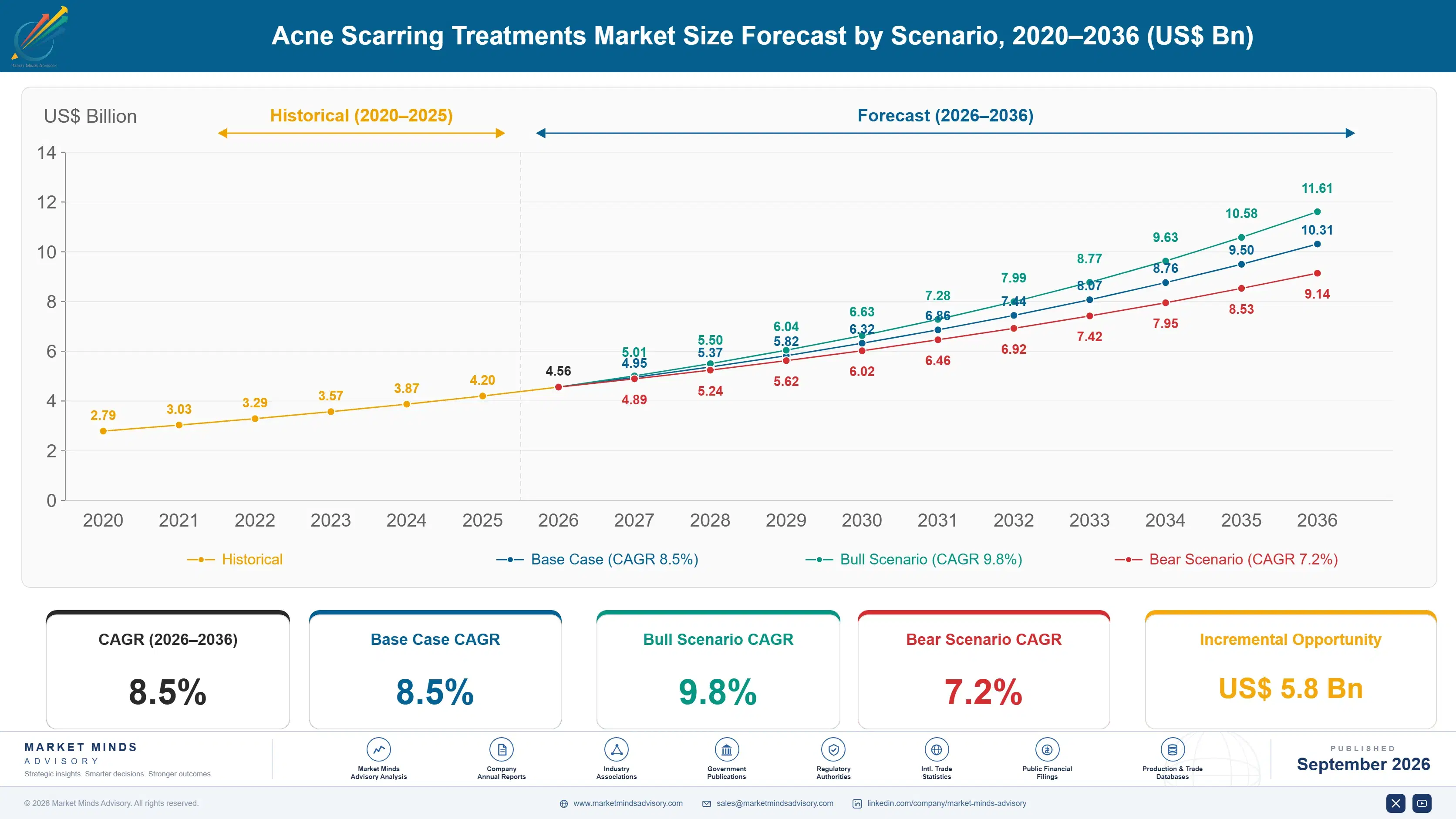
Between 2020 and 2025 the acne scarring treatments category grew at a steady 7.5 percent historical pace, accelerating as social media beauty content normalized cosmetic dermatology procedures previously considered niche or stigmatized. Direct-to-consumer clinic chains captured outsized share during this period as combination therapy protocols matured rapidly across major markets. Clinics restocked basic chemical peel assortments even as radiofrequency microneedling began capturing early adopter treatment interest.
The base case assumes continued migration from single-modality laser resurfacing toward radiofrequency microneedling and combination protocols, sustained clinical demand for documented scar depth reduction, and expanding specialty clinic footprint in emerging markets where premiumization is accelerating. These three mechanisms together support an 8.5 percent forecast CAGR through 2036, with radiofrequency microneedling carrying the bulk of incremental category growth. Legacy single-modality laser lines continue generating steady baseline revenue, cushioning overall category volatility.
The bull case centers on faster-than-expected adoption of combination therapy protocols across mass-premium clinic tiers beyond current luxury positioning. The bear case assumes tightening regulatory scrutiny of device safety claims slows procedure approval timelines, pushing patients back toward simpler chemical peel treatments that compress overall category value growth. Faster mainstream adoption would push category growth toward the upper end of the forecast range.

Combination Therapy Redefines Treatment Value

Acne scarring treatments span an unusually wide price range within a single dermatology category, with average prices varying nearly sixfold between basic peels and premium radiofrequency microneedling protocols. This spread gives clinics wide latitude to trade patients up as scar revision literacy deepens across the dermatology industry. Clinics price entry peels low, using them as a gateway toward higher-margin radiofrequency lines.
CATEGORY CONCENTRATION37% CR5Top five manufacturers hold combined category revenue share
AVERAGE PROCEDURE PRICE$650.00Blended price across peel, laser and microneedling protocols
TOP PRODUCING COUNTRYUnited States, 24%Leading device manufacturing origin country by installed base
COMBINATION PROTOCOL PENETRATION29%Share of treatments incorporating multi-modality combination therapy protocols
REPEAT TREATMENT PURCHASE RATE61%Share of patients returning for additional sessions within a year
DEVICE COMPONENT COST SHARE34% of COGSDevice hardware component share of manufacturer production cost
The United States and South Korea anchor global manufacturing for the category, while specialty aesthetic technology houses increasingly license radiofrequency chemistry to manufacturers across these production hubs rather than developing comparable capability independently. Specialty dermatology clinic distribution continues taking share from general medical spa channels as patients seek curated, physician-led treatment guidance. This pattern should persist while radiofrequency development remains concentrated among a small number of specialized innovators.
Repeat treatment economics favor combination protocols over basic single-modality procedures, since scar-affected patients replenish sessions at a materially higher rate once documented efficacy justifies the premium price point over conventional alternatives. Device safety certification and clinical outcome transparency now function as genuine differentiators, since informed patients evaluate published results as closely as procedure cost itself. Clinics investing in transparent outcome testing report higher patient trust than competitors relying on internal claims.
"Clinical outcome transparency is quietly becoming the category's real competitive currency while generic resurfacing claims fade into background noise for informed patients. Clinics slow to publish documented scar reduction data are ceding their most valuable patient relationships to faster-moving specialty challengers."
Senior Analyst, Aesthetic Dermatology and Medical Devices Practice · MMA Dermatological and Aesthetic Acne Scar Revision Treatments Practice · September 2026

Market Trends

Radiofrequency Microneedling Replaces Single-Modality Laser Treatment

Dermatologists are increasingly specifying radiofrequency microneedling protocols over single-modality laser resurfacing, since documented dermal remodeling efficacy directly addresses atrophic scar tissue that surface-level laser treatment alone struggles to resolve reliably. Manufacturers responding fastest to this shift are expanding combination therapy device lines well beyond their original single-modality assortments, reallocating research budget toward energy delivery precision and safety monitoring infrastructure. Specialty clinics report radiofrequency microneedling sales now outpacing single-modality laser growth by a wide margin across most major premium dermatology markets tracked this year. This transition is reshaping equipment budget allocation at major dermatology clinics worldwide.
Market Impact: Expands premium patient base 23 percent
Social Media Content Drives Treatment Discovery

Short-form video content documenting real patient scar revision stories has become the dominant treatment discovery channel, replacing traditional print advertising as the primary way patients learn about new combination therapy protocols and device technology. Clinics partnering with dermatology content creators see measurably faster patient acquisition than those relying solely on traditional referral marketing. This shift has compressed the credibility gap between established and newer entrant specialty clinics considerably. Brands lacking a credible content partnership strategy are increasingly struggling to gain visibility against faster-moving specialty challengers in the premium tier. Patients notice quickly.
Market Impact: Adds 480 new specialty clinic locations

Market Opportunities and Growth Drivers

Rising Aesthetic Dermatology Spending Expands Buyer Base

Growing consumer willingness to invest in aesthetic dermatology procedures, driven by social media visibility and reduced stigma around cosmetic treatment, is expanding the addressable base willing to pay premium prices for combination therapy protocols rather than settling for basic treatments without documented efficacy. This spending growth disproportionately benefits mid-tier and premium clinics positioned just above mass-market pricing, since these patients are trading up from basics without yet reaching the highest luxury price tier. Clinic loyalty programs targeting this exact spending segment report above-average conversion rates into repeat premium purchasing. Patients notice quickly.
Market Impact: Limits adoption to 18 percent

Specialty Clinic Expansion Widens Category Access

Specialty dermatology and aesthetic clinic chains are expanding location counts across secondary cities in emerging markets, bringing curated combination therapy protocols to patients previously limited to basic general practice dermatology selections. This expansion gives premium and mid-tier clinics physical treatment access they could not previously secure outside major metropolitan flagship locations. Clinics report acne scarring procedure volume per location rising faster than most other dermatology subcategories as awareness converts prospects into repeat patients across an expanding footprint. This growing physical footprint also supports in-person consultation and treatment planning that online-only channels cannot replicate as effectively.
Market Impact: Extends timelines 4 to 8 months

Market Restraints and Challenges

High Out-of-Pocket Costs Limit Broader Adoption

Acne scarring treatments carry substantial out-of-pocket costs since most insurance plans classify scar revision as cosmetic rather than medically necessary, creating a pricing barrier that limits adoption among cost-sensitive patients despite documented psychological impact of visible scarring. The root cause is that insurance classification frameworks have not evolved alongside clinical evidence demonstrating the mental health benefits of scar treatment. Clinics are mitigating this exposure by offering financing plans and package pricing that spread treatment costs across multiple sessions. Some clinics now offer tiered pricing based on scar severity to broaden treatment accessibility across income levels.
Market Impact: Cuts treatment sessions needed 30 percent

Multiple Session Requirements Extend Treatment Timelines

Effective acne scar revision typically requires multiple treatment sessions spaced across several months, creating a commitment barrier that discourages patients seeking immediate results comparable to single-session cosmetic procedures. The root cause is that dermal remodeling and collagen regeneration are biological processes that cannot be accelerated beyond safe treatment intervals without risking adverse skin reactions. Clinics are mitigating this exposure by developing accelerated protocol combinations that reduce total treatment duration while maintaining safety margins. Early results suggest promising reductions in overall treatment duration across several accelerated protocol trials. Patients notice quickly.
Market Impact: Lifts patient acquisition speed 26 percent
3 additional market trends, 4 additional growth drivers, and 3 additional restraints and challenges are covered in the full report. Contact sales@marketmindsadvisory.com to access the complete intelligence.

Segment CAGR and Growth Architecture

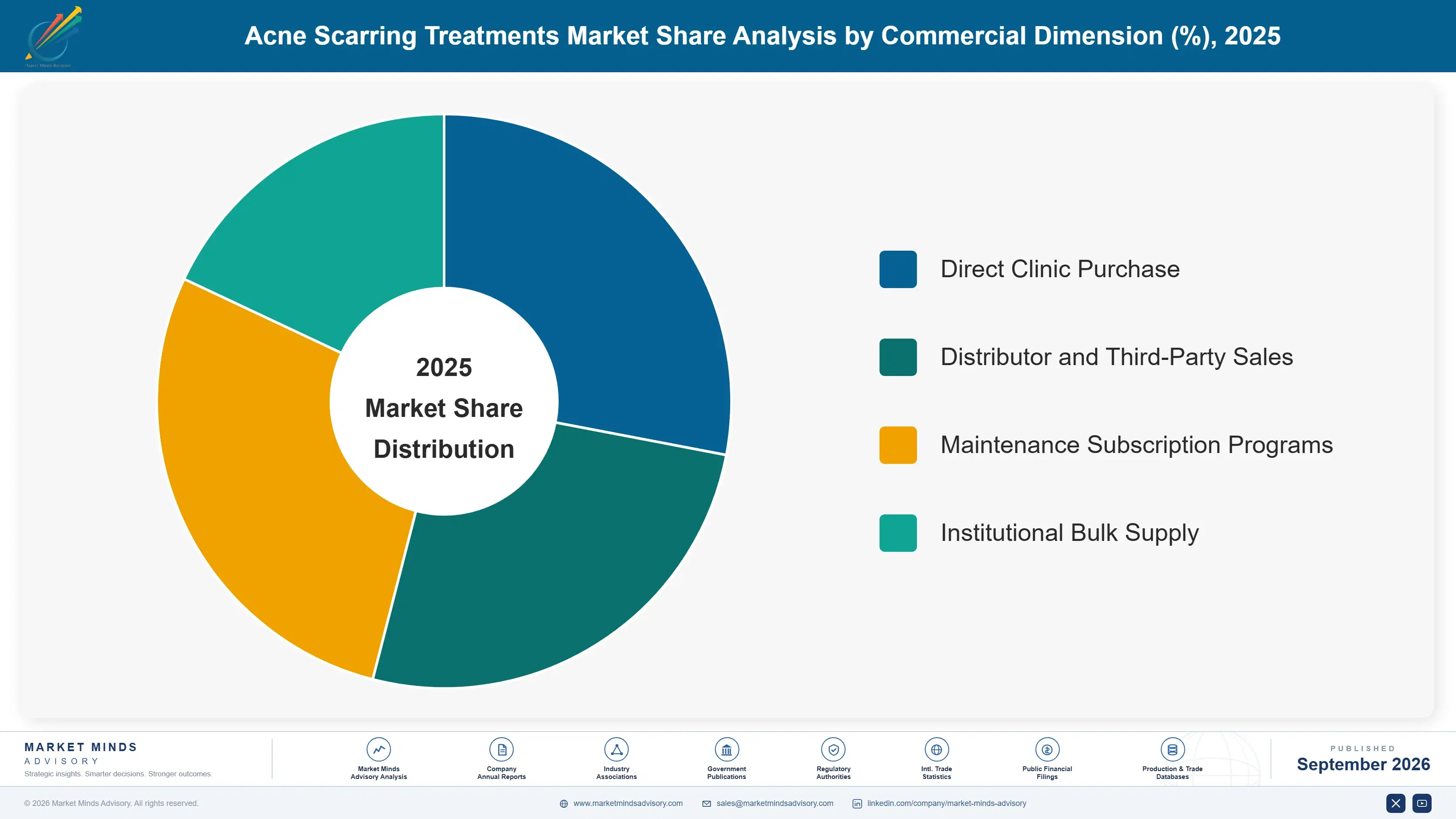
Acne scarring treatments break into six treatment-modality segments spanning laser resurfacing, microneedling, chemical peel, dermal filler, topical scar treatment and radiofrequency microneedling protocols, each carrying distinct margin profiles, treatment cycles and clinical positioning within the broader dermatology category. Classification follows a single treatment-modality logic throughout, avoiding any mixing with distribution channel, provider type or reimbursement category.
acne-scarring-treatments-market-market-share-analysis-1790017357868

Radiofrequency Microneedling Treatments

Radiofrequency microneedling treatments represent the fastest-growing segment, delivering combined thermal energy and mechanical needle penetration that achieves deeper dermal remodeling than either modality can accomplish independently for atrophic scar revision. Growth here reflects genuine technological convergence rather than simple category expansion, since many patients previously accepted incomplete scar improvement as an unavoidable limitation before combination devices demonstrated meaningfully superior clinical outcomes. Manufacturers are racing to expand energy delivery precision and reduce treatment discomfort, since documented efficacy remains the primary purchase driver for this rapidly growing consumer segment currently expanding fastest across most major premium dermatology markets tracked. Specialty clinics increasingly dedicate standalone treatment protocols to this segment alone, a shift unseen just a few years ago.
CAGR 12.5%

Dermal Filler Treatments

Dermal filler treatments form the second-fastest-growing segment, combining volumizing injectable technology with targeted application for depressed atrophic scars that resurfacing-only treatments cannot fully correct through surface-level intervention alone. This segment benefits directly from immediate visible results, since filler treatments deliver instant volume correction that patients can see immediately rather than waiting months for collagen remodeling to complete. Dermatologists report filler treatments performing particularly well among patients seeking quick improvement before events, capturing patients who eventually expand into broader combination therapy purchases. Premium filler lines bundling multiple correction techniques with extended longevity formulations are emerging as a durable subcategory carrying materially higher price points than basic single-treatment alternatives. Early data suggests attach rates for these premium filler systems are climbing.
CAGR 9.0%
Full segment breakdown across 6 segments available in the complete report.

Regional Architecture and Country Demand Map

North America leads global acne scarring treatment demand through deep aesthetic dermatology spending and dense specialty clinic penetration nationwide today, while East Asia sustains large durable device manufacturing scale and South Asia and Pacific accelerates fastest on rapidly rising disposable income and growing dermatology awareness.

North America

The United States accounts for the overwhelming majority of regional acne scarring treatment demand, anchored by dense specialty dermatology clinic chains and a well-established aesthetic device distribution network serving highly engaged patients. Canada tracks similar consumption patterns at smaller absolute scale. American clinics were early adopters of radiofrequency microneedling technology, giving domestic device manufacturers a head start on combination therapy positioning that international competitors are still working to close. Dermatology conference and trade show activity continues concentrating heavily in this region, reinforcing clinical adoption patterns already well established nationwide. Retailer loyalty programs targeting repeat combination therapy patients have become a genuine competitive differentiator across the region's largest specialty clinic chains.
Share: 28% | CAGR: 9.5% (2026 to 2036)

Western Europe

Germany, France and the United Kingdom drive the bulk of Western European acne scarring treatment demand, supported by strict medical device safety regulation that favors established manufacturers with existing compliance infrastructure over newer entrants. The region's regulatory environment has slowed some novel radiofrequency device launches relative to less restrictive markets, contributing to comparatively modest regional growth. German engineering heritage device brands maintain strong domestic loyalty despite growing competition from faster-moving international challengers. Nordic countries show above-average adoption of minimally invasive combination therapy protocols, reflecting regional consumer preference for shorter recovery periods. Slower regulatory approval for novel device chemistry means European clinics often gain access to new technologies well after they debut in less restrictive markets.
Share: 20% | CAGR: 7.0% (2026 to 2036)
Regional intelligence for 5 additional markets available in the complete report: East Asia, South Asia and Pacific, Latin America, Middle East and Africa, Eastern Europe. Contact sales@marketmindsadvisory.com.
acne-scarring-treatments-market-country-cagr-analysis-1790017358683

Combination Therapy Margin Expansion Playbook

Clinics capture disproportionate margin by trading patients up from basic chemical peels toward radiofrequency microneedling and combination protocols, publishing clinical outcome data that supports premium pricing, and building maintenance treatment subscription programs that lock in recurring revenue. This combination of trade-up mechanics and outcome credibility compounds meaningfully over multiple treatment cycles across each patient relationship overall.

Combination Protocol Trade-Up Programs Lift Value

Clinics running structured trade-up programs, demonstrating combination therapy results to loyal single-modality patients through consultation visits, report meaningfully higher conversion into the higher-margin combination category than passive treatment menu listing alone achieves. This approach works because single-modality patients already trust the clinic's provider expertise, lowering the perceived risk of trying an unfamiliar treatment combination for the first time. Clinics running these programs report conversion rates near 20 percent within the first year of program launch. Clinics scaling this approach across their full patient base report the strongest incremental margin gains of any single initiative tested this year.
Market Impact: Lifts combination category conversion rate by 20 percent

Clinical Outcome Data Publishing Supports Pricing

Publishing third-party clinical outcome and scar depth reduction data supports premium pricing that unsubstantiated competitor claims cannot sustain, since informed patients increasingly demand evidence before paying combination-tier prices. This approach also strengthens referral network negotiating position, since referring physicians increasingly favor clinics with credible published outcomes over those relying on marketing claims alone. Clinics publishing outcome data report price premiums of 22 to 32 percent over comparable unsubstantiated competitor treatments. Clinics investing early in substantiation build a credibility moat that unsubstantiated competitors find increasingly difficult to close over time. Early adopters report the strongest gains.
Market Impact: Adds a 22 to 32 percent price premium

Maintenance Treatment Subscriptions Reduce Patient Churn

Subscription-based maintenance treatment programs for scar revision touch-ups reduce patient churn by removing the friction of scheduling individual appointments after the initial treatment course concludes. Clinics report subscription patients generating meaningfully higher lifetime value than one-time treatment purchasers, since the recurring appointment relationship also increases exposure to complementary aesthetic treatment cross-sell opportunities within the same practice over time. Retention rates for subscription maintenance patients reportedly exceed 64 percent after the first full year. Clinics are extending subscription options to complementary aesthetic treatments as well, seeking similar retention gains across the broader practice.
Market Impact: Raises patient lifetime value by 38 percent overall

Bundled Skincare Regimen Sets Increase Order Value

Selling coordinated treatment, homecare product and follow-up consultation packages under a single scar revision program increases average patient spend and introduces patients to complementary treatments they might not otherwise discover through single-procedure booking behavior. Bundled packages also reduce per-patient marketing spend relative to individual treatment campaigns while increasing the likelihood that a patient completes their entire treatment course within one clinic rather than switching providers. Clinics report bundle attach rates reaching roughly 29 percent among first-time combination therapy patients. Clinics coordinating bundle timing with seasonal promotions report even stronger conversion than bundles sold without accompanying marketing support.
Market Impact: Raises bundled average patient spend by 29 percent

Who Controls the Margin Pool

Cutera and Cynosure lead the acne scarring treatments market with a combined revenue share that outpaces the broader field of legacy regional challengers, reflecting years of accumulated clinical relationships and device certification investment that generalist medical equipment houses cannot easily replicate. The gap between these two leaders and third-ranked Candela remains wide on a revenue basis, the consistent yardstick applied throughout this competitive assessment.
Current competitive activity centers on expanding radiofrequency microneedling and combination therapy product lines, publishing clinical outcome studies, and building direct clinic subscription programs that capture recurring maintenance treatment revenue previously ceded to individual booking cycles. Manufacturers are also investing in device safety transparency, since documented clinical substantiation has become a genuine competitive differentiator rather than a marketing afterthought across the broader category.

Emerging pressure comes from independent Korean device startups securing niche combination technology partnerships that larger manufacturers consider too small to pursue, and from regional Asian manufacturers entering Western markets directly through specialty distribution. Rankings could shift meaningfully if a major aesthetic device conglomerate acquires a specialist radiofrequency technology brand to close its combination therapy credibility gap, a move several industry observers consider increasingly likely given current competitive pressure.
acne-scarring-treatments-market-company-positioning-matrix-1790017359517

Competitive Moat and Risk Dimensions

CUTERA

Moat: Combination Device Patent Depth

Cutera's foundational patents covering radiofrequency microneedling combination chemistry, secured years ahead of competitors entering the category, give it licensing leverage and clinical credibility that newer entrants struggle to replicate quickly. This patent depth extends to co-development partnerships with dermatology institutions seeking exclusive device access. Clinics standardizing on Cutera's catalog are more likely to add combination devices to existing equipment orders.
CUTERA

Risk: Patent Expiration Exposure Risk

Cutera's competitive position depends heavily on patent protection that will eventually expire, opening the door to generic competition on its founding combination device methods. Competitors developing comparable proprietary technology ahead of these expiration dates could gradually erode this concentrated advantage over time. Cutera would need to defend its position through expanded proprietary technology investment rather than legacy patent protection alone.
CYNOSURE

Moat: Broad Aesthetic Device Portfolio

Cynosure's diversified aesthetic device portfolio spanning laser, radiofrequency and body contouring technology gives it cross-selling relationships with clinics that single-category specialists cannot replicate as easily. This portfolio breadth lets Cynosure bundle scar treatment devices alongside complementary aesthetic technology in unified clinic proposals. Clinic directors standardizing on Cynosure's broader catalog are more likely to add scar treatment devices to existing orders.
CYNOSURE

Risk: Diluted Category Focus Risk

Cynosure's broad device portfolio means scar treatment investment competes internally against other capital priorities across its diversified product lines. Competitors singularly focused on scar revision technology can sometimes move faster on category-specific innovation decisions. Cynosure has begun ring-fencing dedicated scar treatment research budget to control this internal competition for resources.

Players Tracked

Prominent Players

Cutera
Cynosure
Candela
Galderma
Merz Aesthetics

Other Key Players

Lumenis
Sciton
Sinclair Pharma
Cartessa Aesthetics
InMode
BTL Aesthetics
Venus Concept
Bausch Health
Allergan Aesthetics
Fotona
Deka Laser
Alma Lasers
Classys
Jeisys Medical
WON Technology

Recent Developments

MARCH 2026

Cutera Launches Extended Combination Therapy Range

Cutera launched an expanded combination therapy device range covering additional energy delivery configurations, addressing clinic demand for broader treatment diversity beyond its original radiofrequency franchise. The launch includes published clinical substantiation data compliant with updated regional device disclosure standards. Early sales data suggests strong demand for previously underserved energy configurations.
Signal: Confirms combination therapy diversity as a genuine competitive battleground Rivals are expected to expand energy configuration options in response soon.
NOVEMBER 2025

Cynosure Acquires Combination Technology Startup

Cynosure acquired a combination technology startup specializing in stabilized radiofrequency microneedling chemistry, integrating proprietary device capability directly into its existing product development pipeline. The acquisition strengthens Cynosure's technology innovation timeline ahead of planned expansion into additional combination device categories next year. Integration completes within two quarters.
Signal: Signals growing manufacturer investment in owned combination technology capability Competitors without similar capability risk falling behind on innovation speed.
JULY 2025

Candela Signs Distribution Exclusive Agreement

Candela signed a multi-year exclusive distribution agreement with a major specialty aesthetic device distributor covering its full combination therapy product line across several regional markets. The agreement excludes competing distributors from carrying the same product line for the agreement's duration. Analysts view this as a template for future negotiations.
Signal: Highlights growing use of distribution exclusivity as a differentiation strategy Smaller manufacturers may struggle to secure comparable exclusive distribution terms.

Precision Component Supply Concentration

Radiofrequency generators, microneedle cartridges and precision optics together account for roughly 34 percent of aesthetic device production cost, with the majority of electronics and optics supply originating from manufacturers concentrated in the United States and South Korea. Consumable cartridge components add further concentrated exposure to a smaller set of specialized medical device suppliers. This geographic concentration leaves the category exposed to regional trade and export policy shifts.
Electronics component price volatility during 2021 through 2022, documented in company annual reports across the medical device sector, pushed lead times on precision optics and generator components out by several weeks and forced several manufacturers to delay planned product line expansions tied to launch calendars. Pricing on affected components rose noticeably during the volatility before stabilizing through 2023 as alternative sourcing came online. Diversified manufacturers weathered the volatility with shorter delays than single-source competitors.

Smaller independent brands carry disproportionately higher input cost exposure because they lack the purchase volume to negotiate favorable component pricing that larger manufacturers secure through long-term supply agreements. This disadvantage compounds when a launch deadline forces smaller brands into spot-market purchasing at premium prices, while established manufacturers with forward-contracted supply avoid the same exposure entirely during identical volatility conditions.
acne-scarring-treatments-market-cost-volatility-analysis-1790017359819

Qualifying Secondary Electronics Suppliers

Manufacturers are qualifying secondary electronics and optics suppliers outside their traditional concentrated base, reducing single-source dependency risk ahead of future volatility cycles. This diversification adds modest upfront qualification cost but meaningfully shortens recovery time when supply tightens again. Manufacturers report qualification timelines of three to five months, a worthwhile tradeoff against the multi-month delays experienced during the last volatility cycle.

Forward Contracting Seasonal Component Needs

Larger manufacturers increasingly lock in multi-quarter forward supply contracts for generator and cartridge components ahead of major product launch windows, trading pricing flexibility for delivery certainty. This approach proved valuable during the prior volatility cycle across the category. Several manufacturers extended existing supplier relationships into multi-year agreements following the 2021 through 2022 volatility, prioritizing certainty over marginal cost savings.

Standardizing Device Platform Designs

Design teams are standardizing device platforms across multiple product lines, reducing the total number of unique components a manufacturer must source and qualify for any given product generation. This also lowers overall reformulation risk. This standardization also shortens new product development timelines since design teams reuse qualified platforms rather than sourcing new components for every launch.

Portfolio Architecture for Margin Defence

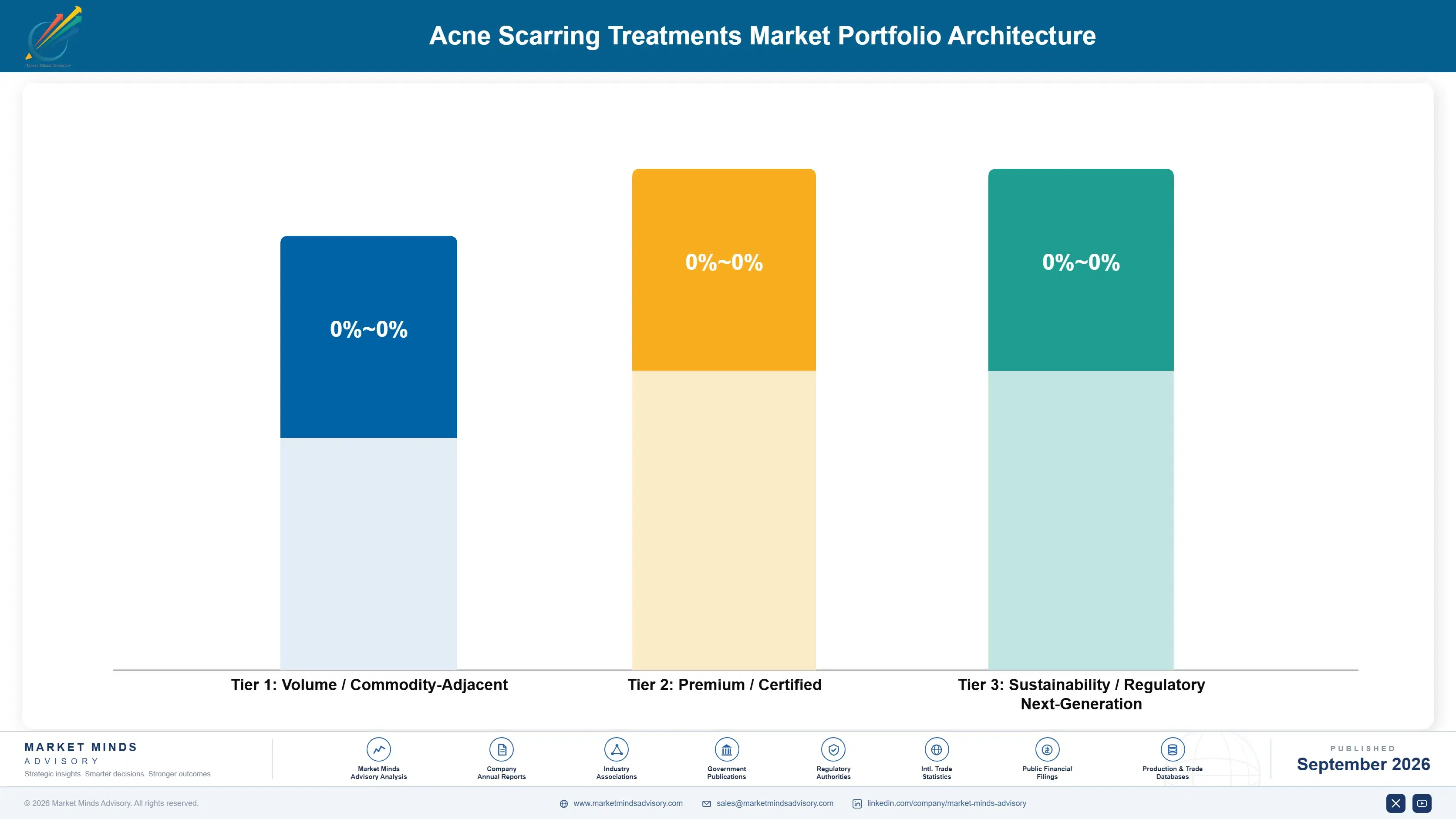
Gross margin economics diverge sharply across the three tiers structuring this market, from thin-margin volume chemical peel treatments competing largely on price to premium radiofrequency microneedling and combination systems where device technology and clinical substantiation support wider margins. Sustainability-focused single-use consumable products occupy a smaller but expanding third tier as infection control standards increasingly matter to clinics.
Clinics face a persistent tension between chasing volume share in commodity chemical peel assortments, where competition is fiercest and margins thinnest, and concentrating capital on premium certified combination therapy products that deliver superior returns per unit sold but require ongoing clinical substantiation investment. Most established practices now allocate a growing share of new equipment budget toward the premium tier.

High-value margin pools concentrate overwhelmingly in radiofrequency microneedling systems and bundled skincare regimen sets, where device technology and clinical substantiation command sustained premium pricing that commodity chemical peels simply cannot replicate. Manufacturers capturing the largest share of these pools tend to be those with the deepest technology expertise and fastest certification cycles synchronized to aesthetic dermatology trend calendars. This dynamic is expected to intensify as more challengers pursue technology investment across the category.

Volume / Commodity-Adjacent

Generic chemical peel and topical treatments sold at accessible price points through mass clinic channels, competing primarily on price against private-label alternatives. These products rely on high unit volume and broad distribution rather than technology exclusivity to sustain profitability.
Gross Margin: 20 to 28 percent

Premium / Certified

Radiofrequency microneedling and combination systems carrying verified clinical substantiation, sold through specialty dermatology distribution at sustained premium pricing. Buyers in this tier are willing to pay significantly more for verified clinical efficacy and device reliability.
Gross Margin: 42 to 52 percent

Sustainability / Regulatory / Next-Generation

Single-use consumable and low-impact manufacturing systems meeting emerging infection control standards, appealing to safety-conscious clinical buyers. This tier remains small today but is expanding as safety disclosure expectations shift among clinical buyers over time.
Gross Margin: 44 to 54 percent
acne-scarring-treatments-market-portfolio-architecture-1790017360626

High-value Sub-segments and Strategic Watch-out

Radiofrequency Microneedling Systems

Advanced combination therapy devices command the highest per-unit margins in the category, combining technology exclusivity with strong clinical substantiation economics. Manufacturers with the strongest technology expertise capture the largest share of this margin pool consistently over time. This concentration should persist through the forecast period.
Gross Margin: 46 to 56 percent

Bundled Skincare Regimen Sets

Matched treatment and homecare product bundles deliver strong margins with moderate but steadily expanding growth as patients seek complete solutions. Attach rates continue climbing as clinics expand matched product lines across a growing number of treatment categories. Growth here should outpace the standard catalog segment.
Gross Margin: 36 to 44 percent

Standard Chemical Peel Treatments

The volume core of the category, standard chemical peel treatments sustaining steady baseline demand across mainstream clinic channels. This segment anchors overall category volume even as clinic strategic attention shifts increasingly toward higher-margin premium tiers. Absolute volume keeps rising as margin share slowly declines. Buyers remain cost-sensitive.
Gross Margin: 20 to 28 percent

High Out-of-Pocket Cost Constraint

Limited insurance coverage for cosmetic scar revision represents a strategic watch-out, constraining broader adoption and pushing clinics toward financing investment. Clinics are investing in financing programs to address this constraint before it compounds further. Left unchecked, this trend limits broader adoption industry wide. Progress may take time.
Gross Margin: not applicable

Treatment Course Repeat Purchase Cycles

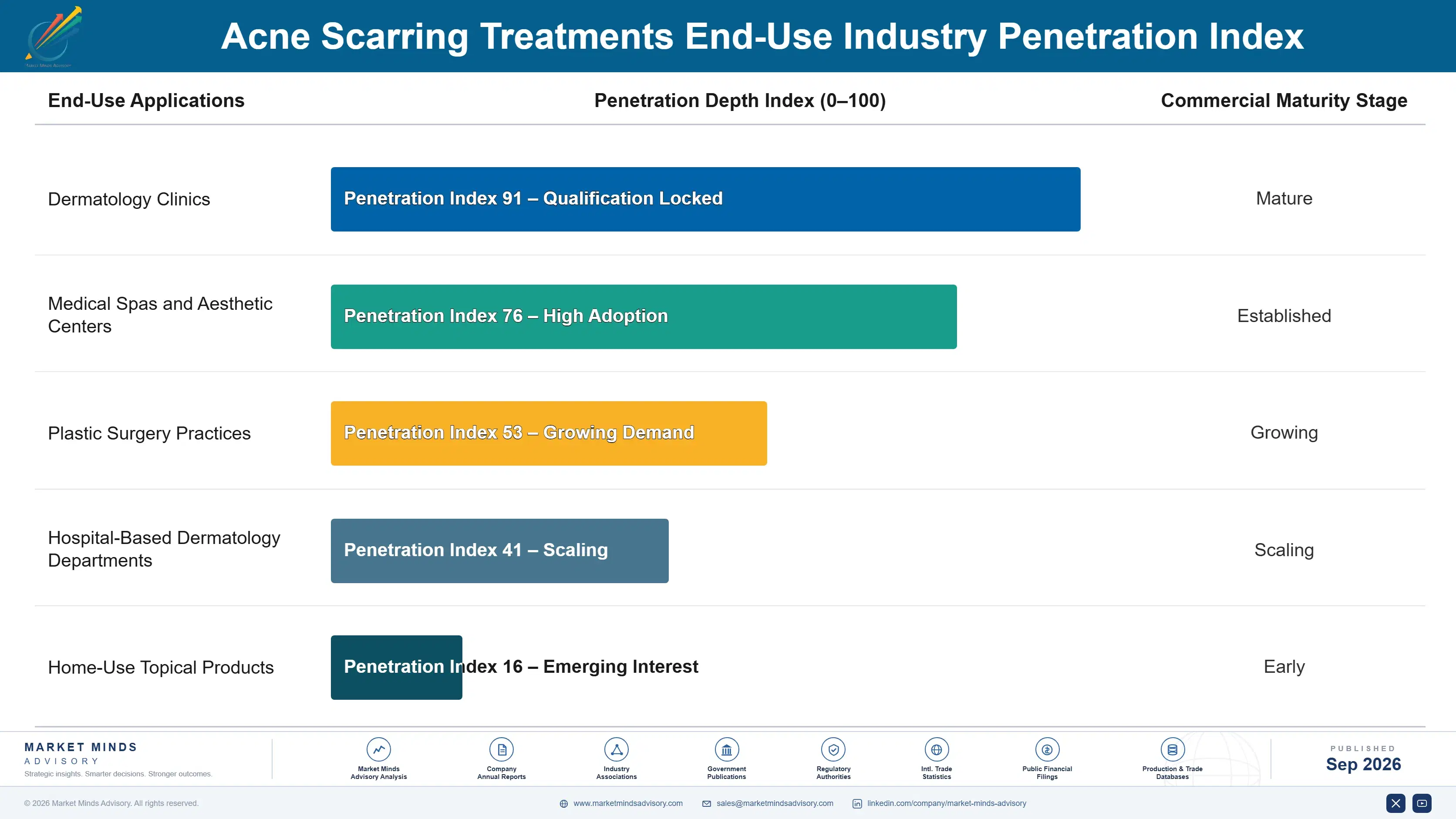
Acne scarring treatment demand behaves less like a one-time purchase and more like a recurring treatment course commitment, since effective scar revision typically requires multiple sessions spaced across several months rather than a single procedure. This repeat-purchase pattern gives clinics a revenue annuity that single-session cosmetic procedures cannot generate as reliably, anchored to genuine biological treatment timelines rather than one-off transactional demand.
Adoption depth varies meaningfully by end-use vertical: severe scarring patients integrate combination therapy deeply into structured multi-session treatment plans built around documented clinical protocols, while mild scarring patients experiment more casually, trying single treatments before committing to longer courses. Maintenance-focused patients occupy a distinct segment entirely, prioritizing periodic touch-up sessions over intensive initial treatment. Manufacturers increasingly build product lines specifically calibrated to these distinct severity and treatment intensity segments.

Generational shifts are reshaping the buyer profile underlying this category. Younger patients who grew up watching dermatology content online treat treatment transparency as a genuine research requirement, driving decisions that skew toward documented clinical outcomes over traditional provider reputation alone. Older patients, by contrast, weigh established provider relationships more heavily and remain comparatively resistant to switching clinics. Clinics targeting each cohort separately report stronger conversion than undifferentiated positioning achieves.
acne-scarring-treatments-market-end-use-penetration-index-1790017361450

Combination Therapy Strategic Priorities

These are among the four positions where our research anticipates prominent divergence between winners and laggards over the coming forecast period. Each is grounded in the demand model, the regulatory perimeter, and the announced capacity pipeline.
01 / COMBINATION PORTFOLIO EXPANSION

Prioritize Radiofrequency Microneedling Investment

Manufacturers should prioritize expanding radiofrequency microneedling and combination therapy development over incremental single-modality line extensions, since combination systems carry both the fastest growth rate and the widest margin in the category. Early movers on clinical substantiation are already capturing disproportionate share among patients who value documented efficacy and outcome transparency over marginal marketing differences alone. Delaying this investment risks ceding the category's most valuable patient relationships to faster-moving specialty challengers already building clinical expertise competitors will find difficult to replicate quickly.
02 / CLINICAL OUTCOME SUBSTANTIATION

Publish Third-Party Scar Reduction Efficacy Data

Manufacturers still relying on unsubstantiated resurfacing marketing claims are missing the meaningful premium pricing power that published clinical outcome data consistently commands across comparable competing product formulations and delivery systems. Building dedicated research partnerships with dermatology institutions captures pricing that unsubstantiated competitor products cannot sustain, while strengthening negotiating position with clinics seeking genuine differentiation from competing brands. Brands slow to act risk losing preferred referral placement and co-marketing support to faster-moving competitors already pursuing this strategy across multiple specialty referral networks simultaneously.
03 / FINANCING ACCESS STRATEGY

Expand Patient Financing And Package Pricing Options

Clinics facing continued out-of-pocket cost barriers are missing a meaningful opportunity to defend patient volume through structured financing programs and tiered package pricing that address the exact affordability concern limiting mainstream adoption directly and credibly. Building dedicated financing partnerships with healthcare lending providers positions clinics to capture patient demand before competitors establish comparable payment flexibility offerings and financing structures. This investment also opens new market opportunities among middle-income patients previously excluded from premium combination therapy entirely and consistently over time.
04 / SUBSCRIPTION REVENUE MODELS

Build Maintenance Subscription Infrastructure Immediately

Clinics without subscription maintenance programs for scar revision touch-ups are missing a meaningful retention and lifetime value opportunity that competitors are already capturing across the category. Building this infrastructure now, well ahead of broader category adoption, secures recurring revenue relationships before competitors normalize subscription as the expected treatment pathway for premium combination therapy patients across every major market. Early movers also gain first-party outcome data that sharpens future protocol development decisions considerably more effectively than competitors relying solely on retail point-of-sale data.

Engagement Snapshot From the Field

A live engagement with an industry participant carrying material or product regulatory and market exposure ahead of a defining policy shift, showing how our research translates into a defensible multi-year portfolio strategy.
MARKET MINDS ADVISORY · CLIENT ENGAGEMENT SUMMARY
Acne Scarring Treatments Producer Strategic Portfolio Review and Transition Roadmap 2026·Investment Scenario on Acne Scarring Treatments Exposure Evaluation 2025-26
CLIENT PROFILE
The client is a mid-tier aesthetic device manufacturer generating annual revenue in the low hundreds of millions of dollars (client-reported, unverified by MMA), competing primarily in single-modality laser categories against larger established manufacturers with deeper combination therapy expertise and broader specialty clinic distribution. The client sought an independent assessment of its combination therapy entry strategy ahead of its next fiscal year planning cycle.
STRATEGIC CHALLENGE
The client had no radiofrequency microneedling products and was losing clinic accounts to specialty competitors with established combination therapy credentials. Leadership needed a category entry strategy that could compete credibly without years of accumulated combination device research that larger specialists had already invested. Board-level pressure to close this gap within one year added urgency to the engagement.
MMA APPROACH
MMA conducted primary interviews with device engineers and specialty clinic buyers to identify viable partnership and licensing paths into radiofrequency technology the client could pursue without ground-up development. The engagement modeled expected returns under multiple entry structures against the client's existing distribution capacity and brand positioning. Findings were validated against MMA's proprietary primary research dataset covering technology licensing terms across the sector.
KEY FINDINGS
  1. Combination technology licensing from established radiofrequency specialists offered a faster path to market than ground-up development, cutting time to launch by roughly a year (client-reported, unverified by MMA).
  2. Specialty clinics showed willingness to grant trial adoption to new combination therapy entrants when paired with committed marketing spend and clinical training.
  3. Direct clinic subscription infrastructure delivered a faster path to combination credibility than pursuing broad distribution immediately upon launch. This channel investment paid back within the first year.
  4. Bundled skincare regimen sets outperformed standalone combination therapy launches on both margin and patient retention metrics across comparable competitor product lines (client-reported, unverified by MMA).
CLIENT PROFILE
The client is a mid-tier aesthetic device manufacturer generating annual revenue in the low hundreds of millions of dollars (client-reported, unverified by MMA), competing primarily in single-modality laser categories against larger established manufacturers with deeper combination therapy expertise and broader specialty clinic distribution. The client sought an independent assessment of its combination therapy entry strategy ahead of its next fiscal year planning cycle.
STRATEGIC CHALLENGE
The client had no radiofrequency microneedling products and was losing clinic accounts to specialty competitors with established combination therapy credentials. Leadership needed a category entry strategy that could compete credibly without years of accumulated combination device research that larger specialists had already invested. Board-level pressure to close this gap within one year added urgency to the engagement.
MMA APPROACH
MMA conducted primary interviews with device engineers and specialty clinic buyers to identify viable partnership and licensing paths into radiofrequency technology the client could pursue without ground-up development. The engagement modeled expected returns under multiple entry structures against the client's existing distribution capacity and brand positioning. Findings were validated against MMA's proprietary primary research dataset covering technology licensing terms across the sector.
KEY FINDINGS
  1. Combination technology licensing from established radiofrequency specialists offered a faster path to market than ground-up development, cutting time to launch by roughly a year (client-reported, unverified by MMA).
  2. Specialty clinics showed willingness to grant trial adoption to new combination therapy entrants when paired with committed marketing spend and clinical training.
  3. Direct clinic subscription infrastructure delivered a faster path to combination credibility than pursuing broad distribution immediately upon launch. This channel investment paid back within the first year.
  4. Bundled skincare regimen sets outperformed standalone combination therapy launches on both margin and patient retention metrics across comparable competitor product lines (client-reported, unverified by MMA).
RECOMMENDED STRATEGY
Phase 1: Phase one: license proven radiofrequency technology from an established combination therapy specialist rather than pursuing costly ground-up development internally. This approach preserves capital for marketing investment instead. Phase 2: Phase two: launch through select specialty clinic partners with clinical training support to build early combination category credibility and awareness. Phase 3: Phase three: expand into bundled skincare regimen sets once initial combination credibility is established with early adopter clinics. This final phase compounds margin gains achieved during the first two phases.
OUTCOME
Within eighteen months of implementation, the client launched a full radiofrequency microneedling line and grew combination-attributable revenue to 19 percent of total brand revenue (client-reported, unverified by MMA), while specialty clinic distribution expanded to cover most major regional accounts previously unavailable to the brand. Leadership credited the licensing-first approach with materially compressing time to market.

Frequently Asked Questions

Foundational context covering the market sizes, CAGR, scope, country, region and competition that inform every finding below. This section is provided to cover basics and most often pre-purchase conversations, answered from the MMA Primary Research Dataset.

What is the current size of the Acne Scarring Treatments Market?

The global acne scarring treatments market was valued at 4.2 billion dollars in 2025. This figure covers laser resurfacing, microneedling, chemical peel, dermal filler and radiofrequency microneedling protocols worldwide.

How large will the Acne Scarring Treatments Market be by 2036?

The market is projected to reach 10.30 billion dollars by 2036. This represents a 2.26 times expansion over the eleven year forecast period from 2026 through 2036.

What is the CAGR for the Acne Scarring Treatments Market 2026 to 2036?

The market is forecast to grow at a compound annual growth rate of 8.5 percent between 2026 and 2036. Bull and bear scenarios range between 7.2 and 9.8 percent respectively.

Which segment is growing fastest?

Radiofrequency microneedling treatments are growing fastest, at a 12.5 percent CAGR, roughly 1.47 times the overall market growth rate. This segment benefits from documented dermal remodeling efficacy and combination technology adoption.

Who are the major companies in the Acne Scarring Treatments Market?

Cutera, Cynosure, Candela, Galderma and Merz Aesthetics lead the market, together holding an estimated 37 percent combined share. Cutera and Cynosure hold the largest combined revenue share among the five.

Which country is growing fastest?

India is growing fastest, at an 11.0 percent CAGR, driven by expanding dermatology awareness. This closely tracks the broader South Asia and Pacific regional growth rate.

Report Segmentation Architecture

The full report scope spans multiple orthogonal segmentation dimensions, with cross-tabulated demand data provided for each dimension pair. Coverage extends further to regional breakdowns, trend trajectories, and the competitive detail needed to support segment-level decision-making.

By Primary Market Dimension

  • Laser Resurfacing Treatments
  • Microneedling Treatments
  • Chemical Peel Treatments
  • Dermal Filler Treatments
  • Topical Scar Treatment Products
  • Radiofrequency Microneedling Treatments

By End-Use Industry

  • Dermatology Clinics
  • Medical Spas and Aesthetic Centers
  • Plastic Surgery Practices
  • Hospital-Based Dermatology Departments
  • Home-Use Topical Products

By Commercial Dimension

  • Direct Clinic Purchase
  • Distributor and Third-Party Sales
  • Maintenance Subscription Programs
  • Institutional Bulk Supply

By Region

  • North America
  • Western Europe
  • East Asia
  • South Asia and Pacific
  • Latin America
  • Middle East and Africa
  • Eastern Europe

Scope, Methodology, and Coverage

Every figure in this report is reproducible from documented input assumptions. The scope below maps the historical period, the forecast horizon, the segmentation dimensions, and the countries covered, alongside the underlying primary and qualitative methodology.
Historical Period
2020 to 2025
Forecast Period
2026 to 2036
Base Year
2025 (USD billions; MMA Primary Research Dataset, September 2026)
Market Definition
The acne scarring treatments market covers laser resurfacing, microneedling, chemical peel, dermal filler, topical scar treatment and radiofrequency microneedling procedures used to reduce or revise acne scar tissue. It excludes acne treatment products targeting active breakouts and general anti-aging skin resurfacing not specifically marketed for scar revision.
Quantitative Units
USD Billion
Segmentation Dimensions
Treatment modality, end-use provider type, commercial model, region
Regions Covered
North America, Western Europe, East Asia, South Asia and Pacific, Latin America, Middle East and Africa, Eastern Europe
Countries Covered
United States, Canada, Germany, France, United Kingdom, China, Japan, South Korea, India, Australia, Brazil, Mexico, United Arab Emirates, Saudi Arabia, South Africa, Poland, Russia
Key Companies Profiled
Cutera, Cynosure, Candela, Galderma, Merz Aesthetics, Lumenis, Sciton, Sinclair Pharma, Cartessa Aesthetics, InMode, BTL Aesthetics, Venus Concept, Bausch Health, Allergan Aesthetics, Fotona, Deka Laser, Alma Lasers, Classys, Jeisys Medical, WON Technology
Quantitative Methodology
Primary survey, n=3,800 respondents, Q4 2025, six countries; demand-side model with trade association cross-validation
Qualitative Methodology
47 expert interviews, Q4 2025; applied to validate demand model assumptions, identify emerging dynamics, and assess competitive positioning
Report Format
PDF and XLSX data workbook (Word format preview document)
Publisher
Market Minds Advisory
Report Code
MMA-2026-HLT-227
Published
September 2026
Contact
sales@marketmindsadvisory.com | www.marketmindsadvisory.com

Purchase the full Acne Scarring Treatments Market Report (2026 to 2036).

This report provides a comprehensive assessment of the global acne scarring treatments market, covering market sizing, segmentation, competitive positioning and regional demand patterns through 2036. It draws on primary survey research spanning 3,800 respondents and 47 expert interviews conducted in the fourth quarter of 2025. The analysis examines combination therapy economics, radiofrequency microneedling adoption cycles and emerging maintenance revenue models reshaping clinic strategy. Readers gain a structured view of where competitive advantage concentrates and how it is likely to shift going forward. The report also flags where established manufacturers face the greatest risk of disruption from faster-moving specialty combination brands.
Ten-year global market sizing and forecast
Six-segment MECE market breakdown and framework
Seven-region demand and growth pattern analysis
Competitive benchmarking across twenty profiled companies
Combination therapy revenue model and lever assessment
Anonymized client licensing engagement case study

Built For The People Who Decide

From boardroom strategy to bench-side execution, this report is read cover-to-cover by leaders shaping the next decade of their industry, turning demand scenarios, market dynamics and valuation benchmarks into decisions.
CXOs/ Presidents/ VPs/ Managers
M&A and Corporate Development
Strategy Teams and R&D Heads
Procurement and Product Directors
Regulatory and Compliance Leaders
Investor Relations and Equity Analysts