Market Minds Advisory
Acid Proof Lining Market

Acid Proof Lining Market: Shutdown Windows as the New Design Constraint

Acid proof lining systems protect chemical, metallurgical, and flue-gas desulfurization equipment from corrosive failure, and plant operators increasingly specify full system replacement on fixed capital cycles rather than reactive repair after a containment breach.

Lead Analyst

Bilal Shaikh

Published

September 2026

Make Smarter Decisions with Customized Research Insights

Request a free sample report and evaluate market opportunities, growth trends, and competitive dynamics relevant to your business needs.

2025 MARKET VALUE$2.4BMarket Size 2025
2036 FORECAST VALUE$4.3BBase Case , 2026 to 2036
CAGR 2026 TO 20365.4 %Bull 6.6% / Bear 4.2%
INCREMENTAL OPPORTUNITY$1.8BNet 10- year value creation
EXPANSION MULTIPLE1.72x2036 value over 2026 base
Strategic Levers
M&A Pipeline
Regional Outlook
Country Rankings
Competitive Intelligence
Segmental Deep-dive
Call-Us : 91 93563 13602

Executive Snapshot and Market Trajectory

Plant operators are done treating lining failure as a maintenance surprise. Chemical processors and power utilities now schedule full acid proof lining replacement on fixed inspection cycles tied to equipment shutdown windows, converting what was once emergency repair spending into planned capital expenditure with a predictable multi-year budget line.
FRP and fluoropolymer lining systems are pulling the market forward fastest, as chemical processors favor lightweight, faster-install alternatives to traditional brick and tile construction. East Asia now holds the largest share of global demand, driven by China's continuing flue-gas desulfurization retrofit program and expanding chemical manufacturing capacity, while South Asia grows fastest as India's metallurgical and fertilizer sectors install new corrosion protection systems alongside a wave of greenfield chemical plant construction.
Consolidation is proceeding through bolt-on acquisitions of applicator firms rather than mega-mergers, as material suppliers buy installation capability to capture more of the total project value. Competitive pressure is intensifying, since fluoropolymer and FRP specialists undercut brick and tile contractors on installation time while plant operators demand longer warranty periods, forcing contractors to prove long-term corrosion performance data rather than simply cite decades of installed base experience.
Market Definition
The acid proof lining market covers corrosion-resistant lining systems installed to protect industrial equipment, tanks, floors, and structures from acid, alkali, and other chemically aggressive process exposure. It includes acid-resistant brick and tile systems, resin mortar and membrane linings, rubber linings, glass-lined steel, FRP linings, and fluoropolymer linings, along with the specialized installation labor these systems require. General industrial coatings without chemical-resistance certification and structural construction materials are excluded.
Base Year Value
$2.4B in 2025 (MMA Primary Research Dataset, August 2026)
Forecast Period
2026 to 2036, eleven discrete annual values
CAGR
5.4% base case. Bull 6.6%. Bear 4.2%.
Fastest Growth Segment
FRP Lining Systems: 7.8% CAGR
Fastest Growth Country
China: 9.5% CAGR
Fastest Growth Region
South Asia and Pacific: 7.4% CAGR
Largest Region
East Asia: 29% of 2025 global value
Market Leaders
Steuler-KCH GmbH, StonCor Group Inc., Sauereisen Inc., Saint-Gobain S.A., Crane ChemPharma & Energy. Source: MMA Analysis based on company annual reports.
Primary Survey
n=3,800 procurement and R&D decision-makers, Q4 2025, six countries
Methodology
Demand-side build-up, cross-validated against public data, 47 expert interviews

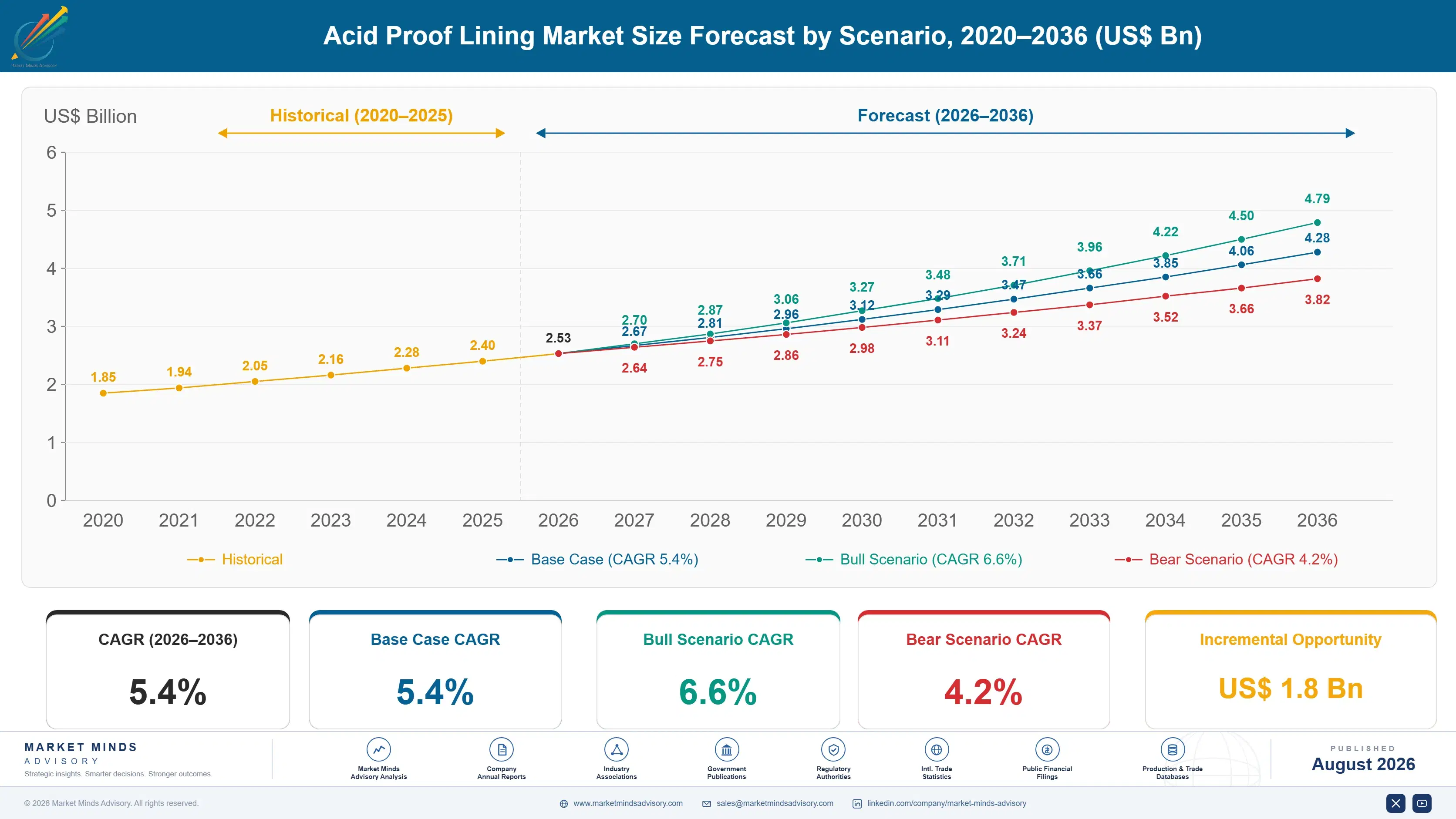
Acid Proof Lining Market Forecast Scenarios

acid-proof-lining-market-size-forecast-scenario-1787300315768
Between 2020 and 2025 the market grew at roughly 4.6% a year, a period shaped by deferred capital projects during pandemic-era shutdowns followed by a catch-up wave of lining replacement once maintenance windows reopened. China's flue-gas desulfurization retrofit program provided a steady demand base throughout, insulating the market from the sharper cyclicality that hit general industrial construction spending.
The base case carries the market to 4.3 billion dollars by 2036 on three mechanisms. First, aging chemical and metallurgical plants across North America and Western Europe are reaching lining replacement age simultaneously, converting deferred maintenance into scheduled capital spending. Second, China and India continue expanding chemical and power generation capacity requiring corrosion protection from first installation. Third, fluoropolymer and FRP systems are winning share from brick and tile on faster installation time, shrinking the shutdown window operators must budget for.
The bull case reaches roughly 6.6% annual growth if chemical capacity expansion in Asia accelerates faster than currently planned and FGD retrofit mandates expand to more coal-fired plants globally. The bear case falls near 4.2% if industrial capital spending softens broadly and plant operators defer lining replacement projects beyond their scheduled maintenance windows to preserve cash.

Where Shutdown Windows Set the Replacement Cycle

Acid proof lining used to be a routine maintenance line item; now it is a scheduled capital project tied directly to plant shutdown windows that can cost a facility millions per day if missed. Every brick course, resin mortar joint, and fluoropolymer sheet installed exists to keep a vessel or floor in service until the next planned shutdown, not indefinitely. That scheduling discipline, not raw material cost, increasingly decides which contractor wins the work.
MARKET CONCENTRATION (CR5)24%Top five suppliers hold under one quarter of volume
AVERAGE SELLING PRICEUSD 185 per sq meter installedBlended price across brick, resin, and FRP systems
TOP PRODUCING COUNTRY SHAREChina, 24% of global outputLargest single national source of lining system volume
CAPACITY UTILIZATION71% of applicator crewsSpecialized installation crews run near full booking most quarters
TRADE INTENSITY29% cross-borderNearly a third of material volume crosses a border
REPLACEMENT CYCLE LENGTH12 to 18 years averageTypical service life before full system replacement is needed
Commercially the market behaves like a specialized construction trade wearing a materials label. Material cost is a modest share of total project value; skilled installation labor and the engineering judgment to specify the right system for a given chemical exposure profile drive most of the price. Plant operators rarely switch lining system type mid-facility-life, since requalifying a new system against process chemistry and scheduling constraints is its own multi-month engineering exercise.
The next decade turns on three forces: aging chemical and metallurgical plant infrastructure reaching simultaneous replacement age, continuing Asian capacity expansion requiring corrosion protection from first installation, and lighter fluoropolymer and FRP systems compressing the installation time plant operators must budget into shutdown windows. Contractors positioned across all three will set the pace.
"Nobody buys acid proof lining because they want to. They buy it because the alternative is a vessel failure that shuts the whole plant down for a lot longer than the lining job would have."
Director, Industrial Corrosion Protection Practice · MMA Chemicals and Materials

Market Trends

FGD Retrofit Mandates Sustain Steady Demand

Coal-fired power plants across China and several other Asian markets continue installing or upgrading flue-gas desulfurization systems to meet tightening sulfur dioxide emissions standards, and every FGD absorber vessel requires acid-resistant lining to survive continuous exposure to sulfurous scrubbing chemistry. China's program alone has covered the large majority of its coal fleet, and remaining retrofit and replacement work provides a steady demand base independent of broader industrial capital spending cycles. Lining contractors with FGD-specific engineering experience are winning repeat work directly from utility operators who prefer a known, qualified applicator over resubmitting the specification to open bid each cycle.
Market Impact: Pulls capital spending forward 4 years
Fluoropolymer Systems Displace Traditional Brick Construction

Fluoropolymer sheet lining systems install significantly faster than traditional acid-resistant brick and tile construction, since a fluoropolymer liner can be fabricated and applied as sheet or spray-on material rather than laid course by course with mortar curing time between layers. That installation speed matters directly to plant operators, since every additional day a vessel sits offline during a shutdown carries real lost-production cost. Chemical processors handling high-purity or highly corrosive process streams have shifted meaningful specification volume toward fluoropolymer systems specifically to compress shutdown duration, even where the material costs more per square meter than brick.
Market Impact: Adds new capacity across 200+ facilities

Market Opportunities and Growth Drivers

Aging Plant Infrastructure Reaches Replacement Age

A substantial share of chemical and metallurgical processing infrastructure across North America and Western Europe was built or last relined decades ago and is reaching the end of its designed lining service life at broadly the same time, rather than the staggered pattern plant operators historically budgeted for. Replacing a failing lining system without addressing the underlying vessel risks repeating the shutdown within a few years, an outcome operators are unwilling to accept. Capital planning teams are bundling full lining replacement into broader vessel refurbishment programs, pulling scheduled maintenance spending forward and consolidating future shutdowns into one project.
Market Impact: Delays projects 2 to 4 months

Asian Chemical Capacity Expansion Requires New Lining

China and India continue expanding chemical processing, fertilizer, and metallurgical capacity to serve both domestic demand and export manufacturing, and every new vessel, tank, and processing floor in that expansion requires corrosion protection from first installation rather than as a later retrofit. That greenfield demand differs fundamentally from replacement demand in developed markets, since it represents genuinely new addressable volume rather than recurring service on existing infrastructure. Domestic Asian lining contractors have scaled installation capacity rapidly, and several have begun exporting engineering expertise and applicator crews to serve chemical plant construction in neighboring Southeast Asian markets.
Market Impact: Adds rework cost 3 to 5x

Market Restraints and Challenges

Skilled Applicator Labor Shortage Delays Projects

Installing acid-resistant brick, resin mortar, and fluoropolymer lining systems correctly requires specialized applicator training that takes years to develop, and the workforce with that training is aging out of the trade faster than new applicators are trained to replace them. The root cause is that lining installation never had the structured apprenticeship pipeline that electrical or plumbing trades built decades ago, leaving skill transfer largely informal. That shortage delays project timelines well beyond material lead times, since a qualified crew is now the binding constraint. Some contractors are building formal in-house training academies to rebuild that pipeline directly.
Market Impact: Covers over 1,000 FGD units retrofitted

Chemical Compatibility Failures Risk Costly Rework

Specifying the wrong lining system for a given process chemistry, temperature, or concentration profile can lead to premature failure years before the expected service life ends, forcing an unplanned shutdown and full rework at a cost far exceeding the original installation. The root cause is that chemical exposure conditions in real plant operation often drift from the original design specification as processes change, without the lining specification being formally revisited to match. That mismatch risk keeps plant engineers conservative, often over-specifying premium systems even where a cheaper system would technically suffice for the exposure involved. Some operators mitigate the risk with periodic chemical exposure audits to catch specification drift before failure occurs.
Market Impact: Cuts installation time 40 to 60%
3 additional market trends, 3 additional growth drivers, and 4 additional restraints and challenges are covered in the full report. Contact sales@marketmindsadvisory.com to access the complete intelligence.

Segment CAGR and Growth Architecture

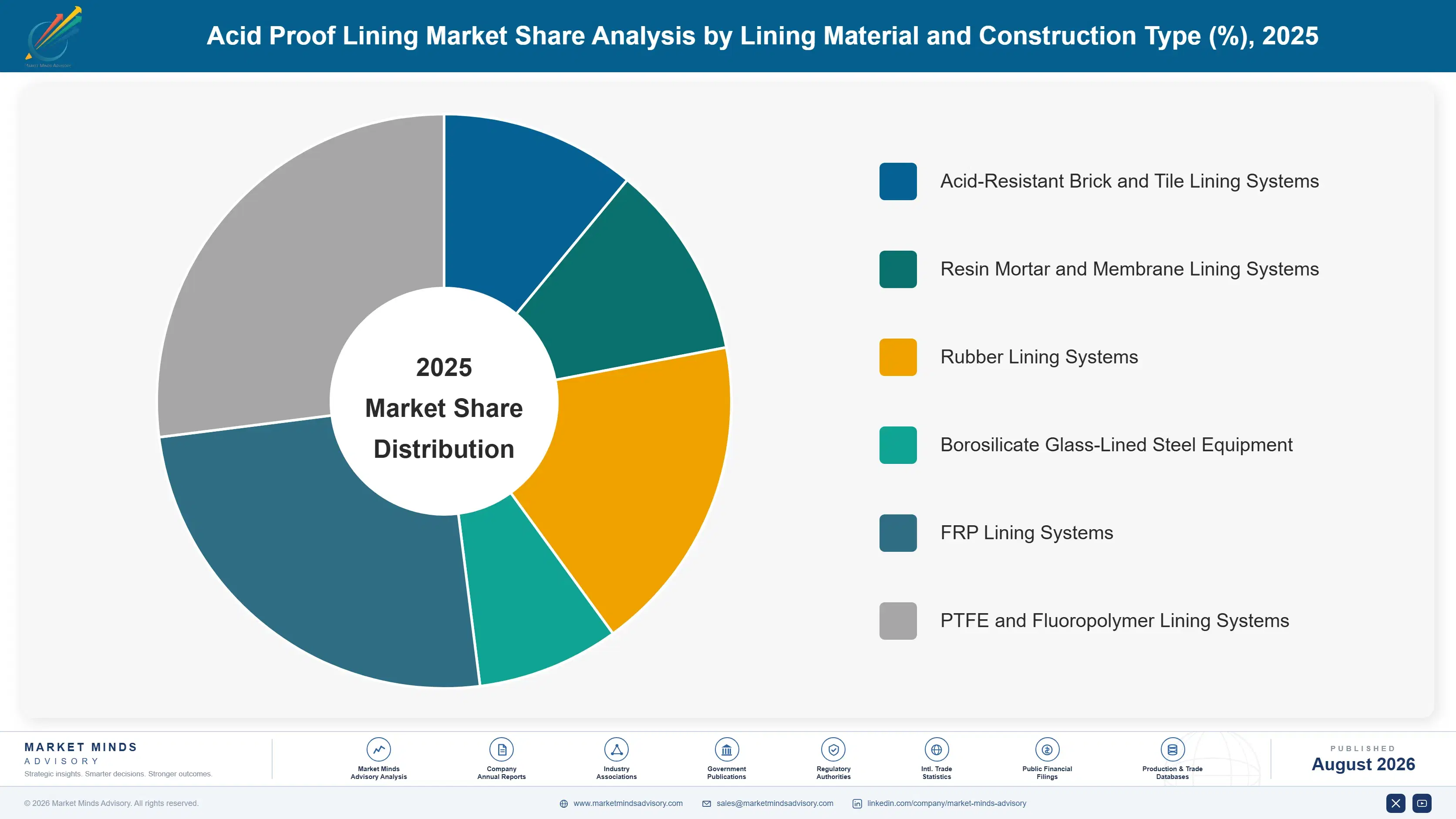
Segmentation follows lining material and construction type, a single materials-science logic that groups systems by the physical form and chemistry used to resist corrosive exposure rather than by end industry served. Each construction type carries its own installation method, chemical resistance profile, and service life, so commercial position tracks the material choice rather than the vessel it eventually protects.
acid-proof-lining-market-market-share-analysis-1787300316294

FRP Lining Systems

FRP lining systems grow fastest at 7.8%, about 1.44 times the overall market rate, as chemical processors and power utilities favor fiberglass reinforced plastic construction over traditional brick and tile for its combination of chemical resistance, lighter weight, and faster installation. FRP linings can be fabricated in sections and bonded into place rather than built course by course with mortar curing time between layers, compressing shutdown duration compared with masonry systems. The format performs well in flue-gas desulfurization absorbers and chemical storage tanks, where its resistance to sulfurous process chemistry has been proven across thousands of installations. Contractors with FRP capability are winning share from masonry specialists on total project timeline rather than material cost alone.
CAGR 7.8%

PTFE and Fluoropolymer Lining Systems

PTFE and fluoropolymer lining systems grow second-fastest at 7.0%, driven by high-purity chemical processing and pharmaceutical intermediate manufacturing applications where trace contamination from a lining system itself is unacceptable to the process. Fluoropolymer sheet and spray-applied systems offer chemical inertness that exceeds most brick, resin, and rubber alternatives, making them the default specification for the most demanding process chemistry regardless of cost. The segment commands the highest price per square meter of any lining format, reflecting both material cost and the specialized fabrication expertise fluoropolymer systems require. Growth concentrates in specialty and fine chemical manufacturing, semiconductor chemical supply, and pharmaceutical intermediate production, where purity requirements keep tightening rather than easing over time.
CAGR 7.0%
Full segment breakdown across 6 segments available in the complete report.

Regional Architecture and Country Demand Map

Demand concentrates where chemical and metallurgical processing capacity and shutdown-driven replacement cycles intersect, which increasingly means East Asia rather than the historically dominant North American base. China's desulfurization program and chemical capacity expansion are pulling deployment east even as North America retains the deepest aging-infrastructure spend.

North America

North America holds 23% of global value, still commanding substantial aging-infrastructure replacement spend as chemical and metallurgical plants built decades ago reach simultaneous lining replacement age across the region. StonCor Group and Sauereisen both run core manufacturing and applicator operations domestically, giving American plant operators direct access to engineering support and rapid emergency response when a lining failure forces an unplanned shutdown. Gulf Coast petrochemical and specialty chemical facilities represent the deepest concentration of demand within the region, reflecting the density of process infrastructure requiring corrosion protection there. Growth of 5.9% tracks steady replacement cycle timing more than any new capacity expansion, since the region's chemical processing footprint is largely mature and growing only incrementally at this point.
Share: 23% | CAGR: 5.9% (2026 to 2036)

Western Europe

Western Europe accounts for 20% of value, a mature base shaped by some of the world's oldest chemical and metallurgical processing infrastructure, much of it now well past its original lining service life. Steuler-KCH, based in Germany, holds particularly deep engineering expertise in acid-resistant brick and tile systems built up over decades serving the region's chemical and power generation sectors. Stringent European industrial safety and environmental regulation keeps lining specification conservative, favoring proven systems with long track records over newer, less-tested alternatives even where they might install faster. Growth of 3.9% trails the global rate directly because the region's replacement cycle, while steady, generates less absolute volume than the greenfield capacity expansion happening elsewhere in the world.
Share: 20% | CAGR: 3.9% (2026 to 2036)
Regional intelligence for 5 additional markets available in the complete report: East Asia, South Asia and Pacific, Latin America, Middle East and Africa, Eastern Europe. Contact sales@marketmindsadvisory.com.
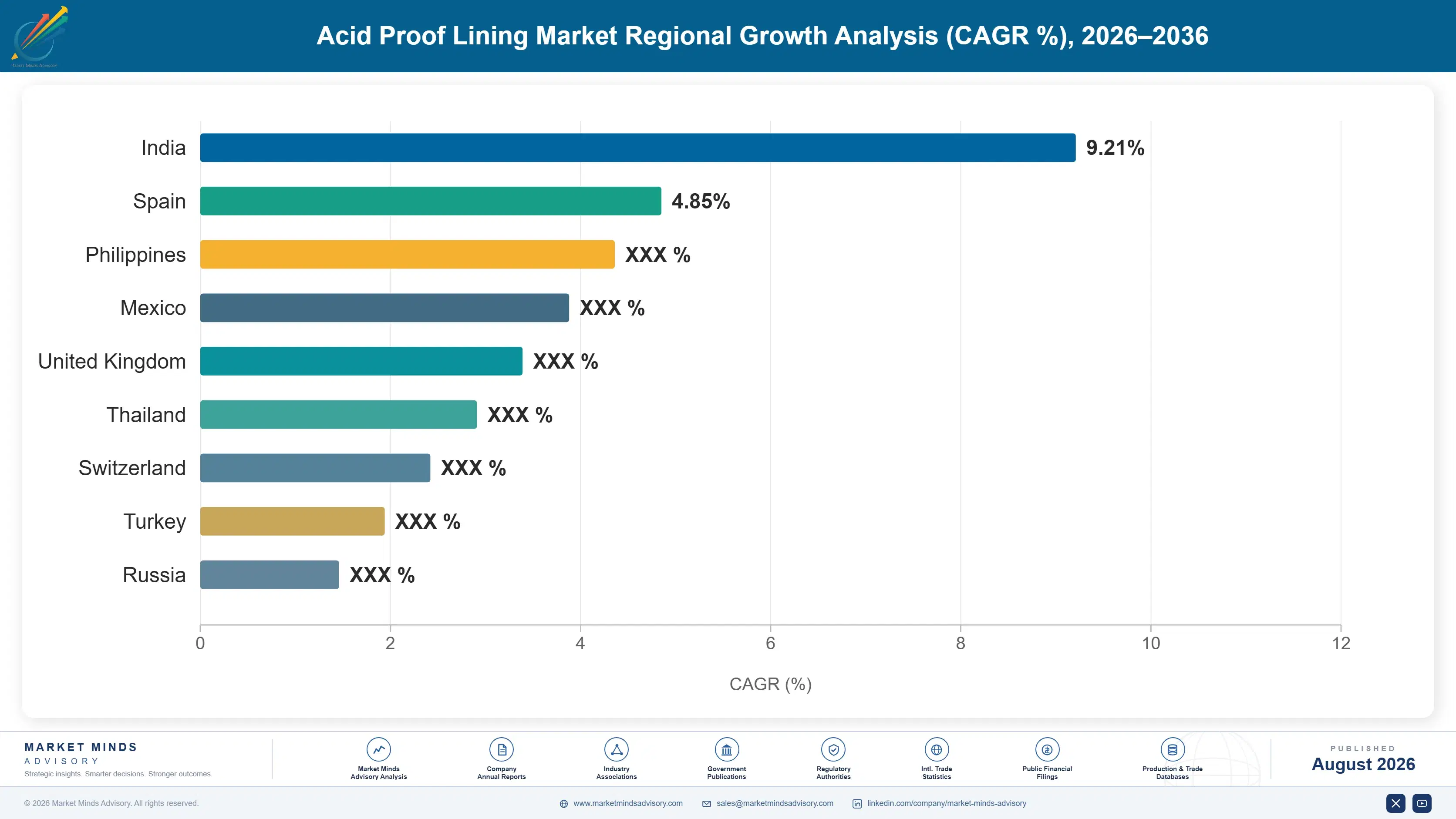
acid-proof-lining-market-country-cagr-analysis-1787300316814

How Contractors Can Defend Project Margin

Bidding a lining project on material cost alone leaves the highest-margin part of this work on the table. The four moves below shift revenue toward positions that command a premium over commodity installation: extended warranty programs, engineering specification services, rapid-response emergency capability, and applicator training capacity that competitors without a formal pipeline cannot easily replicate.

Offer Extended Warranty Programs For Premium Systems

Contractors that back fluoropolymer and FRP installations with extended warranty periods, rather than the industry-standard coverage most competitors offer, capture a documented price premium of roughly 10% to 15% from plant operators who need budget certainty against unplanned failure between scheduled shutdowns. That warranty commitment requires real underwriting discipline, since a premature failure claim costs the contractor directly, but it converts a one-time installation project into a longer relationship that competitors offering only standard coverage cannot match on risk transfer. Steuler-KCH and StonCor have both extended warranty terms to capture this premium ahead of smaller regional competitors.
Market Impact: Captures a 10% to 15% extended warranty premium

Sell Chemical Exposure Specification Engineering Services

Bundling process chemistry review and lining system specification engineering as a paid service, rather than treating it as a free pre-sale activity, captures real margin from plant engineers who need documented specification rationale for capital approval regardless of which system gets installed. Contractors offering this service typically charge a premium of 8% to 12% over installation alone, since the customer would otherwise hire an independent corrosion engineering consultant at a materially higher cost. The approach also reduces costly mismatches, since the same firm that specifies the system installs and stands behind it.
Market Impact: Charges an 8% to 12% engineering specification fee

Build A Rapid-Response Emergency Repair Crew

Contractors that maintain a standing emergency response crew and pre-positioned material inventory, rather than mobilizing from scratch after a failure call, can respond to an unplanned containment breach in days rather than the weeks a standard project mobilization requires. That responsiveness commands a substantial premium, often 25% to 40% over scheduled project pricing, since the alternative is continued unplanned production loss that dwarfs the emergency service premium many times over. Building that standing capability requires real fixed cost investment in crew retention and inventory carrying cost, but it wins loyalty from operators who remember who answered the call last time.
Market Impact: Charges a 25% to 40% emergency response premium

Build Formal In-House Applicator Training Academies

Contractors that invest in formal applicator training academies, rather than relying on informal on-the-job skill transfer, build a pipeline of qualified installation crews that increasingly scarce skilled labor markets cannot otherwise supply. That training investment costs real money upfront and takes roughly 3 years to produce a fully qualified applicator, but it lets contractors bid on more simultaneous projects than labor-constrained competitors can staff, capturing volume that would otherwise go unbid. Several major contractors have opened dedicated training facilities to address the skilled labor shortage restraining broader market growth, converting a market-wide restraint into a company-specific advantage over rivals relying on informal training.
Market Impact: Expands biddable project capacity by roughly 30% annually

Who Controls the Margin Pool

Concentration sits at a low CR5 of 24%, reflecting a market fragmented across regional contractors serving local relationships rather than global scale. The gap between the top five and the next tier is real but moderate: leaders combine multi-region engineering capability with formal training pipelines, while challengers operate from a single region with informally trained crews. All participants here are assessed on one basis: disclosed lining segment revenue.
Competition today runs across three dimensions. First, applicator labor capacity, since a contractor with a trained crew pipeline can bid more projects than labor-constrained competitors. Second, engineering specification depth, as plant operators increasingly value contractors who can document chemical exposure rationale for capital approval. Third, emergency response capability, since a standing crew ready to respond to an unplanned failure commands real premium pricing competitors without that capacity cannot match.

Pressure is building from fluoropolymer and FRP specialists who have closed much of the engineering credibility gap with traditional brick and tile contractors while offering faster installation. Asian contractors are expanding into Western markets on price, competing directly against established regional players on greenfield bids. Rankings will shift toward contractors who pair applicator training capacity with genuine multi-material engineering depth, since neither alone is enough.
acid-proof-lining-market-company-positioning-matrix-1787300317326

Competitive Moat and Risk Dimensions

STEULER-KCH GMBH

Moat: Deep European Brick Lining Expertise

Steuler-KCH has built decades of specialized engineering expertise in acid-resistant brick and tile lining systems, positioning it as the default specification for Europe's most demanding chemical and power generation applications. That accumulated installation track record across thousands of vessels gives plant engineers confidence a newer competitor cannot replicate without years of its own proven service history.
STEULER-KCH GMBH

Risk: Slower Shift To Lighter Systems

Steuler-KCH's core expertise remains concentrated in traditional brick and tile construction, and its shift toward faster-installing fluoropolymer and FRP systems has proceeded more cautiously than newer, lighter-system specialists moving aggressively into that space. As operators increasingly prioritize shutdown duration over pedigree, that cautious pace risks ceding time-sensitive projects to competitors built around faster materials.
STONCOR GROUP INC.

Moat: Broad North American Applicator Network

StonCor operates an extensive network of trained applicator crews across North America, giving it the scheduling flexibility to staff multiple simultaneous projects that smaller regional competitors cannot match during peak shutdown season. That crew depth, combined with decades of installed base across chemical and industrial facilities, makes it a default bid recipient for large multi-site maintenance contracts.
STONCOR GROUP INC.

Risk: Domestic Labor Cost Exposure

StonCor's crew-intensive business model leaves it directly exposed to North American skilled labor cost inflation and the aging-workforce shortage affecting the entire applicator trade. As Asian contractors expand into adjacent markets with lower labor cost structures, StonCor's domestic cost base becomes a harder argument to defend on price-competitive commodity lining projects specifically.

Key Players

Steuler-KCH GmbH
StonCor Group Inc.
Sauereisen Inc.
Saint-Gobain S.A.
Crane ChemPharma & Energy

Others

Sika AG
RPM International Inc.
CECO Environmental Corp.
Belzona Inc.
PPG Industries Inc.
The Chemours Company
Trelleborg AB
Ashland Inc.
Interplastic Corporation
Dow Inc.
Master Builders Solutions
Rath Group
Chemline Plastics Limited
Corrosion Engineering Inc.
HB Fuller Company

Recent Developments

MARCH 2025

StonCor Acquires Regional FRP Lining Specialist

StonCor completed the acquisition of a regional FRP lining specialist for an undisclosed sum, adding fiberglass reinforced plastic fabrication and installation capability to its existing brick and tile lining business. The deal gives StonCor direct FRP capability it previously accessed only through subcontracting arrangements with third-party fabricators.
Signal: Signals traditional lining contractors are buying lightweight system capability rather than building it internally over years.
SEPTEMBER 2024

Steuler-KCH Opens Applicator Training Academy in Germany

Steuler-KCH opened a dedicated applicator training academy at its German headquarters, adding formal training capacity for acid-resistant brick and tile installation crews. The organic investment, not a joint venture or acquisition, followed several years of rising concern over the aging applicator workforce across the European lining trade.
Signal: Signals that contractors increasingly build formal training pipelines rather than rely on informal skill transfer alone.
JUNE 2025

Crane ChemPharma and a Chinese Contractor Form Fluoropolymer Joint Venture

Crane ChemPharma and a Chinese lining contractor formed a joint venture to manufacture and install fluoropolymer lining systems for chemical and power generation customers across China. The partnership targets deployment across dozens of chemical processing facilities within three years, combining Crane's fluoropolymer material technology with its partner's regional installation network.
Signal: Signals that Western material specialists increasingly need a local partner to navigate Chinese plant procurement rules.

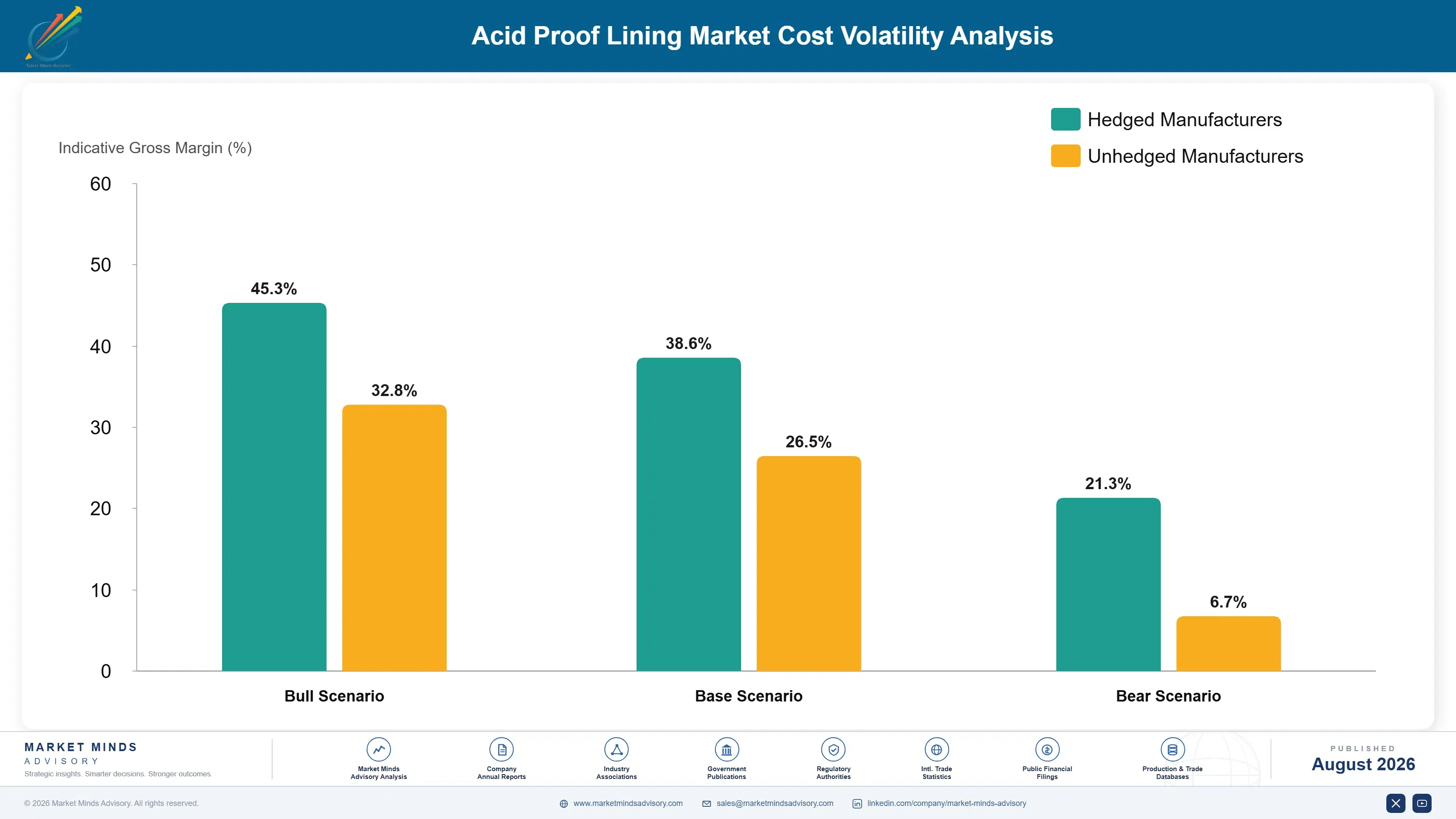
Resin, Labor, and Fabrication Cost Exposure

Specialty resins, fluoropolymer sheet material, and skilled applicator labor together make up roughly 60% to 70% of total project cost across acid proof lining installations, with the balance split between brick, engineering, and mobilization. Resin and fluoropolymer costs trace to petrochemical and fluorochemical feedstock pricing, while skilled labor cost reflects a shrinking pool of trained applicators commanding rising wages across most developed markets.
The 2021 to 2022 resin price spike illustrated the exposure directly. EIA and industry data recorded epoxy and vinyl ester resin prices reaching multi-year highs through 2021 as petrochemical feedstock costs surged alongside broader supply disruption. RPM International's 2022 Annual Report disclosed raw material cost inflation across its corrosion protection and specialty coatings segments, attributing margin pressure to resin and fluoropolymer input costs that took several quarters to fully pass through to customer pricing.

Smaller regional contractors without long-term material supply agreements absorbed the price spike hardest, since their purchase volumes were too small to secure the multi-year fixed pricing that larger suppliers like Sika and RPM negotiate directly with resin producers. That gap compounds: large contractors pre-purchase material months ahead using balance sheet capacity smaller competitors do not have, leaving regional specialists exposed every price cycle.
acid-proof-lining-market-cost-volatility-analysis-1787300317521

Secure Multi-Year Resin Supply Agreements Directly

Negotiating multi-year fixed or indexed pricing agreements directly with resin and fluoropolymer producers, rather than buying on the spot market, secures allocation priority during shortage cycles and smooths input cost volatility. The approach requires committing to volume forecasts years in advance, a real forecasting risk, but it has protected larger contractors' margins through two separate resin price spikes since 2020.

Build Formal Applicator Training Pipelines

Investing in structured applicator training programs, rather than relying entirely on the open labor market for skilled crews, reduces exposure to rising wage inflation driven by workforce scarcity across the trade. Training takes years to produce a fully qualified applicator, so contractors build pipelines steadily rather than all at once, prioritizing their highest-volume regional markets first.

Pass Through Cost Via Indexed Project Pricing

Structuring project contracts with pricing indexed to published resin and labor cost benchmarks, rather than fixed bid pricing locked months before installation, shifts some volatility risk back to plant operators who have more flexibility to absorb short-term swings. Large industrial customers have accepted indexed terms in exchange for guaranteed crew allocation during tight labor markets, a fair trade contractors use to protect margin.

Portfolio Architecture for Margin Defence

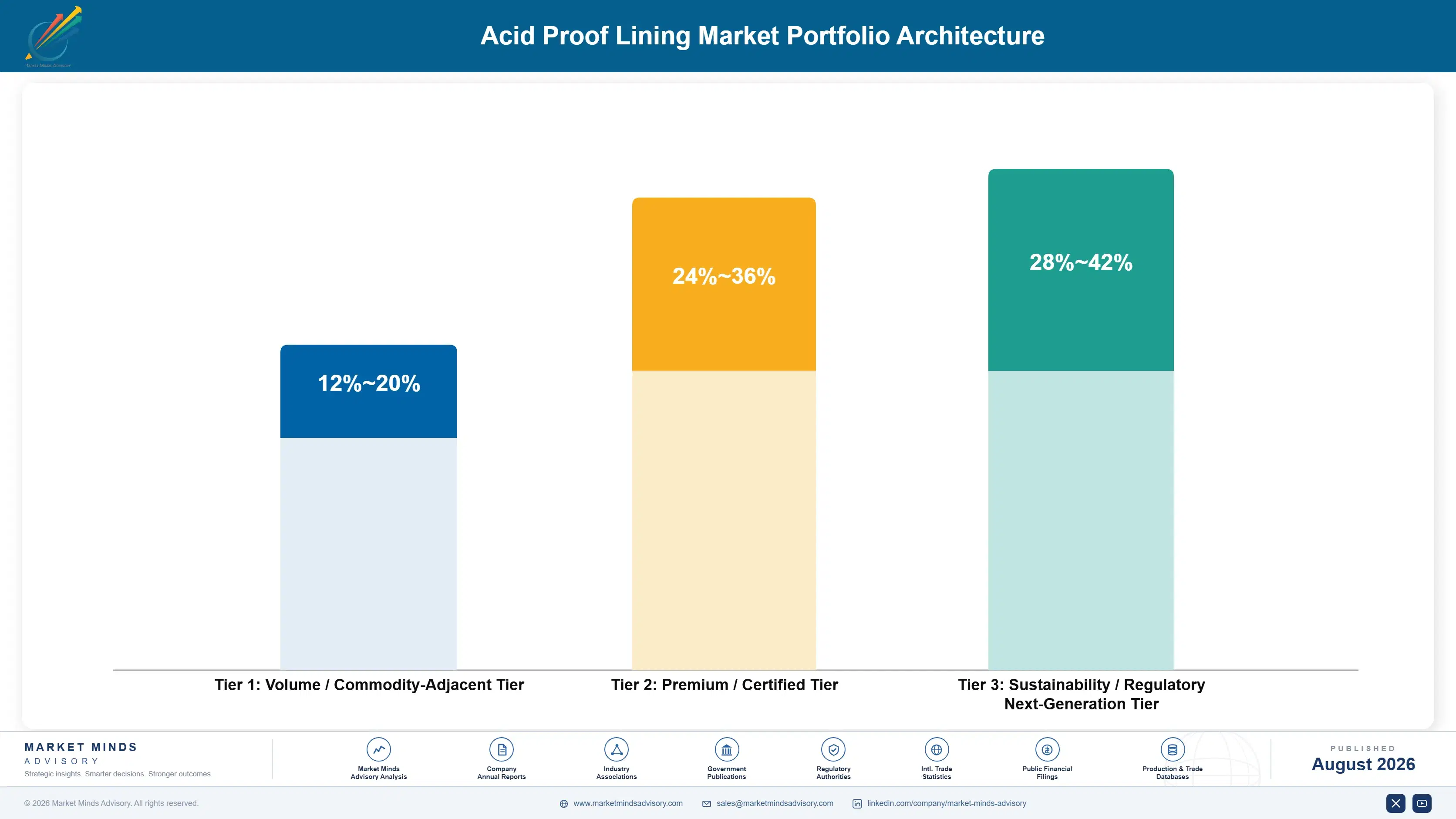
The portfolio splits into three tiers with wide margin separation tied to installation complexity rather than raw material cost alone. Commodity brick and tile installations sold on price and crew availability carry thin margins. Certified fluoropolymer and FRP systems for high-purity or emergency-response applications carry the strongest margins. A third tier of next-generation rapid-cure and modular pre-fabricated systems is still scaling toward proven, repeatable commercial economics across a
The tension between commodity volume and premium specification shapes how contractors allocate crew and engineering investment: commodity projects fund the crew utilization that keeps applicator teams employed between larger jobs, while premium fluoropolymer and emergency-response work fund the engineering and training investment that create genuine competitive protection. Contractors that lean too far toward commodity volume risk losing the specification depth that differentiates them; those leaning too far toward premium risk under-utilized commodity crew capacity.

High-value pools concentrate in fluoropolymer systems for high-purity chemical processing and in emergency-response repair work, where technical barriers and time-sensitivity both run highest. Commodity brick and tile installations used in general chemical storage generate volume but thin, price-competitive margins, since multiple regional contractors can supply functionally similar installations against the same specification.

Volume / Commodity-Adjacent Tier

Standard acid-resistant brick and tile installations sold against several regional contractors competing primarily on price, crew availability, and delivery timeline across large routine maintenance and replacement projects placed each year.
Gross Margin: 12-20%

Premium / Certified Tier

Certified fluoropolymer and FRP systems for high-purity chemical processing carrying premium engineering specification, extended warranty coverage, and documented long-term performance data plant operators increasingly require before granting approval.
Gross Margin: 24-36%

Sustainability / Regulatory / Next-Generation Tier

Rapid-cure and modular pre-fabricated lining systems still scaling toward proven, repeatable commercial economics across a broad and varied plant operator customer base of very different sizes and needs.
Gross Margin: 28-42%
acid-proof-lining-market-portfolio-architecture-1787300318022

High-value Sub-segments and Strategic Watch-out

FRP Lining Systems

The fastest-growing and highest-margin segment, converting shutdown-window compression into a genuine commercial requirement that plant operators increasingly cannot avoid, commanding premium pricing over masonry alternatives while carrying real installation-speed value operators pay for directly and consistently across every project.
Gross Margin: 24-36%

PTFE and Fluoropolymer Lining Systems

High value with steadier growth than FRP, directly serving high-purity chemical processing and pharmaceutical intermediate manufacturing applications where process contamination risk from the lining material itself is genuinely unacceptable to customers and regulators alike.
Gross Margin: 26-40%

Acid-Resistant Brick and Tile Lining Systems

The volume core of the market, supplying commodity masonry installations against several regional contractors competing primarily on price, crew availability, and delivery timeline across routine maintenance work every single cycle.
Gross Margin: 12-20%

Borosilicate Glass-Lined Steel Equipment

The strategic watch-out, a smaller mature niche facing substitution pressure from both fluoropolymer-lined alternatives and newer FRP designs that increasingly match its chemical resistance at meaningfully lower delivered cost.
Gross Margin: 14-24%

Why Shutdown Timing Locks In Contractors

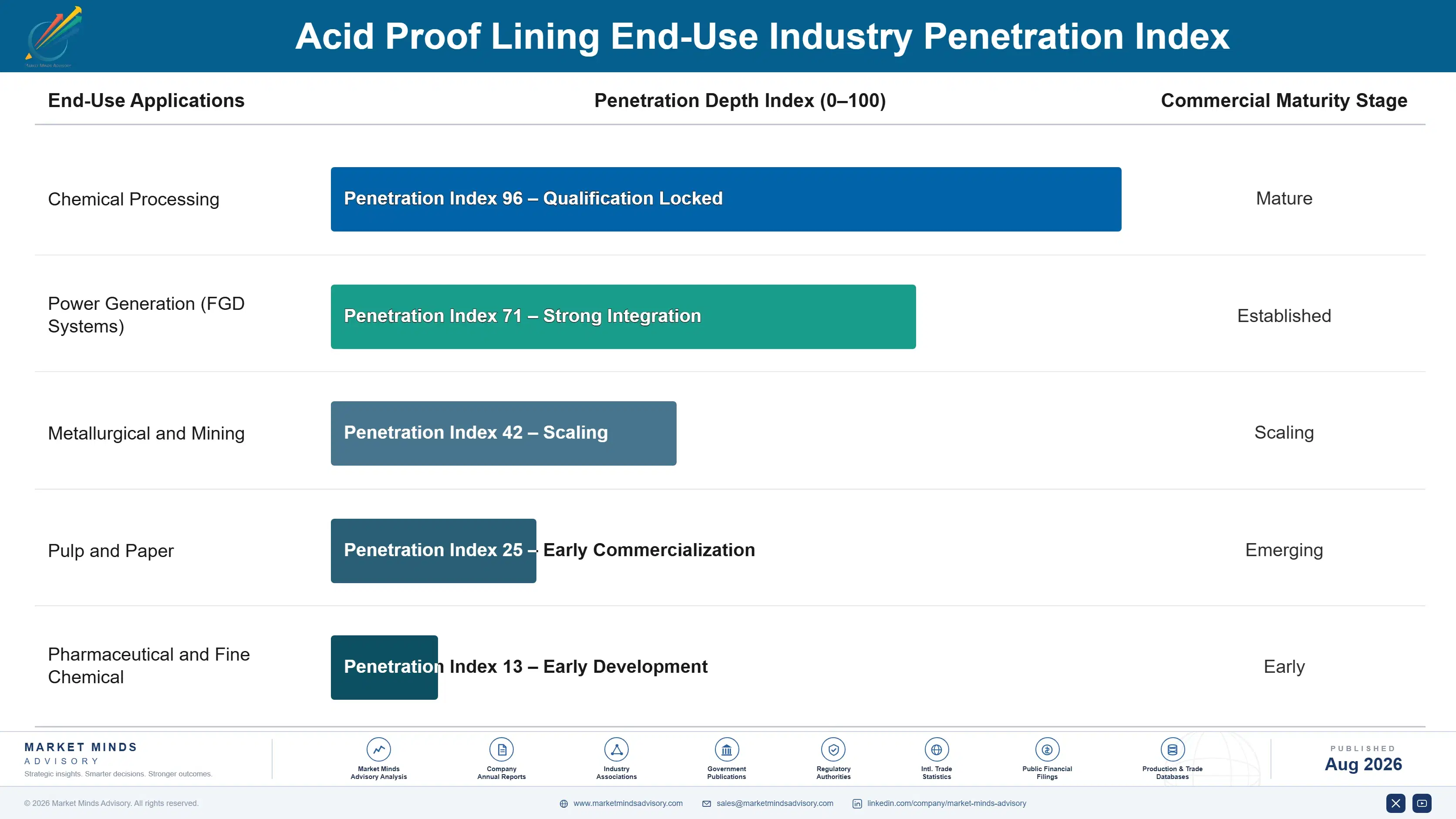
Demand here behaves like a scheduled annuity once a contractor wins the original lining specification, because a plant operator rarely reopens a qualified system choice mid-facility-life given the engineering cost of requalifying against process chemistry. A contractor that wins the original specification typically supplies that vessel for its full twelve to eighteen year service life, converting an initial installation project into a recurring, predictable replacement relationship tied to the p
Adoption depth varies sharply by end-use vertical. Chemical and pharmaceutical processors requalify lining specifications rarely, given the documentation and capital approval cost involved, which makes their contractor relationships the stickiest in the market. Power utilities running FGD systems, by contrast, often rebid maintenance contracts on a more regular cycle since exposure chemistry is well standardized industry-wide, giving them real negotiating leverage chemical processors typically do not have.

Buyer profiles are shifting generationally too. A newer cohort of plant reliability engineers, trained under mounting pressure to minimize unplanned shutdown risk, now weighs a contractor's documented performance data and emergency response capability as heavily as unit price, a shift that favors established contractors with genuine track records over newer entrants offering only lower bids.
acid-proof-lining-market-end-use-penetration-index-1787300318510

Where MMA Sees This Market Heading

These are among the four positions where our research anticipates prominent divergence between winners and laggards over the coming forecast period. Each is grounded in the demand model, the regulatory perimeter, and the announced capacity pipeline.
01 / SHUTDOWN TIMING PREMIUM

Installation speed will separate winners from commodity contractors

Contractors whose systems install fastest will keep winning specification decisions regardless of material cost, because every additional shutdown day now carries real lost-production cost plant operators actively budget against before committing capital to any project. Contractors without lightweight fluoropolymer or FRP capability will increasingly compete only on commodity price against brick and tile specialists facing the same labor shortage pressure. Expect continued acquisition of lightweight-system fabrication capability as traditional masonry contractors race to close the installation-speed gap before it becomes permanent.
02 / ASIAN CAPACITY EXPANSION

East Asia's share keeps growing as China expands chemical capacity

East Asia already holds the largest regional share at 29% and grows near the top of its band as China's flue-gas desulfurization program and chemical capacity expansion pull deployment east at real, sustained scale year after year. Domestic Chinese contractors are closing the engineering credibility gap with Western incumbents faster than most industry observers expected just a few years ago. Multinationals that fail to build direct China contractor relationships risk losing the single largest volume opportunity in the entire global market.
03 / APPLICATOR LABOR SCARCITY

Training capacity will decide who can actually bid the work

Skilled applicator labor, not material availability, is now the binding constraint on how many simultaneous projects a contractor can actually staff and bid competitively across its entire service territory each quarter. Contractors who build formal training pipelines will capture bid volume that labor-constrained competitors must simply decline regardless of price competitiveness on any given project. Expect continued investment in training academies as the applicator workforce continues aging out faster than informal skill transfer alone can replace it.
04 / SPECIFICATION ENGINEERING CAPTURE

Documented chemical exposure data will command real specification premium

Plant engineers increasingly need documented chemical exposure rationale to satisfy capital approval and insurance requirements, and contractors who bundle specification engineering will capture premium pricing that installation-only competitors simply cannot match without building the same technical capability internally first. The approach commands genuine margin precisely because it removes documentation risk plant engineers would otherwise bear internally with limited corrosion expertise. Expect specification-as-a-service to become a standard offering across the top contractor tier within the forecast window.

Engagement Snapshot From the Field

A live engagement with an industry participant carrying material or product regulatory and market exposure ahead of a defining policy shift, showing how our research translates into a defensible multi-year portfolio strategy.
MARKET MINDS ADVISORY · CLIENT ENGAGEMENT SUMMARY
Acid Proof Lining Producer Strategic Portfolio Review and Transition Roadmap 2026·Investment Scenario on Acid Proof Lining Exposure Evaluation 2025-26
CLIENT PROFILE
A specialty chemical manufacturer operating a multi-decade processing facility in the American Gulf Coast approached MMA while planning a major vessel relining program tied to an upcoming scheduled shutdown window. The client reported annual facility output valued near USD 280 million, with several process vessels approaching the end of their original lining service life simultaneously (client-reported, unverified by MMA).
STRATEGIC CHALLENGE
Management knew multiple vessels needed relining but faced a fixed shutdown window too short to complete every project with traditional brick and tile methods. The engineering team wanted premium fluoropolymer systems on every vessel; the finance team balked at the cost premium; and the plant manager needed a plan that would fit the available shutdown window without extending it.
MMA APPROACH
MMA benchmarked installation timelines for brick, FRP, and fluoropolymer systems against the client's specific vessel geometries and process chemistry, modeled the cost of extending the shutdown window against the premium for faster-installing systems, and quantified the lost-production cost of each additional shutdown day. We also assessed a mixed-system approach prioritizing fluoropolymer for the most time-constrained vessels.
KEY FINDINGS
  1. Extending the shutdown window by the days a full brick relining would require cost an estimated USD 3.1 million in lost production, far exceeding the fluoropolymer cost premium (client-reported, unverified by MMA).
  2. A mixed-system approach, using fluoropolymer on the three most time-constrained vessels and FRP on the rest, fit entirely within the original shutdown window without any extension.
  3. Only one of three contractors evaluated had fluoropolymer fabrication capacity available on the client's required timeline without subcontracting to a third party.
  4. Documented chemical exposure data from the specification engineering review supported capital approval significantly faster than the client's typical internal review process usually allowed.
CLIENT PROFILE
A specialty chemical manufacturer operating a multi-decade processing facility in the American Gulf Coast approached MMA while planning a major vessel relining program tied to an upcoming scheduled shutdown window. The client reported annual facility output valued near USD 280 million, with several process vessels approaching the end of their original lining service life simultaneously (client-reported, unverified by MMA).
STRATEGIC CHALLENGE
Management knew multiple vessels needed relining but faced a fixed shutdown window too short to complete every project with traditional brick and tile methods. The engineering team wanted premium fluoropolymer systems on every vessel; the finance team balked at the cost premium; and the plant manager needed a plan that would fit the available shutdown window without extending it.
MMA APPROACH
MMA benchmarked installation timelines for brick, FRP, and fluoropolymer systems against the client's specific vessel geometries and process chemistry, modeled the cost of extending the shutdown window against the premium for faster-installing systems, and quantified the lost-production cost of each additional shutdown day. We also assessed a mixed-system approach prioritizing fluoropolymer for the most time-constrained vessels.
KEY FINDINGS
  1. Extending the shutdown window by the days a full brick relining would require cost an estimated USD 3.1 million in lost production, far exceeding the fluoropolymer cost premium (client-reported, unverified by MMA).
  2. A mixed-system approach, using fluoropolymer on the three most time-constrained vessels and FRP on the rest, fit entirely within the original shutdown window without any extension.
  3. Only one of three contractors evaluated had fluoropolymer fabrication capacity available on the client's required timeline without subcontracting to a third party.
  4. Documented chemical exposure data from the specification engineering review supported capital approval significantly faster than the client's typical internal review process usually allowed.
RECOMMENDED STRATEGY
Phase 1: Phase 1 (0 to 3 months): Complete specification engineering and contractor selection for the mixed fluoropolymer and FRP relining approach. Phase 2: Phase 2 (3 to 5 months): Execute relining across all vessels within the scheduled shutdown window using the selected contractor's crews. Phase 3: Phase 3 (5 to 18 months): Monitor lined vessel performance against documented specification data to validate the mixed-system approach for future shutdowns.
OUTCOME
The client completed the full relining program within the original shutdown window, avoiding any production extension and the associated lost-output cost. Vessel performance has tracked specification data through the first year of operation, and the client has adopted the mixed-system approach as standard practice, reported to save roughly USD 2.8 million per future shutdown cycle (client-reported, unverified by MMA).

Frequently Asked Questions

Foundational context covering the market sizes, CAGR, scope, country, region and competition that inform every finding below. This section is provided to cover basics and most often pre-purchase conversations, answered from the MMA Primary Research Dataset.

What is the current size of the Acid Proof Lining Market?

The market stood at USD 2.4 billion in 2025, spanning brick, resin, rubber, glass-lined steel, FRP, and fluoropolymer systems. FRP lining systems are the fastest-growing format within that base.

How large will the Acid Proof Lining Market be by 2036?

The market is projected to reach USD 4.3 billion by 2036 under the base case scenario. That represents roughly 1.72 times the 2026 value of USD 2.5 billion.

What is the CAGR for the Acid Proof Lining Market 2026 to 2036?

The base case CAGR is 5.4% annually through 2036. The bull case reaches 6.6% on faster Asian capacity expansion, while the bear case falls to 4.2%.

Which segment is growing fastest?

FRP lining systems grow fastest at 7.8% annually, ahead of traditional masonry and glass-lined steel formats. That is roughly 1.44 times the overall market growth rate.

Who are the major companies in the Acid Proof Lining Market?

Steuler-KCH GmbH, StonCor Group Inc., Sauereisen Inc., Saint-Gobain S.A., and Crane ChemPharma & Energy lead the market on disclosed segment revenue across every major region.

Which country is growing fastest?

China grows fastest among all countries at 9.5% annually, ahead of India and other major industrial economies. Growth is driven by flue-gas desulfurization retrofits and chemical capacity expansion.

Report Segmentation Architecture

The full report scope spans multiple orthogonal segmentation dimensions, with cross-tabulated demand data provided for each dimension pair. Coverage extends further to regional breakdowns, trend trajectories, and the competitive detail needed to support segment-level decision-making.

By Lining Material and Construction Type

  • Acid-Resistant Brick and Tile Lining Systems
  • Resin Mortar and Membrane Lining Systems
  • Rubber Lining Systems
  • Borosilicate Glass-Lined Steel Equipment
  • FRP Lining Systems
  • PTFE and Fluoropolymer Lining Systems

By End-Use Industry

  • Chemical Processing
  • Power Generation (FGD Systems)
  • Metallurgical and Mining
  • Pulp and Paper
  • Pharmaceutical and Fine Chemical

By Commercial Dimension

  • Direct Plant Operator Procurement
  • EPC and Engineering Contractor Channel
  • Emergency Response Services
  • Specification Engineering Services

By Region

  • North America
  • Western Europe
  • East Asia
  • South Asia and Pacific
  • Latin America
  • Middle East and Africa
  • Eastern Europe

Scope, Methodology, and Coverage

Every figure in this report is reproducible from documented input assumptions. The scope below maps the historical period, the forecast horizon, the segmentation dimensions, and the countries covered, alongside the underlying primary and qualitative methodology.
Historical Period
2020 to 2025
Forecast Period
2026 to 2036
Base Year
2025 (USD billions; MMA Primary Research Dataset, August 2026)
Market Definition
The acid proof lining market covers corrosion-resistant lining systems installed to protect industrial equipment, tanks, floors, and structures from acid, alkali, and other chemically aggressive process exposure. It includes acid-resistant brick and tile systems, resin mortar and membrane linings, rubber linings, glass-lined steel, FRP linings, and fluoropolymer linings, along with the specialized installation labor these systems require. General industrial coatings without chemical-resistance certification and structural construction materials are excluded.
Quantitative Units
USD billions (current prices); million square meters of lining installed where applicable
Segmentation Dimensions
By Lining Material and Construction Type; By End-Use Industry; By Commercial Dimension; By Region
Regions Covered
North America, Western Europe, East Asia, South Asia and Pacific, Latin America, Middle East and Africa, Eastern Europe
Countries Covered
USA, China, Germany, France, UK, Japan, South Korea, India, Australia, Canada, Brazil, Mexico, Indonesia, Vietnam, Thailand, Malaysia, UAE, Saudi Arabia, South Africa, Nigeria, Turkey, Poland, Netherlands, Italy, Spain, Sweden, Switzerland, Argentina, Colombia, Singapore, and additional markets relevant to this sector
Key Companies Profiled
Steuler-KCH GmbH, StonCor Group Inc., Sauereisen Inc., Saint-Gobain S.A., Crane ChemPharma & Energy, Sika AG, RPM International Inc., CECO Environmental Corp., Belzona Inc., PPG Industries Inc., The Chemours Company, Trelleborg AB, Ashland Inc., Interplastic Corporation, Dow Inc., Master Builders Solutions, Rath Group, Chemline Plastics Limited, Corrosion Engineering Inc., HB Fuller Company
Quantitative Methodology
Primary survey, n=3,800 respondents, Q4 2025, six countries; demand-side model with trade association cross-validation
Qualitative Methodology
47 expert interviews, Q4 2025; applied to validate demand model assumptions, identify emerging dynamics, and assess competitive positioning
Report Format
PDF and XLSX data workbook (Word format preview document)
Publisher
Market Minds Advisory
Report Code
MMA-2026-CHM-152
Published
August 2026
Contact
sales@marketmindsadvisory.com | www.marketmindsadvisory.com

Purchase the full Acid Proof Lining Market Report (2026 to 2036).

The full MMA Acid Proof Lining report sizes the market across six lining material and construction types, five end-use industries, four commercial models, and seven regions through 2036. It profiles 20 suppliers and contractors on a consistent basis of disclosed lining segment revenue, scoring each on engineering specification depth, applicator crew capacity, and regional installation footprint. Scenario models quantify how flue-gas desulfurization retrofit mandates, Asian chemical capacity expansion, and skilled labor availability move both demand and realizable pricing. The report also includes delivered-cost modeling by construction type, an applicator labor capacity assessment across major markets, and an emergency-response service feasibility framework built for plant engineering, procurement, and capital planning teams.
Six-format segmentation with cross-tabulated regional demand data
Twenty-company competitive benchmarking on consistent revenue basis
Applicator labor capacity assessment across major industrial markets
Resin and fabrication cost exposure modeling by construction type
Scenario forecasts through 2036 under bull and bear cases
Case study on shutdown-window vessel relining strategy

Built For The People Who Decide

From boardroom strategy to bench-side execution, this report is read cover-to-cover by leaders shaping the next decade of their industry, turning demand scenarios, market dynamics and valuation benchmarks into decisions.
CXOs/ Presidents/ VPs/ Managers
M&A and Corporate Development
Strategy Teams and R&D Heads
Procurement and Product Directors
Regulatory and Compliance Leaders
Investor Relations and Equity Analysts