Market Minds Advisory
Acesulfame Potassium Market

Acesulfame Potassium Market: Sugar Reduction Policy Meets Chinese Capacity Scale

Acesulfame potassium producers are chasing pharmaceutical and beverage reformulation demand tied to sugar reduction policy even as Chinese commodity capacity keeps compressing pricing for standard food-grade material, forcing Western suppliers to defend margin through quality positioning.

Lead Analyst

Bilal Shaikh

Published

September 2026

Make Smarter Decisions with Customized Research Insights

Request a free sample report and evaluate market opportunities, growth trends, and competitive dynamics relevant to your business needs.

2025 MARKET VALUE$1.1BMarket Size 2025
2036 FORECAST VALUE$2.1BBase Case , 2026 to 2036
CAGR 2026 TO 20366.0 %Bull 7.3% / Bear 4.7%
INCREMENTAL OPPORTUNITY$0.9BNet 10- year value creation
EXPANSION MULTIPLE1.79x2036 value over 2026 base
Strategic Levers
M&A Pipeline
Regional Outlook
Country Rankings
Competitive Intelligence
Segmental Deep-dive
Call-Us : 91 93563 13602

Executive Snapshot and Market Trajectory

Acesulfame potassium producers are shifting from commodity food-grade sales toward pharmaceutical and premium beverage formulation partnerships, as sugar reduction policy and diet beverage reformulation demand purity and consistency specifications standard grade material was never engineered to guarantee.
Growth concentrates in pharmaceutical-grade material used in sugar-free chewables and liquid formulations, and in beverage-grade Ace-K feeding the broader diet and zero-sugar beverage reformulation wave sweeping major markets. East Asia hosts the overwhelming majority of global production capacity, while India's expanding diet beverage and food manufacturing base is pulling demand faster than any other country tracked as domestic reformulation accelerates.
Competitive character splits between dominant Chinese producers like Anhui Jinhe that supply Ace-K at global commodity scale and quality-focused specialists like Nutrinova that lead on pharmaceutical and premium beverage-grade chemistry. Regulatory pressure around purity standards and novel food registration is rising steadily, pushing suppliers toward compliance investment that smaller regional blenders increasingly cannot match without losing volume elsewhere in their broader ingredient operations.
Market Definition
This report covers acesulfame potassium produced and sold as a high-intensity sweetener for beverages, food and bakery products, pharmaceutical formulations, oral care products, tabletop sweetener blends, and animal feed applications. It excludes other high-intensity sweeteners such as sucralose, aspartame, and stevia, and finished consumer products that already incorporate acesulfame potassium internally.
Base Year Value
$1.1B in 2025 (MMA Primary Research Dataset, August 2026)
Forecast Period
2026 to 2036, eleven discrete annual values
CAGR
6.0% base case. Bull 7.3%. Bear 4.7%.
Fastest Growth Segment
Pharmaceutical Grade Acesulfame Potassium: 9.5% CAGR
Fastest Growth Country
India: 8.6% CAGR
Fastest Growth Region
South Asia and Pacific: 8.2% CAGR
Largest Region
East Asia: 43% of 2025 global value
Market Leaders
Anhui Jinhe Industrial Co., Ltd., Nutrinova (Celanese), Suzhou Hope Technology Co., Ltd., Vitasweet Co., Ltd., HYET Sweet. Source: MMA Analysis based on company annual reports.
Primary Survey
n=3,800 procurement and R&D decision-makers, Q4 2025, six countries
Methodology
Demand-side build-up, cross-validated against public data, 47 expert interviews

Acesulfame Potassium Market Forecast Scenarios

acesulfame-potassium-market-trends-size-forecast-scenario-1787463881454
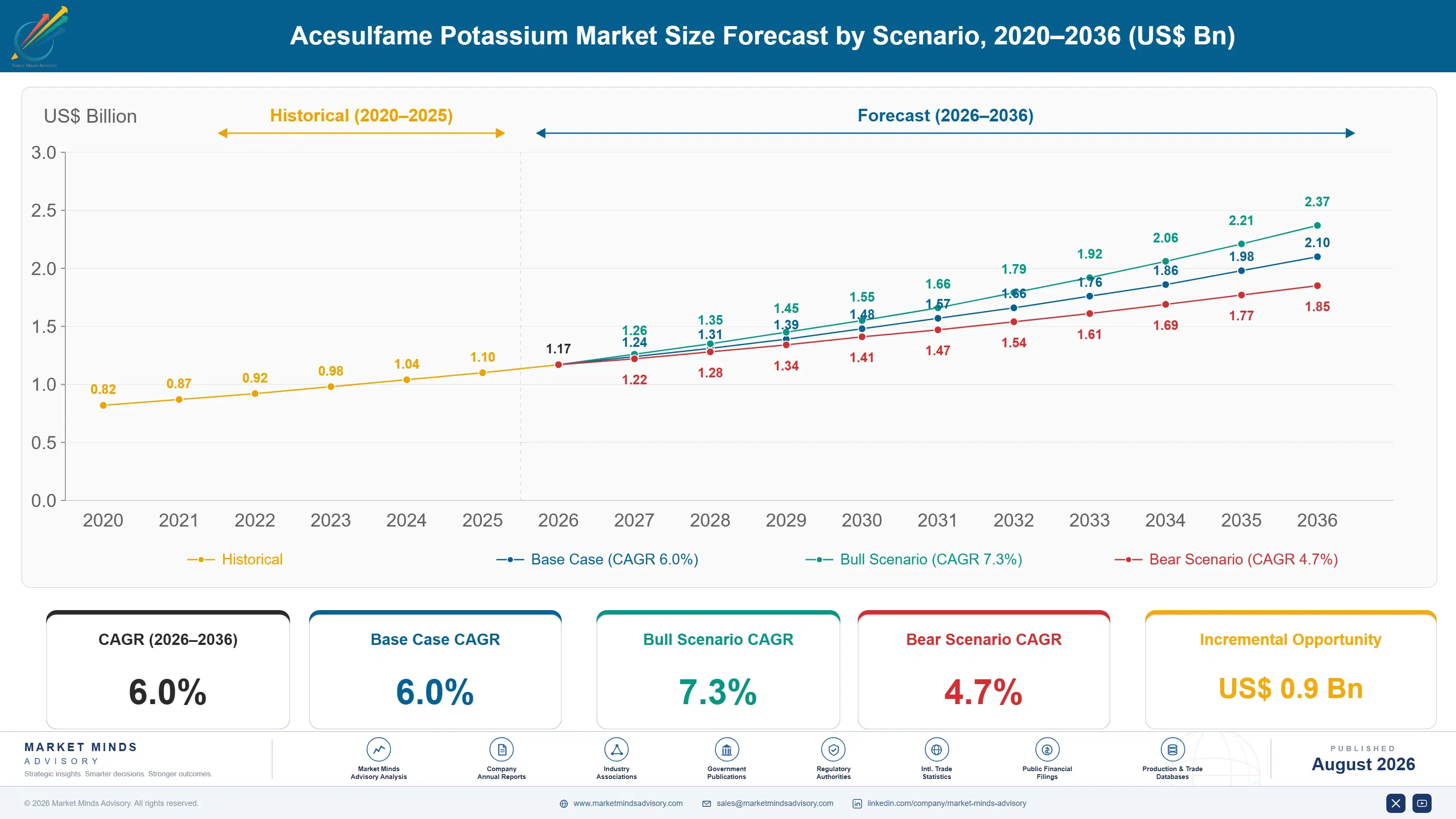
Acesulfame potassium demand grew steadily between 2020 and 2025 as sugar reduction policy expanded across beverage and food categories while pharmaceutical-grade demand began accelerating from a modest base. A historical CAGR of 4.8% reflects that steady build, with pharmaceutical and beverage grades gaining share fastest as formulators sought purity specifications legacy food-grade material could not consistently satisfy.
The base case assumes 6.0% annual growth through 2036, anchored by three mechanisms: expanding sugar-free pharmaceutical formulation requiring purity beyond standard food grade, rising diet and zero-sugar beverage reformulation tied to sugar tax and public health policy across multiple regions, and steady food and bakery demand across mature Western markets. Together these push producers to serve both a stable commodity base and an increasingly demanding pharmaceutical-formulation tier simultaneously.
A bull scenario assumes sugar reduction policy expansion accelerates faster than expected across multiple regions, pushing growth toward 7.3%. The bear case turns on Chinese commodity capacity expansion compressing pricing across standard food grades faster than premium reformulation can offset, dragging growth down toward roughly 4.7% across the most exposed producers.

Sweetener Economics and the Purity Premium

Acesulfame potassium sits downstream of an unusual supply relationship, since the overwhelming majority of global output originates from a small number of Chinese chemical producers rather than dedicated production distributed evenly across major consuming markets. This means sweetener supply tracks Chinese chemical manufacturing economics as much as beverage or pharmaceutical demand itself, a dynamic that sets the category apart from most food ingredient inputs.
MARKET CONCENTRATION (CR5)52%Dominant Chinese producers hold meaningful combined production scale
AVERAGE FOOD-GRADE PRICE$8.20 per kilogramBlended commodity and specialty grade pricing across major markets
TOP PRODUCING COUNTRY SHAREChina, 41%Largest single national base for sweetener production capacity
PHARMACEUTICAL GRADE PENETRATION17% of revenuePharmaceutical and premium beverage grades capture rising revenue share
CAPACITY UTILIZATION RATE74%Average utilization across major global production facilities today
KEY INPUT COST SHARE51% of COGSDiketene and acetoacetamide feedstock dominate total production cost
Commercially, the category splits between standard food-grade material sold on tight tonnage contracts to beverage and food formulators, and a smaller but rapidly growing premium tier built on pharmaceutical and beverage-specific purity. Producers with dedicated purification capability, Nutrinova among them, capture disproportionate margin even where their overall tonnage share stays flat against integrated Chinese giants like Anhui Jinhe.
Over the next decade, capacity additions concentrate around dedicated purification lines serving pharmaceutical customers rather than expanding standard food-grade capacity, since food and beverage demand alone does not justify new volume at the pace pharmaceutical purity demand is growing. Rising Chinese capacity will keep pressuring standard grade pricing even as quality-focused suppliers defend margin through reformulation and certification.
"Ace-K used to be a commodity line item nobody negotiated hard on. Now the suppliers winning pharmaceutical contracts are the ones who invested in purification years before formulators demanded it."
Director, Specialty Ingredients and Sweeteners Practice · MMA Specialty & Performance Chemicals Practice · August 2026

Market Trends

Pharmaceutical Formulation Demand Pulling Purity Specifications Higher

Sugar-free pharmaceutical chewables and liquid formulations increasingly specify pharmaceutical-grade acesulfame potassium with impurity specifications far tighter than standard food-grade requirements, since dosage consistency and taste masking depend directly on sweetener purity and particle size uniformity. Producers including Nutrinova have invested in dedicated purification lines separate from standard food-grade output, since pharmaceutical customers require documentation and consistency that commodity-grade production cannot reliably deliver. This demand is concentrated among a small number of qualified suppliers, since pharmaceutical manufacturers rarely switch sweetener suppliers once a formulation has been validated against a specific source and specification.
Market Impact: Adds 5-7% policy-driven demand growth
Diet Beverage Reformulation Tied to Sugar Tax Policy

Governments across multiple regions continue expanding sugar tax and public health labeling policy that pushes beverage manufacturers toward diet and zero-sugar reformulation, pulling demand for beverage-grade acesulfame potassium formulated for clean taste profiles in carbonated and still beverages alike. Suppliers including Suzhou Hope Technology have expanded dedicated beverage-grade blends designed to improve taste and reduce aftertaste for functional beverage and supplement manufacturers. This trend is pulling acesulfame potassium demand into reformulation projects across categories that historically relied on sugar or older-generation sweeteners entirely.
Market Impact: Adds 8.6% India demand growth

Market Opportunities and Growth Drivers

Expanding Sugar Tax and Public Health Policy Coverage

Governments across North America, Western Europe, and increasingly Asia continue expanding sugar tax and mandatory sugar-content labeling policy, each new jurisdiction requiring beverage and food manufacturers to reformulate toward sweeteners like acesulfame potassium that deliver sweetness without the taxed sugar content. Anhui Jinhe and similar producers have expanded production capacity to meet this rising qualified customer base, since new policy jurisdictions create sudden reformulation demand spikes. This driver is measurable in acesulfame potassium volume growth consistently outpacing overall sweetener category growth across every major policy-driven region tracked in this report.
Market Impact: Raises feedstock cost volatility 9-15%

India's Expanding Diet Beverage and Food Manufacturing Base

India's rapidly growing diet beverage and packaged food manufacturing sector is pulling new acesulfame potassium demand domestically as urban consumers increasingly adopt sugar-free and reduced-sugar products across multiple categories. International suppliers have expanded distribution relationships with Indian formulators to capture this demand ahead of domestic production capacity fully maturing, since dedicated purification investment requires meaningful capital most Indian producers have been slower to commit. This shift is gradually reducing India's historical dependence on imported finished sweetener products.
Market Impact: Cuts margin 170 basis points

Market Restraints and Challenges

Diketene and Acetoacetamide Feedstock Volatility

Diketene and acetoacetamide feedstock pricing tracks volatile global petrochemical markets, squeezing producer margins during periods when formulators resist passing higher sweetener costs through to already price-sensitive beverage and food customers. The root cause is the category's dependence on globally traded commodity chemical inputs whose pricing is set well outside the acesulfame potassium industry's own supply and demand dynamics. The commercial impact falls hardest on smaller regional producers without long-term feedstock contracts or diversified sourcing relationships. Larger producers are mitigating exposure through multi-year supply agreements and geographic sourcing diversification across multiple producing regions.
Market Impact: Adds 9.5% pharmaceutical grade growth

Chinese Commodity Capacity Compressing Standard Grade Pricing

Rapidly expanding Chinese production capacity for standard food-grade acesulfame potassium has compressed pricing across commodity beverage and food applications, squeezing margin for suppliers competing on tonnage rather than specialty formulation. The root cause is China's chemical manufacturing scale advantage across the broader sweetener value chain, not any quality or service differentiation. The commercial impact falls hardest on mid-sized regional producers without a defensible specialty niche to retreat toward. Larger producers are mitigating exposure by shifting mix decisively toward pharmaceutical and premium beverage grades that Chinese commodity producers have not yet matched on purity.
Market Impact: Adds 7.8% beverage grade growth
3 additional market trends, 2 additional growth drivers, and 4 additional restraints and challenges are covered in the full report. Contact sales@marketmindsadvisory.com to access the complete intelligence.

Segment CAGR and Growth Architecture

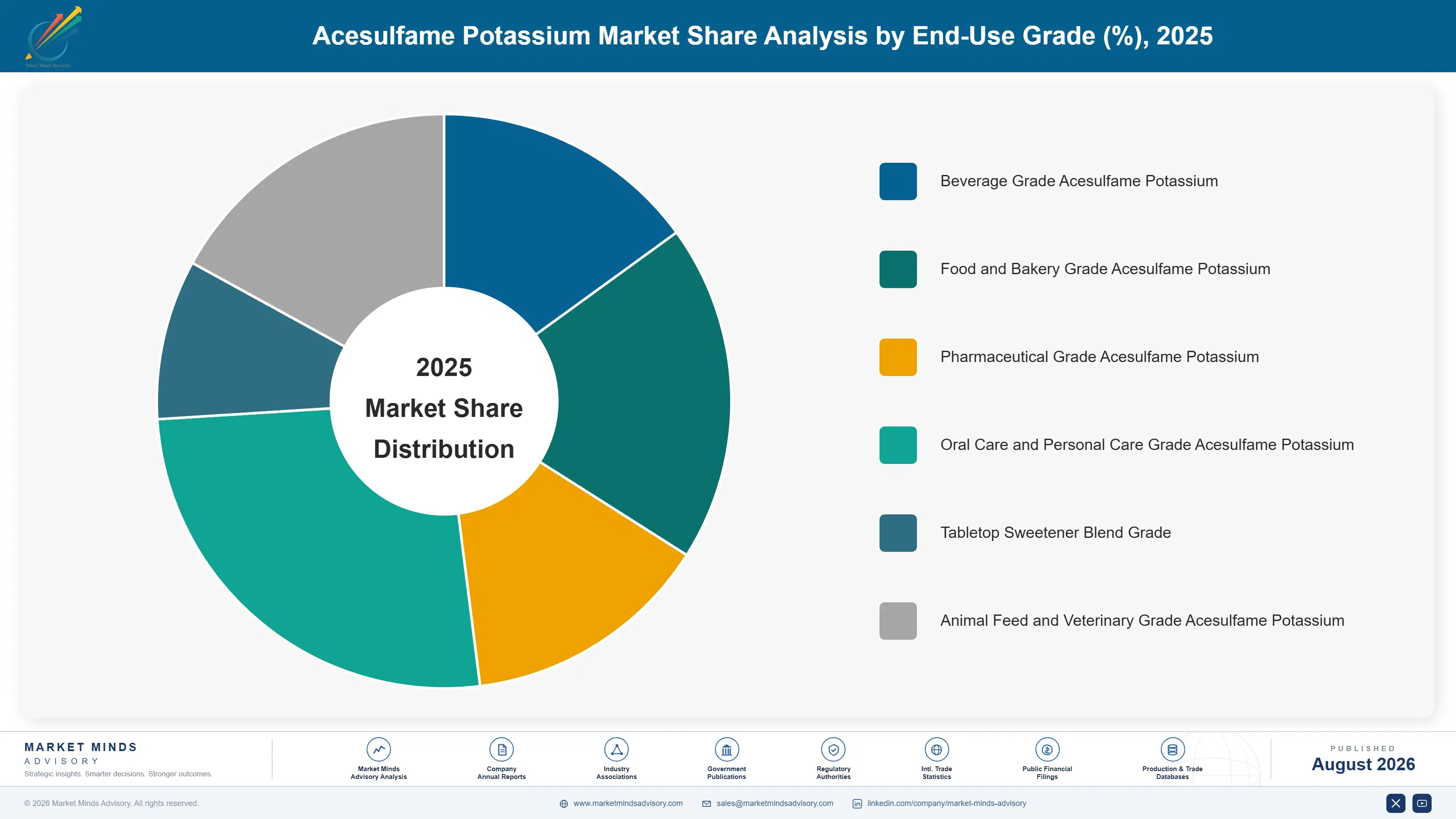
MMA segments the acesulfame potassium market by end-use grade rather than by production process, since purity and formulation requirements, not how the sweetener is synthesized, determine cost structure and margin more than any single production method across beverage, food, or pharmaceutical uses today across every producing country this report tracks.
acesulfame-potassium-market-trends-market-share-analysis-1787463882036

Pharmaceutical Grade Acesulfame Potassium

Pharmaceutical grade acesulfame potassium is the fastest-growing segment, pulled by sugar-free chewable and liquid formulation manufacturers requiring purity specifications that minimize trace impurities and particle size variation well beyond standard food-grade material. Nutrinova and similar producers have built dedicated purification lines entirely separate from standard production, since the two grades require different distillation and quality control processes altogether. This segment commands the strongest price premium in the category, since dosage consistency failures carry meaningful regulatory and reputational cost for pharmaceutical manufacturers that purity specifications directly address. Demand concentrates in North America, Western Europe, and East Asia, where pharmaceutical formulation is most developed, though the format is beginning to appear across emerging pharmaceutical manufacturing hubs as well.
CAGR 9.5%

Beverage Grade Acesulfame Potassium

Beverage grade acesulfame potassium is the second-fastest segment, driven by expanding sugar tax and public health policy that pushes beverage manufacturers toward diet and zero-sugar reformulation across carbonated and still beverage categories alike. Suzhou Hope Technology and similar producers have expanded dedicated beverage-grade blends designed to improve taste and reduce aftertaste for functional beverage and supplement manufacturers. This segment commands meaningful margin over standard food grade, since beverage manufacturers value taste consistency enough to pay a specification-driven premium over commodity material. Growth concentrates in North America, Western Europe, and increasingly India, where diet beverage reformulation continues expanding rapidly across major national markets.
CAGR 7.8%
Full segment breakdown across 6 segments available in the complete report.

Regional Architecture and Country Demand Map

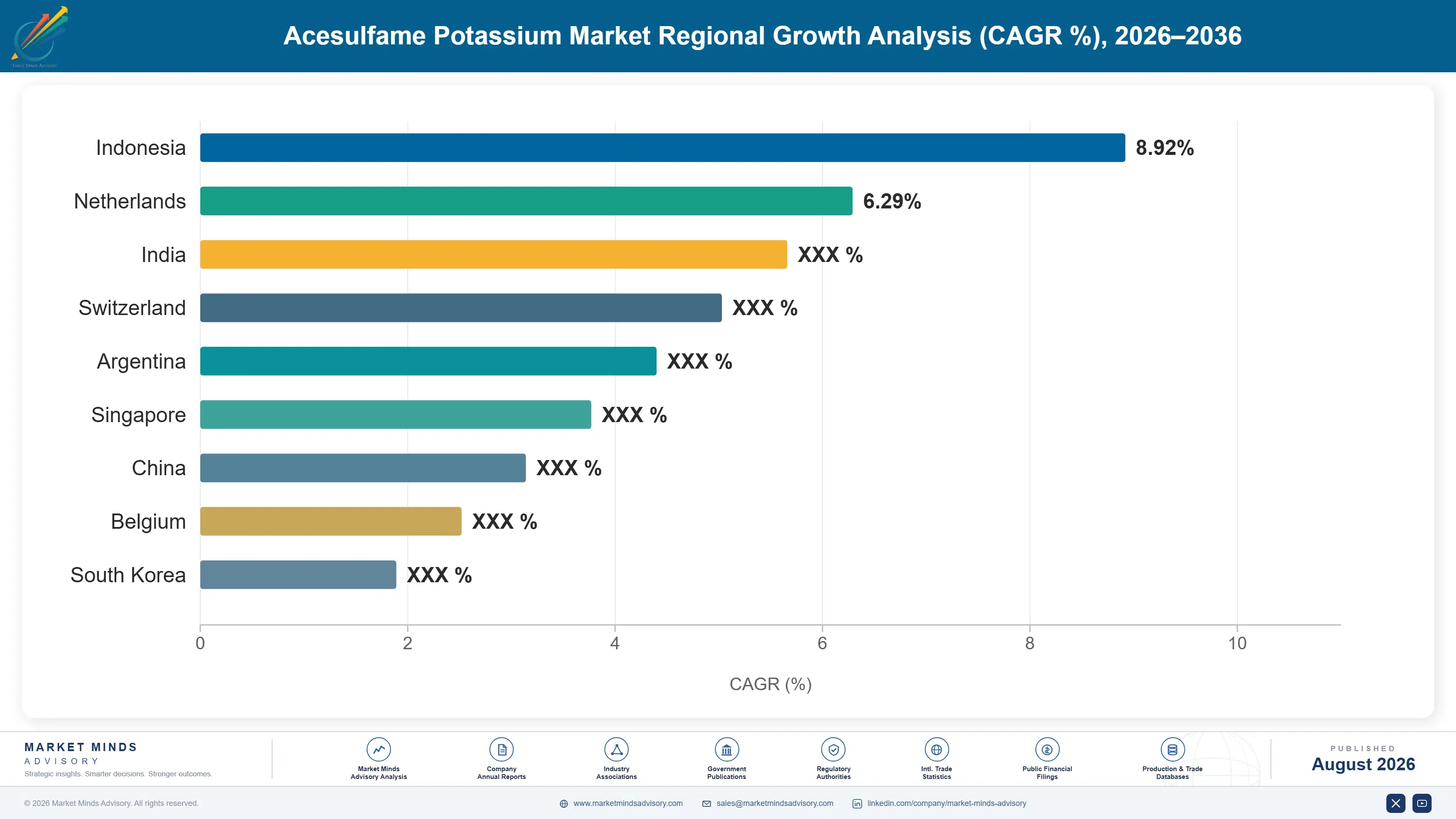
Acesulfame potassium production and formulation capacity concentrates overwhelmingly in East Asia given China's dominant sweetener manufacturing base, while India's expanding diet beverage sector is pulling demand faster than any other country tracked in this analysis.

North America

The United States hosts the region's largest acesulfame potassium formulation and distribution base, with Nutrinova anchoring domestic pharmaceutical and premium beverage-grade supply alongside meaningful import volume from Chinese commodity producers. Beverage and food formulators across the country continue reformulating toward diet and reduced-sugar products, sustaining steady demand for both standard food-grade and premium sweetener material. Pharmaceutical grade penetration runs meaningfully higher here than in most other regions, tracking the concentration of pharmaceutical formulation activity across the country's major manufacturing hubs. Canada contributes a smaller but meaningful distribution base, closely integrated with United States supply chains through cross-border trade relationships and shared regulatory frameworks.
Share: 22% | CAGR: 5.6% (2026 to 2036)

Western Europe

Germany and the United Kingdom host the region's largest acesulfame potassium markets, with HYET Sweet and established European distributors anchoring supply tied to the region's mature beverage and food industry alongside extensive sugar tax policy coverage. The region's stricter regulatory environment around novel food registration and purity standards has pushed suppliers toward documentation and compliance capability as a genuine competitive requirement rather than a background cost. Pharmaceutical grade demand continues rising steadily here, tracking Europe's advanced pharmaceutical manufacturing base and aging population driving sugar-free medication formulation. Growth trails East Asia and North America since the region's beverage demand is already mature and volume gains depend on specialty reformulation rather than expansion across most major national markets tracked here in full detail.
Share: 18% | CAGR: 4.6% (2026 to 2036)
Regional intelligence for 5 additional markets available in the complete report: East Asia, South Asia and Pacific, Latin America, Middle East and Africa, Eastern Europe. Contact sales@marketmindsadvisory.com.
acesulfame-potassium-market-trends-country-cagr-analysis-1787463882582

Purification Investment and Pharmaceutical Value Capture

Acesulfame potassium producers extract more value from existing feedstock and production relationships by moving into pharmaceutical and premium beverage-grade purification rather than competing purely on standard food-grade tonnage. The levers below concentrate on capturing pharmaceutical purity premium, beverage formulation value, and supply security that commodity-only producers cannot easily replicate.

Dedicated Purification Capacity for Pharmaceutical Contracts

Producers that built dedicated pharmaceutical-grade purification lines separate from standard food-grade output are capturing pharmaceutical formulator contracts worth roughly 32 to 42% more per kilogram than standard food-grade material, since purity specifications directly address dosage consistency requirements formulators cannot compromise on. This capacity requires meaningful capital investment and typically takes 2 to 3 years to fully commission and qualify with pharmaceutical formulators, but it lets producers serve a buyer base standard producers cannot reach. Producers without dedicated purification capability increasingly lose pharmaceutical contracts entirely to established competitors already validated against those customers' regulatory filings.
Market Impact: Adds a 32 to 42% pharmaceutical price premium

Beverage-Specific Formulation for Diet Reformulation Contracts

Producers that built beverage-specific taste-masking and aftertaste-reduction formulations are winning diet and zero-sugar beverage reformulation contracts that standard food-grade producers cannot fulfill without extensive customer-side reformulation testing. These contracts generate roughly 18 to 25% higher margin than standard food-grade tonnage, since beverage manufacturers value taste consistency enough to pay a specification-driven premium during reformulation projects. Producers without beverage-specific formulation capability increasingly lose this growing customer base entirely to better-positioned competitors already serving major beverage reformulation programs across multiple regions.
Market Impact: Adds 18 to 25% beverage formulation margin

Multi-Region Feedstock Diversification for Supply Security

Producers that diversify diketene and acetoacetamide feedstock sourcing across multiple producing regions rather than depending on a single source reduce their exposure to sudden petrochemical supply tightness that can strand smaller competitors mid-contract with formulator customers. Building this diversified sourcing base typically takes 3 to 4 years of supplier qualification across multiple regions, but it lets a producer maintain production continuity for customers when any single feedstock source faces disruption. Producers without diversified sourcing risk losing formulator contracts during supply disruptions, since customers cannot pause reformulation projects waiting for a single blocked source to reopen.
Market Impact: Cuts supply disruption risk by roughly 28%

Novel Food Registration for Multi-Jurisdiction Market Access

Producers that invest in formal novel food registration and regulatory documentation across multiple jurisdictions win preferential access to beverage and pharmaceutical customers who increasingly require pre-registered, compliant sweetener chemistry before qualifying a new supplier for regulated products. This regulatory investment requires meaningful upfront cost and typically takes 2 years to fully implement registration across a producer's target jurisdictions, but it pays back through access to markets non-compliant competitors cannot enter. Producers without dedicated registration capability remain confined to commodity-tier contracts regardless of their underlying sweetener quality.
Market Impact: Wins 13 to 18% more multi-jurisdiction contracts

Who Controls the Margin Pool

CR5 in acesulfame potassium sits near 52%, reflecting meaningful concentration among dominant Chinese producers alongside a smaller set of quality-focused Western specialists. Anhui Jinhe leads through dominant global production scale, with Nutrinova close behind through premium quality and regulatory track record, while the gap to smaller regional producers remains wide enough that pharmaceutical certification requirements continue raising the capital bar to compete effectively.
Current competitive activity centers on three fronts: dedicated purification capacity investment to capture pharmaceutical contracts, beverage-specific formulation to serve the growing diet reformulation customer base, and novel food registration to access multiple regulated jurisdictions ahead of competitors. Larger producers with purification and regulatory capability are moving fastest on all three, while smaller regional producers without capital access risk losing both pharmaceutical contracts and reformulation-driven beverage relationships.

Emerging pressure comes from Chinese domestic producers scaling premium purification capacity fast enough to reduce their historical dependence on Western suppliers for pharmaceutical and beverage-grade material. Anhui Jinhe's continued capacity investment signals dominant Chinese producers are treating premium purification as a genuine strategic priority rather than simply a cost-competitive commodity source for standard tonnage sold at scale.
acesulfame-potassium-market-trends-company-positioning-matrix-1787463883102

Competitive Moat and Risk Dimensions

ANHUI JINHE INDUSTRIAL CO., LTD.

Moat: Dominant Global Production Scale

Anhui Jinhe's massive Chinese production capacity gives it feedstock and cost advantages that specialty-only producers cannot match, letting it compete aggressively on standard food-grade tonnage while funding continued investment in premium purification lines across multiple product categories.
ANHUI JINHE INDUSTRIAL CO., LTD.

Risk: Single-Country Concentration Risk

Anhui Jinhe's production remains heavily concentrated within China, leaving it more exposed to domestic regulatory shifts, energy policy changes, or localized supply disruption than globally diversified competitors with production spread across multiple countries and continents.
NUTRINOVA (CELANESE)

Moat: Premium Quality and Regulatory Track Record

Nutrinova's decades-long position as global sales leader rests on a premium quality and regulatory compliance track record that pharmaceutical and beverage customers trust for their most sensitive formulations, a reputation newer entrants cannot replicate quickly regardless of their underlying chemistry.
NUTRINOVA (CELANESE)

Risk: Cost Disadvantage Versus Chinese Scale

Nutrinova's standard food-grade production faces a persistent cost disadvantage against Chinese commodity producers with lower labor and feedstock costs, meaning the company must continually defend its premium positioning through quality and regulatory credibility rather than competing on price alone.

Players Tracked

Prominent Players

Anhui Jinhe Industrial Co., Ltd.
Nutrinova (Celanese)
Suzhou Hope Technology Co., Ltd.
Vitasweet Co., Ltd.
HYET Sweet

Other Key Players

Tianjin Changjie Chemical
Shandong Yabang Chemical Technology Co., Ltd.
Ingredion Incorporated
Tate & Lyle plc
Archer-Daniels-Midland Company
Cargill, Incorporated
Merisant Company
JK Sucralose Inc.
Niutang Chemical Co., Ltd.
Kaifeng Xinghua Fine Chemical Co., Ltd.
Sinosweet Co., Ltd.
Univar Solutions Inc.
Jubilant Ingrevia Limited
Beneo GmbH
Foodchem International Corporation

Recent Developments

APRIL 2025

Suzhou Hope Technology Launches Beverage-Specific Ace-K Blends

Suzhou Hope Technology launched acesulfame potassium blends specifically designed for functional beverages and supplements, formulated to improve taste and reduce aftertaste compared to standard food-grade material. The launch targets manufacturers reformulating toward the expanding sugar-free beverage category.
Signal: Confirms Chinese producers are investing in beverage-specific formulation rather than competing purely on commodity tonnage.
AUGUST 2025

Nutrinova Expands Pharmaceutical-Grade Purification Capacity

Nutrinova expanded dedicated pharmaceutical-grade acesulfame potassium purification capacity at one of its production sites, adding equipment separate from standard food-grade lines. The expansion supports rising demand from pharmaceutical formulators requiring certified, documented sweetener supply chains.
Signal: Signals established quality-focused producers are treating pharmaceutical-grade purification as a genuine strategic priority.
JANUARY 2026

Anhui Jinhe Announces Additional Production Capacity Expansion

Anhui Jinhe announced plans to expand acesulfame potassium production capacity at its Chinese facilities to meet rising global demand across both standard and premium grades. The expansion reinforces the company's position as the world's dominant producer by volume.
Signal: Confirms Chinese production scale continues expanding faster than demand from any single competing region.

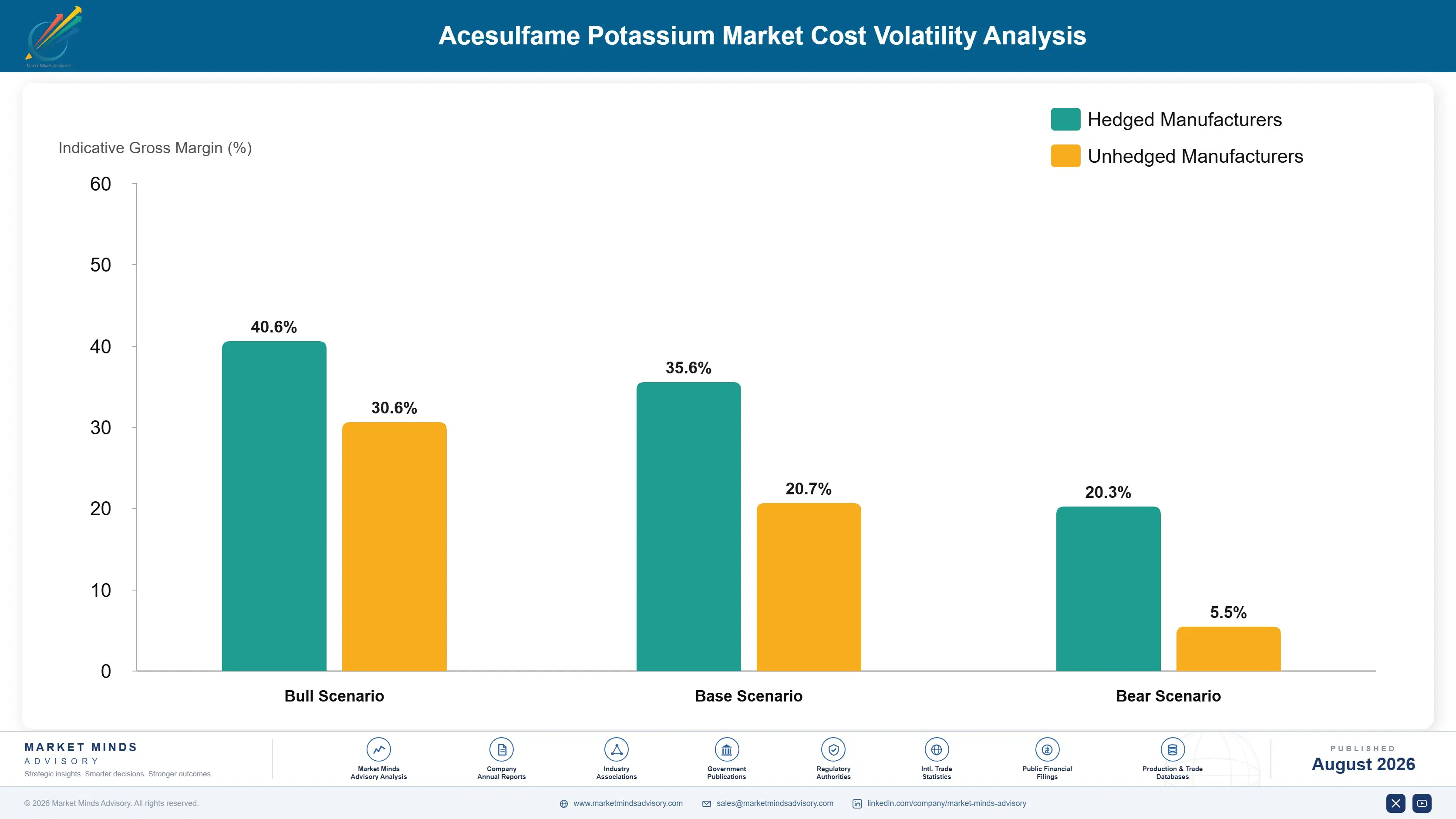
Diketene and Acetoacetamide Feedstock Exposure

Diketene and acetoacetamide feedstock account for roughly 51% of processor cost of goods sold, sourced from global petrochemical producers whose pricing tracks broader commodity and energy markets rather than acesulfame potassium-specific demand alone. This exposure sits meaningfully higher than in more mechanized food ingredient categories, given how concentrated the category's core feedstock inputs remain among a small number of global suppliers.
Global diketene and acetoacetamide prices rose sharply following energy market volatility across 2022 and 2023, with the IEA's industrial energy market reports documenting sustained cost pressure across major petrochemical producing regions through 2024. Producers without long-term feedstock agreements or diversified sourcing absorbed meaningfully higher per-kilogram production costs than competitors with existing multi-year supply contracts already established well before the volatility began.

Exposure varies by producer type: large integrated Chinese producers with captive feedstock production and multi-region sourcing absorb volatility more evenly than smaller regional blenders dependent on spot market purchasing. Pharmaceutical-grade producers with dedicated purification capacity face additional processing cost layers that standard food-grade-only producers do not carry, widening the margin gap between the two producer types during sustained feedstock inflation.
acesulfame-potassium-market-trends-cost-volatility-analysis-1787463883298

Multi-Year Feedstock Supply Agreements

Larger producers increasingly lock in multi-year diketene and acetoacetamide feedstock agreements directly with petrochemical producers, trading some pricing flexibility for predictable long-term input cost visibility across consecutive production cycles. Smaller producers without the volume commitments to negotiate multi-year terms remain more exposed to spot feedstock price spikes during periods of tight supply each cycle across the region.

Captive Feedstock Production Integration

Some larger producers increasingly maintain captive diketene and acetoacetamide production rather than depending entirely on merchant feedstock purchasing, reducing exposure to spot market volatility that drives petrochemical cost swings sharply. This integration requires substantial upfront capital but meaningfully smooths input cost volatility across consecutive years of energy market cycles and feedstock price swings.

Multi-Region Feedstock Sourcing Diversification

Producers are increasingly sourcing diketene and acetoacetamide feedstock from multiple producing regions rather than depending on a single source, reducing exposure to localized supply disruption or regional feedstock cost spikes. This diversification requires supplier qualification investment but meaningfully smooths input cost volatility across multiple sourcing regions over time each year.

Portfolio Architecture for Margin Defence

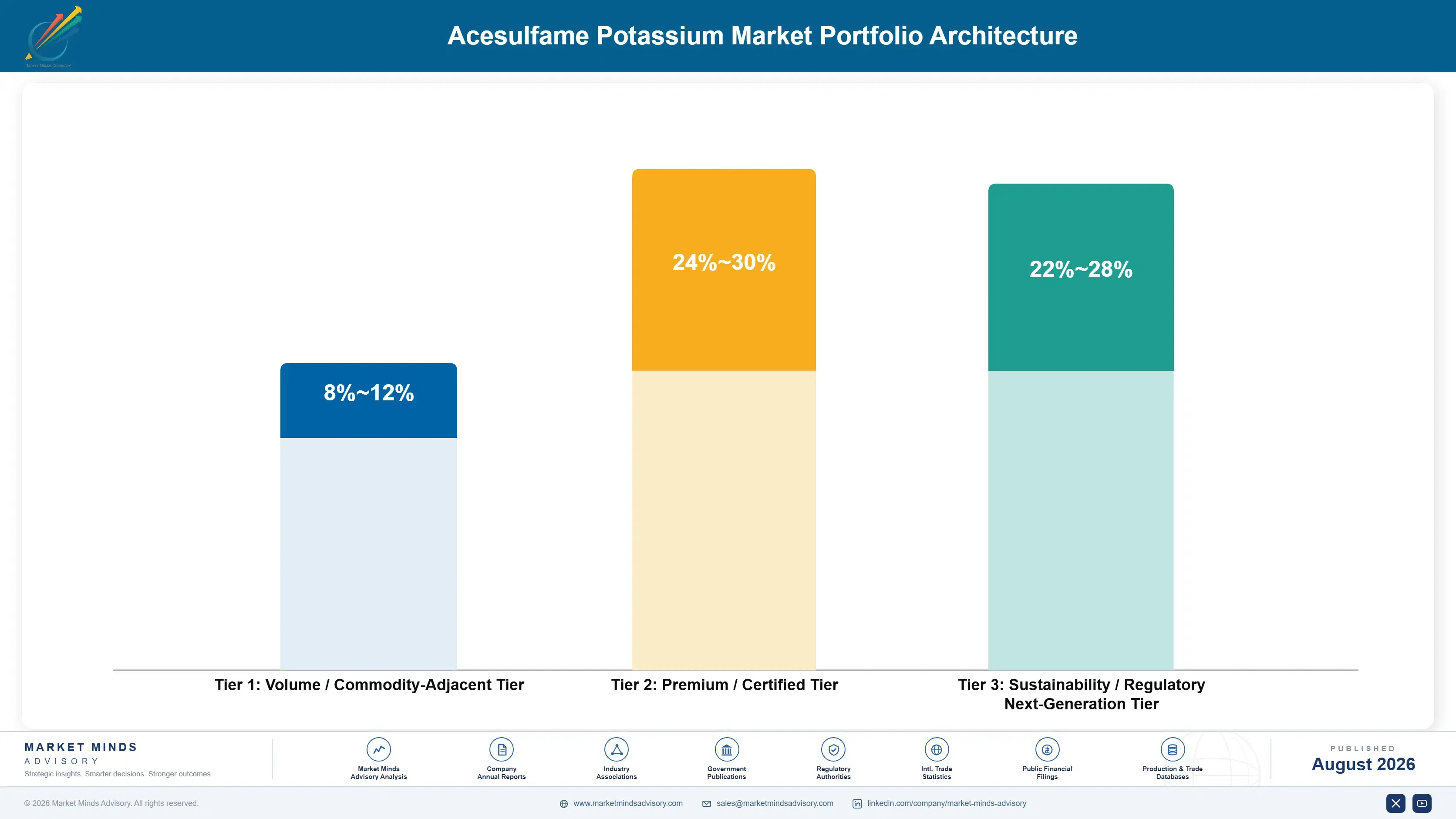
Acesulfame potassium portfolios split across three tiers with different margin economics: a volume tier built on standard food-grade material sold to beverage and food formulators, a premium tier built on pharmaceutical and beverage-specific purification, and an emerging next-generation tier tied to fully documented and traceable formulations that formulators are only beginning to pay a defined premium for consistently.
The tension between volume and premium runs deep in how producers allocate limited purification capacity: every kilogram dedicated to pharmaceutical or premium beverage output is a kilogram unavailable for standard food-grade volume that still generates the bulk of category revenue today. Get the mix wrong and a producer either misses premium pharmaceutical contracts or overinvests in purification capacity that outpaces actual formulator demand for it right now across the wider category.

High-value margin pools concentrate overwhelmingly in pharmaceutical and beverage-specific chemistry sold to specialty formulators, not in standard food-grade tonnage alone. Producers that built purification and regulatory capability early, Nutrinova and Anhui Jinhe among them, now capture a share of total category profit well above their share of total tonnage sold each year across their combined product lines.

Volume / Commodity-Adjacent Tier

Standard food-grade acesulfame potassium sold on tight tonnage contracts to beverage and food formulators, priced close to petrochemical feedstock benchmarks with thin processing margin above input cost across most accounts.
Gross Margin: 8-12%

Premium / Certified Tier

Pharmaceutical and beverage-specific acesulfame potassium sold to specialty formulators requiring purity and reliability specifications, commanding meaningful price premiums through purification science and registration capability that commodity producers cannot easily replicate.
Gross Margin: 24-30%

Sustainability / Regulatory / Next-Generation Tier

Fully documented and traceable acesulfame potassium formulations aimed at formulators with public quality and supply chain transparency commitments, still a small volume tier but growing as documentation expectations continue to rise across major markets.
Gross Margin: 22-28%
acesulfame-potassium-market-trends-portfolio-architecture-1787463883796

High-value Sub-segments and Strategic Watch-out

Pharmaceutical Grade Acesulfame Potassium (High-Value, High-Growth)

Pharmaceutical grade combines the fastest unit growth in the category with meaningfully above-average margins, making it the single most attractive segment for producers with dedicated purification capacity already in place. Demand continues to outpace available certified capacity across North America and Western Europe combined each year.
Gross Margin: 24-30%

Beverage Grade Acesulfame Potassium (High-Value, Moderate-Growth)

Beverage grade carries better margin than standard food-grade material and continues gaining diet reformulation contracts, though growth is more moderate than pharmaceutical grade since it depends on beverage manufacturer reformulation cycles that take real time to complete at meaningful commercial scale.
Gross Margin: 20-26%

Standard Food-Grade Acesulfame Potassium (Volume Core)

Standard food-grade material remains the largest single category by volume and the backbone of producer cash flow, even though margin sits well below the specialty tiers. Nearly every producer depends on this volume base to fund purification investment elsewhere in the wider portfolio each year.
Gross Margin: 8-12%

Non-Registered Commodity Exports (Strategic Watch-Out)

Acesulfame potassium exported without novel food registration or quality documentation carries the thinnest margin in the portfolio and faces the most direct exposure to being excluded from regulated beverage and pharmaceutical contracts as compliance requirements continue to tighten each year.
Gross Margin: 4-8%

Formulation Validation and Switching Costs

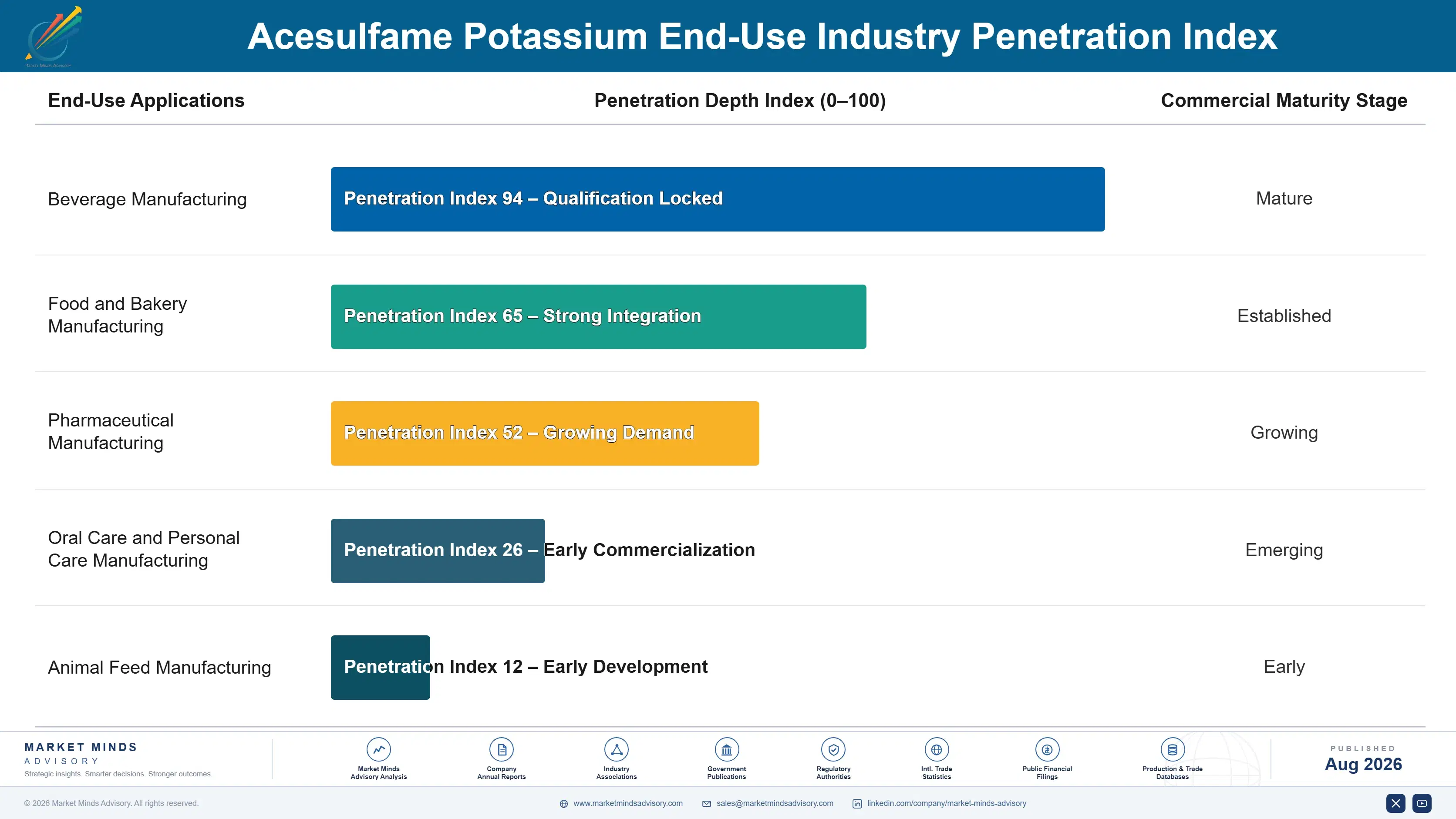
Acesulfame potassium demand runs on multi-year supply contracts tied directly to validated formulations, since beverage, food, and pharmaceutical manufacturers must requalify an entire product formulation, often including regulatory relabeling, before switching to a different sweetener supplier. This gives incumbent producers a meaningful retention advantage once a customer's formulation depends on their specific sweetener purity and consistency profile across every production batch.
Adoption depth varies sharply by customer type: standard beverage and food formulators treat food-grade acesulfame potassium suppliers as relatively interchangeable within quality specifications, switching more readily on price at contract renewal, while pharmaceutical and premium beverage formulators show far stronger supplier lock-in since switching means requalifying an entire validated formulation. Formulators serving regulated pharmaceutical markets show the least willingness to switch of any group, given the compliance risk of adopting an unfamiliar sweetener source.

A generational shift is underway among formulation scientists too: younger technical teams increasingly scrutinize full purity documentation and traceability credentials during supplier qualification in ways their predecessors treated as secondary to price, rewarding producers that invested early in purification and documentation over those still competing purely on standard food-grade cost.
acesulfame-potassium-market-trends-end-use-penetration-index-1787463884291

Where Acesulfame Potassium Margin Concentrates

These are among the four positions where our research anticipates prominent divergence between winners and laggards over the coming forecast period. Each is grounded in the demand model, the regulatory perimeter, and the announced capacity pipeline.
01 / PURIFICATION TIMING ADVANTAGE

Early pharmaceutical investment now defends a durable contract lead

Producers that built dedicated pharmaceutical-grade purification capacity ahead of rising demand now hold validated formulator relationships that later movers cannot quickly replicate, since customers rarely requalify an established, validated sweetener supplier once a formulation is locked in. This timing advantage matters more than raw production scale, because pharmaceutical contracts increasingly require purification capability as a baseline qualification rather than a differentiator. Producers without early purification investment now face a multi-year capital and validation process before they can compete for the same premium pharmaceutical contracts.
02 / CHINESE CAPACITY EXPOSURE

Commodity-only producers face the sharpest margin compression risk

Producers dependent entirely on standard food-grade acesulfame potassium face the sharpest exposure to continued Chinese capacity expansion, since commodity pricing compression shows no sign of reversing given the country's persistent cost advantage across the broader sweetener value chain. This risk concentrates specifically among mid-sized regional producers lacking a defensible specialty niche to retreat toward. Producers that shifted mix toward pharmaceutical or beverage-specific purification early face meaningfully less margin pressure than those still dependent on commodity tonnage for the bulk of their revenue each fiscal year.
03 / EMERGING MARKET CAPACITY RACE

India is where the next wave of reformulation-driven demand gets built

India's rapidly expanding diet beverage and food manufacturing base is pulling acesulfame potassium demand faster than any other market tracked in this report, as domestic reformulation scales toward genuine mainstream adoption across multiple product categories. This capacity race reflects genuinely new category formation rather than share shifting among already-established Western and Chinese competitors. Producers and distributors that build relationships in India now will be better positioned than those waiting for the shift to become obvious in import and trade data several years from now.
04 / REGISTRATION COMPLIANCE GAP

Non-registered suppliers are quietly being excluded from regulated contracts

Producers without formal novel food registration across key jurisdictions increasingly find themselves excluded from premium beverage and pharmaceutical contracts regardless of their underlying sweetener purity, since customers treat verified registration as a baseline requirement rather than a differentiator today. This compliance gap compounds over time, since formulators rarely revisit unregistered suppliers once a documented, validated relationship has been established elsewhere. Producers investing in registration now will close this gap faster than competitors waiting for regulators to force the issue outright.

Engagement Snapshot From the Field

A live engagement with an industry participant carrying material or product regulatory and market exposure ahead of a defining policy shift, showing how our research translates into a defensible multi-year portfolio strategy.
MARKET MINDS ADVISORY · CLIENT ENGAGEMENT SUMMARY
Acesulfame Potassium Producer Strategic Portfolio Review and Transition Roadmap 2026·Investment Scenario on Acesulfame Potassium Exposure Evaluation 2025-26
CLIENT PROFILE
The client is a mid-sized regional acesulfame potassium producer supplying standard food-grade material to beverage and food formulators across a single national market, with no dedicated pharmaceutical-grade purification capability. Revenue approached $70 million in the most recent fiscal year (client-reported, unverified by MMA), though margins had compressed steadily as Chinese commodity imports expanded and larger competitors captured pharmaceutical formulator contracts the client had not pursued.
STRATEGIC CHALLENGE
The producer had no dedicated purification capacity and no novel food registration in key pharmaceutical markets, leaving it entirely dependent on standard food-grade pricing at a moment when Chinese commodity competition was intensifying and pharmaceutical customers were consolidating purchases with certified, purified suppliers. Leadership needed to decide whether to invest in purification capacity, registration systems, or both simultaneously given limited available capital.
MMA APPROACH
MMA benchmarked the producer's cost structure against pharmaceutical-diversified competitors, modeled the capital and timeline required for both purification capacity and novel food registration, and evaluated a phased sequencing that would let registration-driven contract wins help fund the larger purification capital investment over time without straining existing working capital reserves.
KEY FINDINGS
  1. The producer's standard food-grade margin had compressed meaningfully faster than regional peers already diversified into pharmaceutical or premium beverage-grade purified products over recent years.
  2. Novel food registration required substantially less upfront capital than purification capacity, making it the faster near-term path to premium contract qualification for the business.
  3. Pharmaceutical customers confirmed that registration documentation, not price, was the binding constraint on awarding new supply contracts to the regional producer under evaluation.
  4. Competitors that invested earliest in both registration and purification capacity already held multi-year validated contracts that would be difficult to displace quickly once established.
CLIENT PROFILE
The client is a mid-sized regional acesulfame potassium producer supplying standard food-grade material to beverage and food formulators across a single national market, with no dedicated pharmaceutical-grade purification capability. Revenue approached $70 million in the most recent fiscal year (client-reported, unverified by MMA), though margins had compressed steadily as Chinese commodity imports expanded and larger competitors captured pharmaceutical formulator contracts the client had not pursued.
STRATEGIC CHALLENGE
The producer had no dedicated purification capacity and no novel food registration in key pharmaceutical markets, leaving it entirely dependent on standard food-grade pricing at a moment when Chinese commodity competition was intensifying and pharmaceutical customers were consolidating purchases with certified, purified suppliers. Leadership needed to decide whether to invest in purification capacity, registration systems, or both simultaneously given limited available capital.
MMA APPROACH
MMA benchmarked the producer's cost structure against pharmaceutical-diversified competitors, modeled the capital and timeline required for both purification capacity and novel food registration, and evaluated a phased sequencing that would let registration-driven contract wins help fund the larger purification capital investment over time without straining existing working capital reserves.
KEY FINDINGS
  1. The producer's standard food-grade margin had compressed meaningfully faster than regional peers already diversified into pharmaceutical or premium beverage-grade purified products over recent years.
  2. Novel food registration required substantially less upfront capital than purification capacity, making it the faster near-term path to premium contract qualification for the business.
  3. Pharmaceutical customers confirmed that registration documentation, not price, was the binding constraint on awarding new supply contracts to the regional producer under evaluation.
  4. Competitors that invested earliest in both registration and purification capacity already held multi-year validated contracts that would be difficult to displace quickly once established.
RECOMMENDED STRATEGY
Phase 1: Phase 1 (Year 1): Implement novel food registration and quality documentation systems across existing production to qualify for pharmaceutical contract consideration and evaluation. Phase 2: Phase 2 (Years 2 to 3): Use improved registered contract volume and margin to fund dedicated pharmaceutical-grade purification capacity investment at the primary facility. Phase 3: Phase 3 (Years 3 to 4): Pursue multi-year pharmaceutical and beverage-specific supply contracts using newly certified and purified capacity as validated proof of capability.
OUTCOME
Within eighteen months, the producer's registered contract volume reached a meaningful share of total revenue and funded purification capacity planning ahead of the original timeline (client-reported, unverified by MMA). The phased approach let the business diversify without straining working capital, positioning it to compete for pharmaceutical contracts it could not have pursued previously.

Frequently Asked Questions

Foundational context covering the market sizes, CAGR, scope, country, region and competition that inform every finding below. This section is provided to cover basics and most often pre-purchase conversations, answered from the MMA Primary Research Dataset.

What is the current size of the Acesulfame Potassium Market?

The global acesulfame potassium market was valued at approximately $1.1 billion in 2025. This covers standard food-grade, pharmaceutical, and beverage-grade sweetener sold to food, beverage, and pharmaceutical manufacturers.

How large will the Acesulfame Potassium Market be by 2036?

MMA projects the market will reach approximately $2.1 billion by 2036, up from roughly $1.17 billion in 2026. That represents an expansion multiple of about 1.79 times over the ten-year forecast period.

What is the CAGR for the Acesulfame Potassium Market 2026 to 2036?

The base case CAGR is 6.0% annually, with a bull scenario near 7.3% and a bear scenario near 4.7%. This range reflects sensitivity to feedstock costs and Chinese commodity capacity expansion.

Which segment is growing fastest?

Pharmaceutical grade acesulfame potassium is the fastest-growing segment, expanding at roughly 9.5% annually, about 1.6 times the overall market's pace. Beverage grade follows at approximately 7.8% annually.

Who are the major companies in the Acesulfame Potassium Market?

Leading players include Anhui Jinhe Industrial Co., Ltd., Nutrinova (Celanese), Suzhou Hope Technology Co., Ltd., Vitasweet Co., Ltd., and HYET Sweet. Together these five hold an estimated 52% combined market concentration today.

Which country is growing fastest?

India is the fastest-growing national market, expanding near 8.6% annually as its diet beverage and food manufacturing base rapidly scales domestic demand. China remains the dominant production hub for the category overall.

Report Segmentation Architecture

The full report scope spans multiple orthogonal segmentation dimensions, with cross-tabulated demand data provided for each dimension pair. Coverage extends further to regional breakdowns, trend trajectories, and the competitive detail needed to support segment-level decision-making.

By End-Use Grade

  • Beverage Grade Acesulfame Potassium
  • Food and Bakery Grade Acesulfame Potassium
  • Pharmaceutical Grade Acesulfame Potassium
  • Oral Care and Personal Care Grade Acesulfame Potassium
  • Tabletop Sweetener Blend Grade
  • Animal Feed and Veterinary Grade Acesulfame Potassium

By End-Use Industry

  • Beverage Manufacturing
  • Food and Bakery Manufacturing
  • Pharmaceutical Manufacturing
  • Oral Care and Personal Care Manufacturing
  • Animal Feed Manufacturing

By Commercial Dimension

  • Direct Formulator Supply Contracts
  • Distributor and Wholesale Trade
  • Formulation Licensing Agreements
  • Export and Cross-Border Trade

By Region

  • North America
  • Western Europe
  • East Asia
  • South Asia and Pacific
  • Latin America
  • Middle East and Africa
  • Eastern Europe

Scope, Methodology, and Coverage

Every figure in this report is reproducible from documented input assumptions. The scope below maps the historical period, the forecast horizon, the segmentation dimensions, and the countries covered, alongside the underlying primary and qualitative methodology.
Historical Period
2020 to 2025
Forecast Period
2026 to 2036
Base Year
2025 (USD billions; MMA Primary Research Dataset, August 2026)
Market Definition
This report defines the acesulfame potassium market as acesulfame potassium produced and sold as a high-intensity sweetener for beverages, food and bakery products, pharmaceutical formulations, oral care products, tabletop sweetener blends, and animal feed applications globally. It excludes other high-intensity sweeteners such as sucralose, aspartame, and stevia, and finished consumer products that already incorporate acesulfame potassium internally.
Quantitative Units
USD billions (current prices); metric tonnes product weight where cited
Segmentation Dimensions
By End-Use Grade; By End-Use Industry; By Commercial Dimension; By Region
Regions Covered
North America, Western Europe, East Asia, South Asia and Pacific, Latin America, Middle East and Africa, Eastern Europe
Countries Covered
USA, China, Germany, France, UK, Japan, South Korea, India, Australia, Canada, Brazil, Mexico, Indonesia, Vietnam, Thailand, Malaysia, UAE, Saudi Arabia, South Africa, Nigeria, Turkey, Poland, Netherlands, Italy, Spain, Sweden, Switzerland, Argentina, Colombia, Singapore, and additional markets relevant to this sector
Key Companies Profiled
Anhui Jinhe Industrial Co., Ltd., Nutrinova (Celanese), Suzhou Hope Technology Co., Ltd., Vitasweet Co., Ltd., HYET Sweet, Tianjin Changjie Chemical, Shandong Yabang Chemical Technology Co., Ltd., Ingredion Incorporated, Tate & Lyle plc, Archer-Daniels-Midland Company, Cargill, Incorporated, Merisant Company, JK Sucralose Inc., Niutang Chemical Co., Ltd., Kaifeng Xinghua Fine Chemical Co., Ltd., Sinosweet Co., Ltd., Univar Solutions Inc., Jubilant Ingrevia Limited, Beneo GmbH, Foodchem International Corporation
Quantitative Methodology
Primary survey, n=3,800 respondents, Q4 2025, six countries; demand-side model with trade association cross-validation
Qualitative Methodology
47 expert interviews, Q4 2025; applied to validate demand model assumptions, identify emerging dynamics, and assess competitive positioning
Report Format
PDF and XLSX data workbook (Word format preview document)
Publisher
Market Minds Advisory
Report Code
MMA-2026-CHM-110
Published
August 2026
Contact
sales@marketmindsadvisory.com | www.marketmindsadvisory.com

Purchase the full Acesulfame Potassium Market Report (2026 to 2036).

The full Acesulfame Potassium Market report delivers detailed sizing and forecasts across all six end-use grade segments, all seven world regions, and twenty profiled companies through 2036. It includes granular regional data tables, competitive benchmarking on a consistent production volume basis, and input cost sensitivity modeling tied to global diketene and acetoacetamide markets. Subscribers receive access to the underlying primary survey dataset (n=3,800 respondents, Q4 2025, six countries) and qualitative expert interview findings (n=47 interviews, Q4 2025). The report also includes segment-level margin analysis and a portfolio tiering framework analysts can apply directly to company assessments.
Full segmentation across six end-use grade categories
Seven-region market sizing with growth forecasts
Twenty-company competitive benchmarking on consistent basis
Input cost sensitivity modeling tied to petrochemical markets
Access to primary survey dataset of 3,800 respondents
Portfolio tiering framework for margin benchmarking

Built For The People Who Decide

From boardroom strategy to bench-side execution, this report is read cover-to-cover by leaders shaping the next decade of their industry, turning demand scenarios, market dynamics and valuation benchmarks into decisions.
CXOs/ Presidents/ VPs/ Managers
M&A and Corporate Development
Strategy Teams and R&D Heads
Procurement and Product Directors
Regulatory and Compliance Leaders
Investor Relations and Equity Analysts