Market Minds Advisory
Ablation Devices Market

Ablation Devices Market: Energy Platform Transition, Consumable Economics, and Electrophysiology Laboratory Access

Pulsed field energy has rewritten atrial fibrillation ablation inside two years, stranding radiofrequency catheter portfolios, resetting electrophysiology laboratory purchasing, and forcing every incumbent to defend an installed base it once treated as permanent.

Lead Analyst

Alice Ballenger

Published

September 2026

Make Smarter Decisions with Customized Research Insights

Request a free sample report and evaluate market opportunities, growth trends, and competitive dynamics relevant to your business needs.

2025 MARKET VALUE$9.6BMarket Size 2025
2036 FORECAST VALUE$25.8BBase Case , 2026 to 2036
CAGR 2026 TO 20369.4 %Bull 10.7% / Bear 8.2%
INCREMENTAL OPPORTUNITY$15.3BNet 10- year value creation
EXPANSION MULTIPLE2.46x2036 value over 2026 base
Strategic Levers
M&A Pipeline
Regional Outlook
Country Rankings
Competitive Intelligence
Segmental Deep-dive
Call-Us : 91 93563 13602

Executive Snapshot and Market Trajectory

Pulsed field ablation moved from first approval to routine practice in atrial fibrillation faster than any electrophysiology technology before it. Centres that bought radiofrequency consoles in 2023 are running pulsed field cases on competing platforms today, and almost nobody planned for that. Nobody planned for that timescale.
Cardiac work carries the market: atrial fibrillation procedures alone account for most catheter volume, and pulsed field and irreversible electroporation devices compound at 14.1%, a full 1.50x the market rate. North America holds 32% of value because United States electrophysiology laboratory density and ablation reimbursement have no equivalent anywhere else. Interventional oncology grows underneath, constrained by referral patterns rather than by device capability. Referral pathways set that pace.
Five companies hold 78% of shipments, and all five now sell a pulsed field catheter or have publicly committed to one. Mapping system lock-in still decides which catheter a laboratory can physically run, so console placement matters more than catheter specification. Regulatory attention has shifted from oesophageal injury toward haemolysis and coronary spasm, the failure modes pulsed field introduced. Clinical risk has been repriced. The platform underneath the largest cardiology procedure changed in three years.
Market Definition
Ablation devices are energy-delivery systems and their single-use applicators used to destroy targeted tissue in situ, spanning cardiac electrophysiology, interventional oncology, gynaecology, pain management, and ophthalmic applications. Scope covers generators, consoles, catheters, probes, and the integrated mapping hardware sold as part of an ablation platform. Diagnostic-only electrophysiology catheters, surgical resection instruments, and external beam radiotherapy sit outside the definition.
Base Year Value
$9.6B in 2025 (MMA Primary Research Dataset, August 2026)
Forecast Period
2026 to 2036, eleven discrete annual values
CAGR
9.4% base case. Bull 10.7%. Bear 8.2%.
Fastest Growth Segment
Pulsed Field and Irreversible Electroporation Devices: 14.1% CAGR
Fastest Growth Country
India: 13.6% CAGR
Fastest Growth Region
South Asia and Pacific: 11.6% CAGR
Largest Region
North America: 32% of 2025 global value
Market Leaders
Johnson & Johnson MedTech, Medtronic, Boston Scientific, Abbott, and Stryker. Source: MMA Primary Research Dataset, July 2026.
Primary Survey
n=3,800 procurement and R&D decision-makers, Q4 2025, six countries
Methodology
Demand-side build-up, cross-validated against public data, 47 expert interviews

Ablation Devices Market Forecast Scenarios

ablation-devices-market-size-forecast-scenario-1787303398629
The 2020 to 2025 period split cleanly in half. Elective electrophysiology work collapsed through the pandemic and rebuilt slowly, so growth ran below 6% until 2023. Then pulsed field approvals landed in Europe and the United States and the market accelerated hard, closing the period at a historical rate near 8.2%. Deferred backlogs and an energy transition arrived together.
Base case growth of 9.4% rests on three mechanisms. Atrial fibrillation ablation volumes keep expanding as guidelines move ablation earlier in the treatment pathway rather than after drug failure. Pulsed field raises average selling price per case above the radiofrequency catheters it replaces, so revenue grows faster than procedure count. And single-shot workflow shortens case time enough that a laboratory adds cases without adding rooms, converting capital that already exists into higher consumable throughput every year.
The bull case at 10.7% turns on first-line ablation reimbursement widening beyond the United States and Germany into Japan and the larger European systems. The bear case at 8.2% is a specific one: a haemolysis or coronary spasm safety signal serious enough to trigger label restrictions on pulsed field catheters would stall the conversion and hand two or three years back to thermal energy.

Ablation Devices: Energy Platform Transition and Console Economics

This is a consumable business wearing capital equipment clothing. Consoles and mapping systems generate 18% of revenue but decide 100% of it, because a laboratory running a Biosense Webster mapping system cannot easily run a competitor's catheter through it. Companies place capital cheaply, sometimes at negative margin, and earn everything back on catheters over the seven years that follow. Nothing about that model is accidental.
TOP FIVE CONCENTRATION78%Five platform companies control nearly all catheter shipment volume
DISPOSABLE REVENUE SHARE82%Single-use catheters and probes dominate revenue over capital equipment
AVERAGE CATHETER PRICEUSD 3,150Blended global price across cardiac and oncology single-use applicators
GLOBAL LABORATORY BASE8,400 labsEquipped electrophysiology suites capable of running catheter ablation procedures
CONSOLE REPLACEMENT CYCLE7 yearsTypical interval before hospitals replace mapping and generator capital equipment
UNITED STATES PROCEDURE SHARE38%Share of global ablation procedures performed inside one country
Pulsed field changed the economics rather than just the physics. A pulsed field catheter carries a higher price than the radiofrequency catheter it replaces, and the generator is a separate capital item, so the transition raised both revenue per case and the capital hurdle simultaneously. Hospitals that had already amortised their radiofrequency investment found themselves asked to buy again, six years early. Few hospital boards enjoyed that conversation.
Interventional oncology behaves differently. Microwave and cryoablation probes for liver, lung, kidney and bone lesions sell into interventional radiology suites where capital is shared across many procedure types, so console lock-in is weaker and price competition sharper. Growth there depends on referral pathways rather than on device capability, and referral pathways move slowly. Nobody in that suite is waiting for better hardware.
"The pulsed field story is told as a safety story, but hospitals bought it for throughput. A laboratory that used to run four atrial fibrillation cases a day now runs six, and that arithmetic closed more deals than any oesophageal injury data ever did."
Director, Medical Technology and Interventional Devices Practice · MMA Medical D

Market Trends

Pulsed field displaces thermal energy in atrial fibrillation

Pulsed field ablation delivers high-voltage microsecond pulses that kill cardiac myocytes by electroporation while largely sparing oesophagus, phrenic nerve, and pulmonary vein tissue. Boston Scientific's Farapulse, Medtronic's PulseSelect and Sphere-9, Johnson & Johnson's Varipulse, and Abbott's Volt have all reached commercial launch in the United States or Europe. Conversion has been unusually fast for medical devices: centres that adopted early moved most of their atrial fibrillation volume across within four quarters. Thermal radiofrequency retains complex atrial and ventricular work, where point-by-point lesion control still matters more than speed. That division of labour looks reasonably durable.
Market Impact: Over 60 million people affected

Single-shot workflow compresses electrophysiology laboratory procedure time

Single-shot catheter designs isolate a pulmonary vein in one application rather than through dozens of sequential point lesions. Reported skin-to-skin times have fallen from roughly 120 minutes to nearer 75 for straightforward paroxysmal cases, and fluoroscopy exposure has dropped alongside. That matters commercially because electrophysiology laboratory time, not catheter cost, is the binding constraint in most health systems. Hospitals converting to single-shot workflow add procedure slots without capital construction, which improves the return on a laboratory that already exists and shortens waiting lists that had grown through the pandemic years.
Market Impact: First-line coverage since 2024

Market Opportunities and Growth Drivers

Atrial fibrillation prevalence outpaces available electrophysiology treatment capacity

Roughly 60 million people live with atrial fibrillation worldwide, and the figure rises with population ageing in every region MMA tracks. Diagnosis rates have climbed faster still as consumer wearables push previously silent cases into cardiology clinics. Health systems cannot expand electrophysiology capacity at that pace: training an electrophysiologist takes years and building a laboratory takes capital that hospital boards ration carefully. The gap between diagnosed patients and available procedure slots is the single most reliable demand signal in this market, and it is widening rather than closing. Nothing in the demographic data suggests otherwise.
Market Impact: Roughly 80% of laboratories constra

Guidelines and payers move ablation ahead of drug therapy

The 2023 and 2024 guideline revisions from the major cardiology societies placed catheter ablation as a reasonable first-line rhythm control option for selected paroxysmal atrial fibrillation patients, rather than a second step after antiarrhythmic drugs fail. United States payers followed, and German and Japanese coverage moved in the same direction. That single change enlarges the eligible population substantially without any new technology, because it removes a year or more of drug trial that previously sat between diagnosis and procedure. Eligible volume expands without any new technology reaching the laboratory at all.
Market Impact: Only 1 specialist per 200,000

Market Restraints and Challenges

Mapping system lock-in restricts hospital catheter purchasing freedom

Ablation catheters communicate with three-dimensional mapping systems through proprietary interfaces, so a laboratory equipped with one vendor's mapping platform cannot freely buy another vendor's catheter. Roughly four in five electrophysiology laboratories run a single mapping platform, and switching means retraining staff and rebuying capital. The root cause is commercial rather than technical: interoperability standards exist in principle and no vendor has an incentive to implement them. Hospitals are pushing back through multi-vendor tenders and dual-platform laboratories, and a few large systems have made open mapping compatibility a formal procurement requirement.
Market Impact: Above 60% of AF procedures

Electrophysiologist supply caps procedure growth across most markets

A trained interventional electrophysiologist takes seven to nine years to produce beyond medical school, and most countries have fewer than one per 200,000 people. Faster procedures help but do not solve it, because a shorter case still needs the same specialist in the room. The root cause is training capacity: fellowship positions are funded by health systems that respond to budget cycles rather than to disease prevalence. Vendors are responding with simulation training programmes, proctoring networks, and workflow simplification designed to let general cardiologists perform straightforward pulmonary vein isolation safely.
Market Impact: Case time down 45 minutes
4 additional market trends, 2 additional growth drivers, and 3 additional restraints and challenges are covered in the full report. Contact sales@marketmindsadvisory.com to access the complete intelligence.

Segment CAGR and Growth Architecture

Segmentation follows the ablation energy modality itself, because energy type determines the generator, the catheter design, the regulatory pathway, and the clinical indication set. Six modalities cover the market completely without overlap. Mapping systems, navigation hardware, and procedural imaging are treated as platform infrastructure rather than as separate ablation modalities in this hierarchy. They belong elsewhere.
ablation-devices-market-market-share-analysis-1787303399162

Pulsed Field and Irreversible Electroporation Devices

Growing at 14.1%, a full 1.50x the market rate, this is the fastest modality by a wide margin and the reason the overall forecast sits where it does. Non-thermal electroporation kills myocytes selectively, sparing adjacent oesophageal and nerve tissue that thermal energy damages. Every major platform company now has a commercial catheter. Beyond cardiac work, irreversible electroporation is establishing itself in pancreatic and prostate tumour ablation, where thermal methods risk critical structures. The commercial attraction is not only clinical: catheter prices sit above radiofrequency equivalents and case times are shorter, so the modality improves both revenue per case and laboratory throughput at once. Few transitions improve outcome and unit economics at once, which explains the pace.
CAGR 14.1%

Microwave Ablation Devices

Microwave ablation grows at 11.2% on the strength of interventional oncology rather than cardiology. It heats tissue faster and produces larger, more predictable ablation zones than radiofrequency, and it is less affected by the heat-sink effect near blood vessels, which matters for liver lesions. Antenna design has improved enough that a single insertion can now cover lesions above three centimetres reliably. Adoption is strongest in East Asia, where hepatocellular carcinoma incidence is highest and interventional radiology capacity has expanded quickly. Price competition is sharper here than in cardiac work because probes are less tied to proprietary console interfaces, so switching costs are genuinely lower. Growth here rests on interventional radiology capacity rather than on any energy platform contest.
CAGR 11.2%
Full segment breakdown across 6 segments available in the complete report.

Regional Architecture and Country Demand Map

Regional shares track electrophysiology laboratory density and ablation reimbursement rather than population. North America leads on procedure volume per capita by a wide margin. East Asia leads on oncology ablation, where hepatocellular carcinoma burden concentrates demand for microwave and radiofrequency probes. Procedure volume per capita explains more than population.

North America

North America takes the largest share at 32%, and the reason is specific rather than habitual: the United States performs close to 38% of the world's catheter ablation procedures with about 4% of its population, because ablation carries dedicated reimbursement, electrophysiology laboratory density is roughly triple the Western European figure, and first-line coverage arrived here first. Pulsed field launched into that base and converted it quickly. Canadian volumes are smaller and grow through provincial capacity expansion rather than pricing. Mexico contributes mainly through private hospital networks in Mexico City and Monterrey. Growth at 9.0% reflects a market already deeply penetrated in atrial fibrillation, where further expansion depends on ventricular and oncology work.
Share: 32% | CAGR: 9.0% (2026 to 2036)

East Asia

Twenty-four per cent of value sits in East Asia, and the demand mechanism differs from the West. China performs more hepatocellular carcinoma ablations than the rest of the world combined, which makes microwave and radiofrequency probes the dominant products rather than cardiac catheters. Domestic manufacturers including MicroPort Scientific and Lepu Medical have taken meaningful share in oncology probes on price. Japan's cardiac ablation volumes are high and its reimbursement pathway for pulsed field opened in 2025. South Korean and Taiwanese hospitals adopt quickly and pay close to Western prices. Volume-based procurement in China compresses probe pricing, so growth at 10.6% is procedure-led rather than price-led. Cardiac catheter demand builds behind that oncology base rather than alongside it.
Share: 24% | CAGR: 10.6% (2026 to 2036)
Regional intelligence for 5 additional markets available in the complete report: Western Europe, South Asia and Pacific, Latin America, Middle East and Africa, Eastern Europe. Contact sales@marketmindsadvisory.com.
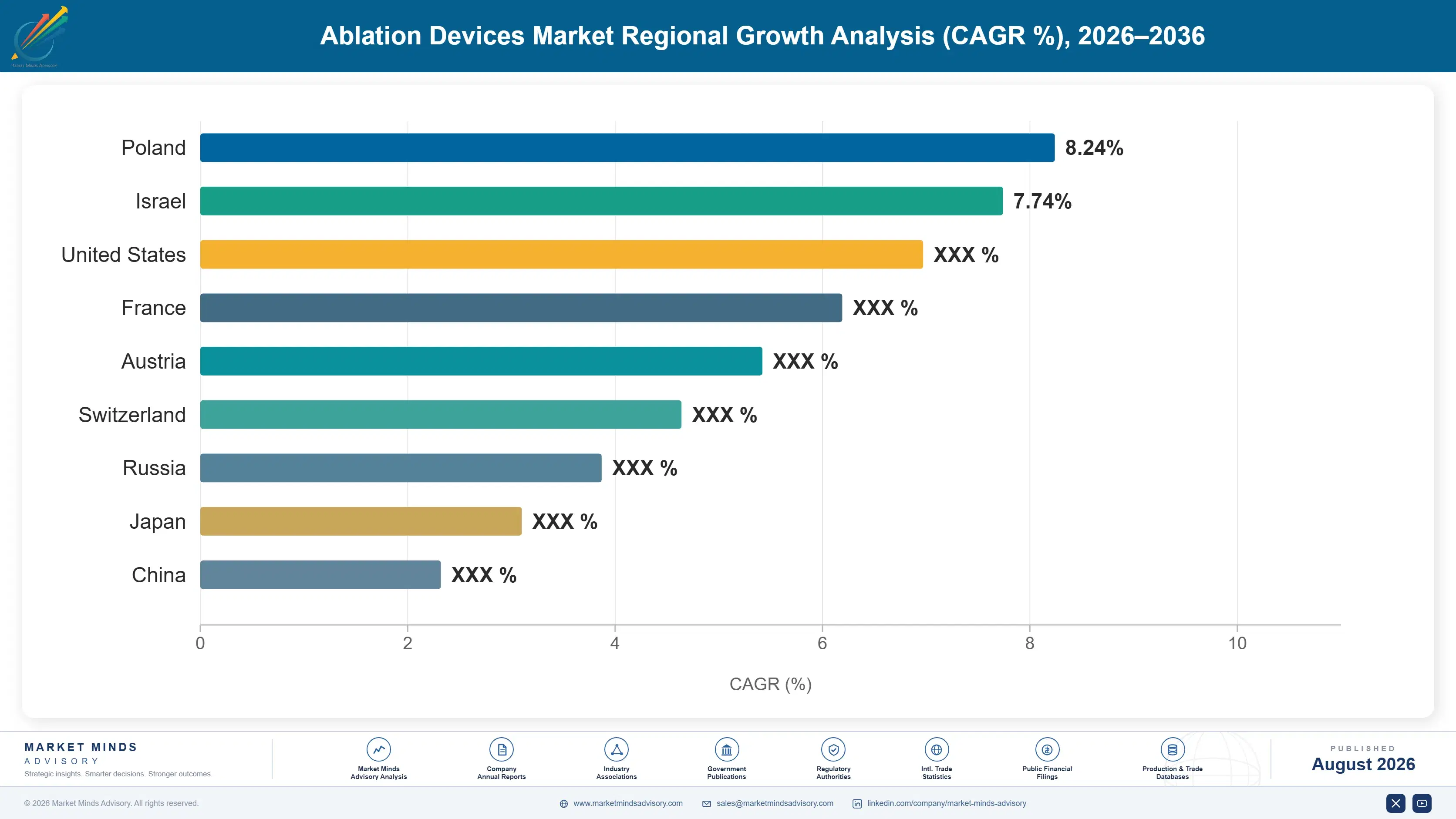
ablation-devices-market-country-cagr-analysis-1787303399676

Where Ablation Margin Actually Sits

Ablation revenue concentrates in the single-use applicator, not the console, and the console decides which applicator a hospital can buy. Every commercial lever in this market therefore works through installed platform position, procedure throughput, or the training relationship that keeps an operator loyal to one workflow rather than another. The third is the one most companies underfund.

Place consoles below cost to secure catheter annuity

Capital placement at or below manufacturing cost buys seven years of catheter revenue at 82% of the lifetime total. The arithmetic favours aggression: a mapping system placed at a 30% discount pays back within eighteen months of normal case volume, and the hospital is then committed until its next capital cycle. The discipline required is contractual rather than financial. Placement agreements need minimum annual catheter commitments with genuine consequences, because hospitals taking discounted capital and then buying competitively on consumables destroy the model. Vendors who enforce those terms earn far better returns than those who negotiate case by case.
Market Impact: Capital payback inside 18 months of

Sell throughput economics rather than clinical safety data

Hospital administrators approve capital on financial returns, and clinicians approve it on outcomes. Pulsed field conversions closed fastest where the commercial team led with laboratory throughput: a 45-minute reduction in case time lets a laboratory run six atrial fibrillation cases daily instead of four, which is roughly 50% more billable procedures from the same room and staff. That argument reaches the finance committee in a form it can act on. Safety data belongs in the clinical conversation and matters there, but it does not by itself release capital from a health system already carrying a long elective waiting list.
Market Impact: Roughly 50% more billable cases per

Build proctoring networks that create operator switching costs

Operators develop muscle memory for a specific catheter, workflow and mapping display, and they resist changing it. Vendors that fund structured proctoring, simulation training and fellowship support create loyalty that survives price competition, because an experienced operator will accept roughly 15% higher consumable pricing before considering a platform they have not been trained on. The investment is real but not enormous: a regional proctoring network costs less than the discount typically given away on a single large hospital tender. It also generates the reference sites that shorten every subsequent sales cycle in that geography.
Market Impact: Sustains about 15% consumable price

Extend platforms into oncology to diversify beyond cardiology

Cardiac electrophysiology carries most revenue and most competitive intensity. Interventional oncology probes for liver, lung, kidney and bone lesions run on shared interventional radiology capital, so entry does not require displacing an installed mapping platform. Companies with existing energy generator technology can reach that market with roughly 40% less development spend than a ground-up cardiac programme, because the generator physics transfers even when the applicator does not. The buying centre is different and the sales cycle is shorter. Margins are lower than cardiac catheters but the revenue is genuinely uncorrelated with the pulsed field conversion cycle.
Market Impact: About 40% lower development spend t

Who Controls the Margin Pool

Concentration is high and stable: the top five hold 78% of shipment volume measured on catheter and probe units sold with their associated capital installed base, the single basis used throughout this assessment. Johnson & Johnson MedTech leads on installed mapping systems through Biosense Webster's CARTO platform, with Abbott's EnSite the alternative. The gap to the next tier is wide, because mapping platforms took two decades to establish.
Competition currently runs on three dimensions. Pulsed field catheter performance is the first, and Boston Scientific's early Farapulse launch gave it a lead the others have been closing through 2026. Console placement economics is the second, where balance sheet strength decides how aggressively a company can subsidise capital. Operator training capacity is the third and least visible, and it constrains how quickly any vendor can actually convert accounts.

Pressure is emerging from two directions. Chinese manufacturers including MicroPort Scientific and Lepu Medical hold real share in domestic oncology probes and are developing cardiac catheters, helped by procurement that favours local supply. Separately, hospital groups are pushing mapping interoperability into tenders. If that succeeds even partially, console lock-in weakens and catheter competition becomes a straight contest on performance and price.
ablation-devices-market-company-positioning-matrix-1787303400224

Competitive Moat and Risk Dimensions

JOHNSON & JOHNSON MEDTECH (BIOSENSE WEBSTER)

Moat: Entrenched mapping platform base

CARTO sits in more electrophysiology laboratories than any competing three-dimensional mapping system, and catheters from other vendors cannot run through it. That installed position converts every procedure performed in those rooms into a Biosense Webster consumable sale by default, and replacing the platform means recapitalising the laboratory and retraining its entire staff.
JOHNSON & JOHNSON MEDTECH (BIOSENSE WEBSTER)

Risk: Late to pulsed field

Varipulse reached commercial launch after Boston Scientific and Medtronic, and an early post-launch pause in the United States rollout cost momentum at exactly the moment accounts were choosing a pulsed field platform. Mapping lock-in slows defection but does not prevent it, because hospitals adding a second laboratory can simply equip it differently.
BOSTON SCIENTIFIC

Moat: First mover pulsed field

Farapulse reached European and United States markets ahead of every competitor and captured the reference sites, the early operator training base, and most of the published real-world evidence. In a market where clinicians adopt what their proctors used, that head start compounds. It also gave Boston Scientific pricing latitude that later entrants have not enjoyed.
BOSTON SCIENTIFIC

Risk: Narrow platform dependence

A large share of the company's electrophysiology growth now rests on one product family in one indication. Any safety signal on pulsed field, particularly around haemolysis or coronary spasm, would hit Boston Scientific harder than competitors carrying broader thermal portfolios. Its mapping position is also thinner than Johnson & Johnson's or Abbott's.

Players Tracked

Prominent Players

Johnson & Johnson MedTech
Medtronic
Boston Scientific
Abbott
Stryker

Other Key Players

AngioDynamics
Olympus Corporation
Terumo Corporation
MicroPort Scientific
Lepu Medical Technology
Japan Lifeline
EDAP TMS
Smith & Nephew
CONMED Corporation
Integra LifeSciences
Biotronik
Adagio Medical
CardioFocus
Kardium
Sonablate Corp

Recent Developments

JANUARY 2025

Medtronic completes Affera Sphere-9 commercial rollout across European centres

Medtronic extended commercial availability of the Affera Sphere-9 mapping and ablation catheter across major European electrophysiology centres, pairing pulsed field and radiofrequency delivery in a single catheter running on its own integrated mapping platform rather than a third-party system. The catheter carries both energy modes in one shaft.
Signal: Dual energy in one catheter hedges the con
JULY 2025

Abbott secures European approval for Volt pulsed field ablation system

Abbott received CE mark for its Volt pulsed field ablation catheter, designed to run on the existing EnSite X mapping platform already installed across a substantial European laboratory base, and began commercial supply into Germany, Italy and the United Kingdom. No new mapping capital was required at those accounts.
Signal: Running on installed EnSite mapping conver
MARCH 2026

Boston Scientific expands Farapulse manufacturing capacity in Ireland

Boston Scientific commissioned additional Farapulse catheter production lines at its Irish manufacturing site, an organic capacity expansion rather than an acquisition, responding to supply constraints that had limited account conversions through the second half of 2025 across European and Middle Eastern territories. No acquisition or partner site was involved.
Signal: Supply, not demand, had been the binding c

Component and Contract Manufacturing Cost Exposure

Ablation device cost of goods is dominated by precision components rather than raw materials. Platinum and iridium electrodes, thermocouples and radiopaque markers account for roughly 18% of catheter COGS, with platinum group metals sourced overwhelmingly from South Africa and Russia. High-voltage generator electronics, including switching semiconductors and capacitor banks, contribute a further 22%, sourced largely from East Asian and European specialist suppliers.
The platinum group metal squeeze shows the exposure. South African supply disruption and Russian export uncertainty pushed platinum group pricing sharply through 2022 and 2023, and Johnson Matthey's annual reporting documented the concentration behind it. Catheter manufacturers absorbed most of it rather than repricing, because hospital contracts are fixed for two to three years and reopening one invites a tender. Gross margin compression of 150 to 200 basis points followed.

The competitive disadvantage falls unevenly. Companies manufacturing catheters in-house at scale qualify second-source electrode suppliers across a broad product family, spreading qualification cost thinly. Smaller entrants relying on contract manufacturers inherit whatever component sourcing their partner has negotiated and cannot easily change it, because every substitution triggers regulatory change control. Geography compounds it: European cleanroom energy costs exceed those at Asian and Costa Rican sites.
ablation-devices-market-cost-volatility-analysis-1787303400448

Qualify dual electrode suppliers across the full catheter family

Regulatory change control makes single-component requalification expensive, so the economics only work when a second source is qualified once across many product codes simultaneously. Manufacturers running broad catheter families spread that cost thinly enough to justify carrying two approved electrode suppliers permanently, which removes the worst pricing exposure. Smaller portfolios cannot make that arithmetic work.

Move high-voltage generator assembly toward regional dual sourcing

Pulsed field generators depend on switching semiconductors and capacitor banks from a narrow supplier set. Splitting assembly between a European and an Asian site, each qualified to build the full generator, protects against both component allocation and tariff exposure. The duplicated tooling cost is modest against the revenue a generator shortage would strand. Allocation risk is the real exposure.

Index long-term hospital contracts to precious metal movement

Fixed multi-year pricing transferred the entire platinum group metal increase onto manufacturers during the last cycle. Newer contracts increasingly include a narrow indexation clause covering precious metal content only, capped at a defined percentage. Hospitals accept it more readily than a general price escalator because the underlying commodity exposure is verifiable and publicly published.

Portfolio Architecture for Margin Defence

Margin architecture in ablation follows the degree to which a product is locked to a proprietary platform. Generic radiofrequency probes sold into shared interventional radiology capital compete openly on price and earn commodity-like returns. Catheters that only function through one vendor's mapping system earn something closer to a franchise margin, and pulsed field catheters currently earn more still because supply has been tight and clinical demand urgent.
The volume versus premium tension is unusually sharp here because the same company often sells both. A manufacturer defending a large radiofrequency installed base while launching pulsed field is cannibalising its own annuity deliberately, and the timing question is genuinely difficult. Move too early and you strand capital your customers only recently bought. Move too late and a competitor converts the account permanently, taking the console with it.

High-value pools concentrate where clinical risk is highest and alternatives are weakest. Complex ventricular tachycardia ablation, pancreatic irreversible electroporation, and paediatric electrophysiology all support premium pricing because the procedure is difficult, the volumes are modest, and no vendor can win them on cost. Routine pulmonary vein isolation is heading the other way as volumes rise and competing pulsed field catheters proliferate through 2026 and beyond.

Volume / Commodity-Adjacent Tier

Standard radiofrequency and cryo probes sold into shared interventional radiology suites, where consoles are not proprietary and tenders run openly on price. Chinese domestic manufacturers compete hard here on oncology probes, and switching costs are genuinely low.
Gross Margin: 38-48%

Premium / Certified Tier

Mapping-integrated cardiac ablation catheters that only run through a specific proprietary three-dimensional navigation platform. The installed console decides the purchase, so competition happens at capital placement rather than at the consumable order itself.
Gross Margin: 62-72%

Sustainability / Regulatory / Next-Generation Tier

Pulsed field and irreversible electroporation catheters, plus complex ventricular and paediatric applications. Clinical evidence requirements and regulatory pathways restrict entry, supply has been constrained, and demand is urgent enough that pricing holds firmly.
Gross Margin: 70-80%
ablation-devices-market-portfolio-architecture-1787303400948

Consumable Annuity Behind Every Console

Every console placement creates an annuity. A mapping system installed in a mid-volume electrophysiology laboratory generates roughly 400 catheter sales a year for seven years, and the capital sale that started it represents a small fraction of that total. Vendors model the relationship as a lifetime value calculation rather than a transaction, which is why aggressive capital discounting is rational rather than reckless in this market.
Stickiness varies sharply by end-use setting. Cardiac electrophysiology laboratories are the stickiest environment in interventional medicine: proprietary mapping, operator muscle memory, and staff training combine so that few accounts change platform between capital cycles. Interventional radiology is far looser, because probes run on shared capital and the same suite handles biopsy, embolisation and drainage work. Gynaecology and pain management ablation sit looser still, closer to consumable purchasing than platform commitment.

The buyer profile has shifted generationally. Ten years ago the electrophysiologist chose the catheter and the hospital paid. Today a value analysis committee, a supply chain director and a service line administrator all sit in the decision, and networks negotiate across many hospitals at once. Younger operators trained on single-shot workflow also show weaker attachment to point-by-point radiofrequency technique than their predecessors did.
ablation-devices-market-end-use-penetration-index-1787303401490

Where Ablation Strategy Must Land

These are among the four positions where our research anticipates prominent divergence between winners and laggards over the coming forecast period. Each is grounded in the demand model, the regulatory perimeter, and the announced capacity pipeline.
01 / PLATFORM PLACEMENT DISCIPLINE

Win the console and the catheter revenue follows

Consoles decide which catheters a laboratory can physically purchase, and that single decision then holds firm for the seven years remaining until the hospital's next capital cycle. Aggressive capital discounting is therefore entirely rational, but only where placement agreements carry minimum annual consumable commitments with real contractual consequences attached to them. Vendors who give away capital and then compete case by case on catheter pricing have already destroyed the model that justified giving away the capital in the first place.
02 / ENERGY TRANSITION TIMING

Cannibalise your own installed base before somebody else does

A manufacturer defending its radiofrequency annuity while launching pulsed field is deliberately eroding revenue it already holds, which makes the timing genuinely difficult to judge from inside the company itself. Moving too early strands capital that customers bought only recently, and it damages the account relationship badly enough to matter at the next tender. Moving too late is considerably worse, because a fully converted account takes its console with it and does not come back for another seven years afterwards.
03 / THROUGHPUT COMMERCIAL FRAMING

Sell laboratory economics to the committee that releases capital

Clinicians approve technology on outcomes, but finance committees release capital on returns, and pulsed field conversions closed fastest where the commercial argument led with procedure throughput rather than with safety data. A 45-minute case time reduction converts directly into roughly 50% more billable procedures from an existing room, existing staff and no additional capital. Safety evidence belongs in the clinical conversation and matters greatly there, but on its own it rarely moves a capital decision through a hospital finance committee.
04 / INTEROPERABILITY EXPOSURE MANAGEMENT

Assume mapping lock-in weakens and plan the fallback now

Hospital groups have begun writing open mapping compatibility into tender documents, and any meaningful progress there dismantles the console lock-in that currently protects premium catheter margins across the whole cardiac portfolio. No vendor holding a strong mapping position has any incentive to move first, so the change will arrive through procurement pressure rather than voluntary adoption. Companies whose catheters can genuinely win on performance and on price will come through that transition comfortably, and everybody else should be planning for it now.

Engagement Snapshot From the Field

A live engagement with an industry participant carrying material or product regulatory and market exposure ahead of a defining policy shift, showing how our research translates into a defensible multi-year portfolio strategy.
MARKET MINDS ADVISORY · CLIENT ENGAGEMENT SUMMARY
Ablation Devices Producer Strategic Portfolio Review and Transition Roadmap 2026·Investment Scenario on Ablation Devices Exposure Evaluation 2025-26
CLIENT PROFILE
A mid-capitalisation interventional device manufacturer with an established thermal ablation portfolio in interventional oncology and a small cardiac electrophysiology presence built around a single radiofrequency catheter family. Annual revenue was approximately USD 640 million (client-reported, unverified by MMA), with roughly three quarters from oncology probes sold into shared interventional radiology capital. The company held no proprietary three-dimensional mapping platform of its own.
STRATEGIC CHALLENGE
The board had approved development funding for a pulsed field cardiac catheter and wanted validation before committing the second tranche. The core question was whether a company without a mapping platform could win cardiac electrophysiology accounts against four vertically integrated competitors, or whether the same capital would return more inside interventional oncology where it already held real position and genuine customer relationships.
MMA APPROACH
MMA combined 47 expert interviews across electrophysiologists, interventional radiologists, hospital value analysis committees and supply chain directors with a quantitative survey of 3,800 respondents covering procedure planning and purchasing authority. We modelled account conversion probability against mapping platform installed base, then tested the oncology alternative using the same lifetime value framework applied to shared interventional radiology capital.
KEY FINDINGS
  1. Roughly four in five target electrophysiology laboratories ran a single proprietary mapping platform, and none of the interviewed operators would run a catheter that did not integrate with their existing navigation display.
  2. Conversion modelling put realistic cardiac account capture at under 6% of the addressable laboratory base within five years, against the 18% the internal business case had assumed without testing it.
  3. Interventional oncology probes reached the buying centre in roughly half the sales cycle length, because shared capital removed the console displacement conversation from the discussion entirely.
  4. Existing generator technology transferred to an oncology electroporation programme with about 40% less development spend than the cardiac catheter programme would require, using the same regulatory pathway.
CLIENT PROFILE
A mid-capitalisation interventional device manufacturer with an established thermal ablation portfolio in interventional oncology and a small cardiac electrophysiology presence built around a single radiofrequency catheter family. Annual revenue was approximately USD 640 million (client-reported, unverified by MMA), with roughly three quarters from oncology probes sold into shared interventional radiology capital. The company held no proprietary three-dimensional mapping platform of its own.
STRATEGIC CHALLENGE
The board had approved development funding for a pulsed field cardiac catheter and wanted validation before committing the second tranche. The core question was whether a company without a mapping platform could win cardiac electrophysiology accounts against four vertically integrated competitors, or whether the same capital would return more inside interventional oncology where it already held real position and genuine customer relationships.
MMA APPROACH
MMA combined 47 expert interviews across electrophysiologists, interventional radiologists, hospital value analysis committees and supply chain directors with a quantitative survey of 3,800 respondents covering procedure planning and purchasing authority. We modelled account conversion probability against mapping platform installed base, then tested the oncology alternative using the same lifetime value framework applied to shared interventional radiology capital.
KEY FINDINGS
  1. Roughly four in five target electrophysiology laboratories ran a single proprietary mapping platform, and none of the interviewed operators would run a catheter that did not integrate with their existing navigation display.
  2. Conversion modelling put realistic cardiac account capture at under 6% of the addressable laboratory base within five years, against the 18% the internal business case had assumed without testing it.
  3. Interventional oncology probes reached the buying centre in roughly half the sales cycle length, because shared capital removed the console displacement conversation from the discussion entirely.
  4. Existing generator technology transferred to an oncology electroporation programme with about 40% less development spend than the cardiac catheter programme would require, using the same regulatory pathway.
RECOMMENDED STRATEGY
Phase 1: Phase one: pause the cardiac pulsed field programme at the current development gate rather than cancelling it, preserving the intellectual property position and optionality. Phase 2: Phase two: redirect the second funding tranche into an irreversible electroporation oncology programme targeting pancreatic and prostate lesions where thermal methods carry real risk. Phase 3: Phase three: pursue mapping integration through partnership with a platform holder lacking pulsed field depth, rather than attempting to build navigation capability internally.
OUTCOME
The board redirected approximately USD 45 million from the cardiac programme into oncology electroporation (client-reported, unverified by MMA) and opened partnership discussions with two mapping platform holders. Twelve months on, the oncology programme had reached first-in-human staging and the company reported oncology segment growth roughly six percentage points above its prior plan.

Frequently Asked Questions

Foundational context covering the market sizes, CAGR, scope, country, region and competition that inform every finding below. This section is provided to cover basics and most often pre-purchase conversations, answered from the MMA Primary Research Dataset.

What is the current size of the Ablation Devices Market?

The global ablation devices market was valued at USD 9.6 billion in 2025, covering cardiac electrophysiology, interventional oncology, gynaecology, pain management and ophthalmic applications. Cardiac work accounts for the majority of catheter volume and value.

How large will the Ablation Devices Market be by 2036?

MMA forecasts the market at USD 25.79 billion by 2036, expanding 2.46 times from the 2026 base of USD 10.5 billion. That represents roughly USD 15.29 billion of incremental value over the forecast decade.

What is the CAGR for the Ablation Devices Market 2026 to 2036?

The base case compound annual growth rate is 9.4%, with a bull case of 10.7% and a bear case of 8.2%. The bull case depends on first-line ablation reimbursement widening beyond the United States and Germany.

Which segment is growing fastest?

Pulsed field and irreversible electroporation devices grow at 14.1%, a full 1.50x the overall market rate. Non-thermal electroporation spares oesophageal and nerve tissue while shortening case times substantially.

Who are the major companies in the Ablation Devices Market?

Johnson & Johnson MedTech, Medtronic, Boston Scientific, Abbott and Stryker together hold 78% of shipment volume. Chinese manufacturers including MicroPort Scientific and Lepu Medical are gaining share in oncology probes.

Which country is growing fastest?

India grows fastest at 13.6%, driven by private hospital groups adding electrophysiology laboratories against a small installed base. South Asia and Pacific is the fastest region overall at 11.6%.

Report Segmentation Architecture

The full report scope spans multiple orthogonal segmentation dimensions, with cross-tabulated demand data provided for each dimension pair. Coverage extends further to regional breakdowns, trend trajectories, and the competitive detail needed to support segment-level decision-making.

By Ablation Energy Modality

  • Radiofrequency Ablation Devices
  • Cryoablation Devices
  • Pulsed Field and Irreversible Electroporation Devices
  • Microwave Ablation Devices
  • Ultrasound-Based Ablation Devices
  • Laser and Light-Based Ablation Devices

By End-Use Industry

  • Cardiac Electrophysiology Centres
  • Interventional Oncology and Radiology Suites
  • Gynaecology and Womens Health Clinics
  • Pain Management and Orthopaedic Centres
  • Ophthalmic and ENT Surgical Units
  • Academic and Research Institutions

By Commercial Dimension

  • Direct Hospital Sales
  • Integrated Delivery Network Contracts
  • Group Purchasing Organisation Tenders
  • Distributor and Dealer Networks
  • Capital Placement and Consumable Commitment Agreements
  • Public Tender and National Procurement Programmes

By Region

  • North America
  • East Asia
  • Western Europe
  • South Asia and Pacific
  • Latin America
  • Middle East and Africa
  • Eastern Europe

Scope, Methodology, and Coverage

Every figure in this report is reproducible from documented input assumptions. The scope below maps the historical period, the forecast horizon, the segmentation dimensions, and the countries covered, alongside the underlying primary and qualitative methodology.
Historical Period
2020 to 2025
Forecast Period
2026 to 2036
Base Year
2025 (USD billions; MMA Primary Research Dataset, August 2026)
Market Definition
This market comprises energy-delivery devices and their single-use applicators used to destroy targeted tissue in situ, measured at manufacturer revenue across cardiac electrophysiology, interventional oncology, gynaecology, pain management, and ophthalmic applications. Coverage spans radiofrequency generators and catheters, cryoablation consoles and probes, pulsed field and irreversible electroporation systems, microwave generators and antennae, high-intensity focused ultrasound systems, laser ablation platforms, and the three-dimensional mapping and navigation hardware sold as an integrated part of an ablation platform. Diagnostic-only electrophysiology catheters, implantable cardiac rhythm devices, surgical resection and electrosurgical instruments, external beam radiotherapy systems, aesthetic dermatology energy devices, and standalone imaging equipment fall outside scope.
Quantitative Units
USD billions (current prices); catheter and probe unit shipments by modality; installed console base; average selling price per single-use applicator
Segmentation Dimensions
By Ablation Energy Modality; By End-Use Industry; By Commercial Dimension; By Region
Regions Covered
North America, East Asia, Western Europe, South Asia and Pacific, Latin America, Middle East and Africa, Eastern Europe
Countries Covered
United States, Canada, Mexico, Germany, France, United Kingdom, Italy, Spain, Netherlands, Switzerland, China, Japan, South Korea, Taiwan, India, Australia, Singapore, Thailand, Malaysia, Indonesia, Brazil, Argentina, Chile, Colombia, Saudi Arabia, United Arab Emirates, Israel, South Africa, Poland, Czechia, Hungary, Romania, and additional markets relevant to the ablation device supply base
Key Companies Profiled
Johnson & Johnson MedTech, Medtronic, Boston Scientific, Abbott, Stryker, AngioDynamics, Olympus Corporation, Terumo Corporation, MicroPort Scientific, Lepu Medical Technology, Japan Lifeline, EDAP TMS, Smith & Nephew, CONMED Corporation, Integra LifeSciences, Biotronik, Adagio Medical, CardioFocus, Kardium, Sonablate Corp
Quantitative Methodology
Primary survey, n=3,800 respondents, Q4 2025, six countries; demand-side model with trade association cross-validation
Qualitative Methodology
47 expert interviews, Q4 2025; applied to validate demand model assumptions, identify emerging dynamics, and assess competitive positioning
Report Format
PDF and XLSX data workbook (Word format preview document)
Publisher
Market Minds Advisory
Report Code
MMA-2026-MED-959
Published
August 2026
Contact
sales@marketmindsadvisory.com | www.marketmindsadvisory.com

Purchase the full Ablation Devices Market Report (2026 to 2036).

The full MMA report runs the pulsed field energy transition to its commercial conclusion, quantifying account conversion rates, console placement economics, and the consumable annuity that follows each capital installation. It sizes six ablation modalities and seven regions to 2036, with procedure volume, applicator pricing and installed base modelled separately so revenue growth can be separated from procedure growth. Competitive assessment covers twenty manufacturers on one consistent basis. Input cost exposure is traced through platinum group metal sourcing and high-voltage generator componentry to the gross margin effect each carries. Four commercial levers and a strategic verdict close the report, grounded in 47 expert interviews and a 3,800-respondent survey.
Six ablation modalities sized separately to 2036
Console placement and consumable annuity economics modelled
Mapping platform lock-in quantified across laboratory base
Twenty manufacturers assessed on one consistent basis
Platinum group metal cost exposure traced to margin
Anonymised client engagement with tested strategic recommendations

Built For The People Who Decide

From boardroom strategy to bench-side execution, this report is read cover-to-cover by leaders shaping the next decade of their industry, turning demand scenarios, market dynamics and valuation benchmarks into decisions.
CXOs/ Presidents/ VPs/ Managers
M&A and Corporate Development
Strategy Teams and R&D Heads
Procurement and Product Directors
Regulatory and Compliance Leaders
Investor Relations and Equity Analysts