Market Minds Advisory
5G Industrial IOT Market

5G Industrial IOT Market: 5G Industrial IOT Market: Deployment Elements, Spectrum Policy and Device Economics 2026 to 2036

For a decade private 5G has been sold as the answer to factory connectivity, and factories kept buying Wi-Fi. The devices only got cheap enough to argue about last year.

Lead Analyst

Published

September 2026

Make Smarter Decisions with Customized Research Insights

Request a free sample report and evaluate market opportunities, growth trends, and competitive dynamics relevant to your business needs.

2025 MARKET VALUE$3.8BMarket Size 2025
2036 FORECAST VALUE$21.0BBase Case , 2026 to 2036
CAGR 2026 TO 203616.8 %Bull 18.0% / Bear 15.4%
INCREMENTAL OPPORTUNITY$16.5BNet 10- year value creation
EXPANSION MULTIPLE4.72x2036 value over 2026 base
Strategic Levers
M&A Pipeline
Regional Outlook
Country Rankings
Competitive Intelligence
Segmental Deep-dive
Call-Us : 91 93563 13602

Executive Snapshot and Market Trajectory.

Private 5G solves problems most factories do not have, at a price most of them would not pay, which is why adoption ran a decade behind the forecasts. Reduced capability devices at around USD 22 are the first thing to change that arithmetic in any real way at all.
The market reaches USD 4.44 billion in 2026 and USD 20.97 billion by 2036, a 4.72 times expansion at 16.8%. RedCap and reduced capability devices grow at 25.2%, half again the market rate of 16.8%, because they bring device cost within reach of the volumes a factory actually needs. East Asia holds 36% of spending on Chinese deployment volume that nothing elsewhere approaches, and China grows at 21.6%. Nobody else is close.
Five suppliers hold 58% of private network equipment and service revenue, concentrated because radio equipment and integration capability both sit with a handful of vendors. Ericsson, Nokia, Huawei and ZTE brought carrier equipment into the enterprise. Siemens brought industrial credibility that none of them had. A layer of specialists including Celona and Betacom built for enterprises who found the carrier vendors difficult to work with.
Market Definition
This report covers private and industrial 5G network deployments in enterprise settings: private network core and radio infrastructure, industrial 5G modules and gateways, reduced capability devices, network slicing and managed connectivity services, industrial edge integration platforms, and deterministic networking services. It excludes public mobile network infrastructure and consumer subscriptions, Wi-Fi and wired industrial networking, the sensors and machinery these networks connect, and industrial software applications running above them.
Base Year Value
$3.8B in 2025 (MMA Primary Research Dataset, September 2026)
Forecast Period
2026 to 2036, eleven discrete annual values
CAGR
16.8% base case. Bull 18.0%. Bear 15.4%.
Fastest Growth Segment
RedCap and Reduced Capability Devices: 25.2% CAGR
Fastest Growth Country
China: 21.6% CAGR
Fastest Growth Region
South Asia and Pacific: 18.8% CAGR
Largest Region
East Asia: 36% of 2025 global value
Market Leaders
Ericsson, Nokia, Huawei, ZTE and Siemens lead on private network equipment and service contract revenue. Source: MMA Analysis.
Primary Survey
n=3,800 procurement and R&D decision-makers, Q4 2025, six countries
Methodology
Demand-side build-up, cross-validated against public data, 47 expert interviews

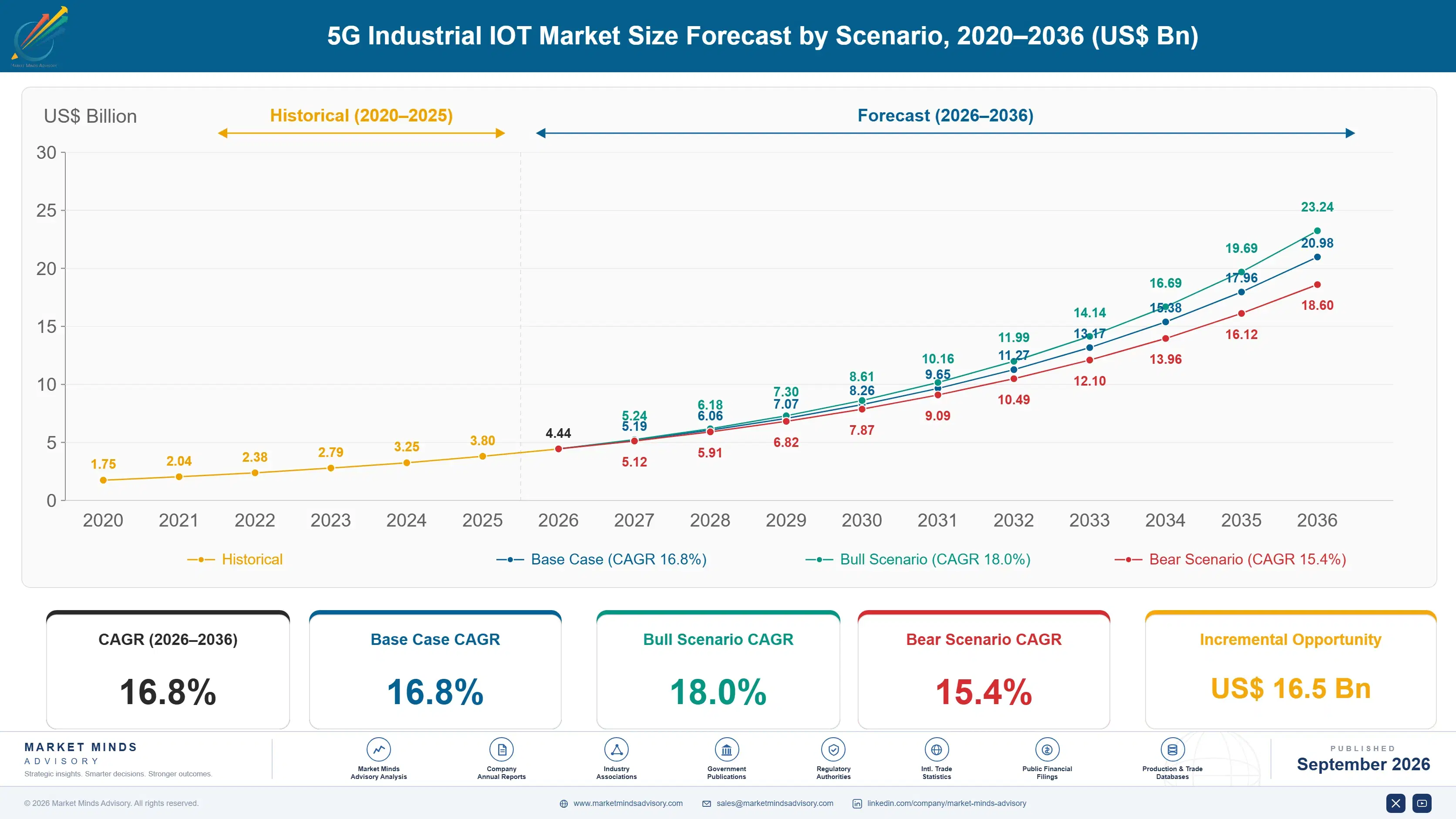
5G Industrial IOT Market Forecast Scenarios

5g-industrial-iot-market-size-forecast-scenario-1789985027991
Between 2020 and 2025 the category compounded at 15.4% from a very small base, which sounds impressive and disguised a decade of disappointment. Deployments concentrated in ports, mines and a handful of large automotive plants where the alternative was genuinely impossible. Everywhere else the honest comparison was against Wi-Fi, which kept winning on cost, familiarity and deployment speed.
The base case holds 16.8% on three mechanisms. Reduced capability devices cut module cost to around USD 22, which is the first time the device side approaches what a factory will fit at scale. Local spectrum licensing has spread beyond Germany to a dozen more countries, so an enterprise can hold its own spectrum without negotiating with a carrier. And Chinese deployment volume under the national industrial internet programme continues at a scale that pulls the equipment supply base along.
The bull case at 18.0% assumes deterministic networking finally displaces wired industrial ethernet on production lines rather than merely supplementing wireless elsewhere. The bear case at 15.4% is Wi-Fi 7 closing the capability gap enough that the deterministic argument stops carrying deployments, which would leave private 5G confined to ports, mines and the handful of sites where nothing else physically works.

Why Factories Kept Choosing Wi-Fi

The technical case for private 5G has always been sound and mostly irrelevant. Deterministic latency around 4 milliseconds, guaranteed capacity, immunity to interference from the microwave in the canteen, and handover across a large site without dropping a session are all genuine advantages. The problem is that most factory applications do not need any of them, and Wi-Fi costs a fraction as much.
TOP FIVE CONCENTRATION58%Concentrated by radio equipment supply and integration capability
DETERMINISTIC LATENCY ACHIEVED4 millisecondsRound trip on a properly configured private industrial network
DEPLOYMENT LEAD TIME11 monthsSite survey to production traffic on typical factory installations
REDCAP MODULE PRICEUSD 22Reduced capability device cost against full industrial modules
LOCAL SPECTRUM LICENCES ISSUED4800 licencesGranted under national frameworks allowing enterprise held spectrum
DEPLOYMENT COST PER SITEUSD 340000Blended capital outlay across radio, core and integration
Where private 5G does win, it wins completely. Ports moving containers across several square kilometres, mines operating underground vehicles, and large automotive plants running automated guided vehicles across multiple buildings all have a mobility and coverage problem that Wi-Fi genuinely cannot solve. Those deployments are large, expensive and permanent. There are simply not very many of them, which is the whole commercial history of this market so far.
Device cost is what changed. A full industrial 5G module cost enough that fitting a thousand sensors was never seriously considered, so private networks connected vehicles and cameras rather than everything. Reduced capability devices at around USD 22 put the module within argument of a Wi-Fi radio for the first time. That is a different market from the one this industry has been selling into.
"Every private 5G business case I have read compares the technology against wired ethernet, because that comparison is winnable. The customer compares it against the Wi-Fi they already have, which is a conversation most vendors would rather not start."
Director, Industrial Connectivity and Automation Networks Practice · MMA Technology Practice · September 2026

Market Trends

Reduced Capability Devices Finally Make Sensor Volumes Affordable

A full industrial 5G module carried enough silicon and enough power draw that nobody seriously proposed fitting a thousand of them to sensors, so private networks connected vehicles, cameras and handhelds and left everything else on Wi-Fi or wires. Reduced capability devices strip the radio down to what an industrial sensor actually needs and bring module cost to around USD 22. That is the first time the device economics approach a Wi-Fi radio rather than sitting an order of magnitude above it. RedCap devices compound at 25.2% against 16.8% for the market on that single change.
Market Impact: Sites cost USD 340000 each
Local Spectrum Licensing Removed The Carrier Middleman

Germany opened 3.7 to 3.8 gigahertz to local enterprise licences in 2019 and issued more of them than anybody expected, and roughly a dozen countries have since built comparable frameworks. That matters because it lets a manufacturer hold its own spectrum, run its own network and answer to nobody about coverage or capacity, rather than negotiating a slice of a carrier network on carrier terms. Roughly 4800 local licences have now been granted worldwide. Enterprises consistently prefer this arrangement and carriers consistently dislike it, which tells you most of what you need to know.
Market Impact: China grows at 21.6% annually

Market Opportunities and Growth Drivers

Ports And Mines Have No Wireless Alternative

A container terminal covering several square kilometres with metal stacked in moving walls, or an underground mine with vehicles operating kilometres from any fixed point, presents a coverage and mobility problem that Wi-Fi cannot address at any budget. These sites deploy private 5G because nothing else works, not because anybody compared business cases. The deployments are large, permanent and expensive, running around USD 340000 per site in capital before integration. They are also the reference customers every vendor cites, which slightly misrepresents how broadly the technology has actually been adopted.
Market Impact: Wi-Fi runs at 20% of cost

Chinese Industrial Programme Deploys At Uncontested Scale

China has more private 5G deployments in industrial settings than the rest of the world combined, built under a national programme that treats factory connectivity as infrastructure policy rather than as a procurement decision each plant makes independently. Steel, mining, ports and electronics assembly account for most of it, with Chinese carriers and equipment vendors delivering as a package. China grows at 21.6%, faster than any other country in this market. Western vendors have almost no access to that volume, which distorts every global comparison of deployment counts and unit economics alike.
Market Impact: Lead times reach 11 months

Market Restraints and Challenges

Wi-Fi Remains Adequate And Considerably Cheaper

Most industrial applications need reliable wireless coverage inside a building, which Wi-Fi has delivered adequately for twenty years at a fraction of the cost and with staff who already know how to run it. The root cause is that private 5G solves determinism, mobility and interference immunity, and most factory floors do not have severe problems with any of the three. Commercially this confines adoption to a narrow set of genuinely hard sites. Mitigation runs through deterministic applications and through RedCap device pricing, and Wi-Fi 7 is closing part of the gap anyway.
Market Impact: Module cost falls to USD 22

Deployment Requires Skills Enterprises Do Not Have

Running a cellular network requires radio planning, core configuration, SIM management and spectrum compliance, none of which exists inside a typical manufacturing organisation and all of which a network engineer who has run Wi-Fi for a decade will not simply pick up. The root cause is that carrier technology arrived in enterprises without the carrier operations staff who normally run it. Commercially this stretches deployment lead times to about 11 months and pushes buyers toward managed services they did not want. Mitigation runs through simplified integrated products that several specialists have built specifically around this problem.
Market Impact: Roughly 4800 licences now granted
3 additional market trends, 4 additional growth drivers, and 2 additional restraints and challenges are covered in the full report. Contact sales@marketmindsadvisory.com to access the complete intelligence.

Segment CAGR and Growth Architecture

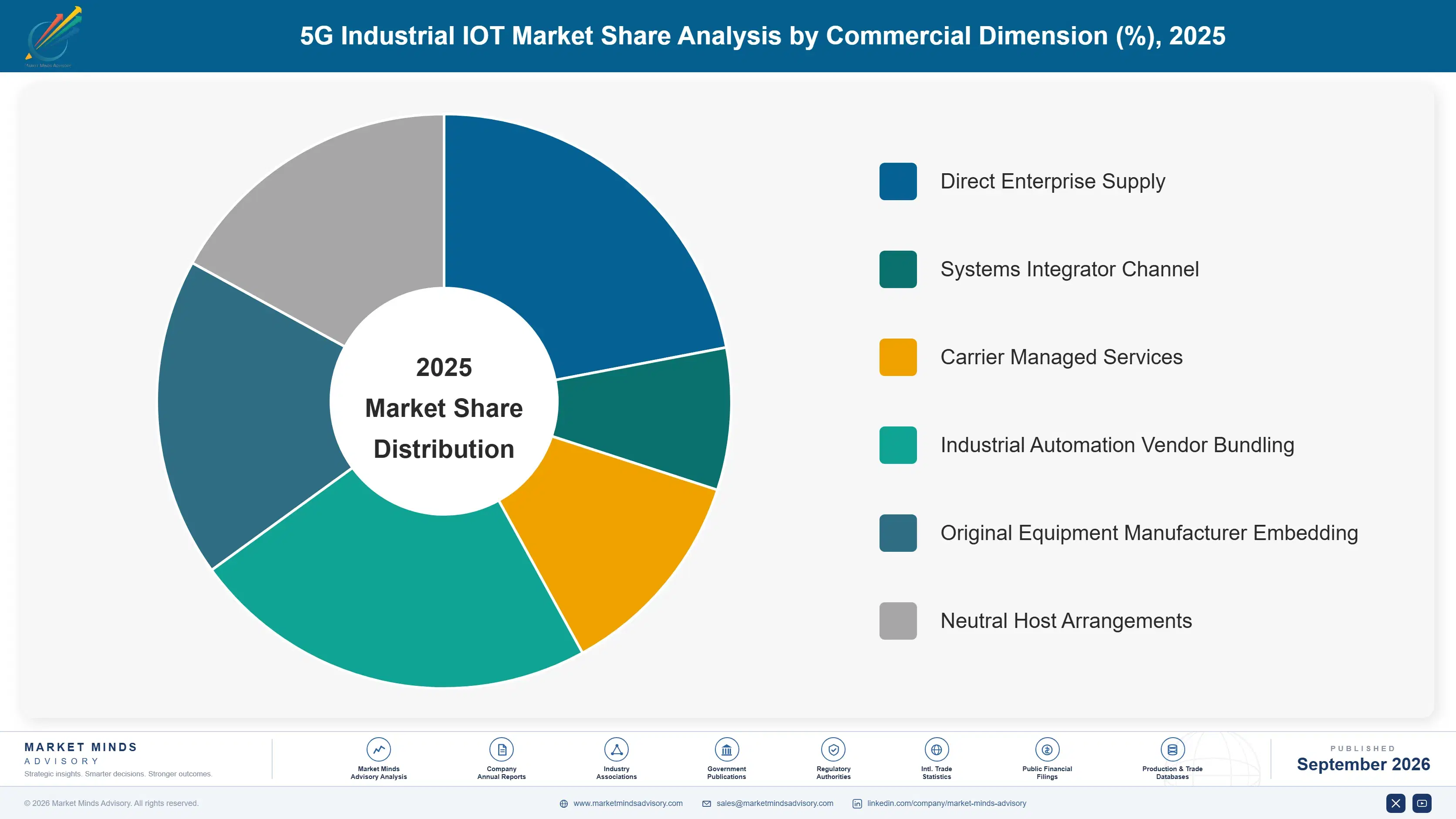
Segmentation follows deployment element, since each part is bought at a different time, by a different function and against a different alternative. Six elements cover the market: reduced capability devices, industrial edge integration platforms, network slicing and managed connectivity, industrial modules and gateways, private core and radio infrastructure, and deterministic networking services. End-use industry and spectrum model are separate dimensions.
5g-industrial-iot-market-market-share-analysis-1789985028591

RedCap and Reduced Capability Devices

Reduced capability devices grow at 25.2%, half again the market rate of 16.8%, and they are the first genuinely new commercial argument this market has had. A full industrial 5G module carried enough silicon and power draw that nobody proposed fitting a thousand to sensors, so private networks connected vehicles, cameras and handhelds while everything else stayed on Wi-Fi. RedCap strips the radio to what an industrial sensor actually needs and brings module cost to around USD 22, which is within argument of a Wi-Fi radio rather than an order of magnitude above it. Whether that converts into deployments depends on applications nobody has built yet, and the module vendors know it.
CAGR 25.2%

Industrial Edge Integration Platforms

Industrial edge integration platforms grow at 20.4% and address the problem that stops most private network projects after the radio works. A factory that installs a network then discovers its machine controllers, historians, quality systems and enterprise software do not speak to it, and the integration effort dwarfs the connectivity investment that started the project. Platforms handling protocol translation, data modelling and application hosting at the edge turn a connectivity deployment into something that produces a measurable result. Siemens and the industrial automation vendors hold a genuine advantage here that no carrier equipment supplier has been able to answer with a partnership. Several have tried and none has succeeded convincingly.
CAGR 20.4%
Full segment breakdown across 6 segments available in the complete report.

Regional Architecture and Country Demand Map

East Asia leads at 36%, far above the standard band, because China has more industrial private 5G deployments than the rest of the world combined under a national programme. Latin America falls below its band on a thin industrial deployment base. Germany drives most of Western Europe.

East Asia

East Asia holds 36% of spending, well above the 30% band ceiling, and Chinese deployment volume is the whole explanation. China has more industrial private 5G installations than the rest of the world combined, built under a national programme that treats factory connectivity as infrastructure policy rather than as a decision each plant makes for itself. Steel, mining, ports and electronics assembly carry most of it, delivered as a package by Chinese carriers and equipment vendors together. China grows at 21.6%, faster than any other country here. Japanese and Korean deployments are fewer and more sophisticated, concentrated in automotive and semiconductor plants with genuinely deterministic requirements. Western vendors reach almost none of it.
Share: 36% | CAGR: 18.0% (2026 to 2036)

Western Europe

German spectrum policy shaped Western Europe's 22% more than any commercial factor did. Opening 3.7 to 3.8 gigahertz to local enterprise licences in 2019 let manufacturers hold their own spectrum, run their own networks and answer to nobody about coverage, and German industry took up more of those licences than anybody had forecast. Automotive plants, chemical sites and logistics operators account for most deployments. Nordic, Dutch and British frameworks followed on comparable principles. Growth at 15.2% is the slowest of any region because the early adopters here moved first and the followers are still comparing against Wi-Fi. What Germany permits tends to become the European template, and then the template everywhere else.
Share: 22% | CAGR: 15.2% (2026 to 2036)
Regional intelligence for 5 additional markets available in the complete report: North America, South Asia and Pacific, Latin America, Middle East and Africa, Eastern Europe. Contact sales@marketmindsadvisory.com.
5g-industrial-iot-market-country-cagr-analysis-1789985029118

How To Beat The Wi-Fi Comparison

Every private 5G sale runs into the same question eventually: what does this do that the Wi-Fi already installed does not. A vendor who cannot answer it in one sentence loses. The four levers below are the four answers that have actually worked, and none of them is about network performance, which surprises most engineers.

Chase Sites Where Nothing Else Physically Works

A container terminal covering several square kilometres, an underground mine with vehicles kilometres from any fixed point, or a refinery with hazardous area constraints all present coverage problems Wi-Fi cannot solve at any budget. Those customers do not compare business cases, they compare what functions. Deployments run around USD 340000 per site in capital before integration and nobody argues about it, because the alternative is not deploying at all. The addressable count is small and the conversion rate approaches certainty, which is an unusually good place for a sales organisation to spend its time.
Market Impact: Sites at USD 340000 convert almost every time

Sell Integration, Because Radios Are Not The Problem

A factory that installs a private network then discovers its machine controllers, historians, quality systems and enterprise software do not speak to it, and the integration effort dwarfs the connectivity investment that started the project. That is where deployments stall and where a customer decides the whole thing was a mistake. Industrial edge integration platforms compound at 20.4% against 16.8% for the market because they address the part that actually stops projects. Siemens and the automation vendors hold real advantage here, and every carrier equipment supplier has tried to answer it with a partnership rather than a product.
Market Impact: Integration platforms compound at 20.4% against 16.8% overall

Design Products For People Who Run Wi-Fi

Running a cellular network requires radio planning, core configuration, SIM management and spectrum compliance, and none of that exists inside a manufacturing organisation. Deployment lead times stretch to about 11 months largely because of it, and buyers get pushed toward managed services they did not want and do not trust. Products built so that a network engineer who has run Wi-Fi for a decade can deploy them without cellular training compress that timeline dramatically. Celona and several specialists built exactly this, which is why enterprises keep choosing them over vendors with better radios.
Market Impact: Cuts the 11 month deployment lead time sharply

Push Local Spectrum Licensing In Every Market

Germany opened 3.7 to 3.8 gigahertz to local enterprise licences in 2019 and roughly 4800 local licences have now been granted worldwide across a dozen or so comparable frameworks. Enterprises overwhelmingly prefer holding their own spectrum to negotiating a slice of a carrier network on carrier terms, and adoption is measurably higher where they can. An equipment vendor benefits from that arrangement and a carrier does not, which is why lobbying positions on this question predict business models exactly. Every market that opens local licensing becomes addressable in a way it was not.
Market Impact: Roughly 4800 local licences have been granted already

Who Controls the Margin Pool

Five suppliers hold 58% of private network equipment and service revenue, concentrated because radio supply and integration capability sit with very few vendors. Ericsson and Nokia lead on carrier-derived equipment sold into enterprises. Huawei and ZTE dominate Chinese deployment volume that Western vendors cannot reach. Siemens leads on industrial credibility rather than radio capability. The gap between first and fifth is wide. All participants are assessed on equipment and service contract revenue.
Competition runs on deployment simplicity rather than radio performance, which carrier vendors took years to accept. An enterprise choosing between suppliers is choosing which one its existing network team can actually operate, and Celona, Betacom and a handful of specialists built products around precisely that. The industrial automation vendors compete on integration with machinery, which is a different argument entirely and frequently decisive.

Rankings shift where device economics change the addressable application set. RedCap module pricing brings sensor volumes into scope for the first time, and the module vendors positioned for that are not the ones holding infrastructure share. The other pressure is geographic: Chinese deployment volume dwarfs everything else and is served almost entirely by domestic suppliers, which caps how large a Western vendor grows.
5g-industrial-iot-market-company-positioning-matrix-1789985029648

Competitive Moat and Risk Dimensions

ERICSSON

Moat: Carrier Grade Radio Capability

Ericsson brings radio engineering refined across decades of carrier deployment, which matters at the sites where private 5G genuinely wins: ports, mines and large plants where coverage and mobility are the actual problem. Its equipment performs where a simplified enterprise product does not. That capability is expensive to build and effectively impossible to shortcut.
ERICSSON

Risk: Enterprise Deployment Complexity

Carrier-derived products assume carrier operations staff, and a manufacturing network team that has run Wi-Fi for a decade does not have those skills. Deployment lead times stretch to around 11 months partly because of it. Specialists selling simpler products keep winning deals against better radios, because the customer is choosing what it can actually operate afterwards.
SIEMENS

Moat: Industrial Integration Credibility

Siemens already supplies the controllers, drives and automation software the network is supposed to connect, which puts it inside the integration problem that stalls most private network projects after the radio works. A carrier equipment vendor has to partner for that capability and the partnership rarely survives a difficult commissioning. Industrial edge platforms compound at 20.4% on exactly this argument.
SIEMENS

Risk: Radio Capability Dependence

Siemens does not build carrier-grade radio equipment and depends on partners for it, which is a weakness at exactly the sites where private 5G is most defensible against Wi-Fi. Ports, mines and large-area deployments are decided on radio performance rather than on integration. The company leads where the technology is least differentiated and follows where it matters most.

Players Tracked

Prominent Players

Ericsson
Nokia
Huawei
ZTE
Siemens

Other Key Players

Cisco Systems
Samsung Networks
NEC Corporation
Fujitsu
Celona
Betacom
Airspan Networks
Mavenir
Quectel Wireless Solutions
Telit Cinterion
Fibocom
Robert Bosch
Deutsche Telekom
Verizon Business
NTT

Recent Developments

FEBRUARY 2025

Nokia Extends Private Wireless Range Toward Reduced Capability Devices

Nokia extended its private wireless portfolio with support for reduced capability devices, an organic product development rather than an acquisition. The work targets sensor deployments that full industrial modules priced out of consideration, and it reflects a device cost decline that changes which applications a private network can economically connect.
Signal: Device pricing rather than network capability now decides which applications a private network can actually reach.
AUGUST 2024

Siemens Expands Industrial Edge Platform For Private Networks

Siemens expanded its industrial edge platform with deeper private network integration, an organic product development rather than a partnership or acquisition. The work addresses the protocol translation, data modelling and application hosting that stalls most private network projects once the radio itself is working correctly.
Signal: The radio has never been the hard part, and the automation vendors understood that long before anybody else.
JUNE 2025

Celona Extends Enterprise Deployment Tooling For Network Teams

Celona extended its deployment and management tooling so that enterprise network teams without cellular training can commission and operate private networks, an organic product development rather than a transaction. The approach targets the skills gap that stretches deployment lead times and pushes buyers toward managed services they generally distrust.
Signal: Enterprises choose the product they can operate themselves over the one with the better radio performance.

What A Private Network Costs

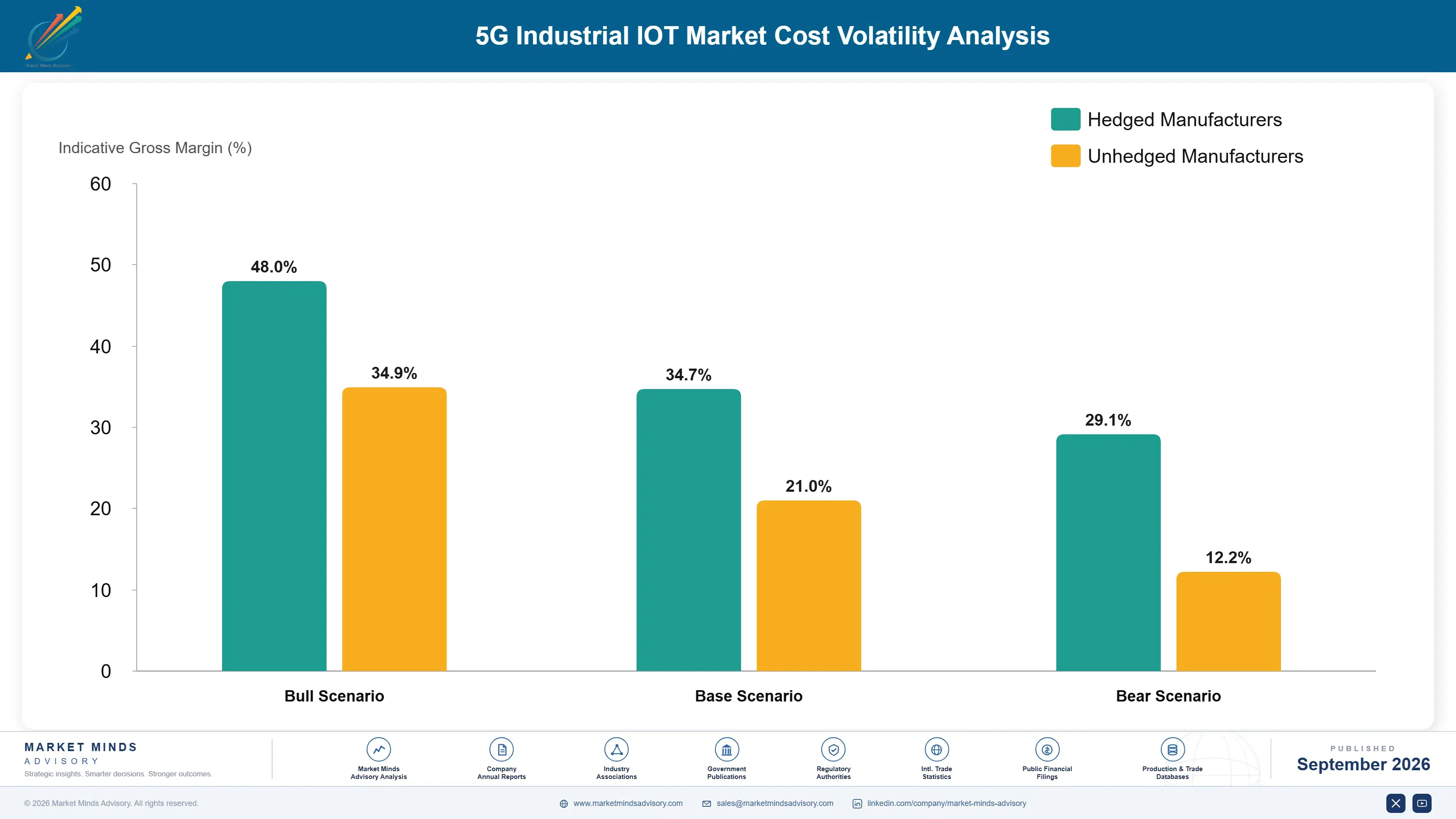
Radio equipment and antennas account for roughly 32% of deployment cost, supplied by a small group of vendors with carrier heritage. Integration and commissioning labour adds about 27%, drawn from systems integrators rather than from the customer. Core network software and licensing carry around 18%, and devices, modules and spectrum fees make up the balance.
Ericsson Annual Report 2024 records component costs and integration services delivery as the dominant variables across its enterprise wireless business. Nokia Annual Report 2024 notes comparable pressure with a heavier weighting toward software and licensing. Specialist integration labour became genuinely scarce through 2023 and 2024 because enterprises deploying private networks competed for the same small pool of engineers who understand both cellular and industrial systems, and rates rose accordingly across every region.

The competitive disadvantage mechanism is integration labour rather than equipment pricing. A vendor whose product a customer's existing network team can commission avoids most of a cost line running 27% of deployment, while one requiring specialist cellular engineers carries it on every site. That difference decides project economics more than any radio specification does, and it varies by vendor rather than by geography. Simplicity is worth more here than performance.
5g-industrial-iot-market-cost-volatility-analysis-1789985029844

Design Out Specialist Integration Labour Wherever Possible

Integration and commissioning labour runs about 27% of deployment cost and depends on engineers who understand both cellular and industrial systems, a pool that became genuinely scarce through 2023. Products a customer's existing network team can commission remove most of that line entirely. The engineering work is interface simplification rather than radio improvement, which vendors consistently underfund.

Standardise Radio Hardware Across Deployment Size Tiers

Radio equipment and antennas run about 32% of deployment cost and most vendors carry separate hardware lines for small and large sites. Designing a single radio platform that scales by software licence rather than by hardware variant improves purchasing volume and cuts the inventory that fragmentation creates. The constraint is that a large port and a small factory genuinely differ.

Train Industrial Integrators Rather Than Recruiting Cellular Engineers

The scarce skill is somebody who understands both cellular and industrial systems, and carrier recruiting produces engineers who know radio and not machinery. Training existing industrial systems integrators on cellular fundamentals takes months rather than years and produces people who already understand the customer. The constraint is that vendors keep recruiting from the wrong side of the gap.

Portfolio Architecture for Margin Defence

Margin architecture separates on how contestable each element is. Modules and gateways earn least, competed by many suppliers on price with almost no differentiation available. Core and radio infrastructure sit in the middle, protected by carrier engineering heritage but sold into competitive tenders. Edge integration platforms, deterministic services and managed connectivity earn most, because each solves something the customer cannot do internally and each is difficult to compare across vendors.
The volume versus premium tension is really about which customer a vendor is organised for. Ports and mines buy expensive, permanent deployments and pay for radio performance. Factories and warehouses buy on total deployment cost and simplicity, and will choose the product their own team can operate over a better one they cannot. Very few vendors serve both well, because sales motion and product design pull in opposite directions.

High-value pools sit in edge integration and in reduced capability device volume, and they reward completely different capabilities. Integration rewards understanding industrial machinery, which the automation vendors have and the carrier vendors do not. RedCap rewards module manufacturing scale, which sits almost entirely with Chinese and a few European suppliers. Nobody holds both, and nobody appears close to holding both.

Volume / Commodity-Adjacent

Industrial 5G modules and gateways competed by many suppliers on price with almost no differentiation available between them. The eight point spread separates suppliers with module manufacturing scale from those integrating somebody else's silicon.
Gross Margin: 22% to 30%

Premium / Certified

Private network core and radio infrastructure sold on carrier engineering heritage into competitive tenders where performance is genuinely comparable. The ten point spread tracks how much integration work each vendor bundles rather than subcontracts.
Gross Margin: 36% to 46%

Sustainability / Regulatory / Next-Generation

Industrial edge integration platforms, deterministic networking and managed connectivity, each solving something the customer cannot do internally at all. The twelve point spread reflects how much industrial domain capability each vendor genuinely holds rather than partners for.
Gross Margin: 54% to 66%
5g-industrial-iot-market-portfolio-architecture-1789985030348

High-value Sub-segments and Strategic Watch-out

RedCap And Reduced Capability Devices

Grows at 25.2% because module cost falling to around USD 22 brings sensor volumes into scope for the first time. The eight point spread reflects manufacturing scale rather than design capability. Whether it converts into deployments depends on applications nobody has built yet at all.
Gross Margin: 22% to 30%

Industrial Edge Integration Platforms

Grows at 20.4% by addressing the protocol translation and application hosting that stalls most private network projects after the radio works. The twelve point spread reflects genuine industrial domain capability. The automation vendors hold an advantage no partnership has answered convincingly at any point yet.
Gross Margin: 54% to 66%

Private Network Core And Radio Infrastructure

Grows at 13.6% and carries the largest share of deployment spending, on sites where coverage and mobility genuinely defeat every wireless alternative. The ten point spread tracks integration bundling. Ports, mines and large plants decide this segment and there are not many of them anywhere.
Gross Margin: 36% to 46%

Time-Sensitive Networking And Deterministic Services

Grows at 12.4%, slowest of the six elements, because displacing wired industrial ethernet on a production line is the hardest sale in this market. The twelve point spread reflects domain capability. If this ever works at scale the whole category reprices upward very sharply indeed.
Gross Margin: 54% to 66%

How Deployments Actually Get Funded

The annuity is the site rather than the contract. A private network installed at a port or a plant stays for the asset life, typically well over a decade, and the vendor that deployed it supplies expansion, devices and support throughout, because nobody replaces a working network. Deployment lead times of about 11 months make the initial decision heavy and the subsequent ones automatic, which is why vendors fight over first installations.
Adoption depth varies entirely by whether an alternative exists. Ports and mines adopt completely because nothing else works, and they instrument everything once the network is there. Large automotive and semiconductor plants adopt selectively on determinism grounds. General manufacturing adopts one production cell as a pilot and frequently stops there. Warehousing adopts on coverage economics and switches back if Wi-Fi improves enough.

The buyer moved from an innovation function to operations, which made the sale harder rather than easier. An innovation team funded pilots and enjoyed the technology. An operations manager funds things that reduce a cost they are measured on, asks what happens when it breaks at three in the morning, and compares everything against the Wi-Fi already installed. Very few vendors have adjusted to that person.
5g-industrial-iot-market-end-use-penetration-index-1789985030838

Where This Technology Actually Wins

These are among the four positions where our research anticipates prominent divergence between winners and laggards over the coming forecast period. Each is grounded in the demand model, the regulatory perimeter, and the announced capacity pipeline.
01 / HARD SITE TARGETING

Sell Where Wi-Fi Physically Cannot Reach

A container terminal covering several square kilometres, an underground mine with vehicles far from any fixed point, or a refinery with hazardous area constraints all present coverage problems that Wi-Fi cannot solve at any budget. Those customers do not compare business cases, they compare what functions, and deployments running around USD 340000 per site in capital get approved without argument because the alternative is not deploying at all. The addressable count is small and the conversion rate approaches certainty, which makes it an unusually good place to spend time.
02 / INTEGRATION CAPABILITY PRIORITY

Buy Industrial Domain Knowledge, Not Radios

A factory that installs a private network then discovers its machine controllers, historians, quality systems and enterprise software do not speak to it, and the integration effort dwarfs the connectivity investment entirely. That is where deployments stall and where a customer concludes the whole project was a mistake, which is why industrial edge integration platforms compound at 20.4% against 16.8% for the market. Siemens and the automation vendors hold genuine advantage here, and every carrier supplier has tried to answer it with a partnership rather than a product.
03 / DEPLOYMENT SIMPLICITY DESIGN

Build For Teams Who Only Know Wi-Fi

Running a cellular network requires radio planning, core configuration, SIM management and spectrum compliance, and none of that capability exists inside a typical manufacturing organisation. Deployment lead times stretch to about 11 months largely because of it, and buyers get pushed toward managed services they did not want and do not particularly trust. Products a network engineer who has run Wi-Fi for a decade can commission without cellular training compress that timeline dramatically, which is exactly why enterprises keep choosing specialists over vendors with measurably better radios.
04 / SPECTRUM POLICY ADVOCACY

Lobby For Local Licensing In Every Market

Germany opened 3.7 to 3.8 gigahertz to local enterprise licences in 2019 and roughly 4800 local licences have now been granted worldwide across a dozen or so comparable frameworks. Enterprises overwhelmingly prefer holding their own spectrum to negotiating a slice of a carrier network on carrier terms, and measured adoption is higher wherever they can. An equipment vendor benefits from that arrangement and a carrier does not, which is why lobbying positions on this question predict business models exactly, and every market that opens local licensing becomes addressable.

Engagement Snapshot From the Field

A live engagement with an industry participant carrying material or product regulatory and market exposure ahead of a defining policy shift, showing how our research translates into a defensible multi-year portfolio strategy.
MARKET MINDS ADVISORY · CLIENT ENGAGEMENT SUMMARY
5G Industrial IOT Producer Strategic Portfolio Review and Transition Roadmap 2026·Investment Scenario on 5G Industrial IOT Exposure Evaluation 2025-26
CLIENT PROFILE
A European automotive manufacturer operating eleven plants across four countries, with one private 5G deployment running at a German site under a local spectrum licence. Group engineering wanted to extend the approach across the estate and finance wanted evidence that the German site had produced anything the existing Wi-Fi could not have delivered. Nobody had measured it properly.
STRATEGIC CHALLENGE
Engineering pointed at deterministic latency and coverage and finance pointed at a capital line running several hundred thousand per site. Both were right and neither had modelled which applications at which plants genuinely needed the capability. A rollout decision covering ten remaining sites was scheduled for the following quarter with no analysis behind it whatever.
MMA APPROACH
MMA catalogued every wireless application at all eleven plants and tested each against what Wi-Fi could actually deliver, separating genuine determinism and mobility requirements from preferences. We modelled deployment cost including integration labour by site rather than by list price, and drew on 47 expert interviews conducted in Q4 2025 with equipment vendors, integrators and comparable manufacturers running estates of similar scale.
KEY FINDINGS
  1. Only 3 of the 11 plants had applications that genuinely required private 5G rather than merely benefiting from it (client-reported, unverified by MMA).
  2. Integration labour accounted for a larger share of the German deployment cost than the radio equipment did, which the original business case had reversed entirely.
  3. The German site's measurable benefit came almost entirely from automated guided vehicle handover across buildings, an application only 3 plants actually run.
  4. Local spectrum licences were available in 2 of the 4 countries and unavailable in the others, which would have forced carrier arrangements the client had not budgeted for.
CLIENT PROFILE
A European automotive manufacturer operating eleven plants across four countries, with one private 5G deployment running at a German site under a local spectrum licence. Group engineering wanted to extend the approach across the estate and finance wanted evidence that the German site had produced anything the existing Wi-Fi could not have delivered. Nobody had measured it properly.
STRATEGIC CHALLENGE
Engineering pointed at deterministic latency and coverage and finance pointed at a capital line running several hundred thousand per site. Both were right and neither had modelled which applications at which plants genuinely needed the capability. A rollout decision covering ten remaining sites was scheduled for the following quarter with no analysis behind it whatever.
MMA APPROACH
MMA catalogued every wireless application at all eleven plants and tested each against what Wi-Fi could actually deliver, separating genuine determinism and mobility requirements from preferences. We modelled deployment cost including integration labour by site rather than by list price, and drew on 47 expert interviews conducted in Q4 2025 with equipment vendors, integrators and comparable manufacturers running estates of similar scale.
KEY FINDINGS
  1. Only 3 of the 11 plants had applications that genuinely required private 5G rather than merely benefiting from it (client-reported, unverified by MMA).
  2. Integration labour accounted for a larger share of the German deployment cost than the radio equipment did, which the original business case had reversed entirely.
  3. The German site's measurable benefit came almost entirely from automated guided vehicle handover across buildings, an application only 3 plants actually run.
  4. Local spectrum licences were available in 2 of the 4 countries and unavailable in the others, which would have forced carrier arrangements the client had not budgeted for.
RECOMMENDED STRATEGY
Phase 1: Phase one: deploy private networks at the 3 plants with genuine automated vehicle handover requirements and leave the remaining eight on Wi-Fi. Phase 2: Phase two: select on deployment simplicity rather than radio specification, since integration labour exceeded equipment cost at the reference site. Phase 3: Phase three: revisit the remaining plants only when RedCap device pricing makes sensor connectivity economic, rather than on any schedule set now.
OUTCOME
The manufacturer deployed at three plants rather than eleven and selected on deployment simplicity over radio specification (client-reported, unverified by MMA). Capital spending came in well below the original rollout proposal and the three deployments commissioned faster than the German reference site had. Application requirement testing now precedes every network decision the group makes.

Frequently Asked Questions

Foundational context covering the market sizes, CAGR, scope, country, region and competition that inform every finding below. This section is provided to cover basics and most often pre-purchase conversations, answered from the MMA Primary Research Dataset.

What is the current size of the 5G Industrial IOT Market?

Global value reaches USD 4.44 billion in 2026, measured as private network equipment and service contract revenue worldwide. The 2025 base is USD 3.8 billion.

How large will the 5G Industrial IOT Market be by 2036?

Equipment and service contract revenue reaches USD 20.97 billion by 2036, an increase of USD 16.53 billion over the forecast period. That represents 4.72 times expansion from 2026.

What is the CAGR for the 5G Industrial IOT Market 2026 to 2036?

The base case runs at 16.8% annually, with a bull case at 18.0% if deterministic networking displaces wired industrial ethernet and a bear case at 15.4% if Wi-Fi 7 closes the capability gap.

Which segment is growing fastest?

RedCap and reduced capability devices grow at 25.2%, half again the market rate of 16.8%. Module cost falling to around USD 22 brings sensor volumes into scope for the first time.

Who are the major companies in the 5G Industrial IOT Market?

Ericsson, Nokia, Huawei, ZTE and Siemens lead on private network equipment and service contract revenue, together holding 58%. Celona, Betacom, Cisco and Samsung Networks hold smaller positions.

Which country is growing fastest?

China leads at 21.6%, with more industrial private 5G deployments than the rest of the world combined under a national programme. India and Australia follow some way behind.

Report Segmentation Architecture

The full report scope spans multiple orthogonal segmentation dimensions, with cross-tabulated demand data provided for each dimension pair. Coverage extends further to regional breakdowns, trend trajectories, and the competitive detail needed to support segment-level decision-making.

By Deployment Element

  • RedCap And Reduced Capability Devices
  • Industrial Edge Integration Platforms
  • Network Slicing And Managed Connectivity
  • Industrial 5G Modules And Gateways
  • Private Network Core And Radio Infrastructure
  • Time-Sensitive Networking And Deterministic Services

By End-Use Industry

  • Automotive Manufacturing
  • Mining And Resources
  • Ports And Logistics
  • Oil Gas And Chemicals
  • Electronics And Semiconductor Plants
  • Utilities And Power Generation

By Commercial Dimension

  • Direct Enterprise Supply
  • Systems Integrator Channel
  • Carrier Managed Services
  • Industrial Automation Vendor Bundling
  • Original Equipment Manufacturer Embedding
  • Neutral Host Arrangements

By Region

  • North America
  • Western Europe
  • East Asia
  • South Asia and Pacific
  • Latin America
  • Middle East and Africa
  • Eastern Europe

Scope, Methodology, and Coverage

Every figure in this report is reproducible from documented input assumptions. The scope below maps the historical period, the forecast horizon, the segmentation dimensions, and the countries covered, alongside the underlying primary and qualitative methodology.
Historical Period
2020 to 2025
Forecast Period
2026 to 2036
Base Year
2025 (USD billions; MMA Primary Research Dataset, September 2026)
Market Definition
This report covers private and industrial 5G network deployments in enterprise settings: private network core and radio infrastructure, industrial 5G modules and gateways, reduced capability devices, network slicing and managed connectivity services, industrial edge integration platforms, and deterministic networking services. It excludes public mobile network infrastructure and consumer subscriptions, Wi-Fi and wired industrial networking, the sensors and machinery these networks connect, and industrial software applications running above them.
Quantitative Units
USD millions, equipment and service contract revenue basis; deployed sites; round trip latency in milliseconds; deployment lead time in months; module price and site capital cost in USD.
Segmentation Dimensions
Deployment element; end-use industry; commercial channel; geography across seven regions.
Regions Covered
North America, Western Europe, East Asia, South Asia and Pacific, Latin America, Middle East and Africa, Eastern Europe
Countries Covered
China, Japan, South Korea, Taiwan, India, Australia, Singapore, United States, Canada, Mexico, Brazil, Chile, Germany, Netherlands, Sweden, United Kingdom, Czechia, Poland, Saudi Arabia, United Arab Emirates.
Key Companies Profiled
Ericsson, Nokia, Huawei, ZTE, Siemens, Cisco Systems, Samsung Networks, NEC Corporation, Celona, Betacom, Airspan Networks, Mavenir, Quectel Wireless Solutions, Telit Cinterion, Fibocom.
Quantitative Methodology
Primary survey, n=3,800 respondents, Q4 2025, six countries; demand-side model with trade association cross-validation
Qualitative Methodology
47 expert interviews, Q4 2025; applied to validate demand model assumptions, identify emerging dynamics, and assess competitive positioning
Report Format
PDF and XLSX data workbook (Word format preview document)
Publisher
Market Minds Advisory
Report Code
MMA-2026-TEC-381
Published
September 2026
Contact
sales@marketmindsadvisory.com | www.marketmindsadvisory.com

Purchase the full 5G Industrial IOT Market Report (2026 to 2036).

This report sizes the global private and industrial 5G market from 2026 to 2036 across six deployment elements, six end-use industries and seven regions. It sets out honestly why adoption ran a decade behind forecasts, and what reduced capability device pricing at around USD 22 changes about that. Deployment cost composition is sourced to company annual reports, with radio equipment at 32% and integration labour at 27%. Regional analysis explains why East Asia leads at 36% on Chinese deployment volume and how German spectrum policy shaped Europe. Competitive assessment covers 20 named suppliers with four revenue lever analyses and an anonymised automotive rollout engagement.
Wi-Fi comparison modelled honestly by application type
Six deployment elements sized through to 2036
Radio and integration cost composition from filings
Twenty named suppliers assessed on contract revenue
Four revenue levers with quantified commercial impact
Anonymised automotive private network rollout engagement included

Built For The People Who Decide

From boardroom strategy to bench-side execution, this report is read cover-to-cover by leaders shaping the next decade of their industry, turning demand scenarios, market dynamics and valuation benchmarks into decisions.
CXOs/ Presidents/ VPs/ Managers
M&A and Corporate Development
Strategy Teams and R&D Heads
Procurement and Product Directors
Regulatory and Compliance Leaders
Investor Relations and Equity Analysts